Elasticity Of Demand
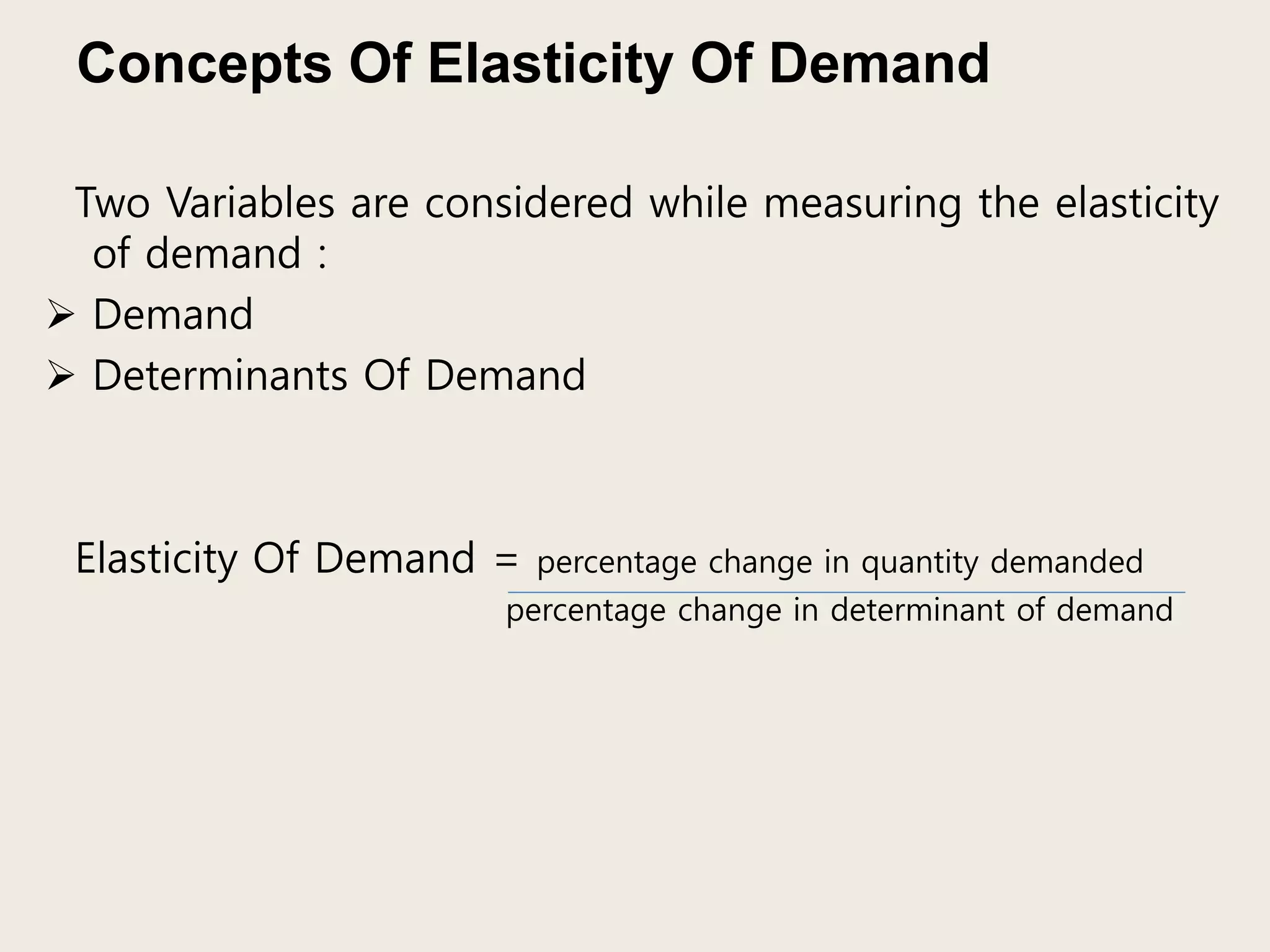
Concepts Of Elasticity Of Demand
Two Variables are considered while measuring the elasticity
of demand :
 Demand
 Determinants Of Demand
Elasticity Of Demand = percentage change in quantity demanded
percentage change in determinant of demand
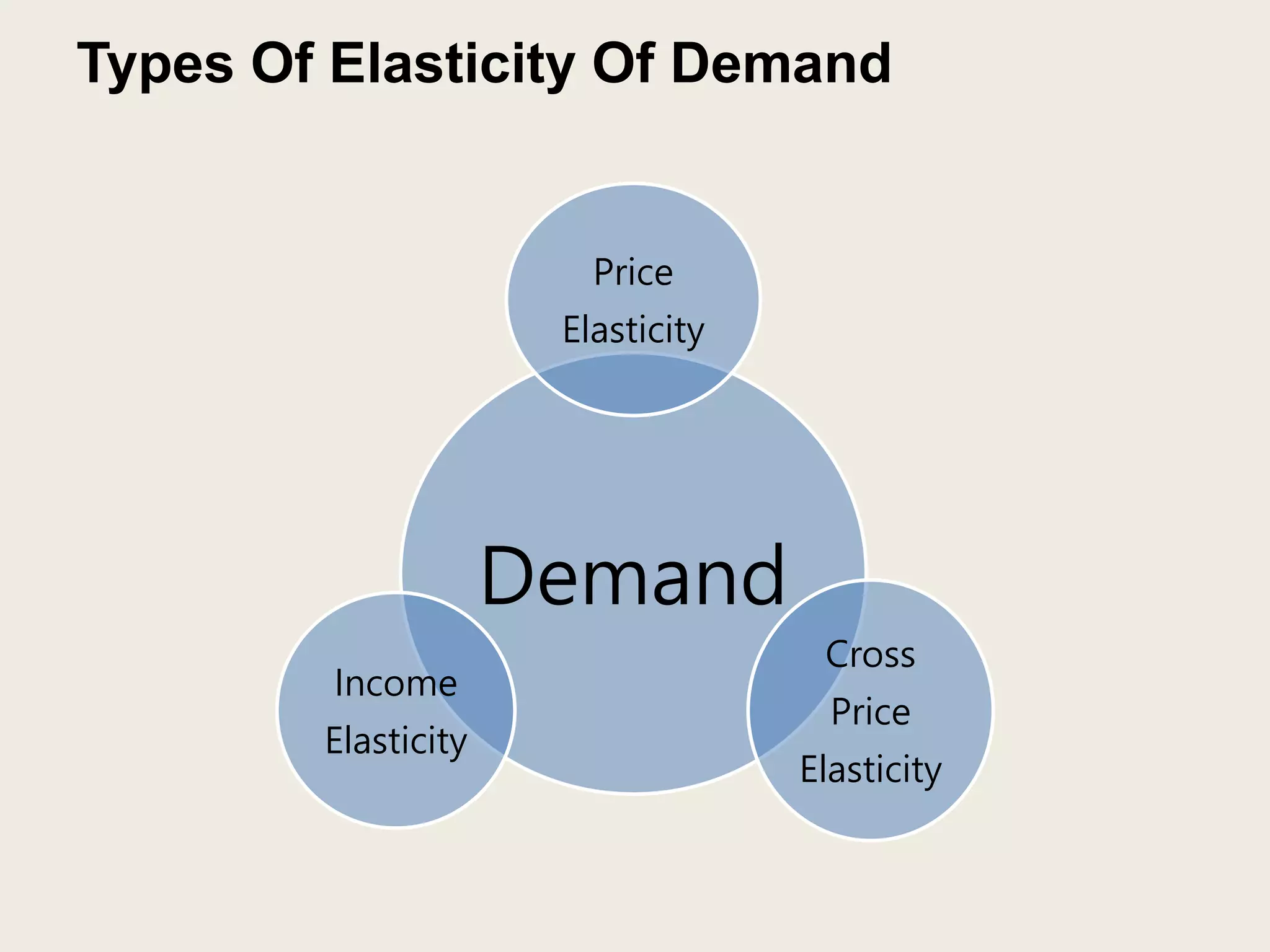
Types Of Elasticity Of Demand
Demand
Price
Elasticity
Cross
Price
Elasticity
Income
Elasticity
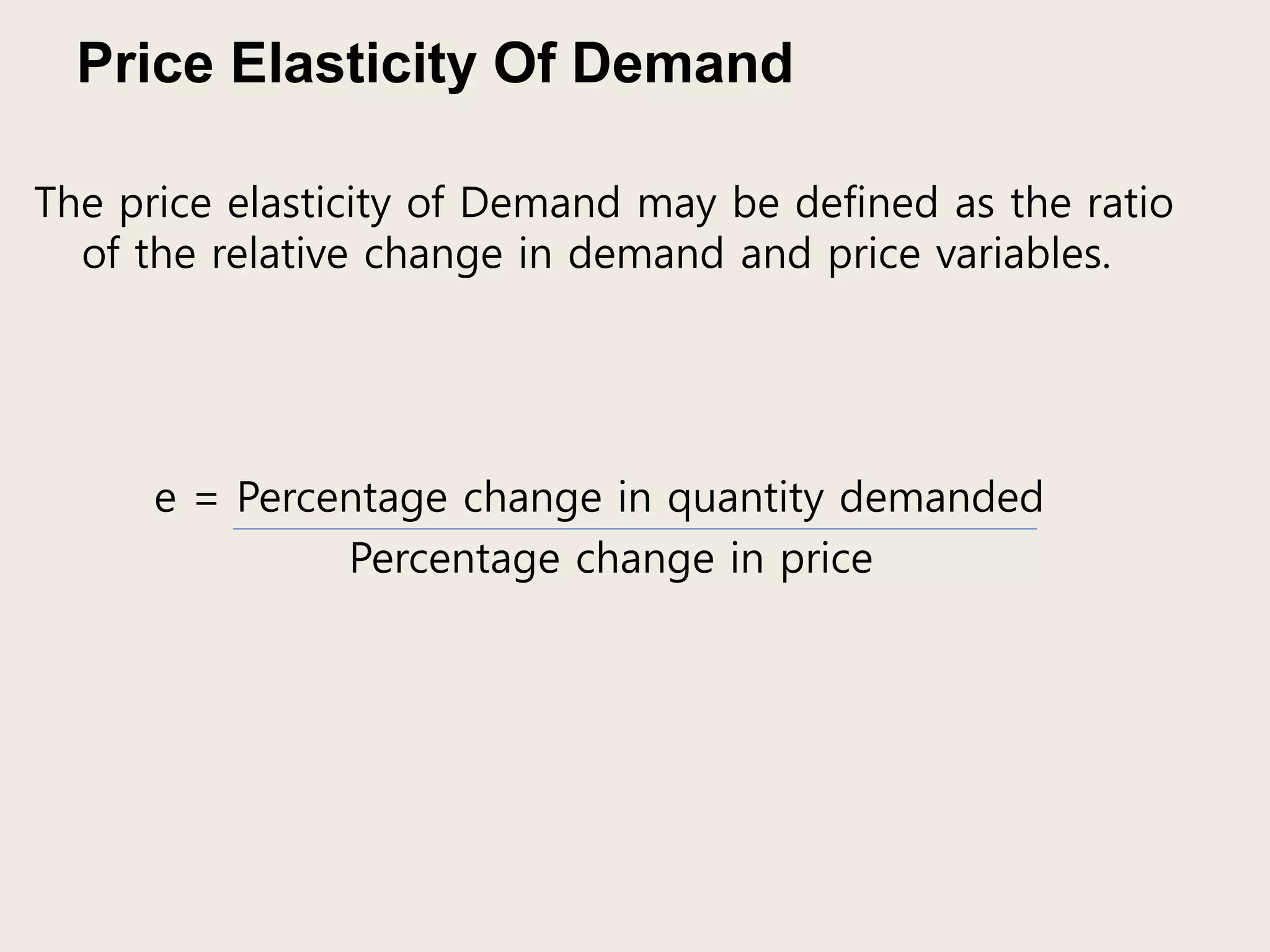
Price Elasticity Of Demand
The price elasticity of Demand may be defined as the ratio
of the relative change in demand and price variables.
e = Percentage change in quantity demanded
Percentage change in price
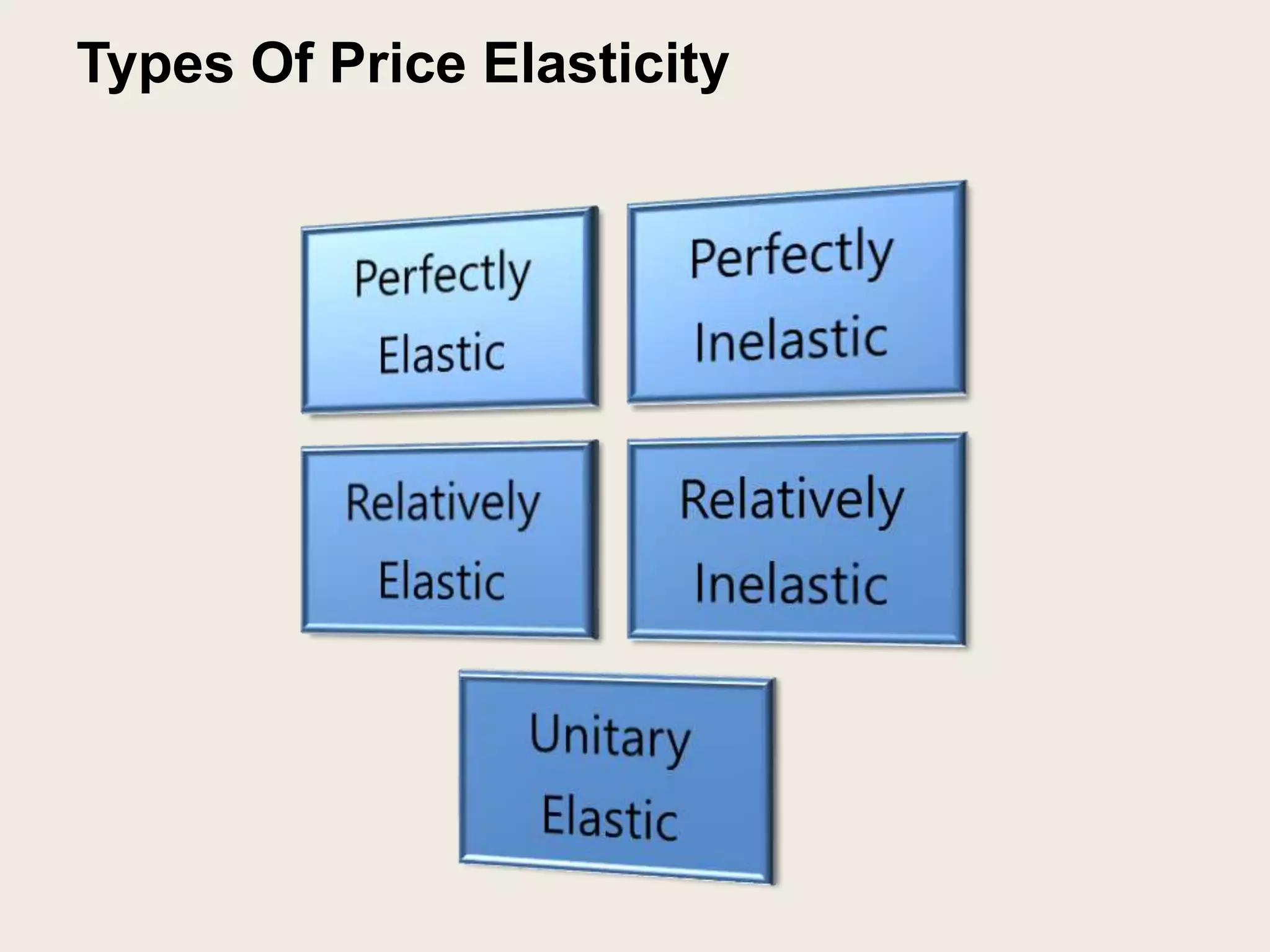
Types Of Price Elasticity
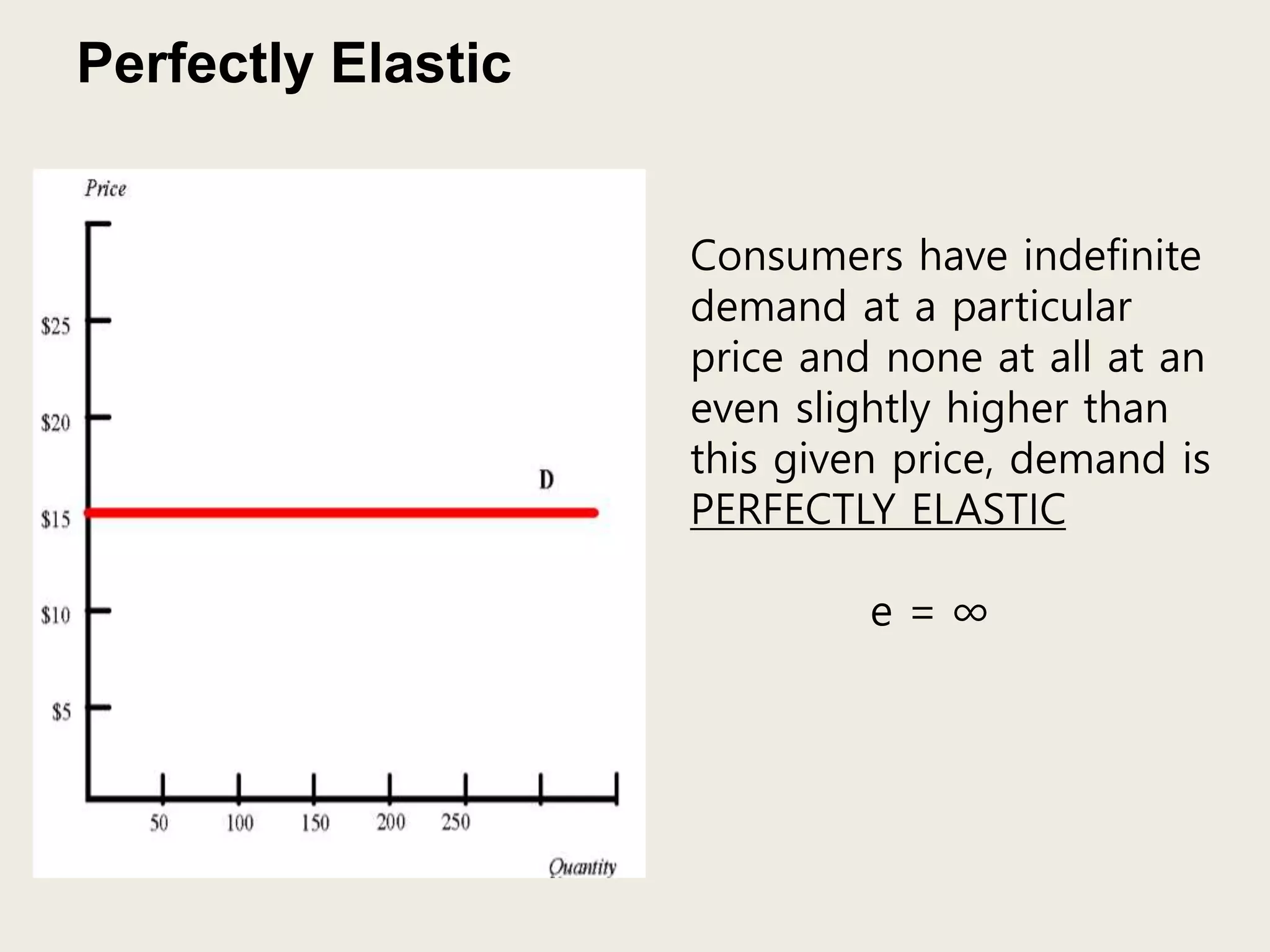
Perfectly Elastic
Consumers have indefinite
demand at a particular
price and none at all at an
even slightly higher than
this given price, demand is
PERFECTLY ELASTIC
e = ∞
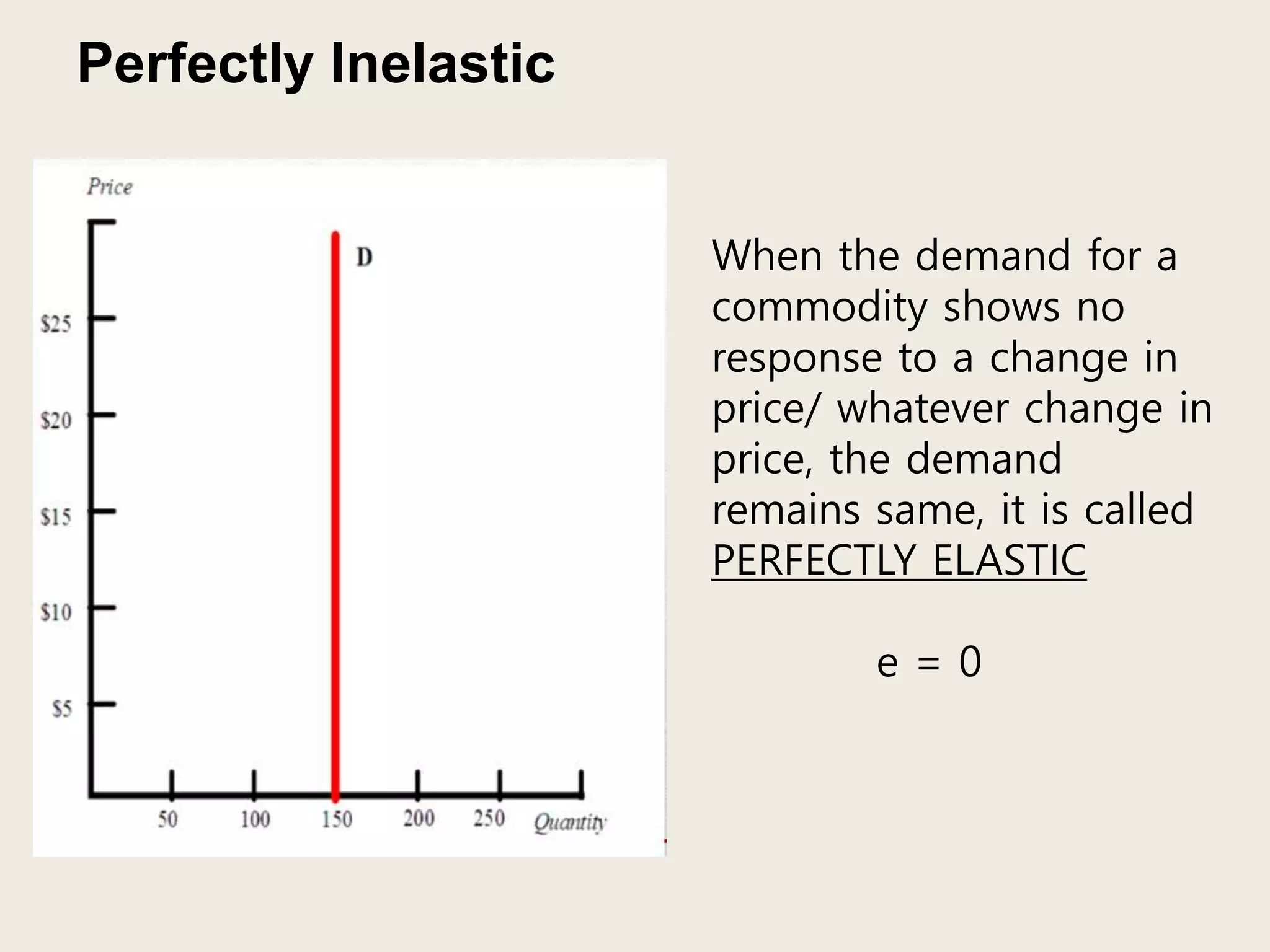
Perfectly Inelastic
When the demand for a
commodity shows no
response to a change in
price/ whatever change in
price, the demand
remains same, it is called
PERFECTLY ELASTIC
e = 0
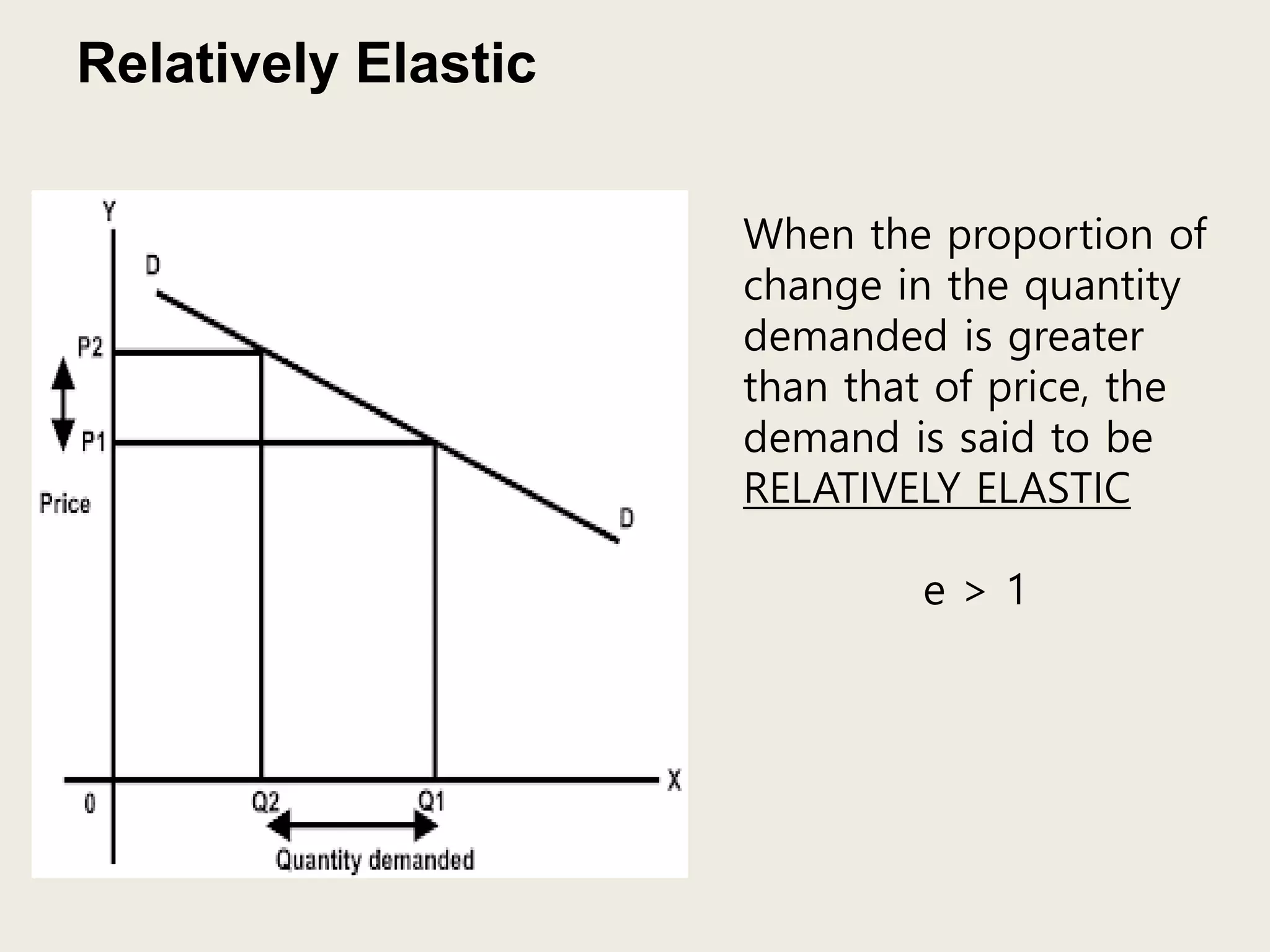
Relatively Elastic
When the proportion of
change in the quantity
demanded is greater
than that of price, the
demand is said to be
RELATIVELY ELASTIC
e > 1
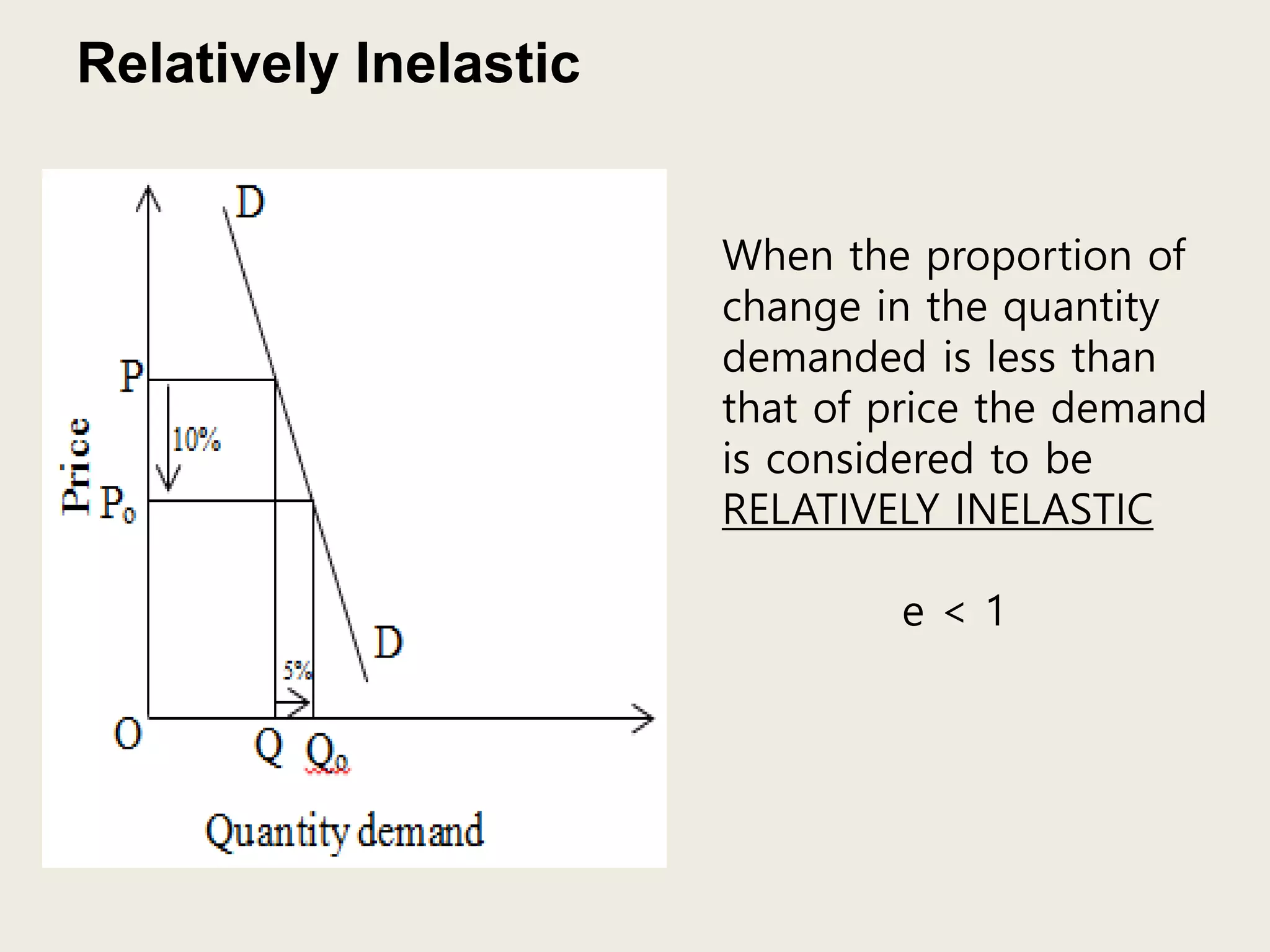
Relatively Inelastic
When the proportion of
change in the quantity
demanded is less than
that of price the demand
is considered to be
RELATIVELY INELASTIC
e < 1
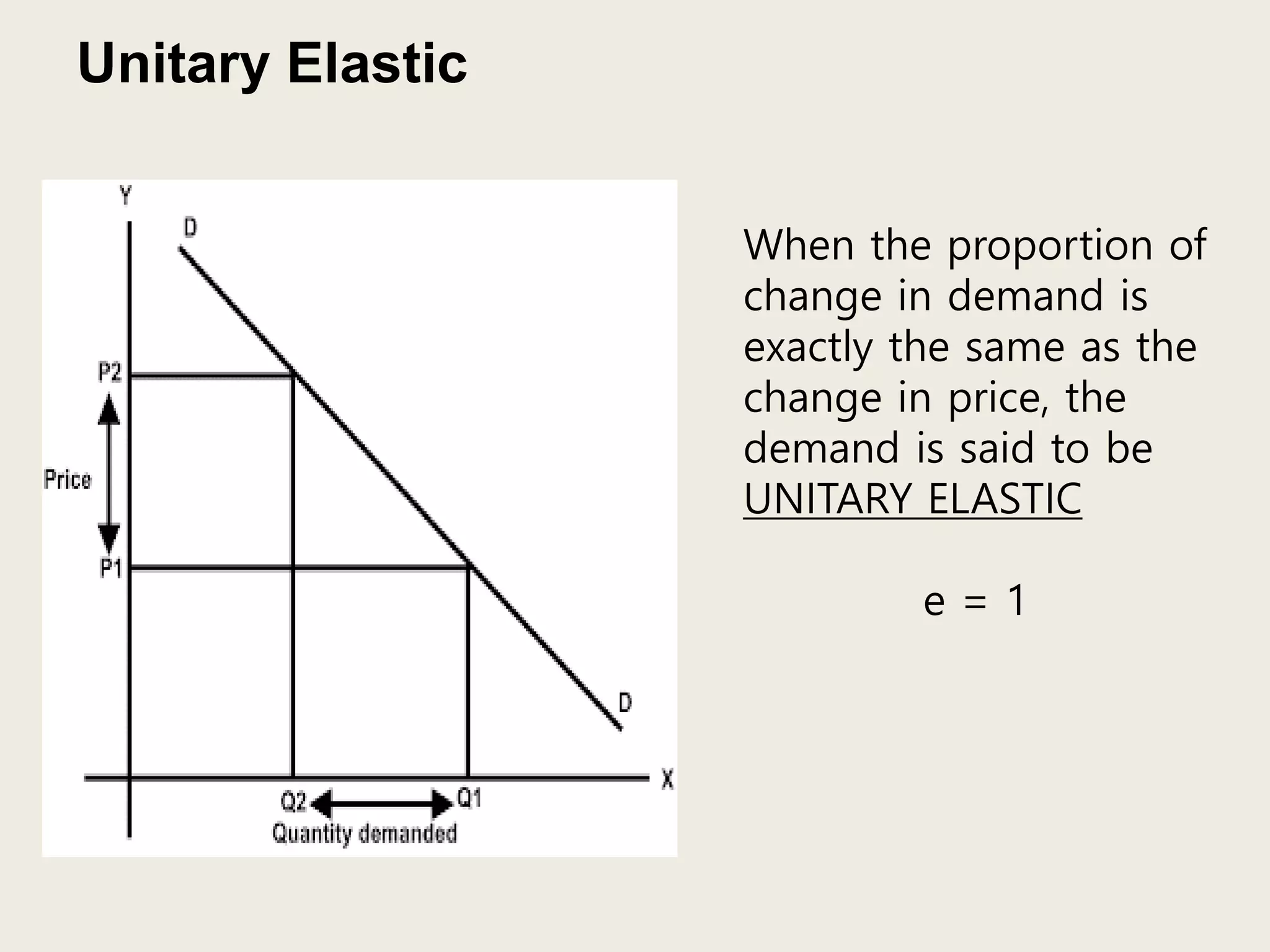
Unitary Elastic
When the proportion of
change in demand is
exactly the same as the
change in price, the
demand is said to be
UNITARY ELASTIC
e = 1
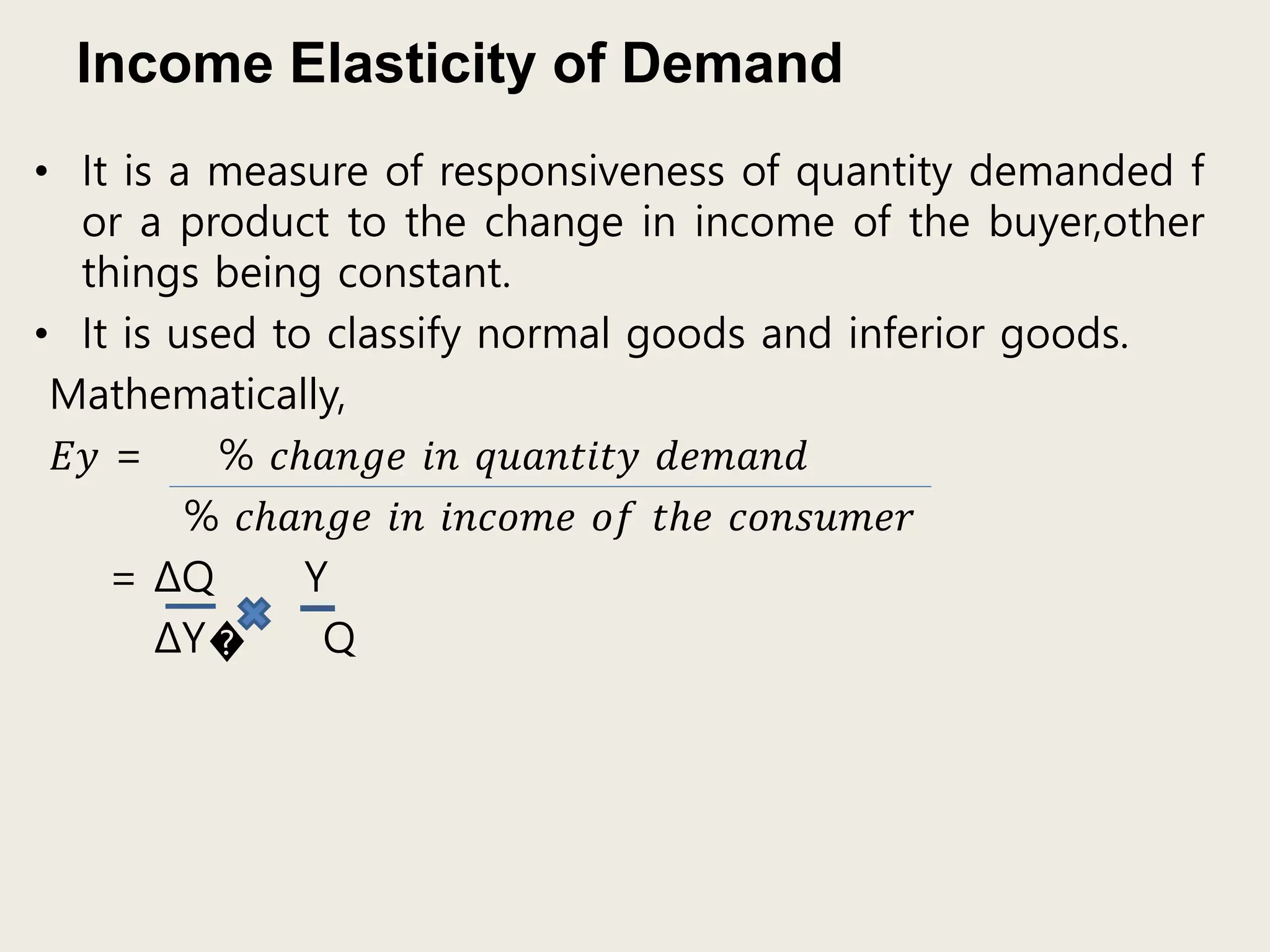
Income Elasticity of Demand
• It is a measure of responsiveness of quantity demanded f
or a product to the change in income of the buyer,other
things being constant.
• It is used to classify normal goods and inferior goods.
Mathematically,
𝐸𝑦 = % 𝑐ℎ𝑎𝑛𝑔𝑒 𝑖𝑛 𝑞𝑢𝑎𝑛𝑡𝑖𝑡𝑦 𝑑𝑒𝑚𝑎𝑛𝑑
% 𝑐ℎ𝑎𝑛𝑔𝑒 𝑖𝑛 𝑖𝑛𝑐𝑜𝑚𝑒 𝑜𝑓 𝑡ℎ𝑒 𝑐𝑜𝑛𝑠𝑢𝑚𝑒𝑟
= ΔQ Y
ΔY� Q
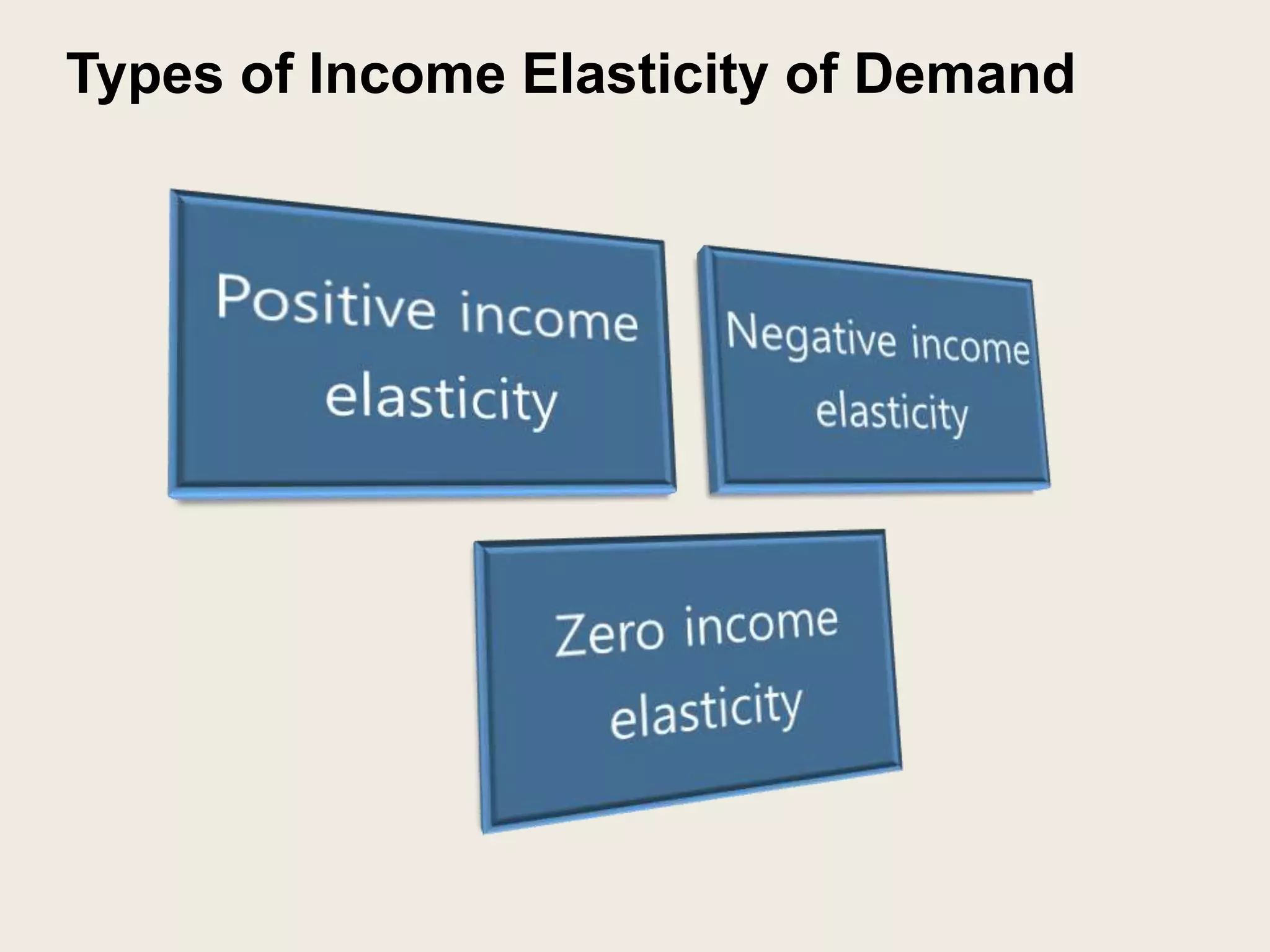
Types of Income Elasticity of Demand
1. Positive Income Elasticity (𝐸𝑦>0)
• Here, Demand varies positively with change in income.
• It can be found in case of superior goods.
• It can be further divided into three degrees:
a. Income Elasticity Greater than Unity (Ey>1)
b. Income Elasticity Less Than Unity (Ey<1)
c. Income Elasticity Equal to Unity (Ey=1)
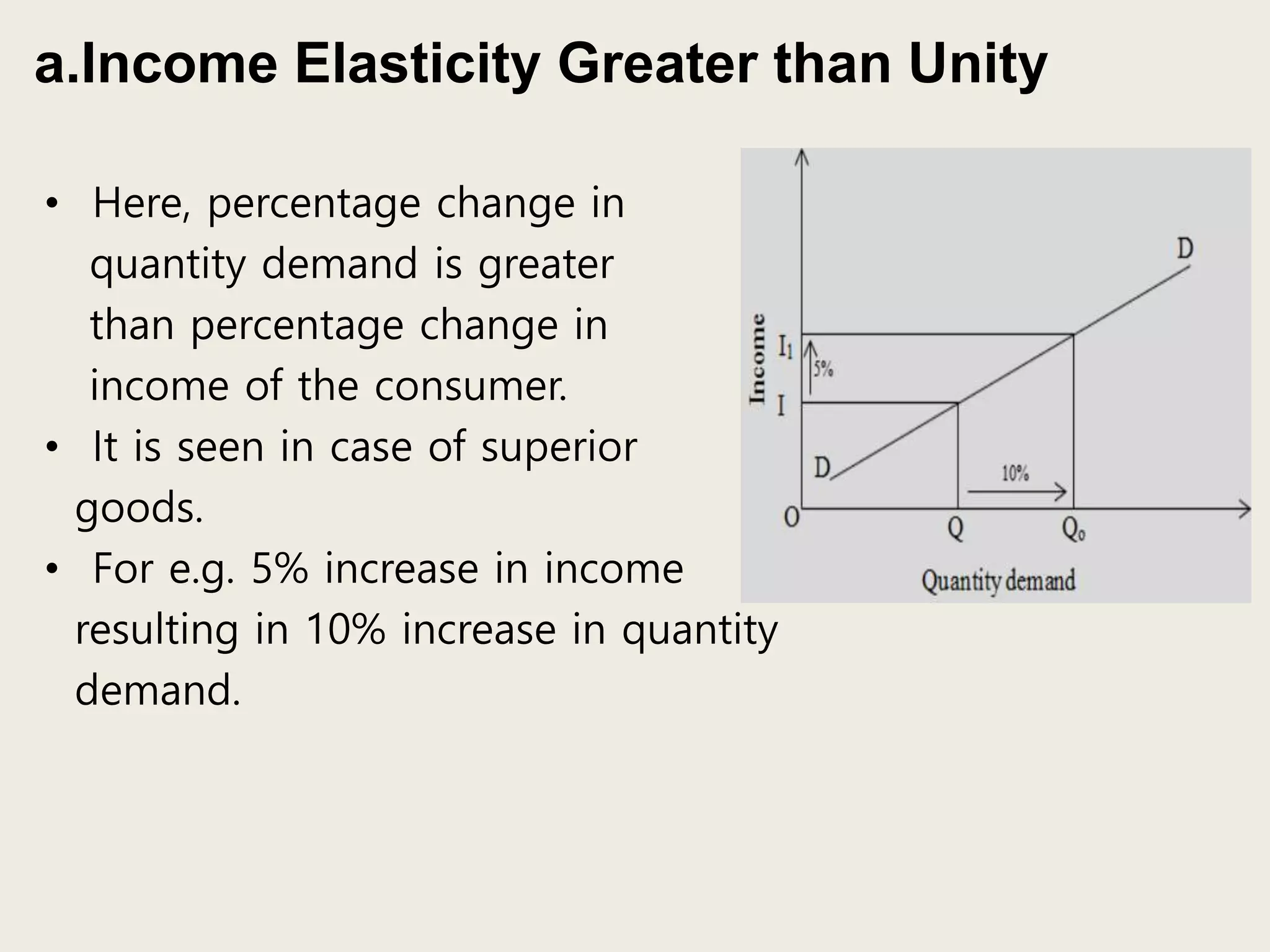
a.Income Elasticity Greater than Unity
• Here, percentage change in
quantity demand is greater
than percentage change in
income of the consumer.
• It is seen in case of superior
goods.
• For e.g. 5% increase in income
resulting in 10% increase in quantity
demand.
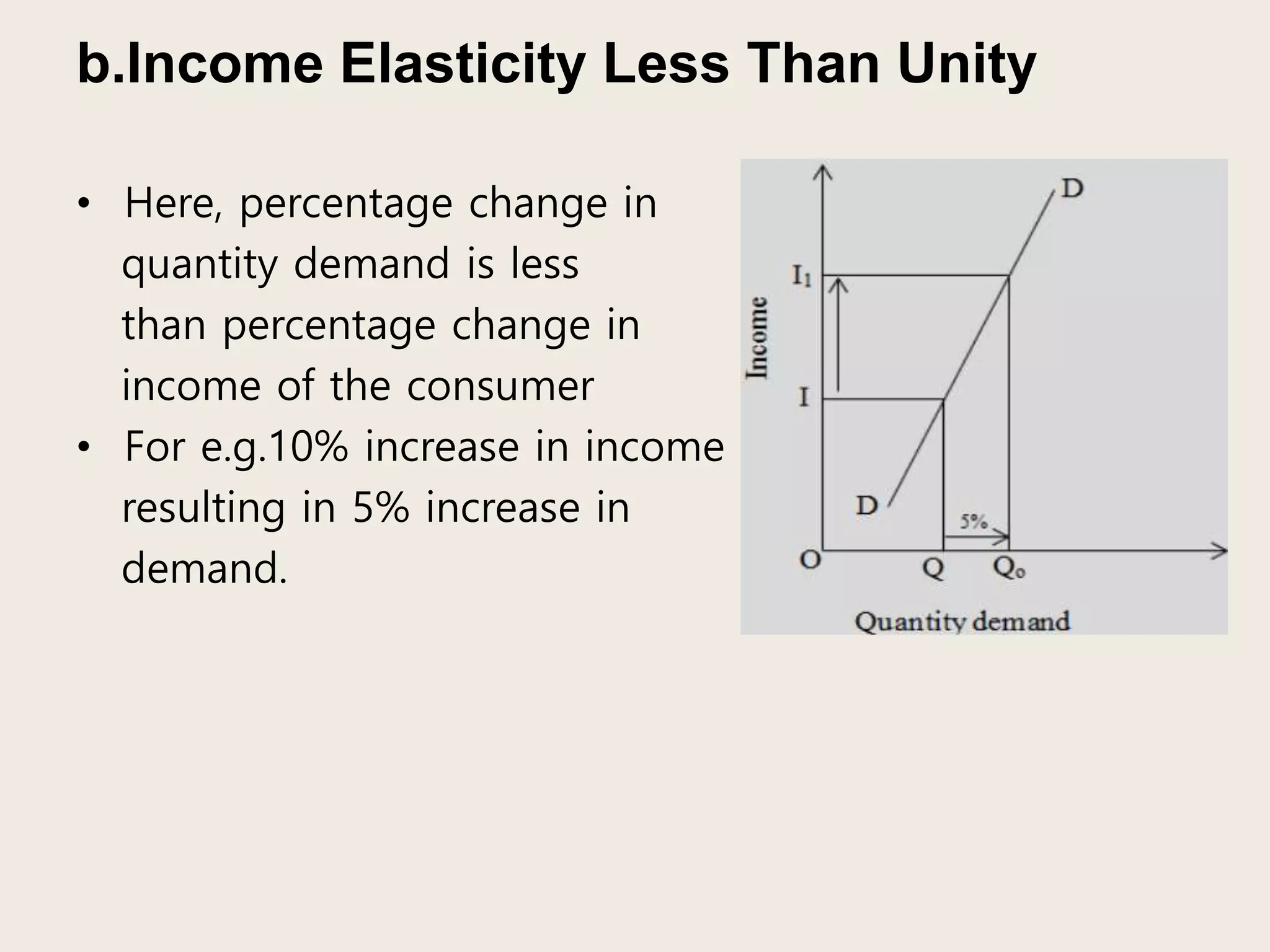
b.Income Elasticity Less Than Unity
• Here, percentage change in
quantity demand is less
than percentage change in
income of the consumer
• For e.g.10% increase in income
resulting in 5% increase in
demand.
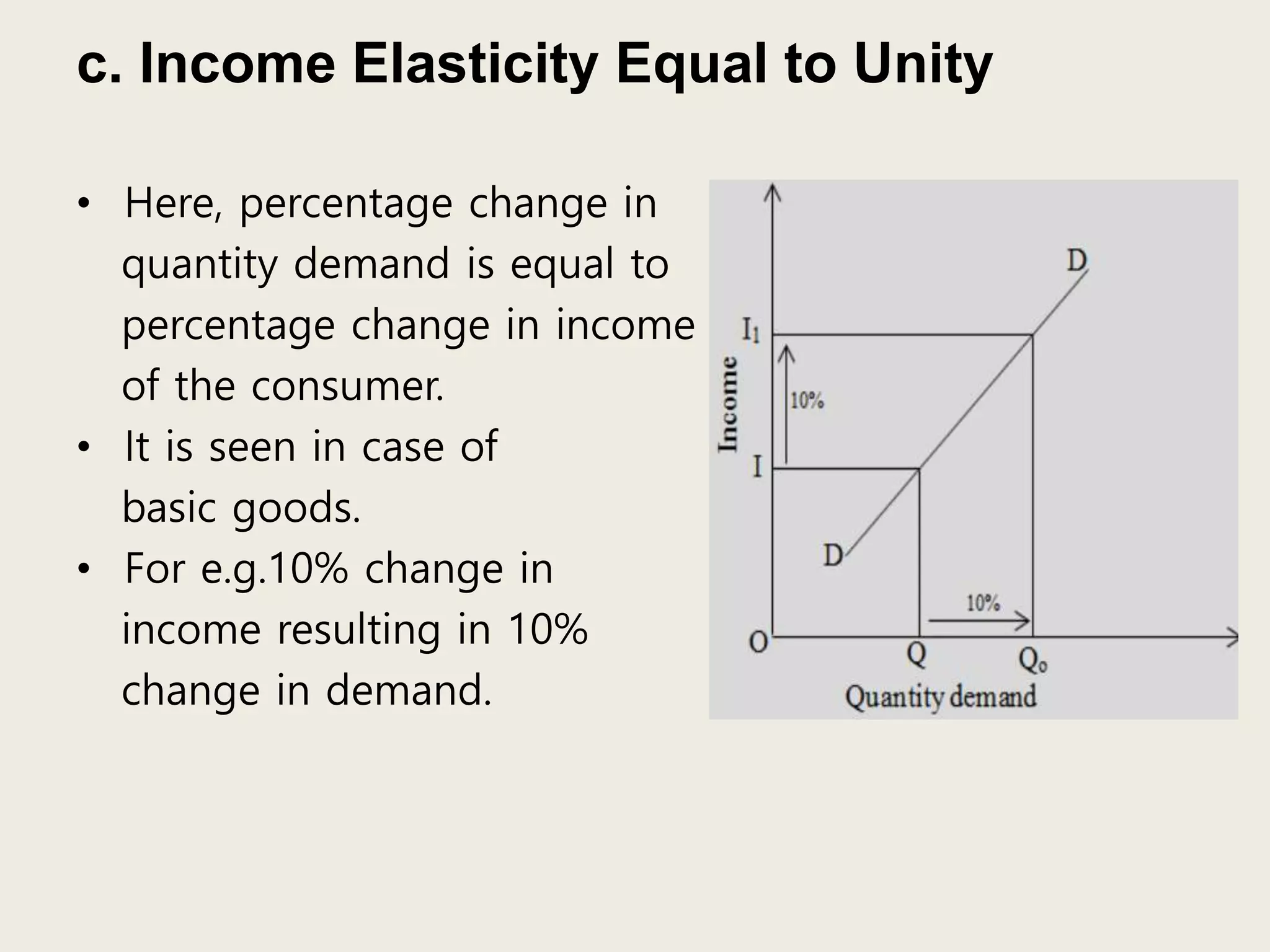
c. Income Elasticity Equal to Unity
• Here, percentage change in
quantity demand is equal to
percentage change in income
of the consumer.
• It is seen in case of
basic goods.
• For e.g.10% change in
income resulting in 10%
change in demand.
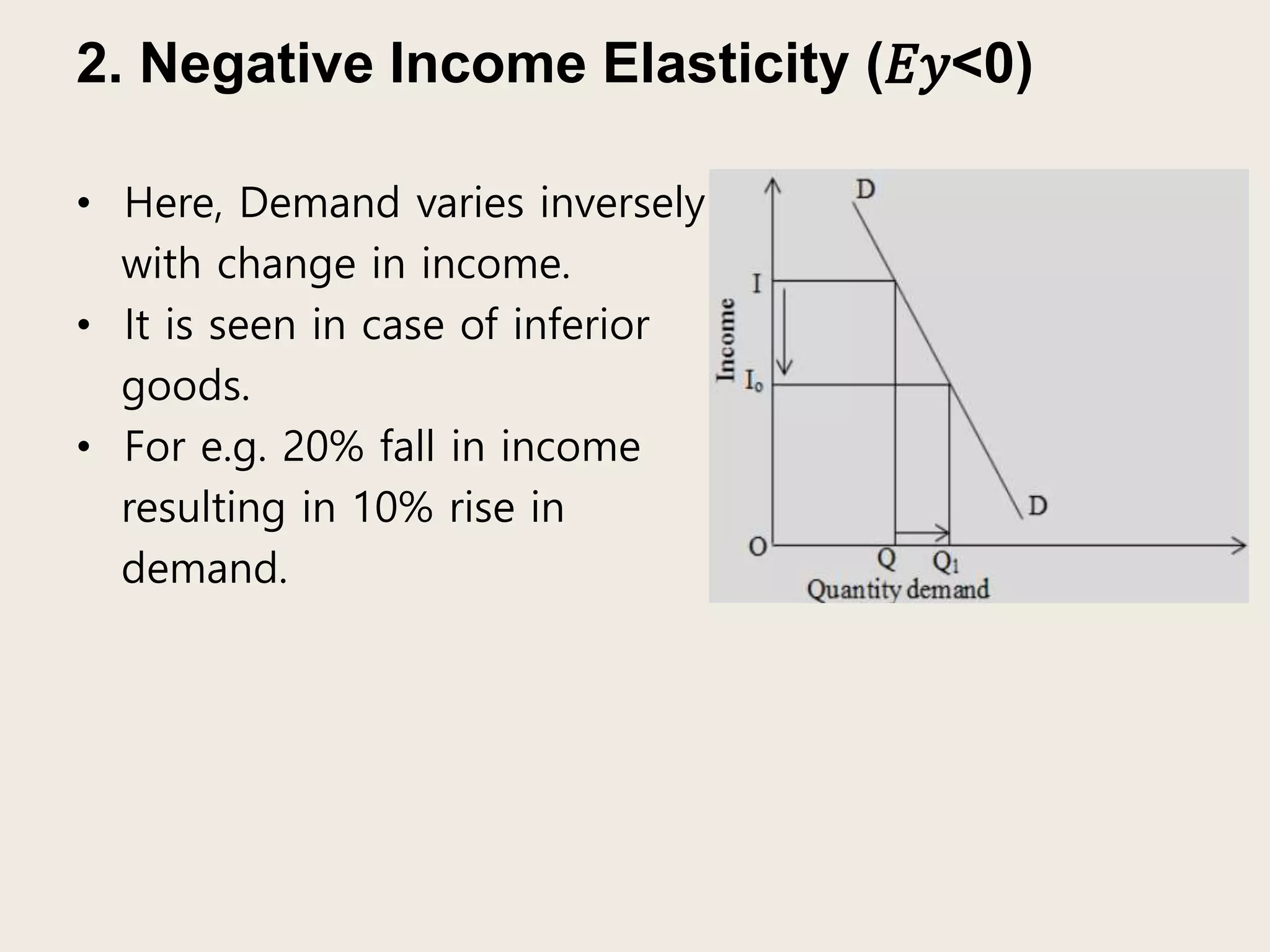
2. Negative Income Elasticity (𝐸𝑦<0)
• Here, Demand varies inversely
with change in income.
• It is seen in case of inferior
goods.
• For e.g. 20% fall in income
resulting in 10% rise in
demand.
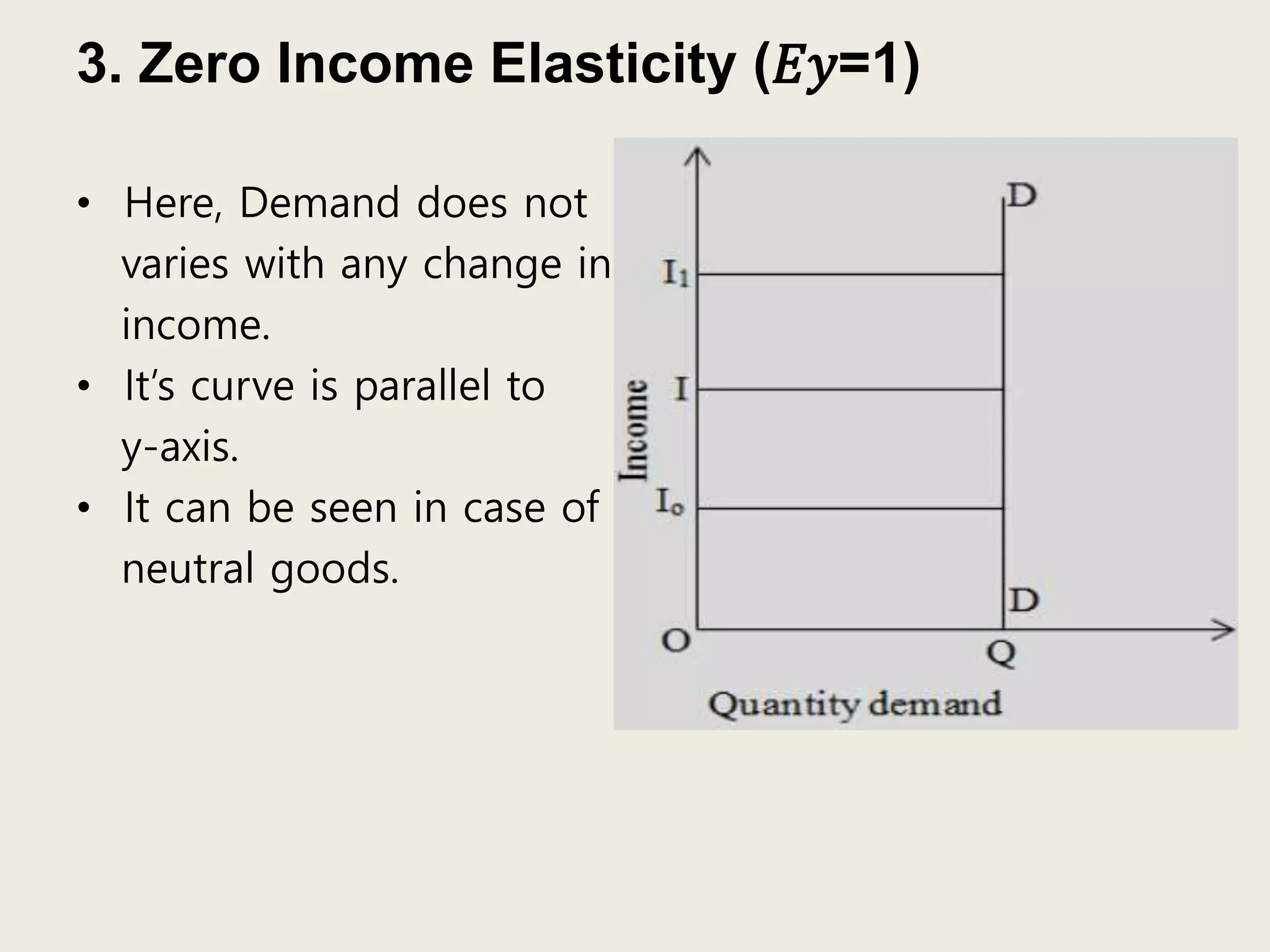
3. Zero Income Elasticity (𝐸𝑦=1)
• Here, Demand does not
varies with any change in
income.
• It’s curve is parallel to
y-axis.
• It can be seen in case of
neutral goods.
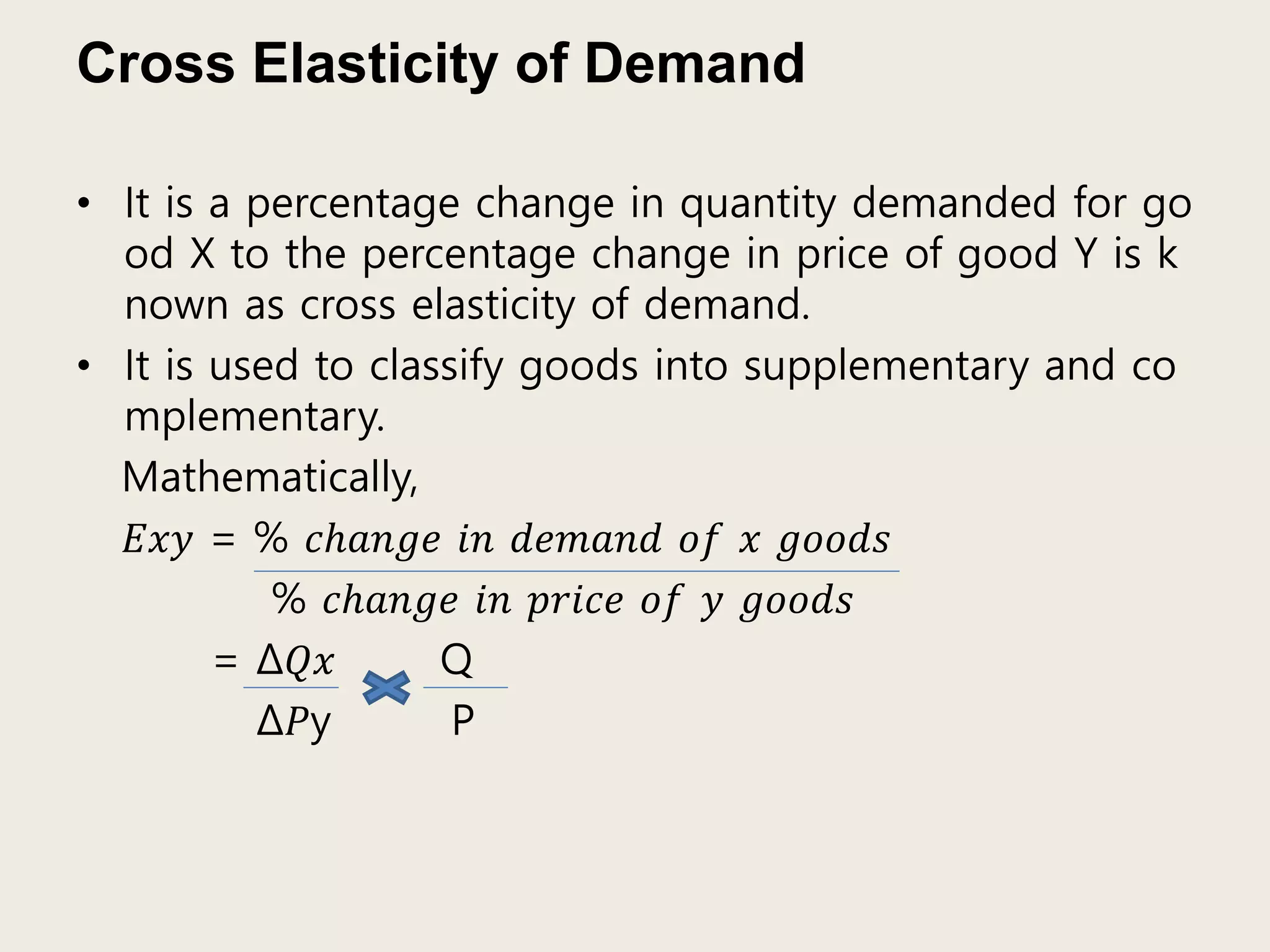
Cross Elasticity of Demand
• It is a percentage change in quantity demanded for go
od X to the percentage change in price of good Y is k
nown as cross elasticity of demand.
• It is used to classify goods into supplementary and co
mplementary.
Mathematically,
𝐸𝑥𝑦 = % 𝑐ℎ𝑎𝑛𝑔𝑒 𝑖𝑛 𝑑𝑒𝑚𝑎𝑛𝑑 𝑜𝑓 𝑥 𝑔𝑜𝑜𝑑𝑠
% 𝑐ℎ𝑎𝑛𝑔𝑒 𝑖𝑛 𝑝𝑟𝑖𝑐𝑒 𝑜𝑓 𝑦 𝑔𝑜𝑜𝑑𝑠
= Δ𝑄𝑥 Q
Δ𝑃y P
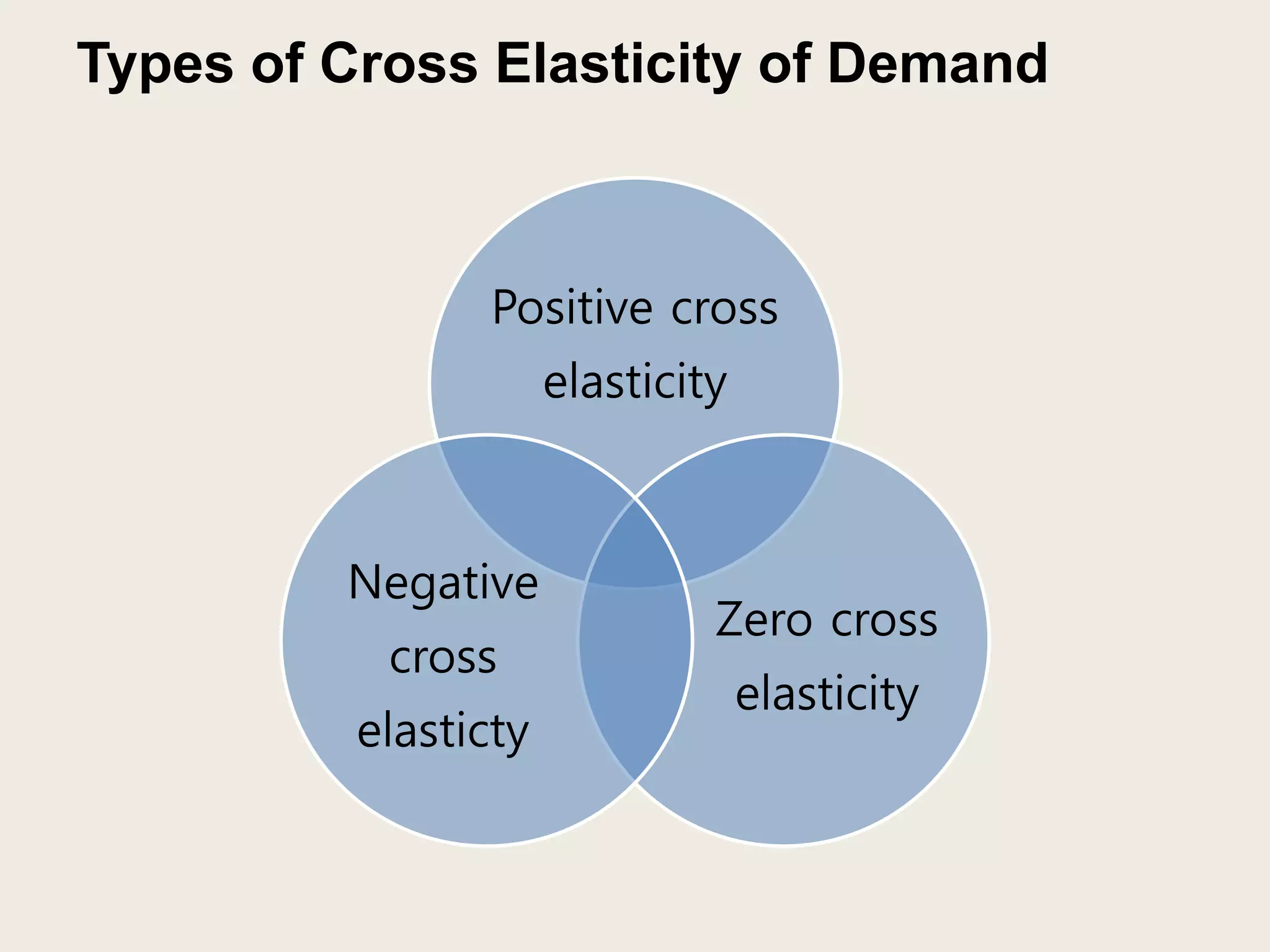
Types of Cross Elasticity of Demand
Positive cross
elasticity
Zero cross
elasticity
Negative
cross
elasticty
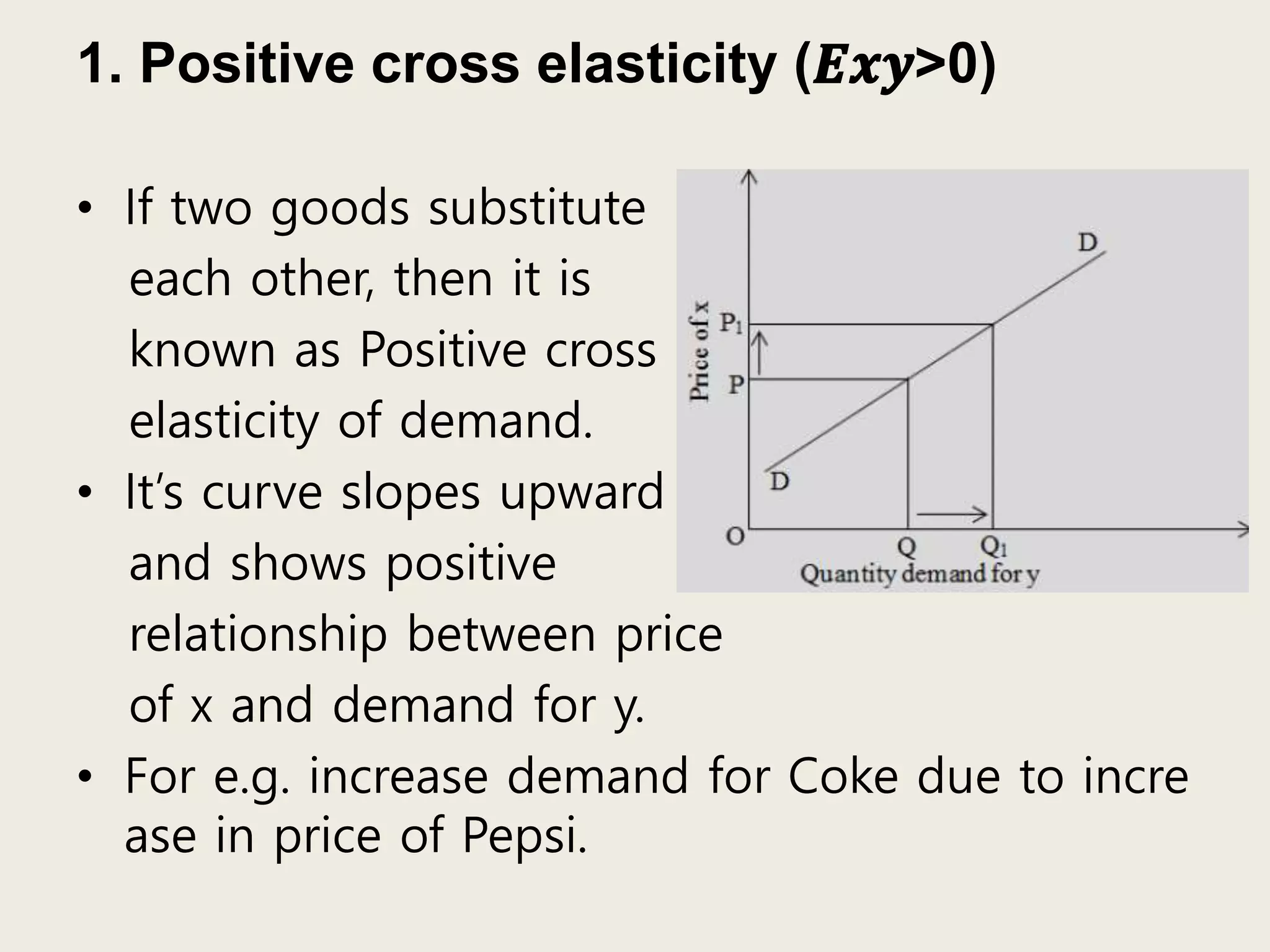
1. Positive cross elasticity (𝑬𝒙𝒚>0)
• If two goods substitute
each other, then it is
known as Positive cross
elasticity of demand.
• It’s curve slopes upward
and shows positive
relationship between price
of x and demand for y.
• For e.g. increase demand for Coke due to incre
ase in price of Pepsi.
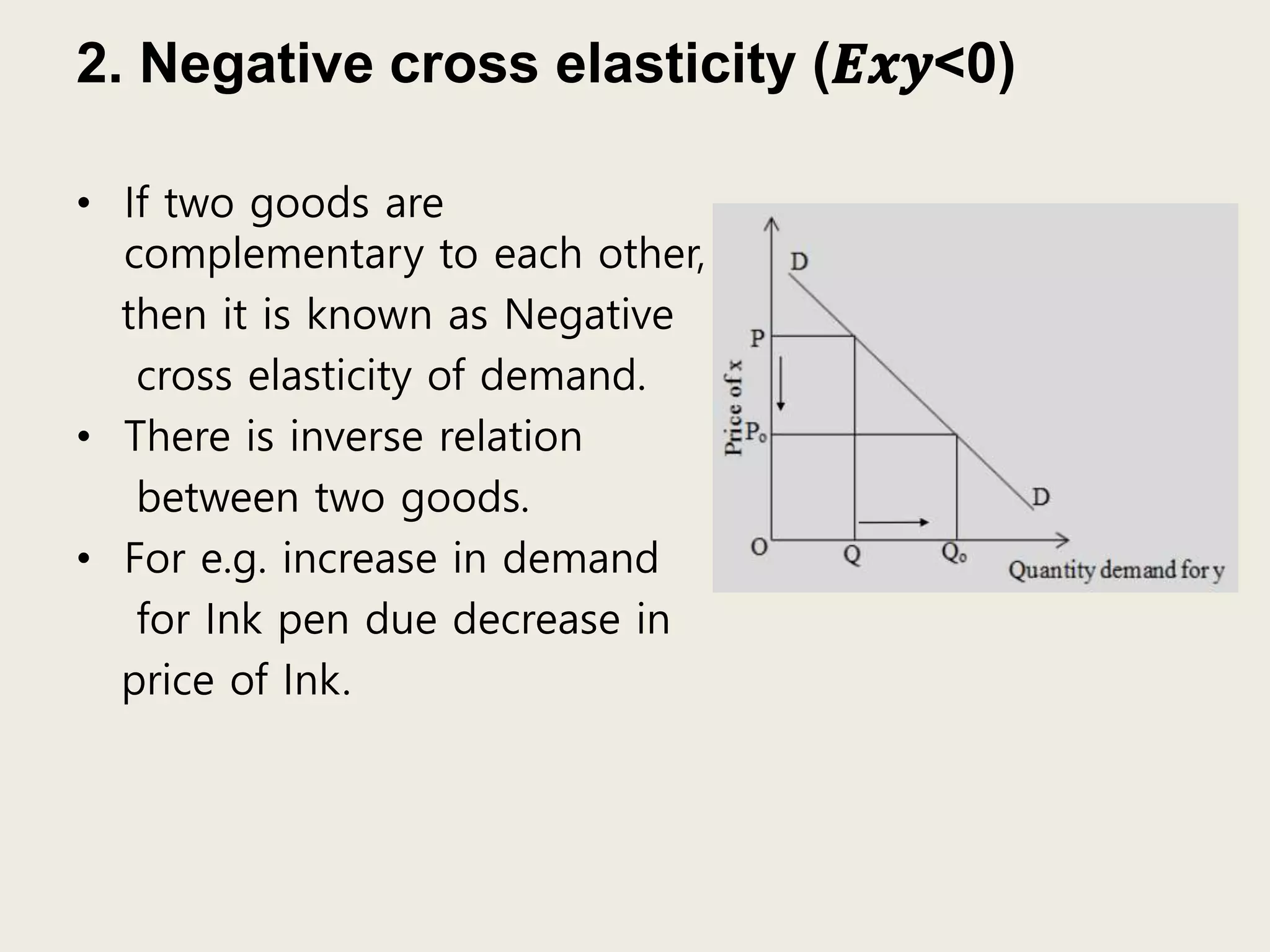
2. Negative cross elasticity (𝑬𝒙𝒚<0)
• If two goods are
complementary to each other,
then it is known as Negative
cross elasticity of demand.
• There is inverse relation
between two goods.
• For e.g. increase in demand
for Ink pen due decrease in
price of Ink.
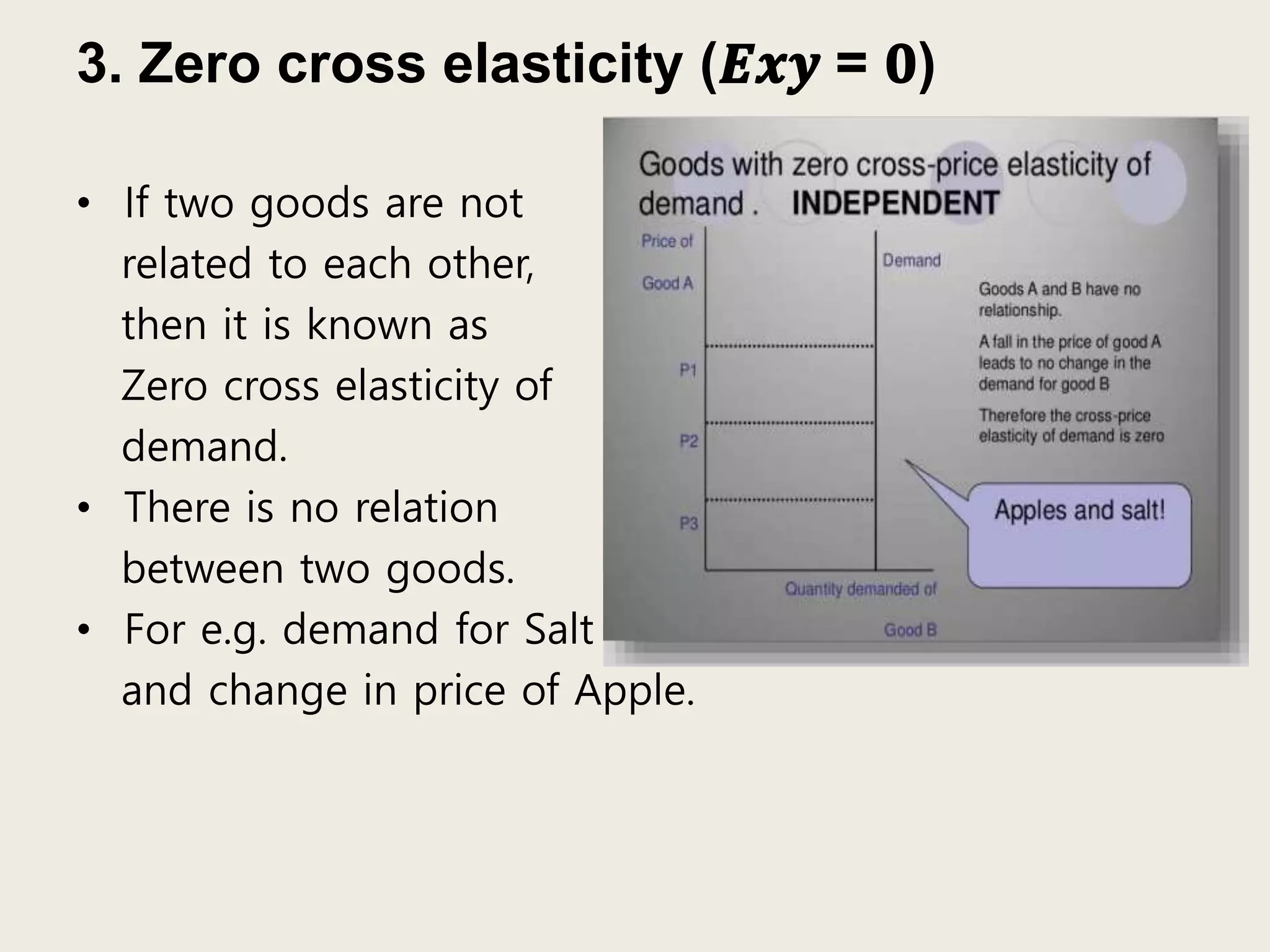
3. Zero cross elasticity (𝑬𝒙𝒚 = 𝟎)
• If two goods are not
related to each other,
then it is known as
Zero cross elasticity of
demand.
• There is no relation
between two goods.
• For e.g. demand for Salt
and change in price of Apple.
Elasticity of demand

Elasticity of demand

  • 1.
  • 2.
    Concepts Of ElasticityOf Demand Two Variables are considered while measuring the elasticity of demand :  Demand  Determinants Of Demand Elasticity Of Demand = percentage change in quantity demanded percentage change in determinant of demand
  • 3.
    Types Of ElasticityOf Demand Demand Price Elasticity Cross Price Elasticity Income Elasticity
  • 4.
    Price Elasticity OfDemand The price elasticity of Demand may be defined as the ratio of the relative change in demand and price variables. e = Percentage change in quantity demanded Percentage change in price
  • 5.
    Types Of PriceElasticity
  • 6.
    Perfectly Elastic Consumers haveindefinite demand at a particular price and none at all at an even slightly higher than this given price, demand is PERFECTLY ELASTIC e = ∞
  • 7.
    Perfectly Inelastic When thedemand for a commodity shows no response to a change in price/ whatever change in price, the demand remains same, it is called PERFECTLY ELASTIC e = 0
  • 8.
    Relatively Elastic When theproportion of change in the quantity demanded is greater than that of price, the demand is said to be RELATIVELY ELASTIC e > 1
  • 9.
    Relatively Inelastic When theproportion of change in the quantity demanded is less than that of price the demand is considered to be RELATIVELY INELASTIC e < 1
  • 10.
    Unitary Elastic When theproportion of change in demand is exactly the same as the change in price, the demand is said to be UNITARY ELASTIC e = 1
  • 11.
    Income Elasticity ofDemand • It is a measure of responsiveness of quantity demanded f or a product to the change in income of the buyer,other things being constant. • It is used to classify normal goods and inferior goods. Mathematically, 𝐸𝑦 = % 𝑐ℎ𝑎𝑛𝑔𝑒 𝑖𝑛 𝑞𝑢𝑎𝑛𝑡𝑖𝑡𝑦 𝑑𝑒𝑚𝑎𝑛𝑑 % 𝑐ℎ𝑎𝑛𝑔𝑒 𝑖𝑛 𝑖𝑛𝑐𝑜𝑚𝑒 𝑜𝑓 𝑡ℎ𝑒 𝑐𝑜𝑛𝑠𝑢𝑚𝑒𝑟 = ΔQ Y ΔY� Q
  • 12.
    Types of IncomeElasticity of Demand
  • 13.
    1. Positive IncomeElasticity (𝐸𝑦>0) • Here, Demand varies positively with change in income. • It can be found in case of superior goods. • It can be further divided into three degrees: a. Income Elasticity Greater than Unity (Ey>1) b. Income Elasticity Less Than Unity (Ey<1) c. Income Elasticity Equal to Unity (Ey=1)
  • 14.
    a.Income Elasticity Greaterthan Unity • Here, percentage change in quantity demand is greater than percentage change in income of the consumer. • It is seen in case of superior goods. • For e.g. 5% increase in income resulting in 10% increase in quantity demand.
  • 15.
    b.Income Elasticity LessThan Unity • Here, percentage change in quantity demand is less than percentage change in income of the consumer • For e.g.10% increase in income resulting in 5% increase in demand.
  • 16.
    c. Income ElasticityEqual to Unity • Here, percentage change in quantity demand is equal to percentage change in income of the consumer. • It is seen in case of basic goods. • For e.g.10% change in income resulting in 10% change in demand.
  • 17.
    2. Negative IncomeElasticity (𝐸𝑦<0) • Here, Demand varies inversely with change in income. • It is seen in case of inferior goods. • For e.g. 20% fall in income resulting in 10% rise in demand.
  • 18.
    3. Zero IncomeElasticity (𝐸𝑦=1) • Here, Demand does not varies with any change in income. • It’s curve is parallel to y-axis. • It can be seen in case of neutral goods.
  • 19.
    Cross Elasticity ofDemand • It is a percentage change in quantity demanded for go od X to the percentage change in price of good Y is k nown as cross elasticity of demand. • It is used to classify goods into supplementary and co mplementary. Mathematically, 𝐸𝑥𝑦 = % 𝑐ℎ𝑎𝑛𝑔𝑒 𝑖𝑛 𝑑𝑒𝑚𝑎𝑛𝑑 𝑜𝑓 𝑥 𝑔𝑜𝑜𝑑𝑠 % 𝑐ℎ𝑎𝑛𝑔𝑒 𝑖𝑛 𝑝𝑟𝑖𝑐𝑒 𝑜𝑓 𝑦 𝑔𝑜𝑜𝑑𝑠 = Δ𝑄𝑥 Q Δ𝑃y P
  • 20.
    Types of CrossElasticity of Demand Positive cross elasticity Zero cross elasticity Negative cross elasticty
  • 21.
    1. Positive crosselasticity (𝑬𝒙𝒚>0) • If two goods substitute each other, then it is known as Positive cross elasticity of demand. • It’s curve slopes upward and shows positive relationship between price of x and demand for y. • For e.g. increase demand for Coke due to incre ase in price of Pepsi.
  • 22.
    2. Negative crosselasticity (𝑬𝒙𝒚<0) • If two goods are complementary to each other, then it is known as Negative cross elasticity of demand. • There is inverse relation between two goods. • For e.g. increase in demand for Ink pen due decrease in price of Ink.
  • 23.
    3. Zero crosselasticity (𝑬𝒙𝒚 = 𝟎) • If two goods are not related to each other, then it is known as Zero cross elasticity of demand. • There is no relation between two goods. • For e.g. demand for Salt and change in price of Apple.