Copyright © 2009 Pearson Education, Inc.
PowerPoint® Lecture Presentation for
Concepts of Genetics
Ninth Edition
Klug, Cummings, Spencer, Palladino
Chapter 14
The Genetic Code and Transcription
Lectures by David Kass with contributions from
John C. Osterman.
Copyright © 2009 Pearson Education, Inc.
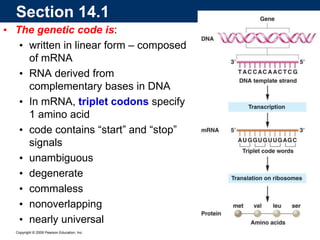
• The genetic code is:
• written in linear form – composed
of mRNA
• RNA derived from
complementary bases in DNA
• In mRNA, triplet codons specify
1 amino acid
• code contains “start” and “stop”
signals
• unambiguous
• degenerate
• commaless
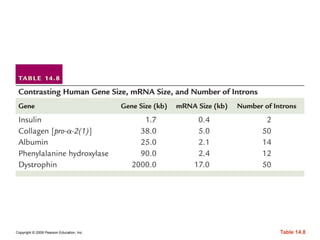
• nonoverlapping
• nearly universal
Section 14.1
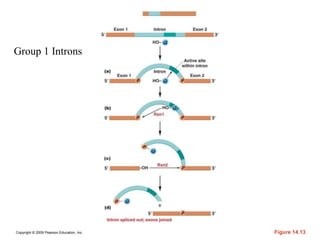
Copyright © 2009 Pearson Education, Inc.
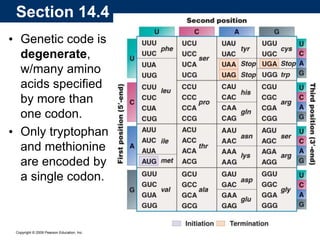
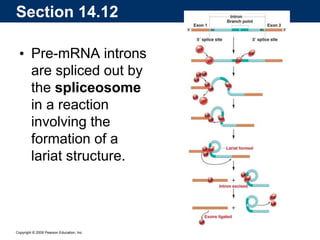
• Genetic code is
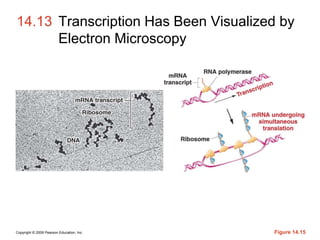
degenerate,
w/many amino
acids specified
by more than
one codon.
• Only tryptophan
and methionine
are encoded by
a single codon.
Section 14.4
Copyright © 2009 Pearson Education, Inc.
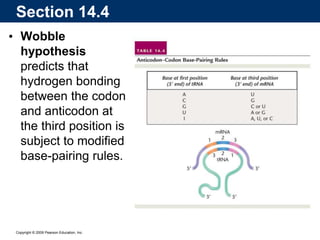
• Wobble
hypothesis
predicts that
hydrogen bonding
between the codon
and anticodon at
the third position is
subject to modified
base-pairing rules.
Section 14.4
Copyright © 2009 Pearson Education, Inc.
• The genetic code shows order in that
chemically similar amino acids often share
one or two middle bases in the triplets
encoding them.
Section 14.4
Copyright © 2009 Pearson Education, Inc.
• The initial amino acid incorporated into all
proteins is a modified form of
methionine—N-formylmethionine (fmet).
(in bacteria)
• AUG is the only codon to encode for
methionine.
• Initiator codon
• When AUG appears internally in mRNA,
an unformylated methionine is inserted
into the protein.
Section 14.4
Copyright © 2009 Pearson Education, Inc.
• Three codons (UAG, UAA, and UGA)
serve as termination codons and do not
code for any amino acid.
Section 14.4
Copyright © 2009 Pearson Education, Inc.
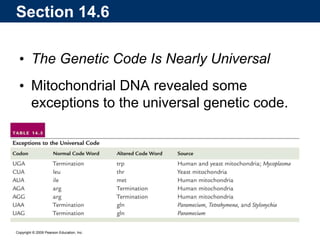
• The Genetic Code Is Nearly Universal
• Mitochondrial DNA revealed some
exceptions to the universal genetic code.
Section 14.6
Copyright © 2009 Pearson Education, Inc.
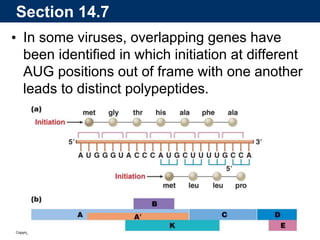
• In some viruses, overlapping genes have
been identified in which initiation at different
AUG positions out of frame with one another
leads to distinct polypeptides.
Section 14.7
Copyright © 2009 Pearson Education, Inc.
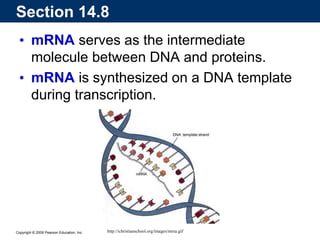
• mRNA serves as the intermediate
molecule between DNA and proteins.
• mRNA is synthesized on a DNA template
during transcription.
Section 14.8
http://ichristianschool.org/images/mrna.gif
Copyright © 2009 Pearson Education, Inc.
• RNA polymerase directs the synthesis of
RNA using a DNA template.
• No primer is required for initiation
• The enzyme uses ribonucleotides instead
of deoxyribonucleotides.
Section 14.10
Copyright © 2009 Pearson Education, Inc.
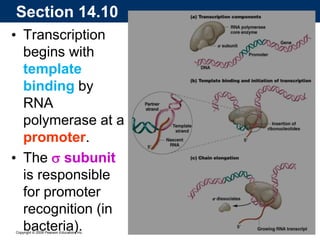
• Transcription
begins with
template
binding by
RNA
polymerase at a
promoter.
• The s subunit
is responsible
for promoter
recognition (in
bacteria).
Section 14.10
Copyright © 2009 Pearson Education, Inc.
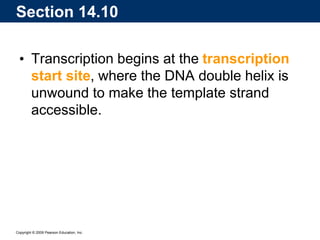
• Transcription begins at the transcription
start site, where the DNA double helix is
unwound to make the template strand
accessible.
Section 14.10
Copyright © 2009 Pearson Education, Inc.
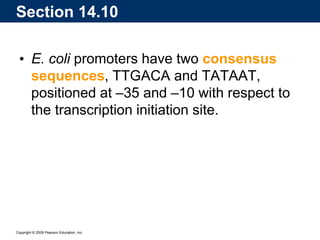
• E. coli promoters have two consensus
sequences, TTGACA and TATAAT,
positioned at –35 and –10 with respect to
the transcription initiation site.
Section 14.10
Copyright © 2009 Pearson Education, Inc.
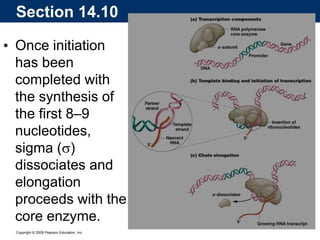
• Once initiation
has been
completed with
the synthesis of
the first 8–9
nucleotides,
sigma (s)
dissociates and
elongation
proceeds with the
core enzyme.
Section 14.10
Copyright © 2009 Pearson Education, Inc.
• At the end of the gene, transcription
terminates due to hairpin formation in the
RNA.
• In some cases, termination depends on
the rho () termination factor.
Section 14.10
Copyright © 2009 Pearson Education, Inc.
• Transcription in Eukaryotes Differs from
Prokaryotic Transcription in Several Ways
• Occurs in nucleus and is not coupled to
translation.
• Requires chromatin remodeling.
• In addition to promoters, enhancers also
influence transcription regulation.
• Eukaryotic mRNAs require processing to
produce mature mRNAs.
Section 14.11
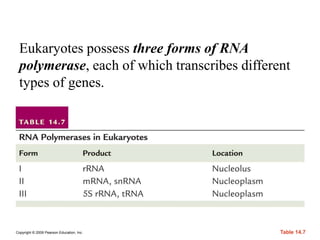
Copyright © 2009 Pearson Education, Inc. Table 14.7
Eukaryotes possess three forms of RNA
polymerase, each of which transcribes different
types of genes.
Copyright © 2009 Pearson Education, Inc.
• RNA polymerase II (RNP II) promoters
have a core promoter element and
promoter and enhancer elements.
• The TATA box is a core promoter element
that binds the TATA-binding protein (TBP)
of transcription factor TFIID and
determines the start site of transcription.
• CAAT box
Section 14.11
Copyright © 2009 Pearson Education, Inc.
• General transcription factors are
required for all RNP II mediated
transcription and help RNA polymerase II
bind to the promoter and initiate
transcription.
Section 14.11
Copyright © 2009 Pearson Education, Inc.
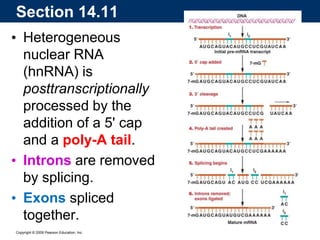
• Heterogeneous
nuclear RNA
(hnRNA) is
posttranscriptionally
processed by the
addition of a 5' cap
and a poly-A tail.
• Introns are removed
by splicing.
• Exons spliced
together.
Section 14.11
Copyright © 2009 Pearson Education, Inc.
• Introns (intervening sequences) are
regions of the initial RNA transcript that
are not expressed in the amino acid
sequence of the protein.
• Introns are removed by splicing and the
exons (expressed) are joined together in
the mature mRNA.
• The size of the mature mRNA is usually
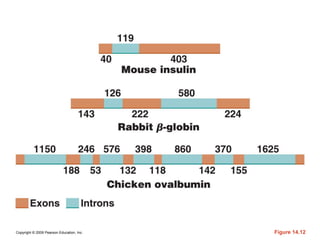
much smaller than that of the initial RNA.
Section 14.12
Copyright © 2009 Pearson Education, Inc. Figure 14.12
Copyright © 2009 Pearson Education, Inc. Table 14.8
Copyright © 2009 Pearson Education, Inc. Figure 14.13
Group 1 Introns
Copyright © 2009 Pearson Education, Inc.
• Pre-mRNA introns
are spliced out by
the spliceosome
in a reaction
involving the
formation of a
lariat structure.
Section 14.12
Copyright © 2009 Pearson Education, Inc. Figure 14.15
14.13 Transcription Has Been Visualized by
Electron Microscopy

Chapter 14 - The Genetic Code and Transcription Klug.ppt

  • 1.
    Copyright © 2009Pearson Education, Inc. PowerPoint® Lecture Presentation for Concepts of Genetics Ninth Edition Klug, Cummings, Spencer, Palladino Chapter 14 The Genetic Code and Transcription Lectures by David Kass with contributions from John C. Osterman. Copyright © 2009 Pearson Education, Inc.
  • 2.
    Copyright © 2009Pearson Education, Inc. • The genetic code is: • written in linear form – composed of mRNA • RNA derived from complementary bases in DNA • In mRNA, triplet codons specify 1 amino acid • code contains “start” and “stop” signals • unambiguous • degenerate • commaless • nonoverlapping • nearly universal Section 14.1
  • 3.
    Copyright © 2009Pearson Education, Inc. • Genetic code is degenerate, w/many amino acids specified by more than one codon. • Only tryptophan and methionine are encoded by a single codon. Section 14.4
  • 4.
    Copyright © 2009Pearson Education, Inc. • Wobble hypothesis predicts that hydrogen bonding between the codon and anticodon at the third position is subject to modified base-pairing rules. Section 14.4
  • 5.
    Copyright © 2009Pearson Education, Inc. • The genetic code shows order in that chemically similar amino acids often share one or two middle bases in the triplets encoding them. Section 14.4
  • 6.
    Copyright © 2009Pearson Education, Inc. • The initial amino acid incorporated into all proteins is a modified form of methionine—N-formylmethionine (fmet). (in bacteria) • AUG is the only codon to encode for methionine. • Initiator codon • When AUG appears internally in mRNA, an unformylated methionine is inserted into the protein. Section 14.4
  • 7.
    Copyright © 2009Pearson Education, Inc. • Three codons (UAG, UAA, and UGA) serve as termination codons and do not code for any amino acid. Section 14.4
  • 8.
    Copyright © 2009Pearson Education, Inc. • The Genetic Code Is Nearly Universal • Mitochondrial DNA revealed some exceptions to the universal genetic code. Section 14.6
  • 9.
    Copyright © 2009Pearson Education, Inc. • In some viruses, overlapping genes have been identified in which initiation at different AUG positions out of frame with one another leads to distinct polypeptides. Section 14.7
  • 10.
    Copyright © 2009Pearson Education, Inc. • mRNA serves as the intermediate molecule between DNA and proteins. • mRNA is synthesized on a DNA template during transcription. Section 14.8 http://ichristianschool.org/images/mrna.gif
  • 11.
    Copyright © 2009Pearson Education, Inc. • RNA polymerase directs the synthesis of RNA using a DNA template. • No primer is required for initiation • The enzyme uses ribonucleotides instead of deoxyribonucleotides. Section 14.10
  • 12.
    Copyright © 2009Pearson Education, Inc. • Transcription begins with template binding by RNA polymerase at a promoter. • The s subunit is responsible for promoter recognition (in bacteria). Section 14.10
  • 13.
    Copyright © 2009Pearson Education, Inc. • Transcription begins at the transcription start site, where the DNA double helix is unwound to make the template strand accessible. Section 14.10
  • 14.
    Copyright © 2009Pearson Education, Inc. • E. coli promoters have two consensus sequences, TTGACA and TATAAT, positioned at –35 and –10 with respect to the transcription initiation site. Section 14.10
  • 15.
    Copyright © 2009Pearson Education, Inc. • Once initiation has been completed with the synthesis of the first 8–9 nucleotides, sigma (s) dissociates and elongation proceeds with the core enzyme. Section 14.10
  • 16.
    Copyright © 2009Pearson Education, Inc. • At the end of the gene, transcription terminates due to hairpin formation in the RNA. • In some cases, termination depends on the rho () termination factor. Section 14.10
  • 17.
    Copyright © 2009Pearson Education, Inc. • Transcription in Eukaryotes Differs from Prokaryotic Transcription in Several Ways • Occurs in nucleus and is not coupled to translation. • Requires chromatin remodeling. • In addition to promoters, enhancers also influence transcription regulation. • Eukaryotic mRNAs require processing to produce mature mRNAs. Section 14.11
  • 18.
    Copyright © 2009Pearson Education, Inc. Table 14.7 Eukaryotes possess three forms of RNA polymerase, each of which transcribes different types of genes.
  • 19.
    Copyright © 2009Pearson Education, Inc. • RNA polymerase II (RNP II) promoters have a core promoter element and promoter and enhancer elements. • The TATA box is a core promoter element that binds the TATA-binding protein (TBP) of transcription factor TFIID and determines the start site of transcription. • CAAT box Section 14.11
  • 20.
    Copyright © 2009Pearson Education, Inc. • General transcription factors are required for all RNP II mediated transcription and help RNA polymerase II bind to the promoter and initiate transcription. Section 14.11
  • 21.
    Copyright © 2009Pearson Education, Inc. • Heterogeneous nuclear RNA (hnRNA) is posttranscriptionally processed by the addition of a 5' cap and a poly-A tail. • Introns are removed by splicing. • Exons spliced together. Section 14.11
  • 22.
    Copyright © 2009Pearson Education, Inc. • Introns (intervening sequences) are regions of the initial RNA transcript that are not expressed in the amino acid sequence of the protein. • Introns are removed by splicing and the exons (expressed) are joined together in the mature mRNA. • The size of the mature mRNA is usually much smaller than that of the initial RNA. Section 14.12
  • 23.
    Copyright © 2009Pearson Education, Inc. Figure 14.12
  • 24.
    Copyright © 2009Pearson Education, Inc. Table 14.8
  • 25.
    Copyright © 2009Pearson Education, Inc. Figure 14.13 Group 1 Introns
  • 26.
    Copyright © 2009Pearson Education, Inc. • Pre-mRNA introns are spliced out by the spliceosome in a reaction involving the formation of a lariat structure. Section 14.12
  • 27.
    Copyright © 2009Pearson Education, Inc. Figure 14.15 14.13 Transcription Has Been Visualized by Electron Microscopy