INTRODUCTION TO SOCIAL DETERMINANTS OF HEALTH By: Travis Howlette B.S., Jeff Wisniowski B.S., MPH and Kelsey Anilionis B.S. Health Equality Peer Educator Training (HEPE)
HDSC WEBSITE/FACEBOOK Updates to site affective April 15 th :  http://enddisparities.org/HDSC/index.html Join us on Facebook:  http://www.facebook.com/#!/hdscneu
SPONSORS
STUDENT SPEAKER Travis Howlette, Health Science Major (2011), Northeastern University. Pre-MPH/MD.
Jeff Wisniowski B.S./MPH Candidate  Kelsey Anilionis, Health Science B.S., 2011
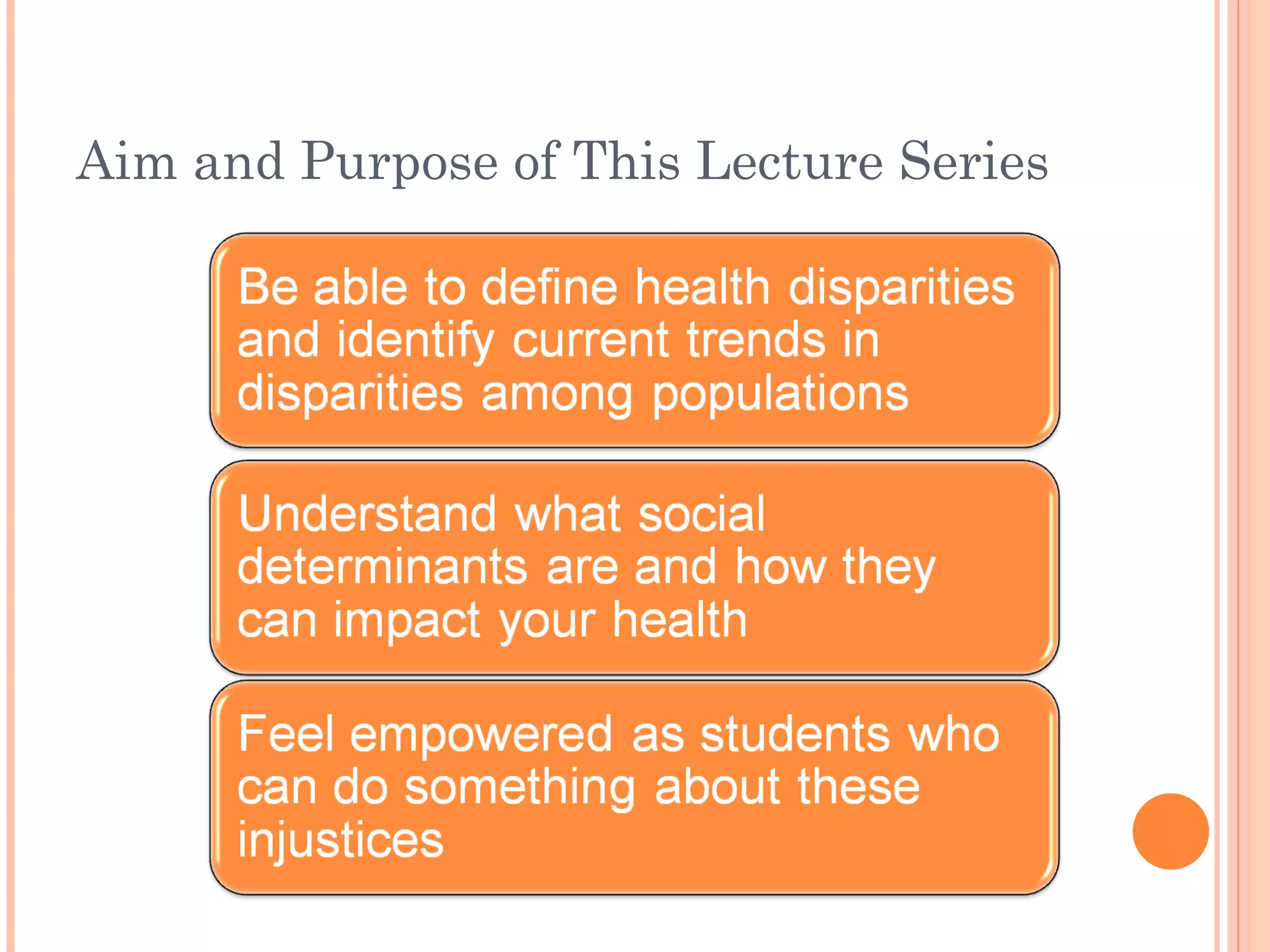
Aim and Purpose of This Lecture Series
TAKE-AWAYS FROM THIS LECTURE
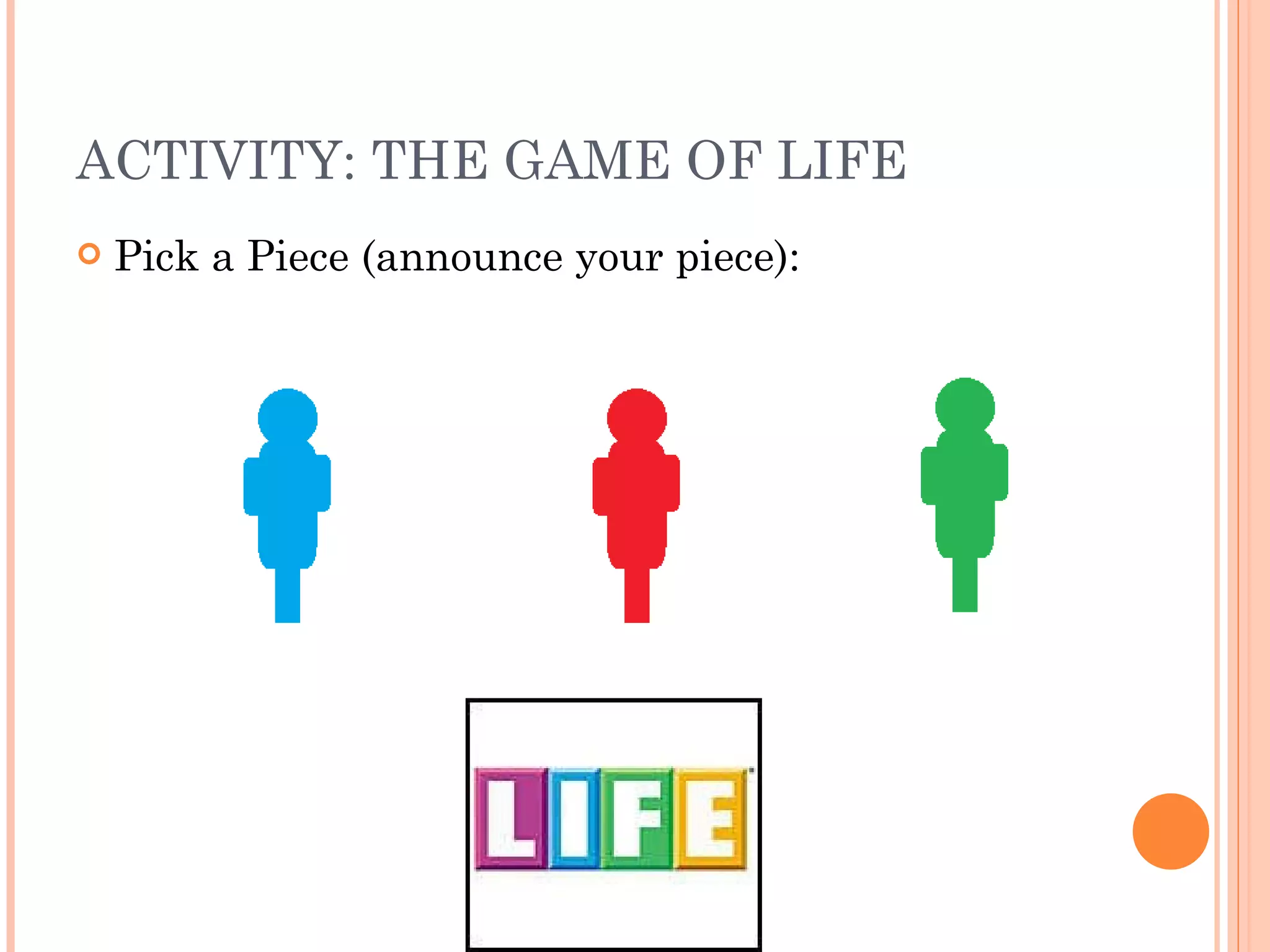
ACTIVITY: THE GAME OF LIFE Pick a Piece (announce your piece):
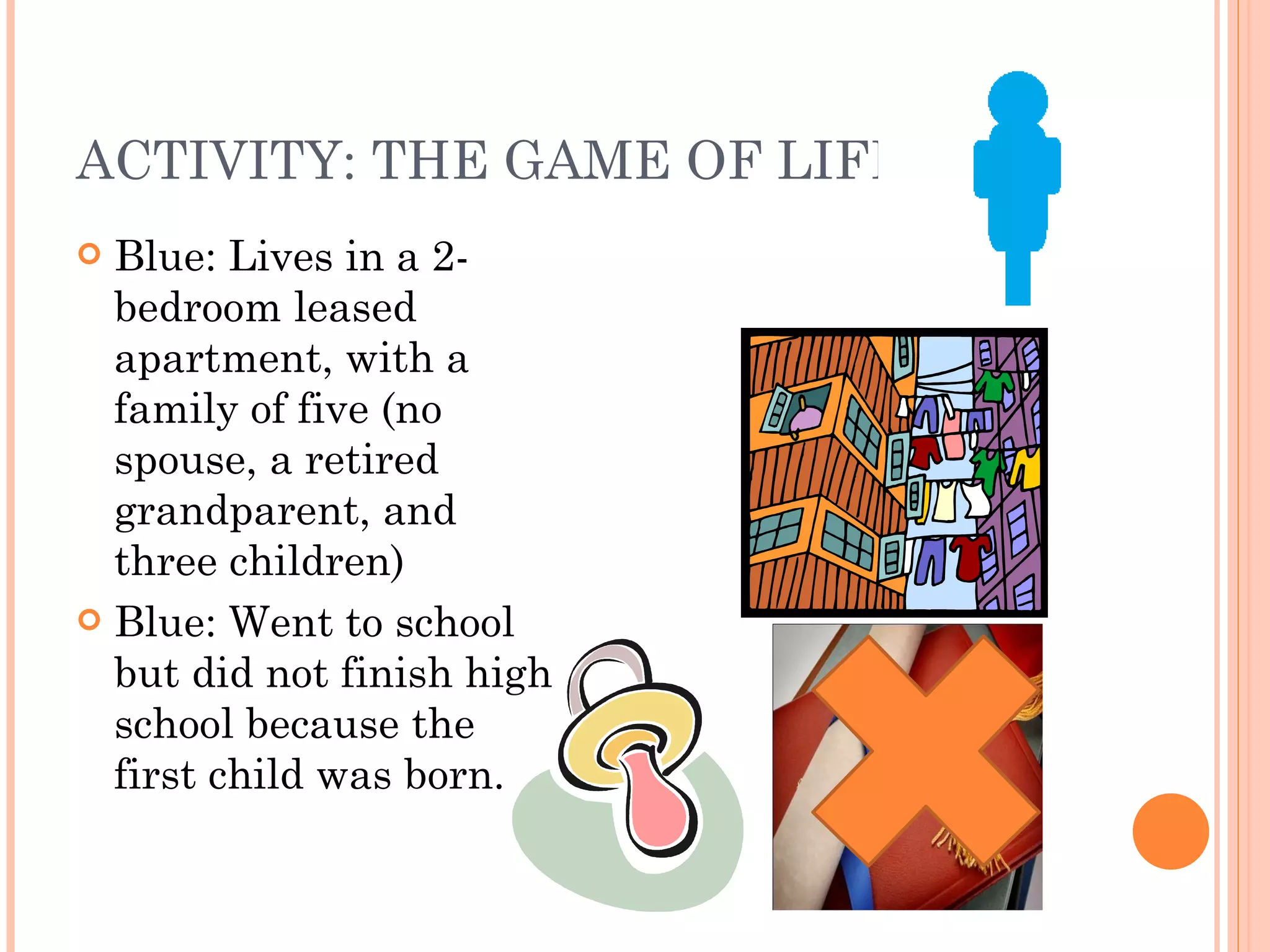
ACTIVITY: THE GAME OF LIFE Blue: Lives in a 2- bedroom leased apartment, with a family of five (no spouse, a retired grandparent, and three children) Blue: Went to school but did not finish high school because the first child was born.
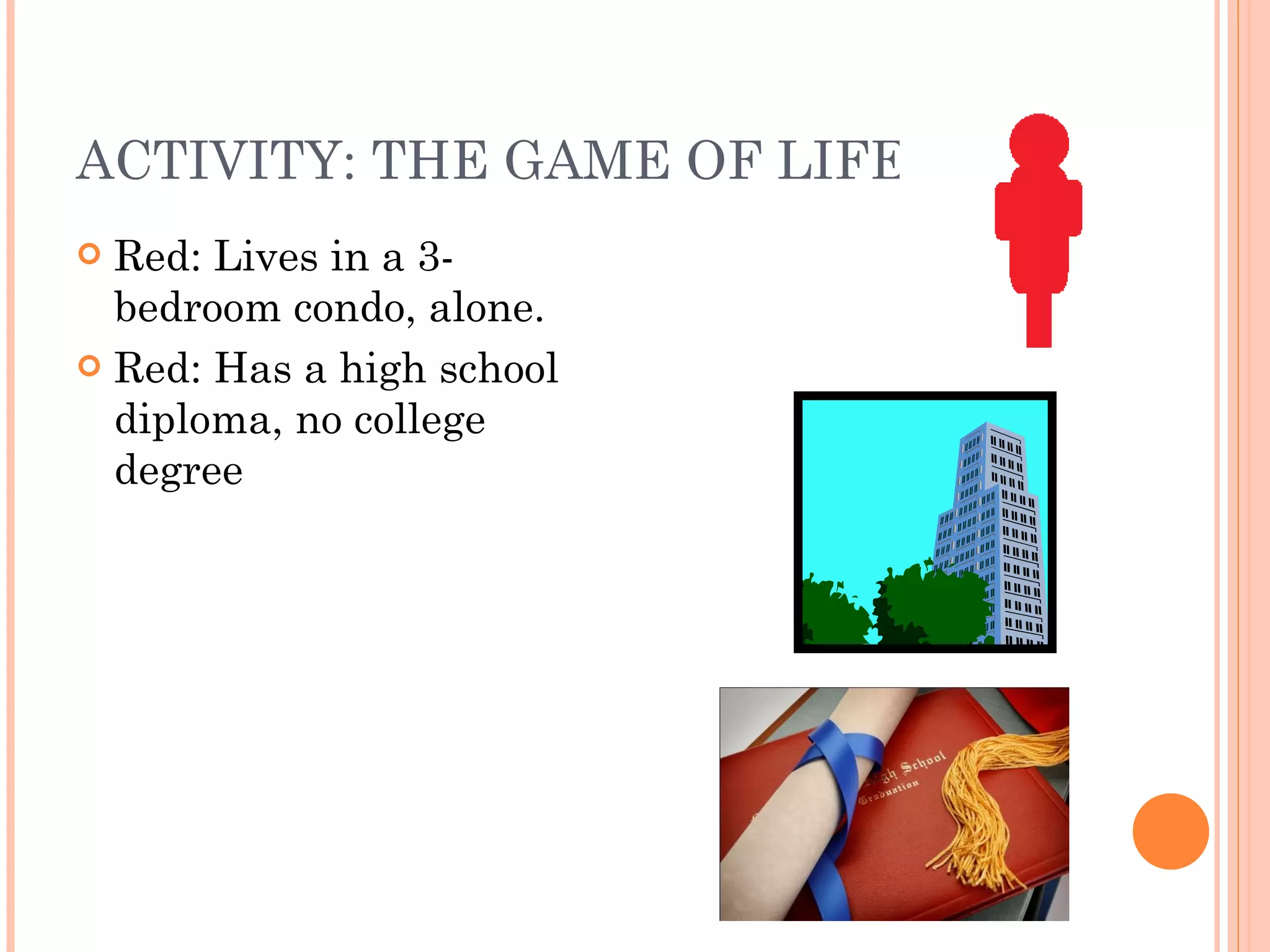
ACTIVITY: THE GAME OF LIFE Red: Lives in a 3- bedroom condo, alone. Red: Has a high school diploma, no college degree
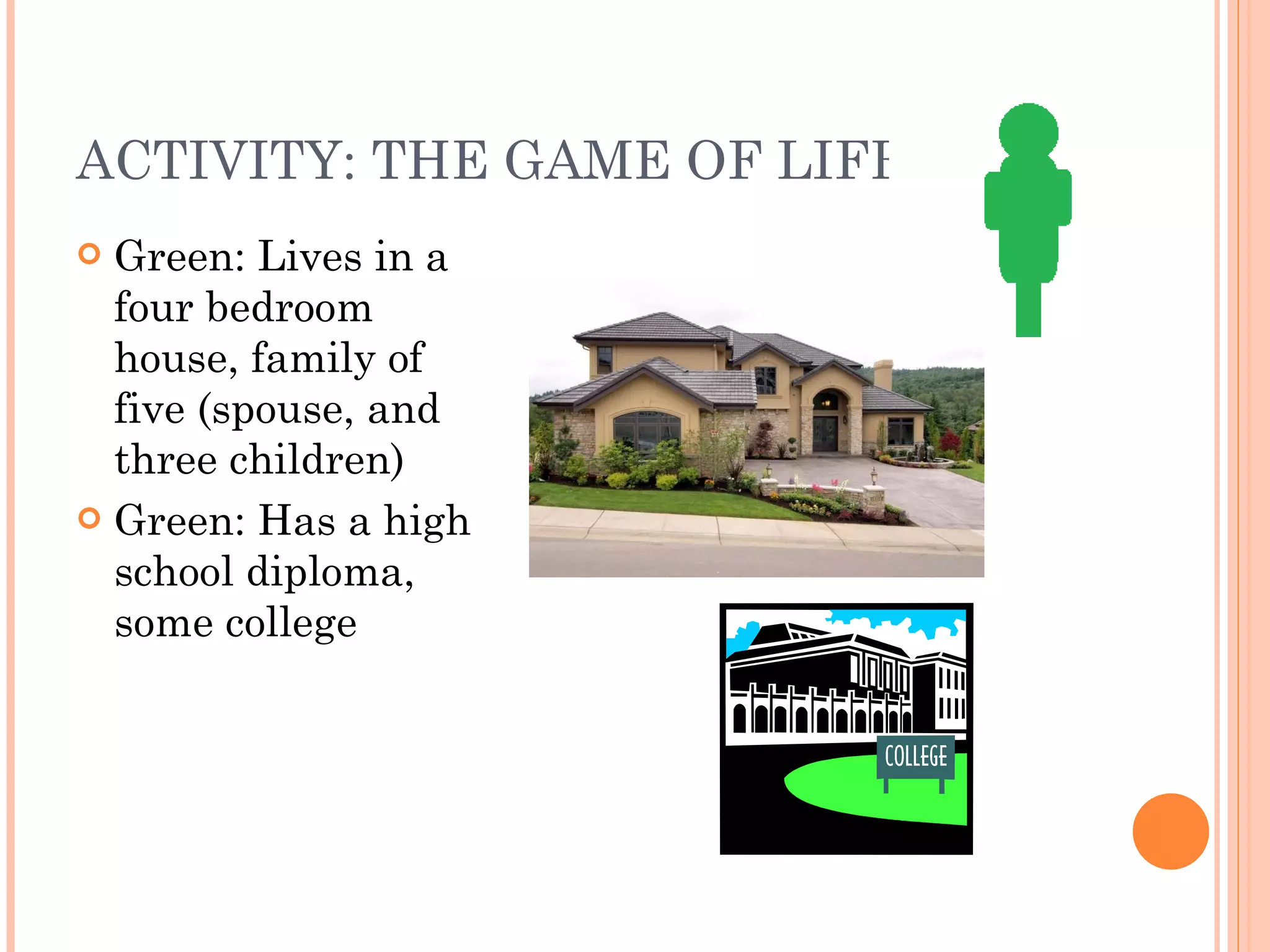
ACTIVITY: THE GAME OF LIFE Green: Lives in a four bedroom house, family of five (spouse, and three children) Green: Has a high school diploma, some college
ACTIVITY: THE GAME OF LIFE Remember your piece, we will come back to this activity at the end.
SOCIAL DETERMINANTS OF HEALTH
DEFINITION World Health Organization (WHO): The social determinants of health are the conditions in which people are born, grow, live, work and age, including the health system. In our words- Breaking down the word Social: your interactions with the external environment (your friends, family, places, and different systems) Determinants: Affecters or indicators… something that is determined or influenced by… Health: we all know what health is, but we put it in the context of physical, social, spiritual, and mental health.
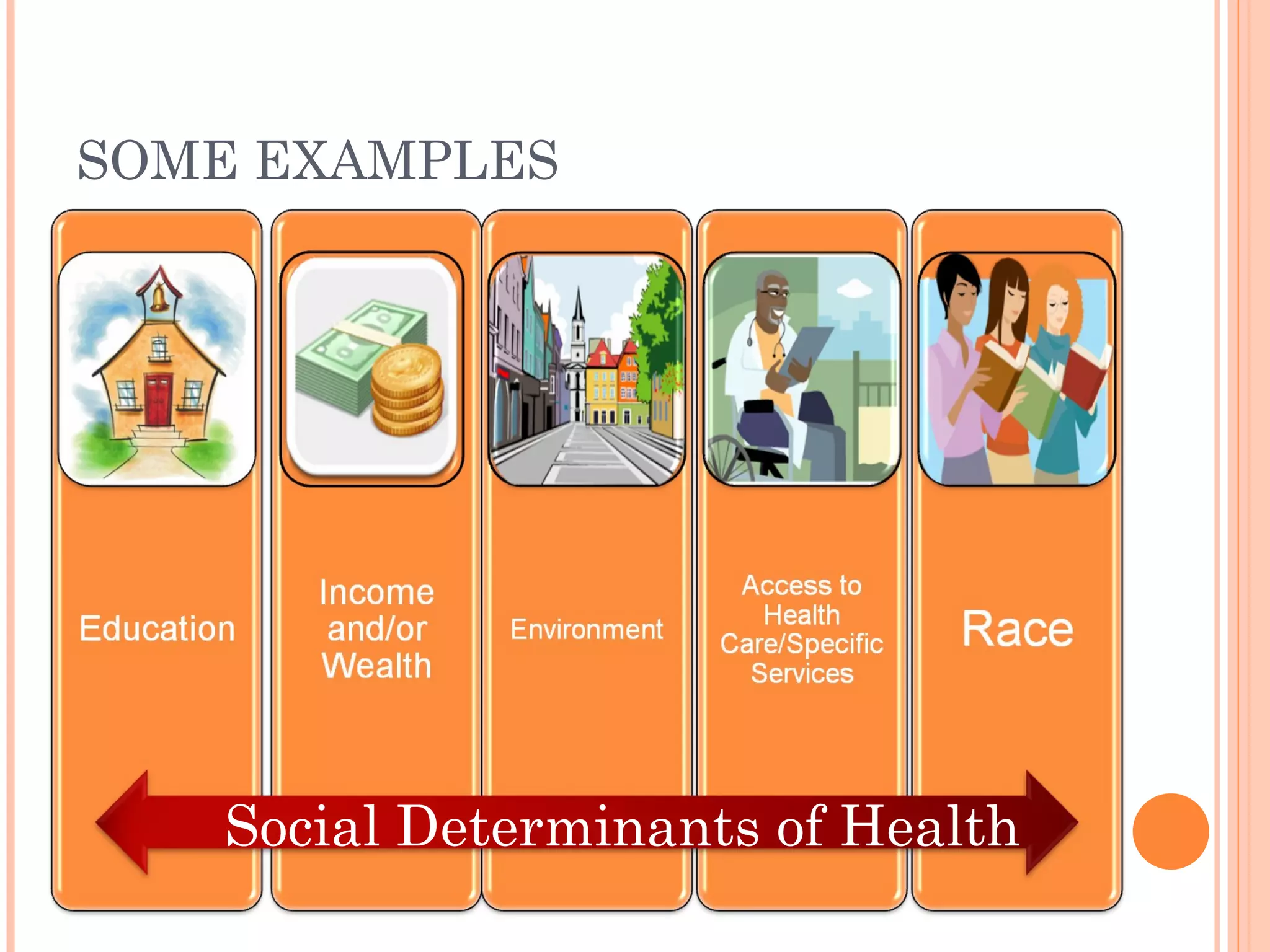
SOME EXAMPLES Social Determinants of Health
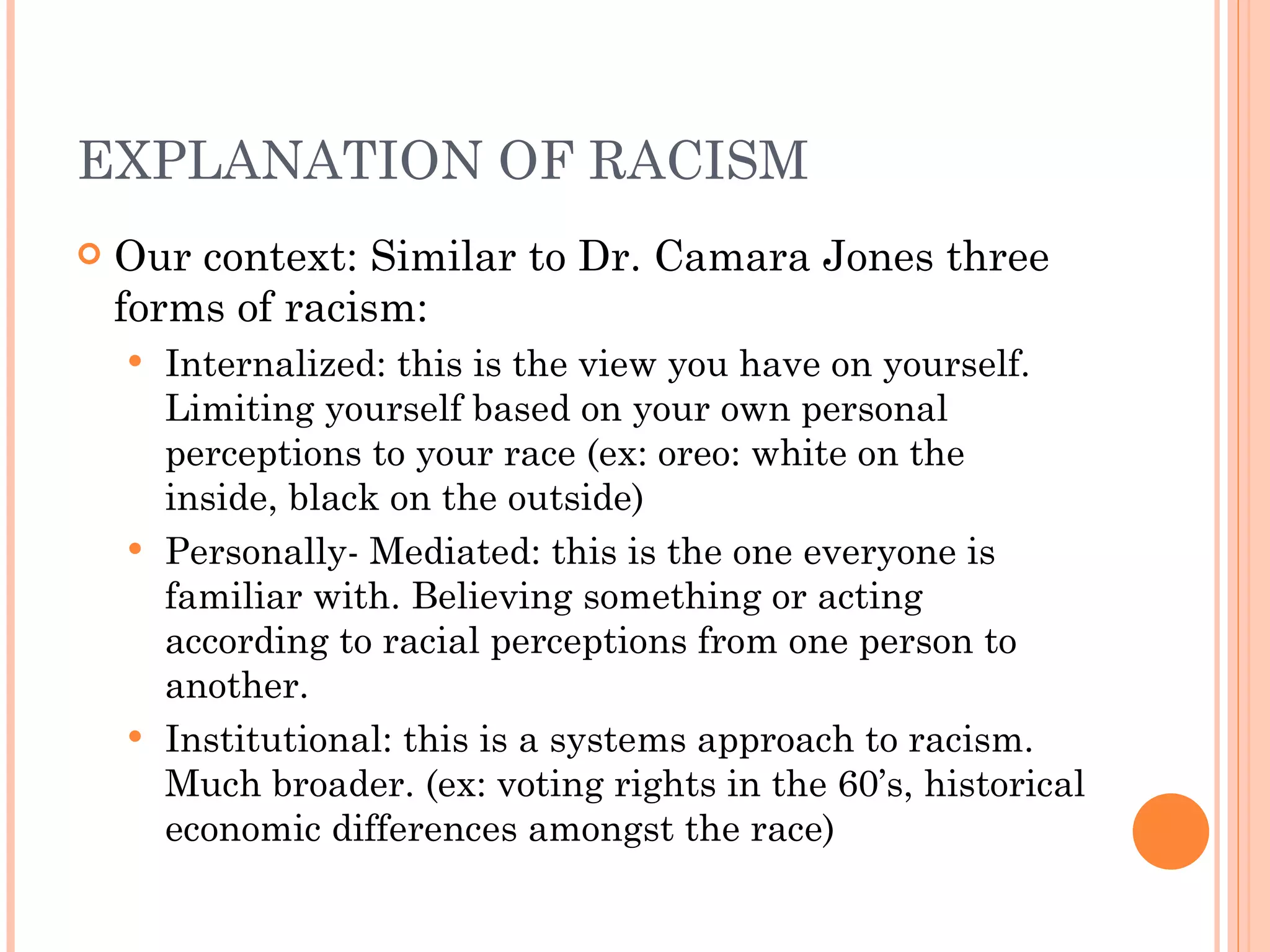
EXPLANATION OF RACISM Our context: Similar to Dr. Camara Jones three forms of racism: Internalized: this is the view you have on yourself. Limiting yourself based on your own personal perceptions to your race (ex: oreo: white on the inside, black on the outside) Personally- Mediated: this is the one everyone is familiar with. Believing something or acting according to racial perceptions from one person to another. Institutional: this is a systems approach to racism. Much broader. (ex: voting rights in the 60’s, historical economic differences amongst the race)
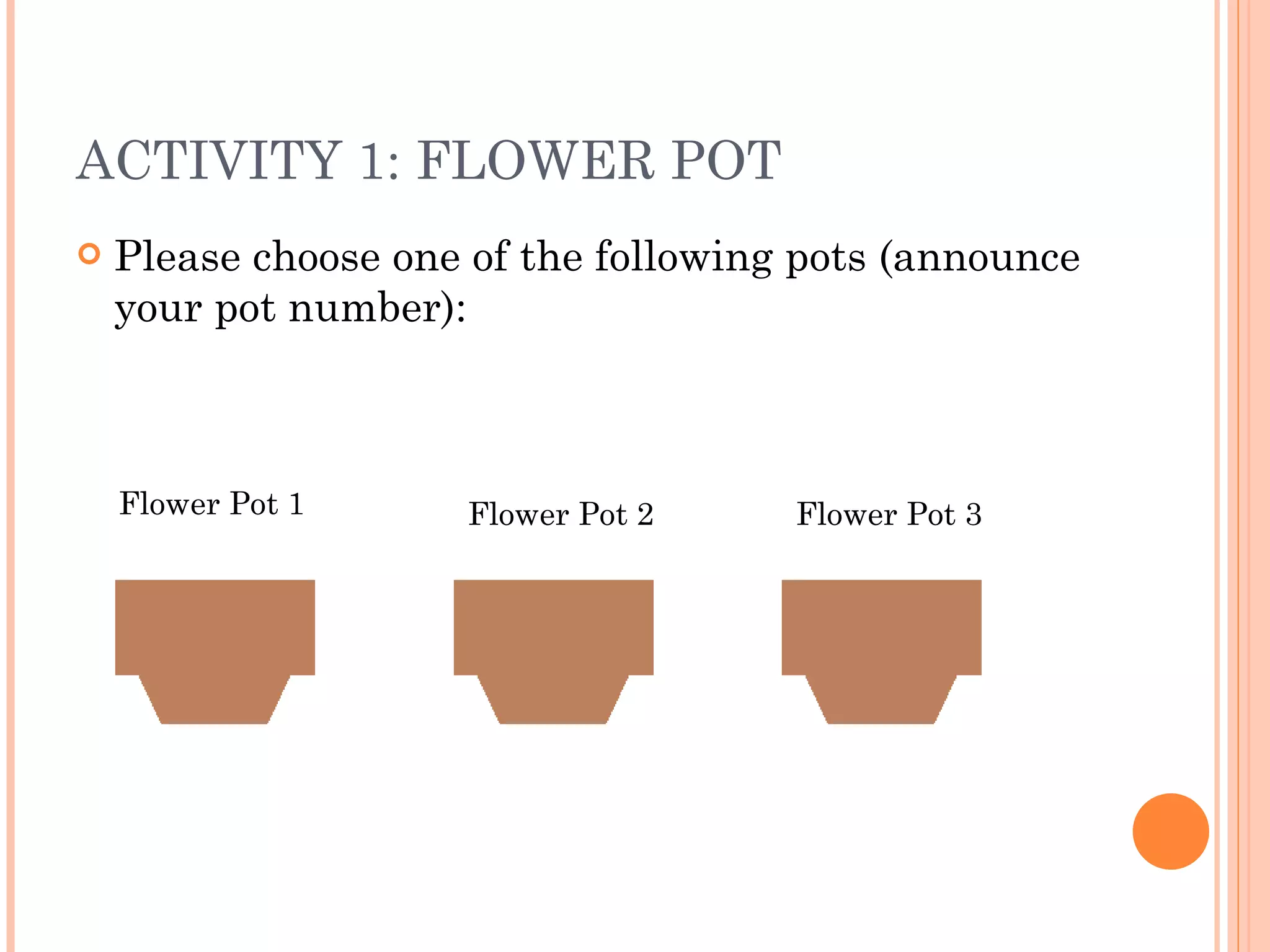
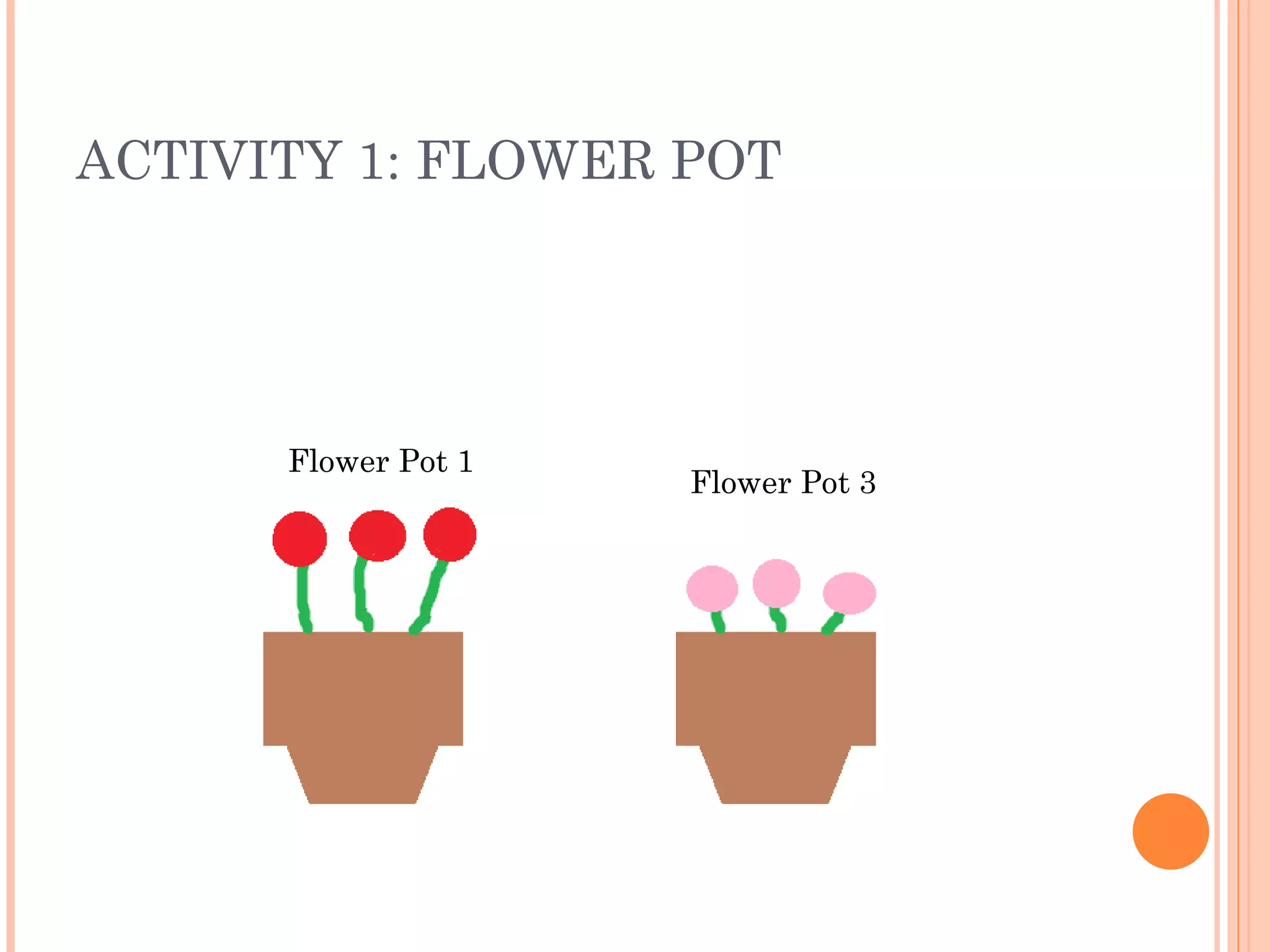
ACTIVITY 1: FLOWER POT Please choose one of the following pots (announce your pot number): Flower Pot 1 Flower Pot 2 Flower Pot 3
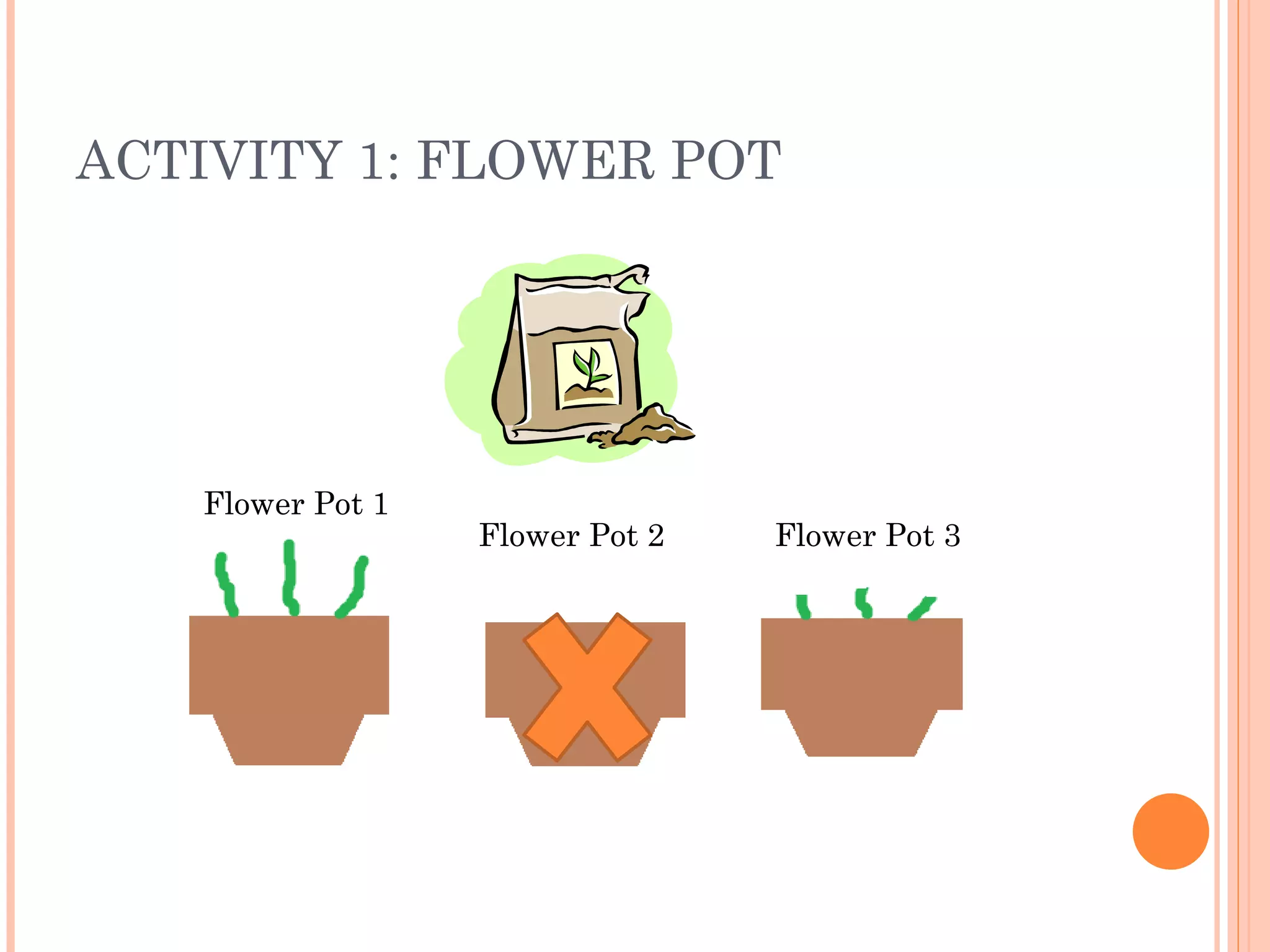
ACTIVITY 1: FLOWER POT Flower Pot 1 Flower Pot 2 Flower Pot 3
ACTIVITY 1: FLOWER POT Flower Pot 1 Flower Pot 3
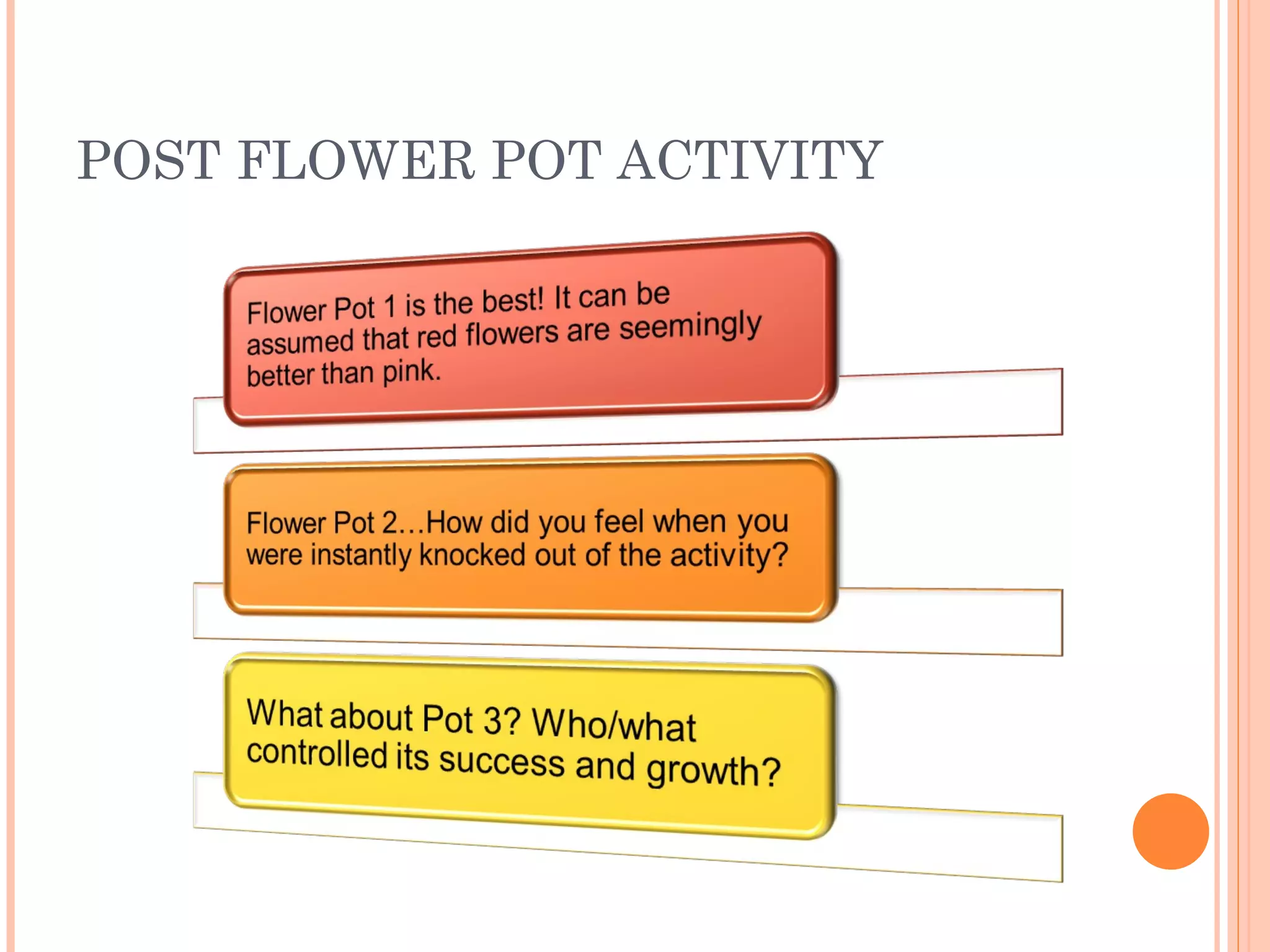
POST FLOWER POT ACTIVITY
SUMMARY/REASON FOR ACTIVITY Pot 1: represents what would be considered white in America (perceived to have better health outcomes, as we learned in the previous webinar). The provision of soil was the emphasis on historical happenings in the U.S. (right to vote, better paying jobs, etc.)
Pot 2: represents the other minorities that tend to be “forgotten” in the discussion of race in America. While the most dynamic and extreme differences are amongst black/white… the concepts of racism are not just a white vs. black battle.
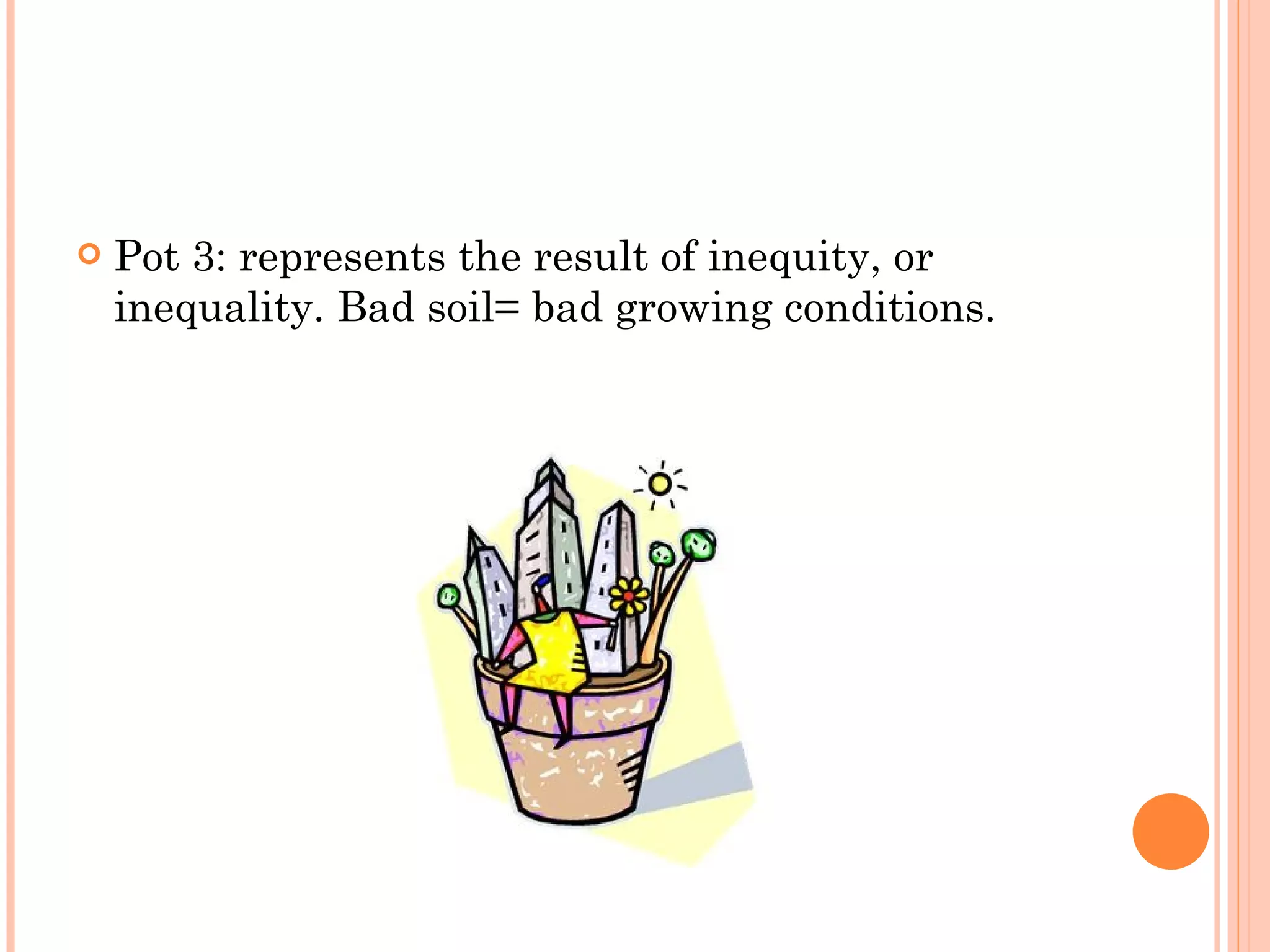
Pot 3: represents the result of inequity, or inequality. Bad soil= bad growing conditions.
QUESTIONS/COMMENTS So…. Who is responsible?
DIFFERENT APPROACHES Different influences based on behavior (more internal) healthy eating Different influences based on systems or society (more external) Access to healthy foods Behavior approach to health Systems approach to health
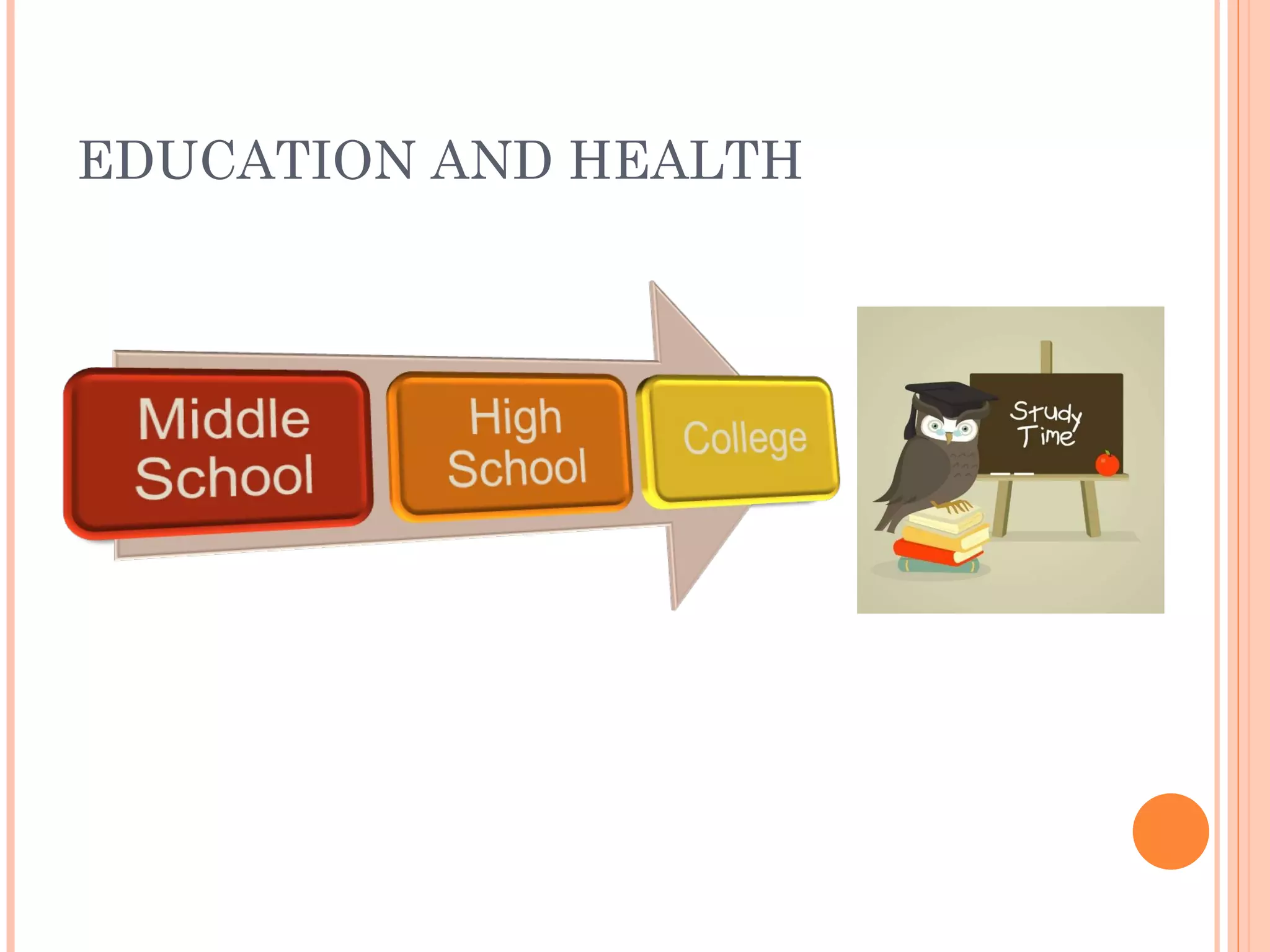
EDUCATION AND HEALTH
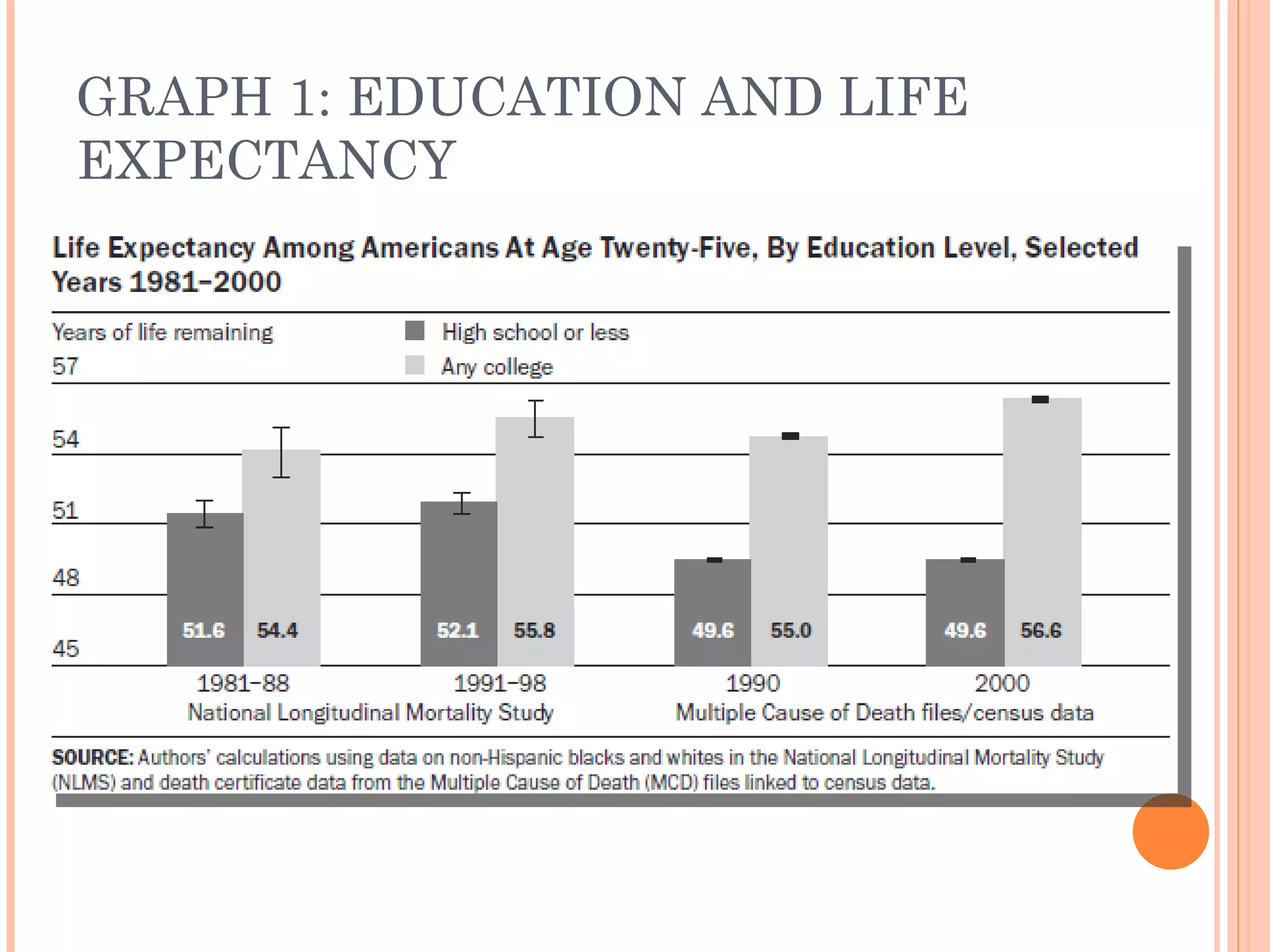
GRAPH 1: EDUCATION AND LIFE EXPECTANCY
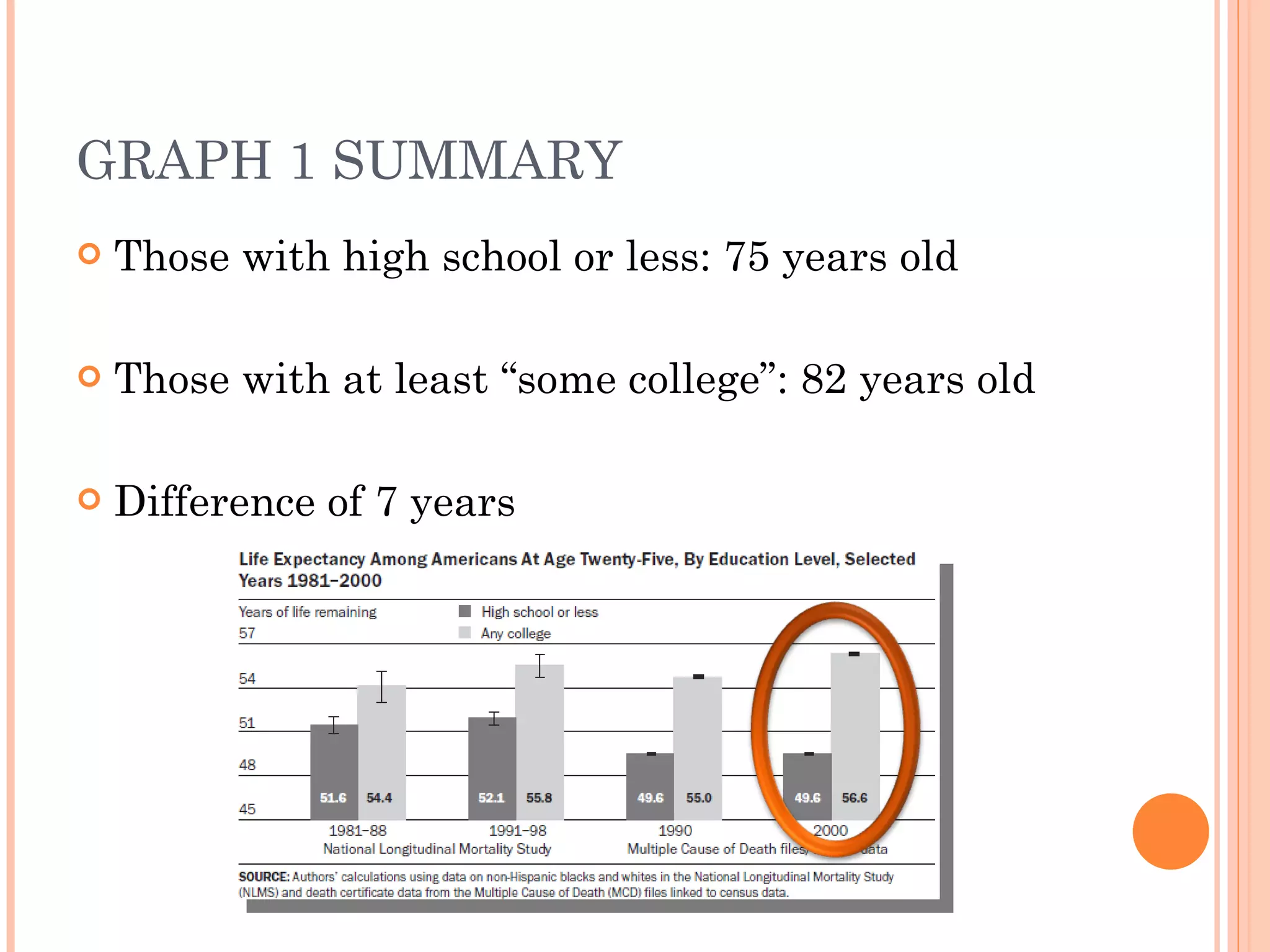
GRAPH 1 SUMMARY Those with high school or less: 75 years old Those with at least “some college”: 82 years old Difference of 7 years
EDUCATION’S IMPACT ON HEALTH Education can also be correlated with  behaviors Smoking rates Teen pregnancy Drug usage Education can be associated with  systems Finances   access to health care Employment stability Game of LIFE
INCOME (SOCIOECONOMIC STATUS) Socioeconomic Status (SES): is an economic and sociological combined total measure of a person's work experience and of an individual's or family’s economic and social position relative to others, based on  income ,  education , and occupation. In other words: Your social status and economic status fused together in one word in respect to your power or assets in society. Example: Lawyer vs. Janitor Game of LIFE example SES is a big factor in health Why?
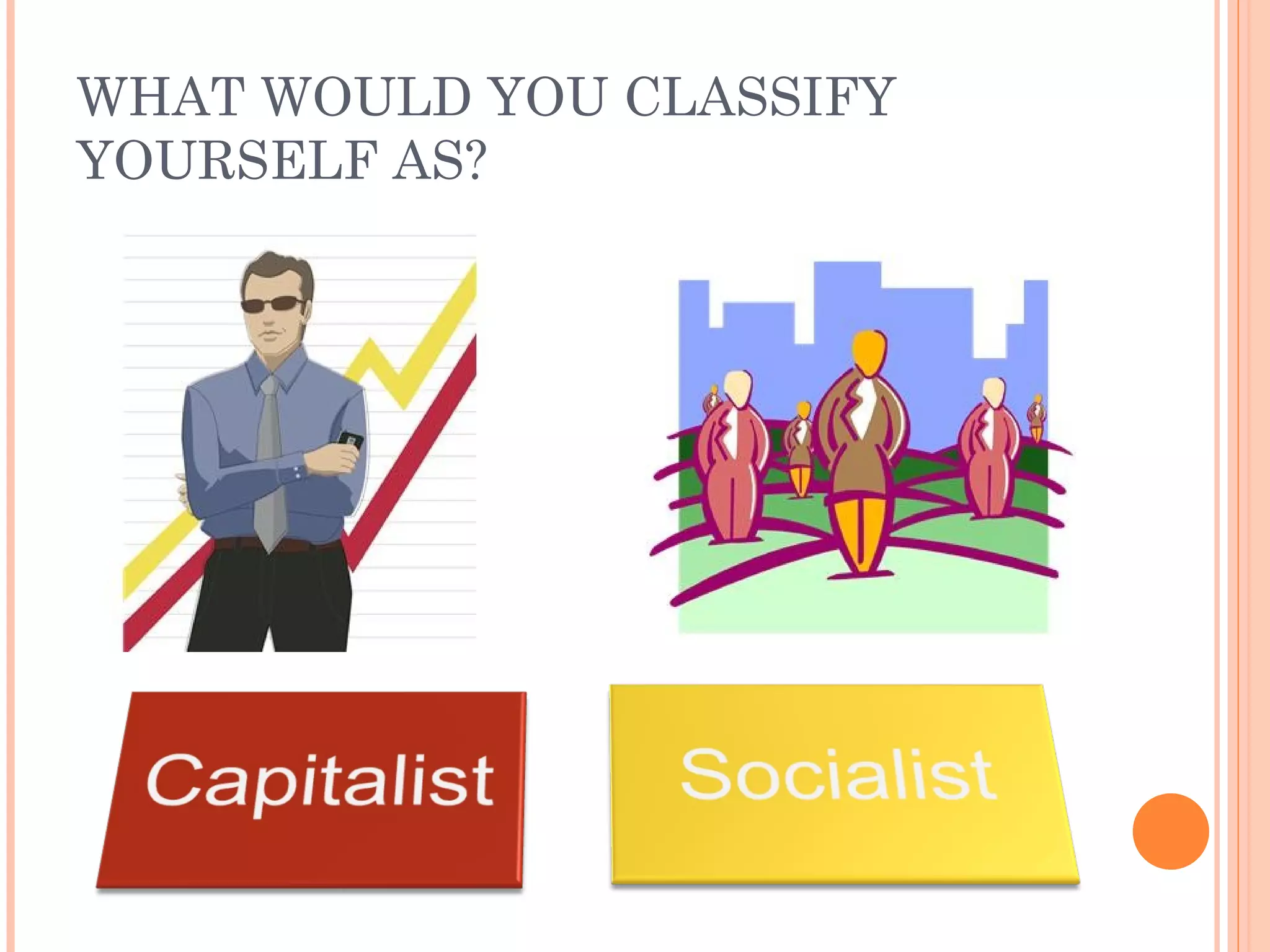
FACTS ON ECONOMIC THEORY Capitalist: the means and production are privately owned and operated for profit This is a popular form of both medical care and medical insurance in the US Socialist: A more cooperative or public ownership in business. Focuses on the abolition of hierarchal structures Medicaid and Medicare
WHAT WOULD YOU CLASSIFY YOURSELF AS?
THE UNITED STATES AND SES Why Economic Theories for this lecture? Neither capitalism or socialism is the answer, but the two are important to understand and respect in the US when talking about Social Determinants of Health.
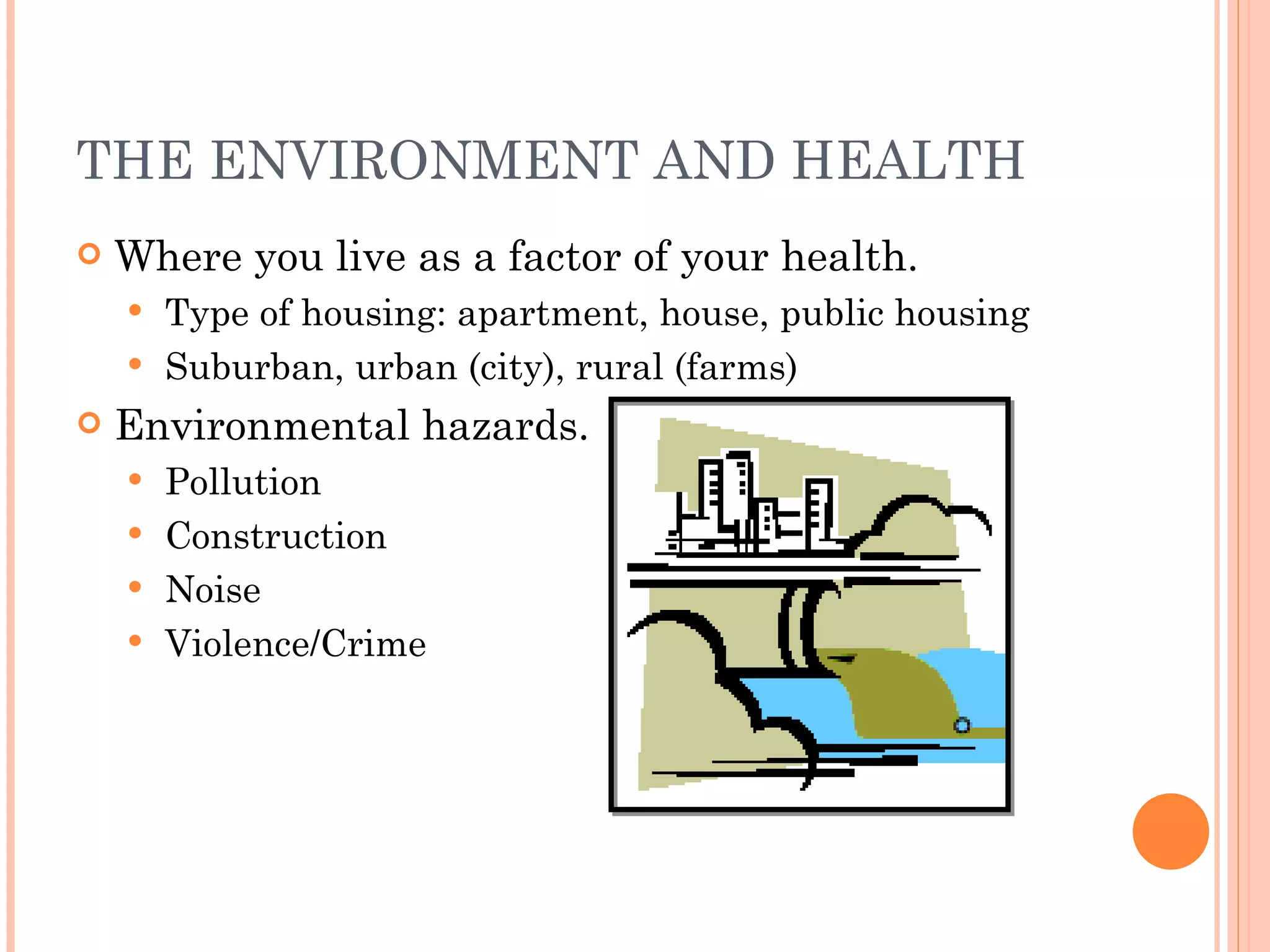
THE ENVIRONMENT AND HEALTH Where you live as a factor of your health. Type of housing: apartment, house, public housing Suburban, urban (city), rural (farms) Environmental hazards. Pollution Construction Noise Violence/Crime
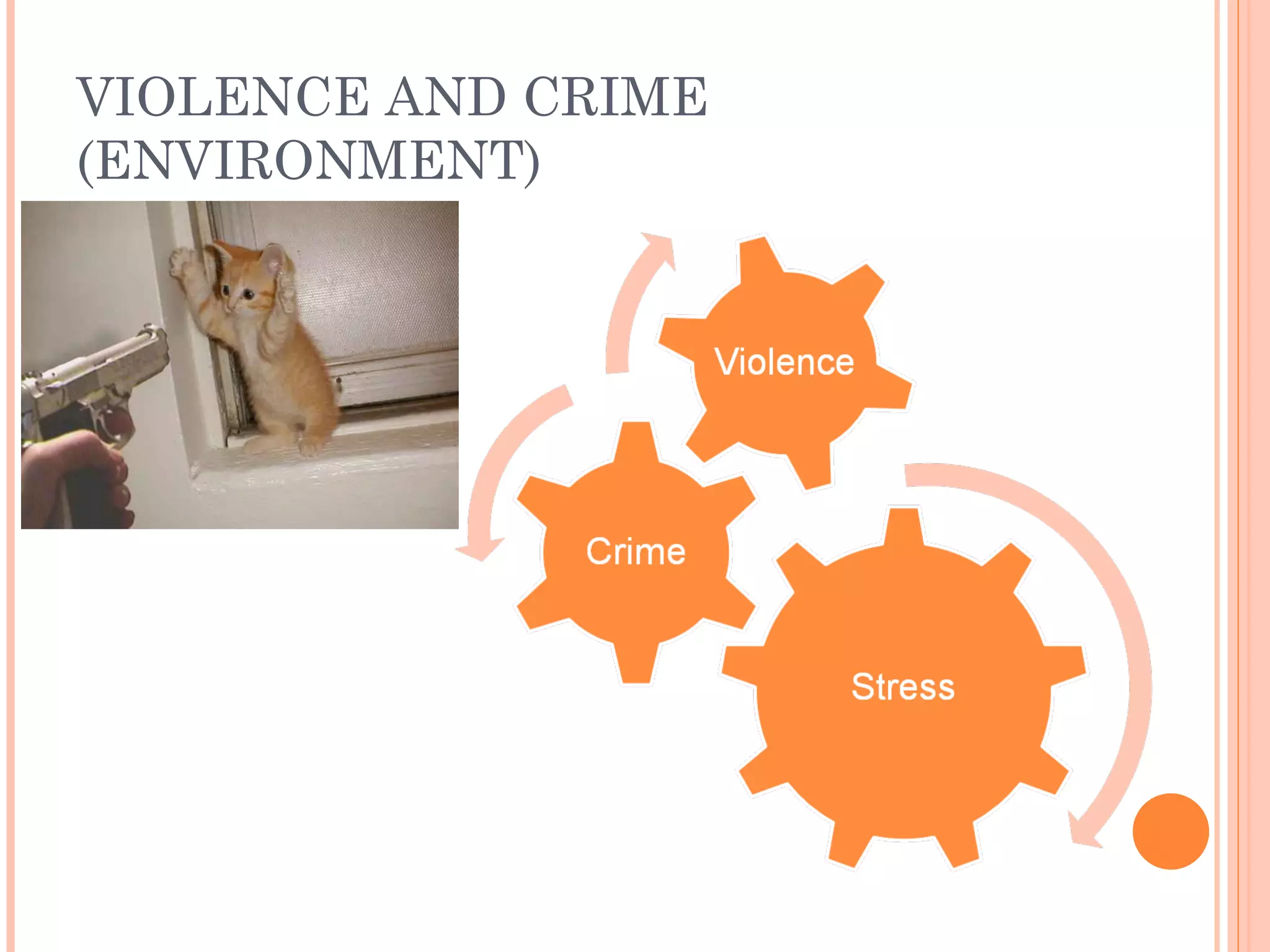
VIOLENCE AND CRIME (ENVIRONMENT)
STRESS We all know what stress is. But how does it affect you other than making you stay up long hours in the night trying to finish a paper? Fight or Flight Response Concept (Dr. Michael Lu, UCLA)
 
WHAT WOULD YOUR REACTION BE? Type what you would do? Would you pet the big kitty? Would you just accept your fate? Would you hit and run?
Those who wish to pet the tiger…. Your either crazy, love pets, or feel that petting the big angry cat will make him/her like you. Those who wish to accept their fate… well your not crazy, but you are probably going to get what you wish. Those who wish to hit and run… This is the most realistic response when you are “frightened”… This is the fight or flight response.
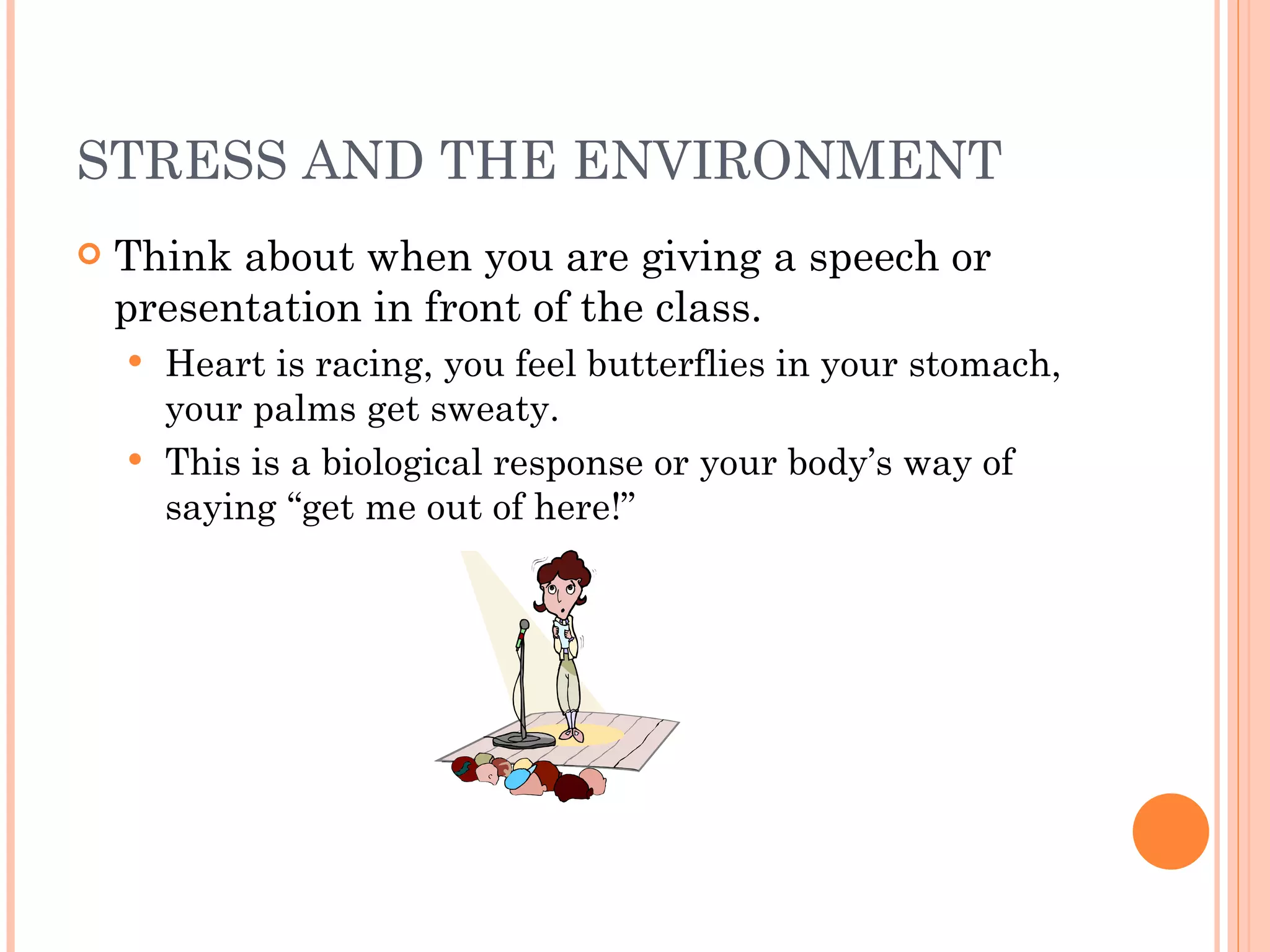
STRESS AND THE ENVIRONMENT Think about when you are giving a speech or presentation in front of the class. Heart is racing, you feel butterflies in your stomach, your palms get sweaty. This is a biological response or your body’s way of saying “get me out of here!”
STRESS AND VIOLENCE Stress is the same feeling, and has the same affect. Chronic stress Weathering on your body  Those that live in areas of crime and violence tend to be more stressed then those in safer neighborhoods   Stress leads to chronic disease (CVD, hypertension, and obesity) The game of LIFE
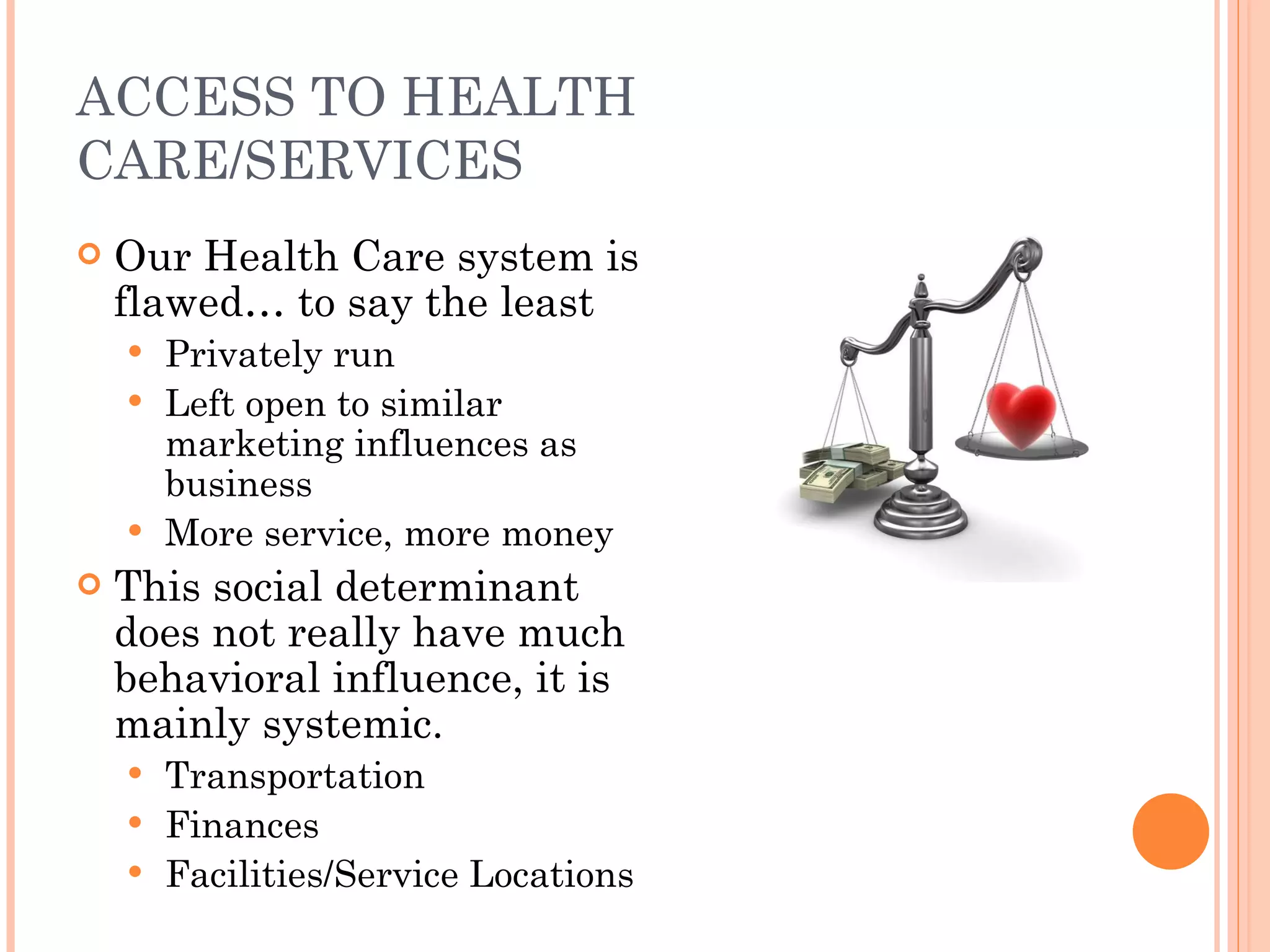
ACCESS TO HEALTH CARE/SERVICES Our Health Care system is flawed… to say the least Privately run Left open to similar marketing influences as business More service, more money This social determinant does not really have much behavioral influence, it is mainly systemic. Transportation Finances Facilities/Service Locations
ACCESS IS NOT THE ONLY ISSUE Access is just a piece. Quality/Equal Care Famous study by Harvard: “Unequal Treatment” Four patients (Black/White) who were actually actors Differences in diagnosis, difference in prescribed treatment… solely based on race What does this say about what is called “provider bias”? Is bias something that people can over come?
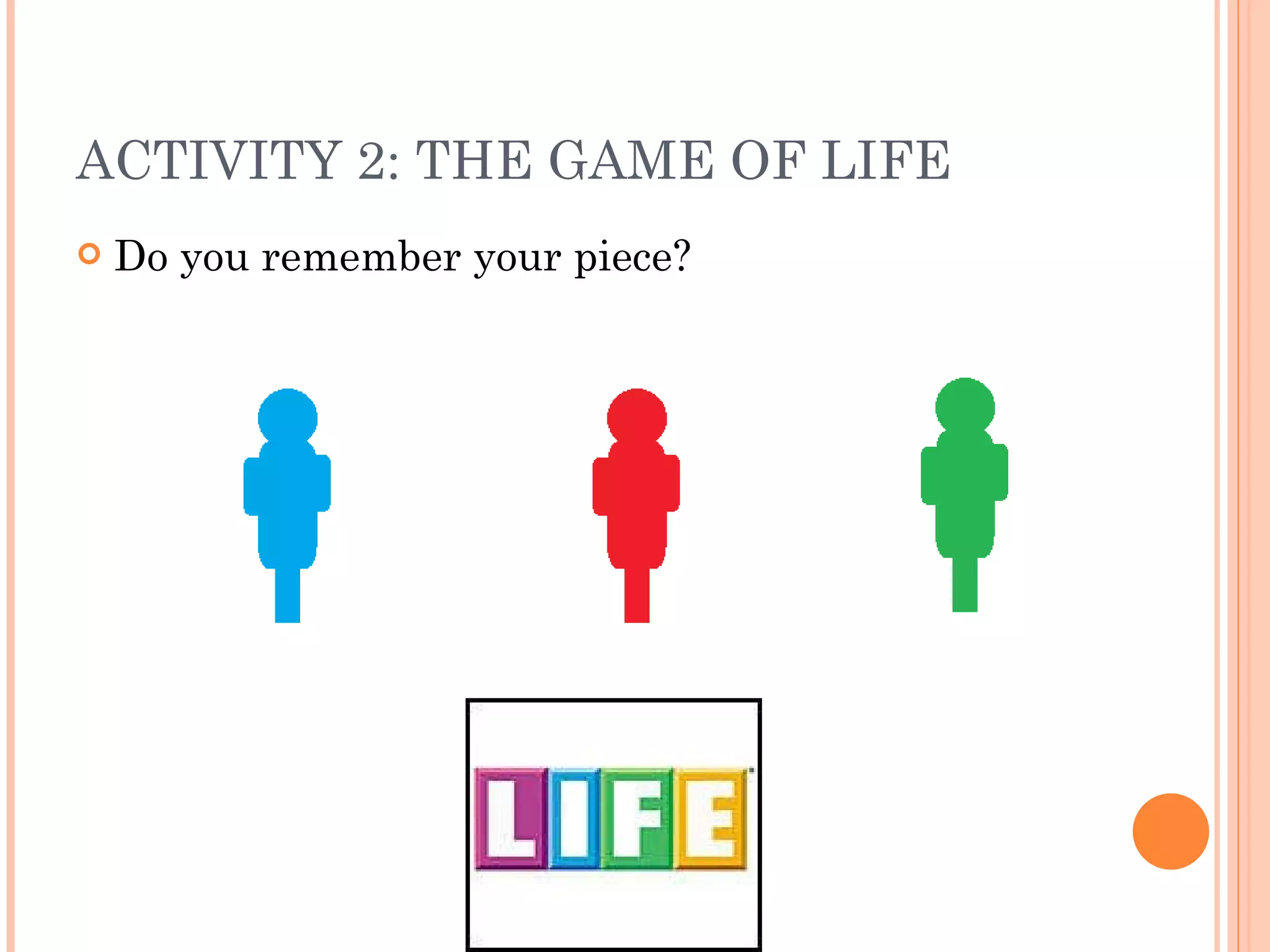
ACTIVITY 2: THE GAME OF LIFE Do you remember your piece?
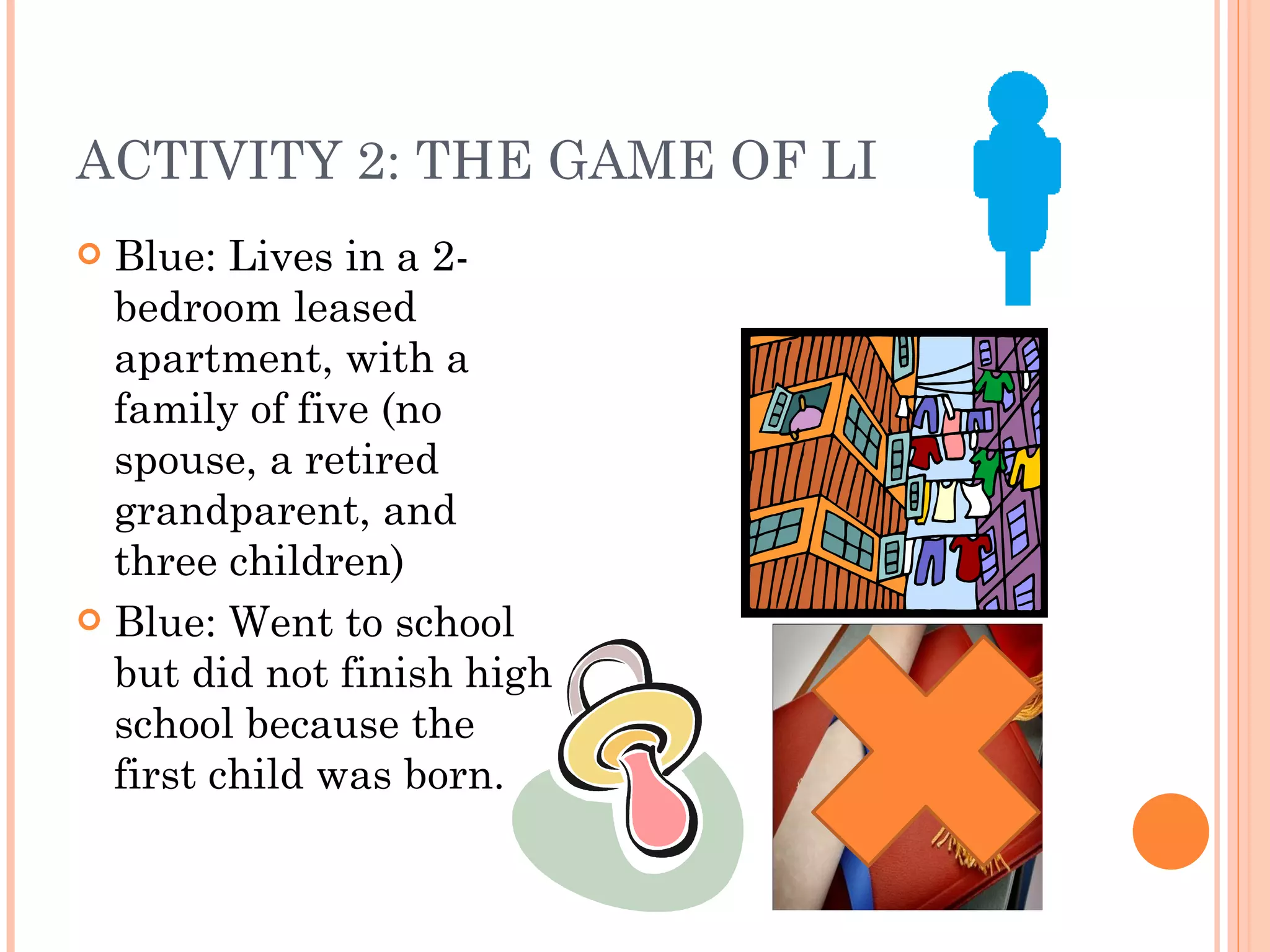
ACTIVITY 2: THE GAME OF LIFE Blue: Lives in a 2- bedroom leased apartment, with a family of five (no spouse, a retired grandparent, and three children) Blue: Went to school but did not finish high school because the first child was born.
ACTIVITY 2: THE GAME OF LIFE Red: Lives in a 3- bedroom condo,  alone . Red: Has a high school diploma, no college degree
ACTIVITY 2: THE GAME OF LIFE Green: Lives in a four bedroom house, family of five (spouse, and three children) Green: Has a high school diploma, some college
ACTIVITY 2: THE GAME OF LIFE Blue/Red/Green: Due to the economic crisis, all three loss their jobs. At the same time, they all had to go for surgery to remove their appendix due to appendicitis (infection of the appendix)
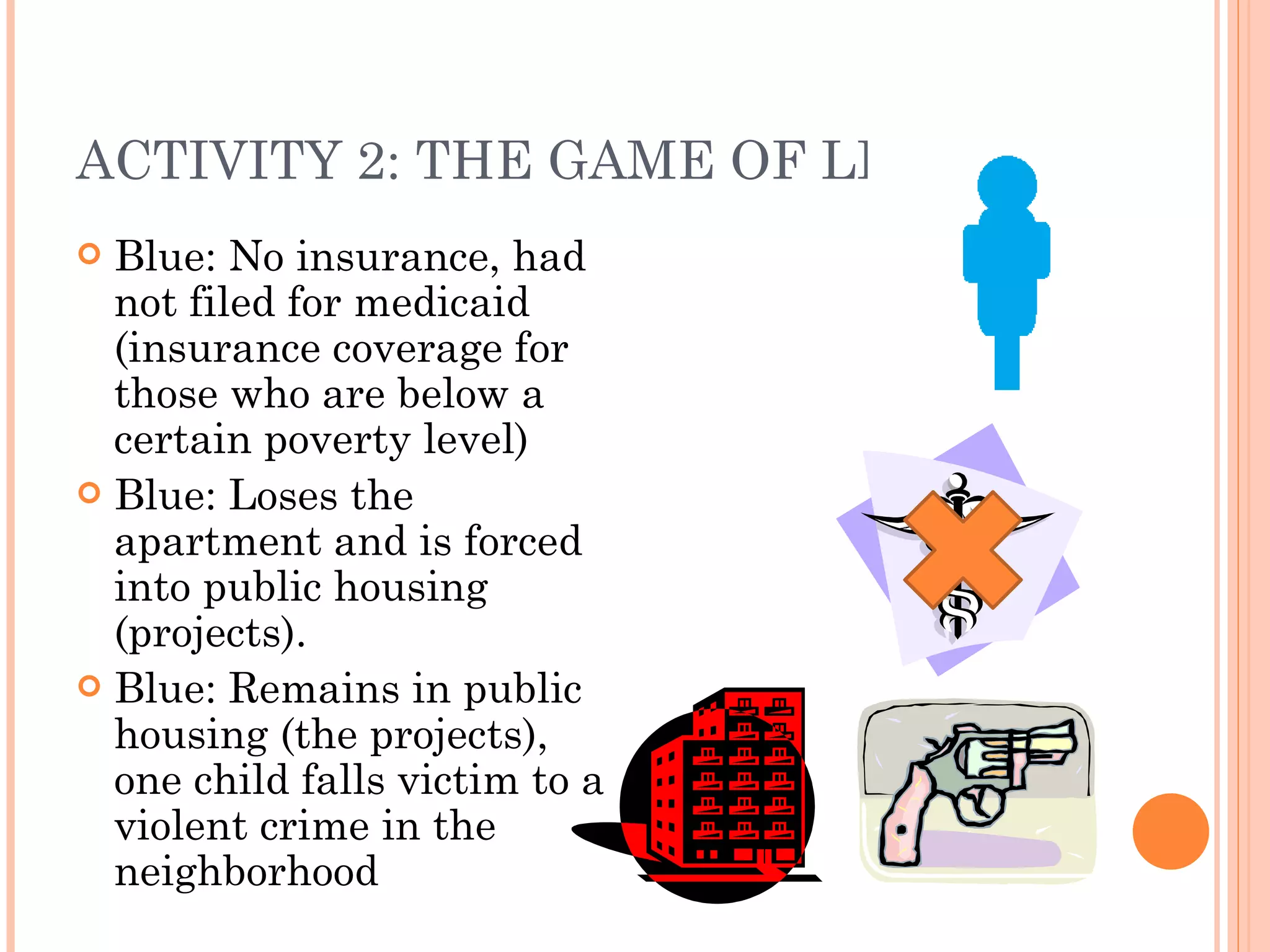
ACTIVITY 2: THE GAME OF LIFE Blue: No insurance, had not filed for medicaid (insurance coverage for those who are below a certain poverty level) Blue: Loses the apartment and is forced into public housing (projects). Blue: Remains in public housing (the projects), one child falls victim to a violent crime in the neighborhood
ACTIVITY 2: THE GAME OF LIFE Red: No insurance (does not meet the poverty level of medicaid). Red: Loses the condo, is homeless Red: Eventually…Picked up a managerial job and now lives in a apartment.
ACTIVITY 2: THE GAME OF LIFE Green: Covered by Blue Cross Blue Shield health insurance (a popular private insurance company) Green: Spouse provides financial support of the household  Green: Remains searching for a job comparable to the previous job, while the spouse supports the financial needs of the household
POST GAME OF LIFE ACTIVITY What happened to each person as they went through the exact same issues? How did it affect their health? Can you see the relation between education, environment, social support, and finances when it comes to health?
WHAT I HOPED YOU LEARNED

(HEPE) Introduction To Social Determinants Of Health (Hepe) 1

  • 1.
    INTRODUCTION TO SOCIALDETERMINANTS OF HEALTH By: Travis Howlette B.S., Jeff Wisniowski B.S., MPH and Kelsey Anilionis B.S. Health Equality Peer Educator Training (HEPE)
  • 2.
    HDSC WEBSITE/FACEBOOK Updatesto site affective April 15 th : http://enddisparities.org/HDSC/index.html Join us on Facebook: http://www.facebook.com/#!/hdscneu
  • 3.
  • 4.
    STUDENT SPEAKER TravisHowlette, Health Science Major (2011), Northeastern University. Pre-MPH/MD.
  • 5.
    Jeff Wisniowski B.S./MPHCandidate Kelsey Anilionis, Health Science B.S., 2011
  • 6.
    Aim and Purposeof This Lecture Series
  • 7.
  • 8.
    ACTIVITY: THE GAMEOF LIFE Pick a Piece (announce your piece):
  • 9.
    ACTIVITY: THE GAMEOF LIFE Blue: Lives in a 2- bedroom leased apartment, with a family of five (no spouse, a retired grandparent, and three children) Blue: Went to school but did not finish high school because the first child was born.
  • 10.
    ACTIVITY: THE GAMEOF LIFE Red: Lives in a 3- bedroom condo, alone. Red: Has a high school diploma, no college degree
  • 11.
    ACTIVITY: THE GAMEOF LIFE Green: Lives in a four bedroom house, family of five (spouse, and three children) Green: Has a high school diploma, some college
  • 12.
    ACTIVITY: THE GAMEOF LIFE Remember your piece, we will come back to this activity at the end.
  • 13.
  • 14.
    DEFINITION World HealthOrganization (WHO): The social determinants of health are the conditions in which people are born, grow, live, work and age, including the health system. In our words- Breaking down the word Social: your interactions with the external environment (your friends, family, places, and different systems) Determinants: Affecters or indicators… something that is determined or influenced by… Health: we all know what health is, but we put it in the context of physical, social, spiritual, and mental health.
  • 15.
    SOME EXAMPLES SocialDeterminants of Health
  • 16.
    EXPLANATION OF RACISMOur context: Similar to Dr. Camara Jones three forms of racism: Internalized: this is the view you have on yourself. Limiting yourself based on your own personal perceptions to your race (ex: oreo: white on the inside, black on the outside) Personally- Mediated: this is the one everyone is familiar with. Believing something or acting according to racial perceptions from one person to another. Institutional: this is a systems approach to racism. Much broader. (ex: voting rights in the 60’s, historical economic differences amongst the race)
  • 17.
    ACTIVITY 1: FLOWERPOT Please choose one of the following pots (announce your pot number): Flower Pot 1 Flower Pot 2 Flower Pot 3
  • 18.
    ACTIVITY 1: FLOWERPOT Flower Pot 1 Flower Pot 2 Flower Pot 3
  • 19.
    ACTIVITY 1: FLOWERPOT Flower Pot 1 Flower Pot 3
  • 20.
  • 21.
    SUMMARY/REASON FOR ACTIVITYPot 1: represents what would be considered white in America (perceived to have better health outcomes, as we learned in the previous webinar). The provision of soil was the emphasis on historical happenings in the U.S. (right to vote, better paying jobs, etc.)
  • 22.
    Pot 2: representsthe other minorities that tend to be “forgotten” in the discussion of race in America. While the most dynamic and extreme differences are amongst black/white… the concepts of racism are not just a white vs. black battle.
  • 23.
    Pot 3: representsthe result of inequity, or inequality. Bad soil= bad growing conditions.
  • 24.
  • 25.
    DIFFERENT APPROACHES Differentinfluences based on behavior (more internal) healthy eating Different influences based on systems or society (more external) Access to healthy foods Behavior approach to health Systems approach to health
  • 26.
  • 27.
    GRAPH 1: EDUCATIONAND LIFE EXPECTANCY
  • 28.
    GRAPH 1 SUMMARYThose with high school or less: 75 years old Those with at least “some college”: 82 years old Difference of 7 years
  • 29.
    EDUCATION’S IMPACT ONHEALTH Education can also be correlated with behaviors Smoking rates Teen pregnancy Drug usage Education can be associated with systems Finances  access to health care Employment stability Game of LIFE
  • 30.
    INCOME (SOCIOECONOMIC STATUS)Socioeconomic Status (SES): is an economic and sociological combined total measure of a person's work experience and of an individual's or family’s economic and social position relative to others, based on income , education , and occupation. In other words: Your social status and economic status fused together in one word in respect to your power or assets in society. Example: Lawyer vs. Janitor Game of LIFE example SES is a big factor in health Why?
  • 31.
    FACTS ON ECONOMICTHEORY Capitalist: the means and production are privately owned and operated for profit This is a popular form of both medical care and medical insurance in the US Socialist: A more cooperative or public ownership in business. Focuses on the abolition of hierarchal structures Medicaid and Medicare
  • 32.
    WHAT WOULD YOUCLASSIFY YOURSELF AS?
  • 33.
    THE UNITED STATESAND SES Why Economic Theories for this lecture? Neither capitalism or socialism is the answer, but the two are important to understand and respect in the US when talking about Social Determinants of Health.
  • 34.
    THE ENVIRONMENT ANDHEALTH Where you live as a factor of your health. Type of housing: apartment, house, public housing Suburban, urban (city), rural (farms) Environmental hazards. Pollution Construction Noise Violence/Crime
  • 35.
    VIOLENCE AND CRIME(ENVIRONMENT)
  • 36.
    STRESS We allknow what stress is. But how does it affect you other than making you stay up long hours in the night trying to finish a paper? Fight or Flight Response Concept (Dr. Michael Lu, UCLA)
  • 37.
  • 38.
    WHAT WOULD YOURREACTION BE? Type what you would do? Would you pet the big kitty? Would you just accept your fate? Would you hit and run?
  • 39.
    Those who wishto pet the tiger…. Your either crazy, love pets, or feel that petting the big angry cat will make him/her like you. Those who wish to accept their fate… well your not crazy, but you are probably going to get what you wish. Those who wish to hit and run… This is the most realistic response when you are “frightened”… This is the fight or flight response.
  • 40.
    STRESS AND THEENVIRONMENT Think about when you are giving a speech or presentation in front of the class. Heart is racing, you feel butterflies in your stomach, your palms get sweaty. This is a biological response or your body’s way of saying “get me out of here!”
  • 41.
    STRESS AND VIOLENCEStress is the same feeling, and has the same affect. Chronic stress Weathering on your body Those that live in areas of crime and violence tend to be more stressed then those in safer neighborhoods  Stress leads to chronic disease (CVD, hypertension, and obesity) The game of LIFE
  • 42.
    ACCESS TO HEALTHCARE/SERVICES Our Health Care system is flawed… to say the least Privately run Left open to similar marketing influences as business More service, more money This social determinant does not really have much behavioral influence, it is mainly systemic. Transportation Finances Facilities/Service Locations
  • 43.
    ACCESS IS NOTTHE ONLY ISSUE Access is just a piece. Quality/Equal Care Famous study by Harvard: “Unequal Treatment” Four patients (Black/White) who were actually actors Differences in diagnosis, difference in prescribed treatment… solely based on race What does this say about what is called “provider bias”? Is bias something that people can over come?
  • 44.
    ACTIVITY 2: THEGAME OF LIFE Do you remember your piece?
  • 45.
    ACTIVITY 2: THEGAME OF LIFE Blue: Lives in a 2- bedroom leased apartment, with a family of five (no spouse, a retired grandparent, and three children) Blue: Went to school but did not finish high school because the first child was born.
  • 46.
    ACTIVITY 2: THEGAME OF LIFE Red: Lives in a 3- bedroom condo, alone . Red: Has a high school diploma, no college degree
  • 47.
    ACTIVITY 2: THEGAME OF LIFE Green: Lives in a four bedroom house, family of five (spouse, and three children) Green: Has a high school diploma, some college
  • 48.
    ACTIVITY 2: THEGAME OF LIFE Blue/Red/Green: Due to the economic crisis, all three loss their jobs. At the same time, they all had to go for surgery to remove their appendix due to appendicitis (infection of the appendix)
  • 49.
    ACTIVITY 2: THEGAME OF LIFE Blue: No insurance, had not filed for medicaid (insurance coverage for those who are below a certain poverty level) Blue: Loses the apartment and is forced into public housing (projects). Blue: Remains in public housing (the projects), one child falls victim to a violent crime in the neighborhood
  • 50.
    ACTIVITY 2: THEGAME OF LIFE Red: No insurance (does not meet the poverty level of medicaid). Red: Loses the condo, is homeless Red: Eventually…Picked up a managerial job and now lives in a apartment.
  • 51.
    ACTIVITY 2: THEGAME OF LIFE Green: Covered by Blue Cross Blue Shield health insurance (a popular private insurance company) Green: Spouse provides financial support of the household Green: Remains searching for a job comparable to the previous job, while the spouse supports the financial needs of the household
  • 52.
    POST GAME OFLIFE ACTIVITY What happened to each person as they went through the exact same issues? How did it affect their health? Can you see the relation between education, environment, social support, and finances when it comes to health?
  • 53.
    WHAT I HOPEDYOU LEARNED

Editor's Notes

  • #2 Welcome Everyone! Thank you for joining us We are students HDSC Plug
  • #4 I just want to recognize our sponsors. Without them, this would not have been possible… So special thanks to them.
  • #5 Quick Introduction of myself President of HDSC 3-4 years of this work Shout out to CBPHC YC
  • #9 So now that you have heard me talk for a quick minute… I want to start this lecture with our first activity. The game of LIFE Blue: raise you hand Red: go faster Green: go slower Paying attention
  • #14 So now I want to ask you all what are social determinants of health and can you list a few in chat?
  • #16 Here are some examples of social determinants of health. So factors like your education level, your income/wealth, your environment, your ability to access the health care system… this includes overall ability to get to a hospital, and potentially specific services you may need… and then your race… which will be something we will start with.
  • #17 So I know no one really needs a definition of race or racism… but it is important to mention and understand in the scope of health. To explain how race can be seen as a social determinant of health, I will be explaining it in the context of Dr. Camara Jones three forms of racism…
  • #18 So to further grasp these concepts of racism, I will be also providing an activity that has been influenced by Dr. Camara Jones famous “Gardeners Tale.” Pot 1: Raise hand Pot 2: go faster Pot 3: go slower Good soil, bad soil Red flowers, pink flowers
  • #19 I decide to put the good soil and the red flower seed in pot 1, and then the bad soil and pink flower seeds in pot 3, and I just decided to only use 2 pots, so pot 2 people are out of this activity for now… Sorry guys… So after some time, I realize that pot 1 plants are seemingly growing tall and pot 3 plants are relatively smaller than pot 1.
  • #20 Now more time has passed and the flowers have bloomed… We see that the red flowers grew taller than the pink… so pot 1 wins in this activity…Now lets summarize from these results…
  • #21 Clearly since pot 1 had taller flowers, then those flowers are the best in our activity… So it is safe to assume that red flowers are better than pink… right? Now flower pot 2… I bet you did not like the fact that pot 1 and 3 at least got to go further than slide 1… And pot 3, think about who controlled the growth and success of that pot
  • #22 So if we break this down, we see that the good soil vs. bad soil represents historical disadvantages… African-Americans were historically disadvantaged here in the U.S., as we were originally brought in as slaves, with no income, with no societal/political power. This was the bad soil in our pot.
  • #23 As we have seen, a lot of the health disparity issues also affect hispanics, asian/pacific islanders and other races/ethnicities disproportionately. Also, the health of one group affects the health of us all… definite lines can not be drawn when it comes to health… and with our current system these health issues also impact our finances and tax money.
  • #24 So as a I mentioned before, that bad soil was symbolic of history… but it also can be a symbol of lack of resources… ghettos are ghettos because of that historical “bad soil” and it is still a “ghetto” because an area of neglect tends to stay neglected until someone makes those positive changes… this is where community empowerment and activism comes in… which you will hear about in the next lecture.
  • #25 So now I want to ask you… who is responsible for this uneven growth… these disparities? Think bigger than the pot exercise Feel free to use the chat to discuss… and at the same time I will pause here for any questions.
  • #26 3 forms of racism: Personally mediated and internalized is behavioral, institutionalized is systemic Another example of this approach is: Read slide
  • #27 First example Studies have shown disparities based on education level. No high school diploma, high school diploma, some college
  • #28 Graph comparing life expectancy rates based on education level. More explanation…
  • #29 In summary we are looking at the most recent date and see… (read slide) This tells us that on average those with some college live 7 years longer than those who just graduate high school Now why do you think that is?
  • #30 As we mentioned before, about the different approaches… there are many underlining factors that go in to the reason why education affects your health… So this can be explained by the behavior/system approach. (read off slide)… So lets take some time to assess how many of you out there have friends or acquaintances who fits some of these scenarios… So if you have had a friend who has not completed high school or attended college after high school and has either gotten pregnant, smokes, maybe into recreational drugs… then just hit the “raise your hand” button… Yea, see its something we have all had experience with, now if you just put it in the scope of Game of LIFE : Blue has no high school, red has high school diploma, green has some college… this will set the stage for our activity.
  • #31 Definition Example… Lawyer has a different status in the economy and in the US society than a janitor… that’s not to say that one is more valued than the other… but in the sense of economics, politics, and societal demands… a lawyer is seemingly of higher SES Game of LIFE: Blue lives in a leased apartment, Red: lives in a condo, Green: lives in a house Now think about SES… why would I make the claim that SES has been shown to be a big factor in your overall health?
  • #32 Explanation of two different economic theories… and their role in the US Capitalist: for profit hospitals, McDonalds.. Tiered system of distribution Socialist: medicaid and medicare, reach a certain age or degree of poverty… many non-profits Did I lose anybody with this talk on economics?
  • #33 Poll: to find out the dynamics of the group online today
  • #34 Important to understand opposing beliefs When talking about social determinants of health you can tend to get into debates and battles, so its good to understand a full picture.
  • #35 Next example
  • #36 Funny picture Gears turning… with violence, crime comes stress
  • #37 Dr. Lu quick bio Scenario: Sleeping in bed
  • #39 Poll
  • #42 Hormone- cortisol Expansion example of balloon This idea of environment is something you can try to remember for the activity.
  • #45 Blue: raise your hand Red: go faster Green: go slower Go over the scenarios again.
  • #53 Now to summarize this game of LIFE and the whole lecture… lets try answering some of these questions…