Felicia Purnomo 1711011041
Atika Putri Dianti 1711011108
EMPLOYEE BENEFITS
http://www.free-powerpoint-templates-design.com
Welcome!!
Insert the title of your subtitle Here
This PowerPoint Template has clean and neutral design
that can be adapted to any content and meets various
market segments.
Dr. Nova Mardiana,
S.E., M.M.
Group 4
1. Atika Putri Dianti
1711011108
2. Felicia Purnomo
1711011041
F E L I C I A A T I K A
LLeearnarningingOObbjjeecctivtiLearning Objectives
 Define a benefit and identify four strategic benefit
considerations.
 Distinguish between mandated and voluntary benefits and list
three examples of each.
 Discuss the shift of retirement plans from defined-benefit to
defined-contribution plans.
 Explain the importance of managing the costs of health benefits
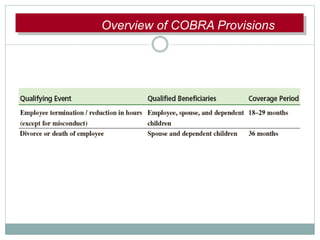
and identify some methods of doing so.
 Describe the growth of financial, family-oriented, and time-off
benefits and their importance to many employees.
 Summarize benefits communication and flexible benefits as
considerations in benefits administration.
BBeneneefitfBenefits
• Benefit
 An indirect compensation given to an employee or
group of employees as a part of organizational
membership.
• Strategic Perspectives on Benefits
 Benefits absorb social costs for health care and
retirement.
 Benefits influence employee decisions about
employers (e.g., recruitment and retirement).
 Benefits are increasingly seen as entitlements.
 Benefit costs average over 40% of total payroll costs.
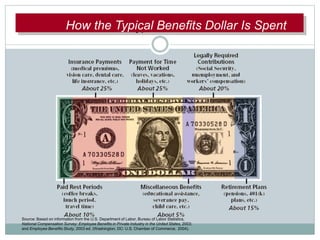
HHowowttheheTypiTypicalcal BBenefenefiittss DDololHow the Typical Benefits Dollar Is Spent
Source: Based on information from the U.S. Department of Labor, Bureau of Labor Statistics,
National Compensation Survey: Employee Benefits in Private Industry in the United States, 2003;
and Employee Benefits Study, 2003 ed. (Washington, DC: U.S. Chamber of Commerce, 2004).
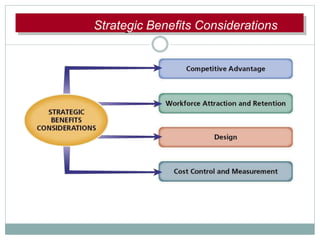
SSttrratategiegiccBBenefenefiittss CConsonsiideStrategic Benefits Considerations
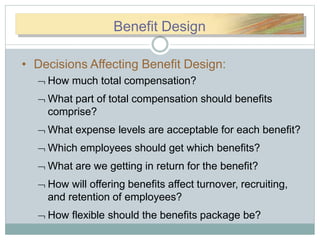
BBeneneefitfitDDBenefit Design
• Decisions Affecting Benefit Design:
 How much total compensation?
 What part of total compensation should benefits
comprise?
 What expense levels are acceptable for each benefit?
 Which employees should get which benefits?
 What are we getting in return for the benefit?
 How will offering benefits affect turnover, recruiting,
and retention of employees?
 How flexible should the benefits package be?
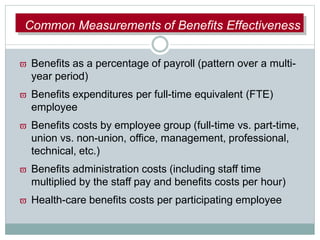
CComommmCommon Measurements of Benefits Effectiveness
 Benefits as a percentage of payroll (pattern over a multi-
year period)
 Benefits expenditures per full-time equivalent (FTE)
employee
 Benefits costs by employee group (full-time vs. part-time,
union vs. non-union, office, management, professional,
technical, etc.)
 Benefits administration costs (including staff time
multiplied by the staff pay and benefits costs per hour)
 Health-care benefits costs per participating employee
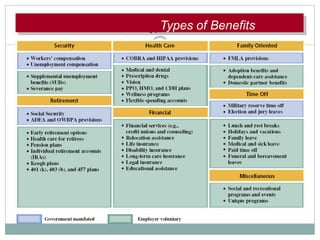
TypesTypes ofof BTypes of Benefits
SSececuuritrityyBeSecurity Benefits
• Worker’s Compensation
 Benefits provided to persons injured on the job.
• Unemployment Compensation
 A Federal/state payroll tax that funds state
unemployment systems.
 Involuntary unemployment and actively seeking work
is required for persons to claim benefit.
• Supplemental Unemployment Benefits (SUB)
 A union-negotiated benefit provision that pays a
supplemental amount to laid-off employees who are
drawing unemployment compensation.
SSece) Security Benefits
• Severance Pay
 A security benefit voluntarily offered by employer to
employees who lose their jobs.
 Payments are determined by the employee’s level
within the organization and years of employment.
 Other benefits (e.g., outplacement and continued
health insurance) may be offered in lieu of cash
severance payments.
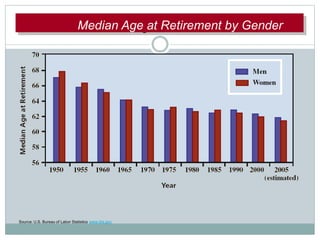
MMediediananAAgegeatatRRetetiirrememententbybMedian Age at Retirement by Gender
Source: U.S. Bureau of Labor Statistics www.bls.gov.
RRetiremetiremeennttBeBRetirement Benefits
• Retirements and Age Discrimination
 Age Discrimination in Employment Act (ADEA)
prohibits mandatory retirement age provisions.
 Older Workers Benefit Protection Act (OWBPA)
 Amended the ADEA and overturned a decision by the U.S.
Supreme Court in Public Employees Retirement System of
Ohio v. Betts.
 This act requires equal treatment for older workers in early
retirement or severance situations in setting forth specific
criteria that must be met when older workers sign waivers
promising not to sue for age discrimination.
RReettirRetirement Benefits (cont’d)
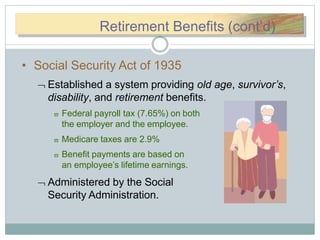
• Social Security Act of 1935
 Established a system providing old age, survivor’s,
disability, and retirement benefits.
 Federal payroll tax (7.65%) on both
the employer and the employee.
 Medicare taxes are 2.9%
 Benefit payments are based on
an employee’s lifetime earnings.
 Administered by the Social
Security Administration.
PPeennPension Plans
• Pension Plans
 Retirement benefits established and funded by
employers and employees.
• Traditional Benefit Plans
 Defined-benefit plans
 Employees are promised a definite pension amount based
on age and length of service.
 Defined-contribution plans
 Employer makes an annual payment to an employee’s
account.
 Benefit payout is determined by the financial performance of
the employee’s retirement.
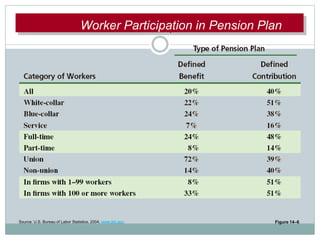
WWororkkererPPaarrttiicciipatpatiiononiinnPPWorker Participation in Pension Plan
Figure 14–6Source: U.S. Bureau of Labor Statistics, 2004, www.bls.gov.
PePennssionionPlaPlannss(c(cPension Plans (cont’d)
• Cash Balance Plans
 Benefits are based on an accumulation of annual
company contributions, expressed as a percentage of
pay, plus interest credited each year.
• Employee Retirement Income Security Act
(ERISA)
 Regulates pension funds to assure their soundness.
 Requires firms to offer retirement plans to all employees if
offered to any employees.
 Accrued benefits must be paid to departing employees.
 Requires minimum funding for IRS approval and purchase of
plan termination insurance.
ReRetiremtiremeennttEEqquuiitytyininPePennssioionnRetirement Equity in Pension Plans
• Arizona Governing Committee v. Norris
 U.S. Supreme Court decision requiring the use of
“unisex” mortality tables.
• The Retirement Equity Act
 An amendment to ERISA and the Internal Revenue
Code—liberalized pension regulations affecting
women, guaranteed access to benefits, prohibited
pension-related penalties due to absences from work,
and lowered the vesting age.
• Qualified Domestic Relations Order (QDRO)
 An agreement between a divorcing couple that
identifies who gets assets in a retirement plan.
PPenenssionionTTermermssananddCoPension Terms and Concepts
• Contributory Plan
 Both employer and employee pay money into the
retirement fund.
• Non-contributory Plan
 All pension benefits funding is paid by the employer.
• Vesting
 The right of employees to receive certain benefits
from their pension plans.
• Portability
 A pension plan feature that allows employees to move
their benefits from one employer to another.
CCoonnttroControlling Health-Care Benefits Costs
• Changing Co-Payment and Employee
Contributions
 Employees are required to pay a portion of the cost of
both insurance premiums and medical care through
increases in per-person deductibles.
 Elimination of first dollar coverage.
• Utilization Review
 Audit of the services and costs billed by health-care
providers.
 Requiring a second opinion, a review of the procedures
done, and a review of the charges for procedures done.
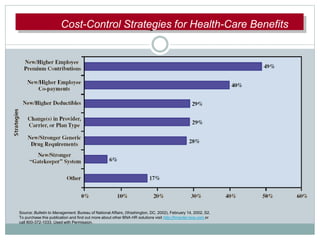
CCoostst--CCoonnttrorollSSttrraatteeggiieessffoorrHHeeaalltthh--CCaarreeBeBenneeffiittssCost-Control Strategies for Health-Care Benefits
Source: Bulletin to Management, Bureau of National Affairs, (Washington, DC, 2002), February 14, 2002, S2.
To purchase this publication and find out more about other BNA HR solutions visit http://hrcenter.bna.com or
call 800-372-1033. Used with Permission.
CCooControlling Health-Care Costs
• Managed Care
 Approaches that monitor and reduce medical costs
using restrictions and market system alternatives.
• Preferred Provider Organization
 A health-care provider that contract with an employer
group to provide health-care services to employees at
a competitive rate.
• Health Maintenance Organization (HMO)
 A managed care plan that provides services for a
fixed period on a prepaid basis.
CoConntrtroollinControlling Health-Care Costs
• Consumer-Driven Health (CDH) Plan
 Also known as defined-contribution health plans,
 Employers contribute a set amount to employees to
cover their own health-related expenses.
• Advantages
 More of the increases in health-care benefits are
shifted to employees
 The focus of controlling health-care usage falls on
employees, who may have to choose when to use
and not use health-care benefits.
HHeeaallthth-CHealth-Care Legislation
• Consolidated Omnibus Budget Reconciliation
Act (COBRA) Provisions
 Former employees are eligible to purchase group
insurance at no more than 102% of group insurance
premium rate.
 Former employees, their spouses, and eligible
dependents are covered for 18 to 36 months
 COBRA requirements incur additional paperwork and
related costs for employers.
HeHeaalth-Clth-CareareHealth-Care Legislation
• Health Insurance Portability and Accountability
Act (HIPAA) of 1996 Provisions
 Allows employees to switch their health insurance
plan from one company to another, regardless of pre-
existing health conditions.
 Health plans must continue to cover sickemployees.
 Require employers to provide privacy notices to
employees.
 Regulate the disclosure of protected health
information without authorization.
OOververviviewewofofCCOOBBRRAAPPrrOverview of COBRA Provisions
FFaammilyilyMMFamily Medical Leave Act (FMLA)
• Coverage
 Employers with 50 or more employees
 Employees who have worked at least 12 months and
1,250 hours in the previous year.
• Requirements
 Employers must allow eligible employees to take up
to a total of 12 weeks of unpaid leave in a 12-month
period to attend to a family or serious medical
condition.
 Employees have the right to continued health benefits
and the right to return to their job.
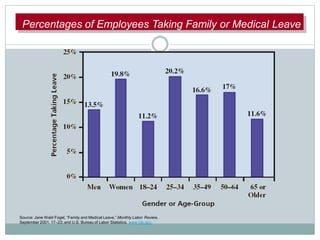
PePercercePercentages of Employees Taking Family or Medical Leave
Source: Jane Wald Fogel, “Family and Medical Leave,” Monthly Labor Review,
September 2001, 17–23; and U.S. Bureau of Labor Statistics, www.bls.gov.
BBeneBenefits for Domestic Partners
• Domestic Partners or Spousal Equivalents
 Unmarried employees who are living with individuals
of the opposite sex
 Gay and lesbian employees who have partners
• Affidavit of Spousal Equivalence
 Each is the other’s only spousal equivalent.
 They are not blood relatives.
 They are living together and jointly share
responsibility for their common welfare and financial
obligations.
TTimimee--OOffffTime-Off Benefits
 Holiday Pay
 Eligibility
 Vacation Pay
 Eligibility and scheduling
 Leaves of Absence
 Family Leave
 Medical and Sick Leave
 Military Leave
 Election Leave
 Jury-duty Leave
 Funeral Leave
•
•
• Paid Time-Off (PTO)
Plans
 Combine all sick leave,
vacation time, and holidays
into a total number of hours
or days that employees can
take off with pay.
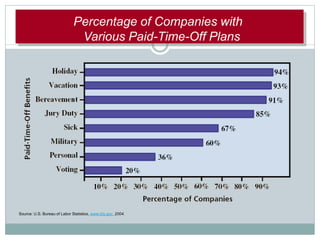
PPerercentcentageageofof
CCoommpanipanieses
Percentage of Companies with
Various Paid-Time-Off Plans
Source: U.S. Bureau of Labor Statistics, www.bls.gov. 2004.
BBeennefitsefitsBenefits Administration
• Benefits Communication
 Benefits Statements
 Annual “personal statement of benefits” that translates the
benefits into dollars to show their worth.
 The Internet and Benefits Communication
 Web-based HR information systems allows employees to
change their benefit choices, track their benefit balances,
and seek benefit information on-line.
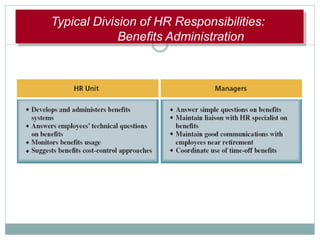
TTypypiicalcalDDiivivisisiononofofHHRR
RResesppoonsinsibibilliittiies:es:
Typical Division of HR Responsibilities:
Benefits Administration
FFlexlexiibbleleBeBenneefifFlexible Benefits
• Flexible Benefit Plan
 A plan (flex or cafeteria plan) that allows employees
to select the benefits they prefer from groups of
benefits established by the employer.
• Problems with Flexible Plans
 Inappropriate benefits package choices
 Adverse selection and use of specific benefits by
higher-risk employees
 Higher administrative const
AAwwaardsr
ds
Awards
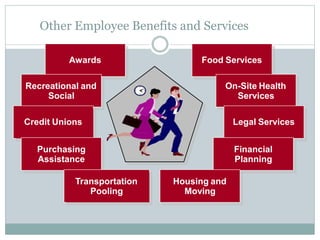
Other Employee Benefits and Services
RReeccrereaattiioonanall
aandndSSocociiaall
Recreational and
Social
CCrerediditt
UUniniononss
Credit Unions
FFoodood
SSeervrviicceess
Food Services
PPurcurchahass
iingng AAssssii
Purchasing
Assistance
TraTransnspportorta
attiionon P
Transportation
Pooling
OOnn--SSiitteeHHeeaalltthh
SSeervrviicceess
On-Site Health
Services
LLeegagallSSeervrviicceessLegal Services
FFiinanancnc
iiaall PPlla
Financial
Planning
HHooususiingng
aannddMMovovii
Housing and
Moving
Chapter 13 Employee Benefit

Chapter 13 Employee Benefit

  • 1.
    Felicia Purnomo 1711011041 AtikaPutri Dianti 1711011108 EMPLOYEE BENEFITS http://www.free-powerpoint-templates-design.com
  • 2.
    Welcome!! Insert the titleof your subtitle Here This PowerPoint Template has clean and neutral design that can be adapted to any content and meets various market segments. Dr. Nova Mardiana, S.E., M.M.
  • 3.
    Group 4 1. AtikaPutri Dianti 1711011108 2. Felicia Purnomo 1711011041 F E L I C I A A T I K A
  • 4.
    LLeearnarningingOObbjjeecctivtiLearning Objectives  Definea benefit and identify four strategic benefit considerations.  Distinguish between mandated and voluntary benefits and list three examples of each.  Discuss the shift of retirement plans from defined-benefit to defined-contribution plans.  Explain the importance of managing the costs of health benefits and identify some methods of doing so.  Describe the growth of financial, family-oriented, and time-off benefits and their importance to many employees.  Summarize benefits communication and flexible benefits as considerations in benefits administration.
  • 5.
    BBeneneefitfBenefits • Benefit  Anindirect compensation given to an employee or group of employees as a part of organizational membership. • Strategic Perspectives on Benefits  Benefits absorb social costs for health care and retirement.  Benefits influence employee decisions about employers (e.g., recruitment and retirement).  Benefits are increasingly seen as entitlements.  Benefit costs average over 40% of total payroll costs.
  • 6.
    HHowowttheheTypiTypicalcal BBenefenefiittss DDololHowthe Typical Benefits Dollar Is Spent Source: Based on information from the U.S. Department of Labor, Bureau of Labor Statistics, National Compensation Survey: Employee Benefits in Private Industry in the United States, 2003; and Employee Benefits Study, 2003 ed. (Washington, DC: U.S. Chamber of Commerce, 2004).
  • 7.
  • 8.
    BBeneneefitfitDDBenefit Design • DecisionsAffecting Benefit Design:  How much total compensation?  What part of total compensation should benefits comprise?  What expense levels are acceptable for each benefit?  Which employees should get which benefits?  What are we getting in return for the benefit?  How will offering benefits affect turnover, recruiting, and retention of employees?  How flexible should the benefits package be?
  • 9.
    CComommmCommon Measurements ofBenefits Effectiveness  Benefits as a percentage of payroll (pattern over a multi- year period)  Benefits expenditures per full-time equivalent (FTE) employee  Benefits costs by employee group (full-time vs. part-time, union vs. non-union, office, management, professional, technical, etc.)  Benefits administration costs (including staff time multiplied by the staff pay and benefits costs per hour)  Health-care benefits costs per participating employee
  • 10.
  • 11.
    SSececuuritrityyBeSecurity Benefits • Worker’sCompensation  Benefits provided to persons injured on the job. • Unemployment Compensation  A Federal/state payroll tax that funds state unemployment systems.  Involuntary unemployment and actively seeking work is required for persons to claim benefit. • Supplemental Unemployment Benefits (SUB)  A union-negotiated benefit provision that pays a supplemental amount to laid-off employees who are drawing unemployment compensation.
  • 12.
    SSece) Security Benefits •Severance Pay  A security benefit voluntarily offered by employer to employees who lose their jobs.  Payments are determined by the employee’s level within the organization and years of employment.  Other benefits (e.g., outplacement and continued health insurance) may be offered in lieu of cash severance payments.
  • 13.
    MMediediananAAgegeatatRRetetiirrememententbybMedian Age atRetirement by Gender Source: U.S. Bureau of Labor Statistics www.bls.gov.
  • 14.
    RRetiremetiremeennttBeBRetirement Benefits • Retirementsand Age Discrimination  Age Discrimination in Employment Act (ADEA) prohibits mandatory retirement age provisions.  Older Workers Benefit Protection Act (OWBPA)  Amended the ADEA and overturned a decision by the U.S. Supreme Court in Public Employees Retirement System of Ohio v. Betts.  This act requires equal treatment for older workers in early retirement or severance situations in setting forth specific criteria that must be met when older workers sign waivers promising not to sue for age discrimination.
  • 15.
    RReettirRetirement Benefits (cont’d) •Social Security Act of 1935  Established a system providing old age, survivor’s, disability, and retirement benefits.  Federal payroll tax (7.65%) on both the employer and the employee.  Medicare taxes are 2.9%  Benefit payments are based on an employee’s lifetime earnings.  Administered by the Social Security Administration.
  • 16.
    PPeennPension Plans • PensionPlans  Retirement benefits established and funded by employers and employees. • Traditional Benefit Plans  Defined-benefit plans  Employees are promised a definite pension amount based on age and length of service.  Defined-contribution plans  Employer makes an annual payment to an employee’s account.  Benefit payout is determined by the financial performance of the employee’s retirement.
  • 17.
    WWororkkererPPaarrttiicciipatpatiiononiinnPPWorker Participation inPension Plan Figure 14–6Source: U.S. Bureau of Labor Statistics, 2004, www.bls.gov.
  • 18.
    PePennssionionPlaPlannss(c(cPension Plans (cont’d) •Cash Balance Plans  Benefits are based on an accumulation of annual company contributions, expressed as a percentage of pay, plus interest credited each year. • Employee Retirement Income Security Act (ERISA)  Regulates pension funds to assure their soundness.  Requires firms to offer retirement plans to all employees if offered to any employees.  Accrued benefits must be paid to departing employees.  Requires minimum funding for IRS approval and purchase of plan termination insurance.
  • 19.
    ReRetiremtiremeennttEEqquuiitytyininPePennssioionnRetirement Equity inPension Plans • Arizona Governing Committee v. Norris  U.S. Supreme Court decision requiring the use of “unisex” mortality tables. • The Retirement Equity Act  An amendment to ERISA and the Internal Revenue Code—liberalized pension regulations affecting women, guaranteed access to benefits, prohibited pension-related penalties due to absences from work, and lowered the vesting age. • Qualified Domestic Relations Order (QDRO)  An agreement between a divorcing couple that identifies who gets assets in a retirement plan.
  • 20.
    PPenenssionionTTermermssananddCoPension Terms andConcepts • Contributory Plan  Both employer and employee pay money into the retirement fund. • Non-contributory Plan  All pension benefits funding is paid by the employer. • Vesting  The right of employees to receive certain benefits from their pension plans. • Portability  A pension plan feature that allows employees to move their benefits from one employer to another.
  • 21.
    CCoonnttroControlling Health-Care BenefitsCosts • Changing Co-Payment and Employee Contributions  Employees are required to pay a portion of the cost of both insurance premiums and medical care through increases in per-person deductibles.  Elimination of first dollar coverage. • Utilization Review  Audit of the services and costs billed by health-care providers.  Requiring a second opinion, a review of the procedures done, and a review of the charges for procedures done.
  • 22.
    CCoostst--CCoonnttrorollSSttrraatteeggiieessffoorrHHeeaalltthh--CCaarreeBeBenneeffiittssCost-Control Strategies forHealth-Care Benefits Source: Bulletin to Management, Bureau of National Affairs, (Washington, DC, 2002), February 14, 2002, S2. To purchase this publication and find out more about other BNA HR solutions visit http://hrcenter.bna.com or call 800-372-1033. Used with Permission.
  • 23.
    CCooControlling Health-Care Costs •Managed Care  Approaches that monitor and reduce medical costs using restrictions and market system alternatives. • Preferred Provider Organization  A health-care provider that contract with an employer group to provide health-care services to employees at a competitive rate. • Health Maintenance Organization (HMO)  A managed care plan that provides services for a fixed period on a prepaid basis.
  • 24.
    CoConntrtroollinControlling Health-Care Costs •Consumer-Driven Health (CDH) Plan  Also known as defined-contribution health plans,  Employers contribute a set amount to employees to cover their own health-related expenses. • Advantages  More of the increases in health-care benefits are shifted to employees  The focus of controlling health-care usage falls on employees, who may have to choose when to use and not use health-care benefits.
  • 25.
    HHeeaallthth-CHealth-Care Legislation • ConsolidatedOmnibus Budget Reconciliation Act (COBRA) Provisions  Former employees are eligible to purchase group insurance at no more than 102% of group insurance premium rate.  Former employees, their spouses, and eligible dependents are covered for 18 to 36 months  COBRA requirements incur additional paperwork and related costs for employers.
  • 26.
    HeHeaalth-Clth-CareareHealth-Care Legislation • HealthInsurance Portability and Accountability Act (HIPAA) of 1996 Provisions  Allows employees to switch their health insurance plan from one company to another, regardless of pre- existing health conditions.  Health plans must continue to cover sickemployees.  Require employers to provide privacy notices to employees.  Regulate the disclosure of protected health information without authorization.
  • 27.
  • 28.
    FFaammilyilyMMFamily Medical LeaveAct (FMLA) • Coverage  Employers with 50 or more employees  Employees who have worked at least 12 months and 1,250 hours in the previous year. • Requirements  Employers must allow eligible employees to take up to a total of 12 weeks of unpaid leave in a 12-month period to attend to a family or serious medical condition.  Employees have the right to continued health benefits and the right to return to their job.
  • 29.
    PePercercePercentages of EmployeesTaking Family or Medical Leave Source: Jane Wald Fogel, “Family and Medical Leave,” Monthly Labor Review, September 2001, 17–23; and U.S. Bureau of Labor Statistics, www.bls.gov.
  • 30.
    BBeneBenefits for DomesticPartners • Domestic Partners or Spousal Equivalents  Unmarried employees who are living with individuals of the opposite sex  Gay and lesbian employees who have partners • Affidavit of Spousal Equivalence  Each is the other’s only spousal equivalent.  They are not blood relatives.  They are living together and jointly share responsibility for their common welfare and financial obligations.
  • 31.
    TTimimee--OOffffTime-Off Benefits  HolidayPay  Eligibility  Vacation Pay  Eligibility and scheduling  Leaves of Absence  Family Leave  Medical and Sick Leave  Military Leave  Election Leave  Jury-duty Leave  Funeral Leave • • • Paid Time-Off (PTO) Plans  Combine all sick leave, vacation time, and holidays into a total number of hours or days that employees can take off with pay.
  • 32.
    PPerercentcentageageofof CCoommpanipanieses Percentage of Companieswith Various Paid-Time-Off Plans Source: U.S. Bureau of Labor Statistics, www.bls.gov. 2004.
  • 33.
    BBeennefitsefitsBenefits Administration • BenefitsCommunication  Benefits Statements  Annual “personal statement of benefits” that translates the benefits into dollars to show their worth.  The Internet and Benefits Communication  Web-based HR information systems allows employees to change their benefit choices, track their benefit balances, and seek benefit information on-line.
  • 34.
  • 35.
    FFlexlexiibbleleBeBenneefifFlexible Benefits • FlexibleBenefit Plan  A plan (flex or cafeteria plan) that allows employees to select the benefits they prefer from groups of benefits established by the employer. • Problems with Flexible Plans  Inappropriate benefits package choices  Adverse selection and use of specific benefits by higher-risk employees  Higher administrative const
  • 36.
    AAwwaardsr ds Awards Other Employee Benefitsand Services RReeccrereaattiioonanall aandndSSocociiaall Recreational and Social CCrerediditt UUniniononss Credit Unions FFoodood SSeervrviicceess Food Services PPurcurchahass iingng AAssssii Purchasing Assistance TraTransnspportorta attiionon P Transportation Pooling OOnn--SSiitteeHHeeaalltthh SSeervrviicceess On-Site Health Services LLeegagallSSeervrviicceessLegal Services FFiinanancnc iiaall PPlla Financial Planning HHooususiingng aannddMMovovii Housing and Moving