Chapter 12
Employee Benefits
Fundamentals of Human
Resource Management
Eighth Edition
DeCenzo and Robbins
Introduction
Employee benefits
• Have grown in importance and variety
• Typically membership-based rewards
offered to attract and keep employees
• Do not directly affect a worker’s
performance, but inadequate benefits
lead to employee dissatisfaction.
Introduction
Costs of Providing Employee Benefits
– Benefit and service offerings add about
40% to an organization’s payroll cost.
– Benefits become the focus of negotiations
with employees when large wage and
salary increases are not feasible.
Introduction
Contemporary Benefits
Offerings
– Benefits today reflect the diversity
of the work force.
– Challenge -- designing a benefits
package which is attractive to
applicants and current workers,
and provides all the legally
required benefits.
Legally Required Benefits
Social Security
– Financed by equal employee and employer
contributions, based on a percentage of
earnings.
– Provides income for retirees, disabled
workers and surviving dependents.
– Provides some health insurance coverage
through Medicare.
Legally Required Benefits
Unemployment Compensation
– Funded by employers who pay combined
federal and state tax imposed on taxable
wage base
– Tax varies based on organization’s
unemployment experience.
– Provides employees with some income
continuation during periods of involuntary
unemployment
– Typical coverage is for 26 weeks.
Legally Required Benefits
Workers’ Compensation
– Paid for by the organization
– Rates based on likelihood of accidents,
past history, and the type of industry.
– Benefits pay expenses and/or compensate
for losses resulting from work-related
accidents or illness, regardless of fault.
Legally Required Benefits
Family and Medical Leave Act
– 1993 Act requires employers with 50 or
more employees to allow up to 12 weeks of
unpaid leave for family or medical reasons.
– Specifies record-keeping and
communication requirements
Voluntary Benefits
Traditional health
insurance
• Typically has the fewest
coverage limitations for
the employee
• Usually the most
expensive
Voluntary Benefits
Health Maintenance Organizations
(HMOs)
• Alternative benefit required by Health
Maintenance Act of 1973.
• Broad comprehensive care provided by
designated service centers for fixed
fees.
• Promotes preventive care.
• Health care choices significantly limited.
Voluntary Benefits
Preferred Provider Organizations
(PPOs)
• Member health care providers agree to
provide services at a fixed fee
• Employees are encouraged by lower
rates to use member or “preferred”
providers.
• Utilization review procedures generate
data on plan use.
Voluntary Benefits
Employer-operated coverage
• Employers self-fund insurance
programs
• Operated under a Voluntary
Employees Beneficiary
Association (VEBA) to reduce
costs.
• Often hire third party to
administer.
Voluntary Benefits
Health insurance continuation
• The Consolidated Omnibus Budget
Reconciliation Act (COBRA)
– Provides for continuation of benefits for
up to three years after an employee
leaves a job
– Cost is paid by the employee
Voluntary Benefits
The HIPAA Requirement
• The Health Insurance Portability and
Accountability Act of 1996
– Imposed on employers and health
providers regulations regarding the
confidentiality of employee health
information.
Retirement Benefits
Employee Retirement Income Security
Act (ERISA) of 1974
– Vesting rights – right to pension benefits
even if one leaves the company.
– Enables pension rights to be portable.
– Sets up Pension Benefit Guaranty
Corporation (PBGC)
• claims corporate assets to cover inadequately
funded pension plans)
– Requires Summary Plan Description
(SPD)
Retirement Benefits
Defined Benefit Plans
• Plan specifies the dollar benefit workers
receive at retirement.
• Usually based on some formula of
years of service and average final
compensation.
Retirement Benefits
Defined Contribution Plans:
• Employee and employer may contribute
to account based on rules established
for contributions
• Amount of benefits depends on success
of account investments.
Retirement Benefits
Money Purchase Pension Plan
• Type of defined contribution plan
• Organization commits to depositing
fixed amount of money or percentage of
employee’s pay annually.
Retirement Benefits
Profit-Sharing Plans
• Variation of defined contribution plan.
• Company amount contributed depends
on profit level in the organization.
• Contribution is optional, not required.
Retirement Benefits
Individual Retirement Accounts (IRAs)
• Currently designed for lower-income
workers who don’t have pension
programs at work
• Can defer taxes on amount deposited
and interest earned in retirement
account.
Retirement Benefits
• Roth IRAs:
– Effective in 1998.
– Eligible employees can contribute post-tax up to
$3,000 annually
– Can be withdrawn tax-free after a certain age.
• 401(k)s:
– Permit workers to set aside specified amount of
income on tax-deferred basis
– Employers may match employee contribution.
Paid Time Off
Vacation and Holiday Leave
– Vacation time is usually related to the
length of time on the job.
– Some companies also allow personal days
that can be used for any reason.
Paid Time Off
Disability Insurance Programs
• Provides salary continuation for:
– Short-term disabilities (sick leave)
– Long-term disabilities (coverage
usually effective after 6 months).
• Some companies provide
financial incentives to employees
to not use their sick leave.
• Long-term disability plans usually
replace a portion of the
employee’s salary, often 60
percent.
Survivor Benefits
• Usually are two types:
– contributory
– non-contributory
• In non-contributory the
employer pays the total cost
of the benefit.
Survivor Benefits
Group Term Life Insurance:
• Benefit is usually based on one to five
times annual rate of pay.
Travel insurance:
• Life insurance for business travel-
related deaths.
Survivor Benefits
The service side of benefits
– social and recreational events
– employee assistance programs
– credit unions
– housing
– tuition reimbursement
– uniforms
– company-paid transportation
– parking
• Employers often can provide services at no
cost or at a significant reduction from the
usual cost.
An Integrative Perspective on
Employee Benefits
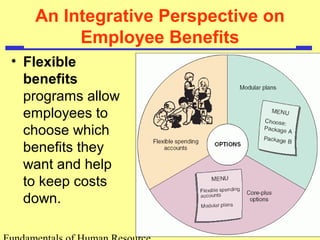
• Flexible
benefits
programs allow
employees to
choose which
benefits they
want and help
to keep costs
down.
An Integrative Perspective on
Employee Benefits
• Flexible spending accounts
– Under Section I25 of the Internal Revenue Code
employees can set aside a designated dollar
amount before taxes for specified services
• health-care premiums
• medical expenses
• dependent child-care
• group legal services
– IRS requires that accounts for different purposes
be separate and that all money be spent during
the year or forfeited.
– Not subject to federal, state, and social security
taxes.
An Integrative Perspective on
Employee Benefits
Modular plans:
• Employees choose a pre-designed
package of benefits from several
options.
Core-Plus Options Plans
• Employees given core coverage (e.g.
medical, life, disability) with option to
select other benefits.

Ch10

  • 1.
    Chapter 12 Employee Benefits Fundamentalsof Human Resource Management Eighth Edition DeCenzo and Robbins
  • 2.
    Introduction Employee benefits • Havegrown in importance and variety • Typically membership-based rewards offered to attract and keep employees • Do not directly affect a worker’s performance, but inadequate benefits lead to employee dissatisfaction.
  • 3.
    Introduction Costs of ProvidingEmployee Benefits – Benefit and service offerings add about 40% to an organization’s payroll cost. – Benefits become the focus of negotiations with employees when large wage and salary increases are not feasible.
  • 4.
    Introduction Contemporary Benefits Offerings – Benefitstoday reflect the diversity of the work force. – Challenge -- designing a benefits package which is attractive to applicants and current workers, and provides all the legally required benefits.
  • 5.
    Legally Required Benefits SocialSecurity – Financed by equal employee and employer contributions, based on a percentage of earnings. – Provides income for retirees, disabled workers and surviving dependents. – Provides some health insurance coverage through Medicare.
  • 6.
    Legally Required Benefits UnemploymentCompensation – Funded by employers who pay combined federal and state tax imposed on taxable wage base – Tax varies based on organization’s unemployment experience. – Provides employees with some income continuation during periods of involuntary unemployment – Typical coverage is for 26 weeks.
  • 7.
    Legally Required Benefits Workers’Compensation – Paid for by the organization – Rates based on likelihood of accidents, past history, and the type of industry. – Benefits pay expenses and/or compensate for losses resulting from work-related accidents or illness, regardless of fault.
  • 8.
    Legally Required Benefits Familyand Medical Leave Act – 1993 Act requires employers with 50 or more employees to allow up to 12 weeks of unpaid leave for family or medical reasons. – Specifies record-keeping and communication requirements
  • 9.
    Voluntary Benefits Traditional health insurance •Typically has the fewest coverage limitations for the employee • Usually the most expensive
  • 10.
    Voluntary Benefits Health MaintenanceOrganizations (HMOs) • Alternative benefit required by Health Maintenance Act of 1973. • Broad comprehensive care provided by designated service centers for fixed fees. • Promotes preventive care. • Health care choices significantly limited.
  • 11.
    Voluntary Benefits Preferred ProviderOrganizations (PPOs) • Member health care providers agree to provide services at a fixed fee • Employees are encouraged by lower rates to use member or “preferred” providers. • Utilization review procedures generate data on plan use.
  • 12.
    Voluntary Benefits Employer-operated coverage •Employers self-fund insurance programs • Operated under a Voluntary Employees Beneficiary Association (VEBA) to reduce costs. • Often hire third party to administer.
  • 13.
    Voluntary Benefits Health insurancecontinuation • The Consolidated Omnibus Budget Reconciliation Act (COBRA) – Provides for continuation of benefits for up to three years after an employee leaves a job – Cost is paid by the employee
  • 14.
    Voluntary Benefits The HIPAARequirement • The Health Insurance Portability and Accountability Act of 1996 – Imposed on employers and health providers regulations regarding the confidentiality of employee health information.
  • 15.
    Retirement Benefits Employee RetirementIncome Security Act (ERISA) of 1974 – Vesting rights – right to pension benefits even if one leaves the company. – Enables pension rights to be portable. – Sets up Pension Benefit Guaranty Corporation (PBGC) • claims corporate assets to cover inadequately funded pension plans) – Requires Summary Plan Description (SPD)
  • 16.
    Retirement Benefits Defined BenefitPlans • Plan specifies the dollar benefit workers receive at retirement. • Usually based on some formula of years of service and average final compensation.
  • 17.
    Retirement Benefits Defined ContributionPlans: • Employee and employer may contribute to account based on rules established for contributions • Amount of benefits depends on success of account investments.
  • 18.
    Retirement Benefits Money PurchasePension Plan • Type of defined contribution plan • Organization commits to depositing fixed amount of money or percentage of employee’s pay annually.
  • 19.
    Retirement Benefits Profit-Sharing Plans •Variation of defined contribution plan. • Company amount contributed depends on profit level in the organization. • Contribution is optional, not required.
  • 20.
    Retirement Benefits Individual RetirementAccounts (IRAs) • Currently designed for lower-income workers who don’t have pension programs at work • Can defer taxes on amount deposited and interest earned in retirement account.
  • 21.
    Retirement Benefits • RothIRAs: – Effective in 1998. – Eligible employees can contribute post-tax up to $3,000 annually – Can be withdrawn tax-free after a certain age. • 401(k)s: – Permit workers to set aside specified amount of income on tax-deferred basis – Employers may match employee contribution.
  • 22.
    Paid Time Off Vacationand Holiday Leave – Vacation time is usually related to the length of time on the job. – Some companies also allow personal days that can be used for any reason.
  • 23.
    Paid Time Off DisabilityInsurance Programs • Provides salary continuation for: – Short-term disabilities (sick leave) – Long-term disabilities (coverage usually effective after 6 months). • Some companies provide financial incentives to employees to not use their sick leave. • Long-term disability plans usually replace a portion of the employee’s salary, often 60 percent.
  • 24.
    Survivor Benefits • Usuallyare two types: – contributory – non-contributory • In non-contributory the employer pays the total cost of the benefit.
  • 25.
    Survivor Benefits Group TermLife Insurance: • Benefit is usually based on one to five times annual rate of pay. Travel insurance: • Life insurance for business travel- related deaths.
  • 26.
    Survivor Benefits The serviceside of benefits – social and recreational events – employee assistance programs – credit unions – housing – tuition reimbursement – uniforms – company-paid transportation – parking • Employers often can provide services at no cost or at a significant reduction from the usual cost.
  • 27.
    An Integrative Perspectiveon Employee Benefits • Flexible benefits programs allow employees to choose which benefits they want and help to keep costs down.
  • 28.
    An Integrative Perspectiveon Employee Benefits • Flexible spending accounts – Under Section I25 of the Internal Revenue Code employees can set aside a designated dollar amount before taxes for specified services • health-care premiums • medical expenses • dependent child-care • group legal services – IRS requires that accounts for different purposes be separate and that all money be spent during the year or forfeited. – Not subject to federal, state, and social security taxes.
  • 29.
    An Integrative Perspectiveon Employee Benefits Modular plans: • Employees choose a pre-designed package of benefits from several options. Core-Plus Options Plans • Employees given core coverage (e.g. medical, life, disability) with option to select other benefits.