 
© 2015 Cengage Learning
Prepared by Tony Wolusky, J.D. , Metropolitan State University of Denver
Chapter 12
The Eighth
Amendment: Bail,
Fines, and Punishment
© 2015 Cengage Learning
 The 8th
Amendment protects three rights:
o That excessive bail shall not be required.
o That excessive fines shall not be imposed.
o That cruel and unusual punishment shall not be
inflicted.
 This Amendment has a lot of controversy because
of interpretations about whether the death penalty
is cruel and unusual.
© 2015 Cengage Learning
 Money or property pledged by a defendant for pretrial
release from custody that would be forfeited should the
defendant fail to appear at subsequent court proceedings.
 Bail serves two purposes:
1. Helps to assure the appearance of the accused at court
proceedings.
2. It maintains the presumption of innocence by allowing individuals
not yet convicted of a crime to avoid continued incarceration.
 Also allows individuals to:
o Prepare a defense.
o To continue earning income if employed.
© 2015 Cengage Learning
 Bail itself is not guaranteed under the 8th
Amendment.
o Only excessive bail is prohibited, which is not clearly
defined.
o Bail may be denied in capital cases and when the
accused has threatened possible trial witnesses.
o The excessive bail prohibition has never been formally
incorporated to apply to the states under the 14th
Amendment, allowing states to deal with it through their
constitutions, legislation and case law.
© 2015 Cengage Learning
 Granted judicial authority to include specific
conditions of release for the community's
safety.
 Allows judges to consider the potential
criminal conduct of those accused of
serious offenses and deny bail on those
grounds. 
© 2015 Cengage Learning
 Jackson v. Indiana (1972)
o Government may detain dangerous defendants who
may be incompetent to stand trial.
 Addington v. Texas (1979)
o Government may detain mentally unstable individuals
who present a public danger.
 United States v. Salerno (1987)
o Pretrial detention under this act did not violate the 8th
Amendment .
© 2015 Cengage Learning
Stack v. Boyle , 342 U.S. 1
(1951)
 Facts: Members of the Communist Party were charged
with conspiring to teach overthrowing the government, and
were unsuccessful in a motion to reduce $50,000 bail.
 Issues: Was the bail excessive under the 8th
Amendment?
 Holding: Yes.
 Rationale: Bail set at a figure higher than an amount
reasonably calculated to fulfill its purpose is excessive
under the 8th
Amendment.
© 2015 Cengage Learning
 The prohibition against excessive fines has
not been incorporated, so it does not apply
to the states.
 Excessive fine prohibition does not apply in
the civil area.
o Because civil cases are between private
parties and the Constitution regulates the
government.
© 2015 Cengage Learning
 Asset Forfeiture
o The seizure by the government, without compensation,
of money and property connected with illegal activity.
 Property connected with illegal activity may be
forfeited when used as a conveyance to transport
illicit drugs.
 Real estate used in association with a crime and
money or other negotiable instruments obtained
through criminal activity also can be seized and is
considered a civil sanction by the government.
© 2015 Cengage Learning
 Facts: Austin pled guilty to one count of possessing
cocaine with intent to distribute. Agents seized his mobile
home and auto body shop.
 Issues: Was the forfeiture excessive?
 Holding: Yes.
 Rationale: The Supreme Court ruled that the 8th
Amendment prohibition against excessive fines applies to
civil forfeiture proceedings against property connected to
drug trafficking. The amount seized must bear some
relation to the value of the illegal enterprise under the 8th
Amendment.
© 2015 Cengage Learning
 The final clause of the 8th
Amendment .
 What is “cruel and unusual?”
o Depends on what society believes it to be.
© 2015 Cengage Learning
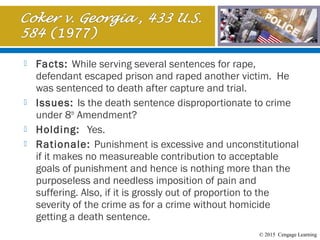
 Facts: While serving several sentences for rape,
defendant escaped prison and raped another victim. He
was sentenced to death after capture and trial.
 Issues: Is the death sentence disproportionate to crime
under 8th
Amendment?
 Holding: Yes.
 Rationale: Punishment is excessive and unconstitutional
if it makes no measureable contribution to acceptable
goals of punishment and hence is nothing more than the
purposeless and needless imposition of pain and
suffering. Also, if it is grossly out of proportion to the
severity of the crime as for a crime without homicide
getting a death sentence.
© 2015 Cengage Learning
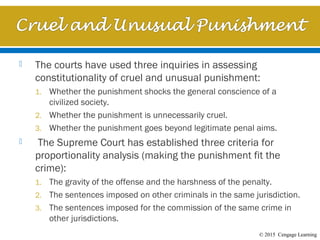
 The courts have used three inquiries in assessing
constitutionality of cruel and unusual punishment:
1. Whether the punishment shocks the general conscience of a
civilized society.
2. Whether the punishment is unnecessarily cruel.
3. Whether the punishment goes beyond legitimate penal aims.
 The Supreme Court has established three criteria for
proportionality analysis (making the punishment fit the
crime):
1. The gravity of the offense and the harshness of the penalty.
2. The sentences imposed on other criminals in the same jurisdiction.
3. The sentences imposed for the commission of the same crime in
other jurisdictions.
© 2015 Cengage Learning
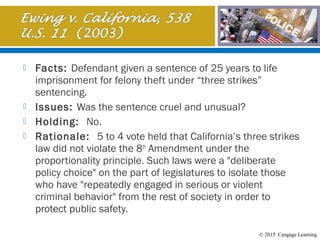
 Facts: Defendant given a sentence of 25 years to life
imprisonment for felony theft under “three strikes”
sentencing.
 Issues: Was the sentence cruel and unusual?
 Holding: No.
 Rationale: 5 to 4 vote held that California’s three strikes
law did not violate the 8th
Amendment under the
proportionality principle. Such laws were a "deliberate
policy choice" on the part of legislatures to isolate those
who have "repeatedly engaged in serious or violent
criminal behavior" from the rest of society in order to
protect public safety.
© 2015 Cengage Learning
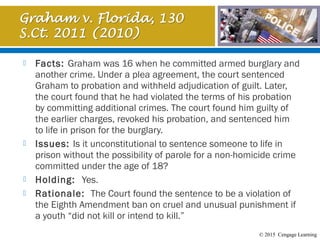
 Facts: Graham was 16 when he committed armed burglary and
another crime. Under a plea agreement, the court sentenced
Graham to probation and withheld adjudication of guilt. Later,
the court found that he had violated the terms of his probation
by committing additional crimes. The court found him guilty of
the earlier charges, revoked his probation, and sentenced him
to life in prison for the burglary.
 Issues: Is it unconstitutional to sentence someone to life in
prison without the possibility of parole for a non-homicide crime
committed under the age of 18?
 Holding: Yes.
 Rationale:  The Court found the sentence to be a violation of
the Eighth Amendment ban on cruel and unusual punishment if
a youth “did not kill or intend to kill.”
© 2015 Cengage Learning
 Facts: While robbing a home, Furman woke up the owner.
However, in the midst of his attempt to escape, a firearm
that he had been carrying was discharged striking and
killing the owner of the home. State law allowed the jury to
impose death for a killing during a felony such as burglary.
 Issues: Was this procedure cruel and unusual?
 Holding: Yes.
 Rationale: Ruled its law as it stood was capricious and
hence, cruel and unusual punishment. The Court ruled
that the states had to give judges and juries more
guidance in capital sentencing to prevent discretionary use
of the death penalty.
© 2015 Cengage Learning
 Due to the Furman case, executions were
suspended across the country.
 The federal government passed a new
death penalty law instituting a new two-step
process (bifurcated trial):
1. Determine innocence or guilt.
2. Determine whether to seek the death penalty.
© 2015 Cengage Learning
Roper v. Simmons , 543 U.S.
551 (2005)
 Facts: 17 year old Simmons entered the home of the
victim, committed robbery, bound the victim, and threw her
off a bridge in a nearby state park, killing her. He was
sentenced to death.
 Issues: Is it cruel and unusual to execute minors?
 Holding: Yes.
 Rationale: Under the "evolving standards of decency" test,
the Court held that it was cruel and unusual punishment to
execute a person who was under the age of 18 at the time of
the murder. In support of the "national consensus" position,
the Court noted the increasing infrequency with which states
were applying capital punishment for juvenile offenders.
© 2015 Cengage Learning
 Mental Retardation
o Atkins v. Virginia (2002)
• The Supreme Court has prohibited executing the
mentally retarded.
 The Mentally Ill
o The Supreme Court banned execution of the
insane.
o Ford v. Wainwright (1986)
• An inmate that becomes mentally ill while in prison
can not be executed.
© 2015 Cengage Learning
 8th
Amendment rights are divides into two categories:
1. Actions against individual prisoners.
2. Institutional conditions.
 Cases based on the 8th
Amendment for prisoners include:
o Overcrowding
o Solitary confinement
o Corporal punishment
o Physical abuse
o Use of force
o Treatment and rehabilitation, the right not to be treated
o Death penalty
© 2015 Cengage Learning
 The Supreme Court has been called on to determine
whether conditions and actions within correctional
institutions constitute cruel and unusual punishment.
 Rhodes v. Chapman (1981)
o Double-celling and crowding do not necessarily constitute cruel
and unusual punishment.
 Wilson v. Seiter (1991)
o Prisoners must prove prison conditions are objectively cruel and
unusual and show they exist because of officials’ deliberate
indifference.

Chapter 12 - The Eighth Amendment: Bail, Fines, and Punishment

  • 1.
      © 2015Cengage Learning Prepared by Tony Wolusky, J.D. , Metropolitan State University of Denver Chapter 12 The Eighth Amendment: Bail, Fines, and Punishment
  • 2.
    © 2015 CengageLearning  The 8th Amendment protects three rights: o That excessive bail shall not be required. o That excessive fines shall not be imposed. o That cruel and unusual punishment shall not be inflicted.  This Amendment has a lot of controversy because of interpretations about whether the death penalty is cruel and unusual.
  • 3.
    © 2015 CengageLearning  Money or property pledged by a defendant for pretrial release from custody that would be forfeited should the defendant fail to appear at subsequent court proceedings.  Bail serves two purposes: 1. Helps to assure the appearance of the accused at court proceedings. 2. It maintains the presumption of innocence by allowing individuals not yet convicted of a crime to avoid continued incarceration.  Also allows individuals to: o Prepare a defense. o To continue earning income if employed.
  • 4.
    © 2015 CengageLearning  Bail itself is not guaranteed under the 8th Amendment. o Only excessive bail is prohibited, which is not clearly defined. o Bail may be denied in capital cases and when the accused has threatened possible trial witnesses. o The excessive bail prohibition has never been formally incorporated to apply to the states under the 14th Amendment, allowing states to deal with it through their constitutions, legislation and case law.
  • 5.
    © 2015 CengageLearning  Granted judicial authority to include specific conditions of release for the community's safety.  Allows judges to consider the potential criminal conduct of those accused of serious offenses and deny bail on those grounds. 
  • 6.
    © 2015 CengageLearning  Jackson v. Indiana (1972) o Government may detain dangerous defendants who may be incompetent to stand trial.  Addington v. Texas (1979) o Government may detain mentally unstable individuals who present a public danger.  United States v. Salerno (1987) o Pretrial detention under this act did not violate the 8th Amendment .
  • 7.
    © 2015 CengageLearning Stack v. Boyle , 342 U.S. 1 (1951)  Facts: Members of the Communist Party were charged with conspiring to teach overthrowing the government, and were unsuccessful in a motion to reduce $50,000 bail.  Issues: Was the bail excessive under the 8th Amendment?  Holding: Yes.  Rationale: Bail set at a figure higher than an amount reasonably calculated to fulfill its purpose is excessive under the 8th Amendment.
  • 8.
    © 2015 CengageLearning  The prohibition against excessive fines has not been incorporated, so it does not apply to the states.  Excessive fine prohibition does not apply in the civil area. o Because civil cases are between private parties and the Constitution regulates the government.
  • 9.
    © 2015 CengageLearning  Asset Forfeiture o The seizure by the government, without compensation, of money and property connected with illegal activity.  Property connected with illegal activity may be forfeited when used as a conveyance to transport illicit drugs.  Real estate used in association with a crime and money or other negotiable instruments obtained through criminal activity also can be seized and is considered a civil sanction by the government.
  • 10.
    © 2015 CengageLearning  Facts: Austin pled guilty to one count of possessing cocaine with intent to distribute. Agents seized his mobile home and auto body shop.  Issues: Was the forfeiture excessive?  Holding: Yes.  Rationale: The Supreme Court ruled that the 8th Amendment prohibition against excessive fines applies to civil forfeiture proceedings against property connected to drug trafficking. The amount seized must bear some relation to the value of the illegal enterprise under the 8th Amendment.
  • 11.
    © 2015 CengageLearning  The final clause of the 8th Amendment .  What is “cruel and unusual?” o Depends on what society believes it to be.
  • 12.
    © 2015 CengageLearning  Facts: While serving several sentences for rape, defendant escaped prison and raped another victim. He was sentenced to death after capture and trial.  Issues: Is the death sentence disproportionate to crime under 8th Amendment?  Holding: Yes.  Rationale: Punishment is excessive and unconstitutional if it makes no measureable contribution to acceptable goals of punishment and hence is nothing more than the purposeless and needless imposition of pain and suffering. Also, if it is grossly out of proportion to the severity of the crime as for a crime without homicide getting a death sentence.
  • 13.
    © 2015 CengageLearning  The courts have used three inquiries in assessing constitutionality of cruel and unusual punishment: 1. Whether the punishment shocks the general conscience of a civilized society. 2. Whether the punishment is unnecessarily cruel. 3. Whether the punishment goes beyond legitimate penal aims.  The Supreme Court has established three criteria for proportionality analysis (making the punishment fit the crime): 1. The gravity of the offense and the harshness of the penalty. 2. The sentences imposed on other criminals in the same jurisdiction. 3. The sentences imposed for the commission of the same crime in other jurisdictions.
  • 14.
    © 2015 CengageLearning  Facts: Defendant given a sentence of 25 years to life imprisonment for felony theft under “three strikes” sentencing.  Issues: Was the sentence cruel and unusual?  Holding: No.  Rationale: 5 to 4 vote held that California’s three strikes law did not violate the 8th Amendment under the proportionality principle. Such laws were a "deliberate policy choice" on the part of legislatures to isolate those who have "repeatedly engaged in serious or violent criminal behavior" from the rest of society in order to protect public safety.
  • 15.
    © 2015 CengageLearning  Facts: Graham was 16 when he committed armed burglary and another crime. Under a plea agreement, the court sentenced Graham to probation and withheld adjudication of guilt. Later, the court found that he had violated the terms of his probation by committing additional crimes. The court found him guilty of the earlier charges, revoked his probation, and sentenced him to life in prison for the burglary.  Issues: Is it unconstitutional to sentence someone to life in prison without the possibility of parole for a non-homicide crime committed under the age of 18?  Holding: Yes.  Rationale:  The Court found the sentence to be a violation of the Eighth Amendment ban on cruel and unusual punishment if a youth “did not kill or intend to kill.”
  • 16.
    © 2015 CengageLearning  Facts: While robbing a home, Furman woke up the owner. However, in the midst of his attempt to escape, a firearm that he had been carrying was discharged striking and killing the owner of the home. State law allowed the jury to impose death for a killing during a felony such as burglary.  Issues: Was this procedure cruel and unusual?  Holding: Yes.  Rationale: Ruled its law as it stood was capricious and hence, cruel and unusual punishment. The Court ruled that the states had to give judges and juries more guidance in capital sentencing to prevent discretionary use of the death penalty.
  • 17.
    © 2015 CengageLearning  Due to the Furman case, executions were suspended across the country.  The federal government passed a new death penalty law instituting a new two-step process (bifurcated trial): 1. Determine innocence or guilt. 2. Determine whether to seek the death penalty.
  • 18.
    © 2015 CengageLearning Roper v. Simmons , 543 U.S. 551 (2005)  Facts: 17 year old Simmons entered the home of the victim, committed robbery, bound the victim, and threw her off a bridge in a nearby state park, killing her. He was sentenced to death.  Issues: Is it cruel and unusual to execute minors?  Holding: Yes.  Rationale: Under the "evolving standards of decency" test, the Court held that it was cruel and unusual punishment to execute a person who was under the age of 18 at the time of the murder. In support of the "national consensus" position, the Court noted the increasing infrequency with which states were applying capital punishment for juvenile offenders.
  • 19.
    © 2015 CengageLearning  Mental Retardation o Atkins v. Virginia (2002) • The Supreme Court has prohibited executing the mentally retarded.  The Mentally Ill o The Supreme Court banned execution of the insane. o Ford v. Wainwright (1986) • An inmate that becomes mentally ill while in prison can not be executed.
  • 20.
    © 2015 CengageLearning  8th Amendment rights are divides into two categories: 1. Actions against individual prisoners. 2. Institutional conditions.  Cases based on the 8th Amendment for prisoners include: o Overcrowding o Solitary confinement o Corporal punishment o Physical abuse o Use of force o Treatment and rehabilitation, the right not to be treated o Death penalty
  • 21.
    © 2015 CengageLearning  The Supreme Court has been called on to determine whether conditions and actions within correctional institutions constitute cruel and unusual punishment.  Rhodes v. Chapman (1981) o Double-celling and crowding do not necessarily constitute cruel and unusual punishment.  Wilson v. Seiter (1991) o Prisoners must prove prison conditions are objectively cruel and unusual and show they exist because of officials’ deliberate indifference.
Editor's Notes

  • #8 Opinion at http://supreme.justia.com/cases/federal/us/342/1/
  • #11 Opinion at http://supreme.justia.com/cases/federal/us/509/602/case.html Oral argument at http://www.oyez.org/cases/1990-1999/1992/1992_92_6073
  • #13 Opinion at http://supreme.justia.com/cases/federal/us/433/584/case.html Oral argument at http://www.oyez.org/cases/1970-1979/1976/1976_75_5444
  • #15 Opinion at http://supreme.justia.com/cases/federal/us/538/11/
  • #16 Opinion at http://www.supremecourt.gov/opinions/09pdf/08-7412.pdf Oral arguments at http://www.supremecourt.gov/opinions/09pdf/08-7412.pdf
  • #17 Opinion at http://supreme.justia.com/cases/federal/us/408/238/case.html Oral arguments at http://www.oyez.org/cases/1970-1979/1971/1971_69_5003
  • #19 Opinion at http://caselaw.lp.findlaw.com/scripts/getcase.pl?court=us&vol=000&invol=03-633 Oral arguments at http://www.oyez.org/cases/2000-2009/2004/2004_03_633/