Chapter 12
  Crafts
Lost Wax Casting Process
• 1- Create a clay sculpture as a model.
• 2- Create a 2 part mold with rubber and plaster over the
  clay core.
• 3- Create a wax replica of the clay sculpture by pouring wax
  into the 2 part mold.
• 4- Attach sprues and gates, which are wax rods all over the
  piece, creating an artery system.
• 5- Encase the wax sculpture with the rod system in a
  ceramic shell.
• 6- Melt the wax out (at this time, the ceramic shell is fired
  to create a mold)
• 7- Pour molten bronze into the mold.
• 8- Break the mold off of the bronze sculpture.
• 9- Remove the channels & smooth & polish the sculpture.
• 10- Patination: create a colored patina on the finished
  surface.
FINE CRAFT
• Most crafts have roots in the middle ages, when a
  craftsman had a trade – potter, glassblower,
  woodworker, weaver.

• The word “craft” alludes to expert work done by hand.

• “Craft” and “Art” originally had the same meaning.
  During the Renaissance, painting, sculpture and
  architecture were elevated to a different level.

   – Thus much of art history before the Renaissance includes
     craft.
Craft vs Art
• Western cultures (Europe & US) have Fine Art and
  Fine Craft in separate categories.
  – Often the dividing line is function.

• Many other cultures around the world attribute
  artistic meaning to craft objects.
  – Often fine art objects like sculpture have a spiritual
    function.

• There is no definite division between art and
  craft, nor should there be.
  – Labels are a convenience for talking about art.
Traditional Materials of Craft

• Clay

• Glass

• Metal

• Wood

• Fiber
Ceramics
• Many kinds of clay
     • Terra cotta        ∙ Stoneware
     • Earthenware        ∙ Porcelain

• Greenware – Clay before it is fired
• Bisqueware – Clay that has been kiln-fired once.
      After clay has been fired its chemical composition
      changes, it can never be clay again
• Glazeware – Clay that has been glazed,
          it can be fired multiple times,
          not all ceramics are glazed
Ceramics Forming Techniques
• Wheel throwing
  – Used in Egypt 6000 years ago
• Slab construction
• Coiling
  – Maria Martinez used this method
• Hand-forming or pinching
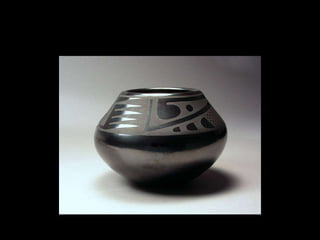
Maria Martinez, Blackware
This type of blackware was only
fired once.

Maria used a red clay.

Before firing she would burnish
the entire pot and then paint on
a design with a slip (liquid clay.)

The dull area is the slip.

The shinier area is the raw clay
that has been burnished.

The ware becomes black by
smothering the flames with dry
manure partway thru the firing.
The smoke reacts with the iron in
the clay to turn it black.
Maria Martinez
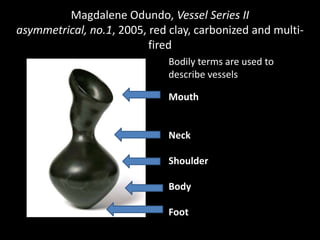
Magdalene Odundo, Vessel Series II
asymmetrical, no.1, 2005, red clay, carbonized and multi-
                          fired
                              Bodily terms are used to
                              describe vessels

                              Mouth


                              Neck

                              Shoulder

                              Body

                              Foot
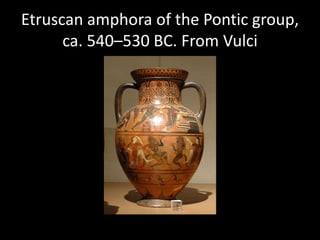
Etruscan amphora of the Pontic group,
      ca. 540–530 BC. From Vulci
Chinese Longquan celadon,
Song Dynasty, 13th century
Elaine Coleman
Incised Lizard and Leaf Teapot
Hellenistic Tanagra figurine, ca. 320 BCE
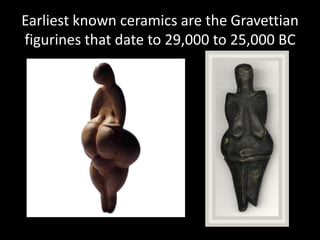
Earliest known ceramics are the Gravettian
figurines that date to 29,000 to 25,000 BC
Chris Antemann, Paradise, 2009, porcelain,
     decals, luster, 27 × 17 × 17 inches
Islamic tilework
  in a mosque,

Iran, 1602-1619
17th century Kütahya tiles in Hall of
  the Ablution Fountain, Topkapı
      Palace, Istanbul, Turkey
Glass
• Made from silica (sand)
• Becomes molten as it is heated and hardens
  as it cools
• Can be formed in many ways
  – Blown glass
  – Fused glass, fired in a kiln
  – Various types of molds – pate de verre
• Can be decorated with sandblasting
• Stained glass is made by cutting sheets of
  glass into pieces and fitting them together
Dale Chihuly
Chihuly
Dale Chihuly
The North Transept windows from
Chartres Cathedral, France, c. 1230
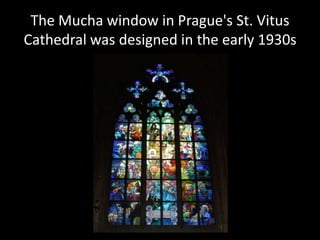
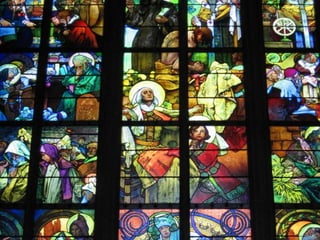
The Mucha window in Prague's St. Vitus
Cathedral was designed in the early 1930s
Metal
• Types of metals
   –   Copper           - Silver
   –   Brass            - Gold
   –   Bronze           - Steel
   –   Nickel           - Iron

• Can be shaped in many ways
   – Casting            - Forging
   – Cutting            - Hammering
   – Soldering

• Can be decorated in many ways
   –   Enameling
   –   Chasing & Repoussé
   –   Inlay
   –   Vermail (a marriage of 2 metals)
A blacksmith forging hot iron
Handforged silver wine goblets by
      Emma-Kate Francis.
Modern Chinese cloisonné enamel
Detail showing cloisons before
enameling. Wire is soldered to the
   piece to separate each color
This slide shows a girl meticulously
adding frit to areas, the piece will be
kiln fired, then ground and polished.
Lidded copper-body cloisonné enamel vase with a dragon
  motif, Probably from Nagoya, it is dated to 1880-1890
Chasing and repoussé - high relief
The underside of the ginko leaf relief
3 bronze custom butterfly cupboard pulls
Chasing tools
Wood
• Easy to work with
• Readily available
• Subject to environmental effects (it rots,
  distorts, insects)

• Furniture
  – The Chair was developed about 2800 yrs ago
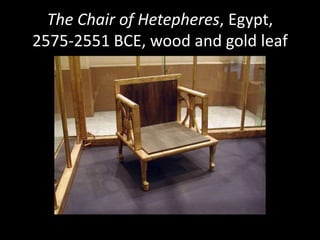
The Chair of Hetepheres, Egypt,
2575-2551 BCE, wood and gold leaf
Chair designed by Henry Van de Velde for
  his house "Bloemenwerf" in Brussels
LCW (Lounge chair wood), Charles and Ray Eames
      1946, molded plywood and rubber
Fiber
• Almost endless design possibilities
• Some civilizations highly prize textiles
   – Incas
• Construction methods are unique to itself
   – Weaving – the general method for all textiles
      • Warp – held taut
      • Weft – is interwoven through the warp
• Tapestry – a type of weaving wear the warp yarns
  are manipulated to form a pattern or design
   – The golden age of tapestry was in Europe from late
     14th to 17th century, it was the art of choice.
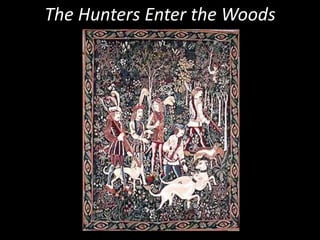
The Hunt of the Unicorn, 1475-1500
Netherlands, wool, silk and metallic thread.
Bought for $1million in 1922 and donated to the
    Metropolitan Museum of Art in 1937.

• A series of 7 tapestry panels
• Depict a midieval story showing the unicorn
  being hunted
• When it lays its head in the lap of a virgin it is
  captured and killed, then later restored to life
• A mixture of pagan and Christian symbolism
• Its an allegory to the Passion of Christ
The Hunters Enter the Woods
Unicorn Is Found at the Fountain
The Unicorn is Attacked
The Unicorn Defends Herself
The Unicorn is Captured by the Maiden
The Unicorn is Killed and Brought to the Castle
The Unicorn
in Captivity
In the Sterling Castle, Scotland, there are
replicas of the original Unicorn Tapestries
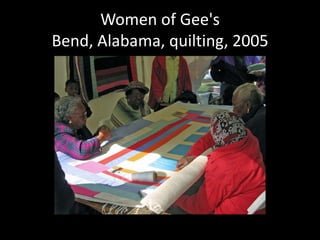
Gee’s Bend Quilts
• A rural community near Selma, Alabama
• Was once the site of cotton plantations
• After the Civil War, the freed slaves took the last name
  Pettway and became tenant farmers
• The unique quilting style has been practiced for at least 6
  generations
• In 2002 there was an exhibition titled “The Quilts of Gee’s
  Bend” featuring 70 masterpieces.
• There are still more than 50 women there who are part of the
  Gee’s Bend Quilters Collective
• Their style is reminiscent of Amish quilts and modern art
• In early years, the primary influence for the style was the
  newspaper and magazine collages used for insulation on the
  inside walls of homes
Women of Gee's
Bend, Alabama, quilting, 2005
Roman Stripes by Deborah Pettway
       Young, circa 1963.
Drunkard´s Path -- Variation (Snowball)
    by Lucy T. Pettway, circa 1950
Allie Pettway
Housetop, 1970-1975
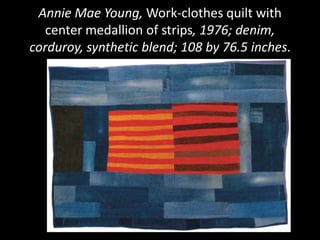
Annie Mae Young, Work-clothes quilt with
   center medallion of strips, 1976; denim,
corduroy, synthetic blend; 108 by 76.5 inches.
Jessie T. Pettway, Bars and string-pieced
columns, 1950s; cotton; 95 by 76 inches.
Annie E. Pettway, Flying Geese
variation, ca. 1935; cotton, wool; 86 by 71
                  inches.
Blocks & Strips Quilt
by Mary Lee Bendolph, 2002
Jade and Lacquer
• Jade – a mineral stone of either nephrite or jadeite
  – Color from white to brown to green
  – Found mostly in the East, Central Asia & Central America
  – Prized in China for 6000 yrs
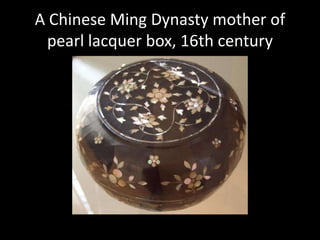
• Lacquer – made from the sap of a tree that
  originally only grew in China, it is brushed over
  wood in very thin coats
  – Hardens to a smooth glasslike finish
  – Demands patience, can take 30 coats to build up a
    substantial layer, must fully dry between coats
A jade Bi with dragons, Warring States
             (403–221 BC)
A Chinese Ming Dynasty mother of
  pearl lacquer box, 16th century
Carved Cinnabar Lacquer Tray with
   Blue Magpies and Camellias,
 China, Yuan Dynasty, 14th century
Blurring the Boundaries between
              Art and Craft
• Taking something functional and making it
  nonfunctional gives it a whole new meaning
  – Voulkos’s Pottery broke this barrier


• Using craft methods to make Fine Art elevates
  the notion of craft
  – Chicago’s The Dinner Party used traditional
    “womens work” in multiple ways to create a fine
    art installation.
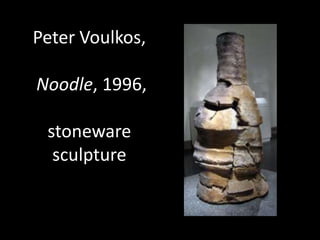
Peter Voulkos,

Noodle, 1996,

 stoneware
  sculpture
Peter Voulkos plates, 1981
Peter Voulkos is on the left.
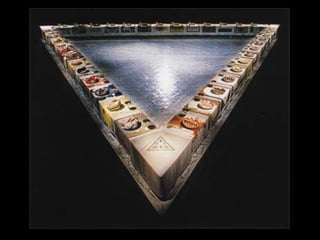
The Dinner Party, Judy Chicago, 1979
• http://www.brooklynmuseum.org/eascfa/din
  ner_party/place_settings/webtour/

• The table has 39 place settings to honor
  influential women in history.
• An additional 999 important women’s names
  are written on the tile floor.
Mary Wollstonecraft and Sojourner
      Truth place settings
The Virginia Woolf setting
Judy Chicago with her masterpiece.

Chapter 12 - Craft

  • 1.
  • 2.
    Lost Wax CastingProcess • 1- Create a clay sculpture as a model. • 2- Create a 2 part mold with rubber and plaster over the clay core. • 3- Create a wax replica of the clay sculpture by pouring wax into the 2 part mold. • 4- Attach sprues and gates, which are wax rods all over the piece, creating an artery system. • 5- Encase the wax sculpture with the rod system in a ceramic shell. • 6- Melt the wax out (at this time, the ceramic shell is fired to create a mold) • 7- Pour molten bronze into the mold. • 8- Break the mold off of the bronze sculpture. • 9- Remove the channels & smooth & polish the sculpture. • 10- Patination: create a colored patina on the finished surface.
  • 3.
    FINE CRAFT • Mostcrafts have roots in the middle ages, when a craftsman had a trade – potter, glassblower, woodworker, weaver. • The word “craft” alludes to expert work done by hand. • “Craft” and “Art” originally had the same meaning. During the Renaissance, painting, sculpture and architecture were elevated to a different level. – Thus much of art history before the Renaissance includes craft.
  • 4.
    Craft vs Art •Western cultures (Europe & US) have Fine Art and Fine Craft in separate categories. – Often the dividing line is function. • Many other cultures around the world attribute artistic meaning to craft objects. – Often fine art objects like sculpture have a spiritual function. • There is no definite division between art and craft, nor should there be. – Labels are a convenience for talking about art.
  • 5.
    Traditional Materials ofCraft • Clay • Glass • Metal • Wood • Fiber
  • 6.
    Ceramics • Many kindsof clay • Terra cotta ∙ Stoneware • Earthenware ∙ Porcelain • Greenware – Clay before it is fired • Bisqueware – Clay that has been kiln-fired once.  After clay has been fired its chemical composition changes, it can never be clay again • Glazeware – Clay that has been glazed, it can be fired multiple times, not all ceramics are glazed
  • 7.
    Ceramics Forming Techniques •Wheel throwing – Used in Egypt 6000 years ago • Slab construction • Coiling – Maria Martinez used this method • Hand-forming or pinching
  • 8.
    Maria Martinez, Blackware Thistype of blackware was only fired once. Maria used a red clay. Before firing she would burnish the entire pot and then paint on a design with a slip (liquid clay.) The dull area is the slip. The shinier area is the raw clay that has been burnished. The ware becomes black by smothering the flames with dry manure partway thru the firing. The smoke reacts with the iron in the clay to turn it black.
  • 9.
  • 12.
    Magdalene Odundo, VesselSeries II asymmetrical, no.1, 2005, red clay, carbonized and multi- fired Bodily terms are used to describe vessels Mouth Neck Shoulder Body Foot
  • 13.
    Etruscan amphora ofthe Pontic group, ca. 540–530 BC. From Vulci
  • 14.
    Chinese Longquan celadon, SongDynasty, 13th century
  • 15.
  • 16.
  • 17.
    Earliest known ceramicsare the Gravettian figurines that date to 29,000 to 25,000 BC
  • 18.
    Chris Antemann, Paradise,2009, porcelain, decals, luster, 27 × 17 × 17 inches
  • 21.
    Islamic tilework in a mosque, Iran, 1602-1619
  • 22.
    17th century Kütahyatiles in Hall of the Ablution Fountain, Topkapı Palace, Istanbul, Turkey
  • 23.
    Glass • Made fromsilica (sand) • Becomes molten as it is heated and hardens as it cools • Can be formed in many ways – Blown glass – Fused glass, fired in a kiln – Various types of molds – pate de verre • Can be decorated with sandblasting • Stained glass is made by cutting sheets of glass into pieces and fitting them together
  • 24.
  • 25.
  • 26.
  • 27.
    The North Transeptwindows from Chartres Cathedral, France, c. 1230
  • 28.
    The Mucha windowin Prague's St. Vitus Cathedral was designed in the early 1930s
  • 30.
    Metal • Types ofmetals – Copper - Silver – Brass - Gold – Bronze - Steel – Nickel - Iron • Can be shaped in many ways – Casting - Forging – Cutting - Hammering – Soldering • Can be decorated in many ways – Enameling – Chasing & Repoussé – Inlay – Vermail (a marriage of 2 metals)
  • 31.
  • 32.
    Handforged silver winegoblets by Emma-Kate Francis.
  • 33.
  • 34.
    Detail showing cloisonsbefore enameling. Wire is soldered to the piece to separate each color
  • 35.
    This slide showsa girl meticulously adding frit to areas, the piece will be kiln fired, then ground and polished.
  • 36.
    Lidded copper-body cloisonnéenamel vase with a dragon motif, Probably from Nagoya, it is dated to 1880-1890
  • 37.
    Chasing and repoussé- high relief
  • 38.
    The underside ofthe ginko leaf relief
  • 39.
    3 bronze custombutterfly cupboard pulls
  • 40.
  • 41.
    Wood • Easy towork with • Readily available • Subject to environmental effects (it rots, distorts, insects) • Furniture – The Chair was developed about 2800 yrs ago
  • 42.
    The Chair ofHetepheres, Egypt, 2575-2551 BCE, wood and gold leaf
  • 43.
    Chair designed byHenry Van de Velde for his house "Bloemenwerf" in Brussels
  • 44.
    LCW (Lounge chairwood), Charles and Ray Eames 1946, molded plywood and rubber
  • 45.
    Fiber • Almost endlessdesign possibilities • Some civilizations highly prize textiles – Incas • Construction methods are unique to itself – Weaving – the general method for all textiles • Warp – held taut • Weft – is interwoven through the warp • Tapestry – a type of weaving wear the warp yarns are manipulated to form a pattern or design – The golden age of tapestry was in Europe from late 14th to 17th century, it was the art of choice.
  • 46.
    The Hunt ofthe Unicorn, 1475-1500 Netherlands, wool, silk and metallic thread. Bought for $1million in 1922 and donated to the Metropolitan Museum of Art in 1937. • A series of 7 tapestry panels • Depict a midieval story showing the unicorn being hunted • When it lays its head in the lap of a virgin it is captured and killed, then later restored to life • A mixture of pagan and Christian symbolism • Its an allegory to the Passion of Christ
  • 47.
  • 49.
    Unicorn Is Foundat the Fountain
  • 50.
  • 51.
  • 52.
    The Unicorn isCaptured by the Maiden
  • 53.
    The Unicorn isKilled and Brought to the Castle
  • 54.
  • 55.
    In the SterlingCastle, Scotland, there are replicas of the original Unicorn Tapestries
  • 56.
    Gee’s Bend Quilts •A rural community near Selma, Alabama • Was once the site of cotton plantations • After the Civil War, the freed slaves took the last name Pettway and became tenant farmers • The unique quilting style has been practiced for at least 6 generations • In 2002 there was an exhibition titled “The Quilts of Gee’s Bend” featuring 70 masterpieces. • There are still more than 50 women there who are part of the Gee’s Bend Quilters Collective • Their style is reminiscent of Amish quilts and modern art • In early years, the primary influence for the style was the newspaper and magazine collages used for insulation on the inside walls of homes
  • 57.
    Women of Gee's Bend,Alabama, quilting, 2005
  • 58.
    Roman Stripes byDeborah Pettway Young, circa 1963.
  • 59.
    Drunkard´s Path --Variation (Snowball) by Lucy T. Pettway, circa 1950
  • 60.
  • 61.
    Annie Mae Young,Work-clothes quilt with center medallion of strips, 1976; denim, corduroy, synthetic blend; 108 by 76.5 inches.
  • 62.
    Jessie T. Pettway,Bars and string-pieced columns, 1950s; cotton; 95 by 76 inches.
  • 63.
    Annie E. Pettway,Flying Geese variation, ca. 1935; cotton, wool; 86 by 71 inches.
  • 64.
    Blocks & StripsQuilt by Mary Lee Bendolph, 2002
  • 65.
    Jade and Lacquer •Jade – a mineral stone of either nephrite or jadeite – Color from white to brown to green – Found mostly in the East, Central Asia & Central America – Prized in China for 6000 yrs • Lacquer – made from the sap of a tree that originally only grew in China, it is brushed over wood in very thin coats – Hardens to a smooth glasslike finish – Demands patience, can take 30 coats to build up a substantial layer, must fully dry between coats
  • 66.
    A jade Biwith dragons, Warring States (403–221 BC)
  • 67.
    A Chinese MingDynasty mother of pearl lacquer box, 16th century
  • 68.
    Carved Cinnabar LacquerTray with Blue Magpies and Camellias, China, Yuan Dynasty, 14th century
  • 69.
    Blurring the Boundariesbetween Art and Craft • Taking something functional and making it nonfunctional gives it a whole new meaning – Voulkos’s Pottery broke this barrier • Using craft methods to make Fine Art elevates the notion of craft – Chicago’s The Dinner Party used traditional “womens work” in multiple ways to create a fine art installation.
  • 70.
    Peter Voulkos, Noodle, 1996, stoneware sculpture
  • 71.
  • 72.
    Peter Voulkos ison the left.
  • 73.
    The Dinner Party,Judy Chicago, 1979 • http://www.brooklynmuseum.org/eascfa/din ner_party/place_settings/webtour/ • The table has 39 place settings to honor influential women in history. • An additional 999 important women’s names are written on the tile floor.
  • 75.
    Mary Wollstonecraft andSojourner Truth place settings
  • 76.
  • 77.
    Judy Chicago withher masterpiece.