Chapter 9


© 2012 McGraw-Hill Companies. All Rights Reserved.
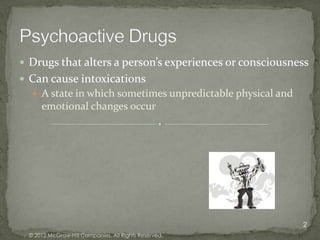
 Drugs that alters a person’s experiences or consciousness
 Can cause intoxications
   A state in which sometimes unpredictable physical and
     emotional changes occur


                                                            2
 © 2012 McGraw-Hill Companies. All Rights Reserved.
 Addictive behaviors are habits that have gotten out
  of control, with resulting negative effects on a
  person’s health
 Addiction is a psychological or physical
  dependence on a substance or behavior
 Dependence defined by four key characteristics:
  1.    Compulsive desire for a drug
  2.    Need to increase the dosage
  3.    Harmful effects to the individual
  4.    Harm to society
 Tolerance
                                                        3
  © 2012 McGraw-Hill Companies. All Rights Reserved.
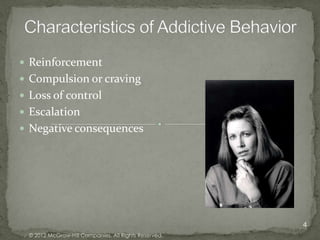
 Reinforcement
 Compulsion or craving
 Loss of control
 Escalation
 Negative consequences


                                                       4
  © 2012 McGraw-Hill Companies. All Rights Reserved.
 Often starts when a person does something to bring
  pleasure or to avoid pain
 Eventually, the behavior no longer brings pleasure, but it
  is necessary to avoid the pain of going without it
 Examples of addictive behaviors:
    Gambling
    Compulsive Exercising
    Work Addiction
    Sex and love addiction
    Compulsive buying or shopping
    Internet addiction
 Characteristics of people with addiction
                                                          5
  © 2012 McGraw-Hill Companies. All Rights Reserved.
 Commonly referred to as addicts
 Substance or activity used as substitute for coping
    strategies
   May have trouble dealing with stress or emotions
   May have a genetic predisposition to a particular
    substance
   May have problems with impulse control
    or self-regulation
   Tend to be risk-takers


                                                         6
    © 2012 McGraw-Hill Companies. All Rights Reserved.
 Eating
 Watching TV
 Playing video games
 Gambling
 Compulsive exercising
 Work preoccupation
 Sex and love addiction
 Compulsive buying or shopping
 Internet usage


                                                      7
 © 2012 McGraw-Hill Companies. All Rights Reserved.
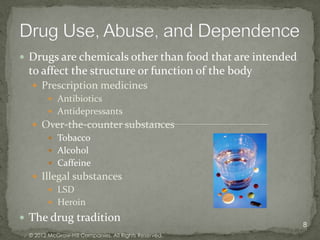
 Drugs are chemicals other than food that are intended
 to affect the structure or function of the body
   Prescription medicines
      Antibiotics
      Antidepressants
   Over-the-counter substances
      Tobacco
      Alcohol
      Caffeine
   Illegal substances
       LSD
       Heroin

 The drug tradition
                                                          8
 © 2012 McGraw-Hill Companies. All Rights Reserved.
 The APA’s Diagnostics and Statistical Manual of
  Mental Disorders – authoritative reference
 Abuse
   Substance abuse:
      Failure to fulfill major responsibilities
      Drug use in situations that are hazardous
      Drug related legal problems
      Drug use despite persistent social or interpersonal problems
   Physical dependence may or may not be present


                                                                      9
 © 2012 McGraw-Hill Companies. All Rights Reserved.
 Substance dependence
    1. Developing tolerance to the substance
    2. Experiencing withdrawal
    3. Taking in larger amounts
    4. Expressing a persistent desire to cut down
    5. Spending great deal of time getting the substance
    6. Giving up or reducing important activities
    7. Continuing usage even with recognition of a
        problem
 Considered physically dependent if experiences
 either tolerance or withdrawal

                                                           10
© 2012 McGraw-Hill Companies. All Rights Reserved.
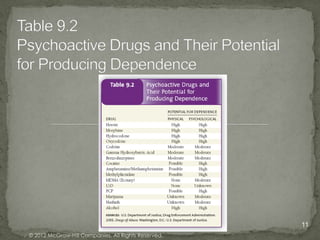
11
© 2012 McGraw-Hill Companies. All Rights Reserved.
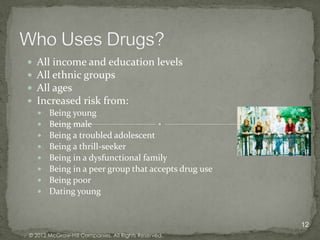
   All income and education levels
   All ethnic groups
   All ages
   Increased risk from:
       Being young
       Being male
       Being a troubled adolescent
       Being a thrill-seeker
       Being in a dysfunctional family
       Being in a peer group that accepts drug use
       Being poor
       Dating young


                                                      12
© 2012 McGraw-Hill Companies. All Rights Reserved.
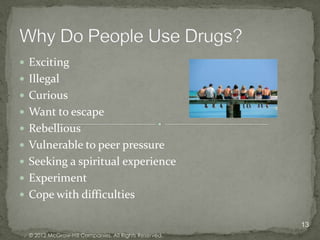
 Exciting
 Illegal
 Curious
 Want to escape
 Rebellious
 Vulnerable to peer pressure
 Seeking a spiritual experience
 Experiment
 Cope with difficulties

                                                       13
  © 2012 McGraw-Hill Companies. All Rights Reserved.
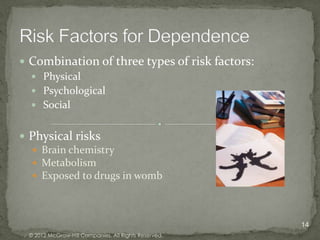
 Combination of three types of risk factors:
   Physical
   Psychological
   Social


 Physical risks
   Brain chemistry
   Metabolism
   Exposed to drugs in womb


                                                      14
 © 2012 McGraw-Hill Companies. All Rights Reserved.
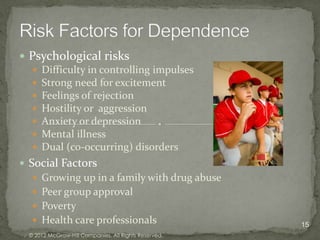
 Psychological risks
   Difficulty in controlling impulses
   Strong need for excitement
   Feelings of rejection
   Hostility or aggression
   Anxiety or depression
   Mental illness
   Dual (co-occurring) disorders
 Social Factors
    Growing up in a family with drug abuse
    Peer group approval
    Poverty
    Health care professionals                         15
  © 2012 McGraw-Hill Companies. All Rights Reserved.
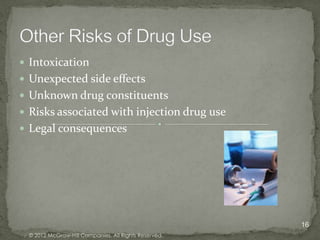
 Intoxication
 Unexpected side effects
 Unknown drug constituents
 Risks associated with injection drug use
 Legal consequences


                                                      16
 © 2012 McGraw-Hill Companies. All Rights Reserved.
        Changes in brain chemistry
           Neurotransmitters
        Drug factors:
           Pharmacological properties
           Dose-response function
           Time-action function
           Drug use history
           Method of use
        User Factors
        Social Factors

                                                         17
    © 2012 McGraw-Hill Companies. All Rights Reserved.
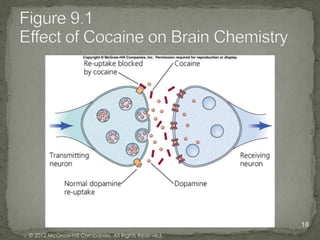
Psychoactive Drugs   Chapter Nine   18
© 2012 McGraw-Hill Companies. All Rights Reserved.
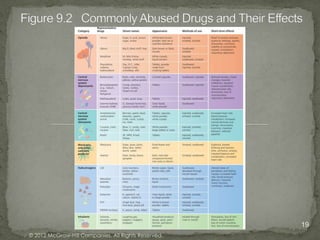
19
© 2012 McGraw-Hill Companies. All Rights Reserved.
 Opioids (narcotics)
   Natural or synthetic
      Opium, morphine, heroin, methadone, codeine,
       hydrocodone, oxycodone, meperidine, and fentanyl
   Relieve pain
   Cause drowsiness
   Induce euphoria
   Methods of administration
      Injection, absorbed, snorting, sniffing, smoking
   Symptoms of overdose


                                                          20
   © 2012 McGraw-Hill Companies. All Rights Reserved.
 Also known as sedative-hypnotics
   Slow down the overall activity of the CNS
   Types
   Effects
         Effects on the body
    Medical uses
    From use to abuse
    Overdosing


                                                       21
  © 2012 McGraw-Hill Companies. All Rights Reserved.
 Speed up the activity of the nervous or muscular
 system
   Cocaine
      Methods of use
      Effects
      Abuse and dependence
      Use during pregnancy


                                                      22
 © 2012 McGraw-Hill Companies. All Rights Reserved.
 Amphetamines
   Effects
   From use to abuse
         State dependence
   Dependence
         Psychosis
 Ritalin
 Ephedrine
 Caffeine


                                                       23
  © 2012 McGraw-Hill Companies. All Rights Reserved.
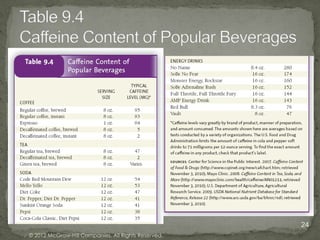
24
© 2012 McGraw-Hill Companies. All Rights Reserved.
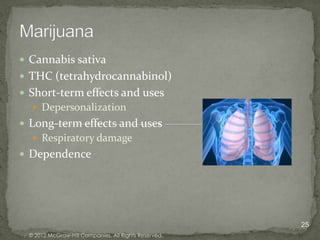
 Cannabis sativa
 THC (tetrahydrocannabinol)
 Short-term effects and uses
   Depersonalization
 Long-term effects and uses
   Respiratory damage
 Dependence


                                                      25
 © 2012 McGraw-Hill Companies. All Rights Reserved.
 Altered state of consciousness, perceptions, feelings
  and thoughts
 LSD, mescaline, psilocybin, STP, DMT, MDMA,
  Ketamine, PCP (angel dust)
 Synesthesia
 Flashbacks


                                                          26
   © 2012 McGraw-Hill Companies. All Rights Reserved.
 Nearly all inhalants produce effects similar to those of
  anesthetics and slow down the body’s functions
 Several major groups
       Volatile solvents
       Aerosols
       Nitrites
       Anesthetics
 Methods of use
       Sniffing
       Snorting
       “Bagging”
       “Huffing”


                                                             27
 © 2012 McGraw-Hill Companies. All Rights Reserved.
 Drug research
 Drugs, society, and families
 Legalizing Drugs
 Drug Testing


                                                       28
  © 2012 McGraw-Hill Companies. All Rights Reserved.
 Medication-assisted treatment
   Drug substitution
 Treatment centers
 Self-help groups and peer counseling
    AA
    NA
 Harm reduction strategies
 Codependency


                                                       29
  © 2012 McGraw-Hill Companies. All Rights Reserved.
 Governmental attempts
 Anti-drug education programs
 Indirect approaches
    Young people’s self-esteem
    Improve academic skills
    Increase recreational opportunities
 Direct approaches
    Information about the adverse effects
    Peer pressure resistance


                                                       30
  © 2012 McGraw-Hill Companies. All Rights Reserved.
Chapter 9


© 2012 McGraw-Hill Companies. All Rights Reserved.

Chapter 9

  • 1.
    Chapter 9 © 2012McGraw-Hill Companies. All Rights Reserved.
  • 2.
     Drugs thatalters a person’s experiences or consciousness  Can cause intoxications  A state in which sometimes unpredictable physical and emotional changes occur 2 © 2012 McGraw-Hill Companies. All Rights Reserved.
  • 3.
     Addictive behaviorsare habits that have gotten out of control, with resulting negative effects on a person’s health  Addiction is a psychological or physical dependence on a substance or behavior  Dependence defined by four key characteristics: 1. Compulsive desire for a drug 2. Need to increase the dosage 3. Harmful effects to the individual 4. Harm to society  Tolerance 3 © 2012 McGraw-Hill Companies. All Rights Reserved.
  • 4.
     Reinforcement  Compulsionor craving  Loss of control  Escalation  Negative consequences 4 © 2012 McGraw-Hill Companies. All Rights Reserved.
  • 5.
     Often startswhen a person does something to bring pleasure or to avoid pain  Eventually, the behavior no longer brings pleasure, but it is necessary to avoid the pain of going without it  Examples of addictive behaviors:  Gambling  Compulsive Exercising  Work Addiction  Sex and love addiction  Compulsive buying or shopping  Internet addiction  Characteristics of people with addiction 5 © 2012 McGraw-Hill Companies. All Rights Reserved.
  • 6.
     Commonly referredto as addicts  Substance or activity used as substitute for coping strategies  May have trouble dealing with stress or emotions  May have a genetic predisposition to a particular substance  May have problems with impulse control or self-regulation  Tend to be risk-takers 6 © 2012 McGraw-Hill Companies. All Rights Reserved.
  • 7.
     Eating  WatchingTV  Playing video games  Gambling  Compulsive exercising  Work preoccupation  Sex and love addiction  Compulsive buying or shopping  Internet usage 7 © 2012 McGraw-Hill Companies. All Rights Reserved.
  • 8.
     Drugs arechemicals other than food that are intended to affect the structure or function of the body  Prescription medicines  Antibiotics  Antidepressants  Over-the-counter substances  Tobacco  Alcohol  Caffeine  Illegal substances  LSD  Heroin  The drug tradition 8 © 2012 McGraw-Hill Companies. All Rights Reserved.
  • 9.
     The APA’sDiagnostics and Statistical Manual of Mental Disorders – authoritative reference  Abuse  Substance abuse:  Failure to fulfill major responsibilities  Drug use in situations that are hazardous  Drug related legal problems  Drug use despite persistent social or interpersonal problems  Physical dependence may or may not be present 9 © 2012 McGraw-Hill Companies. All Rights Reserved.
  • 10.
     Substance dependence 1. Developing tolerance to the substance 2. Experiencing withdrawal 3. Taking in larger amounts 4. Expressing a persistent desire to cut down 5. Spending great deal of time getting the substance 6. Giving up or reducing important activities 7. Continuing usage even with recognition of a problem  Considered physically dependent if experiences either tolerance or withdrawal 10 © 2012 McGraw-Hill Companies. All Rights Reserved.
  • 11.
    11 © 2012 McGraw-HillCompanies. All Rights Reserved.
  • 12.
    All income and education levels  All ethnic groups  All ages  Increased risk from:  Being young  Being male  Being a troubled adolescent  Being a thrill-seeker  Being in a dysfunctional family  Being in a peer group that accepts drug use  Being poor  Dating young 12 © 2012 McGraw-Hill Companies. All Rights Reserved.
  • 13.
     Exciting  Illegal Curious  Want to escape  Rebellious  Vulnerable to peer pressure  Seeking a spiritual experience  Experiment  Cope with difficulties 13 © 2012 McGraw-Hill Companies. All Rights Reserved.
  • 14.
     Combination ofthree types of risk factors:  Physical  Psychological  Social  Physical risks  Brain chemistry  Metabolism  Exposed to drugs in womb 14 © 2012 McGraw-Hill Companies. All Rights Reserved.
  • 15.
     Psychological risks  Difficulty in controlling impulses  Strong need for excitement  Feelings of rejection  Hostility or aggression  Anxiety or depression  Mental illness  Dual (co-occurring) disorders  Social Factors  Growing up in a family with drug abuse  Peer group approval  Poverty  Health care professionals 15 © 2012 McGraw-Hill Companies. All Rights Reserved.
  • 16.
     Intoxication  Unexpectedside effects  Unknown drug constituents  Risks associated with injection drug use  Legal consequences 16 © 2012 McGraw-Hill Companies. All Rights Reserved.
  • 17.
    Changes in brain chemistry  Neurotransmitters  Drug factors:  Pharmacological properties  Dose-response function  Time-action function  Drug use history  Method of use  User Factors  Social Factors 17 © 2012 McGraw-Hill Companies. All Rights Reserved.
  • 18.
    Psychoactive Drugs Chapter Nine 18 © 2012 McGraw-Hill Companies. All Rights Reserved.
  • 19.
    19 © 2012 McGraw-HillCompanies. All Rights Reserved.
  • 20.
     Opioids (narcotics)  Natural or synthetic  Opium, morphine, heroin, methadone, codeine, hydrocodone, oxycodone, meperidine, and fentanyl  Relieve pain  Cause drowsiness  Induce euphoria  Methods of administration  Injection, absorbed, snorting, sniffing, smoking  Symptoms of overdose 20 © 2012 McGraw-Hill Companies. All Rights Reserved.
  • 21.
     Also knownas sedative-hypnotics  Slow down the overall activity of the CNS  Types  Effects  Effects on the body  Medical uses  From use to abuse  Overdosing 21 © 2012 McGraw-Hill Companies. All Rights Reserved.
  • 22.
     Speed upthe activity of the nervous or muscular system  Cocaine  Methods of use  Effects  Abuse and dependence  Use during pregnancy 22 © 2012 McGraw-Hill Companies. All Rights Reserved.
  • 23.
     Amphetamines  Effects  From use to abuse  State dependence  Dependence  Psychosis  Ritalin  Ephedrine  Caffeine 23 © 2012 McGraw-Hill Companies. All Rights Reserved.
  • 24.
    24 © 2012 McGraw-HillCompanies. All Rights Reserved.
  • 25.
     Cannabis sativa THC (tetrahydrocannabinol)  Short-term effects and uses  Depersonalization  Long-term effects and uses  Respiratory damage  Dependence 25 © 2012 McGraw-Hill Companies. All Rights Reserved.
  • 26.
     Altered stateof consciousness, perceptions, feelings and thoughts  LSD, mescaline, psilocybin, STP, DMT, MDMA, Ketamine, PCP (angel dust)  Synesthesia  Flashbacks 26 © 2012 McGraw-Hill Companies. All Rights Reserved.
  • 27.
     Nearly allinhalants produce effects similar to those of anesthetics and slow down the body’s functions  Several major groups  Volatile solvents  Aerosols  Nitrites  Anesthetics  Methods of use  Sniffing  Snorting  “Bagging”  “Huffing” 27 © 2012 McGraw-Hill Companies. All Rights Reserved.
  • 28.
     Drug research Drugs, society, and families  Legalizing Drugs  Drug Testing 28 © 2012 McGraw-Hill Companies. All Rights Reserved.
  • 29.
     Medication-assisted treatment  Drug substitution  Treatment centers  Self-help groups and peer counseling  AA  NA  Harm reduction strategies  Codependency 29 © 2012 McGraw-Hill Companies. All Rights Reserved.
  • 30.
     Governmental attempts Anti-drug education programs  Indirect approaches  Young people’s self-esteem  Improve academic skills  Increase recreational opportunities  Direct approaches  Information about the adverse effects  Peer pressure resistance 30 © 2012 McGraw-Hill Companies. All Rights Reserved.
  • 31.
    Chapter 9 © 2012McGraw-Hill Companies. All Rights Reserved.