ASSESSMENT O F S T U D E N T L E A R N I N G 1
Pamantasanng Lungsod ng Muntinlupa
College of Teacher Education
1
ASSESSMENT
O F S T U D E N T L E A R N I N G 1
Shift of Educational
Focus From Content to
Learning Outcomes
Chapter 1:
Mr. CyrusT. Esguerra, LPT
College Instructor
Pamantasan ng Lungsod ng Muntinlupa
ASSESSMENT O F S T U D E N T L E A R N I N G 1
Pamantasanng Lungsod ng Muntinlupa
College of Teacher Education
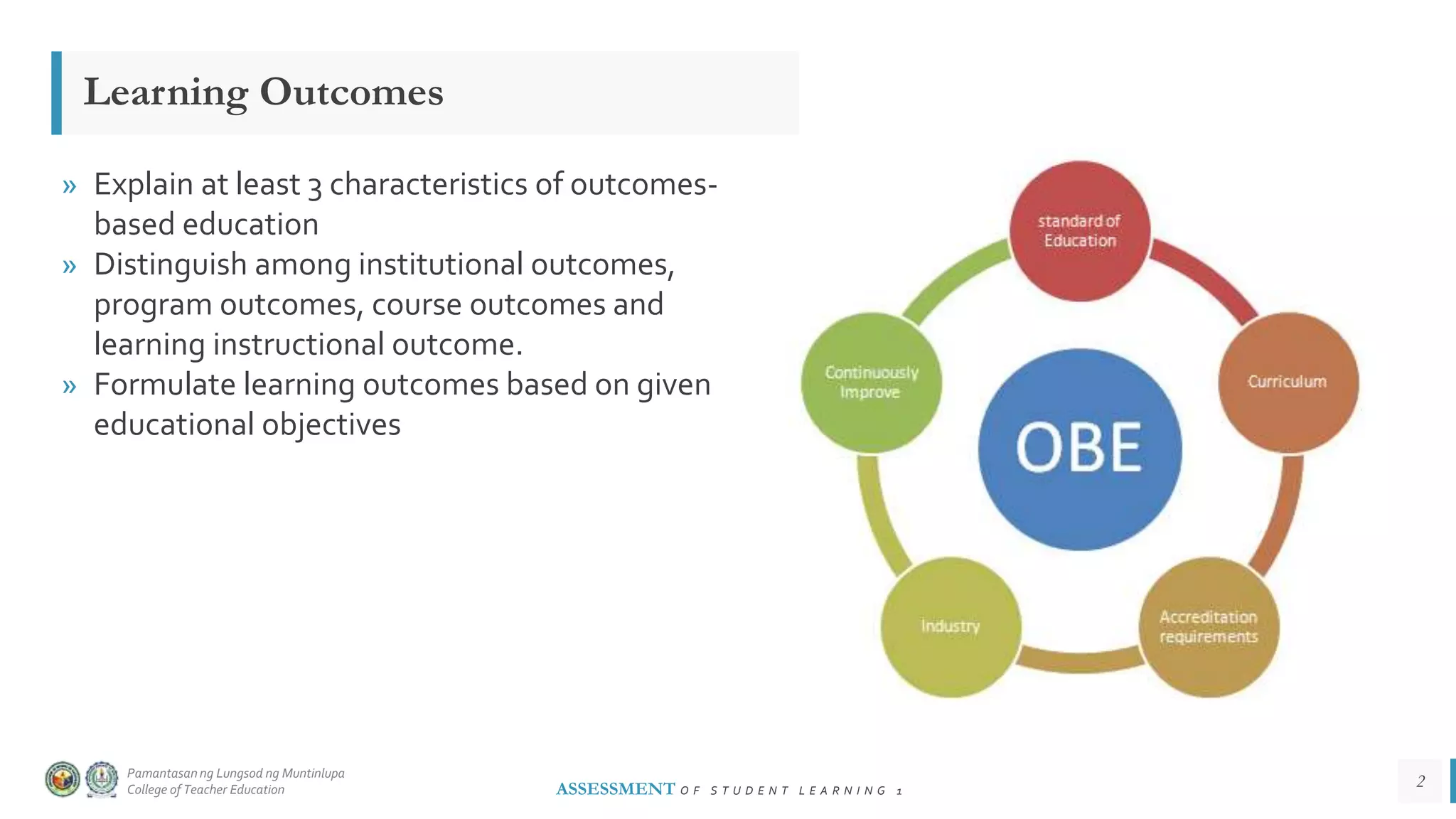
Learning Outcomes
» Explain at least 3 characteristics of outcomes-
based education
» Distinguish among institutional outcomes,
program outcomes, course outcomes and
learning instructional outcome.
» Formulate learning outcomes based on given
educational objectives
2
ASSESSMENT O F S T U D E N T L E A R N I N G 1
Pamantasanng Lungsod ng Muntinlupa
College of Teacher Education
Introduction
» The educative process happens between the
teacher and the student.
» Education originated from the terms "educare“
(to train or to mold) or "educere“ (to lead out)
» Ironically, however, for centuries we believe that
education is a "pouring in" process.
» Where the teacher was the infallible giver of
knowledge and the student was the passive
recipient.
» Focus of instruction was content and subject
matter.
3
ASSESSMENT O F S T U D E N T L E A R N I N G 1
Pamantasanng Lungsod ng Muntinlupa
College of Teacher Education
Introduction
» We were used to regarding education basically in
terms of designating a set of subjects to take and
when the course is completed we pronounce the
students "educated," assuming that the instruction
and activities we provided will lead to the desired
knowledge, skills and other attributes that we think
the course passers would possess.
4
ASSESSMENT O F S T U D E N T L E A R N I N G 1
Pamantasanng Lungsod ng Muntinlupa
College of Teacher Education
Introduction
» The advent of technology caused a change of
perspective in education, nationally and
internationally.
» The teacher ceased to be the sole source of
knowledge.
» With knowledge explosion, students are surrounded
with various sources of facts and information
accessible through user-friendly technology.
» The teacher has become a facilitator of knowledge
who assists in the organization, interpretation and
validation of acquired facts and information.
5
ASSESSMENT O F S T U D E N T L E A R N I N G 1
Pamantasanng Lungsod ng Muntinlupa
College of Teacher Education
6
ASSESSMENT
O F S T U D E N T L E A R N I N G 1
Outcomes-Based Education: Matching
Intentions with Accomplishment
ASSESSMENT O F S T U D E N T L E A R N I N G 1
Pamantasanng Lungsod ng Muntinlupa
College of Teacher Education
Outcomes-Based Education Framework
7
ASSESSMENT O F S T U D E N T L E A R N I N G 1
Pamantasanng Lungsod ng Muntinlupa
College of Teacher Education
8
UNBOXING OUTCOMES-BASED EDUCATION:
What do you think are the characteristics of
outcome-based education (OBE)?
ASSESSMENT O F S T U D E N T L E A R N I N G 1
Pamantasanng Lungsod ng Muntinlupa
College of Teacher Education
Outcomes-Based Education
» Outcome-based education (OBE) is education in
which an emphasis is placed on a clearly
articulated idea of what students are expected to
know and be able to do, that is, what skills and
knowledge they need to have, when they leave
the school system.
» Outcome-based education or outcomes-based
education is an educational theory that bases
each part of an educational system around goals.
By the end of the educational experience, each
student should have achieved the goal.
9
ASSESSMENT O F S T U D E N T L E A R N I N G 1
Pamantasanng Lungsod ng Muntinlupa
College of Teacher Education
Outcomes-Based Education
The change in educational perspective is called
Outcomes-Based Education (OBE) which has three (3)
characteristics:
1. It is student centered; that is, it places the students
at the center of the process by focusing on Student
Learning Outcomes (SLO).
2. It is faculty driven; that is, it encourages faculty
responsibility for teaching, assessing program
outcomes and motivating participation from the
students.
3. It is meaningful; that is, it provides data to guide the
teacher in making valid and continuing
improvement in instruction and assessment
activities.
10
ASSESSMENT O F S T U D E N T L E A R N I N G 1
Pamantasanng Lungsod ng Muntinlupa
College of Teacher Education
Outcomes-Based Education
To implement outcomes-based education on the subject or
course level, the following procedure is recommended:
1. Identification of the educational objectives of the
subject/ course.
» Educational objectives are the broad goals that the
subject/course expects to achieve, and defining in
general terms the knowledge, skills and attitude that
the teacher will help the students to attain.
» The objectives are stated from the point of view of the
teacher such as: "to develop, to provide, to enhance,
to inculcate, etc."
11
ASSESSMENT O F S T U D E N T L E A R N I N G 1
Pamantasanng Lungsod ng Muntinlupa
College of Teacher Education
Outcomes-Based Education
To implement outcomes-based education on the subject or course
level, the following procedure is recommended:
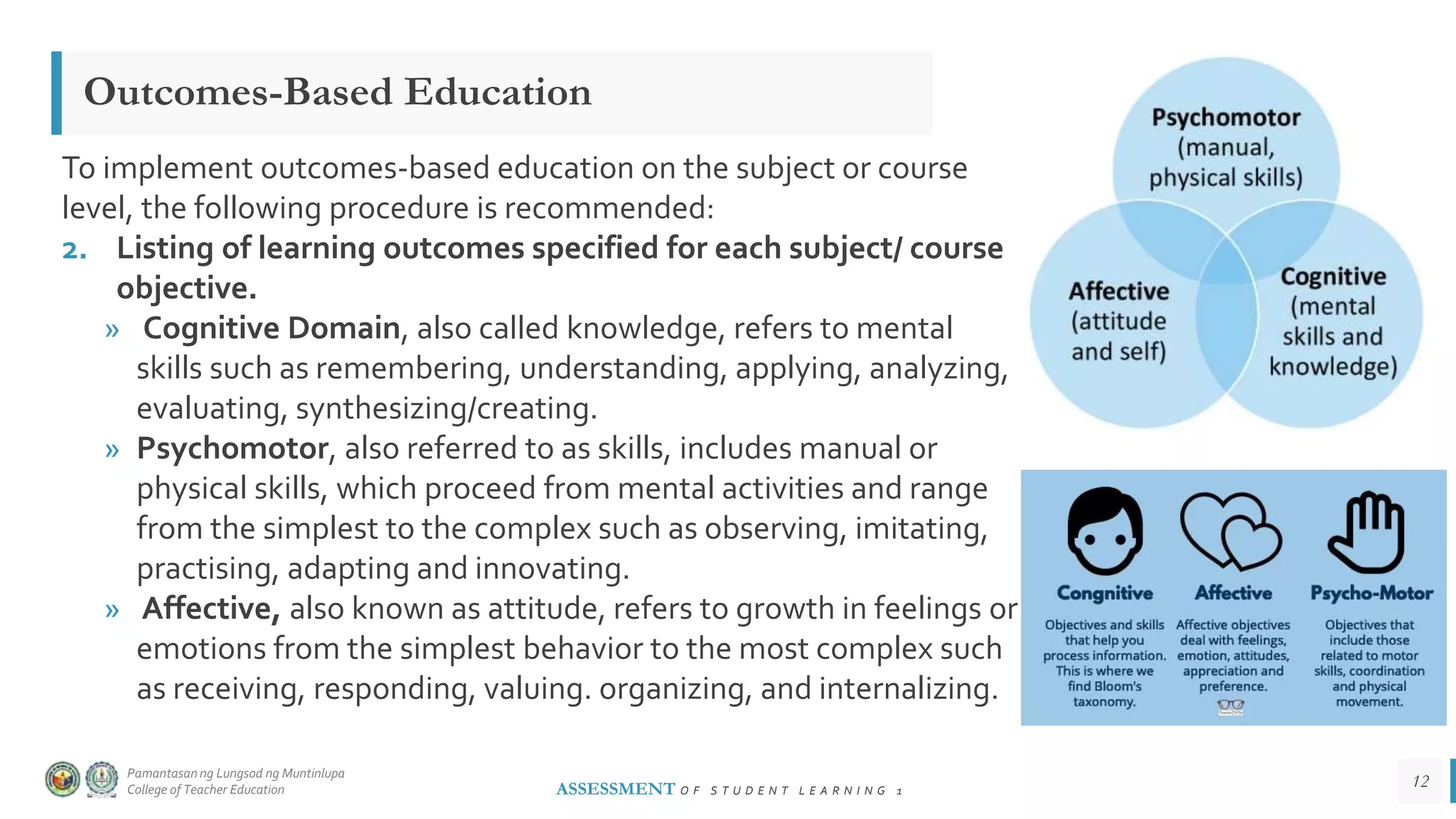
2. Listing of learning outcomes specified for each subject/ course
objective.
» Cognitive Domain, also called knowledge, refers to mental
skills such as remembering, understanding, applying, analyzing,
evaluating, synthesizing/creating.
» Psychomotor, also referred to as skills, includes manual or
physical skills, which proceed from mental activities and range
from the simplest to the complex such as observing, imitating,
practising, adapting and innovating.
» Affective, also known as attitude, refers to growth in feelings or
emotions from the simplest behavior to the most complex such
as receiving, responding, valuing. organizing, and internalizing.
12
ASSESSMENT O F S T U D E N T L E A R N I N G 1
Pamantasanng Lungsod ng Muntinlupa
College of Teacher Education
Outcomes-Based Education
To implement outcomes-based education on the
subject or course level, the following procedure is
recommended:
3. Drafting outcomes assessment procedure.
» This procedure will enable the teacher to
determine the degree to which the students are
attaining the desired learning outcomes.
» It identifies for every outcome the data that will
be gathered which will guide the selection of the
assessment tools to be used and at what point
assessment will be done.
13
ASSESSMENT O F S T U D E N T L E A R N I N G 1
Pamantasanng Lungsod ng Muntinlupa
College of Teacher Education
14
ASSESSMENT O F S T U D E N T L E A R N I N G 1
Pamantasanng Lungsod ng Muntinlupa
College of Teacher Education
15
ASSESSMENT
O F S T U D E N T L E A R N I N G 1
The Outcomes of Education
ASSESSMENT O F S T U D E N T L E A R N I N G 1
Pamantasanng Lungsod ng Muntinlupa
College of Teacher Education
The Outcomes of Education
» Outcomes-based education focuses classroom instruction on the skills and
competencies that students must demonstrate when they exit.
» There are two (2) types of outcomes: immediate and deferred outcomes.
1. Immediate outcomes are competencies/skills acquired upon
completion of a subject, a grade level, a segment of the program, or of
the program itself.
Examples:
» Ability to communicate in writing and speaking
» Mathematical problem-solving skill
» Skill in identifying objects by using the different senses
» Ability to produce artistic or literary works
» Ability to do research and write the results
» Ability to present an investigative science project Skill in story-telling
» Promotion to a higher grade level
16
ASSESSMENT O F S T U D E N T L E A R N I N G 1
Pamantasanng Lungsod ng Muntinlupa
College of Teacher Education
The Outcomes of Education
» Outcomes-based education focuses classroom instruction on the skills and
competencies that students must demonstrate when they exit.
» There are two (2) types of outcomes: immediate and deferred outcomes.
2. Deferred outcomes refer to the ability to apply cognitive, psychomotor
and affective skills/competencies in various situations many years after
completion of a subject; grade level or degree program.
Examples:
» Success in professional practice or occupation
» Promotion in a job
» Success in career planning, health and wellness
» Awards and recognition
These are referred to as institutional outcomes.
17
ASSESSMENT O F S T U D E N T L E A R N I N G 1
Pamantasanng Lungsod ng Muntinlupa
College of Teacher Education
18
ASSESSMENT
O F S T U D E N T L E A R N I N G 1
Institutional, Program, Course and
Learning Outcomes
ASSESSMENT O F S T U D E N T L E A R N I N G 1
Pamantasanng Lungsod ng Muntinlupa
College of Teacher Education
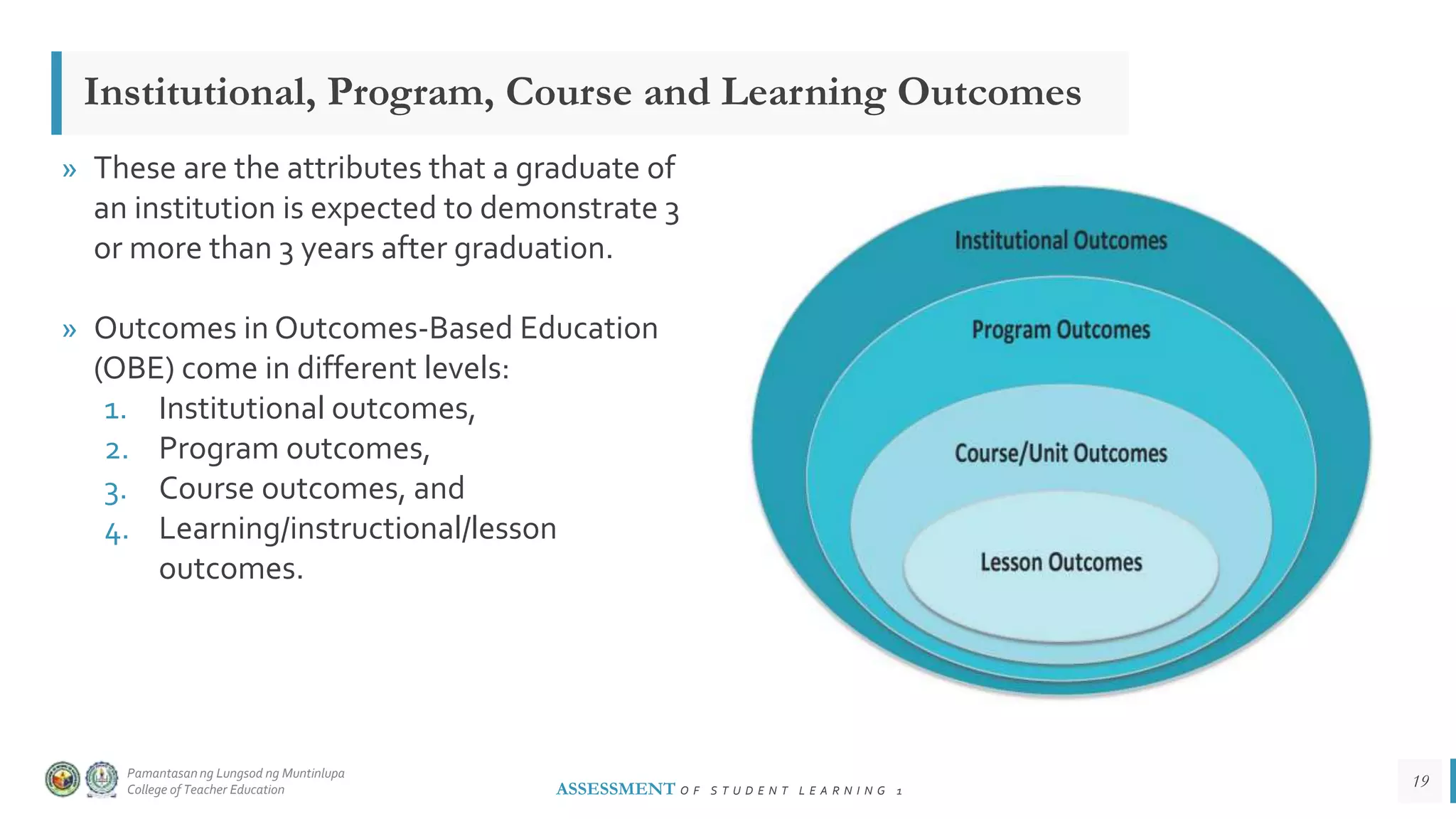
Institutional, Program, Course and Learning Outcomes
» These are the attributes that a graduate of
an institution is expected to demonstrate 3
or more than 3 years after graduation.
» Outcomes in Outcomes-Based Education
(OBE) come in different levels:
1. Institutional outcomes,
2. Program outcomes,
3. Course outcomes, and
4. Learning/instructional/lesson
outcomes.
19
ASSESSMENT O F S T U D E N T L E A R N I N G 1
Pamantasanng Lungsod ng Muntinlupa
College of Teacher Education
Institutional, Program, Course and Learning Outcomes
» Institutional outcomes are statements of what
the graduates of an educational institution are
supposed to be able to do beyond graduation.
» Program outcomes are what graduates of
particular educational programs or degrees are
able to do at the completion of the degree.
» Course or subject outcomes are what students
should be able to demonstrate at the end of
course or subject.
» Learning or instructional outcomes are what
students should be able to do after a lesson or
instruction.
20
ASSESSMENT O F S T U D E N T L E A R N I N G 1
Pamantasanng Lungsod ng Muntinlupa
College of Teacher Education
Example of Institutional Outcomes
21
ASSESSMENT O F S T U D E N T L E A R N I N G 1
Pamantasanng Lungsod ng Muntinlupa
College of Teacher Education
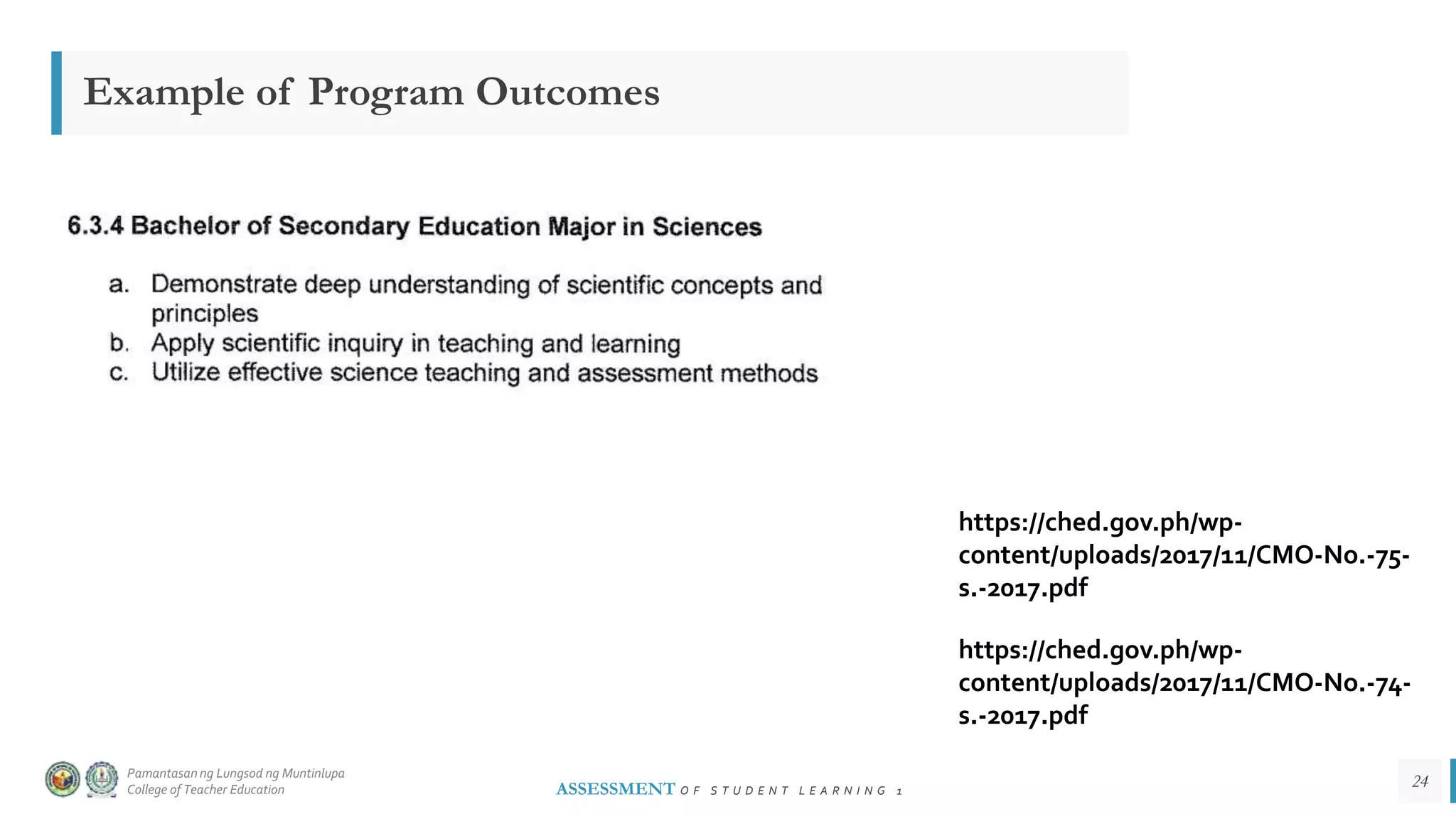
Example of Program Outcomes
22
https://ched.gov.ph/wp-
content/uploads/2017/11/CMO-No.-75-
s.-2017.pdf
https://ched.gov.ph/wp-
content/uploads/2017/11/CMO-No.-74-
s.-2017.pdf
ASSESSMENT O F S T U D E N T L E A R N I N G 1
Pamantasanng Lungsod ng Muntinlupa
College of Teacher Education
Example of Program Outcomes
23
https://ched.gov.ph/wp-
content/uploads/2017/11/CMO-No.-75-
s.-2017.pdf
https://ched.gov.ph/wp-
content/uploads/2017/11/CMO-No.-74-
s.-2017.pdf
ASSESSMENT O F S T U D E N T L E A R N I N G 1
Pamantasanng Lungsod ng Muntinlupa
College of Teacher Education
Example of Program Outcomes
24
https://ched.gov.ph/wp-
content/uploads/2017/11/CMO-No.-75-
s.-2017.pdf
https://ched.gov.ph/wp-
content/uploads/2017/11/CMO-No.-74-
s.-2017.pdf
ASSESSMENT O F S T U D E N T L E A R N I N G 1
Pamantasanng Lungsod ng Muntinlupa
College of Teacher Education
Example of Program Outcomes
25
https://ched.gov.ph/wp-
content/uploads/2017/11/CMO-No.-75-
s.-2017.pdf
https://ched.gov.ph/wp-
content/uploads/2017/11/CMO-No.-74-
s.-2017.pdf
ASSESSMENT O F S T U D E N T L E A R N I N G 1
Pamantasanng Lungsod ng Muntinlupa
College of Teacher Education
26
ASSESSMENT
O F S T U D E N T L E A R N I N G 1
Shift of Educational
Focus From Content to
Learning Outcomes
Chapter 1:
Mr. CyrusT. Esguerra, LPT
College Instructor
Pamantasan ng Lungsod ng Muntinlupa

Chapter 1 - Shift of Educational Focus From Content to Learning Outcomes.pptx

  • 1.
    ASSESSMENT O FS T U D E N T L E A R N I N G 1 Pamantasanng Lungsod ng Muntinlupa College of Teacher Education 1 ASSESSMENT O F S T U D E N T L E A R N I N G 1 Shift of Educational Focus From Content to Learning Outcomes Chapter 1: Mr. CyrusT. Esguerra, LPT College Instructor Pamantasan ng Lungsod ng Muntinlupa
  • 2.
    ASSESSMENT O FS T U D E N T L E A R N I N G 1 Pamantasanng Lungsod ng Muntinlupa College of Teacher Education Learning Outcomes » Explain at least 3 characteristics of outcomes- based education » Distinguish among institutional outcomes, program outcomes, course outcomes and learning instructional outcome. » Formulate learning outcomes based on given educational objectives 2
  • 3.
    ASSESSMENT O FS T U D E N T L E A R N I N G 1 Pamantasanng Lungsod ng Muntinlupa College of Teacher Education Introduction » The educative process happens between the teacher and the student. » Education originated from the terms "educare“ (to train or to mold) or "educere“ (to lead out) » Ironically, however, for centuries we believe that education is a "pouring in" process. » Where the teacher was the infallible giver of knowledge and the student was the passive recipient. » Focus of instruction was content and subject matter. 3
  • 4.
    ASSESSMENT O FS T U D E N T L E A R N I N G 1 Pamantasanng Lungsod ng Muntinlupa College of Teacher Education Introduction » We were used to regarding education basically in terms of designating a set of subjects to take and when the course is completed we pronounce the students "educated," assuming that the instruction and activities we provided will lead to the desired knowledge, skills and other attributes that we think the course passers would possess. 4
  • 5.
    ASSESSMENT O FS T U D E N T L E A R N I N G 1 Pamantasanng Lungsod ng Muntinlupa College of Teacher Education Introduction » The advent of technology caused a change of perspective in education, nationally and internationally. » The teacher ceased to be the sole source of knowledge. » With knowledge explosion, students are surrounded with various sources of facts and information accessible through user-friendly technology. » The teacher has become a facilitator of knowledge who assists in the organization, interpretation and validation of acquired facts and information. 5
  • 6.
    ASSESSMENT O FS T U D E N T L E A R N I N G 1 Pamantasanng Lungsod ng Muntinlupa College of Teacher Education 6 ASSESSMENT O F S T U D E N T L E A R N I N G 1 Outcomes-Based Education: Matching Intentions with Accomplishment
  • 7.
    ASSESSMENT O FS T U D E N T L E A R N I N G 1 Pamantasanng Lungsod ng Muntinlupa College of Teacher Education Outcomes-Based Education Framework 7
  • 8.
    ASSESSMENT O FS T U D E N T L E A R N I N G 1 Pamantasanng Lungsod ng Muntinlupa College of Teacher Education 8 UNBOXING OUTCOMES-BASED EDUCATION: What do you think are the characteristics of outcome-based education (OBE)?
  • 9.
    ASSESSMENT O FS T U D E N T L E A R N I N G 1 Pamantasanng Lungsod ng Muntinlupa College of Teacher Education Outcomes-Based Education » Outcome-based education (OBE) is education in which an emphasis is placed on a clearly articulated idea of what students are expected to know and be able to do, that is, what skills and knowledge they need to have, when they leave the school system. » Outcome-based education or outcomes-based education is an educational theory that bases each part of an educational system around goals. By the end of the educational experience, each student should have achieved the goal. 9
  • 10.
    ASSESSMENT O FS T U D E N T L E A R N I N G 1 Pamantasanng Lungsod ng Muntinlupa College of Teacher Education Outcomes-Based Education The change in educational perspective is called Outcomes-Based Education (OBE) which has three (3) characteristics: 1. It is student centered; that is, it places the students at the center of the process by focusing on Student Learning Outcomes (SLO). 2. It is faculty driven; that is, it encourages faculty responsibility for teaching, assessing program outcomes and motivating participation from the students. 3. It is meaningful; that is, it provides data to guide the teacher in making valid and continuing improvement in instruction and assessment activities. 10
  • 11.
    ASSESSMENT O FS T U D E N T L E A R N I N G 1 Pamantasanng Lungsod ng Muntinlupa College of Teacher Education Outcomes-Based Education To implement outcomes-based education on the subject or course level, the following procedure is recommended: 1. Identification of the educational objectives of the subject/ course. » Educational objectives are the broad goals that the subject/course expects to achieve, and defining in general terms the knowledge, skills and attitude that the teacher will help the students to attain. » The objectives are stated from the point of view of the teacher such as: "to develop, to provide, to enhance, to inculcate, etc." 11
  • 12.
    ASSESSMENT O FS T U D E N T L E A R N I N G 1 Pamantasanng Lungsod ng Muntinlupa College of Teacher Education Outcomes-Based Education To implement outcomes-based education on the subject or course level, the following procedure is recommended: 2. Listing of learning outcomes specified for each subject/ course objective. » Cognitive Domain, also called knowledge, refers to mental skills such as remembering, understanding, applying, analyzing, evaluating, synthesizing/creating. » Psychomotor, also referred to as skills, includes manual or physical skills, which proceed from mental activities and range from the simplest to the complex such as observing, imitating, practising, adapting and innovating. » Affective, also known as attitude, refers to growth in feelings or emotions from the simplest behavior to the most complex such as receiving, responding, valuing. organizing, and internalizing. 12
  • 13.
    ASSESSMENT O FS T U D E N T L E A R N I N G 1 Pamantasanng Lungsod ng Muntinlupa College of Teacher Education Outcomes-Based Education To implement outcomes-based education on the subject or course level, the following procedure is recommended: 3. Drafting outcomes assessment procedure. » This procedure will enable the teacher to determine the degree to which the students are attaining the desired learning outcomes. » It identifies for every outcome the data that will be gathered which will guide the selection of the assessment tools to be used and at what point assessment will be done. 13
  • 14.
    ASSESSMENT O FS T U D E N T L E A R N I N G 1 Pamantasanng Lungsod ng Muntinlupa College of Teacher Education 14
  • 15.
    ASSESSMENT O FS T U D E N T L E A R N I N G 1 Pamantasanng Lungsod ng Muntinlupa College of Teacher Education 15 ASSESSMENT O F S T U D E N T L E A R N I N G 1 The Outcomes of Education
  • 16.
    ASSESSMENT O FS T U D E N T L E A R N I N G 1 Pamantasanng Lungsod ng Muntinlupa College of Teacher Education The Outcomes of Education » Outcomes-based education focuses classroom instruction on the skills and competencies that students must demonstrate when they exit. » There are two (2) types of outcomes: immediate and deferred outcomes. 1. Immediate outcomes are competencies/skills acquired upon completion of a subject, a grade level, a segment of the program, or of the program itself. Examples: » Ability to communicate in writing and speaking » Mathematical problem-solving skill » Skill in identifying objects by using the different senses » Ability to produce artistic or literary works » Ability to do research and write the results » Ability to present an investigative science project Skill in story-telling » Promotion to a higher grade level 16
  • 17.
    ASSESSMENT O FS T U D E N T L E A R N I N G 1 Pamantasanng Lungsod ng Muntinlupa College of Teacher Education The Outcomes of Education » Outcomes-based education focuses classroom instruction on the skills and competencies that students must demonstrate when they exit. » There are two (2) types of outcomes: immediate and deferred outcomes. 2. Deferred outcomes refer to the ability to apply cognitive, psychomotor and affective skills/competencies in various situations many years after completion of a subject; grade level or degree program. Examples: » Success in professional practice or occupation » Promotion in a job » Success in career planning, health and wellness » Awards and recognition These are referred to as institutional outcomes. 17
  • 18.
    ASSESSMENT O FS T U D E N T L E A R N I N G 1 Pamantasanng Lungsod ng Muntinlupa College of Teacher Education 18 ASSESSMENT O F S T U D E N T L E A R N I N G 1 Institutional, Program, Course and Learning Outcomes
  • 19.
    ASSESSMENT O FS T U D E N T L E A R N I N G 1 Pamantasanng Lungsod ng Muntinlupa College of Teacher Education Institutional, Program, Course and Learning Outcomes » These are the attributes that a graduate of an institution is expected to demonstrate 3 or more than 3 years after graduation. » Outcomes in Outcomes-Based Education (OBE) come in different levels: 1. Institutional outcomes, 2. Program outcomes, 3. Course outcomes, and 4. Learning/instructional/lesson outcomes. 19
  • 20.
    ASSESSMENT O FS T U D E N T L E A R N I N G 1 Pamantasanng Lungsod ng Muntinlupa College of Teacher Education Institutional, Program, Course and Learning Outcomes » Institutional outcomes are statements of what the graduates of an educational institution are supposed to be able to do beyond graduation. » Program outcomes are what graduates of particular educational programs or degrees are able to do at the completion of the degree. » Course or subject outcomes are what students should be able to demonstrate at the end of course or subject. » Learning or instructional outcomes are what students should be able to do after a lesson or instruction. 20
  • 21.
    ASSESSMENT O FS T U D E N T L E A R N I N G 1 Pamantasanng Lungsod ng Muntinlupa College of Teacher Education Example of Institutional Outcomes 21
  • 22.
    ASSESSMENT O FS T U D E N T L E A R N I N G 1 Pamantasanng Lungsod ng Muntinlupa College of Teacher Education Example of Program Outcomes 22 https://ched.gov.ph/wp- content/uploads/2017/11/CMO-No.-75- s.-2017.pdf https://ched.gov.ph/wp- content/uploads/2017/11/CMO-No.-74- s.-2017.pdf
  • 23.
    ASSESSMENT O FS T U D E N T L E A R N I N G 1 Pamantasanng Lungsod ng Muntinlupa College of Teacher Education Example of Program Outcomes 23 https://ched.gov.ph/wp- content/uploads/2017/11/CMO-No.-75- s.-2017.pdf https://ched.gov.ph/wp- content/uploads/2017/11/CMO-No.-74- s.-2017.pdf
  • 24.
    ASSESSMENT O FS T U D E N T L E A R N I N G 1 Pamantasanng Lungsod ng Muntinlupa College of Teacher Education Example of Program Outcomes 24 https://ched.gov.ph/wp- content/uploads/2017/11/CMO-No.-75- s.-2017.pdf https://ched.gov.ph/wp- content/uploads/2017/11/CMO-No.-74- s.-2017.pdf
  • 25.
    ASSESSMENT O FS T U D E N T L E A R N I N G 1 Pamantasanng Lungsod ng Muntinlupa College of Teacher Education Example of Program Outcomes 25 https://ched.gov.ph/wp- content/uploads/2017/11/CMO-No.-75- s.-2017.pdf https://ched.gov.ph/wp- content/uploads/2017/11/CMO-No.-74- s.-2017.pdf
  • 26.
    ASSESSMENT O FS T U D E N T L E A R N I N G 1 Pamantasanng Lungsod ng Muntinlupa College of Teacher Education 26 ASSESSMENT O F S T U D E N T L E A R N I N G 1 Shift of Educational Focus From Content to Learning Outcomes Chapter 1: Mr. CyrusT. Esguerra, LPT College Instructor Pamantasan ng Lungsod ng Muntinlupa