DIVISION PROGRAMS and PROJECTS
FOR SY 2018-2019
HI-TEACH
• The HI-TEACH (Highly Integral Teachers’ Empowerment Amplified
with Collaboration and Hard work) Program is division banner
program anchored on DEPED National program which gives
emphasis on ensuring the full implementation of K to 12 curricula.
• This program is established is to conduct Team Based
Instructional Supervision as basis for providing Technical Assistance
in terms of content and pedagogy, capacitate school heads in the
exercise of Instructional Leadership through process observation,
coaching and mentoring scheme and capability building for all
instructional leaders in all learning areas in the Division.
HI-TEACH (OBJECTIVES)
To Increase the performance level, the learners up to 75 %
proficiency level through instructional supervision, TA provision
and monitoring evaluation of curriculum delivery and specifically
to:
• Enhance supervisory skills and competence of at least 5-10% of 347
school heads annually.
• Enhance the competency level of 11,447 teachers in terms of
content, pedagogy and assessment at least 5-10% annually.
• Strengthen the curriculum support system in delivering relevant
Technical Assistance, monitoring and evaluation
HI-TEACH
AASA (Across all subject areas)
1. Conduct of needs- responsive/ team-based monitoring
2. Strengthening of ICT-mediated Instruction.
3. Conduct of regular and quarterly meeting to address issues
relevant to improvement of pupil’s performance
4. Institutionalization of SLAC and INSET in school level
5. Benchmarking
6. Job embedded learning
7. Profiling of teachers and school heads’ needs
8. Provision of immediate and relative Technical Assistance
9. Coaching and Mentoring to school heads relative to
Instructional Supervisory Plan.
10.Conduct of Demo-Festival during summer INSET
11.Performance review and evaluation
12.Need-based Capacity Building
13.Conduct of Action Researches
14.Continuous Improvement Project
HI-TEACH
AASA (Across all subject areas)
POWER IT UP
Proactive Optimization of Wide-ranging Experiential and
Rationalized Instruction towards Upgraded Potentials
• This program is established to uphold the DepEd VMG which states
the rights of every Filipino child to quality, equitable, culture-based
and complete education. It continuously galvanizes the DepEd
immediate outcomes where learners are expected to attain learning
standards and lifelong literacy, through intervention, remediation,
reinforcement and enhancement programs in all subject areas.
• This program caters to all types of learners to address learning gaps,
achieve expected competencies unleash student’s highest potentials
within and outside classroom set up.
POWER IT UP (OBJECTIVES)
To Increase the performance level, the learners at least up to 75 %
proficiency level through conduct of intervention, enhancement and
reinforcement activities, specifically to:
• Improve students’ academic performance by creating transformative co-
curricular activities that is complementary to curricular activities.
• Develop literacy and numeracy skills and attitudes for lifelong learning of the
Filipino students.
• Ensure the learners’ optimum potentials in learning across all learning areas.
• Achieve better or maintain the highest performance and rank in various
regional, national or even in international competitions.
1. Characterization of base-line data least mastered and
achieved competencies.
a. Mastered competencies
b. Closely Mastered competencies
c. Average Mastery
d. Low Mastery
e. Very low mastery
POWER IT UP
AASA (Across all subject areas)
2. Development and implementation of remediation, reinforcement
and intervention plans across all learning areas, such as but not
limited to:
a. Peer tutoring
b. Remedial teaching
c. Math Saturday Program
d. Home Based Module Utilization Approach
e. Enhancement activity after class.
f. Sustainable School to School partnership
g. SBM instructional dimension project per school
POWER IT UP
AASA (Across all subject areas)
3. Reading activities for languages such as but not limited to:
a. Reading awareness campaign
b. Reading interventions
c. Reading rescue to those non-readers in higher grade levels.
d. Reading recovery to those slow readers in the higher grade levels.
e. Reading Month Celebration
f. Storytelling for reading appreciation.
g. Phil IRI Assessment
h. language subjects.
POWER IT UP – Project SPARK
AASA (Across all subject areas)
4. Rewards and recognitions to excellent students in all subject
areas
5. Conduct of Division Festival Talents in all Subject Areas.
6. Participation to Regional, National and International competitions.
7. Conduct of periodical Learning Outcomes assessment results
from school, district and division level.
8. Midyear and Yearly performance review of projects implemented.
9. Conduct of Action Researches relative to the program.
10.Continuous Improvement Projects relative to the program.
POWER IT UP
AASA (Across all subject areas)
I-LIKHA
Integrasyon ng Lokalidad, Iugnay sa Karunungan at
Hubog ng Aralin
• This program is established pursuant to Republic Act 10533, An Act
Enhancing the Basic Education System by strengthening its
curriculum, through contextualization and other related processes
and strategies.
• This program focuses on contextualizing instructional materials of
different kinds addressing the needs of our 21st learners and serves
as support teaching aids to the teachers.
I-LIKHA (OBJECTIVES)
To Increase the performance level, the learners at least up to 75 %
proficiency level through contextualization and other related processes
specifically to:
1. Provide teachers and learners with sufficient set of learning materials.
2. Incorporate culturally relevant teaching skills that are important to be a globally
competitive learner.
3. Contextualize learning materials in all learning areas based on needs initiated
by teachers and other learning leaders.
4. Equip teachers with necessary skills in teaching 21st Century learners through
contextualization.
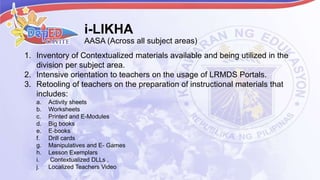
1. Inventory of Contextualized materials available and being utilized in the
division per subject area.
2. Intensive orientation to teachers on the usage of LRMDS Portals.
3. Retooling of teachers on the preparation of instructional materials that
includes:
a. Activity sheets
b. Worksheets
c. Printed and E-Modules
d. Big books
e. E-books
f. Drill cards
g. Manipulatives and E- Games
h. Lesson Exemplars
i. Contextualized DLLs .
j. Localized Teachers Video
i-LIKHA
AASA (Across all subject areas)
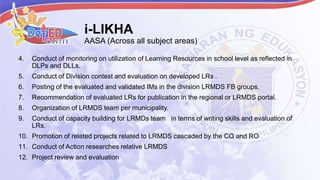
4. Conduct of monitoring on utilization of Learning Resources in school level as reflected in
DLPs and DLLs.
5. Conduct of Division contest and evaluation on developed LRs .
6. Posting of the evaluated and validated IMs in the division LRMDS FB groups.
7. Recommendation of evaluated LRs for publication in the regional or LRMDS portal.
8. Organization of LRMDS team per municipality.
9. Conduct of capacity building for LRMDs team in terms of writing skills and evaluation of
LRs.
10. Promotion of related projects related to LRMDS cascaded by the CO and RO
11. Conduct of Action researches relative LRMDS
12. Project review and evaluation
i-LIKHA
AASA (Across all subject areas)
PROGRAM: AGAP
• This program is established to focus on the objective adherence to
the process of assessment across all learning areas.
• This includes preparation and evaluation of assessment tools,
analysis of assessment results which serve as data for Instructional
Supervision, monitoring and evaluations and crafting of intervention
plans to address learning gaps, adjust instruction, track students’
progress based on learning standards.
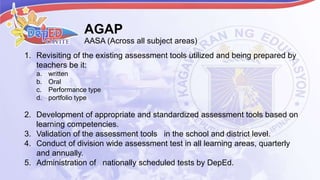
1. Revisiting of the existing assessment tools utilized and being prepared by
teachers be it:
a. written
b. Oral
c. Performance type
d. portfolio type
2. Development of appropriate and standardized assessment tools based on
learning competencies.
3. Validation of the assessment tools in the school and district level.
4. Conduct of division wide assessment test in all learning areas, quarterly
and annually.
5. Administration of nationally scheduled tests by DepEd.
AGAP
AASA (Across all subject areas)
6. Quarterly monitoring of Learning Outcomes Assessment Results by district
and by subject area.
7. Identification of Least Mastered Competencies by subject areas by quarter.
8. Conduct of FGD/ Meeting with all subject area administrators relative to
LOA results by quarter.
9. Organization of LOA coordinators per municipality.
10.Conduct of research relative to LOA (learning outcomes assessments)
11.Conduct of continuous Improvement Projects relative to LOA.
12.Giving of awards and recognition in schools based on quarterly grades.
AGAP
AASA (Across all subject areas)
AGAP (OBJECTIVES)
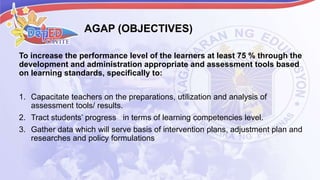
To increase the performance level of the learners at least 75 % through the
development and administration appropriate and assessment tools based
on learning standards, specifically to:
1. Capacitate teachers on the preparations, utilization and analysis of
assessment tools/ results.
2. Tract students’ progress in terms of learning competencies level.
3. Gather data which will serve basis of intervention plans, adjustment plan and
researches and policy formulations
PROGRAM SALIK- SURI
• This program is established to develop research studies relative to
curriculum implementation, utilization of findings and policy
formulations based on researches.
SALIK-SURI (OBJECTIVES)
To increase the performance level of the learners at least 75 % through
utilization of research results, specifically to :
1. provide a model on how educators can use the best available proofs to take
evidence-based approaches and researches in their teaching-learning
practices.
2. develop action researches which will guide teachers to address various issues
inside the school.
3. Conduct research colloquia as venue of the teachers’ research initiatives.
4. present action researches in regional, national or international plenary.
5. recognize individuals who exemplified support to various research projects of
the division.
1. Profiling of researches available and conducted in the
division per subject area.
2. Conduct of capability building and provision of TA to
Research Proponents
3. Organization of Research Monitoring Core Team in
school, District and Division level across all learning
areas.
4. Conduct of action research in school to District and
National Level.
SALIK-SURI
AASA (Across all subject areas)
5. Conduct of Division Research Colloquia.
6. Search for outstanding researcher across all learning
areas.
7. Publication and presentation in the division, regional,
national or international level.
8. Program review and evaluation.
SALIK-SURI
AASA (Across all subject areas)
PROGRAM KALINGA
• Project Kalinga 1
Inclusive Education
• Project Kalinga 2
Cavite SHED (Students’ Home for Education and Development).
• Project Kalinga 3
Expanded Kariton Classroom
PROJECT KALINGA (OBJECTIVES)
Aims to achieve zero out-of-school children and youth in all barangays in
the Province of Cavite and address school leavers and out-of-school youth
problem in the division, particularly on the secondary level.
1. Provide equal opportunity to students with special needs to be accepted and
transferred in mainstream classes as long as they are already equipped with
skills and learning.
2. Development of the skills, talents, and knowledge of the special students in
their own little way.
3. Improve special students’ skills like simple cooking and food preparation,
buying and selling products, wearing and changing their own clothes, and
personal health and hygiene.
PROJECT KALINGA
1. Conduct Advocacy campaign for Inclusive Education to all
learning leaders.
2. Strengthening of partnership to stakeholders and social
marketing
3. Conduct of assessment for students with special needs
4. Admission of students with special needs in Inclusive Education
5. Coordination/consultative meeting among school head-parent-
teacher-receiving teacher
6. Preparation of students IP by SPED teacher
PROJECT KALINGA
7. Inter-agency partnership on Child-mapping
8. Drug Education
9. Expansion of Inclusive Education
10.Youth Development Services
11.Career Guidance and Advocacy
12.Counselling
13.Youth Camp
14.“Kwentambayan”
15.School Sports (KID-LIGTAS)
16.Social Mobilization and Networking
17.Parenting Seminar
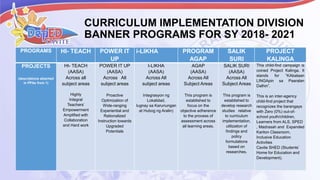
CURRICULUM IMPLEMENTATION DIVISION
BANNER PROGRAMS FOR SY 2018- 2021
PROGRAMS HI- TEACH POWER IT
UP
i-LIKHA PROGRAM
AGAP
SALIK
SURI
PROJECT
KALINGA
PROJECTS
(descriptions attached
in PPAs from 1)
HI- TEACH
(AASA)
Across all
subject areas
Highly
Integral
Teachers’
Empowerment
Amplified with
Collaboration
and Hard work
POWER IT UP
(AASA)
Across All
subject areas
Proactive
Optimization of
Wide-ranging
Experiential and
Rationalized
Instruction towards
Upgraded
Potentials
I-LIKHA
(AASA)
Across All
subject areas
Integrasyon ng
Lokalidad,
Iugnay sa Karunungan
at Hubog ng Aralin)
AGAP
(AASA)
Across All
Subject Areas
This program is
established to
focus on the
objective adherence
to the process of
assessment across
all learning areas.
SALIK SURI
(AASA)
Across All
Subject Areas
This program is
established to
develop research
studies relative
to curriculum
implementation,
utilization of
findings and
policy
formulations
based on
researches.
This child-find campaign is
coined Project Kalinga. It
stands for “KAbataan
LINGApin sa Paaralan
Dalhin”.
This is an inter-agency
child-find project that
recognizes the barangays
with Zero (0%) out-of-
school youth/children,
Learners from ALS, SPED
, Madrasah and Expanded
Kariton Classroom,
Inclusive Education
Activities
Cavite SHED (Students’
Home for Education and
Development).
CURRICULUM IMPLEMENTATION DIVISION
BANNER PROGRAMS FOR SY 2018- 2021
PROGR
AMS
HI- TEACH POWER IT UP I-LIKHA PROGR
AM
AGAP
SALIK
SURI
PROJECT
KALINGA
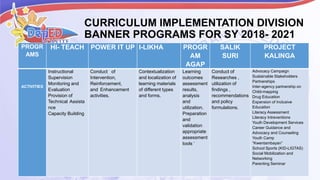
ACTIVITIES
Instructional
Supervision
Monitoring and
Evaluation
Provision of
Technical Assista
nce
Capacity Building
Conduct of
Intervention,
Reinforcement,
and Enhancement
activities.
Contextualization
and localization of
learning materials
of different types
and forms.
Learning
outcomes
assessment
results,
analysis
and
utilization.
Preparation
and
validation
appropriate
assessment
tools ‘
Conduct of
Researches ,
utilization of
findings ,
recommendations
and policy
formulations.
Advocacy Campaign
Sustainable Stakeholders
Partnerships
Inter-agency partnership on
Child-mapping
Drug Education
Expansion of Inclusive
Education
Literacy Assessment
Literacy Intreventions
Youth Development Services
Career Guidance and
Advocacy and Counseling
Youth Camp
“Kwentambayan”
School Sports (KID-LIGTAS)
Social Mobilization and
Networking
Parenting Seminar
CURRICULUM IMPLEMENTATION DIVISION
BANNER PROGRAMS FOR SY 2018- 2021
PROGRAMS
HI- TEACH POWER IT UP I-LIKHA PROGR
AM
AGAP
SALIK SURI PROJECT
KALINGA
INITIATED
BY
Office of the
SDS
Curriculum
Implementation
Division and
SGOD
Office of the SDS
Curriculum
Implementation
Division
Office of the SDS
Curriculum
Implementation
Office of the
SDS
Curriculum
Implementati
on
Office of the SDS
Curriculum
Implementation
Division
Office of the SDS
Curriculum Implementation
Division and SGOD
M & E Monthly,
quarterly and
yearly.
As needed.
Monthly, quarterly
and yearly.
As needed.
Monthly,
quarterly and
yearly.
As needed .
Monthly,
quarterly
and yearly.
As needed
.
Monthly,
quarterly and
yearly.
As needed .
Monthly, quarterly and
yearly.
As needed.
CURRICULUM IMPLEMENTATION DIVISION
BANNER PROGRAMS FOR SY 2018- 2021
PROGRAMS
HI- TEACH POWER IT
UP
I-LIKHA PROGRAM
AGAP
SALIK
SURI
PROJECT
KALINGA
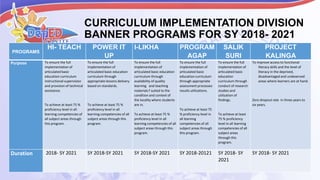
Purpose To ensure the full
implementation of
articulated basic
education curriculum
instructional supervision
and provision of technical
assistance.
To achieve at least 75 %
proficiency level in all
learning competencies of
all subject areas through
this program.
To ensure the full
implementation of
articulated basic education
curriculum through
appropriate lessons delivery
based on standards.
To achieve at least 75 %
proficiency level in all
learning competencies of all
subject areas through this
program.
To ensure the full
implementation of
articulated basic education
curriculum through
availability of quality
learning and teaching
materials f suited to the
condition and context of
the locality where students
are in.
To achieve at least 75 %
proficiency level in all
learning competencies of all
subject areas through this
program.
To ensure the full
implementation of
articulated basic
education curriculum
through appropriate
assessment processes
results utilizations.
To achieve at least 75
% proficiency level in
all learning
competencies of all
subject areas through
this program.
To ensure the full
implementation of
articulated basic
education
curriculum through
conduct of research
studies and
utilization of
findings.
To achieve at least
75 % proficiency
level in all learning
competencies of all
subject areas
through this
program.
To improve access to functional
literacy skills and the level of
literacy in the deprived,
disadvantaged and undeserved
areas where learners are at hand.
Zero dropout rate in three years to
six years.
Duration 2018- SY 2021 SY 2018-SY 2021 SY 2018-SY 2021 SY 2018-20121 SY 2018- SY
2021
SY 2018- SY 2021

Form 2-ppa

  • 1.
    DIVISION PROGRAMS andPROJECTS FOR SY 2018-2019
  • 2.
    HI-TEACH • The HI-TEACH(Highly Integral Teachers’ Empowerment Amplified with Collaboration and Hard work) Program is division banner program anchored on DEPED National program which gives emphasis on ensuring the full implementation of K to 12 curricula. • This program is established is to conduct Team Based Instructional Supervision as basis for providing Technical Assistance in terms of content and pedagogy, capacitate school heads in the exercise of Instructional Leadership through process observation, coaching and mentoring scheme and capability building for all instructional leaders in all learning areas in the Division.
  • 3.
    HI-TEACH (OBJECTIVES) To Increasethe performance level, the learners up to 75 % proficiency level through instructional supervision, TA provision and monitoring evaluation of curriculum delivery and specifically to: • Enhance supervisory skills and competence of at least 5-10% of 347 school heads annually. • Enhance the competency level of 11,447 teachers in terms of content, pedagogy and assessment at least 5-10% annually. • Strengthen the curriculum support system in delivering relevant Technical Assistance, monitoring and evaluation
  • 4.
    HI-TEACH AASA (Across allsubject areas) 1. Conduct of needs- responsive/ team-based monitoring 2. Strengthening of ICT-mediated Instruction. 3. Conduct of regular and quarterly meeting to address issues relevant to improvement of pupil’s performance 4. Institutionalization of SLAC and INSET in school level 5. Benchmarking 6. Job embedded learning 7. Profiling of teachers and school heads’ needs
  • 5.
    8. Provision ofimmediate and relative Technical Assistance 9. Coaching and Mentoring to school heads relative to Instructional Supervisory Plan. 10.Conduct of Demo-Festival during summer INSET 11.Performance review and evaluation 12.Need-based Capacity Building 13.Conduct of Action Researches 14.Continuous Improvement Project HI-TEACH AASA (Across all subject areas)
  • 6.
    POWER IT UP ProactiveOptimization of Wide-ranging Experiential and Rationalized Instruction towards Upgraded Potentials • This program is established to uphold the DepEd VMG which states the rights of every Filipino child to quality, equitable, culture-based and complete education. It continuously galvanizes the DepEd immediate outcomes where learners are expected to attain learning standards and lifelong literacy, through intervention, remediation, reinforcement and enhancement programs in all subject areas. • This program caters to all types of learners to address learning gaps, achieve expected competencies unleash student’s highest potentials within and outside classroom set up.
  • 7.
    POWER IT UP(OBJECTIVES) To Increase the performance level, the learners at least up to 75 % proficiency level through conduct of intervention, enhancement and reinforcement activities, specifically to: • Improve students’ academic performance by creating transformative co- curricular activities that is complementary to curricular activities. • Develop literacy and numeracy skills and attitudes for lifelong learning of the Filipino students. • Ensure the learners’ optimum potentials in learning across all learning areas. • Achieve better or maintain the highest performance and rank in various regional, national or even in international competitions.
  • 8.
    1. Characterization ofbase-line data least mastered and achieved competencies. a. Mastered competencies b. Closely Mastered competencies c. Average Mastery d. Low Mastery e. Very low mastery POWER IT UP AASA (Across all subject areas)
  • 9.
    2. Development andimplementation of remediation, reinforcement and intervention plans across all learning areas, such as but not limited to: a. Peer tutoring b. Remedial teaching c. Math Saturday Program d. Home Based Module Utilization Approach e. Enhancement activity after class. f. Sustainable School to School partnership g. SBM instructional dimension project per school POWER IT UP AASA (Across all subject areas)
  • 10.
    3. Reading activitiesfor languages such as but not limited to: a. Reading awareness campaign b. Reading interventions c. Reading rescue to those non-readers in higher grade levels. d. Reading recovery to those slow readers in the higher grade levels. e. Reading Month Celebration f. Storytelling for reading appreciation. g. Phil IRI Assessment h. language subjects. POWER IT UP – Project SPARK AASA (Across all subject areas)
  • 11.
    4. Rewards andrecognitions to excellent students in all subject areas 5. Conduct of Division Festival Talents in all Subject Areas. 6. Participation to Regional, National and International competitions. 7. Conduct of periodical Learning Outcomes assessment results from school, district and division level. 8. Midyear and Yearly performance review of projects implemented. 9. Conduct of Action Researches relative to the program. 10.Continuous Improvement Projects relative to the program. POWER IT UP AASA (Across all subject areas)
  • 12.
    I-LIKHA Integrasyon ng Lokalidad,Iugnay sa Karunungan at Hubog ng Aralin • This program is established pursuant to Republic Act 10533, An Act Enhancing the Basic Education System by strengthening its curriculum, through contextualization and other related processes and strategies. • This program focuses on contextualizing instructional materials of different kinds addressing the needs of our 21st learners and serves as support teaching aids to the teachers.
  • 13.
    I-LIKHA (OBJECTIVES) To Increasethe performance level, the learners at least up to 75 % proficiency level through contextualization and other related processes specifically to: 1. Provide teachers and learners with sufficient set of learning materials. 2. Incorporate culturally relevant teaching skills that are important to be a globally competitive learner. 3. Contextualize learning materials in all learning areas based on needs initiated by teachers and other learning leaders. 4. Equip teachers with necessary skills in teaching 21st Century learners through contextualization.
  • 14.
    1. Inventory ofContextualized materials available and being utilized in the division per subject area. 2. Intensive orientation to teachers on the usage of LRMDS Portals. 3. Retooling of teachers on the preparation of instructional materials that includes: a. Activity sheets b. Worksheets c. Printed and E-Modules d. Big books e. E-books f. Drill cards g. Manipulatives and E- Games h. Lesson Exemplars i. Contextualized DLLs . j. Localized Teachers Video i-LIKHA AASA (Across all subject areas)
  • 15.
    4. Conduct ofmonitoring on utilization of Learning Resources in school level as reflected in DLPs and DLLs. 5. Conduct of Division contest and evaluation on developed LRs . 6. Posting of the evaluated and validated IMs in the division LRMDS FB groups. 7. Recommendation of evaluated LRs for publication in the regional or LRMDS portal. 8. Organization of LRMDS team per municipality. 9. Conduct of capacity building for LRMDs team in terms of writing skills and evaluation of LRs. 10. Promotion of related projects related to LRMDS cascaded by the CO and RO 11. Conduct of Action researches relative LRMDS 12. Project review and evaluation i-LIKHA AASA (Across all subject areas)
  • 16.
    PROGRAM: AGAP • Thisprogram is established to focus on the objective adherence to the process of assessment across all learning areas. • This includes preparation and evaluation of assessment tools, analysis of assessment results which serve as data for Instructional Supervision, monitoring and evaluations and crafting of intervention plans to address learning gaps, adjust instruction, track students’ progress based on learning standards.
  • 17.
    1. Revisiting ofthe existing assessment tools utilized and being prepared by teachers be it: a. written b. Oral c. Performance type d. portfolio type 2. Development of appropriate and standardized assessment tools based on learning competencies. 3. Validation of the assessment tools in the school and district level. 4. Conduct of division wide assessment test in all learning areas, quarterly and annually. 5. Administration of nationally scheduled tests by DepEd. AGAP AASA (Across all subject areas)
  • 18.
    6. Quarterly monitoringof Learning Outcomes Assessment Results by district and by subject area. 7. Identification of Least Mastered Competencies by subject areas by quarter. 8. Conduct of FGD/ Meeting with all subject area administrators relative to LOA results by quarter. 9. Organization of LOA coordinators per municipality. 10.Conduct of research relative to LOA (learning outcomes assessments) 11.Conduct of continuous Improvement Projects relative to LOA. 12.Giving of awards and recognition in schools based on quarterly grades. AGAP AASA (Across all subject areas)
  • 19.
    AGAP (OBJECTIVES) To increasethe performance level of the learners at least 75 % through the development and administration appropriate and assessment tools based on learning standards, specifically to: 1. Capacitate teachers on the preparations, utilization and analysis of assessment tools/ results. 2. Tract students’ progress in terms of learning competencies level. 3. Gather data which will serve basis of intervention plans, adjustment plan and researches and policy formulations
  • 20.
    PROGRAM SALIK- SURI •This program is established to develop research studies relative to curriculum implementation, utilization of findings and policy formulations based on researches.
  • 21.
    SALIK-SURI (OBJECTIVES) To increasethe performance level of the learners at least 75 % through utilization of research results, specifically to : 1. provide a model on how educators can use the best available proofs to take evidence-based approaches and researches in their teaching-learning practices. 2. develop action researches which will guide teachers to address various issues inside the school. 3. Conduct research colloquia as venue of the teachers’ research initiatives. 4. present action researches in regional, national or international plenary. 5. recognize individuals who exemplified support to various research projects of the division.
  • 22.
    1. Profiling ofresearches available and conducted in the division per subject area. 2. Conduct of capability building and provision of TA to Research Proponents 3. Organization of Research Monitoring Core Team in school, District and Division level across all learning areas. 4. Conduct of action research in school to District and National Level. SALIK-SURI AASA (Across all subject areas)
  • 23.
    5. Conduct ofDivision Research Colloquia. 6. Search for outstanding researcher across all learning areas. 7. Publication and presentation in the division, regional, national or international level. 8. Program review and evaluation. SALIK-SURI AASA (Across all subject areas)
  • 24.
    PROGRAM KALINGA • ProjectKalinga 1 Inclusive Education • Project Kalinga 2 Cavite SHED (Students’ Home for Education and Development). • Project Kalinga 3 Expanded Kariton Classroom
  • 25.
    PROJECT KALINGA (OBJECTIVES) Aimsto achieve zero out-of-school children and youth in all barangays in the Province of Cavite and address school leavers and out-of-school youth problem in the division, particularly on the secondary level. 1. Provide equal opportunity to students with special needs to be accepted and transferred in mainstream classes as long as they are already equipped with skills and learning. 2. Development of the skills, talents, and knowledge of the special students in their own little way. 3. Improve special students’ skills like simple cooking and food preparation, buying and selling products, wearing and changing their own clothes, and personal health and hygiene.
  • 26.
    PROJECT KALINGA 1. ConductAdvocacy campaign for Inclusive Education to all learning leaders. 2. Strengthening of partnership to stakeholders and social marketing 3. Conduct of assessment for students with special needs 4. Admission of students with special needs in Inclusive Education 5. Coordination/consultative meeting among school head-parent- teacher-receiving teacher 6. Preparation of students IP by SPED teacher
  • 27.
    PROJECT KALINGA 7. Inter-agencypartnership on Child-mapping 8. Drug Education 9. Expansion of Inclusive Education 10.Youth Development Services 11.Career Guidance and Advocacy 12.Counselling 13.Youth Camp 14.“Kwentambayan” 15.School Sports (KID-LIGTAS) 16.Social Mobilization and Networking 17.Parenting Seminar
  • 28.
    CURRICULUM IMPLEMENTATION DIVISION BANNERPROGRAMS FOR SY 2018- 2021 PROGRAMS HI- TEACH POWER IT UP i-LIKHA PROGRAM AGAP SALIK SURI PROJECT KALINGA PROJECTS (descriptions attached in PPAs from 1) HI- TEACH (AASA) Across all subject areas Highly Integral Teachers’ Empowerment Amplified with Collaboration and Hard work POWER IT UP (AASA) Across All subject areas Proactive Optimization of Wide-ranging Experiential and Rationalized Instruction towards Upgraded Potentials I-LIKHA (AASA) Across All subject areas Integrasyon ng Lokalidad, Iugnay sa Karunungan at Hubog ng Aralin) AGAP (AASA) Across All Subject Areas This program is established to focus on the objective adherence to the process of assessment across all learning areas. SALIK SURI (AASA) Across All Subject Areas This program is established to develop research studies relative to curriculum implementation, utilization of findings and policy formulations based on researches. This child-find campaign is coined Project Kalinga. It stands for “KAbataan LINGApin sa Paaralan Dalhin”. This is an inter-agency child-find project that recognizes the barangays with Zero (0%) out-of- school youth/children, Learners from ALS, SPED , Madrasah and Expanded Kariton Classroom, Inclusive Education Activities Cavite SHED (Students’ Home for Education and Development).
  • 29.
    CURRICULUM IMPLEMENTATION DIVISION BANNERPROGRAMS FOR SY 2018- 2021 PROGR AMS HI- TEACH POWER IT UP I-LIKHA PROGR AM AGAP SALIK SURI PROJECT KALINGA ACTIVITIES Instructional Supervision Monitoring and Evaluation Provision of Technical Assista nce Capacity Building Conduct of Intervention, Reinforcement, and Enhancement activities. Contextualization and localization of learning materials of different types and forms. Learning outcomes assessment results, analysis and utilization. Preparation and validation appropriate assessment tools ‘ Conduct of Researches , utilization of findings , recommendations and policy formulations. Advocacy Campaign Sustainable Stakeholders Partnerships Inter-agency partnership on Child-mapping Drug Education Expansion of Inclusive Education Literacy Assessment Literacy Intreventions Youth Development Services Career Guidance and Advocacy and Counseling Youth Camp “Kwentambayan” School Sports (KID-LIGTAS) Social Mobilization and Networking Parenting Seminar
  • 30.
    CURRICULUM IMPLEMENTATION DIVISION BANNERPROGRAMS FOR SY 2018- 2021 PROGRAMS HI- TEACH POWER IT UP I-LIKHA PROGR AM AGAP SALIK SURI PROJECT KALINGA INITIATED BY Office of the SDS Curriculum Implementation Division and SGOD Office of the SDS Curriculum Implementation Division Office of the SDS Curriculum Implementation Office of the SDS Curriculum Implementati on Office of the SDS Curriculum Implementation Division Office of the SDS Curriculum Implementation Division and SGOD M & E Monthly, quarterly and yearly. As needed. Monthly, quarterly and yearly. As needed. Monthly, quarterly and yearly. As needed . Monthly, quarterly and yearly. As needed . Monthly, quarterly and yearly. As needed . Monthly, quarterly and yearly. As needed.
  • 31.
    CURRICULUM IMPLEMENTATION DIVISION BANNERPROGRAMS FOR SY 2018- 2021 PROGRAMS HI- TEACH POWER IT UP I-LIKHA PROGRAM AGAP SALIK SURI PROJECT KALINGA Purpose To ensure the full implementation of articulated basic education curriculum instructional supervision and provision of technical assistance. To achieve at least 75 % proficiency level in all learning competencies of all subject areas through this program. To ensure the full implementation of articulated basic education curriculum through appropriate lessons delivery based on standards. To achieve at least 75 % proficiency level in all learning competencies of all subject areas through this program. To ensure the full implementation of articulated basic education curriculum through availability of quality learning and teaching materials f suited to the condition and context of the locality where students are in. To achieve at least 75 % proficiency level in all learning competencies of all subject areas through this program. To ensure the full implementation of articulated basic education curriculum through appropriate assessment processes results utilizations. To achieve at least 75 % proficiency level in all learning competencies of all subject areas through this program. To ensure the full implementation of articulated basic education curriculum through conduct of research studies and utilization of findings. To achieve at least 75 % proficiency level in all learning competencies of all subject areas through this program. To improve access to functional literacy skills and the level of literacy in the deprived, disadvantaged and undeserved areas where learners are at hand. Zero dropout rate in three years to six years. Duration 2018- SY 2021 SY 2018-SY 2021 SY 2018-SY 2021 SY 2018-20121 SY 2018- SY 2021 SY 2018- SY 2021