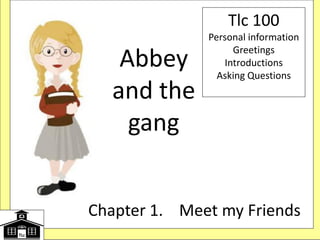
Abbey
and the
gang
Chapter 1. Meet my Friends
Tlc 100
Personal information
Greetings
Introductions
Asking Questions
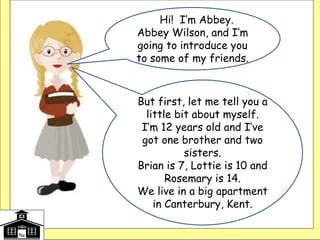
HHi! I’m Abbey.
Abbey Wilson, and I’m
going to introduce you
to some of my friends.
But first, let me tell you a
little bit about myself.
I’m 12 years old and I’ve
got one brother and two
sisters.
Brian is 7, Lottie is 10 and
Rosemary is 14.
We live in a big apartment
in Canterbury, Kent.
Let’s start with simple greetings.
In English we say “Good Morning”,
“Good Afternoon”, “Good Evening”
when we greet people and “Goodbye” when we
leave - but remember that “Goodnight” means that
you are saying goodbye to someone at night.
It´s not the same as “Buenas Noches” in Spanish.
We have lots of ways of greeting each other –
but the most common is simply:
Good morning
Good afternoon how are you?
Good evening
I´m fine, thanks – and you?
Fine, thanks
Introductions
So what are the rules for making introductions?
How do you introduce yourself?
How do you introduce other people to each other?
Hello. My name’s Jane.
I’m English and I’m thirteen and
a half years old. I’m quite shy
and a little absent minded. I’ve
got two brothers. Their names
are Mathew and Scott. I’ve also
got a dog. His name’s Sunny
Name
Nationality
Age
Personality
Family
Pets
Jane
English
131/2
(thirteen and a half)
quite shy
a little absent-minded
2 brothers
(Matthew + Scott)
1 dog
(Sunny)
Jane says…………….. Important information
Now introduce yourself to a classmate
Use the help in the speech bubble below
Hello! My name is …
I am [+ nationality]. I’m … (years old).
I am a little / quite / very / extremely [+ adjective].
I have got … brother(s) and … sister(s).
I haven’t got any brothers and sisters.
I’ve got … [cat(s)] and … [dog(s)]
I haven’t got any pets.
Name?
Nationality?
Age?
Personality?
Family?
Pets?
?
What is your name? (What’s your name?)
What is your nationality? (What’s your nationality?)
How old are you?
What are you like?
Have you got any brothers and sisters?
Do you have any brothers and sisters?
Have you got any pets
Do you have any pets?
Introducing other people to each other
Hi James, this is
Mary - she´s a
friend of mine.
Hi Mary, nice to
meet you.
Nice to meet you too,
James
Name
Nationality
Age
Personality
Family
Pets
Rebecca
Scottish
13
very friendly
extremely talkative
1 sister (Susan)
2 cats
(Comet + Tiger)
Nickname Becky
Physical
Description
long wavy red hair
blue eyes + glasses
tall + slim
This is my friend Rebecca.
Transfer the information
on the right into normal
speech in the speech
bubble below. Remember
to use the 3rd person
“She” and “Her” etc.
Jane says…..
Name
Nationality
Age
Personality
Family
Pets
John
Irish
15
extremely rude
an only child
none
Physical
Description
short straight brown hair
green eyes
short + a little plump
Now do the same for this boy.
He’s in my class at school.
Remember to use the 3rd
person “He” and “His”
Important information
So what are the rules for asking simple questions?
Let’s have a look!
First we need to know if we are asking a question about the
SUBJECT of the answer or the OBJECT of the answer.
Example:
So if we are asking a question about the subject (Peter) we
need to ask a “WHO” question – but if we want to ask
about the object (London) we need to ask a “WHERE”
question.
Second we need to understand the structure of the two
questions – because they are different.
Peter lives In London
Subject Verb Object
V Let’s look at the structures. First the subject question.
Peter lives In London
Subject Verb Object
Who lives In London? Peter
Where does Peter live? In London
Now the object question
Peter lives In London
Subject Verb Object
Very different - so what are the rules?
Let’s look at the actual question words.
Question Words
We normally use question words for:
people
Jobs
things
animals
actions
place quantity reasonmannertime
Who
Whose
Which
(one of)
What
Which
(one of)
Where
When
How long
What time
How often
How
much
How
many
How Why
Subject / Object questions 1.
Notice that they all have an
auxilliary / modal verb in the
structure and the same auxilliary is
used to make the questions for both
the subject and the object.
This is a rule.
Peter is a doctor.
Who is a doctor? Peter.
What is Peter? A doctor
John can fly a helicopter.
Who can fly a helicopter? John.
What can John fly? A helicopter.
Mary has (got) a dog.
Who has (got) a dog? Mary
What has Mary got? A dog.
Look at these models BUT
When we ask a question about a structure
that does not have an auxilliary verb in it – we
have to use the auxilliary verb “do”.
Maria lives in Madrid.
Who lives in Madrid . Maria
Where does Maria live. Madrid
Brian drives a Porche.
Who drives a Porche? Brian.
What does Brian drive? A Porche.
Notice that we do not need an auxilliary /
modal verb to make a question for the subjects
Maria / Brian
BUT we had to use one to make the
question for the object Madrid / Porche
This is another a rule.
Let’s go back to the original structure.
Peter lives In London
Subject Verb Object
Who lives In London? Peter
No auxiliary needed to make the subject question – just the question word – Who?
Note: The word order stays the same (Question word + verb + object) = subject
Peter lives In London
Subject Verb Object
Where does Peter live? In London
We had to use the question word “Where” plus the auxiliary “do” (3rd Person
“does”) to make the object question. The word order is different.
Question word + auxiliary + subject + verb = object
Subject verb Object
Helen hates coffee
Vicky is English
Mark can cook
Jenny is going to go to London
John went to Madrid
Subject / Object Questions
Remember – we do not need an
auxiliary / modal verb to ask a
question about the subject of the
sentence. All we need is the
question word – in this case “WHO”
Who hates coffee? Helen.
Who went to Madrid? Mark
BUT it is necessary to use an auxiliary / modal verb when we ask a question about the object
So - if the answer is
1. coffee
2. English
3. cook
4. to London
5. to Madrid
What is
the
question?
Look at
the table.
Question
word
Aux Subject Verb Answer
Object
What does Helen hate? Coffee
What
nationality
is Vicky? English
What can Mark do? Cook
Where is Jenny going to go? To London
Where did John go? To Madrid
Notice another rule? All the verbs are in the infinitive and “do” became “does” and “did”
Look at this profile. We are going to ask questions to get this information.
His name is Robert Drayton.
He is 37 years old and he is a policeman.
He’s married. His wife’s name is Carla.
She’s 36 and she’s a secretary.
Robert works in Rochester, Kent.
He’s a detective sargeant.
He’s been a policeman for 14 years.
He’s lived in Rochester since March 1999.
He was promoted to DS 2 years ago.
He likes his job because of the variety of work he gets.
He would like to be a detective inspector by 2016.
He is going to go on a course next week.
He will have to stay in London for 3 days
Making subject / object questions
and
remember
is it the
SUBJECT
or the
OBJECT
you are
asking
about?
Now go to the
next page for
some practice
His name is Robert Drayton
He’s 37 years old.
He’s a policman
Yes, he’s married.
His wife’s name is Carla.
She’s 36 years old.
She’s a secretary.
He works in Rochester, Kent.
He’s a Detective Sargeant.
He’s been a policeman for 14 years.
He’s lived in Rochester since March 1999.
He was promoted to DS 2 years ago.
He likes his job because of the variety of work.
He would like to be an inspector by 2016.
He’s going to go on a course next week.
He will have to stay in London for 3 days.
1.
2.
3.
4.
5.
6.
7.
8.
9.
10.
11.
12
13.
14
15
16.
Make the questions for these answers then check them on the next page
His name is Robert Drayton
He’s 37 years old.
He’s a policman
Yes, he’s married.
His wife’s name is Carla.
She’s 36 years old.
She’s a secretary.
He works in Rochester, Kent.
He’s a Detective Sargeant.
He’s been a policeman for 14 years.
He’s lived in Rochester since March 1999.
He was promoted to DS 2 years ago.
He likes his job because of the variety of work.
He would like to be an inspector by 2016.
He’s going to go on a course next week.
He will have to stay in London for 3 days.
What’s his name?
How old is he?
What does he do?
Is he married?
What’s his wife’s name?
How old is she?
What does she do?
Where does he work?
What rank is he?
How long has he been a policeman for?
How long has he lived in Rochester?
When was he promoted?
Why does he like his job?
When would he like to be an inspector by?
When is he going to go on a course?
How long will he have to stay in London?
Make the questions for these answers then check them on the next page
Now let me introduce you to my friends.
This is Paul Magda Bobbie and Cleo
They are going to help me with these presentations.
Between us we are going to present the Tlc 100.
A hundred areas of English grammar and structures
that will help you to pass your examinations.
We´re going to start
with Paul, and he’s
going to talk about
School
Each chapter focuses on
different areas of the TLC 100
and backup materials for those
areas can be found in our self
access resource unit.
You will need a user name and
password to login to these
materials
Yes, I’m Paul Gates and I live in Canterbury, too.
In fact, I live in the same apartment block as Abbey.
She lives on the 3rd floor and I live on 7th floor.
We are in the same class at school.
Magda’s in our class too, but Bobbie and Cleo are a
year older.
They’re in year 8.
In Chapter 2 I’m going to tell you about our school.
The rules – what we can and can´t do.

Chapter 1. my friends

  • 1.
    Abbey and the gang Chapter 1.Meet my Friends Tlc 100 Personal information Greetings Introductions Asking Questions
  • 2.
    HHi! I’m Abbey. AbbeyWilson, and I’m going to introduce you to some of my friends. But first, let me tell you a little bit about myself. I’m 12 years old and I’ve got one brother and two sisters. Brian is 7, Lottie is 10 and Rosemary is 14. We live in a big apartment in Canterbury, Kent.
  • 3.
    Let’s start withsimple greetings. In English we say “Good Morning”, “Good Afternoon”, “Good Evening” when we greet people and “Goodbye” when we leave - but remember that “Goodnight” means that you are saying goodbye to someone at night. It´s not the same as “Buenas Noches” in Spanish. We have lots of ways of greeting each other – but the most common is simply: Good morning Good afternoon how are you? Good evening I´m fine, thanks – and you? Fine, thanks
  • 4.
    Introductions So what arethe rules for making introductions? How do you introduce yourself? How do you introduce other people to each other?
  • 5.
    Hello. My name’sJane. I’m English and I’m thirteen and a half years old. I’m quite shy and a little absent minded. I’ve got two brothers. Their names are Mathew and Scott. I’ve also got a dog. His name’s Sunny Name Nationality Age Personality Family Pets Jane English 131/2 (thirteen and a half) quite shy a little absent-minded 2 brothers (Matthew + Scott) 1 dog (Sunny) Jane says…………….. Important information
  • 6.
    Now introduce yourselfto a classmate Use the help in the speech bubble below Hello! My name is … I am [+ nationality]. I’m … (years old). I am a little / quite / very / extremely [+ adjective]. I have got … brother(s) and … sister(s). I haven’t got any brothers and sisters. I’ve got … [cat(s)] and … [dog(s)] I haven’t got any pets.
  • 7.
    Name? Nationality? Age? Personality? Family? Pets? ? What is yourname? (What’s your name?) What is your nationality? (What’s your nationality?) How old are you? What are you like? Have you got any brothers and sisters? Do you have any brothers and sisters? Have you got any pets Do you have any pets?
  • 8.
    Introducing other peopleto each other Hi James, this is Mary - she´s a friend of mine. Hi Mary, nice to meet you. Nice to meet you too, James
  • 9.
    Name Nationality Age Personality Family Pets Rebecca Scottish 13 very friendly extremely talkative 1sister (Susan) 2 cats (Comet + Tiger) Nickname Becky Physical Description long wavy red hair blue eyes + glasses tall + slim This is my friend Rebecca. Transfer the information on the right into normal speech in the speech bubble below. Remember to use the 3rd person “She” and “Her” etc. Jane says…..
  • 10.
    Name Nationality Age Personality Family Pets John Irish 15 extremely rude an onlychild none Physical Description short straight brown hair green eyes short + a little plump Now do the same for this boy. He’s in my class at school. Remember to use the 3rd person “He” and “His” Important information
  • 11.
    So what arethe rules for asking simple questions? Let’s have a look! First we need to know if we are asking a question about the SUBJECT of the answer or the OBJECT of the answer. Example: So if we are asking a question about the subject (Peter) we need to ask a “WHO” question – but if we want to ask about the object (London) we need to ask a “WHERE” question. Second we need to understand the structure of the two questions – because they are different. Peter lives In London Subject Verb Object
  • 12.
    V Let’s lookat the structures. First the subject question. Peter lives In London Subject Verb Object Who lives In London? Peter Where does Peter live? In London Now the object question Peter lives In London Subject Verb Object Very different - so what are the rules? Let’s look at the actual question words.
  • 13.
    Question Words We normallyuse question words for: people Jobs things animals actions place quantity reasonmannertime Who Whose Which (one of) What Which (one of) Where When How long What time How often How much How many How Why
  • 14.
    Subject / Objectquestions 1. Notice that they all have an auxilliary / modal verb in the structure and the same auxilliary is used to make the questions for both the subject and the object. This is a rule. Peter is a doctor. Who is a doctor? Peter. What is Peter? A doctor John can fly a helicopter. Who can fly a helicopter? John. What can John fly? A helicopter. Mary has (got) a dog. Who has (got) a dog? Mary What has Mary got? A dog. Look at these models BUT When we ask a question about a structure that does not have an auxilliary verb in it – we have to use the auxilliary verb “do”. Maria lives in Madrid. Who lives in Madrid . Maria Where does Maria live. Madrid Brian drives a Porche. Who drives a Porche? Brian. What does Brian drive? A Porche. Notice that we do not need an auxilliary / modal verb to make a question for the subjects Maria / Brian BUT we had to use one to make the question for the object Madrid / Porche This is another a rule.
  • 15.
    Let’s go backto the original structure. Peter lives In London Subject Verb Object Who lives In London? Peter No auxiliary needed to make the subject question – just the question word – Who? Note: The word order stays the same (Question word + verb + object) = subject Peter lives In London Subject Verb Object Where does Peter live? In London We had to use the question word “Where” plus the auxiliary “do” (3rd Person “does”) to make the object question. The word order is different. Question word + auxiliary + subject + verb = object
  • 16.
    Subject verb Object Helenhates coffee Vicky is English Mark can cook Jenny is going to go to London John went to Madrid Subject / Object Questions Remember – we do not need an auxiliary / modal verb to ask a question about the subject of the sentence. All we need is the question word – in this case “WHO” Who hates coffee? Helen. Who went to Madrid? Mark BUT it is necessary to use an auxiliary / modal verb when we ask a question about the object So - if the answer is 1. coffee 2. English 3. cook 4. to London 5. to Madrid What is the question? Look at the table. Question word Aux Subject Verb Answer Object What does Helen hate? Coffee What nationality is Vicky? English What can Mark do? Cook Where is Jenny going to go? To London Where did John go? To Madrid Notice another rule? All the verbs are in the infinitive and “do” became “does” and “did”
  • 17.
    Look at thisprofile. We are going to ask questions to get this information. His name is Robert Drayton. He is 37 years old and he is a policeman. He’s married. His wife’s name is Carla. She’s 36 and she’s a secretary. Robert works in Rochester, Kent. He’s a detective sargeant. He’s been a policeman for 14 years. He’s lived in Rochester since March 1999. He was promoted to DS 2 years ago. He likes his job because of the variety of work he gets. He would like to be a detective inspector by 2016. He is going to go on a course next week. He will have to stay in London for 3 days Making subject / object questions and remember is it the SUBJECT or the OBJECT you are asking about? Now go to the next page for some practice
  • 18.
    His name isRobert Drayton He’s 37 years old. He’s a policman Yes, he’s married. His wife’s name is Carla. She’s 36 years old. She’s a secretary. He works in Rochester, Kent. He’s a Detective Sargeant. He’s been a policeman for 14 years. He’s lived in Rochester since March 1999. He was promoted to DS 2 years ago. He likes his job because of the variety of work. He would like to be an inspector by 2016. He’s going to go on a course next week. He will have to stay in London for 3 days. 1. 2. 3. 4. 5. 6. 7. 8. 9. 10. 11. 12 13. 14 15 16. Make the questions for these answers then check them on the next page
  • 19.
    His name isRobert Drayton He’s 37 years old. He’s a policman Yes, he’s married. His wife’s name is Carla. She’s 36 years old. She’s a secretary. He works in Rochester, Kent. He’s a Detective Sargeant. He’s been a policeman for 14 years. He’s lived in Rochester since March 1999. He was promoted to DS 2 years ago. He likes his job because of the variety of work. He would like to be an inspector by 2016. He’s going to go on a course next week. He will have to stay in London for 3 days. What’s his name? How old is he? What does he do? Is he married? What’s his wife’s name? How old is she? What does she do? Where does he work? What rank is he? How long has he been a policeman for? How long has he lived in Rochester? When was he promoted? Why does he like his job? When would he like to be an inspector by? When is he going to go on a course? How long will he have to stay in London? Make the questions for these answers then check them on the next page
  • 20.
    Now let meintroduce you to my friends. This is Paul Magda Bobbie and Cleo They are going to help me with these presentations. Between us we are going to present the Tlc 100. A hundred areas of English grammar and structures that will help you to pass your examinations.
  • 21.
    We´re going tostart with Paul, and he’s going to talk about School Each chapter focuses on different areas of the TLC 100 and backup materials for those areas can be found in our self access resource unit. You will need a user name and password to login to these materials
  • 22.
    Yes, I’m PaulGates and I live in Canterbury, too. In fact, I live in the same apartment block as Abbey. She lives on the 3rd floor and I live on 7th floor. We are in the same class at school. Magda’s in our class too, but Bobbie and Cleo are a year older. They’re in year 8. In Chapter 2 I’m going to tell you about our school. The rules – what we can and can´t do.