Christina Latham-Koenig
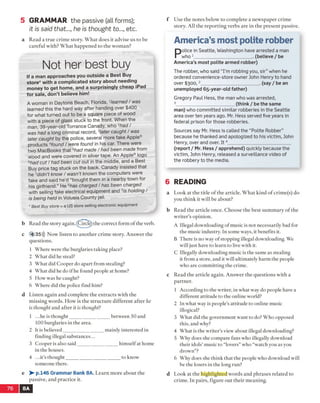
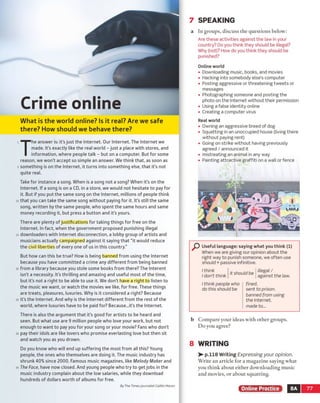
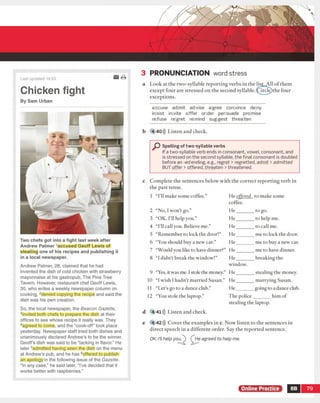
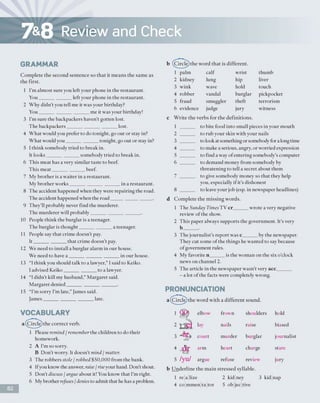
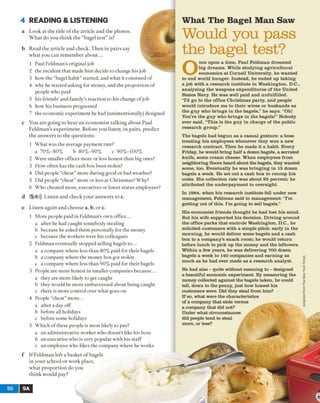
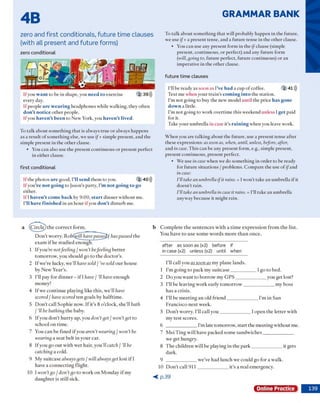
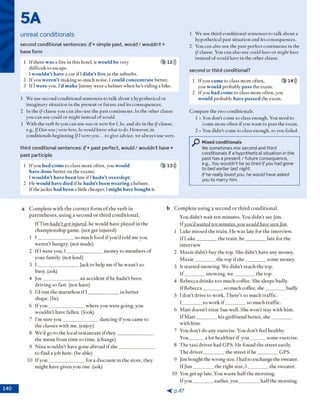
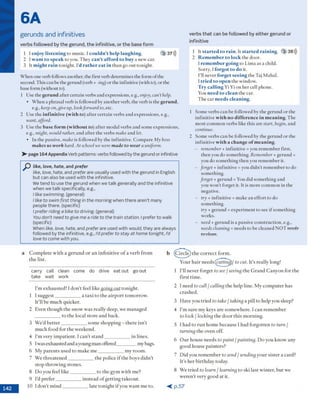
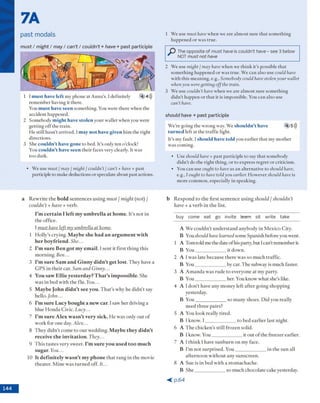
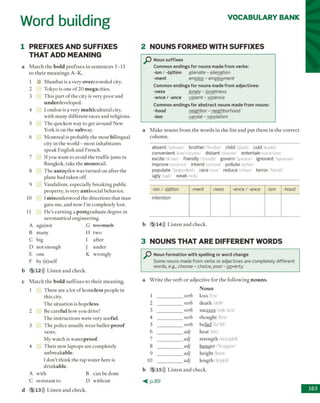
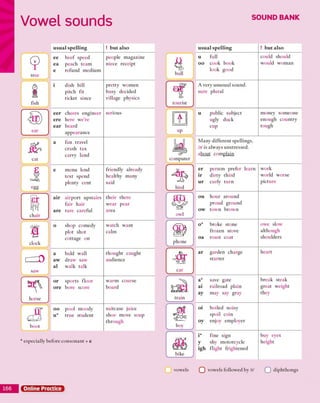
Clive Oxenden
American
S E C O N D E D I T I O N
ENGLISH FILE
O XFO RD
American
ENGLISH FILE
Christina Latham-Koenig
Clive Oxenden
Paul Seligson and Clive Oxenden arethe original co-authors of
EnglishFile 1and English File2
OXFORD
U N IV E R S IT Y PRESS
Grammar Vocabulary Pronunciation
1
4 A Questions and answers question formation figuring out meaning
from context
friendly intonation,
showing interest
8 B Do you believe in it? auxiliary verbs; the...the...
+ comparatives
compound adjectives,
modifiers
intonation and sentence
rhythm
12 COLLOQUIAL ENGLISH 1 Talking about interviews, On the street
2
14 A Call the doctor? present perfect simple and
continuous
illnesses and injuries /ʃ/>/dp ItJ7, and /k/; word
stress
18 B Older and wiser? using adjectives as nouns,
adjective order
clothes and fashion vowel sounds
22 REVIEW& CHECK 1&2 Short movie The history of surgery
3
24 A The truth about air travel narrative tenses, past perfect
continuous; so / such...that
air travel regular and irregular past
forms, sentence rhythm
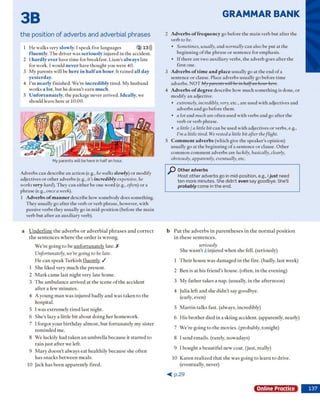
28 B Incredibly short stories the position of adverbs and
adverbial phrases
adverbs and adverbial
phrases
word stress and
intonation
32 M i COLLOQUIAL ENGLISH 2&3 Talking about books. On the street
4
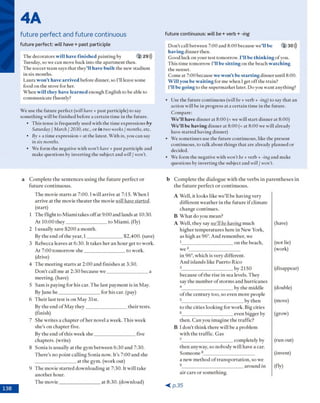
34 A Eco-guilt future perfect and future continuous the environment, the
weather
vowel sounds
38 B Are you a risk taker? zero and first conditionals, future
time clauses
expressions with take sentence stress
and rhythm
42 REVIEW& CHECK 3&4 M i Short movie The Weatherman
5
44 A The survivors'club unreal conditionals feelings word stress in 3- or
4-syllabie adjectives
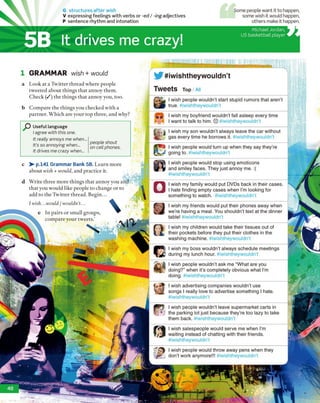
48 B It drives me crazy! structures after wish expressing feelings with
verbs or -ed / -ing adjectives
sentence rhythm
and intonation
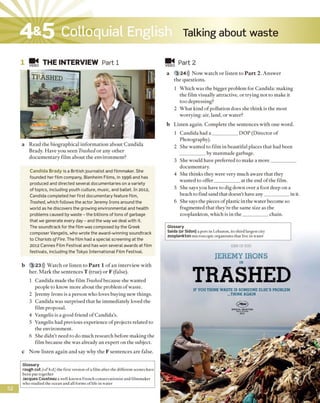
52 ■ < COLLOQUIAL ENGLISH 4&5 Talking about waste, On the street
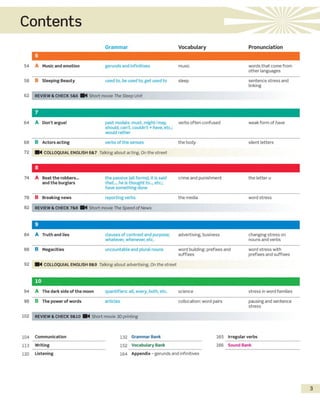
Contents
Grammar V o cabulary P ro nu ncia tion
6
54 A Music and emotion gerunds and infinitives music words that come from
other languages
58 B Sleeping Beauty used to, be used to, get used to sleep sentence stress and
linking
62 REVIEW& CHECK 5&6 ■ < Short movie The Sleep Unit
7
64 A Don’t argue! past modals: must, might/may,
should, can't, couldn't +have, etc.;
would rather
verbs often confused weak form of have
68 B Actors acting verbs of the senses the body silent letters
72 ■ < COLLOQUIAL ENGLISH 6&7 Talking about acting, On the street
8
74 A Beat the robbers...
and the burglars
the passive (all forms); it is said
that..., he is thought to..., etc.;
have something done
crime and punishment the letter u
78 B Breaking news reporting verbs the media word stress
82 REVIEW& CHECK 7&8 ■ < Short movie The Speed of News
9
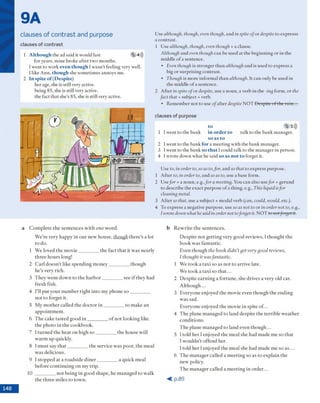
84 A Truth and lies clauses of contrast and purpose;
whatever, whenever, etc.
advertising, business changing stress on
nouns and verbs
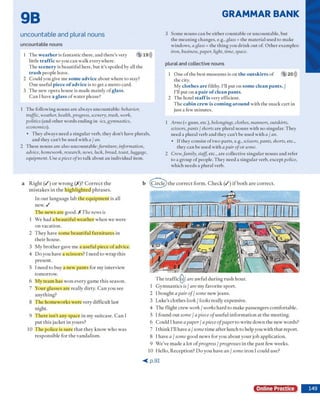
88 B Megacities uncountable and plural nouns word building: prefixes and
suffixes
word stress with
prefixes and suffixes
92 COLLOQUIAL ENGLISH 8&9 Talking about advertising, On the street
10
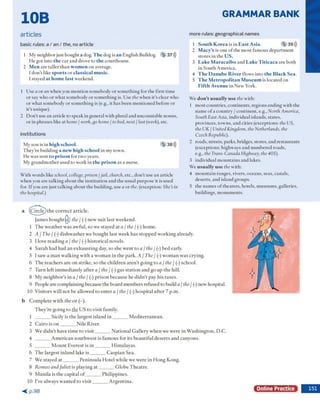
94 A The dark side of the moon quantifiers: all, every, both, etc. science stress in word families
98 B The power of words articles collocation: word pairs pausing and sentence
stress
102 REVIEWS CHECK 9&10 U i Short movie 3D printing
104 Communication 132 Grammar Bank 165 Irregular verbs
113 Writing 152 Vocabulary Bank 166 Sound Bank
120 Listening 164 Appendix - gerunds and infinitives
3
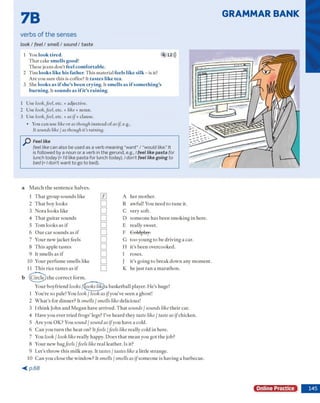
G question form ation
V figuring out meaning from context
P friendly intonation, showing interest
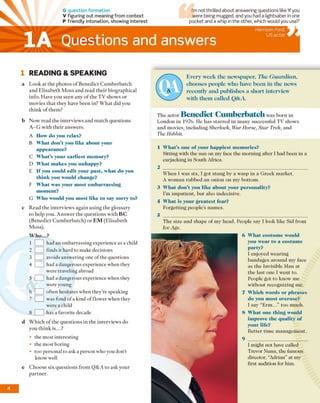
Questions and answers
Harrison Ford,
US actor
1 READING & SPEAKING
a Look at the photos o f Benedict Cumberbatch
and Elisabeth M oss and read their biographical
info. Have you seen any o f the TV shows or
movies that they have been in? W hat did you
think o f them?
b Now read the interviews and match questions
A -G with their answers.
A IIow do you relax?
B What don’t you like about your
appearance?
C What’s your earliest memory?
D What m akes you unhappy?
E If you could edit your past, what do you
think you would change?
F What was your most embarrassing
moment?
G Who would you most like to say sorry to?
c Read the interviews again using the glossary
to help you. Answer the questions with B C
(Benedict Cumberbatch) or E M (Elisabeth
Moss).
W h o...?
1 I 1had an embarrassing experience as a child
2 [ 1 finds it hard to make decisions
3 I 1avoids answering one of the questions
4 1 1 had a dangerous experience when they
were traveling abroad
5 [__1 had a dangerous experience when they
were young
6 I 1 often hesitates when they’re speaking
was fond of a kind of flower when they
were a child
8 I 1 has a favorite decade
d Which of the questions in the interviews do
you think is...?
• the most interesting
• the most boring
• too personal to ask a person who you don’t
know well
e Choose six questions from Q&A to ask your
partner.
Every week the newspaper, The G uardian,
chooses people who have been in the news
recently and publishes a short interview
with them called Q&A.
The actor Benedict Cumberbatch was bom in
London in 1976. lie has starred in many successful TV shows
and movies, including Sherlock, War Horse, S ta r Trek, and
The Hobbit.
1 What’s one of your happiest memories?
Sitting with the sun on my face the morning after I had been in a
carjacking in South Africa.
2 ____________________________________________________
When I was six, I got stung by a wasp in a Greek market.
A woman rubbed an onion on my bottom.
3 What don’t you like about your personality?
I’m impatient, but also indecisive.
4 What is your greatest fear?
Forgetting people’s names.
5 _________________________________________________________
The size and shape of my head. People say I look like Sid from
Ice Age.
6 What costume would
you wear to a costume
party?
I enjoyed wearing
bandages around my face
as the Invisible Man at
the last one I went to.
People got to know me
without recognizing me.
7 Which words or phrases
do you most overuse?
I say “Erm ...” too much.
8 What one thing would
improve the quality of
your life?
Better time management.
I might not have called
Trevor Nunn, the famous
director, “Adrian” at my
first audition for him.
I’m not thrilled about answering questions like ‘If you
were being mugged, and you had a lightsaber in one
pocket and a whip in the other, which would you use?’
1A
4
The actress Elisabeth Moss was born in California in
1982. She has been in several very successful US TV dramas,
including The West Wing and M ad Men, for which she won an
Emmy award.
1 _________________________________________________
Going out into the backyard of my home in LA and
pretending to build a vegetable garden with sticks and
rocks. I must have been five.
2 Which living person do you most admire?
This is kind of cheesy, but my mom.
3 Which living person do you most despise, and why?
I won’t say his name.
4 ______________________________________________________
Not getting enough sleep.
5 What is your favorite smell?
Jasm ine. I grew up in Los Angeles, in the hills, and there
was always jasm ine growing.
6 _________________________________________________
To a really good girlfriend who I lost touch with when I was
little. I would love to see her again.
7 If you could go back in time, where would you go?
To a 1930s jazz club in New York City. I love the art deco
period - the jewelry, the clothes, the music.
8 _______________________________________________________________
I am a big fan of getting a box set and watching the entire
show in two or three weeks. I’m watching The Sopranos at the
moment, because I missed it when it first came out.
9 What has been your most
frightening experience?
When I was little, 1 was
on a lake in the US and
got caught underneath
a rowing boat. That was
pretty scary.
Glossary
carjacking the crime of forcing the
driver of a car to take you somewhere
or give you their car
Emmy an award similar to the
Oscars, but for TV
cheesy informal too emotional
or romantic in a way that is
embarrassing, e.g., a cheesy love song
2 GRAMMAR question formation
a Now read the questions in lb again and answer
the questions below with a partner.
1 Which questions are examples of...?
• a subject question, where there is no auxiliary
verb
• a question that ends with a preposition
• a question that uses a negative auxiliary verb
2 What happens to the word order in the question
What wouldyou change? when you add doyou
think after what?
b > - p.132 Grammar Bank 1A. Learn more about
question formation, and practice it.
3 PRONUNCIATION
friendly intonation, showing interest
a 1 4))) Listen to some people asking questions
1-5. Who sounds friendlier and more interested
each time, a or b?
1 Do you h a vQ ja b ig fa m ily ?
2 W h a t d o n ’t you lik q ^ b o u t the p la c e
where you liv e ?
3 W h a t s p o rt$ J 3 rg a m e $ j3 re you
g o o c jja t?
4 do you t h in k you h a v q ja h e a lt h y d ie t?
5 W h a t m a k e s you f e e l h a p p y ?
b 15))) Listen and repeat the questions with
friendly intonation. Focus on sentence stress and
linking.
O Reacting to what someone says
When you ask someone a question and they
answer, it is normal to show interest by saying,
e.g., Really? or How interesting! with a friendly
intonation or by asking a question.
c 16))) Now listen to the questions in a
conversation. Complete the expressions or
questions that the m an or woman use to react to
the answers.
1 Wow ! That’s a huge family.
2 ________ ? What’s wrong with them?
3 ________! We could play a game one day.
4 ________ ! How long have you been a vegan?
5 ________ ? I can't think of anything worse!
d 17))) Listen and repeat the responses. Copy the
intonation.
e Ask and answer the questions with a partner.
Use friendly intonation, and react to your
partner’s answers.
Adapted from The Guardian
Online Practice 1A
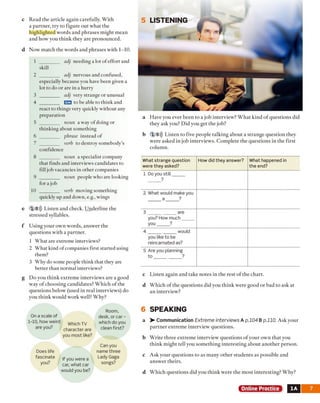
4 READING & VOCABULARY
a Look at the photo with the article. W hat do
you think is happening? Do you think the
question is one that someone might really
ask in this situation? Why (not)?
b Read the article once and find out. How
would yon answer the question?
PGuessing the meaning of new words and phrases
When you are reading and find a word or phrase you don’t know:
1 Try to guess the meaning from the context (e.g., the other words
around it). Think also about what part of speech the unknown word
is (e.g., a verb, an adjective, etc.), whether it is similar to another
English word you know, or whether it is similar to a word in your
language.
2 If you still can’t figure out what the word or phrase means, either
ignore it and continue reading or use a dictionary (or glossary if
there is one) to help you.
HOME / NEWS / US NEWS / SOCIETY
E x tre m e in terv iew s
WHAT kind of dinosaur are you? If you answered Tyrannosaurus rex, then the bad news is that
you probably won’t get the job you’re applying for.
Comment
So, what kind of
dinosaur would
you be?
A Tyrannosaurus rex
ı Welcome to the strange world of extreme
interviewing, the latest trend in which
interviewers throw bizarre questions at
candidates to see how they react.
s It may seem like a game, but extreme
interviewing is deadly serious. The idea is
to see how quicklyjob seekers think on their
feet and, at a time when 25 percent of recent
graduates are unemployed, it offers employers
io a new way of separating the brilliant
candidates from the merely very good.
This new approach to selecting candidates
comes from Silicon Valley in California —
where else? Google, famous for its demanding
is interview process, asked a recent candidate:
“You are stranded on a desert island. You have
60 seconds to choose people of 10 professions
to come with you. Who do you choose? Go!”
One of the early pioneers of extreme interviewing was SteveJobs, cofounder of Apple, who could be
20 famously cruel withjob seekers. Faced once with a candidate he considered boring,Jobs suddenly
pretended to be a chicken, flapping his arms and making clucking noises around the unfortunate applicant,
waiting to see what he would do. In fact, the secret to extreme interviewing is neither in the question nor
the answer. It is in the candidate’s reaction.
David Moyle, a headhunter with the recruitment agency Eximius Group, who admits to using the dinosaur
25 question when selecting candidates, said: “Essentially, that kind of interviewing is used by us to give
someone an opportunity to show they are smart and not easily flustered.”
“Most candidates actually get something out of it, it’s not about trying to crush them. We are trying to give
them an opportunity to show their personality, rather than just showing how they perform in an interview.”
O f course, getting thejob isjust the start. In the modern business world, survival will depend on what kind
30 of dinosaur you realiv are.
Glossary
Silicon Valley the
informal name for the
region in northern
California where many
of the world’s largest
technology corporations
are based
headhunter a person
whose job it is to
find people with the
necessary skills to work
for a company and to
persuade them to join
that company
6 1A Adapted from The Sunday Times
Print
c Read the article again carefully. With
a partner, try to figure out what the
highlighted words and phrases might mean
and how you think they are pronounced.
d Now match the words and phrases with 1-10.
1 ________ adj needing a lot o f effort and
skill
2 ________ adj nervous and confused,
especially because you have been given a
lot to do or are in a hurry
3 ________ adj very strange or unusual
4 ________ ITO1 to be able to think and
react to things very quickly without any
preparation
5 ________ noun a way of doing or
thinking about something
6 ________ phrase instead of
7 ________ verb to destroy somebody’s
confidence
8 ________ noun a specialist company
that finds and interviews candidates to
fill job vacancies in other companies
9 ________ noun people who are looking
for a job
10 ________ verb moving something
quickly up and down, e.g., wings
e 18))) Listen and check. Underline the
stressed syllables.
f Using your own words, answer the
questions with a partner.
1 What are extreme interviews?
2 What kind of companies first started using
them?
3 Why do some people think that they are
better than normal interviews?
g Do you think extreme interviews are a good
way o f choosing candidates? Which o f the
questions below (used in real interviews) do
you think would work well? Why?
a Have you ever been to a job interview? W hat kind o f questions did
they ask you? Did you get the job?
b 19))) Listen to five people talking about a strange question they
were asked in job interviews. Complete the questions in the first
column.
What strange question
were they asked?
How did they answer? What happened in
the end?
1 Do you still
?
2 What would make you
a ?
3 are
you? How much
vou ?
4 would
you like to be
reincarnated as?
5 Are you planning
to ?
c Listen again and take notes in the rest o f the chart.
d Which o f the questions did you think were good or bad to ask at
an interview?
6 SPEAKING
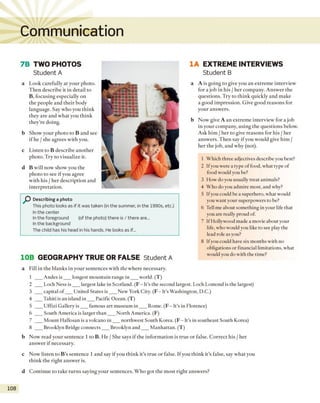
a > - Communication Extreme interviews A p.104 B p.110. Ask your
partner extreme interview questions.
b Write three extreme interview questions of your own that you
think might tell you something interesting about another person.
c Ask your questions to as many other students as possible and
answer theirs.
d Which questions did you think were the most interesting? Why?
Online Practice 1A
5 LISTENING
On a scale of
1-10, how weird
are you?
Which TV
character are
you most like?
Room,
desk, or ca r-
which do you
dean first?
If you were a
car, what car
would you be?
Can you
name three
Lady Gaga
songs?
Does life
fascinate
you?
G auxiliary verbs; the...the... + comparatives
V compound adjectives, modifiers
P intonation and sentence rhythm
For those who believe,
no proof is necessary. For those who
don’t believe, no proof is possible.
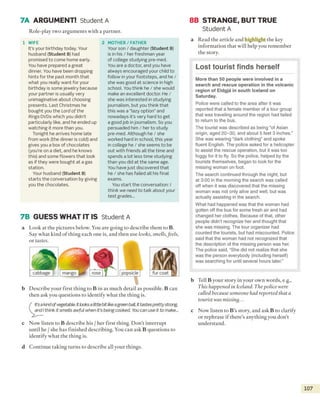
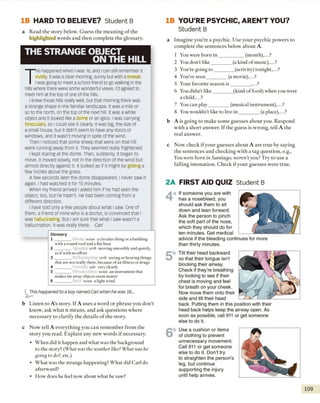
b ^-C o m m u n ica tio n Work in pairs A and B and read two stories.
A read Noises in the Night on p.104. B go to p .109 and read The Strange
Object on the Hill.
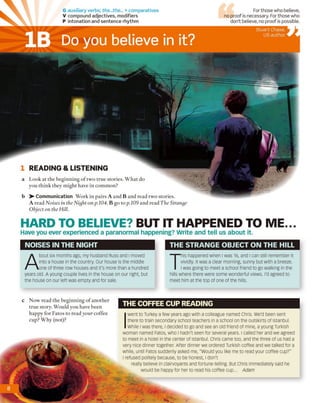
1 READING & LISTENING
a Look at the beginning o f two true stories. What do
you think they might have in common?
THE COFFEE CUP READING
c Now read the beginning o f another
true story. Would you have been
happy for Fatos to read your coffee
cup? Why (not)?
I
went to Turkey a few years ago with a colleague named Chris. We'd been sent
there to train secondary school teachers in a school on the outskirts of Istanbul.
While ı was there, ı decided to go and see an old friend of mine, a young Turkish
woman named Fatos, who ı hadn't seen for several years. I called her and we agreed
to meet in a hotel in the center of Istanbul. Chris came too, and the three of us had a
very nice dinner together. After dinner we ordered Turkish coffee and we talked for a
while, until Fatos suddenly asked me, "would you like me to read your coffee cup?"
I refused politely because, to be honest, I don't
really believe in clairvoyants and fortune-telling. But Chris immediately said he
would be happy for her to read his coffee cup... Adam
Do you believe in it?IB
Stuart Chase,
US author
NOISES IN THE NIGHT
A
bout six months ago, my husband Russ and I moved
into a house in the country. Our house is the middle
one of three row houses and it's more than a hundred
years old. A young couple lives in the house on our right, but
the house on our left was empty and for sale.
T
his happened when I was 16, and I can still remember it
vividly. It was a clear morning, sunny but with a breeze.
I was going to meet a school friend to go walking in the
hills where there were some wonderful views. I'd agreed to
meet him at the top of one of the hills.
THE STRANGE OBJECT ON THE HILL
HARD TO BELIEVE? BUT IT HAPPENED TO ME...
Have you ever experienced a paranormal happening? Write and tell us about it.
d 1 10))) Listen to the rest o f The C offee Cup Rending and
answer the questions.
1 What were the first two things Fatos saw in Chris’s coffee
cup? Were they accurate?
2 What was the third thing she saw?
3 How did Chris and Adam react to this?
4 Who did Chris’s mother live with?
5 Where did Chris go the next morning?
6 Who called Adam? Why?
7 What was the bad news?
8 How did Fatos react to what had happened?
9 How does Adam feel about the experience?
e 1 ID)) Listen to some extracts from the story and complete
the m issing words. Try to figure out what they mean.
1 Well, Carla, Chris's girlfriend at the time, was blond, so
that w as__________________,too.
2 But Chris is a very________ -________ kind of person, and
he didn't seem to be too worried by what she’d said.
3 It was a slightly________ end to what had been a very
enjoyable evening.
4 So, was it just a __________________...?
5 I always used to be very________ about fortune-telling...
2 SPEAKING
Talk in small groups.
Which of the three stories do you find the spookiest?
Can you think of any possible explanation for what happened in
each story?
Have you (or anybody you know)...?
• seen or heard something that can’t be explained,
e.g., a UFO ora ghost
• visited a fortune-teller, psychic, or faith healer
• had a surprising coincidence
P Reacting to a story about something strange
When somebody talks about something strange or difficult to
explain, we often react with these phrases.
How / That’s strange; bizarre; odd; weird; spooky
3 GRAMMAR auxiliary verbs
a Look at the dialogues and try to fill in the blanks with a [+]
or 3 auxiliary (do, did, is, was, etc.).
1 A I heard a noise in the middle of the night.
B You 1____ ? What kind of noise?
2 A You don’t believe in ghosts,2____ you?
B No, Idon’t.
3 A I don't believe you really saw a UFO.
B 13____ see one! It couldn’t have been anything else.
4 A fve never been to a fortune-teller.
B Neither'1____ I.
C 15____ . It was really interesting!
b 1 12))) Listen and check. In pairs, decide which
auxiliary (1-5) is used...
A L7I to add emphasis
B □ to say that you are different
C [_I to check information
D [ ] to show surprise
E HU to say that you are the same
c V -p.133 Grammar Bank IB. Learn more about
using auxiliary verbs, and practice them.
4 PRONUNCIATION
intonation and sentence rhythm
a 1 14))) Listen to the dialogues. Notice the stressed
auxiliary verbs.
a ı dreamed that ı saw a ghost last night.
b You did? So did I. How spooky!
a ı don’t believe in fortune-telling.
b you don’t? I do.
b Repeat the dialogues with a partner, copying the
rhythm and intonation.
c Complete sentences 1-8 so that they are true
for you.
1 I’m not very good a t________ . (activity)
2 I’m going to ________ tonight, (verb phrase)
3 I love________. (a kind of music)
4 I don’t like________ . (a kind o f food)
5 I’ve never read________ . (a famous book)
6 I’d love to live in ________ . (a town or country)
7 1was very________ as a child, (adj of personality)
8 I didn't________ last night, (verb phrase)
d Work in pairs A and B. A read your sentences
to B.
B respond with a reply question and then say
whether you are the same or different. Then
switch roles.
e 1 15))) Listen to another dialogue. Is do stressed
in the highlighted phrases?
A You don’t like horror movies, do you?
B I do like them. It's just that sometimes they’re too scary!
f Repeat the dialogue with a partner, copying the
rhythm and intonation.
g > - Communication You’re psychic, aren’t you? A
p.105 B p.109. Make guesses about your partner.
5 1 16))) SONG Unbelievable Jl
Online Practice IB 9
6 LISTENING & SPEAKING
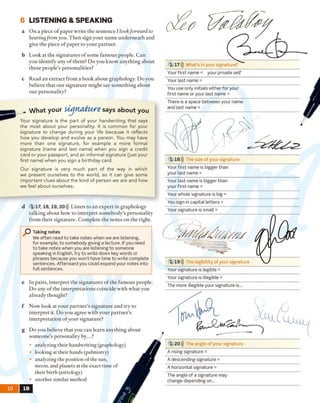
a On a piece o f paper write the sentence I lookforward to
hearingfrom you. Then sign your name underneath and
give the piece o f paper to your partner.
b Look at the signatures o f some famous people. Can
you identify any o f them? Do you know anything about
these people’s personalities?
c Read an extract from a book about graphology. Do you
believe that our signature might say something about
our personality?
W hat your tUJftdfyw e says about you
Your signature is the part of your handwriting that says
the most about your personality. It is common for your
signature to change during your life because it reflects
how you develop and evolve as a person. You may have
more than one signature, for example a more formal
signature (name and last name) when you sign a credit
card or your passport, and an informal signature (just your
first name) when you sign a birthday card.
Our signature is very much part of the way in which
we present ourselves to the world, so it can give some
im portant clues about the kind of person we are and how
we feel about ourselves.
e In pairs, interpret the signatures o f the fam ous people.
Do any o f the interpretations coincide with what you
already thought?
f Now look at your partner's signature and try to
interpret it. D o you agree with your partner’s
interpretation ofy o u r signature?
g Do you believe that you can learn anything about
someone’s personality by...?
• analyzing their handwriting (graphology)
• looking at their hands (palmistry)
• analyzing the position of the sun,
moon, and planets at the exact time of
their birth (astrology)
• another similar method
10 IB
1 17))) What's in your signature?
Your first name = your private self
Your last name =
You use only initials either for your
first name or your last name =
There is a space between your name
and last name =
1 18))) The size of your signature
Your first name is bigger than
your last name =
Your last name is bigger than
your first name =
Your whole signature is big =
You sign in capital letters =
Your signature is small =
1 19))) The legibility of your signature
Your signature is legible =
Your signature is illegible =
The more illegible your signature is...
1 20))) The angle of your signature
A rising signature =
A descending signature =
A horizontal signature =
The angle of a signature may
change depending on...
Taking notes
We often need to take notes when we are listening,
for example, to somebody giving a lecture. If you need
to take notes when you are listening to someone
speaking in English, try to write down key words or
phrases because you won’t have time to write complete
sentences. Afterward you could expand your notes into
full sentences.
d 1 17,18,19, 20))) Listen to an expert in graphology
talking about how to interpret somebody’s personality
from their signature. Complete the notes on the right.
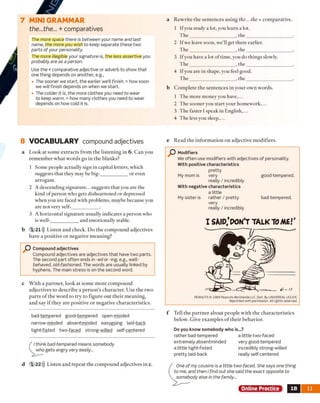
7 M INI GRAMMAR
the...the... + comparatives
The more space there is between your name and last
name, the more you wish to keep separate these two
parts o f your personality.
The more illegible your signature is, the less assertive you
probably are as a person.
Use the + comparative adjective or adverb to show that
one thing depends on another, e.g.,
• The sooner we start, the earlier we’ll finish. = how soon
we will finish depends on when we start.
• The colder it is, the more clothes you need to wear
to keep warm. = how many clothes you need to wear
depends on how cold it is.
8 VOCABULARY compound adjectives
a Look at some extracts from the listening in 6. Can you
remember what words go in the blanks?
1 Some people actually sign in capital letters, which
suggests that they may be big-___________ or even
arrogant.
2 A descending signature...suggests that you are the
kind of person who gets disheartened or depressed
when you are faced with problems, maybe because you
are not very self-___________ .
3 A horizontal signature usually indicates a person who
is well-___________ and emotionally stable.
b 1 2 1 ))) Listen and check. Do the compound adjectives
have a positive or negative meaning?
O Compound adjectives
Compound adjectives are adjectives that have two parts.
The second part often ends in -ed or -ing, e.g., well-
behaved, olcl-loshioned. The words are usually linked by
hyphens. The main stress is on the second word.
c With a partner, look at some more compound
adjectives to describe a person's character. Use the two
parts o f the word to try to figure out their meaning,
and say if they are positive or negative characteristics.
a Rewrite the sentences using the... the + comparative.
1 Ifyou study a lot, you learn a lot.
T he___________________ , the___________________ .
2 If we leave soon, we’ll get there earlier.
T he___________________ , the___________________ .
3 Ifyou have a lot of time, you do things slowly.
T he___________________ , the___________________ .
4 Ifyou are in shape, you feel good.
T he___________________ , the___________________ .
b Complete the sentences in your own words.
1 The more money you have,...
2 The sooner you start your homework,...
3 The faster I speak in English,...
4 The less you sleep,...
e Read the information on adjective m odifiers.
P Modifiers
We often use modifiers with adjectives of personality.
With positive characteristics
pretty
My mom is very good-tempered.
really / incredibly
With negative characteristics
a little
My sister is rather / pretty bad-tempered,
very
really / incredibly
I SAID,'PON'T TALK TOME.''
PEANUTS© 1966 Peanuts Worldwide LLC. Dist. By UNIVERSAL UCLICK.
Reprinted with permission. All rights reserved.
f Tell the partner about people with the characteristics
below. Give examples o f their behavior.
Do you know somebody who is...?
rather bad-tempered a little two-faced
extremely absentminded very good-tempered
a little tight-fisted incredibly strong-willed
pretty laid-back really self-centered
Online Practice IB 11
bad-tempered good-tem pered open-minded
narrow-minded absentminded easygoing iaid-back
tight-fisted two-faced strong-willed self-centered
I think bad-tempered means somebody
who gets angry very easily...
d 1 2 2 ))) Listen and repeat the compound adjectives in c. One of my cousins is a little two-faced. She says one thing
to me, and then I find out she said the exact opposite to
somebody else in the family...
Talking about interviewsColloquial English
VIDE0 THE INTERVIEW Part 1
a Read the biographical information about
Jeff Neil. How do you think his previous
experience helps him in his present job?
Jeff Neil is a US career coach and the founder of
a company called New Career Breakthrough in
New York City. Hisjob involves helping peopie to
discover the right career options for them, and then
to heip them actually get a job, by advising them
on their resumes and on interview techniques. His
specialty is helping people who are making career
transitions, e.g., from one industry to another.
Before setting up his company, he worked for seven
years as an HR (Human Resources) director.
b 123))) Watch or listen to P art 1 of an
interview with him, where he talks about
helping candidates when they are applying for
a job. Check ( / ) the three things he talks about.
I I Checking what there is about you on the
Internet.
] Choosing the right jobs to apply for.
LH Choosing what photos to send with your
resume.
EZ] Thinking out the skills and abilities a job
needs.
] Writing a good cover letter.
LI] Writing a good resume
c Now listen again. Take notes about the advice
he gives in the three areas you checked.
VIDEO Part 2
a 1 24))) Read five tips for the day o f the interview. Now watch or
listen to P art 2, where Jeff talks about the day o f the interview.
Are they T (true) or F (false)? Correct the F ones.
1 It's better to dress too formally than too casually.
2 You should try to find out beforehand what the company’s
dress style is.
3 You should arrive at the place where the interview is going to
take place at least half an hour before the interview.
4 Don’t take any electronic devices with you to the interview.
5 Be careful how you talk to other company employees before an
interview.
b Listen again for more detail. Do you agree with all the tips? Why (not)?
VIDEO
Part 3
oak tree cactus apple tree
a 1 25))) Now watch or listen to P art 3 where Jeff talks about the
interview itself. Complete the advice he gives.
1 If you want to ask about________and_________ , either do this late
in the interview, or wait for the employer to mention them.
2 ________ language and the_________ofyour voice are just as
important as what you actually say.
3 Be aware that the wav you answer an “extreme” interview
question can reveal things about your________ .
1
Glossary
resume a written record ofyour education and
the jobs you have done that you send whenyou are
applying for a job
cover letter a letter containing extra information
which candidates send with their resume
Glossary
Linkedln a social networking service for professional people.
b Listen again and answer the questions.
1 What’s the biggest mistake that job
candidates make during an interview?
2 What's the most important thing for them
to communicate in the interview?
3 Why does he mention people who were
“slouched back and down”?
4 What do you need to try to communicate
with your tone of voice?
5 What “extreme” question did )eff once ask?
6 What possible answers does he suggest? Why?
2 LOOKING AT LANGUAGE
O Make or do?
Jeff uses several expressions with make and do.
These verbs are very common in expressions
related to work, and are sometimes confused
by learners of English often because they just
have one verb in their LI.
a 1 26))) Complete the extracts from the
interview with the right form o f make or do.
Listen and check.
1 “... so some of the biggest mistakes that,
that I’ve seen that people________ on their
resume is they include everything.”
2 “.. ms an employer, I don't care what you
20 years ago or 30 years ago.”
3 “You also want to ________ a Google
search on your own name.”
4 “.. .and to take an eight and a halfsheet of
paper and________ three columns...”
5 “You want to ________ sure your cell phone
is turned off.”
6 “They're________ a lot of eye contact
directly with me.”
b Now complete some more sentences related
to the world o f work.
1 They are going to make a decision about
who gets the job by the end of the week
2 Can I ________ a suggestion about how to
re-organize the HR department?
3 We m ust________ much more market
research before we develop the new product.
4 All the new employees are going to ________
a training course next month.
5 Everyone in the company h as________ a
big effort this year.
6 George is________ a great job and 1think
he deserves to earn a higher salary.
7 I need to ________ a few phone calls before
the meeting starts.
3 VIDEO
ON THE STREET
a 1 27))) Watch or listen to five people talking about job
interviews. How many of them say they definitely got the job?
Jeanine,
South African
Jo,
English
Ivan,
American
Yasuko,
American
Joost,
Dutch
b Watch or listen again. Who (Je, Jo, I, Y, or Jst)...?
I I didn’t get the job because of his / her age
J had his / her interview the most recently
I I prepared for the interview by assessing how suitable he / she
was for the job
] took some medicine to help make him / her feel less nervous
] tried to find out what the company believed in
c 1 28))) Watch or listen and complete the highlighted Colloquial
English phrases. What do you think they mean?
1 “Ijust practiced every question that they could ask me in
my_________
2 ..and then tried to _________ my experience to the various
different points on the job interview...”
3 “I think it went well because they_________ up with an email.”
4 “... their philosophy, the history, and the_________ of the
company.”
5 “In the end they said Iwas too young, so they didn't_________ me.”
4 SPEAKING
Answer the questions with a partner.
1 Have you ever been interviewed for a job or a place in a school?
What was it for? How did you prepare for it? How did it go?
2 Have you ever interviewed another person? What for?
3 What do you think is the most important advice to give to
someone who is going for a job interview?
Online Practice 13
G present perfect simple and continuous
V illnesses and injuries
P /ʃ/, /d3/, /tj/, and /k/; word stress
2A Call the doctor?
My doctor gave me six months to live, but when
I couldn’t pay the bill he gave me six months more.
Walter Matthau,
US actor
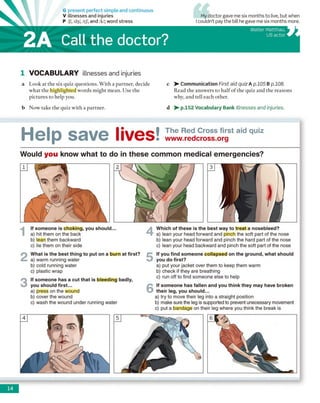
1 VOCABULARY illnesses and injuries
a Look at the six quiz questions. With a partner, decide
what the highlighted words might mean. Use the
pictures to help you.
b Now take the quiz with a partner.
c > - Communication First aid quiz A p.105 B p.108.
Read the answers to half o f the quiz and the reasons
why, and tell each other.
d > - p.152 Vocabulary Bank Illnesses and injuries.
M o l n c a  / D I i W O C I The Red Cross first aid quiz
l l v l U D G V C l l v w O i www.redcross.org
Would you know what to do in these common medical emergencies?
I lf someone is choking, you should...
a) hit them on the back
b) lean them backward
c) lie them on their side
2 What is the best thing to put on a burn at first?
a) warm running water
b) cold running water
c) plastic wrap
3 if someone has a cut that is bleeding badly,
you should first...
a) press on the wound
b) cover the wound
c) wash the wound under running water
4 Which of these is the best way to treat a nosebleed?
a) lean your head forward and pinch the soft part of the nose
b) lean your head forward and pinch the hard part of the nose
c) lean your head backward and pinch the soft part of the nose
5 if you find someone collapsed on the ground, what should
you do first?
a) put your jacket over them to keep them warm
b) check if they are breathing
c) run off to find someone else to help
6 If someone has fallen and you think they may have broken
their leg, you should...
a) try to move their leg into a straight position
b) make sure the leg is supported to prevent unecessary movement
c) put a bandage on their leg where you think the break is
14
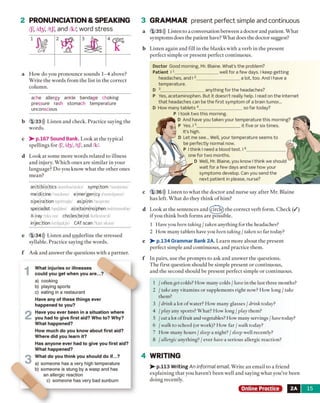
2 PRONUNCIATION & SPEAKING
///, /dy, /tJ7, and /k/; word stress
a How do you pronounce sounds 1 -4 above?
Write the words from the list in the correct
column.
ache allergy ankle bandage choking
pressure rash stomach temperature
unconscious
b 1 33))) Listen and check. Practice saying the
words.
c > - p.167 Sound Bank. Look at the typical
spellings for /J7, Id'S/,/tJ7, and Ik/.
d Look at some more words related to illness
and injury. Which ones are sim ilar in your
language? Do you know what the other ones
mean?
an ti bi 0 tics vntibaiuliks symp tom 'simptoni/
me di cine /'medasn/ e mer gen cy /I'mardpnsi/
o pe ra tion /apo'reifn as pi tin Ycspron
spe cia list 'spejblist/ a ce ta mi no phen osiio'mmafon/
X- ray Iks rei/ cho les te rol ko'Iestpml/
in jec tion /m'dykjri/ CAT scan 1æɪ skam/
e 1 34))) Listen and underline the stressed
syllable. Practice saying the words.
f Ask and answer the questions with a partner.
I What injuries or illnesses
could you get when you are...?
a) cooking
b) playing sports
c) eating in a restaurant
Have any of these things ever
happened to you?
2 Have you ever been in a situation where
you had to give first aid? Who to? Why?
What happened?
How much do you know about first aid?
Where did you learn it?
Has anyone ever had to give you first aid?
What happened?
What do you think you should do if...?
a) someone has a very high temperature
b) someone is stung by a wasp and has
an allergic reaction
c) someone has very bad sunburn
3 GRAMMAR present perfect simple and continuous
a 135))) Listen to a conversation between a doctor and patient. What
symptoms does the patient have? What does the doctor suggest?
b Listen again and fill in the blanks with a verb in the present
perfect simple or present perfect continuous.
Doctor Good morning, Mr. Blaine. What’s the problem?
Patient 11__________________well for a few days. I keep getting
headaches, and 12__________________a lot, too. And I have a
temperature.
D 3__________________anything for the headaches?
P Yes, acetaminophen. But it doesn’t really help. I read on the Internet
that headaches can be the first symptom of a brain tumor...
D How many tablets 4__________________so far today?
P I took two this morning.
D And have you taken your temperature this morning?
P Yes. I 5__________________it five or six times.
It’s high.
D Let me see... Weil, your temperature seems to
be perfectly normal now.
P I think I need a blood test. 16________________
one for two months.
D Well, Mr. Blaine, you know I think we should
wait for a few days and see how your
symptoms develop. Can you send the
next patient in please, nurse?
c 1 36))) Listen to what the doctor and nurse say after Mr. Blaine
has left. What do they think o f him?
d Look at the sentences and (arde) the correct verb form. Check ( / )
if you think both form s are possible.
1 Have you been taking / taken anything for the headaches?
2 How many tablets have you been taking / taken so far today?
e p.134 G ram m ar Bank 2A. Learn more about the present
perfect simple and continuous, and practice them.
f In pairs, use the prompts to ask and answer the questions.
The first question should be simple present or continuous,
and the second should be present perfect simple or continuous.
1 / often get colds? How many colds / have in the last three months?
2 / take any vitamins or supplements right now? How long / take
them?
3 / drink a lot of water? How many glasses / drink today?
4 / play any sports? What? How long / play them?
5 / eat a lot of fruit and vegetables? How many servings / have today?
6 / walk to school (or work)? How far / walk today?
7 How many hours / sleep a night? / sleep well recently?
8 / allergic anything? / ever have a serious allergic reaction?
4 WRITING
> - p.113 W riting An informal email. Write an email to a friend
explaining that you haven’t been well and saying what you've been
doing recently
Online Practice 2A
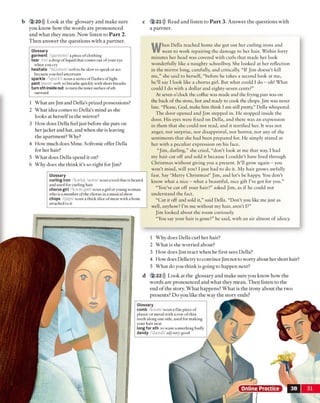
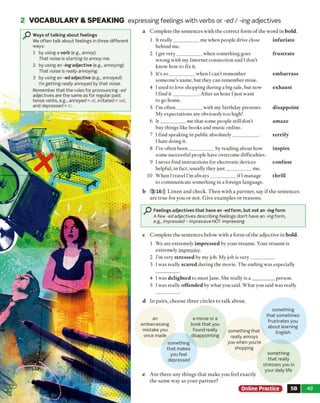
5 READING & VOCABULARY
a Look at the title o f the article. How would
you define a hypochondriac? W hat do you
think a “cyberchondriac” is?
b Read the article once and check. Then
complete the paragraphs with topic
sentences A -E.
PTopic sentences
In a well-written article, each paragraph
usually begins with a “topic sentence” that
tells you what the paragraph is about.
A Another problem for cyberchondriacs is lhal
online medical information may be from an
unreliable source or be out of date.
B Sadly, the problem with Dr. Google is that he
isn't exactly a comfort in times of crisis.
C The Microsoft study also revealed another
serious problem - that online information often
doesn’t discriminate between common and very
rare conditions.
D Unfortunately, once you have it, cyberchondria
can be hard to cure.
E Four hours later, I got a diagnosis.
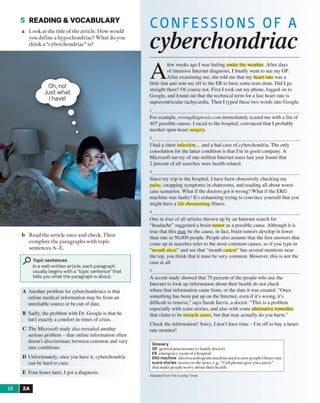
CONFESSIONS OF A
cyberchondriac
A
few weeks ago I was feeling under the weather. After days
of intensive Internet diagnosis, I finally went to see my GP.
After examining me, she told me that my heart rate was a
little fast and sent me off to the ER to have some tests done. Did I go
straight there? Of course not. First I took out my phone, logged on to
Google, and found out that the technical term for a fast heart rate is
supraventricular tachycardia. Then I typed these two words into Google,
ı
For example, wwngdiagnosis.com immediately scared me with a list of
407 possible causes. I raced to the hospital, convinced that I probably
needed open-heart surgery.
2
1 had a chest infection... and a bad case of cyberchondria. The only
consolation for the latter condition is that I’m in good company. A
Microsoft survey of one million Internet users last year found that
2 percent of all searches were health related.
3
Since my irip to the hospital, 1 have been obsessively checking my
pulse, swapping symptoms in chatrooms, and reading all about worst-
case scenarios. What if the doctors got it wrong? What if the EKG
machine was faulty? It’s exhausting trying to convince yourself that you
might have a life-threatening illness.
4
One in four of all articles thrown up by an Internet search for
“headache” suggested a brain tumor as a possible cause. Although it is
true that this may be the cause, in fact, brain tumors develop in fewer
than one in 50,000 people. People also assume lhal the first answers lhal
come up in searches refer to the most common causes, so if you type in
“mouth ulcer” and see that “mouth cancer” has several mentions near
the top, you think that it must be very common. However, this is not the
case at all.
5
A recent study showed that 75 percent of the people who use the
Internet to look up information about their health do not check
where that information came from, or the date it was created. “Once
something has been put up on the Internet, even if it's wrong, it’s
difficult to remove,” says Sarah Jarvis, a doctor. “This is a problem
especially with scare stories, and also with some alternative remedies
that claim to be miracle cures, but that may actually do you harm.”
Check the information? Sorry, I don’t have time - I’m off to buy a heart-
rate monitor!
Glossary
GP general practitioner (= family doctor)
ER emergency room of a hospital
EKG machine electrocardiogram machine used to test people’s heart rate
scare stories stories in the news, e.g., “Ceil phones give you cancer”
that make people worry about their health
Adapted from The Sunday Times
16 2A
Oh, no!
Just what
I have!
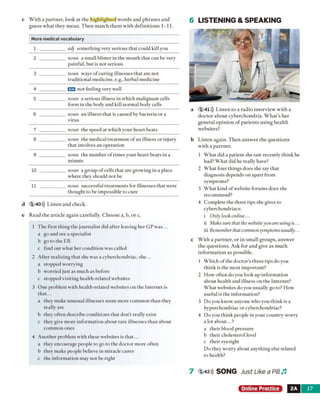
c With a partner, look at the highlighted words and phrases and
guess what they mean. Then match them with definitions 1-11.
More medical vocabulary
1 adj something verv serious that could kill vou
2 noun a small blister in the mouth that can be verv
painful, but is not serious
3 noun wavs o f curing illnesses that are not
traditional medicine, e.g., herbal medicine
4 Iran not feeling verv well
5 noun a serious illness in which malignant cells
form in the body and kill normal body cells
6 noun an illness that is caused bv bacteria or a
virus
7 noun the speed at which vour heart beats
8 noun the medical treatment o fan illness or injury
that involves an operation
9 noun the number of times vour heart beats in a
minute
10 noun a oroup o f cells that are prowing in a place
where they should not be
11 noun successful treatments for illnesses that were
thought to be impossible to cure
d 1 40))) Listen and check.
e Read the article again carefully. Choose a, b, or c.
1 The first thing the journalist did after leaving her GP was...
a go and see a specialist
b go to the ER
c find out what her condition was called
2 After realizing that she was a cyberchondriac, she...
a stopped worrying
b worried just as much as before
c stopped visiting health-related websites
3 One problem with health-related websites on the Internet is
that...
a they make unusual illnesses seem more common than they
really are
b they often describe conditions that don’t really exist
c they give more information about rare illnesses than about
common ones
4 Another problem with these websites is that...
a they encourage people to go to the doctor more often
b they make people believe in miracle cures
c the information may not be right
6 LISTENING & SPEAKING
a 1 41))) Listen to a radio interview with a
doctor about cyberchondria. W hat’s her
general opinion o f patients using health
websites?
b Listen again. Then answer the questions
with a partner.
1 What did a patient she saw recently think he
had? What did he really have?
2 What four things does she say that
diagnosis depends on apart from
symptoms?
3 What kind of website forums does she
recommend?
4 Complete the three tips she gives to
cyberchondriacs:
i Only look online...
ii Make sure that thewebsiteyou are using is...
iii Remember that commonsymptoms usually...
c With a partner, or in small groups, answer
the questions. Ask for and give as much
information as possible.
1 Which of the doctor's three tips do you
think is the most important?
2 How often do you look up information
about health and illness on the Internet?
What websites do you usually go to? How
useful is the information?
3 Do you know anyone who you think is a
hyperchondriac or cyberchondriac?
4 Do you think people in your country worry
a lot about...?
a their blood pressure
b their cholesterol level
c their eyesight
Do they worry about anything else related
to health?
7 ı 42))) SONG Just Like a Pill J3
Online Practice 2A 17
G using adjectives as nouns, adjective order
V clothes and fashion
P vowel sounds
2B Older and wiser?
Wisdom doesn’t automatically come with old age.
Nothing does - except wrinkles.
Abigail Van Buren,
USjournalist
1 SPEAKING 2 READING
a Look at some adjectives that are commonly
used to describe teenagers or elderly people.
With a partner, write them in the column
where you think they belong. Are the majority
of the adjectives positive or negative?
absentminded adventurous bad-tempered
clumsy kind lazy moody narrow-minded
self-centered stubborn unenthusiastic
vulnerable weak wise
teenagers elderly people
P old or elderly?
Old and elderly mean the same thing, but
elderly is only used for people and is more
polite.
b In pairs or small groups, discuss the
questions.
1 Do you think the adjectives in a truly
describe most teenagers and elderly people
or do you think these are stereotypes?
2 In what way could these stereotypes be
damaging?
3 Do you know people in these two age
groups who a) conform to the stereotypes
b) don’t conform to the stereotypes? How?
a Look at the photos o f Nick Sydney and Karoline Bell. W hat do
you think has been done to them and why?
b Read the first paragraph o f the article once and check your
answer. Look at the highlighted phrases related to the body.
With a partner, say what you think they mean.
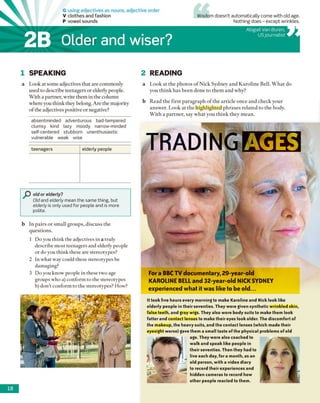
TRADING AGES
For a BBC TV documentary, 29-year-old
KAROLINE BELL and 32-year-old NICK SYDNEY
experienced what it was like to be old...
It took five hours every morning to make Karoline and Nick look like
elderly people in their seventies. They were given synthetic wrinkled skin,
false teeth, and gray wigs. They also wore body suits to make them look
fatter and contact lenses to make their eyes look older. The discomfort of
the makeup, the heavy suits, and the contact lenses (which made their
eyesight worse) gave them a small taste of the physical problems of old
age. They were also coached to
walk and speak like people in
their seventies. Then they had to
live each day, for a month, as an
old person, with a video diary
to record their experiences and
hidden cameras to record how
other people reacted to them.
c You are going to read about what happened
during the program. Before you read talk to
a partner.
1 In what way do you think people treated
them differently because they appeared to
be old people?
2 What do you think they learned about what
old age is really like?
3 How do you think they felt after making the
program?
d Now read the rest o f the article and check.
|fterward, both of them described the
“invisibility” of being old. Karoline was
Iastonished to be ignored by some workmen,
who only hours before had been whistling at her
when she had been an attractive young woman. Nick
said, “ I learned that how people Treat you depends
on what you look like.” On one occasion a bus driver
treated him very rudely when he tried to pay his
fare with a large bill. “I was amazed. He wouldn't
have talked like that to my young self.” Nick was also
nearly robbed when he was taking money out of
an ATM.
T
here is a point in the documentary when Karoline
2breaks down and cries. It comes at the end of
a day out with her two new senior citizen friends,
Betty and Sylvia, who she met at a community center.
It is partly because she feels guilty that she is tricking
them, but mainly because she realizes that they are
individuals, and not just members of what she had
previously thought of as “the elderly.” “They were
talking about real things and I felt unqualified. I
didn't have that life experience. They had
3been through so much. It made me realize how
ignorant I was. It was as if I was seeing the young
people inside them. Before I would have just seen
the wrinkles.”
A
t the start of the documentary Karoline had said
that old people scared her, and that in spite of
loving her 86-year-old grandmother, who lives in a
retirement home, she had found it hard to visit her.
B
oth she and Nickfound makingthe program life-
changing. Nicksaid, “I'd neverthought about getting
old before.” Karoline said, “Thewhole experience of
living as an old person helped me to understand
them far better and also to understand myself.
One ofthe things that surprised me most was how
important relationships still were to elderly people.
I was shocked by the fact that older people could
still have their hearts broken. After a while I felt like
one of them. I felt in a way that they were just young
people in an old body trying to 4deal with the
problems of old age. 5l'm not ready to be 73, but I'm
not scared like I was.”
e Read the article again and answer the questions with K (Karoline),
N (Nick), or B (both o f them).
Who...?
1 P ] found the physical preparation for his / her role very
uncomfortable
2 L3] was given classes on how to move like an elderly person
3 Q was surprised at not being noticed by people who had
previously reacted to him / her
4 f~] noticed that people were less polite to older people
5 L J found that playing the role of an older person made him / her
more emotional
6 Q realized that old people were very different from what he /
she had previously imagined
7 !__I used to be frightened of old people
8 LH had never worried about what it would be like to be old
9 Q J hadn't expected love and friendship to be so important to
old people
f Now look at the highlighted verb phrases and match them with
their meaning.
] be prepared Q loses control of his / her feelings
] behave toward you Q solve a problem or do a task
] experienced
g How much contact do you usually have with elderly people? Do
you think that they are treated well in your country?
3 GRAMMAR
using adjectives as nouns, adjective order
a Look at the sentences in 1 and 2 below and decide if you think
they are right ( / ) or wrong (/). Com pare with a partner and say
why you think the ones with / s are wrong.
1 a IThe old have a harder life than the young.
b ^ The old people have a harder life than the young people,
c L ] Old people have a harder life than young people.
2 a ŋ The man was with a blond tall Canadian woman,
b □ The man was with a tall Canadian blond woman,
c □ The man was with a tall blond Canadian woman.
b >■ p.135 Grammar Bank 2B. Learn more about using adjectives
as nouns and adjective order, and practice them.
c Answer the questions in pairs or small groups. Do you agree?
Why (not)?
• The elderly are best looked after in retirement homes, not at home.
• Politicians should be at least 40 years old - younger people don’t
have enough experience for such a responsible job.
• Society doesn’t sufficiently value the wisdom that elderly
people have.
• Rich people are usually cheaper than poor people.
• The government could and should do more for the unemployed.
• The homeless should be allowed to live rent-free in empty apartment
buildings and houses.
Adapted from The Times Online Practice 2B 19
4 LISTENING
a Look at the photos. How old do you think these people
are? Do you like the way they are dressed? Why (not)?
b 1 45))) Listen to a radio program where two fashion
journalists are talking about “dressing your age.” Do
they agree that men and women should dress their age?
Complete their two fashion rules.
Liza Wear whatever you think______________ and
makes you______________ .
Adrian Dressfor______________ , n o tfo r______________ .
c Listen again and take notes. Why do the journalists
mention the following?
d Who do you agree with most, Liza or Adrian?
5 VOCABULARY clothes and fashion
a In two minutes write down as many items o f clothing or jewelry as you can that you can w ear...
• on your hands and arms • around your neck • on your feet • on your head
b > • p.153 Vocabulary Bank Clothes and fashion
c Take the quiz with a partner.
What are the opposites of these
adjectives and verbs?
get dressed short-sleeved
neat tight trendy
What material are the following
usually m ade of?
bicycle shorts jeans shoes
a sweater a tie tights
CLOTHES QUIZ
Complete the sentence you say if something, e.g., a sweater.
a is too big It doesn't]
b looks awful on you It doesn't
c goes perfectly with your pants It
me.
my pants.
In what situations do you usually...?
a try clothes on
b dress up
c hang clothes up
d get changed
20 2B
BESTDRESSEDl
FIST
Liza
• a warm sweater and slippers
• a leather miniskirt
• teenagers
• women who are 30+
• very short shorts
Adrian
• men in their 20s who
wear blazers and
khakis or suits
• men in their 30s
me.
6 PRONUNCIATION
vowel sounds
Vowel sounds
Some English vowel sounds are fairly
similar and might be confusing. Practice
distinguishing them.
a 1 50))) Look at the pairs o f sound pictures
below. Put two words from the list in each
column. Listen and check.
awful checked cotton dotted hooded
jeans leather linen long loose patterned
sandals sleeveless slippers suit wool
b > - p.166 Sound Bank. Look at the typical
spellings for these sounds.
c Practice saying these phrases.
• a loose linen suit
• pink silk slippers
• a pale gray suede jacket
• a green sleeveless T-shirt
• a trendy denim Vest
• blue suede shoes
7 SPEAKING
Talk in small groups.
1 At what age do you think it is OK for men or women to have...?
2 In what situations do you think it is not OK to wear...?
ripped denim jeans a baseball cap worn backward
very short shorts large sunglasses a miniskirt no shirt
3 Do you agree or disagree with the following statements? Say why.
8 WRITING
a Imagine you were given two items o f clothing for your birthday
that you don’t like. You have decided to sell them on eBay. Write a
detailed description, making them sound as attractive as possible.
Set a starting price.
For sale! Blue and white striped
cotton skirt - never worn! Size six.
Would look great with white T-shirt.
Perfect for the summer.
7 days left
Thursday April 24 11:38
$12.99
1 bid
+$5.00
shipping
b Now read some other students’ ads. Are there any things that
you’d like to bid for?
Online Practice 2B 21
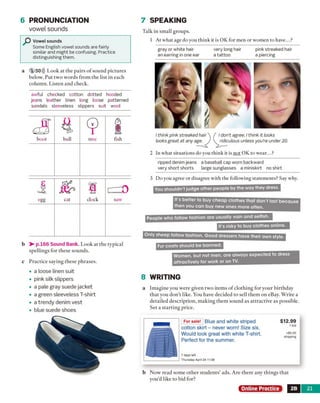
/ don't agree. I think it looks
ridiculous unless you're under 20.
I think pink streaked hair
looks great at any age.
gray or white hair
an earring in one ear
very long hair
a tattoo
pink streaked hair
a piercing
boot bull tree fish
egg cat clock saw It's better to buy cheap clothes that don't last because
then you can buy new ones more often.
You shouldn't judge other people by the way they dress.
Women, but not men, are always expected to dress
attractively for work or on TV.
Fur coats should be banned.
Only sheep follow fashion. Good dressers have their own style.
People who follow fashion are usually vain and selfish.
It's risky to buy clothes online.
1&2 Review and Check
GRAMMAR
a Complete the sentences with one word.
b
1 What were you and Sarah talking______ ?
2 You didn't like her latest novel,______ you?
3 My father loves opera and so ______ my mother.
4 A I’ve been to India twice. B You______? I'd love to go.
5 What have you______ doing since I last saw you?
1 Could you tell me what tim e______ ?
a the bus leaves b leaves the bus c does the bus leave
2 How many people______ this computer?
a douse b use c does use
3 You're not eating much.______ like the food?
a You don't b Don’t you c Aren’t you
4 A Why didn't you call me?
B I ______ , but your phone was off.
a do call b did called c did call
5 The slower you work,______ you'll finish.
a later b the later c the later than
6 ______ three cups o f coffee already this morning.
a I've been having b I've had c I have
7 That was probably the worst movie______ !
a I've ever seen b I’ve never seen
c I’ve ever been seeing
8 I m et______ in my language class today.
a a Japanese b the Japanese c a Japanese girl
9 Some people think that______ don't pay enough tax.
a the rich b the rich people c rich
10 I got a ______ bag for my birthday.
a beautiful leather Italian b Italian leather beautiful
c beautiful Italian leather
VOCABULARY
a Complete the compound adjectives.
1 My boss is very bad-______. When things go wrong he
starts shouting at everyone.
2 I'm very______ -back. Nothing really bothers me.
3 I think Paul is very tight-______ . He never spends
money unless he absolutely has to.
4 Syliva won't have any problems at the interview - she’s
very self-______.
5 That dress is very old-______ . It looks like the kind of
thing my grandma would wear.
b Write words for the definitions.
c
1 bl______verb to lose blood, from a wound or injury
2 sw_____adj bigger than normal, especially because
of an injury or infection
3 b______noun a piece of cloth used to tie around a part
of the body that has been hurt
4 t______noun a pain in one ofyour teeth
5 r______noun an area of red spots caused by an illness
or allergy
(Circle)the correct verb or verb phrase.
d
1 I have Ifeel a little dizzy. I need to sit down.
2 She burned / sprained her ankle when she was jogging.
3 It was so hot in the room that I nearlyfaulted / choked.
4 This skirt doesn’tfit / suit me. It’s too big.
5 Can I go in jeans? I don't feel like getting dressed /
getting changed.
(Circle)the word that is different.
1 striped dotted plain patterned
2 silk cotton fur neat
3 collar sleeveless hooded long-sleeved
4 Lycra scarf vest cardigan
5 fashionable scruffy stylish trendy
e Complete with one word.
1 My mother had a very bad case of the flu last week, but
she's beginning to get______ it now.
2 Please lie______ on the couch over there.
3 I’m feeling sick. I think I’m going to ______ up.
4 Do we really need to dress______ for the party tonight?
5 Please______ up your clothes in the closet.
PRONUNCIATION
a .Circle) the word with a different sound.
b Underline the main stressed syllable.
1 in ere di bly 2 big- hea ded 3 an ti bi o tics
4 swim suit 5 fa shio na ble
22
Uircleya, b, or c.
ache choke change matches
unconscious rash fashion suede
injury striped silk blister
jeans leather velvet denim
cough flu suit loose
CAN YOU UNDERSTAND THIS TEXT?
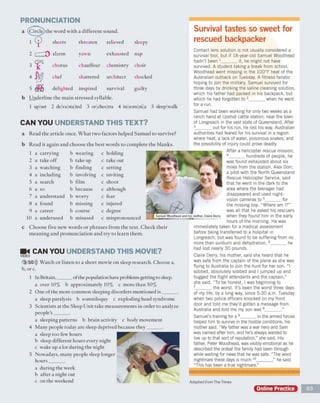
a Read the article once. What do sham ans do? The rise of the shamans
b Read the article again and choose a, b, or c.
1 According to the article, shamans help people to...
a communicate with dead relatives
b solve their health problems
c enter a parallel reality
2 Shamans heal people by...
a curing their depression
b helping them to find something they have lost
c dealing with their deep emotional problems
3 Harnam Sidhu and Shelly Khanna...
a both had serious diseases
b did not initially believe that shamanism could help
them
c have both become more deeply interested in
shamanism
4 According to Klinger-Paul, shamanism...
a requires time to work
b only works if people believe in it
c may work only because of the placebo effect
c Choose five words or phrases from the text. Check
their meaning and pronunciation and try to learn
them.
VIDEO
CAN YOU UNDERSTAND THIS
MOVIE?
1 51))) Watch or listen to a short movie on the History o f
Surgery and mark the sentences T (true) or F (false).
1 St. Thomas's hospital had a very early operating theater.
2 In a modern operating theater there is a monitor to
measure a patient’s brain activity.
3 The room where the operating theater used to be is
now a church.
4 The rooms where operations took place were called
theaters because the public came to watch.
5 The theater was usually full for an operation.
6 Most operations at St. Thomas's were done on rich people.
7 Surgeons used primitive forms of anaesthetic.
8 Surgeons could cut off a limb very quickly.
9 When there was a lot of blood during an operation, it
was collected in a space under the floor.
10 If patients died, their bodies were given back to their
families.
The sound of drumbeats
reverberates in the small
conference room as the
shaman goes into a trance.
The others present, their eyes
closed, focus on the rhythmic
sounds of the drums. The
shaman, in his trance, makes
the journey to a parallel
reality in search of solutions
to the various problems the
group has brought with it.
For most people this may seem weird, but it is becoming
a fairly common experience for others. People from many
different professions - students, businessmen, housewives,
even former soldiers - are turning to shamanism, an ancient
spiritual practice where the practitioner communes with "spirit
guides" to gain access to information and healing.
Cosima Klinger-Paul, an Austrian who moved to India in 2000
and has started a school of shamanism, says that the interest
in the practice is not surprising. "Shamanism has always
been there in every culture. It is the oldest healing method of
mankind."
How exactly does shamanism work? Shamans believe
that all illnesses have a spiritual cause, which is reflected
in the physical body. Healing the spiritual cause heals the
physical body. An important shamanic belief is the concept of
"soul loss." Shamanic cultures around the world believe that
whenever someone suffers an extreme physical or emotional
trauma, a piece of his soul "falls off." Soul loss manifests in most
people through feelings of emptiness and depression. Once
the person gets the missing part of his soul back, shamans
believe that the lost vitality and health also comes back.
But is it really as simplistic as this? Those who have
undergone shamanic healing sessions seem to think so.
Harnam Sidhu, a 46-year-old marketing executive, swears by
the practice. "It helped reverse my disease," he says. Sidhu was
suffering from glaucoma - a degenerative condition that causes
the loss of optic nerves leading to blindness. Doctors had told
him it was a matter of months before he went completely blind
in the bad eye. As a last resort, he tried shamanism. After a few
sessions, when he went for a checkup, his doctor told him that
a miracle had happened - his condition was starting to reverse.
Shelly Khanna, who took shamanic healing for a frozen shoulder
condition, says 80% of her pain vanished after the session.
"I went as a skeptic, but I was so amazed by the experience that
I resolved to learn shamanism myself."
Was it really shamanism at work or simply the placebo effect?
Believers stress that shamanic healing isan established tradition
that has been tested time and again over centuries. "Shamanism
is not a religion, but an adventure into one's own mind," says
Klinger-Paul. "It takes time to become familiar and to deal with the
spirit world. I tend to say no to requests for quick healing. This is
not a spiritual aspirin that you can take and be healed."
Atul Sethi in The Times o f India
Online Practice
G narrative tenses, past perfect continuous; so / such...that
V air travel
P regular and irregular past forms, sentence rhythm
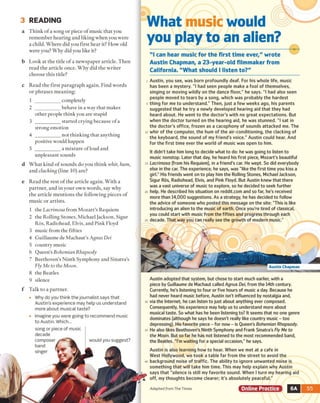
The truth about air travel
1 LISTENING & VOCABULARY air travel
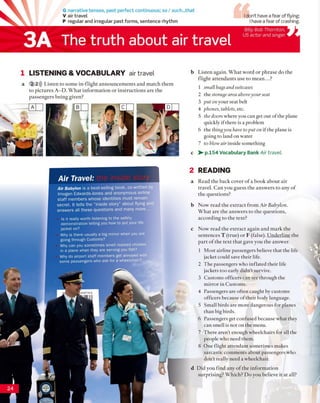
a 2 2))) Listen to some in-flight announcements and match them
to pictures A -D . What information or instructions are the
passengers being given?
b Listen again. What word or phrase do the
flight attendants use to m ean...?
1 small bags and suitcases
2 the storage area aboveyour seat
3 put on your seat belt
4 phones, tablets, etc.
5 the doors where you can get out of the plane
quickly if there is a problem
6 the thingyou have to put on if the plane is
going to land on water
7 to blow air inside something
c > - p.154 Vocabulary Bank Air travel.
Air Travel:
Air Babylon is ə best-selling book, co-written by
Imogen Edwards-Jones and anonymous airline
staff members whose identities must remain
secret. It tells the "inside story” about flying and
answers all these questions and many more...
Is it really worth listening to the safety
dem onstration telling you how to put your life
jacket on?
Why is there usually a big m irror when you are
going through Customs?
Why can you som etim es smell roasted chicken
in a plane when they are serving you fish?
Why do airport s ta ff m em bers get annoyed with
some passengers who ask fo r a wheelchair?
2 READING
a Read the back cover o f a book about air
travel. Can you guess the answers to any of
the questions?
b Now read the extract from Air Babylon.
What are the answers to the questions,
according to the text?
c Now read the extract again and mark the
sentences T (true) or F (false). Underline the
part o f the text that gave you the answer.
1 Most airline passengers believe that the life
jacket could save their life.
2 The passengers who inflated their life
jackets too early didn't survive.
3 Customs officers can see through the
mirror in Customs.
4 Passengers are often caught by customs
officers because of their body language.
5 Small birds are more dangerous for planes
than big birds.
6 Passengers get confused because what they
can smell is not on the menu.
7 There aren’t enough wheelchairs for all the
people who need them.
8 One flight attendant sometimes makes
sarcastic comments about passengers who
don’t really need a wheelchair.
d Did you find any o f the information
surprising? Which? Do you believe it at all?
I don't have a fear of flying;
I have a fear of crashing.
3A
Billy Bob Thornton,
US actor and singer
Most airline passengers think it is laughable
that a small yellow lifejacket with a whistle
will make any difference if the plane crashes into
the water. However, in some cases, like when a
hijacked Ethiopian Airlines Boeing 767 landed
in the Indian Ocean in 1996, it did. Despite
instructions from the cabin crew not to pre-
inflate their lifejackets inside the plane, several
passengers did. They were unable to escape the
rising water inside the plane. But others, who
followed the pilot’s instructions, survived. So
it is probably a good idea to look up from your
magazine when the flight attendant is giving the
safety demonstration.
Customs officers are watching everywhere.
They are watching you from the moment
you walk off the plane, while you are standing
in Baggage claim waiting for your bag, and
especially when you come out the other side of
Customs, which is when people who are trying
to smuggle something finally let their guard
down and get caught. The large two-way mirror
in Customs, (behind which customs officers sit
and watch) is part of that process. As you walk
past, it makes you look taller and thinner. So you
feel good about yourself and you relax and smile.
That’s when a customs officer suddenly appears
and asks you to open your suitcase...
Birds are one of the major problems for any
airport when planes are taking off and
landing. Any large bird can easily cause an
accident. It flies into the engine, totally destroying
itself and the machinery. Smaller birds are less
of a problem. In some cases they can do some
damage, but usually they are just roasted. When
this happens, there is often such a strong smell
of roasted bird that passengers on the plane
think that chicken is being cooked, and they are
often surprised when they’re given a choice of
fish or beef at dinner!
W
heelchairs are a big problem for airline staff.
Not only is there always a shortage of them
for the people who really need them, but what
is worse, some of the people who request them
often don't need them at all. I've lost count of
the number of times I have pushed someone
through the airport, taken them through Customs
and Passport Control, gotten a porter to pick up
their luggage, and then seen the person jump up
in Arrivals and move quickly toward their waiting
relatives. One flight attendant I know gets so
annoyed when this happens that as soon as the
passenger gets out of the chair she shouts to
the other passengers, “Ladies and gentlemen!
Another miracle, courtesy of the airline industry!
After years in a wheelchair, he walks again!" The
passenger is usually so embarrassed that he
(and it’s usually a “he") disappears as quickly as
he can.
From Air Babylon by Imogen Edwards-Jones
3 MINI GRAMMAR so / such...that
a Look at these two sentences from the Air Babylon extract.
The passenger is usually so embarrassed that he disappears as
quickly as he can.
When this happens, there is often such a strong smell of roasted bird
that passengers on the plane think that chicken is being cooked.
We often use so / such...that to express a consequence.
• Use so + adjective
The flight was so bumpy (that) we all felt sick.
• Use so + adverb
The taxi driver drove so quickly (that) we got to the airport on time.
• Use so much / so many + noun
There was so much traffic that we almost missed our flight.
• Use such a + adjective + single countable noun
It was such a great hotel (that) we want to go back there next year.
• Use such + adjective + uncountable noun
We had such terrible weather that we didn't really enjoy our vacation.
• Use such + adjective + plural noun
They were such uncomfortable seats (that) I couldn't sleep at all.
b Complete the sentences with so, so much / many, such, or such a.
1 The flight w as_______ long that I got really bored.
2 Ihad_______ noisy child sitting next to me that Icouldn't sleep at all.
3 My suitcase was_______ heavy that I had to pay an excess baggage fee.
4 I slept_______ badly on the flight from New York that the jet lag
was worse than usual.
5 We were served_______ terrible food that I couldn’t eat a thing.
6 There were_______ people at check-in that we had to stand in
line forever.
7 We had_______ luggage that we had to get another cart.
8 The people we met on vacation were_______ nice people that we
kept in touch with them.
4 SPEAKING
In pairs, ask and answer the questions.
1 How do you feel about flying?
2 How often do you fly? What for?
3 When was the last flight you took? Where did you fly to?
4 Have you ever...
• been very delayed at an airport? How long for?
• missed a flight? Why?
• been stopped in Customs? Were you carrying anything that you
shouldn't have?
• had very bad turbulence on a flight? How did you feel?
Was anyone on the flight injured?
• taken a long-haul flight? Did you get jet lag?
• flown or been upgraded to business class? What was it like?
• been on a flight where there was an emergency?
What happened?
• sat next to a screaming baby on a flight (or a child that kept
kicking your seat)? What did you do?
Online Practice ■ 3A 25
5 LISTENING
a You are going to listen to an airline pilot
and an air traffic controller talking on a
radio program. Before you listen, discuss
questions 1-8 with a partner and imagine
what the answers will be.
1 What weather conditions are the most
dangerous when you are flying a plane?
2 Is turbulence really dangerous?
3 Which is more dangerous, taking off or
landing?
4 Are some airports more dangerous than
others?
5 What personal qualities does an air traffic
controller need?
6 Is the job really very stressful?
7 Why is it important for air traffic
controllers and pilots to speak English well?
8 Are there more men than women working
as pilots and air traffic controllers?
b 2 7))) Listen to the program. How many of
the questions did you answer correctly?
c Listen again for more detail and take notes
for each o f the questions.
d Which job would you prefer, to work as a
pilot or as an air traffic controller? Why?
6 GRAMMAR
narrative tenses, past perfect continuous
a Read a newspaper story about an incident that happened during
a flight. W hat exactly happened?
Last updated at 09:12
Nightmare over the Atlantic!
At 11:35 on January 13, 2012, British Airways flight BA 0206
Hoo/c o ff l was taking o ff from Miami to London. It had been
flying for about three hours, and was over the Atlantic, when
suddenly a voice 2came out / had come out of the loudspeakers:
“This is an emergency announcement. We may shortly have to
make an emergency landing on water.”
Immediately panic 3broke out / was breaking out. One passenger
on the flight said, “My wife and I looked at each other and we
feared the worst. We imagined that we were about to crash into the
Atlantic. It was awful. Everybody 4scream ed / was scream ing.”
But about 30 seconds later, the cabin crew started to run up and
down the aisle saying that the message 5had been played / was
being played by accident, and that everything was OK. By this time
a lot of the passengers were in tears, and 6tried / were trying to get
their life jackets out from under their seats.
Another passenger said, “The captain didn't even say anything
about it until just before we started to land and even then he didn't
explain w h at7happened / had happened. It was very traumatic.
Everybody was terrified. I can't think of anything worse than being
told your plane's about to crash. I t 8was / had been the worst
experience of my life.”
Later a British Airways spokesman 9sa/h / had said, “A pre-
recorded emergency announcement was activated by error on
our flight from Miami to Heathrow. We would like to apologize to
passengers on this flight.”
Adapted from the Daily Telegraph
b Read the story again and (circle)the correct form o f the verbs 1-9.
c Now look at two sentences about the story. W hat do you think is
the difference between the two highlighted verbs?
The pilot was very experienced and had flown this route many times
before.
When the announcement was made, the plane had been flying for
about three hours.
d V- p.136 Grammar Bank 3A. Learn more about narrative tenses
and the past perfect continuous, and practice them.
e In pairs or groups, try to complete the two sentences in four
different ways using the four narrative tenses.
1 The police stopped the driver because he...
2 I couldn't sleep last night because...
26 3A
8 SPEAKING7 PRONUNCIATION
irregular past forms, sentence rhythm
a Write the simple past o f the following verbs in the chart
according to the pronunciation o f the vowel sound.
become eofeh cut drive fall fly hear
hide fight hold hurt keep leave lie read
ride say sleep tell think throw write
b Look at the verbs in a again. Which ones have a past
participle that is different from the simple past form?
Write these past participles in the chart.
c 2 10))) Listen and check. Then listen and repeat.
d 211))) Listen to an extract from a narrative. Notice
which are the stressed and unstressed words.
We were on a flight to Leon, and we’d been flying
for about five hours. ıwas reading and my wife
was watching a movie when suddenly we heard
a very loud noise, it sounded as if an engine
had exploded. The pilot didn’t tell us what had
happened until half an hour later.
e Practice reading the extract with the right rhythm.
a > - Communication Flight stories A p.105 B p.108.
Read a newspaper story. Then imagine you were a
passenger on the plane, and tell your partner the story.
b You are going to tell an anecdote. The story can either
be true or invented. If it's invented, try to tell it in
such a convincing way that your partner thinks it's
true. Choose one o f the topics below and plan what
you're going to say. Use the language in the Telling an
anecdote box to help you, and ask your teacher for any
other words you need.
Talk about a time when you...
had a frightening experience when you were traveling or on
vacation
arrived home from a trip and had a surprise
c In pairs, A tell B your story. B show interest and ask
for more details. Then decide whether you think the
story is true or not. Then change roles.
This happened to me a few years ago when
I was on vacation in Florida. I was swimming in
the ocean one day when I saw a shark.
Really? How big was it?
9 2.12))) SONG The Airplane Song J3
Online Practice ■ 3A 27
caught
became
got sick or had an accident while traveling
Telling an anecdote
Setting the scene
This happened to me when I was...
I was..long when... /...because I had/hadn't...
The main events
I decided to...because... So then /...
Suddenly /A t that moment...
What happened in the end
In the end/Eventually... I felt...
G the position of adverbs and adverbial phrases
V adverbs and adverbial phrases
P word stress and intonation
If you want a happy ending, that depends,
of course, on where you stop your story.
3B Incredibly short stories
Orson Welles,
US actor and director
1 GRAMMAR the position of adverbs and adverbial phrases
a Read the four fifty-word stories, using the glossary to help you. Match each one to its title.
The story o f m y life G eneration gap In the card s G ood intentions
fifty w o rd sto ries.co mFiftywordstories.com is a website to which people from all over the w orld contribute fifty-w o rd stories in English.
A _______________________________________
She recognized the writing on the envelope
immediately. The fortune-teller had warned her that
she had no future with him, yet here he was - five
lonely years after their last meeting, begging her to
join him in New York.
She felt unbelievably happy as she stepped on board
the Titanic.
B ________________________________________
My house looks as if it's been hit by a bomb. Since I'm
terrible at organizing, I bought a new book, Key to
Organizing Your Life. I felt so proud.
I started cleaning the bookcase. Five minutes later,
I couldn’t believe my eyes. I'd bought the same book
last year.
C ______________________________________
He was worried. Unfortunately, since his wife’s death
his teenage daughter had become extremely difficult.
They had agreed 2:00 a.m. as the latest return time
from nightclubs. Now it was 3:30. He prepared himself
for confrontation as the door opened. “Dad,” she
shouted angrily. “I've been frantic. You're late again.”
D ________________________________________
Stage one: Feel fat. Go on diet. Lose weight. Feel
fabulous. Buy new clothes.
Stage two: Eat normally but controlling intake. Look
fabulous. New clothes slightly tight.
Stage three: Eat and drink normally (potatoes, bread,
pasta, AND smoothies). New clothes don’t fit. Old
clothes thrown away.
Back to stage one.
Glossary
A
beg verbask somebody very
strongly or anxiously for
something
C
frantic adjvery worried
D
fabulous adjwonderful
intake noun the amount of
food and drink that you take
into your body
smoothie noun a drink
made of fruit or fruit juice
mixed with milk or ice
cream
28
b Look at the highlighted adverbs or adverbial
phrases in the stories. Think about what
they mean and notice their position in the
sentence. Write them in the correct place in
the chart.
2 VOCABULARY adverbs and adverbial phrases
a Read another fifty-word story. Who is it about?
E x am nerves
It was nearly 4 a.m. and she could hardly
keep her eyes open. She had been working
hard since lunchtime, but the exam was near.
Would she be able to finish on time? At nine
the next morning she was in the classroom.
“OK,”she said. "You can start now.”
b Look at the highlighted adverbs. What’s the difference between...?
a hard and hardly b near and nearly
c > - p.155 Vocabulary Bank Adverbs and adverbial phrases.
c With a partner, decide where the bold
adverbs should go in these sentences.
1 He speaks Chinese and Spanish, fluently
2 I use public transportation, hardly ever
3 I thought I'd lost my phone, but it was in my
bag. fortunately
4 It’s important that you arrive on time,
extremely
5 As soon as I know, I'll tell you.
right away
d V -p.137 Grammar Bank 3B. Learn more
about adverbs and adverbial phrases, and
practice them.
e 2 14))) Listen to some sound effects and
short dialogues. Then use the bold adverb to
complete the sentence.
1 When she got to the bus stop, the bus...
just
3 PRONUNCIATION word stress and intonation
a 2 17))) Underline the stressed syllables in these adverbs. Listen
and check.
ac|tu|a|lly allmost a|ppar|ent|ty ba|si|ca|lly de|fi nite|ly
e|ven e|ven|tual|ly fortu|nate|ly gra|dua|lly i|de|a|lly
in|cre|di|bly lu|cki|ly ob|vi|ous|ly un|fortu|nate|ly
b 2 18))) Listen and repeat the sentences, copying the stress and
intonation o f the adverbs.
1 There was a lot oftraffic, and unfortunately we arrived extremely late.
2 We definitely want to go abroad this summer, ideally somewhere hot.
3 It’s incredibly easy - even a child could do it!
4 Mark gradually began to realize that Lily didn't love him anymore.
5 I thought Roberto was Portuguese, but actually he's Brazilian.
6 Apparently Jack has been offered a promotion at work, but it will
mean moving to New York.
7 Iabsolutely love Italian food, especially pasta.
4 WRITING
2 They were having a party when...
suddenly
3 He thought he lost his boarding pass,
but... luckily
4 The woman thought Andrea and Tom were
friends, but in fact... hardly
5 The driver couldn’t see where he was going
because... hard
6 juan couldn't understand the man
because... incredibly
a You are going to write a fifty-word story. It must be 50 words
exactly (not including the title) and you must include at least two
adverbs. Contracted form s (e.g., I’d) count as one word. First, in
pairs, choose two o f the titles below.
A su m m er rom ance A day to forget
The lie Never again
b Brainstorm ideas for the two plots and each write a first draft
without worrying about the number o f words.
c Exchange your drafts. Then edit the stories, making sure they are
exactly 50 words.
d Read two other pairs’ stories. Which do you like best?
e > - p.114 Writing A short story. Write a 120-180 word short story.
Online Practice 3B 29
Types of adverbs
Time (when things happen, e.g., shortly)
Manner (how you do something, e.g., slowly)
Degree (describing / modifying an adjective,
e.g., very)
Comment (giving an opinion, e.g., luckily)
5 SPEAKING 6 READING & LISTENING
a Ask and answer the questions in the Reading
habits questionnaire with a partner.
a 2 19))) Read and listen to P art 1 o f a short story. Answer the
questions with a partner.
b How sim ilar are your reading habits?
• Which of the above do you read? How often?
• Do you ever read any of them in English?
• Do you read anything specifically to improve
your English?
• Do you prefer reading on paper or on screen?
• Do you read more or less than you used to (or
about the same)?
YES
• What was the last book you read?
• Why did you choose to read it?
• What are you reading right now?
• Do you have a favorite author or authors?
• What's the best book you’ve read recently?
NO
• Would you read more if you had more time?
• Did you use to read more when you were
younger? When did you stop? Did you have
a favorite children’s book?
• What do you do to pass the time when you
are traveling?
Do you ever...?
• listen to a song and read the lyrics at the
same time
• watch movies or TV in English with English
subtitles
• read books and listen to them on audio at
the same time, e.g., Graded Readers
1 How did Della save the one dollar and eighty-seven cents?
2 What details about the apartment tell us how poor Della and her
husband are?
3 Why do you think the author uses gray three times in the third
paragraph?
4 Does Della have enough to buy her husband the special gift?
5 Guess the meaning o f the highlighted phrases.
The Gift of the Magi
BY 0. HENRY
PA R TI
One dollar and eighty-seven cents. That was all. And sixty cents of it
was in pennies. Pennies saved one and two at a time by bargaining
with the grocer and the vegetable man and the butcher until her cheeks
burned with embarrassment. Three times Della counted it. One dollar
and eighty-seven. And the next day would be Christmas.
There was clearly nothing to do but sit on the shabby little couch
and cry. So Della did it. Della lived with her husband in a furnished
apartment at $8 a week. At the front door, there was an empty mail box
and a doorbell that no longer worked, and under the broken doorbell,
there was a card with the name “Air. James Dillingham Young.” But
whenever M r James Dillingham came home and reached his apartment,
he was called “Jim ” and greatly loved by Mrs. James Dillingham, already
introduced to you as Della. Which is all very good.
Della stopped crying and fixed her makeup. She stood by the window
and looked out at a gray cat walking a gray fence in a gray backyard.
Tomorrow would be Christmas Day, and she had only $1.87 to buy Jim
a present. She had been saving every penny she could for months, with
this result. Twenty dollars a week doesn’t go far. Expenses had been more
than she calculated. They always are. Only $1.87 to buy a present for Jim.
Her Jim. She had spent many happy hours planning something nice for
him. Something fine and rare. Something Jim deserved.
Glossary
pennies /'peniz/ nounused to
emphasize a small amount of money
grocer /'yroosor/ noun a person who
works in a store selling food
shabby /'f<ebi/ adjin poor condition
because rhev have been used a Inf
The press
national newspapers free papers
local papers comics
sports papers academic journals
Books
novels nonfiction, e.g., self-help books
classics short stories
textbooks manuals
Online
web pages academic or work-related websites
blogs news websites
chat forums song lyrics
3B30
b 2 20))) Look at the glossary and make sure c
1 Why does Della curl her hair?
2 What is she worried about?
3 How does Jim react when he first sees Della?
4 How does Della try to convince Jim not to worry about her short hair?
5 What do you think is going to happen next?
2 22))) Look at the glossary and make sure you know how the
words are pronounced and what they mean. Then listen to the
end of the story. What happens? What is the irony about the two
presents? Do you like the way the story ends?
Glossary
comb /koom/ noun a flat piece of
plastic or metal with a row of thin
teeth along one side, used for making
your hair neat
longfor sth to want something badly
dandy /'damdi/ adjvery good
2 21))) Read and listen to P art 3. Answer the questions with
a partner.
W
hen Della reached home she got out her curling irons and
went to work repairing the damage to her hair. Within forty
minutes her head was covered with curls that made her look
wonderfully like a naughty schoolboy. She looked at her reflection
in the mirror long, carefully, and critically. “If Jim doesn’t kill
me,” she said to herself, “before he takes a second look at me,
he’ll say I look like a chorus girl. But what could I do - oh! What
could I do with a dollar and eighty-seven cents?”
At seven o’clock the coffee was made and the frying pan was on
the back of the stove, hot and ready to cook the chops. Jim was never
late. “Please, God, make him think I am still pretty,” Della whispered.
The door opened and Jim stepped in. He stopped inside the
door. His eyes were fixed on Della, and there was an expression
in them that she could not read, and it terrified her. It was not
anger, nor surprise, nor disapproval, nor horror, nor any of the
sentiments that she had been prepared for. He simply stared at
her with a peculiar expression on his face.
“Jim, darling,” she cried, “don’t look at me that way. I had
my hair cut off and sold it because 1couldn’t have lived through
Christmas without giving you a present. It’ll grow again - you
won’t mind, will you? I just had to do it. My hair grows awfully
fast. Say ‘Merry Christmas!’ Jim, and let’s be happy. You don’t
know what a nice —what a beautiful, nice gift I’ve got for you.”
“You’ve cut off your hair?” asked Jim, as if he could not
understand the fact.
“Cut it off and sold it,” said Della. “Don’t you like me just as
well, anyhow? I’m me without my hair, aren't I?”
Jim looked about the room curiously.
“You say your hair is gone?” he said, with an air almost of idiocy.
you know how the words are pronounced
and what they mean. Now listen to P art 2.
Then answer the questions with a partner.
1 What are Jim and Della’s prized possessions?
2 What idea comes to Della's mind as she
looks at herselfin the mirror?
3 How does Della feel just before she puts on
her jacket and hat, and when she is leaving
the apartment? Why?
4 How much does Mme. Sofronie offer Della
for her hair?
5 What does Della spend it on?
6 Why does she think it’s so right for Jim?
Glossary
garment /'garmont/ a piece ofclothing
tear /tir/ a drop of liquid that comes out ofyour eye
when you cry
hesitate /'hezateit/ verb to be slow to speak or act
because you feel uncertain
sparkle /'sparkl/noun a series of flashes oflight
pant /pamt verb ro breathe quickly withshort breaths
turnsthinsideout to turn theinnersurface ofsth
outward
Glossary
curling iron /'karliri 'aiarn/ noun a tool that is heated
and used for curling hair
chorusgirl /'koras gorl/ nouna girl or young woman
who is a member ofthe chorus in a musical show
chops /ifops/ noun a thick slice ofmeat with a bone
attached to it
3B 31
Talking about books2&3 Colloquial English
■M THE INTERVIEW Part 1
a Read the biographical information about Marion
Pomeranc. In what way are the two parts o f her career
connected?
Marion Pomeranc is the manager of literary programs at
a non-profit organization in New York City called Learning
Leaders. The programs involve encouraging children to read
by providing books for children who don’t have much access
to them, and getting adults to come in and read to them, and
discuss the books. She is also the author of three children’s
books, The Hand Me Down Horse, TheAmerican Wei, and The
Can Do Thanksgiving. She believes in dealing with serious
topics in her books such as hunger and immigration, but in a
way that children can relate to.
b 2 23))) Watch or listen to P art 1 o f an interview with
her. Why does she mention the four books?J
c Now listen again and mark the sentences T (true) or
F (false). Say why the F sentences are false.
1 What Marion loved about Ifl Ran the Circus was the
pictures.
2 She helped her parents to become readers.
3 Her son reads mainly fiction these days.
4 She and her husband both read to their son.
5 Marion doesn’t like the fact that children's authors
today write about real life.
Glossary
Corduroy a children’s book by Don Freeman about a teddy bear
fiction a type ofliterature that describes imaginary people and
events
■ «
VIDEO Part 2
a 2 24))) Now watch or listen to P art 2. W hat does
M arion say is important for getting a teenagers to read
more b younger children to read?
b Watch or listen again. Check ( / ) the things that she
says are good for encouraging teenagers and children
to read.
Teenagers
□ Not insisting on them finishing a book.
□ Getting them to buy ebooks.
□ Suggesting that they read in bed at night.
LZ1 Accepting that they don't just have to read books to
become good readers.
□ Series of books where the same characters reoccur.
Children
□ Having a lot of books in the house.
] Going to visit libraries or publishers.
□ Always buying them books as birthday presents.
] Hearing authors talk about their books.
□ Books where children have a more active role than the
adults.
□ Books with beautiful illustrations.
Glossary
adsabbreviation for advertisements
goofy silly or foolish
32
m <
VIDEO Part 3
a 2 25))) Now watch or listen to P a rt 3. Is Marion
positive or negative about new technology and the
future o f books?
b Listen again and answer the questions.
1 Why does she prefer to read on an e-reader these days?
2 Why does she think all children should have an
e-reader ?
3 In what way does she think social media can be
positive for kids?
4 How often does she read for pleasure? Where, when,
and why?
2 LOOKING AT LANGUAGE
O Ways of giving yourself time to think
Marion often gives herself time to think when she is
answering questions by repeating the question or
stopping and starting again. She also uses filler sounds
such as “urn" and “er,” and certain words or phrases e.g.,
you know, etc. that don’t add meaning but which are used
for this purpose.
a 2 26))) Complete the extracts from the interview with
the m issing words. Listen and check.
1 I What was it that you liked about Dr. Seuss?
M ____________________ about Dr. Seuss is his use of
language...
2 “_____________ , the inade-up words, the way the words
flow together and sound.”
3 ..or you can read the side o f a cereal box.______
______ , that’s all reading.”
4 “And I think if you’d look carefully at books that kids
really like, it's the one where, where youth dominates.
And_____________ rules the world a little bit.”
5 I Do you think social media has decreased or increased
people’s literacy?
M _____________ I think social media has had a
positive effect on children.
3
a
VIDEO
ON THE STREET
2 27))) Watch or listen to three people talking about
children’s books. Match the speakers (J, S , and R ) with
the book titles they mention.
Jill, American Sean, English Rachel, American
□ Coraline
I I Where the Wild Things Are
I I The Lion, The Witch, and The Wardrobe
 The Trixie Belden book series
b Watch or listen again. Who (J, S, or R )...?
] liked an author's book especially because it didn't
have a lot of text in it
] heard their favorite book before reading it
j identified with a character who figured out situations
that are difficult to explain
] identified with badly behaved children in general
I I liked a book because it’s main character was a girl
] enjoyed a book because it contained imaginative
situations that were unlikely to happen
c 2 28))) Watch or listen and complete the highlighted
Colloquial English phrases. W hat do you think
they mean?
1 “Trixie Belden was sort of a teenage o r__________
_________ mystery person.”
2 “I remember we had a teacher at school who read it
to us...”
3 “I realized how much you could get__________of a
book, I think.”
4 “.. .so whenever there was a boy who got into lots
o f_________ ...”
5 “I identified with Coraline because I tend to be curious
about__________.”
4 SPEAKING
Answer the questions with a partner. Practice using
“fillers” to give yourself time to think.
1 What was your favorite book when you were a child?
Why did you like it so much?
2 Was there a character in a children’s book that you
identified with when you were a child?
3 Did your parents used to read to you? When and where?
4 Do you read more print books or more e-books? Why?
Online Practice 33
G future perfect and future continuous
V the environment, the weather
P vowel sounds
Modem technology
Owes ecology
An apology
4A Eco-guilt
1 READING & SPEAKING
a Look at the title o f the lesson. W hat do you think it means?
b Read the introduction to the article and check. Then take the questionnaire and add up
your score.
c Now compare your answers with a partner. Explain why you do or don't do these things.
See what your score means. D o you agree with it?
I
com m itted a crime last Tuesday, which just happened to be Earth
Day*, a day that invites people to think about their eco-sins. I
turned on the shower, intending to get in right away even though
the water takes a while to warm up. But then I decided to brush my
teeth, and suddenly the water had been running for over tw o minutes.
By the tim e I go t in, I was drowning in eco-guilt! I had wasted water...
__1.11 1/ am wift
Should you feel eco-guilty,
too? Take the test.
SHOPPING BAGS
□ I have a reusable shopping bag
made of recyclable materials that I
always use when I'm shopping.
0 0 0 0 (+4 eco-points)
□ I own several reusable shopping
bags, but I often forget to bring
them with me.
O G O (-3 eco-points)
□ I always ask for plastic bags
because they're convenient.
They can be recycled, can't they?
O O C j O (4)
WASHING TOWELS
□ I wash my towels immediately after
1 use them. O O O O O (-5)
□ I use a towel for several days before
I put it in the washinq machine.
0 (+ D
□ That reminds me, I need to wash
my towels! O O O (+3)
□ I never leave the water running
when I brush my teeth, nor before
getting into the shower. O O (+2)
□ I'm allergic to cold water, so I have
to let the shower run for a while
before I get in. O O (-2)
□ I hate showers. I need a hot bath
every day to relax. O O O (-3)
BUYING FRUIT AND VEGETABLES
□ I never buy fruit and vegetables at
supermarkets. I buy organic fruit
and vegetables in markets or at
farm stands. O O G (+3)
□ I buy some fruit and vegetables in
a market, but the supermarket is
more convenient. 9 0 (-2)
□ I shop at the cheapest places-w ho
cares about eco-guilt, I feel guiltier
if I spend too much money on
food! O O O O O (-5)
‘ Earth Day an annual day (April 22)
on which events are held worldwide to
increase awareness and appreciation ofthe
environment
□ I throw everything in the same can.
O O O O O O (6)
□ I sometimes recycle glass bottles,
especially after a party! But that's
probably all. O O O O (-4)
□ I recycle all my newspapers, bottles, and
plastic containers. O O O O O (+5)
GETTING AROUND
□ I walk, use public transportation, or ride
a bike because cars pollute the planet.
O O O O O (+5)
□ I walk, use public transportation, or ride
a bike because I can't afford to buy a car.
O M )
□ Vroom vroom here I come!
O O O O O (5)
So how guilty should you feel?
Below 0: You should feel very guilty.
0-12 points: You should feel a little guilty.
Above 10: You are too good to be true!
Adapted from the Chicago Times
34
Alan M.Eddison,
US environmentalist
RECYCLINGRUNNING WATER
2 GRAMMAR future perfect and future continuous
a Read some predictions that have been made about the next 20
years. Which ones do you think...?
c Look at the highlighted verbs in the
predictions. Which ones refer to...?
a an action or situation that will be finished
in the future
Howwe will be living in
20years...(or will we?)
1 are already happening
2 are likely to happen
3 probably won't happen
b an action or situation that will be in
progress in the future
d > - p.138 Grammar Bank 4A. Learn more
about the future perfect and the continuous,
and practice them.
e Talk to a partner and say if you think the
following predictions will happen. Explain
why (not).
IN TWENTY YEARS...
• Most people in office jobs will be working from
home.
• All private swimming pools and golf courses
will have been banned.
• Most people wilt be using public transportation
or bikes to get to work.
• People will be taking more vacations in their
own country and fewer abroad.
• People will be retiring at 70 or even later.
• The teaching of handwriting will have
disappeared from the school curriculum
because students will only be writing on
tablets or laptops.
At home
Most people will have installed solar panels or wind turbines on
their houses or apartment buildings to generate their electricity.
People will be recycling almost 100% of their waste (and those
who don't will have to pay a fine).
Transportation
Cars that use a lot of gas (e.g., SUVs) will have been banned and
many people will be driving electric cars.
Low-cost airlines will have disappeared and flights will be much
more expensive.
The environment
Paper books will no longer be produced to save trees from being
cut down, and all books will be electronic.
Fresh water will be running out in many parts of the world and
we will be getting much of our water from the ocean (through
desalination plants).
The weather
Temperatures worldwide will have risen even further. Many ski
resorts will have closed because of a lack of winter snow and some
beaches and vacation resorts will have disappeared completely.
We will be having even more extreme weather, and heat waves,
hurricanes, floods, etc., will be frequent occurrences.
b Read the predictions again. Which two would you m ost and least
like to come true?
P d e fin ite ly , pro b a b ly, and lik e ly / u n lik e ly
We often use definitely, probably, and likely /
unlikely when talking about the future,
especially when we are making predictions.
I think it'll definitely happen /
it definitely won’t happen,
it’ll probably happen /
it probably won't happen,
it's (very) likely (to happen) /
it’s (very) unlikely (to happen).
Online Practice 4A 35
3 READING & VOCABULARY
the weather
a Look at the cartoon. What does it say about
American weather? Would it be true about
your country?
Can the W eath er Drive
You Crazy?
“There was a desert wind blowing... it was one of those hot dry Santa
Anas that come down through the mountain passes and curl your hair
and make your nerves jump and your skin itch. On nights like that every
party ends in a fight.” Raymond Chandler's 1938 short story “Red
W ind” captures the infamous “devil winds” of Los Angeles that at times
seem to drive people a little nuts. But if you think that's just a lot of hot
air, think again. “Human responses to the Santa Anas have been shown
to be generally unfavorable - for example, people tend to become
irritable,” says Dennis Driscoll, a professor at Texas A&M University.
“W e don't know why. It may have something to do with the electrical
charges and an increase in positive ions. At least, that's the theory.”
W hat else can the weather do to your mood? Here’s a forecast:
Cold Snap: Lawrence Palinkas, professor at the University of
Southern California, has studied the impact of extremely cold
tem peratures on Antarctic researchers. “W e've noticed an increase
in anger and irritability after prolonged exposure,” he says, although
he believes isolation and confinement play a part. “In addition, thyroid
hormones are particularly susceptible to changes in tem perature.
People sometimes exhibit symptoms of depression, short-term
memory loss, and anxiety.”
And last year, some Canadian newspapers started using the term snow
ra g e . “At the end of March 2008, we'd had over 16 feet of snow,” says
Catherine Viel, with the Quebec City Police. “During that month,
we had several incidents - 911 calls, a guy punching a neighbor over a
few shovelfuls of snow, a man who threatened his neighbor because
someone had blown snow onto his lawn.”
Hot-headed: Heat waves really can make tem pers boil. In fact, from
1950 to 1995, rates of serious assaults were higher during hotter years,
according to research in the J o u rn a l o f P e rso n a lity a n d S ocial P sychology
in 1997. The authors suggest that uncomfortably high tem peratures
increase annoyance-provoked crimes, in which the primary goal is to
hurt someone. (Crimes like burglary, where the incentive is money, did
not increased They predicted at least 115,000 additional serious and
fatal assaults a year in the United States due to global warming.
Spring Fever: “We studied about 600 people and found that in
springtime, sunny days and warm weather seem to boost mood and
have a broadening effect on cognition, basically opening the mind to
new ideas,” says Matthew Keller, assistant professor at the University of
Colorado at Boulder. “You just have to get outside.”
b Read the article once. Where do the Santa
Ana winds blow? W hat affect do the Santa
Ana winds have on people?
c Read the article again and mark the sentences
T (true) or F (false). Underline the sentence or
part of the article that gives you the answer.
1 Professor Palinkas is sure that the amount
of time spent in cold temperatures has the
biggest effect on a person's mood.
2 People’s hormones are easily affected by the
weather.
3 In 2008, a number o f Canadians who
committed crimes blamed them on the huge
amount of snow that fell.
4 The number of serious crimes decreases
during a period of extreme heat.
5 Some experts predict that global warming
will increase the number of serious crimes
committed in the US.
6 Spring weather can negatively affect a
person's creativity.
Glossary
drive someonenuts to make someone very angry o r crazy
electrical charge a u n it o f m a tte r th a t expresses the a m o un t
o f e le c tric ity held by an object
positive / negative ion an atom o r a g ro u p o f atom s th a t has
an e le ctric charge
hot air statem ents th a t sound im pressive b u t have no real
m eaning o r tru th
susceptible very lik e ly to be in flue nced , harm ed, o r affected
b y som eone o r som e th in g
shovelfuls (of snow) the a m o un t th a t a shovel can hold
make tempers boil to cause people to become angry
cognition the process by w h ic h know ledge and
un d e rsta n d in g is developed in the m in d
d
e
f
Look at the highlighted phrases related to
the weather. With a partner, say what you
think they mean.
p.156 Vocabulary Bank Weather.
D oes weather affect people’s m oods in your
country? How?
4 PRONUNCIATION
vowel sounds
Spelling and pronunciation
Most vowels, or combinations of vowels, can
be pronounced in more than one way. If you
are unsure what the vowel sound is in a new
word, check with your dictionary.
a Look at the groups o f words below and
(circle)the word you think is different.
1 blow snow showers below
2 weather sweat heavy heat
3 drizzle blizzard chilly mild
4 hard warm dark garden
5 flood moon soon loose
6 fought ought drought brought
7 thunder sunny summer humid
8 scorching world tornado storm
b 2 34))) Listen and check.
c 2 35))) Listen and write five sentences.
Then practice saying them.
d Talk to a partner.
• What kind ofweather do you associate with
the different seasons where you live?
• What's the weather like today? Have you
heard the forecast for tomorrow / next
weekend?
• What’s your favorite weather? Does the
weather affect your mood? What do you
like doing when the weather is bad?
• What kind ofweather do you think is the
best and the worst for...?
a camping
b going for a hike in the mountains
c driving
d running a marathon
e shopping
f sightseeing
• Do you think global warming is affecting
the climate? In what ways has climate
change affected the weather in your
country?
5
a
b Listen again and take notes in the chart.
Speaker 1 Speaker 2 Speaker 3
When did it
happen?
Where were they
at the time?
What kind of
weather was it?
What happened
as a result?
P Modifiers with strong adjectives
When you are talking about extreme situations, e.g., very bad
weather you can use:
1 Normal adjectives with a modifier [very, really, extremely,
incredibly, unbelievably), e.g.. It was incredibly cold, extremely hot,
unbelievably windy, etc.
2 Strong adjectives, e.g., It's boiling here - 104 degrees. It's freezing
today, etc.
3 Strong adjectives with absolutely, e.g.. It was absolutely freezing.
The midday heat was absolutely scorching.
Remember that we often use a little or rather + adjective to express
a negative idea, e.g., It’s a little too hot. It's rather chilly today.
c In small groups, talk about a time when you were somewhere
when...
it poured rain for
days and days
there was
a flood
it was
incredibly cold
it was very
foggy or there
was bad smog
you were
caught outside in
a thunderstorm
Where were you and what were you doing?
What did you do to protect yourself from the weather?
Did you ever feel scared or in danger?
6 2 37))) SONG Heat Wave Jl
Online Practice 4A 37
LISTENING & SPEAKING
2 36))) You’re going to listen to three
people talking about their experiences
o f extreme weather in the U S. Listen once.
Which speaker...?
"] was both relieved and scared by the weather
] got stressed because of the weather
~] really enjoyed themselves in spite of the weather
there was a
storm, or it was
incredibly windy
there was
a terrible
heatwave
Sports and activities
Have you ever done
any dangerous sports
or activities? Did you
enjoy them? Would you
do them again?
Do you usually
cross the street
at a traffic light or
crosswalk or just
anywhere?
Would you do a
parachute jump
or a bungee jump
for charity?
Do you
drive a car or
ride a motorcycle?
Do you ever go
really fast and
break the speed
- limit? A
Health
r Do you have '
any habits that
you know are not
good for your health?
Have you ever tried to
give up the habits?
Do you worry about
k them?
Shopping
Do you buy
clothes online?
Are there any
kinds of clothes
you wouldn’t buy
online?
Do you ever
buy things
online? Have you
ever had a bad
experience?
Would you
ever buy a
second-hand car
or bike on eBay
(ora similar
website)?
1 LISTENING & SPEAKING
a Talk to a partner.
1 Imagine that you had a dream where you
were walking on a tightrope. What sort of
dream would it be for you?
a an exciting one
b a nightmare
c an interesting one that you might try to
interpret
2 What do you think your answer says about
your attitude to risk?
b 2 38))) Listen to six people answering the
question Areyou a risk taker? How many
o f the speakers consider themselves risk
takers?
c Listen again. W ho...?
] says that some activities are enjoyable
because they are a little bit risky
ff] thinks that his / her attitude to risk is
different from what it was before
J thinks that taking risks means losing
control
[ I had to pay some money because of his / her
risky behavior
□ worries about his / her personal safety
I I does something that most people think of
as very risky, but which he / she says is not
d Listen again for more detail. What examples
o f risks do the speakers say they would take,
or have taken? What things wouldn’t they
do? Do you identify with any o f the speakers?
Why?
e Work with a partner. A interview B with the
questions in the red circles. For each circle,
write R if you think that in that area B is
prepared to take risks. Then B interview
A with the blue circles.
f Look at what you have written in the circles.
In which areas o f his / her life would you say
your partner was a risk taker? D oes he / she
agree? Which o fyou is the bigger risk taker?
G zero and firs t conditionals, future tim e clauses
V expressions w ith take
P sentence stress and rhythm
In a world that's changing really quickly, the only
strategy that is guaranteed to fail is not taking risks.
4B Are you a risk taker?
Mark Zuckerberg,
US Internet entrepreneur
On the road
Do you ride
your bike in
your town or
city? How safe
do you feel?
Do you
walk by
yourself late
at night or get
ate night
taxis?
Appearance
Have you ever
done something
dramatically different to
your appearance, e.g., had
a very different hairstyle
or hair color, a tattoo, or a
piercing? How did you feel
. immediately afterward?
Did you regret it
later?
Have you
ever traveled
somewhere without
having booked
somewhere to stay
in advance?
Travel
Do you
usually take
out insurance
when you
travel?
* If you are
traveling
somewhere, do you
usually get to the train
station or airport with
plenty of time or at
the last minute? A
Would
you go on
vacation
overseas by
yourself?
RelationshipsDo you think
you would go
out with...?
a) someone from
another country
b) someone you
had met online
Do you think
you would go out
with someone who
was much older (or
much younger)
than you?
Would
you take a
job (with a two-
year contract) in
an English-speaking
country, e.g., the
US or Australia?
Have you
ever cheated on
an test? Were you
worried about getting
caught? Would you
ever cheat on a very
k important test? ,
Do you ^
usually start
studying for an
exam ahead of
time, or do you wait
until the last
L minute?
re time clauses
A you'll have lost ten pounds by
the holidays.
B he'll be furious.
C I’m going to buy a car.
D make sure you look left
and right.
E she’ll have forgotten she
borrowed it.
F we can start looking for hotels.
G we’re postponing the game.
H Iwon't be going to work.
b Look at the highlighted verbs. In first conditional sentences and future time
clauses, what form s or tenses can you use a) after if when, etc., (1-8) b) in the
main clause (A -H )?
c Now look at two more conditional sentences. Do the main clauses refer to
a) something that might be a consequence o f the //"-clause, or b) something
that is always a consequence o f the if-clause?
If people drive when they are tired, they often have accidents.
If roads are wet or icy, the number ofaccidents goes up.
d V" p.139 Grammar Bank 4B. Learn more about conditionals and future time
clauses, and practice them.
e In pairs, complete each sentence in your own words.
1 Don't let children play near a swimming pool unless...
2 Never leave a dog locked up in a car if...
3 Keep a first aid kit in your house in case...
4 Children shouldn’t be left alone in the house until...
5 Always unplug electrical appliances (e.g., a hair dryer) as soon as...
6 Always keep medicines in a safe place in case...
7 Don't allow strangers into your house unless...
8 If you are frying something and the oil catches fire,...
2 GRAMMAR conditionals and futur
a Match the sentence halves.
1 I__] If my dad finds out I’ve been
hitchhiking,
2 ff When you're crossing the street in the
US,
3 LZ As soon as I've passed my driver’s test,
4 ff If it’s still raining this afternoon,
5 Ld When I’ve booked the flights,
6 ff Ifyou don’t ask her to pay you back,
J If I'm not feeling better tomorrow,
8 O Ifyou continue with the diet,
3 PRONUNCIATION sentence stress and rhythm
a 2 42))) Listen and write six sentences in the dialogues.
1 A If we rent a house in the mountains, will you come skiing with us?
B 1____________________________________ . How much do you think it’ll cost?
A 2________________________________________ .
B Well, I'll have to check my dates first.
A OK, but 3____________________________________ .
2 A How will I find you at the theater?
B 4_______________________________________ .
A 5___________________________________ ? I don't finish work until 7:00.
B I’ll wait for you until 7:20, and then I’ll go to my seat.
A 6________________________________________.
b 2 43))) Listen to both dialogues and underline the stressed words you
have written.
c In pairs, practice the dialogues. Try to say the sentences smoothly with a
natural rhythm. _________________
Online Practice ■ 4B 39
Work and study
4 READING
a Have you ever traveled very fast in a car or
on a motorcycle? Do you know how fast you
were going? How did you feel?
b Look at the article. Can you explain the
title? Read the article once and answer the
questions.
1 What two alternatives are offered to
speedaholics if they are caught?
2 What’s the main thing that participants
learn during the course?
3 Do you think the course will make John
Earl go more slowly?
c Read the article again and fill in the blanks
with A -E.
A the speeders are asked to explain why they were
stopped and to give details of any accidents
they’ve had
B so before leaving, each ofthem is given a metal
key ring engraved with a cross-section of a head
inside a helmet
C programs used to treat addiction
D although other people get injured and even die,
‘It’s not goingto happen to me’
E the class to write down their worst experience on
the road, their potential risk areas, and what they
need to rememberto keep themselves alive
d Look at the highlighted phrases. With a
partner, use your own words to say what
they mean.
e Which o f the two punishments for speeding
(taking the course or getting points on your
license) do you think would be more
effective in your country? Why?
J
ohn Earl is 25 and addicted to speed - an intoxicating combination of
high-powered engines, testosterone, and youth. “It's not the speed
exactly,” he says. “It’s the adrenaline. It’s the buzz you get when you go
fast."
But if you regularly drive at 120 mph (190 kph] on a public road, sooneror
later you’re goingto get caught, and today John is one ofa dozen speeders
attending a new program designed to cure them oftheir need for speed. It is
similar to 1____.At the beginning ofthe course, the participants are asked to
introduce themselves and admit that they have a problem. “Hello, my name’s
John, and I’m a speedaholic."
The speedaholics course is for serious and habitual offenders, and is offered
as an alternative to getting points on your license. “It is based on research into
the attitudes of young drivers and bikers," says Chris Burgess, a psychology
lecturer at Exeter University, who created the program. There are courses
for both ear drivers and motorcyclists. “There is an element ofaddiction in
this sort of behavior,” says Burgess. “It’s sensation-seeking, it’s taking risks,
lookingforthat buzz, but ignoringthe potentially fatal consequences.They all
have the feeling that2____
Glossary
speed noun the rate at which something moves or travels
points on your license in the US (and many other
countries) ifyou commit a driving offense you may get
penalty points on your license. Ifyou get more than 11
points in 18 months (for example, in New York State), you
can be banned from driving.
Valentino Rossi an Italian motorcyclist who has won
nine Grand Prix World Championships
Today’s course, which is for motorcyclists, is led by Robin Derges, a police
officer who is a senior investigator of road deaths and an avid biker himself.
After introducingthemselves,3____. They range in age from 18 to mid-forties
and most were caught doing at least 20 mph (36 kph) overthe speed limit.
Derges gets straight to the point. "Motorcyclists make up just 1%of all the
vehicles on the road, but 33%of all deaths and serious injuries happen to
motorcyclists. Unless something changes, if we meet up here in a year,
one of you will be dead."
Says Derges, “We want to give them a sense of their own vulnerability,
their human limitations, and to help them make a realistic assessment
ofthe risks involved. It’s not about stopping people from enjoying
riding, it’s about preventing deaths." Toward the end ofthe day,
he asks 4____.“The problem is that people get on their bikes and
suddenly think they’re Valentino Rossi,” says John.
Standing in the parking lot at the end ofthe course, the bikers seem
to have taken everythingthey have heard very seriously. John
admits, “It’s certainly made me more aware. I know I sometimes behave
like an idiot. But that’s not to say I won’t forget all about it in a few weeks.”
Burgess knows this,5____. It is to remind them of a part ofthe course that
explained what can happen to the brain in a collision.
"The idea is that they will seethe key ring when they are riding and it will make
themthinktwicef says Burgess.
40 4B Adapted from The Sunday Times
5 LISTENING
a You are going to listen to an expert talking about the
risks o f driving. Before you listen, choose which you
think is the correct option, a, b, or c. Com pare with a
partner and give reasons for your choice.
1 The most dangerous thing to be on the road is...
a a pedestrian b a driver c a motorcyclist
2 Most fatal accidents happen because drivers....
a are distracted b are drunk c drive too fast
3 Driving at night is...as dangerous as driving during
the day.
a three times b four times c ten times
4 You're most likely to have an accident on a...
a Monday morning
b Saturday afternoon
c Sunday night
5 Most accidents happen...
a on long-distance trips
b in downtown city areas
c very close to your house
6 The worst roads for fatal accidents are...
a freeways b urban roads c country roads
7 Mile for mile, women have more...than men.
a minor accidents
b serious accidents
c fatal accidents
8 The age at which a driver is at most risk is...
a over 25 b between 21 and 26 c under 25
b 2 44))) Listen once and check your answers,
c Listen for more details for each question in a.
d Talk to a partner.
1 Would these statistics probably be similar in your
country?
2 Do you think the age limit for having a driver's license
should be raised?
3 Do you think punishments for dangerous driving
should be more severe?
4 What else do you think would help to reduce accidents
in your country?
5 Do you or does anybody you know often drive too fast?
6 VOCABULARY expressions with take
a Look at three sentences from the lesson. What do the
highlighted phrases with take mean? Which one is a
phrasal verb?
Do you usually take out insurance when you travel?
It’s sensation-seeking, it’s taking risks...
...we need to take the risks involved in driving very seriously
b Match some more expressions and phrasal verbs with
take to their meanings.
1 Who do you take_________ more, your father or your
mother?
2 Do you worry about your health? Do you take
yourself?
3 Do you get up very quickly in the morning or do you
take_________ ?
4 Have you ever not taken_________ a good opportunity
(and regretted it)?
5 Have you ever taken_________ a demonstration?
6 Have you taken_________ a new sport or hobby recently?
7 Has any big sporting event ever taken_________ in
your (nearest big) city?
8 If you were thinking of buying a new computer or cell
phone, what factors would you take_________ ?
P Giving examples
We often use for example or for instance to give
examples.
I take after my mother, for example / for instance we
both have the same sense o f humor.
7 WRITING
>- p.115 Writing For and Against. Write a blog post.
Online Practice 4B 41
E xpression s
w ith take
1 take care of
2 take advantage of
3 take part in
4 take place
5 take (your) time
6 take into account
P h rasal verbs
w ith take
7 take after
8 takeoff
9 take up
look after
begin a new activity
participate in
happen
1 (for planes) leave the
ground; 2 f o r clothes)
remove
do something slowly, not
in a hurry
be similar to somebody
make use of an
opportunity
think about somebody /
something when you are
making a decision
c Complete the questions with a phrasal verb or
expression from b. Then ask and answer with a
partner. Give examples to explain your answers.
3&4 Review and Check
GRAMMAR
a (clrcle)a, b, or c.
1 When we got to Terminal 2, the flight from
Seoul______ .
a had already landed b had already been landing
c already landed
2 As soon as we arrived at the airport, w e______ .
a had checked in b were checking in c checked in
3 We______ for about an hour when suddenly the plane
began to lose altitude.
a had been flying b were flying c flew
4 Itw as______boring movie that we left in the middle of it.
a so b such a c a such
5 Nico’s father______ .
a speaks English fluently b speaks English fluent
c speaks fluently English
6 ______ . I just need another five minutes.
a I’m finished almost b Almost I’m finished
c I'm almost finished
7 The driver______ in the accident.
a seriously was injured b was injured seriously
c was seriously injured
8 The car______ 50,000 miles - we'll need to get it serviced.
a will soon have reached b will soon reach
c will soon be reaching
9 You can watch TV as soon a s______ your homework.
a you’ll finish b you're finishing
c you’ve finished
10 If the tickets cost more than $100,_____ .
a Idon’t go b I’m not going to go
c 1won't have gone
b Complete the sentences with the correct form o f the
verb in bold.
1 Imagine! This time tomorrow w e______ on the
beach, lie
2 The game starts at 7:00. By the time I get home, it
______ already______ . start
3 You can't use your cell phone until the plane______ .
land
4 Many people have problems sleeping if they______
coffee after midday, drink
5 Iwant to spend a year traveling when I______ college.
finish
VOCABULARY
a Write words for the definitions.
1 g______ the door outside where you wait to board
your flight
2 b______ c______ the place where you pickup your
luggage after you've arrived
3 a______ the passage between the rows of seats inside
a plane
4 t______ a series of sudden and violent changes in win
direction that affects flights
5 j______ 1______ the feeling of being tired and
confused after a long flight
b (Circle)the correct word.
1 Gina and I haven’t seen each other much late / lately.
2 Our hotel has a great view! We can even / ever see the
Eiffel Tower!
3 I’ve been working too hard / hardly lately.
4 How much cases / luggage are you going to take?
5 I love all pasta, but especially / specially lasagna.
c
d
Complete with the verb in the past tense.
1 The wind bl______ so hard that two trees fell down.
2 The taxi dr______me off outside the terminal.
3 It p______ rain this afternoon, and I got soaked
walking to the bus stop.
4 She g______ on the bus but there was nowhere to sit.
5 We t______ advantage o f the good weather and spent
the day at the beach.
(Circle) the word that is different.
1 breeze wind hurricane blizzard
2 chilly boiling hot scorching
3 fog damp mist smog
4 cold freezing bright icy
5 hail thunder lightning drought
e Complete with one word.
1 Diana always takes insurance even for short
trips.
2 The most dangerous moment during a flight is when
the plane is taking or landing.
3 I’ve decided to take running. I need to lose
some weight.
4 Who do vou takeJ
most in your family?
5 The final game will take in Vancouver next
Saturday.
42
PRONUNCIATION
a
b
(Circle) the word with a different sound.
Underline the main stressed syllable.
1 e ven tua lly 2 gra dua lly 3 es pecia lly
4 pa ssen ger 5 hurr i cane
CAN YOU UNDERSTAND THIS TEXT?
a Read the article once. Is wingsuit flying a popular hobby?
b Read the article again and complete it with phrases A-F.
There is one sentence you do not need.
A But the sport truly took off in 1997
B Some wingsuit flyers attach cameras to their helmets
C For me, the crazy thing isn't continuing to do it
D With practice, some wingsuiters can stay in the air for more
than three minutes
E The acronym stands for the potential jump off points
F But wingsuiters are not easily deterred
c Choose five words or phrases from the text. Check their
meaning and pronunciation and try to learn them.
m< CAN YOU UNDERSTAND THIS MOVIE?
VIDEO
2 45))) Watch or listen to a short movie on Mr. G and
complete the sentences with one or two words.
They believe they can fly
Some people just won't be satisfied until they can fly.
This primal urge has given rise to wingsuit fliers, thrill-
seekers who leap offcliffs or out of airplanes wearing
winged jumpsuits.1________, and hit speeds of over 100
miles an hour, achieving what they say is the closest thing
to engineless flight that humans have ever experienced.
“It's a weird, risky thing to do,” said Tanya Weiss, 35, a
professional wingsuit pilot, “but the dream of flight is
ancient, and some of us feel like it’s something we were
born with.”
In addition to the dozen or so professionals like Ms. Weiss,
who spend their workdays filming ads and doing movie
stunts, there are only a handful ofpeople who have ever
actually tried it. Most are elite skydivers, also known as
BASE jumpers.2________- Buildings, Antennas, Spans
(bridges), and Earth (e.g., hills and cliff’s).
There have been many attempts at wingsuit flying
throughout history, dating from the German engineer
Otto Lilienthal, who in the late 1800s designed winged
gliders that allowed him to fly up to 1,000 feet without
an engine. 3________, when the French skydiver Patrick
de Gayardon successfully jumped from a plane wearing
nothing but a modified jumpsuit.
Wingsuit flying as a spectator sport derives much of its
thrill from people putting their lives at risk, and at extremely
high speeds. Both Otto Lilienthal and Patrick de Gayardon
died trying to achieve flight with winged outfits, as did
Eric Stephenson, Tanya Weiss's mentor and fiance.
4________. Despite the death ofthe man she planned to
marry, Ms. Weiss, who recently led the successful effort
to set a world record for the largest wingsuit skydive
formation with 99 others in California, still pursues her
dream of flying.
“I thought about quitting,” she said. “But we're pushing
the boundaries of what humans can do. 5________. The
crazy thing would be to walk away from this thing that
has brought me together with some of the most incredible
people in the world.”
Adapted from The New York Times
Online Practice 43
pouring storm hardly warm
weather heavy clear pleasant
lounge snow cold closed
luggage flood thunder humid
rain aisle lately delayedJ
1 Mr. G is the meteorologist for Channel______ and
______ radio.
2 In NYC it has been snowing,______ and raining.
3 He says that people don't want to hear about another
possible______ .
4 He thinks New Yorkers are a ______ group.
5 People talk about the weather when they want to ______
people or when they want to ______.
6 When Mr. G started, there were only______ hour forecasts.
7 Today everyone sees a ______ forecast.
8 In the distant future there will b e ______ forecasts.
9 Today, apart from on TV, people
get weather forecasts on their
______ and on_______.
10 However,______% of Americans
still watch the news on TV and
get their weather forecast
from Mr. G.
G unreal conditionals
V feelings
P word stress in 3- or 4-syllable adjectives
The survivors’ club
To survive, it is often necessary to fight,
and to fight you have to dirty yourself.
George Orwell,
UK author
1 SPEAKING & READING
a Answer the questions with a partner. Give reasons for your
answers.
1 How do you think you would react in a life or death
emergency situation?
a I'd panic and become hysterical,
b I'd "freeze" and wouldn't be able to do anything,
c I'd act coolly and calmly
2 If you caught a plane tomorrow
and the flight attendant began
giving the safety information,
would you...?
a listen, but not take itvery
seriously
b continue reading your book or
magazine
c pay attention and also read
the safety information in the
seat pocket
3 What would you do if you were
hiking alone in the mountains
and you got completely lost
(without phone coverage)?
a I'd stay where I was and wait
to be rescued,
b I'd keep walking and
try to find my way to my
destination.
c I'd try to find my way back to
where I started from.
4 What would you do if you woke
up in the middle of the night
and thought that you could hear
an intruder in your home? If you
would do something different,
say what.
a I'd confront the intruder,
b I'd keep still and quiet and
hope that the intruder would
go away.
c I'd lock myself in a room and
call the police.
b Read the article How to eat an elephant and
answer the questions.
1 What is the key to surviving in a life or
death crisis?
2 What is the 10-80-10 principle?
3 What is the other important factor aside
from keeping calm?
c Look at the highlighted words and phrases
and try to figure out their meaning. Then
match them to 1-8.
1 overwhelmed
adj unable to react because the emotion is
too strong
2 _________________
adj so shocked that you cannot think clearly
or act
3 ________________
noun a new or difficult thing that tests your
abilities
4 ________________
adj very confused
5 ________________
adj based on reason and not emotion
6 ___________________________
verb to succeed in dealing with or
controlling a problem
7 ________________
to not get excited or nervous, to not panic
8 ___________________________
pieces ofwork that are possible to deal with
or control
d Work in groups of three. > - Communication
It's an emergency! A p.106 B p.110 C p.122.
Read about what to do in three different
emergency situations. Then take turns to say
what you should and shouldn’t do.
e Now look back at the questions in a. Did you
choose the right answers?
44
5A
2 VOCABULARY feelings
a Look at four adjectives in lc. Which three describe
how people are feeling?
b > - p.157 Vocabulary Bank Feelings.
3 PRONUNCIATION
word stress in 3- or 4-syllable adjectives
a Read the dialogues and underline the stressed syllable
in the bo ld adjectives.
1 A Hi, Sue. What’s the matter?
B I was just robbed! Please come quickly.
I’m des pe rate.
2 A You weren’t of fend ed by what Isaid, were you?
B Yes, actually I was.
3 A What did you think of the movie?
B To be honest, I was a little dis ap poin ted.
4 A What don't you understand in the report?
B I’m just completely be wil dered by so many facts
and figures.
5 A Were you surprised to hear that the boss is leaving?
B I was a sto nished. I really wasn't expecting it.
6 A So can you come to dinner next week?
B Yes, we’d be de light ed to.
7 A How did your parents react when you told them you
and Susan had separated?
B They were dev as ta ted.
8 A How did you feel when you heard the news?
B I was absolutely horr i fied. It was such an awful
accident.
9 A So do you like the watch?
B I love it. I'm completely o ver whelmed - 1don’t
know what to say!
b 3 5))) Listen and check. Practice the conversations,
copying the intonation and stressing the right syllable
in the adjectives.
c Choose two adjectives from a and tell your partner
about a time or a situation when you felt like that.
Online Practice 5A 45
HOW TO EAT AN
ELEPHANT
A
t least 80 percent of us react in the same
way to a life or death crisis or emergency:
were simply overwhelmed - the challenge
seems too great, the problem insolvable. In
Air Force survival school, they try to teach you how
to overcome this feeling. One of the things they ask
new cadets is, "How would you eat an elephant?” and
they make them memorize the right answer, which
is: "You eat an elephant one bite at a time." Survival
means dealing with a huge life-or-death problem,
one that you may not be able to solve quickly or all at
once. The key to survival is to slow down and divide
the challenges into small, manageable tasks, one goal
at a time, one decision at a time. When an avalanche
buried the survivors of a plane crash in the Andes, the
survivors whispered to each other, "Breathe. Breathe
again. With every breath you are alive." In a hopeless
situation without oxygen or light, this approach kept
them going until they found a way out.
This and much more is what survival expert Ben
Sherwood tells us in his best-selling book The
Survivors Club, which brings together stories of real-
life survivors from all kinds of disasters. He begins by
explaining the 10-80-10 principle. When faced with
an emergency 80 percent of people freeze. They are
stunned and "turn into statues" or are so bewildered
by what is happening around them that they can't
react. 10 percent lose control. These people scream
and cry, and often make the situation worse. But
10 percent keep calm and behave in a rational way.
They don't panic and they assess the situation clearly
and make decisions. These people have the best
chance of survival in a crisis, and Sherwood explains
how you can try to become more like them.
He also reminds us that, apart from staying calm
and not despairing, knowing the right thing to do in a
crisis is also vital, and that in most emergencies many
more people survive than don't. For example, most
people think that you can't survive a plane crash, but
American research has shown that the survival rate
in all air crashes is historically 95.7 percent. Sherwood
not only tries to show us how to behave rationally and
calmly, he also gives us the information we need to
join "The Survivors Club."
4 READING & LISTENING
a Answer the questions in pairs.
1 Imagine you were going to go backpacking in the
Amazon rainforest. What do you think would be the
main problems you would need to overcome, e.g., the
heat, insects, the food, etc.?
2 What would you be most afraid of?
b Read the beginning o f a true survival story and then
answer the questions below.
1 What was the three friends’ original plan? How did
this change?
2 What caused tensions between...?
a the three men and the guide
b Kevin and Marcus
3 Why did they finally separate?
4 Which pair would yon have chosen to go with? Why?
5 How would you have felt if you had been in Marcus's
situation?
c You are going to listen to part o f a documentary and
find out what happened to the four men. After each
part answer the questions with a partner.
3 6))) 1 What happened to Kevin and Yossi on the raft?
2 What piece of luck did Yossi have?
Whose situation would you rather have been in, Kevin's
or Yossi's? Why?
3 7))) 3 How were Kevin and Yossi feeling?
4 What happened to Yossi on his first night alone in
the jungle?
What would you have done if you had been in Yossi’s
situation?
LOST IN THE
Four young men w ent into the jungle on
the adventure of a lifetim e. Only tw o of
them would com e out alive...
The Am azon rainforest is roughly the size of Europe or
Australia. It is the home of more than half the plant and
animal species known to man, many of which are lethal.
In 1981, three friends went backpacking in a remote
area of Bolivia: Yossi Ghinsberg, 22, and his two friends
Kevin Wallace, 29, and Marcus Stamm, 29. They hired
an experienced guide, an Austrian named Karl, who
promised that he could take them deep into the rainforest
to an undiscovered Indian village. Then they would raft
nearly 125 miles back down river. Karl said that the
journey to the village would take them about seven days.
Before they entered the jungle, the three friends made
a promise that they would “go in together and come
out together.”
3 8))) 5 Why did Yossi’s spirits change from desperate
to optimistic, and then to desperate again?
How would you have felt at this point? What do you think
had happened to Kevin?
3 9))) 6 What had Kevin been doing all this time?
7 What did Kevin decide to do?
8 Why was he incredibly lucky?
Ifyou had been Kevin, what would you have done now?
46 5A
JUNGLEThe four men set off from the town of Apolo and soon they had left
civilization far behind. But after walking for more than a week, there was
no sign of the village and tensions began to appear in the group. The
three friends started to suspect that Karl, the guide, didn't really know
where the Indian village was. Yossi and Kevin began to get fed up with
their friend Marcus because he was complaining about everything,
especially his feet, which had become infected and were hurting.
Eventually they decided to abandon the search for the village and just
to hike back to Apolo (instead of rafting), the way they had come. But
Kevin was furious because he thought that it was Marcus’s fault that
they had had to cut short their adventure. So he decided that he would
raft down the river, and he persuaded Yossi to join him, but he didn't
want Marcus to come with them. Marcus and Karl decided to go back
to Apolo on foot. The three friends agreed to meet in a hotel in the capital
La Paz in a week.
Early the next morning the two pairs of travelers said goodbye and
set off on their different journeys...
5 GRAMMAR unreal conditionals
3/10))) 9 How did Kevin first try to get help?
10 Why was it unsuccessful?
11 What was his last attempt to find
his friend?
a Look at four sentences, and fill in the blanks with the verbs in the
right tense.
1 What would you do if you______________(be) in the mountains
and you______________(get lost)?
2 If I thought that somebody was in my house, I_____________(call)
the police and I______________(not confront) the intruder.
3 What would you have done if you________________(be) in Yossi’s
situation?
4 If Kevin hadn't looked for his friend, Yossi________________(die).
b Look at sentences 1-4 again. Which two refer to a hypothetical
situation in the past? Which two refer to a hypothetical situation
in the present or future?
c >- p.140 Grammar Bank 5A. Learn more about unreal
conditionals, and practice them.
3 ID)) 12 How long had Yossi been on his
own in the jungle? How was he?
13 What did he think the buzzing noise
was? What was it?
What do you think might have happened to
Marcus and Karl?
d Do you think you would have survived if you
had been in Yossi’s situation? Would you
have done anything differently?
d Complete the two sentences in your own words with a positive El
and negative clause
1 If I lived in the city...
m _________________________________________________________
□ _________________________________________________________
2 My phone bill wouldn't have been so high if...
0
E _________________________________________________________
e > - Communication Guess the conditionals A p.106 B p.110.
6 WRITING
> -p .H 6 Writing An article. Write an article about how to keep safe.
Online Practice 5A 47
G structures a fte r wish
V expressing feelings w ith verbs or -ed / -ing adjectives
P sentence rhythm and intonation
5B It drives me crazy!
Some people want it to happen,
some wish it would happen,
others make it happen.
Michael Jordan,
US basketball player
Write three more things that annoy you and
that you would like people to change or to
add to the Twitter thread. Begin...
/ wish...would I wouldn’t...
e In pairs or small groups, ^
compare your tweets.
I wish people wouldn't start stupid rumors that aren't
true. #iwishtheywouldn't
1 GRAMMAR wish + would
a Look at a Twitter thread where people
tweeted about things that annoy them.
Check ( / ) the things that annoy you, too.
b Compare the things you checked with a
partner. Which are your top three, and why? I wish my boyfriend wouldn't fall asleep every time
I want to talk to him. © #iwishtheywouldn’t
I wish my son wouldn't always leave the car without
gas every time he borrows it. #iwishtheywouldn't
I wish people would stop using emoticons
and smiley faces. They just annoy m e .:(
#iwishtheywouldn't
I wish my family would put DVDs back in their cases.
I hate finding empty cases when I'm looking for
something to watch. #iwishtheywouldn’t
I wish my children would take their tissues out of
their pockets before they put their clothes in the
washing machine. #iwishtheywouldn't
I wish my boss wouldn’t always schedule meetings
during my lunch hour. #iwishtheywouldn’t
I wish salespeople would serve me when I'm
waiting instead of chatting with their friends.
#iwishtheywouldn't
I wish people would turn up when they say they're
going to. #iwishtheywouldn't
I wish my friends would put their phones away when
we're having a meal. You shouldn't text at the dinner
table! #iwishtheywouldn’t
I wish people wouldn't ask me “What are you
doing?” when it’s completely obvious what I'm
doing. #iwishtheywouldn't
I wish advertising companies wouldn't use
songs I really love to advertise something I hate.
#iwishtheywouldn’t
I wish people wouldn't leave supermarket carts in
the parking lot just because they're too lazy to take
them back. #iwishtheywouldn't
I wish people would throw away pens when they
don't work anymore!!! #iwishtheywouldn't
Useful language
I agree with this one.
It really annoys me when...
It's so annoying when...
It drives me crazy when...
people shout
on cell phones.
#iwishtheywouldn’t
Tweets T o p /A ii
c > - p.141 Gram m ar Bank 5B. Learn more
about wish + would, and practice it.
W/'M
2 VOCABULARY & SPEAKING expressing feelings with verbs or -ed / -ing adjectives
O Ways of talking about feelings
We often talk about feelings in three different
ways:
1 by using a verb (e.g., annoy)
That noise is starting to annoy me.
2 by using an -ing adjective (e.g., annoying)
That noise is really annoying.
3 by using an -ed adjective (e.g., annoyed)
I’m getting really annoyed by that noise.
Remember that the rules for pronouncing -ed
adjectives are the same as for regular past
tense verbs, e.g., annoyed = /d/, irritated = /ad/,
and depressed = It/.
a Complete the sentences with the correct form of the word in bold.
1 It really__________ me when people drive close
behind me.
2 I get very__________ when something goes
wrong with my Internet connection and I don't
know how to fix it.
3 It’s so __________ when I can't remember
someone’s name, but they can remember mine.
4 I used to love shopping during a big sale, but now
I find it_________ . After an hour I just want
to go home.
5 I’m often__________ with my birthday presents.
My expectations are obviously too high!
6 It__________ me that some people still don’t
buy things like books and music online.
7 I find speaking in public absolutely__________ .
I hate doing it.
8 I’ve often been__________ by reading about how
some successful people have overcome difficulties.
9 I never find instructions for electronic devices
helpful, in fact, usually they just__________ me.
10 When I travel I’m always__________ if 1manage
to communicate something in a foreign language.
infuriate
frustrate
em barrass
exhaust
disappoint
amaze
terrify
inspire
confuse
thrill
b 3 16))) Listen and check. Then with a partner, say if the sentences
are true for you or not. Give examples or reasons.
Feelings adjectives that have an -ed form, but not an -ing form
A few -ed adjectives describing feelings don’t have an -ing form,
e.g., impressed - impressive NOT impressing
c Complete the sentences below with a form o f the adjective in bold.
1 We are extremely im pressed by your resume. Your resume is
extremely impressive.
2 I'm very stressed by my job. My job is very_________ .
3 Iwas really scared during the movie. The ending was especially
4 I was delighted to meet Jane. She really is a _________ person.
5 Iwas really offended by what you said. What you said was really
d In pairs, choose three circles to talk about.
something that
really annoys
you when you're
shopping
e Are there any things that make you feel exactly
the sam e way as your partner?
something
that sometimes
frustrates you
about learning
English
something
that really
stresses you in
your daily life
, Online Practice 5B 49
something
that makes
you feel
depressed
an
embarrassing
mistake you
once made
a movie or a
book that you
found really
disappointing
3 READING & SPEAKING
a You are going to read an article about some
research that has been done about what
people regret in life. Before you read, with a
partner say whether you think the following
sentences are true or not.
1 Most people spend some time every day
thinking about things that they regret
having done or not having done.
2 The main area of life where people have
regrets is relationships.
3 On average people have one major regret
in life.
4 Most people think that the things they
regret having done (or not done) are other
people’s fault.
5 Most people believe that regrets are
positive, because you learn from your
mistakes.
b Read the first part o f the article (to line 16)
once and check.
c Without looking back at the article, can you
remember another way o f saying...?
1 75 percent
2 66.6 percent
3 25 percent
d Now read Some of the top 20 regrets. With
a partner, number what you think the top
five regrets were in the survey (1= the most
common regret).
e 3 17))) Listen and check. How many did you
get right? Which do you think would be the
top regrets for people in your age group?
P re g re t d o in g or re g re t h a v in g done?
After regret the following verb must be in
the gerund, but you can normally use either a
simple gerund or a perfect gerund.
I regret not going to college. OR / regret not
having gone to college.
Glossary
Regrets, I’ve had a few... an often-quoted
line from the Frank Sinatra song My Way
lay the blame at somebody else's door idm
say that somebody else is responsible for
something
getting onthe property ladder idm
buying your first house or apartment
Regrets, we’ve had a few
(our love lives, health, childhoods...)
A recent survey has shown th a t w e spend alm ost th re e
q u arters o f an hour every w eek dwelling on our regrets.
Three quarters of the people surveyed said they did not believe it
was possible to live a life without regrets, perhaps explaining why,
on average, we spend 44 minutes a week thinking about things we
could or should have done differently. Our main areas of regret are
our love lives (20%). family (18%), career (16%), health (14%), and
finances (14%).
On average, most people have two main regrets in life - and
17 percent of those interviewed laid the blame at someone else's
door. But two-thirds of 2,000 people interviewed said they thought
their regrets had led them to act more positively and that they had
learned from their mistakes. A quarter of them said their regrets
had made them into the person they are today.
Common regrets range from not getting on the property ladder
sooner to not having had more relationships when they were
younger. Others include regretting not telling someone we loved
them and wishing that we had repaired a damaged friendship.
Some of the top 20 regrets were (not in order):
• Getting married too early
• Not asking grandparents more about their lives when they were alive
• Not having exercised more or eaten more healthily
• Not having saved enough money
• Not learning a foreign language or a musical instrument when
you were younger
• Not working harder at school
• Not having traveled more and seen more of the world
• Making the wrong career choice
• Not keeping in touch with friends
• Having started smoking
• Arguing with a friend and not making up
50 5B From the Daily Mail
I wish I hadn’t...
b Underline the six sentences in the comments
with wish. W hat tense is the verb after wish?
Are they wishes about the present or about
the past?
c > • p.141 Grammar Bank 5B. Learn more
about wish + simple past or past perfect, and
practice it.
5 PRONUNCIATION sentence rhythm and
intonation
a 3 19))) Listen and write down six sentences with wish.
b Match each sentence from a with a sentence below.
A [_] Do you want me to call and make an excuse?
B Q Well, don't ask me! I’ve never been here before.
C □ Well, it isn’t too late. You're only 22.
D Q Well, it’s not my fault. You have no self-control!
E L J Why don’t you go back to the store and see if they still have
them?
F Q ] Sorry, but it is. And I'm getting hungry.
c 3 20))) Listen and check. In pairs, practice the dialogues, copying
the rhythm and intonation.
6 LISTENING & SPEAKING
3 21))) Listen and match speakers 1-5 with the regrets. There is
one sentence you don't need to use.
W h o...?
A [_] wishes he / she had followed somebody's advice
b D wasn’t old enough to do something he / she now regrets
C [_] felt very ashamed about what he / she had done
D Q wishes he / she had been more grateful for everything he /
she had.
E L J wishes he / she had been a little braver
F Ld regretted what he / she had done immediately after doing it
Listen again. Why do the speakers mention or say the following:
1 “I really liked her.”; “Now it's too late.”
2 “Someone has to say to you that you really don’t have to do this.”
“I spent the next 15 years trying to get out of it.”
3 the Russian Revolution; old letters
4 “It was a crazy idea and totally out of character”
“in the long run it was probably a good thing”
5 “My parents were ideally eager for me to change”
“but I was totally against the idea”
Work in small groups. Tell the other students about...
• two things you wish you could do but you can’t
• two things you wish you had that would improve your life
• two things you wish you had done when you were younger
• two things you wish you hadn’t done when you were younger
7 3 22))) SONG Same Mistake Jl
Online Practice 5B 51
4 GRAMMAR
wish + simple past or past perfect
a Now read four comments that people posted
on the newspaper website after reading
the article. Do you agree with any o f them?
Why (not)?
I'm almost 23 and saving incredibly hard to
travel around the world! I'd hate to reach my
30s and then look back at my 20s and say, "I
wish I’d traveled more when I had the time."
Matthew, Dallas
I don't regret anything. There’s nothing that I
wish was different about my life. Everything I’ve
done, however stupid it seems now, seemed like
the right thing at the time... Of course. I’ve made
mistakes, but I don’t regret anything. And yes,
that includes saving money, bad boyfriends, all
the usual things! I see them as pure mistakes -
something to learn from, something that makes
me the person I am today! I never think “I wish
I’d stayed in college... I wish I'd married my ex...”
If I had done these things, then I wouldn’t be
who I am today.
Cindy, Chicago
Regrets? I try not to think about them. What’s
the point? It’s no use crying over spilled milk.
But I have a few. Not buying the house I was
renting for half the price I eventually paid for
it, and smoking. I really wish I hadn’t wasted all
that money on cigarettes. What a fool. Still, I
managed to give it up, which I’m proud of.
Nancy, Seattle
I wish there was a song called “Je regrette
tout.”* That would be my philosophy of life!
Martin, Portland
*Je regrette tout French for / regreteverything. There is
a very well-known Edith Piafsong called je ne regretterien
(=I don’t regret anything).
Talking about waste4&5 Colloquial English
VIDE0 THE INTERVIEW Part 1
a Read the biographical information about Candida
Brady. Have you seen Trashed or any other
documentary film about the environment?
Candida Brady is a British journalist and filmmaker. She
founded her film company, Blenheim Films, in 1996 and has
produced and directed several documentaries on a variety
of topics, including youth culture, music, and ballet. In 2012,
Candida completed her first documentary feature film,
Trashed, which follows the actor Jeremy Irons around the
world as he discovers the growing environmental and health
problems caused by waste - the billions of tons of garbage
that we generate every day - and the way we deal with it.
The soundtrack for the film was composed by the Greek
composer Vangelis, who wrote the award-winning soundtrack
to Chariots ofFire. The film had a special screening at the
2012 Cannes Film Festival and has won several awards at film
festivals, including the Tokyo International Film Festival.
b 3 23))) Watch or listen to P art 1 o f an interview with
her. Mark the sentences T (true) or F (false).
1 Candida made the film Trashed because she wanted
people to know more about the problem of waste.
2 Jeremy Irons is a person who loves buying new things.
3 Candida was surprised that he immediately loved the
film proposal.
4 Vangelis is a good friend of Candida's.
5 Vangelis had previous experience of projects related to
the environment.
6 She didn't need to do much research before making the
film because she was already an expert on the subject.
c Now listen again and say why the F sentences are false.
52
Glossary
rough cut/rnf kxt/ the first version ofa film after the different scenes have
been put together
Jacques Cousteau a well-known French conservationist and filmmaker
who studied the ocean and all forms of life in water
Part 2
a 3 24))) Now watch or listen to P art 2. Answer
the questions.
1 Which was the bigger problem for Candida: making
the film visually attractive, or trying not to make it
too depressing?
2 What kind of pollution does she think is the most
worrying: air, land, or water?
b Listen again. Complete the sentences with one word.
1 Candida had a __________ DOP (Director of
Photography).
2 She wanted to film in beautiful places that had been
by manmade garbage.
3 She would have preferred to make a m ore__________
documentary.
4 She thinks they were very much aware that they
wanted to offer__________ at the end of the film.
5 She says you have to dig down over a foot deep on a
beach to find sand that doesn’t have any__________ in it.
6 She says the pieces of plastic in the water become so
fragmented that they’re the same size as the
zooplankton, which is in the__________ chain.
VIDEO
Glossary
Saida (OrSidon) a port in Lebanon, its third largest city
zooplankton microscopic organisms that live in water
JEREMY IRONS
IN
TRASHEDIF YOU THINK WASTE IS SOMEONE ELSE’S PROBLEM
...THINK AGAIN
V*-
Part 3
a 3 25))) Now watch or listen to P art 3. Answer
the questions.
1 Who does she blame for the problem o f waste?
2 Why does San Francisco offer a positive note at the
end of the film?
3 Has the film changed her own habits?
b Listen again. What does she say about...?
1 hotels in San Francisco
2 her grandparents
3 her bicycle
Glossary
zero waste the recycling and reusing ofall products
bins containers where people throw their garbage
m i
VIDEO
2 LOOKING AT LANGUAGE
O Comment adverbs
Candida uses a lot of comment adverbs (e.g.,
unfortunately) to clarify how she feels about what she is
saying.
3 26))) Listen to some extracts from the interview and
write in the m issing adverbs.
1 “We ended u p__________ filming in eleven
countries...”
2 “.. .but the stories that I’ve chosen are universal
and,__________ , I spoke to, to people in communities,
um, in more countries, um, than we actually filmed
in...”
3 “.. .and so I sent him the treatment and__________ he,
um, he loved it.”
4 “but__________ , again, he was very shocked, um, by
the film and really wanted to get involved.”
5 ..yes and no,__________ enough. Obviously, I had a
wonderful, DOP, Director of Photography, so he can
pretty much make anything look beautiful..
6 “I did a lot of research and so,__________ , these things
were repeatable and, and in every country around the
world...”
7 “__________ , what’s happened with the way that soft
plastic degrades in water is that, um, the pieces become
so fragmented...”
3 M i ON THE STREET
VIDEO
a 3 27))) Watch or listen to four people talking about
recycling. Which person seem s to have the most
positive attitude about recycling?
Sally, Jo, Jill, Pranjal,
English English American American
b Watch or listen again. Who (S, Jo, J, or P r)...?
] thinks the government should offer money for
recycling and producing less garbage
] thinks it's up to people themselves to realize that it’s
worth recycling
] thinks the government should provide more
containers for recycling
] thinks the government should do more to show
people why recycling is good for the environment
c 3 28))) Watch or listen and complete the highlighted
Colloquial English phrases. W hat do you think
they mean?
1 “.. .well maybe they could offer a incentive
for, for recycling.”
2 ..1 think we still have a ___________________ to go.”
3 “Besides,_________ and__________monetary
incentives, just incentives to promote, you know,
benefits to the environment.”
4 “.. .filling it up with cans and bottles, newspapers and
all ^ o f_________ .”
5 ..and so if everyone could just get in that_________
that the smallest change they can make in their lives
makes a big difference.”
4 SPEAKING
Answer the questions with a partner. Try to use comment
adverbs to show how you feel about what you’re saying.
1 How much recycling do people in your country do?
2 How much recycling do you do personally?
3 What do you think the government, or individuals,
could do to make people recycle more?
4 What do you think that companies and stores could do
to reduce the amount of waste?
5 Are you optimistic or pessimistic about the future of
the environment?
Online Practice 53
G gerunds and infinitives
V music
P words th a t come from other languages
Music and emotion
Music with dinner is an insult both
to the cook and the violinist.
G.K. Chesterton,
UK author
1 VOCABULARY & PRONUNCIATION
music, words from other languages
a 3 29))) Listen and match what you hear with a word in the list.
2 SPEAKING
Ask and answer the questions with a
partner.
i a bass guitar [ |a cello [ f] a choir 1a conductor j |drums an orchestra
^ a soprano Q a flute L ] a violin | |ə keyboard | a saxophone
b 3 30))) Listen and check. Practice saying the words. What other words
do you know for instruments and musicians?
c Read the information box below. Then, in pairs, look at Borrow ed words
related to m usic and try to pronounce them as they are pronounced in
English. Underline the stressed syllable.
O Foreign words that are used in English
English has “borrowed” many words from other languages, for example in the
field of music from Italian, Greek, and French. The English pronunciation is
often similar to their pronunciation in their original language, e.g., ch in words
that come from Greek is /k/, e.g., orchestra.
Borrowed words related to music
From Italian cello /'tfeloo/; concerto kon'tjcrtoo
mezzo-soprano /metsou sa'praenou/
From Greek orchestra /'orkostra/; choir /'kwaiar/; chorus 'koras/
microphone/'maikrofoon/; rhythm 'ndam/; symphony itimfoni
From French ballet/bae'lei/
encore /'urikor/; genre /ˈʒɑɪnW
d 3 31))) Listen and check. How are the pink letters pronounced?
e With a partner, try to figure out which language these words come from,
and put them in the right columns. Do you know what they all mean?
Your music
Do you have a favorite...?
• kind of music
• song
• piece of classical music (symphony,
sonata, etc.)
• band
• solo artist
• composer
• conductor
Do you play a musical instrum ent?
YES
• What instrument, or instruments, do you
play?
• How long have you been playing it?
• Have you had or are you taking lessons?
• Can you read music?
• Have you ever played in a band / orchestra?
NO
• Have you ever tried to team to play an
instrument? Why did you stop learning?
• Is there an instrument you would like to
learn to play?
Have you ever...?
• sung in a choir
• performed in front of a lot of people
• taken part in a musical talent contest
Concerts
• Have you been to a good concert
recently?
• Which artist or band would you most like
to see in concert?
• What’s the best live concert you’ve
ever been to?
architecture barista bouquet cappuccino chauffeur chef chic
croissant fiance graffiti hypochondriac macchiato paparazzi
philosophy photograph psychic psychologist villa
From Italian
From Greek
From French
f 3 32))) Listen and check. Practice saying the words.
54
6A
3 READING
a Think o f a song or piece of music that you
remember hearing and liking when you were
a child. Where did you first hear it? How old
were you? Why did you like it?
b Look at the title o f a newspaper article. Then
read the article once. Why did the writer
choose this title?
What music would
you play to an alien?
"I can hear music for the first time ever," wrote
Austin Chapman, a 23-year-old filmmaker from
California. "W hat should I listen to?"
c Read the first paragraph again. Find words
or phrases meaning:
1 __________ completely
2 __________ behave in a way that makes
other people think you are stupid
3 __________ started crying because of a
strong emotion
4 __________ not thinking that anything
positive would happen
5 __________ a mixture of loud and
unpleasant sounds
Austin, you see, was born profoundly d eaf For his whole life, music
has been a mystery. "I had seen people make a fool of themselves,
singing or moving wildly on the dance floor," he says. "I had also seen
people moved to tears by a song, which was probably the hardest
thing for me to understand." Then, just a few weeks ago, his parents
suggested that he try a newly developed hearing aid that they had
heard about. He went to the doctor's with no great expectations. But
when the doctor turned on the hearing aid, he was stunned. "I sat in
the doctor's office, frozen as a cacophony of sounds attacked me. The
whir of the computer, the hum of the air-conditioning, the clacking of
the keyboard, the sound of my friend's voice." Austin could hear. And
for the first time ever the world of music was open to him.
It didn't take him long to decide what to do: he was going to listen to
music nonstop. Later that day, he heard his first piece, Mozart's beautiful
ı L a c rim o s a (from his Requiem), in a friend's car. He wept. So did everybody
else in the car. The experience, he says, was "like the first time you kiss a
girl." His friends went on to play him the Rolling Stones, Michael Jackson,
Sigur Ros, Radiohead, Elvis, and Pink Floyd. But Austin knew that there
was a vast universe of music to explore, so he decided to seek further
ı help. He described his situation on reddit.com and so far, he's received
more than 14,000 suggestions. As a strategy, he has decided to follow
the advice of someone who posted this message on the site: "This is like
introducing an alien to the music of earth. Once you're tired of classical,
you could start with music from the fifties and progress through each
decade. That way you can really see the growth of modern music."
Austin Chapman
Read the rest o f the article again. With a
partner, and in your own words, say why
the article mentions the following pieces of
music or artists.
1 the Lacrimosa from M ozart’s Requiem
2 the Rolling Stones, Michael Jackson, Sigur
Ros, Radiohead, Elvis, and Pink Floyd
3 music from the fifties
4 Guillaume de Machaut’s Agnus Dei
5 country music
6 Queen’s Bohemian Rhapsody
7 Beethoven’s Ninth Symphony and Sinatra's
Fly Me to the Moon.
8 the Beatles
9 silence
Talk to a partner.
• Why do you think the journalist says that
Austin's experience may help us understand
more about musical taste?
• Imagine you were going to recommend music
to Austin. Which...
song or piece of music
decade
composer
band
singer
would you suggest?
Austin adopted that system, but chose to start much earlier, with a
piece by Guillaume de Machaut called A g n u s D ei, from the 14th century.
Currently, he's listening to four or five hours of music a day. Because he
had never heard music before, Austin isn't influenced by nostalgia and,
via the Internet, he can listen to just about anything ever composed.
Consequently, his experience may help us to understand more about
musical taste. So what has he been listening to? It seems that no one genre
dominates (although he says he doesn't really like country music - too
depressing). His favorite piece - for now - is Queen's B o h e m ia n R h a p so d y.
He also likes Beethoven's Ninth Symphony and Frank Sinatra's F ly M e to
th e M o o n . But so far he has not listened to the most recommended band,
the Beatles. "I'm waiting for a special occasion," he says.
Austin is also learning how to hear. When we met at a cafe in
West Hollywood, we took a table far from the street to avoid the
background noise of traffic. The ability to ignore unwanted noise is
something that will take him time. This may help explain why Austin
says that "silence is still my favorite sound. When I turn my hearing aid
off my thoughts become dearer; it's absolutely peaceful."
Adapted from The Times Online Practice ■ 6A r
What kind o f sounds do you think whir, hum,
and clacking (line 10) are?
4 LISTENING & SPEAKING
a 3 33))) Listen to some short pieces o f music. How
do they make you feel? Would you like to continue
listening?
b 3 34))) Listen to John Sloboda, a music psychologist,
talking about why we listen to music. Try to
complete the notes below by writing key words or
phrases. Then with a partner, try to remember as
much as you can o f what he said.
Wky Ao vJe Lifter, to t*ufic?
1 to m a k e rf...
1 to kelp r f to...
* ’3 - '___________ __
3 to irte rfify ...
€3->
56 6A
c 3 35))) Now listen to John explaining how music can
affect the way we feel. Complete the notes below by
giving examples. Then compare with a partner and try
to remember what he said.
Horl Aoef rx rfic e ffe c t o rr erxo tio rf?
Tkree irrportA -rjt krrcA .r. erco tio rf
1 kA.ppir.eff
1 _______
1 _____________________________________________ _
Hor} vOt f t t i e ffe c ts tk t rJAJf vJe fpeA-k, t.ep,
1 ktxffy - fpeA-kfAfter [ k ick er
1
i ______________________________________________
A irfic Copuf tk if, e’^ 't
1 f * f t [ k iq k r v r f ic ImsAskef r f kA-ppy
1
l
BAAurpLef (.fietef of trrfic)
Mrfic tkA-trxA-kef rf feet
ı W o e-3->
1 A -rq ry , e.g.,
3 fAA,e.^.,
T kif if especially eApioiteA irs...
d Talk to a partner. Ask for more details where possible.
1 On a typical day, when and where do you listen
to music?
2 Do you listen to different kinds of music at different
times of day?
3 What music would you play...?
• if you were feeling sad and you wanted to
feel happier
• if you were feeling down and you wanted to
feel even worse
• if you were feeling furious about something
or somebody
• if you were feeling stressed or nervous about
something and wanted to calm down
• if you wanted to create a romantic atmosphere
fora special dinner
• if you were feeling excited and were getting
ready to go out for the evening
• if you were falling in love
5 GRAMMAR gerunds and infinitives
a Look at some extracts from the listening. Put the verbs
in parentheses in the infinitive (with to), the base form
(without to), or the gerund (ling form).
1 Firstly, we listen to music to make u s______ important
moments in the past, (remember)
2 When we hear a certain piece o f music, we remember
it for the first tim e... (hear)
3 If we want______ from one activity to another, we
often use music to help u s______ the change.
(go, make)
b 3 36))) Listen and check.
c Look at two sentences with the verb remember. Which
one is about remembering the past? Which one is
about remembering something for the future?
1 I remember meeting him for the first time.
2 Please remember to meet him at the train station.
d p.142 Grammar Bank 6A. Find out more about
gerunds and infinitives, and practice them.
e Tell your partner one thing that...
• you’ll never forget seeing for the first time
• you sometimes forget to do before you leave the house in
the mornings
• you remember doing when you were under five years old
• you have to remember to do today or this week
• needs to be done in your house / apartment (e.g., the
kitchen ceiling needs repainting)
• you need to do this evening
• you tried to learn but couldn’t
• you have tried doing when you can’t sleep at night
6 3 39))) SONG Sing J3
6A 57
G used to, be used to, get used to
V sleep
P sentence stress and linking
6B Sleeping Beauty
Laugh and the world laughs with you,
snore and you sleep alone.
Anthony Burgess,
UK author
1 LISTENING & SPEAKING
a Do you have problems sleeping? Why (not)?
b 3 40,41,42))) You are going to listen to three people
who have problems sleeping at night. Listen and take
notes on what their problem is and what has caused
it. Com pare with a partner and then listen again to
complete your notes.
Speaker 1 Speaker 2 Speaker 3
c Answer the questions with a partner.
1 Do you usually sleep with your bedroom completely
dark, or with the curtains or blinds open? Do you have
problems sleeping if there is too much or not enough
light for you?
2 Have you ever worked at night? Did you have any
problems sleeping the next day? Why (not)? Do you
think you would be able to work at night and sleep
during the day?
3 Have you ever flown long haul? Where to? Did you get
jet lag? How long did it take you to get over it?
2 GRAMMAR
used to, be used to, get used to
a Look at some extracts from the listening. Match the
highlighted phrases to their meanings 1-3. What form
is the verb after a) used to b) be / get used to?
□ Where I grew up, I always used to sleep in complete
darkness.
] It's hard to get used to being awake all night...
J And just when I’m finally used to being on New York
time, then it’s time to fly home.
1 Iusually did this in the past.
2 It’s not a problem for me because it is now a habit.
3 It’s a problem for me because it hasn’t become a habit
yet.
b > - p.143 Grammar Bank 6B. Find out more about used
to, be used to, and get used to, and practice them.
3 PRONUNCIATION
sentence stress and linking
a 3 45 Listen and repeat three sentences. Notice the
rhythm and how the words are linked.
ı I’musedj:o working^n^) team.
2 ıcan’t get usedjto d riv in g s the left.
3 ı usedj:o getj j p at six o ’clodR javery day.
b 3 46 Now listen and write down three more sentences.
c Practice saying the sentences quickly, getting the stress
right and trying to link the words.
d Talk to a partner. Ask for and give more information.
1 When you were a child, did you use to...?
• share a room with a brother or sister
• have nightmares
• wake up very early in the morning
2 Do you have problems if you have to sleep in a bed that
you aren't used to sleeping in (e.g., in a hotel)?
3 Do you think you would find it difficult to get used to...?
• getting up at 5:30 a.m. every day
• only being able to sleep for six hours a night
• not having breakfast in the morning
58
4 READING & SPEAKING
a Read the introductory paragraph o f Three thingsyou
(probably) didn’t know about sleep. D o you know the answers
to any o f the questions?
b Read L iv in g y o u r d ream s and mark the sentences T (true)
or F (false). Underline the part o f the text that gave you the
answer.
1 When we have a “lucid” dream we know that we're dreaming.
2 In a “lucid” dream the person who is dreaming can never
change what is happening.
3 Gamers may be able to control their dreams because dreams
are similar to computer games.
4 The reason we have nightmares may be to prepare us for
certain dangerous situations.
5 Video gamers have more nightmares than non-gamers
because they don't experience dangerous life-threatening
situations.
6 Video gamers are braver in their dreams than non-gamers.
c > - Communication Three things you (probably) didn't know
about sleeping. A Sleeping Beauty p.106 B How our ancestors
used to sleep p .lll. Tell your partner some more interesting
facts about sleep.
d In pairs see if you can remember some o f the words and
phrases from the articles you have read or heard.
Vocabulary Quiz
1 a medical condition, often an unusual one: a ____________
2 an adjective meaning staying faithful to somebody and
supporting them :____________
3 an adjective often used with sleep. A person who is in a ~ sleep is
difficult to wake:____________
4 a hundred years, e.g., from 1900 to 2000: a ____________
5 the time in the evening when it becomes dark:____________
6 the verb meaning to speak to God:____________
7 the word for a person who plays a lot of video games: a video
8 an adjective meaning clear, especially after a period of confusion:
9 to change position so as to face the other way:____________
e Answer the questions in pairs.
1 Do you play video games? Do you think it has any effect
on the way you dream? Do you think it has any positive or
negative effects on you?
2 What do you think would be the worst thing for someone
with Sleeping Beauty Syndrome?
3 Do you think sleeping in two shorter periods is a better way of
sleeping? Do you think it would suit you and your lifestyle?
Three things you (probably)
didn’t know about
Everybody loves it. Everybody needs it. No one seems
to get enough of it. We all know that most people need
eight hours sleep, and that REM* sleep is when you have
the most dreams, but here are three questions about
sleep that you may not know the answer to:
• How can video games help us control our dreams?
• What is Sleeping Beauty Syndrome?
• What did our ancestors use to do in the middle of the
night (that we don't)?
Living your dreams
A
university psychologist in Canada believesthat people
who play video games are more likely to be able to
control their own dreams.Jayne Gackenbach studied the
dreams of regular video gamers and non-gamers and found
5 that people who frequently played video games experienced
"lucid” dreams more often. A lucid dream isone in which
we are aware that we are dreaming. In a lucid dream, the
dreamer issometimes able to control or influence what is
happening to them in the dream - very similar to controlling
io the action of a character in a video game.
"Dreams and video games are both parallel universes,"
says Gackenbach. "Gamers spend hours a day in a virtual
reality and they are used to controlling their game
environments, and this seems to help them to do the
is same when they are dreaming."
Gackenbach also discovered that video gamers have
fewer nightmares than non-gamers. Some experts
believe that we have nightmares to help us practice for
life-threatening situations in a safe environment. Since
2o video gamers already practice those situations regularly in
games, Gackenbach's research suggests that video gamers
may have less need of nightmares. But, interestingly, when
gamers do have a nightmare, they react differently to non­
gamers: "What happens with gamers,” says Gackenbach,
25 "is that when they have a scary experience in a dream
they don't run away like most of us do. They turn around
and fight back."
*REM is an abbreviation for "rapid eye movement”
Online Practice 6B 59
5 LISTENING & SPEAKING
a Look at the picture and the headline o f the
article. Why do you think the man cooks in
the middle o f the night?
b 3 47))) Now listen to the first part o f a radio
program and check your answers to a. What
kind o f things does he cook? Why is it a
problem?
c Read the newspaper article about Robert
Wood. Can you remember any o f the details
about him? Try to fill in the blanks with a
word or words. Then listen again to check.
d You are now going to listen to the second half
o f the radio program. Before you listen, work
with a partner and discuss if you think the
information in sentences 1-10 is T (true) or
F (false).
1 A sleepwalker can drive a car while he is
asleep.
2 It is easy to know if someone is
sleepwalking or not.
3 About 8 percent of people sleepwalk from
time to time.
4 Sleepwalking is most common among
young boys.
5 Stress can cause people to sleepwalk.
6 You should never wake up a sleepwalker.
7 Sleepwalkers cannot hurt themselves.
8 People usually sleepwalk for a short time.
9 Sleepwalkers don't usually remember
anything afterward.
10 Sleepwalking is no excuse if you commit a
crime.
e 3 48))) Listen once to check your answers.
Then listen again and correct the false
statements.
The chef who cooks in
the middle of the night
ROBERT WOOD often gets up in the middle of the night and goes
downstairs to the kitchen. Not surprising, you may think. He's
probably hungry and looking for something to eat. But you’d
be wrong. Robert starts cooking - and he does this while he is
fast asleep.
Mr. Wood, who is 1__________ years old and a retired 2___________ ,
has been a sleepwalker for more than 40 years.
“The first time it happened I was 3___________,* he said. “My parents
heard me wandering downstairs in the middle of the night. Now I
get up 4__________ times a week, and these days I usually head for
the kitchen, although on other occasions I have also turned on the
television very loudly and even filled 5__________ with water."
His wife Eleanor says that she often wakes up in the night when she
hears her husband cooking downstairs. She has seen him setting the
table and caught him making 6__________ and spaghetti bolognese
and even frying 7__________ . The couple says that because of
Mr. Wood's sleepwalking, they only get a few hours' sleep a night and
are getting worried that Robert could start a 8__________ without
realizing. “ I really am asleep and have no idea I am getting up,” said
Mr. Wood.
Mrs. Wood says that although the food her husband cooks when
asleep looks delicious, she has never eaten it. “Every night, I think ‘Is
Rob going to cook tonight?’ The last time he was in the kitchen, he
spilt milk all over the place.”
f Have you ever sleepwalked or do you know
anyone who sleepwalks? W hat do they do
when they sleepwalk? Where do they go?
D oes anyone try to wake them up?
Adapted from The Guardian
6 VOCABULARY & SPEAKING sleep
a V ocabulary race. In pairs, write the correct word from the list
in the column on the right.
c ar comforter'-"*^fast asleep
keep you awake insomnia
nap , jet"lagged nightmares
pillow
set
log
sheets
sleeping pills
snore
oversleep
siesta
yawn
1 Most people start feeling ■ around 11:00
at night.
2 They often open their mouth and ■ .
3 They go to bed and ■ their ■(clock).
sleepy
4 They get into bed and put their head on the ■ .
5 They cover themselves up with a ■ , or with
6 Soon they ■ .
7 Some people make a loud noise when they
breathe. In other words, they ■ .
8 During the night some people have bad
dreams, called ■ .
9 If you don't hear your alarm clock, you might
10 If you drink coffee in the evening, it may ■ .
11 Some people can’t sleep because they suffer
from ■ .
12 These people often have to take ■ .
13 Some people take a ■ or ■ after lunch.
14 A person who sleeps well “sleeps like a
15 Someone who is tired after flying to another
time zone is ■ .
16 Someone who is sleeping very deeply is .
b 3 49))) Listen and check.
c Cover the column o f words and test yourself.
d Ask and answer the questions in pairs.
A asks the blue questions, and B asks the
red questions. Ask for and give as much
information as p o ssib le^ ^ ^ ^ —
Do you often have nightmares or recurring
dreams? Do you usually remember what
your dreams were about? Do you ever try
to interpret your dreams?
Have you ever stayed up all night to
study for a test the next day? How
well did you do on the test?
S3 '
Do you have a TV or computer in your bedroom?
Do you often watch TV before going to sleep? Do
you ever fall asleep on the sofa in front of the TV?
Do you snore? Have you ever had tn cham ^
with someone who snores? Was this a problem?™
Have you ever fallen asleep at an
5 n a^
Have you ever overslept and missed
something important? What was it?
Online Practice 1W 6B 61
Do you sometimes have problems getting to
sleep? Do you take, or have you ever taken
sleeping pills? Do you have any tips for peop
who suffer from insomnia?
Do you prefer to sleep with a comforter o
with blankets? How many pillows
do you have? What temperature
do you like the bedroom to be/
00you<"** p S S "
fcwdol’dikikThat keeps you awake
Stops you from sleep'ng wen?
Do you ever take a nap
after lunch or during the day?
How long do you sleep for?
How do you feel when you wake up?
5&6 Review and Check
GRAMMAR
a Complete the second sentence so that it means the
same as the first.
1 They escaped from the jungle because they found the
river.
They wouldn’t have escaped from the jungle if they
_____________ the river.
2 Ican't go to dance classes because I work in the evening.
I would be able to go to dance classes if I____________
in the evening.
3 We went to that restaurant because you recommended it.
We_____________________to that restaurant if you
hadn’t recommended it.
4 Marta goes to bed late, so she’s always tired in the
morning.
If Marta didn't go to bed late, she_____________ so
tired in the morning.
5 After living in Hong Kong for a year, I still find driving
on the left difficult.
After living in Hong Kong for a year, I still can’t get
_____________________on the left.
6 My hair was very long when Iwas a child.
When Iwas a child, I used_____________ very long hair.
7 I get up very early, but it's not a problem for me now.
I'm used_____________________very early.
8 It’s too bad I can't speak Spanish.
I w ish___________________ Spanish.
9 I regret not learning to play the piano when I was
younger.
I w ish___________________________the piano when I
was younger.
10 I hate seeing your dirty clothes on the floor.
I w ish___________________ your dirty clothes on the
floor.
b Complete the sentences with the correct form o f the
b o ld verb.
1 I don’t remember______ you before, meet
2 The car needs______ . I'll take it to the car wash, clean
3 We managed______ to the airport on time, get
4 Please try______ late tomorrow, not be
5 My sister isn’t used to ______ in such a big city. She'd
always lived in the suburbs before, live
VOCABULARY
a Complete the sentences with an adjective expressing a
feeling.
1 Our son played incredibly well in the concert! We felt
very pr______.
2 I’m feeling a little h______ . I really miss my family.
3 Thanks for lending me the money. I’m very gr______ .
4 I shouldn't have bought that bag - it was so expensive.
Now I feel really g______ .
5 When I heard that Ihad won the prize, Iwas completely
s t ______ . 1couldn't say anything!
b Complete the sentences with the correct form o f the
bold word.
1 That walk w as______. I need to rest now. exhaust
2 Iwas really______ when 1read Tim’s email, shock
3 You really______me at the party last night! embarrass
4 It's very______ when you think that you are going to
miss your flight, stress
5 It______ me when people who don't know me use my
first name, annoy
6 Last night's concert was really______ . The orchestra
didn't play well at all. disappoint
7 It always______ me that people actually enjoy playing
risky sports, amaze
8 We were______ when we heard the news, horrify
9 What you said to Naomi was rather______ . I think you
should apologize, offend
10 It was an incredibly______movie! scare
c Write the words for the definitions.
1 _________ the person who directs an orchestra
2 _________ a group o f people who sing together
3 _________ a stringed instrument that you hold
between your knees
4 _________ a woman who sings with a very high voice
5 _________ an electronicmusical instrument, likea piano
d Complete the m issing words.
1 Could I have an extra p______ for my bed, please?
2 My husband says I sn______ really loudly at night.
3 I didn't sleep last night, so I'm going to take a n______
now.
4 Last night I had a horrible n______ . I dreamed that I
was lost in the jungle.
5 Don't forget to s______ the alarm for tomorrow
morning.
62
PRONUNCIATION
a (Circle)the word with a different sound.
b Underline the main stressed syllable.
1 up set 2 de va sta ted 3 or ches tra 4 in som ni a 5 sleep walk
CAN YOU UNDERSTAND THIS TEXT?
a Read the article once. What two factors helped Samuel to survive?
b Read it again and choose the best words to complete the blanks.
1 a carrying b wearing c holding
2 a take off b take up c take out
3 a watching b finding c setting
4 a including It involving c inviting
5 a search b film c shoot
6 a so b because c although
7 a understand b worry c fear
8 a found b missing c injured
9 a career b course c degree
10 a underused b misused c mispronounced
c Choose five new words or phrases from the text. Check their
meaning and pronunciation and try to learn them.
_ CAN YOU UNDERSTAND THIS MOVIE?
VIDEO
3 50))) Watch or listen to a short movie on sleep research. Choose a,
b, or c.
1 In Britain,______ of the population have problems getting to sleep.
a over 10% b approximately 10% c more than 50%
2 One of the more common sleeping disorders mentioned is______
a sleep paralysis b somniloquy c exploding head syndrome
3 Scientists at the Sleep Unit take measurements in order to analyz
people's______ .
a sleeping patterns b brain activity c body movement
4 Many people today are sleep deprived because they______ .
a sleep too few hours
b sleep different hours every night
c wake up a lot during the night
5 Nowadays, many people sleep longer
hours______ .
a during the week
b after a night out
c on the weekend
Survival tastes so sweet for
rescued backpacker
Contact lens solution is not usually considered a
survival tool, but if 18-year-old Samuel Woodhead
hadn't been 1______ it, he might not have
survived. A student taking a break from school,
Woodhead went missing in the 100°F heat of the
Australian outback on Tuesday. A fitness fanatic
hoping to join the military, Samuel survived for
three days by drinking the saline cleaning solution,
which his father had packed in his backpack, but
which he had forgotten to 2______ when he went
for a run.
Samuel had been working for only two weeks as a
ranch hand at Upshot cattle station, near the town
of Longreach in the vast state of Queensland. After
3______ out for his run, he lost his way. Australian
authorities had feared for his survival in a region
where heat, a lack of water, poisonous snakes, and
the possibility of injury could prove deadly.
After a helicopter rescue mission,
4______ hundreds of people, he
was found exhausted about six
miles from the station. Alex Dorr,
a pilot with the North Queensland
Rescue Helicopter Service, said
that he went in the dark to the
area where the teenager had
disappeared and used night-
vision cameras to 5______ for
the missing boy. “Where am I?”
was all that he asked his rescuers
when they found him in the early
hours of the morning. He was
immediately taken for a medical assessment
before being transferred to a hospital in
Longreach, but was found to be suffering from no
more than sunburn and dehydration, 6______ he
had lost nearly 30 pounds.
Claire Derry, his mother, said she heard that he
was safe from the captain of the plane as she was
flying to Australia to join the hunt for her son. “ I
sobbed, absolutely sobbed and I jumped up and
hugged the flight attendants and the captain,”
she said. “To be honest, I was beginning to
7______ the worst. It's been the worst three days
of my life, by a long way, since 5:30 a.m. Tuesday
when two police officers knocked on my front
door and told me they’d gotten a message from
Australia and told me my son was 8______ ."
Samuel’s training for a 9______ in the armed forces
helped him to survive in the hostile conditions, his
mother said. “ My father was a war hero and Sam
was named after him, and he’s always wanted to
live up to that sort of reputation," she said. His
father, Peter Woodhead, was visibly emotional as he
described the ordeal the family had been through
while waiting for news that he was safe. "The word
nightmare these days is much 10______ ˌ” he said.
“This has been a true nightmare.”_______________
Online Practice
sheets threaten relieved sleepy
alarm yawn exhausted nap
chorus chauffeur chemistry choir
chef shattered architect shocked
delighted inspired survival guilty
Samuel Woodhead and his mother, Claire Derry
Adapted from The Times
G past modals: must have, etc.; would rather
V verbs often confused
P weak form of have
7A Don’t argue!
My parents had only one argument
in 45 years. It lasted 43 years.
Cathy Ladman,
US comedian'
1 GRAMMAR past modals: must have, etc.
a 4 2))) Look at the photos. W hat do you think the people are
arguing about in each photo? What were the arguments about?
Listen and check.
b 4 3))) Listen to some extracts from the conversations again and
complete them with may have, might have, must have, couldn’t have,
or should have.
Conversation 1
1 [ You______________ finished it.
2 L j You______________ given it to the cat last night.
3 □ I______________ given it to the cat.
Conversation 2
4 1__ Oh, no! We______________ gone the wrong way.
5 L L We______________ taken the second exit at the traffic circle.
6 OK, I ______________made a mistake.
c In pairs, put A, B, C , or D in the box before each phrase.
Which phrase (or phrases) in b means you think...?
A it’s very probable (or almost certain) that something happened or
somebody did something
B it’s possible that something happened or somebody did something
C it’s impossible that something happened or somebody did
something
D somebody did something wrong
d p.144 Grammar Bank 7A. Learn more about past modals, and
practice them.
2 PRONUNCIATION
weak form of have
a 4 6))) Listen to the extracts from the
conversations in lb again. Underline the
stressed words. How is have pronounced?
b In pairs, read the conversations and
complete B ’s responses with your own ideas
(for responses 5 -8 you also need to use must
have, might have, should have, or couldn’t
have). Then practice the conversations.
1 A It was my birthday yesterday!
B You should have told me.
2 A I can’t find my phone anywhere.
B You must have______________________.
3 A I definitely said we were meeting them at
7:00.
B They may have_____________________ .
4 A I’m so tired. I can't keep my eyes open.
B You shouldn't have__________________ .
5 A I failed my history test.
B ___________________________________.
6 A Why do you think Fiona and Brian broke up?
B ___________________________________ •
7 A Alberto didn't come to class yesterday.
B ___________________________________.
8 A We’re going to be late. There’s so much
traffic.
B ___________________________________.
3 READING & SPEAKING
a In your experience, what do couples
typically argue about? Do you think
men and women use different strategies
when they argue? In what way?
b Read an article about how men and
women argue. D oes it mention any of
the strategies you talked about?
H o w M tr f AtrP w ornf w p A K tf U E
I
n Gapun, a remote village in Papua New Guinea, the women take a
very direct approach to arguing. Linguist Deborah Cameron tells of
an argument between a husband and wife. It started after the woman
fell through a hole in the rotten floor of their home and she blamed
her husband. He hit her with a piece of sugar cane, so she threatened
to attack him with a machete and burn the house to the ground. At
this point the husband decided to leave and she launched into a Zeros -
a traditional angry tirade of insults and swear words - directed at a
husband with the intention of it being heard by everyone in the village.
c
d
e
'you AKB A ?/**(&/ YOUAfU A ?/**(& qAKJSAqe MAtf, YOU HBAKP
YOU $>UtLTM£A HOUSe THATt JU STH PP POWff t(f,
rneu you q erur amp h it Ate w ith a rteee op suqAK.cA(/et you ?/&&&//"
Now read the article again and mark
the sentences T (true) or F (false).
Underline the parts o f the article that
give you the answers.
1 The argument Deborah Cameron
describes happened because a wife
considered her husband responsible
for an accident she had.
2 In Papua New'Guinea when a woman
is arguing with her husband, he’s
supposed to reply to his wife's insults.
3 John Gray says that men are more
assertive in arguments than women.
4 Edward thinks that he could win
arguments more often if he were better
prepared.
5 Christine Northant says that older
men are less able than younger men to
talk about their feelings.
6 She says that some women start crying
during arguments only because they
get truly upset.
7 Sarah thinks that her boyfriend is
insensitive to her crying.
8 Christine Northam believes it is not
difficult to learn new ways of dealing
with arguments.
The fury can last for up to 45 minutes, during which time the husband is
expected to keep quiet. Such a domestic scene may be familiar to some
readers, but, for most of us, arguing with our partners is not usually
such an explosive business!
Human beings argue about everything, but are there any differences
between the sexes in the way that we argue?
In fact, according to John Gray, author of Men o re fr o m M a rs , W o m e n
a r e fr o m V e n u s (the 1990s best-seller) - men prefer not to argue at
all, wherever possible. "To avoid confrontation men may retire into
their caves and never come out. They refuse to talk and nothing gets
resolved. Men would rather keep quiet and avoid talking about any
topics that may cause an argument." Women, however, are happy to
bring up relationship matters that they would like to change.
Edward, 37, a writer, says, "I'm useless at arguing. There are things that
bother me about my partner, but when I finally say something, I am too
slow to win the argument. I can only argue convincingly when I have all
the evidence to back up my argument ready to use, but I'm too lazy to
do that. I think women, on the whole, are more practiced at arguing, or
more interested."
Christine Northam, a counselor with Relate, a marriage-counseling
service, agrees with the view that men have a greater tendency to
withdraw. "Women say: 'He won't respond to me, he won't listen, he
thinks he's right all the time.' However, the younger men that I see
tend to be much more willing to understand their own feelings and talk
about them. Older men find it more difficult."
However she adds that women are also capable of the withdrawal
technique. "Oh, yes, women are very good at doing that, too. They
change the subject or cry. Crying is a good tactic and then the poor
man says: 'Oh, my God, she's in tears.'"
”1don't argue a lot, but I do cry a lot," says Sarah, 32, an advertising
executive. "I'll say something hurtful to him and he'll say something
equally hurtful back and then I'll be in a flood of tears. I call my friend
and she says: 'Where are you?' 'In the bathroom,' I say. And then, when
I finally come out after half an hour, he's just watching TV as if nothing
happened."
Northam says, "Everything goes back to our upbringing, the stereotypical
stuff we have all been fed. We are very influenced by the way our parents
were, or even our grandparents. The way you deal with emotions is
learned in your family. To understand this, and then make a conscious
decision that you will do it differently, requires a lot of maturity."
Look at the highlighted words and
phrases which are related to arguing.
With a partner, try to figure out what
they mean and then check with a
dictionary or the teacher.
Do you agree with what the text says
about the different way men and
women argue?
Adapted from The Times
Online Practice
Damian Whitworth
4 LISTENING & SPEAKING
a 4 7))) You’re going to listen to a psychologist giving some tips to
help people when they disagree with somebody about something.
Listen once and check ( / ) the six things she says.
1 I 1Think carefully what to say when you begin a discussion.
2 □ Try to “win” the argument as quickly as you can.
3 [ ] Say sorry if something really is your fault.
4 LZ Never avoid an argument by refusing to talk.
5 [ Don't say things that aren’t completely true.
6 LZ Don't shout.
7 [__ Don't talk about things that aren’t relevant to the argument.
8 1 Use another person to mediate.
9 I_ Postpone the argument until later when you have both
calmed down.
10 It’s a bad thing for a couple to argue.
b Listen again and with a partner, try to add more detail to the tips
you checked.
c 4 8))) Look at the sentences from the
listening and try to figure out what the
missing words are. Then listen and check.
1 But of course it’s easier said ______
2 Ifyou’re the person who’s ______
th e______ , just admit it!
3 ...it’s important to ______ things______
control...
4 Raising your voice will just make the other
person______ th eir______ , too.
5 ...stop for a moment and______ a ______
breath.
6 It’s also very important to _____________
the point.
7 There’s a better chance that you'll be
able to ______ a n _______.
8 ..._____________ con flict is an important
part of any relationship...
d With a partner, decide which two o f the
psychologist’s tips you think are the m ost
useful, and why they're useful.
e > - Communication Argument! A p.107
Bp .lll. Role-play two arguments with a
partner.
f Did you follow any o f the psychologist’s
advice about how to argue? Was there
anything you should / shouldn't have done?
Is there anything your partner should /
shouldn’t have said?
7A
5 M INI GRAMMAR would rather
Men would rather keep quiet and avoid talking about any
topics that may cause an argument.
Listen, I’d rather talk about this tomorrow when we’ve both
calmed down.
• We use would rather with the base form as an alternative
to would prefer, e.g.,
I'd rather go on vacation in July than August.
Would you rather stay in or go out tonight?
I'd rather not go out tonight. I'm really tired.
NOT I'd not rather.
• We can also use would rather + person + past tense to
talk about what we would prefer another person to do.
I'd rather you didn’t smoke in here, if you don't mind.
6 VOCABULARY verbs often confused
a Look at some extracts from the listening in 4.(Litrde)
the correct verb. W hat does the other verb mean?
1 Try not to say...you never remind / remember to buy the
toothpaste.
2 Ifyou follow these tips, you just might be able to
prevent / avoid an argument.
3 The most important thing is not to rise / raise your
voice.
b > • p.158 Vocabulary Bank Verbs often confused.
c Complete the questions with the verbs from each pair
in the right form. Then ask and answer with a partner.
a Rewrite the sentences using would rather.
1 I'd prefer to go to the movies than to a dance club.
2 I’d prefer not to go to the party if my ex is going to be
there.
3 Would you prefer to meet on Thursday morning or
afternoon?
4 My wife would prefer not to fly. She had a bad
experience once.
5 My husband would prefer to take a train to Boston, not
take the car.
6 I'd prefer to come on Sunday, if that’s OK.
b Work in pairs. Look at the options and take turns to
ask and answer with Wouldyou rather... ? Say why.
1 take an English class in New York or London
2 take a summer vacation or a winter vacation
3 work for yourself or work for a company
4 go to a foreign restaurant for dinner or to a restaurant
that serves food from your country
5 read an e-book ora normal book
6 have an SUV or a small sports car
7 go to a concert or a sporting event
8 live on your own or share an apartment with friends
Wouldyou rather take an English'
class in New York or London?
I'd rather take a class
in New York because...
1 Do you_______ if people are late when you
have arranged to meet them, or do you think it
doesn't_______ ? m atter / mind
2 Can you usually_______ family birthdays, or do you
need somebody to _______ you? remember / remind
3 Have you ever been_______ when you were on
vacation? What w as_______ ? steal / rob
4 What would you_______ people to do if they want to
come to your country in the summer? What would
you_______ them to be careful about? advise / warn
5 Do you think taking vitamin C helps to _______ colds?
What other things can people do to _______ catching
colds? avoid / prevent
7 (4 10))) SONG My Girl Jl
Online Practice 7A 67
G verbs o f the senses
V the body
P silent letters
7B Actors acting
1 GRAMMAR verbs of the senses
a Read the introduction to Howard Schatz’s book. Then
look at the photo o f actress Fran Drescher playing a
role. In pairs, choose a, b, or c.
In Character: Actors Acting
Caught in the Act: Actors Acting
The photographer Howard Schatz
had a very unusual idea for his
book. He invited actors into
his studio, and asked them
to “be” certain characters in
certain situations, and then he
photographed them.
Botox should be banned for actors...
Acting is all about expression; why would
you want to iron out a frown?
Rachel Weisz,
UK actress
InCharacter:ActorsActing
1 I think she looks...
a scared
b miserable
c embarrassed
2 I think she looks like...
a a teenage student
b a young mother
c a young businesswoman
3 I think she looks as if...
a she has just heard some bad news
b she is watching something on TV
c she has just heard a noise
b 4fll))) Now listen to someone talking about the
photo. Were you right?
c Look at the sentences in a. What kind o f words or
phrases do you use after looks, looks like, and looks as if?
d > - p.145 Grammar Bank 7B. Learn more about using
the verbs o f the senses, and practice them.
e 4; 13))) Listen to these sounds. W hat do you think is
happening? Use It sounds as if... or It sounds like...
2 SPEAKING & LISTENING
a Look at some more photos from the book. Describe
how you think the characters are feeling.
think she looks very happy with herself...
b Answer the questions with a partner.
W ho do you think looks ...?
1 like a child who’s behaving badly
2 like somebody who’s apologizing to someone
3 like a very proud parent or teacher
4 as if they have just seen something awful
5 as if they are eating or drinking something that tastes
terrible
6 as if they’re going to hit somebody
c 4 14))) Listen and check.
d Listen again. What exactly were the roles each actor
was asked to play?
e How do you think acting is different when you are
working in...?
a movies and TV b theater c radio
68
Fran Drescher
It sounds as if somebody's scored a goat
It sounds like a soccer game.
f Communication Guess what it is A p.107 B p .lll.
Describe objects for your partner to identify using
looks,feels, smells, or tastes + an adjective or + like +
noun.
Cheryl Hines
Ellen Burstyn
Jason Schwartzman
f 4 15))) Now listen to an interview with Tim Bentinck,
who has been working as a radio actor for many years.
What is the main way in which he says radio acting is
different from other kinds o f acting?
g Listen again and answer the questions.
1 What two things does he say radio actors use to convey
feelings?
2 Complete the tip that a radio actor once gave him: You
have to be able to ____one eyebrow with your____ .
3 What technique does he use to help convey the feeling
of happiness?
4 What are radio actors trying to do when they read a
script?
h Do you have radio dram as in your country? Do you
ever listen to them?
3 M INI GRAMMAR as
a Look at some extracts from 2f, and then read the rules
about as.
Tim Bentinck has been working as a radio actor for many
years.
“It’s as naturalistic asyou can make it sound - to lift it offthe
page, to make it sound as thoughyou’re not reading it
We can use as in many different ways:
1 to describe somebody or something’s job or function:
She works as a nurse. You can use that box as a chair.
2 to compare people or things: She's as tall as me now.
3 to talk about how something appears, sounds, feels,
etc.: It looks as if it's going to snow.
4 to say that something happened while something else
was happening: As they were leaving, the mailman
arrived, (as = when / at the same time)
b Decide how as is used in each sentence and match them
to uses 1-4 above.
A ŋ I don’t think his performance in this TV show was as
good as in the last one.
B ^ That picture looks as if it was painted by a child.
C L d You can use that glass as a vase for the flowers.
D L~| As he was driving home it started to rain.
E O You sound as if you have a bad cold.
F □ His hair got grayer as he got older.
G __I He got a job with Google as a computer programmer.
Online Practice 7B 69
Dart Hedaya
Jane Lynch Steve Guttenberg
4 VOCABULARY the body
a 4 16))) Look at a picture o f another actress, Glenn
Close. Match the words in the list with 1-9 in the
photo. Listen and check.
_ cheek __]chin [__]eyebrow [__]eyelash [__]eyelid
forehead __] lips [_Jneck [ ^ wrinkles
b > - p.159 Vocabulary Bank The body
c 4 20))) Listen and mime the action.
5 PRONUNCIATION silent letters
a C ross out the “silent” consonant in these words.
calf wrist palm wrinkles comb kneel thumb
6 READING & LISTENING
a Look at the title o f the article and read the subheading.
Why do you think the writer called his book What
Every Body is Saying and not What Everybody is
Saying?
b Read the article once and then in pairs, answer the
questions.
1 Why wasn’t the man being questioned one of the main
suspects?
2 Why did the agent ask him the question about four
different murder weapons?
3 How did the man show that he committed the crime?
4 Why was Joe Navarro a very successful FBI agent?
5 What are the two kinds of communication he
mentions?
6 Why can't we usually identify non-verbal signs?
WHAT EVERY
IS SAYING
IT ’S ESTIMATED THAT AS MUCH AS 8 0 % OF OUR
INTERACTION W ITH OTHERS IS THROUGH NON-VERBAL
COMMUNICATION, OR BODY LANGUAGE.
b 4 21))) Listen and check. What can you deduce about
the pronunciation of...?
• wr and kn at the beginning of a word
• mb at the end of a word
c Look at some more words with silent consonants. In
pairs, decide which they are and cross them out. Use
the phonetics to help you.
aisle/ail/ calm/kurn/ climb /klaim/ design /di'zam/
doubt/daut fasten/Taesn/ half/h;ef/ honest/'anast/
knock /nak/ muscle/'m,sl/ whistle /'wist whole 'hoof
d 4 22))) Listen and check. Then practice saying the
phrases below.
half an hour I doubt it calm down an aisle seat, please
designer clothes anti-wrinkle cream kneel down
T
he man sat at one end of the table, carefully planning
his replies. He wasn't considered a major suspect in
the murder case. He had an alibi which was credible, and
he sounded sincere, but the agent pressed on, and
asked a series of questions about the
murder weapons: “ If you had
committed the crime, would you
have used a gun?” “ If you had
committed the crime, would
you have used a knife?”
“ If you had committed the
crime, would you have
used an ice pick?” “ If
you had committed the
crime, would you have
used a hammer?"
70 7B
mm
c Read the article again, and find synonyms
for the words and phrases below.
d Look at the pictures. With a partner, say how you think the people
are feeling.
Paragraph 1
1 believable_______
2 honest, not pretending_______
3 continued in a determined way (verb)
Paragraph 2
1 watched_______
2 meaning (noun)______
3 seen_______
Paragraph 3
1 thought to be responsible fo r______
2 find the meaning o f_______
3 make it possible fo r_______
Paragraph 4
1 identify_______
2 succeed in getting_______
3 join together_______
O
ne of the weapons, the ice pick, had
actually been used in the crime, but that
information had been kept from the public.
So, only the killer would know which object was
the real murder weapon. As Joe Navarro, the
FBI agent, went through the list of weapons,
he observed the suspect carefully. When the
ice pick was mentioned, the man’s eyelids
came down hard, and stayed down until the
next weapon was named. Joe immediately
understood the significance of the eyelid
movement he had witnessed, and from that
moment the man became the chief suspect.
He later confessed to the crime.
Joe Navarro is credited with catching many
criminals in his 25-year career with the FBI. If
you ask him how he has been able to do this, he
says, “I owe it to being able to read people.” In
his best-selling book What Every Body is Saying,
he teaches us how to decipher other people’s
non-verbal behavior, and thus to enable us to
interact with them more successfully.
i t  A /hen it comes to human behaviors,” he
VVsays, “there are basically two kinds
of signs, verbal and non-verbal, e.g., facial
expressions, gestures, etc. All of us have
been taught to look for the verbal signs. Then
there are the non-verbal signs, the ones that
have always been there but that many of us
have not learned to spot because we haven’t
been trained to look for them. It is my hope
that through an understanding of non-verbal
behavior, you will achieve a deeper, more
meaningful view of the world around you - able
to hear and see the two languages, spoken
and silent, that combine to present human
experience in all its complexity.”
e Now try to match the gestures to the feelings.
^dom inant ^ frie n d ly and interested __]in a good mood
^insecure Q nervous Q relaxed | |stressed
f 4 23))) Listen and check. Then listen again for more detail, and
take notes.
P-w a rd
We often add the suffix -ward to a preposition or adverb of
movement to mean “in this direction,” e.g., forward, backward,
inward, outward, upward, downward.
g Test a partner. A make the gestures, one-by-one, but in a different
order. B say what the gestures mean. Then switch roles.
h Is there any gesture that you know you do a lot, like folding your
arm s or standing with your hands on your hips? Why do you
think you do it?
7 SPEAKING & WRITING
a > - Communication Two photos A p.108 B p.112. Describe your
picture for your partner to visualize. Describe the people’s body
language, and how you think they are feeling.
b > - p.117 Writing Describing a photo. Write a description o f a
picture speculating about what the people are doing, feeling, etc.
Online Practice 7B 71
Talking about acting6&7 Colloquial English
1 VIDE0 THE INTERVIEW Parti
a Read the biographical information about Simon Callow. Have you
seen any o f his movies?
Simon Callow is an English actor, writer, and theater director. He was
born in London in 1949 and studied at Queen's University of Belfast, and
the Drama Center in London. As a young actor he made his name when
he played the part of Mozart in Peter Shaffer's production of Amadeus at
the Royal National Theater in London in 1979 and he later appeared in the
movie version. As well as acting in the theater, he has also appeared in TV
dramas and comedies and in many movies including Four Weddings and a
Funeral and Shakespeare in Love. He has directed both plays and musicals
and was awarded the Laurence Olivier award for Best Musical for Carmen
Jones in 1992. He has written biographies of the Irish writer Oscar Wilde
and Orson Welles, the American actor and movie director. He was awarded
the CBE in 1999 for his services to drama.
b 4 24))) Watch or listen to P art 1 o f an interview with him. Mark
the sentences T (true) or F (false).
1 His first job was as an actor at The Old Vic theater.
2 When he watched rehearsals he was fascinated by how good the
actors were.
3 Acting attracted him because it involved problem solving.
4 Playing the part of Mozart in Amadeus was a challenge because he
wasn't a fictional character.
5 Mozart was the most exciting role he has had because it was
his first.
c Now listen again and say why the F sentences are false.
Glossary
The OldVicone o f the oldest and m ost fam ous o f the
Lo nd on theaters
A m a d e u s is a play by Peter S ha ffe r about the life o f the
com poser W o lfg a n g Am adeus M o z a rt. It was also made
in to a m ovie o f the same name. In the play, M o z a rt is
portra yed as havin g a very c h ild is h pe rson ality, w h ich
contrasts w ith the genius and so p histication o f his m usic.
T h e M a rria g e o f F ig a ro one o f M o z a rt’s be st-kn ow n operas
box office the place at a theater o r m ovie theater where
tickets are sold
rehearsals/ri'h a rs lz / tim e th a t is spent p ra c tic in g a play or
a piece o f m usic
auditorium /o d a 'to ria rn / the p a rt o f a theater where the
audience sits
VIDEO
Part 2
a 4 25))) Now watch or listen to P a rt 2.
Answer the questions.
1 Which does he prefer, acting in the theater
or in movies?
2 Complete the two crucial differences he
mentions about acting in the theater:
There’s an ________ .
Every single performance is
utterly________ .
3 Who does he say are the most important
people in the making o f a movie, the
director, the editor, or the actors? Why?
4 Does he think acting in movies is more
natural and realistic than theater acting?
Why (not)?
b Listen again. What is he referring to when
he says...?
1 “It’s important because you have to reach
out to them, make sure that everybody can
hear and see what you're doing.”
2 “... I mean you never do, you never can.”
3 “So, in that sense, the actor is rather
powerless.”
4 “.. .there are some, you know, little metal
objects right in front ofyou, sort of, staring
at you as you're doing your love scene...”
Glossary
(film) editor the person whose jo b it is to decide w h a t to
in clude and w h a t to c u t in a m ovie
editing suite /'e d a tio s w it/ a roo m co n ta in in g electron ic
equipm en t fo r e d itin g vid eo m aterial
Part 3
4 26))) Now watch or listen to
P art 3. What does he say about...?
1 watching other actors acting
2 the first great actors he saw
3 Daniel Day-Lewis
4 wearing makeup
5 the first night of a play
VIDEO
Glossary
John Gielgud a fam ous stage and m ovie
acto r (1 9 0 4 -2 0 0 0 )
Ralph Richardson a fam ous stage and
m ovie acto r (1 9 0 2 - 1983)
Laurence Olivier a fam ous stage and
m ovie acto r (1907 - 1989)
Edith Evansa fam ous stage an ti m ovie
acto r (1 8 8 8 -1 9 7 6 )
Peggy Ashcroft a fam ous stage and m ovie
acto r (1 9 0 7 -1 9 9 1 )
Daniel Day-Lewisa fam ous m ovie a cto r (1 9 5 7 -)
stage fright nervous feelings fe lt by actors before they appear in fro n t o f
an audience
2 LOOKING AT LANGUAGE
O Modifiers
Simon Callow uses a wide variety of modifiers (really,
incredibly, etc.) to make his language more expressive.
a 4 27))) Listen to some extracts from the interview and
complete the m issing adjective or modifier.
1 “... I thought what a wonderful job, what a ________
interesting job...”
2 “My job was to reconcile that with the fact that
he wrote The Marriage ofFigaro, and that was
trem endously________
3 “.. .its fame, almost from the moment it was
announced, was overwhelmingly________ than
anything 1had ever done...”
4 “They're________ different media, they require
different things from you as an actor...”
5 ..you bring________ different things to them.”
6 “The beauty of the theater is that every single
performance is utterly________ from every
other one.”
7 “A sa young man, and a boy, I w as________ lucky to
see that fabled generation o f actors, o f of Gielgud and
Richardson, Olivier,...”
3 VIDEO
ON THE STREET
a 4 28))) Watch or listen to four people talking about
children's books. Match the speakers (H , S, I, Y) to
the actors.
Heyleen, Sean, Ivan, Yasuko,
Venezuelan British American American
L J Anne Hathaway L J Meryl Streep
j Jennifer Aniston 1__1 Robert De Niro
1__ Christian Bale __ Sandra Bullock
1__1 Meg Ryan 1__1Tom Hanks
b Watch or listen again. Who (H , S , I, Y )...?
□ likes one of the actors he / she mentions because he / she
can cause strong feelings or emotions with herwork
□ thinks his / her favorite actor can show different sides
of a character well
I_] has enjoyed his / her favorite actor in several
different roles
□ says the actor he / she likes best was also in the movie
he / she likes best
c 4 29))) Watch or listen and complete the highlighted
Colloquial English phrases. W hat do you think
they mean?
1 “I like it because she first shows a side of her that’s not
too_________ ...”
2 “I think he just has an intensity, and a _________ that
makes you want to watch him..
3 “I think my favorite film and my favorite performance
o f___________________ is The Deer Hunter.”
4 “Anything that she does she___________________ .”
5 “I think she did a really___________________
capturing Julia Child.”
4 SPEAKING
Answer the questions with a partner. Try to use a variety
o f modifiers.
1 What actors do you particularly enjoy watching? Why
do you like them? Which performances particularly?
2 What's one of the best movies you've seen recently?
Why did you like it so much?
3 Do you ever go to the theater? Do you prefer it to the
movies? Why (not)? What plays have you seen?
4 Have you ever acted in a play or movie? What was it,
and what part did you play? Did you get stage fright?
Online Practice 73
Daniel Day-Lewis
Laurence Olivier
G the passive (all forms); it is said that..., he is thought to..., etc.,
have something done
V crime and punishment P the letter u
The reason there is so little crime in
Germany is that it’s against the law.
Alex Levin, US writer
8A Beat the robbers...and the burglars
HOW NOT TO
GET ROBBED ON THE STREET.
You dramatically increase your chances of being robbed
if you look as if you might have a lot of money on you.
You don't have to look like a hobo, but you should try
to look as if you aren't carrying much of value. If you're
a tourist, keep your expensive camera or phone hidden.
This is especially true in countries where there are big income differences,
and particularly in urban areas. Children are sadly often the most
dangerous people on the street because they have nothing to lose. If you
seea group of children coming toward you, ignore them completely and
walk quickly to an area where there are plenty of other people.
If you see that people are watching you in a suspicious way, look straight
back at them and make eye contact. If they were thinking of robbing you,
it will make them realize that you may not be an easy target.
If you are a tourist and somebody on the street tells you to put your
phone away, do it. Sometimes the locals can be overprotective because
they want you to see the best side of their town, but it's always a good
idea to take their advice. If they say don't go somewhere, don't.
The safest thing to do is to call a reputable company every time you need
one (your hotel can usually help with this). If you do have to get a taxi on
the street, make sure it looks like a regulated one (e.g., one that has an
official number or company phone number on it), and never ever get into
a cab that has another person in the front passenger seat.
What's the first thing tourists do when they come out of the Times Square
subway station in New York City? They look up at the tall buildings, and
then they pose to have their photo taken. When they're looking up, or
looking at the camera, that's the moment when a pickpocket steals their
wallet. Thieves also love the posters you see that warn tourists: “Watch
out for pickpockets!” When men read that, their natural reaction is to
immediately put their hand on the pocket where their wallet is, to make
sure it's still there. The pickpockets are watching, and so they see exactly
where the man is carrying his wallet.
Adapted from CNN
1 READING & LISTENING
Have you ever been robbed on the street?
Where were you? W hat was stolen?
Read the article How not to get robbed on the
street. Match the headings to the paragraphs.
A Be careful when you’re sightseeing
B Be smart about cabs
C Don’t look too rich
D Keep an eye on the kids
E Listen to the locals
F Look confident
Read the article again. Then cover the text
and look at A-F. Can you remember the
advice? What advice would you give someone
to avoid being robbed in your town?
Look at the questions and predict the answers.
How to beat the burglars
1 How long do you think a burglar usually
takes to search someone’s house?
2 Which are the most common things that
burglars steal, apart from money?
3 What one thing would be likely to stop
a burglar from coming into your house?
4 What factors influence a burglar to choose
a house?
5 Why do some burglars prefer it if the
owners are at home?
6 When are you most likely to be robbed,
during the day or night?
7 How are burglars more likely to get
into a house?
8 What is the best room in the
house to hide your
valuables?
74
e 4 30))) Listen to an interview with an ex-burglar. Check your
answers to d.
f Listen again for more detail. W hat reasons does he give for each
answer? What tips can you learn from what he says to protect
yourself from being robbed?
g O f all the tips for staying safe at home and on the street, which
one do you think is the most useful? Why?
2 VOCABULARY crime and punishment
a Match the words for people who steal with the definitions in the list,
burglar mugger pickpocket robber shoplifter thief
1 A ________ is someone who breaks into a building illegally in
order to steal.
2 A ________ is someone who steals from a person or place, e.g., a
bank, using or threatening violence.
3 A ________ is someone who steals something from a store.
4 A ________ is someone who steals from you on the street, usually
without you noticing.
5 A ________ is someone who uses violence to steal from you on the
street.
6 A ________ is the general word for someone who steals from a
person.
b 4 31))) Listen and check. Underline the stressed syllables.
c > - p.160 Vocabulary Bank Crime and punishment.
d Talk to a partner.
What are the most common
crimes in your town or city?
What has been the biggest crime
story in your country in the last few weeks?
Do you have trial by jury in your country?
Do you think it’s a good system?
Do you have capital punishment in your country?
If not, would you re-introduce it?
Do you know anyone...? What happened?
• who has been burgled
• who has been mugged
• whose car has been stolen
• who has been unfairly accused of shoplifting
• who has been stopped by the police while driving
• who has been robbed while on vacation
• who has been offered a bribe
• who has been kidnapped
4 MINI GRAMMAR
have something done
They look up at the tall buildings, and then
they pose to have their photo taken.
• Use have (something) done when you get
another person to do something for you.
Compare:
I took a photo o f Rockefeller Center = I took
the photo myself.
I had my photo taken at Rockefeller Center =
I asked someone to take my photo.
• Have is the main verb so it changes
according to the tense.
I'm going to have my hair cut tomorrow. I had
my car repaired after the accident.
• You can also use get instead of have, e.g., I'm
going to get my hair cut tomorrow.
a Complete the sentences with the right form
o f have + the past participle o f a verb from
the list.
cut install renew repair take
1 How often do you______ your hair______ ?
2 Have you ever had a problem with your
laptop? Where did you______ it_______?
3 Do you usually______ your passport or
ID card______ in plenty of time before it
expires?
4 Have you______ a burglar alarm _______in
your house or apartment? What kind is it?
5 Have you ever______ your photo______ in
front of a famous monument? Where?
b Ask and answer the questions with a partner.
3 PRONUNCIATION & SPEAKING the letter u
accuse burglar caught court drugs fraud judge
jury mugger murderer punishment smuggling
a Look at the words in the list, which all have the letter u in them.
Put them in the correct column below according to how the vowel
sound is pronounced.
b 4 34))) Listen and check.
c Practice saying the sentences.
1 Luke was accused of smuggling drugs.
2 “Murderers must be punished,” said the judge
3 The burglar is doing community service.
4 The jury said he was guilty of fraud.
5 The mugger was caught and taken to court.
Online Practice 8A 75
5 GRAMMAR the passive (all forms);
it is said that..., he is thought to..., etc.
a Read a true crime story. What does it advise us to be
careful with? W hat happened to the woman?
Not her best buy
If a man approaches you outside a Best Buy
store* with a com plicated story about needing
money to get home, and a surprisingly cheap iPad
for sale, don’t believe him!
A woman in Daytona Beach, Florida, 1learned / was
learned this the hard way after handing over $400
for what turned out to be a square piece of wood
with a piece of glass stuck to the front. When the
man, 39-year-old Torrance Canady, who load /
was had a long criminal record, 3later caught / was
later caught by the police, several more fake Apple®
products loound / were found in his car. There were
two MacBooks that load made / had been made from
wood and were covered in silver tape. An Apple® logo
6had cut / had been cut out in the middle, and a Best
Buy price tag stuck on the back. Canady insisted that
he 7didn’t know / wasn’t known the computers were
fake and said he'd “bought them in a nearby town for
his girlfriend.” He 8l?as charged / has been charged
with selling fake electrical equipment and 9/s holding /
is being held in Volusia County jail.
* Best Buy store = a US store selling electronic equipment
c 4 35))) Now listen to another crime story. Answer the
questions.
1 Where were the burglaries taking place?
2 What did he steal?
3 What did Cooper do apart from stealing?
4 What did he do if he found people at home?
5 How was he caught?
6 Where did the police find him?
d Listen again and complete the extracts with the
m issing words. How is the structure different after he
is thought and after it is thought?
1 .. .he is thought_________________between 50 and
100 burglaries in the area.
2 It is believed_________________mainly interested in
finding illegal substances...
3 Cooper is also said_________________himselfat home
in the houses.
4 ...it’s thought______________________ to know
someone there.
e > - p.146 Grammar Bank 8A. Learn more about the
passive, and practice it.
f Use the notes below to complete a newspaper crime
story. All the reporting verbs are in the present passive.
America’s most polite robber
Police in Seattle, Washington have arrested a man
w h o 1________________________ . (believe / be
America’s most polite armed robber)
The robber, who said “I'm robbing you, sir” when he
ordered convenience-store owner John Henry to hand
over $300,2________________________ . (say / be an
unemployed 65-year-old father)
Gregory Paul Hess, the man who was arrested,
3________________________ (think / be the same
man) who com mitted sim ilar robberies in the Seattle
area over ten years ago. Mr. Hess served five years in
federal prison for those robberies.
Sources say Mr. Hess is called the “ Polite Robber”
because he thanked and apologized to his victim , John
Henry over and over. I t 4__________________________
(report / Mr. Hess / apprehend) quickly because the
victim , John Henry released a surveillance video of
the robbery to the media.
6 READING
a Look at the title o f the article. W hat kind o f crime(s) do
you think it will be about?
b Read the article once. Choose the best summary o f the
writer’s opinion.
A Illegal downloading o f music is not necessarily bad for
the music industry. In some ways, it benefits it.
B There is no way of stopping illegal downloading. We
will just have to learn to live with it.
C Illegally downloading music is the same as stealing
it from a store, and it will ultimately harm the people
who are committing the crime.
c Read the article again. Answer the questions with a
partner.
1 According to the writer, in what way do people have a
different attitude to the online world?
2 In what way is people’s attitude to online music
illogical?
3 What did the government want to do? Who opposed
this, and why?
4 What is the writer's view about illegal downloading?
5 Why does she compare fans who illegally download
their idols' music to “lovers” who “watch you as you
drown”?
6 Why does she think that the people who download will
be the losers in the long run?
d Look at the highlighted words and phrases related to
crime. In pairs, figure out their meaning.
76 8A
b Read the story again. (Circle) the correct form o f the verb.
7 SPEAKING
W hat is the world online? Is it real? Are we safe
there? How should we behave there?
T
he answer is: it’sjust the Internet. Our Internet. The Internet we
made. It’s exactly like the real world - just a place with stores, and
information, where people talk - but on a computer. But for some
reason, we won’t accept so simple an answer. We think that, as soon as
something is on the Internet, it turns into something else, that it's not
quite real.
Take for instance a song. When is a song not a song? When it’s on the
Internet. If a song is on a CD, in a store, we would not hesitate to pay for
it. But if you put the same song on the Internet, millions of people think
that you can take the same song without paying for it. It's still the same
song, written by the same people, who spent the same hours and same
money recording it, but press a button and it’s yours.
There are plenty of justifications for taking things for free on the
Internet. In fact, when the government proposed punishing illegal
downloaders with Internet disconnection, a lobby group of artists and
musicians actually campaigned against it saying that “ it would reduce
the civil liberties of every one of us in this country.”
But how can this be true? How is being banned from using the Internet
because you have committed a crime any different from being banned
from a library because you stole some books from there? The Interent
isn’t a necessity. It's thrilling and amazing and useful most of the time,
but it's not a right to be able to use it. We don’t have a right to listen to
the music we want, or watch the movies we like, for free. These things
are treats, pleasures, luxuries. Why is it considered a right? Because
it's the Internet. And why is the Internet different from the rest of the
world, where luxuries have to be paid for? Because.Jt’s the Internet.
There is also the argument that it's good for artists to be heard and
seen. But what use are 9 million people who love your work, but not
enough to want to pay you for your song or your movie? Fans who don't
pay their idols are like lovers who promise everlasting love but then sit
and watch you as you drown.
Do you know who will end up suffering the most from all this? Young
people, the ones who themselves are doing it. The music industry has
shrunk 40% since 2000. Famous music magazines, like Melody Maker and
The Face, have now closed. And young people who try to get jobs in the
music industry complain about the low salaries, while they download
hundreds of dollars worth of albums for free.
By The Times journalist Caitlin Moran
a In groups, discuss the questions below:
Are these activities against the law in your
country? Do you think they should be illegal?
Why (not)? How do you think they should be
punished?
Online world
• Downloading music, books, and movies
• Hacking into somebody else’s computer
• Posting aggressive or threatening tweets or
messages
• Photographing someone and posting the
photo on the Internet without their permission
• Using a false identity online
• Creating a computer virus
Real world
• Owning an aggressive breed of dog
• Squatting in an unoccupied house (living there
without paying rent)
• Going on strike without having previously
agreed / announced it
• mistreating an animal in any way
• Painting attractive graffiti on a wall or fence
P Useful language: saying what you think (1)
When we are giving our opinion about the
right way to punish someone, we often use
should + passive infinitive.
I think
I don’t think
it should be
illegal /
against the law.
I think people who
do this should be
fined.
sent to prison,
banned from using
the Internet,
made to...
b Com pare your ideas with other groups.
Do you agree?
8 WRITING
> - p.118 Writing Expressing your opinion.
Write an article for a magazine saying what
you think about either downloading music
and movies, or about squatting.
Online Practice 8A 77
Crime online
G reporting verbs
V the media
P word stress
8B Breaking news
For most folks, no news is good news;
for the press, good news is not news.
Gloria Borget
US political commentator W W
Home World US Business Politics Health Education Sci/Environment Technology Entertainment &Arts
1 SPEAKING & LISTENING
Talk to a partner.
1 How do you usually find out...?
• the latest news
• what the weather’s going to be like
• sports reports and game scores
• what's on TV
• your horoscope
• movie and book reviews
• job / classified ads
2 Which sections of a newspaper do you usually read?
Which sections do you usually skip?
• politics • business • food & lifestyle
• sports • foreign news • local / national news
• crime • celebrity gossip
3 What stories are in the news right now in your
country?
Look at the photo and the headline from a news story.
What do you think the story is about?
Last updated 07:52
Love at first bite
a
b
c 4 38))) Listen and check. Were you right?
d Listen again and answer the questions.
1 Who is Soundari, and how old is she?
2 Why did the zookeepers build the snowmen?
3 What was inside one of the snowmen?
4 What did Soundari do when she saw the snowman?
5 Why is the video recorded on the camera very unusual?
6 What useful information did the zookeepers get from
the video?
e Look at the photos and headlines from two more
stories. What do you think they are about?
Last updated 15:09
Lost tourist
finds herself
Dog calls
for help
f > - Communication Strange, but true A p.107, B p.112.
Read the other two stories and tell each other what
happened.
2 GRAMMAR reporting verbs
a Read a news story called Chickenfight. What w as the
“chicken fight”? How did the local paper resolve the
dispute? Would you like to try the dish?
b Read it again and match the highlighted phrases 1-6 in
the text with the direct speech below.
A □ “I'll say sorry.”
B □ “It's not true.”
C □ “OK. Idid see it there.”
D □ “Would you like to make it for us?
E □ “OK, we'll do it.”
F □ “You stole it.”
c Three o f the four stories on these pages are true, but
one was invented. Which do you think is the invented
one?
d > - p.147 Grammar Bank 8B. Learn more about
reporting verbs, and practice them.
3 PRONUNCIATION word stress
Last updated 14:33
Chicken fight
By Sam Urban
Two chefs got into a fight last week after
Andrew Palmer Accused Geoff Lewis of
stealing one of his recipes and publishing it
in a local newspaper.
Andrew Palmer, 28, claimed that he had
invented the dish of cold chicken with strawberr
mayonnaise at his gastropub, The Pine Tree
Tavern. However, restaurant chef Geoff Lewis,
30, who writes a weekly newspaper column on
cooking, 2denied copying the recipe and said th
dish was his own creation.
So, the local newspaper, the Beacon Gazette,
3invited both chefs to prepare the dish at their
offices to see whose recipe it really was. They
4agreed to come, and the “cook-off” took place
yesterday. Newspaper staff tried both dishes an
unanimously declared Andrew’s to be the winne
Geoff's dish was said to be “lacking in flavor.” H
later 5admitted having seen the dish on the mer
at Andrew's pub, and he has 6offered to publish
an apology in the following issue of the Gazette.
“In any case/' he said later, “I've decided that it
works better with raspberries.”
a Look at the two-syllable reporting verbs in the list. All o f them
except four are stressed on the second syllable.(Circle)the four
exceptions.
aiccuse adimit adjvise ajgree convince de|ny
in sist in vite o ffer order per|suade prolmise
refuse regret relmind suggest threaten
b 4 4 0 >)) Listen and check.
P Spelling of two-syllable verbs
If a two-syllable verb ends in consonant, vowel, consonant, and
is stressed on the second syllable, the final consonant is doubled
before an -ed ending, e.g., regret > regretted, admit > admitted
BUT offer > offered, threaten > threatened.
c Complete the sentences below with the correct reporting verb in
the past tense.
e 4 4 2 ))) Cover the examples in c. Now listen to the sentences in
direct speech in a different order. Say the reported sentence.
Online Practice 8B 79
1 “I’ll make some coffee.”
2 “No, I won't go.”
3 “OK, I'll help you.”
4 ‘TH call you. Believe me.”
5 “Remember to lock the door!”
6 “You should buy a new car.”
7 “Would you like to have dinner?”
8 “I didn't break the window!”
9 “Yes, itwas me. 1stole the money.”
10 “Iwish I hadn’t married Susan.”
11 “Let’s go to a dance club.”
12 “You stole the laptop.”
He offered to make some
coffee.
H e_______ to go.
H e_______ to help me.
H e_______ to call me.
H e_______ me to lock the door.
H e_______ me to buy a new car.
H e_______ me to have dinner.
H e_______ breaking the
window.
H e_______ stealing the money.
H e_______ marrying Susan.
He_______ going to a dance club.
The police_______ him of
stealing the laptop.
d 4 41))) Listen and check.
He agreed to help me.OK. I'll help you.
4 READING & VOCABULARY the media
a Read an extract from 24 Hours inJournalism, showing what six different people are doing
between 6:00 and 8:00 in the morning. Match the extracts with the kind o f journalists below.
~] a war reporter Q the online editor of the magazine Marie Claire |a paparazzo (pi paparazzi)
J a radio newscaster 3 1 an advice columnist f?] a freelance journalist
When reporter and authorJohn Dale wanted to show his
readers what the life ofa journalist was really like, he wrote
tojournalists from all different types ofmedia and asked them to
describe a typical day in their working life.
Helen Russell wakes up excited, with a Frank Sinatra song
running through her head like a mantra...New YorkNew York
The first thing she reaches for is her BlackBerry". She has
all her complex life locked up in that electronic matchbox.
Well-manicured fingers tap keys, and she starts looking at her
calendar. She sees meetings, meetings...
In her head, Helen is already choosing the wardrobe she needs
to wear, to look like her 1_________would like to look themselves.
When you’re this kind ofjournalist you have to look 2________ .
“You’relisteningto TodayonRadio 4 withJustin WebbandJanies
Naughtie. The3_________this morning...The Chancellorhas warnedthat
therowaboutpayingbonusesthreatenstoputjobs at risk... butLabourhave
accusedhimofputtingtheeconomyinto reverse...A new4_________says
that oldpeoplewhoneedcarehavebeenletdownbysocialservicesthatpass
themaroundlikeaparcel...’
“Anythinghappening?”
“TwoIEDs haveexplodedthismorning.”
“Howmanyhaveyoufound?”
“Fourteen”
It’s a bad start to the day, and a warning. Sommerville climbs into
an armored vehicle. It is a dangerous 5________ , although he is
used to that. His life is one ofbloody headlines. Wherever he is, that’s
the Big Story. The army convoy movesforward. Sommerville knows
it’s not ifanother bomb will6______ , it’s when.
ONE DAY. ONE MILLION STORIES.
A limousine sweeps along Wilshire Boulevard, Los Angeles,
and turns in between the palm trees that mark the driveway of
an undistinguished chain hotel. It pulls up, and a uniformed
commissionaire steps forward and reaches for the handle of the
rear door.
He pulls it open, and a woman’s legs appear. He 7_________
her face and says, “Good evening, Madam.” The woman smiles
and walks through the door into the lobby.
Outside on the hotel grounds a man carrying several large
cameras 8_________a call on his cell phone.
“She’s here.”
Samantha Boothgets out ofbed, goes into the kitchen, and makes the
first coffee ofthe day. She sits at her computer and opens her emails.
Gimmework,gimme work.
She’s been sending out lots of ideas, hoping that at least one of
her stories would be accepted. She 9_________ down the screen.
Nothing. Zilch. Samantha is starting to feel sidelined. She
10_________the TV and stares at the news, hardly taking it in.
Why don’t editors reply?
While organizing her three children for school, Katie Fraser
turns on her computer. She 11_________ dozens ofFacebook
groups dealing with everything, from drugs to abandoned wives,
to panic attacks and premature babies.
She12_________her messages. The first one says, “I’vehadenough
offeelinglikethisnow. Doctorskeepgivingmepills buttheydon’twork...”
Fraser has to take the ciog
for a walk as well as get her
kids ready for school. “Come
on, everyone,” she keeps saying,
“Time to go.”
Glossary
The Chancellor (of the Exchequer) The
senior finance minister inthe British
government
Labour Oneof Britain’s political parties
IED Improvised Explosive Device(small
homemadebomb)
commissionaire attendant,a person
whosejob itis to help orserve
gimme slang,contraction of“give me”
zilch nothing(informal)
Read the extract again. Choose the best option a, b, or c to fill in the
blanks.
1 a readers b viewers c audience
2 a hardworking b intelligent c glamorous
3 a titles b headlines c story
4 a report b article c news
5 a arrangement b assignment c attachment
6 a go off b take off c be off
7 a reminds b recognizes c realizes
8 a makes b does c dials
9 a downloads b scrolls c clicks
10 a turns down b turns off c turns on
11 a leads b posts c runs ^
12 a controls b checks c saves
6 a .m . —8 a .m .
c Which of the six jobs in the book extract sounds...? 6 LISTENING
• the most interesting • the most stressful
• the most insecure • the most fun
Which job would you m ost / least like to have?
d > - p.161 Vocabulary Bank The media.
5 SPEAKING
Talk in small groups.
1 Do you have a favorite...?
a newscaster
b movie or TV critic
c sports writer or commentator
d TV or radio host
e newspaper journalist
What do you like about them? Are there any that you
can’t stand?
2 Which newspapers, TV channels, or radio stations in
your country do you think are...?
a biased b reliable c sensational
3 Is there much censorship in your country?
4 Look at the topics below and decide if you personally
agree or disagree with them. Then, in your groups,
discuss them. What is the majority opinion on each
topic?
a 4 46))) Look at photos o f six celebrities. Do you know
anything about them? Listen to an interview with
Jennifer Buhl, one o f the paparazzi who works in the
Hollywood area. Why are the celebrities mentioned?
b Listen again and check ( / ) the things that Jennifer says.
1 Many celebrities work with the paparazzi.
2 There are far more male paparazzi than female.
3 Most celebrities have a favorite paparazzo or paparazza.
4 It’s easy for celebrities to avoid the paparazzi if they
want to.
It’s not acceptable for journalists to listen in on politicians’
phone calls and hack into their email accounts.
The print newspaper is dead. We will soon read all our
news online.
Celebrities have to accept that the media publishes
stories and photos about their private lives. That is the
price they pay for being rich and famous.
5 If celebrities are not photographed, the public becomes
less interested in them.
6 There is no need to have stricter laws to protect people
from paparazzi.
7 Nowadays many paparazzi use their phones to take
photos.
8 There are some places where paparazzi won’t go to try
and get photographs.
9 Being followed by paparazzi is not stressful for most
celebrities.
Who do the paparazzi follow a lot in your country?
Why? Are there any celebrities who rarely appear in
the press?
J D Useful language: saying what you think (2)
In my opinion / view...
If you ask me...
Personally, I think-
celebrities should...
Agreeing / disagreeing
Icompletely agree. / Idon’t agree at all.
Ithink / don’t think you’re right.
c
Brad Pitt Britney Spears Lindsay Lohan
Julia Roberts Kate Bosworth Paris Hilton
7 4 47))) SONG News o f the World J3
7&8 Review and Check
GRAMMAR b (Circle/the word that is different.
Complete the second sentence so that it means the same as
the first.
1 I'm almost sure you left your phone in the restaurant.
You_____________ left your phone in the restaurant.
2 Why didn't you tell me it was your birthday?
You_____________________me it was your birthday!
3 I’m sure the backpackers haven't gotten lost.
The backpackers_____________________lost.
4 What would you prefer to do tonight, go out or stay in?
What would you_____________ tonight, go out or stay in?
5 I think somebody tried to break in.
It looks_____________ somebody tried to break in.
6 This meat has a very similar taste to beef.
This m eat_____________ beef
7 My brother is a waiter in a restaurant.
My brother works___________________ in a restaurant.
8 The accident happened when they were repairing the road.
The accident happened when the road_________________ .
9 They’ll probably never find the murderer.
The murderer will probably_____________________.
10 People think the burglar is a teenager.
The burglar is thought_____________ a teenager.
11 People say that crime doesn't pay.
It_____________ that crime doesn't pay.
12 We need to install a burglar alarm in our hoiise.
We need to have a _____________________in our house.
13 “I think you should talk to a lawyer,” I said to Keiko.
I advised Keiko____________ to a lawyer.
14 “I didn't kill my husband,” Margaret said.
Margaret denied_____________________.
15 “I’m sorry I’m late,” James said.
Jam es_____________________ late.
1 palm calf wrist thumb
2 kidney lung hip liver
3 wink wave hold touch
4 robber vandal burglar pickpocket
5 fraud smuggler theft terrorism
6 evidence judge jury witness
c Write the verbs for the definitions.
1 ______ to bite food into small pieces in your mouth
2 ______ to rub your skin with your nails
3 ______ to look at something or somebody for a long time
4 ______ to make a serious, angry, or worried expression
5 ______ to find a way of entering somebody’s computer
6 ______ to demand money from somebody by
threatening to tell a secret about them
7 ______ to give somebody money so that they help
you, especially if it’s dishonest
8 ______ to leave your job (esp. in newspaper headlines)
d Complete the m issing words.
1 The Sunday TimesTV cr______ wrote a very negative
review of the show.
2 This paper always supports the government. It's very
b______.
3 The journalist’s report was c______ by the newspaper.
They cut some of the things he wanted to say because
of government rules.
4 My favorite n______ is the woman on the six o’clock
news on channel 2.
5 The article in the newspaper wasn’t very acc
- a lot of the facts were completely wrong.
1® elbow frown shoulders hold
2eeI lay nails raise biased
3^ court murder burglar journalist
4 • #
arm heart charge stare
5 /y u f argue refuse review jury
b Underline the main stressed syllable.
1 re a lize 2 kid ney 3 kid nap
4 co mmen ta tor 5 ob jec tive
VOCABULARY
a (Circle) the correct verb.
1 Please remind / remember the children to do their
homework.
2 A I’m so sorry.
B Don’t worry. It doesn't mind j matter.
3 The robbers stole / robbed $50,000 from the bank.
4 Ifyou know the answer, raise / riseyour hand. Don't shout.
5 Don't discuss / argue about it! You know that I'm right.
6 My brother refuses/ denies to admit that he has a problem.
PRONUNCIATION
a (Circle) the word with a different sound.
CAN YOU UNDERSTAND THIS TEXT?
a Read the article once. Why do you think this hijacking
so famous?
b Read the article again. M ark the sentences T (true) or
F (false).
1 The hijacking of Flight 305 was carried out by political
extremists.
2 The hijacker was flying under a false name.
3 The flight attendant did not see the bomb that Cooper
said he was carrying.
4 The hijacker demanded money, parachutes, and fuel
for the plane.
5 No passengers were injured during the hijacking of
the plane.
6 A small amount of the money was recovered.
7 Only some of the ransom money was spent.
8 It has never been discovered who “Dan Cooper”
really was.
9 DNA was found on the hijacker's clothes.
10 The FBI believe that Dan Cooper is still alive.
m i CAN YOU UNDERSTAND THIS MOVIE?
VIDEO
4 48))) Watch or listen to a short movie on The Speed of
News and answer the questions.
Who hijacked Flight 305?
The hijacking of Northwest Orient Airlines
Flight 305 from Portland, Oregon to Seattle,
Washington in 1971 has baffled police and
crime experts for many years.
Hijackings of aircraft are usually carried out
by political extremists or by terrorists. The
hijacking of Flight 305, however, was
atypical because the hijacker did it for money.
A man using the alias Dan Cooper boarded Flight 305 at
Portland airport on November 24, 1971, the day before
Thanksgiving and he sat in the last row at the back of the
plane. There was nothing unusual about the flight until
halfway through it when Cooper called for a flight attendant.
He passed her a note which said he was carrying a bomb
and he briefly opened an attache case to show her what
appeared to be an explosive device. He had a number of
demands: $200,000 in $20 bills, two parachutes (and two
reserve parachutes) and a truck ready to refuel the plane
when it landed in Seattle.
The police agreed to his demands. When the Boeing 727 landed,
Cooper let the passengers leave the airplane unharmed in return
for the ransom money and the parachutes. At 7:40 pm, when the
plane had been refueled Cooper ordered the pilot to take off.
Twenty minutes later, Cooper opened the back door of the plane
and jumped out, strapped into one of the parachutes and
carrying the money. He was never seen again.
In 1978 a card with instructions for opening the rear door
of a 727 were found by hunters, and in 1980 a child found
three small bundles of cash on the banks of the Columbia
River. The rest of the money was never recovered but police
searches show that it was never used.
Over the years people have come forward claiming to be
“Dan Cooper," or to know him, and many suspects have
been investigated without the true identity of the hijacker
being established. In 2007, forensic experts found DNA on a
tie which the hijacker took off before jumping out the plane,
but they have not been able to match it to anybody. The FBI
believe that it is highly unlikely that the hijacker survived a
jump from such high altitude on a freezing cold winter’s night
wearing only a light coat. Yet five decades later the case
remains open and perhaps one day the mystery of the
hijacking of flight 305 will be solved.
Glossary
political extremists people who take extreme actions for political reasons
alias used when a person is known by two names
attache case a small, hard, flat case used for carrying business documents
bulk the (large) size or quantity of something
Online Practice 83
1 How can ordinary people become journalists
nowadays?
2 How many newspapers are there in the Newseum?
3 Which famous person appeared in the Boston
Newsletter in 1718?
4 In the early days of journalism, how did journalists get
their stories to the closest printing press?
5 Why was the news out of date by the time it reached
the public?
6 Which invention changed the history of journalism?
7 What were two reasons why the news reporting on the
American Civil War wasn’t very accurate?
8 Which inventions created the age of mass media?
9 How do visitors to the H P New Media Gallery see the
day’s latest news stories?
10 Why did the news o f the plane landing on the Hudson
River reach the world so quickly?
G clauses o f contrast and purpose; whatever, whenever, etc.
V advertising, business
P changing stress on nouns and verbs
9A Truth and lies
Advertising is the art of convincing
people to spend money they don’t
have for something they don’t need.
W ill R o g e rs ,
U S h u m o r is t
1 READING & VOCABULARY
Why we have the youngest
cuefomere in fhe business
HoikingdoesftlikeSevendp/
a Look at the ad and answer the questions with
a partner.
1 What kind of product is being advertised?
2 Do you think this is a recent ad?
3 Why do you think there is a baby in the ad?
b Read the first paragraph o f the article and
check your answers to a.
c Read the whole article and answer the
questions. Write 1 -4 next to sentences A-F.
W hich com pany (or com panies)...?
A [ |[ I deceived the public by pretending
that their product had properties that it
didn't really have
B O O used a celebrity or an authority
figure in order for them to associate their
product with a healthy lifestyle
C Q used technology to create a false
impression
D □ admitted that they had made a claim
that wasn't true
E Ld admitted that they had done something
wrong
F [_| was punished for their misleading ad
FOUR OFTHE MOST MISLEADING
ADS OF ALL TIME
Soda is good for you
Hard to believe, but there was a time when soft drink companies
actually tried to make us believe soda was good for babies. Some
brands even suggested that mothers mix soda with milk to encourage
babies to drink more. This advertisement for 7Up from the mid-1950s
is just one of many ads featuring mothers giving babies soda.
The thinner the better
In 2009 fashion retailer Ralph Lauren made a series
of advertisements using a model who was so heavily
airbrushed that her waist appeared to be smaller than
her head. The ads were widely criticized in the press
and experts warned of the negative effect these
kinds of images might have on young girls. Lauren
threatened to sue a blogger, who was the first person
to publish and comment on the image online. But
later he made a statement apologizing and admitting
that "we are responsible for the poor imaging and
retouching that resulted in a very distorted image of
a woman's body." However, he later fired the model
in the ad, Fillipa Hamilton, because she was
"overweight" (she weighed 119 pounds).
Vitamins prevent cancer
In 2010 the pharmaceutical company Bayer was sued by the
Center for Science in the Public Interest for running TV and radio
commercials that suggested one of the ingredients in its O n e A D a y
vitamin supplement brand prevented prostate cancer. In fact, there
is no scientific evidence that vitamins fight cancer in any way. Bayer
eventually paid a fine and signed a legal agreement that banned it
from claiming that vitamins can cure cancer.
You can lose weight without dieting or exercising
During the 1990s, Enforma, a US fitness company, ran an advertising
campaign using TV commercials in which baseball player Steve
Garvey promoted two diet supplements, a "Fat Trapper" that
supposedly blocked the absorption of fat, and a product named
"Exercise In A Bottle." These two products together, according to
the ad, would allow you to lose weight without dieting or exercise
and promised consumers that "they would never have to diet again/'
The Federal Trade Commission* (the FTC) took Garvey to court for
making false claims about the product. So began an epic legal battle
that the FTC ultimately lost when a federal court ruled that celebrity
endorsers were not responsible for misleading statements in ads.
However, this ruling eventually led to the passing of new regulations
making it illegal for celebrities to make false statements of fact in
advertisements.
* The Federal Trade Commission is an independent agency in the US th a t helps to protect
consumers.
84
FromCBSNewswebsite
d Look at the highlighted words and phrases. With a partner, try to figure
out what they mean. Then match them with their meanings 1-11.
1 advertisements notices, pictures, or movies telling people about a
product
2 ________ noun advertisements on the radio or TV
3 ________ noun abbreviation for advertisements
4 ________ verb saying that something is true
5 ________ famous people who promote a product
6 ________ verb digitally changed details in a photograph
7 ________ noun types of product made by a particular company
8 ________ verb took a person or company to court to ask for money
because of something they said or did to harm you
9 ________ adj giving the wrong idea or impression, making you
believe something that is not true
10 ________ noun people who buy goods or use services
11 ________ a series o fadvertising messages with the same theme
e Do ads or commercials in your country use any of the tricks
mentioned in the text? Which ones?
2 LISTENING & SPEAKING
a Look at the advertisement
for m ascara. The ad
campaign for this product
w as withdrawn because it
w as misleading. Why do you
think it was misleading?
b 5 2))) Now listen to a
radio program about five
tricks used by advertisers. Check ( / ) the things that the woman
mentions that are often used in ads:
J free gifts ] attractive models
j limited supplies of the product J doctors and celebrities
] two-for-one offers smiling, happy families
] animals and nature 1 good music or a good song
"] crowds of people ] recent studies
J a good slogan ] humor
c Listen again. Why are the things you have checked often a trick?
Take notes.
d Talk in small groups.
1 Which of the marketing techniques in b might influence you to
buy (or not buy) the product?
2 Have you bought something recently that wasn’t as good as the
advertisement made you think? How was the ad misleading?
3 What are viral ads? Have you ever forwarded one to other people?
Do you have a favorite one?
4 Can you think o f a recent ad that made you not want to ever buy
the product? Why did the ad have this effect on you?
5 Are there any brands that you think have a really good logo or
slogan? Does it make you want to buy the products?
3 GRAMMAR
clauses of contrast and purpose
a Look at some extracts from the listening in 2,
and complete them with the phrases A -G .
1 In spite o f__________ . its price was really
included in the magazine subscription.
2 Even though__________ , and maybe don't
even like them, we immediately want to be
among the lucky few who have them.
3 So as to __________ , they use expressions
like, “It’s a must-have...”
4 .. .and they combine this with a
photograph of a large group of people, so
that__________ .
5 The photo has been airbrushed in order
to __________ , with perfect skin, and even
more attractive than they are in real life.
6 Although__________ , do you really think
she colors her hair with it at home?
7 It was probably produced for__________ ,
and paid for by them, too.
A the company itself
B the actress is holding the product in the
photo
C we can't fail to get the message
D make us believe it
E we don't really need the products
F what the ad said
G make the model look even slimmer
b 5 3))) Listen and check. Then look at the
seven phrases again, and the highlighted
word(s) immediately before them. Which
ones express a contrast? Which ones express
a purpose?
c > - p.148 Grammar Bank 9A. Find out more
about clauses o f contrast and purpose, and
practice them.
d Sen ten ce race: Try to complete as many
sentences as you can in two minutes.
1 I think the advertising of expensive toys
should be banned, so that...
2 In spite of a huge marketing campaign,...
3 Although they have banned most cigarette
advertising,...
4 She applied for a job with a company in Tokyo
so as to...
5 He’s decided to continue working despite...
6 Even though the ad said I would notice the
effect after a week,...
7 I took my new laptop back to the store to...
8 We went to our main office in New York for...
Online Practice 9A 85
4 READING & LISTENING
a Look at the title o f the article and the photos.
W hat do you think the “bagel test” is?
b Read the article and check. Then in pairs say
what you can remember about...
1 Paul Feldman's original job
2 the incident that made him decide to change his job
3 how the “bagel habit” started, and what it consisted of
4 why he started asking for money, and the proportion of
people who paid
5 his friends' and family’s reaction to his change of job
6 how his business progressed
7 the economic experiment he had (unintentionally) designed
c You are going to hear an economist talking about Paul
Feldman’s experiment. Before you listen, in pairs, predict
the answers to the questions:
1 What was the average payment rate?
a 70% -80% b 80%-90% c 90%-100%
2 Were smaller offices more or less honest than big ones?
3 How often has the cash box been stolen?
4 Did people “cheat” more during good or bad weather?
5 Did people “cheat” more or less at Christmas? Why?
6 Who cheated more, executives or lower status employees?
d 5 6))) Listen and check your answers to c.
e Listen again and choose a, b, or c.
1 More people paid in Feldman's own office...
a after he had caught somebody stealing
b because he asked them personally for the money
c because the workers were his colleagues
2 Feldman eventually stopped selling bagels to...
a a company where less than 80% paid for their bagels
b a company where the money box got stolen
c a company where less than 90% paid for their bagels
3 People are more honest in smaller companies because...
a they are more likely to get caught
b they would be more embarrassed about being caught
c there is more control over what goes on
4 People “cheat” more...
a after a day off
b before all holidays
c before some holidays
5 Which of these people is most likely to pay?
a an administrative worker who doesn’t like his boss
b an executive who is very popular with his staff
c an employee who likes the company where he works
f If Feldman left a basket o f bagels
in your school or work place,
what proportion do you
think would pay?
What The Bagel Man Saw
Would you pass
the bagel test?
nee upon a time, Paul Feldman dreamed
big dreams. While studying agricultural
economics at Cornell University, he wanted
to end world hunger. Instead, he ended up taking
a job with a research institute in Washington, D.C.,
analyzing the weapons expenditures of the United
States Navy. He was well paid and unfulfilled.
“I’d go to the office Christm as party, and people
would introduce me to their wives or husbands as
the guy who brings in the bagels,” he says. “Oh!
You’re the guy who brings in the bagels!” Nobody
ever said, “This is the guy in charge of the public
research group.”
The bagels had begun as a casual gesture: a boss
treating his employees whenever they won a new
research contract. Then he made it a habit. Every
Friday, he would bring half a dozen bagels, a serrated
knife, some cream cheese. When employees from
neighboring floors heard about the bagels, they wanted
some, too. Eventually he w as bringing in 15 dozen
bagels a week. He set out a cash box to recoup his
costs. His collection rate was about 95 percent; he
attributed the underpayment to oversight.
In 1984, when his research institute fell under new
management, Feldman said to management: “I’m
getting out of this. I’m going to sell bagels.”
His economist friends thought he had lost his mind.
But his wife supported his decision. Driving around
the office parks that encircle Washington, D.C., he
solicited customers with a simple pitch: early in the
morning, he would deliver some bagels and a cash
box to a company’s snack room; he would return
before lunch to pick up the money and the leftovers.
Within a few years, he was delivering 700 dozen
bagels a week to 140 companies and earning as
much as he had ever made as a research analyst.
He had also - quite without meaning to - designed
a beautiful economic experiment. By m easuring the
money collected against the bagels taken, he could
tell, down to the penny, just how honest his
customers were. Did they steal from him?
If so, what were the characteristics
of a company that stole versus
a company that did not?
Under what circumstances
did people tend to steal
more, or less?
AdaptedfromTheNewYorkTimes
5 M INI GRAMMAR
whatever, whenever, etc.
...a boss treating h/s employees w h e n e v e r they won a
new research contract
We use whenever to mean at any time or it doesn't
matter when, e.g., Come and see me whenever you like.
We can also use:
whatever (= anything), whichever (=anything, from a
limited number), whoever (= any person), however (=
in any way), wherever (= any place). They also mean it
doesn’t matter what / which / who / how / where, etc.
Complete the sentences with whatever, whichever,
whoever, whenever, however, or wherever.
1 Please sit_____ you like.
2 There is a prize fo r_____ can answer the question.
3 _____ she opens her mouth she says something foolish.
4 I’m going to buy it_____expensive it is!
5 _____ I give her, it’s always the wrong thing.
6 I'll go by bus or train,_____ is cheaper.
6 VOCABULARY business
a Look at some words from the Wouldyou pass the bagel
test? article. With a partner, say what they mean.
• research • employees
• in charge of • under new management
• won a contract • customers
b > - p.162 Vocabulary Bank Business.
7 PRONUNCIATION & SPEAKING
changing stress on nouns and verbs
PChanging stress on two-syllable nouns and verbs
Some words change their stress depending on whether
they are verbs or nouns. The nouns are usually stressed
on the first syllable, e.g., an export, a record and the
verbs on the second syllable, e.g., to export, to record.
Words like this include: increase, decrease, import,
progress, permit, produce, refund, reject.
a Read the information in the box and practice saying
each word both ways, as a verb and as a noun.
b Underline the stressed syllable on the bold word.
1 We’re making good pro gress with the report.
2 The new building is pro gre ssing well.
3 We ex port to customers all over the world.
4 One of our main ex ports is cheese.
5 A Can you re fund me the cost of my ticket?
B Sorry, we don’t give re funds.
6 Sales have in creased by 10% this month, so there has
been an in crease in profits.
7 The demand for organic pro duce has grown
enormously.
8 Most toys nowadays are pro duced in China.
9 H alf the applicants for the job were re ject ed.
10 R e jects are sold at a reduced price.
c 5 10))) Listen and check. Practice saying the sentences.
c Answer the questions with a partner. d Talk to a partner.
In your country...
1 What agricultural products are produced or grown?
What products are manufactured?
2 What are the main exports to other countries? What
kind of products are usually imported to your country?
3 Is your country in a boom period, in a recession, or
somewhere in between? How easy is it to find a job
right now? Has the number of unemployed increased
or decreased recently?
8 I5,1D)) SONG The Truth
W hat’s the difference betw een...?
1 a customer and a client
2 a boom and a recession
3 increase and improve
4 rise and fall
5 export a product and import a product
6 a manager and an owner
G uncountable and plural nouns
V word building: prefixes and suffixes
P word stress with prefixes and suffixes
9B Megacities
Cities, like cats will reveal
themselves at night.
Rupert Brooke,
UK poet
Andrew Marr’s Megacities
1 READING & SPEAKING
a W hat do you think a “megacity” is? Read the
introduction to the text to check your answer. With
a partner, in two minutes list what you think are
probably the biggest problems for people who live in a
megacity.
b Read the article once. In which city are the things you
discussed in a a problem: Tokyo, M exico City, both,
or neither?
c Read the article again. Then, in pairs, using your own
words, say why the following are mentioned.
TOKYO
33 million eight million a letter from the train company
driving schools 270 square feet the Hikikomori
Rent a friend the Hashiriya
MEXICO CITY
taco stands Mariachi bands two-and-a-half hours
social imbalance kidnapping Kevlar
d Find words in the article that m ean...
T O K Y O
1 ___________ adj operated by machines not people
(paragraph 1)
2 ___________ adj impossible to imagine (paragraph 1)
3 ___________ noun the number of people who don't
have a job (paragraph 1)
4 ___________ adj with too many people in it (paragraph 2)
5 ____________noun a feeling that you don’t belong to a
community (paragraph 3)
6 ___________ noun the feeling o f not having any friends
(paragraph 3)
M E X IC O C IT Y
7 ___________ noun the process of making air (and water)
dirty (paragraph 2)
8 ___________ noun the state o f being very rich
(paragraph 2)
9 ___________ noun the state of being poor (paragraph 2)
10 adj not having a house (paragraph 2)
e Talk to a partner.
1 Ifyou had to go to work or study in either Mexico City
or Tokyo, which would you choose, and why?
2 What do you think are the main advantages o f living in
a big city?
3 What’s the biggest city you’ve ever been to? Why did
you go there? What did you think of it?
By 2050, 70% of th e world will live in cities,
and by th e end of th e cen tu ry th re e -q u a rte rs
of th e entire planet will be urban. T h ere
are now 21 cities called “ m egacities,” e.g.,
they have m o re than 10 million inhabitants.
In A ndrew M arr’s BBC series M e g a c itie s ,
he traveled to five of th e se cities, including
Tokyo and Mexico City.
TOKYO
T
okyo, with a population of 33 million people, is
by far the largest city in world. It's also the most
technologically advanced, and the city runs like digital
clockwork. The automated subway, for example,
is so efficient that it is able to transport almost eight million
commuters every day and on the rare occasions that it doesn't
work well, nobody believes it. If you are late for work in
Tokyo and, as an excuse, you say that your train was
late, you need to provide written proof from the
train company. The idea of late trains is almost
unthinkable. There is very little crime, violence,
or vandalism in Tokyo and the streets are
safe to walk both day or night. There is also
relatively low unemployment compared to
other big cities in the world.
But such a huge population creates
serious problems of space, and as Marr
flew over Tokyo in a helicopter he saw
soccer fields, playgrounds, even driving
schools constructed on top of buildings.
Streets, parks, and subways are extremely
overcrowded. Property prices are so high and
space is so short that a family of six people may
live in a tiny apartment of only 270 square feet.
There are other problems too, of alienation and loneliness.
The Hikikomori are inhabitants of Tokyo who cannot cope with
“the mechanical coldness and robotic uniformity” of a megacity
and have become recluses, rarely or never leaving their homes.
There is also a new business that has grown up in Tokyo that
allows friendless people to “rent a friend” to accompany them to a
wedding or just to sit and talk to them in a restaurant after work.
Another strange group of people are the Hashiriya, Tokyo's
street racers who risk their lives driving at ridiculous speeds
along the city streets. During the week these men have ordinary
jobs and they're model citizens. But on Saturday nights they
spend the evening driving through the city as fast as they
possibly can. It's a deadly game, but it's just one way of escaping
the daily pressures of life in the metropolis.
88
TOKYO
MEXICO CITY
A
s a complete contrast to Tokyo, Marr takes us to
Mexico City, a colorful and vibrant city of about
20 million people where people live their lives on
the street. Marr says that “ in Mexico City, food and
friendship go hand in hand.” The city is full of taco stands and
cafes where people meet and socialize and Mariachi bands stroll
through the boulevards and squares playing songs for money. And
on Sundays people of all ages gather to dance in the street.
But it's a city with problems of its own, too. It can take two-
and-a-half hours for commuters to drive to and from work
during rush hour through choking traffic fumes, and pollution
levels are high. And, looking down from a helicopter, Marr
shows us the huge social divide. On one hillside we see
v massive, luxurious houses and on the next hill, slums.
It's a city of great wealth but also extreme poverty,
and there are many homeless people. Because
of this social imbalance, it can be a dangerous
city, too, with high levels of crime, especially
kidnapping. In fact, there are boutiques that
sell a rather special line in men's clothes: the
shirts, sweaters, and jackets look completely
normal, but are in fact bulletproof, made of
reinforced Kevlar.
But despite the crime, the traffic, and the
pollution, Andrew Marr describes Mexico
City as “a friendly, liveable place” and the most
enjoyable megacity of all that he visited.
2 VOCABULARY
word building: prefixes and suffixes
P Prefixes and suffixes
A prefix is something that you add to the beginning of
a word, usually to change its meaning, e.g., pre = before
[prewar), or a negative prefix like un- or dis- [unhealthy,
dishonest). A suffix is something you add to the end
of a word, usually to change its grammatical form, e.g.,
-ment and -ness are typical noun suffixes [enjoyment,
happiness). However, some suffixes also add meaning to a
word, e.g., -ful = full of [stressful, beautiful).
a Read the information about prefixes and suffixes.
What prefix can you add to city meaning big? What
suffix can you add to home meaning without? Can you
think o f any other examples o f words with this suffix?
b > - p.163 Vocabulary Bank Word building.
3 PRONUNCIATION & SPEAKING
word stress with prefixes and suffixes
Word stress on words with prefixes and suffixes
We don’t put main stress on prefixes and suffixes that
are added to nouns and adjectives. However, there is usually
secondary stress on prefixes, e.g. un in unemployment.
a Underline the stressed syllable in these multi-syllable
nouns and adjectives. The secondary stress has already
been underlined.
aiccojmmoldaltion a n tiso cia l bi|ling|ual
en|ter|tain|ment golvemlment home less
lonelli ness mul|ti|cul|tu|ral neighbor hood
o|vetcrow|ded po|verty un deride veiioped
unem ploym ent vandalism
b 5 16))) Listen and check. Practice saying the words.
c Answer the questions below with a partner.
W hich city (or region) in your country do you
think...?
• is the most multicultural
• offers the best entertainment (for tourists / for locals)
• has a bilingual or trilingual population
• is very overcrowded
• has very serious pollution problems
• has a lot o f homeless people
• has some very dangerous neighborhoods
• has the highest rate o f unemployment
• has the worst levels of poverty
• suffers from the worst vandalism and antisocial
behavior
Online Practice 9B 89
MEXICO CITY
4 LISTENING & SPEAKING
a When you travel to another country or city, do you usually try
to find out about it before you go? Where from? What kind of
information do you look for?J
b You are going to listen to an interview with Miles Roddis, a travel
writer for the Lonely Planet guidebook series, talking about his
five favorite cities. Look at the photos, and try to guess which
continent or country they were taken in.
c 5 17))) Listen once and find out where they are. What personal
connection does Miles have to each place?
d Listen again and take notes. What does Miles say is special about
each place?
e 5 18))) Now listen to some extracts from the interview. Try to
write in the m issing words. What do you think they mean?
1 .. .there's wonderful surfing on Bondi beach and plenty of great
little_____ for sunbathing and swimming.
2 ...the choice of places to eat is____ .
3 But what gives the city a special_____ during the Festival is “the
Fringe.”
4 And the Museum o fIslamic A n has a whole lot o f_____ pieces
from Muslim times.
5 Tuscany’s two major tourist towns, Florence and Pisa, are
absolutely_____ -______with tourists all year round...
6 These walls are amazing - they’re completely intact, and you can
into people’s living rooms as you walk past.
7 The Laotians are a lovely,_____ , laid-back people.
8 Iremember looking down on it from one of the restaurants along
its banks, and feeling that it w as___________all my troubles.
f Talk in small groups.
1 Which of the five places Miles mentions would you most like to go
to? Why?
2 What other cities would you really like to go to? Why?
3 What are your two favorite cities (not including your own)?
4 O f the cities you've been to, which one(s) have you liked least?
Why?
5 GRAMMAR uncountable and plural nouns
a (^Zireje)the correct form. Check ( / ) if you think both
are possible.
1 A good guidebook will give you advice / advices about
what to see.
2 You may have some bad weather / a bad weather if you go
to London in March.
3 Walking around cities in the summer can be hard work /
a hard work.
4 It’s best not to take too much luggage / too many
luggages if you take a quick vacation to a city.
5 The old town center is amazing, but the outskirts is / the
outskirts are a little depressing.
6 Ijust heard an interesting news / some interesting news.
b > - p.149 Grammar bank 9B. Learn more about
uncountable nouns and plural and collective nouns,
and practice them.
c Play Ju st a m in ute in small groups.
Just a minute
RULES
One person starts. He / she has to try to talk for a minute
about the first subject below.
If he or she hesitates for more than five seconds, he / she
loses his / her turn and the next student continues.
The person who is talking when one minute is up gets a
point.
modem furniture
good advice you’ve been given
what’s in the news right now
local customs in your town or city
the weather you like most
the most beautiful scenery you’ve seen
the traffic in your town / city
chocolatethe police in your country
clothes you love wearing
6 WRITING
> - p.119 Writing Bank A report. Write a report
for a website about good places for eating out or
entertainment in your city.
Online Practice ■ 9B 91
8&9 Colloquial English Talking about advertising
1 ■§< THE INTERVIEW Part 1 VIDEO Part 2
a Read the biographical information about George Tannenbaum.
Have you seen any ads for the companies he has worked with?
George Tannenbaum was born in 1957 in Yonkers, New York and
was educated at Columbia University in New York. He has worked on
advertising campaigns for many well-known companies such as IBM,
Mercedes-Benz, Gillette, Citibank, and FedEx.
b 5 21))) Watch or listen to Part 1 o f an interview with him and
answer the questions.
1 Which other members of his family have worked in advertising?
2 When did George start working in advertising?
3 What wasn't he allowed to do when the family was watching TV?
4 Why does he think jingles are so memorable?
5 What kind of ads were the H.O. Farina TV commercial?
6 What happens in the story of Wilhelmina and Willie?
Tommy Lee Jones in a
BOSS advertising campaign
5 22))) Watch or listen to Part 2. Complete the
notes with one or two words.
1 George says that a commercial is made up
of three elements
1
2
3
2 The acronym AIDA stands for
A _____________
I
D _____________
A _____________
3 According to George, using a celebrity in
advertising is a way o f_____________,
but he isn’t a _____________of it.
4 George thinks that humor in advertising
is_____________.
Glossary
a depilatory /o di'pilotori/ a product used for removing
unwanted hair
Tommy LeeJonesa US actor born in 1946, winner of an
Oscar in the 1993 movie The Fugitive
Mad Men a well-known US TV series about advertising
executives in the 1960s who worked in oflices on Madison
Avenue in New York
Glossary
jingle a short song or tune that is easy to remember and is used in advertising on radio
or television.
H.O. Farina a company that has been making cereals since the 1940s. They ran an
advertising campaign in the 50s based on a cartoon character named Wilhelmina.
92
M i
VIDEO
Part 3
5 23))1 Watch or listen to P a rt 3
and (circle)the correct phrase.
1 He thinks that billboard and
TV advertising will remain
important / slowly decline.
2 He tends to notice both
good and bad ads / only
well-made ads.
3 He thinks Nike ads are very
successful because of their
logo and slogan / because they
make peoplefeel good about
themselves.
4 He thinks Apple’s approach
to advertising was very innovative / repetitive.
5 Their advertising message was honest and clear /
modern and informative.
G lo s s a ry
b illb o a rd /'bilbord/ a large board on the outside ofa building or on the
side ofthe road, used for putting advertisements on
2 LOOKING AT LANGUAGE
O Metaphors and idiomatic expressions.
George Tannenbaum uses a lot of metaphors and
idiomatic expressions to make his language more
colorful, e.g., took the baton = continue the family
tradition, (from relay races in track and field).
a 5 24))) Listen to some extracts from the interview and
complete the m issing words.
1 “You know they, what do they call them,__________
w orm s?”
2 “They get into y our__________ and you can’t get
them out sometimes..
3 “And Ibet you I’m getting this__________ for word if
you could find it.”
4 “.. .we do live in a celebrity culture and people, you
know, their e ars__________ up when they see a
celebrity.”
5 “Have billboards and TV commercials had
their_________ ?”
6 “.. .because you've got a captive__________
7 “they became kind of the gold standard and they rarely
hit a __________note.”
b Look at the expressions with a partner. What do you
think they mean?
3 VIDEO
ON THE STREET
a 5 25)}) Watch or listen to five people talking about
advertising. How many o f them say they are influenced
by advertising campaigns?
Jeanine,
South
African
Dustin,
American
Elvira,
American
Ivan,
American
Yasuko,
American
b Watch or listen again. Who (J, D, El, I, or Y )...?
j is against ads that can make smoking seem attractive
to young people
] prefers to do their own research before they buy a product
J say that they are concerned about young
people’s health
] is not sure we should ban the advertising of
unhealthy products
J thinks thatwomen are sometimesexploited in advertising
c 5 26))) Watch or listen and complete the highlighted
Colloquial English phrases. W hat do you think
they mean?
1 “.. .when they see it they’re very________ to the adverts
and then they want it immediately and it’s a problem.”
2 “I am sure I am, probably not consciously, but I’m
sure_________ .”
3 “The only thing that_________ to __________that
should be banned from advertisement, is...”
4 “That’s ,___________________ the only thing that I can
think of.”
5 “.. .so I think that anything that causes health________
or bad influences or addiction should be banned from
being on commercials.”
4 SPEAKING
Answer the questions with a partner.
1 Do you think yoir’re influenced by advertising
campaigns?
2 Is there any product that you think shouldn’t be
advertised?
3 Are there any brands that you think make very good or
very bad ads?
4 Are there any jingles or slogans that you remember
from your childhood? Why do you think they were so
memorable? Are there any others that have gotten into
your head since then?
5 Are there many billboards in your country? Do you
think they make the streets uglier or more attractive?
6 How important do you think humor and celebrities are
in advertising?
Online Practice 93
G quantifiers: all, every, both, etc.
V science
P stress in word families
We live in a society exquisitely dependent on science
and technology, in which hardly anyone knows
anything about science and technology.
10AThe dark side of the moon
Carl Sagan,
US scientist and writer
With a partner, see if you can remember any o f the
explanations the scientist gave. Then listen again and
take notes for each statement.
SPEAKING & LISTENING
With a partner, discuss the statements below. Do you
think they are F (facts) or M (myths)? Say why.
5 27))) Listen to a scientist on a radio program
discussing each statement. Were you right?
Do you know any other things that some people think
are scientific facts, but are really myths?
7 A full moon makes people
and animals go crazy.
A coin dropped from a very
high building can kill
someone on the ground. 3 There is no part of the moon
that is permanently dark.
5 Albert Einstein was very
bad at math in school.
6 Antibiotics don’t kill viruses
2 We only use ten percent
of our brains.
4 Rubber tires protect a car
from lightning.
8 Bats are blind.
3 SPEAKING2 VOCABULARY & PRONUNCIATION
stress in word families, science
a Look at these extracts from the listening in lb and write the
highlighted words in the table below.
This is one of the most popular scientific myths...
He got very good grades in math and science.
person adjective subject
scientist
chemist
biologist
physicist
geneticist
b Now complete the chart for the other four words.
Stress in word families
In some word groups the stressed syllable changes in the different
parts of speech, e.g., geographer, geographic, geography.
c 5 28))) Listen and check. Then listen again and underline the
stressed syllables in the words. In which groups does the stress
change?
d Practice saying the word groups.
e Complete the sentences with a word from the list.
discovery drugs experiments guinea pigs laboratory
research side effects tests theory
1 Scientists carry out experiments in a __________ .
2 Archimedes made an important__________ in his bathtub.
3 Isaac Newton’s experiments proved h is__________ that gravity
existed.
4 Before a pharm aceutical company can sell new__________ ,
they have to d o __________ to make sure they are safe.
5 Scientists have to do a lot o f__________ into the possible
__________ of new drugs.
6 People can volunteer to be__________ in clinical trials.
f 5 29))) Listen and check, and mark the stress on all the
multisyllable words in bold. Practice saying the sentences.
Work with a partner. A interview B with the
questions in the red circles. Then B interview
A with the blue circles.
Which scientific
subjects do / did you
study in school? What
do / did you enjoy the
most / the least?
Is there a
scientist (living
or dead) who you
admire? Who?
Which scientific
subjects do you
think have actually
taught you
something useful?
Are there
any scientific
discoveries that
you wish hadn't
been made?
What do you
think is the most
important scientific
discovery of recent
years? Why?
If you were sick,
would you agree
to be a guinea pig
for a new kind of
treatment?
Are you
OK with
eating
genetically
modified food?
Why (not)?
Do you think it
is acceptable for
animals to be used in
experiments? Does it
make a difference if the
experiments are for
medical research or for
cosmetics testing?
Are you
worried
about any of the
things scientists
are currently
experimenting
with?
What would
you most like
scientists to
discover in the
near future?
Are there any
scientific stories
in the news right
now?
Online Practice IB 10A 95
4 READING
a You are going to read about four scientists
who suffered to make their discoveries.
Read the article once. How many o f the
scientists were killed by their experiments
or inventions?
b Read the extracts again and answer questions
1-8 from memory. Write A -D in the right
box.
W hich scientist or scientists...?
1 L^] got sick after trying to show that his discovery was harmless
2 LJL^] made a fatal mistake during an experiment
3 Q ] died of diseases he caught as a result of his experiment
4 I__I caused the death o f other scientists
5 Q L ?] used to breathe in toxic substances
6 LH was doing his experiments to reverse / stop the aging process
] is remembered today for the negative effects of his discovery
8 L J was not very successful in his first job
Suffering scientists
Four scientists who were injured or killed bytheir own experiments.
A Sir Humphry Davy
(1778-1829)
Sir Humphry Davy, the British chemist
and inventor, had a very bumpy
start to his science career - as a young
apprentice he was fired from hisjob as an
apothecary* because he caused too many
explosions! When he eventually took up
the field of chemistry, he had a habit of
inhaling the various gases he was dealing
with. Fortunately, this bad habit led to his
discovery of the anaesthetic properties
of nitrous oxide. Unfortunately, the
same habit led him to nearly kill himself
on many occasions and the frequent
poisonings left him an invalid for the last
two decades of his life. During this time he
also permanently damaged his eyes in a
nitrogen trichloride explosion.
' apothecary = person who in the past used to make and
sell medicines
B Alexander Bogdanov
(1873-1928)
A
lexander Bogdanov was a Russian
physician, philosopher, economist,
science fiction writer, and revolutionary.
In 1924, he began experiments with blood
transfusion - in a search for eternal youth.
After 11 transfusions (which he performed
on himself), he declared that he had stopped
going bald, and had improved his eyesight.
Unfortunately for Bogdanov, the science
of transfusion was not very advanced
and Bogdanov had not been testing the
health of the blood he was using, or of
the donors. In 1928, Bogdanov took a
transfusion of blood infected with malaria
and tuberculosis, and died soon after.
C Thomas Midgley
(1889-1944)
Thomas Midgley was an American
chemist who helped to develop leaded
gas (lead was added to gas to make car
engines less noisy). General Motors
commercialized Midgley’s discovery, but
there were several deaths from lead
poisoning at the factory where the
additive was produced. In 1924, Midgley
took part in a press conference to
demonstrate the safety of his product
and he inhaled its vapor for a minute.
It took him a year to recover from the
harmful effects! Weakened by lead
poisoning, he contracted polio at the age
of 51, which left him disabled. He invented
a system of ropes and pulleys so that he
could pull himself out of bed, but his
invention caused his death when he was
strangled by the ropes. The negative
impact on the environment of leaded gas
seriously damaged his reputation and he
has been described as “the human
responsible for most deaths in history."
96 10A
c 5 30))) Look at the highlighted words, which
are related to science and medicine. Do you
know what they mean? Are they sim ilar in
your language? How do you think they are
pronounced? Listen and check.
D Louis Slotin
(1910-1946)
Louis Slotin, a Canadian physicist, worked
on the Manhattan Project (the American
project that designed the first nuclear bomb).
In 1946, during an experiment with plutonium,
he accidentally dropped a container causing a
critical reaction. Other scientists in the room
witnessed a "blue glow” and felt a "heat wave.”
Slotin had been exposed to a lethal dose of
radiation. He rushed outside and was sick
and then was taken to the hospital. Although
volunteers donated blood for transfusions, he
died nine days later. Three of the other scientists
who were present died later of illnesses related
to radiation.
5
a
GRAMMAR quantifiers: all, every, both, etc.
With a partner (circle)the right word or phrase.
1 Both I Both ofSir Humphry Davy and Thomas Midgley damaged
their health as a result of inhaling chemicals.
2 Either / Neither Thomas Midgley nor General Motors were
prepared to admit how dangerous lead was.
3 Until 1973, all / every cars used leaded gas.
4 All the I All blood Bogdanov used in his experiments might have
been contaminated because he never tested any of it.
5 Sir Humphry Davy was fascinated by all / everything to do
with gases.
b > - p.150 Grammar Bank 10A. Learn more about quantifiers, and
practice them.
c Take the science quiz with a partner.
1 In direct current, the electrons...
a move in only one direction
b move in both directions
c don’t move at all
2 Helium gas can be found...
a only in liquid form
b in neither liquid nor solid form
c in both liquid and solid form
3 Adult giraffes remain standing...
a some of the day
b all day
c most of the day
4 Of all the water on our planet,... is found underground,
a hardly any of it
b about half of it
c most of it
5 Snakes eat...
a only other animals
b either other animals or eggs
c either other animals or fruit
6 A diamond can be destroyed...
a by either intense heat or acid
b by both intense heat and acid
c only by intense heat
7 The human brain can continue to live without oxygen for...
a about two minutes
b about six minutes
c a few hours
8 In our solar system,...
a neither Pluto nor Neptune are now considered to be planets
b both Pluto and Neptune are considered to be planets
c Pluto is no longer considered to be a planet
9 When we breathe out,...
a most of that air is oxygen
b none of that air is oxygen
c some of that air is oxygen
10 An individual blood cell makes a whole circuit of the body in...
a about 60 seconds
b about 45 seconds
c a few minutes
d 5 34))) Listen and check.
Online Practice 10A 97
G articles
V collocation: word pairs
P pausing and sentence stress
Today’s public figures can no longer write their own speeches or
books, and there is some evidence that they can’t read them either.
10B The power of words
Gore Vidal,
US writer
1 GRAMMAR articles 2 READING
a W ho w as the first man to land on the moon? In what year? a
b 5 35))) Listen to him saying the first words
spoken from the moon. With a partner, try
to complete the sentence and answer
the questions.
“That’s o ne________ step fo r_________,
one giant leap fo r________
1 What do you think the difference is between a step and a leap?
2 What do you think mankind means?
Read extracts from four fam ous inspirational
speeches. Match the sum m ary o f what they are
saying to each speaker EP, W C , N M , and B O .
1 Although people don’t believe we are capable of
succeeding, if we really want to, we will be able
to do it.
2 We are prepared to starve ourselves in order to
draw attention to inequality.
3 However long it takes, we will carry on resisting
the enemy and we will never give up.
4 I have fought all my life to end racial inequality.
c 5 36))) Listen to an interview about the moon landing. What
was the controversy about the words Armstrong actually said?
What’s the difference in meaning between a man and man? Did
new technology prove him right or wrong?
d Listen again and answer the questions.
1 When did Armstrong write the words he was planning to say
when he first stepped on the moon?
2 Does Armstrong say he wrote, “That’s one small stepfor
man.. or “One small stepfor a man...”?
3 Why doesn’t the sentence everybody heard make sense?
4 What did Armstrong think he said?
5 Who is Peter Shann Ford? What did he discover?
6 How did Armstrong feel when he heard about this?
e Read some more facts about Armstrong. Are the highlighted
phrases right or wrong grammatically? Correct the mistakes.
1 Neil Armstrong was born in the US.
2 He was a shy boy, who loved the books and the music.
3 He studied aeronautical engineering at the university.
4 He was the first man who set foot on moon.
5 His famous words were heard by people all over the world.
6 Before becoming a astronaut, he worked for the US Navy.
7 After 1994, he refused to give the autographs.
8 In 2005, he was involved in a lawsuit with an ex-barber, who
tried to sell some of the Armstrong's hair.
f >■ p.151 Grammar Bank 10B. Learn more about articles, and
practice them.
g > • Communication Geography true or false A p.108 B p.106.
Complete sentences about geography with articles.
b Read the speeches again and find words or
phrases in the text for these definitions.
Emmeline Pankhurst
1 __________noun refusing to eat to protest about
something
2 __________|HJ> about to die
3 __________noun the people in power, e.g., in
government
4 __________adj very important, to be treated with
great respect
Winston Churchill
1 _________ HJITITOcontinue
2 _________ adj getting bigger
3 _________ verb give up, stop fighting
Nelson Mandela
1 __________verb formal to love something very much
2 __________E33> formal if necessary
Barack Obama
1 _________ verb resist
2 _________ noun a person who doesn’t believe
that anything good can happen
3 __________IH!> when you have to think about how
things really are, not how you would
like them to be
4 __________nounbelief
c Which speeches seem s to you to be the m ost /
least inspirational? Why?
d 5 40))) Now listen to the extracts spoken by the
people themselves (except Emmeline Pankhurst’s,
which is read by an actress). Do you respond to
any o f them differently? Which do you think is
more important, the words themselves or the
way they were spoken?
WINSTON
CHURCHILL
He was British Prime Minister during
World War II. He gave this speech to the
House of Commons in 1940 when a
German invasion of Britain was expected
at any moment.
We shall go on to the end. We shall
fight in France, we shall fight on the
seas and oceans, we shall fight with
growing confidence and growing
strength in the air, we shall defend our
island, whatever the cost may be.
We shall fight on the beaches, we shall
fight on the landing grounds, we shall
fight in the fields and in the streets,
we shall fight in the hills; we shall
never surrender.
She was a leader of the suffragette movement. In 1913, when women were
campaigning for the right to vote. She gave the speech after several suffragettes had
been imprisoned for attacking a police officer and chaining themselves to railings
outside the Prime Minister’s house in London.
I have been in audiences where I
have seen men smile when they
heard the words ‘hunger strike,’
and yet I think there are very few men
today who would be prepared to adopt
a ‘hunger strike’ for any cause. It is only
people who feel an intolerable sense of
oppression who would adopt a means of
that kind. Well, our women decided to
terminate those unjust sentences at the
earliest possible moment by the terrible
means* of the hunger strike. It means
you refuse food until you are at death’s
door, and then the authorities have to
choose between letting you die, and
letting you go.
He made this speech in 1990 on his
release from jail, where he had spent 27
years for being an activist in the fight
against apartheid. He later became the
first black president of South Africa.
Human life for us is sacred, but we say if
any life is to be sacrificed it shall be ours;
we won’t do it ourselves, but we will put
the enemy in the position where they will
have to choose between giving us
freedom or giving us death.
*means = method
He made this speech during his first
presidential campaign in 2008, which
he won to become the first ever black
president of the United States.
We know the battle ahead will be long,
but always remember that no matter
what obstacles stand in our way,
nothing can stand in the way of the power
of millions of voices calling for change.
We have been told we cannot do this
by a chorus of cynics, and they will only
grow louder and more dissonant in the
weeks and months to come. We've been
asked to pause for a reality check. We’ve
been warned against offering the people
of this nation false hope.
In conclusion, l wish to go to my own
words during my trial in 1964. They
are as true today as they were then.
I wrote: l have fought against white
domination, and l have fought against
black domination. I have cherished the
ideal of a democratic and free society
in which all persons live together
in harmony and...and with equal
opportunities. It is an ideal which I
hope to live for and to achieve. But,
if needs be, it is an ideal for which
I am prepared to die.
But in the unlikely story that is America,
there has never been anything false
about hope. For when we have faced
down impossible odds*; when we’ve
been told we’re not ready, or that we
shouldn’t try, or that we can’t,
generations of Americans have
responded with a simple creed that
sums up the spirit of a people.
Yes, we can! Yes, we can! Yes, we can!
*faced down impossible odds = had to dea
with very difficult situations
Online Practice 10B 99
BARACK
OBAMA
EMMELINE PANKHURST
NELSON
MANDELA
3 LISTENING & SPEAKING
a Have you ever had to make a speech or give a talk or presentation
in front o f a lot o f people? When? Where? How did you feel? Was
it a success?
b Read part o f an article about presentation disasters. Which tip
from “Ten Top Tips” below should the speaker have remembered?
Presentation
Disasters!
H
owever bad you think your presentation
has been, take some comfort from the
fact that at least it probably wasn't as bad
as these true stories...
A few years ago I had to give a presentation
to the Belgian management team of an
international IT company. Not wishing to be the typical
American presenting in English, I had carefully prepared
my presentation in French. I intended it as a surprise, so I
didn't say anything beforehand. After speaking in French
for 45 minutes, I was halfway through my presentation and
we had a break for coffee. At this point the manager of the
company came up to me and asked me if 1would change to
speaking in English. 'Is my French that bad?' I said. 'No,' he
replied, 'it's just that we are all from the Dutch-speaking
part of Belgium.'
TEN TOP TIPS FOR
SPEAKING IN PUBLIC
1 Prepare your presentation carefully, and if practice practice it
beforehand.
2 If you are using, e.g., PowerPoint slides or Prezi presentation
software, make sure that your text is clear and easy to read
and that there are not too many distracting graphics.
3 Get to know as much as possible about your audience
beforehand and about any important or sensitive local issues.
4 Dress carefully so that you feel confident about your
appearance in front of an audience.
5 Get to the place where you are going to speak in plenty of time.
6 Make sure that you check that all your equipment is working
properly before you start.
7 If you are given a time limit, keep to it.
8 Sound enthusiastic, even passionate, about what you are saying.
9 Look at your audience. Try to make eye contact with individual
people as you speak.
10 It's good to make your audience laugh, but make sure any
jokes or stories you tell are appropriate.
c 5 41))) Listen to four other people talking
about a disastrous presentation. Complete
the first column o f the chart.
Speaker What the
disaster
was
How and
why it
happened
Which tip the
speaker should
have remembered
1
2
3
4
d Listen to the people again, one by one, and
complete the second and third columns.
e Which of the Ten T op T ip s do you think
are the most important? Have you ever been
to a talk or presentation where something
went terribly wrong?
100 10B
4 VOCABULARY collocation: word pairs
^ 3 Word pairs
Some pairs of words in English that go together always come in a
certain order, for example we always say “Ladies and Gentlemen” at
the beginning of a speech, but never the other way around, and we
always say “black and white" not “white and black.” This order may
sometimes be different in your language.
a How do you say “Ladies and Gentlemen” and “black and white” in
your language? Are the words in the same order?
b Take one word from circle
A and match it with another
from circle B. Then decide
which word comes first. They
are all joined with and.
c Look at some common word
pairs joined with or. What is the second word?
pepper bread
peanut butter
thunder
fork quiet
bed forward
knife peace
jelly butter
lightning salt
breakfast
backward
right o r_____ sooner o r_____ dead o r_____
now o r_____ all o r_____
more o r_____ once o r_____
d 5 42))) Listen and check your answers to b and c, and notice
how the phrases are linked and how and is pronounced. Practice
saying them.
e Match the word pair idioms with their meanings.
1 I'm sick and tired o f hearing you complain.
2 I didn’t buy much, just a few odds and ends.
3 I've been having headaches now and then.
4 A What are you making for lunch? B Wait and see.
5 Every relationship needs some give and take.
6 We've had our ups and downs, but now we get along really well.
7 The National Guard was called in to restore law and order.
8 Despite flying through a storm, we arrived safe and sound.
A good times and bad times E compromise
B a situation in which the law is obeyed F occasionally
C fed up with G small things
D without problem or injury H You’ll find out soon.
f Complete the sentences with a word pair from this page.
1 I see my uncle__________ , but not very often.
2 I think this is our last chance. It’s __________ .
3 I prefer__________ photos to color ones. They’re more artsy.
4 After a lot of adventure, she arrived home__________ .
5 Could you stop making so much noise? I need som e__________ .
6 __________ Naomi will realize that Henry is not the man for her.
7 A Are you done?
B __________ . I just have one sentence left.
8 After the riots, the government sent soldiers in to try to
establish__________ .
9 I’m ___________o f my boss! I’m going to look for a new job.
10 It was an amazing storm. There was a lot o f__________ .
b Now practice giving the beginning o f the talk,
pausing and trying to get the right rhythm.
c You are going to give a five-minute
presentation to other students. You can
choose what to talk about, for example:
a hobby you have or a sport you play
an interesting person in your family
a famous person you admire
the good and bad side of your job
Decide what you are going to talk about and
make a plan for what you want to say.
d In groups, take turns giving your
presentation. While they are listening, the
other students should write down at least
one question to ask the speaker after the
presentation is over. Then have a short
question and answer session.
6 5 44))) SONG World
Online Practice 10B 101
Good afternoon everyone/and
thank you for coming. I’m going to
talk to you today about one of my
hobbies, collecting adult comics.
Since I was a child I’ve been crazy
about comics and comic books.
I started reading Spider-Man and
Superman when I was seven or
eight. Later when I was a teenager
some friends at school introduced
me to Manga, which are Japanese
comics. I’ve been collecting them
now for about five years and I’m
also learning to draw them.
5 PRONUNCIATION &
SPEAKING pausing and
sentence stress
a 5 43))) When people give a talk, they usually
divide what they say into small chunks, with
a brief pause between each chunk. Listen to
the beginning o f a talk and mark the pauses.
Giving a presentation
Read through the tips in 3 again to help
you to prepare your presentation and to
give it successfully. When you give your
presentation, don’t speak too quickly.
Remember to pause and take a breath from
time to time. This will help the audience to
follow what you are saying.
9&10 Review and Check
GRAMMAR
Choose a, b, or c.
1 He got a good job,______not having the right degree.
a although b despite c in spite
2 My uncle still works,______ he won the lottery last year.
a in spite of b despite c even though
3 I called my sister to remind her______ the flowers.
a to buy b for buy c for buying
4 Jane opened the door quietly______ her parents up.
a to not wake b so that she not wake
c so as not to wake
5 ______ she goes out, the paparazzi are always there.
a Whatever b However c Whenever
6 Jin Lee bought______ for her camera.
a some new equipments b some new equipment
c a new equipment
7 Let me give you______ - don’t marry him!
a a piece of advice b an advice c some advices
8 I need to buy a new______ .
a pant b pants c pair of pants
9 There’s ______ milk. I'll have to get some from the store.
a no b any c none
10 ______ in that store is incredibly expensive.
a All b All of them c Everything
11 They shouldn't go sailing because______ ofthem can swim.
a both b either c neither
12 Iwas in______hospital for two weeks with a broken leg.
a - b the c a
13 I now live next door to ______ school where I used to go.
a the b - c a
14 ______ Lake Baikal is the deepest lake in the world.
a The b - c A
15 ______ Getty Museum is in Los Angeles.
a The b - c A
VOCABULARY
a Complete with the correct form o f the bold word.
1 A lot ofresearch is being done into human_____ . gene
2 Many important______ discoveries were made in the
19th century, science
3 We live in a very safe______ . neighbor
4 Many people in big cities suffer from ______ . lonely
5 H is______ came as a terrible shock, die
b Add a prefix to the bold word.
1 New Delhi in India is a very______ populated city.
2 I asked for an aspirin, but the receptionist didn't
understand me because I had______ pronounced it.
3 A ______ national company is a large company that
operates in several different countries.
4 Gandhi wrote most of his_____ biography in 1929.
5 Anne is unhappy with her job because she’s
paid.
c Complete the m issing words.
1 Will the company take a 1______ this year?
2 He borrowed $50,000 to s_____________ his own
business.
3 Ikea is probably the market 1______ in cheap furniture.
4 The company is planning to 1______ its new product in
the spring.
5 It's a large bank that has br______ all over the country.
6 It’s a large company with a s______ of 1,000.
7 When there’s a property boom, housing prices r______.
8 The new drug has some very unpleasant s______ effects.
9 We need to c______ out some more experiments.
10 Would you ever be a g______pig in a clinical trial?
d Complete the two-word phrases.
1 I'm going to the mountains for some peace and______ .
2 He arrived home from his adventure safe and______ .
3 Sooner or______ we’re going to have to make a decision.
4 It's a very dangerous city. There's no law and_____ .
5 This is our last chance to do this. It’s now o r______.
PRONUNCIATION
a (Circle) the word with a different sound.
b Underline the main stressed syllable.
1 hi o lo gi cal 2 phy si cist 3 mul ti cul tu ral
4 in crease (verb) 5 man u fac ture
102
1 IS neighborhood bilingual science height
2
0 government prove slums discovery
3 volunteer theory research sincere
4 staff branch launch national
5 geologist colleague genes biology
CAN YOU UNDERSTAND THIS TEXT?
a Read the article once. How does Billy Ray H arris feel
about the incident?
b Read it again and choose the best words to fill in the
blanks.
1 a lost b dropped c fallen
2 a relieved b infuriated c shocked
3 a expensive b serious c genuine
4 a often b occasionally c rarely
5 a realized b noticed c expected
6 a apparently b unluckily c fortunately
7 a appreciation b happiness c luck
8 a according to b related to c belonging to
9 a losing b finding c returning
10 a obviously b actually c eventually
c Choose five new words or phrases from the text.
Check their meaning and pronunciation and try to
learn them.
■ 4 CAN YOU UNDERSTAND THIS MOVIE?
VIDEO
5 45))) Watch or listen to a short movie about digital
design and complete the sentences with one or two words.
1 The 3D NYC Lab is a digital design and______ studio
in New York.
2 They help people who have an ______ for something
and help them make it.
3 The technology they use is called 3 D ______ .
4 This technology can be used to make things which are
very______hut do it cheaply.
5 The computer takes a digital design and makes
horizontal______ .
6 In the future the technology will become______and
______ and quality will rise.
7 The people who know how to this technology are
getting______.
8 This technology means that anyone can become a ____
or an _____.
The return of the ring
A homeless man in Kansas City, Missouri, is anticipating
a windfall of more than $100,000 for his kindness after he
returned a diamond engagement ring to its rightful owner,
which she had accidentally 1________into his donation cup.
Billy Ray Harris, who is homeless and often sleeps under a
bridge, was 2________to find a diamond ring in his collection
cup while begging last Friday. “The ring was so big, I knew
that if it was real then it must be 3________he said. Rather
than sell it, Harris had a hunch that the owner would return
for it and so he stored it in a safe place.
The ring belonged to Sarah Darling, who was devastated the
next day when she realized she had lost it. She 4________
takes the ring off, but that day she had put it in her purse for
safe keeping after she had developed a slight rash on her
finger. She 5________that she must have given Harris the
ring by mistake along with some coins when she took out
her purse to give him some money.
She went back to look for Harris on the Saturday, but couldn’t
find him. She tried again the next day and 6________he
was in the same spot. “I said to him, ‘I don’t know if you
remember me, but I think I gave you something that’s very
precious to me,’ and he said, ‘Was it a ring? Yeah, I have it.
I kept it for you.’”
To show th e ir7 _______, Darling and her husband set up an
online fundraising page for Harris on giveforward.com. So
far, more than 3,800 donations have been made, totalling
over $100,000. The money will be given to Harris at the
end of a 90-day campaign. Darling's husband, Bill Krejci,
met Harris to tell him about the flood of donations and to
get to know him better. “We talked about a lot of things
8________my family's ring and about the many donations.
We talked about how one day in the future the ring may be
passed down to my daughter."
Harris told Krejci that he has found a place to stay where he
is “safe and sound." He has spoken about the attention he
has received since 9________the ring. “I like it, but I don’t
think I deserve it. What 110________feel like is, ‘What has
the world come to when a person returns something that
doesn’t belong to him and all this happens?”' he said.
Adapted from the Mail Online
Online Practice 103
Communication
1A EXTREME INTERVIEW S
Student A
a You are giving B an extreme interview for
a job in your company. Ask B the questions
and ask him / her to give reasons for his / her
answers. Then say if you would give him /
her the job and why (not).
1 Which one aspect ofyour personality
would you change ifyou could, and why?
2 Ifyou could have dinner with anyone from
history, who would you choose?
3 Ifyou were an animal, which animal would
you be?
4 What kind ofthings make you angry?
5 Ifyou had to spend the rest of your life on
a deserted island (with plenty of food and
water), what two things would you want to
have with you?
6 Which TV or movie character would you
most like to be?
7 What’s the best (or worst) decision you've
ever made?
8 If I came to your house for dinner, what
would you cook for me?
b Now answer B ’s questions. Try to think
quickly and make a good impression. Give
good reasons for your answers.
104
I t HARD TO BELIEVE? Student A
a Read the story below. Guess the meaning o f the highlighted
words and then complete the glossary.
b Tell B the important details from the story you read. Explain any
new words if necessary.
• When did it happen and what was the background to the story?
• What was the strange happening? What did Carol do afterward?
• How do they feel now about what they heard?
(^This happened to a woman named Carol and her husband Russ...
c Now listen to B's story. If B uses a word or phrase you don’t know,
ask what it means, and ask questions where necessary to clarify
the details o f the story.
NOISES IN THE NIGHT
A
bout six months ago, my husband Russ and ı moved into a house
in the country. Our house is the middle one of three row houses
and it's more than a hundred years old. A young couple lives in the
house on our right, but the house on our left was empty and for sale.
We had been living in the house for about two months when we were
both suddenly woken up in the middle of the night by a loud noise. We
could hear the sound of furniture being moved in the empty house next
door. It sounded as if somebody was moving something very heavy, like a
table or a bed, by dragging it across the floor. I looked at my watch. ı said
to Russ, "What are they doing moving furniture at this time of the night?
It must be the new owners. I'll speak with them tomorrow." Just then
the noise stopped, but five minutes later it started again and this time it
carried on for several minutes. Finally it stopped completely, and we were
able to go back to sleep.
The next morning l rang the doorbell next door, but there was no answer,
and when I looked through the curtains the house still looked completely
empty. I called the real estate agent and asked him if he had come to the
house the previous night to move furniture. He said that he hadn't and he
was as mystified as us about the noises.
Iasked the real estate agent who had lived in the house previously and
he told me that an old lady had been living there for many years, but she
had suddenly died a few months ago. I don't really believe in ghosts, but
Russ and I can find no logical explanation for the noises we heard that
night. Carol
Glossary
1 ________/'kortnz/noun piecesofcloth
that are used to cover a window
2 __til I'steit cidjontInoun a
person whose job is to sell houses for people
3 __ /'drasguj/ verb pulling
something with effort or difficulty
4 ________./'kasrid un/pv continued
5 ________iron adj used to describe
houses that are joined together on each side
IB YOU’RE PSYCHIC, AREN’T YOU?
Student A
a Imagine you're a psychic. Use your psychic powers to
complete the sentences below about B.
1 Your favorite color is__________ ,...?
2 You were born in __________ (place),...?
3 You really like__________ , (a sport or hobby),...?
4 You__________ (an activity) last weekend,...?
5 You haven’t been to ___________(a city or country),...?
6 You would like to be able to __________ ,...?
7 You can't__________ very well,...?
8 You’re very good at__________ ,...?
b Check if your guesses are true by saying the sentences
to B and checking with a tag question, e.g., Yourfavorite
color is pink, isn’t it? Try to use falling intonation.
c Now B will check his / her guesses about you. Respond
with a short answer. If the guess is wrong, tell B the
real answer.
d Count your correct guesses. Who was the best psychic?
2A FIRST AID QUIZ Student A
1
a You should hit the person firmly
on the back between the shoulder
blades to remove the object.
This is often enough to clear
the blockage, letting the person
breathe again. If necessary,
call 911 or get someone else
to do it.
2b The first thing to do is cool the
bum under cold running water
for at least ten minutes. This
will make the bum less painful
and reduce swelling and scarring.
Then cover the bum with plastic
wrap or a clean plastic bag if
your foot or hand is burned.
This prevents infection and
keeps air from the surface of
the skin, which reduces pain. If it’s a serious bum, call
911 because it may need immediate medical treatment.
3
a You should immediately put
pressure on the wound to stop
or slow down the bleeding. Use
whatever is available - like a
T-shirt or other clean cloth, or
even your hand. Get help as
soon as possible by calling 911.
Keep pressure on the wound
until help arrives.
3A FLIGHT STORIES Student A
a Read a newspaper article about a flight. Imagine that
you were one o f the passengers on the plane. Think
about:
• why you were flying to North Carolina
• who you were with
• what you did during the emergency and how you felt.
BRAVE PILOT LANDS PLANE
ON THE HUDSON RIVER
O
n January 15, US Airways flight 1549 took off from
La Guardia airport in New York at 3:26 p.m. heading for North
Carolina, with 150 passengers and five crew members on board.
Less than two minutes after take off, passengers near the wings
heard strange noises coming from the engines. The plane started
shaking, and then suddenly began to lose height. Both engines
had stopped making any noise, and the plane was strangely
quiet - the only sound was some people who were crying quietly.
Most people were looking out of the window in horror. Moments
later the captain made an announcement: “This is the captain,
brace for impact.” He had decided to try to land the plane on the
only large flat empty area that he could reach - the Hudson River.
The plane landed on the river, and one passenger shouted, “We’re
in the water!" People stood up and starting pushing toward the
emergency exits, which the crew had managed to open. It was
freezing cold outside. Some passengersjumped into life rafts, and
others stood on the wings waiting for help. Amazingly, after only
ten minutes ferries arrived and rescued all the passengers and
crew members. It was later discovered that birds had flown into
both engines on the plane that had caused them to stop working.
b Tell B your story in your own words, e.g., It was in
January afew years ago and I was on a flight from New
York to North Carolina...
c Now listen to B ’s story.
d What two details do the stories have in common? Have
you ever been on a flight where there was a medical or
technical emergency?
105
Communication
5A IT’S AN EMERGENCY! Student A
a Read your survival tips and underline things you should and
shouldn’t do, and why. Try to remember the information.
6B THREE THINGS YOU
(PROBABLY) DIDN’T KNOW
ABOUT SLEEP Student A
WHAT TO DO IF...THERE'S AN
EMERGENCY ON A PLANE
Your plane is very unlikely to crash, but if itdoes, the most
important thing is to be ready for it. 80 percent of all accidents
take place during take off or landing, and if there is an emergency,
such as a fire, you will probably only have about 90 seconds toget
off. So when you get on the plane (and when it starts the descent),
you need to be thinking about what you would do.
Pay attention tothe safety card and the flight attendant's safety
briefing. Memorize where the emergency exits are and count how
many rows you are away from them. Don't do what many people
do which is to relax, take off their shoes, and start reading or
listening to music. Ifsomething does happen you need tobe ready
to take action. In fact, this is one of the reasons why people are told
to turn offelectronic devices during takeoff and landing. Above all,
don't go to sleep. But once the plane is flying and the seat belt signs
have been turned off, you can start to relax and enjoy the flight.
b Now in your own words tell B and C how to survive if there’s an
emergency on a plane.
5A GUESS THE CONDITIONALS Student A
a Read through sentences 1-6 and think how you could fill in
the blanks. They are either second or third conditionals. EE= a
positive verb phrase, El = a negative verb phrase.
b Say your complete sentences 1-6 to B. If B says That’s right,
write in the words. If B says Try again, think o f another possible
completion and say the sentence again. You can have three tries.
Sleeping Beauty
In 2008, when Louisa Ball was fourteen, she had
symtoms of the flu, and soon after she began
falling asleep in class. Then one day she went to
sleep and didn't wake up...for ten days. Doctors
diagnosed her as having a rare neurological
disorder called Kleine-Levin Syndrome, also
known as "Sleeping Beauty Syndrome." People
who have this medical condition often sleep for
long periods without waking up.
Louisa regularly misses long periods of
school, her weekly dance lessons, and, once, a
whole week of a family vacation because she
is asleep. On one occasion she even missed her
final exams. When she sleeps for several days,
her parents have to wake her up once a day to
give her something to eat and take her to the
bathroom. But then she immediately falls back
into a deep sleep.
People who have this syndrome often
complain that they lose their friends because
they disappear for such long periods of time.
Fortunately, Louisa's friends have stayed loyal,
and they even visit her on days when she is
asleep.
Although she sometimes feels frustrated, Louisa
says, "I've gotten used to it now, and I've learned
to live with it." Doctors have told her that the
syndrome will eventually disappear, but maybe not
for ten or fifteen years.
106
c Now listen to B say sentences 7-12. If B says exactly what you
have, say That’s right. If B says something different, say Try again.
7 We would have played tennis if it hadn't been so windy.
8 If you hadn't reminded me, I would have forgotten.
9 I would have bought the car if it had been cheaper.
10 Iwouldn't rise public transportation if 1had a car.
11 Ifyou had watered the plants, they wouldn’t have died.
12 If I knew' the answer, I’d tell you.
Read the article and answer the questions.
1 What exactly is the syndrome?
2 What were the early symptoms o f Louisa’s
medical problem?
3 What affect does the syndrome have on her
life? How have her friends reacted?
4 What do her parents do when she has one of
her long sleeps?
5 How does she feel about her problem?
b Use the questions to help you tell B about
the Sleeping Beauty Syndrome.
c Then listen to B telling you about how our
ancestors used to sleep.
1 The cat wouldn't have gotten out if you_____________________ .0
2 If I spent a month in the U S,______________________________ , 0
3 We wouldn't have lost the game if our best player__________ .El
4 Ifyou’d told me earlier about the concert,___________________.0
5 If I'd known the traffic was going to be so bad,_______________.□
6 My husband and I would go out more if w e________________ .E]
7A ARGUMENT! Student A
1 WIFE
It’s your birthday today. Your
husband (Student B) had
promised to come home early.
You have prepared a great
dinner. You have been dropping
hints for the past month that
what you really want for your
birthday is some jewelry because
your partner is usually very
unimaginative about choosing
presents. Last Christmas he
bought you the Lord of the
Rings DVDs which you didn't
particularly like, and he ended up
watching it more than you.
Tonight he arrives home late
from work (the dinner is cold) and
gives you a box of chocolates
(you’re on a diet, and he knows
this) and some flowers that look
as if they were bought at a gas
station.
Your husband (Student B)
starts the conversation by giving
you the chocolates.
2 MOTHER/ FATHER
Your son / daughter (Student B)
is in his / her freshman year
of college studying pre-med.
You are a doctor, and you have
always encouraged your child to
follow in your footsteps, and he /
she was good at science in high
school. You think he / she would
make an excellent doctor. He /
she was interested in studying
journalism, but you think that
this was a “lazy option” and
nowadays it’s very hard to get
a good job injournalism. So you
persuaded him / her to study
pre-med. Although he / she
worked hard in school, this year
in college he / she seems to be
out with friends all the time and
spends a lot less time studying
than you did at the same age.
You have just discovered that
he / she has failed all his final
exams.
You start the conversation: /
think we need to talk about your
test grades...
7B GUESS WHAT IT IS Student A
a
b
Look at the pictures below. You are going to describe them to B.
Say what kind o f thing each one is, and then use looks, smells,feels,
or tastes.
popsicle
Describe your first thing to B in as much detail as possible. B can
then ask you questions to identify what the thing is.
It’s a kindof vegetable. It looksa littlebit likeagreenbait It tastes prettystrong,
and I think it smells awful when it's being cooked. You can use it to make...
c Now listen to B describe his / her first thing. Don’t interrupt
until he / she has finished describing. You can ask B questions to
identify what the thing is.
d Continue taking turns to describe all your things.
8B STRANGE, BUT TRUE
Student A
a Read the article and highlight the key
information that will help you remember
the story.
More than 50 people were involved in a
search and rescue operation in the volcanic
region of Eldgja in south Iceland on
Saturday.
Police were called to the area after it was
reported that a female member of a tour group
that was traveling around the region had failed
to return to the bus.
The tourist was described as being “of Asian
origin, aged 20-30, and about 5 feet 3 inches.”
She was wearing “dark clothing” and spoke
fluent English. The police asked for a helicopter
to assist the rescue operation, but it was too
foggy for it to fly. So the police, helped by the
tourists themselves, began to look for the
missing woman on foot.
The search continued through the night, but
at 3:00 in the morning the search was called
off when it was discovered that the missing
woman was not only alive and well, but was
actually assisting in the search.
What had happened was that the woman had
gotten off the bus for some fresh air and had
changed her clothes. Because of that, other
people didn't recognize her and thought that
she was missing. The tour organizer had
counted the tourists, but had miscounted. Police
said that the woman had not recognized that
the description of the missing person was her.
The police said, “She did not realize that she
was the person everybody (including herself)
was searching for until several hours later.”
b Tell B your story in your own words, e.g.,
This happened in Iceland. The police were
called because someone had reported that a
tourist was missing...
c Now listen to B 's story, and ask B to clarify
or rephrase if there’s anything you don’t
understand.
107
Role-play two arguments with a partner.
Lost tourist finds herself
cabbage mango rose fur coat
Communication
7B TWO PHOTOS
Student A
a Look carefully at your photo.
Then describe it in detail to
B, focusing especially on
the people and their body
language. Say who you think
they are and what you think
they’re doing.
b Show your photo to B and see
if he / she agrees with you.
c Listen to B describe another
photo. Try to visualize it.
d B will now show you the
photo to see if you agree
with his / her description and
interpretation.
Describing a photo
This photo looks as if it was taken (in the summer, in the 1990s, etc.)
In the center
In the foreground (of the photo) there is / there are...
In the background
The child has his head in his hands. He looks as if...
10B GEOGRAPHY TRUE OR FALSE Student A
1A EXTREME INTERVIEWS
Student B
a A is going to give you an extreme interview
for a job in his / her company. Answer the
questions. Try to think quickly and make
a good impression. Give good reasons for
your answers.
b Now give A an extreme interview for a job
in your company, using the questions below.
Ask him / her to give reasons for his / her
answers. Then say if you would give him /
her the job, and why (not).
1 Which three adjectives describe you best?
2 Ifyou were a type of food, what type of
food would you be?
3 How do you usually treat animals?
4 Who do you admire most, and why?
5 Ifyou could be a superhero, what would
you want your superpowers to be?
6 Tell me about something in your life that
you are really proud of.
7 If Hollywood made a movie about your
life, who would you like to see play the
lead role as you?
8 Ifyou could have six months with no
obligations or financial limitations, what
would you do with the time?
a Fill in the blanks in your sentences with the where necessary.
1 ___Andes is___ longest mountain range in ___ world. (T)
2 ___Loch Ness is___ largest lake in Scotland. (F - It's the second largest. Loch Lomond is the largest)
3 ___capital o f___ United States is___ New York City. (F - It’s Washington, D.C.)
4 ___Tahiti is an island in___ Pacific Ocean. (T)
5 ___Uffizi Gallery is___ famous art museum in ___ Rome. (F - It's in Florence)
6 ___South America is larger than___ North America. (F)
7 ___Mount Hallosan is a volcano in ___ northwest South Korea. (F - It's in southeast South Korea)
8 ___Brooklyn Bridge connects___ Brooklyn and___ Manhattan. (T)
b Now read your sentence 1 to B. He / She says if the information is true or false. Correct his / her
answer if necessary.
c Now listen to B ’s sentence 1 and say if you think it’s true or false. If you think it’s false, say what you
think the right answer is.
d Continue to take turns saying your sentences. Who got the m ost right answers?
108
IB HARD TO BELIEVE? Student B
a Read the story below. G uess the meaning o f the
highlighted words and then complete the glossary.
THE STRANGE OBJECT
ON THE HILL
T
his happened when Iwas 16, and Ican still remember it
vividly. Itwas a clear morning, sunny but with a breeze.
Iwas going to meet a school friend to go walking in the
hills where there were some wonderful views. I'd agreed to
meet him at the top of one of the hills.
I knew those hills really well, but that morning there was
a strange shape in the familiar landscape. It was a mile or
so to the north, on the top of the next hill. It was a white
object and it looked like a dome or an igloo, i was carrying
binoculars, so I could see it clearly. It was big, the size of
a small house, but it didn't seem to have any doors or
windows, and it wasn't moving in spite of the wind.
Then I noticed that some sheep that were on that hill
were running away from it. They seemed really frightened.
I kept staring at the dome. Then, suddenly, it began to
move. It moved slowly, not in the direction of the wind but
almost directly against it. It looked as if it might be gliding a
few inches above the grass.
A few seconds later the dome disappeared. ı never saw it
again. I had watched it for 15 minutes.
When my friend arrived l asked him if he had seen the
object, too, but he hadn't. He had been coming from a
different direction.
ı have told only a few people about what ı saw. One of
them, a friend of mine who is a doctor, is convinced that ı
was hallucinating. But I am sure that what I saw wasn't a
hallucination. It was really there. Carl
This happened to a boy named Carl when he was 16...
Listen to A’s story. If A uses a word or phrase you don’t
know, ask what it means, and ask questions where
necessary to clarify the details o f the story.
Now tell A everything you can remember from the
story you read. Explain any new words if necessary.
• When did it happen and what was the background
to the story? (What was the weather like? What was he
going to do?, etc.)
• What was the strange happening? What did Carl do
afterward?
• How does he feel now about what he saw?
IB YOU’RE PSYCHIC, AREN’T YOU?
Student B
a Imagine you’re a psychic. Use your psychic powers to
complete the sentences below about A.
1 You were born in __________ (month),...?
2 You don’t like________ (a kind o f music),...?
3 You’re going to ________(activity) tonight,...?
4 You’ve seen________ (amovie),...?
5 Your favorite season is________ ,...?
6 You didn’t like________ (kind of food) when you were
a child,...?
7 You can play________ (musical instrument),...?
8 You wouldn't like to live in ________ (a place),...?
b A is going to make some guesses about you. Respond
with a short answer. If the guess is wrong, tell A the
real answer.
c Now check if your guesses about A are true by saying
the sentences and checking with a tag question, e.g.,
You were born in Santiago, weren’tyou? Try to use a
falling intonation. Check if your guesses were true.
2A FIRST AID QUIZ Student B
4a If someone you are with
has a nosebleed, you
should ask them to sit
down and lean forward.
Ask the person to pinch
the soft part of the nose,
which they should do for
ten minutes. Get medical
advice if the bleeding continues for more
than thirty minutes.
5b Tilt their head backward
so that their tongue isn't
blocking their airway.
Check if they're breathing
by looking to see if their
chest is moving and feel
for breath on your cheek.
Now move them onto their
side and tilt their head
back. Putting them in this position with their
head back helps keep the airway open. As
soon as possible, call 911 or get someone
else to do it.
6b Use a cushion or items
of clothing to prevent
unnecessary movement.
Call 911 or get someone
else to do it. Don’t try
to straighten the person's
leg, but continue
supporting the injury
until help arrives.
109
Glossary
1 _________ d o o m <n o u n a c irc u la r th in g o r a b u ild in g
w ith a ro u n d ro o f and a fla t base
2 _________"g la id u j/ verb m o vin g sm o o th ly and quietly,
as i f w ith no e ffo rt
3 _________/ho 'lu sa n e itio /ve rfa seeing o r h e a rin g th in g s
tha t are n o t re a lly there, because o f an illne ss o r drugs
4 __ 'v iv o d li/o d v ve ry clearly
5 _________/b i'n a k y o ls rz , n o u n an in s tru m e n t tha t
makes fa r away objects seem nearer
6 _________'b ri 7.1n o u n a lig h t w in d
Communication
3A FLIGHT STORIES Student B 5A IT’S AN EMERGENCY! Student B
a Read a newspaper article about a flight.
Imagine that you were one o f the passengers
on the flight and were sitting just behind
M rs Fletcher. Think about:
• why you were traveling to Florida
• who you were with
• what you saw and how you felt.
IS THERE A DOCTOR ON BOARD?
M
rs. Dorothy Fletcher was traveling with her
daughter and her daughter's fiance on a US
Airways flight from London to Florida. Her daughter
was going to be married there the following week.
They had to get a connecting flight in Philadelphia,
but the flight landed late and they had to rush
between terminals. On their way to the gate, Mrs.
Fletcher began to feel sick. She didn’t say anything to
her daughter because she didn’t want to worry her.
However, when the flight from Philadelphia to Florida
took off, she suddenly got a terrible pain in her chest,
back, and arm - she was having a heart attack.
The cabin crew put out a call to passengers: “We have
a medical emergency. If there is a doctor on board,
could you please press the call bell?” Incredibly, not
just one bell sounded but fifteen! There were fifteen
doctors on board, and what was even better news,
they were all cardiologists! They were traveling to
Florida for a conference.
The doctors immediately gave Mrs. Fletcher
emergency treatment and they managed to save her
life. The plane made an emergency landing in North
Carolina and she was taken to the hospital there.
Fortunately she recovered quickly enough to be able
to attend her daughter’swedding.
b Now listen to A’s story.
c Tell A your story in your own words, e.g.
Afew years ago I was-flyingfrom London to
Florida on a US Airwaysflight...
d W hat two details do the stories have in
common? Have you ever been on a flight
where there was a medical or technical
emergency?
110
a Read your survival tips and underline things you should and
shouldn't do, and why. Try to remember the information.
WHAT TO DO IF...YOU GET LOST
ON A HIKE IN THE MOUNTAINS
According toexperts, people who get lost when they are out hiking
typically keep walking (oreven running), desperately trying to
find the right path to safety. This, however, is absolutely the wrong
thing to do. As a survival expert says, "Fear is theenemy. Lost people
want torun." They lose their heads and start to panic. Sometimes they
even forget to look in their backpacks for food and water.
The number one survival tip is to stay where you are or find an
open space nearby and wait tobe rescued (especially ifyou have
told someone where you were going towalk). In research done in
Canada, only two out of 800 lost people actually did this. Ifthe others
had stayed in one place, they would have been found much sooner.
Look for a sheltered place nearby in case you have to spend the
night there, for example under a rock, or make a shelter with tree
branches to keep you warm. But make sure you stay in the open
during the day so that you can be seen by a helicopter. Make a fire
to attract attention. Ifyou don't have matches, tie a piece of bright
clothing toa stickand leave it in a visible place.
b Now in your own words tell A and C how to survive if you get
lost in the mountains.
7A ARGUMENT! Student B
Role-play two arguments with a partner.
1 HUSBAND
It’s your wife’s (Student A’s)
birthday today. You always try to
buy her good birthday presents
(last year you bought her the Lord
of the Rings DVD!). You know that
she really wanted some jewelry,
but you have been very busy at
work and haven’t had time to
go shopping. You had intended
to finish work early this evening
and go shopping, but you had
to work late. So you stopped at
a gas station on the way home
and bought her some chocolates,
which you know she usually likes,
and some flowers.
You start the conversation
by giving your wife her present.
Happy Birthday, honey. I hope
you like them.
2 SON / DAUGHTER (COLLEGE
STUDENT)
You’re a freshman in college,
studying pre-med. You haven’t
enjoyed it at all, and have just
failed all your final exams. In
fact, you never really wanted to
study pre-med, but your parents
are both doctors and you feel
they pushed you into it. You
would like to change majors and
study journalism, which you think
would suit you better. You want
to try to convince your mother /
father (Student A) although you
know they’re not very happy with
your test scores.
Your mother / father (Student
A) will start by asking you about
your test scores.
5A GUESS THE CONDITIONALS Student B 7B GUESS WHAT IT IS Student B
a Read through sentences 7-12 and think how you could fill in the
blanks. They are either second or third conditionals. EE= a
positive verb phrase, 3 = a negative verb phrase.
1 The cat wouldn't have gotten out if you’d closed the window.
2 If I spent a month in the US, my English would improve a lor.
3 We wouldn't have lost the game if our best player hadn’t been injured.
4 Ifyou'd told me earlier about the concert, I would have gone.
5 If I'd known the traffic was going to be so bad, I wouldn't have
taken the car.
6 My husband and Iwould go out more ifwe didn’t have children.
7 We would have played tennis if it__________________________.0
8 Ifyou hadn’t reminded me, I______________________________. 0
9 I would have bought the car if it___________________________ .[it]
10 I wouldn't use public transportation if_____________________ .0
11 Ifyou had watered the plants,______________________________.0
12 If 1knew' the answer, I____________________________________ .E]
a Look at the pictures below. You are going ı
describe them to A. Say what kind of
thing each one is, and then use
looks, smells,feels, or tastes.
vinegar
b Now listen to A describe his / her first thing.
Don’t interrupt until he / she has finished
describing. You can ask A questions.
c Now describe your first thing in as much
detail as possible. A can then ask you
questions to identify what the thing is.
It’s a kind o f vegetable. It's very popular in
Mexico. It's very hot...
b Listen to A saying sentences 1-6. If A says exactly what you have,
say That’s right. If A says something different, say Try again.
c Say your complete sentences 7-12 to A. If A says That’s right,
write in the words. If A says Try again, think o f another possible
completion and say the sentence again. You can have three tries.
d Continue taking turns to describe all your
things. Who guessed the m ost right?
10B GEOGRAPHY TRUE OR
FALSE Student B
6B THREE THINGS YOU (PROBABLY) DIDN’T
KNOW ABOUT SLEEP Student B
How our ancestors used to sleep
An American historian, Roger Ekirch, has done a lot of research
(based mainly on literature and diaries) that shows that until the
end of the 18th century humans used to sleep in two distinct periods,
called "first sleep" and "second sleep."
First sleep began about two hours after nightfall and lasted for about
four hours. It was followed by a period of between one or two hours
when people were awake. During the waking period people were active.
Most people stayed in bed reading, writing, or praying, etc., but others
got up and even used the time to visit neighbors. They then went back
to sleep for another four hours.
This research is backed up by an experiment done by a psychiatrist,
Thomas Wehr, in the early 1990s, in which a group of people were left in
total darkness for 14 hours every day for a month. By the fourth week, the
people had begun to sleep in a very clear pattern. They slept first for four
hours, and then woke for one or two hours before falling into a second
four-hour sleep, in exactly the same way as people had slept in the 18th
century. The research suggests that today's habit of sleeping seven to
eight consecutive hours may not be the most natural way to sleep.
a Fill in the blanks in your sentences with
the where necessary.
1 ___capital o f___ Netherlands is___
Amsterdam. (F - It’s The Hague)
2 ___Amazon is ___ longest river in ___
world. (F - It’s the Nile)
3 ___Panama Canal connects___ Atlantic
Ocean to ___Pacific Ocean. (T)
4 ___Atacama desert is in__ northern part o f__
Chile. (T)
5 ___Black Sea is in ___ southwest Europe.
(F - It’s in southeast Europe)
6 ___biggest lake in ___ world is___ Lake
Victoria in___Africa. (F - It’s Lake
Superior in Canada / the US)
7 ___Mount McKinley is ___ highest mountain in
___Alaska Range. (T)
8 ___Greenwich Village is in ___ downtown
New York City. (T)
b Now listen to A’s sentence 1 and say if you
think it’s true or false. If you think it’s false,
say what you think the right answer is.
c Now read your sentence 1 to A. Correct his /
her answer if necessary.
d Continue to take turns saying your sentences.
Who got the most right answers?
I l l
camembert cheese jasmine kitten
chili pepper
a Read the text and answer the questions.
1 What did the historian's research show?
2 What was the typical sleep routine in those days?
3 What did people do during the period between sleeps?
4 What was Thomas Wehr’s experiment, and what did it show?
b Listen to A tell you about the Sleeping Beauty Syndrome,
c Use the questions in a to tell A about how our ancestors used to sleep.
Communication
5A IT’S AN EMERGENCY! Student C
a Read your survival tips and underline things you should and
shouldn’t do, and why. Try to remember the information.
WHAT TO DO IF... SOMEBODY BREAKS
INTO YOUR HOUSE.
Imagine that you wake up in the middle of the night because
you can hear somebody moving around in the kitchen. What
should you do?
Even ifyou are brave, it is usually a mistake to go and confront
the intruder. You could find yourself face to face with somebody
who may have a weapon and who is likely to react violently
The most important thing is to have a plan tofollow: lockyourself
and your family in a safe place, e.g., your bedroom or bathroom.
Move a piece of furniture against the door to make it impossible
for the intruder toopen it. Next, call the police (you should always
have a fullycharged phone close at hand at night with the
emergency number programmed in) and wait for help to arrive.
b Now in your own words tell A and B how to survive if
somebody breaks into your house.
7B TWO PHOTOS Student B
a Listen to A describe
his / her photo. Try
to visualize it.
b A will now show you the
photo to see if you agree
with his / her description
and interpretation.
c Now describe your photo.
Focus on the people and
their body language, and
say who you think they
are and what you think they’re doing. Then finally show your
photo to A and see if he / she agrees with your interpretation.
Dogs are often called “Man’s best friend”
because they sometimes help save their
owner's life. But George, a two-year-old
basset hound in Yorkshire in the north of
England, managed to save his own life by
dialling 999.
George had been left at home on his own
and had knocked the phone on the floor. He
became entangled with the cord of the phone
and was choking. Somehow he must have
touched the number 9 key of the phone with
his paws a few times, and as a result, he
dialed the UK emergency number: 999. All
the operator could hear was the the sound of
somebody choking and breathing heavily, so
she sent the police to the house. The police
got in with the help of a neighbor, Paul Walker,
who had a spare key. To their amazement they
found George with the cord around his neck.
He was absolutely terrified, and couldn't free
himself. They quickly pulled the phone cord out
of the wall. Mr. Walker said, “It was incredible.
You could see his paw print on the key of the
phone. He literally saved his own life.”
George's owners, Steve Brown and his
daughter Lydia, 18, were as amazed as
everybody else. Lydia said, “It's not as if
George is particularly smart. In fact, he's really
foolish - he just likes to chew socks most of the
time.”
b Listen to A's story, and ask A to clarify
or rephrase if there’s anything you don’t
understand.
c Tell A your story in your own words, e.g.,
A dog named George who lives with afamily in
Yorkshire in the UK was left alone in the house
when his owners went out...
112
8B STRANGE, BUT TRUE
Student B
a Read the article and highlight the key
information that will help you remember
the story.
Dog calls for help
Describing a photo
This photo looks as if it was taken (in the summer, in the 1990s, etc.)
In the center
In the foreground (of the photo) there is / there are...
In the background
The woman on the left has her eyes closed. She looks as if...
Writing
AN INFORMAL EMAIL
From: Anna
johnston586@gmail.com
Subject: News!
Hi Olivia,
Sorry that I havent been in touch for a while, but I've been sick. I got the
flu last week and I had a temprature of 102°F, so I’ve been in bed since
four days. I’m feeling a little better today, so I’ve been catching up on
my emails. Luckly my college classes don't start until next week.
How are you? What have you been doing? Anything exciting. Here
everyone are fine (apart from me and my flu!). My brother Mike
started his new job with a software-company - I think I told you
about it when I wrote last time - anyway, he's really enjoying it. How
is your family? I hope their well.
I have some good news - I'm going to a conference in your town in
may, from the 16th to the 20th. Could you recomend a hotel where I
could stay near the downtown area? It needs to be somewhere not
too expensive because my college is paying. I'll have a free half-day
for siteseeing. Do you think you'll be able show me around? That
would be great.
Well, that's all for now. Please give my regards to your family.
Hope to hear from you soon.
Take care,
Anna
Beginning an informal email
When you are writing an informal email, it is more usual to start with
Hi than with Dear.
a Read the email from Anna. It has 12 highlighted m istakes, four
gram m ar or vocabulary, four punctuation, and four spelling.
With a partner, decide what kind of mistake each one is and
correct it.
b Read Anna’s email again and find sentences that m ean...
I haven't written or called.
I've been reading and replying to my emails.
Have you been doing anything exciting?
c You’re going to answer Anna’s email. Look at the U seful
language expressions and try to complete them.
Useful language: an informal email
Opening expressions
Thanks ı______ your email / letter.
It was great 2______ hear from you.
Sorry for 3______ writing earlier / Sorry that I
haven't been in touch for a while.
14______you and your family are well.
Responding to news
Sorry s______hear about your final grades.
Glad to s______ that you're all well.
Good 7______ with the new job.
Hope you8______ better soon.
Closing expressions
Anyway, / Well, that's all 9______now.
Hope to hear from you soon. / Looking
10______ to hearing from you soon.
n______ my regards (love) to...
Take 12______ /13______ wishes / Regards /
(Lots of) love from...
______ (= something you forgot and want to
add) Please send me the pictures you promised.
d Plan the content o f your email.
1 Underline the questions in the email that
Anna wants you to answer.
2 Underline other places in the email where
you think you need to respond, e.g., I’ve
been sick.
3 Think about how to respond to each of the
things you’ve underlined.
e W rite 120-180 words, in two or three
paragraphs. Use informal language
(contractions, etc.) and expressions
from U seful language.
f Check your email for m istakes (grammar,
punctuation, and spelling).
< p . ! 5
W riting 113
A SHORT STORY
a Read the story. What was the “small mistake”?
What happened in the end?
It was only a small mistake, but it changed my life
forever. I had been working at JB Simpson’s for ten
years. It was a small ı family-run company th a t
exported outdoor furniture. I was 2________ happy
w ith my job. i got along 3________ w ith the owner,
Arthur Simpson, but not w ith his wife, Linda. She
was a loud, 4________ woman, who 5_________used
to turn up at the office and sta rt criticizing us for no
reason. Everyone disliked her.
One afternoon Mrs. Simpson came in while I was
finishing writing a report. She looked at me and said,
“If I were you, I wouldn’t wear th a t color. It doesn’t
suit you at all.” I was wearing a 6________ pink shirt
th a t I was very 7________ of, and her comment
really annoyed me. I typed a 8________ email to Alan
Simmonds in sales. “Watch out! The old witch is here!”
and pressed send. A couple of minutes later 1was
surprised to receive an email from Mr. Simpson asking
me to come to his office 9________ . When I opened
the door I saw his wife glaring a t the computer
screen. I realized, to my horror, what I had done. I had
clicked on Simpson instead of Simmonds. 10________
I was packing my things. I had been fired!
c You may want to write some dialogue as part of
your story. Rewrite the following with the correct
punctuation. Use the dialogue in the story to help you.
i want to talk to you about an email you sent
Mr. Simpson said coldly
d Look at the highlighted time expressions in U seful
language and complete them.
Useful language: time expressions
______that moment the door opened.
As soon______ / saw him, I knew something was wrong.
Ten minutes_____ , / went back to sleep.
______ morning in September Igot to work early.
We got to the station ju s t______tim e to catch the train.
e You are going to write a story beginning with one of
the sentences below. With a partner, choose which
story to write and discuss what the plot could be.
1 It was eleven o’clock at night when the phone rang.
2 Alex had been working hard all day and was
looking forward to going home.
3 We had been driving for four hours when we saw
the sign for a sm all hotel and decided to stop.
f Plan the content.
1 Write what happened simply, in about 50 words.
2 Think about how you could improve your story by
adding more details, e.g., with adjectives and adverbs.
3 Think about what tenses you need for each part of the
story, e.g., how to set the scene, what significant events
happened before the story starts.
g W rite 120-180 words, organized in two or three
paragraphs. Use a variety o f narrative tenses and
adverbs and adjectives to make your story more vivid.
Use time expressions to make the sequence o f events
clear.
h C heck your short story for m istakes (grammar,
punctuation, and spelling).
< p . 2 9
114
aggressive an hour later family-run fond
frequently immediately new quick very well
Writing
b Using adverbs and adjectives helps to make a story
come alive and makes it more enjoyable to read.
Complete the story with an adjective or adverb
from the list.
FOR AND AGAINST
a Read a post about adventure sports on a
blog site called For and Against. Do you
think there are more advantages or more
disadvantages?
b Read the blog post again and complete it
with the linking expressions from the list
(two of them are interchangeable).
although another advantage because of
for example (x2) furthermore in addition
on the other hand the main advantage
to sum up
c Put the linking expressions from b in the
U seful language chart below.
d You are going to write a post for the site.
Choose one o f the titles below.
G oing to work abroad: an exciting
opportunity or a scary one?
Being a celebrity: a dream or a
nightmare?
Everything has two sides to it, a positive one and a negative one.
Post your opinions on our blog...
Adventure sports -
fun or too risky?
Every year, more and more people
are tempted by the idea of going on
an adventure sports vacation, especially
during the summer months.
Spending your vacation being active and enjoying the outdoors has a lot of
advantages. ıThe main advantage is that adventure sports, like many other
physical activities, offer health benefits. 2________ , when you practice
extreme sports, your brain releases endorphins because of the adrenalin
rush and that makes you feel happy. 3________ is the self-confidence that
you gain from doing these activities. 4________ , the lessons learned from
facing the difficulties and the risks of these extreme sports may be very
valuable in everyday life.
5________ , there are also some important disadvantages. 6________
they make you feel good, risky sports can be extremely dangerous.
The possibility of getting seriously injured while performing these activities
is very high, and some adventure sports, 7________ skydiving or cliff
jumping can even have fatal consequences. 8________ these risks, you
need to be in very good shape to practice these sports during a vacation,
which means that they are not for everyone. 9________ , they are likely to
be expensive because they require a lot of equipment, safety measures,
and well-trained and qualified instructors.
10________ , adventure sports vacations have both advantages and
disadvantages. Whether they suit you or not depends on your level
of fitness, your personality, and how much you can afford.
e Plan the content.
1 Decide what you could say either about how many young people
today choose or are forced to go and work abroad, or about how
people today are interested in famous people or want to be famous
themselves. This will give you material for the introduction.
2 List two or three advantages and disadvantages, and number them
in order of importance.
3 Decide if you think there are more advantages than disadvantages.
f W rite 120-180 words, organized in four paragraphs: introduction,
advantages, disadvantages (or disadvantages then advantages),
and conclusion. Use a formal style (no contractions or colloquial
expressions). Use the linking expressions in U seful language.
g Check for mistakes (grammar, punctuation, and spelling).
^ pA1 W riting 115
Useful language: linking expressions
To list advantages / disadvantages
the main advantage
To add more points to the same topic
To introduce an example
For instance,...
To make contrasting points
However,...
In spite o f (the fact that)...
To give a reason
Because (+ clause)...
___________ (+ noun)...
To introduce the conclusion
In conclusion,...
AN ARTICLE
a Look at the three pictures. What do you think the parents
should and shouldn’t have done? Read the article and check.
Y
ou probably think that your
home is a very safe place. But this
may not be true if you have children
coming to visit. Here are some tips
to prevent accidents./First look at
the bedroom where the children
are going to sleep. Make sure the
beds are not under a window, in
case a child tries to climb out. If a
very small child is going to sleep in
the bed, you could put some pillows
on the floor next to the bed, in case
the child falls out. The next place
to check is the bathroom. Many
people keep medicines in a drawer
or on a shelf above the sink. But
this can be dangerous, as children
may find them and think they are
candy. You should leave them in a
locked cabinet. Finally, take a look
at the kitchen, which is the most
dangerous room in the house for
children. Knives should be kept in
drawers that children can't reach,
and make sure that all cleaning
liquids are in high cabinets. If you
follow this simple advice, children
who come to stay will never be at
risk in your home.
b This article was originally written in five short
paragraphs. Mark /w h ere each new paragraph
should begin.
c You are going to write an article for a school magazine.
With a partner, choose one o f the titles below.
How to stay safe if you go hiking in the mountains.
How to stay safe on a day at the beach.
How to stay safe online.
d Plan the content.
1 Think of at least three useful tips.
2 Think of a good introductory sentence (or sentences).
e W rite 120-180 words. Use expressions from
U seful language below, and write in a neutral or
informal style.
Useful language; giving advice
Don’t forget to... / Remember to...
Make sure you...
You should...
Never...
Reasons
...in case
...so (that)
...because it might...
f Check your article for mistakes (grammar, punctuation,
and spelling).
< p . 4 7
116
Writing
DESCRIBING A PHOTO
a Look at the photo and read the description. D o you
agree with what the writer says about the people?
b Complete the description with a word or phrase from
the list.
across from behind in front of in the background
in the center in the foreground to her right outside
I think this is a family photo, although none of the
family members are actually looking at the camera,
ıIn the foreground we see the inside of a room with
a glass door leading to a yard. 2__________of the
photo there is a girl sitting at the table, resting her
head on one hand, with an open book 3__________
her. There are two other em pty chairs around
the table. The girl is smiling; she looks as if she's
daydreaming, maybe about something she's read in
the book. 4__________, there is another woman, who
looks older than the girl, maybe her mother. She's
standing with her arms folded, looking out of the
glass doors into the yard. She seems to be watching
what's happening 5__________, and she looks a
little worried.
6__________, we can see a patio, and 7__________
that a beautiful yard. Outside the glass doors on
the right you can see a boy and a man who may be
father and son. The boy is standing looking at the
man, who is crouching 8__________him. It looks as
though they're having a serious conversation. Maybe
the boy has been misbehaving because it seems as
if he's looking at the ground. This photo reminds me
of a David Hockney or Edward Hopper painting, and
it immediately makes you speculate about who the
people are and what they are thinking.
Useful language: describing a photo or picture
In the foreground / background / center of the photo...
The (man) looks as i f / looks as though...
It looks as i f / as though...
The (woman) may / might be... / Maybe the woman is...
The photo reminds me of...
c You are going to write a description o f the photo below.
Plan the content. With a partner, look at the photo
carefully and decide what you think the people are
thinking or feeling. Decide how to organize what you
want to say into two paragraphs.
d W rite 120-180 words. Use the phrases in U sefu l
lan gu age to help you.
e C h eck your description for mistakes (grammar,
punctuation, and spelling).
< p .7 1
Writing 117
Writing
Writing
EXPRESSING YOUR OPINION
a Read the title o f the magazine article. Do you agree or
disagree? Then quickly read the article and see if the
writer’s opinion is the same as yours.
b Complete the article with a word or phrase from the
list below.
finally first for instance in addition in conclusion
in most cases nowadays second so whereas
c You are going to write an article for a magazine. With a
partner, choose one o f the titles below.
Dow nloading music or movies without paying is as
much o f a crim e as stealing from a store.
Squatters who live in an unoccupied property
should not be forced to leave it.
d Plan the content. The article should have four or five
paragraphs.
1 The introduction: Think about what the current
situation is and what your opinion is.
2 The main paragraphs: Try to think of at least two or
three clear reasons to support your opinion. You could
also include examples to back up your reasons.
3 The conclusion: Think of how to express your
conclusion (a summary o fyour opinion).
e W rite 120-180 words, organized in four or five
paragraphs (introduction, reasons, and conclusion).
Use a formal style (no contractions or colloquial
expressions). Use the phrases in b and in U seful
language.
Useful language: ways of giving your opinion
(Personally) I think... / 1believe...
In my opinion...
In addition / Also
In conclusion / To sum up
Ways of giving examples
There are several things we can do, for example / for
instance / such as...
Another thing we can do is...
We can also...
C om m unity service is a bad
punishm ent for sports stars
w ho com m it crimes
ı Nowadays in the US when a
star athlete commits a crime,
he or she is usually sentenced
to community service instead
of serving time in a jail or
prison. 2__________, for
these high-profile people,
I believe that community
service is a very bad option.
3__________ , the community
service that star athletes
are asked to complete is
often very different from
the community service that
non-celebrities must complete. 4__________, star athletes
might fulfill their community service by coaching kids at
sports camps 5__________non-celebrities often perform
court-ordered community service by picking up garbage on
roadsides or digging ditches.
6__________, kids often view sports stars as role models.
So when a sports star never goes on trial for committing a
crime, kids assume that if you're famous you can get away
with breaking the law. 7__________, in some cases, once
celebrities complete their community service, the crime
doesn't go on their records. This sends kids the wrong
message: if you're famous the laws don't apply to you in the
same way as they do for non-famous people.
8_________ , I think that when sports stars are sentenced to
community service for their crimes, they should also be fined.
They usually have a lot of money 9__________they can afford
to pay larger fines than non-celebrity criminals.
io__________, I believe that star athletes who commit crimes
should be sentenced to more than community service. They
should also be fined or serve time in prison for more serious
crimes.
f Check your article for mistakes (grammar,
punctuation, and spelling).
< p . 7 7
118
A REPORT
a Read the report on restaurants. With a
partner, think o f suitable headings for
paragraphs 1, 3, and 4.
b You have been asked to write a report
on either good places for eating out
or entertainm ent in your tow n for an
English language magazine. With a partner,
plan the content.
1 Decide which report you are going to write.
2 Decide what headings you can use to divide
up your report.
3 Decide what information to include under
each heading.
c W rite 120-180 words, organized in three
or four paragraphs with a heading. Use a
neutral / formal style, and use expressions
from U seful language for generalizing.
Useful language: talking in general
Most / The majority of (movie theaters in my
town...)
(Movie theaters) are usually / tend to be
(pretty expensive)
In general... / Generally speaking...
almost always... / nearly always...
d C heck your report for m istakes (grammar,
punctuation, and spelling).
< p .9 1
Eating out in New York City
This report describes various options for students who
w ant to e a t out while staying in New York City.
Fast food - The majority of fast-food restaurants are cheap and
the service is fast, but they are often noisy and crowded, and of
course the food is the same all over the world.
World food - New York City has restaurants offering food from
many parts of the world, for example India and Thailand. These
are often relatively inexpensive and have good-quality food and
a nice atmosphere.
There are many options if you want to try somewhere special, but
be aware th a t this almost always means spending a lot of money.
French restaurants, for example, are often expensive, and also
restaurants run by celebrity chefs.
• Don’t make your meal cost more by ordering expensive drinks.
• If you have a special restaurant in mind, don’t forget to book
in advance because the best restaurants are usually full,
especially on the weekend.
• All New York City restaurants get inspection grades based on
cleanliness and food safety standards. The grades are displayed
near the front door of restaurants. Check before you go inside.
• Even if you have a limited budget, take advantage o f the
different restaurants th a t New York City has to offer.
W riting 119
2Value for money
Gastropubs - These are pubs th a t serve high-quality food but
tend to be slightly cheaper than the majority of mid-range
restaurants. Generally speaking, the food is well-cooked and
some have very imaginative menus.
Diners - You can usually get a good sandwich, hamburger, or bowl
of soup in a diner w ithout spending too much. Some diners are
open 24 hours, so if you’re hungry late at night, a diner might be
your best option.
Listening
1 9)))
1 1was being interviewed for ajob with anadvertising
agency and the interviewer kept checking
information on my resume and then asking me about
it, and he sawthat I’d studied philosophy in college,
and hesaid, "Oh, 1see that you studied philosophy in
college. Do you still practice philosophy?” So I said,
“Well, I still think a lot.” Anyway, heobviously liked
the answer because I got the job.
2 At my job interview to become an editorwith a
publishing company, there were three people asking
questions: two managers, and awoman from human
resources. A ll the questions had beenpretty normal;
they were about my studies and experience, and then
suddenly the woman from human resources asked
me, “Whatwould make you kick adog?” I was totally
flustered, but I managed to answer-1 said, “I’d only
kick it if the dog had badgrammarand couldn’t
punctuate properly.” 1thought it was aclever answer
and, in fact, I got the job!
3 When I was applying for ateaching job in Korea,
they were doing the interviews by phone because
I was in the US. And becauseo fthe time difference
they were all very early in the morning, which is not
my best time. Anyway, the director o fstudies o fthis
particular school asked me, “ How tall areyou?” and,
“ How much do you weigh?” 1answered his questions,
but after the interview, when I thought about it,
I decided that I didn’t want to work in a school that
would judge me by my height or my weight. So later,
when they offered trie thejob, I turned it down.
4 I was being interviewed for ajob and the interviewer
asked me, “Whatanimal would you like to be
reincarnated as?” So 1said acat because it was the
first thing 1thought o fand becausecats haveagood
life - well at least in the US they do. And then the
interviewer immediately looked a little embarrassed
and said that he had been told to ask me that question
to see how I would react, but that hethought it was
a stupid question. In the end I didn’t get thejob, so
maybe the interviewerwasn’t very fond o fcats...
5 i went for ajob interview at alawyer’s office. There
were two ofus waiting to be interviewed - me and
a man about the sameageas me - lie was niceso we
were chatting beforewe went in,and we agreed to
haveacoffee afterward. Well, I went in first, and
they asked me theusual kinds ofquestions about my
previousjob.They had all my personal informalion
on my resume and so they knew I was married and
suddenly they asked me, ‘Are you planning to have
children?” I said, “not in the immediate future but
maybe one day.” Afterward when 1was havingcoffee
with the other candidate, 1asked him i f he’d been
askedthe samequestion, and hesaid no, eventhough
hewas married, too. In fact we both got offered jobs,
but Istill think that it wasavery sexist question to ask.
1 10)))
Adam
Fatosbeganto look very carefully at the coffeegrounds in
Chris’scup and to tell him what shecould see. I remember
that the first thing shesaid was that shecould see“sacks
o fmoney” - and this wasvery accurate becauseChris had
worked in Saudi Arabia for several years and hadearned
alot o fmoney there. Shealso saidthat shecould see“a
blond lady.” Well, Carla, Chris’sgirlfriendat the lime, was
blond, so chat wasspot on, too. But then Fatos suddenly
looked very serious and shesaid, “ Icanseesomebody in
yourfamily who is sick,very sick, at this moment.”
I rememberthinking, “Oh, no! Don’t ruin a nice
evening!” But Chris isa very laid-back kind o fperson,
and he didn’t seem to be too worried by what she’d said.
Hejust said, “Well, as far as I know the people in my
family are OK.” Chris is an only child and his mother
lived with her sister. They were both in their seventies.
Fatossaid one or two more things and then we asked
the waiter for the check and said our goodbyes. It was
aslightly weird end to what hadbeenavery enjoyable
evening. 1can remember feeling relieved that I had said
“no” when Fatosasked me if shecould read my coffee cup.
Chris and I gota taxi back to our hotel.The nextday
Chris had a free morning becauseit was myturn to do
the teacher training session in the hotel, so he went out
early to go sightseeing in Istanbul. Around nine o’clock
I got acall on my cell phone. It was Chris’sgirlfriend,
Carla, calling. She told me that sheneeded to talk to
Chris immediately, but that he wasn’t answering his cell
phone. 1could tell by her voice that shehad some very
bad news for him, and 1immediately thought o fwhat
Fatos had said the night before and 1felt ashiver run
down my spine.
I asked Carla what had happened and shetold me
that Chris’saunt had died suddenly in the night. So, was
it just a spooky coincidence, or did Fatos really seewhat
shesaid she sawin the coffee cup? 1spoke to her before I
left Istanbul and I told herthat Chris’s aunt had died the
night that vvehad dinner. She wasn’t at all surprised and
shejust said, “ Yes, 1saw in the cup thatsomeone in his
family was neardeath, but I didn’t want to frighten him
so 1just said that the person was very sick.” A ll 1can say
is that Ialways used to bevery skeptical about fortune­
telling but now, well, I’m notso sure.
1 17)))
W h a t’s in your signature?
Our signature is very much part ofthe way in which we
present ourselvesto the world, so it can definitely give us
some clues about the kind o fperson we areand how we
feel about ourselves.
As you know, a person’s signature usually consists of
a first name and alast name, or an initial and alast name.
Your first name represents your private self-how you
are with your family; and your last name represents your
public self-the way you are at work or school, and in
your social life.
1f you useonly in itials either for your first name or
your last name in your signature, this means that you are
more secretive and protective about either your private
or public self
Now look at the spacebetween your name and last
name. Are the two namesvery dose together, or is there
a reasonable spacebetween them? The more spacethere
is between your name and your last name, the moreyou
wish to keep thesetwo parts ofyour personality separate.
1 18)))
The size o fyour signature
Now let's look at the size o fyoursignature. Ifyour first
name is bigger and more prominent in your signature
this usually means thatyour “private” selfis more
important to you than your “public” self It your last
name is biggerand more prominent, this probably means
that your "public” selfis more important to you.
If your whole signature isvery big compared with
the rest ofyour writing, this usually means thatyou
are aself-confident person. Some people actually sign
in capital letters, which suggeststhat they may be big­
headed or even arrogant ratherthan just self-confident.
On the other hand, people who sign their name with a
very small signaturetend to beinsecure and havelow
self-esteem.
fl 19)))
The le g ib ility o f your signature
Another important factor is how legible your signature
is- in other wordshow easy it is to read. A legible
signature tends to mean that you’re a person with dear
ideasand objectives. On the other hand, if your signature
isdifficult to read this may imply that you’re somebody
who doesn’t think very clearly and that you may be
disorganized or indecisive. It can also mean thatyou’re
secretive.
Generally speaking, the more illegible your signature
is, the lessassertive you probably are asa person.
1 2 0 )))
The angle o fyour signature
Finally, I want to say something about theangle of
your signature, that’s to saywhether your signature is
horizontal, or goes up or goesdown on the page.
A rising signature, one that goes up, meansthat
you are the kind ofperson who, when you’re laced with
problems, w ill work hard to overcome them. You’re
adetermined person and probably optimistic and
ambitious. A descendingsignature, that is one that
goesdown, suggests that you're the kind o fperson
who gets disheartened or depressed when you're
faced with problems, maybe becauseyou are not very
self-confident. A horizontal signature, one that goes
straight acrossthe page, usually indicatesa person who
is well-balanced and emotionally stable, and someone
who is generally satisfied with the way their life is going.
But it’sworth bearing in mind that the angle o four
signature may change at differenttimes o four lives,
depending on how we're feeling.
1 23)))
Jeff My name isJeffNeil. I’m acareer coach, and I help
people discoverthe right career for them and actually
go getthatjob.
Interview er How important is the resume when you’re
applying for 3job?
(e ff The resume is really important becauseit
represents you. It's often the fi rst presentation o fyour
skills and abilities to an employer before they actually
haveachance to talk with you.
Interview er What are some mistakes that people make
with their resumes?
Jeff So some ofthe biggest mistakesthat, that I’veseen
that people make on their resume is they include
everything. Right, asanemployer, I don’tcare what
you did 20 years ago or 30years ago. You may have
beenastar at something thatyou did 25 yearsago. but
asan employer I'm thinking, this has no relevancies
to me. You’vechanged over 25 years. The world has
changed over 25 years. So people include far too much
information on their resumes.My recommendation is
that they only go back about 15years.
Interview er Are there any other mistakes?
Jeff Another completely, anothercompletely
unforgiveable mistake isgrammatical errors, bad
punctuation and spelling errors. When I seea resume
that has, you know, more than one error, it's done.
Right? We live in a world where resumesare expected
to be perfect. So word processing has spell check on it.
There's just no reason to havesomething misspelled.
Interview er How important is acandidate’ssocial
media presence?
Jeff Yeah, in today's world, almost all hiring managers
and HR staffw ill look for you online before they
interview you. So your online profile can actually
either help you getan interview, or it can stop you
from getting an interview. So for your social media,
you want to be really careful, particularly when you’re
looking for ajob. You want to be really careful about
what pictures you’re showing and what conversations
you're posting, um, is public information. You also
want to do a Google search on your own name.
Interview er Assuming acandidate gets an interview,
how do you help them to prepare for it?
Jeff So the way I helpcandidates prepare for interviews
is I, I havethem take thejob advertisement. Right, they
can get thejob advertisement if it's posted online, ora
job description from the H R office. And to go through
it and simplycircle whataretheskills and abilitiesthat
arerequired to do that kind ofjob? And to takean eight
and a halfsheet o fpaper and make 3 columns, and in
the first column, list the keyskills and abilitiesthat are
required to do that position. And then in the second
column, list where they’veusedthoseskills and abilities
in different roles in their career. And then in thethird
column, to actually create stories thatdemonstrate how
they’veusedthose skills in thosedifferent companies.
120 Listening
1 24)))
Interview er What tips canyou give acandidate for the
day itself? Forexample, how should peopledress for
an interview?
Jeff It’s important to dressappropriately for an
interview, because if you’re underdressed for
an interview it shows a lack of respect. Right?
Companies, an employer's going to look at that and
say,this isn’t, this person's not taking this interview
seriously. So Iencourage my clients to actually
overdress a little bit for an interview. Now, how can
you determine the best way to dress for an interview?
You mightactually get on acompany’s Linkedln page
and look at their Linkedln photos, becausethat’ll
giveyou asenseo fthat company’sstyle. Are they all
dressed in suits and they’re really formal? Are they
more relaxed? Another way, uh, outside ofabig city is
that you can often stake out the front door, you know,
acoupledays ahead oftime and see how employees are
actually going into that office. How are diey dressed?
Interview er Obviously you shouldn’t be late, but how
early should you get there?
Jeff So you want to show up at an interview about five
minutes early. If you get there earlier than that, just
grab a cup o fcoffee in a nearby, uh, restaurant or
shop. And then whenyou walk into the interview you
don’t want to haveyour headphones on. You want
to make sureyour cell phone is turned o ff You don't
want to haveany interruptions.
Interview er Do you haveany other tips before the
interview starts?
(e ff As soon asyou walk into the building for ajob
interview, you've already begun the interview.The
way that you greet people, the way thatyou greet the
receptionist at the front desk, and security if there
is security, all those people are part of the interview
process. Because if you don't handle it in the right
way, they may tell the person that you’re interviewing
with how you approached them. And your chances
o fgetting the job can actually beeliminated. So it’s
importani that you ireat everyone that you meet in the
building aspart o fthe interview process.
1 25)))
Interview er is it OK for acandidate to talk about
money or salary during an interview?
Jeff 11 is OK for acandidate to talk about money and
salary during an interview. But the real question is
whenshould they talk about money and salary. And
the answer is late.
One o fthe biggest mistakes that job candidates
make is they focus too much on their own needs.
Right? So work life balance is important. The number
o fhours I'm going to work, the amount o fvacation
I’m going to get, the pay, and the benefits, they’reall
very important. But we haveto understand that the
employer isgiving us money.
What’s most important is I want to communicate
that I can deliver enough value for this position that
you offer me the job. Once an employer believes that
I’m the right candidate, and then they offer me a
position - that’s the right time to start talking about
money and benefits. However, I wouldn’t raise the
topic. I would let the employer raise it first.
Interview er Do you haveany other tips for candidates
during the interview?
Jeff Body image and body language is really, really
important in an interview. I can remember
interviewing someone- they were slouched back
and they weredown, and their energy was really,
really low, and it justcommunicated to me, this
person doesn't really want this job. They didn’t
feel motivated. And I can remember talking with
candidates where they’releaning forward and their,
their voice is stronger. They’re making alot ofeye
contact directly with me.
I can tell that they’re really listening to what
I’m saying. They’rehearing what I’m saying, and
that they want to learn about this job to help me
understand their value. So body language and eye
contact are really, really important. The tone ofvoice
isalso really, really important becausewhen we’re
unsure or lessconfident we tend to, you know, not
only slouch, but our voice goesdown. And that’s not
communicating the confidence that you, that you're
confident in your skills and abilities.
Interview er And just to finish, did you ever ask
extreme questionsduring interviews when you
worked in HR?
Jeff As adirector of H R, sometimes 1would askextreme
questions, such as, if you could be any kind o ftree in
the world, what kind oftree would youwant to be?
BecauseI want to seewhat it revealsabout someone’s
personality.
Interview er What would agood answer be?
Jeff Soone good answer could be, I’d like to bean oak
tree, because it’s strong and it’ssteady. Another good
answer could be, I'd like to bean apple tree, because
it’s beautiful when it’s blooming and it gives fruit to
people that they would enjoy. Anotheranswercould
be, I’d Iiketo be acactus, becausecactuses don’t need
a lot o fsupport and they’revery, very persistent. They
can survive.
1 27)))
Interview er When did you last havean interview for
ajob?
(canine The last time 1had an interview for a job was
in 2011.
Interview er How did you prepare for the interview?
(canine I took a lot o fRescue Remedy to help the
nervesand I, Ijust practiced every question that they
could ask me in my head.
interview er Did the interview go well?
Jeanine No, itdidn't. 1didn’tgetthe job.
Interview er When did you last havean interview for
ajob?
Jo Uh, about two months ago.
Interview er How did you prepare for the interview?
Jo Well, I looked at the job description and thought
about my experience, urn, and then tried to match my
experience to the various different points on the job
interview.
Interview er Did the interview go well?
)o It did.
Interview er How do you know it went well?
Jo Becausethey offered me thejob.
Interview er When did you last havean interview for
ajob?
Ivan I last had an interview for ajob a few weeks ago,
um, that's the lasttime 1had an interview for ajob.
Interview er How did you prepare for the interview?
Ivan To prepare for the job interview I read about the
company and learned about what they did and to see if
ɪliked the work that they did.
Interview er How do you know it went well?
Ivan I think it went well becausethey followed up with
an email, um, to talk about, um, further opportunities
at thatcompany.
Interview er When did you last havean interview for
ajob?
Yasuko Um, the last interview that I had was for my
currentcompany that I work for, and that wasabout
two yearsago.
Interview er How did you prepare for the interview?
Yasuko I prepared for the interview by, um, res...doing
a little research on thecompany, the kind o fproducts
that they make, um, the, their philosophy, the history
and the background ofthe company.
Interview er Did the interview go well?
Yasuko I think the interview went well because it
was actually along interview. I had alot ofgood
conversation with the managers there, and I also got
a few more interviews afterwards, and eventually got
the job, so the, the interviews went well.
Interview er When did you last havean interview for
ajob?
Joost About three months ago.
Interview er How did you prepare for the interview?
Joost 1read about the company and I knew whatthe job
contentwas,and I knew everything that I had to know
for the interview. I was well-prepared to answertheir
questions.
Interview er Did the interview go well?
Joost It went well. In the end they said I was too young,
so they didn't hire me, but, yeah, they would have if
I was older, they said.
1 41)))
ɪ So, Dr. Roberta, do you meet a lot ofcyberchondriacs
in your work?
D Allthetim e, I’mafraid. It's very common these days
for people to look up their symptoms on health
websites on the Iruernet and to diagnose themselves
will) weird or exotic illnesses. For example, the other
day I had a patient who came in because his back was
very red and itchy. He had been looking on Internet
medical sites and wasabsolutely convinced that lie
had an extremely rare skin condition - he evenknew
the medical name: Nodular Panniculitis. But, in fact
when I examined him and talked to him, it turned out
that he had spent the weekend working in his yard in
the sun and his back was sunburned.
I Soyou would prefer your patients not to check their
symptoms on the Internet?
D No, don’t get me wrong, I’m not anti-health websites,
1just want people to usethem sensibly. The problem
isthat diagnosis o facondition or an illness doesa’t
just depend on one specific symptom that you can
type into Google. It depends on all kinds o fother
things Iikea patient’sappearance, their blood
pressure, their heart rate, and so on.
ɪ O fcourse.
D And diagnosis also depends on whereyou live. For
example, if you live in a US city and you haven’t
traveled overseas, it's very unlikely thatyou have
malaria even if you havesome o fthe symptoms.
I What other problemsare there when people use
health websites?
D Well, you haveto check carefully what kind ofsite it is
that you are looking at. Some websites look asif they
havebeencreated by health professionals, but in fact
they’ve beenset up by commercial companiesthatare
trying to sell you something. Also, some healthcare
sites recommend expensive treatments or medicine
that is not available in all parts ofthe world.
I Are there any websites that you would recommend?
D Oh, yes. Absolutely. Forexample, people with
chronic diseases like asthma can geta lot o fhelp
and information from onlinesupport groups. These
websites haveforums where you can talk to other
people who havethe same condition and illness and
you can usually get information about the latest
research and new treatments. And there are often
online support groups forpeople who haveunusual
illnesses, too.
I Finally,doyouhaveanytipsforall thosecyberchondriacs
outthere?
D Yes, I havethree. First, only look online afteryou’ve
beento the doctor. If you’re not feeling well, make a
list o fthe symptomsyou have thatare worrying you,
and go and seeyour doctor with this list. Then when
your doctor has told you what heor shethinks, you
could take alook online.
Second, make sure you're looking at a reliable
and professional medical website. And finally,
rememberthatcommon symptoms usually have
common causes-so if you have diarrhea, for
example, it’s much more likely to be food poisoning
than the Ebola virus.
ɪ Dr. Roberta, thank you very much.
1 45)))
P Welcome to today’s program in our series on age.
The topic is clothes, and the question is, do people
these daysdress theirage, and should they? Our
guestsare both fashionjournalists with well-known
magazines. Hello, Liza and Adrian.
A + L Hello. Hi!
P Let’s start with you, Liza.
L Well, the first thing I'd like to say to all the young
people out there is next time you give your grandma
awarm cardigan and someslippers for her birthday,
don’t be surprised if sheasks for the receipt, because
she’ll probably want to go out and exchange them for
something more exciting.
P So you think these days women in their sixtiesand
seventies dress much younger than they usedto?
L Oh, absolutely. Think o fwomen like Sofia Loren,
Catherine Deneuve, Helen Mirren, and lane Fonda.
)ane Fonda is in her late seventies and last month she
wason a talk show wearing a leather miniskirt-she
looked fabulous! But, o fcourse, it isn’t just famous
women who are dressing younger; some recent
research saysthat nine out o ften women saythat
they try to dressyounger than their age.
P Do you think that’strue?
L Well, it dependson yourageofcourse. A lot ofteenage
girls try to dress olderthan theyare, maybe to get into
parties. But I would saythat from 30 onward most
women try to dressyoungerthan theyare.
Listening 121
P And do you think there’sanything wrong with that?
L Actually, I think it’snot aquestion o fdressing older
oryounger, it’sa question ofwearing what suitsyou.
And if you looked good in jeans when you were 15,
ifyou keep your figure you’ll probably look good in
them whenyou’re 80. There are a few things that can
look a little ridiculous on older women, like, let’ssee,
very short shorts...but not many.
P Soyourfashion rule would be...?
L Wear whateveryou think suits you and makes you
feel good.
P Adrian, what about men? Do you think they also try
to look youngerthan their age?
A Well, interestingly, in the research Liza mentioned,
only 12%o fthe men who were questioned said they
had ever thought about dressing to look younger. But
actually I think alot o fthem weren't telling the truth.
Look at all those middle-aged men you see wearing
jeans that are too tight and incredibly brightT-shirts.
P You don’t approve?
A No, 1don’t. Personally 1think that men should take
their ageinto account when they’rebuying clothes.
P Do you think that some men actually dress older
than their age?
A Yes,definitely, some do. Some men in their twenties
look as if they were 20 years older by wearing blazers
and khakis, or wearing suits and ties when they don't
have to. They’vemaybe started their careersand they
want their bosses to take them more seriously. And
a lot of men in their thirties realize that they can’t
dress like a teenager anymore, but they go to the
opposite extreme and they start buyingthe kind of
clothes that their fathers wear.
P So what would your fashion rule be for men?
A Dress for the ageyou are, not for the ageyou wish
you were.
P Liza and Adrian, thank you very much.
2 2)))
1 Ladies and gentlemen, welcome on board this flight
to Hong Kong. Pleaseplace all carry-on luggage in
the overhead compartments or underneath the seat
in front o fyou. Weask that you please fasten your
seat belts and, for safety reasons, we adviseyou to
keep them fastened throughout the flight.
2 We also ask that you make sureyour seat backs
and tray tables are in their full upright and locked
positions foriakeoff. Pleaseturn offall personal
electronic devices, including laptops and cell phones.
We remind you that smoking is prohibited for the
duration ofthe flight.
3 Ladiesand gentlemen, xveask for your attention for
the following safety instructions. Please read the
safety information card located in the seat pocket in
front o fyou. There are six emergency exits on this
aircraft, all marked with exit signs. Take aminute to
locate the exit closest to you. Note that the nearest
exit may be behind you.
4 The safety information card is in the seat pocket
in front o fyou. Please read it. It shows you the
equipmentcarried on this aircraft for your safety.
Your life jacket is located under your seat. In the
unlikely event o fa waterlanding, place the life jacket
overyour head, fasten the straps at the front, and
pull them tight. Do not inflate the jacket inside the
aircraft. As you leavethe aircraft, pull down on the
red tabs to inflate the vest. If necessary, the life jacket
can be inflated by blowing through these tubes.
2 7)))
Interview er W ith me in the studio today I have
Richard, who’sa pilot, and Brynn, who’san air traffic
controller, and they are goingto answersome o fthe
most frequently asked questions about flying and air
travel. Hello to both ofyou.
Richard and B rynn Hello.
Interview er OK, we’regoing to start with you,
Richard. The first question is what weatherconditions
are the most dangerous when flying a plane?
Richard Probably the most dangerousweather
conditions are when thewind changes direction
very suddenly. Uh... this tends to happen during
thunderstorms and hurricanesand it’sespecially
dangerous during take-offand landing. But it’s pretty
unusual - I’ve been flying for 37 years now and I’ve
only experienced this three or four times.
Interviewer What aboutturbulence? Isthat dangerous?
Richard It can very bumpy and very uncomfortable,
but it isn’t dangerous. Even strong turbulence
won’t damage the plane. Pilots always try to avoid
turbulence, but it can sometimesoccurwithout any
warning, which iswhy wealways advise passengers to
wear their seat belt all the time during the flight.
Interview er Which is more dangerous, take-offor
landing?
Richard Both take-offanti landingcan bedangerous.
They’re the most dangerous moments ofa flight.
Pilots talk about the “critical eight minutes” - the
three minutes after take-offand the five minutes
before landing. Most accidents happen in this period.
But I would saythat take-offis probably slightly more
dangerous than landing. There is acritical moment
just before take-offwhen the plane isaccelerating,
but il hasn’l yet reached the speed to beable to fly. If
the pilot hasa problem with the plane at this point, he
or shehasvery little time - maybe only a second- to
abort the take-off
Interview er Are some airports moredangerous than
others?
Richard Yes, some are - particularly airports with high
mountains around them and airports in countries
with older or more basicnavigation equipment. For
some difficult airports like, let's say Kathmandu, they
only allow very experienced pilots to land there. And
for some oftheseairports, pilots have to practice on
asimulator first before they are given permission to
land a plane there.
Interview er Thanks, Richard. Over to you, Brynn.
What personal qualities do you think you need to be
an air traffic controller?
B rynn Urn, I think confidence is number one. You need
to bea self-confident person; you haveto besure of
yourselfand ofthe decisionsyou're making.
Interview er Most people imaginethat being an air
traffic controller isvery stressful. Do you agree?
Brynn Actually, on adaily basis, the job isn't as
stressful as people think. Obviously it’strue that
stressful situations do arise, but when you're very
busy,you just don’t havetime to get stressed.
Interview er Why is it important for pilots and
controllers to havegood, clear English?
Brynn English is the official language ofair traffic
control. We communicate with pilots using very
specific phrases like runway, wind, cleared for
take-off, turbulence, traffic ahead, to your left, to
your right-things like that, and it’s true that you
could just learn thesespecific phrases. But then in an
emergency, you don’t know what language you might
need; it’s much less predictable, which is why it’svital
for pilots and air traffic controllers to speak really
good, clear English.
Richard If l could just interrupt here, in fact, there have
been several air crashes that happened becausethe air
traffic controller misunderstood something thatthe
pilot had said in English, or vice versa, becausetheir
pronunciation wasn’t clear enough.
B rynn Yes, that's right.
Interview er Finally, people tend to think that most
pilots and air traffic controllers are men. Would you
saythat was true?
Brynn Not in air traffic control - there are Iocso fwomen.
It may not befifty-fifty, but there areplenty of us.
Richard It's true about pilots, though. I mean there are
some women pilots, but it’sstill pretty much a male-
dominated job, I’d say.
Interview er Why do you think that is?
Richard Peoplesay it's because men havea better sense
o fdirection.
B rynn Very funny.
Interview er Richard, Brynn, thank you very much.
2 2 0 )))
Della looked ai herselfin the mirror. Shepulled down
her hair and let it fall to its full length.
Now, there were two possessions thatJim and Della
were very proud o f One was)ini’sgold watch that had
beenhis father's and his grandfather's. The other was
Della’shair. It reached below her kneeand made itself
almost like agarment for her.
As shelooked in die mirror shehad an idea. Shedid
her hair up again nervously and quickly. She hesitated
for aminute and stood still while atear or two fell on the
worn red carpet.
But then she put on her old brown jacket; she put on
her old brown hat. W ith abrilliant sparkle in her eyes,
shedanced out the doorand down the stairs to the street.
Where shestopped the sign read: “Mme. Sofronie.
Hair Goods o fA ll Kinds.” Della ran up one flight of
stairsand then stopped, panting.
“ W ill you buy my hair?” asked Della.
"1 buy hair,” said Madame. “Take your hat o ffand
let’stake alook at it.”
Down came the brown hair.
“Twenty dollars,” said Madame, lifting the hair with
herhand.
"Give it to me quick,” said Della.
The next two hours sped by quickly. Shehurried
through the stores looking for |iin’spresent.
She found it at last. It surely had been made for )im
and no one else. There was no other like it in any ofthe
stores, and she had turned them all inside out. It was a
platinum chain, simple and elegant in design, As soon as
shesaw it she knew that it must beJim’s. It was like him.
Quietness and value—the description applied to both
(inland the chain. She paid twenty-one dollars for the
chain, and shehurried home with 87 cents.
2 22)))
Jim drew a package from his overcoat pocket and threw
it upon the table.
"Don’t make any mistake, Dell,” he said, “about me. I
don’t think there's anything that could make me like my
girl any less. But if you'll unwrap that package, you may
seewhy I was upsetat first.”
Della tore at the string and paper. And then ascream
o fecstaticjoy; and then, alas! aquick change to hysterical
tears and crying.
For there lay the set ofcombs that Della had really
wanted. Beautiful combs, just the color to wear in her
beautiful vanished hair. They were expensive combs,
sheknew, and her heart had longed for them without the
least hope that shewould ever own them. And now, they
were hers, but the hair that the beautiful combs should
haveadorned wasgone.
But shehugged them to herchest, and, at length, she
was able to look up with dim eyesand asmile and say:
“ My hair grows so fast, Jim!”
And then Delia jumped up.Jim had notyet seenhis
beautiful present. Sheheld it out to him, “ Isn’t it dandy,
)im? 1hunted all over town to find it. You’ll haveto look
at the time a hundred times a day now. Give me your
watch. I want to see how it looks on it.”
Instead o fobeying, Jimsat down on the couch and
put his hands under the back o fhis head and smiled.
“ Dell,” hesaid, “let’s put our Christmas presents
away and keep ‘em awhile. They’re too nice to useright
now. I sold the watch to get the money to buy your combs.
And now, suppose you put the chops on.”
2 23)))
M arion My name is Marion Pomeranc. I’m the
manager o fLiterary Programsand a nonprofit in New
York City called Learning Leaders, and I havealso
written three children’sbooks.
Interview er What was your favorite book when you
wereachild?
M arion My favorite book was Ifl Ran the Circusby
Dr. Seuss. Um, it wasa first book in my home that was
for children. And it wasjust so exciting to have it, to
hold it, to read it. And 1still haveit.
Interviewer What was it that you liked about Dr. Seuss?
M arion What I love about Dr. Seuss is his useof
language. The words, the made-up words, the way the
words flow togetherand sound. It just brought me to a
different place. And, uh, loved that.
Interview er Who read to you when you were a child,
your mom or dad or both?
M arion My parents didn’t speak English when I was
growing up. They were, they were English learners
as I wasgrowing up. And I kind o fhelped them with
language. And I think I introcluced books to the home,
really. Um, they became readersdown the road.
Interviewer You havea son, right? Did you read to him?
M arion I have one son. And asa child, books were very
important to me. And i think became important to
him because o fthat. We read togetherevery night.
We read books like Stella Luna and Corduroy when
he was young. And, and continued to read together,
mostly fiction.
Interview er How haswriting for children changed
over time, maybe in the last 50 years?
122 Listening
M arion 1think books havechanged in that now you
really, authors are more cognizant o fwriting about
real children and real issues. 1grew up with stories
like Nancy Drew, who lived in this fictional America
where everyone was,everyone waswhite. And
everyone had a Mommy and a Daddy.
And, and, um, now they write about more honest
and, uh, true stories o f ofwhatchildren's lives are
really like.
Interview er And that’sagood thing?
M arion And that’sagreatthing.
2 24)))
Interview er Do you haveanythoughtsabout getting
teenagers to read more?
M arion Ido. I think teenagers would read if they were
given more control over what they can read. If the
choices were their own, and they weren’t told what
they had to read. If they were told they were allowed
to put a book down and start somethingelse. Um, and
you can read anything. You can read the ads on the
subway. You can read a magazinearticle. You can read
the side o facereal box. I mean that’sall reading.
Interview er Are there good authors or books in pop
culture now whose material hasencouraged teenagers
to read?
M arion I think thatthese series books that are really
popular these days havehelped teenagers want to
read. Like the Twilight series. The Harry Potterseries.
Kids like to go back, they like to become familiar with
a, with a character in the story. And, and 1think those
books have beensuccessful becauseo fthat.
Interview er Going back to kids, what is the key to
getting avery young person to start reading?
M arion I think to get achild to start reading, the key
is really to starting when they’re young. Have books
around yourhome. Have alibrary card. Um, share the
booksthatyou read with them. Talk about the books
the, at, at, atdinner. Know whatthey’re reading,and
talk about their books.Takea trip to a publishinghouse.
And, and see whatgoes into makinga book. Meet
an author, if you can do that. Go to, go to a bookstore
and have someone, hear someone who's written a
book talk about abook. I think you have to justget the
excitement ofbooksacross. If you're excited about
booksyou'll get, they’ll get excited aboutbooks.
Interview er What kind o fbooks do you think young
people enjoy reading?
M arion The kind ofbooks that children like to read
are books maybe with a little subversion in them.
Books where maybe the adultsare alittle goofy, and
the kidssolve the problems. Children want to relate.
They want to feel they havea little bit of power. 1think
young children feel that way, middle-schoolers feel
that way. And i think ifyou look carefully at books
that kids really like, it’sthe one where, where youth
dominates.
And, uh, kind of rules the world a little bit.
2 25)))
Interview er Do you prefer paper books or e-books,
and why?
M arion So I now preferto read books on ail e-reader,
on my Kindle. I, I havetons ofbooks in my house. And
I haven't bought a book in three years. I only read on
my Kindle. And, and love it. Because it’s, to me it’s
more intimate than a book. I’vechosen the type of
print. And so it’sjust me and the word. And, and the
fact that I can carry 100 books with meat all times is
athrill.
Interview er Do you think e-readersare helpful forkids
or teens who want to get into reading?
M arion 1think it would be wonderful for every child to
have an e-reader. We’re, we’rea technological society.
And we’re used to pushing buttons, and getting things
instantly. And I think it might be really helpful for
children to, to havetheir own e-readers and, and start
their own collection of books that way. And you can
seeevery bookyou’ve read. A nd you can go back to ir
in two seconds. So why not?
Interview er Do you think social media hasdecreased
or increased people’s literacy?
M arion So 1,1think social media hashad a positive
effect on children. I think they’re exposed to
many, many more things. They can go online and
get information on just about anything. I, I’m not
afraid o fthechanges that any kind ofsocial media
brings to kids. They have to read, they haveto write.
Maybe they’ll read a few lessbooks. But maybe they'll
write someamazing things about their adventures
online. I, I think it’sgreat.
Interview er Do you think, despite all the technology,
books w ill survive?
M arion Yes. 1think there’sagreat future for books. I
chink they’ll be around fora long time. I think weall
like to haveour moments with abook. So sure.
Interview er Do you still read for pleasure, and if so
how much?
M arion I read daily. 1read on the subway. 1read before I
go to sleep. I read to relax. I’m usually reading three or
four books at a time. Whatever pleases me, 1go to. I’m
always reading.
2 27)))
Interview er What wasyour favorite book when you
were achild?
( ill Uni...I think my favorite book when I wasa child
probably is Where the Wild Things Are.
Interview er Why did you like it so much?
( ill I chink I liked it becauseo fthe fantasy aspects and it
was just acreative book. And I think alot o fkids like it
for that reason.
Interview er Did you seethe movie?
Jill No, Idid not seethe movie, unfortunately. I should,
so...
Interview er Was there acharacter in achildren's book
that you identified with?
Jill Well, 1usedto read a book seriescalled TrixieBelden.
Trixie Belden was sort ofa teenageor young teen
mystery person. And shewasvery curious and very...
liked to solve mysteries. And I always fashioned that,
you know, I would too, as well, so...
Interview er What wasyour favorite book when you
were achild?
Sean Probably The Lion,The Witch, andThe Wardrobe.
Interview er Why did you like it so much?
Sean Um, ɪ remember we had a teacher at school who
read it aloud to us, and um, when 1was probably six
or seven, when I was too young to read it myself um,
and I remember getting the book and then sitting
down by myselfand reading it. 1think it was the first
time I realized how much you could get out ofa book,
I think.
Interview er Was there acharacter in achildren’s book
thatyou identified with?
Sean Ican’t think o fanyspecificcharacters. I think
I was quite ascruffy child. Ialways had dirty knees
and torn clothes and things like that, so whenever
there was a boy who got into lots o ftrouble, I usually
thought that wasa little bit like me, but I can't think of
one particular one.
Interview er What was your favorite book when you
were achild?
Rachel I think thac.,.1 think Coralineby Neil Gaimen
was my favorite.
Interview er Why did you like it so much?
Rachel 1liked the writing style. A lot ofbooksjust
sort o fhavea wall o ftext that's hard to absorb, but I
thought it was easier to read.
Interview er Was there acharacter in achildren’s book
that you identified with?
Rachei I identified with Coraline becauseI tend to
be curiousaboutstuff. And also because in a lot of
those sorts of books thal I like, unfortunately the
protagonistsare usually male.
2 36)))
1 It was just at the end o fthe summer in 2013, yeah,
and 1was acollege student at the University of
Colorado in Boulder. It had been really dry that
summer- hardly any rain at all, and it was incredibly
hot.Then toward the end o fSeptember, the rain
came, and it rained almost an entire week. At first,
everyone was so relieved becausethe rain brought
coolertemperaturesand made the grassgreen.
But then, it just kept raining and raining. Streams
and creeks started flooding and roared out ofthe
mountains, and it was really scary. The stream
that goesthrough mycollege campus flooded
several dorm buildings, and kids had to find safe
places to slay. Some rooms had three to four feet of
water in them! I was OK because 1lived on a high
floor in my dorm. Even though there wasa lot of
damageto the campus and to a lot ofthe towns
surrounding Boulder, there was a bright side. Kids
on the athletic teams served lunch to flood victims
in the community. Other students donated their
clothes, shoes,and books to kids who had lost their
belongings in flooded dorm rooms. So...uh...even
though the flooding wasextremely severe, it really
made me realize that we haveasupportive college
community here.
2 This was in the summer o f 2003 and there was
a pretty intense heat wave in New York City. I
remember it really well becauseI’d just started
working asan office assistant in acivil engineering
firm -and I’d only been at my new job for a few
weeks. Around 4:00 in the afternoon on August
14th, the electricity went out all across New York
City. The massive blackout - caused in part by
everyone using their air-conditioners - affected
seven states in the eastern US along with parts of
Canada. Mv boss told me to go home, so 1did. First,
I had to walk down ɪ7 flights ofstairs becausethe
elevators didn’t work. Then I had co walk nearly
four miles from Manhattan to Brooklyn in the heat
becausethe subways didn’t work. Thank goodness
1could walk over the Brooklyn Bridge to get back to
Brooklyn! When I finally got home around eight in
the evening, I was absolutely surprised and happy
to seeall my apartment building neighbors outside
cooking on grills and getting to know one another.
It was too hot to stay inside, so 1enjoyed the evening
sitting outside on the sidewalk with my neighbors.
It’s been overten years since that blackout, and I
have very fond memories of that day, but 1don’t
really want to go through that experience again
anytime soon!
3 On October29,2011,1was visiting friends in
upstate New York when it started snowing. It’spretty
unusual for snow to fall in New York during late
October, but I was safe with my friends, so1didn't
mind. The next day it was time for me to drive home.
It had only snowed about three inches in Albany and
the roads there were completely clear, so 1thought
my two-hour crip home would beuneventful.
However, as I started driving south. I noticed
the snow was getting deeper. Trees were bent over
and many had fallen. Driving was rather stressful
because the roads were slippery and dangerous.
When I finally got home-almost fivehourslater—
therewas nearly two feet ofsnow on theground and
I couldn’t drive up my driveway, which only added
to my stress. 1parked on the streetand trudged upto
my house, only to discover there was no electricity. I
ended up booking aroom in alocal hotel fora week
until work crews reconnected the electrical wires.
That storm caused billions o fdollars ofdamage
across the northeast. Over three million people were
without electricity, some for up to three weeks, and
cities across the norlheast reported record snowfall
totals.
In addition, many communities had to cancel or
postpone Halloween celebrations. It wasn’t safe for
the children to walk in the snow. Luckily for me, no
trees had fallen on my houseduring the storm, but
1was mad that it took me several daysto shovel my
driveway.
2 38)))
1 Yes, 1think I am, or anyway more than I used to
be. ɪ think myattitude to risk haschanged as I’ve
gotten older. For example, I’m more open to risking
achange in appearance because 1think I’m lessself-
conscious now. 1often change hairstyles and color,
but when I wasyounger Ihad the samehairstyle for
yearsandyears, i also think I would take more risks
traveling now because I'm more self-confident, so
I’m pretty sure 1could cope with any problems.
2 Yes, I’m definitely arisk taker. 1take risks to dothings
that Ienjoy likeskiing or riding abike in New York City,
which ispretty dangerous. In fact, I think theelement
ofrisk probably makesthemeven more enjoyable.The
only time I wouldn’t takea risk would beif Icouldn’t see
that Iwasgoingto getany pleasurefrom it- 1wouldn’t
dosomething riskyjust for the sakeofit.
3 I’m the kind of person who likes to know exactly what
I’m doing and when I’m doing it, so there’s not much
room for risk in my life. For me, risk means not being
completely in control, and that can make me feel
really nervous. For example, if I’m meetinga friend
for dinner, Ialways make sure vvehaveatable booked
somewhere nice. I wouldn't risk just turning up and
hoping that there was atable. And I never buy clothes
oniine becauseI don’t want to run the risk ofthem
being the wrong size and having to send them back.
Listening 123
4 I’m definitely not a risk laker. I might like lo think
that I am becauseit seemsexciting, butI’m not. I live
in a suburb of Boston and I'd never walk home on
my own in the evening when it's dark becausethat
just seemslike an unnecessary risk to take. And I'd
never get into a taxi on my own at night. Bui on the
other hand. I would love to do something like bungee
jumping or paragliding, which other people would
probably think is risky.
5 i don’t see myselfas a risk taker. I’ve done a lot
of mountain climbing, and everyoneassumes,
because ofthis, that I’m attracted to risk, but it
isn't really true. In fact, when you’reclimbing high
mountains you're always trying to minimize the
risk. The biggest risk I’ve evertaken in my life was a
professional one - after 20 years in the samejob, 1left
and set up my own company - and that’sgiven me a
lot more sleepless nights than climbing in ihe Andes
or the Himalayas.
6 1am happy to take risks. 1love driving fast. In fact, I
bought myselfasports car when I had some money
and 1got quite a few speeding tickets- though
probably not asmany as I deserved! 1also take risks
with money, like lending to people who probably
won’t pay me back, or spendingall ɪhave on
something alittle bit unnecessary. Last year i went
on a balloon ride and I wasamazed that so many
people said, “Ooh, 1wouldn't do that!” I loved it and
i’d happily do it again - it was fantastic!
2 44)))
Host For most of us, the riskiest thing we everdo
is to get into a car and drive. And becausethis is
something that we do almost every day ofour lives,
we needto take the risks involved in driving very
seriously. Sandra, you’rean expert on road safety.
How dangerous is driving compared to other ways of
getting around?
Sandra Driving gets a lot of bad publicity. Statistics
show that, mile for mile, it’s riskier to be a pedestrian
or ajogger than to drive acar or ride a motorcycle.
Host But car accidents do happen. What’s the main
reason?
Sandra Many fatal accidents occur becausesomeone
has broken the law. The most frequentcauseof fatal
accidents in the US isdistracted driving-when a
driver focuses his attention on acell phone or to eat
something, and the second most frequent is driving
too fast. And ihe third major cause of fatal accidents is
drunk driving.
Host Tell usabout some ofthe other factors that can
increase our chances o fhavingan accident.
Sandra Well, the time o fday we’re on the road is a
very significant factor. Generallyspeaking, driving
at night, for example, is four times asdangerous as
during the day. This is mainly becausevisibility is so
much worse when it’s dark. By day, a driver's visibility
is roughly 500 yards, but at night, driving with
headlights, it can beaslittle as 120yards.
Host Are there any times o fday or night that are
particularly risky?
Sandra Research shows that you're most likely to have
an accident between five and seven p.m. during the
week, that’s to sayduring the evening rush hour, and
especially in the winter when it’sdark. And the day of
the week when you’re most 1ikeiy to havean accident
is Saturday. In the US, more accidents happen on a
Saturday than at any otherday.
Host Why do you think that is?
Sandra It’s probably becausethe weekend is when the
highest number of people are driving. Therefore,
the more peopledriving on the roads increases the
chances o fhaving an accident.
Host Which brings usto where accidents happen.
Sandra lust over 50 percent o faccidents happen within
five miles ofwhere we live. Statistically the most
common kind ofaccident is crashinginto aparked
car near our home. Researchshows that drivers
concentrate lesswell whenthey’redriving on familiar
roads. Fortunately most ofthese accidentsare not fatal.
Host So what about fatal accidents? Where do these
tend to happen?
Sandra As far as fatal accidentsare concerned, the
riskiest kind of road to drive on isa rural road. More
fatal car crashes in the US happen on country roads
than on city streets. In fact, 4,000 more car accidents
happened on acountry road than on an urban road.
Host And why is that?
Sandra Drivers often think that it’s OK to break the
speed lim it on these roads becausethere’s lesstraffic
and consequently they take more risks.
Host And thesafest kind o froad to drive on?
Sandra A freeway is by far the safest kind o froad.
Host People- usually men - saythat women havemore
accidents than men. Isthat true?
Sandra Well, it is true that, mile for mile, women have
more minor accidents than men, buta man is twice as
likely to be killed in a caraccident asa woman.
Host So men really are more dangerous drivers then?
Sandra Women, by nature, are usually much more
careful and cautious drivers than men. in general, men
take far more unnecessary risks when they're driving
than women.
Host Theageofadrivermust bean important factor, too?
Sandra Yes, in fact it’s probably the most important
factor. A driveraged between 17and 24 hasdouble
the risk o fhaving an accidentthan an older driver.
The reasons for this are obvious. This is the age when
drivers havevery limited experience with driving, but
it’salso when they’re most likely to drive too fast and
take unnecessary risks, particularly if there are other
young people in the car.
Host Which iswhy a lot o fpeople would like to seethe
age lim it for havinga driver’s license raised to 21.
Sandra I think it would beavery good idea.
Host Well,that'sall we havetime for.Thank you very
much for coming into the studio today, Sandra. And to
all you drivers out there whoarelistening... drivesafely!
3 6)))
Yossi and Kevin soon realized thatgoing by river was a
big mistake. The river got fasterand faster, and soon they
were in rapids.
The raft was swept down the river atan incredible
speed until it hit a rock. Both men were thrown into the
water. Kevin was astrong swimmerand he managed to
swim to land, but Yossi was swept away by the rapids.
But Yossi didn’t drown. He wascarried several miles
downriver by the rapids, but heeventually managed to
swim to the riverbank. He was totally exhausted. By an
incredible piece ofluck, he found their backpack floating
in the river. The backpack contained a little food, insect
repellent, a lighter, and most important ofall... the map.
But the two friends were now separated by acanyon and
three or four miles ofjungle.
3 7)))
Kevinwasfeelingdesperate. He didn't know if Yossi was
aliveor dead, buthestarted walking downriverto look for
him. He felt responsibleforwhat hadhappenedto hisfriend
becausehehadpersuadedhim logo with him on the river.
Yossi, however, was feeling very optimistic. He was
sure that Kevin would look for him, so he started walking
uprivercalling his friend’s name. But nobody answered.
At night Yossi tried to sleep, but he felt terrified. The
jungle was full o fnoises. Suddenly he woke up because
heheard a branch breaking. He turned on his flashlight.
There was ajaguarstaring at him...
Yossi was trembling with fear. But then he
remembered something that he had once seen in a movie.
He usedthe cigarette lighter to set fire to the insect
repellent spray and he managed to scarethejaguaraway.
3 _ 8 »)
After five days alone, Yossi was exhausted and starving.
Suddenly, ashe waswalking, he saw' a footprint on the
trail - it wasa hiking boot, ft had to be Kevin’sfootprint!
He followed the trail until he discovered another
footprint and then another. But suddenly herealized
that the footprints weren’t Kevin’s footprints. They were
his own. He had beenwalking around in a circle. At that
moment Yossi realized that he would never find Kevin.
In fact, he felt sure that Kevin must bedead. He felt
totally depressed and at the point o fgiving up.
3 9)))
But Kevin wasn’t dead. He was still looking for Yossi.
But after nearly a week, he wasalso weak and exhausted
from lack o ffood and lack o fsleep. He decided that it was
time to forget Yossi and try to savehimself He had just
enough strength left to hold onto a log and let himself
float down the river.
Kevin was incredibly lucky - hewas rescuedby two
Bolivian hunters who were travelingdownriver in acanoe.
The menonly hunted in that parto fthe rain forest oncea
year, so if they had passedby ashort time earlier or later,
they wouldn’t haveseen Kevin.They took him back to the
town o fSan)ose wherehe spent two daysrecovering.
3 10)))
As soon as Kevin felt well enough, he went to a Bolivian
army baseand asked them to look for Yossi. The army
officer he spoke to was sure that Yossi must bedead,
but in the end Kevin persuaded them to take him up
in a planeand fly over the part o fthe rainforest where
Yossi might be. But the plane had to fly too high over the
rainforest and the forest wastoo dense. They couldn't
seeanything at all. It wasa hopeless search. Kevin felt
terribly guilty. He wasconvinced that it wasall his fault
that Yossi was going to die in the jungle. Kevin’slast
hope was to paya local man with a boat to take him up
the river to look for his friend.
3 ID))
By now, Yossi had been on his own in the jungle for
nearly th ree weeks. He hadn’t eaten for days. He was
starving, exhausted, and slowly losing his mind. It was
evening. He lay down by the side ofthe river ready for
another night alone in thejungle.
Suddenly he heard the sound o fa bee buzzing in his
ear. He thought abeehad gotten inside his mosquito net.
But when lie opened his eyes, hesaw that the buzzing
noise wasn’t a bee...
It wasaboat. Yossi wastoo weak to shout, but Kevin
had already seen him. It wasaone-in-a-million chancethat
Kevin would find his friend. But hedid. Yossi wassaved.
When Yossi had recovered, he and Kevin flew to the
city o fLa Pazand they wentdirectly to the hotel where
they had agreed (o meet Marcus and Karl.
But Marcus and Karl were not at the hotel. The two
men had never arrived back in the town o fApolo. The
Bolivian army organized asearch ofthe rainforest, but
Marcusand Karl were never seen again.
3 21»)
1 The only thing I really regret is, is not having had the
courage to talk to agirl 1met at a party last summer.
1really liked her- shewasvery attractive - but I
just wasn't brave enough to start a conversation. I
wish I’d tried. I’m absolutely positive we would have
gotten along well. Now it’s too late - she'sengaged to
anotherguy!
2 At the risk o fsounding really negative, the one thing
I really regret in my life isgetting married. My sister
said to me in the car on the way to the registry office,
“Someone hasto say to you that you really don’t have
to do this you know,” and um, I ignored her because 1
thought, “What do you know? You'resiill single." But
in fact the next day when I woke up I realized it wasa
terrible mistake, and I spent the next 15years trying
to get out of it. So, and I would neverdo it again. So
that’sprobably my biggest regret.
3 Um, 1really wish I’d been able to know my
grandmother better. Shedied when I was 12, and
since then I discovered that she must havebeen a
really fascinating person, and there are so many
things I would love to havebeen ableto talk to her
about. Shewas Polish, but shewas in Russia, in
St. Petersburg, during the Russian Revolution and
she knew all kinds o finteresting people at the time:
painters, writers, people like that. I was only achild,
so I neverasked her much about her own life. Now,
I’m discovering all about her through reading her
old letters and papers, but I wish she’d lived longer
so that I could havetalked to her about those times
face-to-face.
4 When i was 15 I had aweekend job. um, in a
supermarket-stocking shelvesand that kind of
thing. My friend also worked there, and he persuaded
me one day to help him steal acarton ofcigarettes,
200 cigarettes, from thestockroom. It was acrazy
idea, and totally out o fcharacter for me to do
something like that. I'd always beenvery honest
until then. Anyway, the store manager found where
we’d hidden the cigarettes-and hecalled the police.
So when we came to work that evening the police
were waiting for us. Although vvegot offwith just
awarning-we were only kids-the police came to
my house and talked to my mom. I felt so awful. But
in the long run it was probably agood thing because
it meant that I never, ever thought aboutstealing
something again.
5 When I was 161got the chance to change schools
and go to a betterschool to do mylast two years. My
parents were really eager for me to change schools
becausethey thought I’d probably get better scores
on the college aptitude test, and havea better chance
124 Listening
o fgoing to college. But 1was totally against the idea
because 1didn’t want to leaveall my friends behind,
and I didn’t know anyone at the other school. So, in
the end I managed to convince them and I stayed at
my old school. Idid OK on the test, but not super
well. Um, now I regret not listening to my parents
because 1think it would havebeen better for my
future career, but at the time Ijust couldn’t see it.
3 23)))
Part 1
Interview er What were you hoping to do by making
the film Trashed?
Candida Well, I think, um, the role of the film, uni, for
mewas to raise awareness, um, on the topic and get
it into the press so that people could start havinga, a
meaningful conversation about waste which, um, is
not a particularly, um, attractive subject, let’ssay.
Interview er How many countries did you film in?
Candida We ended up actually filming in eleven
countries, um, but the stories that I've chosen are
universal and, obviously, I spoke to, to people in
communities, um, in more countries, um, than we
actually filmed in, um, but their stories arecertainly
not isolated, they were repeated around the world,
sadly whereveryou kind of want to pick actually.
Interview er How did you persuadeJeremy Irons to get
involved in the film?
Candida I had worked with |eremy someyearsagoon
a, on adifferent film and Iwasgenerallyaware that he
doesn'tlike wasteeither, um. lie will, you know,wearhis
junipers until they’re worn out, he'll keephiscars until
they're failing apart, you know, he'll repaireverything,
so he’salwaysseen,you know, the value in reusing
things, it’sjustsomething natural to him aswell, sohe
just felt like anatural, um, first approach,and, and so I
sent him thetreatment andamazingly heloved it.
Interview er And how did you get Vangelis to write the
soundtrack?
Candida Well. Jeremy and Vangelis havebeen friends
for years, so, um, |eremy sent him the rough cut of
the film and Vangelis absolutely loved it, he, he is also
acommitted environmentalist, so he’s always been
aware, um, he wasaware becausehe worked with,
um Cousteau, sort o fvarious people, you know, he
was aware ofissues for the seasand so on, um, but
generally, again, hewas very shocked, um, by the film
and really wanted to getinvolved, so...
Interview er What research did you do beforeyou
started making the film?
Candida I spent about ayear, um, talking to
communities, talking to experts, um, you know,
obviously reading an awful lot, um, and, um, just
ingesting it all becauseobviously again it’s such an
enormous topic to take on.
3 24)))
Part 2
Interview er Rubbish isn’t very attractive visually. Was
that a problem for you asa filmmaker?
Candida Uh,yesand no, um, strangely enough.
Obviously I had awonderful, uni, DOP, Director
o f Photography, so, um, hecan pretty much make
anything look beautiful, I think, but, urn, 1wanted
to choose,as I’ve, asl‘ve said earlier, um, you know,
I did a lot of research and so, sadly, these things
were repeatable and, and in every country around
the world, so I wanted to choose, um, beautiful
places wherever possible, um, that had been ruined
unfortunately by, um manmade rubbish, so, um, the
ancient port o fSaida in Lebanon, um the fact that, you
know, you’vegot this huge mountain o fwaste which
was formerly a flat sandy beach.
Interview er Documentaries about how we’re
destroying the planet can bevery depressing, was that
also achallenge for you?
Candida A hugechallenge,yes, um, 1would have
preferred to have madea much more cheerful, um.
documentary than, um, I think Trashedis, 1think it
hasgot hope, um, 1think we were very much aware
that wewanted to offer solutions at theend o fit, but
you are, um, the subject is not acheerful subject, um, I
could havegone further I think with it but Ididn't want
to becauseactually, you know, you could sort o fend
up feeling that you just want to goand shoot yourself
which is not what I wanted, I wanted to feel, you know,
people feel thatthey can makeadifference to this topic.
Interview er In the film you focus on air pollution, land
pollution, and water pollution, which do you think is
the most worrying?
Candida Um, if I had to pick one, um, which 1would be
reluctant to do, uh, it would bewater withoutadoubt,
I think that what hashappened to all ofthe oceansand
beachesactually aswell, um, in the world in the last 30
years isastonishing in the scaleand the speed, um, you
know, thereare certain placesin the world, thatyou
know, that you haveto dig down on a beach, um overa
foot, before you’ll find sand that doesn’t haveplastic in
it. Unfortunately, what’s happened with the way that
soft plastic degrades in water isthat,um, the pieces
become so fragmented that they’rethe samesize asthe
zooplankton, um, which isobviously in the food chain.
3 25)))
Part 3
Interview er Who do you think is mostly to blame for
the problemswe havewith waste?
Candida 1tried very hardactually not to blame one
person or things, um, in the film, actually quite
deliberately becauseI think in away, um, it lets usoffthe
hook, um, and it also, um, I think weall needto work on
the, the problemtogether because it’stoo complicated
to blame one person or onething or oneactor, um,you
know, Ithink it’s, it’smultifaceted, unfortunately.
interview er Your film finishes on an optimistic note
with the example ofSan Francisco's zero waste policy.
Can youtell usa bit about that?
Candida Well, ɪ, 1actually in the film ended up, um, to
show, uh, that zero waste could beachieved on a big
scale. When you go and stay in San Francisco in your
hotel room, you’ll havefour different bins and you'll
havesigns on the wall o fwhat goes into each bin, so
it’svery, very easy to, to recycleand 1think that’sa
huge part o fwhat we should bedoing.
Interview er Has the film changed your own habits
regarding waste?
Candida Idon’t think ihe film hasparticularly changed
my own habits dramatically, um, because I’vealways
been thrifty, um, by nature because, um, I was lucky
enough to spend alot o ftime with my grandparents
when 1wasgrowing upanti the post war, sort of,
philosophy ofnever wastinganything it just, you
know, it was instilled in me. 1ride the samebicycle
that I’ve had since 1was 15years old and overthe
years obviously had it repaired and repaired, bul I
taketremendous pride in the fact that I’ve always,
um, ridden thesame bike and you know I have lovely
memories o fit, soand with it, so, um 1think, 1think
we needa siight change of mindset to make things cool
the longeryou havethem in away, than actuallythis
perpetual thing ofbuying new things for the sake ofit.
3 27)))
Interview er How much recyclingdo people in your
country do?
Sally Idon’t think we do enough, ɪ think we could do
a little bit more. I’m not wonderful myselfbut we try
and do a little bit o frecycling.
Interview er How responsible are you personally?
Sally Well, we probably do about, probably about 30%
we recycle.
Interview er Whatdo you think the government, or
individuals, could do to make people recycle more?
Sally Well, they could give you all these, um, boxes
and bins and things at home to helpyou recycle, the
Germans seemto do it quite well.
Interview er How much recyclingdo people in your
country do?
|o I think people are quite good at recycling, I think, um,
now that the, the waste companies come and collect
recycling front the houses, people haven't really got an
excuse notto recycle any more.
Interview er How responsible are you personally?
Jo Uh, ɪ, I recycle asmuch as I can.
Interview er What do you think the government, or
individuals, could do to make people recycle more?
)o Uni, well maybe they could offer a financial incentive
for, for recycling, um, or maybe for producing less
rubbish that can't be recycled.
Interview er How much recyclingdo people in your
country do?
Jill I think that recycling isgetting better in this
country, 1think we still havea long ways to go. I think
it’sstill done largely in pocketsand nol necessarily
nationwide as much as it could be.
Interview er How responsible are you personally?
Jill Actually, in the town where 1live we haveavery
strong recycling program, and so I participate in, um,
till ing it up with cans and bottles, newspapers and all
kinds o fstuff and they come and get it every other
week, so. Easy, too.
Interview er What do you think the government, or
individuals, could do to make people recycle more?
Jill Well, incentives always work. Besides, aboveand
beyond monetary incentives, just incentives to
promote,you know, benefits to the environment.
Interview er How much recyclingdo people inyour
country do?
Pranjal I don’t think people in the US recycle enough.
Ithink we should recycle more and I’m even, uh, you
know, I’m even guilty o fnot recycling enough, but I
don't think we recycle enough.
Interview er How responsible are you personally?
Pranjal Personally, I'm not really that responsible in
recycling, 1don’t really recycle that often,but if Ido
get the opportunity to recycle, I will.
Interview er What do you think the government, or
individuals, could do to make people recycle more?
Pranjal Well, 1think it’s important for individuals to
realize that even the smallest difference makes a big
difference, and so i f everyone could just get in that
mindsetthat the smallest change they can make in
their lives makes a big difference. I think that will, in
fact, makeabigdifference.
Listening 125
3 34)))
1think it’svery interestingthat human beings are the
only animals which listen to music for pleasure. A lot of
research hasbeendoneto find out why we listen to music,
and there seemsto bethree main reasons. Firstly, we
listen to music to make us remember important moments
in the past, for example when vvemet someone for the first
time. Think ofHumphrey Bogart in the film Casablanca
saying, “Darling, they're playingour song." When we hear
acertain piece ofmusic, vveremember hearing it for the
first time in some very special circumstances. Obviously,
this musicvaries from person to person.
Secondly, we listen to music to help us change
activities. If we want to go from one activity to another,
we often use music to help usmake the change. For
example, we might play acertain kind ofmusic to
prepare us to go out in the evening, or we might play
another kind o fmusic to relax us when we get home
from work. That’smainly why people listen to music
in cars, and they often listen to one kind o fmusic when
they're going to work and another kind when they’re
coming home. The same istrue o fpeople on buses and
trains with their iPods. The third reason why we listen ro
music is to intensify the emotion that we're feeling. For
example, if we’re feeling sad, sometimes we want to get
even sadder, so vveplay sad music. Or we’re feeling angry
and vvewant to intensify the anger, then we play angry
music. O r when we're planning a romantic dinner, vve
lay the table, we light candles, and then we think, “ What
music would make this even more romantic?”
3 35)))
Let’s take three important human emotions: happiness,
sadness, and anger. When people are happy they speak
faster, and their voice is higher. When they are sadthey
speak more slowly and their voice is lower, and when
people are angry they raise their voices or shout. Babies
can tell whether their mother ishappy or not simply by
the sound o fher voice, not by her words. What music
does is it copiesthis, and it produces the sameemotions.
So faster, higher-pitched musicw ill sound happy. Slow
music with lots o ffalling pitches w ill sound sad. Loud
music with irregular rhythms w ill sound angry. It doesn’t
matter how good or bad the music is, if it lias these
characteristics it w ill make you experience this emotion.
Let megive you someexamples. For happy, for
example, the first movement of Beethoven’sSeventh
Symphony. Forangry,sayMars, from The Planets by Holst.
And for sad,somethinglike Albinoni’s Adagiofor Strings.
O fcourse the people who exploit this most are the
people who write movie soundtracks. They can take a
scenethat visually has no emotion and they can make
the sceneeitherscary or calm or happy just by the
music they write to go with i(. Think o fthe music in the
showerscenein 11itchcock’s movie Psycho. A ll you can
seeis a woman havinga shower, but the music makes it
absolutely terrifying.
3 40)))
I
ɪ Why do you have problems sleeping?
S Well, I’m from a pretty rural area, but I moved to
the city a few years ago when I got married. I’ve
been living in the city for three years now. I havea
lot of problems getting to sleepat night becauseour
bedroom just isn’t dark enough. I can’t get usedto
sleeping in a bedroom where there’slight coming
in from the streetlights outside. Where 1grew up,
I always usedto sleep in complete darkness because
my bedroom window had blinds and when I went to
bed I usedto close the blinds completely. But here in
the city, our bedroom window just has curtains and
curtains don’t block out the light very well. It takes
me a long time to get to sleep at night, and 1always
wake up more often than I usedto.
1 So why don't you just get heavier curtains?
S Because my wife doesn’t like sleeping in acompletely
dark room. Shesaysthat she feels claustrophobic if
the room is too dark.
1 Hmm, yes, alot o f people do feel like that.
3 41)))
2
I W hy do you haveproblems sleeping?
S Well, I’m a police officer and so I haveto work
different shifts, which means I work at night every
other week, so I start work at 10 o’clock at night
and end at 6:00 in the morning the following day.
The main problem is that my body's used to sleeping
at night, not during the day. So it’shard to get used
to being awake all night and trying to work and
concentrate when your body isjust telling you to
go to bed.
I But isn’t it something you get used to?
S Actually no, because1work during the day for one
week, and then the next week I work at night, which
means that just when my body hasgotten usedto
beingawake at night, then 1go back to working in the
day. And then, o fcourse, I can't get to sleepat night
becausemy body thinks it’sgoing to haveto work
all night.
The other problem isthat when I get home after
working a night shift, everyone else isjust starting
to wake up, so that means that it can be really noisy.
The neighbors turn the radio on, and bang doors, and
shout to wake their children up. So eventhough I'm
really tired it’sjustvery hard to get to sleep.
1 How many hours do you usually sleep?
S Before 1became apolice officer I usedto sleep about
eight or nine hours a night, but I think now I probably
don’t sleep more than six hours.
3 42)))
3
1 Wliy do you haveproblems sleeping?
S I havea lot o fproblems sleeping because ofjet lag. 1
haveto travel alot in my job, and 1take alot o flong-
haul flights. I fly to New York quite often, and I arrive
maybe at 6:00 in the evening my time, but when it’s
only one o’clock in the afternoon in New York. Soat
5:00 in the afternoon local lime, I’ll be feeling tired
and ready for bed because it’s my bedtime. But I can’t
go to sleep because I’m probably still working or
havingdinner with my American colleagues.Then
when I do finally get to bed at say midnight local
time, ɪ find that 1wake up in the middle o fthe night
because my body thinks that it’s morning because
I’m still working on UK time.
I And can you get back to sleepwhen you wake up?
S No, that’sthe problem - 1can’t get back to sleep. And
then the next day when I have meetings I feel really
sleepy. It's very hard to stay awake all day. And just
when I'm finally usedto being on New York time,
then it's time to fly home. And flying west to east is
even worse.
1 Oh! Why’sthat?
S Because when 1get o ffthe plane it’s early morning in
the UK. But for me, on New York time, it’s the middle
o fthe night. It takes me four or five daysto recover
from one ofthese trips.
I Gosh, that must be really difficult for you.
3 47)))
Host And finally today the story o fasleepwalkerwho
gets up in the middle o fthe nightand goesto the
kitchen and starts... you guessed it, cooking. Robert
Wood, who’s 55 years old, usedto be achefuntil
he retired last year. We have Robert and his wife,
Eleanor, with us in the studio today. Robert, tell us
what happens.
Robert Well, I’ve beena sleepwalker for about 40 years
now. I think it first started when I was about 14 or so.
Anyway, thesedays 1get upabout four or five times
a week and I always end up in the kitchen, and I start
cooking something.
Host Do you alwayscook?
Robert No, not always. I’ve done other things, too. I
remember once I put theTV on - at full volume - and
once I filled the bath with water,although I didn’t get
in it. But 1usually cook.
Host Eleanor, do you wake up when this happens?
Eleanor Yes, I usually wake up becausehe’s makings
noise. I go downstairs and usually I find him in the
kitchen. Once he wasjust laying the table but other
times he’s beencooking.
Host What kind ofthings does hecook?
Eleanor A ll soresofthings. I've caught him cooking
omelettes and spaghetti bolognese, and ɪeven caught
him frying chips once.That was abit scary because he
could easily haveburnt himselfor started a fire.
Host Doyou ever eat thethings that Robertcooks?
Eleanor No. It always looks lovely but I must admit I’ve
nevertried it - notat three o'clock in the morning.
And the trouble is lie always leavesthe kitchen in a
terrible mess. The lasttime he sleepwalked hespilt
milk all over the place.
Host So, Robert, you don't know thatyou're cooking?
Robert No, I haven’t. I really amasleep and afterwards I
just haveno recollection o fhavingcooked anything.
Host You’regetting some help to seei f you can cure
your sleepwalking, aren’t you?
Robert Yes, I've been going to asleep clinic in
Edinburgh where they think they’ll beable to help me.
Host Well, good luck with that, and thank you both for
coming into the studio today. Now we’re going to a
break, but join usagain in a few minutes.
3 48)))
Host We’ve been talking to Robert, the sleepwalking
cook and his wife, Eleanor. And we’re now joined by
Professor Maurice from Rochester, New York, who is
an expert in sleepwalking. Hello. Welcome, Professor
Maurice, does this story surprise you?
Professor No, it doesn’t, not at all. I've treated people
who havedriven cars, ridden horses, and I had one
man who even tried to fly a helicopter while he was
asleep.
Host Do people usually havetheir eyesopen when they
sleepwalk?
Professor Yes, sleepwalkersdo usually havetheir eyes
open. That's why sometimes it's difficult to know if
someone is sleepwalking or not.
Host How common issleepwalking?
Professor More common than you might think.
Research showsthat about 18 percent o fthe
population hasa tendency to sleepwalk. But it’s much
more common in children than in teenagers or adults.
And,curiously, it's more common among boys than
girls. Adults who sleepwalk are usually people who
usedto sleepwalk when they were children. They
might do it after astressful event, for example, after a
traffic accident.
Host Peoplealways saythatyou should neverwake a
sleepwalker up when they’re walking. Is that true?
Professor No, it isn’t. People usedto chink that it was
dangerousto wake up asleepwalker. But, in fact, this
isn’t the case. You can wake asleepwalker up without
any problem,although ifyoudo, it is pretty common
for the sleepwalker to be confused, so they probably
won't know where they are for afew minutes.
Host So, if we see someone sleepwalking, should we
wake them up?
Professor Yes,you should rememberthatanotherofthe
myths aboutsleepwalkers is that they can’t injure
themselves while they aresleepwalking. But this
isn’t true. Ifa sleepwalker is walking around the house,
they might trip or fall over achair or evenfall down
stairs. There was acaseawhile ago ofa nine-year-old
girl who opened her bedroom window while shewas
sleepwalkingand fell 30 feetto theground. Luckily,
shewasn’t seriously injured. Soyou see, Eleanor,
you're right to worry that Robert might burn himself
when he’scooking. You need to wake him up and get
him back to bed.
Host How long does sleepwalkingusually last?
Professor It can be very brief for example, a few
minutes.The most typical casesare people getting up
and getting dressed, or people going to the bathroom.
But it can occasionally last much longer, maybe half
an hour or even more, as in Robert's case.
Host And what happens when sleepwalkers wake up?
Do they remember the things they did while they were
sleepwalking?
Professor No, as Robert says, asleepwalker usually
doesn't rememberanything afterward.
Host So, isa sleepwalker responsible for his or her
actions?
Professor That’savery good question, actually. A few
years agoa man from Canada got up in the middle
o fthe night and drove 20 miles from his home to
the house where his parents-in-law lived and, for no
apparent reason, he killed his mother-in-law. The man
was charged with murder, but he was found not guilty
becausehe had been asleep at die time he committed
the crime.
Host What a sad story. Professor Maurice, thank you
very much for joining ustoday.
4 2)))
Conversation I
Female student Where’s my milk? It's not here.
Male student I haven’t seenit. You must havefinished it.
Female student I definitely didn’t finish it. I was
126 Listening
keepingsome for my cereal this morning. You must
have used it.
Male student Me? Inevertake anything from the
refrigerator that isn’t mine. You might havegiven it to
the cat last nightand then forgotten about it.
Female student The cat drinks water not milk, so I
couldn’t havegiven it to the cat. Last night there was
halfacarton of milk in the refrigerator. MY milk.
Male student Well, Idon’t know what happened to it.
Female student Whatareyou drinking?
Male student Just coffee.
Female student Yes, white coffee. That’swhere my
milk went. Well,you can go to the supermarket and
get me some more.
Male student OK, OK, calm down. I’ll go and get you
some milk... (fade)
Conversation 2
GPS voice At the traffic circle, take the second exit.
Woman Why are you taking the third exit? Shesaid the
second exit.
Man I’m sure it’s this one. Iremember when we came
here last time.
Woman According to that signthis is Sunrise
Highway.
Man Sunrise Highway? Oh, no! We must havegone the
wrong way.
Woman O fcourse we’vegone the wrong way. We
should havetakenthe second exit o ffthe traffic circle.
What’s the point o fhavinga GPS if you don't do what
it says?
Man OK, Imay have made a mistake. But if you knew
ihe way to your cousin’s house, then we wouldn’t have
to usethe GPS.
GPS voice Turn around assoon as possible...
4 7)))
In life, we sometimes havedisagreements with people.
It could bewith your partner, with your boss, with
your parents, or with a friend. When this happens, the
importantthing is to try not to let adifference o fopinion
turn into a heated argument. But, o fcourse, it's easier
said than done.
The first thing I would say is that the way you begin
the conversation is very important.
I magine you're astudent and you sharean apartment
with anotherstudent who you think isn’t helping out
with ihe housework. If you say, “Look, you neverhelp
out with the housework. What are we going to do about
it?” the discussion w ill turn into anargument. It’s
much more constructive to saysomething like. “I think
we'd better take another look at how vvedivide up the
housework. Maybe there’sa better way ofdoing it.”
My second piece ofadvice is simple. If you’re the
person who’sin the wrong, just admit it! This is the
easiest and best way to avoid an argument, (listapologize
to your roommate, your parents, or your husband, and
move on. The other person w ill have much more respect
for you if you do that.
The next tip is don’t exaggerate. Try not to say
things Iike, “You always come home late when my
mother comes to dinner” when maybethis has only
happened once before, or, “ You never rememberto buy
the toothpaste.” This w ill just make the other person get
very defensive becausewhatyou're saying aboul them
just isn’t true.
Ifyou follow these tips, you just might be ableto
avoid an argument. But if an argument doesstart, it’s
important to keep things under control, and there are
ways to do this.
The most important thing isnot to raiseyour voice.
Raisingyour voice w ill just make the other person lose
their temper, too. Ifyou find yourselfraisingyour voice,
stop for a moment and cakea deep breath. Say,“ I’m sorry
I shouted, but this is very important to me" and continue
calmly. Ifyou can talk calmly and quietly,you’ll find the
other person w ill be more ready to think about what
you’resaying.
It’salso very important to stick to the point. Try
to stay on the topic you're talking about. Don’t bring
up old arguments or try to bring in other issues, just
concentrate on solving the one problem you’re having,
and leave the other things for another time. So, for
example, if you’rearguingabout the housework, don’t
start talking about cell phone bills, too.
And my final tip is that, if necessary, call "Time out”
like in a basketball game, lfyou think that an argument
isgetting out o fcontrol, then you can say to the other
person, “ Listen, I’d rather talk aboul this tomorrow
when we've both calmed down.” You can then continue
talking about it the next day when maybe botli ofyou are
feeling lesstense and angry.That way, there’sabetter
chance that you'll beable to reach an agreement. You'll
also probably find that the problem is much easier to
solve when you’ve both had agood night’ssleep.
Bui I want to say one Iasi thing that ɪ think is very
important. Some people think that arguing is always
bad, but that isn't true. Conflict is a normal part of
life, and dealing with conflict is an important part of
any relationship, whether it’s three people sharingan
apartment, a married couple, or just two good friends.
If you don’t learn to argue constructively, then when a
real problem comes along, you won’t be prepared to face
it together. Think ofthe smaller arguments astraining
sessions. Learn how to arguecleanlyand fairly. It w ill
help your relationship become stronger and last longer.
4 ID))
I love this photo, especially the way she’s using her
hands... and the expression in hereyesand her mouth.
Here she is in the role ofayoung single motherwho
heard a noise in the kitchen in the middle ofthe night.
You can see the fear in her eyes, that she’s worried about
her child. I think shesuggests all that beautifully...
4 14)))
1 Here is the actress Cheryl Hines, lfyou think she
looks furious, that’s becauseshe is! She’s playing a
wife who’sopening the door to her husband at one
o’clock in the morning. Her husband forgot that she
was giving adinner party, and he went o ffto play
poker with his friends and turned his phone o ff She
looks asif she’sgoing to tell him to leaveand never
come back.
2 I love this one. This isjason Schwartzman and he’s
playing a five-year-old boy. He’sin the process of
quietly putting his pet rat into his seven-year-old
sister’s clothes drawer. He looks pretty confident
about what he’s doing, and as ifhe's really looking
forward to hearing her scream when she finds it!
3 Here Ellen Burstyn is playing ahigh school drama
teacher. She is in the audience at the Oscar ceremony
and one of the winners is an ex-student others. Her
ex-student actually mentions her name when she
makes her winner’sspeech. You can seehow proud
she is, and how moved she is to havebeen mentioned.
4 1n this photo i see pure horror and fear. This is the
actor Dan Hedaya. He’s playing the part ofa long­
distance truck driver who was tired and closed his
eyes for afew moments. He opens them to seethat
he’s-you guessed it - on the wrong sideo fthe road,
with cars racingtoward him. Do you think he looks
as ifhe’sgoing to react in time? I think probably not.
5 Here the actress lane Lynch was given the role ofa
child. She'sswallowing aspoonful o fmedicine that
her mom promised would castegood. O fcourse it
didn’t, and now her mom istelling her that if it didn't
taste awful it wouldn’t work. Shelooksas if she's
about to spit it out! 1can remember reactingjust like
that when I was kid, and my mom saying those exact
same words!
6 When you look at this last one ofSteve Guttenberg,
1think you can immediately seefrom his expression
that he’sworried, and maybe nervous. He’s playing
the role ofa married man, who's begging his wife to
give him one more chance. But I think he looksas if
he’s done something bad, and is pretty desperate, so
I’m not sure if his wife's going to forgive him!
4 15)))
Interviewer How difficult is it to express feelings
when you can't usebody language?
Tim Radio acting is adifferent style o facting from
visual acting because, obviously, you only haveyour
voice to, to use. Butyou can useyour voice and you can
usetiming to convey everything. When I started o ffas
a radio actor somebody said lo me “you have to beable
to raise one eyebrow with your voice,” which I loved.
Becauseyou haven’t got your body, you haveto put it
into your voice, and so, therefore, the way that a radio
actor works isn’t totally naturalistic in the way that it
would be on the television or on film.
Interviewer What techniques do you useto help you to
express emotions, feelings?
Tim Mmm, well, there's abig difference between
speaking with asmile, and not speaking with asmile.
There's ahuge difference between being happy, and
being really sad, and really angry.
Interviewer Is il hard for actors who don’t have
experience in radio to do radio acting?
Tim Well, people don’t realize that it is adifferent
technique. You would get famous people coming
in, not realizing that there wasatechnique to
radio acting and thinking thatyou could do total
naturalism, and it isn’t totally naturalistic. It’sas
naturalistic asyou can make it sound-to lift it o ffthe
page, to make it sound asthough you're not reading it.
4 23)))
1 Touching or stroking their neck is a very typical
sign that a person is nervous, and is trying to calm
themselves down. A woman may also play with a
necklace, and a man may tighten his tie.
2 When somebody'sstanding and they point one of
their toesupward, this is adear sign that the person
is in agood mood, often becausetheyare thinking
about, or havejust heard, something positive, lfyou
seesomeone standing talking on the phone and they
suddenly point one foot up, you can besure thatthey
havejust beentold some good news.
3 Crossingtheir legs, whether they’resitting or
standing, is asign that aperson feels relaxed and
comfortable. If the person is sitting with their
legscrossed and their feet toward another person,
that shows that they are interested in this person.
However if someone they don’t Iikeappears, you may
find that they quickly uncross their legs.
4 This position, standing with your hands on your hips
and yourelbows pointing out, is a pose used to show
dominance. lfyou watch police officers or soldiers
you’ll notice that they often usethis pose. Men tend
to use it more than women, and it’ssomething we
teach women executives to do in meetings where
there area lot o f men present, to show that they are
confident and won’t be bullied.
5 We all know lhal thumbs up isa positive sign,
meaning we feel good or approve o fsomething.
But what about when somebody puts their thumbs
downward, in their pockets? As you might guess, this
usually means that their confidence islow, and they
are feeling unsure o fthemselves. So try not to do
this i f you are in asituation where you need to look
confident and in control.
6 Putting their headto one side is a powerful sign that
a person feels friendly and interested in someone
or something, it’san automatic,genuinegesture,
unlike asmile, which might be artificial, and so it’sa
good sign o f real interest. It's also very difficult to do
naturally around people youdon't like.
7 lfyou look at people in astressful situation, for
example witnesses who are answeringquestions in
courts, you’ll often seethat it looksas if their lips
havedisappeared inward. In fact, this is one ofthe
most universal signs ofstress, as if a person wanted
to disappearcompletely.
4 24)))
Part ɪ
Interviewer How did you get into acting?
Simon I wasabout ɪ8, it wasmy first real job and it wasa
very unusual job becauseI wasworking in the box office
ofthe Old VicTheatre. And not only did 1get loseean
awful lot of playsbut Ialso mettheactors and Iwasable
to sneak in to rehearsals, in the theater, quite illegally,
and I becamefascinated by the work o fthe theater.
Interviewer What in particular fascinatedyou?
Simon The thing that fascinated me, as1said, was, was
when I was in rehearsalsthere wasthis, the work o fthe
theater, the sort ofwork it was, so 1'dstand atthe back
o fthe Old VicTheatrewhen theactors were rehearsing,
bul mostly it consisted ofpeople sitting ratherglumly
about saying, “1don’l know how to do this, I don't
know how to dothis, I don’t know how to make this
scenework, 1don't understand my character," and
the directorwould try to help them to understand the
character orsuggest amove here ora move there or
maybe they’d try walking in adifferent way or putting
on adifferent hat, and bit by bit it started to fall into
placeand I thought what awonderful job, what a
fantastically interestingjob to wrestlewith these kinds
o fproblems,try to understand the characters, try to
find out how best to expressthem and show them off,
so I, Icame to acting very much from that point ofview.
Interviewer The role that first made you famous as
ayoung actor was playing Mozart in the original
Listening 127
theater production o fAmadeus, which later went on
to become afilm . What wasthe mostchallenging
thing about playing the part o fMozart?
Simon What wasachallenge was that Mozart was a
person who’d actually lived and was indeed one of
the greatest artistic geniuses o fthe whole Western
civilization, and I wasa great loverand admirer
o f Mozart’s music, so therewas atremendous, uh,
challenge to bridgethe character that Peter Shaffer
had written, Peter Shaffer knows all about Mozart, he
could sothat Mozart was, was,uh, uh sorto fa smutty,
uh, hysterical child really, er, in alot o fthe play. My job
was to reconcile that with the fact that hewrote The
MarriageofFigaro, and that was tremendously hard.
Interview er Was Mozart oneo fyour mostsatisfying
roles?
Simon No, I wouldn't saythat, that it was the most
satisfying, it was the mostexciting because its, its
fame uh, almost from the moment it wasannounced,
was overwhelmingly greater than anything I had
ever done, and to be honest ever havedone since. The
fact that the play was very very controversial when it
opened proved to be, uh, very, um, uni shocking for
many people, only increased the excitement around
it, and it was, uh, uh astonishing to lookout into the
auditorium every night and to see Paul Newman
or, or, or, or Robert Redford or or, or Ava Gardner,
or Margaret Thatchersitting out there because
everybody had to see that play.
4 25)))
Part 2
Interview er Overyour careeryou haveacred in the
theater, and you havealso acted in many films. Which
do you prefer?
Simon They’re absolutely different media, they require
different things from you asan actor, I love them both.
But they are each ofthem completely different, you
bring completely different things to them. Obviously
the crucial difference with the cheater isthat there's
an audience and that’ssuch an important aspect o fit
in every way. It’s important becauseyou haveto reach
out to them, make sure that everybody can hear and
seewhat you’redoing. The beauty o fthe theater is
that every single performance is utterly different from
every other one.
Interview er How do you motivate yourselfto play the
same character again nightafter night?
Simon 1think asyou get olderyou realize that, um, you
neverget it right, 1,1mean I've, I’ve probably about half
adozen times in my 40 years o facting havethought
well that wasa really good performance, uh, but it can
always bebetter. And so one goesto thetheaterevery
day hoping that it w ill be in someway better, uh, uh,
you know there isalwaysthe possibility you might get
it right, I mean you neverdo, you never can.
Interview er So what for you is the main difference
with film acting?
Simon Uh, in movies or, or television film which is
what almost all television is nowadays um, a lot of
those responsibilities are, lie with the director and
the editor. And havingdirected a film myselfI know
perfectlywell thatyou can make a sadscenefunny,
you can make a slow scene fast, uh, uh, in die editing
suite, it’s, it's an astonishing, uh, power that adirector
and editor have. Um, uh, you can make acharacter
seemstupid just byediting them a certain way or make
them seembrilliant by editing them in adifferent way.
So, in that sense, the actor is rather powerless.
Interview er Anything else?
Simon The other thing that’svery hard about acting
on film is that hilariously it’s regarded asa sort of
naturalistic medium but in no sense is it that for the
actor, becauseyou’re,you’re, you know, first o fall
there are some little metal objects right in from of
you, sort o f staring at you asyou’re doing your love
sceneor whateverelse it might be.
4 26»)
Part 3
Interview er Do you enjoy watching other actors
acting?
Simon I love watching other actors acting, I've been
obsessed by acting since I wasa child and I’m agreat
connoisseuro fit and I think I’m quite agood judge of
it, and so 1adore watching otheractors work when it’s
good, when it’s not it’sagreat pain to me.
Interview er Who were die first great actors you saw?
Simon As ayoung man, and a boy, I wasextraordinarily
lucky to seethat fabled generation ofactors, o f
ofGielgud and Richardson, Olivier, Edith Evans,
PeggyAshcroft, people now, almost all completely
forgotten. Uh. uh. uh even if they made movies it’s
unlikely that people o fayounger generation know
who they are, but, but er, when, when they were alive
and kicking and,erdoing their extraordinary work on
stage it, it, it was somethingquite, quite remarkable,
I mean it was, it wasthe sort o fthing that nobody
attempts any more.
Interview er Do any modern actors come close to that
golden generation?
Simon In movies, notalways but, but sometimes Daniel
Day Lewis does, uh, I think probably approach a role
in the way a lot ofthem might haveapproached it.
Interviewer Isthereanythingyou don’t likeaboutacting?
Simon I don’t much like wearing makeup, I sweata lot,
it comes off, it’suncomfortable, it's sticky,and Ido
everything I can to avoid wearing makeup.
Interview er Do you still get stage fright?
Simon I don’t getstage fright but I do get selfconscious
and I hate that and I wish Ididn't, particularly at
events like first nights, because Idon’t know how it's
impossible to ignorethe fact that there are at least
100 people sitting outthere judging you, you know,
I think almostall actors feel tremendous longing for
the first night to be over, but it has to happen, it’s like
asort ofoperation, it's, you know it’s got to happen,
it’sgoing to hurt but you w ill feel betterafterwards.
4 28)))
Interview er Whatactors do you enjoy watching?
Heyleen Um, well my favorite actors are Meg Ryan.
Um...1like Jennifer Aniston. Um, all that hasto do
with Friends. And, um, I like Tom Hanks...Sandra
Bullock.
Interview er Why do you like them?
Heyleen Um...Sandra Bullock, for example, i like her
becauseshe's... 1mean shecan make different roles,
and shekills it. She’s really good at it.
Interview er Why do you like Sandra Bullock’s
performance in Miss Congeniality?
Heyleen Um, 1like it becauseshe first shows aside of
herthat’s not toogirly, She's like, um, 1don't care...
whatever. Anti then sheshowed that shecould, um,
change hercharacter into this girly woman. That was
really good.
Interview er What actors do you particularly enjoy
watching?
Sean I don’t really havea favorite actor 1don’t think,
but, um, Ialways enjoy watching Robert De Niro.
Interview er Why do you like him?
Sean I think hejust hasan intensity, and a presence
that makes you want to watch him, makesyou want
to think about why lie’sdoing what he’sdoing, i think
even if it’ssomething quite silly, um, it’sstill always
interesting to watch.
Interview er What performance ofhis do you
particularly enjoy?
Sean 1think my favorite film and my favorite
performance ofall time isTheDeerHunter.
Interview er What actors do you particularly enjoy
watching?
Ivan 1particularly like watching Christian Baleuh asan
actor. And maybe an actress...Anne Hathaway?
Interview er Which o ftheir performances did you
particularly enjoy?
Ivan ɪenjoyed Christian BaleasBatman, and also in the
movie The Prestige.
Interview er Why do you like Anne Hathaway?
Ivan I like Anne Hathaway becauseshe’s very attractive.
And I liked her in The Dark Knight Rises.
Interview er What actors do you particularly enjoy
watching?
Yasuko An actress that I do like is Meryl Streep. Um,
Ithink she’sa very powerful actress. I think shedoes
well in any role that’sgiven to her. Um...I really do
admire her. She’svery moving. Anything that she
does, she moves me.
Interview er Are there any particular films in which
you enjoyed her performance?
Yasuko My favorite movie with Meryl Street isJulie
andJulia.
Interview er Why did you like her performance?
Yasuko Um...she...I think shedid a really goodjob
capturing Julia Child. Shesounded like her. Shewas
able to just become her. So, I loved it.
4 30)))
Host So, welcome to the program, Danny. Now, you're
an ex-burglaryourselfso you can obviously give us
the inside story here. Tell me, how longdoes a burglar
usually take to rob a house?
Danny i’d saythat an experienced burglar would never
spend more than 20 minutes in a house. Twenty
minutes maximum and then out.
Host And how much would they probably take in that
time?
Danny Maybe 4,000 or 5,000 buck's worth o fgoods. It
depends on the house.
Host And what arethe favorite things for burglars to
steal?
Danny Well,these daysthey're usually looking for
things like laptopsand tablets.They’reeasyto sell,
you know,and not so easyfor the ownerto identify if
the burglar later getscaught.
Host What one thing would be likely to stop aburglar
from breaking into a house?
Danny I'd saydefinitely adog, especially a noisy one.
Burglarsdon’t like dogs becausethey're unpredictable.
Host What kind ofthings would actually makea
burglarchoose a particular house to break into?
Danny Well, it hasto look like a house where there’ll
bethings worth taking, soa burglar w ill usually go
for ahouse that looks expensive, in agood area. And
they'll also often choosea house where there are trees
or bushes outside that aregood places to hide while
they’rewatching the house before they break in - and
also where they could hide when they come out of
the house.That way there’s lesschance of neighbors
seeing them. And, obviously, they’ll usually wait for
the house to be empty before they break in.
Host So aburglar wouldn’t break in i f they thought the
owners were at home?
Danny Not usually, no, though there are some burglars
who actually prefer it if the owners are at home in bed.
That way they won’t get surprised by them suddenly
coming home when they’re in the middle o fthings.
Host Oh, not a very nice thought. What's the most
common time ofday for aburglar to break into your
house?
Danny Peoplealwaysthink ofburglars asworking
at night, and ofcourse somedo, but the majority
o fburglaries happen betweenaround 10:00 in the
morning and lunchtime. A burglarw ill watch ahouse,
and then wait for theadults to go to work and thekids to
go to school, and then lie can besure the house isempty.
Host W hat’sthe easiest way for a burglar to break into
a house?
Danny The easiest way isjust taking out a window or a
patio door, usually at the back ofthe house. You can
do this really quickly, and it doesn’t make much noise
i f you havegood equipment, which aserious burglar
would usually have.
Host And finally,what’sthesafest room to hideyour
valuables in?What’sthelast placeaburglar would look?
Danny There’s atypical order burglars usewhen they
search a house. They start with the main bedroom,
because that's often where people leavetheir
valuables, and then the living room. Um, after that
probably the dining room if there is one, a home
office, and then the kitchen. The last place would
probably be akid’s bedroom. You wouldn't usually
expect to find anything worth taking there.
Host Soachild’sbedroom isthe best placeto hide things?
Danny Well, in theory, though ofcourse i f any burglars
out there have been listening to this program, they
might start looking there first...
4 35)))
And last on our crime news stories from around the
world, aburglar who’sbeen fooling even the most
intelligentstudents. Thearea near Broadway and 9th
Street in New York City is where studentsoften headto
when they’re looking for an apartment to share. This was
128 Listening
something well known to Daniel Stewart Cooper, who
also knew that students in ashared houseoften go out and
leavethe doorunlocked, maybe thinking thatanother
roommate isstill inside. This situation suited Cooper
perfectly,and heis thought to havecommitted between
50 and 100 burglaries in the area. It is believed that he
was mainly interested in finding illegal substances, but
that if he found electronics or othergadgets lying around,
he took those, too. And he didn't just steal things. Cooper
isalso saidto have made himselfat home in the houses,
helping himself to food from! herefrigerator, and even
takings shower. Although lie usually tried to make sure
that the residents were out, if he did meet people, it's
thought that hewould pretend to know someone there,
and sowasableto leavewithout raising suspicions.
However, on September 5th, Cooper was finally
caughtafter two students sawhim in thearea with a
laptop and abackpack that he hadjuststolen from their
house. Dylan John, oneo fthe victims, told CBS News that
Cooperhad taken some food, too. Cooper, who ran o ffas
soon ashe realized that thestudents suspectedhim, was
found by the police hiding behind some nearby bushes.
4 38)))
And for our last story today, haveyou ever wondered
what it would be like to be eaten by a tiger? Well, now
we know, thanks to Soundari, aseven-year-old Siberian
tiger living at Longleat Safari Park. Last week when it
snowed, the zookeepers decided to build some snowmen
to entertain the tigers, and they hid a tiny video camera
inside one o fthe snowmen to video the tigers’ reactions.
At first, the tigers just sniffed at the snowman, but then
one ofthem, named Soundari, began attacking the
snowman and started to ear it and the camera. However,
shedidn’t like the taste ofthe camera, so after awhile
shespat it out. Amazingly, the camera hadn't stopped
recording, and was still working when the zookeepers
recovered it.The video that the hidden camera had taken
was incredible. Forthe first time you could feel what it
would be Iike to beattacked by a tiger,and see its open
mouth coming atyou and seeits enormous razorsharp
teeth and its rough longue. In fact, aspokesman for the
safari park said that the shots ofSoundari's teeth were
so clear that it gavethem the chance to do aquick health
check on her mouth, gums, and teeth!
4 46)))
Interview er Brad Pitt said recently, “They call my kids
by their names. They shove cameras in their faces.
I really believe there should bea law against it.” He
was talking, o fcourse, about paparazzi. But are the
paparazzi really asbad as Brad Pitt saysthey are?
Today in the studio with me isJennifer Buhl, who is an
actual- is it paparazzi or paparazzo?
Jennifer Buhl Paparazzo for aman, paparazza for a
woman. Paparazzi is the plural.
Interviewer So]emiiferareyougood,bad, orin between?
Jennifer Well, I think I’m agood girl. But some people
would probably not like me.
Interview er A lot o fpeople say there’sa working
relationship between celebrities and paparazzi.
Would you say that was true?That celebrities actually
tell you where they’regoing to be?
Jennifer Yes, o fcourse. That happens all the time. But
1think that’s what alot o fthe public doesn't realize.
You know, people shout at usand insult uswhen
there's abig crowd ofus around, let’s say, Britne)'
Spears or Lindsay Lohan. I just want to tell them that
they called us. After we’ve sold the photos, we split the
money between the starsand us.
Interview er I’ve often thought that must betrue. I
mean, nobodyjustgoes to the gym with their hair
done and makeup on unless they’reactually expecting
to be photographed.
Jennifer Exactly. But don’t get me wrong, it’s not like alI
the celebrities want to be photographed. If acelebrity
wants to go out and avoid the paparazzi, it's pretty
easyto do. Celebrities that don't like it rarely get
photographed; they very rarely get photographed.
Interview er Give me some exampleso fcelebrities who
genuinely don’t want to be photographed? Like, who
really hates it?
Jennifer Julia Roberts hates it. Kate Bosworth hates it.
Interview er Are photos o fthem worth more money if
they hate it?
Jennifer It depends. No, not necessarily. Becausethey
don’t get photographed often: then nobody seesthem
in magazines, and they lose interest in them. Because
they become boring.
Interview er What shot have you taken that you got the
most money for?
Jennifer Probably one o fthe shots that sold the best,
that I didn’t expect, didn’t even know, was Paris
Hilton carrying the Bible right before she went to jail.
There were lots of paparazzi there, but I was the only
one that got the Bible.
Interview er Do you think we needstricter laws to keep
paparazzi away?
Jennifer There are already enough laws. We don’t need
more laws, or anti-paparazzi laws or anything else.
There are places where celebrities can go to where
they know they won't befollowed, and places where
they know they w ill be.
Interview er For example?
Jennifer We don’t go into restaurants, wedon’t go into
stores, and, ofcourse, we don’t go into people’shomes.
That’s private property. But a beach or a park isn’t.
Interview er So you don’t think thatbeing followed and
photographed by the paparazzi is really stressful for
celebrities?
Jennifer 1think thereareonly afew peoplefor whom
it’sreally andtruly stressful. I’d saythat in mostcases,
the starnot onlydoesn't mind, but hasactuallytold the
paparazzi, “This iswhere I'm goingto bethis afternoon.”
Interview er Fascinating.Thank you very much for
coming in to the studio. |ennifer Buhl everybody!
5 2»)
The first point to bear in mind is that nothing, I repeat,
nothing, is ever free. How often haveyou seenads saying
things like, “Get a free mp3 player when you subscribe to
our magazine for six months.” There's something about
the word free that immediately attracts us- ɪ want it! It
makes us feel smart, as if we'regoing to get something
for nothing. But, ofcourse, that mp3 player (which,
incidentally, w ill probably break the second time you use
it) wasn’t free at all. In spite o fwhat the ad said, its price
was really included in the magazine subscription. So
don’t trust any ad that offers something for free.
A second trick that advertisers useis when they tell
us, “There are only a few left! Buy now while the stock
lasts!” What happens to us when we read or hear these
words? Even though we don’t really need the products,
and maybe don’t even like them, we immediately want
to beamong the lucky few who have them. But - let’s
be clearabout this -companies justdon’t run out
o fproducts. Do you really think the manufacturers
couldn’i produce a few more, if they thought they could
sell them? Ofcourse they could.
When it comes to new products we, the consumers,
are like sheep and we follow each other. Soanother
way advertisersget usto usesomething isto tell
us,“ Everybody’s using it.” And o fcourse, vvethink
everybody can’t bewrong, so the product must
be fantastic. So asto make us believe it, they use
expressions like, “ It’sa must-have” or “It’s the in thing,"
and they combinethis with aphotograph o fa large group
o fpeople, so that we can't fail to get the message. But
don’t be fooled. Even if everybody is using it (and they
may not be), everybody can bewrong.
Another favorite messageis, “You, too, can look like
this,” accompanied by a photo ofa fabulous-looking
man or woman. But the problem is, you can't look like
this becauseactually the woman or man in the photo is
a model and also becauselie or shedoesn't really look
like that, either. The photo hasbeen airbrushed in order
to make the model look evenslimmer, with perfect skin,
and even more attractive than they are in real life.
Finally, what mostannoys me is, “Trust me, I’m a
doctor” or “Trust me. I’m acelebrity." The idea isthat if
acelebrity is usingthe product, it must befantastic, or
if adoctor recommends it, it must really work. But be
careful. Although the actress is holding the product in
the photo, do you really think shecolors her hair with it
at home? And the doctor in the ad, is he really adoctor
or just an actor wearing awhite coat? Ads also often
mention a particularorganization that recommends their
product- for example chingsIike, “Our dog biscuitsare
recommended by the International Association of Dog
Nutritionists” -w ell, that's probably an organization
that the company set up themselves. Or, “A recent
independent study found that our toothpaste cleansyour
teeth better than any other brand.” Whatstudy was il?
Who commissioned the study? It was probably produced
for the company itself and paid for by them, too.
5 6)))
When Paul Feldman started his business, you know,
he really thought that at least 95 percent o fthe people
would pay for their bagels. Tli is was presumably because
that was the payment rate that he got in his own office.
But, in fact, this ratewasn’t representative at all. I mean,
in his office, most people paid probably just because
Feldman worked there himself and they knew him
personally, and probably liked him.
So when Feldman sold his bagels in other offices,
he had to accept less. After a while, heconsidered that a
company was “honest” if over 90 percent o fthe people
paid. Between 80 and 90 percent waswhat heconsidered
to benormal, you know, the averagerate. He didn't like it,
but he had to accept it. It was only if acompany habitually
paid lessthan 80 percent-which luckily not many did —
that he would feel he had to do something. First, he
would leavea note, sort o fgiving them awarning, and
then, if things didn’t improve, he would simply stop
selling there. Interestingly, since he started the business,
the boxes heleavesto collect the cash have hardly ever
been stolen. Obviously in the mind ofan office worker, to
steal a bagel isn’t acrime, but to steal the money box is.
So, what does the bagel data tell usabout the kind
o foffices that were not honest, the ones that didn’t pay?
Well, first ofall, it shows that smaller offices are more
honest than big ones. An office with 20 to 30 employees
generally paysthree to five percent more than an office
with two to three hundred employees. This seemsto
be because in a smallercommunity people are more
worried about beingdishonest- probably becausethey
would feel worse if they were caught.
The bagel data also suggeststhatyour mood, how
you feel, affects how honestyou are. For example, the
weather is areally important factor. When the weather is
unusuallygood, more people pay, but if it’s unusually cold
or rainy, fewer people pay. And peoplearealsoaffected by
holidays, but in different ways-it depends whichholiday.
Before Christinas and Thanksgiving, people are less
honest, butjust before the U 1ofJulyand Labor Day they
are morehonest. This seemsto be becauseholidays like
the 4th ofJulyarejustaday o ffwork, and people always
look forward to them. But Christmas and Thanksgiving
are holidays where people very often feel stressed or
miserable. So their bad mood makes them lesshonest.
The ocher thing Feldman believes affects how honest
people are isthe morale in an office. When employees
like their bossand like their job, then the office is
more honest. He also thinks that the higher people
are promoted, the lesshonest they are. He reached
this conclusion because, overseveral years, he’d been
delivering three baskets o fbagelsto acompany that was
on three floors. The top floor was the executive floor,
and the lower two floors were people who worked in
sales, and service,and administrative employees. Well,
it turned out that the least honest floor was the executive
floor! It makes you wonderwhether maybe these guys
got to be executives becausethey were good at cheating!
But in general, the story of Feldman’s bagel business
isa really positive one. It’strue that some peopledo steal
from him, but the vast majority, even though no one is
watching them, are honest.
5 17)))
I So, Miles, you're going to tell us about your top
five cities.
M Yes. It was adifficult question for me because, of
course, asa travel writer I’vebeen to so many places.
But, in the end, Idecided that if I was making a
personal choice, they had to be cities that meant
something to me personally, that had a personal
connection. So, these aren’t necessarily big tourist
cities, though some o fthem are, but the cities that
are my own personal top five. Incidentally, these five
aren’t in any particular order.
I So, what’sthe first one in your top five?
M Well, the first one isSydney.The personal connection
isthat my son and his family live there, so o fcourse,
my wife and I havebeenthere quite often and got to
know it well. Ofcourse, there arelots ofamazing
things about Sydney. For one thing it's awaterfront
Listening 129
city, it hastheseaall around it; there’swonderful
surfing on Bondi beachand plenty ofgreat little
baysfor sunbathingand swimming. It’salso avery
cosmopolitan city. Sydneysiders-which iswhat
people from Sydneyare called -come from all corners
o fthe world, so for example, the choice ofplacesto eat
isendless. Youcan find everything from simple soup
kitchensto elegant, world-class restaurants soyou
can chooseto eatThai, Vietnamese, Greek, Italian,
and many, many other kinds ofcuisine.
ɪ And your second city?
M My wife and 1spent our honeymoon in Edinburgh
so it's always beena special place for me. But I think
it’sespecially exciting during the Festival, which
happens every August. O fcourse, there’sa fantastic
program o fmusic, and dance,and the arts. But what
gives the city a special buzz during the Destival is
"the Fringe.” The Fringe is a massive alternative
festival, and it has literally hundreds o fevents -
comedy, theater, amateur student groups, street
entertainers. And, ofcourse, the pubs stay open until
much later than usual during the Festival and lhat
adds to the atmosphere, too. However, it's really hard
to get accommodation during the Festival soyou
needto book well in advance.
ɪ I must say, I’ve never been to the Destival, though I’ve
often thought about going. Nextyear I really haveto
get there. What about your third city?
M My third city is Cairo. We lived there for five years
in the 70s and both our sons were born there, beside
the River Nile. Peoplealways associate Cairo with
the pyramids, and o fcourse they areamazing, but for
me the best thing about it is the museums, which are
absolutely fantastic.The Egyptian Museum hasthe
world’s largest and best collection from Pharaonic
times. Then the Coptic museum, which is in the
suburb o fA1 Fustat hasthe best o fEgypt's Christian
culture. And the Museum o f IslamicA rt has awhole
lot ofexquisite pieces from Muslim times. So if
you’resomeone who likes museumsand antiquities,
my advice is go to Cairo.
ɪ Oh! I have been to Cairo and 1completely agree with
you. And your next one?
M For my next one, we’re back in Europe in Italy. I’ve
chosen Lucca, in Tuscany.Tuscany’stwo major
tourist towns, Florence and Pisa, are absolutely
jam-packed with tourists all year round, but most of
them neverget to Lucca. You can only really explore
it on foot, which is the way I like to move around
atown, and in about an hour you can do the four-
kilometer circuit all around its Renaissancetown
walIs.These walls are amazing- they’re completely
intact, and you can peer into people’sliving roomsas
you walk past. Or you can walk from one end ofthe
town to the other along Via Fillungo. Also, Lucca is
the birthplace o f Puccini, who’s oneo f my all-time
favorite composers. He played the organ o fthe
town’s magnificent cathedral when he was ayoung
man, and there’s awonderful open-air festival every
year where they perform his operas at a place called
Torre del Lago. which is just nearby.
ɪ And yourlastcity?
M My last city is one that not many people havebeen
to - it’s not on the usual tourist route. I’d just finished
university and I was curious about the wider world,
so I went to Laos in South East Asia. Laos and its
capital, Vientiane, were my first experience of living
and working outside western Europe. The Laotians
are alovely, gentle, laid-back people. They taught me
to relax. And they showed me how it's quite possible
to be happy with very little money. The scenery is
spectacular, too. The impressive Mekong River
flows far away overthe sands in the dry seasonand
speedsby the city like a wide, rushing torrent once
the rainy season begins. I rememberlookingdown
on it from one ofthe restaurants along its banks,and
feeling that it was sweepingaway all my troubles.
5 21)))
Part 1
Interview er What first drew you to advertising asa
careerchoice?
George What drew me to advertising was actually, in
a weird way, I had no choice, I'm athird generation
advertising guy. My father's brother, my uncle, who
was ɪ5 years oider than he, was in advertising believe
it or not in the 1940s in Philadelphia. My father kind
oftook the baton from him and was in advertising and
I grew up with it, so I’ve been making a living in the
business since 1984. It’salong time. It’s 30 years.
Interview er Do you still remember any commercials
from your childhood?
George I remember alot o fcommercials, you know,
growing up in an advertising household aswe did, TV
was more o fasocial event in those days. There wasn’t
aTV in every room, like, the family would gather to
watch television. And we were told not to talk during
the commercials, we could talk during the shows, so
I grew up kind o fwatching commercials. I remember
a lot ofcommercials. I bet you most people of my
generation would remembera lot o f I feel kind of
guilty saying this becausethey are usually decried as
not very creative, but I remember alot o fjingles.
Interview er What do you think makesjingles
memorable?
George Among purists in the field jingles are,you
know, laughed at, scoffed at, but God you remember
them. You know they, what do they call them, ear
worms? They get into your headand you can’t get them
out sometimesand you add that to almost everyday
exposure six times aday. it's going to get in there. Ican
do, there wasa, you know, there wasa, there was a, I
could sing one for you, there was akids, hot cereal, a
hot cereal for children called H. O. Farina and it was
an animatedCartoon, it wasvery rudimentary. If you
saw it today you wouldn’t believe it wasa nationally
broadcast cartoon, and it wasa little story of Willie
and Wilhelminaand Willie trips on a rock and hegoes,
“ Every day I trip over that rock Wilhelmina.” And she
says, “ Move it, Willie.” And hesays, “Can't, too big."
Anti I bet you I’m getting this word for word i f you
could find it. And shesays, “1will.” And he says, “Huh,
you’reagirl." And she picks it up and then thejingle
comes up and it goes, “Strong Wilhelmina eats her
Farina.” Like I said, I probably heard that 500 times,
maybe more, when Iwas growing up becauseit was
every weekend for about eight years.
5 22)))
Part 2
Interview er What elements o fa commercial are the
most important?
George To me a commercial basically is built in three
parts. If you think ofit asa pyramid, the top part of
the pyramid I would say is impact. I haveto intrude
upon your life becauseyou are probably working on
your computer while you’re watching TV or you’re
doing something, and when I’m talking about aTV'
commercial it’sthe samefor aweb ad or ail app. So
you haveto get impact,you haveto intrude, you have
to kind o fknock on the door. The second thing is
communication, what doyou want the person to
know. And, and, that needs to bedear and precise.
And the third thing is the hardest, it’s persuasion
becauseultimately you are running acommercial to
get people to do something, so it’s that amalgamation.
Another way o ftalking about it-and this is old
school- but there’s an acronym that probably comes
from the Mad Men era that iscalled AIDA, you know
like the opera: Attention, Interest, Desire, Action.
Interview er How do you feel about usingcelebrities to
sell things?
George Sometimes it’sa short, using acelebrity is a
shortcut to intrusion because people payattention
to celebrities. Hopefully, it’sacelebrity that hassome
bearing on the brand. Idon’t think, if! was working
on adepilatory, I would want to useTommy Lee[ones,
that would just begross. But you know if you find the
right person, they can havespecial meaning, I think,
and we do live in acelebrity culture,and people, you
know their ears perk up when they seea celebrity.
So, if you go back to the pyramid i drew, it’saway of
getting impact. I’m not agiant fan of it, but sometimes
you do things you’re nota giant fan of.
Interview er On your websiteyou say,“I can
make people laugh." How important is humor in
advertising?
George I tend not to be funny in TV commercials, I’m
just, partly becauseI am akind o fcerebral guy and
I wind up having to usethat more than humor, but 1
think humor is incredibly important in the business
and alot ofthe commercials that really resonate with
people I think are funny, a lot ofthe movies, a lot of
everything, you know.
5 23)))
Part 3
Interview er With all the technology, viral advertising,
etc., do you think billboards and TV commercials
have had their day?
George Have billboards and TV commercials had their
day?You know what, I don't think so. I mean, ɪcan
tell you empirically and I can cell you rationally that
75%o fall media dollars is spent on broadcast, and I
know it’scurrentto say,“ Idon’t have aTV,” or “1never
watchTV.” But, the fact is, TV viewership is at an
all-time high. So I don't think TV is deadand I don’t
think billboards w ill be, you know, something askind
o fpasseasa billboard w ill be deadaslong as, like, the
highwaysarecrowded, becauseyou’vegot acaptive
audience, and until we can kind of pixilise ourselves
and beam ourselves to work, ɪthink there w ill be
billboards. They can be effective.
Interview er As aconsumer, and obviously asan
advertiser, doesadvertising influence the decisions
you make?
George Yes,youknow,I’mvery, I’m very susceptibleto
advertising. Ithink because1tend to notice it. You know,
I think 1amvery sensitiveto, Ithink I’m very sensitive
to stuffthat isn’t true. But when I seesomethingthat's
well crafted andappeals, 1think to both my headand my
heart, I think I registerthosethings.
Interview er Isthere an existing advertising campaign
you wish you’d come up with, and why do you think it
is so effective?
George Is there an existing advertising campaign?
Yes, that I wish I did? There’sa few. Ithink thestuff
that is being done for Nike justin general for 30 years
hasbeen exemplary,you know. They tapped into a
mind-set, and they made everyone feel like they were
athletic, and they became kind o fthe gold standard,
and they rarely hit a false note. The samething with
Apple, though people arejust stressed in the industry
about the latestdirection Apple hasbeen taking,
which seemslesssincere.
Interview er Why do you think the Apple campaign is
so effective?
George You know Apple took... Ithink Apple iseffective
becausethey looked at an industryand they said,
“ Here’swhat’s wrong with the industry and everything
that industry doeswe’re going to do differently.” So,
that industry for years andyearsandyears and years
was talking about speedsand feeds, and they were
talkingabout697 megahertzand 4 megabytes of RAM
or gigabyteso f RAM, or whatever it is,and Apple just
said, “ It works.” And whatthey did was to say,“You
wantto be creative?This machine makes you creative.”
And they simplified, they simplified, and they were
compelling, and they neverlied,yeah.
5 25)))
Interview er Do you think you’re influenced by
advertising campaigns?
Jcanine Most definitely.
Interview er Is there any product that shouldn’t be
advertised, in your opinion?
Jeanine Alcohol and junk food lo children.
Interview er Why should those adsbe banned?
Jeanine Becauseit’s promoting something that’s
unhealthy and that, especially junk food for children.’
when they see it they're very susceptible to the advert
and then they want it immediately, and it’sa problem’
Interview er Do you thinkyou’re influenced by
advertising campaigns?
D ustin I am sure I am, probably not consciously, but I
am sure subconsciously.
Interview er Isthere any product that shouldn’t be ,,
advertised, in your opinion? Why should those ads b
banned?
D ustin I mean I, I don’t care for, for cigarette ads or
alcohol ads, but should they bead..., or should they
not beadvertised?That is not a decision 1should
make, so, 1don’t think so.
Interview er Doyou thinkyou’reinfluenced by
advertising campaigns?
Elvira I'm not very influenced by adcampaigns, I’m
influenced by reviews.
130 Listening
Interview er Isthere any product that shouldn’t be
advertised, in your opinion? Why should those ads be
banned?
Elvira The only thing that comesto mind that should
be banned from advertisements is, I think they tend to
use the female body, um, inappropriately to sell things
and items. That’s pretty much the only thing that 1can
think o f
Interview er Do you think you’reinfluenced by
advertising campaigns?
Ivan I think that everyone issomewhat influenced by
advertising campaigns, even on a minor level.
Interview er Is there any product that shouldn’t be
advertised, in your opinion? Why should those ads be
banned?
Ivan Perhaps cigarettes shouldn’t beadvertised because
children, um, probably shouldn’t be seeing them
advertised in acool or exciting manner.
Interview er Do you think you’re influenced by
advertising campaigns?
Yasuko Ithink a lot of peopleare usually influenced,
you know,a little by advertisement, especially because
we’ve, there’sso much advertisement on media. And
we watch a lot ofTV, you know, 1nternet. I try not
to be, I cry to research the product on my own using
Interner or whatnot, and choose the, and try to choose
the best product. Not because of the advertisement.
Interview er Isthere any product that shouldn’t be
advertised, in your opinion? Why should those ads be
banned?
Yasuko Advertisements for cigarettes, 1think should
bebanned. Um. I don’t think there’sanything positive
about cigarette smoking, so 1think that anything that
causeshealth issues or bad influences or addiction
should be banned from being on commercials.
5 27)))
Let’s start with the first one about the coin. Many people
think thatacoin dropped from thetopof the Empire
State Building, for example, would be travelingso fast
that if it hit a person on the ground it would kill them.
However, this just isn't true. Coins are notaerodynamic
and they are also relatively small and light so, although
a person on theground would certainly feel the impact,
the coin wouldn’t kill them - it wouldn’t even hurt them
very much!
Number two is one ofthe most popular scientific
myths - that we only useten percent o four brains.
Maybe this is becausepeople would like to think
that they could be much more intelligent if they were
able to find away to usethe other 90 percent! In fact,
neurologists haven't been able to find any area o four
brains that isn't being used for something.
Number three. The dark sideo fthe moon? Well,
that only exists as the title ofa Pink Floyd album. People
used to think that there wasa side ofthe moon that was
alwaysdark, that nevergot the sun, but, o fcourse, that
isn't true. The sun illuminates every part o fthe moon
at some point during the 24-hour cycle. It is true that
there’saside ofthe moon that we never see,that's to say
we always seethe same side ofthe moon, but the other
side isn’t always dark.
Now number four, the one about rubber tires. A lot
o fpeople think that rubber tires on a car w ill protect
you from lightning in the same way that wearing rubber
shoes w ill protectyou from an electricshock. Well, it's
certainly true that ifyou’recaught in athunderstorm,
it's much safer to be inside acar than outside. But the
tires have nothing to do with it. When lightning strikes
acar, it’sactually the car's metal body that protects
the passengers, it acts asaconductorand passesthe
electrical current right down to the ground.
Number five. Poorold Einstein! Over theyears he’s
often been used asan example to showthat you can do
very badly at school and still bevery successful in life.
And people haveactually said that he wasn’t very good
at math or science. But, in fact, records show that the
young Albert, asyou would expect, got very good grades
in math and science.
Number six. Antibiotics don’t kill viruses. No, they
don’t, and it's awaste oftime taking them ifyou have
a virus. Antibiotics help your body to kill bacteria, not
viruses. What’s more, you can’t exactly “kill'' a virus at
all. since avirus is not really alive to begin with. Stick to
your doctor’sadviceand only take antibiotics when he or
shespecifically prescribes them. The problem is that it’s
often very hard for adoctor to know ifyou’re suffering
from a virus or from abacterial infection.
Numberseven. I love the ideathat a full moon can
make people go crazy, but 1think this is only true for
werewolves. For centuries, nearly all cultures have
attributed special mystical powers to the full moon, and
in fact the English word lunatic, which can be used to
describeacrazy person,comes from the word lunar-
which means “to do with the moon." But, in spite o fa lot
o fscientific research, nobody has found any link at all
between the full moon and insanity or crime.
And finally, number eight, are bats really blind?
Most English-speaking people probably think that they
are, becausewe havethe expression in English “asblind
asa bat.” But it’sjust not true. In fact, bats can seejust as
well ashumans, even if they don't depend on their sight
in the sameway. Like dogs, bats rely heavily on other
senseslike hearing and smell. They havea very advanced
sound-based system called echolocation, which allows
them to know where they are when they’re flying at
night. But they can certainly see.
5 36)))
Host When Neil Armstrong became the first man
to walk on the moon on July 20*^, 1969, aglobal
audience o f500 million people was watching and
listening. As he climbed down the steps from the
spacecraft and stepped onto the moon, they heard him
say,“That’sone small step for man, one giant leap for
mankind.” It seemed like the perfect quote for such a
momentous occasion. But from the moment hesaid it,
people haveargued about whether Armstrong got his
lines wrong and madea mistake. )ames, tell usabout it.
James Well, Armstrong always said that he wrote
those words himself which became some ofthe most
famous and memorable words in history, during
the time between landing on the moon and actually
stepping out o fthe capsule onto the moon. That was
almost seven hours.
Host And so what isthe controversy about what
Armstrong said when he stepped dow n the ladder
onto the moon?
James The question is, did he say,“onesmall step for
man" or “one small seepfora man.” That’s to say,
did he usethe indefinite article or not? It's just a
little word, but there’sa big difference in meaning.
Armstrong always insisted that he wrote “onesmall
step fora man, onegiant leap for mankind.” O f
course, this would have beena meaningful sentence.
If you say“a man,” then it clearly means that this was
one small step for an individual man, i.e., himself
but onegiantleap for mankind, that’sto say, men
and women in general. But what everybody actually
heard was, “One small step for man, one giant leap
for mankind,” with no indefinite article, and that
sentence means, “One small step tor people in
general, onegiant leap for people in general.” And
that doesn’t really make sense.
Host So, did hejust gel the line wrong when he said it?
James Well, Armstrong himselfwas never sure if he
actually saidwhat hewrote. In his biography First
Man, hetold the author lames Hansen, “ ɪ mustadmit
that it doesn't sound like the word ‘a’ is there. On the
other hand, certainly the V was imended, because
that’s the only way it makessense." He always
regretted that there had been so much confusion about
it. But, almost four decades later, Armstrong was
proved to be right. Peter Shaun Ford, an Australian
computer expert, usedvery hi-tech sound techniques
to analyze his sentence and hediscovered that the
“a” was said by Armstrong. It’sjust that hesaid it so
quickly that you couldn’t hear it on the recording that
was broadcast to the world on July 201*1, 1969.
Host Was Armstrong relieved to hear this?
James Yes, he was. I think it meant alot to him to know
that hedidn’t make a mistake.
5 41)))
1 I was doing a tour ofAsia where I wasgiving a
presentation about database programs. Iassumed
the audienceswould understand English-the
organizers knew that 1couldn’t speak Chinese-and
I knew they would be familiar with the, um, with the
technical language ofthe products I was going to talk
about, which were dbaseand Clipper.
Well, for most o fthe tour the talks seemedto
go extremely well; there were big audiences and the
venueswere great. The questions I was asked by the
audience at the end o fthe talks showed that, um,
everyone had really understood what 1wassaying.
When we arrived in the penultimate city, whose
name i'm notgoingto mention, 1started my sessionas
I, as I usually did with a few' questions to get to know
somethingabout the audience. So, first 1askedthem
“ How many o fyou usedbase?” 1raised my own hand,
becauseI use it myselfand pretty much the whole
audience raised their hands. So then Iasked, “How
many ofyou here useClipper?" And, once again,
pretty much 100 percent oftheaudience raised their
hands. This was, um, this wasextremely unusual- in
fact, almost impossible. With a sinking feeling 1then
asked, “ How many o fyou want to bean astronaut?”
and 1watched aseveryone’shands went up. I might
aswell have beenspeakingto agroup ofaliens-as it
turned out most o fthe audiencespoke Chinese, and
only Chinese. But 1could seethat two or three people
in theaudience spoke English, becausethey were
practically rolling on the floor laughing.
2 I was giving a talk in Hungary to agroup ofabout
200 English teachers. I gotto the place where I
wasgiving the talk a little bit late, only about ten
minutes before I was supposed to start. I rushed
to the room, and saw that everything was set up
and most ofthe audience wasalready waiting and
1told the organizers that I just needed to quickly
go to the bathroom, and then 1would start. They
pointed me in the right direction but, when I got to
the bathroom, I sawthat there were two doors with
words on them in Hungarian, but no signs. 1looked
at the words and decided that one o fthem must be
the men’s room, and I went in and went into acubicle.
Suddenly ɪ heard voices ofother people coming
in - but, to my horror, they were women’s voices, and
I realized that I had guessed wrongly and had gone
into the women’s room. 1guessedthat these women
must be teachers coining to my talk, so there was
no way I could open the door and come out. I waited
and waited, getting more and more stressed by the
minute and worrying about being late to start my
talk. After about five minutes or so, everything went
quiet and 1was able to rush out and go back to the
room where the audience was waiting for me to start
as it wasalready five minutes after the starttime.
Thank goodness nobody saw me...
3 My first ever presentation was at aconference for
English teachers around 1988. ɪwanted to show
the audience some good ideas for using video in
the classroom. 1explained one o fthe ideasand
then I went to turn on the video playerand nothing
happened... and then again... nothing... and again.
By this time I was sostressed and annoyed that in
the end 1said, “OK, i f it doesn't work this time, I'm
leaving,” and I really meant it. Amazingly, almost
as if it had heard me, it worked. I never forgot that
talk and it taught me to never rely 100 percent on
technology in a presentation.
4 Some years ago, 1had to do a presentation to a group
ofconstruction workers about health and safety at
work. When I was getting dressed that morning I put
on asilk skirt, and as I was fastening it, the button at
the waist broke. I didn't bother to change, because
the skirt had a zipper, and anyway I was in a hurry.
During the presentation, as 1walked backward
and forward across the stage, Istarted to feel
something silky hit the back o fmy ankles. My skirt
was falling down! The audiencewas absolutely
entranced - and not by what I was saying. I quickly
pulled it upand said, “ Now that I haveyour
attention....” The audience roared with laughter, and
one o fthem shouted out, “I thought that was part
ofyour presentation!” I felt terribly embarrassed,
and I could hear my mother’svoice in my ear saying,
“You should always wear nice underwear, in case
you are ever in an accident.” 1managed to finish my
presentation and I rushed outside and started to
shake. That audience may never remember athing
I said, but I’m sure they won’t forget me.
Listening 131
1A
question formation
1 Should we buy h er a present? H ow long have 1 2)))
you been w aiting? H ow m any children does your sister
have?
2 W hy didn’t you like the m ovie? Isn’t this a beautiful
place?
3 What are they talking about? Who does this bag belong
to?
4 Who lives in th at house? How many people follow you
o n T w itter?
1 W e m ake questions w ith m odal verbs and w ith tenses w here
there is an auxiliary verb (be, have, etc.) by inverting the
subject and th e m odal / auxiliary verb. W ith the sim ple
present and past, w e add the auxiliary verb do / does or did
before the subject.
2 W e o ften use negative questions to show su rp rise o r w hen we
expect som ebody to agree w ith us.
3 lfa verb is follow ed by a preposition, the preposition com es at
the end o f the question, n o t at the b eg in n in g N O T About what
areyou talking?
• W e often just use the question w ord and the preposition,
e.g., A I’mthinking. B What about?
4 W hen who / what / which, etc., is the subject o f the question, we
don’t use do / did, e.g., Who wrote this? N O T Whodid write this?
indirect questions
C ould you tell m e what time the store next door 1 3)))
opens? D o you know if (whether) Mark’s coming to the
meeting?
W e use in d irect questions w hen vve w ant to ask a question in
a m ore polite way, and begin w ith Can / Couldyou tell me...?
o r w hen w e introduce a question w ith, e.g., Doyou know... ?
Doyou remember... ?
C om pare:
What timedoes thestore next door open? (direct question), and
Couldyou tell me what time thestore next door opens? (indirect
question)
• In in d irect questions the o rder is subject + verb. Canyon
tell me where it is? N O T Canyou tell me where is it?
• W e d o n 't use do / did in the second p art o f th e question.
Doyou know wherehe lives? N O T where does he live.
• You can use ifo r whetherin questions w ithout a question
w ord (What, How many, etc.) and after Canyon tell me.
Doyou know, etc.
Other expressions followed by th e word order of indirect
questions
The word order of indirect questions is used after:
I wonder..., e.g., I wonder why they didn't come.
I’m not sure..., e.g., I’m not sure what time it starts.
I can’t remember..., e.g., I can’t remember where I left my
phone.
I want to know..., e.g., / want to know what time you're
coming home.
Do you have any idea...?, e.g., Do you have any idea if
(whether) James is on vacation this week?
a O rd e r th e w o rd s to m a k e q u e stio n s.
to m o rro w c a n 't W h y c o m e you ?
Why ccmhyou come tomorrow?
1 I S h o u ld h e r tell I feel how ?
2 frie n d k n o w n lo n g b e st have H o w you y o u r ?
3 tell w h e n you tra in n ex t leaves th e C o u ld m e ?
4 h o u se w o rk fam ily in W h o y o u r th e d o es ?
5 a re W h a t a b o u t you th in k in g ?
6 o n d o n ’t w eekend you W h a t d o in g th e like ?
7 m usic to d o es W h a t Jane k in d like listen in g o f ?
8 you tim e m ovie k n o w en d s D o w h a t th e ?
9 class stu d e n ts y esterd ay to m an y cam e H o w ?
10 you rem e m b e r is w h ere D o th e re s ta u ra n t ?
b C o m p le te th e q u e s tio n s w ith th e w o rd s in p a re n th e s e s .
W h e re did von go o n v a c atio n la st year? (you / go)
1 H o w o f te n _________________ yoga? (yo u / u su ally do)
2 W h o _________________ The Great Gatsby? (w rite)
3 C o u ld you tell m e how m u c h _________________ ?
(th is b o o k / cost)
4 I c a n 't rem e m b e r w h e re _________________ m y c a r th is
m o rn in g . (I / park)
5 _________________ y o u r trip to P a ris last w eekend?
(you / enjoy)
6 W h a t k in d o f w o rk _________________ ? (y o u r siste r / do)
7 W h o _________________ th e last cookie? (eat)
8 D o you k n o w w h at tim e _________________ o n a Saturday?
(the sw im m in g p o o l / open)
9 _________________ the p resen t you gave her? (y o u r sister /
n o t like)
10 play y o u r m usic so loud? I c a n 't
c o n c en tra te , (you / have to)
< p . 5
GRAMMAR BANK
IB
auxiliary verbs
1 I like cats, b u t mv husband d o e s n ’t. 1 13)))
Sally's com ing tonight, b u t A ngela is n ’t.
2 A 1loved his latest novel.
B S o d id 1.
A I haven’t finished yet.
B N e ith e r h a v e I.
A n d rew ’s a d o cto r and so is h is w ife .
3 A I d o n 't like shopping online.
B 1d o . I buy a lot o f m y clothes online.
4 A I w ent to a psychic yesterday.
B Y ou d id ?
A I'll m ake the dinner.
B Y o u w ill? T h a t's great!
5 A You d id n 't lock the door!
B I d id lock it, I know I d id .
A Silvia isn 't com ing.
B She is com ing. I just spoke to her.
6 You w on't forget, w ill you? She can speak Italian, c a n ’t she?
W e use auxiliary verbs (do, have, etc.) o r m odal verbs
(can, must, etc.):
1 to avoid repeating the m ain verb / verb phrase,
e.g., N O T I likecats, but my husband doesn’t like cats.
2 w ith so and neither to say th a t som eone o r
som ething is the sam e. U se so + auxiliary + subject
w ith an affirm ative verb, and neither (or nor) +
auxiliary + subject w ith a negative verb.
3 to say th a t som eone o r so m eth in g is different.
4 to m ake “reply questions,” to show in terest or
surprise.
5 to show em phasis in an affirm ative sentence,
often w hen you w ant to co n trad ict w hat
som ebody says. W ith the present / sim ple past, we
add do I does / did before the m ain verb. W ith o th er
auxiliaries, e.g., be, have, will the auxiliary verb is
stressed and n o t contracted.
6 to m ake tag questions, usually to check inform ation.
W e use an affirm ative auxiliary w ith a negative verb
and a negative auxiliary w ith an affirm ative verb.
• Tag questions are often used sim ply to ask
another person to agree w ith you, e.g., It’sa nice
day, isn’t it? In this case the tag questions is said
w ith falling intonation, e.g., the voice goes dow n.
• Tag questions can also be used to check
som ething you th in k is true, e.g., She’s a painter,
isn’t she? In this case the tag question is said
w ith rising in to n atio n , as in a norm alyes /
no question.
a C o m p le te th e m in i-d ia lo g u e s w ith a n a u x ilia ry o r m o d a l verb.
A You d id n ’t re m e m b e r to buy coffee.
B I did rem em b er. It’s in th e cab in et.
1 A H e ’s b o o k ed th e flig h ts ,____________ he?
B Yes, I th in k so.
2 A It’s h o t to d a y ,____________ it?
B Yes, it’s boiling.
3 A W h y d id n 't you go to th e m eetin g ?
B I ____________ go to th e m ee tin g , b u t I left early.
4 A I w o u ld n ’t like to b e a celebrity.
B N e ith e r____________ I.
5 A E m m a d o e sn 't like m e.
B S h e ____________like you. She just d o esn 't w a n t to go o u t w ith you.
6 A M ik e ’s a rriv in g to m o rro w !
B ____________ he? I th o u g h t he w as a rriv in g today.
7 A W h a t d id you th in k o f th e m ovie?
B T o m liked it, b u t I ____________ . I th o u g h t it w as aw ful.
8 A A re you a v eg etarian ?
B Yes, I a m a n d s o ____________ m y b o y frien d .
9 A Y ou'll re m e m b e r to call m e ,____________ you?
B Yes, o f course!
10 I really w a n t to go to T h a ila n d , b u t u n fo rtu n a te ly m y h u sb an d
. H e h a tes th e heat.
b C o m p le te th e c o n v e rsa tio n w ith a su itab le
a u x ilia ry verb.
A Y ou're T om 's sister, W e n t you?
B Yes, I’m C arla.
A It’s a g rea t c lu b ,2_____it?
B W ell, it’s O K . B ut I d o n ’t like th e m usic m uch.
A You 3____ ? I love it! I’ve never b e e n here
before.
B N eith er 4____ 1.1 d o n 't go d u b b in g very often.
A O h, you 5____ ? 16_____ . In fact, I usually go
m o st w eekends.
B Y o u 7____ ? I c a n ’t afford to go o u t every
w eekend.
A I d id n 't see you at T om 's b irth d ay p a rty last
Saturday. W hy 8_____you go?
B 19____ go, b u t I got th ere really late because
m y car broke dow n.
A O h, th a t’s w hy I d id n ’t see you. I left early.
B I’d like so m eth in g to d rin k . I'm really th irsty
after all th a t dancing.
A S o 10____ I.
< p . 9
Online Practice
2A
present perfect simple and continuous
p resent p erfect simple: h a v e / h a s + p ast participle
1 H a v e you e v e r w r itte n a blog? 1 37)))
2 W e’v e la n d e d , b ut we h a v e n ’t g o tte n o f f the plane yet.
I’ve already to ld you three tim es.
3 It's the b est book I’v e ever re a d .
4 I’ve k n o w n K eiko since I w as a child.
M y sister h a s h a d the flu for ten days now.
5 H ow m any Patricia C ornw ell novels h a v e you re a d ?
T h e y ’ve s e e n each o th er tw ice th is week.
W e use the p resen t perfect sim ple:
1 to talk about p ast experiences w hen you d o n 't say w hen
so m eth in g happened.
2 w ith y ef and already.
3 w ith superlatives and thefirst, second, last time, etc.
4 w ith n o n actio n verbs (= verbs n o t usually used in the
continuous form , e.g., be, have, know, like, etc.) to say th at
som ething started in the past and is still tru e now.
• T h is use is com m on w ith tim e expressions like How long...?,
for o r since, all day / evening, etc.
• D o n ’t use the sim ple p resen t o r continuous in this
situation: N O T 1know Keiko since I was a child.
5 w hen we say o r ask how much / many we have done o r how
often w e have done som ething up to now.
p resent p erfect continuous: h a v e / h a s + b e e n + verb + - in g
1 H ow long h a v e you b e e n fe e lin g sick? 1 38)))
H e’s b e e n c h a ttin g online all evening.
2 l h a v e n ’t b e e n s le e p in g well.
It’s b e e n r a in in g all day.
3 I’ve b e e n s h o p p in g all m orning. I’m exhausted.
A Take your shoes o f f T h ey ’re filthy.
B Yes, I know. I’ve b e e n w o r k in g in the yard.
W e use the present perfect continuous:
1 w ith action verbs, to say th a t an action started in the past and
is still h appening now.
• T h is use is com m on w ith tim e expressions like How long...?,
for o r since, all day / evening, etc.
• D on't use the sim ple present o r continuous in this situation.
N O T I know Keiko since I was a child.
2 for repeated actions, especially w ith a tim e expression,
e.g., all day, recently.
3 for continuous actions th at have just finished (but th a t have
p resen t results).
1 I've been learning French for the last three 1 39)))
years. H e's liked classical m usic since he w as a teenager.
2 She's been having a good tim e at school. T h ey 'v e had
th a t ear for at least ten years.
3 W e’v e lived in th is to w n since 1980. W e’ve been living in
a rented h ouse for the last tw o m onths.
4 I’ve painted the kitchen. I’ve been painting the kitchen.
1 To talk about an u n fin ish ed action w e usually use the present
perfect continuous w ith actio n verbs and the p resent perfect
sim ple w ith nonaction verbs.
2 Som e verbs can be action o r nonaction depending on their
m eaning, e.g., havea good time = action, havea car = nonaction.
3 W ith the verbs liveo r workyou can o ften use the present
perfect sim ple o r continuous. H ow ever, we usually use the
present perfect continuous for shorter, m ore tem porary actions.
4 T he present perfect sim ple em phasizes the com pletion o f an
action (= the kitchen has been painted). T he present perfect
continuous em phasizes the d u ratio n o f a n action, th a t m ay or
m ay n o t be finished (= the p ain tin g o f the kitchen m ay n o t be
finished vet).
a (C irc le ) th e c o rre c t fo rm o f th e v e rb . C h e c k ( / ) i f b o th
a re p o ssib le .
H ave you everlqucd)/ been trying caviar?
1 S h e's worked / been working h ere sin ce July.
2 Y o u r m o th e r h as called / been calling th re e tim e s th is
m o rn in g !
3 T h e k id s are ex h au sted b ecau se th e y ’ve run / been
running a ro u n d all day.
4 T im a n d Lucy h a v en 't seen / been seeing o u r n ew house.
5 I’ve n ev er met / been meeting h e r b o y frien d . H ave you?
6 It's rained / been raining all m o rn in g .
7 We’ve already had / We’vealready been having lunch.
8 M y siste r h as lived / been living alo n e since h e r divorce.
b C o m p le te th e se n te n c e w ith th e b e s t fo rm o f th e v erb
in p a re n th e s e s , p re s e n t p e rfe c t sim p le o r c o n tin u o u s .
I’ve bought a n ew car. D o you like it? (buy)
1 W e _________________ Jack a n d A n n fo r years, (know )
2 You lo o k really h o t.___________________________ at th e
gym ? (you / w o rk out)
3 E m ily _________________ h e r h o m ew o rk yet, so she c a n ’t
go o u t. (n o t do)
4 T h ey d o n ’t live in M iam i. T h e y ____________ . (move)
5 I _________________ tim e to co o k an y th in g , (n o t have)
6 W e ____________ for h o u rs. Is th is th e rig h t w ay? (w alk)
7 _____________ y o u _______________ m y d ia ry ag ain ? (read)
8 O h , no! I _________________ m y fin g e r o n th is k n ife, (cut)
< p . ! 5
GRAMMAR BANK
2B
adjectives as nouns, adjective order
adjectives as nouns
1 T h e E n g lis h are fam ous for 1 43)))
d rin k in g tea.
T h e C h in e s e invented paper.
T h e D u tc h m ake w onderful cheese.
2 T h e p o o r are getting p o o rer and th e ric h are
getting richer.
T he governm ent needs to create m ore jobs for
th e u n e m p lo y e d .
• You can use the + som e adjectives to talk about groups o f people, e.g.,
1 nationalities th at end in -ch, -sh, -ese, and -ss, e.g., theFrench, theSpanish,
theBritish, theJapanese, theIrish, theSwiss, etc. (n o t the Czeehs)
(m ost other nationality w ords are nouns and are used in the plural, e.g., the
Brazilians, thePeruvians, theTurks, theSouth Koreans, theArgentinians, etc.).
2 specific groups in society, e.g., theyoung, theold (or the elderly), thesick
(= people w ho are ill), the blind, thedeaf the homeless, thedead.
• To talk ab o u t one person use, e.g., a Japanese woman, a rich man, etc., N O T
a Japanese, nrich
You can also use adjective + people to talk about a group o f people,
e.g., poor people, homelesspeople, old people, Thaipeople.
adjective order
W e have a c h a rm in g o ld house near the lake. 1 44)))
She has lo n g b r o w n hair.
I bought a b e a u tif u l I ta lia n le a th e r belt.
• You can p u t m ore th an one adjective before a noun (often tw o and
occasionally three). T hese adjectives go in a p articu lar order,
e.g., N O T on old charming house
• O pinion adjectives, e.g., beautiful, nice, charming, always go before
descriptive adjectives, e.g., big, old, round.
• If there is m ore th an one descriptive adjective, they go in this order:
OPINION SIZE AGE SHAPE COLOR PATTERN
expensive little brand new long purple striped
beautiful
ORIGIN / PLACE
French
Japanese
MATERIAL NOUN
silk scarf
car
a R e w rite th e u n d e rlin e d p h ra s e u sin g the + a n ad jectiv e.
P eople fro m V ie tn a m enjoy spicy fo o d . The Vietnamese
1 P eople fro m th e N e th e rla n d s ten d to be good at
languages.
2 C la ra B a rto n to o k ca re o f th e p eo p le w h o w e re n ’t w ell
d u rin g th e A m e ric a n C iv il W ar.
3 T h e sy stem o f re a d in g for p eo p le w h o c a n ’t see is called
B raille.
4 P eople fro m C h in a have a fa sc in a tin g histo ry .
5 A m b u lan c e s a rriv ed to tak e th e p eo p le w h o had b een
in ju re d to th e ho sp ital.
6 People fro m S w itz erlan d are u su ally v ery p u n c tu a l.
7 T h e w o rst se a so n fo r p eo p le w ith o u t a h o m e is w in ter.
8 T h e re is a d isc o u n t for stu d e n ts and p eo p le w ith o u t a
jo b .
9 T h e m o n u m e n t w as erec te d to h o n o r th e p eo p le w ho
died d u rin g W orld YVar II.
10 T h e re a re sp ecial T V show s fo r p eo p le w h o c a n 't h e a r
th a t use sig n language.
b W rite th e a d je c tiv e s in p a re n th e s e s in th e rig h t p lace.
C h a n g e a to an w h e re n e c essa ry .
a b ig p a rk in g lot (em pty) a big emptyparking lot
1 a m a n (yo u n g / attrac tiv e ) ___________________________
2 shoes (old / d irty ) ____________________________________
3 a velvet jacket (black / b e a u tifu l) _____________________
4 a w o m a n (heavy / s h o rt / A m erican ) _________________
5 a b each (sandy / long) ________________________________
6 a log c a b in (c h a rm in g / old) __________________________
7 a le a th e r bag (Ita lia n / sty lish ) ________________________
8 eyes (huge / dark) ____________________________________
9 a d o g (black / frien d ly / old) __________________________
10 a T -sh irt (strip ed / c o tto n ) ____________________________
< p . l 9
Online Practice
3A
narrative tenses: simple past, past continuous,
past perfect, past perfect continuous
narrative te n ses
1 W e arrived at the a irp o rt and checked in. 2 8)))
2 W e were having d in n er w hen the plane h it som e
turbulence.
A t nine o'clock m ost people on the plane were reading o r
were trying to sleep.
3 W h en w e arrived at the airp o rt, we suddenly realized th at
we had left one o f the suitcases in th e taxi.
4 W e’d been flying for about tw o hours w hen suddenly the
captain told u s to fasten o u r seat belts because we w ere
flying into som e very bad w eather.
1 W e use the simple past to talk about consecutive actions or
situ atio n s in the past, i.e., for the m ain events in a story.
2 W e use the past continuous (was / were + verb + -inf) to
describe a longer con tin u o u s past action o r situ atio n th a t was
in progress w hen a n o th er actio n happened, o r to describe an
action o r situation th at w as n o t com plete at a past time.
a (C irc le ) th e c o rre c t v e rb fo rm .
M eg a n d L iam M c G o w a n (got)/ weregetting a n asty
s u rp rise w h en th ey 1had checked in / were checking in at
th e a irp o rt y esterd ay w ith th e ir b aby S h au n . T h ey
2had won / won th re e free p lan e tic k e ts to R o m e in a
c o m p e titio n , and th ey 3were lookingforward to / had
been lookingforward to th e ir trip for m o n th s. But,
u n fo rtu n a te ly , th ey Ahad beenforgetting / hadforgotten to
get a p a ssp o rt for th e ir so n , so S h a u n c o u ld n 't fly. Luckily,
th ey 5had arrived / were arriving very early for th e ir flig h t,
so th ey still had tim e to d o so m e th in g a b o u t it. T h ey 6had
run I ran to th e po lice sta tio n in th e a irp o rt to apply fo r an
em erg en cy p a ssp o rt. M eg 7wasgoing / went w ith S h au n
to th e p h o to m a c h in e w h ile L ia m Bhad filled in / wasfilling
in th e fo rm s. T h e p a ssp o rt w as read y in an h o u r, so they
9hurried / were hurrying to th e g ate a n d wgot / had got on
th e plane.
3 W e use the past perfect (had + past participle) to talk about
the “earlier past,” i.e., th in g s th a t happened before the m ain
event(s).
4 W e use the past perfect continuous (had been + verb + -inf)
w ith actio n verbs to talk about longer co n tinuous actions
o r situations th a t started before the m ain events happened
and have continued up to th a t point. N onaction verbs
(e.g., be, have, know, like, etc.) are n o t usually used in the
p ast con tin u o u s o r past perfect continuous.
p ast p erfect simple or continuous?
L ina w as crying because she’d b e e n r e a d in g a 2 9)))
very sad book.
L ina d id n 't w ant to see the m ovie, because she’d already read
the book.
• T he past perfect continuous em phasizes the continuation
o f an activity. T he past perfect sim ple em phasizes the
com pletion o f an activity.
b P u t th e v e rb in p a re n th e s e s in th e p a s t p e rfe c t sim p le
(had done) o r c o n tin u o u s (had been doing). I f y o u th in k
b o th a re p o ssib le , u se th e c o n tin u o u s fo rm .
H is E n g lish w as very good. H e 'd been learning it for
five years, (learn)
1 I w a s really fed u p b e c au se w e ______________________ in
lin e fo r h o u rs, (w ait)
2 S h e w e n t to th e p o lice to re p o rt th a t so m eo n e
h e r bag. (steal)
3 I t ______________________ all m o rn in g . T h e stre e ts w ere
w et, a n d th e re w ere p u d d les ev ery w h ere, (rain)
4 S h e g o t to w o rk late b ecau se s h e ______________________
h e r p h o n e at h o m e a n d ______________________ g o back
a n d get it. (leave, have to)
5 I a lm o st d id n 't re c o g n iz e T ony a t th e p a rty . H e
a lot since I last saw him . (change)
6 T h e to u ris ts ’ faces w ere v ery red . T h e y ________________
in the su n all m o rn in g and th e y ______________________any
sunscreen, (sit, n o t put on)
7 I could see fro m th e ir ex p re ssio n s th a t m y
p a re n ts ______________________ . (argue)
8 ju n k o had a b an d ag e o n h e r a rm b ecau se she
o ff h e r bike th a t m o rn in g , (fall)
9 I w a s a m a z e d b ecau se I ______________________ su ch a n
e n o rm o u s p lan e before, (never see)
10 H o w lo n g _____________________ b efo re you realized
th a t you w ere lost? (walk)
< p . 2 6
GRAMMAR BANK
3B
the position of adverbs and adverbial phrases
1 H e w alks very slowly. I speak five languages 2 13)))
fluently. T he driver w as seriously injured in th e accident.
2 I hardly ever have tim e for breakfast. Liam ’s always late
for w ork. I w ould never have th o u g h t you w ere 40.
3 M y p arents w ill be here in h alfan hour. It rained all day
ycsterday.
4 I'm nearly finished. W e’re incredibly tired. M y husband
w orks a lot, b u t he do esn 't e a rn much.
5 Unfortunately, the package never arrived. Ideally, we
should leave here at 10:00.
My parents w ill be here in half an hour.
A dverbs can describe an actio n (e.g., he walks slowly) o r m odify
adjectives o r o th er adverbs (e.g., it’s incredibly expensive, he
works very hard). T hey can either be one w ord (e.g., often) o r a
phrase (e.g., once a week).
1 Adverbs o f manner describe how som ebody does som ething.
T hey usually go after the verb o r verb phrase, how ever, w ith
passive verbs they usually go in m id-position (before the m ain
verb b u t after an auxiliary verb).
2 Adverbs o ffrequency go before the m ain verb b u t after the
verb to be.
• Sometimes, usually, and normally can also be p u t a t the
beg in n in g o f the phrase o r sentence for em phasis.
• If there are tw o auxiliary verbs, the adverb goes after the
first one.
3 Adverbs of time and place usually go at the end o f a
sentence o r clause. Place adverbs usually go before tim e
adverbs. N O T My parents will be in halfan hour here.
4 Adverb,s o f degree describe how m uch so m eth in g is done, or
m odify an adjective.
• extremely, incredibly, very, etc., are used w ith adjectives and
adverbs and go before them .
• a lot and much are o ften used w ith verbs and go after the
verb o r verb phrase.
• a little I a little bit can be used w ith adjectives o r verbs, e.g.,
I’ma little tired. We resteda little bit after theflight.
5 Comment adverbs (w hich give the speaker's opinion)
usually go at the b eg in n in g o f a sentence o r clause. O th er
com m on com m ent adverbs are luckily, basically, clearly,
obviously, apparently, eventually, etc.
Other adverbs
Most other adverbs go in mid-position, e.g., Iju st need
ten more minutes. She didn't e v e n say goodbye. She’ll
probably come in the end.
a U n d e rlin e th e a d v e rb s o r a d v e rb ia l p h ra s e s a n d c o rre c t
th e s e n te n c e s w h e re th e o r d e r is w ro n g .
W e’re g o in g to be u n fo rtu n a te ly late. X
Unfortunately, we’regoing to be late.
H e c a n sp e a k T u rk ish flu e n tly . /
 S he liked very m uch th e p resen t.
2 M a rk cam e last n ig h t v ery late hom e.
3 T h e a m b u lan ce a rriv ed at th e scene o f th e accident
a fte r a few m in u tes.
4 A y o u n g m a n w as in ju re d badly a n d w as ta k e n to th e
ho sp ital.
5 I w a s ex trem ely tire d last n ig h t.
6 S h e’s lazy a little b it a b o u t d o in g h e r h o m ew o rk .
7 I fo rg o t y o u r b irth d a y a lm o st, b u t fo rtu n a te ly m y sister
rem in d ed m e.
8 W e luckily h ad ta k e n a n u m b re lla b ecau se it s ta rte d to
ra in ju st a fte r w e left.
9 M ary d o e sn 't alw ays e a t h e alth ily b ecau se she o ften
h as sn ack s b e tw e en m eals.
10 Jack h as b e e n a p p a re n tly fired.
b P u t th e a d v e rb s in p a re n th e s e s in th e n o rm a l p o s itio n
in th e se se n te n c e s.
seriously
S h e w a sn 't Ain ju re d w h en she fell, (seriously)
1 T h e ir h o u se w as d a m ag ed in th e fire, (badly, last w eek)
2 Ben is at h is frie n d 's hotise. (often, in th e evening)
3 M y fa th e r tak es a nap. (usually, in th e a fte rn o o n )
4 Julia left a n d she d id n ’t say goodbye.
(early, even)
5 M a rtin talk s fast, (alw ays, incredibly)
6 H is b ro th e r died in a skiing accident, (apparently, nearly)
7 W e’re g o in g to th e m ovies, (probably, to n ig h t)
8 I send e m ails, (rarely, now adays)
9 I b o u g h t a b e a u tifu l new coat, (ju st, really)
10 K a re n re a liz e d th a t she w as g o in g to le a rn to drive,
(eventually, never)
< p . 2 9
Online Practice
fu tu re continuous: will be + verb + -ing
4A
future perfect and future continuous
fu tu re perfect: will have + p a st participle
T he decorators will have finished painting by 2 29 >))
Tuesday, so w e can m ove back into the ap artm en t then.
T he soccer team says th a t they’ll have built the new stadium
in six m onths.
L aura won’t have arrived before dinner, so I'll leave som e
food on the stove for her.
W h en will they have learned enough E nglish to be able to
com m unicate fluently?
W e use the fu tu re perfect (will have + past participle) to say
so m eth in g w ill be finished before a certain tim e in the future.
• T h is tense is frequently used w ith the tim e expressions by
Saturday / March / 2030, etc., o r in two weeks / months, etc.
• By + a tim e expression = at the latest. W ith in, you can say
in six months.
• W e form the negative w ith won’thave + p ast participle and
m ake questions by inverting the subject and will / won’t.
D o n 't call betw een 7:00 and 8:00 because w e’ll be 2 30)))
having d in n er then.
G o o d luck o n y o u r test tom orrow . I’ll be thinking o f you.
T h is tim e tom orrow ' I’ll be sitting on the beach watching
the sunset.
C om e at 7:00 because we won’t be starting d in n er until 8:00.
W ill you be waiting for m e w hen I get o ff the train?
I’ll b e going to the sup erm ark et later. D o you w ant anything?
• U se the fu tu re con tin u o u s (will be + verb + -ing) to say th a t an
action w ill be in progress at a certain tim e in the future.
C om pare:
We’ll have d in n er at 8 :0 0 (= we w ill sta rt d in n er at 8:00)
We’ll be having d in n er at 8:00 (= at 8:00 w e w ill already
have sta rte d having dinner)
• W e som etim es use the future continuous, like the present
continuous, to talk about th in g s th a t are already planned or
decided.
• W e form the negative w ith won’t be + verb + -ing and m ake
questions by inverting the subject and will / won’t.
a C o m p le te th e s e n te n c e s u s in g th e f u tu r e p e rfe c t o r
fu tu re c o n tin u o u s .
T h e m ovie s ta rts a t 7 :0 0 .1w ill a rriv e a t 7:15. W h e n I
arriv e at th e m ovie th e a te r th e m ovie will have started.
(start)
1 T h e flig h t to M iam i takes o ff at 9 :0 0 and lands at 10:30.
A t 10:00 th e y ____________________to M ia m i, (fly)
2 1usually save $ 2 0 0 a m o n th .
By th e end o f th e year, I _________________ $ 2 ,4 0 0 . (save)
3 R ebecca leaves at 6:30. it tak es h e r a n h o u r get to w ork.
A t 7 :0 0 to m o rro w ' s h e ____________________to w ork.
(drive)
4 T h e m e e tin g s ta rts at 2 :0 0 and fin ish e s at 3:30.
D o n ’t c all m e at 2 :3 0 b ecau se w e ____________________a
m eetin g , (have)
5 S a m is p ay in g fo r h is car. T h e last p a y m e n t is in M ay.
By June h e ____________________fo r his car. (pay)
6 T h e ir last te st is o n M ay 31st.
By th e end o f M ay th e y ____________________th e ir tests.
(finish)
7 S he w rite s a c h a p te r o f h e r novel a w eek. T h is w eek
sh e’s o n c h a p te r five.
By th e end o f th is w eek s h e ____________________five
c h ap ters, (w rite)
8 S o n ia is usually at th e g y m b e tw e e n 6 :3 0 and 7:30.
T h e re ’s n o p o in t c a llin g S o n ia now . It’s 7:00 an d she
at th e gym . (w ork out)
9 T h e m ovie s ta rte d d o w n lo a d in g at 7:30. It w ill take
a n o th e r h o u r.
T h e m o v ie ____________________a t 8 :3 0 . (dow nload)
b C o m p le te th e d ia lo g u e w ith th e v e rb s in p a re n th e s e s in
th e f u tu re p e rfe c t o r c o n tin u o u s .
A W ell, it lo o k s like w e ’ll b e h av in g very
d iffe re n t w e a th e r in th e fu tu re if clim ate
ch an g e c o n tin u e s.
B W h a t d o you m ean?
A W ell, th e y say we’Ube having m uch
h ig h er te m p e ra tu re s here in N ew York,
as high as 96°. A nd rem em b er, w e
1_________________________o n th e b each,
w e 2________________________
in 96°, w h ich is very d ifferen t.
A n d islan d s like P u e rto R ico
3 _______________________by 2150
b ecau se o f th e rise in sea levels. T h ey
say th e n u m b e r o f sto rm s a n d h u rric an e s
4 _______________________by th e m iddle
o f th e c e n tu ry to o , so even m o re people
5______________________________by th en
to th e cities lo o k in g fo r w ork. Big cities
6 ______________________ even b ig g er by
th en . C a n you im ag in e th e traffic?
B I d o n ’t th in k th ere w ill be a pro b lem
w ith th e tra ffic. G as
7 ______________________ com pletely by
th e n anyw ay, so n o b o d y w ill have a car.
S o m eo n e 8_________________________
a n ew m e th o d o f tra n s p o rta tio n , so w e
9______________________________a ro u n d in
a ir c a rs o r so m eth in g .
(have)
(not lie)
(w ork)
(disappear)
(double)
(m ove)
(grow )
(ru n out)
(invent)
(fiy)
< p . 3 5
GRAMMAR BANK
4B
Zero and first conditionals, future time clauses
(with all present and future forms)
zero conditional
If you w a n t to be in shape, you n e e d to exercise 2 39)))
every day.
If people a re w e a r in g headphones w hile w alking, they often
d o n ’t n o tic e o th er people.
Ifyou h a v e n ’t b e e n to New York, you h a v e n ’t liv ed .
To talk about so m eth in g th a t is alw ays true o r alw ays happens
as a result o f som ething else, we use if+ sim ple present, and the
sim ple p resent in the o th er clause.
• You can also use the p resent con tin u o u s o r p resent perfect
in either clause.
first conditional
Ifth e p h o to s a re good, I’ll s e n d them to you. 2 40)))
If you’r e n o t g o in g to Jason's party, I’m n o t g o in g to go
either.
If I h a v e n ’t c o m e b a c k by 9:00, s t a r t d in n er w ith o u t m e.
I’ll h a v e fin is h e d in an h o u r ify o u d o n ’t d istu rb me.
To talk about so m ething th a t will probably happen in the future,
we use if+ a present tense, and a fu tu re tense in the o th er clause.
• You can use any present form in the (/-clause (sim ple
present, continuous, o r perfect) and any fu tu re form
(will, going to, future perfect, fu tu re continuous) o r an
im perative in the o th er clause.
fu tu re tim e clauses
I'll be ready as so o n as I’ve h a d a cup o f coffee. 2 41)))
Text m e w hen your tra in ’s c o m in g in to the station.
I'm n o t going to buy the new m odel u n til the price h a s g o n e
d o w n a little.
I'm n o t going to w ork overtim e th is w eekend unless I g e t paid
for it.
Take your um brella in case it's r a in in g w hen you leave w ork.
W hen you are talking about the future, use a p resent tense after
these expressions: as soon as, when, until, unless, before, after,
and in case. T h is can be any p resent form , e.g., sim ple present,
present continuous, present perfect.
• W e use in case w hen we do so m ething in order to be ready
for fu tu re situ atio n s / problem s. C om pare the use o f ifand
in case:
I’ll take an umbrella ifit rains. = l w on't take an um brella if it
do esn 't rain.
/'ll take an umbrella in case it rains. = I'll take an um brella
anyw ay because it m ight rain.
a (C irc le ) th e c o rre c t fo rm .
D o n ’t w o rry . RobCiydUiave passeffef haspassed th e
ex am if h e stu d ied enough.
1 I f y o u ’re notfeeling / won’t befeeling b e tte r
to m o rro w , you sh o u ld go to th e d o cto r's.
2 If w e 're lucky, w e ’ll havesold / ve sold o u r h ouse
by N ew Y ear’s.
3 I'll pay for d in n e r - if I have / ’ll have en o u g h
m oney!
4 If w e c o n tin u e p lay in g like th is, w e ’ll have
scored / havescored te n goals by h a lftim e.
5 D o n ’t c all S o p h ie now . If it’s 8 o'clock, sh e 'll bath
I ’ll be bathing th e baby.
6 If you d o n 't h u rry up, you don’tget / w on't get to
sch o o l o n tim e.
7 You c a n be fin ed if you aren ’t wearing / w on't be
wearing a se at b e lt in y o u r car.
8 Ify o u go o u t w ith w et h a ir, y o u 'll catch / ’ll be
catching a cold.
9 M y su itc a se alwaysgets / will alwaysget lo st if I
have a c o n n e c tin g flig h t.
10 I w on’t go / d o n ’t go to w o rk o n M o n d a y if m y
d a u g h te r is still sick.
b C o m p le te th e se n te n c e s w ith a tim e e x p re ssio n fro m th e list.
Y ou h a v e to u se s o m e w o rd s m o re th a n o n ce.
after as soon as (x2) before if
in case (x2) unless (x2) until when
I'll call you as soon as m y p lan e lands.
1 I'm g o in g to p ack m y s u itc a s e ____________ I go to bed.
2 D o you w an t to b o rro w m y G P S ______________ you get lost?
3 I’ll be leav in g w o rk early to m o rro w ______________ m y boss
h as a crisis.
4 I’ll be m e e tin g a n old frie n d _______________I’m in S an
F ran cisco n e x t w eek.
5 D o n ’t w o rry . I’ll call y o u _______________I o p e n th e le tte r w ith
m y te st scores.
6 _______________I’m late tom orrow , sta rt the m eetin g w ith o u t m e.
7 M ei T in g w ill have packed so m e sa n d w ic h e s_______________
w e get hungry.
8 T h e ch ild ren w ill be playing in th e p a rk ______________ it gets
dark.
9 _______________w e've h ad lu n ch w e c o u ld go for a w alk.
10 D o n 't call 9 1 1 _______________it’s a re a l em ergency.
< p . 3 9
Online Practice
5A
unreal conditionals
second conditional se n te n c es: i f + simple past, w o u ld / w o u ld n ’t +
base form
1 If there w as a fire in this hotel, it would be very 3 12)))
difficult to escape.
I wouldn’t have a car if l didn’t live in the suburbs.
2 If you weren’t m aking so m uch noise, 1could concentrate better.
3 If I were you, I’d m ake Jim m y w ear a helm et w hen he's riding a bike.
1 W e use second conditional sentences to talk about a hypothetical or
im aginary situ atio n in the present o r fu tu re and its consequences.
2 In the if-clause you can also use the past continuous. In the o th er clause
you can use could o r might instead o f would.
3 W ith the verb beyou can use was o r were for /, he, and she in the if-clause,
e.g., IfDan was / werehere, he wouldknowwhat todo. However, in
conditionals begin n in g IfI wereyou... to give advice, we alw ays use were.
third conditional sen ten ces: i f + p a s t perfect, w o u ld / w o u ld n ’t h a v e r
p a s t participle
1 If you had come to class m ore often, you would 3 13)))
have done b e tte r on the exam s.
I wouldn’t have been late if 1hadn’t overslept.
2 H e would have died if he hadn’t been wearing a helm et.
If the jacket had been a little cheaper, 1might have bought it.
1 W e use th ird conditional sentences to talk about a
hypothetical past situ atio n and its consequences.
2 You can also use the past perfect con tin u o u s in the
(/-clause. You can also use could haveo r might have
instead o f would have in the o th er clause.
second or third conditional?
1 If you came to class m ore often, 3 14)))
you would probably pass the exam .
2 If you had come to class m ore often, you
would probably have passed the exam .
C om pare the tw o conditionals.
1 = You d o n ’t com e to class enough. You need to
com e m o re often if you w an t to pass the exam .
2 = You d id n 't com e to class enough, so you failed.
Mixed conditionals
We sometimes mix second and third
conditionals if a hypothetical situation in the
past has a present / future consequence,
e.g., You wouldn’t be so tired if you had gone
to bed earlier last night.
If he really loved you, he would have asked
you to marry him.
a C o m p le te w ith th e c o rre c t fo rm o f th e v e rb in
p a re n th e s e s , u s in g a se c o n d o r th ir d c o n d itio n a l.
If T im hadn't got injured, he w o u ld h av e played in th e
c h a m p io n sh ip gam e, (n o t g et in ju red )
1 I _________________ so m uch food if y o u ’d told m e you
w e re n ’t h u n g ry , (n o t m ade)
2 If I w ere y o u , I _________________m on ey to m em b ers o f
y o u r fam ily, (not lend)
3 I ____________________Jack to help m e if he w a sn ’t so
busy, (ask)
4 jo e _________________ a n accid en t if he h a d n 't been
d riv in g so fast, (n o t have)
5 I'd ru n th e m a ra th o n i f I ______________ in b e tte r
sh ap e, (be)
6 I f y o u _________________w h e re you w ere g oing, you
w o u ld n 't h av e fallen , (look)
7 I'm su re y o u _________________ d a n c in g if you cam e to
th e classes w ith m e. (enjoy)
8 W e’d go to th e local re s ta u ra n t if th e y _________________
th e m en u fro m tim e to tim e , (change)
9 N in a w o u ld n 't have g one ab ro ad if s h e ________________
to fin d a jo b here, (b e able)
10 If y o u _________________for a d isc o u n t in th e sto re , they
m ig h t have given you o n e. (ask)
b C o m p le te u s in g a se c o n d o r th ir d c o n d itio n a l.
You d id n ’t w ait ten m in u tes. You d id n 't see Jim .
If you'd waited ten minutes.you would have seenjitn.
1 L uke m issed th e tra in . H e w as late fo r th e interview .
If L u k e __________th e tra in , h e __________ late fo r th e
in terv iew
2 M ax ie d id n ’t buy th e to p . S he d id n ’t h av e any m oney.
M a x ie __________th e to p if s h e __________ so m e m oney.
3 It s ta rte d sn o w in g . W e d id n 't reach th e top.
I f __________sn o w in g , w e __________ th e top.
4 R eb ecca d rin k s to o m u ch coffee. S he sleep s badly.
If R eb ecca_________ so m uch coffee, s h e __________ badly.
5 I d o n ’t d riv e to w o rk . T h e re ’s so m u ch tra ffic.
1__________to w o rk i f __________ so m u ch traffic.
6 M a tt d o e sn ’t tre a t S ue w ell. S he w o n 't stay w ith h im .
If M a tt__________his g irlfrien d b e tte r, s h e __________
w ith h im .
7 You d o n ’t d o any exercise. You d o n ’t feel healthy.
You_______ a lo t h e a lth ie r if y o u ________som e exercise.
8 T h e ta x i d riv e r h ad G P S . H e fo u n d th e s tre e t easily.
T h e d riv e r__________th e stre e t i f h e __________ G PS.
9 Jim b o u g h t th e w ro n g size. I had to exchange th e sw eater.
If J im __________th e rig h t size, I__________ th e sw eater.
10 You get u p late. You w aste h a lf th e m o rn in g .
If y o u _________ earlier, y o u __________ h a lf th e m o rn in g .
< p . 4 7
GRAMMAR BANK
5B
structures after wish
w ish + w ould / w ouldn’t
I w ish bike riders wouldn’t ride on the sidew alk! 3 15 >))
I w ish you’d spend a little m ore tim e w ith the children.
I w ish the b u s would come. I'm freezing.
I w ish you wouldn’t leave your shoes there. I alm o st fell over
them .
W e use wish + person / th in g + would to talk about th in g s we
w ant to happen, o r sto p happening because they ann o y us.
• You d o n 't usually use wish + would for a w ish ab o u t yourself,
e.g., N O T / wish I would...
w ish + simple past or past perfect
1 1w ish I w a s ten years younger! 3 18)))
I w ish I could u n d erstan d w hat th ey 're saying.
2 I w ish I hadn’t bought those shoes.
I w ish you’d told m e th e tru th .
1 W e use wish + sim ple past to talk ab o u t th in g s w e w ould like
to be different in the present / fu tu re (but th a t are im possible
o r unlikely).
• A fter wishyou can use was o r were w ith /, he, she, and it,
e.g., 1wish I was / were taller.
2 W e use wish + past perfect to talk about things th at happened or
did n 't happen in the p ast and th a t you now regret.
If only...
We can also use If only instead of / wish in all these
structures, e.g., If only he'd hurry up! If only I had a little
more money. If only she hadn't told him about the affair!
a W rite se n te n c e s w ith I wish...would / wouldn’t.
It a n n o y s m e th a t... you d o n 't p u t aw ay y o u r
clothes.
I wishyoild put awayyour clothes!
It annoys me that...
1 salesp eo p le a re n 't m o re polite
2 you tu rn th e h eat u p all th e tim e
3 m y siste r d o e sn 't clean o u r ro o m
•
4 th e n e ig h b o r's d o g b a rk s a t n ig h t
5 it d o e sn 't sto p ra in in g
6 jan e talk s a b o u t h e r b o y frie n d so m uch
7 m y d ad sin g s in fro n t o f m y frien d s
8 you driv e so fast!
9 m y h u sb an d d o e sn 't d o th e d ish es
10 th e b u s d o e sn ’t com e
< p . 4 8
b C o m p le te w ith th e v e rb in th e sim p le p a st o r p a s t p e rfe c t.
I w ish I was th in n e r! M y c lo th e s d o n ’t fit m e! (be)
1 I w ish I _______ n a tu ra lly b lo n d hair! (have)
2 S u z a n n e w ish e s h e r p a re n ts __________so far away, (n o t live)
3 I w ish I _________ le a rn in g E n g lish w h e n I w as a c h ild ! (start)
4 T h is a p a rtm e n t’s so cold! Iw ish i t __________c e n tra l h eat.
(have)
5 I w ish w e __________m o re expensive seats. I c a n 't see a thing.
(buy)
6 T h e p a rty so u n d s as i f it w as a lo t o f fu n . I w ish I __________
th ere, (be)
7 Is it o n ly five o'clock? I w ish i t __________d a rk so early in
w in ter, (not get)
8 I w ish I _________ sp eak F rench. It w ould b e usefu l in th is job.
(can)
9 T h is suitcase is to o heavy. I w ish I _________ so m an y clothes!
(not pack)
10 I’m really tired . I w ish w e _________b y c a r in stead o f deciding
to w alk, (go)
1 1 1 w ish I ________ a n o n ly ch ild . I'd love to have b ro th e rs and
sisters, (n o t be)
12 I'd love to b e able to play th e p ian o . I w ish I __________w h en I
w as a child, (learn)
< p .5 1
Online Practice
6A
gerunds and infinitives
verbs followed by th e gerund, th e infinitive, or th e base form
1 1enjoy listening co m usic. Icouldn’t help laughing. 3 37)))
2 I want to speak to you. T hey can’t afford to buy a new' car.
3 It might rain tonight. I'd rather eat in th an go o u t tonight.
W hen one verb follows another, the first verb determ ines the form o f the
second. T his can be the gerund (verb + -ing) o r the infinitive (w ith to), o r the
base form (w ithout to).
1 Use the gerund after certain verbs and expressions, e.g., enjoy, can't help.
• W hen a phrasal verb is followed by another verb, the verb is the gerund,
e.g., keep on,give up, lookforward to, etc.
2 U se the infinitive (with to ) after certain verbs and expressions, e.g.,
want, afford.
3 U se the base form (without to ) after m odal verbs and som e expressions,
e.g., might, would rather, and after the verbs make and let.
• In the passive, make is follow ed by the infinitive. C om pare My boss
makes us work hard. Atschool we were made t o wear a uniform.
page 164 Appendix Verb patterns: verbs followed by the gerund or infinitive
lik e , lo v e , h a te , and p r e f e r
like, love, hate, and prefer are usually used with the gerund in English
but can also be used with the infinitive.
We tend to use the gerund when we talk generally and the infinitive
when we talk specifically, e.g.,
I like swimming, (general)
/ like to swim first thing in the morning when there aren’t many
people there, (specific)
I prefer riding a bike to driving, (general)
You don't need to give me a ride to the train station. I prefer to walk
(specific)
When like, love, hate, and prefer are used with would, they are always
followed by the infinitive, e.g., I’d prefer to stay at home tonight, I'd
love to come with you.
verbs th a t can be followed by either gerund or
infinitive
1 it started to rain. It started raining. 3 38)))
2 Rem em ber to lock the door.
1remember going to L im a as a child.
S orry, I forgot to do it.
I'll never forget seeing the Taj M ahal.
I tried to open the w indow .
Try calling Yi Yi on h er cell phone.
You need to clean the car.
The car needs cleaning.
1 Som e verbs can be follow ed by the gerund o r the
infinitive with no difference in meaning. T he
m ost com m on verbs like this are start, begin, and
continue.
2 Som e verbs can be follow ed by the gerund o r the
infinitive with a change o f meaning.
- remember + infinitive = you rem em ber first,
th en you do som ething. Remember + gerund =
you do som ething then you rem em ber it.
- forget + infinitive = you did n 't rem em ber to do
som ething.
forget + gerund = You did som ething and
you w on't forget it. It is m ore com m on in the
negative.
- try + infinitive = m ake an effort to do
som ething.
try + gerund = ex p erim en t to see if som ething
w orks.
- need + gerund is a passive co n stru ctio n , e.g.,
needs cleaning = needs to be cleaned N O T needs
to clean.
a C o m p le te w ith a g e ru n d o r a n in fin itiv e o f a v e rb fro m
th e list.
carry call dean come do drive eat out go out
take wait work
b (C irc le) th e c o rre c t fo rm .
Y o u r h a ir needs (cutting)/ to cut. It's really long!
1 I’ll n ever fo rg et to see / seeing th e G ra n d C a n y o n for th e
firs t tim e.
I’m ex h au sted ! I d o n 't feel like going out to n ig h t.
1 I s u g g e st____________ a ta x i to th e a ir p o r t tom orrow '.
It'll be m u ch quicker.
2 Even th o u g h th e snow w as really deep, w e m an ag ed
to th e local sto re a n d back.
3 W e'd b e tte r ____________ so m e sh o p p in g - th e re isn ’t
m u ch food for th e w eekend.
4 I'm v ery im p a tie n t. I c a n 't s ta n d ____________ in lines.
5 Iw as exhausted and a young m an offered_________ m y bags.
6 M y p a re n ts u sed to m ak e m e ____________ m y ro o m .
7 W e th re a te n e d ____________ th e police i f th e b o y s d id n 't
sto p th ro w in g sto n es.
8 D o you feel lik e ____________ to th e g y m w ith m e?
9 I’d p re f e r ____________ in ste a d o f g e ttin g tak eo u t.
10 I d o n ’t m in d ___________ late to n ig h t if you w a n t m e to.
2 I n eed to call / calling th e help line. M y c o m p u te r has
crash ed .
3 H ave you trie d to take / taking a pill to help you sleep?
4 I’m su re m y keys are so m ew h ere. I c a n rem e m b e r
to lock I locking th e d o o r th is m o rn in g .
5 I h ad to r u n h o m e b ecau se I had fo rg o tte n to turn /
turning th e oven off.
6 O u r h ouse n eed s to paint / painting. D o you k n o w any
g o o d h o u se p a in ters?
7 D id you re m e m b e r to send / sending y o u r siste r a card?
It's h e r b irth d a y today.
8 W e trie d to learn / learning to ski la st w in te r, b u t w e
w e re n ’t v ery g o o d at it.
< p . 5 7
GRAMMAR BANK
6B
used to, be used to, get used to
u s e d t o / d id n 't u s e t o + base form
1 l used to sleep for eight hours every night, 3 43)))
b u t now I only sleep for six.
I d id n 't recognize him . H e didn’t use to have a beard.
2 W hen l lived in M exico as a child, we used to have pan
dulce for breakfast. W e would buy them every m orning
from the local baker.
1 W e use used to / didn’tuse to + base form to talk about past
habits err repeated actio n s o r situ atio n s / states th a t have
changed.
• used to doesn't exist in the present tense. For p resent habits,
use usually + the sim ple, present, e . g I usually walk to work.
N O T / use to walk to work.
2 W e can also use wouldto refer to repeated actions in the past.
H ow ever, we don't use wouldfor n o n actio n verbs (e.g., be,
have, know, like, etc.). N O T / didn’t recognize him. Ile wouldn't
have a beard.
b e u s e d t o / g e t u s e d t o + gerund
1 I'mnotused to sleepingw ith a comforter. I've always 3 44)))
slept w ith blankets.
C arlos has lived in H ong K ong for years. H e’s used to
driving o n the left.
2 A I can 't get used to working at night. I feel tired all the
tim e.
B D o n 't w orry, you'll get used to it fast.
1 U se be used to + gerund to talk about a new situation th at is
now fam iliar o r less strange.
2 Use pet used to + gerund to talk about a new situ atio n th a t is
becoming fam iliar o r less strange.
T he difference betw een be used to and get used to is exactly the
sam e as the difference betw een be and get + adjective.
a R ig h t ( / ) o r w ro n g ( / ) ? C o r r e c t th e m is ta k e s in th e
h ig h lig h te d p h ra se s.
I c a n ’t get used to g e ttin g u p so early. /
S h e isn 't u sed to have a big d in n e r in th e evening. X
isn’t used to having
1 W h e n w e w ere c h ild ren w e u sed to p lay in g so ccer on
th e stre e t.
2 T h e first tim e w e visited C h in a , w e c o u ld n ’t get u sed to
e a t w ith ch o p stick s.
3 H ave you g o tte n used to live in th e su b u rb s o r d o you
still m iss th e city?
4 I’m really sleepy. I’m n o t used to stay in g u p so late. I'm
u su ally in b ed by m id n ig h t.
5 T h e re u sed to be a m ovie th e a te r in o u r to w n , b u t it
closed d o w n th re e y ears ago.
6 Paul is used to having very long h a ir w hen he w as younger.
7 A I d o n 't th in k I co u ld w o rk at n ig h t.
B It's n o t so bad. I'm use to it now .
8 D id you u se to w e a r a u n ifo rm to school?
9 It's tak in g m e a long tim e to be used to living o n m y ow n.
10 W h e n I had te sts in college, I u sed to stay u p all n ig h t
stu d y in g .
b C o m p le te w ith used to, be used to, o r get used to (p o sitiv e
o r n e g a tiv e) a n d th e v e rb in p a re n th e s e s .
M y b o y frie n d is Japanese, so he isn ’t used to driving on
th e left, (drive)
1 W h e n L uis s ta rte d his first job, he co u ld n 't
at 6 a.m . (get up)
2 I d id n ’t re c o g n iz e you! Y o u _______________l° n g hair,
d id n 't you? (have)
3 Isa b e lle _______________a n a p a rtm e n t w h e n she w a s in
college, b u t n o w she h as a h o u se o f h e r o w n . (rent)
4 W h e n w e w ere ch ild ren , w e _______________all day
p lay in g so ccer in th e p ark , (spend)
5 Jasm in e h a s b e e n a n u rse all h e r life, so s h e ____________
n ig h ts, (w ork)
6 I’ve n ev er w o rn glasses b efo re , b u t n o w I’ll have to
th em , (w ear)
7 R eiko is a n only ch ild . S h e ______________ h e r th in g s.
(share)
8 A lth o u g h I've lived in B razil fo r y ears, I’ve n ever
d in n e r a t 9 o r 10 o'clock at n ig h t, (have)
9 I _______________sp in a c h , b u t n o w I love it. (like)
10 I f y o u w a n t to lose w eig h t, th e n y o u ’ll have t o __________
less, (eat)
< p . 5 8
Online Practice
7A
past modals
m u s t / m ig h t / m ay / can’t / c o u ld n ’t + have + p ast participle
1 Imust have left my phone at A nna's. I definitely 4 4)))
rem em ber having it there.
You must have seen som ething. You w ere there w hen the
accident happened.
2 Som ebody might have stolen y o u r w allet w hen you w ere
g ettin g o ff the train.
H e still h asn ’t arrived. I may not have given him the right
directions.
3 She couldn’t have gone to bed. It's only ten o'clock!
You couldn’t have seen th eir faces very dearly. It was
to o dark.
• W e use must / may / might / couldn’t / can’t + have + past
participle to m ake deductions o r speculate about past actions.
1 W e use must have w hen we are alm ost sure th a t som ething
happened o r w as true.
The opposite of must have is couldn’t have - see 3 below
NOT must not have
2 W e use might / may have w hen we th in k it's possible th at
som ething happened o r w as tru e. W e can also use could have
w ith this m eaning, e.g., Somebody could havestolenyour wallet
whenyou weregetting offthe train.
3 W e use couldn’t have w hen we are alm o st sure som ething
did n 't h appen o r th a t it is im possible. You can also use
can’t have.
s h o u ld h a v e + p ast participle
W e're going the w rong way. W e shouldn’t have 4 5)))
turned left at the traffic light.
It's my fault. Ishould have told you earlier th a t my m o th er
w as com ing.
• U se should have + p ast participle to say th a t som ebody
d id n 't do the right thing, o r to express regret o r criticism .
• You can use ought to haveas an alternative to should have,
e.g., I ought to have toldyou earlier. H ow ever should have is
m ore com m on, especially in speaking.
a R e w rite th e bold se n te n c e s u s in g must / might (not) /
couldn’t + have + verb.
I’m certain I left my um brella at home. It’s n o t in
th e office.
I must have left my umbrella at home.
1 H o lly ’s cry in g . Maybe she had an argum ent with
her boyfriend. She...
2 I’m sure Ben got my email. Ise n t it firs t th in g th is
m o rn in g . Ben...
3 I’m sure Sam and Ginny didn’t get lost. T h ey have a
G P S in th e ir car. Sam and Ginny...
4 You saw Elite yesterday? T h at’s impossible. She
w as in bed w ith th e flu . You...
5 Maybe John didn’t see you. T h a t's w h y he d id n 't say
hello. John...
6 I’m sure Lucy bought a new car. Isaw h er d riv in g a
blue H o n d a C ivic. Lucy...
7 I’m sure Alex w asn’t very sick. H e w as o n ly o u t o f
w o rk for one day. Alex...
8 T h e y d id n 't co m e to o u r w ed d in g . Maybe they didn’t
receive the invitation. They...
9 T h is ta ste s very sw eet. I’m sure you used too much
sugar. You...
10 It definitely wasn’t my phone th a t ra n g in th e m ovie
th ea ter. M in e w as tu rn e d off. It...
b R e s p o n d to th e first se n te n c e u s in g should / shouldn’t
have + a v e rb in th e list.
buy come eat go invite team sit write take
A W e c o u ld n 't u n d e rsta n d an y b o d y in M ex ico C ity.
B You should have learned som e S p an ish before you w ent.
1 A T om told m e the date o f his party, b u t I can’t rem em ber it.
B Y o u _______________it d o w n .
2 A I w as late b ecau se th e re w a s so m u ch tra ffic.
B Y o u ______________ by car. T h e subw ay is m uch faster.
3 A A m a n d a w as ru d e to ev ery o n e a t m y p arty .
B Y o u ______________ her. You k now w h at she’s like.
4 A I d o n ’t have any m o n ey left a fte r g o in g sh o p p in g
yesterday.
B Y o u _______________so m an y shoes. D id you really
n eed th re e p airs?
5 A You lo o k really tire d .
B I know . I _______________to bed e a rlie r last night.
6 A T h e ch ick en ’s still fro z e n solid.
B I know . Y o u ______________ it o u t o f th e freezer earlier.
7 A I th in k I have s u n b u rn o n m y face.
B I’m n o t su rp rise d . Y o u _______________in th e su n all
a fte rn o o n w ith o u t any su n screen .
8 A Sue is in b ed w ith a sto m ach ach e.
B S h e ______________ so m uch chocolate cake yesterday.
< p . 6 4
GRAMMAR BANK
7B
verbs of the senses
look / feel / smell / sound / taste
1 You look tired. 4 12)))
T h a t cake smells good!
T hese jeans d o n 't feel comfortable.
2 T im looks like his father. T h is m aterial feels like silk - is it?
A re you sure this is coffee? It tastes like tea.
3 She looks as if she’s been crying. It smells as if something’s
burning. It sounds as ifit’s raining.
1 U se look,fed, etc. + adjective.
2 U se look,fed, etc. + like + noun.
3 U se look,feel, etc. + as if+ clause.
• You can use like o r as though instead o f as if e.g.,
It sounds like / as though it’s raining.
Feel like
feel like can also be used as a verb meaning "want” / “would like.” It
is followed by a noun or a verb in the gerund, e.g., / feel like pasta for
lunch today (= I'd like pasta for lunch today). I don’t feel like going to
bed (= I don’t want to go to bed).
a M a tc h th e s e n te n c e h a lv e s.
1 T h a t g ro u p so u n d s like 0 A h e r m o th er.
2 T h a t boy looks □ B aw ful! You n eed to tu n e it.
3 N o ra lo o k s like □ C very soft.
4 T h a t g u ita r so u n d s □ D so m e o n e h as b e e n sm o k in g in here.
5 T o m lo o k s as if □ E really sw eet.
6 O u r c a r so u n d s as if □ F G oldplay;
7 Y o u r n ew jacket feels □ G to o y o u n g to be d riv in g a car.
8 T h is ap p le tastes □ H it’s b e e n overcooked.
9 It sm ells as if □ I roses.
10 Y our p e rfu m e sm ells like □ I it’s g o in g to b re a k d o w n any m o m en t.
11 T h is rice ta ste s as if □ K he ju st ra n a m a ra th o n .
b (C irc le ) th e c o rre c t fo rm .
Y our b o y frien d looks /(^oksliky)a b ask etb a ll player. H e ’s huge!
1 Y ou're so pale! You look / look as ify o u ’ve seen a ghost!
2 W h a t’s fo r d in n e r? It smells / smells like delicious!
3 I th in k Jo h n a n d M eg an have arriv ed . T h a t sounds / sounds like th e ir car.
4 H ave y o u ever trie d fro g s' legs? I've h e a rd they taste like / taste as ifchicken.
5 A re you O K ? You sound / sound as ifyou have a cold.
6 C a n you tu rn th e h eat on? Itfeels jfeels like really cold in here.
7 You look I look like really happy. D o es th a t m e a n you g o t th e job?
8 Y our n ew bagfeels/feels like re a l leath er. Is it?
9 L et's throw ' th is m ilk away. It tastes / tastes like a little stra n g e .
10 C a n you close th e w in d o w ? It smells / smells as ifso m e o n e is h av in g a b arb ecu e.
< p . 6 8
Online Practice
8A
the passive (all forms); it is said that..., he is thought to..., etc.
th e passive (all forms)
sim ple present
p resent con tin u o u s
p resent perfect
sim ple p ast
past continuous
past perfect
future
infinitive
base form
gerund
M urderers are usually sentenced to life im prisonm ent. 4 36)))
T he trial is being held rig h t now.
My car has been stolen.
Jim was arrested last m onth.
T he th eater was being rebuilt w hen it w as set o n fire.
W e saw th a t one o f the w indow s had been broken.
T he p riso n er will be released next m onth. T he verdict is going to be given tom orrow .
People used to be imprisoned for stealing bread.
You can be fined fo r parking at a bus stop.
H e paid a fine to avoid being sent to jail.
• U se the passive w hen yon w ant to talk about an • If you also w ant to m ention the person o r th in g th at did
action, b u t you are n o t so interested in saying the actio n (the agent), use by. H ow ever, in the m ajority
w'ho o r w hat does / did the action. o f passive sentences the agent is n o t m entioned.
i t is s a id th a t..., h e is t h o u g h t to ..., etc.
active
1 T hey say th a t th e fire w as started deliberately.
People th in k th a t the m ayor w ill resign.
2 People say the m an is in his 40s.
T he police believe he has left the country.
passive 4 37)))
It is said that th e fire w as started deliberately.
It is thought that the m ayor w ill resign.
The man is said to be in his 40s.
He is believed to have left the country.
• T h is form al stru ctu re is used especially in new s
rep o rts and on T V w ith the verbs know, tell,
understand, report, expect, say, and think. It
m akes the in fo rm atio n sound m ore im personal.
You can use It issaid, believed, etc. + that + clause.
You can use He, The man, etc. (i.e., the subject o f the
clause) + issaid, believed, etc. + infinitive (e.g., to be) or
perfect infinitive (e.g., to have been).
a R e w rite th e se n te n c e s in th e p assiv e, w ith o u t th e a g e n t.
T h e p o lice cau g h t th e b u rg la r im m ediately.
The burglar was caught immediately.
1 Police closed th e ro ad a fte r th e accident.
T h e ro a d ...
2 S o m eb o d y h as sto le n m y bag.
M y b a g ...
3 T h e y are p a in tin g m y house.
M y h o u se ...
4 T h ey 'll hold a m eetin g to m o rro w to discuss th e problem .
A m e e tin g ...
5 If th ey h a d n ’t fo u n d th e b u rg la r in tim e, he w ould have
left th e country.
I f th e b u rg la r...
6 T h e p o lice can a rre s t you for d riv in g w ith o u t a license.
Y ou...
7 M ira n d a th in k s so m e o n e w as fo llo w in g h e r last n ig h t.
M ira n d a th in k s s h e ...
8 I h a te so m eb o d y w a k in g m e u p w h e n I'm fast asleep.
I h a te ...
9 T h e y 're g o in g to close th e local police sta tio n .
T h e local p o lice s ta tio n ...
b R e p h ra s e th e se n te n c e s in tw o w ay s to m a k e th e m
m o re fo rm a l.
P eople th in k th e m u rd e re r is a w o m an .
It is thought that the murderer is a woman.
T h e m u rd e re r is thought to be a woman.
1 Police believe th e b u rg la r is a local m an.
It...
T h e b u rg la r...
2 P eople say th e m u g g ers are v ery d an g ero u s.
It...
T h e m u g g ers...
3 Police th in k th e ro b b er en tered th ro u g h a n o pen
w indow .
It...
T h e ro b b e r...
4 Police say th e m u rd e re r h as d isap p eared .
It...
T h e m u rd e re r...
5 L aw yers e x p e ct th a t th e tria l w ill last th re e w eeks.
It...
T h e tria l...
< p .7 6
GRAMMAR BANK
8B
reporting verbs
stru ctu res after reporting verbs
1 jack offered to drive m e to the airport. 4 39)))
I promised not to tell anybody.
2 T he d o cto r a d v is e d m e to rest.
l persuaded my sister not to go out w ith
M ax.
3 l apologized for being so late.
T he police accused Karl o fstealing the car.
To re p o rt w hat o th er people have said, you can use
say o r a specific verb, e.g., “I’ll driveyou to
theairport.”
jack said he woulddrive me to theairport.
Jack offered to drive me to the airport.
• A fter specific rep o rtin g verbs, there are one to
th ree different gram m atical p attern s (see ch art
on the right)
• In negative sentences, use the negative infinitive
(not to do) o r the negative gerund (notdoing),
e.g., He reminded me not to be late. She regretted
notgoing to theparty.
P Verbs th a t use a t h a t clause
With agree, admit, deny, promise, regret, you can also use that + clause.
Leo admitted stealing the watch.
Leo admitted that he had stolen the watch.
a C o m p le te w ith th e g e ru n d o r in fin itiv e o f
th e v e rb in p a re n th e s e s .
T h e au to m ech an ic advised m e to buy a new
car. (buy)
1 Jam ie in siste d o n _______________fo r th e
m eal, (pay)
2 L au ren h as a g re e d ______________ late next
w eek, (w ork)
3 I w a rn e d S u k i______________ th ro u g h the
p a rk at n ig h t, (not w alk)
4 T h e m an a d m itte d _______________the
w o m an 's bag. (steal)
5 T h e d o c to r ad v ised L u isa _______________
d rin k in g coffee, (give up)
6 T h e b o ss p e rsu a d e d Ji-S u _______________th e
com pany, (not leave)
7 F rey a accu sed m e o f _______________to steal
h e r b o y frien d , (try)
8 I ap o lo g ized to S o fia f o r _______________h e r
b irth d ay , (n o t rem em b er)
9 W ere you able to co n v in ce y o u r p a re n ts
_______________to n ig h t in ste a d o f to m o rro w ?
(com e)
10 M y n e ig h b o r d e n ie s _______________m y car,
b u t I’m su re it w as h im . (dam age)
C o m p le te u s in g a r e p o r tin g v e rb fro m th e lis t a n d th e c o rre c t
fo rm o f th e v e rb in p a re n th e s e s . U se a n o b je c t w h e re n e c e ssa ry .
accuse invite offer promise recommend refuse remind
suggest threaten
D ia n a said to m e, “I’ll tak e you to th e tra in sta tio n .”
D ia n a offered to take (take) m e to th e tra in sta tio n .
1 R yan said, “L et's go fo r a w alk. It’s a b e a u tifu l day.”
R y a n ____________________(go) fo r a w alk.
2 “You co p ied A n n a 's ex am !” th e teach er said to h im .
T h e te a c h e r______________________________(copy) A n n a ’s exam .
3 S a m ’s n e ig h b o r told h im , “I'll call th e p o lice if you have a n o th e r
p a rty .”
S am ’s n e ig h b o r_________________________(call) th e p o lice if he had
a n o th e r party.
4 T h e c h ild ren said , “W e’re n o t g o in g to bed. It’s to o early.”
T h e c h ild re n ___________________________(go) to bed.
5 R am o n said to m e, “W o u ld you like to have d in n e r w ith m e? ”
R a m o n ________________________________ (have) d in n e r w ith h im .
6 M olly said to Jack, “D o n 't fo rg et to call th e e le c tricia n .”
M o lly ________________________________ (call) th e e lectrician .
7 R icky said, “I'll n ev er d o it ag ain .”
R ic k y ________________________________ (do) it again.
8 S arah said, “You have to try G iacobazzi’s. It's a fantastic restau ran t.”
S a r a h ________________________________ (try) G ia c o b a z z i’s. S he said
it w as fan tastic.
< p .7 8
Online Practice
1 + infinitive
agree
offer
prom ise
refuse
th reaten (not) to do something
2 + person
+ infinitive
advise
ask
convince
encourage
invite
persuade
rem ind
tell
w arn
somebody (not) to do
something
3 + -ing form
apologize (to
som ebody) for
insist on
accuse som ebody o f
recom m end
adm it
regret
blam e som ebody for
suggest
deny
(not) doing something
9A
clauses of contrast and purpose
clauses of c o n tra st
1 Although the ad said it w ould last 5 4)))
for years, m ine broke after tw o m onths.
I w ent to w ork even though Iw asn 't feeling very well.
1like A nn, though she som etim es annoys me.
2 In spite of (Despite)
her age, she is still very active.
being 85, she is still very active.
the fact th at she’s 85, she is still very active.
U se although, though, even though, and in spite ofo r despite to expresss
a contrast.
1 U se although, though, even though + a clause.
Although and even though can be used at the beg in n in g o r in the
m iddle o f a sentence.
• Even though is stro n g er than although and is used to express a
big o r su rp risin g co n trast.
• Though is m ore inform al th a n although. It can only be used in
the m iddle o f a sentence.
2 A fter inspite ofo r despite, use a no u n , a verb in the -ing form , o r the
fact that + subject + verb.
• R em em ber n o t to use o f after despite N O T D espite o f the r ain ...
clauses o f purpose
to (5,5)))
1 Iw ent to the b ank in order to talk to the b ank m anager.
so as to
2 I w ent to the b an k fo r a m eeting w ith the b ank m anager.
3 l w ent to the b ank s o that 1could talk to th e m anager in person.
4 I w rote dow n w hat he said so as not to forget it.
U se to, in order to, so as to,far, and so that to express purpose.
1 A fter to, in order to, and so as to, use a base form .
2 Jsefar + a no u n , e.g.,f a r a meeting. You can also usefar + gerund
to describe the exact p u rp o se o f a thing, e.g., This liquid isfar
cleaning metal.
3 A fter so that, use a subject + m odal verb (can, could, would, etc.).
4 To express a negative pu rp o se, use so as not to o r in order not to, e.g.,
I wrotedown what hesaidin order not toforget it. N O T to notforget it.
a C o m p le te th e s e n te n c e s w ith one w o rd .
W e're v e ry hap p y in o u r n ew h o u se, though th e re 's a lot
to do.
1 W e loved th e m o v ie __________th e fact th a t it w a s nearly
th re e h o u rs long!
2 C a rl d o e sn ’t lik e sp e n d in g m o n e y __________th o u g h
h e ’s v ery rich.
3 T h e y w e n t d o w n to th e h a r b o r _________ see if th ey had
fre sh fish.
4 I’ll p u t y o u r n u m b e r rig h t in to m y p h o n e s o __________
n o t to fo rg et it.
5 M y m o th e r called th e d o c to r i n __________to m ak e an
a p p o in tm e n t.
6 T h e cake ta ste d g o o d i n __________o f n o t lo o k in g like
th e p h o to in th e cook b o o k .
7 I tu rn e d th e h eat o n h ig h s o __________th e h ouse w ill
w a rm u p quickly.
8 I m u st say t h a t __________th e service w as p o o r, th e m eal
w as delicious.
9 1sto p p e d at a ro ad sid e d in e r __________a q uick m eal
b efo re c o n tin u in g o n m y trip .
10 __________n o t being in g o o d sh ap e, he m an a g e d to w alk
th e th re e m iles to to w n .
b R e w rite th e se n te n c e s.
D e sp ite n o t g e ttin g v ery g o o d review s, I th o u g h t the
b o o k w as fan tastic.
Even th o u g h the book didn’tget very good reviews,
/ thought it wasfantastic.
1 W e to o k a ta x i so as n o t to a rriv e late.
W e to o k a ta x i so th a t...
2 D e sp ite e a rn in g a fo rtu n e , sh e d riv es a v ery old car.
A lth o u g h ...
3 E v ery o n e enjoyed th e m ovie ev en th o u g h th e e n d in g
w as sad.
E veryone enjoyed th e m ovie in spite o f ...
4 T h e p lan e m an ag ed to lan d d e sp ite th e te rrib le w e a th er
c o n d itio n s.
T h e p lan e m an ag ed to land even th o u g h ...
5 I told h e r I enjoyed th e m eal she h ad m ad e m e so th a t
I w o u ld n ’t o ffen d her.
I told h e r I enjoyed th e m eal she had m ad e m e so a s ...
6 T h e m a n a g e r called a m e e tin g so as to ex p lain th e
n ew policy.
T h e m a n a g e r called a m e e tin g in o rd e r...
< p . 8 5
GRAMMAR BANK
9B
uncountable and plural nouns
uncountable nouns
1 T he weather is fantastic there, and there's very 5 19)))
little traffic so you can w alk everyw here.
T he scenery is beautiful here, b ut it's spoiled by all the
trash people leave.
2 C ould you give m e some advice ab o u t w here to stay?
O n e usefu l piece o fadvice is to get a m etro card.
3 T he new opera house is m ade m ainly o f glass.
C an I have a glass o f w ater please?
1 T he follow ing n o u n s are alw ays uncountable: behavior,
traffic, weather, health, progress, scenery, trash, work,
politics (and o th er w ords end in g in -ics, gymnastics,
economics).
• T hey alw ays need a sin g u lar verb, they d o n 't have plurals,
and they can 't be used w ith a / an.
2 T hese n o u n s are also uncountable:/w m tture, information,
advice, homework, research, news, hick, bread, toast, luggage,
equipment. U se a piece ofto talk about an individual item.
3 Som e nouns can be eith er countable o r uncountable, b u t
the m ean in g changes, e.g., glass = the m aterial used to m ake
w indow s, a glass - the th in g you d rin k o u t o f O th er exam ples
iron, business, paper, light, time, space.
plural and collective nouns
1 O ne o f the best m useum s is on the outskirts o f 5 20)))
the city.
M y clothes are filthy. I'll p ut on some clean pants. /
I'll put o n a pair o f clean pants.
2 T he hotel staffis very efficient.
T he cabin crew is coming around w ith the snack c a rt in
ju st a few m inutes.
1 Arms (= guns, etc.), belongings, clothes, manners, outskirts,
scissors, pants / shorts are plural nouns w ith no singular. They
need a plural verb and they can 't be used w ith a / an.
• If they consist o f tw o p a rts, e.g., scissors, pants, shorts, etc.,
they can be used w ith a pair ofo r some.
2 Crew,family, staff, etc., are collective sin g u lar nouns and refer
to a group o f people. T hey need a sin g u lar verb, except police,
w hich needs a plural verb.
a R ig h t ( / ) o r w ro n g ( / ) ? C o r r e c t th e
m is ta k e s in th e h ig h lig h te d p h ra se s.
In o u r lan g u ag e lab th e e q u ip m e n t is all
new . /
T h e n ew s are goo d . X The news is
1 W e had a b e a u tifu l w e a th e r w h e n w e w ere
o n vacation.
2 T h ey have so m e b e a u tifu l fu rn itu re s in
th e ir house.
3 M y b ro th e r gave m e a u sefu l piece o f advice.
4 D o you have a scisso rs? I need to w ra p th is
present.
5 I need to buy a n ew p a n ts for m y interview
to m o rro w .
6 M y te a m h as w o n every gam e th is season.
7 Y our g lasses are really d irty . C a n you see
a n y th in g ?
8 T h e h o m ew o rk s w ere very d ifficu lt last
night.
9 T h e re isn 't a n y space in m y su itcase. C a n I
p u t th is jacket in yours?
10 T h e p o lice is su re th a t th e y k n o w w h o w as
resp o n sib le fo r th e v an d alism .
T h e t r a f f i c ^ / are a w fu l d u rin g ru sh hour.
1 G y m n a stic s is / are m y fav o rite sp o rt.
2 I b o u g h t a pair of/ some n ew jeans.
3 Luke's clo th es look / looks really expensive.
4 T h e flig h t crew work / works h a rd to m ake p assen g ers com fortable.
5 1 fo u n d o u t some / a piece ofu sefu l in fo rm a tio n a t th e m eetin g .
6 C o u ld 1have a paper / a piece ofpaper to w rite d o w n th e n ew w ords?
7 I th in k I'll have a / some tim e a fte r lunch to help you w ith th a t rep o rt.
8 I have a / some good n ew s for you a b o u t y o u r job ap p licatio n .
9 W e've m ad e a lot o f progress / progresses in th e p a st few' w eeks.
10 H ello, R ecep tio n ? D o y o u have an / some iro n I could use?
< p .9 1
Online Practice
b (C irc le ) th e c o rre c t fo rm . C h e c k ( / ) i f b o th a re c o rre c t.
n o , n o n e , a n y
10A
quantifiers: all, every, both, etc.
a ll, e v e ry , m o s t
1 All anim als need food. All fru it co n tain s sugar. 5 31)))
All (of) the an im als in th is zoo look sad.
T he anim als all look sad.
2 Everybody is here. Everything is very expensive.
3 Most people live in cities.
Most o fthe people in th is class are w om en.
4 All ofus w ork h ard and most o fus com e to class every week.
5 Every room has a b ath ro o m . Iw ork every Saturday.
1 W e use all o r all (of) the + a plural o r uncountable noun.
All - in general, all (of) the = specific.
All can be used before a m ain verb (and after be).
2 W e use everything / everybody (= all things, all people) + sin g u lar
verb, e.g., Everything is very expensive. N O T A ll is very expensive.
3 W e use most to say the m ajority; most = general, most of= specific.
4 W e o ften use all / most of + an object pronoun, e.g., all ofus, most of
them, all ofyou, most ofit.
5 U se every + sin g u lar countable n o u n to m ean “all o f a group.”
every and a ll + time expressions
Note the difference between every and all + time expressions.
Every day = Monday to Sunday. All day = from morning to night
I usually go running every day. ...but today I’m sick, so I stayed
in bed all day.
1 A Is th ere any m ilk? 5 32)))
B S orry, there's no m ilk. T here isn’t any (milk).
2 A Is there any food?
B No, none. / There's none. But none ofus are hungry.
3 C om e any w eekend! Anyone can com e.
1 W e use no + a noun after a 0 verb, o r any + noun after
a E] verb to refer to zero quantity. Any can also be used
w ith o u t a noun.
2 W e use none in sh o rt answ ers o r w ith a 0 verb to refer
to zero quantity. You can also use none + of + pro n o u n /
noun.
3 W e use any (and anything, anyone, etc.) and a 0 verb to
m ean “it do esn 't m atter w hat, w ho, etc.”
b o th , n e ith e r , e it h e r
1 Both Pierre and M arie C urie w ere scientists. 5 33)))
Neither Pierre nor M arie w as (were) aw are o f the
dangers o f rad iatio n . M arie C u rie w anted to study
cither physics or m athem atics. In the end she studied
both at the S o rb o n n e in Paris.
2 She and h er husband both w on N obel prizes.
Pierre and M arie w ere b o th interested in radium .
3 Neither of them realized how dangerous radium was.
1 W e use a 0 verb w ith bothand neither. T he verb is plural
w ith both, and either sin g u lar o r plural w ith neither.
2 W hen bothrefers to the subject o f a clause, it can also be
used before a m ain verb b u t after be.
3 W e o ften use both / either / neither + of+ object pronoun,
e.g., us, them, etc., o r + of the + noun.
a (C irc le ) th e c o rre c t w o rd o r p h ra s e .
W e've eaten (g/Tf/u’)/ all cake.
1 Most of I Most m y closest frie n d s live n e a r m e.
2 You c a n co m e o v er at any / no tim e o n S atu rd ay . W e’ll
be h o m e a ll day.
3 All I Everything is read y fo r th e p a rty . W e're ju st
w aitin g for th e g u ests to arriv e.
4 Most I Most ofp eo p le enjoy th e su m m e r h ere, b u t for
so m e it’s to o hot.
5 G in a goes d a n c in g all / every F riday night.
6 W e d o n ’t have any / no o n io n s fo r th e soup.
7 Any / None o f u s w an t to go o ut to n ig h t. W e’re all broke.
8 Nobody / Anybody c a n go to th e festival. It’s free.
9 I have tw o very close frie n d s, b u t u n fo rtu n a te ly either /
neither o f th em lives n e a r m e.
10 I’d like to have a b ig g er tab le, b u t th e re 's no / none ro o m
in m y kitchen.
b R ig h t ( / ) o r w r o n g ( /) ? C o r r e c t th e w r o n g se n te n c e s.
B o th M ik e a n d A lan p assed th e exam . /
H e n e ith e r w atch es th e n ew s o r re a d s a n ew sp ap er. X
He neither watches the news nor reads a newspaper.
1 B o th th e k itch en an d th e b a th ro o m n eed s clean in g .
2 T h e fo o d w a sn ’t ch eap n o r tasty.
3 W e c a n go o n v a catio n e ith e r in July o r in A u g u st.
4 B oth th e trip w as lo n g a n d b o rin g .
5 It’s o r Jan e’s o r K a re n ’s b irth d a y today. I c a n 't
re m e m b e r w hich.
6 M y b ro th e r has n e ith e r th e en erg y n o r th e s ta m in a to
ru n a m a ra th o n .
7 H e r a u n t an d h e r co u sin cam e to v isit b o th .
8 W e can w alk e ith e r o r tak e th e bus.
9 I have tw o c h ild re n b u t n e ith e r o f th e m lo o k like m e.
10 M y p a re n ts love horses, a n d b o th o f th ey ride every day.
< p . 9 7
GRAMMAR BANK
10B
articles
basic rules: a / a n / th e , no article
1 M y neighbor just bought a dog. The dog is an English Bulldog. 5 37)))
H e g o t into the car and drove to the courthouse.
2 Men are taller th an women on average.
1d o n 't like sports o r classical music.
1stayed at home last w eekend.
1 U se a o r an w hen you m ention som ebody o r som ething for the first tim e
o r say w ho o r w hat som ebody o r so m eth in g is. Use the w hen it's clear w ho
o r w hat som ebody o r so m eth in g is (e.g., it has been m entioned before o r
it's unique).
2 D o n 't use an article to speak in general w ith plural and uncountable nouns,
o r in phrases like at home/ work,go home / to bed, next / last (week), etc.
institutions
M y son is in high school. 5 38)))
T h ey ’re building a new high school in m y tow n.
H e w as sen t to prison for tw o years.
M y g ran d m o th er used to w ork in the prison as a nurse.
W ith w ords like school, college, prison /jail, church, etc., d o n 't use an article
w hen you are talking about the in stitu tio n and the usual p u rp o se it is used
for. If you are just talking about the building, use a o r the. (exception: She’s in
thehospital.)
m ore rules: geographical nam es
1 South Korea is in East Asia. 5 39)))
2 Macy’s is one o f the m ost fam ous d ep artm en t
stores in the U S .
3 Lake Maracaibo and Lake Titicaca are both
in S outh A m erica.
4 The Danube River flow s into the Black Sea.
5 The Metropolitan Museum is located on
Fifth Avenue in N ew York.
W e don’t usually use the w ith:
1 m ost countries, continents, regions ending w ith the
nam e o f a co u n try / continent, e.g., North America,
South East Asia, individual islands, states,
provinces, tow ns, and cities (exceptions: the US,
the UK I United Kingdom, the Netherlands, the
Czech Republic).
2 roads, streets, parks, bridges, stores, and restaurants
(exceptions: highw ays and num bered roads,
e.g., the Trans-Canada Highway, the405).
3 individual m o u n tain s and lakes.
W e usually use the w ith:
4 m o u n ta in ranges, rivers, oceans, seas, canals,
deserts, and island groups.
5 the nam es o f th eaters, hotels, m useum s, galleries,
buildings, m onum ents.
a ((C ircle ) th e c o rre c t a rticle .
Jam es b o u g h tQ / the / (-) n ew su it last w eekend.
1 T h e w e a th e r w as aw fu l, so w e stayed a t a / the / (-) hom e.
2 A / The I (-) d ish w a sh e r w e b o u g h t last w eek h as sto p p e d w o rk in g already.
3 I love re a d in g a / the / (-) h isto ric a l novels.
4 S a ra h h ad had an e x h a u stin g day, so she w en t to a / the / (-) b ed early.
5 I saw a m a n w a lk in g w ith a w o m a n in th e p ark . A / The / (■) w o m a n w a s crying.
6 T h e teach ers are o n strik e, so th e c h ild re n a re n 't g o in g to a / the / (-) school.
7 T u rn left im m ed ia te ly a fte r a / the / (•) gas s ta tio n a n d go u p th e hill.
8 M y n e ig h b o r’s in a / the / (-) p riso n b e c au se he d id n ’t pay his taxes.
9 People a re com plaining because th e b o ard m em bers refused to build a / the/ (-) new hospital.
10 V isitors w ill n o t b e allo w ed to e n te r a / the / (-) h o sp ita l a fte r 7 p.m .
b C o m p le te w ith the o r (-).
T h e y 're g o in g to the U S to v isit fam ily.
1 _______ Sicily is th e larg est island i n ________M e d ite rra n e a n .
2 C a iro is o n _______ N ile R iver.
3 W e d id n ’t have tim e to v is it_______ N a tio n a l G alle ry w hen w e w ere in W a sh in g to n , D .C .
4 _______ A m e ric a n so u th w e st is fam o u s for its b e a u tifu l d e se rts an d can y o n s.
5 _______ M o u n t E verest is i n ________H im alay as.
6 T h e larg est in la n d lake i s _______ C a sp ia n S ea.
7 W e stayed a t _______ P e n in su la H o tel w h ile w e w ere in H o n g K ong.
8 Romeo and Juliet is p lay in g a t _______ G lo b e T h e a tre .
9 M a n ila is th e cap ital o f _______ P h ilip p in es.
10 I've alw ays w a n te d to v is it_______ A rg e n tin a .
< p . 9 8
Online Practice
VOCABULARY BANK
Illnesses and injuries
1 MINOR ILLNESSES AND CONDITIONS
a M a tc h th e se n te n c e s w ith
th e p ic tu re s.
She has / She’s got...
a co u g h /kof/
a h e a d ach e /'hedeik/
(earache, stom achache.
to o th ache, etc.)
1 a ra sh /raJ7
a te m p e ra tu re
/'tem protfor/
su n b u rn /'snnborn/
S h e ’s sick / She's
v o m itin g /'vum otto/.
S h e’s sn eez in g /'snizip/.
H e r a n k le is sw ollen
/'sw oolon/.
H e r back h u rts /h arts/
H e r back aches /eiks/.
H e r fin g e r is b leed in g
/blidiri/.
b 1 29))) L iste n a n d ch eck .
c M a tc h th e illn e sse s an d c o n d itio n s w ith th e ir sy m p to m s
o r c a u se s.
1 B H e h as a sore throat /sor O root /.
2 H e h as diarrhea daio'rio/.
3 H e feels sick /'fi Iz sik/.
4 H e ’s fainted 'feinted/.
5 H e h as a blister "b lis to r/on his foot.
6 H e has a cold /ə koold/.
7 H e h as th e flu /flu/.
8 H e feels dizzy Z'dizi/.
9 H e ’s cut him self knt him'sellV.
A H e h as a te m p e ra tu re a n d he ach es all over.
B It h u rts w h en he talk s o r sw allo w s food.
C It’s so h o t in th e ro o m th a t h e ’s lo st co n scio u sn ess.
D H e ’s b e e n to th e b a th ro o m five tim e s th is m o rn in g .
E H e feels like h e ’s g o in g to vom it.
F H e ’s sn eezin g a lo t a n d he has a cough.
G H e feels th a t e v e ry th in g is sp in n in g a ro u n d .
H H e ’s b een w a lk in g in u n c o m fo rta b le shoes.
I H e ’s bleeding.
d 1 30))) L iste n a n d check.
2 INJURIES AND MORE SERIOUS
CONDITIONS
a M a tc h th e in ju rie s w ith th e ir c a u se s o r s y m p to m s.
1 C H e ’s unconscious Ln'kanjos/.
2 H e ’s h ad a n allergic rea c tio n Lmhjik/.
3 H e ’s tw isted his an k le /'tw isto d /
H e ’s sprained his a n k le rpreind/.
4 H e h as high (low ) blood pressure /'bind 'prefer/.
5 H e h as food poisoning fud poi/onip/.
6 H e ’s choking tfookir)/.
7 H e ’s burned h im se lf /bornd/.
A H e spilled so m e b o ilin g w a te r o n h im self.
B H e fell badly a n d n o w it’s sw ollen.
C H e ’s b re a th in g , b u t h is eyes are closed a n d he c a n ’t
h e a r o r feel a n y th in g .
D It’s 180 o v er 140.
E H e a te so m e chicken th a t w a sn ’t fully cooked.
F H e w as eatin g a steak a n d a piece g o t stu ck in his th ro a t.
G H e w as stu n g by a w asp a n d n o w he h as a rash a n d has
d iffic u lty b rea th in g .
b 1 31))) L iste n a n d ch eck .
3 PHRASAL VERBS CONNECTED
W ITH ILLNESS
a M a tc h th e bold p h ra s a l v e rb s to th e ir m e a n in g s.
P lease lie down o n th e table. I’m g o in g to e x a m in e you.
I’d b een sta n d in g fo r such a lo n g tim e th a t I passed out,
a n d w h en Icame around Iw as ly in g o n th e floor.
It u su ally tak es a lo n g tim e to get over th e flu.
A few m in u te s a fte r d rin k in g th e liquid I had to ru n to th e
b a th ro o m to throw up.
1 ____________ fain t
2 ____________ p u t y o u r b o d y in a h o riz o n ta l p o sitio n
3 ____________ v o m it, be sick
4 ____________ g et b e tte r / recover fro m so m e th in g
5 ____________ b eco m e co n scio u s a g a in
b 1 32))) L iste n a n d check.
Online Practice < p . ! 4
Common tre a tm e n ts for...
a cut minor: put Band-Aid™ and antibiotic ointment;
major: get stitches
headaches take painkillers
an infection take antibiotics
a sprained ankle put ice on it and bandage it
an allergic reaction take antihistamine tablets or apply
cream
Clothes and fashion VOCABULARY BANK
1 DESCRIBING
CLOTHES
a M a tc h th e a d je c tiv e s
a n d p ic tu re s .
F it
lo o se /lus/
1 tig h t Aait
S ty le
h o o ded /'hudod/
long sleeved /lor) slivd/
(also s h o rt sleeved)
sleeveless /'slivlos/
V -n eck /'v i nek/
P a t t e r n
p a tte rn e d /'pretarnd/
plaid /pla;d/
p lain /p le in /
d o tte d /'datod/
strip e d /straip t/
b 1 46))) L iste n a n d ch eck .
c M a tc h th e p h ra s e s a n d p ic tu re s.
d
M a te r ia ls
a c o tto n u n d e rsh irt
/ə 'k atn A ndorfart/
a d e n im vest
/ɔ 'dcnom vest/
a fu r c o llar /ə for 'kalsr/
a lace to p ɔ leis tap/
1 a H nen su it
/ə 'lmon su t/
a L ycra sw im suit
/ə 'laikra 'sw um sut/
a silk s c a rf /ə silk sk arf/
a velvet b o w tie
/ə 'vclvot bao tai/
a w o o l card ig an
/ə wol 'kardigon/
lea th er san dals
/'lector 'sarndlz/
su ed e b o o ts
/sw eid b uts/
1 47))) L iste n a n d ch eck .
wear and dress
Be careful with the difference between wear and dress. Compare:
Some Americans don't d re s s very stylishly. She usually d re s s e s in black.
I usually w e a r a skirt andjacket to work. She always w e a rs black clothes.
2 ADJECTIVES TO DESCRIBE
THE WAY PEOPLE DRESS
tr e n d y , s ty lis h , and fa s h io n a b le
Fashionable is a general adjective and means
following a style that is popular at a particular
time. Trendy is very similar, but is more informal.
Stylish means fashionable and attractive.
a C o m p le te th e s e n te n c e s w ith a n ad jectiv e.
fashionable laitonabl/ neat nit
old-fashioned old Taitnd/ scruffy 'skrAfi/
stylish /'stailijy trendy /trendi/
1 L ong sk irts are really fashionable now .
2 S h e ’s v e ry ____________ . S he alw ays w ears
th e latest fash io n s.
3 T h e Ita lia n s have a re p u ta tio n fo r being
v e ry ____________- t h e y w e a r fash io n ab le
an d a ttra c tiv e clothes.
4 H e looks re a lly ____________ . H is c lo th e s are
old a n d d irty.
5 Jane loo k ed v e ry ____________ in h e r new
suit. S he w an ted to m ak e a good im pression.
6 T h a t tie’s a little ____________! Is it your d ad ’s?
b 1 48))) L iste n a n d ch eck .
3 VERB PHRASES
a M a tc h th e se n te n c e s.
1 C I’m g o in g to dress up to n ig h t.
2 P lease hang up y o u r coat.
3 T h e se jean s d o n ’t fit m e.
4 T h a t s k irt rea lly suits you.
5 Y our bag m atches y o u r shoes.
6 I n eed to get changed.
7 H u rry u p an d get undressed.
8 G e t u p a n d get dressed.
9 T h a t tie d o esn 't really go with y o u r shirt.
A D o n 't leave it on th e chair.
B I ju st sp illed co ffee o n m y sh irt.
C I’m g o in g to a party.
D T h e y d o n ’t lo o k g o o d to g eth er.
E It's b a th tim e.
F T h e y 're to o sm all.
G T h e y 're a lm o st th e sam e color.
H You look g rea t in it.
I B reak fast is o n th e table.
b 1 49))) L is te n a n d ch e ck .
< p . 2 0
Air travel VOCABULARY BANK
1 AT THE AIRPORT
a M a tc h th e w o rd s a n d d e fin itio n s.
1 A airport term inal 6 departures board
2 bag(gage) drop off 7 gate
3 baggage claim 8 runway
4 check-in desk 9 security
5 custom s 10 VIP lounge
A a b u ild in g at a n a ir p o r t divided in to A rrivals and
D epartures (domestic a n d international flights)
B an ele c tro n ic display sh o w in g flight tim es an d i f th e
flig h t is on time, boarding, closed, o r delayed
C w h ere you h a n d in an y checked baggage (bags,
su itcases, etc.) a n d are given a boarding pass
D w h ere you tak e y o u r luggage to ch eck it in if you
alread y have y o u r b o a rd in g p ass
E w h ere th ey ch eck th a t you are n o t try in g to tak e
p ro h ib ite d item s (e.g., liquids o r sharp objects) o n to
th e p lan e, by scanning y o u r carry-on luggage a n d
m a k in g you w a lk th ro u g h a m eta l d e te c to r
F w h ere p assen g ers w h o a re tra v e lin g business o r first
class c a n w ait fo r th e ir flig h t
G w h ere you sh o w y o u r b o a rd in g p ass and ID and board
y o u r flig h t
H w h ere p lan es take o ff and land
I w h e re you collect y o u r luggage o n a rriv al, a n d th ere
are u su ally carts fo r c a rry in g h eav y suitcases
] w h ere y o u r luggage m ay be checked to see if you are
b rin g in g illegal goods in to th e c o u n try
b 2 3))) L iste n a n d ch e ck .
2 ONBOARD
a C o m p le te th e te x t w ith th e w o rd s in th e list.
aisle a il/ cabin crew /'kaeban k ru / seat belts /'s it b e lts /
connecting flight k a 'n c k tig f la it/ turbulence 'to rb ya la n s/
direct flights ditrcki flait s je t lag 'd.yct teg/
long-haul flights 1ɔŋ hoi fla ils /
I o ften fly to C h ile o n b u sin ess. I alw ays c h o o se an 'aisle
seat, so th a t I can get u p and w alk a ro u n d m o re easily.
S o m e tim e s th e re is 2____________ w h e n th e p lan e flies over
th e A n d es, w h ich I d o n ’t enjoy, and th e 3____________ tells
th e p a ssen g ers to p u t th e ir 4____________ on.
T h e re a re n 't m an y 3____________ to C h ile fro m P aris, so
I usually have to g et a 6____________ in A tlan ta. W h e n ev e r I
take ____________I alw ays suffer fro m 8_____________because
o f th e tim e d ifferen ce, an d I feel tire d for several days.
b 2 4))) L iste n a n d check.
3 TRAVEL, TRIP, OR JOURNEY?
a C o m p le te th e se n te n c e s w ith travel (v erb o r n o u n ), trip,
o r journey.
1 W e're going o n a five-day trip________ to the
m o u n tain s.
2 A H o w lo n g w as y o u r ____________ across C h in a?
B It w as a b o u t tw o m o n th s long, a n d it w as am azin g .
3 D o you have t o ____________m u ch fo r y o u r job?
4 H ave a g o o d ____________. S ee you w h en you get back.
b 2 5))) L iste n a n d ch eck .
c W h a t a re th e d iffe re n c e s b e tw e e n th e th re e w o rd s?
4 PHRASAL VERBS RELATED TO AIR
TRAVEL
a C o m p le te th e se n te n c e s w ith a p h ra s a l v e rb fro m th e
lis t in th e p a s t te n se .
checkin dropoff fill out get o ff get on pickup
take off
1 M y h u sb a n d dropped m e off a t th e a irp o rt
tw o h o u rs b efo re th e flight.
2 I _______________________o n lin e th e day b efo re I w as
g o in g to fly.
3 A s so o n as I ______________________ th e p lan e, I sat
d o w n in th e first em p ty seat.
4 T h e p la n e ______________________ late b ecau se o f th e
bad w eath er.
5 I _______________________th e im m ig ra tio n fo rm for
th e U S , w hich th e cab in c rew gave m e sh o rtly b efo re
lan d in g .
6 W h e n I _______________________th e p lan e, I felt
e x h a u ste d a fte r th e lo n g flight.
7 W h e n I ______________ ________ m y luggage at baggage
claim , I b u m p e d in to a n old frien d w h o h ad b e e n on
th e sam e flight!
b 2 6))) L iste n a n d ch eck .
< p . 2 4
Online Practice
Adverbs and adverbial phrases vocabularybank
1 CONFUSING ADVERBS AND ADVERBIAL PHRASES
a M a tc h e a c h p a ir o f a d v e rb s w ith a p a ir o f se n te n c e s. T h e n d e c id e w h ic h
a d v e rb g o e s w h e re a n d w rite it in th e a d v e rb c o lu m n .
right now / actually
especially / specially
ever/ even
hard / hardly
in the end / at the end
late / lately
near / nearly
still / yet
1 H e tra in s v ery - a t least th re e h o u rs a day.
It's in cred ib ly foggy. I c a n see a n y th in g .
2 I h a te it w h en p eo p le arriv e for m eetin g s.
1h a v en 't h eard fro m M ike . H e m u st b e very busy.
3 o f a m ovie I alw ays stay and w a tc h th e c re d its roll.
I d id n ’t w a n t to go, b u t they p ersu a d e d m e.
4 I love m o st k in d s o f m usic, b u t jazz.
M y w e d d in g d re ss w as m ad e fo r m e by a d ressm ak er.
5 S h e looks y o u n g e r th a n m e, b u t sh e ’s tw o y ears older.
th ey 're re n tin g a h o u se, b u t th ey 're h o p in g to buy one soon.
6 I'm fin ish ed w ith m y b o o k . I’m o n th e last chapter.
E x cu se m e, is th ere a b a n k here?
7 H ave you fo u n d a jo b ?
H e's 35, b u t he lives w ith his p aren ts.
8 H ave you b e e n to th e U S?
I've b een all over th e U S - I've b een to A laska!
Adverbs
hard
hardly
b 2 15))) L iste n a n d ch eck .
2 COMMENT ADVERBS
a R e a d th e se n te n c e s. T h e n m a tc h th e bold a d v e rb s w ith d e fin itio n s 1-8.
I th o u g h t th e job w as g o in g to be d ifficu lt, b u t in fact it's very
easy in fæ kl/.
It to o k u s o v er five h o u rs to get th e re , b u t eventually w e w ere
able to relax /fventjoli/.
Ideally w e w o u ld go to A u stra lia if w e could affo rd it. ai'dioli/
Basically it’s p re tty a sim ple id ea /'bcisikli/.
Ith o u g h t th e y ’d b ro k en up, b u t apparently th e y ’re back
to g e th e r a g ain /o'peronlli/.
.. .so you can see it w as a really aw ful w eekend. Anyway, le t’s
fo rg et a b o u t it a n d talk a b o u t so m e th in g else /'eniwei/.
S h e ’s o n ly 14, so obviously she c a n ’t stay a t h o m e o n h e r o w n
/'abviasli/...
S h e ’s b een sick for w eek s, b u t gradually sh e ’s b e g in n in g to
feel b e tte r /'gr<ed3 uoli/.
b 2 16))) L iste n a n d ch eck .
< p . 2 9
in a p e rfe c t w orld
th e tru th is; a c tu a lly (used to em p h asize
so m e th in g , esp ecially th e o p p o site o f
w h a t w a s p rev io u sly said)
in th e m o st im p o rta n t w ays
clearly (used to give in fo rm a tio n you
e x p e c t o th e r p eo p le to k now o r ag ree
w ith)
little by little
acco rd in g to w h a t you have h e a rd o r read
in any case (used to ch an g e o r fin ish a
co n v ersatio n )
in th e end; a fte r a series o f ev en ts or
d ifficu lties
ideally
Weather VOCABULARY BANK
1 WHAT’S THE WEATHER LIKE?
a P u t th e w o rd s o r p h ra s e s in th e rig h t p lac e in th e c h a rt.
below zero/b i'lo o 'z ir o o boiling 'b o ilin / breeze b riz chilly 'if ili cool/kul d a m p /d a ;m p / drizzling /'d r iz lin
freezing 'fr iz m / humid /'h y u m o d / mild m a ild pouring "p o rin / (rain) showers /T a o a iv warm w o rm /
b C o m p le te th e s e n te n c e s w ith fog, mist, a n d smog.
W h e n th e w e a th e r’s foggy o r m isty , o r th ere is sm og, it is d iffic u lt to see.
1 ________isn ’t u su ally v ery th ick , a n d o fte n o c c u rs in th e m o u n ta in s o r n e a r th e o cean .
2 ________is th ick er, a n d can be found in to w n s a n d in th e co u n try .
3 ________is cau sed by p o llu tio n a n d u su ally o c c u rs in big cities.
c 2 31))) L iste n a n d c h e ck a a n d b.
2 EXTREME WEATHER
a M a tc h th e w o rd s a n d d e fin itio n s.
blizzard b liz o rd drought d ra m / flood fin d /
hail heil heat wave 'hit weiv/ hurricane /'harakein/
lightning/'la itm iv monsoon/m u n 's u n / thunder 'Onndar/
3 ADJECTIVES TO DESCRIBE
WEATHER
a C o m p le te th e w e a th e r fo re c a s t w ith th e s e ad jectiv es.
bright/brait/ changeable /'tjeindsnbl dear khr/
heavy hcvi icy "aisi settled sctld (= not likely to change)
strong 'strop sunny ,ni thick Oik/
In th e w e ste rn p a rt o f N ew Y ork it w ill b e v ery cold, w ith
ıstrong w in d s and 2__________rain . T h e re w ill also be
3_________ fog in th e h ills an d valleys, th o u g h it sh o u ld
c lear by m idday. D riv in g w ill be d a n g e ro u s b ecau se th e
ro a d s wall be 4__________. H ow ever, th e H u d so n V alley a n d
th e tri-s ta te are a w ill have 5__________skies a n d it w ill be
6_________ a n d sunny, th o u g h th e te m p e ra tu re w ill still
be low. O v e r th e n e x t few days th e w e a th e r w ill be
7_________ , w ith so m e sh o w ers, b u t o ccasio n al 8__________
p e rio d s. It sh o u ld b eco m e m o re 9__________o v er th e
w eekend.
b 2 33))) L iste n a n d ch eck .
< p . 3 6
Online Practice
1 It’s cool . (a little
cold)
2 It's
(unpleasantly cold)
It’s cold.
3 It's . (very cold)
4 It's .H 0 °)
5 It’s . (pleasant
and not cold)
6 It’s . (a pleasantlv
high temperature)
It’s hot.
7 It’s /
It’s scorching,
(unpleasantly hot)
8 It’s . (warm and
damp)
9 It’s . (a little bit wet
but not raining)
10 It’s . (raining lightly)
It’s raining / wet.
11 There are . (raininR
intermittently)
12 It’s . (raining a lot)
13 There’s a
(a light wind)
It’s windy.
1 heat wave n a p erio d o f u n u su ally h o t w e a th er
2 ____________ n a long, u su ally h o t, d ry p e rio d w h en
th ere is little o r n o rain
3 ____________ n a n d v sm all b alls o f ice th a t fall like ra in
4 ____________ n a fla sh o f very b rig h t light in th e sky
cau sed by electricity
5 ____________na n d v th e loud noise th a t you h e a r d u rin g
a sto rm
6 ____________ n a snow sto rm w ith very s tro n g w in d s
7 ____________v a n d n w hen ev ery th in g b ecom es covered
w ith w ater
8 ____________ n a v io len t s to rm w ith v ery stro n g w in d s
(also cyclone, tornado)
9 ____________ n th e se a so n w h en it ra in s a lot in
so u th e rn A sia
b 2 32))) L is te n a n d ch eck .
VOCABULARY BANK
Feelings
1 ADJECTIVES 2 STRONG ADJECTIVES
a M a tc h th e fe e lin g s a n d th e situ a tio n s .
1 J “I’m v ery offended /a'fendod/.”
2 “I feel a little homesick /'hoom stk/.”
3 “I’m a little disappointed /diso'pointod/.”
4 “I’m very lonely /'loon Ii/.”
5 “I'm in cred ib ly proud praod/.”
6 “I’m really nervous /’norvos/.”
7 “ I’m very grateful greitl'l/.”
8 “ I’m shocked /J'ukt/.”
9 “ I’m so relieved /riTivd/.”
10 “I feel a little guilty /'gilt i/.”
A You d isco v er th a t you have a b ro th e r you
had never k n o w n ab o u t.
B Y ou h av en ’t visited y o u r g ra n d p a re n ts fo r a
lo n g tim e.
C A stra n g e r gives you a lo t o f help w ith a
problem .
D Y ou a re a b ro a d a n d you th in k so m eo n e has
sto len y o u r p a ssp o rt, b u t th e n you find it.
E Y ou d o n ’t get a jo b y o u w ere h o p in g to get.
F Y ou go to stu d y a b ro a d a n d y o u ’re m issin g
y o u r fam ily a n d frien d s.
G You m ove to a n ew to w n and d o n ’t have any
frien d s.
H Y ou a re g o in g to ta lk in public fo r th e first
tim e.
I S o m eo n e in y o u r fam ily w in s a n im p o rta n t
p rize.
J A frie n d d o e sn ’t in v ite you to h is w edding.
fe d u p and u p s e t
fed up = bored or frustrated and unhappy
(especially with a situation that has gone on
too long)
I'm really fed up with myjob. I think I'm going
to quit.
upset = unhappy when something bad
happens
Kate was terribly upset when her dog
disappeared.
b 3 2))) L is te n a n d check.
a M a tc h th e s tr o n g a d je c tiv e s d e s c rib in g fe e lin g s w ith th e ir
d e fin itio n s.
astonished VsiamJY bewildered bi'wildord/ delighted /di'laiiad/
desperate/'desporot. devastated /'devasteitad/ horrified "horafaid/
overwhelmed oovofwdmd/ stunned sIaikI/ thrilled Onld/
Modifiers with strong adjectives
Remember you can’t use a little or very with these adjectives. NOT 1
was very astonished. If you want to use an intensifies use
really / absolutely / totally / completely.
b 3 3))) L iste n a n d ch eck .
3 INFORMAL OR SLANG WORDS AND
EXPRESSIONS
a L o o k a t th e h ig h lig h te d w o rd s a n d p h ra s e s a n d try to fig u re o u t
th e ir m e a n in g .
1 B I w as scared s tif f w h en I h e a rd th e b e d ro o m d o o r o p e n in g
/skerd stif/.
2 You look a little d o w n . W h a t’s th e problem ?
3 I’m ab so lu tely w o rn out. I w a n t to rela x a n d p u t m y feet up
/w orn aol/.
4 W h e n I saw h er, I c o u ld n 't believe m y eyes. S h e looked ten
y ears younger!
5 I'm sick an d tire d o f h e a rin g you c o m p la in a b o u t y o u r job.
6 H e fin ally p assed h is d riv e r’s test. H e ’s ju m p in g fo r joy!
b M a tc h th e w o rd s a n d p h ra s e s to th e fee lin g s.
A sad o r d ep re sse d D ex h au sted
B te rrifie d E fed u p o r irrita te d
C ex trem ely h ap p y F a sto n ish ed
c 3 4))) L iste n a n d ch eck .
< p . 4 5
1 stunned v ery su rp rise d a n d u n ab le to m ove o r react
2 ___________ ex trem ely u p se t
3 ___________ in cred ib ly hap p y
4 ___________v ery excited
5 ___________am azed / very su rp rise d
6 ___________w ith little h o p e, an d read y to d o a n y th in g to im p ro v e
th e situ a tio n
7 ___________ feelin g su ch stro n g e m o tio n s th a t you d o n ’t k n o w how
to react
8 ___________ ex trem ely co n fu sed
9 ___________ ex trem ely sh o ck ed o r d isg u sted
Verbs often confused VOCABULARY BANK
a C o m p le te th e verbs c o lu m n w ith th e c o rre c t v e rb in th e rig h t fo rm .
b 4 9))) L iste n a n d check.
< p . 6 7
Online Practice
verbs
argue / discuss
1 I n eed to th e p ro b le m w ith m y boss.
2 I o fte n w ith m y p a re n ts a b o u t d o in g h o u sew o rk .
(= talk a b o u t so m e th in a )
(= sp eak a n a rily to som ebodv)
notice / realize
3 I d id n ’t you w ere so u n happy.
4 I d id n ’t th a t K a re n h ad ch a n g ed h e r h a ir color.
(= und erstan d fully, becom e aw are o f som ething)
(= see, observe)
avoid / prevent
5 Jack alw ays trie s to a rg u in g w ith m e.
6 M y d ad c a n ’t m e fro m seein g m y frien d s.
(= try n o t to d o so m e th in g )
(= s to P)
look / seem
7 I've sp o k e n to h e r h u sb a n d tw ice a n d he very nice.
8 C a ro l d o e sn 't very w ell. I th in k she's w o rk in g to o h ard .
(= g en eral im p ressio n )
(= physical ap p earan ce)
mind / m atter
9 M y p a re n ts d o n 't i f 1stay o u t late.
10 It d o e sn 't if w e are five m in u te s late.
(= get an n o y ed o r upset)
(- be a p ro b lem )
remember / remind
11 C a n you m e to call m y m o m later?
12 to tu rn o ff th e lig h ts b efo re you go.
(= help so m eb o d y to rem em b er)
(= n o t forget)
expect / wait
13 I th a t D a n ie l w ill fo rg et o u r a n n iv ersary . H e alw ays does.
14 W e’ll have to h a lf an h o u r fo r th e n ex t tra in .
(= th in k th a t so m e th in g w ill hap p en )
(= stay w h ere you are u n til so m e th in g happens)
wish / hope
15 1 I w ere a little taller!
16 I th a t you c a n c o m e o n Friday. I h av en ’t se en you for ages.
(= w an t som ething to be tru e even if it is nnlikelv)
(= w a n t so m e th in g to hap p en )
beat / win
17 T h e D allas C o w b o y s th e g am e 28-10.
18 T h e D allas C o w b o y s th e N ew Y ork Jets 28-10.
(= be su ccessfu l in a c o m p etitio n )
(= d efeat som ebodv)
refuse / denv
19 T o m alw ays to d isc u ss th e problem .
20 T o m alw ays th a t he h as a problem .
(= say you d o n ’t w a n t to d o so m e th in g )
(= say th a t so m e th in g isn ’t tru e)
raise / rise
21 T h e co st o f liv in g is g o in g to a g ain th is m o n th .
2 2 It’s h a rd n o t to y o u r voice w h en y ou're a rg u in g w ith so m eo n e.
(= go up)
(= m ak e so m e th in g go up)
lay (past laid) / lie (past lay)
23 L ast n ig h t I cam e h o m e a n d o n th e so fa and w en t to sleep.
24 I th e baby o n th e bed a n d c h an g ed h is diaper.
(- p u t y o u r b o d v in a h o riz o n ta l position)
(= p u t so m e th in g o r so m eb o d y in a h o riz o n ta l
p o sitio n )
steal / rob
25 T h e m en had b e e n p la n n in g to th e b an k .
26 If you leave y o u r bike u n lo ck ed , so m eb o d y m ig h t it.
(= tak e so m e th in g fro m a p e rso n o r place by
th re a t o r force)
(= tak e m o n ey o r p ro p e rty th a t isn ’t yours)
advise / warn
2 7 I th in k I sh o u ld you th a t L iam d o e sn ’t alw ays tell th e tru th .
2 8 M y teach ers a re going to m e o n w h a t subjects to stu d y n ex t year.
(= tell so m eb o d v th a t so m e th in g u n p le a sa n t is
a b o u t to h appen)
(= tell so m eb o d y w h a t you th in k th ey sh o u ld do)
VOCABULARY BANK
The body
1 PARTS OF THE BODY AND ORGANS
a M a tc h th e w o rd s a n d p ic tu re s ,
a n k le 'tepkl/
1 c a lf /kief/ (pi calves)
h e e l/h i 1/
elb o w /'elboo/
fist /fist/
n a ils/n o il//
p a lm /p am /
w ris t/ris t/
b o tto m /'batam/
c h e st ltfcstl
h ip /hip/
th ig h Oai/
w a ist /w eist/
b ra in /brcin/
h e a rt /h a rt/
k id neys /'kidniz
h v er /ˈ1ıvar/
lu n g s 1ʌŋ/
b 4 117))) L iste n a n d check.
2 VERBS AND VERB PHRASES
a C o m p le te th e v e rb p h ra s e s w ith th e p a rts o f
th e bo d y .
arms eyebrows hair (x2) hand hands
head nails nose shoulders teeth
thumb toes
< p .7 0
1 bite y o u r nails bait/
2 blow y o u r _______ /bloo/
3 brush y o u r _______ biwf
brush y o u r _______
4 comb y o u r _______ /koom /
5 fold y o u r _______ /foold/
6 hold so m e b o d y ’s _______ /hoold/
7 touch y o u r _______ /tntJ7
8 suck y o u r _______ /snk/
9 sh ake_______ /Jerk/
10 shrug y o u r _______ /frng/
11 shake y o u r ______
12 raise y o u r _______ /reiz/
b 4^18))) L iste n a n d ch eck .
c R e a d th e se n te n c e s. W rite th e p a r t o f th e b o d y re la te d to th e bold
v erb.
1 H e winked at m e to show th a t he w as o n ly joking, eye_______
/w ip k t/
2 T h e ste a k w a s to u g h a n d d iffic u lt to chew. __________ /tfu /
3 W h e n w e m et, w e w ere so h a p p y w e hugged each other.
__________ /hngd/
4 D o n ’t scratch th e m o sq u ito bite. Y ou'll o n ly m ak e it w orse.
__________ /skradJV
5 S he sadly waved goodbye to h e r b o y frien d as th e tra in left th e
sta tio n . __________ /w civd!
6 S o m e w o m e n th in k a m a n sh o u ld kneel d o w n w h e n h e p ro p o se s
m a rria g e . __________ /nil/
7 T h e tea c h e r frowned w h en she saw all th e m istak es I had m ade.
__________ /frao n d /
8 T h e p a in tin g w as so stra n g e Istared at it for a lo n g tim e.
__________ /ste rd /
9 S he g o t o u t o f bed, a n d yawned a n d stretched.
__________I __________ /yond/
10 If you d o n ’t k n o w th e w o rd for so m e th in g , ju st point at w h a t you
w a n t. __________ /point/
d 4 19))) L iste n a n d ch eck .
Crime and punishment VOCABULARY BANK
1 CRIMES AND CRIMINALS
a M a tc h th e e x a m p le s to th e c rim e s in th e c h a rt.
A T hey took a rich m an's son and then asked for m oney for his safe return.
B H e deliberately drove above the speed lim it and caused a fatal accident.
C T w o p assen g ers to o k c o n tro l o f th e p lan e an d m ad e th e p ilo t land
in th e d esert.
D S o m eo n e copied m y h a n d w ritin g a n d signed m y nam e to a check.
E W e cam e h o m e fro m v a c atio n an d fo u n d th a t o u r T V w a s gone.
F A te e n a g e r g o t in to th e P en tag o n 's c o m p u te r sy stem and
d o w n lo a d e d so m e secret d ata.
G W h e n th e b o rd e r p o lice search ed h is car, it w a s fu ll o f cig arettes.
H S o m eo n e th re w p a in t o n th e sta tu e in th e park.
I H e said h e ’d send th e p h o to s to a n ew sp a p e r if th e a c tre ss d id n ’t
pay h im a lo t o f m oney.
J A n arm e d m an in a m ask w alked in to a sto re a n d sh o u te d , “G ive
m e all th e m o n ey in th e cash reg ister.”
K T h e co m p an y a c c o u n ta n t w as tra n s fe rrin g m o n ey in to his o w n
b a n k acco u n t.
L T h e b u ild e r o ffered th e m ay o r a fre e a p a rtm e n t in re tu r n for
g iv in g h is c o m p a n y p e rm issio n to b u ild a new a p a rtm e n t
b u ild in g o n som e w etlan d s.
M T h ey c o m m itte d a v io len t c rim e to cau se fea r a m o n g th e civilians.
N S o m eb o d y stole m y car last n ig h t fro m o u tsid e m y house.
O A m a n held o u t a k n ife a n d m ad e m e give h im m y w allet.
P A w o m an follow ed a p o p sin g e r ev ery w h ere he w en t, w a tc h in g
h im a n d se n d in g h im c o n sta n t m essag es on th e In te rn et.
Crime Criminal Verb
1 blackmail /‘blaekmeil/ blackmailer blackmail
2 bribery /'braibari/ - bribe
3 burglary /'barglari/ burglar break in / burgle
4 forgery /‘Urdsari/ forger forge
5 fraud Trad/ fraudster commit fraud
6 hacking /hrekig/ hacker hack (into)
7 hijacking 'haid^kig/ hijacker hijack
8 kidnapping /'kidntepm/ kidnapper kidnap A
9 mugging /ˈɒıʌəɪŋ/ mugger mug
10 murder /'mardar/ murderer murder
11 robbery /'rabari/ robber rob
12 smuggling /"smAglity smuggler smuggle
13 stalking /'stokir)/ stalker stalk
14 terrorism /'terarizam/ terrorist use violent actions, etc.
15 th e ft /heft/ thief steal
16 vandalism 'vamdlizom/ vandal vandalize
b 4 32))) L iste n a n d ch eck .
2 W HAT HAPPENS
TO A CRIMINAL
a C o m p le te th e se n te n c e s w ith
th e w o rd s in th e list.
The crime
arrested /o'restid/ questioned /'kwestfand/
charged /tfardgd/ committed /ko'mitid/
investigated /in'vestogeitid/ caught kot/
accused /a'kyuzd/ acquitted I k wit id/
court /kart/ evidence 'evadans/
guilty (opposite innocent) 'gilti
judge/d3Ad3/ jury/'dymi proof/pruf/
punishment /'pnnijmant/ sentenced 'sentnst
verdict/'vardikt/ witnesses 'witnosiz
7 T w o m o n th s later, C a rl and A d am
a p p eared i n ___________.
8 T h ey w e re ____________ o f arm e d ro b b ery
an d c a r th eft.
9 ____________ told th e c o u rt w h a t th ey had
seen o r knew'.
10 T h e ____________ (o f 12 people) loo k ed at
an d h e a rd all t h e ____________ .
11 A fter tw o days th e ju ry reached
th e ir ____________ .
12 C arl w as fo u n d ____________.H is
fin g e rp rin ts w ere o n th e g u n used in the
robbery.
13 T h e ____________ decided w hat C arl’s ________
should be.
14 H e ____________h im to te n y ears in p riso n
(jail).
15 T h e re w as n o ____________ th a t A d am had
c o m m itte d th e crim e.
16 H e w a s ____________ a n d allo w ed to go free.
Online Practice
b 4 33))) L iste n a n d ch eck .
< p . 7 5
1 C a rl a n d A d am committed a crim e. T h ey
ro b b ed a large su p e rm a rk e t.
2 T h e p o lic e ____________ th e crim e.
3 C a rl and A d am w e re ____________ d riv in g
to th e a irp o rt in a sto le n car.
4 T h ey w e re ____________ and taken to a police
station.
5 T h e p o lic e ____________ th em for ten h o u rs.
6 Finally, th ey w e re ____________ w ith
(= o fficially accu sed o f) a rm e d robbery.
The trial
The media VOCABULARY BANK
1 JOURNALISTS AND PEOPLE IN THE MEDIA
a M a tc h th e w o rd s a n d d e fin itio n s.
advice columnist od'vais 'kolomnist critic /'kntik/ editor /'edatar/ freelance journalist Trilens 'dsarnalist/ news anchor nuz Yenkor/
newscaster /'mi/kiestor/ paparazzi (pi)/pupo'ratsi/ reporter ifportar/ sports commentator sports 'kumonteitor/
b
2
a
1 critic______ a p e rso n w h o w rite s (a re v ie w ) a b o u t th e g o o d / bad q u alities o f b o o k s, c o n c erts, th e a te r, m o v ies, etc.
2 ____________a p e rso n w h o d e scrib es a sp o rts ev en t w hile it’s h a p p e n in g o n T V o r rad io
3 ____________a p e rso n w h o co llects a n d re p o rts n ew s fo r n ew sp ap ers, rad io , o r T V
4 ____________a p e rso n in c h arg e o f a n e w sp a p e r o r m ag azin e, o r p a rt o f o n e, a n d decides w h a t sh o u ld be in it
5 ____________a p e rso n w h o h o sts o r is th e m a in p e rso n w h o in tro d u c e s th e new s o n a T V o r ra d io n ew s p ro g ra m
6 ____________a p e rso n w h o w rite s a rtic le s for d iffe re n t p a p e rs a n d is n o t em ployed by any one p ap er
7 ____________a p e rso n w h o read s th e n ew s o n T V o r rad io
8 ____________ p h o to g ra p h e rs w h o follow fam o u s p eo p le a ro u n d to g et p h o to s o f th em to sell to n ew sp ap ers a n d m ag azin es
9 ____________ a p e rso n w h o w rite s in a n e w sp a p e r o r m ag a z in e g iv in g advice to p eo p le in rep ly to th e ir lette rs
4 43))) L iste n a n d ch eck .
b
ADJECTIVES TO DESCRIBE THE 3 THE LANGUAGE OF HEADLINES
MEDIA
M a tc h th e se n te n c e s.
1 T h e re p o rtin g in th e p a p e r w as v ery sensational
/scn'sdjbnl/.
2 T h e n ew s o n c h a n n e l 12 is really biased /'baiast/.
3 I th in k The New York Times is th e m o st objective
/ob'd^ektiv/ o f th e S unday p ap ers.
4 T h e m ovie rev iew w as v ery accurate /'tekyam t/.
5 Ith in k th e re p o rt w as censored /'sensord/.
A It said th e plot w a s p o o r b u t th e a c tin g go o d , w h ich
w a s tru e .
B It b ases its sto ries ju st o n facts, n o t o n feelin g s o r
beliefs.
C T h e n ew sp ap er w a sn 't allow ed to p u b lish all th e details.
D It m ad e th e sto ry seem m o re sh o ck in g th a n it really was.
E You c a n 't believe a n y th in g you h e a r o n it. It's o b v io u s
w h a t p o litical p a rty th e y su p p o rt.
4 44))) L iste n a n d ch eck .
PThe language of headlines
Newspaper headlines, especially in tabloids*, often use
short snappy words. These words use up less space and
are more emotive, which helps to sell newspapers.
"newspapers with smallerpages that print short articles with lots of photos,
often about famous people
a M a tc h th e h ig h lig h te d “h e a d lin e p h ra s e s ” w ith th e ir
m e a n in g .
1 A Famous actress in restaurant bill spat
2 Team m anager to q u it after shocking defeat
3 Prince to w ed 18-year-old TV soap star
4 President backs senator in latest scandal
5 Tarantino tabbed to direct new thriller
6 Thousands of jobs axed by US companies
7 Stock m arket h it by oil fears
8 Police quiz witness in murder trial
9 Astronaut bids to be first m an on Mars
10 P o litic ia n s c la sh o v e r n e w c a r ta x p ro p o sa l
11 Tennis sta r vows to avenge defeat
12 Actor and wife split over affair with cleaner
161
A a rg u m e n t
B have b een cu t
C q u e stio n , in te rro g a te
D is g o in g to a tte m p t
E is g o in g to leave
F se p arate
G is g o in g to m a rry
H p ro m ises
I is a n n o u n c e d ; h ired
) d isag ree
K h as b e e n b ad ly affected
L su p p o rts
b 4 45))) L iste n a n d ch eck .
Business VOCABULARY BANK
1 VERBS AND EXPRESSIONS
a C o m p le te th e s e n te n c e s w ith a v e rb fro m th e lis t in
th e c o rre c t fo rm (sim p le p re s e n t, sim p le p a s t, o r p a st
p a rtic ip le ).
become bi'knm/ close down /klouz daun/ drop /drop/
grows/grooz/ expand /ik'spamd/ export ik'sport/
im port/im'port/ launch font f manufacture /mænyəlfæktʃər/
market 'markot/ merge Zmordy produce /pre'dus/
set up /set ap/ take over /teik 'oovor/
1 A lth o u g h G A P sta n d s fo r G e n u in e
A m e ric an P ro d u ct, m o st o f its
clo th es are manufactured in A sia.
2 In 1 9 8 9 P e p si-C o la _______ anew
product called Pepsi A.M., w h ich w as
aim ed at th e “b re a k fa st co la d rin k e r.” It
w a s a n im m ed ia te flop.
3 T h e S p an ish a irlin e Ib e ria _______ with B ritish
A irw ay s in 2011.
4 A pple Inc. is co n sid ered o n e o f th e b e st co m p a n ies in
th e w orld fo r th e w ay th e y _______ their products.
5 Prosciutto is a k in d o f Italian h a m . T w o o f th e
b est-k n o w n k in d s are S an D an iele a n d P arm a,
w h ich a r e _______ in th e F riu li a n d E m ilia
reg io n s o f Italy, and a r e _______ all o v er the
world.
6 T h e R oyal B an k o f S c o tla n d ______
N atW est B an k in 2 0 0 0 , ev en th o u g h it
w a s in fact a sm aller rival.
7 T h e social m ed ia co m p an y F acebook
______the m arket leader in 2 0 0 8 ,
a n d it’s still th e U S ’s m o st-u sed social
m ed ia w ebsite.
8 Z a ra sh o p s w ere o p en ed in S p ain in 1975, b u t th e
------- co m p an y s o o n _______ in tern atio n ally .
9 N o w ad ay s it is a risk t o _______a new
b u s in e s s . In th e U S , 2 0 -2 5 % o f b u sin esses
fail in th e ir first year.
10 T h e c o st o f living in Iceland is so h ig h
b ecau se so m an y fo o d p ro d u c ts have to
b e _______ .
11 In a b o o m p e rio d , sta n d a rd s o f living
im p ro v e g reatly a n d th e eco n o m y
quickly.
12 D u rin g a recessio n , m an y co m p an ies
a n d sta n d a rd s o f liv in g _______ .
b 5 7))) L iste n a n d check.
D o o r make? P u t th e p h ra s e s in th e rig h t c o lu m n .
business (with) /'bi/nos/ a deal /dil/ (= business agreement)
a decision Ah's^n/ an investment /m'vestmant/ ajob ldgib/
a loss (opposite profit) bs/ market research markat 'litsort//
money/'m,ni/ well / badly
do make
business (with)
d 5 8))) L iste n a n d ch e ck .
2 ORGANIZATIONS AND PEOPLE
a O rganization s M a tc h th e w o rd s a n d d e fin itio n s.
a business /'biznas/ (orfirm / company)
a branch bramtf/ a chainItjeml headquarters hedkwortor//
a multinational (company) /nWthueJanl/
1 a chain a g ro u p o f sto res, h o tels, etc. o w n ed by
th e sam e p e rso n o r co m p an y
2 ____________ a n o rg a n iz a tio n th a t p ro d u ces o r sells
g o o d s o r p ro v id es a service
3 ____________ a co m p an y th a t h as offices o r facto ries in
m an y c o u n trie s
4 ____________ th e m a in office o f a co m p an y
5 ____________ a n office o r sto re th a t is p a rt o f a larger
o rg a n iz a tio n , e.g., a b an k
b P e o p l e M a tc h th e w o rd s a n d d e fin itio n s.
the CEO si i W (= chief executive officer)
a client /‘klaiant, a colleague tkalig/ a customer 'kAstomor
a manager /'maemdiar/ the owner 'oonor the sta ff stref’
1 _____________ th e g ro u p o f p eo p le w h o w o rk for an
o rg a n iz a tio n
2 _____________ so m e o n e w h o buys g o o d s o r services, for
exam ple fro m a sto re o r re s ta u ra n t
3 _____________ so m e o n e w h o receives a service fro m a
p ro fe ssio n a l p e rso n , fo r ex am p le fro m a law yer
4 _____________ a p e rso n w h o w o rk s w ith you
5 _____________ th e p e rso n w ith th e h ig h e st ra n k in a
co m p an y
6 _____________ th e p e rso n w h o o w n s a b u sin ess
7 _____________ th e p e rso n in c h arg e o f p a rt o f a n
o rg a n iz a tio n , fo r ex am p le a sto re o r a b ran ch
c 5 9))) L iste n a n d ch eck y o u r a n s w e rs to a a n d b.
1 6 2 Online Practice
< p . 8 7
VOCABULARY BANK
Word building
1 PREFIXES AND SUFFIXES
THAT ADD MEANING
a M a tc h th e bold p re fix e s in s e n te n c e s 1-11
to th e ir m e a n in g s A -K .
1 G M u m b a i is a v ery o v e rc ro w d e d city.
2 T okyo is one o f 20 m e g a c itie s.
3 T h is p a rt o f th e city is v ery p o o r and
u n d e rd e v e lo p e d .
4 L o n d o n is a very m u ltic u ltu ra l city,
w ith m an y d iffe re n t races a n d religions.
5 T h e q u ick est w ay to get a ro u n d N ew
Y ork is o n th e subw ay.
6 M o n treal is probably th e m o st b ilin g u a l
city in th e w orld - m o st in h a b ita n ts
sp e ak E n g lish a n d F rench.
I f you w a n t to avoid th e tra ffic jam s in
B angkok, tak e th e m o n o ra il.
8 T h e a u to p ilo t w as tu rn e d o n a fte r the
p lan e had tak en off.
9 V andalism , esp ecially b re a k in g public
p ro p erty , is very a n tis o c ia l b ehavior.
10 1m isu n d e rsto o d th e d ire c tio n s th a t m an
gave m e, and now I'm com pletely lost.
11 H e ’s e a rn in g a p o s tg ra d u a te deg ree in
a e ro n a u tic a l en g in eerin g .
b 5 112))) L iste n a n d ch eck .
c M a tc h th e bold s u ffix e s to th e ir m e a n in g .
1 T h e re a re a lot o f h o m e le ss p eo p le in
th is city.
T h e situ a tio n is h o p e le ss.
2 Be c a re fu l h o w you drive!
T h e in stru c tio n s w ere v ery u se fu l.
3 T h e p o lice u su ally w e a r b u lle t- p r o o f
vests.
M y w a tc h is w a te rp ro o f.
4 T h e ir n ew lap to p s a re com pletely
u n b re a k a b le .
1 d o n 't th in k th e ta p w a te r h e re is
d rin k a b le .
A w ith B c a n b e d one
C re sista n t to D w ith o u t
5 13))) Listen and check.
2 NOUNS FORMED WITH SUFFIXES
a M a k e n o u n s fro m th e w o rd s in th e list a n d p u t th e m in th e c o rre c t
c o lu m n .
absent /'aebsant/ brother /'bnvdor/ child ijaikl cold /koold/
convenient /kan'vinyant/ distant /'distant/ entertain /entar'tem/
excite Ak'sait friendly /'frendli/ govern /‘gworn/ ignorant/'ignorant/
improve /im'pruv/ intend/m'tend/ pollute po'lut/
populate Z'papyaleit/ race/rcns/ reduce/n'dus/ terror /'terar/
ugly/Agli/ weak Zwik/
-ion / -(a)tion -ment -ness -ence / -ance -ism -hood
intention
b 5 14))) L iste n a n d ch eck .
3 NOUNS THAT ARE DIFFERENT WORDS
Noun formation with spelling or word change
Some nouns made from verbs or adjectives are completely different
words, e.g., choose - choice, poor - poverty.
a W rite th e v e rb o r a d je c tiv e fo r th e fo llo w in g n o u n s .
b 5 15))) L iste n a n d check.
< p . 8 9
d 163
Noun suffixes
Common endings for nouns made from verbs:
-io n / - ( a ) tio n alienate - alienation
- m e n t employ - employment
Common endings for nouns made from adjectives:
-n e s s lonely - loneliness
-e n c e / -a n c e violent - violence
Common endings for abstract nouns made from nouns:
- h o o d neighbor - neighborhood
-is m vandal - vandalism
1 ____________ verb
2 _____________verb
3 ____________ verb
4 _____________verb
5 ____________ verb
6 ____________ adj
7 ____________ adj
8 ____________ adj
9 ____________ adj
10 ____________ adj
Noun
loss /b s /
deathZdeO/
success so k 'ses/
th o u g h t /(b t/
b e lie f b i'lif/
h eat hit/
stre n g th /st rep k0/
h u n g e r /'h a n g a r/
h eig h t /h art/
len g th /lepkO/
A a g a in st
B m any
C big
D n o t en o u g h
E one
F by (it) self
G t o o m uch
H tw o
I a fte r
J u n d er
K w ro n g ly
Appendix
Verb patterns: verbs followed by the
gerund or infinitive
Gerund
admit In c o u r t th e a c c u s e d a d m itte d (to )
s te a lin g th e d o c u m e n ts .
avoid 1a lw a y s t r y to a v o id d riv in g d u rin g ru s h
h o u r
be worth It isn ’t w o r th g o in g t o th e e x h ib itio n . It's
re a lly b o rin g .
can’t help W e c a n ’t h e lp la u g h in g w h e n m y d a d
tr ie s t o s p e a k F re n ch . H is a c c e n t is
a w fu l!
can't stand 1c a n 't s ta n d ta lk in g t o p e o p le w h o o n ly
ta lk a b o u t th e m s e lv e s .
deny M iria m d e n ie d k illin g h e r h u s b a n d , b u t
th e ju r y d id n ’t b e lie v e her.
enjoy 1u s e d t o e n jo y fly in g , b u t n o w 1d o n ’t.
feel like 1d o n ’t fe e l lik e g o in g o u t to n ig h t.
finish H a ve y o u fin is h e d w r itin g th e r e p o r t y e t?
give up* K a re n h a s g iv e n u p e a tin g m e a t, b u t sh e
s till e a ts fis h .
keep (on) 1k e e p (on) te llin g m y h u s b a n d t o lo se
s o m e w e ig h t, b u t h e ju s t w o n ’t lis te n .
look forward to W e a re re a lly lo o k in g fo rw a rd t o s e e in g
y o u a g a in .
imagine 1c a n ’t im a g in e liv in g in th e c o u n try . 1
th in k 1w o u ld g e t b o re d a ft e r a w e e k .
involve M y b o y fr ie n d ’s jo b in v o lv e s tr a v e lin g a t
le a s t o n c e a m o n th .
mind 1d o n ’t m in d d o in g h o u s e w o rk . 1fin d it
v e ry re la x in g .
miss D o e s y o u r fa th e r m is s w o rk in g n o w t h a t
h e h a s re tire d ?
postpone W e’ll h a v e to p o s tp o n e g o in g t o th e
b e a c h u n til th e w e a th e r w a rm s up.
practice T h e m o re y o u p ra c tic e s p e a k in g E n g lish ,
th e m o re flu e n t y o u ’ll g e t.
recommend 1re c o m m e n d ta k in g a b u s to u r b e c a u s e
i t ’s th e b e s t w a y t o s e e M a n h a tta n .
regret 1 r e g r e t n o t tr a v e lin g m o re b e fo re 1g o t
m y f ir s t jo b .
risk If 1w e re y o u , l w o u ld n ’t ris k w a lk in g
th ro u g h t h e p a rk a t n ig h t.
spend 1s p e n t h a lf an h o u r lo o k in g fo r m y
g la s s e s th is m o rn in g .
stop O n ce 1o p e n a b o x o f c h o c o la te s , 1c a n ’t
s to p e a tin g th e m .
suggest A frie n d o f m in e s u g g e s te d v is itin g
W a s h in g to n , D.C. in t h e s p rin g .
* All phrasal verbs that are followed by another verb,
e.g., giveup, etc., are followed by the gerund.
Infinitive
* help can be followed by the infinitive or the base form.
The organization I workfor helpsyoungpeople (to)find workabroad.
Base form
< p.142
Appendix
afford 1c a n t a ffo rd t o g o o n v a c a tio n th is s u m m e r
agree 1a g re e d t o p a y D avid b a c k th e m o n e y h e le n t m e n e x t w e e k .
appear T h e re s u lts a p p e a r to s u p p o rt th e s c ie n tis t's th e o ry .
arrange 1a rra n g e d t o m e e t S o fia o u ts id e th e re s ta u ra n t.
be able 1w o n 't b e a b le t o w o rk fo r tw o w e e k s a fte r th e o p e ra tio n .
can’t wait W e c a n ’t w a it to s e e y o u r n e w h o u s e - it s o u n d s g re a t.
choose I c h o s e t o s tu d y a b ro a d fo r a ye a r, a n d it's th e b e s t th in g I’v e e v e r d o n e .
decide T h e y ’v e d e c id e d t o c a ll o f f th e w e d d in g .
deserve K im d e s e rv e s t o g e t th e jo b . S h e 's a v e ry s tr o n g c a n d id a te .
expect W e’re e x p e c tin g t o g e t o u r t e s t s c o re s o n Friday.
happen T o m h a p p e n e d to b e a t A la n ’s w h e n 1c a lle d , s o 1in v ite d h im t o o u r
p a rty , to o .
help* T h e o rg a n iz a tio n 1w o rk fo r h e lp s y o u n g p e o p le t o fin d w o rk a b ro a d .
hesitate D o n ’t h e s ita te t o a s k a s t a f f m e m b e r if y o u n e e d a n y th in g .
hope I'm h o p in g t o s e t u p m y o w n c o m p a n y if 1c a n g e t a b a n k loan.
learn 1w is h 1h a d le a rn e d t o p la y th e g u ita r w h e n 1w a s y o u n g e r
make T h is c a r w a s m a d e t o p e rfo rm w e ll o n w e t ro a d s.
manage D id y o u m a n a g e to g e t t o th e a irp o rt in tim e ?
offer L u c y h a s o ffe re d t o g iv e m e a rid e t o th e tr a in s ta tio n .
plan W e 're p la n n in g t o h a v e a b ig p a r ty t o c e le b ra te .
pretend 1p re te n d e d t o b e e n th u s ia s tic , b u t re a lly l d id n ’t lik e th e id e a a t a ll.
promise S a ra h a lw a y s p ro m is e s t o h e lp m e in t h e k itc h e n , b u t s h e n e v e r d o e s.
refuse M y n e ig h b o r re fu s e d t o tu r n d o w n th e m u sic, a n d 1h a d to c a ll th e p o lice .
seem S o m e th in g s e e m s t o b e w ro n g w ith th e w a s h in g m a c h in e .
teach J a c k ’s fa th e r ta u g h t h im t o d riv e w h e n h e w a s s e v e n te e n .
tend M y b o s s te n d s t o lo s e h e r te m p e r w h e n s h e ’s fe e lin g s tre s s e d .
threaten T h e te a c h e r th re a te n e d t o c a ll m y p a re n ts a n d te ll th e m w h a t 1h a d done.
want T h e p o lic e w a n t to in te rv ie w a n y o n e w h o w itn e s s e d th e c rim e .
would like W o u ld y o u lik e t o t r y th e d re s s o n ? T h e c h a n g in g ro o m s a re o v e r th e re .
can C an y o u h e lp m e c a rry th e s e s u itc a s e s ?
may T h e re ’s a lo t o f tr a ff ic to d a y , s o w e m a y b e a lit t le la te .
might It m ig h t ra in to m o rro w , s o p le a s e b rin g a n u m b re lla o r a ra in c o a t.
must 1m u s t re m e m b e r t o s e t th e b u rg la r a la rm b e fo re 1le a v e w o rk .
should S h o u ld w e b o o k a ta b le fo r to m o rro w n ig h t? It’s a v e ry p o p u la r
re s ta u ra n t.
had better Y ou'd b e tte r le a v e n o w i f y o u w a n t t o c a tc h t h a t tra in .
would rather Y ou lo o k tire d . W o u ld y o u r a th e r s ta y h o m e to n ig h t a n d w a tc h a
m o vie ?
make M o n ic a m a k e s h e r tw o te e n a g e rs w a s h th e d is h e s e v e ry e v e n in g
a fte r d in n e r.
let L e t m e p a y fo r c o ffe e - it ’s m y tu rn .
Irregular verbs
Infinitive Past simple P ast participle
be /bi/ was / were
/WAZ/ /wor/
been /bi:n/
b e a t/bit/ beat beaten /'bitn/
become /'bi'knm/ became /bi'keim / become
begin /bi'gm/ began /b i'g ^ / begun /U 'gW
bite /bait/ bit /bit/ bitten /'bitn/
break/brcik/ broke /brook/ broken /'broukon/
bring /brig/ brought /brot/ brought
build /bild/ built /bilt/ built
burn /bam / burned /barnd/ burned
(burnt) /bom t/ (burnt)
buy /bai/ bought /bot/ bought
can /kæn/ could /kud/ -
catch /kcctj'/ caught Zkot/ caught
choose HJuzJ chose /tJbo/7 chosen /'tfoozn/
come Zknm/ came keim/ come
cost /kost/ cost cost
cut /kAt/ cut cut
deal /dil/ dealt /delt/ dealt
do /du/ did /did/ done AUn/
draw /dm/ drew /dru/ drawn /dron/
dream /drim / dreamed /clrimd/ dreamed
(dreamt /drum t/) (dreamt)
drink /dripk/ drank /drtepk/ drunk /dn.i]k/
drive /draiv/ drove /droov/ driven/'d n v n /
eat /it/ ate /eit/ eaten Z'itn/
fall /fol/ fell IM I fallen /'folon/
feel /fil/ fe lt/fell/ fe lt
find /faind/ found /faund/ found
fly /flat/ fle w /flu/ flow n /floon/
forget /for'get/ forgot /for'gat/ forgotten /for'gatn/
get /get/ got /gat/ got
give /giv/ gave/geiv/ given /'givn/
go /goo/ went /w ent/ gone /gon/
grow /groo/ grew /gru/ grown /groun/
hang /1ıæŋ/ hung /1ıʌŋ/ hung
have /haw/ had /h £ d / had
hear /hir/ heard /hard/ heard
hit /hit/ hit hit
hurt /hort/ hurt hurt
keep /kip/ k e p t/kepi kept
kneel 'nil/ knelt /nelt/ knelt
know /non/ knew Ixwil known /noun/
Infinitive Past simple Past participle
lay /lei/ laid /lcid/ laid
learn /lam / learned /lam d/ learned
leave /liv/ le ft /left/ le ft
lend /lend/ lent /lent/ lent
let /let/ let let
lie /lai/ lay /lei/ lain /lein/
lose /luz/ lost /lost/ lost
make/meik/ made /meid/ made
mean /min/ meant /m ent/ meant
m e e t/m il/ m et /met/ m et
pay /pci/ paid /peid/ paid
put /pot/ put put
read /rid/ read /red/ read /red/
ride /raid/ rode /rood/ ridden/'n d n /
ring nr)/ rang ^æ ŋ/ rung /™ŋ/
rise /raiz/ rose /rooz/ risen /'nzn/
run /rAn/ ran /ra n / run
say /sei/ said /sed/ said
see /si/ saw /so/ seen /sin/
sell /sel/ sold /sould/ sold
send /send/ sent /sent/ sent
set /sel/ set set
shake /feik/ shook /J'ok/ shaken /feikan/
shine /Jain/ shone /foun/ shone
shut /Fit/ shut shut
sing /sig/ sang /s<eo/ sung /8ʌŋ/
sit /sit/ sat liacil sat
sleep/slip/ slept /slept/ slept
speak/spik/ spoke /spook/ spoken /'spoukan/
spend /spend/ spent /spent/ spent
stand /stam d/ stood /stod/ stood
steal /stil/ stole /stool/ stolen /'stouten/
swim /swim/ swam /sw am / swum / s w ^ /
take/teik/ took /tuk/ taken /'teikan/
teach /tiif/ taught /tot/ taught
te ll /tel/ told /toolcl/ told
think /0igk/ thought /θɔı/ thought
throw /Orou/ threw /Oru/ throw n /Oroun/
understand understood understood
/ʌndərˈstænd/ A ndar'stud/
wake /w cik/ woke /wook/ woken /'woukon/
wear /wer/ wore /wor/ worn /wnrn/
win /win/ won /w W won
w rite /ran/ wrote /rout/ w ritten /'ru n /
Irregular verbs
Vowel sounds SOUND BANK
usual spelling ! but also
ee b e e f speed
ea p each te a m
e re fu n d m ed iu m
p eo p le m ag azin e
n iece receip t
i d ish bill
p itc h fit
tick et since
p re tty w o m en
busy decided
village physics
eer ch eers en g in e e r
ere h ere w e’re
ear b eard
a p p earan ce
serio u s
a fa n travel
c ra sh tax
c a rry landJ
e m en u lend
te x t spend
p len ty cen t
frien d ly alread y
h e a lth y m an y
said
air a irp o rt u p sta irs
fair h a ir
are ra re c arefu l
th e ir th ere
w e a r p e a r
are a
o sh o p com edy
p lo t sh o t
c o ttag e on
w atch w an t
calm
a bald w all
aw d raw saw'
al w a lk ta lk
th o u g h t cau g h t
audience
or sp o rts flo o r
ore b o re score
w a rm co u rse
b o a rd
oo p o o l m o o d y
u* tru e stu d e n t
su itc a se juice
sh o e m ove soup
th ro u g h
* esp ecially b efo re c o n so n a n t + e
Online Practice 1»■ __ —d i
bull
to u rist
up
co m p u ter
V /
bird
train
boy
hike
usual spelling ! but also
u full
oo cook b o o k
lo o k good
c o u ld should
w ould w o m a n
A v ery u n u su al so u n d ,
su re p lural
u p u b lic su b ject
ugly d uck
cup
m o n ey so m eo n e
e n o u g h c o u n try
to u g h
M an y d iffe re n t sp ellin g s,
hi is alw ays u n stre sse d ,
a b o u t c o m p la in
er p e rso n p re fe r lea rn
ir d irty th ird
ur cu rly tu rn
w o rk
w orld w o rse
p ictu re
ou h o u r a ro u n d
p ro u d g ro u n d
ow to w n b ro w n
o+ b ro k e sto n e
fro z e n stove
oa ro a st co at
ow e slow
a lth o u g h
sh o u ld ers
ar g ard en ch arg e
s ta rte r
h e a rt
a* save gate
ai ra ilro a d p lain
ay m ay sav gray
b rea k steak
g re a t w eight
they
oi b o iled noisy
sp o il coin
oy enjoy em p lo y er
i* fin e sign
y shy m o to rcy cle
igh flig h t frig h ten ed
b u y eyes
h eig h t
O vow els O vow els follow ed by Irl □ d ip h th o n g s
tree
fish
ear
cat
egg
chair
clock
saw
h o rse
b o o t
ow l
pho n e
car
Consonant sounds SOUND BANK
usual spelling ! but also
p plate
tra n s p o rt trip
pp sh o p p in g apply
b b e a n s bill
p ro b ab ly crab
bb stu b b o rn d u b b ed
c c o u rt scrip t
k k in d kick
ck tra c k lucky
c h e m isty sch o o l
sto m a c h squid
acco u n t
g g o lf grilled
co lleag u e fo rg et
gg aggressive luggage
f food ro o f
ph p h a rm a c y n ep h ew
f f tra ffic a ffectio n ate
e n o u g h laugh
v van vegetables
travel invest
p riv ate believe
o f
t ta ste te n n is
sta d iu m strict
tt a ttra c tiv e co ttag e
w o rk ed passed
d d ire c to r affo rd
co m ed y c o n fid e n t
dd a d d re ss m id d le
failed b o red
s ste p s likes
ss b o ss a ssista n t
c tw ice city cycle
(b efo re e, i,y)
science scene
z lazy freezin g
s nose
loves co u sin s
sh s h o rt d ish w a sh e r
selfish cash
ti (+ vowel)
a m b itio u s ex p la n a tio n
ci (+ vowel)
sp acio u s sociable
su g ar su re
m a c h in e c h e f
d ecisio n c o n fu sio n usually
o voiced □ unvoiced
usual spelling ! but also
th th ro w th rille r
h ealth y path
m ath teeth
th th e th a t
w ith
fa rth e r to g e th e r
ch ch an g e ch eat
tch w a tc h m atch
t (+ ure) p ictu re fu tu re
j jealo u s just
g g e n ero u s m an a g e r
dge b rid g e judge
I lim it salary
u n til reliable
II sell reb ellio u s
r resu lt referee
e le m en ta ry fried
rr b o rro w m a rrie d
w ritte n w ro n g
w w a r w aste
w e ste rn h ig h w ay
wh w h istle w h ich
o n e once
y yet year
y o g u rt y o u rse lf
b efo re u u n iv ersity arg u e
m m ean a rm
ro m a n tic c h a rm in g
mm su m m e r sw im m in g
lam b
n neck h o n e st
n o n e ch im n e y
nn te n n is th in n e r
k n e e k n ew
ng c o o k in g going
sp rin g b rin g
b efo re g/k
th in k to n g u e
h h a n d so m e h elm et
beh av e in h e rit
u n h a p p y p e rh a p s
w h o w h o se
w h o le
p a rro t
bag
key
girl
flow er
vase
tie
dog
snake
zeb ra
show er
television
house
singer
nose
m onkey
yacht
w itch
rig h t
leg
jazz
chess
th u m b
m o th er
OXFORD
UNIVERSITY PRESS
198 Madison Avenue
New York, NY 10016 USA
Great Clarendon Street. Oxford, 0x2 6d p ,
United Kingdom
Oxford University Press is a departm ent o f the University o f
Oxford. II furthers the University’s objective o fexcellence in
research, scholarship, and education by publishing worldwide.
Oxford is a registered trade m ark o f Oxford University Press in
the UK and in certain other countries.
© Oxford University Press 2014
The moral rights o f the author have been asserted.
First published in 2014
2018 2017 2016 2015 2014
10 9 8 7 6 5 4 3 2 1
No u n a u th o riz e d photo co p y in g
All rights reserved. No part o f this publication may be
reproduced, stored in a retrieval system, o r transm itted, in
any form o r by any means, w ithout the prior perm ission in
w riting o f Oxford University Press, o r as expressly perm itted
by law. by license or under term s agreed w ith the appropriate
reprographics rights organization. Enquiries concerning
reproduction outside the scope o f the above should be sent
to the ELTRights Department, Oxford University Press, a t the
address above.
You m ust not circulate this work in any other form and you
m ust impose this sam e condition on any acquirer
Links to third party websites are provided by Oxford in
good faith and for inform ation only. Oxford disclaims any
responsibility for the m aterials contained in any third party
website referenced in this work.
General Manager: Laura Pearson
Executive Publishing Manager: Erik Gundersen
Publisher Adult Course books: Louisa van Houten
Development Editor: Hana Yoo
Executive Art and Design Manager: Maj-Britt Hagsted
Design Project Manager: Michael Steinhofer
Electronic Production Manager: Julie Armstrong
Production Artists: Elissa Santos. Julie Sussman-Perez
Image Manager: Trisha Masterson
Image Editors: Liaht Pashayan
Production Coordinator: Brad Tucker
ISBN! 978 O 19 4776 28 8 MULTI-PACK A (PACK)
ISB N : 978 o 19 4 7 75 9 2 2 STUDENT b o o k /w o r k b o o k a
(p a c k c o m p o n e n t )
ISBN: 978 O 19 4 776 76 9 ICHECKER CD-ROM
(PACK COMPONENT)
ISBN: 978 0 19 472064 9 ONLINE PRACTICE
(PACK COMPONENT)
Printed in China
This book is printed on paper from certified and well-managed
sources.
S T U D E N T BO O K A C K N O W LE D G E M EN T S
Theauthorsandpublisherareverygratefultothefollmmgwhohaveprovided
information,personalstories,andjorphotographs:
RyanJudd (pp.12-13).Julia Eccleshare (pp.32-33),Candida Brady
(pp.42-43),Simon Caliow (pp.52-53), and George Tannenbaum
(pp.62-63) for agreeing to be interviewed for the Class DVD;
John Sloboda (p.56)and Miles Roddis(p.90) for agreeing to be
interviewed forthe ClassDVDand ilUton Kiysia Cogollos for
her invaluable research; Fran Drescher, Cheryl Hines.Jason
Schwartzman, Ellen Burstyn, Dan Hedaya,Jane Lynch,and
Steve Guttenberg(pp.68-69) forgivingus permission to print
theirAdore Acting photographs;Joe Navarro (p.71) for allowing
us to usethe photographs from his book.
The authors would also like to thank Alicia Monge for her help
with interpreting handwriting material.
Tiieauthorsandpublisheraregratejultotliosfwhohavegivenpermission
lo reproducetlic/oitoiringextractsandadaptationsofcopyrightmaterial:
p.5 Extract from "Q&A: Elisabeth Moss" by Rosanna Greenstrcet,
first published in The Guardian, 31 March 2012. Reproduced by
kind permission, p.4 Extractfrom “Q&A: Benedict Cumberbatch”
by Rosanna Greenstrcet. first published in The Guardian, 6January
2012. Reproduced by kind permission, p.6 Adapted extract from
“Bigbeasts fail ‘extreme interviews’" byJames Gillespie and
LouStoppard. The SundayTimes, 11 March 2012. Reproduced
by permission o fNews Syndication, p.14 Adapted extract from
"British Red Cross First Aid Quiz", redrross.oig.uk/firstaid
Reproduced by permission ofBritish RedCross, p.16 Adapted extract
from "Confessions o fa cybercondriac” byAnita Chaudhuri. The
Sunday Times. 26 April 2009. Reproduced by permission o fNews
Syndication.pp.18-19 Adapted extract from "Older and wiser" by
LizGill,TheTimes, 10August 2004. Reproduced by permission of
News Syndication, p.23 Adapted extractfrom “Rise ofthe shamans"
by Atiil Sethi.The Times oflndia, 21 August2011.Copyright © 2013,
Bennett, Coleman &Co. Ltd. All Rights Reserved Reproduced by
permission, pp.24-25 Adapted extract from Air Babylonby Imogen
Echvard-Jones.Published by Bantam Press. Reprinted by permission
ofThe Random House Group Limited and FumissLawton, p.26
Adapted extract from “Mini Sagas” by BrianAldiss,The Daily
Telegraph, © Telegraph Media Group Limited 2013. Reproduced by
permission, pp.28-29Adapted extract from “Rampage” byLewisCole.
fiflywordstories.com. Reproduced by permission of Lewis Cole
(ww.coleshideyhole.Mogspot.com). p.30 Adapted extract from
“lazy Susan" by Nancy Pickard, copyright © 1991 by Nancy Pickard,
adapted from Sisters in Crime4, edited by Marilyn Wallace. Used by
permission ofNancy Pickard and The Berkley Publishing Group, a
division ofPenguin Group (USA)LLC. p.34 Adapted extract from
“Little habits rack up big ecoguUt” by Mary Schmich, Chicago
Tribune, 23 April 2008© 2008 ChicagoTribune. All rights reserved.
Used by permission and protected by the copyright laws ofthe
United States. The printing, copying,redistribution, or
retransmission ofthis Content without express written permission
is prohibited, p.36 Adapted extract from "Why we always warm to
the weather" byWilliam Langley.The DailyTelegraph, 1October
201 ɪ ©Telegraph Media Group Limited 2011. Reproduced by
permission, p.40 Adapted extract from "I’m Dave, I'm a speedaholic"
by Emma Smith, The Sunday Times, 24June 2007. Reproduced by
permission ofNews Syndication, p.43 Adapted extract from "They
BelieveThey Can Fly” by Douglas Quenqua, New YorkTimes,
14th December 2012 © 2012 New YorkTimes.All rights reserved.
Used by permissionand protected by the copyright laws ofthe
United States.The printing, copying, redistribution, or retransmission
ofthis Content without expresswritten permission is prohibited,p.45
Adapted extract from The Survivor’s Club by Ben Sherwood (Michael
Joseph. 2009). Copyright © 2009 by Ben Sherwood. By permission of
Grand Central Publishingand Penguin UK.All rights reserved, p.55
Adapted extract from “What music would you play an alien?" by
RhysBlakely, TheTimes, 3 October 2012. Reproduced by permission
of News Syndication, p.60 Adapted extract from "Sleepwalking
chefs recipe for disaster” byKirsty Scott,The Guardian, 31 March
2006. Copyright Guardian News &Media Ltd 2006. Reproduced by
permission, p.63Adapted extract from “Survival tastes so sweet for
rescued British backpacker" by Alexi Mostrous, TheTimes,
15 February 2013. Reproduced by permission ofNews Syndication.
p.65 Adapted extract from "Why men and women argue differently"
by Damian Whitworth. The Times, 30 October 2007. Reproduced by
permission ofNews Syndication, pp.70-71 Adapted extract front
What EverybodyIs SayingbyJoe Navarro and with Marvin Karlins.
PhD. Copyright © 2008 byJoe Navarro. Reprinted by permission of
HarperCollins Publishers, p.77 Adapted extract from “Freeloaders
and then internet" by Caitlin Moran,The Tillies, 22 September 2012.
Reproduced by permission of News Syndication, p.80 Adapted
extract from 24 Hours inJournalism byJohn Dale.John Dale
Publishing Limited. Reproduced by permission, p.84 Adapted extract
from “The 10biggest lies evertold in advertising” byJim Edwards.
CBS NewsWebsite, 21July 2011. Reproduced bypermission ofCBS
News, p.86 Abridged extract from “What the Bagel Man Saw” by
StephenJ. Dubncr and Steven D, Levitt. Copyright © by StephenJ.
Dubner &Steven D. Levitt. From The NewYorkTimes (June 6.2004).
Reproduced by permission, p.103Adapted extract from “How’s that
forgood karma? Homeless m an isgiven $100,000 by well-wishers
after he returned diamond engagement ringto bride after it fell
into his cup”by David McCormack. DailyMail. 23 February 2013.
Reproduced by permission of Solo Syndication. p.U2 Adapted
extract from "Choking dog saves its own life by dialling 999" by
AlistairTaylor The Sun, 28 Match 2012. Reproduced by permission
of News Syndication.Allrights reserved. Any unauthorised copying,
reproduction, rental, or communication to the public ofthe
material contained in this product is a violation o fapplicable laws,
we wouldalsoliketothankthefdUowingforpermissiontoreproducethe
followingphotographs:Cover Gemenacom/shuttcrstock.com. Andrcy
Popov/shutterstock.com, VVavebreakmedia/shutterstockxom, Image
Source/Getty Images, lane Oatey/BlueJean Images/Getty linages, BJI/
BlueJean Images/Getty Images, Image Source/Corbis.YuriArcurs/
Tetra Images/Corbis.Wavebreak Media Ltd/Corbis; pg.4 Pascal Le
Segretain/Getty Images; pg. 5 LarryBusacca/GettyImages; pg. 6
Image Source/Getty Images. NISyndicationfrhe Sun; pg. 7 Reza
Estakhrian/Getty Images; pg. 10 Frasers Signatures (5), Rex Features,
Startraks Photo/Rex Features, Sipa Press/Rex Features, Peter Brooker/
RexFeatures, Ken McKay/Rex Features,Jon Fletcher; pg. 1ɪ ©1966
Peanuts Worldwide UC. Dist. ByUNIVERSALUCUCK. Reprinted
with permission. All rights reserved; pg. 12 leolintang/shutterstock.
SMercer/shutterstock. JoMo333/shutterstock. Mazzzur/shutterstock;
pg. 13wavebreakmedia/shutterstock; pg 16Tetra Images/Corbis; pg
17stocktib/Getty Images; pg. 18Ocean/Coibis, Stephen Betties (4);
pg. 20Jon Kopaloff/FilmMagic/GeUyImages, Gregg DeGuire/
Wirelmage/Getty Images, Robyn Beck/AFP/GettyImages, Dave
J Hogan/Getty Images; pg. 21 LdF/GettyImages, eurobanks/
shutterstock.Juanpablo San Martin/Getty Images. Coprid/
shutterstock. Karkas/shutterstock; pg. 23 Hemis/Alamy; pg. 24 Alex
Segre/RexFeatures, Thom Lang/Corbis,Altrcndo/Getty Images.
Image Source Plus/Alamy, Merten/age fotosiock, Rtimages/
istockphoto, andrcsrimaging/istockphoto; pg. 25 DavidJoyner/Getty
Images. Alfonso de Tomas/Alamy,pg. 26James Lauritz/Getty Images,
Anion Press/Rex Features; pg. 30 OUP/BrandXPictures; pg. 32 CBW/
Alamy(2), Spencer Grant/ZUMAPRESS.rom/ncwscom; pg. 34Yuri
Samsonov/shutterstock. FotografiaBasica/Getty Images, Oleksiy
Maksymenko/Alamy, holbox/shullerslock, suidiomode/Alamy;
pg. 35 andrea lehmkuhl/shutterstork, Marco BULGARELU/Gamma-
Rapho via Getty Images,Andreas Rentz/Getty Images/Getty Images,
JohanH/Alamy. AFP/GettyImages; pg. 36 Ed Fischer/cartoonstock.
com, Trady Wilkerson/shuUerstock; pg. 37welcomia/shuttcrstock;
pg. 38 Ariadne Van Zandbergen/Getty Images; pg, 40 Maurice
Marquardt 2009/Getty Images, Chris Buigess; pg.4 ɪ image-broker/
Alamy; pg. 43 Anders Blomqvisl/Getty Images; pg.45Joe
Petersburger/Getty Images; pg. 46TheSilverFox/istockphoto, Mode
Images/Alamy,JacquesJangoux/Alamy. Bruce Coleman Inc./Alamy;
pg.47 Cover image of lost in theJungle byYossiGhinsberg is
reproduced by kind permission of Summersdale Publishers, Kevin
Gale, Photodisc/Getty Images, Wolfgang Kaehler/Corbis; pg.48 OUP/
Purestock, OUP/AlamyCreativity,OUP/Photographers Choice. OUP/
Jason Keith Heydom, OUP/JoseAS Reyes, OUP,OUP/CLJ Studio,
OUP/Lifesize, OUP/DragonImages, OUP/ArabianEye RF,OUP/Digital
vision. OUP/GIowimages, OUP/Vetta, OUP/PHOVOIR; pg. 50 Peter
Widmann/Getty Images; pg. 51 Hill Street Studios/Getty Images;
pg. 52 Everett Collection/Rex Features; pg. 54 Tetra Images/Getty
Images, Hans Neleman/Getty Images, Kevin Nixon/Classic Rock
Magazine/leamRock via Getty Images,JeffFusco/Getty linages,
Harry Herd/Redfems/Getty Images; pg. 55 AP Photo/Grant Hindsley,
RegWilson/Rex Features,John AIphonse/Getty Images; pg. 56 Ben
Richardson/Getty Images, Leon Neal/AFP/Getty Images; pg. 57 OUP,
Sergey Galushko/Alamy.pg. 60 Stocktrck Imagcs/LuisArgerich/Getty
Images; pg. 6ɪ OUP; pg. 63 Splash/Splash News/Corbis; pg. 64 OUP(2);
pg. 68The photographs ofFran Dresher on page 68 and Ellen
Burstyn. Dan Hedaya and Steve Guttenberg on page 69 are
reproduced by land permissiono fHoward Schatz from In Character:
ActorsActing (published 2006 by Bulfmch Press)©Howard Scliatz
and Beverly Ornstein; pg.69 The photographs o fCheryl Hines.Jason
Schwartzman andJane Lynchare reproduced by kind permission of
Itoward Schatz from Caught in the Act: ActorsActing (published
2013 by Glitterati, Inc.)©Howard Schatz and Beverly Omslein 2013;
pg. 70 enewsimage.com/Splash News/Corbis. Mark Wemple; pg. 71
Mark wemple (6); pg. 72 Polygram/Channel 4/WorkingTitle/Kobal,
Alisdair Macdonalds/Rex Features. Graham Wiltshire/Rex Features.
2/Ocean/Corbis; pg. 73 Miramax/Dimension Films/Kobal,Hulton-
Deutsch Collection/Corbis; pg. 77Tetra Images/Getty Images. Chris
Cheadle/Getty Images; pg. 78 Bemd Mellmann/Alamy, Ben lack,
Longleat/Steve Mytton; pg. 79 RomanOkopny/Getty Images,Juice
Images/Getty Images; pg. 80 RexFeatures; pg. 81 Dupuy Florent/
SIPA/RexFeatures,JBLacroix/VVirelmage/GettyImages, Michael
Stewarl/Getty Images. Broadimage/RexFeatures, Startraks Photo/
RexFeatures, Michael Buckner/Getty Images for PCA; pg. 83 Everett
Collection Historical/Alamy; pg. 84 Advertising Archives/Bridgeman
Images; pg. 85 Advertising Archives/Bridgeman Images, OUP/
Photodisc; pg. 86 OUP: pg. 88 Colin McPherson/Corbis, Delphotos/
Alamy; pg. 89Artem Vorobiev/Getty Images, Patrick Frilet/Rex
Features, REUTERS/TomasBravo; pg. 90 Reproduced with
permission of LonelyPlanet. © 2011 Lonely Planet, cover image of
Blue Guide Istanbul by kind permission of Blue Guides, OUP, Mike V/
Alamy,jeremy sutton-hibbeit/Alaniy, Manfred (.ousrhalk/Alamy;
pg. 91 TiborBognar/Alamy, Image Brokcr/Rex Features: pg. 92
jeremy sutton-hibbert/AIamy.captainbijou.com; pg. 93 Prashanth
Vishwanathan/Bloombergvia Getty Images. GillesMingasson/
Liaison/Getty Images; pg. 94 EyeUbiquitous/Rex Features.
diverivers/Alamy,Tetra Images/Getty Images, MI’l/Gclly Images,
Marvin Oembinsky Photo Associates/Alamy,Vetta/Getty Images,
Sean Murphy/GeUyImages. Garo/Phanie/Rex Features, allanbairedo/
Getty Images; pg. 98 Buyenlarge/Getty Images; pg. 99 Topical Press
Agency/Getty Images. Keystone-France/Gamnia-Keystone via Getty
images, Walter Dhladhla/AFP/GettyImages, Michael Kappeler/AFP/
Getty Images; pg. 103 KCTV5 News,James Leynsc/Corbis; pg. 105
Chris McGrath/Getty Images; pg. 107 matin/shurterstock (2), satit_
srihin/shutterslock, LucieLang/shulterslock, lynneue/shullerstock;
pg. 108JonFeingersh/Getty Images; pg. 110 Pascal Pavani/AFP/
Gettylmages; pg. I l l mexrix/shutterstock, picturcpartners/
shutteretock, Vincenzo Lombardo/Getty Images. OUP/Photodisc,
OUP/Stockbyte; pg. 112AFP/GettyImages; pg. 115 2happy/Alamy;
pg. 117 Hans Neleman/Getty Images. Leland Bobbe/Getty Images;
pg. 118 RickYeatts/Getty Images; pg. ll9wdstock/istockphoto,
lonely Planet Images/Getty Images,Jon Hicks/Corbis; pg. 153
OUP(3), prostok/shutterstock, Karkas/shutterstock (2). vovan/
shutterstock. Marat Sirotyukov/istockphoto. ultiniathule/
shutterstock, DaisyCooper/Corbis, Irish Gant/GettyImages; pg. 159
Simon Balson/Alamy. Ian Sanderson/Getty Images,Jason LaVeris/
FilmMagic/Getty Images, photobank.ch/shuttcrstock, JazzIRT/Getty
Images, Steven Frame/shutterstock, George Pimentel/Wirdmage/
Geliy Images,Tamara83/shutterstock, DanieLDash/shutterstock,
MJKini/Gelty Images, Paul Doyle/Alamy, KidStock/BlendImages/
Corbis. Stock Shop Photography LLC/istockphoto, SCIEPRO/Science
Photo Library (5); pg. 161 Ian McKinnell/GettyImages; pg. 162 David
Paul Morns/Bloombci'gvia Getty Images. Clynt Gamham Food &
Drink/Alamy, XaviGomez/Cover/Getty Images, Mike Scgar/Reuters/
Corbis.John Phillips/UKPress via Getty Images.
Pronunciationchartartworkby.Ellis Nadler
illustrationsby:The Ait Market/David McConochie pp.8,44,56-57,
157;Colagene/Jerome Mirault p.60.100: Dutch Uncle Agency/
Atsushi Hardpp.27,132. J33,135,136.137,139,141,143.144,145,
148,149,150,151; Good niustration/Oliver Latyk pp.74,75,160;
Illustration Ltd/Matthew Hollings pp.14,15.105,109,116,152,153;
Jon Krause pp. 30-31; Tim Marrs pp.48-49;JoeMclaren p.58-59;
Roger Penwill p.156; Peppercooldes/Sarah E. Eiersholt pp.28;
Peppercookies/Lisa Billvik 29,66,67,96,97.114.155. Pronunciation
chart artwork: by Ellis Nadler

student book

  • 1.
    Christina Latham-Koenig Clive Oxenden American SE C O N D E D I T I O N ENGLISH FILE O XFO RD
  • 2.
    American ENGLISH FILE Christina Latham-Koenig CliveOxenden Paul Seligson and Clive Oxenden arethe original co-authors of EnglishFile 1and English File2 OXFORD U N IV E R S IT Y PRESS
  • 3.
    Grammar Vocabulary Pronunciation 1 4A Questions and answers question formation figuring out meaning from context friendly intonation, showing interest 8 B Do you believe in it? auxiliary verbs; the...the... + comparatives compound adjectives, modifiers intonation and sentence rhythm 12 COLLOQUIAL ENGLISH 1 Talking about interviews, On the street 2 14 A Call the doctor? present perfect simple and continuous illnesses and injuries /ʃ/>/dp ItJ7, and /k/; word stress 18 B Older and wiser? using adjectives as nouns, adjective order clothes and fashion vowel sounds 22 REVIEW& CHECK 1&2 Short movie The history of surgery 3 24 A The truth about air travel narrative tenses, past perfect continuous; so / such...that air travel regular and irregular past forms, sentence rhythm 28 B Incredibly short stories the position of adverbs and adverbial phrases adverbs and adverbial phrases word stress and intonation 32 M i COLLOQUIAL ENGLISH 2&3 Talking about books. On the street 4 34 A Eco-guilt future perfect and future continuous the environment, the weather vowel sounds 38 B Are you a risk taker? zero and first conditionals, future time clauses expressions with take sentence stress and rhythm 42 REVIEW& CHECK 3&4 M i Short movie The Weatherman 5 44 A The survivors'club unreal conditionals feelings word stress in 3- or 4-syllabie adjectives 48 B It drives me crazy! structures after wish expressing feelings with verbs or -ed / -ing adjectives sentence rhythm and intonation 52 ■ < COLLOQUIAL ENGLISH 4&5 Talking about waste, On the street Contents
  • 4.
    Grammar V ocabulary P ro nu ncia tion 6 54 A Music and emotion gerunds and infinitives music words that come from other languages 58 B Sleeping Beauty used to, be used to, get used to sleep sentence stress and linking 62 REVIEW& CHECK 5&6 ■ < Short movie The Sleep Unit 7 64 A Don’t argue! past modals: must, might/may, should, can't, couldn't +have, etc.; would rather verbs often confused weak form of have 68 B Actors acting verbs of the senses the body silent letters 72 ■ < COLLOQUIAL ENGLISH 6&7 Talking about acting, On the street 8 74 A Beat the robbers... and the burglars the passive (all forms); it is said that..., he is thought to..., etc.; have something done crime and punishment the letter u 78 B Breaking news reporting verbs the media word stress 82 REVIEW& CHECK 7&8 ■ < Short movie The Speed of News 9 84 A Truth and lies clauses of contrast and purpose; whatever, whenever, etc. advertising, business changing stress on nouns and verbs 88 B Megacities uncountable and plural nouns word building: prefixes and suffixes word stress with prefixes and suffixes 92 COLLOQUIAL ENGLISH 8&9 Talking about advertising, On the street 10 94 A The dark side of the moon quantifiers: all, every, both, etc. science stress in word families 98 B The power of words articles collocation: word pairs pausing and sentence stress 102 REVIEWS CHECK 9&10 U i Short movie 3D printing 104 Communication 132 Grammar Bank 165 Irregular verbs 113 Writing 152 Vocabulary Bank 166 Sound Bank 120 Listening 164 Appendix - gerunds and infinitives 3
  • 5.
    G question formation V figuring out meaning from context P friendly intonation, showing interest Questions and answers Harrison Ford, US actor 1 READING & SPEAKING a Look at the photos o f Benedict Cumberbatch and Elisabeth M oss and read their biographical info. Have you seen any o f the TV shows or movies that they have been in? W hat did you think o f them? b Now read the interviews and match questions A -G with their answers. A IIow do you relax? B What don’t you like about your appearance? C What’s your earliest memory? D What m akes you unhappy? E If you could edit your past, what do you think you would change? F What was your most embarrassing moment? G Who would you most like to say sorry to? c Read the interviews again using the glossary to help you. Answer the questions with B C (Benedict Cumberbatch) or E M (Elisabeth Moss). W h o...? 1 I 1had an embarrassing experience as a child 2 [ 1 finds it hard to make decisions 3 I 1avoids answering one of the questions 4 1 1 had a dangerous experience when they were traveling abroad 5 [__1 had a dangerous experience when they were young 6 I 1 often hesitates when they’re speaking was fond of a kind of flower when they were a child 8 I 1 has a favorite decade d Which of the questions in the interviews do you think is...? • the most interesting • the most boring • too personal to ask a person who you don’t know well e Choose six questions from Q&A to ask your partner. Every week the newspaper, The G uardian, chooses people who have been in the news recently and publishes a short interview with them called Q&A. The actor Benedict Cumberbatch was bom in London in 1976. lie has starred in many successful TV shows and movies, including Sherlock, War Horse, S ta r Trek, and The Hobbit. 1 What’s one of your happiest memories? Sitting with the sun on my face the morning after I had been in a carjacking in South Africa. 2 ____________________________________________________ When I was six, I got stung by a wasp in a Greek market. A woman rubbed an onion on my bottom. 3 What don’t you like about your personality? I’m impatient, but also indecisive. 4 What is your greatest fear? Forgetting people’s names. 5 _________________________________________________________ The size and shape of my head. People say I look like Sid from Ice Age. 6 What costume would you wear to a costume party? I enjoyed wearing bandages around my face as the Invisible Man at the last one I went to. People got to know me without recognizing me. 7 Which words or phrases do you most overuse? I say “Erm ...” too much. 8 What one thing would improve the quality of your life? Better time management. I might not have called Trevor Nunn, the famous director, “Adrian” at my first audition for him. I’m not thrilled about answering questions like ‘If you were being mugged, and you had a lightsaber in one pocket and a whip in the other, which would you use?’ 1A 4
  • 6.
    The actress ElisabethMoss was born in California in 1982. She has been in several very successful US TV dramas, including The West Wing and M ad Men, for which she won an Emmy award. 1 _________________________________________________ Going out into the backyard of my home in LA and pretending to build a vegetable garden with sticks and rocks. I must have been five. 2 Which living person do you most admire? This is kind of cheesy, but my mom. 3 Which living person do you most despise, and why? I won’t say his name. 4 ______________________________________________________ Not getting enough sleep. 5 What is your favorite smell? Jasm ine. I grew up in Los Angeles, in the hills, and there was always jasm ine growing. 6 _________________________________________________ To a really good girlfriend who I lost touch with when I was little. I would love to see her again. 7 If you could go back in time, where would you go? To a 1930s jazz club in New York City. I love the art deco period - the jewelry, the clothes, the music. 8 _______________________________________________________________ I am a big fan of getting a box set and watching the entire show in two or three weeks. I’m watching The Sopranos at the moment, because I missed it when it first came out. 9 What has been your most frightening experience? When I was little, 1 was on a lake in the US and got caught underneath a rowing boat. That was pretty scary. Glossary carjacking the crime of forcing the driver of a car to take you somewhere or give you their car Emmy an award similar to the Oscars, but for TV cheesy informal too emotional or romantic in a way that is embarrassing, e.g., a cheesy love song 2 GRAMMAR question formation a Now read the questions in lb again and answer the questions below with a partner. 1 Which questions are examples of...? • a subject question, where there is no auxiliary verb • a question that ends with a preposition • a question that uses a negative auxiliary verb 2 What happens to the word order in the question What wouldyou change? when you add doyou think after what? b > - p.132 Grammar Bank 1A. Learn more about question formation, and practice it. 3 PRONUNCIATION friendly intonation, showing interest a 1 4))) Listen to some people asking questions 1-5. Who sounds friendlier and more interested each time, a or b? 1 Do you h a vQ ja b ig fa m ily ? 2 W h a t d o n ’t you lik q ^ b o u t the p la c e where you liv e ? 3 W h a t s p o rt$ J 3 rg a m e $ j3 re you g o o c jja t? 4 do you t h in k you h a v q ja h e a lt h y d ie t? 5 W h a t m a k e s you f e e l h a p p y ? b 15))) Listen and repeat the questions with friendly intonation. Focus on sentence stress and linking. O Reacting to what someone says When you ask someone a question and they answer, it is normal to show interest by saying, e.g., Really? or How interesting! with a friendly intonation or by asking a question. c 16))) Now listen to the questions in a conversation. Complete the expressions or questions that the m an or woman use to react to the answers. 1 Wow ! That’s a huge family. 2 ________ ? What’s wrong with them? 3 ________! We could play a game one day. 4 ________ ! How long have you been a vegan? 5 ________ ? I can't think of anything worse! d 17))) Listen and repeat the responses. Copy the intonation. e Ask and answer the questions with a partner. Use friendly intonation, and react to your partner’s answers. Adapted from The Guardian Online Practice 1A
  • 7.
    4 READING &VOCABULARY a Look at the photo with the article. W hat do you think is happening? Do you think the question is one that someone might really ask in this situation? Why (not)? b Read the article once and find out. How would yon answer the question? PGuessing the meaning of new words and phrases When you are reading and find a word or phrase you don’t know: 1 Try to guess the meaning from the context (e.g., the other words around it). Think also about what part of speech the unknown word is (e.g., a verb, an adjective, etc.), whether it is similar to another English word you know, or whether it is similar to a word in your language. 2 If you still can’t figure out what the word or phrase means, either ignore it and continue reading or use a dictionary (or glossary if there is one) to help you. HOME / NEWS / US NEWS / SOCIETY E x tre m e in terv iew s WHAT kind of dinosaur are you? If you answered Tyrannosaurus rex, then the bad news is that you probably won’t get the job you’re applying for. Comment So, what kind of dinosaur would you be? A Tyrannosaurus rex ı Welcome to the strange world of extreme interviewing, the latest trend in which interviewers throw bizarre questions at candidates to see how they react. s It may seem like a game, but extreme interviewing is deadly serious. The idea is to see how quicklyjob seekers think on their feet and, at a time when 25 percent of recent graduates are unemployed, it offers employers io a new way of separating the brilliant candidates from the merely very good. This new approach to selecting candidates comes from Silicon Valley in California — where else? Google, famous for its demanding is interview process, asked a recent candidate: “You are stranded on a desert island. You have 60 seconds to choose people of 10 professions to come with you. Who do you choose? Go!” One of the early pioneers of extreme interviewing was SteveJobs, cofounder of Apple, who could be 20 famously cruel withjob seekers. Faced once with a candidate he considered boring,Jobs suddenly pretended to be a chicken, flapping his arms and making clucking noises around the unfortunate applicant, waiting to see what he would do. In fact, the secret to extreme interviewing is neither in the question nor the answer. It is in the candidate’s reaction. David Moyle, a headhunter with the recruitment agency Eximius Group, who admits to using the dinosaur 25 question when selecting candidates, said: “Essentially, that kind of interviewing is used by us to give someone an opportunity to show they are smart and not easily flustered.” “Most candidates actually get something out of it, it’s not about trying to crush them. We are trying to give them an opportunity to show their personality, rather than just showing how they perform in an interview.” O f course, getting thejob isjust the start. In the modern business world, survival will depend on what kind 30 of dinosaur you realiv are. Glossary Silicon Valley the informal name for the region in northern California where many of the world’s largest technology corporations are based headhunter a person whose job it is to find people with the necessary skills to work for a company and to persuade them to join that company 6 1A Adapted from The Sunday Times Print
  • 8.
    c Read thearticle again carefully. With a partner, try to figure out what the highlighted words and phrases might mean and how you think they are pronounced. d Now match the words and phrases with 1-10. 1 ________ adj needing a lot o f effort and skill 2 ________ adj nervous and confused, especially because you have been given a lot to do or are in a hurry 3 ________ adj very strange or unusual 4 ________ ITO1 to be able to think and react to things very quickly without any preparation 5 ________ noun a way of doing or thinking about something 6 ________ phrase instead of 7 ________ verb to destroy somebody’s confidence 8 ________ noun a specialist company that finds and interviews candidates to fill job vacancies in other companies 9 ________ noun people who are looking for a job 10 ________ verb moving something quickly up and down, e.g., wings e 18))) Listen and check. Underline the stressed syllables. f Using your own words, answer the questions with a partner. 1 What are extreme interviews? 2 What kind of companies first started using them? 3 Why do some people think that they are better than normal interviews? g Do you think extreme interviews are a good way o f choosing candidates? Which o f the questions below (used in real interviews) do you think would work well? Why? a Have you ever been to a job interview? W hat kind o f questions did they ask you? Did you get the job? b 19))) Listen to five people talking about a strange question they were asked in job interviews. Complete the questions in the first column. What strange question were they asked? How did they answer? What happened in the end? 1 Do you still ? 2 What would make you a ? 3 are you? How much vou ? 4 would you like to be reincarnated as? 5 Are you planning to ? c Listen again and take notes in the rest o f the chart. d Which o f the questions did you think were good or bad to ask at an interview? 6 SPEAKING a > - Communication Extreme interviews A p.104 B p.110. Ask your partner extreme interview questions. b Write three extreme interview questions of your own that you think might tell you something interesting about another person. c Ask your questions to as many other students as possible and answer theirs. d Which questions did you think were the most interesting? Why? Online Practice 1A 5 LISTENING On a scale of 1-10, how weird are you? Which TV character are you most like? Room, desk, or ca r- which do you dean first? If you were a car, what car would you be? Can you name three Lady Gaga songs? Does life fascinate you?
  • 9.
    G auxiliary verbs;the...the... + comparatives V compound adjectives, modifiers P intonation and sentence rhythm For those who believe, no proof is necessary. For those who don’t believe, no proof is possible. b ^-C o m m u n ica tio n Work in pairs A and B and read two stories. A read Noises in the Night on p.104. B go to p .109 and read The Strange Object on the Hill. 1 READING & LISTENING a Look at the beginning o f two true stories. What do you think they might have in common? THE COFFEE CUP READING c Now read the beginning o f another true story. Would you have been happy for Fatos to read your coffee cup? Why (not)? I went to Turkey a few years ago with a colleague named Chris. We'd been sent there to train secondary school teachers in a school on the outskirts of Istanbul. While ı was there, ı decided to go and see an old friend of mine, a young Turkish woman named Fatos, who ı hadn't seen for several years. I called her and we agreed to meet in a hotel in the center of Istanbul. Chris came too, and the three of us had a very nice dinner together. After dinner we ordered Turkish coffee and we talked for a while, until Fatos suddenly asked me, "would you like me to read your coffee cup?" I refused politely because, to be honest, I don't really believe in clairvoyants and fortune-telling. But Chris immediately said he would be happy for her to read his coffee cup... Adam Do you believe in it?IB Stuart Chase, US author NOISES IN THE NIGHT A bout six months ago, my husband Russ and I moved into a house in the country. Our house is the middle one of three row houses and it's more than a hundred years old. A young couple lives in the house on our right, but the house on our left was empty and for sale. T his happened when I was 16, and I can still remember it vividly. It was a clear morning, sunny but with a breeze. I was going to meet a school friend to go walking in the hills where there were some wonderful views. I'd agreed to meet him at the top of one of the hills. THE STRANGE OBJECT ON THE HILL HARD TO BELIEVE? BUT IT HAPPENED TO ME... Have you ever experienced a paranormal happening? Write and tell us about it.
  • 10.
    d 1 10)))Listen to the rest o f The C offee Cup Rending and answer the questions. 1 What were the first two things Fatos saw in Chris’s coffee cup? Were they accurate? 2 What was the third thing she saw? 3 How did Chris and Adam react to this? 4 Who did Chris’s mother live with? 5 Where did Chris go the next morning? 6 Who called Adam? Why? 7 What was the bad news? 8 How did Fatos react to what had happened? 9 How does Adam feel about the experience? e 1 ID)) Listen to some extracts from the story and complete the m issing words. Try to figure out what they mean. 1 Well, Carla, Chris's girlfriend at the time, was blond, so that w as__________________,too. 2 But Chris is a very________ -________ kind of person, and he didn't seem to be too worried by what she’d said. 3 It was a slightly________ end to what had been a very enjoyable evening. 4 So, was it just a __________________...? 5 I always used to be very________ about fortune-telling... 2 SPEAKING Talk in small groups. Which of the three stories do you find the spookiest? Can you think of any possible explanation for what happened in each story? Have you (or anybody you know)...? • seen or heard something that can’t be explained, e.g., a UFO ora ghost • visited a fortune-teller, psychic, or faith healer • had a surprising coincidence P Reacting to a story about something strange When somebody talks about something strange or difficult to explain, we often react with these phrases. How / That’s strange; bizarre; odd; weird; spooky 3 GRAMMAR auxiliary verbs a Look at the dialogues and try to fill in the blanks with a [+] or 3 auxiliary (do, did, is, was, etc.). 1 A I heard a noise in the middle of the night. B You 1____ ? What kind of noise? 2 A You don’t believe in ghosts,2____ you? B No, Idon’t. 3 A I don't believe you really saw a UFO. B 13____ see one! It couldn’t have been anything else. 4 A fve never been to a fortune-teller. B Neither'1____ I. C 15____ . It was really interesting! b 1 12))) Listen and check. In pairs, decide which auxiliary (1-5) is used... A L7I to add emphasis B □ to say that you are different C [_I to check information D [ ] to show surprise E HU to say that you are the same c V -p.133 Grammar Bank IB. Learn more about using auxiliary verbs, and practice them. 4 PRONUNCIATION intonation and sentence rhythm a 1 14))) Listen to the dialogues. Notice the stressed auxiliary verbs. a ı dreamed that ı saw a ghost last night. b You did? So did I. How spooky! a ı don’t believe in fortune-telling. b you don’t? I do. b Repeat the dialogues with a partner, copying the rhythm and intonation. c Complete sentences 1-8 so that they are true for you. 1 I’m not very good a t________ . (activity) 2 I’m going to ________ tonight, (verb phrase) 3 I love________. (a kind of music) 4 I don’t like________ . (a kind o f food) 5 I’ve never read________ . (a famous book) 6 I’d love to live in ________ . (a town or country) 7 1was very________ as a child, (adj of personality) 8 I didn't________ last night, (verb phrase) d Work in pairs A and B. A read your sentences to B. B respond with a reply question and then say whether you are the same or different. Then switch roles. e 1 15))) Listen to another dialogue. Is do stressed in the highlighted phrases? A You don’t like horror movies, do you? B I do like them. It's just that sometimes they’re too scary! f Repeat the dialogue with a partner, copying the rhythm and intonation. g > - Communication You’re psychic, aren’t you? A p.105 B p.109. Make guesses about your partner. 5 1 16))) SONG Unbelievable Jl Online Practice IB 9
  • 11.
    6 LISTENING &SPEAKING a On a piece o f paper write the sentence I lookforward to hearingfrom you. Then sign your name underneath and give the piece o f paper to your partner. b Look at the signatures o f some famous people. Can you identify any o f them? Do you know anything about these people’s personalities? c Read an extract from a book about graphology. Do you believe that our signature might say something about our personality? W hat your tUJftdfyw e says about you Your signature is the part of your handwriting that says the most about your personality. It is common for your signature to change during your life because it reflects how you develop and evolve as a person. You may have more than one signature, for example a more formal signature (name and last name) when you sign a credit card or your passport, and an informal signature (just your first name) when you sign a birthday card. Our signature is very much part of the way in which we present ourselves to the world, so it can give some im portant clues about the kind of person we are and how we feel about ourselves. e In pairs, interpret the signatures o f the fam ous people. Do any o f the interpretations coincide with what you already thought? f Now look at your partner's signature and try to interpret it. D o you agree with your partner’s interpretation ofy o u r signature? g Do you believe that you can learn anything about someone’s personality by...? • analyzing their handwriting (graphology) • looking at their hands (palmistry) • analyzing the position of the sun, moon, and planets at the exact time of their birth (astrology) • another similar method 10 IB 1 17))) What's in your signature? Your first name = your private self Your last name = You use only initials either for your first name or your last name = There is a space between your name and last name = 1 18))) The size of your signature Your first name is bigger than your last name = Your last name is bigger than your first name = Your whole signature is big = You sign in capital letters = Your signature is small = 1 19))) The legibility of your signature Your signature is legible = Your signature is illegible = The more illegible your signature is... 1 20))) The angle of your signature A rising signature = A descending signature = A horizontal signature = The angle of a signature may change depending on... Taking notes We often need to take notes when we are listening, for example, to somebody giving a lecture. If you need to take notes when you are listening to someone speaking in English, try to write down key words or phrases because you won’t have time to write complete sentences. Afterward you could expand your notes into full sentences. d 1 17,18,19, 20))) Listen to an expert in graphology talking about how to interpret somebody’s personality from their signature. Complete the notes on the right.
  • 12.
    7 M INIGRAMMAR the...the... + comparatives The more space there is between your name and last name, the more you wish to keep separate these two parts o f your personality. The more illegible your signature is, the less assertive you probably are as a person. Use the + comparative adjective or adverb to show that one thing depends on another, e.g., • The sooner we start, the earlier we’ll finish. = how soon we will finish depends on when we start. • The colder it is, the more clothes you need to wear to keep warm. = how many clothes you need to wear depends on how cold it is. 8 VOCABULARY compound adjectives a Look at some extracts from the listening in 6. Can you remember what words go in the blanks? 1 Some people actually sign in capital letters, which suggests that they may be big-___________ or even arrogant. 2 A descending signature...suggests that you are the kind of person who gets disheartened or depressed when you are faced with problems, maybe because you are not very self-___________ . 3 A horizontal signature usually indicates a person who is well-___________ and emotionally stable. b 1 2 1 ))) Listen and check. Do the compound adjectives have a positive or negative meaning? O Compound adjectives Compound adjectives are adjectives that have two parts. The second part often ends in -ed or -ing, e.g., well- behaved, olcl-loshioned. The words are usually linked by hyphens. The main stress is on the second word. c With a partner, look at some more compound adjectives to describe a person's character. Use the two parts o f the word to try to figure out their meaning, and say if they are positive or negative characteristics. a Rewrite the sentences using the... the + comparative. 1 Ifyou study a lot, you learn a lot. T he___________________ , the___________________ . 2 If we leave soon, we’ll get there earlier. T he___________________ , the___________________ . 3 Ifyou have a lot of time, you do things slowly. T he___________________ , the___________________ . 4 Ifyou are in shape, you feel good. T he___________________ , the___________________ . b Complete the sentences in your own words. 1 The more money you have,... 2 The sooner you start your homework,... 3 The faster I speak in English,... 4 The less you sleep,... e Read the information on adjective m odifiers. P Modifiers We often use modifiers with adjectives of personality. With positive characteristics pretty My mom is very good-tempered. really / incredibly With negative characteristics a little My sister is rather / pretty bad-tempered, very really / incredibly I SAID,'PON'T TALK TOME.'' PEANUTS© 1966 Peanuts Worldwide LLC. Dist. By UNIVERSAL UCLICK. Reprinted with permission. All rights reserved. f Tell the partner about people with the characteristics below. Give examples o f their behavior. Do you know somebody who is...? rather bad-tempered a little two-faced extremely absentminded very good-tempered a little tight-fisted incredibly strong-willed pretty laid-back really self-centered Online Practice IB 11 bad-tempered good-tem pered open-minded narrow-minded absentminded easygoing iaid-back tight-fisted two-faced strong-willed self-centered I think bad-tempered means somebody who gets angry very easily... d 1 2 2 ))) Listen and repeat the compound adjectives in c. One of my cousins is a little two-faced. She says one thing to me, and then I find out she said the exact opposite to somebody else in the family...
  • 13.
    Talking about interviewsColloquialEnglish VIDE0 THE INTERVIEW Part 1 a Read the biographical information about Jeff Neil. How do you think his previous experience helps him in his present job? Jeff Neil is a US career coach and the founder of a company called New Career Breakthrough in New York City. Hisjob involves helping peopie to discover the right career options for them, and then to heip them actually get a job, by advising them on their resumes and on interview techniques. His specialty is helping people who are making career transitions, e.g., from one industry to another. Before setting up his company, he worked for seven years as an HR (Human Resources) director. b 123))) Watch or listen to P art 1 of an interview with him, where he talks about helping candidates when they are applying for a job. Check ( / ) the three things he talks about. I I Checking what there is about you on the Internet. ] Choosing the right jobs to apply for. LH Choosing what photos to send with your resume. EZ] Thinking out the skills and abilities a job needs. ] Writing a good cover letter. LI] Writing a good resume c Now listen again. Take notes about the advice he gives in the three areas you checked. VIDEO Part 2 a 1 24))) Read five tips for the day o f the interview. Now watch or listen to P art 2, where Jeff talks about the day o f the interview. Are they T (true) or F (false)? Correct the F ones. 1 It's better to dress too formally than too casually. 2 You should try to find out beforehand what the company’s dress style is. 3 You should arrive at the place where the interview is going to take place at least half an hour before the interview. 4 Don’t take any electronic devices with you to the interview. 5 Be careful how you talk to other company employees before an interview. b Listen again for more detail. Do you agree with all the tips? Why (not)? VIDEO Part 3 oak tree cactus apple tree a 1 25))) Now watch or listen to P art 3 where Jeff talks about the interview itself. Complete the advice he gives. 1 If you want to ask about________and_________ , either do this late in the interview, or wait for the employer to mention them. 2 ________ language and the_________ofyour voice are just as important as what you actually say. 3 Be aware that the wav you answer an “extreme” interview question can reveal things about your________ . 1 Glossary resume a written record ofyour education and the jobs you have done that you send whenyou are applying for a job cover letter a letter containing extra information which candidates send with their resume Glossary Linkedln a social networking service for professional people.
  • 14.
    b Listen againand answer the questions. 1 What’s the biggest mistake that job candidates make during an interview? 2 What's the most important thing for them to communicate in the interview? 3 Why does he mention people who were “slouched back and down”? 4 What do you need to try to communicate with your tone of voice? 5 What “extreme” question did )eff once ask? 6 What possible answers does he suggest? Why? 2 LOOKING AT LANGUAGE O Make or do? Jeff uses several expressions with make and do. These verbs are very common in expressions related to work, and are sometimes confused by learners of English often because they just have one verb in their LI. a 1 26))) Complete the extracts from the interview with the right form o f make or do. Listen and check. 1 “... so some of the biggest mistakes that, that I’ve seen that people________ on their resume is they include everything.” 2 “.. ms an employer, I don't care what you 20 years ago or 30 years ago.” 3 “You also want to ________ a Google search on your own name.” 4 “.. .and to take an eight and a halfsheet of paper and________ three columns...” 5 “You want to ________ sure your cell phone is turned off.” 6 “They're________ a lot of eye contact directly with me.” b Now complete some more sentences related to the world o f work. 1 They are going to make a decision about who gets the job by the end of the week 2 Can I ________ a suggestion about how to re-organize the HR department? 3 We m ust________ much more market research before we develop the new product. 4 All the new employees are going to ________ a training course next month. 5 Everyone in the company h as________ a big effort this year. 6 George is________ a great job and 1think he deserves to earn a higher salary. 7 I need to ________ a few phone calls before the meeting starts. 3 VIDEO ON THE STREET a 1 27))) Watch or listen to five people talking about job interviews. How many of them say they definitely got the job? Jeanine, South African Jo, English Ivan, American Yasuko, American Joost, Dutch b Watch or listen again. Who (Je, Jo, I, Y, or Jst)...? I I didn’t get the job because of his / her age J had his / her interview the most recently I I prepared for the interview by assessing how suitable he / she was for the job ] took some medicine to help make him / her feel less nervous ] tried to find out what the company believed in c 1 28))) Watch or listen and complete the highlighted Colloquial English phrases. What do you think they mean? 1 “Ijust practiced every question that they could ask me in my_________ 2 ..and then tried to _________ my experience to the various different points on the job interview...” 3 “I think it went well because they_________ up with an email.” 4 “... their philosophy, the history, and the_________ of the company.” 5 “In the end they said Iwas too young, so they didn't_________ me.” 4 SPEAKING Answer the questions with a partner. 1 Have you ever been interviewed for a job or a place in a school? What was it for? How did you prepare for it? How did it go? 2 Have you ever interviewed another person? What for? 3 What do you think is the most important advice to give to someone who is going for a job interview? Online Practice 13
  • 15.
    G present perfectsimple and continuous V illnesses and injuries P /ʃ/, /d3/, /tj/, and /k/; word stress 2A Call the doctor? My doctor gave me six months to live, but when I couldn’t pay the bill he gave me six months more. Walter Matthau, US actor 1 VOCABULARY illnesses and injuries a Look at the six quiz questions. With a partner, decide what the highlighted words might mean. Use the pictures to help you. b Now take the quiz with a partner. c > - Communication First aid quiz A p.105 B p.108. Read the answers to half o f the quiz and the reasons why, and tell each other. d > - p.152 Vocabulary Bank Illnesses and injuries. M o l n c a / D I i W O C I The Red Cross first aid quiz l l v l U D G V C l l v w O i www.redcross.org Would you know what to do in these common medical emergencies? I lf someone is choking, you should... a) hit them on the back b) lean them backward c) lie them on their side 2 What is the best thing to put on a burn at first? a) warm running water b) cold running water c) plastic wrap 3 if someone has a cut that is bleeding badly, you should first... a) press on the wound b) cover the wound c) wash the wound under running water 4 Which of these is the best way to treat a nosebleed? a) lean your head forward and pinch the soft part of the nose b) lean your head forward and pinch the hard part of the nose c) lean your head backward and pinch the soft part of the nose 5 if you find someone collapsed on the ground, what should you do first? a) put your jacket over them to keep them warm b) check if they are breathing c) run off to find someone else to help 6 If someone has fallen and you think they may have broken their leg, you should... a) try to move their leg into a straight position b) make sure the leg is supported to prevent unecessary movement c) put a bandage on their leg where you think the break is 14
  • 16.
    2 PRONUNCIATION &SPEAKING ///, /dy, /tJ7, and /k/; word stress a How do you pronounce sounds 1 -4 above? Write the words from the list in the correct column. ache allergy ankle bandage choking pressure rash stomach temperature unconscious b 1 33))) Listen and check. Practice saying the words. c > - p.167 Sound Bank. Look at the typical spellings for /J7, Id'S/,/tJ7, and Ik/. d Look at some more words related to illness and injury. Which ones are sim ilar in your language? Do you know what the other ones mean? an ti bi 0 tics vntibaiuliks symp tom 'simptoni/ me di cine /'medasn/ e mer gen cy /I'mardpnsi/ o pe ra tion /apo'reifn as pi tin Ycspron spe cia list 'spejblist/ a ce ta mi no phen osiio'mmafon/ X- ray Iks rei/ cho les te rol ko'Iestpml/ in jec tion /m'dykjri/ CAT scan 1æɪ skam/ e 1 34))) Listen and underline the stressed syllable. Practice saying the words. f Ask and answer the questions with a partner. I What injuries or illnesses could you get when you are...? a) cooking b) playing sports c) eating in a restaurant Have any of these things ever happened to you? 2 Have you ever been in a situation where you had to give first aid? Who to? Why? What happened? How much do you know about first aid? Where did you learn it? Has anyone ever had to give you first aid? What happened? What do you think you should do if...? a) someone has a very high temperature b) someone is stung by a wasp and has an allergic reaction c) someone has very bad sunburn 3 GRAMMAR present perfect simple and continuous a 135))) Listen to a conversation between a doctor and patient. What symptoms does the patient have? What does the doctor suggest? b Listen again and fill in the blanks with a verb in the present perfect simple or present perfect continuous. Doctor Good morning, Mr. Blaine. What’s the problem? Patient 11__________________well for a few days. I keep getting headaches, and 12__________________a lot, too. And I have a temperature. D 3__________________anything for the headaches? P Yes, acetaminophen. But it doesn’t really help. I read on the Internet that headaches can be the first symptom of a brain tumor... D How many tablets 4__________________so far today? P I took two this morning. D And have you taken your temperature this morning? P Yes. I 5__________________it five or six times. It’s high. D Let me see... Weil, your temperature seems to be perfectly normal now. P I think I need a blood test. 16________________ one for two months. D Well, Mr. Blaine, you know I think we should wait for a few days and see how your symptoms develop. Can you send the next patient in please, nurse? c 1 36))) Listen to what the doctor and nurse say after Mr. Blaine has left. What do they think o f him? d Look at the sentences and (arde) the correct verb form. Check ( / ) if you think both form s are possible. 1 Have you been taking / taken anything for the headaches? 2 How many tablets have you been taking / taken so far today? e p.134 G ram m ar Bank 2A. Learn more about the present perfect simple and continuous, and practice them. f In pairs, use the prompts to ask and answer the questions. The first question should be simple present or continuous, and the second should be present perfect simple or continuous. 1 / often get colds? How many colds / have in the last three months? 2 / take any vitamins or supplements right now? How long / take them? 3 / drink a lot of water? How many glasses / drink today? 4 / play any sports? What? How long / play them? 5 / eat a lot of fruit and vegetables? How many servings / have today? 6 / walk to school (or work)? How far / walk today? 7 How many hours / sleep a night? / sleep well recently? 8 / allergic anything? / ever have a serious allergic reaction? 4 WRITING > - p.113 W riting An informal email. Write an email to a friend explaining that you haven’t been well and saying what you've been doing recently Online Practice 2A
  • 17.
    5 READING &VOCABULARY a Look at the title o f the article. How would you define a hypochondriac? W hat do you think a “cyberchondriac” is? b Read the article once and check. Then complete the paragraphs with topic sentences A -E. PTopic sentences In a well-written article, each paragraph usually begins with a “topic sentence” that tells you what the paragraph is about. A Another problem for cyberchondriacs is lhal online medical information may be from an unreliable source or be out of date. B Sadly, the problem with Dr. Google is that he isn't exactly a comfort in times of crisis. C The Microsoft study also revealed another serious problem - that online information often doesn’t discriminate between common and very rare conditions. D Unfortunately, once you have it, cyberchondria can be hard to cure. E Four hours later, I got a diagnosis. CONFESSIONS OF A cyberchondriac A few weeks ago I was feeling under the weather. After days of intensive Internet diagnosis, I finally went to see my GP. After examining me, she told me that my heart rate was a little fast and sent me off to the ER to have some tests done. Did I go straight there? Of course not. First I took out my phone, logged on to Google, and found out that the technical term for a fast heart rate is supraventricular tachycardia. Then I typed these two words into Google, ı For example, wwngdiagnosis.com immediately scared me with a list of 407 possible causes. I raced to the hospital, convinced that I probably needed open-heart surgery. 2 1 had a chest infection... and a bad case of cyberchondria. The only consolation for the latter condition is that I’m in good company. A Microsoft survey of one million Internet users last year found that 2 percent of all searches were health related. 3 Since my irip to the hospital, 1 have been obsessively checking my pulse, swapping symptoms in chatrooms, and reading all about worst- case scenarios. What if the doctors got it wrong? What if the EKG machine was faulty? It’s exhausting trying to convince yourself that you might have a life-threatening illness. 4 One in four of all articles thrown up by an Internet search for “headache” suggested a brain tumor as a possible cause. Although it is true that this may be the cause, in fact, brain tumors develop in fewer than one in 50,000 people. People also assume lhal the first answers lhal come up in searches refer to the most common causes, so if you type in “mouth ulcer” and see that “mouth cancer” has several mentions near the top, you think that it must be very common. However, this is not the case at all. 5 A recent study showed that 75 percent of the people who use the Internet to look up information about their health do not check where that information came from, or the date it was created. “Once something has been put up on the Internet, even if it's wrong, it’s difficult to remove,” says Sarah Jarvis, a doctor. “This is a problem especially with scare stories, and also with some alternative remedies that claim to be miracle cures, but that may actually do you harm.” Check the information? Sorry, I don’t have time - I’m off to buy a heart- rate monitor! Glossary GP general practitioner (= family doctor) ER emergency room of a hospital EKG machine electrocardiogram machine used to test people’s heart rate scare stories stories in the news, e.g., “Ceil phones give you cancer” that make people worry about their health Adapted from The Sunday Times 16 2A Oh, no! Just what I have!
  • 18.
    c With apartner, look at the highlighted words and phrases and guess what they mean. Then match them with definitions 1-11. More medical vocabulary 1 adj something verv serious that could kill vou 2 noun a small blister in the mouth that can be verv painful, but is not serious 3 noun wavs o f curing illnesses that are not traditional medicine, e.g., herbal medicine 4 Iran not feeling verv well 5 noun a serious illness in which malignant cells form in the body and kill normal body cells 6 noun an illness that is caused bv bacteria or a virus 7 noun the speed at which vour heart beats 8 noun the medical treatment o fan illness or injury that involves an operation 9 noun the number of times vour heart beats in a minute 10 noun a oroup o f cells that are prowing in a place where they should not be 11 noun successful treatments for illnesses that were thought to be impossible to cure d 1 40))) Listen and check. e Read the article again carefully. Choose a, b, or c. 1 The first thing the journalist did after leaving her GP was... a go and see a specialist b go to the ER c find out what her condition was called 2 After realizing that she was a cyberchondriac, she... a stopped worrying b worried just as much as before c stopped visiting health-related websites 3 One problem with health-related websites on the Internet is that... a they make unusual illnesses seem more common than they really are b they often describe conditions that don’t really exist c they give more information about rare illnesses than about common ones 4 Another problem with these websites is that... a they encourage people to go to the doctor more often b they make people believe in miracle cures c the information may not be right 6 LISTENING & SPEAKING a 1 41))) Listen to a radio interview with a doctor about cyberchondria. W hat’s her general opinion o f patients using health websites? b Listen again. Then answer the questions with a partner. 1 What did a patient she saw recently think he had? What did he really have? 2 What four things does she say that diagnosis depends on apart from symptoms? 3 What kind of website forums does she recommend? 4 Complete the three tips she gives to cyberchondriacs: i Only look online... ii Make sure that thewebsiteyou are using is... iii Remember that commonsymptoms usually... c With a partner, or in small groups, answer the questions. Ask for and give as much information as possible. 1 Which of the doctor's three tips do you think is the most important? 2 How often do you look up information about health and illness on the Internet? What websites do you usually go to? How useful is the information? 3 Do you know anyone who you think is a hyperchondriac or cyberchondriac? 4 Do you think people in your country worry a lot about...? a their blood pressure b their cholesterol level c their eyesight Do they worry about anything else related to health? 7 ı 42))) SONG Just Like a Pill J3 Online Practice 2A 17
  • 19.
    G using adjectivesas nouns, adjective order V clothes and fashion P vowel sounds 2B Older and wiser? Wisdom doesn’t automatically come with old age. Nothing does - except wrinkles. Abigail Van Buren, USjournalist 1 SPEAKING 2 READING a Look at some adjectives that are commonly used to describe teenagers or elderly people. With a partner, write them in the column where you think they belong. Are the majority of the adjectives positive or negative? absentminded adventurous bad-tempered clumsy kind lazy moody narrow-minded self-centered stubborn unenthusiastic vulnerable weak wise teenagers elderly people P old or elderly? Old and elderly mean the same thing, but elderly is only used for people and is more polite. b In pairs or small groups, discuss the questions. 1 Do you think the adjectives in a truly describe most teenagers and elderly people or do you think these are stereotypes? 2 In what way could these stereotypes be damaging? 3 Do you know people in these two age groups who a) conform to the stereotypes b) don’t conform to the stereotypes? How? a Look at the photos o f Nick Sydney and Karoline Bell. W hat do you think has been done to them and why? b Read the first paragraph o f the article once and check your answer. Look at the highlighted phrases related to the body. With a partner, say what you think they mean. TRADING AGES For a BBC TV documentary, 29-year-old KAROLINE BELL and 32-year-old NICK SYDNEY experienced what it was like to be old... It took five hours every morning to make Karoline and Nick look like elderly people in their seventies. They were given synthetic wrinkled skin, false teeth, and gray wigs. They also wore body suits to make them look fatter and contact lenses to make their eyes look older. The discomfort of the makeup, the heavy suits, and the contact lenses (which made their eyesight worse) gave them a small taste of the physical problems of old age. They were also coached to walk and speak like people in their seventies. Then they had to live each day, for a month, as an old person, with a video diary to record their experiences and hidden cameras to record how other people reacted to them.
  • 20.
    c You aregoing to read about what happened during the program. Before you read talk to a partner. 1 In what way do you think people treated them differently because they appeared to be old people? 2 What do you think they learned about what old age is really like? 3 How do you think they felt after making the program? d Now read the rest o f the article and check. |fterward, both of them described the “invisibility” of being old. Karoline was Iastonished to be ignored by some workmen, who only hours before had been whistling at her when she had been an attractive young woman. Nick said, “ I learned that how people Treat you depends on what you look like.” On one occasion a bus driver treated him very rudely when he tried to pay his fare with a large bill. “I was amazed. He wouldn't have talked like that to my young self.” Nick was also nearly robbed when he was taking money out of an ATM. T here is a point in the documentary when Karoline 2breaks down and cries. It comes at the end of a day out with her two new senior citizen friends, Betty and Sylvia, who she met at a community center. It is partly because she feels guilty that she is tricking them, but mainly because she realizes that they are individuals, and not just members of what she had previously thought of as “the elderly.” “They were talking about real things and I felt unqualified. I didn't have that life experience. They had 3been through so much. It made me realize how ignorant I was. It was as if I was seeing the young people inside them. Before I would have just seen the wrinkles.” A t the start of the documentary Karoline had said that old people scared her, and that in spite of loving her 86-year-old grandmother, who lives in a retirement home, she had found it hard to visit her. B oth she and Nickfound makingthe program life- changing. Nicksaid, “I'd neverthought about getting old before.” Karoline said, “Thewhole experience of living as an old person helped me to understand them far better and also to understand myself. One ofthe things that surprised me most was how important relationships still were to elderly people. I was shocked by the fact that older people could still have their hearts broken. After a while I felt like one of them. I felt in a way that they were just young people in an old body trying to 4deal with the problems of old age. 5l'm not ready to be 73, but I'm not scared like I was.” e Read the article again and answer the questions with K (Karoline), N (Nick), or B (both o f them). Who...? 1 P ] found the physical preparation for his / her role very uncomfortable 2 L3] was given classes on how to move like an elderly person 3 Q was surprised at not being noticed by people who had previously reacted to him / her 4 f~] noticed that people were less polite to older people 5 L J found that playing the role of an older person made him / her more emotional 6 Q realized that old people were very different from what he / she had previously imagined 7 !__I used to be frightened of old people 8 LH had never worried about what it would be like to be old 9 Q J hadn't expected love and friendship to be so important to old people f Now look at the highlighted verb phrases and match them with their meaning. ] be prepared Q loses control of his / her feelings ] behave toward you Q solve a problem or do a task ] experienced g How much contact do you usually have with elderly people? Do you think that they are treated well in your country? 3 GRAMMAR using adjectives as nouns, adjective order a Look at the sentences in 1 and 2 below and decide if you think they are right ( / ) or wrong (/). Com pare with a partner and say why you think the ones with / s are wrong. 1 a IThe old have a harder life than the young. b ^ The old people have a harder life than the young people, c L ] Old people have a harder life than young people. 2 a ŋ The man was with a blond tall Canadian woman, b □ The man was with a tall Canadian blond woman, c □ The man was with a tall blond Canadian woman. b >■ p.135 Grammar Bank 2B. Learn more about using adjectives as nouns and adjective order, and practice them. c Answer the questions in pairs or small groups. Do you agree? Why (not)? • The elderly are best looked after in retirement homes, not at home. • Politicians should be at least 40 years old - younger people don’t have enough experience for such a responsible job. • Society doesn’t sufficiently value the wisdom that elderly people have. • Rich people are usually cheaper than poor people. • The government could and should do more for the unemployed. • The homeless should be allowed to live rent-free in empty apartment buildings and houses. Adapted from The Times Online Practice 2B 19
  • 21.
    4 LISTENING a Lookat the photos. How old do you think these people are? Do you like the way they are dressed? Why (not)? b 1 45))) Listen to a radio program where two fashion journalists are talking about “dressing your age.” Do they agree that men and women should dress their age? Complete their two fashion rules. Liza Wear whatever you think______________ and makes you______________ . Adrian Dressfor______________ , n o tfo r______________ . c Listen again and take notes. Why do the journalists mention the following? d Who do you agree with most, Liza or Adrian? 5 VOCABULARY clothes and fashion a In two minutes write down as many items o f clothing or jewelry as you can that you can w ear... • on your hands and arms • around your neck • on your feet • on your head b > • p.153 Vocabulary Bank Clothes and fashion c Take the quiz with a partner. What are the opposites of these adjectives and verbs? get dressed short-sleeved neat tight trendy What material are the following usually m ade of? bicycle shorts jeans shoes a sweater a tie tights CLOTHES QUIZ Complete the sentence you say if something, e.g., a sweater. a is too big It doesn't] b looks awful on you It doesn't c goes perfectly with your pants It me. my pants. In what situations do you usually...? a try clothes on b dress up c hang clothes up d get changed 20 2B BESTDRESSEDl FIST Liza • a warm sweater and slippers • a leather miniskirt • teenagers • women who are 30+ • very short shorts Adrian • men in their 20s who wear blazers and khakis or suits • men in their 30s me.
  • 22.
    6 PRONUNCIATION vowel sounds Vowelsounds Some English vowel sounds are fairly similar and might be confusing. Practice distinguishing them. a 1 50))) Look at the pairs o f sound pictures below. Put two words from the list in each column. Listen and check. awful checked cotton dotted hooded jeans leather linen long loose patterned sandals sleeveless slippers suit wool b > - p.166 Sound Bank. Look at the typical spellings for these sounds. c Practice saying these phrases. • a loose linen suit • pink silk slippers • a pale gray suede jacket • a green sleeveless T-shirt • a trendy denim Vest • blue suede shoes 7 SPEAKING Talk in small groups. 1 At what age do you think it is OK for men or women to have...? 2 In what situations do you think it is not OK to wear...? ripped denim jeans a baseball cap worn backward very short shorts large sunglasses a miniskirt no shirt 3 Do you agree or disagree with the following statements? Say why. 8 WRITING a Imagine you were given two items o f clothing for your birthday that you don’t like. You have decided to sell them on eBay. Write a detailed description, making them sound as attractive as possible. Set a starting price. For sale! Blue and white striped cotton skirt - never worn! Size six. Would look great with white T-shirt. Perfect for the summer. 7 days left Thursday April 24 11:38 $12.99 1 bid +$5.00 shipping b Now read some other students’ ads. Are there any things that you’d like to bid for? Online Practice 2B 21 / don't agree. I think it looks ridiculous unless you're under 20. I think pink streaked hair looks great at any age. gray or white hair an earring in one ear very long hair a tattoo pink streaked hair a piercing boot bull tree fish egg cat clock saw It's better to buy cheap clothes that don't last because then you can buy new ones more often. You shouldn't judge other people by the way they dress. Women, but not men, are always expected to dress attractively for work or on TV. Fur coats should be banned. Only sheep follow fashion. Good dressers have their own style. People who follow fashion are usually vain and selfish. It's risky to buy clothes online.
  • 23.
    1&2 Review andCheck GRAMMAR a Complete the sentences with one word. b 1 What were you and Sarah talking______ ? 2 You didn't like her latest novel,______ you? 3 My father loves opera and so ______ my mother. 4 A I’ve been to India twice. B You______? I'd love to go. 5 What have you______ doing since I last saw you? 1 Could you tell me what tim e______ ? a the bus leaves b leaves the bus c does the bus leave 2 How many people______ this computer? a douse b use c does use 3 You're not eating much.______ like the food? a You don't b Don’t you c Aren’t you 4 A Why didn't you call me? B I ______ , but your phone was off. a do call b did called c did call 5 The slower you work,______ you'll finish. a later b the later c the later than 6 ______ three cups o f coffee already this morning. a I've been having b I've had c I have 7 That was probably the worst movie______ ! a I've ever seen b I’ve never seen c I’ve ever been seeing 8 I m et______ in my language class today. a a Japanese b the Japanese c a Japanese girl 9 Some people think that______ don't pay enough tax. a the rich b the rich people c rich 10 I got a ______ bag for my birthday. a beautiful leather Italian b Italian leather beautiful c beautiful Italian leather VOCABULARY a Complete the compound adjectives. 1 My boss is very bad-______. When things go wrong he starts shouting at everyone. 2 I'm very______ -back. Nothing really bothers me. 3 I think Paul is very tight-______ . He never spends money unless he absolutely has to. 4 Syliva won't have any problems at the interview - she’s very self-______. 5 That dress is very old-______ . It looks like the kind of thing my grandma would wear. b Write words for the definitions. c 1 bl______verb to lose blood, from a wound or injury 2 sw_____adj bigger than normal, especially because of an injury or infection 3 b______noun a piece of cloth used to tie around a part of the body that has been hurt 4 t______noun a pain in one ofyour teeth 5 r______noun an area of red spots caused by an illness or allergy (Circle)the correct verb or verb phrase. d 1 I have Ifeel a little dizzy. I need to sit down. 2 She burned / sprained her ankle when she was jogging. 3 It was so hot in the room that I nearlyfaulted / choked. 4 This skirt doesn’tfit / suit me. It’s too big. 5 Can I go in jeans? I don't feel like getting dressed / getting changed. (Circle)the word that is different. 1 striped dotted plain patterned 2 silk cotton fur neat 3 collar sleeveless hooded long-sleeved 4 Lycra scarf vest cardigan 5 fashionable scruffy stylish trendy e Complete with one word. 1 My mother had a very bad case of the flu last week, but she's beginning to get______ it now. 2 Please lie______ on the couch over there. 3 I’m feeling sick. I think I’m going to ______ up. 4 Do we really need to dress______ for the party tonight? 5 Please______ up your clothes in the closet. PRONUNCIATION a .Circle) the word with a different sound. b Underline the main stressed syllable. 1 in ere di bly 2 big- hea ded 3 an ti bi o tics 4 swim suit 5 fa shio na ble 22 Uircleya, b, or c. ache choke change matches unconscious rash fashion suede injury striped silk blister jeans leather velvet denim cough flu suit loose
  • 24.
    CAN YOU UNDERSTANDTHIS TEXT? a Read the article once. What do sham ans do? The rise of the shamans b Read the article again and choose a, b, or c. 1 According to the article, shamans help people to... a communicate with dead relatives b solve their health problems c enter a parallel reality 2 Shamans heal people by... a curing their depression b helping them to find something they have lost c dealing with their deep emotional problems 3 Harnam Sidhu and Shelly Khanna... a both had serious diseases b did not initially believe that shamanism could help them c have both become more deeply interested in shamanism 4 According to Klinger-Paul, shamanism... a requires time to work b only works if people believe in it c may work only because of the placebo effect c Choose five words or phrases from the text. Check their meaning and pronunciation and try to learn them. VIDEO CAN YOU UNDERSTAND THIS MOVIE? 1 51))) Watch or listen to a short movie on the History o f Surgery and mark the sentences T (true) or F (false). 1 St. Thomas's hospital had a very early operating theater. 2 In a modern operating theater there is a monitor to measure a patient’s brain activity. 3 The room where the operating theater used to be is now a church. 4 The rooms where operations took place were called theaters because the public came to watch. 5 The theater was usually full for an operation. 6 Most operations at St. Thomas's were done on rich people. 7 Surgeons used primitive forms of anaesthetic. 8 Surgeons could cut off a limb very quickly. 9 When there was a lot of blood during an operation, it was collected in a space under the floor. 10 If patients died, their bodies were given back to their families. The sound of drumbeats reverberates in the small conference room as the shaman goes into a trance. The others present, their eyes closed, focus on the rhythmic sounds of the drums. The shaman, in his trance, makes the journey to a parallel reality in search of solutions to the various problems the group has brought with it. For most people this may seem weird, but it is becoming a fairly common experience for others. People from many different professions - students, businessmen, housewives, even former soldiers - are turning to shamanism, an ancient spiritual practice where the practitioner communes with "spirit guides" to gain access to information and healing. Cosima Klinger-Paul, an Austrian who moved to India in 2000 and has started a school of shamanism, says that the interest in the practice is not surprising. "Shamanism has always been there in every culture. It is the oldest healing method of mankind." How exactly does shamanism work? Shamans believe that all illnesses have a spiritual cause, which is reflected in the physical body. Healing the spiritual cause heals the physical body. An important shamanic belief is the concept of "soul loss." Shamanic cultures around the world believe that whenever someone suffers an extreme physical or emotional trauma, a piece of his soul "falls off." Soul loss manifests in most people through feelings of emptiness and depression. Once the person gets the missing part of his soul back, shamans believe that the lost vitality and health also comes back. But is it really as simplistic as this? Those who have undergone shamanic healing sessions seem to think so. Harnam Sidhu, a 46-year-old marketing executive, swears by the practice. "It helped reverse my disease," he says. Sidhu was suffering from glaucoma - a degenerative condition that causes the loss of optic nerves leading to blindness. Doctors had told him it was a matter of months before he went completely blind in the bad eye. As a last resort, he tried shamanism. After a few sessions, when he went for a checkup, his doctor told him that a miracle had happened - his condition was starting to reverse. Shelly Khanna, who took shamanic healing for a frozen shoulder condition, says 80% of her pain vanished after the session. "I went as a skeptic, but I was so amazed by the experience that I resolved to learn shamanism myself." Was it really shamanism at work or simply the placebo effect? Believers stress that shamanic healing isan established tradition that has been tested time and again over centuries. "Shamanism is not a religion, but an adventure into one's own mind," says Klinger-Paul. "It takes time to become familiar and to deal with the spirit world. I tend to say no to requests for quick healing. This is not a spiritual aspirin that you can take and be healed." Atul Sethi in The Times o f India Online Practice
  • 25.
    G narrative tenses,past perfect continuous; so / such...that V air travel P regular and irregular past forms, sentence rhythm The truth about air travel 1 LISTENING & VOCABULARY air travel a 2 2))) Listen to some in-flight announcements and match them to pictures A -D . What information or instructions are the passengers being given? b Listen again. What word or phrase do the flight attendants use to m ean...? 1 small bags and suitcases 2 the storage area aboveyour seat 3 put on your seat belt 4 phones, tablets, etc. 5 the doors where you can get out of the plane quickly if there is a problem 6 the thingyou have to put on if the plane is going to land on water 7 to blow air inside something c > - p.154 Vocabulary Bank Air travel. Air Travel: Air Babylon is ə best-selling book, co-written by Imogen Edwards-Jones and anonymous airline staff members whose identities must remain secret. It tells the "inside story” about flying and answers all these questions and many more... Is it really worth listening to the safety dem onstration telling you how to put your life jacket on? Why is there usually a big m irror when you are going through Customs? Why can you som etim es smell roasted chicken in a plane when they are serving you fish? Why do airport s ta ff m em bers get annoyed with some passengers who ask fo r a wheelchair? 2 READING a Read the back cover o f a book about air travel. Can you guess the answers to any of the questions? b Now read the extract from Air Babylon. What are the answers to the questions, according to the text? c Now read the extract again and mark the sentences T (true) or F (false). Underline the part o f the text that gave you the answer. 1 Most airline passengers believe that the life jacket could save their life. 2 The passengers who inflated their life jackets too early didn't survive. 3 Customs officers can see through the mirror in Customs. 4 Passengers are often caught by customs officers because of their body language. 5 Small birds are more dangerous for planes than big birds. 6 Passengers get confused because what they can smell is not on the menu. 7 There aren’t enough wheelchairs for all the people who need them. 8 One flight attendant sometimes makes sarcastic comments about passengers who don’t really need a wheelchair. d Did you find any o f the information surprising? Which? Do you believe it at all? I don't have a fear of flying; I have a fear of crashing. 3A Billy Bob Thornton, US actor and singer
  • 26.
    Most airline passengersthink it is laughable that a small yellow lifejacket with a whistle will make any difference if the plane crashes into the water. However, in some cases, like when a hijacked Ethiopian Airlines Boeing 767 landed in the Indian Ocean in 1996, it did. Despite instructions from the cabin crew not to pre- inflate their lifejackets inside the plane, several passengers did. They were unable to escape the rising water inside the plane. But others, who followed the pilot’s instructions, survived. So it is probably a good idea to look up from your magazine when the flight attendant is giving the safety demonstration. Customs officers are watching everywhere. They are watching you from the moment you walk off the plane, while you are standing in Baggage claim waiting for your bag, and especially when you come out the other side of Customs, which is when people who are trying to smuggle something finally let their guard down and get caught. The large two-way mirror in Customs, (behind which customs officers sit and watch) is part of that process. As you walk past, it makes you look taller and thinner. So you feel good about yourself and you relax and smile. That’s when a customs officer suddenly appears and asks you to open your suitcase... Birds are one of the major problems for any airport when planes are taking off and landing. Any large bird can easily cause an accident. It flies into the engine, totally destroying itself and the machinery. Smaller birds are less of a problem. In some cases they can do some damage, but usually they are just roasted. When this happens, there is often such a strong smell of roasted bird that passengers on the plane think that chicken is being cooked, and they are often surprised when they’re given a choice of fish or beef at dinner! W heelchairs are a big problem for airline staff. Not only is there always a shortage of them for the people who really need them, but what is worse, some of the people who request them often don't need them at all. I've lost count of the number of times I have pushed someone through the airport, taken them through Customs and Passport Control, gotten a porter to pick up their luggage, and then seen the person jump up in Arrivals and move quickly toward their waiting relatives. One flight attendant I know gets so annoyed when this happens that as soon as the passenger gets out of the chair she shouts to the other passengers, “Ladies and gentlemen! Another miracle, courtesy of the airline industry! After years in a wheelchair, he walks again!" The passenger is usually so embarrassed that he (and it’s usually a “he") disappears as quickly as he can. From Air Babylon by Imogen Edwards-Jones 3 MINI GRAMMAR so / such...that a Look at these two sentences from the Air Babylon extract. The passenger is usually so embarrassed that he disappears as quickly as he can. When this happens, there is often such a strong smell of roasted bird that passengers on the plane think that chicken is being cooked. We often use so / such...that to express a consequence. • Use so + adjective The flight was so bumpy (that) we all felt sick. • Use so + adverb The taxi driver drove so quickly (that) we got to the airport on time. • Use so much / so many + noun There was so much traffic that we almost missed our flight. • Use such a + adjective + single countable noun It was such a great hotel (that) we want to go back there next year. • Use such + adjective + uncountable noun We had such terrible weather that we didn't really enjoy our vacation. • Use such + adjective + plural noun They were such uncomfortable seats (that) I couldn't sleep at all. b Complete the sentences with so, so much / many, such, or such a. 1 The flight w as_______ long that I got really bored. 2 Ihad_______ noisy child sitting next to me that Icouldn't sleep at all. 3 My suitcase was_______ heavy that I had to pay an excess baggage fee. 4 I slept_______ badly on the flight from New York that the jet lag was worse than usual. 5 We were served_______ terrible food that I couldn’t eat a thing. 6 There were_______ people at check-in that we had to stand in line forever. 7 We had_______ luggage that we had to get another cart. 8 The people we met on vacation were_______ nice people that we kept in touch with them. 4 SPEAKING In pairs, ask and answer the questions. 1 How do you feel about flying? 2 How often do you fly? What for? 3 When was the last flight you took? Where did you fly to? 4 Have you ever... • been very delayed at an airport? How long for? • missed a flight? Why? • been stopped in Customs? Were you carrying anything that you shouldn't have? • had very bad turbulence on a flight? How did you feel? Was anyone on the flight injured? • taken a long-haul flight? Did you get jet lag? • flown or been upgraded to business class? What was it like? • been on a flight where there was an emergency? What happened? • sat next to a screaming baby on a flight (or a child that kept kicking your seat)? What did you do? Online Practice ■ 3A 25
  • 27.
    5 LISTENING a Youare going to listen to an airline pilot and an air traffic controller talking on a radio program. Before you listen, discuss questions 1-8 with a partner and imagine what the answers will be. 1 What weather conditions are the most dangerous when you are flying a plane? 2 Is turbulence really dangerous? 3 Which is more dangerous, taking off or landing? 4 Are some airports more dangerous than others? 5 What personal qualities does an air traffic controller need? 6 Is the job really very stressful? 7 Why is it important for air traffic controllers and pilots to speak English well? 8 Are there more men than women working as pilots and air traffic controllers? b 2 7))) Listen to the program. How many of the questions did you answer correctly? c Listen again for more detail and take notes for each o f the questions. d Which job would you prefer, to work as a pilot or as an air traffic controller? Why? 6 GRAMMAR narrative tenses, past perfect continuous a Read a newspaper story about an incident that happened during a flight. W hat exactly happened? Last updated at 09:12 Nightmare over the Atlantic! At 11:35 on January 13, 2012, British Airways flight BA 0206 Hoo/c o ff l was taking o ff from Miami to London. It had been flying for about three hours, and was over the Atlantic, when suddenly a voice 2came out / had come out of the loudspeakers: “This is an emergency announcement. We may shortly have to make an emergency landing on water.” Immediately panic 3broke out / was breaking out. One passenger on the flight said, “My wife and I looked at each other and we feared the worst. We imagined that we were about to crash into the Atlantic. It was awful. Everybody 4scream ed / was scream ing.” But about 30 seconds later, the cabin crew started to run up and down the aisle saying that the message 5had been played / was being played by accident, and that everything was OK. By this time a lot of the passengers were in tears, and 6tried / were trying to get their life jackets out from under their seats. Another passenger said, “The captain didn't even say anything about it until just before we started to land and even then he didn't explain w h at7happened / had happened. It was very traumatic. Everybody was terrified. I can't think of anything worse than being told your plane's about to crash. I t 8was / had been the worst experience of my life.” Later a British Airways spokesman 9sa/h / had said, “A pre- recorded emergency announcement was activated by error on our flight from Miami to Heathrow. We would like to apologize to passengers on this flight.” Adapted from the Daily Telegraph b Read the story again and (circle)the correct form o f the verbs 1-9. c Now look at two sentences about the story. W hat do you think is the difference between the two highlighted verbs? The pilot was very experienced and had flown this route many times before. When the announcement was made, the plane had been flying for about three hours. d V- p.136 Grammar Bank 3A. Learn more about narrative tenses and the past perfect continuous, and practice them. e In pairs or groups, try to complete the two sentences in four different ways using the four narrative tenses. 1 The police stopped the driver because he... 2 I couldn't sleep last night because... 26 3A
  • 28.
    8 SPEAKING7 PRONUNCIATION irregularpast forms, sentence rhythm a Write the simple past o f the following verbs in the chart according to the pronunciation o f the vowel sound. become eofeh cut drive fall fly hear hide fight hold hurt keep leave lie read ride say sleep tell think throw write b Look at the verbs in a again. Which ones have a past participle that is different from the simple past form? Write these past participles in the chart. c 2 10))) Listen and check. Then listen and repeat. d 211))) Listen to an extract from a narrative. Notice which are the stressed and unstressed words. We were on a flight to Leon, and we’d been flying for about five hours. ıwas reading and my wife was watching a movie when suddenly we heard a very loud noise, it sounded as if an engine had exploded. The pilot didn’t tell us what had happened until half an hour later. e Practice reading the extract with the right rhythm. a > - Communication Flight stories A p.105 B p.108. Read a newspaper story. Then imagine you were a passenger on the plane, and tell your partner the story. b You are going to tell an anecdote. The story can either be true or invented. If it's invented, try to tell it in such a convincing way that your partner thinks it's true. Choose one o f the topics below and plan what you're going to say. Use the language in the Telling an anecdote box to help you, and ask your teacher for any other words you need. Talk about a time when you... had a frightening experience when you were traveling or on vacation arrived home from a trip and had a surprise c In pairs, A tell B your story. B show interest and ask for more details. Then decide whether you think the story is true or not. Then change roles. This happened to me a few years ago when I was on vacation in Florida. I was swimming in the ocean one day when I saw a shark. Really? How big was it? 9 2.12))) SONG The Airplane Song J3 Online Practice ■ 3A 27 caught became got sick or had an accident while traveling Telling an anecdote Setting the scene This happened to me when I was... I was..long when... /...because I had/hadn't... The main events I decided to...because... So then /... Suddenly /A t that moment... What happened in the end In the end/Eventually... I felt...
  • 29.
    G the positionof adverbs and adverbial phrases V adverbs and adverbial phrases P word stress and intonation If you want a happy ending, that depends, of course, on where you stop your story. 3B Incredibly short stories Orson Welles, US actor and director 1 GRAMMAR the position of adverbs and adverbial phrases a Read the four fifty-word stories, using the glossary to help you. Match each one to its title. The story o f m y life G eneration gap In the card s G ood intentions fifty w o rd sto ries.co mFiftywordstories.com is a website to which people from all over the w orld contribute fifty-w o rd stories in English. A _______________________________________ She recognized the writing on the envelope immediately. The fortune-teller had warned her that she had no future with him, yet here he was - five lonely years after their last meeting, begging her to join him in New York. She felt unbelievably happy as she stepped on board the Titanic. B ________________________________________ My house looks as if it's been hit by a bomb. Since I'm terrible at organizing, I bought a new book, Key to Organizing Your Life. I felt so proud. I started cleaning the bookcase. Five minutes later, I couldn’t believe my eyes. I'd bought the same book last year. C ______________________________________ He was worried. Unfortunately, since his wife’s death his teenage daughter had become extremely difficult. They had agreed 2:00 a.m. as the latest return time from nightclubs. Now it was 3:30. He prepared himself for confrontation as the door opened. “Dad,” she shouted angrily. “I've been frantic. You're late again.” D ________________________________________ Stage one: Feel fat. Go on diet. Lose weight. Feel fabulous. Buy new clothes. Stage two: Eat normally but controlling intake. Look fabulous. New clothes slightly tight. Stage three: Eat and drink normally (potatoes, bread, pasta, AND smoothies). New clothes don’t fit. Old clothes thrown away. Back to stage one. Glossary A beg verbask somebody very strongly or anxiously for something C frantic adjvery worried D fabulous adjwonderful intake noun the amount of food and drink that you take into your body smoothie noun a drink made of fruit or fruit juice mixed with milk or ice cream 28
  • 30.
    b Look atthe highlighted adverbs or adverbial phrases in the stories. Think about what they mean and notice their position in the sentence. Write them in the correct place in the chart. 2 VOCABULARY adverbs and adverbial phrases a Read another fifty-word story. Who is it about? E x am nerves It was nearly 4 a.m. and she could hardly keep her eyes open. She had been working hard since lunchtime, but the exam was near. Would she be able to finish on time? At nine the next morning she was in the classroom. “OK,”she said. "You can start now.” b Look at the highlighted adverbs. What’s the difference between...? a hard and hardly b near and nearly c > - p.155 Vocabulary Bank Adverbs and adverbial phrases. c With a partner, decide where the bold adverbs should go in these sentences. 1 He speaks Chinese and Spanish, fluently 2 I use public transportation, hardly ever 3 I thought I'd lost my phone, but it was in my bag. fortunately 4 It’s important that you arrive on time, extremely 5 As soon as I know, I'll tell you. right away d V -p.137 Grammar Bank 3B. Learn more about adverbs and adverbial phrases, and practice them. e 2 14))) Listen to some sound effects and short dialogues. Then use the bold adverb to complete the sentence. 1 When she got to the bus stop, the bus... just 3 PRONUNCIATION word stress and intonation a 2 17))) Underline the stressed syllables in these adverbs. Listen and check. ac|tu|a|lly allmost a|ppar|ent|ty ba|si|ca|lly de|fi nite|ly e|ven e|ven|tual|ly fortu|nate|ly gra|dua|lly i|de|a|lly in|cre|di|bly lu|cki|ly ob|vi|ous|ly un|fortu|nate|ly b 2 18))) Listen and repeat the sentences, copying the stress and intonation o f the adverbs. 1 There was a lot oftraffic, and unfortunately we arrived extremely late. 2 We definitely want to go abroad this summer, ideally somewhere hot. 3 It’s incredibly easy - even a child could do it! 4 Mark gradually began to realize that Lily didn't love him anymore. 5 I thought Roberto was Portuguese, but actually he's Brazilian. 6 Apparently Jack has been offered a promotion at work, but it will mean moving to New York. 7 Iabsolutely love Italian food, especially pasta. 4 WRITING 2 They were having a party when... suddenly 3 He thought he lost his boarding pass, but... luckily 4 The woman thought Andrea and Tom were friends, but in fact... hardly 5 The driver couldn’t see where he was going because... hard 6 juan couldn't understand the man because... incredibly a You are going to write a fifty-word story. It must be 50 words exactly (not including the title) and you must include at least two adverbs. Contracted form s (e.g., I’d) count as one word. First, in pairs, choose two o f the titles below. A su m m er rom ance A day to forget The lie Never again b Brainstorm ideas for the two plots and each write a first draft without worrying about the number o f words. c Exchange your drafts. Then edit the stories, making sure they are exactly 50 words. d Read two other pairs’ stories. Which do you like best? e > - p.114 Writing A short story. Write a 120-180 word short story. Online Practice 3B 29 Types of adverbs Time (when things happen, e.g., shortly) Manner (how you do something, e.g., slowly) Degree (describing / modifying an adjective, e.g., very) Comment (giving an opinion, e.g., luckily)
  • 31.
    5 SPEAKING 6READING & LISTENING a Ask and answer the questions in the Reading habits questionnaire with a partner. a 2 19))) Read and listen to P art 1 o f a short story. Answer the questions with a partner. b How sim ilar are your reading habits? • Which of the above do you read? How often? • Do you ever read any of them in English? • Do you read anything specifically to improve your English? • Do you prefer reading on paper or on screen? • Do you read more or less than you used to (or about the same)? YES • What was the last book you read? • Why did you choose to read it? • What are you reading right now? • Do you have a favorite author or authors? • What's the best book you’ve read recently? NO • Would you read more if you had more time? • Did you use to read more when you were younger? When did you stop? Did you have a favorite children’s book? • What do you do to pass the time when you are traveling? Do you ever...? • listen to a song and read the lyrics at the same time • watch movies or TV in English with English subtitles • read books and listen to them on audio at the same time, e.g., Graded Readers 1 How did Della save the one dollar and eighty-seven cents? 2 What details about the apartment tell us how poor Della and her husband are? 3 Why do you think the author uses gray three times in the third paragraph? 4 Does Della have enough to buy her husband the special gift? 5 Guess the meaning o f the highlighted phrases. The Gift of the Magi BY 0. HENRY PA R TI One dollar and eighty-seven cents. That was all. And sixty cents of it was in pennies. Pennies saved one and two at a time by bargaining with the grocer and the vegetable man and the butcher until her cheeks burned with embarrassment. Three times Della counted it. One dollar and eighty-seven. And the next day would be Christmas. There was clearly nothing to do but sit on the shabby little couch and cry. So Della did it. Della lived with her husband in a furnished apartment at $8 a week. At the front door, there was an empty mail box and a doorbell that no longer worked, and under the broken doorbell, there was a card with the name “Air. James Dillingham Young.” But whenever M r James Dillingham came home and reached his apartment, he was called “Jim ” and greatly loved by Mrs. James Dillingham, already introduced to you as Della. Which is all very good. Della stopped crying and fixed her makeup. She stood by the window and looked out at a gray cat walking a gray fence in a gray backyard. Tomorrow would be Christmas Day, and she had only $1.87 to buy Jim a present. She had been saving every penny she could for months, with this result. Twenty dollars a week doesn’t go far. Expenses had been more than she calculated. They always are. Only $1.87 to buy a present for Jim. Her Jim. She had spent many happy hours planning something nice for him. Something fine and rare. Something Jim deserved. Glossary pennies /'peniz/ nounused to emphasize a small amount of money grocer /'yroosor/ noun a person who works in a store selling food shabby /'f<ebi/ adjin poor condition because rhev have been used a Inf The press national newspapers free papers local papers comics sports papers academic journals Books novels nonfiction, e.g., self-help books classics short stories textbooks manuals Online web pages academic or work-related websites blogs news websites chat forums song lyrics 3B30
  • 32.
    b 2 20)))Look at the glossary and make sure c 1 Why does Della curl her hair? 2 What is she worried about? 3 How does Jim react when he first sees Della? 4 How does Della try to convince Jim not to worry about her short hair? 5 What do you think is going to happen next? 2 22))) Look at the glossary and make sure you know how the words are pronounced and what they mean. Then listen to the end of the story. What happens? What is the irony about the two presents? Do you like the way the story ends? Glossary comb /koom/ noun a flat piece of plastic or metal with a row of thin teeth along one side, used for making your hair neat longfor sth to want something badly dandy /'damdi/ adjvery good 2 21))) Read and listen to P art 3. Answer the questions with a partner. W hen Della reached home she got out her curling irons and went to work repairing the damage to her hair. Within forty minutes her head was covered with curls that made her look wonderfully like a naughty schoolboy. She looked at her reflection in the mirror long, carefully, and critically. “If Jim doesn’t kill me,” she said to herself, “before he takes a second look at me, he’ll say I look like a chorus girl. But what could I do - oh! What could I do with a dollar and eighty-seven cents?” At seven o’clock the coffee was made and the frying pan was on the back of the stove, hot and ready to cook the chops. Jim was never late. “Please, God, make him think I am still pretty,” Della whispered. The door opened and Jim stepped in. He stopped inside the door. His eyes were fixed on Della, and there was an expression in them that she could not read, and it terrified her. It was not anger, nor surprise, nor disapproval, nor horror, nor any of the sentiments that she had been prepared for. He simply stared at her with a peculiar expression on his face. “Jim, darling,” she cried, “don’t look at me that way. I had my hair cut off and sold it because 1couldn’t have lived through Christmas without giving you a present. It’ll grow again - you won’t mind, will you? I just had to do it. My hair grows awfully fast. Say ‘Merry Christmas!’ Jim, and let’s be happy. You don’t know what a nice —what a beautiful, nice gift I’ve got for you.” “You’ve cut off your hair?” asked Jim, as if he could not understand the fact. “Cut it off and sold it,” said Della. “Don’t you like me just as well, anyhow? I’m me without my hair, aren't I?” Jim looked about the room curiously. “You say your hair is gone?” he said, with an air almost of idiocy. you know how the words are pronounced and what they mean. Now listen to P art 2. Then answer the questions with a partner. 1 What are Jim and Della’s prized possessions? 2 What idea comes to Della's mind as she looks at herselfin the mirror? 3 How does Della feel just before she puts on her jacket and hat, and when she is leaving the apartment? Why? 4 How much does Mme. Sofronie offer Della for her hair? 5 What does Della spend it on? 6 Why does she think it’s so right for Jim? Glossary garment /'garmont/ a piece ofclothing tear /tir/ a drop of liquid that comes out ofyour eye when you cry hesitate /'hezateit/ verb to be slow to speak or act because you feel uncertain sparkle /'sparkl/noun a series of flashes oflight pant /pamt verb ro breathe quickly withshort breaths turnsthinsideout to turn theinnersurface ofsth outward Glossary curling iron /'karliri 'aiarn/ noun a tool that is heated and used for curling hair chorusgirl /'koras gorl/ nouna girl or young woman who is a member ofthe chorus in a musical show chops /ifops/ noun a thick slice ofmeat with a bone attached to it 3B 31
  • 33.
    Talking about books2&3Colloquial English ■M THE INTERVIEW Part 1 a Read the biographical information about Marion Pomeranc. In what way are the two parts o f her career connected? Marion Pomeranc is the manager of literary programs at a non-profit organization in New York City called Learning Leaders. The programs involve encouraging children to read by providing books for children who don’t have much access to them, and getting adults to come in and read to them, and discuss the books. She is also the author of three children’s books, The Hand Me Down Horse, TheAmerican Wei, and The Can Do Thanksgiving. She believes in dealing with serious topics in her books such as hunger and immigration, but in a way that children can relate to. b 2 23))) Watch or listen to P art 1 o f an interview with her. Why does she mention the four books?J c Now listen again and mark the sentences T (true) or F (false). Say why the F sentences are false. 1 What Marion loved about Ifl Ran the Circus was the pictures. 2 She helped her parents to become readers. 3 Her son reads mainly fiction these days. 4 She and her husband both read to their son. 5 Marion doesn’t like the fact that children's authors today write about real life. Glossary Corduroy a children’s book by Don Freeman about a teddy bear fiction a type ofliterature that describes imaginary people and events ■ « VIDEO Part 2 a 2 24))) Now watch or listen to P art 2. W hat does M arion say is important for getting a teenagers to read more b younger children to read? b Watch or listen again. Check ( / ) the things that she says are good for encouraging teenagers and children to read. Teenagers □ Not insisting on them finishing a book. □ Getting them to buy ebooks. □ Suggesting that they read in bed at night. LZ1 Accepting that they don't just have to read books to become good readers. □ Series of books where the same characters reoccur. Children □ Having a lot of books in the house. ] Going to visit libraries or publishers. □ Always buying them books as birthday presents. ] Hearing authors talk about their books. □ Books where children have a more active role than the adults. □ Books with beautiful illustrations. Glossary adsabbreviation for advertisements goofy silly or foolish 32
  • 34.
    m < VIDEO Part3 a 2 25))) Now watch or listen to P a rt 3. Is Marion positive or negative about new technology and the future o f books? b Listen again and answer the questions. 1 Why does she prefer to read on an e-reader these days? 2 Why does she think all children should have an e-reader ? 3 In what way does she think social media can be positive for kids? 4 How often does she read for pleasure? Where, when, and why? 2 LOOKING AT LANGUAGE O Ways of giving yourself time to think Marion often gives herself time to think when she is answering questions by repeating the question or stopping and starting again. She also uses filler sounds such as “urn" and “er,” and certain words or phrases e.g., you know, etc. that don’t add meaning but which are used for this purpose. a 2 26))) Complete the extracts from the interview with the m issing words. Listen and check. 1 I What was it that you liked about Dr. Seuss? M ____________________ about Dr. Seuss is his use of language... 2 “_____________ , the inade-up words, the way the words flow together and sound.” 3 ..or you can read the side o f a cereal box.______ ______ , that’s all reading.” 4 “And I think if you’d look carefully at books that kids really like, it's the one where, where youth dominates. And_____________ rules the world a little bit.” 5 I Do you think social media has decreased or increased people’s literacy? M _____________ I think social media has had a positive effect on children. 3 a VIDEO ON THE STREET 2 27))) Watch or listen to three people talking about children’s books. Match the speakers (J, S , and R ) with the book titles they mention. Jill, American Sean, English Rachel, American □ Coraline I I Where the Wild Things Are I I The Lion, The Witch, and The Wardrobe The Trixie Belden book series b Watch or listen again. Who (J, S, or R )...? ] liked an author's book especially because it didn't have a lot of text in it ] heard their favorite book before reading it j identified with a character who figured out situations that are difficult to explain ] identified with badly behaved children in general I I liked a book because it’s main character was a girl ] enjoyed a book because it contained imaginative situations that were unlikely to happen c 2 28))) Watch or listen and complete the highlighted Colloquial English phrases. W hat do you think they mean? 1 “Trixie Belden was sort of a teenage o r__________ _________ mystery person.” 2 “I remember we had a teacher at school who read it to us...” 3 “I realized how much you could get__________of a book, I think.” 4 “.. .so whenever there was a boy who got into lots o f_________ ...” 5 “I identified with Coraline because I tend to be curious about__________.” 4 SPEAKING Answer the questions with a partner. Practice using “fillers” to give yourself time to think. 1 What was your favorite book when you were a child? Why did you like it so much? 2 Was there a character in a children’s book that you identified with when you were a child? 3 Did your parents used to read to you? When and where? 4 Do you read more print books or more e-books? Why? Online Practice 33
  • 35.
    G future perfectand future continuous V the environment, the weather P vowel sounds Modem technology Owes ecology An apology 4A Eco-guilt 1 READING & SPEAKING a Look at the title o f the lesson. W hat do you think it means? b Read the introduction to the article and check. Then take the questionnaire and add up your score. c Now compare your answers with a partner. Explain why you do or don't do these things. See what your score means. D o you agree with it? I com m itted a crime last Tuesday, which just happened to be Earth Day*, a day that invites people to think about their eco-sins. I turned on the shower, intending to get in right away even though the water takes a while to warm up. But then I decided to brush my teeth, and suddenly the water had been running for over tw o minutes. By the tim e I go t in, I was drowning in eco-guilt! I had wasted water... __1.11 1/ am wift Should you feel eco-guilty, too? Take the test. SHOPPING BAGS □ I have a reusable shopping bag made of recyclable materials that I always use when I'm shopping. 0 0 0 0 (+4 eco-points) □ I own several reusable shopping bags, but I often forget to bring them with me. O G O (-3 eco-points) □ I always ask for plastic bags because they're convenient. They can be recycled, can't they? O O C j O (4) WASHING TOWELS □ I wash my towels immediately after 1 use them. O O O O O (-5) □ I use a towel for several days before I put it in the washinq machine. 0 (+ D □ That reminds me, I need to wash my towels! O O O (+3) □ I never leave the water running when I brush my teeth, nor before getting into the shower. O O (+2) □ I'm allergic to cold water, so I have to let the shower run for a while before I get in. O O (-2) □ I hate showers. I need a hot bath every day to relax. O O O (-3) BUYING FRUIT AND VEGETABLES □ I never buy fruit and vegetables at supermarkets. I buy organic fruit and vegetables in markets or at farm stands. O O G (+3) □ I buy some fruit and vegetables in a market, but the supermarket is more convenient. 9 0 (-2) □ I shop at the cheapest places-w ho cares about eco-guilt, I feel guiltier if I spend too much money on food! O O O O O (-5) ‘ Earth Day an annual day (April 22) on which events are held worldwide to increase awareness and appreciation ofthe environment □ I throw everything in the same can. O O O O O O (6) □ I sometimes recycle glass bottles, especially after a party! But that's probably all. O O O O (-4) □ I recycle all my newspapers, bottles, and plastic containers. O O O O O (+5) GETTING AROUND □ I walk, use public transportation, or ride a bike because cars pollute the planet. O O O O O (+5) □ I walk, use public transportation, or ride a bike because I can't afford to buy a car. O M ) □ Vroom vroom here I come! O O O O O (5) So how guilty should you feel? Below 0: You should feel very guilty. 0-12 points: You should feel a little guilty. Above 10: You are too good to be true! Adapted from the Chicago Times 34 Alan M.Eddison, US environmentalist RECYCLINGRUNNING WATER
  • 36.
    2 GRAMMAR futureperfect and future continuous a Read some predictions that have been made about the next 20 years. Which ones do you think...? c Look at the highlighted verbs in the predictions. Which ones refer to...? a an action or situation that will be finished in the future Howwe will be living in 20years...(or will we?) 1 are already happening 2 are likely to happen 3 probably won't happen b an action or situation that will be in progress in the future d > - p.138 Grammar Bank 4A. Learn more about the future perfect and the continuous, and practice them. e Talk to a partner and say if you think the following predictions will happen. Explain why (not). IN TWENTY YEARS... • Most people in office jobs will be working from home. • All private swimming pools and golf courses will have been banned. • Most people wilt be using public transportation or bikes to get to work. • People will be taking more vacations in their own country and fewer abroad. • People will be retiring at 70 or even later. • The teaching of handwriting will have disappeared from the school curriculum because students will only be writing on tablets or laptops. At home Most people will have installed solar panels or wind turbines on their houses or apartment buildings to generate their electricity. People will be recycling almost 100% of their waste (and those who don't will have to pay a fine). Transportation Cars that use a lot of gas (e.g., SUVs) will have been banned and many people will be driving electric cars. Low-cost airlines will have disappeared and flights will be much more expensive. The environment Paper books will no longer be produced to save trees from being cut down, and all books will be electronic. Fresh water will be running out in many parts of the world and we will be getting much of our water from the ocean (through desalination plants). The weather Temperatures worldwide will have risen even further. Many ski resorts will have closed because of a lack of winter snow and some beaches and vacation resorts will have disappeared completely. We will be having even more extreme weather, and heat waves, hurricanes, floods, etc., will be frequent occurrences. b Read the predictions again. Which two would you m ost and least like to come true? P d e fin ite ly , pro b a b ly, and lik e ly / u n lik e ly We often use definitely, probably, and likely / unlikely when talking about the future, especially when we are making predictions. I think it'll definitely happen / it definitely won’t happen, it’ll probably happen / it probably won't happen, it's (very) likely (to happen) / it’s (very) unlikely (to happen). Online Practice 4A 35
  • 37.
    3 READING &VOCABULARY the weather a Look at the cartoon. What does it say about American weather? Would it be true about your country? Can the W eath er Drive You Crazy? “There was a desert wind blowing... it was one of those hot dry Santa Anas that come down through the mountain passes and curl your hair and make your nerves jump and your skin itch. On nights like that every party ends in a fight.” Raymond Chandler's 1938 short story “Red W ind” captures the infamous “devil winds” of Los Angeles that at times seem to drive people a little nuts. But if you think that's just a lot of hot air, think again. “Human responses to the Santa Anas have been shown to be generally unfavorable - for example, people tend to become irritable,” says Dennis Driscoll, a professor at Texas A&M University. “W e don't know why. It may have something to do with the electrical charges and an increase in positive ions. At least, that's the theory.” W hat else can the weather do to your mood? Here’s a forecast: Cold Snap: Lawrence Palinkas, professor at the University of Southern California, has studied the impact of extremely cold tem peratures on Antarctic researchers. “W e've noticed an increase in anger and irritability after prolonged exposure,” he says, although he believes isolation and confinement play a part. “In addition, thyroid hormones are particularly susceptible to changes in tem perature. People sometimes exhibit symptoms of depression, short-term memory loss, and anxiety.” And last year, some Canadian newspapers started using the term snow ra g e . “At the end of March 2008, we'd had over 16 feet of snow,” says Catherine Viel, with the Quebec City Police. “During that month, we had several incidents - 911 calls, a guy punching a neighbor over a few shovelfuls of snow, a man who threatened his neighbor because someone had blown snow onto his lawn.” Hot-headed: Heat waves really can make tem pers boil. In fact, from 1950 to 1995, rates of serious assaults were higher during hotter years, according to research in the J o u rn a l o f P e rso n a lity a n d S ocial P sychology in 1997. The authors suggest that uncomfortably high tem peratures increase annoyance-provoked crimes, in which the primary goal is to hurt someone. (Crimes like burglary, where the incentive is money, did not increased They predicted at least 115,000 additional serious and fatal assaults a year in the United States due to global warming. Spring Fever: “We studied about 600 people and found that in springtime, sunny days and warm weather seem to boost mood and have a broadening effect on cognition, basically opening the mind to new ideas,” says Matthew Keller, assistant professor at the University of Colorado at Boulder. “You just have to get outside.” b Read the article once. Where do the Santa Ana winds blow? W hat affect do the Santa Ana winds have on people? c Read the article again and mark the sentences T (true) or F (false). Underline the sentence or part of the article that gives you the answer. 1 Professor Palinkas is sure that the amount of time spent in cold temperatures has the biggest effect on a person's mood. 2 People’s hormones are easily affected by the weather. 3 In 2008, a number o f Canadians who committed crimes blamed them on the huge amount of snow that fell. 4 The number of serious crimes decreases during a period of extreme heat. 5 Some experts predict that global warming will increase the number of serious crimes committed in the US. 6 Spring weather can negatively affect a person's creativity. Glossary drive someonenuts to make someone very angry o r crazy electrical charge a u n it o f m a tte r th a t expresses the a m o un t o f e le c tric ity held by an object positive / negative ion an atom o r a g ro u p o f atom s th a t has an e le ctric charge hot air statem ents th a t sound im pressive b u t have no real m eaning o r tru th susceptible very lik e ly to be in flue nced , harm ed, o r affected b y som eone o r som e th in g shovelfuls (of snow) the a m o un t th a t a shovel can hold make tempers boil to cause people to become angry cognition the process by w h ic h know ledge and un d e rsta n d in g is developed in the m in d d e f Look at the highlighted phrases related to the weather. With a partner, say what you think they mean. p.156 Vocabulary Bank Weather. D oes weather affect people’s m oods in your country? How?
  • 38.
    4 PRONUNCIATION vowel sounds Spellingand pronunciation Most vowels, or combinations of vowels, can be pronounced in more than one way. If you are unsure what the vowel sound is in a new word, check with your dictionary. a Look at the groups o f words below and (circle)the word you think is different. 1 blow snow showers below 2 weather sweat heavy heat 3 drizzle blizzard chilly mild 4 hard warm dark garden 5 flood moon soon loose 6 fought ought drought brought 7 thunder sunny summer humid 8 scorching world tornado storm b 2 34))) Listen and check. c 2 35))) Listen and write five sentences. Then practice saying them. d Talk to a partner. • What kind ofweather do you associate with the different seasons where you live? • What's the weather like today? Have you heard the forecast for tomorrow / next weekend? • What’s your favorite weather? Does the weather affect your mood? What do you like doing when the weather is bad? • What kind ofweather do you think is the best and the worst for...? a camping b going for a hike in the mountains c driving d running a marathon e shopping f sightseeing • Do you think global warming is affecting the climate? In what ways has climate change affected the weather in your country? 5 a b Listen again and take notes in the chart. Speaker 1 Speaker 2 Speaker 3 When did it happen? Where were they at the time? What kind of weather was it? What happened as a result? P Modifiers with strong adjectives When you are talking about extreme situations, e.g., very bad weather you can use: 1 Normal adjectives with a modifier [very, really, extremely, incredibly, unbelievably), e.g.. It was incredibly cold, extremely hot, unbelievably windy, etc. 2 Strong adjectives, e.g., It's boiling here - 104 degrees. It's freezing today, etc. 3 Strong adjectives with absolutely, e.g.. It was absolutely freezing. The midday heat was absolutely scorching. Remember that we often use a little or rather + adjective to express a negative idea, e.g., It’s a little too hot. It's rather chilly today. c In small groups, talk about a time when you were somewhere when... it poured rain for days and days there was a flood it was incredibly cold it was very foggy or there was bad smog you were caught outside in a thunderstorm Where were you and what were you doing? What did you do to protect yourself from the weather? Did you ever feel scared or in danger? 6 2 37))) SONG Heat Wave Jl Online Practice 4A 37 LISTENING & SPEAKING 2 36))) You’re going to listen to three people talking about their experiences o f extreme weather in the U S. Listen once. Which speaker...? "] was both relieved and scared by the weather ] got stressed because of the weather ~] really enjoyed themselves in spite of the weather there was a storm, or it was incredibly windy there was a terrible heatwave
  • 39.
    Sports and activities Haveyou ever done any dangerous sports or activities? Did you enjoy them? Would you do them again? Do you usually cross the street at a traffic light or crosswalk or just anywhere? Would you do a parachute jump or a bungee jump for charity? Do you drive a car or ride a motorcycle? Do you ever go really fast and break the speed - limit? A Health r Do you have ' any habits that you know are not good for your health? Have you ever tried to give up the habits? Do you worry about k them? Shopping Do you buy clothes online? Are there any kinds of clothes you wouldn’t buy online? Do you ever buy things online? Have you ever had a bad experience? Would you ever buy a second-hand car or bike on eBay (ora similar website)? 1 LISTENING & SPEAKING a Talk to a partner. 1 Imagine that you had a dream where you were walking on a tightrope. What sort of dream would it be for you? a an exciting one b a nightmare c an interesting one that you might try to interpret 2 What do you think your answer says about your attitude to risk? b 2 38))) Listen to six people answering the question Areyou a risk taker? How many o f the speakers consider themselves risk takers? c Listen again. W ho...? ] says that some activities are enjoyable because they are a little bit risky ff] thinks that his / her attitude to risk is different from what it was before J thinks that taking risks means losing control [ I had to pay some money because of his / her risky behavior □ worries about his / her personal safety I I does something that most people think of as very risky, but which he / she says is not d Listen again for more detail. What examples o f risks do the speakers say they would take, or have taken? What things wouldn’t they do? Do you identify with any o f the speakers? Why? e Work with a partner. A interview B with the questions in the red circles. For each circle, write R if you think that in that area B is prepared to take risks. Then B interview A with the blue circles. f Look at what you have written in the circles. In which areas o f his / her life would you say your partner was a risk taker? D oes he / she agree? Which o fyou is the bigger risk taker? G zero and firs t conditionals, future tim e clauses V expressions w ith take P sentence stress and rhythm In a world that's changing really quickly, the only strategy that is guaranteed to fail is not taking risks. 4B Are you a risk taker? Mark Zuckerberg, US Internet entrepreneur On the road Do you ride your bike in your town or city? How safe do you feel? Do you walk by yourself late at night or get ate night taxis? Appearance Have you ever done something dramatically different to your appearance, e.g., had a very different hairstyle or hair color, a tattoo, or a piercing? How did you feel . immediately afterward? Did you regret it later?
  • 40.
    Have you ever traveled somewherewithout having booked somewhere to stay in advance? Travel Do you usually take out insurance when you travel? * If you are traveling somewhere, do you usually get to the train station or airport with plenty of time or at the last minute? A Would you go on vacation overseas by yourself? RelationshipsDo you think you would go out with...? a) someone from another country b) someone you had met online Do you think you would go out with someone who was much older (or much younger) than you? Would you take a job (with a two- year contract) in an English-speaking country, e.g., the US or Australia? Have you ever cheated on an test? Were you worried about getting caught? Would you ever cheat on a very k important test? , Do you ^ usually start studying for an exam ahead of time, or do you wait until the last L minute? re time clauses A you'll have lost ten pounds by the holidays. B he'll be furious. C I’m going to buy a car. D make sure you look left and right. E she’ll have forgotten she borrowed it. F we can start looking for hotels. G we’re postponing the game. H Iwon't be going to work. b Look at the highlighted verbs. In first conditional sentences and future time clauses, what form s or tenses can you use a) after if when, etc., (1-8) b) in the main clause (A -H )? c Now look at two more conditional sentences. Do the main clauses refer to a) something that might be a consequence o f the //"-clause, or b) something that is always a consequence o f the if-clause? If people drive when they are tired, they often have accidents. If roads are wet or icy, the number ofaccidents goes up. d V" p.139 Grammar Bank 4B. Learn more about conditionals and future time clauses, and practice them. e In pairs, complete each sentence in your own words. 1 Don't let children play near a swimming pool unless... 2 Never leave a dog locked up in a car if... 3 Keep a first aid kit in your house in case... 4 Children shouldn’t be left alone in the house until... 5 Always unplug electrical appliances (e.g., a hair dryer) as soon as... 6 Always keep medicines in a safe place in case... 7 Don't allow strangers into your house unless... 8 If you are frying something and the oil catches fire,... 2 GRAMMAR conditionals and futur a Match the sentence halves. 1 I__] If my dad finds out I’ve been hitchhiking, 2 ff When you're crossing the street in the US, 3 LZ As soon as I've passed my driver’s test, 4 ff If it’s still raining this afternoon, 5 Ld When I’ve booked the flights, 6 ff Ifyou don’t ask her to pay you back, J If I'm not feeling better tomorrow, 8 O Ifyou continue with the diet, 3 PRONUNCIATION sentence stress and rhythm a 2 42))) Listen and write six sentences in the dialogues. 1 A If we rent a house in the mountains, will you come skiing with us? B 1____________________________________ . How much do you think it’ll cost? A 2________________________________________ . B Well, I'll have to check my dates first. A OK, but 3____________________________________ . 2 A How will I find you at the theater? B 4_______________________________________ . A 5___________________________________ ? I don't finish work until 7:00. B I’ll wait for you until 7:20, and then I’ll go to my seat. A 6________________________________________. b 2 43))) Listen to both dialogues and underline the stressed words you have written. c In pairs, practice the dialogues. Try to say the sentences smoothly with a natural rhythm. _________________ Online Practice ■ 4B 39 Work and study
  • 41.
    4 READING a Haveyou ever traveled very fast in a car or on a motorcycle? Do you know how fast you were going? How did you feel? b Look at the article. Can you explain the title? Read the article once and answer the questions. 1 What two alternatives are offered to speedaholics if they are caught? 2 What’s the main thing that participants learn during the course? 3 Do you think the course will make John Earl go more slowly? c Read the article again and fill in the blanks with A -E. A the speeders are asked to explain why they were stopped and to give details of any accidents they’ve had B so before leaving, each ofthem is given a metal key ring engraved with a cross-section of a head inside a helmet C programs used to treat addiction D although other people get injured and even die, ‘It’s not goingto happen to me’ E the class to write down their worst experience on the road, their potential risk areas, and what they need to rememberto keep themselves alive d Look at the highlighted phrases. With a partner, use your own words to say what they mean. e Which o f the two punishments for speeding (taking the course or getting points on your license) do you think would be more effective in your country? Why? J ohn Earl is 25 and addicted to speed - an intoxicating combination of high-powered engines, testosterone, and youth. “It's not the speed exactly,” he says. “It’s the adrenaline. It’s the buzz you get when you go fast." But if you regularly drive at 120 mph (190 kph] on a public road, sooneror later you’re goingto get caught, and today John is one ofa dozen speeders attending a new program designed to cure them oftheir need for speed. It is similar to 1____.At the beginning ofthe course, the participants are asked to introduce themselves and admit that they have a problem. “Hello, my name’s John, and I’m a speedaholic." The speedaholics course is for serious and habitual offenders, and is offered as an alternative to getting points on your license. “It is based on research into the attitudes of young drivers and bikers," says Chris Burgess, a psychology lecturer at Exeter University, who created the program. There are courses for both ear drivers and motorcyclists. “There is an element ofaddiction in this sort of behavior,” says Burgess. “It’s sensation-seeking, it’s taking risks, lookingforthat buzz, but ignoringthe potentially fatal consequences.They all have the feeling that2____ Glossary speed noun the rate at which something moves or travels points on your license in the US (and many other countries) ifyou commit a driving offense you may get penalty points on your license. Ifyou get more than 11 points in 18 months (for example, in New York State), you can be banned from driving. Valentino Rossi an Italian motorcyclist who has won nine Grand Prix World Championships Today’s course, which is for motorcyclists, is led by Robin Derges, a police officer who is a senior investigator of road deaths and an avid biker himself. After introducingthemselves,3____. They range in age from 18 to mid-forties and most were caught doing at least 20 mph (36 kph) overthe speed limit. Derges gets straight to the point. "Motorcyclists make up just 1%of all the vehicles on the road, but 33%of all deaths and serious injuries happen to motorcyclists. Unless something changes, if we meet up here in a year, one of you will be dead." Says Derges, “We want to give them a sense of their own vulnerability, their human limitations, and to help them make a realistic assessment ofthe risks involved. It’s not about stopping people from enjoying riding, it’s about preventing deaths." Toward the end ofthe day, he asks 4____.“The problem is that people get on their bikes and suddenly think they’re Valentino Rossi,” says John. Standing in the parking lot at the end ofthe course, the bikers seem to have taken everythingthey have heard very seriously. John admits, “It’s certainly made me more aware. I know I sometimes behave like an idiot. But that’s not to say I won’t forget all about it in a few weeks.” Burgess knows this,5____. It is to remind them of a part ofthe course that explained what can happen to the brain in a collision. "The idea is that they will seethe key ring when they are riding and it will make themthinktwicef says Burgess. 40 4B Adapted from The Sunday Times
  • 42.
    5 LISTENING a Youare going to listen to an expert talking about the risks o f driving. Before you listen, choose which you think is the correct option, a, b, or c. Com pare with a partner and give reasons for your choice. 1 The most dangerous thing to be on the road is... a a pedestrian b a driver c a motorcyclist 2 Most fatal accidents happen because drivers.... a are distracted b are drunk c drive too fast 3 Driving at night is...as dangerous as driving during the day. a three times b four times c ten times 4 You're most likely to have an accident on a... a Monday morning b Saturday afternoon c Sunday night 5 Most accidents happen... a on long-distance trips b in downtown city areas c very close to your house 6 The worst roads for fatal accidents are... a freeways b urban roads c country roads 7 Mile for mile, women have more...than men. a minor accidents b serious accidents c fatal accidents 8 The age at which a driver is at most risk is... a over 25 b between 21 and 26 c under 25 b 2 44))) Listen once and check your answers, c Listen for more details for each question in a. d Talk to a partner. 1 Would these statistics probably be similar in your country? 2 Do you think the age limit for having a driver's license should be raised? 3 Do you think punishments for dangerous driving should be more severe? 4 What else do you think would help to reduce accidents in your country? 5 Do you or does anybody you know often drive too fast? 6 VOCABULARY expressions with take a Look at three sentences from the lesson. What do the highlighted phrases with take mean? Which one is a phrasal verb? Do you usually take out insurance when you travel? It’s sensation-seeking, it’s taking risks... ...we need to take the risks involved in driving very seriously b Match some more expressions and phrasal verbs with take to their meanings. 1 Who do you take_________ more, your father or your mother? 2 Do you worry about your health? Do you take yourself? 3 Do you get up very quickly in the morning or do you take_________ ? 4 Have you ever not taken_________ a good opportunity (and regretted it)? 5 Have you ever taken_________ a demonstration? 6 Have you taken_________ a new sport or hobby recently? 7 Has any big sporting event ever taken_________ in your (nearest big) city? 8 If you were thinking of buying a new computer or cell phone, what factors would you take_________ ? P Giving examples We often use for example or for instance to give examples. I take after my mother, for example / for instance we both have the same sense o f humor. 7 WRITING >- p.115 Writing For and Against. Write a blog post. Online Practice 4B 41 E xpression s w ith take 1 take care of 2 take advantage of 3 take part in 4 take place 5 take (your) time 6 take into account P h rasal verbs w ith take 7 take after 8 takeoff 9 take up look after begin a new activity participate in happen 1 (for planes) leave the ground; 2 f o r clothes) remove do something slowly, not in a hurry be similar to somebody make use of an opportunity think about somebody / something when you are making a decision c Complete the questions with a phrasal verb or expression from b. Then ask and answer with a partner. Give examples to explain your answers.
  • 43.
    3&4 Review andCheck GRAMMAR a (clrcle)a, b, or c. 1 When we got to Terminal 2, the flight from Seoul______ . a had already landed b had already been landing c already landed 2 As soon as we arrived at the airport, w e______ . a had checked in b were checking in c checked in 3 We______ for about an hour when suddenly the plane began to lose altitude. a had been flying b were flying c flew 4 Itw as______boring movie that we left in the middle of it. a so b such a c a such 5 Nico’s father______ . a speaks English fluently b speaks English fluent c speaks fluently English 6 ______ . I just need another five minutes. a I’m finished almost b Almost I’m finished c I'm almost finished 7 The driver______ in the accident. a seriously was injured b was injured seriously c was seriously injured 8 The car______ 50,000 miles - we'll need to get it serviced. a will soon have reached b will soon reach c will soon be reaching 9 You can watch TV as soon a s______ your homework. a you’ll finish b you're finishing c you’ve finished 10 If the tickets cost more than $100,_____ . a Idon’t go b I’m not going to go c 1won't have gone b Complete the sentences with the correct form o f the verb in bold. 1 Imagine! This time tomorrow w e______ on the beach, lie 2 The game starts at 7:00. By the time I get home, it ______ already______ . start 3 You can't use your cell phone until the plane______ . land 4 Many people have problems sleeping if they______ coffee after midday, drink 5 Iwant to spend a year traveling when I______ college. finish VOCABULARY a Write words for the definitions. 1 g______ the door outside where you wait to board your flight 2 b______ c______ the place where you pickup your luggage after you've arrived 3 a______ the passage between the rows of seats inside a plane 4 t______ a series of sudden and violent changes in win direction that affects flights 5 j______ 1______ the feeling of being tired and confused after a long flight b (Circle)the correct word. 1 Gina and I haven’t seen each other much late / lately. 2 Our hotel has a great view! We can even / ever see the Eiffel Tower! 3 I’ve been working too hard / hardly lately. 4 How much cases / luggage are you going to take? 5 I love all pasta, but especially / specially lasagna. c d Complete with the verb in the past tense. 1 The wind bl______ so hard that two trees fell down. 2 The taxi dr______me off outside the terminal. 3 It p______ rain this afternoon, and I got soaked walking to the bus stop. 4 She g______ on the bus but there was nowhere to sit. 5 We t______ advantage o f the good weather and spent the day at the beach. (Circle) the word that is different. 1 breeze wind hurricane blizzard 2 chilly boiling hot scorching 3 fog damp mist smog 4 cold freezing bright icy 5 hail thunder lightning drought e Complete with one word. 1 Diana always takes insurance even for short trips. 2 The most dangerous moment during a flight is when the plane is taking or landing. 3 I’ve decided to take running. I need to lose some weight. 4 Who do vou takeJ most in your family? 5 The final game will take in Vancouver next Saturday. 42
  • 44.
    PRONUNCIATION a b (Circle) the wordwith a different sound. Underline the main stressed syllable. 1 e ven tua lly 2 gra dua lly 3 es pecia lly 4 pa ssen ger 5 hurr i cane CAN YOU UNDERSTAND THIS TEXT? a Read the article once. Is wingsuit flying a popular hobby? b Read the article again and complete it with phrases A-F. There is one sentence you do not need. A But the sport truly took off in 1997 B Some wingsuit flyers attach cameras to their helmets C For me, the crazy thing isn't continuing to do it D With practice, some wingsuiters can stay in the air for more than three minutes E The acronym stands for the potential jump off points F But wingsuiters are not easily deterred c Choose five words or phrases from the text. Check their meaning and pronunciation and try to learn them. m< CAN YOU UNDERSTAND THIS MOVIE? VIDEO 2 45))) Watch or listen to a short movie on Mr. G and complete the sentences with one or two words. They believe they can fly Some people just won't be satisfied until they can fly. This primal urge has given rise to wingsuit fliers, thrill- seekers who leap offcliffs or out of airplanes wearing winged jumpsuits.1________, and hit speeds of over 100 miles an hour, achieving what they say is the closest thing to engineless flight that humans have ever experienced. “It's a weird, risky thing to do,” said Tanya Weiss, 35, a professional wingsuit pilot, “but the dream of flight is ancient, and some of us feel like it’s something we were born with.” In addition to the dozen or so professionals like Ms. Weiss, who spend their workdays filming ads and doing movie stunts, there are only a handful ofpeople who have ever actually tried it. Most are elite skydivers, also known as BASE jumpers.2________- Buildings, Antennas, Spans (bridges), and Earth (e.g., hills and cliff’s). There have been many attempts at wingsuit flying throughout history, dating from the German engineer Otto Lilienthal, who in the late 1800s designed winged gliders that allowed him to fly up to 1,000 feet without an engine. 3________, when the French skydiver Patrick de Gayardon successfully jumped from a plane wearing nothing but a modified jumpsuit. Wingsuit flying as a spectator sport derives much of its thrill from people putting their lives at risk, and at extremely high speeds. Both Otto Lilienthal and Patrick de Gayardon died trying to achieve flight with winged outfits, as did Eric Stephenson, Tanya Weiss's mentor and fiance. 4________. Despite the death ofthe man she planned to marry, Ms. Weiss, who recently led the successful effort to set a world record for the largest wingsuit skydive formation with 99 others in California, still pursues her dream of flying. “I thought about quitting,” she said. “But we're pushing the boundaries of what humans can do. 5________. The crazy thing would be to walk away from this thing that has brought me together with some of the most incredible people in the world.” Adapted from The New York Times Online Practice 43 pouring storm hardly warm weather heavy clear pleasant lounge snow cold closed luggage flood thunder humid rain aisle lately delayedJ 1 Mr. G is the meteorologist for Channel______ and ______ radio. 2 In NYC it has been snowing,______ and raining. 3 He says that people don't want to hear about another possible______ . 4 He thinks New Yorkers are a ______ group. 5 People talk about the weather when they want to ______ people or when they want to ______. 6 When Mr. G started, there were only______ hour forecasts. 7 Today everyone sees a ______ forecast. 8 In the distant future there will b e ______ forecasts. 9 Today, apart from on TV, people get weather forecasts on their ______ and on_______. 10 However,______% of Americans still watch the news on TV and get their weather forecast from Mr. G.
  • 45.
    G unreal conditionals Vfeelings P word stress in 3- or 4-syllable adjectives The survivors’ club To survive, it is often necessary to fight, and to fight you have to dirty yourself. George Orwell, UK author 1 SPEAKING & READING a Answer the questions with a partner. Give reasons for your answers. 1 How do you think you would react in a life or death emergency situation? a I'd panic and become hysterical, b I'd "freeze" and wouldn't be able to do anything, c I'd act coolly and calmly 2 If you caught a plane tomorrow and the flight attendant began giving the safety information, would you...? a listen, but not take itvery seriously b continue reading your book or magazine c pay attention and also read the safety information in the seat pocket 3 What would you do if you were hiking alone in the mountains and you got completely lost (without phone coverage)? a I'd stay where I was and wait to be rescued, b I'd keep walking and try to find my way to my destination. c I'd try to find my way back to where I started from. 4 What would you do if you woke up in the middle of the night and thought that you could hear an intruder in your home? If you would do something different, say what. a I'd confront the intruder, b I'd keep still and quiet and hope that the intruder would go away. c I'd lock myself in a room and call the police. b Read the article How to eat an elephant and answer the questions. 1 What is the key to surviving in a life or death crisis? 2 What is the 10-80-10 principle? 3 What is the other important factor aside from keeping calm? c Look at the highlighted words and phrases and try to figure out their meaning. Then match them to 1-8. 1 overwhelmed adj unable to react because the emotion is too strong 2 _________________ adj so shocked that you cannot think clearly or act 3 ________________ noun a new or difficult thing that tests your abilities 4 ________________ adj very confused 5 ________________ adj based on reason and not emotion 6 ___________________________ verb to succeed in dealing with or controlling a problem 7 ________________ to not get excited or nervous, to not panic 8 ___________________________ pieces ofwork that are possible to deal with or control d Work in groups of three. > - Communication It's an emergency! A p.106 B p.110 C p.122. Read about what to do in three different emergency situations. Then take turns to say what you should and shouldn’t do. e Now look back at the questions in a. Did you choose the right answers? 44 5A
  • 46.
    2 VOCABULARY feelings aLook at four adjectives in lc. Which three describe how people are feeling? b > - p.157 Vocabulary Bank Feelings. 3 PRONUNCIATION word stress in 3- or 4-syllable adjectives a Read the dialogues and underline the stressed syllable in the bo ld adjectives. 1 A Hi, Sue. What’s the matter? B I was just robbed! Please come quickly. I’m des pe rate. 2 A You weren’t of fend ed by what Isaid, were you? B Yes, actually I was. 3 A What did you think of the movie? B To be honest, I was a little dis ap poin ted. 4 A What don't you understand in the report? B I’m just completely be wil dered by so many facts and figures. 5 A Were you surprised to hear that the boss is leaving? B I was a sto nished. I really wasn't expecting it. 6 A So can you come to dinner next week? B Yes, we’d be de light ed to. 7 A How did your parents react when you told them you and Susan had separated? B They were dev as ta ted. 8 A How did you feel when you heard the news? B I was absolutely horr i fied. It was such an awful accident. 9 A So do you like the watch? B I love it. I'm completely o ver whelmed - 1don’t know what to say! b 3 5))) Listen and check. Practice the conversations, copying the intonation and stressing the right syllable in the adjectives. c Choose two adjectives from a and tell your partner about a time or a situation when you felt like that. Online Practice 5A 45 HOW TO EAT AN ELEPHANT A t least 80 percent of us react in the same way to a life or death crisis or emergency: were simply overwhelmed - the challenge seems too great, the problem insolvable. In Air Force survival school, they try to teach you how to overcome this feeling. One of the things they ask new cadets is, "How would you eat an elephant?” and they make them memorize the right answer, which is: "You eat an elephant one bite at a time." Survival means dealing with a huge life-or-death problem, one that you may not be able to solve quickly or all at once. The key to survival is to slow down and divide the challenges into small, manageable tasks, one goal at a time, one decision at a time. When an avalanche buried the survivors of a plane crash in the Andes, the survivors whispered to each other, "Breathe. Breathe again. With every breath you are alive." In a hopeless situation without oxygen or light, this approach kept them going until they found a way out. This and much more is what survival expert Ben Sherwood tells us in his best-selling book The Survivors Club, which brings together stories of real- life survivors from all kinds of disasters. He begins by explaining the 10-80-10 principle. When faced with an emergency 80 percent of people freeze. They are stunned and "turn into statues" or are so bewildered by what is happening around them that they can't react. 10 percent lose control. These people scream and cry, and often make the situation worse. But 10 percent keep calm and behave in a rational way. They don't panic and they assess the situation clearly and make decisions. These people have the best chance of survival in a crisis, and Sherwood explains how you can try to become more like them. He also reminds us that, apart from staying calm and not despairing, knowing the right thing to do in a crisis is also vital, and that in most emergencies many more people survive than don't. For example, most people think that you can't survive a plane crash, but American research has shown that the survival rate in all air crashes is historically 95.7 percent. Sherwood not only tries to show us how to behave rationally and calmly, he also gives us the information we need to join "The Survivors Club."
  • 47.
    4 READING &LISTENING a Answer the questions in pairs. 1 Imagine you were going to go backpacking in the Amazon rainforest. What do you think would be the main problems you would need to overcome, e.g., the heat, insects, the food, etc.? 2 What would you be most afraid of? b Read the beginning o f a true survival story and then answer the questions below. 1 What was the three friends’ original plan? How did this change? 2 What caused tensions between...? a the three men and the guide b Kevin and Marcus 3 Why did they finally separate? 4 Which pair would yon have chosen to go with? Why? 5 How would you have felt if you had been in Marcus's situation? c You are going to listen to part o f a documentary and find out what happened to the four men. After each part answer the questions with a partner. 3 6))) 1 What happened to Kevin and Yossi on the raft? 2 What piece of luck did Yossi have? Whose situation would you rather have been in, Kevin's or Yossi's? Why? 3 7))) 3 How were Kevin and Yossi feeling? 4 What happened to Yossi on his first night alone in the jungle? What would you have done if you had been in Yossi’s situation? LOST IN THE Four young men w ent into the jungle on the adventure of a lifetim e. Only tw o of them would com e out alive... The Am azon rainforest is roughly the size of Europe or Australia. It is the home of more than half the plant and animal species known to man, many of which are lethal. In 1981, three friends went backpacking in a remote area of Bolivia: Yossi Ghinsberg, 22, and his two friends Kevin Wallace, 29, and Marcus Stamm, 29. They hired an experienced guide, an Austrian named Karl, who promised that he could take them deep into the rainforest to an undiscovered Indian village. Then they would raft nearly 125 miles back down river. Karl said that the journey to the village would take them about seven days. Before they entered the jungle, the three friends made a promise that they would “go in together and come out together.” 3 8))) 5 Why did Yossi’s spirits change from desperate to optimistic, and then to desperate again? How would you have felt at this point? What do you think had happened to Kevin? 3 9))) 6 What had Kevin been doing all this time? 7 What did Kevin decide to do? 8 Why was he incredibly lucky? Ifyou had been Kevin, what would you have done now? 46 5A
  • 48.
    JUNGLEThe four menset off from the town of Apolo and soon they had left civilization far behind. But after walking for more than a week, there was no sign of the village and tensions began to appear in the group. The three friends started to suspect that Karl, the guide, didn't really know where the Indian village was. Yossi and Kevin began to get fed up with their friend Marcus because he was complaining about everything, especially his feet, which had become infected and were hurting. Eventually they decided to abandon the search for the village and just to hike back to Apolo (instead of rafting), the way they had come. But Kevin was furious because he thought that it was Marcus’s fault that they had had to cut short their adventure. So he decided that he would raft down the river, and he persuaded Yossi to join him, but he didn't want Marcus to come with them. Marcus and Karl decided to go back to Apolo on foot. The three friends agreed to meet in a hotel in the capital La Paz in a week. Early the next morning the two pairs of travelers said goodbye and set off on their different journeys... 5 GRAMMAR unreal conditionals 3/10))) 9 How did Kevin first try to get help? 10 Why was it unsuccessful? 11 What was his last attempt to find his friend? a Look at four sentences, and fill in the blanks with the verbs in the right tense. 1 What would you do if you______________(be) in the mountains and you______________(get lost)? 2 If I thought that somebody was in my house, I_____________(call) the police and I______________(not confront) the intruder. 3 What would you have done if you________________(be) in Yossi’s situation? 4 If Kevin hadn't looked for his friend, Yossi________________(die). b Look at sentences 1-4 again. Which two refer to a hypothetical situation in the past? Which two refer to a hypothetical situation in the present or future? c >- p.140 Grammar Bank 5A. Learn more about unreal conditionals, and practice them. 3 ID)) 12 How long had Yossi been on his own in the jungle? How was he? 13 What did he think the buzzing noise was? What was it? What do you think might have happened to Marcus and Karl? d Do you think you would have survived if you had been in Yossi’s situation? Would you have done anything differently? d Complete the two sentences in your own words with a positive El and negative clause 1 If I lived in the city... m _________________________________________________________ □ _________________________________________________________ 2 My phone bill wouldn't have been so high if... 0 E _________________________________________________________ e > - Communication Guess the conditionals A p.106 B p.110. 6 WRITING > -p .H 6 Writing An article. Write an article about how to keep safe. Online Practice 5A 47
  • 49.
    G structures afte r wish V expressing feelings w ith verbs or -ed / -ing adjectives P sentence rhythm and intonation 5B It drives me crazy! Some people want it to happen, some wish it would happen, others make it happen. Michael Jordan, US basketball player Write three more things that annoy you and that you would like people to change or to add to the Twitter thread. Begin... / wish...would I wouldn’t... e In pairs or small groups, ^ compare your tweets. I wish people wouldn't start stupid rumors that aren't true. #iwishtheywouldn't 1 GRAMMAR wish + would a Look at a Twitter thread where people tweeted about things that annoy them. Check ( / ) the things that annoy you, too. b Compare the things you checked with a partner. Which are your top three, and why? I wish my boyfriend wouldn't fall asleep every time I want to talk to him. © #iwishtheywouldn’t I wish my son wouldn't always leave the car without gas every time he borrows it. #iwishtheywouldn't I wish people would stop using emoticons and smiley faces. They just annoy m e .:( #iwishtheywouldn't I wish my family would put DVDs back in their cases. I hate finding empty cases when I'm looking for something to watch. #iwishtheywouldn’t I wish my children would take their tissues out of their pockets before they put their clothes in the washing machine. #iwishtheywouldn't I wish my boss wouldn’t always schedule meetings during my lunch hour. #iwishtheywouldn’t I wish salespeople would serve me when I'm waiting instead of chatting with their friends. #iwishtheywouldn't I wish people would turn up when they say they're going to. #iwishtheywouldn't I wish my friends would put their phones away when we're having a meal. You shouldn't text at the dinner table! #iwishtheywouldn’t I wish people wouldn't ask me “What are you doing?” when it’s completely obvious what I'm doing. #iwishtheywouldn't I wish advertising companies wouldn't use songs I really love to advertise something I hate. #iwishtheywouldn’t I wish people wouldn't leave supermarket carts in the parking lot just because they're too lazy to take them back. #iwishtheywouldn't I wish people would throw away pens when they don't work anymore!!! #iwishtheywouldn't Useful language I agree with this one. It really annoys me when... It's so annoying when... It drives me crazy when... people shout on cell phones. #iwishtheywouldn’t Tweets T o p /A ii c > - p.141 Gram m ar Bank 5B. Learn more about wish + would, and practice it.
  • 50.
    W/'M 2 VOCABULARY &SPEAKING expressing feelings with verbs or -ed / -ing adjectives O Ways of talking about feelings We often talk about feelings in three different ways: 1 by using a verb (e.g., annoy) That noise is starting to annoy me. 2 by using an -ing adjective (e.g., annoying) That noise is really annoying. 3 by using an -ed adjective (e.g., annoyed) I’m getting really annoyed by that noise. Remember that the rules for pronouncing -ed adjectives are the same as for regular past tense verbs, e.g., annoyed = /d/, irritated = /ad/, and depressed = It/. a Complete the sentences with the correct form of the word in bold. 1 It really__________ me when people drive close behind me. 2 I get very__________ when something goes wrong with my Internet connection and I don't know how to fix it. 3 It’s so __________ when I can't remember someone’s name, but they can remember mine. 4 I used to love shopping during a big sale, but now I find it_________ . After an hour I just want to go home. 5 I’m often__________ with my birthday presents. My expectations are obviously too high! 6 It__________ me that some people still don’t buy things like books and music online. 7 I find speaking in public absolutely__________ . I hate doing it. 8 I’ve often been__________ by reading about how some successful people have overcome difficulties. 9 I never find instructions for electronic devices helpful, in fact, usually they just__________ me. 10 When I travel I’m always__________ if 1manage to communicate something in a foreign language. infuriate frustrate em barrass exhaust disappoint amaze terrify inspire confuse thrill b 3 16))) Listen and check. Then with a partner, say if the sentences are true for you or not. Give examples or reasons. Feelings adjectives that have an -ed form, but not an -ing form A few -ed adjectives describing feelings don’t have an -ing form, e.g., impressed - impressive NOT impressing c Complete the sentences below with a form o f the adjective in bold. 1 We are extremely im pressed by your resume. Your resume is extremely impressive. 2 I'm very stressed by my job. My job is very_________ . 3 Iwas really scared during the movie. The ending was especially 4 I was delighted to meet Jane. She really is a _________ person. 5 Iwas really offended by what you said. What you said was really d In pairs, choose three circles to talk about. something that really annoys you when you're shopping e Are there any things that make you feel exactly the sam e way as your partner? something that sometimes frustrates you about learning English something that really stresses you in your daily life , Online Practice 5B 49 something that makes you feel depressed an embarrassing mistake you once made a movie or a book that you found really disappointing
  • 51.
    3 READING &SPEAKING a You are going to read an article about some research that has been done about what people regret in life. Before you read, with a partner say whether you think the following sentences are true or not. 1 Most people spend some time every day thinking about things that they regret having done or not having done. 2 The main area of life where people have regrets is relationships. 3 On average people have one major regret in life. 4 Most people think that the things they regret having done (or not done) are other people’s fault. 5 Most people believe that regrets are positive, because you learn from your mistakes. b Read the first part o f the article (to line 16) once and check. c Without looking back at the article, can you remember another way o f saying...? 1 75 percent 2 66.6 percent 3 25 percent d Now read Some of the top 20 regrets. With a partner, number what you think the top five regrets were in the survey (1= the most common regret). e 3 17))) Listen and check. How many did you get right? Which do you think would be the top regrets for people in your age group? P re g re t d o in g or re g re t h a v in g done? After regret the following verb must be in the gerund, but you can normally use either a simple gerund or a perfect gerund. I regret not going to college. OR / regret not having gone to college. Glossary Regrets, I’ve had a few... an often-quoted line from the Frank Sinatra song My Way lay the blame at somebody else's door idm say that somebody else is responsible for something getting onthe property ladder idm buying your first house or apartment Regrets, we’ve had a few (our love lives, health, childhoods...) A recent survey has shown th a t w e spend alm ost th re e q u arters o f an hour every w eek dwelling on our regrets. Three quarters of the people surveyed said they did not believe it was possible to live a life without regrets, perhaps explaining why, on average, we spend 44 minutes a week thinking about things we could or should have done differently. Our main areas of regret are our love lives (20%). family (18%), career (16%), health (14%), and finances (14%). On average, most people have two main regrets in life - and 17 percent of those interviewed laid the blame at someone else's door. But two-thirds of 2,000 people interviewed said they thought their regrets had led them to act more positively and that they had learned from their mistakes. A quarter of them said their regrets had made them into the person they are today. Common regrets range from not getting on the property ladder sooner to not having had more relationships when they were younger. Others include regretting not telling someone we loved them and wishing that we had repaired a damaged friendship. Some of the top 20 regrets were (not in order): • Getting married too early • Not asking grandparents more about their lives when they were alive • Not having exercised more or eaten more healthily • Not having saved enough money • Not learning a foreign language or a musical instrument when you were younger • Not working harder at school • Not having traveled more and seen more of the world • Making the wrong career choice • Not keeping in touch with friends • Having started smoking • Arguing with a friend and not making up 50 5B From the Daily Mail I wish I hadn’t...
  • 52.
    b Underline thesix sentences in the comments with wish. W hat tense is the verb after wish? Are they wishes about the present or about the past? c > • p.141 Grammar Bank 5B. Learn more about wish + simple past or past perfect, and practice it. 5 PRONUNCIATION sentence rhythm and intonation a 3 19))) Listen and write down six sentences with wish. b Match each sentence from a with a sentence below. A [_] Do you want me to call and make an excuse? B Q Well, don't ask me! I’ve never been here before. C □ Well, it isn’t too late. You're only 22. D Q Well, it’s not my fault. You have no self-control! E L J Why don’t you go back to the store and see if they still have them? F Q ] Sorry, but it is. And I'm getting hungry. c 3 20))) Listen and check. In pairs, practice the dialogues, copying the rhythm and intonation. 6 LISTENING & SPEAKING 3 21))) Listen and match speakers 1-5 with the regrets. There is one sentence you don't need to use. W h o...? A [_] wishes he / she had followed somebody's advice b D wasn’t old enough to do something he / she now regrets C [_] felt very ashamed about what he / she had done D Q wishes he / she had been more grateful for everything he / she had. E L J wishes he / she had been a little braver F Ld regretted what he / she had done immediately after doing it Listen again. Why do the speakers mention or say the following: 1 “I really liked her.”; “Now it's too late.” 2 “Someone has to say to you that you really don’t have to do this.” “I spent the next 15 years trying to get out of it.” 3 the Russian Revolution; old letters 4 “It was a crazy idea and totally out of character” “in the long run it was probably a good thing” 5 “My parents were ideally eager for me to change” “but I was totally against the idea” Work in small groups. Tell the other students about... • two things you wish you could do but you can’t • two things you wish you had that would improve your life • two things you wish you had done when you were younger • two things you wish you hadn’t done when you were younger 7 3 22))) SONG Same Mistake Jl Online Practice 5B 51 4 GRAMMAR wish + simple past or past perfect a Now read four comments that people posted on the newspaper website after reading the article. Do you agree with any o f them? Why (not)? I'm almost 23 and saving incredibly hard to travel around the world! I'd hate to reach my 30s and then look back at my 20s and say, "I wish I’d traveled more when I had the time." Matthew, Dallas I don't regret anything. There’s nothing that I wish was different about my life. Everything I’ve done, however stupid it seems now, seemed like the right thing at the time... Of course. I’ve made mistakes, but I don’t regret anything. And yes, that includes saving money, bad boyfriends, all the usual things! I see them as pure mistakes - something to learn from, something that makes me the person I am today! I never think “I wish I’d stayed in college... I wish I'd married my ex...” If I had done these things, then I wouldn’t be who I am today. Cindy, Chicago Regrets? I try not to think about them. What’s the point? It’s no use crying over spilled milk. But I have a few. Not buying the house I was renting for half the price I eventually paid for it, and smoking. I really wish I hadn’t wasted all that money on cigarettes. What a fool. Still, I managed to give it up, which I’m proud of. Nancy, Seattle I wish there was a song called “Je regrette tout.”* That would be my philosophy of life! Martin, Portland *Je regrette tout French for / regreteverything. There is a very well-known Edith Piafsong called je ne regretterien (=I don’t regret anything).
  • 53.
    Talking about waste4&5Colloquial English VIDE0 THE INTERVIEW Part 1 a Read the biographical information about Candida Brady. Have you seen Trashed or any other documentary film about the environment? Candida Brady is a British journalist and filmmaker. She founded her film company, Blenheim Films, in 1996 and has produced and directed several documentaries on a variety of topics, including youth culture, music, and ballet. In 2012, Candida completed her first documentary feature film, Trashed, which follows the actor Jeremy Irons around the world as he discovers the growing environmental and health problems caused by waste - the billions of tons of garbage that we generate every day - and the way we deal with it. The soundtrack for the film was composed by the Greek composer Vangelis, who wrote the award-winning soundtrack to Chariots ofFire. The film had a special screening at the 2012 Cannes Film Festival and has won several awards at film festivals, including the Tokyo International Film Festival. b 3 23))) Watch or listen to P art 1 o f an interview with her. Mark the sentences T (true) or F (false). 1 Candida made the film Trashed because she wanted people to know more about the problem of waste. 2 Jeremy Irons is a person who loves buying new things. 3 Candida was surprised that he immediately loved the film proposal. 4 Vangelis is a good friend of Candida's. 5 Vangelis had previous experience of projects related to the environment. 6 She didn't need to do much research before making the film because she was already an expert on the subject. c Now listen again and say why the F sentences are false. 52 Glossary rough cut/rnf kxt/ the first version ofa film after the different scenes have been put together Jacques Cousteau a well-known French conservationist and filmmaker who studied the ocean and all forms of life in water Part 2 a 3 24))) Now watch or listen to P art 2. Answer the questions. 1 Which was the bigger problem for Candida: making the film visually attractive, or trying not to make it too depressing? 2 What kind of pollution does she think is the most worrying: air, land, or water? b Listen again. Complete the sentences with one word. 1 Candida had a __________ DOP (Director of Photography). 2 She wanted to film in beautiful places that had been by manmade garbage. 3 She would have preferred to make a m ore__________ documentary. 4 She thinks they were very much aware that they wanted to offer__________ at the end of the film. 5 She says you have to dig down over a foot deep on a beach to find sand that doesn’t have any__________ in it. 6 She says the pieces of plastic in the water become so fragmented that they’re the same size as the zooplankton, which is in the__________ chain. VIDEO Glossary Saida (OrSidon) a port in Lebanon, its third largest city zooplankton microscopic organisms that live in water JEREMY IRONS IN TRASHEDIF YOU THINK WASTE IS SOMEONE ELSE’S PROBLEM ...THINK AGAIN V*-
  • 54.
    Part 3 a 325))) Now watch or listen to P art 3. Answer the questions. 1 Who does she blame for the problem o f waste? 2 Why does San Francisco offer a positive note at the end of the film? 3 Has the film changed her own habits? b Listen again. What does she say about...? 1 hotels in San Francisco 2 her grandparents 3 her bicycle Glossary zero waste the recycling and reusing ofall products bins containers where people throw their garbage m i VIDEO 2 LOOKING AT LANGUAGE O Comment adverbs Candida uses a lot of comment adverbs (e.g., unfortunately) to clarify how she feels about what she is saying. 3 26))) Listen to some extracts from the interview and write in the m issing adverbs. 1 “We ended u p__________ filming in eleven countries...” 2 “.. .but the stories that I’ve chosen are universal and,__________ , I spoke to, to people in communities, um, in more countries, um, than we actually filmed in...” 3 “.. .and so I sent him the treatment and__________ he, um, he loved it.” 4 “but__________ , again, he was very shocked, um, by the film and really wanted to get involved.” 5 ..yes and no,__________ enough. Obviously, I had a wonderful, DOP, Director of Photography, so he can pretty much make anything look beautiful.. 6 “I did a lot of research and so,__________ , these things were repeatable and, and in every country around the world...” 7 “__________ , what’s happened with the way that soft plastic degrades in water is that, um, the pieces become so fragmented...” 3 M i ON THE STREET VIDEO a 3 27))) Watch or listen to four people talking about recycling. Which person seem s to have the most positive attitude about recycling? Sally, Jo, Jill, Pranjal, English English American American b Watch or listen again. Who (S, Jo, J, or P r)...? ] thinks the government should offer money for recycling and producing less garbage ] thinks it's up to people themselves to realize that it’s worth recycling ] thinks the government should provide more containers for recycling ] thinks the government should do more to show people why recycling is good for the environment c 3 28))) Watch or listen and complete the highlighted Colloquial English phrases. W hat do you think they mean? 1 “.. .well maybe they could offer a incentive for, for recycling.” 2 ..1 think we still have a ___________________ to go.” 3 “Besides,_________ and__________monetary incentives, just incentives to promote, you know, benefits to the environment.” 4 “.. .filling it up with cans and bottles, newspapers and all ^ o f_________ .” 5 ..and so if everyone could just get in that_________ that the smallest change they can make in their lives makes a big difference.” 4 SPEAKING Answer the questions with a partner. Try to use comment adverbs to show how you feel about what you’re saying. 1 How much recycling do people in your country do? 2 How much recycling do you do personally? 3 What do you think the government, or individuals, could do to make people recycle more? 4 What do you think that companies and stores could do to reduce the amount of waste? 5 Are you optimistic or pessimistic about the future of the environment? Online Practice 53
  • 55.
    G gerunds andinfinitives V music P words th a t come from other languages Music and emotion Music with dinner is an insult both to the cook and the violinist. G.K. Chesterton, UK author 1 VOCABULARY & PRONUNCIATION music, words from other languages a 3 29))) Listen and match what you hear with a word in the list. 2 SPEAKING Ask and answer the questions with a partner. i a bass guitar [ |a cello [ f] a choir 1a conductor j |drums an orchestra ^ a soprano Q a flute L ] a violin | |ə keyboard | a saxophone b 3 30))) Listen and check. Practice saying the words. What other words do you know for instruments and musicians? c Read the information box below. Then, in pairs, look at Borrow ed words related to m usic and try to pronounce them as they are pronounced in English. Underline the stressed syllable. O Foreign words that are used in English English has “borrowed” many words from other languages, for example in the field of music from Italian, Greek, and French. The English pronunciation is often similar to their pronunciation in their original language, e.g., ch in words that come from Greek is /k/, e.g., orchestra. Borrowed words related to music From Italian cello /'tfeloo/; concerto kon'tjcrtoo mezzo-soprano /metsou sa'praenou/ From Greek orchestra /'orkostra/; choir /'kwaiar/; chorus 'koras/ microphone/'maikrofoon/; rhythm 'ndam/; symphony itimfoni From French ballet/bae'lei/ encore /'urikor/; genre /ˈʒɑɪnW d 3 31))) Listen and check. How are the pink letters pronounced? e With a partner, try to figure out which language these words come from, and put them in the right columns. Do you know what they all mean? Your music Do you have a favorite...? • kind of music • song • piece of classical music (symphony, sonata, etc.) • band • solo artist • composer • conductor Do you play a musical instrum ent? YES • What instrument, or instruments, do you play? • How long have you been playing it? • Have you had or are you taking lessons? • Can you read music? • Have you ever played in a band / orchestra? NO • Have you ever tried to team to play an instrument? Why did you stop learning? • Is there an instrument you would like to learn to play? Have you ever...? • sung in a choir • performed in front of a lot of people • taken part in a musical talent contest Concerts • Have you been to a good concert recently? • Which artist or band would you most like to see in concert? • What’s the best live concert you’ve ever been to? architecture barista bouquet cappuccino chauffeur chef chic croissant fiance graffiti hypochondriac macchiato paparazzi philosophy photograph psychic psychologist villa From Italian From Greek From French f 3 32))) Listen and check. Practice saying the words. 54 6A
  • 56.
    3 READING a Thinko f a song or piece of music that you remember hearing and liking when you were a child. Where did you first hear it? How old were you? Why did you like it? b Look at the title o f a newspaper article. Then read the article once. Why did the writer choose this title? What music would you play to an alien? "I can hear music for the first time ever," wrote Austin Chapman, a 23-year-old filmmaker from California. "W hat should I listen to?" c Read the first paragraph again. Find words or phrases meaning: 1 __________ completely 2 __________ behave in a way that makes other people think you are stupid 3 __________ started crying because of a strong emotion 4 __________ not thinking that anything positive would happen 5 __________ a mixture of loud and unpleasant sounds Austin, you see, was born profoundly d eaf For his whole life, music has been a mystery. "I had seen people make a fool of themselves, singing or moving wildly on the dance floor," he says. "I had also seen people moved to tears by a song, which was probably the hardest thing for me to understand." Then, just a few weeks ago, his parents suggested that he try a newly developed hearing aid that they had heard about. He went to the doctor's with no great expectations. But when the doctor turned on the hearing aid, he was stunned. "I sat in the doctor's office, frozen as a cacophony of sounds attacked me. The whir of the computer, the hum of the air-conditioning, the clacking of the keyboard, the sound of my friend's voice." Austin could hear. And for the first time ever the world of music was open to him. It didn't take him long to decide what to do: he was going to listen to music nonstop. Later that day, he heard his first piece, Mozart's beautiful ı L a c rim o s a (from his Requiem), in a friend's car. He wept. So did everybody else in the car. The experience, he says, was "like the first time you kiss a girl." His friends went on to play him the Rolling Stones, Michael Jackson, Sigur Ros, Radiohead, Elvis, and Pink Floyd. But Austin knew that there was a vast universe of music to explore, so he decided to seek further ı help. He described his situation on reddit.com and so far, he's received more than 14,000 suggestions. As a strategy, he has decided to follow the advice of someone who posted this message on the site: "This is like introducing an alien to the music of earth. Once you're tired of classical, you could start with music from the fifties and progress through each decade. That way you can really see the growth of modern music." Austin Chapman Read the rest o f the article again. With a partner, and in your own words, say why the article mentions the following pieces of music or artists. 1 the Lacrimosa from M ozart’s Requiem 2 the Rolling Stones, Michael Jackson, Sigur Ros, Radiohead, Elvis, and Pink Floyd 3 music from the fifties 4 Guillaume de Machaut’s Agnus Dei 5 country music 6 Queen’s Bohemian Rhapsody 7 Beethoven’s Ninth Symphony and Sinatra's Fly Me to the Moon. 8 the Beatles 9 silence Talk to a partner. • Why do you think the journalist says that Austin's experience may help us understand more about musical taste? • Imagine you were going to recommend music to Austin. Which... song or piece of music decade composer band singer would you suggest? Austin adopted that system, but chose to start much earlier, with a piece by Guillaume de Machaut called A g n u s D ei, from the 14th century. Currently, he's listening to four or five hours of music a day. Because he had never heard music before, Austin isn't influenced by nostalgia and, via the Internet, he can listen to just about anything ever composed. Consequently, his experience may help us to understand more about musical taste. So what has he been listening to? It seems that no one genre dominates (although he says he doesn't really like country music - too depressing). His favorite piece - for now - is Queen's B o h e m ia n R h a p so d y. He also likes Beethoven's Ninth Symphony and Frank Sinatra's F ly M e to th e M o o n . But so far he has not listened to the most recommended band, the Beatles. "I'm waiting for a special occasion," he says. Austin is also learning how to hear. When we met at a cafe in West Hollywood, we took a table far from the street to avoid the background noise of traffic. The ability to ignore unwanted noise is something that will take him time. This may help explain why Austin says that "silence is still my favorite sound. When I turn my hearing aid off my thoughts become dearer; it's absolutely peaceful." Adapted from The Times Online Practice ■ 6A r What kind o f sounds do you think whir, hum, and clacking (line 10) are?
  • 57.
    4 LISTENING &SPEAKING a 3 33))) Listen to some short pieces o f music. How do they make you feel? Would you like to continue listening? b 3 34))) Listen to John Sloboda, a music psychologist, talking about why we listen to music. Try to complete the notes below by writing key words or phrases. Then with a partner, try to remember as much as you can o f what he said. Wky Ao vJe Lifter, to t*ufic? 1 to m a k e rf... 1 to kelp r f to... * ’3 - '___________ __ 3 to irte rfify ... €3-> 56 6A c 3 35))) Now listen to John explaining how music can affect the way we feel. Complete the notes below by giving examples. Then compare with a partner and try to remember what he said. Horl Aoef rx rfic e ffe c t o rr erxo tio rf? Tkree irrportA -rjt krrcA .r. erco tio rf 1 kA.ppir.eff 1 _______ 1 _____________________________________________ _ Hor} vOt f t t i e ffe c ts tk t rJAJf vJe fpeA-k, t.ep, 1 ktxffy - fpeA-kfAfter [ k ick er 1 i ______________________________________________ A irfic Copuf tk if, e’^ 't 1 f * f t [ k iq k r v r f ic ImsAskef r f kA-ppy 1 l BAAurpLef (.fietef of trrfic) Mrfic tkA-trxA-kef rf feet ı W o e-3-> 1 A -rq ry , e.g., 3 fAA,e.^., T kif if especially eApioiteA irs...
  • 58.
    d Talk toa partner. Ask for more details where possible. 1 On a typical day, when and where do you listen to music? 2 Do you listen to different kinds of music at different times of day? 3 What music would you play...? • if you were feeling sad and you wanted to feel happier • if you were feeling down and you wanted to feel even worse • if you were feeling furious about something or somebody • if you were feeling stressed or nervous about something and wanted to calm down • if you wanted to create a romantic atmosphere fora special dinner • if you were feeling excited and were getting ready to go out for the evening • if you were falling in love 5 GRAMMAR gerunds and infinitives a Look at some extracts from the listening. Put the verbs in parentheses in the infinitive (with to), the base form (without to), or the gerund (ling form). 1 Firstly, we listen to music to make u s______ important moments in the past, (remember) 2 When we hear a certain piece o f music, we remember it for the first tim e... (hear) 3 If we want______ from one activity to another, we often use music to help u s______ the change. (go, make) b 3 36))) Listen and check. c Look at two sentences with the verb remember. Which one is about remembering the past? Which one is about remembering something for the future? 1 I remember meeting him for the first time. 2 Please remember to meet him at the train station. d p.142 Grammar Bank 6A. Find out more about gerunds and infinitives, and practice them. e Tell your partner one thing that... • you’ll never forget seeing for the first time • you sometimes forget to do before you leave the house in the mornings • you remember doing when you were under five years old • you have to remember to do today or this week • needs to be done in your house / apartment (e.g., the kitchen ceiling needs repainting) • you need to do this evening • you tried to learn but couldn’t • you have tried doing when you can’t sleep at night 6 3 39))) SONG Sing J3 6A 57
  • 59.
    G used to,be used to, get used to V sleep P sentence stress and linking 6B Sleeping Beauty Laugh and the world laughs with you, snore and you sleep alone. Anthony Burgess, UK author 1 LISTENING & SPEAKING a Do you have problems sleeping? Why (not)? b 3 40,41,42))) You are going to listen to three people who have problems sleeping at night. Listen and take notes on what their problem is and what has caused it. Com pare with a partner and then listen again to complete your notes. Speaker 1 Speaker 2 Speaker 3 c Answer the questions with a partner. 1 Do you usually sleep with your bedroom completely dark, or with the curtains or blinds open? Do you have problems sleeping if there is too much or not enough light for you? 2 Have you ever worked at night? Did you have any problems sleeping the next day? Why (not)? Do you think you would be able to work at night and sleep during the day? 3 Have you ever flown long haul? Where to? Did you get jet lag? How long did it take you to get over it? 2 GRAMMAR used to, be used to, get used to a Look at some extracts from the listening. Match the highlighted phrases to their meanings 1-3. What form is the verb after a) used to b) be / get used to? □ Where I grew up, I always used to sleep in complete darkness. ] It's hard to get used to being awake all night... J And just when I’m finally used to being on New York time, then it’s time to fly home. 1 Iusually did this in the past. 2 It’s not a problem for me because it is now a habit. 3 It’s a problem for me because it hasn’t become a habit yet. b > - p.143 Grammar Bank 6B. Find out more about used to, be used to, and get used to, and practice them. 3 PRONUNCIATION sentence stress and linking a 3 45 Listen and repeat three sentences. Notice the rhythm and how the words are linked. ı I’musedj:o working^n^) team. 2 ıcan’t get usedjto d riv in g s the left. 3 ı usedj:o getj j p at six o ’clodR javery day. b 3 46 Now listen and write down three more sentences. c Practice saying the sentences quickly, getting the stress right and trying to link the words. d Talk to a partner. Ask for and give more information. 1 When you were a child, did you use to...? • share a room with a brother or sister • have nightmares • wake up very early in the morning 2 Do you have problems if you have to sleep in a bed that you aren't used to sleeping in (e.g., in a hotel)? 3 Do you think you would find it difficult to get used to...? • getting up at 5:30 a.m. every day • only being able to sleep for six hours a night • not having breakfast in the morning 58
  • 60.
    4 READING &SPEAKING a Read the introductory paragraph o f Three thingsyou (probably) didn’t know about sleep. D o you know the answers to any o f the questions? b Read L iv in g y o u r d ream s and mark the sentences T (true) or F (false). Underline the part o f the text that gave you the answer. 1 When we have a “lucid” dream we know that we're dreaming. 2 In a “lucid” dream the person who is dreaming can never change what is happening. 3 Gamers may be able to control their dreams because dreams are similar to computer games. 4 The reason we have nightmares may be to prepare us for certain dangerous situations. 5 Video gamers have more nightmares than non-gamers because they don't experience dangerous life-threatening situations. 6 Video gamers are braver in their dreams than non-gamers. c > - Communication Three things you (probably) didn't know about sleeping. A Sleeping Beauty p.106 B How our ancestors used to sleep p .lll. Tell your partner some more interesting facts about sleep. d In pairs see if you can remember some o f the words and phrases from the articles you have read or heard. Vocabulary Quiz 1 a medical condition, often an unusual one: a ____________ 2 an adjective meaning staying faithful to somebody and supporting them :____________ 3 an adjective often used with sleep. A person who is in a ~ sleep is difficult to wake:____________ 4 a hundred years, e.g., from 1900 to 2000: a ____________ 5 the time in the evening when it becomes dark:____________ 6 the verb meaning to speak to God:____________ 7 the word for a person who plays a lot of video games: a video 8 an adjective meaning clear, especially after a period of confusion: 9 to change position so as to face the other way:____________ e Answer the questions in pairs. 1 Do you play video games? Do you think it has any effect on the way you dream? Do you think it has any positive or negative effects on you? 2 What do you think would be the worst thing for someone with Sleeping Beauty Syndrome? 3 Do you think sleeping in two shorter periods is a better way of sleeping? Do you think it would suit you and your lifestyle? Three things you (probably) didn’t know about Everybody loves it. Everybody needs it. No one seems to get enough of it. We all know that most people need eight hours sleep, and that REM* sleep is when you have the most dreams, but here are three questions about sleep that you may not know the answer to: • How can video games help us control our dreams? • What is Sleeping Beauty Syndrome? • What did our ancestors use to do in the middle of the night (that we don't)? Living your dreams A university psychologist in Canada believesthat people who play video games are more likely to be able to control their own dreams.Jayne Gackenbach studied the dreams of regular video gamers and non-gamers and found 5 that people who frequently played video games experienced "lucid” dreams more often. A lucid dream isone in which we are aware that we are dreaming. In a lucid dream, the dreamer issometimes able to control or influence what is happening to them in the dream - very similar to controlling io the action of a character in a video game. "Dreams and video games are both parallel universes," says Gackenbach. "Gamers spend hours a day in a virtual reality and they are used to controlling their game environments, and this seems to help them to do the is same when they are dreaming." Gackenbach also discovered that video gamers have fewer nightmares than non-gamers. Some experts believe that we have nightmares to help us practice for life-threatening situations in a safe environment. Since 2o video gamers already practice those situations regularly in games, Gackenbach's research suggests that video gamers may have less need of nightmares. But, interestingly, when gamers do have a nightmare, they react differently to non­ gamers: "What happens with gamers,” says Gackenbach, 25 "is that when they have a scary experience in a dream they don't run away like most of us do. They turn around and fight back." *REM is an abbreviation for "rapid eye movement” Online Practice 6B 59
  • 61.
    5 LISTENING &SPEAKING a Look at the picture and the headline o f the article. Why do you think the man cooks in the middle o f the night? b 3 47))) Now listen to the first part o f a radio program and check your answers to a. What kind o f things does he cook? Why is it a problem? c Read the newspaper article about Robert Wood. Can you remember any o f the details about him? Try to fill in the blanks with a word or words. Then listen again to check. d You are now going to listen to the second half o f the radio program. Before you listen, work with a partner and discuss if you think the information in sentences 1-10 is T (true) or F (false). 1 A sleepwalker can drive a car while he is asleep. 2 It is easy to know if someone is sleepwalking or not. 3 About 8 percent of people sleepwalk from time to time. 4 Sleepwalking is most common among young boys. 5 Stress can cause people to sleepwalk. 6 You should never wake up a sleepwalker. 7 Sleepwalkers cannot hurt themselves. 8 People usually sleepwalk for a short time. 9 Sleepwalkers don't usually remember anything afterward. 10 Sleepwalking is no excuse if you commit a crime. e 3 48))) Listen once to check your answers. Then listen again and correct the false statements. The chef who cooks in the middle of the night ROBERT WOOD often gets up in the middle of the night and goes downstairs to the kitchen. Not surprising, you may think. He's probably hungry and looking for something to eat. But you’d be wrong. Robert starts cooking - and he does this while he is fast asleep. Mr. Wood, who is 1__________ years old and a retired 2___________ , has been a sleepwalker for more than 40 years. “The first time it happened I was 3___________,* he said. “My parents heard me wandering downstairs in the middle of the night. Now I get up 4__________ times a week, and these days I usually head for the kitchen, although on other occasions I have also turned on the television very loudly and even filled 5__________ with water." His wife Eleanor says that she often wakes up in the night when she hears her husband cooking downstairs. She has seen him setting the table and caught him making 6__________ and spaghetti bolognese and even frying 7__________ . The couple says that because of Mr. Wood's sleepwalking, they only get a few hours' sleep a night and are getting worried that Robert could start a 8__________ without realizing. “ I really am asleep and have no idea I am getting up,” said Mr. Wood. Mrs. Wood says that although the food her husband cooks when asleep looks delicious, she has never eaten it. “Every night, I think ‘Is Rob going to cook tonight?’ The last time he was in the kitchen, he spilt milk all over the place.” f Have you ever sleepwalked or do you know anyone who sleepwalks? W hat do they do when they sleepwalk? Where do they go? D oes anyone try to wake them up? Adapted from The Guardian
  • 62.
    6 VOCABULARY &SPEAKING sleep a V ocabulary race. In pairs, write the correct word from the list in the column on the right. c ar comforter'-"*^fast asleep keep you awake insomnia nap , jet"lagged nightmares pillow set log sheets sleeping pills snore oversleep siesta yawn 1 Most people start feeling ■ around 11:00 at night. 2 They often open their mouth and ■ . 3 They go to bed and ■ their ■(clock). sleepy 4 They get into bed and put their head on the ■ . 5 They cover themselves up with a ■ , or with 6 Soon they ■ . 7 Some people make a loud noise when they breathe. In other words, they ■ . 8 During the night some people have bad dreams, called ■ . 9 If you don't hear your alarm clock, you might 10 If you drink coffee in the evening, it may ■ . 11 Some people can’t sleep because they suffer from ■ . 12 These people often have to take ■ . 13 Some people take a ■ or ■ after lunch. 14 A person who sleeps well “sleeps like a 15 Someone who is tired after flying to another time zone is ■ . 16 Someone who is sleeping very deeply is . b 3 49))) Listen and check. c Cover the column o f words and test yourself. d Ask and answer the questions in pairs. A asks the blue questions, and B asks the red questions. Ask for and give as much information as p o ssib le^ ^ ^ ^ — Do you often have nightmares or recurring dreams? Do you usually remember what your dreams were about? Do you ever try to interpret your dreams? Have you ever stayed up all night to study for a test the next day? How well did you do on the test? S3 ' Do you have a TV or computer in your bedroom? Do you often watch TV before going to sleep? Do you ever fall asleep on the sofa in front of the TV? Do you snore? Have you ever had tn cham ^ with someone who snores? Was this a problem?™ Have you ever fallen asleep at an 5 n a^ Have you ever overslept and missed something important? What was it? Online Practice 1W 6B 61 Do you sometimes have problems getting to sleep? Do you take, or have you ever taken sleeping pills? Do you have any tips for peop who suffer from insomnia? Do you prefer to sleep with a comforter o with blankets? How many pillows do you have? What temperature do you like the bedroom to be/ 00you<"** p S S " fcwdol’dikikThat keeps you awake Stops you from sleep'ng wen? Do you ever take a nap after lunch or during the day? How long do you sleep for? How do you feel when you wake up?
  • 63.
    5&6 Review andCheck GRAMMAR a Complete the second sentence so that it means the same as the first. 1 They escaped from the jungle because they found the river. They wouldn’t have escaped from the jungle if they _____________ the river. 2 Ican't go to dance classes because I work in the evening. I would be able to go to dance classes if I____________ in the evening. 3 We went to that restaurant because you recommended it. We_____________________to that restaurant if you hadn’t recommended it. 4 Marta goes to bed late, so she’s always tired in the morning. If Marta didn't go to bed late, she_____________ so tired in the morning. 5 After living in Hong Kong for a year, I still find driving on the left difficult. After living in Hong Kong for a year, I still can’t get _____________________on the left. 6 My hair was very long when Iwas a child. When Iwas a child, I used_____________ very long hair. 7 I get up very early, but it's not a problem for me now. I'm used_____________________very early. 8 It’s too bad I can't speak Spanish. I w ish___________________ Spanish. 9 I regret not learning to play the piano when I was younger. I w ish___________________________the piano when I was younger. 10 I hate seeing your dirty clothes on the floor. I w ish___________________ your dirty clothes on the floor. b Complete the sentences with the correct form o f the b o ld verb. 1 I don’t remember______ you before, meet 2 The car needs______ . I'll take it to the car wash, clean 3 We managed______ to the airport on time, get 4 Please try______ late tomorrow, not be 5 My sister isn’t used to ______ in such a big city. She'd always lived in the suburbs before, live VOCABULARY a Complete the sentences with an adjective expressing a feeling. 1 Our son played incredibly well in the concert! We felt very pr______. 2 I’m feeling a little h______ . I really miss my family. 3 Thanks for lending me the money. I’m very gr______ . 4 I shouldn't have bought that bag - it was so expensive. Now I feel really g______ . 5 When I heard that Ihad won the prize, Iwas completely s t ______ . 1couldn't say anything! b Complete the sentences with the correct form o f the bold word. 1 That walk w as______. I need to rest now. exhaust 2 Iwas really______ when 1read Tim’s email, shock 3 You really______me at the party last night! embarrass 4 It's very______ when you think that you are going to miss your flight, stress 5 It______ me when people who don't know me use my first name, annoy 6 Last night's concert was really______ . The orchestra didn't play well at all. disappoint 7 It always______ me that people actually enjoy playing risky sports, amaze 8 We were______ when we heard the news, horrify 9 What you said to Naomi was rather______ . I think you should apologize, offend 10 It was an incredibly______movie! scare c Write the words for the definitions. 1 _________ the person who directs an orchestra 2 _________ a group o f people who sing together 3 _________ a stringed instrument that you hold between your knees 4 _________ a woman who sings with a very high voice 5 _________ an electronicmusical instrument, likea piano d Complete the m issing words. 1 Could I have an extra p______ for my bed, please? 2 My husband says I sn______ really loudly at night. 3 I didn't sleep last night, so I'm going to take a n______ now. 4 Last night I had a horrible n______ . I dreamed that I was lost in the jungle. 5 Don't forget to s______ the alarm for tomorrow morning. 62
  • 64.
    PRONUNCIATION a (Circle)the wordwith a different sound. b Underline the main stressed syllable. 1 up set 2 de va sta ted 3 or ches tra 4 in som ni a 5 sleep walk CAN YOU UNDERSTAND THIS TEXT? a Read the article once. What two factors helped Samuel to survive? b Read it again and choose the best words to complete the blanks. 1 a carrying b wearing c holding 2 a take off b take up c take out 3 a watching b finding c setting 4 a including It involving c inviting 5 a search b film c shoot 6 a so b because c although 7 a understand b worry c fear 8 a found b missing c injured 9 a career b course c degree 10 a underused b misused c mispronounced c Choose five new words or phrases from the text. Check their meaning and pronunciation and try to learn them. _ CAN YOU UNDERSTAND THIS MOVIE? VIDEO 3 50))) Watch or listen to a short movie on sleep research. Choose a, b, or c. 1 In Britain,______ of the population have problems getting to sleep. a over 10% b approximately 10% c more than 50% 2 One of the more common sleeping disorders mentioned is______ a sleep paralysis b somniloquy c exploding head syndrome 3 Scientists at the Sleep Unit take measurements in order to analyz people's______ . a sleeping patterns b brain activity c body movement 4 Many people today are sleep deprived because they______ . a sleep too few hours b sleep different hours every night c wake up a lot during the night 5 Nowadays, many people sleep longer hours______ . a during the week b after a night out c on the weekend Survival tastes so sweet for rescued backpacker Contact lens solution is not usually considered a survival tool, but if 18-year-old Samuel Woodhead hadn't been 1______ it, he might not have survived. A student taking a break from school, Woodhead went missing in the 100°F heat of the Australian outback on Tuesday. A fitness fanatic hoping to join the military, Samuel survived for three days by drinking the saline cleaning solution, which his father had packed in his backpack, but which he had forgotten to 2______ when he went for a run. Samuel had been working for only two weeks as a ranch hand at Upshot cattle station, near the town of Longreach in the vast state of Queensland. After 3______ out for his run, he lost his way. Australian authorities had feared for his survival in a region where heat, a lack of water, poisonous snakes, and the possibility of injury could prove deadly. After a helicopter rescue mission, 4______ hundreds of people, he was found exhausted about six miles from the station. Alex Dorr, a pilot with the North Queensland Rescue Helicopter Service, said that he went in the dark to the area where the teenager had disappeared and used night- vision cameras to 5______ for the missing boy. “Where am I?” was all that he asked his rescuers when they found him in the early hours of the morning. He was immediately taken for a medical assessment before being transferred to a hospital in Longreach, but was found to be suffering from no more than sunburn and dehydration, 6______ he had lost nearly 30 pounds. Claire Derry, his mother, said she heard that he was safe from the captain of the plane as she was flying to Australia to join the hunt for her son. “ I sobbed, absolutely sobbed and I jumped up and hugged the flight attendants and the captain,” she said. “To be honest, I was beginning to 7______ the worst. It's been the worst three days of my life, by a long way, since 5:30 a.m. Tuesday when two police officers knocked on my front door and told me they’d gotten a message from Australia and told me my son was 8______ ." Samuel’s training for a 9______ in the armed forces helped him to survive in the hostile conditions, his mother said. “ My father was a war hero and Sam was named after him, and he’s always wanted to live up to that sort of reputation," she said. His father, Peter Woodhead, was visibly emotional as he described the ordeal the family had been through while waiting for news that he was safe. "The word nightmare these days is much 10______ ˌ” he said. “This has been a true nightmare.”_______________ Online Practice sheets threaten relieved sleepy alarm yawn exhausted nap chorus chauffeur chemistry choir chef shattered architect shocked delighted inspired survival guilty Samuel Woodhead and his mother, Claire Derry Adapted from The Times
  • 65.
    G past modals:must have, etc.; would rather V verbs often confused P weak form of have 7A Don’t argue! My parents had only one argument in 45 years. It lasted 43 years. Cathy Ladman, US comedian' 1 GRAMMAR past modals: must have, etc. a 4 2))) Look at the photos. W hat do you think the people are arguing about in each photo? What were the arguments about? Listen and check. b 4 3))) Listen to some extracts from the conversations again and complete them with may have, might have, must have, couldn’t have, or should have. Conversation 1 1 [ You______________ finished it. 2 L j You______________ given it to the cat last night. 3 □ I______________ given it to the cat. Conversation 2 4 1__ Oh, no! We______________ gone the wrong way. 5 L L We______________ taken the second exit at the traffic circle. 6 OK, I ______________made a mistake. c In pairs, put A, B, C , or D in the box before each phrase. Which phrase (or phrases) in b means you think...? A it’s very probable (or almost certain) that something happened or somebody did something B it’s possible that something happened or somebody did something C it’s impossible that something happened or somebody did something D somebody did something wrong d p.144 Grammar Bank 7A. Learn more about past modals, and practice them. 2 PRONUNCIATION weak form of have a 4 6))) Listen to the extracts from the conversations in lb again. Underline the stressed words. How is have pronounced? b In pairs, read the conversations and complete B ’s responses with your own ideas (for responses 5 -8 you also need to use must have, might have, should have, or couldn’t have). Then practice the conversations. 1 A It was my birthday yesterday! B You should have told me. 2 A I can’t find my phone anywhere. B You must have______________________. 3 A I definitely said we were meeting them at 7:00. B They may have_____________________ . 4 A I’m so tired. I can't keep my eyes open. B You shouldn't have__________________ . 5 A I failed my history test. B ___________________________________. 6 A Why do you think Fiona and Brian broke up? B ___________________________________ • 7 A Alberto didn't come to class yesterday. B ___________________________________. 8 A We’re going to be late. There’s so much traffic. B ___________________________________.
  • 66.
    3 READING &SPEAKING a In your experience, what do couples typically argue about? Do you think men and women use different strategies when they argue? In what way? b Read an article about how men and women argue. D oes it mention any of the strategies you talked about? H o w M tr f AtrP w ornf w p A K tf U E I n Gapun, a remote village in Papua New Guinea, the women take a very direct approach to arguing. Linguist Deborah Cameron tells of an argument between a husband and wife. It started after the woman fell through a hole in the rotten floor of their home and she blamed her husband. He hit her with a piece of sugar cane, so she threatened to attack him with a machete and burn the house to the ground. At this point the husband decided to leave and she launched into a Zeros - a traditional angry tirade of insults and swear words - directed at a husband with the intention of it being heard by everyone in the village. c d e 'you AKB A ?/**(&/ YOUAfU A ?/**(& qAKJSAqe MAtf, YOU HBAKP YOU $>UtLTM£A HOUSe THATt JU STH PP POWff t(f, rneu you q erur amp h it Ate w ith a rteee op suqAK.cA(/et you ?/&&&//" Now read the article again and mark the sentences T (true) or F (false). Underline the parts o f the article that give you the answers. 1 The argument Deborah Cameron describes happened because a wife considered her husband responsible for an accident she had. 2 In Papua New'Guinea when a woman is arguing with her husband, he’s supposed to reply to his wife's insults. 3 John Gray says that men are more assertive in arguments than women. 4 Edward thinks that he could win arguments more often if he were better prepared. 5 Christine Northant says that older men are less able than younger men to talk about their feelings. 6 She says that some women start crying during arguments only because they get truly upset. 7 Sarah thinks that her boyfriend is insensitive to her crying. 8 Christine Northam believes it is not difficult to learn new ways of dealing with arguments. The fury can last for up to 45 minutes, during which time the husband is expected to keep quiet. Such a domestic scene may be familiar to some readers, but, for most of us, arguing with our partners is not usually such an explosive business! Human beings argue about everything, but are there any differences between the sexes in the way that we argue? In fact, according to John Gray, author of Men o re fr o m M a rs , W o m e n a r e fr o m V e n u s (the 1990s best-seller) - men prefer not to argue at all, wherever possible. "To avoid confrontation men may retire into their caves and never come out. They refuse to talk and nothing gets resolved. Men would rather keep quiet and avoid talking about any topics that may cause an argument." Women, however, are happy to bring up relationship matters that they would like to change. Edward, 37, a writer, says, "I'm useless at arguing. There are things that bother me about my partner, but when I finally say something, I am too slow to win the argument. I can only argue convincingly when I have all the evidence to back up my argument ready to use, but I'm too lazy to do that. I think women, on the whole, are more practiced at arguing, or more interested." Christine Northam, a counselor with Relate, a marriage-counseling service, agrees with the view that men have a greater tendency to withdraw. "Women say: 'He won't respond to me, he won't listen, he thinks he's right all the time.' However, the younger men that I see tend to be much more willing to understand their own feelings and talk about them. Older men find it more difficult." However she adds that women are also capable of the withdrawal technique. "Oh, yes, women are very good at doing that, too. They change the subject or cry. Crying is a good tactic and then the poor man says: 'Oh, my God, she's in tears.'" ”1don't argue a lot, but I do cry a lot," says Sarah, 32, an advertising executive. "I'll say something hurtful to him and he'll say something equally hurtful back and then I'll be in a flood of tears. I call my friend and she says: 'Where are you?' 'In the bathroom,' I say. And then, when I finally come out after half an hour, he's just watching TV as if nothing happened." Northam says, "Everything goes back to our upbringing, the stereotypical stuff we have all been fed. We are very influenced by the way our parents were, or even our grandparents. The way you deal with emotions is learned in your family. To understand this, and then make a conscious decision that you will do it differently, requires a lot of maturity." Look at the highlighted words and phrases which are related to arguing. With a partner, try to figure out what they mean and then check with a dictionary or the teacher. Do you agree with what the text says about the different way men and women argue? Adapted from The Times Online Practice Damian Whitworth
  • 67.
    4 LISTENING &SPEAKING a 4 7))) You’re going to listen to a psychologist giving some tips to help people when they disagree with somebody about something. Listen once and check ( / ) the six things she says. 1 I 1Think carefully what to say when you begin a discussion. 2 □ Try to “win” the argument as quickly as you can. 3 [ ] Say sorry if something really is your fault. 4 LZ Never avoid an argument by refusing to talk. 5 [ Don't say things that aren’t completely true. 6 LZ Don't shout. 7 [__ Don't talk about things that aren’t relevant to the argument. 8 1 Use another person to mediate. 9 I_ Postpone the argument until later when you have both calmed down. 10 It’s a bad thing for a couple to argue. b Listen again and with a partner, try to add more detail to the tips you checked. c 4 8))) Look at the sentences from the listening and try to figure out what the missing words are. Then listen and check. 1 But of course it’s easier said ______ 2 Ifyou’re the person who’s ______ th e______ , just admit it! 3 ...it’s important to ______ things______ control... 4 Raising your voice will just make the other person______ th eir______ , too. 5 ...stop for a moment and______ a ______ breath. 6 It’s also very important to _____________ the point. 7 There’s a better chance that you'll be able to ______ a n _______. 8 ..._____________ con flict is an important part of any relationship... d With a partner, decide which two o f the psychologist’s tips you think are the m ost useful, and why they're useful. e > - Communication Argument! A p.107 Bp .lll. Role-play two arguments with a partner. f Did you follow any o f the psychologist’s advice about how to argue? Was there anything you should / shouldn't have done? Is there anything your partner should / shouldn’t have said? 7A
  • 68.
    5 M INIGRAMMAR would rather Men would rather keep quiet and avoid talking about any topics that may cause an argument. Listen, I’d rather talk about this tomorrow when we’ve both calmed down. • We use would rather with the base form as an alternative to would prefer, e.g., I'd rather go on vacation in July than August. Would you rather stay in or go out tonight? I'd rather not go out tonight. I'm really tired. NOT I'd not rather. • We can also use would rather + person + past tense to talk about what we would prefer another person to do. I'd rather you didn’t smoke in here, if you don't mind. 6 VOCABULARY verbs often confused a Look at some extracts from the listening in 4.(Litrde) the correct verb. W hat does the other verb mean? 1 Try not to say...you never remind / remember to buy the toothpaste. 2 Ifyou follow these tips, you just might be able to prevent / avoid an argument. 3 The most important thing is not to rise / raise your voice. b > • p.158 Vocabulary Bank Verbs often confused. c Complete the questions with the verbs from each pair in the right form. Then ask and answer with a partner. a Rewrite the sentences using would rather. 1 I'd prefer to go to the movies than to a dance club. 2 I’d prefer not to go to the party if my ex is going to be there. 3 Would you prefer to meet on Thursday morning or afternoon? 4 My wife would prefer not to fly. She had a bad experience once. 5 My husband would prefer to take a train to Boston, not take the car. 6 I'd prefer to come on Sunday, if that’s OK. b Work in pairs. Look at the options and take turns to ask and answer with Wouldyou rather... ? Say why. 1 take an English class in New York or London 2 take a summer vacation or a winter vacation 3 work for yourself or work for a company 4 go to a foreign restaurant for dinner or to a restaurant that serves food from your country 5 read an e-book ora normal book 6 have an SUV or a small sports car 7 go to a concert or a sporting event 8 live on your own or share an apartment with friends Wouldyou rather take an English' class in New York or London? I'd rather take a class in New York because... 1 Do you_______ if people are late when you have arranged to meet them, or do you think it doesn't_______ ? m atter / mind 2 Can you usually_______ family birthdays, or do you need somebody to _______ you? remember / remind 3 Have you ever been_______ when you were on vacation? What w as_______ ? steal / rob 4 What would you_______ people to do if they want to come to your country in the summer? What would you_______ them to be careful about? advise / warn 5 Do you think taking vitamin C helps to _______ colds? What other things can people do to _______ catching colds? avoid / prevent 7 (4 10))) SONG My Girl Jl Online Practice 7A 67
  • 69.
    G verbs of the senses V the body P silent letters 7B Actors acting 1 GRAMMAR verbs of the senses a Read the introduction to Howard Schatz’s book. Then look at the photo o f actress Fran Drescher playing a role. In pairs, choose a, b, or c. In Character: Actors Acting Caught in the Act: Actors Acting The photographer Howard Schatz had a very unusual idea for his book. He invited actors into his studio, and asked them to “be” certain characters in certain situations, and then he photographed them. Botox should be banned for actors... Acting is all about expression; why would you want to iron out a frown? Rachel Weisz, UK actress InCharacter:ActorsActing 1 I think she looks... a scared b miserable c embarrassed 2 I think she looks like... a a teenage student b a young mother c a young businesswoman 3 I think she looks as if... a she has just heard some bad news b she is watching something on TV c she has just heard a noise b 4fll))) Now listen to someone talking about the photo. Were you right? c Look at the sentences in a. What kind o f words or phrases do you use after looks, looks like, and looks as if? d > - p.145 Grammar Bank 7B. Learn more about using the verbs o f the senses, and practice them. e 4; 13))) Listen to these sounds. W hat do you think is happening? Use It sounds as if... or It sounds like... 2 SPEAKING & LISTENING a Look at some more photos from the book. Describe how you think the characters are feeling. think she looks very happy with herself... b Answer the questions with a partner. W ho do you think looks ...? 1 like a child who’s behaving badly 2 like somebody who’s apologizing to someone 3 like a very proud parent or teacher 4 as if they have just seen something awful 5 as if they are eating or drinking something that tastes terrible 6 as if they’re going to hit somebody c 4 14))) Listen and check. d Listen again. What exactly were the roles each actor was asked to play? e How do you think acting is different when you are working in...? a movies and TV b theater c radio 68 Fran Drescher It sounds as if somebody's scored a goat It sounds like a soccer game. f Communication Guess what it is A p.107 B p .lll. Describe objects for your partner to identify using looks,feels, smells, or tastes + an adjective or + like + noun.
  • 70.
    Cheryl Hines Ellen Burstyn JasonSchwartzman f 4 15))) Now listen to an interview with Tim Bentinck, who has been working as a radio actor for many years. What is the main way in which he says radio acting is different from other kinds o f acting? g Listen again and answer the questions. 1 What two things does he say radio actors use to convey feelings? 2 Complete the tip that a radio actor once gave him: You have to be able to ____one eyebrow with your____ . 3 What technique does he use to help convey the feeling of happiness? 4 What are radio actors trying to do when they read a script? h Do you have radio dram as in your country? Do you ever listen to them? 3 M INI GRAMMAR as a Look at some extracts from 2f, and then read the rules about as. Tim Bentinck has been working as a radio actor for many years. “It’s as naturalistic asyou can make it sound - to lift it offthe page, to make it sound as thoughyou’re not reading it We can use as in many different ways: 1 to describe somebody or something’s job or function: She works as a nurse. You can use that box as a chair. 2 to compare people or things: She's as tall as me now. 3 to talk about how something appears, sounds, feels, etc.: It looks as if it's going to snow. 4 to say that something happened while something else was happening: As they were leaving, the mailman arrived, (as = when / at the same time) b Decide how as is used in each sentence and match them to uses 1-4 above. A ŋ I don’t think his performance in this TV show was as good as in the last one. B ^ That picture looks as if it was painted by a child. C L d You can use that glass as a vase for the flowers. D L~| As he was driving home it started to rain. E O You sound as if you have a bad cold. F □ His hair got grayer as he got older. G __I He got a job with Google as a computer programmer. Online Practice 7B 69 Dart Hedaya Jane Lynch Steve Guttenberg
  • 71.
    4 VOCABULARY thebody a 4 16))) Look at a picture o f another actress, Glenn Close. Match the words in the list with 1-9 in the photo. Listen and check. _ cheek __]chin [__]eyebrow [__]eyelash [__]eyelid forehead __] lips [_Jneck [ ^ wrinkles b > - p.159 Vocabulary Bank The body c 4 20))) Listen and mime the action. 5 PRONUNCIATION silent letters a C ross out the “silent” consonant in these words. calf wrist palm wrinkles comb kneel thumb 6 READING & LISTENING a Look at the title o f the article and read the subheading. Why do you think the writer called his book What Every Body is Saying and not What Everybody is Saying? b Read the article once and then in pairs, answer the questions. 1 Why wasn’t the man being questioned one of the main suspects? 2 Why did the agent ask him the question about four different murder weapons? 3 How did the man show that he committed the crime? 4 Why was Joe Navarro a very successful FBI agent? 5 What are the two kinds of communication he mentions? 6 Why can't we usually identify non-verbal signs? WHAT EVERY IS SAYING IT ’S ESTIMATED THAT AS MUCH AS 8 0 % OF OUR INTERACTION W ITH OTHERS IS THROUGH NON-VERBAL COMMUNICATION, OR BODY LANGUAGE. b 4 21))) Listen and check. What can you deduce about the pronunciation of...? • wr and kn at the beginning of a word • mb at the end of a word c Look at some more words with silent consonants. In pairs, decide which they are and cross them out. Use the phonetics to help you. aisle/ail/ calm/kurn/ climb /klaim/ design /di'zam/ doubt/daut fasten/Taesn/ half/h;ef/ honest/'anast/ knock /nak/ muscle/'m,sl/ whistle /'wist whole 'hoof d 4 22))) Listen and check. Then practice saying the phrases below. half an hour I doubt it calm down an aisle seat, please designer clothes anti-wrinkle cream kneel down T he man sat at one end of the table, carefully planning his replies. He wasn't considered a major suspect in the murder case. He had an alibi which was credible, and he sounded sincere, but the agent pressed on, and asked a series of questions about the murder weapons: “ If you had committed the crime, would you have used a gun?” “ If you had committed the crime, would you have used a knife?” “ If you had committed the crime, would you have used an ice pick?” “ If you had committed the crime, would you have used a hammer?" 70 7B mm
  • 72.
    c Read thearticle again, and find synonyms for the words and phrases below. d Look at the pictures. With a partner, say how you think the people are feeling. Paragraph 1 1 believable_______ 2 honest, not pretending_______ 3 continued in a determined way (verb) Paragraph 2 1 watched_______ 2 meaning (noun)______ 3 seen_______ Paragraph 3 1 thought to be responsible fo r______ 2 find the meaning o f_______ 3 make it possible fo r_______ Paragraph 4 1 identify_______ 2 succeed in getting_______ 3 join together_______ O ne of the weapons, the ice pick, had actually been used in the crime, but that information had been kept from the public. So, only the killer would know which object was the real murder weapon. As Joe Navarro, the FBI agent, went through the list of weapons, he observed the suspect carefully. When the ice pick was mentioned, the man’s eyelids came down hard, and stayed down until the next weapon was named. Joe immediately understood the significance of the eyelid movement he had witnessed, and from that moment the man became the chief suspect. He later confessed to the crime. Joe Navarro is credited with catching many criminals in his 25-year career with the FBI. If you ask him how he has been able to do this, he says, “I owe it to being able to read people.” In his best-selling book What Every Body is Saying, he teaches us how to decipher other people’s non-verbal behavior, and thus to enable us to interact with them more successfully. i t A /hen it comes to human behaviors,” he VVsays, “there are basically two kinds of signs, verbal and non-verbal, e.g., facial expressions, gestures, etc. All of us have been taught to look for the verbal signs. Then there are the non-verbal signs, the ones that have always been there but that many of us have not learned to spot because we haven’t been trained to look for them. It is my hope that through an understanding of non-verbal behavior, you will achieve a deeper, more meaningful view of the world around you - able to hear and see the two languages, spoken and silent, that combine to present human experience in all its complexity.” e Now try to match the gestures to the feelings. ^dom inant ^ frie n d ly and interested __]in a good mood ^insecure Q nervous Q relaxed | |stressed f 4 23))) Listen and check. Then listen again for more detail, and take notes. P-w a rd We often add the suffix -ward to a preposition or adverb of movement to mean “in this direction,” e.g., forward, backward, inward, outward, upward, downward. g Test a partner. A make the gestures, one-by-one, but in a different order. B say what the gestures mean. Then switch roles. h Is there any gesture that you know you do a lot, like folding your arm s or standing with your hands on your hips? Why do you think you do it? 7 SPEAKING & WRITING a > - Communication Two photos A p.108 B p.112. Describe your picture for your partner to visualize. Describe the people’s body language, and how you think they are feeling. b > - p.117 Writing Describing a photo. Write a description o f a picture speculating about what the people are doing, feeling, etc. Online Practice 7B 71
  • 73.
    Talking about acting6&7Colloquial English 1 VIDE0 THE INTERVIEW Parti a Read the biographical information about Simon Callow. Have you seen any o f his movies? Simon Callow is an English actor, writer, and theater director. He was born in London in 1949 and studied at Queen's University of Belfast, and the Drama Center in London. As a young actor he made his name when he played the part of Mozart in Peter Shaffer's production of Amadeus at the Royal National Theater in London in 1979 and he later appeared in the movie version. As well as acting in the theater, he has also appeared in TV dramas and comedies and in many movies including Four Weddings and a Funeral and Shakespeare in Love. He has directed both plays and musicals and was awarded the Laurence Olivier award for Best Musical for Carmen Jones in 1992. He has written biographies of the Irish writer Oscar Wilde and Orson Welles, the American actor and movie director. He was awarded the CBE in 1999 for his services to drama. b 4 24))) Watch or listen to P art 1 o f an interview with him. Mark the sentences T (true) or F (false). 1 His first job was as an actor at The Old Vic theater. 2 When he watched rehearsals he was fascinated by how good the actors were. 3 Acting attracted him because it involved problem solving. 4 Playing the part of Mozart in Amadeus was a challenge because he wasn't a fictional character. 5 Mozart was the most exciting role he has had because it was his first. c Now listen again and say why the F sentences are false. Glossary The OldVicone o f the oldest and m ost fam ous o f the Lo nd on theaters A m a d e u s is a play by Peter S ha ffe r about the life o f the com poser W o lfg a n g Am adeus M o z a rt. It was also made in to a m ovie o f the same name. In the play, M o z a rt is portra yed as havin g a very c h ild is h pe rson ality, w h ich contrasts w ith the genius and so p histication o f his m usic. T h e M a rria g e o f F ig a ro one o f M o z a rt’s be st-kn ow n operas box office the place at a theater o r m ovie theater where tickets are sold rehearsals/ri'h a rs lz / tim e th a t is spent p ra c tic in g a play or a piece o f m usic auditorium /o d a 'to ria rn / the p a rt o f a theater where the audience sits VIDEO Part 2 a 4 25))) Now watch or listen to P a rt 2. Answer the questions. 1 Which does he prefer, acting in the theater or in movies? 2 Complete the two crucial differences he mentions about acting in the theater: There’s an ________ . Every single performance is utterly________ . 3 Who does he say are the most important people in the making o f a movie, the director, the editor, or the actors? Why? 4 Does he think acting in movies is more natural and realistic than theater acting? Why (not)? b Listen again. What is he referring to when he says...? 1 “It’s important because you have to reach out to them, make sure that everybody can hear and see what you're doing.” 2 “... I mean you never do, you never can.” 3 “So, in that sense, the actor is rather powerless.” 4 “.. .there are some, you know, little metal objects right in front ofyou, sort of, staring at you as you're doing your love scene...”
  • 74.
    Glossary (film) editor theperson whose jo b it is to decide w h a t to in clude and w h a t to c u t in a m ovie editing suite /'e d a tio s w it/ a roo m co n ta in in g electron ic equipm en t fo r e d itin g vid eo m aterial Part 3 4 26))) Now watch or listen to P art 3. What does he say about...? 1 watching other actors acting 2 the first great actors he saw 3 Daniel Day-Lewis 4 wearing makeup 5 the first night of a play VIDEO Glossary John Gielgud a fam ous stage and m ovie acto r (1 9 0 4 -2 0 0 0 ) Ralph Richardson a fam ous stage and m ovie acto r (1 9 0 2 - 1983) Laurence Olivier a fam ous stage and m ovie acto r (1907 - 1989) Edith Evansa fam ous stage an ti m ovie acto r (1 8 8 8 -1 9 7 6 ) Peggy Ashcroft a fam ous stage and m ovie acto r (1 9 0 7 -1 9 9 1 ) Daniel Day-Lewisa fam ous m ovie a cto r (1 9 5 7 -) stage fright nervous feelings fe lt by actors before they appear in fro n t o f an audience 2 LOOKING AT LANGUAGE O Modifiers Simon Callow uses a wide variety of modifiers (really, incredibly, etc.) to make his language more expressive. a 4 27))) Listen to some extracts from the interview and complete the m issing adjective or modifier. 1 “... I thought what a wonderful job, what a ________ interesting job...” 2 “My job was to reconcile that with the fact that he wrote The Marriage ofFigaro, and that was trem endously________ 3 “.. .its fame, almost from the moment it was announced, was overwhelmingly________ than anything 1had ever done...” 4 “They're________ different media, they require different things from you as an actor...” 5 ..you bring________ different things to them.” 6 “The beauty of the theater is that every single performance is utterly________ from every other one.” 7 “A sa young man, and a boy, I w as________ lucky to see that fabled generation o f actors, o f of Gielgud and Richardson, Olivier,...” 3 VIDEO ON THE STREET a 4 28))) Watch or listen to four people talking about children's books. Match the speakers (H , S, I, Y) to the actors. Heyleen, Sean, Ivan, Yasuko, Venezuelan British American American L J Anne Hathaway L J Meryl Streep j Jennifer Aniston 1__1 Robert De Niro 1__ Christian Bale __ Sandra Bullock 1__1 Meg Ryan 1__1Tom Hanks b Watch or listen again. Who (H , S , I, Y )...? □ likes one of the actors he / she mentions because he / she can cause strong feelings or emotions with herwork □ thinks his / her favorite actor can show different sides of a character well I_] has enjoyed his / her favorite actor in several different roles □ says the actor he / she likes best was also in the movie he / she likes best c 4 29))) Watch or listen and complete the highlighted Colloquial English phrases. W hat do you think they mean? 1 “I like it because she first shows a side of her that’s not too_________ ...” 2 “I think he just has an intensity, and a _________ that makes you want to watch him.. 3 “I think my favorite film and my favorite performance o f___________________ is The Deer Hunter.” 4 “Anything that she does she___________________ .” 5 “I think she did a really___________________ capturing Julia Child.” 4 SPEAKING Answer the questions with a partner. Try to use a variety o f modifiers. 1 What actors do you particularly enjoy watching? Why do you like them? Which performances particularly? 2 What's one of the best movies you've seen recently? Why did you like it so much? 3 Do you ever go to the theater? Do you prefer it to the movies? Why (not)? What plays have you seen? 4 Have you ever acted in a play or movie? What was it, and what part did you play? Did you get stage fright? Online Practice 73 Daniel Day-Lewis Laurence Olivier
  • 75.
    G the passive(all forms); it is said that..., he is thought to..., etc., have something done V crime and punishment P the letter u The reason there is so little crime in Germany is that it’s against the law. Alex Levin, US writer 8A Beat the robbers...and the burglars HOW NOT TO GET ROBBED ON THE STREET. You dramatically increase your chances of being robbed if you look as if you might have a lot of money on you. You don't have to look like a hobo, but you should try to look as if you aren't carrying much of value. If you're a tourist, keep your expensive camera or phone hidden. This is especially true in countries where there are big income differences, and particularly in urban areas. Children are sadly often the most dangerous people on the street because they have nothing to lose. If you seea group of children coming toward you, ignore them completely and walk quickly to an area where there are plenty of other people. If you see that people are watching you in a suspicious way, look straight back at them and make eye contact. If they were thinking of robbing you, it will make them realize that you may not be an easy target. If you are a tourist and somebody on the street tells you to put your phone away, do it. Sometimes the locals can be overprotective because they want you to see the best side of their town, but it's always a good idea to take their advice. If they say don't go somewhere, don't. The safest thing to do is to call a reputable company every time you need one (your hotel can usually help with this). If you do have to get a taxi on the street, make sure it looks like a regulated one (e.g., one that has an official number or company phone number on it), and never ever get into a cab that has another person in the front passenger seat. What's the first thing tourists do when they come out of the Times Square subway station in New York City? They look up at the tall buildings, and then they pose to have their photo taken. When they're looking up, or looking at the camera, that's the moment when a pickpocket steals their wallet. Thieves also love the posters you see that warn tourists: “Watch out for pickpockets!” When men read that, their natural reaction is to immediately put their hand on the pocket where their wallet is, to make sure it's still there. The pickpockets are watching, and so they see exactly where the man is carrying his wallet. Adapted from CNN 1 READING & LISTENING Have you ever been robbed on the street? Where were you? W hat was stolen? Read the article How not to get robbed on the street. Match the headings to the paragraphs. A Be careful when you’re sightseeing B Be smart about cabs C Don’t look too rich D Keep an eye on the kids E Listen to the locals F Look confident Read the article again. Then cover the text and look at A-F. Can you remember the advice? What advice would you give someone to avoid being robbed in your town? Look at the questions and predict the answers. How to beat the burglars 1 How long do you think a burglar usually takes to search someone’s house? 2 Which are the most common things that burglars steal, apart from money? 3 What one thing would be likely to stop a burglar from coming into your house? 4 What factors influence a burglar to choose a house? 5 Why do some burglars prefer it if the owners are at home? 6 When are you most likely to be robbed, during the day or night? 7 How are burglars more likely to get into a house? 8 What is the best room in the house to hide your valuables? 74
  • 76.
    e 4 30)))Listen to an interview with an ex-burglar. Check your answers to d. f Listen again for more detail. W hat reasons does he give for each answer? What tips can you learn from what he says to protect yourself from being robbed? g O f all the tips for staying safe at home and on the street, which one do you think is the most useful? Why? 2 VOCABULARY crime and punishment a Match the words for people who steal with the definitions in the list, burglar mugger pickpocket robber shoplifter thief 1 A ________ is someone who breaks into a building illegally in order to steal. 2 A ________ is someone who steals from a person or place, e.g., a bank, using or threatening violence. 3 A ________ is someone who steals something from a store. 4 A ________ is someone who steals from you on the street, usually without you noticing. 5 A ________ is someone who uses violence to steal from you on the street. 6 A ________ is the general word for someone who steals from a person. b 4 31))) Listen and check. Underline the stressed syllables. c > - p.160 Vocabulary Bank Crime and punishment. d Talk to a partner. What are the most common crimes in your town or city? What has been the biggest crime story in your country in the last few weeks? Do you have trial by jury in your country? Do you think it’s a good system? Do you have capital punishment in your country? If not, would you re-introduce it? Do you know anyone...? What happened? • who has been burgled • who has been mugged • whose car has been stolen • who has been unfairly accused of shoplifting • who has been stopped by the police while driving • who has been robbed while on vacation • who has been offered a bribe • who has been kidnapped 4 MINI GRAMMAR have something done They look up at the tall buildings, and then they pose to have their photo taken. • Use have (something) done when you get another person to do something for you. Compare: I took a photo o f Rockefeller Center = I took the photo myself. I had my photo taken at Rockefeller Center = I asked someone to take my photo. • Have is the main verb so it changes according to the tense. I'm going to have my hair cut tomorrow. I had my car repaired after the accident. • You can also use get instead of have, e.g., I'm going to get my hair cut tomorrow. a Complete the sentences with the right form o f have + the past participle o f a verb from the list. cut install renew repair take 1 How often do you______ your hair______ ? 2 Have you ever had a problem with your laptop? Where did you______ it_______? 3 Do you usually______ your passport or ID card______ in plenty of time before it expires? 4 Have you______ a burglar alarm _______in your house or apartment? What kind is it? 5 Have you ever______ your photo______ in front of a famous monument? Where? b Ask and answer the questions with a partner. 3 PRONUNCIATION & SPEAKING the letter u accuse burglar caught court drugs fraud judge jury mugger murderer punishment smuggling a Look at the words in the list, which all have the letter u in them. Put them in the correct column below according to how the vowel sound is pronounced. b 4 34))) Listen and check. c Practice saying the sentences. 1 Luke was accused of smuggling drugs. 2 “Murderers must be punished,” said the judge 3 The burglar is doing community service. 4 The jury said he was guilty of fraud. 5 The mugger was caught and taken to court. Online Practice 8A 75
  • 77.
    5 GRAMMAR thepassive (all forms); it is said that..., he is thought to..., etc. a Read a true crime story. What does it advise us to be careful with? W hat happened to the woman? Not her best buy If a man approaches you outside a Best Buy store* with a com plicated story about needing money to get home, and a surprisingly cheap iPad for sale, don’t believe him! A woman in Daytona Beach, Florida, 1learned / was learned this the hard way after handing over $400 for what turned out to be a square piece of wood with a piece of glass stuck to the front. When the man, 39-year-old Torrance Canady, who load / was had a long criminal record, 3later caught / was later caught by the police, several more fake Apple® products loound / were found in his car. There were two MacBooks that load made / had been made from wood and were covered in silver tape. An Apple® logo 6had cut / had been cut out in the middle, and a Best Buy price tag stuck on the back. Canady insisted that he 7didn’t know / wasn’t known the computers were fake and said he'd “bought them in a nearby town for his girlfriend.” He 8l?as charged / has been charged with selling fake electrical equipment and 9/s holding / is being held in Volusia County jail. * Best Buy store = a US store selling electronic equipment c 4 35))) Now listen to another crime story. Answer the questions. 1 Where were the burglaries taking place? 2 What did he steal? 3 What did Cooper do apart from stealing? 4 What did he do if he found people at home? 5 How was he caught? 6 Where did the police find him? d Listen again and complete the extracts with the m issing words. How is the structure different after he is thought and after it is thought? 1 .. .he is thought_________________between 50 and 100 burglaries in the area. 2 It is believed_________________mainly interested in finding illegal substances... 3 Cooper is also said_________________himselfat home in the houses. 4 ...it’s thought______________________ to know someone there. e > - p.146 Grammar Bank 8A. Learn more about the passive, and practice it. f Use the notes below to complete a newspaper crime story. All the reporting verbs are in the present passive. America’s most polite robber Police in Seattle, Washington have arrested a man w h o 1________________________ . (believe / be America’s most polite armed robber) The robber, who said “I'm robbing you, sir” when he ordered convenience-store owner John Henry to hand over $300,2________________________ . (say / be an unemployed 65-year-old father) Gregory Paul Hess, the man who was arrested, 3________________________ (think / be the same man) who com mitted sim ilar robberies in the Seattle area over ten years ago. Mr. Hess served five years in federal prison for those robberies. Sources say Mr. Hess is called the “ Polite Robber” because he thanked and apologized to his victim , John Henry over and over. I t 4__________________________ (report / Mr. Hess / apprehend) quickly because the victim , John Henry released a surveillance video of the robbery to the media. 6 READING a Look at the title o f the article. W hat kind o f crime(s) do you think it will be about? b Read the article once. Choose the best summary o f the writer’s opinion. A Illegal downloading o f music is not necessarily bad for the music industry. In some ways, it benefits it. B There is no way of stopping illegal downloading. We will just have to learn to live with it. C Illegally downloading music is the same as stealing it from a store, and it will ultimately harm the people who are committing the crime. c Read the article again. Answer the questions with a partner. 1 According to the writer, in what way do people have a different attitude to the online world? 2 In what way is people’s attitude to online music illogical? 3 What did the government want to do? Who opposed this, and why? 4 What is the writer's view about illegal downloading? 5 Why does she compare fans who illegally download their idols' music to “lovers” who “watch you as you drown”? 6 Why does she think that the people who download will be the losers in the long run? d Look at the highlighted words and phrases related to crime. In pairs, figure out their meaning. 76 8A b Read the story again. (Circle) the correct form o f the verb.
  • 78.
    7 SPEAKING W hatis the world online? Is it real? Are we safe there? How should we behave there? T he answer is: it’sjust the Internet. Our Internet. The Internet we made. It’s exactly like the real world - just a place with stores, and information, where people talk - but on a computer. But for some reason, we won’t accept so simple an answer. We think that, as soon as something is on the Internet, it turns into something else, that it's not quite real. Take for instance a song. When is a song not a song? When it’s on the Internet. If a song is on a CD, in a store, we would not hesitate to pay for it. But if you put the same song on the Internet, millions of people think that you can take the same song without paying for it. It's still the same song, written by the same people, who spent the same hours and same money recording it, but press a button and it’s yours. There are plenty of justifications for taking things for free on the Internet. In fact, when the government proposed punishing illegal downloaders with Internet disconnection, a lobby group of artists and musicians actually campaigned against it saying that “ it would reduce the civil liberties of every one of us in this country.” But how can this be true? How is being banned from using the Internet because you have committed a crime any different from being banned from a library because you stole some books from there? The Interent isn’t a necessity. It's thrilling and amazing and useful most of the time, but it's not a right to be able to use it. We don’t have a right to listen to the music we want, or watch the movies we like, for free. These things are treats, pleasures, luxuries. Why is it considered a right? Because it's the Internet. And why is the Internet different from the rest of the world, where luxuries have to be paid for? Because.Jt’s the Internet. There is also the argument that it's good for artists to be heard and seen. But what use are 9 million people who love your work, but not enough to want to pay you for your song or your movie? Fans who don't pay their idols are like lovers who promise everlasting love but then sit and watch you as you drown. Do you know who will end up suffering the most from all this? Young people, the ones who themselves are doing it. The music industry has shrunk 40% since 2000. Famous music magazines, like Melody Maker and The Face, have now closed. And young people who try to get jobs in the music industry complain about the low salaries, while they download hundreds of dollars worth of albums for free. By The Times journalist Caitlin Moran a In groups, discuss the questions below: Are these activities against the law in your country? Do you think they should be illegal? Why (not)? How do you think they should be punished? Online world • Downloading music, books, and movies • Hacking into somebody else’s computer • Posting aggressive or threatening tweets or messages • Photographing someone and posting the photo on the Internet without their permission • Using a false identity online • Creating a computer virus Real world • Owning an aggressive breed of dog • Squatting in an unoccupied house (living there without paying rent) • Going on strike without having previously agreed / announced it • mistreating an animal in any way • Painting attractive graffiti on a wall or fence P Useful language: saying what you think (1) When we are giving our opinion about the right way to punish someone, we often use should + passive infinitive. I think I don’t think it should be illegal / against the law. I think people who do this should be fined. sent to prison, banned from using the Internet, made to... b Com pare your ideas with other groups. Do you agree? 8 WRITING > - p.118 Writing Expressing your opinion. Write an article for a magazine saying what you think about either downloading music and movies, or about squatting. Online Practice 8A 77 Crime online
  • 79.
    G reporting verbs Vthe media P word stress 8B Breaking news For most folks, no news is good news; for the press, good news is not news. Gloria Borget US political commentator W W Home World US Business Politics Health Education Sci/Environment Technology Entertainment &Arts 1 SPEAKING & LISTENING Talk to a partner. 1 How do you usually find out...? • the latest news • what the weather’s going to be like • sports reports and game scores • what's on TV • your horoscope • movie and book reviews • job / classified ads 2 Which sections of a newspaper do you usually read? Which sections do you usually skip? • politics • business • food & lifestyle • sports • foreign news • local / national news • crime • celebrity gossip 3 What stories are in the news right now in your country? Look at the photo and the headline from a news story. What do you think the story is about? Last updated 07:52 Love at first bite a b c 4 38))) Listen and check. Were you right? d Listen again and answer the questions. 1 Who is Soundari, and how old is she? 2 Why did the zookeepers build the snowmen? 3 What was inside one of the snowmen? 4 What did Soundari do when she saw the snowman? 5 Why is the video recorded on the camera very unusual? 6 What useful information did the zookeepers get from the video? e Look at the photos and headlines from two more stories. What do you think they are about? Last updated 15:09 Lost tourist finds herself Dog calls for help f > - Communication Strange, but true A p.107, B p.112. Read the other two stories and tell each other what happened. 2 GRAMMAR reporting verbs a Read a news story called Chickenfight. What w as the “chicken fight”? How did the local paper resolve the dispute? Would you like to try the dish? b Read it again and match the highlighted phrases 1-6 in the text with the direct speech below. A □ “I'll say sorry.” B □ “It's not true.” C □ “OK. Idid see it there.” D □ “Would you like to make it for us? E □ “OK, we'll do it.” F □ “You stole it.” c Three o f the four stories on these pages are true, but one was invented. Which do you think is the invented one? d > - p.147 Grammar Bank 8B. Learn more about reporting verbs, and practice them.
  • 80.
    3 PRONUNCIATION wordstress Last updated 14:33 Chicken fight By Sam Urban Two chefs got into a fight last week after Andrew Palmer Accused Geoff Lewis of stealing one of his recipes and publishing it in a local newspaper. Andrew Palmer, 28, claimed that he had invented the dish of cold chicken with strawberr mayonnaise at his gastropub, The Pine Tree Tavern. However, restaurant chef Geoff Lewis, 30, who writes a weekly newspaper column on cooking, 2denied copying the recipe and said th dish was his own creation. So, the local newspaper, the Beacon Gazette, 3invited both chefs to prepare the dish at their offices to see whose recipe it really was. They 4agreed to come, and the “cook-off” took place yesterday. Newspaper staff tried both dishes an unanimously declared Andrew’s to be the winne Geoff's dish was said to be “lacking in flavor.” H later 5admitted having seen the dish on the mer at Andrew's pub, and he has 6offered to publish an apology in the following issue of the Gazette. “In any case/' he said later, “I've decided that it works better with raspberries.” a Look at the two-syllable reporting verbs in the list. All o f them except four are stressed on the second syllable.(Circle)the four exceptions. aiccuse adimit adjvise ajgree convince de|ny in sist in vite o ffer order per|suade prolmise refuse regret relmind suggest threaten b 4 4 0 >)) Listen and check. P Spelling of two-syllable verbs If a two-syllable verb ends in consonant, vowel, consonant, and is stressed on the second syllable, the final consonant is doubled before an -ed ending, e.g., regret > regretted, admit > admitted BUT offer > offered, threaten > threatened. c Complete the sentences below with the correct reporting verb in the past tense. e 4 4 2 ))) Cover the examples in c. Now listen to the sentences in direct speech in a different order. Say the reported sentence. Online Practice 8B 79 1 “I’ll make some coffee.” 2 “No, I won't go.” 3 “OK, I'll help you.” 4 ‘TH call you. Believe me.” 5 “Remember to lock the door!” 6 “You should buy a new car.” 7 “Would you like to have dinner?” 8 “I didn't break the window!” 9 “Yes, itwas me. 1stole the money.” 10 “Iwish I hadn’t married Susan.” 11 “Let’s go to a dance club.” 12 “You stole the laptop.” He offered to make some coffee. H e_______ to go. H e_______ to help me. H e_______ to call me. H e_______ me to lock the door. H e_______ me to buy a new car. H e_______ me to have dinner. H e_______ breaking the window. H e_______ stealing the money. H e_______ marrying Susan. He_______ going to a dance club. The police_______ him of stealing the laptop. d 4 41))) Listen and check. He agreed to help me.OK. I'll help you.
  • 81.
    4 READING &VOCABULARY the media a Read an extract from 24 Hours inJournalism, showing what six different people are doing between 6:00 and 8:00 in the morning. Match the extracts with the kind o f journalists below. ~] a war reporter Q the online editor of the magazine Marie Claire |a paparazzo (pi paparazzi) J a radio newscaster 3 1 an advice columnist f?] a freelance journalist When reporter and authorJohn Dale wanted to show his readers what the life ofa journalist was really like, he wrote tojournalists from all different types ofmedia and asked them to describe a typical day in their working life. Helen Russell wakes up excited, with a Frank Sinatra song running through her head like a mantra...New YorkNew York The first thing she reaches for is her BlackBerry". She has all her complex life locked up in that electronic matchbox. Well-manicured fingers tap keys, and she starts looking at her calendar. She sees meetings, meetings... In her head, Helen is already choosing the wardrobe she needs to wear, to look like her 1_________would like to look themselves. When you’re this kind ofjournalist you have to look 2________ . “You’relisteningto TodayonRadio 4 withJustin WebbandJanies Naughtie. The3_________this morning...The Chancellorhas warnedthat therowaboutpayingbonusesthreatenstoputjobs at risk... butLabourhave accusedhimofputtingtheeconomyinto reverse...A new4_________says that oldpeoplewhoneedcarehavebeenletdownbysocialservicesthatpass themaroundlikeaparcel...’ “Anythinghappening?” “TwoIEDs haveexplodedthismorning.” “Howmanyhaveyoufound?” “Fourteen” It’s a bad start to the day, and a warning. Sommerville climbs into an armored vehicle. It is a dangerous 5________ , although he is used to that. His life is one ofbloody headlines. Wherever he is, that’s the Big Story. The army convoy movesforward. Sommerville knows it’s not ifanother bomb will6______ , it’s when. ONE DAY. ONE MILLION STORIES. A limousine sweeps along Wilshire Boulevard, Los Angeles, and turns in between the palm trees that mark the driveway of an undistinguished chain hotel. It pulls up, and a uniformed commissionaire steps forward and reaches for the handle of the rear door. He pulls it open, and a woman’s legs appear. He 7_________ her face and says, “Good evening, Madam.” The woman smiles and walks through the door into the lobby. Outside on the hotel grounds a man carrying several large cameras 8_________a call on his cell phone. “She’s here.” Samantha Boothgets out ofbed, goes into the kitchen, and makes the first coffee ofthe day. She sits at her computer and opens her emails. Gimmework,gimme work. She’s been sending out lots of ideas, hoping that at least one of her stories would be accepted. She 9_________ down the screen. Nothing. Zilch. Samantha is starting to feel sidelined. She 10_________the TV and stares at the news, hardly taking it in. Why don’t editors reply? While organizing her three children for school, Katie Fraser turns on her computer. She 11_________ dozens ofFacebook groups dealing with everything, from drugs to abandoned wives, to panic attacks and premature babies. She12_________her messages. The first one says, “I’vehadenough offeelinglikethisnow. Doctorskeepgivingmepills buttheydon’twork...” Fraser has to take the ciog for a walk as well as get her kids ready for school. “Come on, everyone,” she keeps saying, “Time to go.” Glossary The Chancellor (of the Exchequer) The senior finance minister inthe British government Labour Oneof Britain’s political parties IED Improvised Explosive Device(small homemadebomb) commissionaire attendant,a person whosejob itis to help orserve gimme slang,contraction of“give me” zilch nothing(informal) Read the extract again. Choose the best option a, b, or c to fill in the blanks. 1 a readers b viewers c audience 2 a hardworking b intelligent c glamorous 3 a titles b headlines c story 4 a report b article c news 5 a arrangement b assignment c attachment 6 a go off b take off c be off 7 a reminds b recognizes c realizes 8 a makes b does c dials 9 a downloads b scrolls c clicks 10 a turns down b turns off c turns on 11 a leads b posts c runs ^ 12 a controls b checks c saves 6 a .m . —8 a .m .
  • 82.
    c Which ofthe six jobs in the book extract sounds...? 6 LISTENING • the most interesting • the most stressful • the most insecure • the most fun Which job would you m ost / least like to have? d > - p.161 Vocabulary Bank The media. 5 SPEAKING Talk in small groups. 1 Do you have a favorite...? a newscaster b movie or TV critic c sports writer or commentator d TV or radio host e newspaper journalist What do you like about them? Are there any that you can’t stand? 2 Which newspapers, TV channels, or radio stations in your country do you think are...? a biased b reliable c sensational 3 Is there much censorship in your country? 4 Look at the topics below and decide if you personally agree or disagree with them. Then, in your groups, discuss them. What is the majority opinion on each topic? a 4 46))) Look at photos o f six celebrities. Do you know anything about them? Listen to an interview with Jennifer Buhl, one o f the paparazzi who works in the Hollywood area. Why are the celebrities mentioned? b Listen again and check ( / ) the things that Jennifer says. 1 Many celebrities work with the paparazzi. 2 There are far more male paparazzi than female. 3 Most celebrities have a favorite paparazzo or paparazza. 4 It’s easy for celebrities to avoid the paparazzi if they want to. It’s not acceptable for journalists to listen in on politicians’ phone calls and hack into their email accounts. The print newspaper is dead. We will soon read all our news online. Celebrities have to accept that the media publishes stories and photos about their private lives. That is the price they pay for being rich and famous. 5 If celebrities are not photographed, the public becomes less interested in them. 6 There is no need to have stricter laws to protect people from paparazzi. 7 Nowadays many paparazzi use their phones to take photos. 8 There are some places where paparazzi won’t go to try and get photographs. 9 Being followed by paparazzi is not stressful for most celebrities. Who do the paparazzi follow a lot in your country? Why? Are there any celebrities who rarely appear in the press? J D Useful language: saying what you think (2) In my opinion / view... If you ask me... Personally, I think- celebrities should... Agreeing / disagreeing Icompletely agree. / Idon’t agree at all. Ithink / don’t think you’re right. c Brad Pitt Britney Spears Lindsay Lohan Julia Roberts Kate Bosworth Paris Hilton 7 4 47))) SONG News o f the World J3
  • 83.
    7&8 Review andCheck GRAMMAR b (Circle/the word that is different. Complete the second sentence so that it means the same as the first. 1 I'm almost sure you left your phone in the restaurant. You_____________ left your phone in the restaurant. 2 Why didn't you tell me it was your birthday? You_____________________me it was your birthday! 3 I’m sure the backpackers haven't gotten lost. The backpackers_____________________lost. 4 What would you prefer to do tonight, go out or stay in? What would you_____________ tonight, go out or stay in? 5 I think somebody tried to break in. It looks_____________ somebody tried to break in. 6 This meat has a very similar taste to beef. This m eat_____________ beef 7 My brother is a waiter in a restaurant. My brother works___________________ in a restaurant. 8 The accident happened when they were repairing the road. The accident happened when the road_________________ . 9 They’ll probably never find the murderer. The murderer will probably_____________________. 10 People think the burglar is a teenager. The burglar is thought_____________ a teenager. 11 People say that crime doesn't pay. It_____________ that crime doesn't pay. 12 We need to install a burglar alarm in our hoiise. We need to have a _____________________in our house. 13 “I think you should talk to a lawyer,” I said to Keiko. I advised Keiko____________ to a lawyer. 14 “I didn't kill my husband,” Margaret said. Margaret denied_____________________. 15 “I’m sorry I’m late,” James said. Jam es_____________________ late. 1 palm calf wrist thumb 2 kidney lung hip liver 3 wink wave hold touch 4 robber vandal burglar pickpocket 5 fraud smuggler theft terrorism 6 evidence judge jury witness c Write the verbs for the definitions. 1 ______ to bite food into small pieces in your mouth 2 ______ to rub your skin with your nails 3 ______ to look at something or somebody for a long time 4 ______ to make a serious, angry, or worried expression 5 ______ to find a way of entering somebody’s computer 6 ______ to demand money from somebody by threatening to tell a secret about them 7 ______ to give somebody money so that they help you, especially if it’s dishonest 8 ______ to leave your job (esp. in newspaper headlines) d Complete the m issing words. 1 The Sunday TimesTV cr______ wrote a very negative review of the show. 2 This paper always supports the government. It's very b______. 3 The journalist’s report was c______ by the newspaper. They cut some of the things he wanted to say because of government rules. 4 My favorite n______ is the woman on the six o’clock news on channel 2. 5 The article in the newspaper wasn’t very acc - a lot of the facts were completely wrong. 1® elbow frown shoulders hold 2eeI lay nails raise biased 3^ court murder burglar journalist 4 • # arm heart charge stare 5 /y u f argue refuse review jury b Underline the main stressed syllable. 1 re a lize 2 kid ney 3 kid nap 4 co mmen ta tor 5 ob jec tive VOCABULARY a (Circle) the correct verb. 1 Please remind / remember the children to do their homework. 2 A I’m so sorry. B Don’t worry. It doesn't mind j matter. 3 The robbers stole / robbed $50,000 from the bank. 4 Ifyou know the answer, raise / riseyour hand. Don't shout. 5 Don't discuss / argue about it! You know that I'm right. 6 My brother refuses/ denies to admit that he has a problem. PRONUNCIATION a (Circle) the word with a different sound.
  • 84.
    CAN YOU UNDERSTANDTHIS TEXT? a Read the article once. Why do you think this hijacking so famous? b Read the article again. M ark the sentences T (true) or F (false). 1 The hijacking of Flight 305 was carried out by political extremists. 2 The hijacker was flying under a false name. 3 The flight attendant did not see the bomb that Cooper said he was carrying. 4 The hijacker demanded money, parachutes, and fuel for the plane. 5 No passengers were injured during the hijacking of the plane. 6 A small amount of the money was recovered. 7 Only some of the ransom money was spent. 8 It has never been discovered who “Dan Cooper” really was. 9 DNA was found on the hijacker's clothes. 10 The FBI believe that Dan Cooper is still alive. m i CAN YOU UNDERSTAND THIS MOVIE? VIDEO 4 48))) Watch or listen to a short movie on The Speed of News and answer the questions. Who hijacked Flight 305? The hijacking of Northwest Orient Airlines Flight 305 from Portland, Oregon to Seattle, Washington in 1971 has baffled police and crime experts for many years. Hijackings of aircraft are usually carried out by political extremists or by terrorists. The hijacking of Flight 305, however, was atypical because the hijacker did it for money. A man using the alias Dan Cooper boarded Flight 305 at Portland airport on November 24, 1971, the day before Thanksgiving and he sat in the last row at the back of the plane. There was nothing unusual about the flight until halfway through it when Cooper called for a flight attendant. He passed her a note which said he was carrying a bomb and he briefly opened an attache case to show her what appeared to be an explosive device. He had a number of demands: $200,000 in $20 bills, two parachutes (and two reserve parachutes) and a truck ready to refuel the plane when it landed in Seattle. The police agreed to his demands. When the Boeing 727 landed, Cooper let the passengers leave the airplane unharmed in return for the ransom money and the parachutes. At 7:40 pm, when the plane had been refueled Cooper ordered the pilot to take off. Twenty minutes later, Cooper opened the back door of the plane and jumped out, strapped into one of the parachutes and carrying the money. He was never seen again. In 1978 a card with instructions for opening the rear door of a 727 were found by hunters, and in 1980 a child found three small bundles of cash on the banks of the Columbia River. The rest of the money was never recovered but police searches show that it was never used. Over the years people have come forward claiming to be “Dan Cooper," or to know him, and many suspects have been investigated without the true identity of the hijacker being established. In 2007, forensic experts found DNA on a tie which the hijacker took off before jumping out the plane, but they have not been able to match it to anybody. The FBI believe that it is highly unlikely that the hijacker survived a jump from such high altitude on a freezing cold winter’s night wearing only a light coat. Yet five decades later the case remains open and perhaps one day the mystery of the hijacking of flight 305 will be solved. Glossary political extremists people who take extreme actions for political reasons alias used when a person is known by two names attache case a small, hard, flat case used for carrying business documents bulk the (large) size or quantity of something Online Practice 83 1 How can ordinary people become journalists nowadays? 2 How many newspapers are there in the Newseum? 3 Which famous person appeared in the Boston Newsletter in 1718? 4 In the early days of journalism, how did journalists get their stories to the closest printing press? 5 Why was the news out of date by the time it reached the public? 6 Which invention changed the history of journalism? 7 What were two reasons why the news reporting on the American Civil War wasn’t very accurate? 8 Which inventions created the age of mass media? 9 How do visitors to the H P New Media Gallery see the day’s latest news stories? 10 Why did the news o f the plane landing on the Hudson River reach the world so quickly?
  • 85.
    G clauses of contrast and purpose; whatever, whenever, etc. V advertising, business P changing stress on nouns and verbs 9A Truth and lies Advertising is the art of convincing people to spend money they don’t have for something they don’t need. W ill R o g e rs , U S h u m o r is t 1 READING & VOCABULARY Why we have the youngest cuefomere in fhe business HoikingdoesftlikeSevendp/ a Look at the ad and answer the questions with a partner. 1 What kind of product is being advertised? 2 Do you think this is a recent ad? 3 Why do you think there is a baby in the ad? b Read the first paragraph o f the article and check your answers to a. c Read the whole article and answer the questions. Write 1 -4 next to sentences A-F. W hich com pany (or com panies)...? A [ |[ I deceived the public by pretending that their product had properties that it didn't really have B O O used a celebrity or an authority figure in order for them to associate their product with a healthy lifestyle C Q used technology to create a false impression D □ admitted that they had made a claim that wasn't true E Ld admitted that they had done something wrong F [_| was punished for their misleading ad FOUR OFTHE MOST MISLEADING ADS OF ALL TIME Soda is good for you Hard to believe, but there was a time when soft drink companies actually tried to make us believe soda was good for babies. Some brands even suggested that mothers mix soda with milk to encourage babies to drink more. This advertisement for 7Up from the mid-1950s is just one of many ads featuring mothers giving babies soda. The thinner the better In 2009 fashion retailer Ralph Lauren made a series of advertisements using a model who was so heavily airbrushed that her waist appeared to be smaller than her head. The ads were widely criticized in the press and experts warned of the negative effect these kinds of images might have on young girls. Lauren threatened to sue a blogger, who was the first person to publish and comment on the image online. But later he made a statement apologizing and admitting that "we are responsible for the poor imaging and retouching that resulted in a very distorted image of a woman's body." However, he later fired the model in the ad, Fillipa Hamilton, because she was "overweight" (she weighed 119 pounds). Vitamins prevent cancer In 2010 the pharmaceutical company Bayer was sued by the Center for Science in the Public Interest for running TV and radio commercials that suggested one of the ingredients in its O n e A D a y vitamin supplement brand prevented prostate cancer. In fact, there is no scientific evidence that vitamins fight cancer in any way. Bayer eventually paid a fine and signed a legal agreement that banned it from claiming that vitamins can cure cancer. You can lose weight without dieting or exercising During the 1990s, Enforma, a US fitness company, ran an advertising campaign using TV commercials in which baseball player Steve Garvey promoted two diet supplements, a "Fat Trapper" that supposedly blocked the absorption of fat, and a product named "Exercise In A Bottle." These two products together, according to the ad, would allow you to lose weight without dieting or exercise and promised consumers that "they would never have to diet again/' The Federal Trade Commission* (the FTC) took Garvey to court for making false claims about the product. So began an epic legal battle that the FTC ultimately lost when a federal court ruled that celebrity endorsers were not responsible for misleading statements in ads. However, this ruling eventually led to the passing of new regulations making it illegal for celebrities to make false statements of fact in advertisements. * The Federal Trade Commission is an independent agency in the US th a t helps to protect consumers. 84 FromCBSNewswebsite
  • 86.
    d Look atthe highlighted words and phrases. With a partner, try to figure out what they mean. Then match them with their meanings 1-11. 1 advertisements notices, pictures, or movies telling people about a product 2 ________ noun advertisements on the radio or TV 3 ________ noun abbreviation for advertisements 4 ________ verb saying that something is true 5 ________ famous people who promote a product 6 ________ verb digitally changed details in a photograph 7 ________ noun types of product made by a particular company 8 ________ verb took a person or company to court to ask for money because of something they said or did to harm you 9 ________ adj giving the wrong idea or impression, making you believe something that is not true 10 ________ noun people who buy goods or use services 11 ________ a series o fadvertising messages with the same theme e Do ads or commercials in your country use any of the tricks mentioned in the text? Which ones? 2 LISTENING & SPEAKING a Look at the advertisement for m ascara. The ad campaign for this product w as withdrawn because it w as misleading. Why do you think it was misleading? b 5 2))) Now listen to a radio program about five tricks used by advertisers. Check ( / ) the things that the woman mentions that are often used in ads: J free gifts ] attractive models j limited supplies of the product J doctors and celebrities ] two-for-one offers smiling, happy families ] animals and nature 1 good music or a good song "] crowds of people ] recent studies J a good slogan ] humor c Listen again. Why are the things you have checked often a trick? Take notes. d Talk in small groups. 1 Which of the marketing techniques in b might influence you to buy (or not buy) the product? 2 Have you bought something recently that wasn’t as good as the advertisement made you think? How was the ad misleading? 3 What are viral ads? Have you ever forwarded one to other people? Do you have a favorite one? 4 Can you think o f a recent ad that made you not want to ever buy the product? Why did the ad have this effect on you? 5 Are there any brands that you think have a really good logo or slogan? Does it make you want to buy the products? 3 GRAMMAR clauses of contrast and purpose a Look at some extracts from the listening in 2, and complete them with the phrases A -G . 1 In spite o f__________ . its price was really included in the magazine subscription. 2 Even though__________ , and maybe don't even like them, we immediately want to be among the lucky few who have them. 3 So as to __________ , they use expressions like, “It’s a must-have...” 4 .. .and they combine this with a photograph of a large group of people, so that__________ . 5 The photo has been airbrushed in order to __________ , with perfect skin, and even more attractive than they are in real life. 6 Although__________ , do you really think she colors her hair with it at home? 7 It was probably produced for__________ , and paid for by them, too. A the company itself B the actress is holding the product in the photo C we can't fail to get the message D make us believe it E we don't really need the products F what the ad said G make the model look even slimmer b 5 3))) Listen and check. Then look at the seven phrases again, and the highlighted word(s) immediately before them. Which ones express a contrast? Which ones express a purpose? c > - p.148 Grammar Bank 9A. Find out more about clauses o f contrast and purpose, and practice them. d Sen ten ce race: Try to complete as many sentences as you can in two minutes. 1 I think the advertising of expensive toys should be banned, so that... 2 In spite of a huge marketing campaign,... 3 Although they have banned most cigarette advertising,... 4 She applied for a job with a company in Tokyo so as to... 5 He’s decided to continue working despite... 6 Even though the ad said I would notice the effect after a week,... 7 I took my new laptop back to the store to... 8 We went to our main office in New York for... Online Practice 9A 85
  • 87.
    4 READING &LISTENING a Look at the title o f the article and the photos. W hat do you think the “bagel test” is? b Read the article and check. Then in pairs say what you can remember about... 1 Paul Feldman's original job 2 the incident that made him decide to change his job 3 how the “bagel habit” started, and what it consisted of 4 why he started asking for money, and the proportion of people who paid 5 his friends' and family’s reaction to his change of job 6 how his business progressed 7 the economic experiment he had (unintentionally) designed c You are going to hear an economist talking about Paul Feldman’s experiment. Before you listen, in pairs, predict the answers to the questions: 1 What was the average payment rate? a 70% -80% b 80%-90% c 90%-100% 2 Were smaller offices more or less honest than big ones? 3 How often has the cash box been stolen? 4 Did people “cheat” more during good or bad weather? 5 Did people “cheat” more or less at Christmas? Why? 6 Who cheated more, executives or lower status employees? d 5 6))) Listen and check your answers to c. e Listen again and choose a, b, or c. 1 More people paid in Feldman's own office... a after he had caught somebody stealing b because he asked them personally for the money c because the workers were his colleagues 2 Feldman eventually stopped selling bagels to... a a company where less than 80% paid for their bagels b a company where the money box got stolen c a company where less than 90% paid for their bagels 3 People are more honest in smaller companies because... a they are more likely to get caught b they would be more embarrassed about being caught c there is more control over what goes on 4 People “cheat” more... a after a day off b before all holidays c before some holidays 5 Which of these people is most likely to pay? a an administrative worker who doesn’t like his boss b an executive who is very popular with his staff c an employee who likes the company where he works f If Feldman left a basket o f bagels in your school or work place, what proportion do you think would pay? What The Bagel Man Saw Would you pass the bagel test? nee upon a time, Paul Feldman dreamed big dreams. While studying agricultural economics at Cornell University, he wanted to end world hunger. Instead, he ended up taking a job with a research institute in Washington, D.C., analyzing the weapons expenditures of the United States Navy. He was well paid and unfulfilled. “I’d go to the office Christm as party, and people would introduce me to their wives or husbands as the guy who brings in the bagels,” he says. “Oh! You’re the guy who brings in the bagels!” Nobody ever said, “This is the guy in charge of the public research group.” The bagels had begun as a casual gesture: a boss treating his employees whenever they won a new research contract. Then he made it a habit. Every Friday, he would bring half a dozen bagels, a serrated knife, some cream cheese. When employees from neighboring floors heard about the bagels, they wanted some, too. Eventually he w as bringing in 15 dozen bagels a week. He set out a cash box to recoup his costs. His collection rate was about 95 percent; he attributed the underpayment to oversight. In 1984, when his research institute fell under new management, Feldman said to management: “I’m getting out of this. I’m going to sell bagels.” His economist friends thought he had lost his mind. But his wife supported his decision. Driving around the office parks that encircle Washington, D.C., he solicited customers with a simple pitch: early in the morning, he would deliver some bagels and a cash box to a company’s snack room; he would return before lunch to pick up the money and the leftovers. Within a few years, he was delivering 700 dozen bagels a week to 140 companies and earning as much as he had ever made as a research analyst. He had also - quite without meaning to - designed a beautiful economic experiment. By m easuring the money collected against the bagels taken, he could tell, down to the penny, just how honest his customers were. Did they steal from him? If so, what were the characteristics of a company that stole versus a company that did not? Under what circumstances did people tend to steal more, or less? AdaptedfromTheNewYorkTimes
  • 88.
    5 M INIGRAMMAR whatever, whenever, etc. ...a boss treating h/s employees w h e n e v e r they won a new research contract We use whenever to mean at any time or it doesn't matter when, e.g., Come and see me whenever you like. We can also use: whatever (= anything), whichever (=anything, from a limited number), whoever (= any person), however (= in any way), wherever (= any place). They also mean it doesn’t matter what / which / who / how / where, etc. Complete the sentences with whatever, whichever, whoever, whenever, however, or wherever. 1 Please sit_____ you like. 2 There is a prize fo r_____ can answer the question. 3 _____ she opens her mouth she says something foolish. 4 I’m going to buy it_____expensive it is! 5 _____ I give her, it’s always the wrong thing. 6 I'll go by bus or train,_____ is cheaper. 6 VOCABULARY business a Look at some words from the Wouldyou pass the bagel test? article. With a partner, say what they mean. • research • employees • in charge of • under new management • won a contract • customers b > - p.162 Vocabulary Bank Business. 7 PRONUNCIATION & SPEAKING changing stress on nouns and verbs PChanging stress on two-syllable nouns and verbs Some words change their stress depending on whether they are verbs or nouns. The nouns are usually stressed on the first syllable, e.g., an export, a record and the verbs on the second syllable, e.g., to export, to record. Words like this include: increase, decrease, import, progress, permit, produce, refund, reject. a Read the information in the box and practice saying each word both ways, as a verb and as a noun. b Underline the stressed syllable on the bold word. 1 We’re making good pro gress with the report. 2 The new building is pro gre ssing well. 3 We ex port to customers all over the world. 4 One of our main ex ports is cheese. 5 A Can you re fund me the cost of my ticket? B Sorry, we don’t give re funds. 6 Sales have in creased by 10% this month, so there has been an in crease in profits. 7 The demand for organic pro duce has grown enormously. 8 Most toys nowadays are pro duced in China. 9 H alf the applicants for the job were re ject ed. 10 R e jects are sold at a reduced price. c 5 10))) Listen and check. Practice saying the sentences. c Answer the questions with a partner. d Talk to a partner. In your country... 1 What agricultural products are produced or grown? What products are manufactured? 2 What are the main exports to other countries? What kind of products are usually imported to your country? 3 Is your country in a boom period, in a recession, or somewhere in between? How easy is it to find a job right now? Has the number of unemployed increased or decreased recently? 8 I5,1D)) SONG The Truth W hat’s the difference betw een...? 1 a customer and a client 2 a boom and a recession 3 increase and improve 4 rise and fall 5 export a product and import a product 6 a manager and an owner
  • 89.
    G uncountable andplural nouns V word building: prefixes and suffixes P word stress with prefixes and suffixes 9B Megacities Cities, like cats will reveal themselves at night. Rupert Brooke, UK poet Andrew Marr’s Megacities 1 READING & SPEAKING a W hat do you think a “megacity” is? Read the introduction to the text to check your answer. With a partner, in two minutes list what you think are probably the biggest problems for people who live in a megacity. b Read the article once. In which city are the things you discussed in a a problem: Tokyo, M exico City, both, or neither? c Read the article again. Then, in pairs, using your own words, say why the following are mentioned. TOKYO 33 million eight million a letter from the train company driving schools 270 square feet the Hikikomori Rent a friend the Hashiriya MEXICO CITY taco stands Mariachi bands two-and-a-half hours social imbalance kidnapping Kevlar d Find words in the article that m ean... T O K Y O 1 ___________ adj operated by machines not people (paragraph 1) 2 ___________ adj impossible to imagine (paragraph 1) 3 ___________ noun the number of people who don't have a job (paragraph 1) 4 ___________ adj with too many people in it (paragraph 2) 5 ____________noun a feeling that you don’t belong to a community (paragraph 3) 6 ___________ noun the feeling o f not having any friends (paragraph 3) M E X IC O C IT Y 7 ___________ noun the process of making air (and water) dirty (paragraph 2) 8 ___________ noun the state o f being very rich (paragraph 2) 9 ___________ noun the state of being poor (paragraph 2) 10 adj not having a house (paragraph 2) e Talk to a partner. 1 Ifyou had to go to work or study in either Mexico City or Tokyo, which would you choose, and why? 2 What do you think are the main advantages o f living in a big city? 3 What’s the biggest city you’ve ever been to? Why did you go there? What did you think of it? By 2050, 70% of th e world will live in cities, and by th e end of th e cen tu ry th re e -q u a rte rs of th e entire planet will be urban. T h ere are now 21 cities called “ m egacities,” e.g., they have m o re than 10 million inhabitants. In A ndrew M arr’s BBC series M e g a c itie s , he traveled to five of th e se cities, including Tokyo and Mexico City. TOKYO T okyo, with a population of 33 million people, is by far the largest city in world. It's also the most technologically advanced, and the city runs like digital clockwork. The automated subway, for example, is so efficient that it is able to transport almost eight million commuters every day and on the rare occasions that it doesn't work well, nobody believes it. If you are late for work in Tokyo and, as an excuse, you say that your train was late, you need to provide written proof from the train company. The idea of late trains is almost unthinkable. There is very little crime, violence, or vandalism in Tokyo and the streets are safe to walk both day or night. There is also relatively low unemployment compared to other big cities in the world. But such a huge population creates serious problems of space, and as Marr flew over Tokyo in a helicopter he saw soccer fields, playgrounds, even driving schools constructed on top of buildings. Streets, parks, and subways are extremely overcrowded. Property prices are so high and space is so short that a family of six people may live in a tiny apartment of only 270 square feet. There are other problems too, of alienation and loneliness. The Hikikomori are inhabitants of Tokyo who cannot cope with “the mechanical coldness and robotic uniformity” of a megacity and have become recluses, rarely or never leaving their homes. There is also a new business that has grown up in Tokyo that allows friendless people to “rent a friend” to accompany them to a wedding or just to sit and talk to them in a restaurant after work. Another strange group of people are the Hashiriya, Tokyo's street racers who risk their lives driving at ridiculous speeds along the city streets. During the week these men have ordinary jobs and they're model citizens. But on Saturday nights they spend the evening driving through the city as fast as they possibly can. It's a deadly game, but it's just one way of escaping the daily pressures of life in the metropolis. 88
  • 90.
    TOKYO MEXICO CITY A s acomplete contrast to Tokyo, Marr takes us to Mexico City, a colorful and vibrant city of about 20 million people where people live their lives on the street. Marr says that “ in Mexico City, food and friendship go hand in hand.” The city is full of taco stands and cafes where people meet and socialize and Mariachi bands stroll through the boulevards and squares playing songs for money. And on Sundays people of all ages gather to dance in the street. But it's a city with problems of its own, too. It can take two- and-a-half hours for commuters to drive to and from work during rush hour through choking traffic fumes, and pollution levels are high. And, looking down from a helicopter, Marr shows us the huge social divide. On one hillside we see v massive, luxurious houses and on the next hill, slums. It's a city of great wealth but also extreme poverty, and there are many homeless people. Because of this social imbalance, it can be a dangerous city, too, with high levels of crime, especially kidnapping. In fact, there are boutiques that sell a rather special line in men's clothes: the shirts, sweaters, and jackets look completely normal, but are in fact bulletproof, made of reinforced Kevlar. But despite the crime, the traffic, and the pollution, Andrew Marr describes Mexico City as “a friendly, liveable place” and the most enjoyable megacity of all that he visited. 2 VOCABULARY word building: prefixes and suffixes P Prefixes and suffixes A prefix is something that you add to the beginning of a word, usually to change its meaning, e.g., pre = before [prewar), or a negative prefix like un- or dis- [unhealthy, dishonest). A suffix is something you add to the end of a word, usually to change its grammatical form, e.g., -ment and -ness are typical noun suffixes [enjoyment, happiness). However, some suffixes also add meaning to a word, e.g., -ful = full of [stressful, beautiful). a Read the information about prefixes and suffixes. What prefix can you add to city meaning big? What suffix can you add to home meaning without? Can you think o f any other examples o f words with this suffix? b > - p.163 Vocabulary Bank Word building. 3 PRONUNCIATION & SPEAKING word stress with prefixes and suffixes Word stress on words with prefixes and suffixes We don’t put main stress on prefixes and suffixes that are added to nouns and adjectives. However, there is usually secondary stress on prefixes, e.g. un in unemployment. a Underline the stressed syllable in these multi-syllable nouns and adjectives. The secondary stress has already been underlined. aiccojmmoldaltion a n tiso cia l bi|ling|ual en|ter|tain|ment golvemlment home less lonelli ness mul|ti|cul|tu|ral neighbor hood o|vetcrow|ded po|verty un deride veiioped unem ploym ent vandalism b 5 16))) Listen and check. Practice saying the words. c Answer the questions below with a partner. W hich city (or region) in your country do you think...? • is the most multicultural • offers the best entertainment (for tourists / for locals) • has a bilingual or trilingual population • is very overcrowded • has very serious pollution problems • has a lot o f homeless people • has some very dangerous neighborhoods • has the highest rate o f unemployment • has the worst levels of poverty • suffers from the worst vandalism and antisocial behavior Online Practice 9B 89 MEXICO CITY
  • 91.
    4 LISTENING &SPEAKING a When you travel to another country or city, do you usually try to find out about it before you go? Where from? What kind of information do you look for?J b You are going to listen to an interview with Miles Roddis, a travel writer for the Lonely Planet guidebook series, talking about his five favorite cities. Look at the photos, and try to guess which continent or country they were taken in. c 5 17))) Listen once and find out where they are. What personal connection does Miles have to each place? d Listen again and take notes. What does Miles say is special about each place? e 5 18))) Now listen to some extracts from the interview. Try to write in the m issing words. What do you think they mean? 1 .. .there's wonderful surfing on Bondi beach and plenty of great little_____ for sunbathing and swimming. 2 ...the choice of places to eat is____ . 3 But what gives the city a special_____ during the Festival is “the Fringe.” 4 And the Museum o fIslamic A n has a whole lot o f_____ pieces from Muslim times. 5 Tuscany’s two major tourist towns, Florence and Pisa, are absolutely_____ -______with tourists all year round... 6 These walls are amazing - they’re completely intact, and you can into people’s living rooms as you walk past. 7 The Laotians are a lovely,_____ , laid-back people. 8 Iremember looking down on it from one of the restaurants along its banks, and feeling that it w as___________all my troubles. f Talk in small groups. 1 Which of the five places Miles mentions would you most like to go to? Why? 2 What other cities would you really like to go to? Why? 3 What are your two favorite cities (not including your own)? 4 O f the cities you've been to, which one(s) have you liked least? Why?
  • 92.
    5 GRAMMAR uncountableand plural nouns a (^Zireje)the correct form. Check ( / ) if you think both are possible. 1 A good guidebook will give you advice / advices about what to see. 2 You may have some bad weather / a bad weather if you go to London in March. 3 Walking around cities in the summer can be hard work / a hard work. 4 It’s best not to take too much luggage / too many luggages if you take a quick vacation to a city. 5 The old town center is amazing, but the outskirts is / the outskirts are a little depressing. 6 Ijust heard an interesting news / some interesting news. b > - p.149 Grammar bank 9B. Learn more about uncountable nouns and plural and collective nouns, and practice them. c Play Ju st a m in ute in small groups. Just a minute RULES One person starts. He / she has to try to talk for a minute about the first subject below. If he or she hesitates for more than five seconds, he / she loses his / her turn and the next student continues. The person who is talking when one minute is up gets a point. modem furniture good advice you’ve been given what’s in the news right now local customs in your town or city the weather you like most the most beautiful scenery you’ve seen the traffic in your town / city chocolatethe police in your country clothes you love wearing 6 WRITING > - p.119 Writing Bank A report. Write a report for a website about good places for eating out or entertainment in your city. Online Practice ■ 9B 91
  • 93.
    8&9 Colloquial EnglishTalking about advertising 1 ■§< THE INTERVIEW Part 1 VIDEO Part 2 a Read the biographical information about George Tannenbaum. Have you seen any ads for the companies he has worked with? George Tannenbaum was born in 1957 in Yonkers, New York and was educated at Columbia University in New York. He has worked on advertising campaigns for many well-known companies such as IBM, Mercedes-Benz, Gillette, Citibank, and FedEx. b 5 21))) Watch or listen to Part 1 o f an interview with him and answer the questions. 1 Which other members of his family have worked in advertising? 2 When did George start working in advertising? 3 What wasn't he allowed to do when the family was watching TV? 4 Why does he think jingles are so memorable? 5 What kind of ads were the H.O. Farina TV commercial? 6 What happens in the story of Wilhelmina and Willie? Tommy Lee Jones in a BOSS advertising campaign 5 22))) Watch or listen to Part 2. Complete the notes with one or two words. 1 George says that a commercial is made up of three elements 1 2 3 2 The acronym AIDA stands for A _____________ I D _____________ A _____________ 3 According to George, using a celebrity in advertising is a way o f_____________, but he isn’t a _____________of it. 4 George thinks that humor in advertising is_____________. Glossary a depilatory /o di'pilotori/ a product used for removing unwanted hair Tommy LeeJonesa US actor born in 1946, winner of an Oscar in the 1993 movie The Fugitive Mad Men a well-known US TV series about advertising executives in the 1960s who worked in oflices on Madison Avenue in New York Glossary jingle a short song or tune that is easy to remember and is used in advertising on radio or television. H.O. Farina a company that has been making cereals since the 1940s. They ran an advertising campaign in the 50s based on a cartoon character named Wilhelmina. 92
  • 94.
    M i VIDEO Part 3 523))1 Watch or listen to P a rt 3 and (circle)the correct phrase. 1 He thinks that billboard and TV advertising will remain important / slowly decline. 2 He tends to notice both good and bad ads / only well-made ads. 3 He thinks Nike ads are very successful because of their logo and slogan / because they make peoplefeel good about themselves. 4 He thinks Apple’s approach to advertising was very innovative / repetitive. 5 Their advertising message was honest and clear / modern and informative. G lo s s a ry b illb o a rd /'bilbord/ a large board on the outside ofa building or on the side ofthe road, used for putting advertisements on 2 LOOKING AT LANGUAGE O Metaphors and idiomatic expressions. George Tannenbaum uses a lot of metaphors and idiomatic expressions to make his language more colorful, e.g., took the baton = continue the family tradition, (from relay races in track and field). a 5 24))) Listen to some extracts from the interview and complete the m issing words. 1 “You know they, what do they call them,__________ w orm s?” 2 “They get into y our__________ and you can’t get them out sometimes.. 3 “And Ibet you I’m getting this__________ for word if you could find it.” 4 “.. .we do live in a celebrity culture and people, you know, their e ars__________ up when they see a celebrity.” 5 “Have billboards and TV commercials had their_________ ?” 6 “.. .because you've got a captive__________ 7 “they became kind of the gold standard and they rarely hit a __________note.” b Look at the expressions with a partner. What do you think they mean? 3 VIDEO ON THE STREET a 5 25)}) Watch or listen to five people talking about advertising. How many o f them say they are influenced by advertising campaigns? Jeanine, South African Dustin, American Elvira, American Ivan, American Yasuko, American b Watch or listen again. Who (J, D, El, I, or Y )...? j is against ads that can make smoking seem attractive to young people ] prefers to do their own research before they buy a product J say that they are concerned about young people’s health ] is not sure we should ban the advertising of unhealthy products J thinks thatwomen are sometimesexploited in advertising c 5 26))) Watch or listen and complete the highlighted Colloquial English phrases. W hat do you think they mean? 1 “.. .when they see it they’re very________ to the adverts and then they want it immediately and it’s a problem.” 2 “I am sure I am, probably not consciously, but I’m sure_________ .” 3 “The only thing that_________ to __________that should be banned from advertisement, is...” 4 “That’s ,___________________ the only thing that I can think of.” 5 “.. .so I think that anything that causes health________ or bad influences or addiction should be banned from being on commercials.” 4 SPEAKING Answer the questions with a partner. 1 Do you think yoir’re influenced by advertising campaigns? 2 Is there any product that you think shouldn’t be advertised? 3 Are there any brands that you think make very good or very bad ads? 4 Are there any jingles or slogans that you remember from your childhood? Why do you think they were so memorable? Are there any others that have gotten into your head since then? 5 Are there many billboards in your country? Do you think they make the streets uglier or more attractive? 6 How important do you think humor and celebrities are in advertising? Online Practice 93
  • 95.
    G quantifiers: all,every, both, etc. V science P stress in word families We live in a society exquisitely dependent on science and technology, in which hardly anyone knows anything about science and technology. 10AThe dark side of the moon Carl Sagan, US scientist and writer With a partner, see if you can remember any o f the explanations the scientist gave. Then listen again and take notes for each statement. SPEAKING & LISTENING With a partner, discuss the statements below. Do you think they are F (facts) or M (myths)? Say why. 5 27))) Listen to a scientist on a radio program discussing each statement. Were you right? Do you know any other things that some people think are scientific facts, but are really myths? 7 A full moon makes people and animals go crazy. A coin dropped from a very high building can kill someone on the ground. 3 There is no part of the moon that is permanently dark. 5 Albert Einstein was very bad at math in school. 6 Antibiotics don’t kill viruses 2 We only use ten percent of our brains. 4 Rubber tires protect a car from lightning. 8 Bats are blind.
  • 96.
    3 SPEAKING2 VOCABULARY& PRONUNCIATION stress in word families, science a Look at these extracts from the listening in lb and write the highlighted words in the table below. This is one of the most popular scientific myths... He got very good grades in math and science. person adjective subject scientist chemist biologist physicist geneticist b Now complete the chart for the other four words. Stress in word families In some word groups the stressed syllable changes in the different parts of speech, e.g., geographer, geographic, geography. c 5 28))) Listen and check. Then listen again and underline the stressed syllables in the words. In which groups does the stress change? d Practice saying the word groups. e Complete the sentences with a word from the list. discovery drugs experiments guinea pigs laboratory research side effects tests theory 1 Scientists carry out experiments in a __________ . 2 Archimedes made an important__________ in his bathtub. 3 Isaac Newton’s experiments proved h is__________ that gravity existed. 4 Before a pharm aceutical company can sell new__________ , they have to d o __________ to make sure they are safe. 5 Scientists have to do a lot o f__________ into the possible __________ of new drugs. 6 People can volunteer to be__________ in clinical trials. f 5 29))) Listen and check, and mark the stress on all the multisyllable words in bold. Practice saying the sentences. Work with a partner. A interview B with the questions in the red circles. Then B interview A with the blue circles. Which scientific subjects do / did you study in school? What do / did you enjoy the most / the least? Is there a scientist (living or dead) who you admire? Who? Which scientific subjects do you think have actually taught you something useful? Are there any scientific discoveries that you wish hadn't been made? What do you think is the most important scientific discovery of recent years? Why? If you were sick, would you agree to be a guinea pig for a new kind of treatment? Are you OK with eating genetically modified food? Why (not)? Do you think it is acceptable for animals to be used in experiments? Does it make a difference if the experiments are for medical research or for cosmetics testing? Are you worried about any of the things scientists are currently experimenting with? What would you most like scientists to discover in the near future? Are there any scientific stories in the news right now? Online Practice IB 10A 95
  • 97.
    4 READING a Youare going to read about four scientists who suffered to make their discoveries. Read the article once. How many o f the scientists were killed by their experiments or inventions? b Read the extracts again and answer questions 1-8 from memory. Write A -D in the right box. W hich scientist or scientists...? 1 L^] got sick after trying to show that his discovery was harmless 2 LJL^] made a fatal mistake during an experiment 3 Q ] died of diseases he caught as a result of his experiment 4 I__I caused the death o f other scientists 5 Q L ?] used to breathe in toxic substances 6 LH was doing his experiments to reverse / stop the aging process ] is remembered today for the negative effects of his discovery 8 L J was not very successful in his first job Suffering scientists Four scientists who were injured or killed bytheir own experiments. A Sir Humphry Davy (1778-1829) Sir Humphry Davy, the British chemist and inventor, had a very bumpy start to his science career - as a young apprentice he was fired from hisjob as an apothecary* because he caused too many explosions! When he eventually took up the field of chemistry, he had a habit of inhaling the various gases he was dealing with. Fortunately, this bad habit led to his discovery of the anaesthetic properties of nitrous oxide. Unfortunately, the same habit led him to nearly kill himself on many occasions and the frequent poisonings left him an invalid for the last two decades of his life. During this time he also permanently damaged his eyes in a nitrogen trichloride explosion. ' apothecary = person who in the past used to make and sell medicines B Alexander Bogdanov (1873-1928) A lexander Bogdanov was a Russian physician, philosopher, economist, science fiction writer, and revolutionary. In 1924, he began experiments with blood transfusion - in a search for eternal youth. After 11 transfusions (which he performed on himself), he declared that he had stopped going bald, and had improved his eyesight. Unfortunately for Bogdanov, the science of transfusion was not very advanced and Bogdanov had not been testing the health of the blood he was using, or of the donors. In 1928, Bogdanov took a transfusion of blood infected with malaria and tuberculosis, and died soon after. C Thomas Midgley (1889-1944) Thomas Midgley was an American chemist who helped to develop leaded gas (lead was added to gas to make car engines less noisy). General Motors commercialized Midgley’s discovery, but there were several deaths from lead poisoning at the factory where the additive was produced. In 1924, Midgley took part in a press conference to demonstrate the safety of his product and he inhaled its vapor for a minute. It took him a year to recover from the harmful effects! Weakened by lead poisoning, he contracted polio at the age of 51, which left him disabled. He invented a system of ropes and pulleys so that he could pull himself out of bed, but his invention caused his death when he was strangled by the ropes. The negative impact on the environment of leaded gas seriously damaged his reputation and he has been described as “the human responsible for most deaths in history." 96 10A
  • 98.
    c 5 30)))Look at the highlighted words, which are related to science and medicine. Do you know what they mean? Are they sim ilar in your language? How do you think they are pronounced? Listen and check. D Louis Slotin (1910-1946) Louis Slotin, a Canadian physicist, worked on the Manhattan Project (the American project that designed the first nuclear bomb). In 1946, during an experiment with plutonium, he accidentally dropped a container causing a critical reaction. Other scientists in the room witnessed a "blue glow” and felt a "heat wave.” Slotin had been exposed to a lethal dose of radiation. He rushed outside and was sick and then was taken to the hospital. Although volunteers donated blood for transfusions, he died nine days later. Three of the other scientists who were present died later of illnesses related to radiation. 5 a GRAMMAR quantifiers: all, every, both, etc. With a partner (circle)the right word or phrase. 1 Both I Both ofSir Humphry Davy and Thomas Midgley damaged their health as a result of inhaling chemicals. 2 Either / Neither Thomas Midgley nor General Motors were prepared to admit how dangerous lead was. 3 Until 1973, all / every cars used leaded gas. 4 All the I All blood Bogdanov used in his experiments might have been contaminated because he never tested any of it. 5 Sir Humphry Davy was fascinated by all / everything to do with gases. b > - p.150 Grammar Bank 10A. Learn more about quantifiers, and practice them. c Take the science quiz with a partner. 1 In direct current, the electrons... a move in only one direction b move in both directions c don’t move at all 2 Helium gas can be found... a only in liquid form b in neither liquid nor solid form c in both liquid and solid form 3 Adult giraffes remain standing... a some of the day b all day c most of the day 4 Of all the water on our planet,... is found underground, a hardly any of it b about half of it c most of it 5 Snakes eat... a only other animals b either other animals or eggs c either other animals or fruit 6 A diamond can be destroyed... a by either intense heat or acid b by both intense heat and acid c only by intense heat 7 The human brain can continue to live without oxygen for... a about two minutes b about six minutes c a few hours 8 In our solar system,... a neither Pluto nor Neptune are now considered to be planets b both Pluto and Neptune are considered to be planets c Pluto is no longer considered to be a planet 9 When we breathe out,... a most of that air is oxygen b none of that air is oxygen c some of that air is oxygen 10 An individual blood cell makes a whole circuit of the body in... a about 60 seconds b about 45 seconds c a few minutes d 5 34))) Listen and check. Online Practice 10A 97
  • 99.
    G articles V collocation:word pairs P pausing and sentence stress Today’s public figures can no longer write their own speeches or books, and there is some evidence that they can’t read them either. 10B The power of words Gore Vidal, US writer 1 GRAMMAR articles 2 READING a W ho w as the first man to land on the moon? In what year? a b 5 35))) Listen to him saying the first words spoken from the moon. With a partner, try to complete the sentence and answer the questions. “That’s o ne________ step fo r_________, one giant leap fo r________ 1 What do you think the difference is between a step and a leap? 2 What do you think mankind means? Read extracts from four fam ous inspirational speeches. Match the sum m ary o f what they are saying to each speaker EP, W C , N M , and B O . 1 Although people don’t believe we are capable of succeeding, if we really want to, we will be able to do it. 2 We are prepared to starve ourselves in order to draw attention to inequality. 3 However long it takes, we will carry on resisting the enemy and we will never give up. 4 I have fought all my life to end racial inequality. c 5 36))) Listen to an interview about the moon landing. What was the controversy about the words Armstrong actually said? What’s the difference in meaning between a man and man? Did new technology prove him right or wrong? d Listen again and answer the questions. 1 When did Armstrong write the words he was planning to say when he first stepped on the moon? 2 Does Armstrong say he wrote, “That’s one small stepfor man.. or “One small stepfor a man...”? 3 Why doesn’t the sentence everybody heard make sense? 4 What did Armstrong think he said? 5 Who is Peter Shann Ford? What did he discover? 6 How did Armstrong feel when he heard about this? e Read some more facts about Armstrong. Are the highlighted phrases right or wrong grammatically? Correct the mistakes. 1 Neil Armstrong was born in the US. 2 He was a shy boy, who loved the books and the music. 3 He studied aeronautical engineering at the university. 4 He was the first man who set foot on moon. 5 His famous words were heard by people all over the world. 6 Before becoming a astronaut, he worked for the US Navy. 7 After 1994, he refused to give the autographs. 8 In 2005, he was involved in a lawsuit with an ex-barber, who tried to sell some of the Armstrong's hair. f >■ p.151 Grammar Bank 10B. Learn more about articles, and practice them. g > • Communication Geography true or false A p.108 B p.106. Complete sentences about geography with articles. b Read the speeches again and find words or phrases in the text for these definitions. Emmeline Pankhurst 1 __________noun refusing to eat to protest about something 2 __________|HJ> about to die 3 __________noun the people in power, e.g., in government 4 __________adj very important, to be treated with great respect Winston Churchill 1 _________ HJITITOcontinue 2 _________ adj getting bigger 3 _________ verb give up, stop fighting Nelson Mandela 1 __________verb formal to love something very much 2 __________E33> formal if necessary Barack Obama 1 _________ verb resist 2 _________ noun a person who doesn’t believe that anything good can happen 3 __________IH!> when you have to think about how things really are, not how you would like them to be 4 __________nounbelief c Which speeches seem s to you to be the m ost / least inspirational? Why? d 5 40))) Now listen to the extracts spoken by the people themselves (except Emmeline Pankhurst’s, which is read by an actress). Do you respond to any o f them differently? Which do you think is more important, the words themselves or the way they were spoken?
  • 100.
    WINSTON CHURCHILL He was BritishPrime Minister during World War II. He gave this speech to the House of Commons in 1940 when a German invasion of Britain was expected at any moment. We shall go on to the end. We shall fight in France, we shall fight on the seas and oceans, we shall fight with growing confidence and growing strength in the air, we shall defend our island, whatever the cost may be. We shall fight on the beaches, we shall fight on the landing grounds, we shall fight in the fields and in the streets, we shall fight in the hills; we shall never surrender. She was a leader of the suffragette movement. In 1913, when women were campaigning for the right to vote. She gave the speech after several suffragettes had been imprisoned for attacking a police officer and chaining themselves to railings outside the Prime Minister’s house in London. I have been in audiences where I have seen men smile when they heard the words ‘hunger strike,’ and yet I think there are very few men today who would be prepared to adopt a ‘hunger strike’ for any cause. It is only people who feel an intolerable sense of oppression who would adopt a means of that kind. Well, our women decided to terminate those unjust sentences at the earliest possible moment by the terrible means* of the hunger strike. It means you refuse food until you are at death’s door, and then the authorities have to choose between letting you die, and letting you go. He made this speech in 1990 on his release from jail, where he had spent 27 years for being an activist in the fight against apartheid. He later became the first black president of South Africa. Human life for us is sacred, but we say if any life is to be sacrificed it shall be ours; we won’t do it ourselves, but we will put the enemy in the position where they will have to choose between giving us freedom or giving us death. *means = method He made this speech during his first presidential campaign in 2008, which he won to become the first ever black president of the United States. We know the battle ahead will be long, but always remember that no matter what obstacles stand in our way, nothing can stand in the way of the power of millions of voices calling for change. We have been told we cannot do this by a chorus of cynics, and they will only grow louder and more dissonant in the weeks and months to come. We've been asked to pause for a reality check. We’ve been warned against offering the people of this nation false hope. In conclusion, l wish to go to my own words during my trial in 1964. They are as true today as they were then. I wrote: l have fought against white domination, and l have fought against black domination. I have cherished the ideal of a democratic and free society in which all persons live together in harmony and...and with equal opportunities. It is an ideal which I hope to live for and to achieve. But, if needs be, it is an ideal for which I am prepared to die. But in the unlikely story that is America, there has never been anything false about hope. For when we have faced down impossible odds*; when we’ve been told we’re not ready, or that we shouldn’t try, or that we can’t, generations of Americans have responded with a simple creed that sums up the spirit of a people. Yes, we can! Yes, we can! Yes, we can! *faced down impossible odds = had to dea with very difficult situations Online Practice 10B 99 BARACK OBAMA EMMELINE PANKHURST NELSON MANDELA
  • 101.
    3 LISTENING &SPEAKING a Have you ever had to make a speech or give a talk or presentation in front o f a lot o f people? When? Where? How did you feel? Was it a success? b Read part o f an article about presentation disasters. Which tip from “Ten Top Tips” below should the speaker have remembered? Presentation Disasters! H owever bad you think your presentation has been, take some comfort from the fact that at least it probably wasn't as bad as these true stories... A few years ago I had to give a presentation to the Belgian management team of an international IT company. Not wishing to be the typical American presenting in English, I had carefully prepared my presentation in French. I intended it as a surprise, so I didn't say anything beforehand. After speaking in French for 45 minutes, I was halfway through my presentation and we had a break for coffee. At this point the manager of the company came up to me and asked me if 1would change to speaking in English. 'Is my French that bad?' I said. 'No,' he replied, 'it's just that we are all from the Dutch-speaking part of Belgium.' TEN TOP TIPS FOR SPEAKING IN PUBLIC 1 Prepare your presentation carefully, and if practice practice it beforehand. 2 If you are using, e.g., PowerPoint slides or Prezi presentation software, make sure that your text is clear and easy to read and that there are not too many distracting graphics. 3 Get to know as much as possible about your audience beforehand and about any important or sensitive local issues. 4 Dress carefully so that you feel confident about your appearance in front of an audience. 5 Get to the place where you are going to speak in plenty of time. 6 Make sure that you check that all your equipment is working properly before you start. 7 If you are given a time limit, keep to it. 8 Sound enthusiastic, even passionate, about what you are saying. 9 Look at your audience. Try to make eye contact with individual people as you speak. 10 It's good to make your audience laugh, but make sure any jokes or stories you tell are appropriate. c 5 41))) Listen to four other people talking about a disastrous presentation. Complete the first column o f the chart. Speaker What the disaster was How and why it happened Which tip the speaker should have remembered 1 2 3 4 d Listen to the people again, one by one, and complete the second and third columns. e Which of the Ten T op T ip s do you think are the most important? Have you ever been to a talk or presentation where something went terribly wrong? 100 10B
  • 102.
    4 VOCABULARY collocation:word pairs ^ 3 Word pairs Some pairs of words in English that go together always come in a certain order, for example we always say “Ladies and Gentlemen” at the beginning of a speech, but never the other way around, and we always say “black and white" not “white and black.” This order may sometimes be different in your language. a How do you say “Ladies and Gentlemen” and “black and white” in your language? Are the words in the same order? b Take one word from circle A and match it with another from circle B. Then decide which word comes first. They are all joined with and. c Look at some common word pairs joined with or. What is the second word? pepper bread peanut butter thunder fork quiet bed forward knife peace jelly butter lightning salt breakfast backward right o r_____ sooner o r_____ dead o r_____ now o r_____ all o r_____ more o r_____ once o r_____ d 5 42))) Listen and check your answers to b and c, and notice how the phrases are linked and how and is pronounced. Practice saying them. e Match the word pair idioms with their meanings. 1 I'm sick and tired o f hearing you complain. 2 I didn’t buy much, just a few odds and ends. 3 I've been having headaches now and then. 4 A What are you making for lunch? B Wait and see. 5 Every relationship needs some give and take. 6 We've had our ups and downs, but now we get along really well. 7 The National Guard was called in to restore law and order. 8 Despite flying through a storm, we arrived safe and sound. A good times and bad times E compromise B a situation in which the law is obeyed F occasionally C fed up with G small things D without problem or injury H You’ll find out soon. f Complete the sentences with a word pair from this page. 1 I see my uncle__________ , but not very often. 2 I think this is our last chance. It’s __________ . 3 I prefer__________ photos to color ones. They’re more artsy. 4 After a lot of adventure, she arrived home__________ . 5 Could you stop making so much noise? I need som e__________ . 6 __________ Naomi will realize that Henry is not the man for her. 7 A Are you done? B __________ . I just have one sentence left. 8 After the riots, the government sent soldiers in to try to establish__________ . 9 I’m ___________o f my boss! I’m going to look for a new job. 10 It was an amazing storm. There was a lot o f__________ . b Now practice giving the beginning o f the talk, pausing and trying to get the right rhythm. c You are going to give a five-minute presentation to other students. You can choose what to talk about, for example: a hobby you have or a sport you play an interesting person in your family a famous person you admire the good and bad side of your job Decide what you are going to talk about and make a plan for what you want to say. d In groups, take turns giving your presentation. While they are listening, the other students should write down at least one question to ask the speaker after the presentation is over. Then have a short question and answer session. 6 5 44))) SONG World Online Practice 10B 101 Good afternoon everyone/and thank you for coming. I’m going to talk to you today about one of my hobbies, collecting adult comics. Since I was a child I’ve been crazy about comics and comic books. I started reading Spider-Man and Superman when I was seven or eight. Later when I was a teenager some friends at school introduced me to Manga, which are Japanese comics. I’ve been collecting them now for about five years and I’m also learning to draw them. 5 PRONUNCIATION & SPEAKING pausing and sentence stress a 5 43))) When people give a talk, they usually divide what they say into small chunks, with a brief pause between each chunk. Listen to the beginning o f a talk and mark the pauses. Giving a presentation Read through the tips in 3 again to help you to prepare your presentation and to give it successfully. When you give your presentation, don’t speak too quickly. Remember to pause and take a breath from time to time. This will help the audience to follow what you are saying.
  • 103.
    9&10 Review andCheck GRAMMAR Choose a, b, or c. 1 He got a good job,______not having the right degree. a although b despite c in spite 2 My uncle still works,______ he won the lottery last year. a in spite of b despite c even though 3 I called my sister to remind her______ the flowers. a to buy b for buy c for buying 4 Jane opened the door quietly______ her parents up. a to not wake b so that she not wake c so as not to wake 5 ______ she goes out, the paparazzi are always there. a Whatever b However c Whenever 6 Jin Lee bought______ for her camera. a some new equipments b some new equipment c a new equipment 7 Let me give you______ - don’t marry him! a a piece of advice b an advice c some advices 8 I need to buy a new______ . a pant b pants c pair of pants 9 There’s ______ milk. I'll have to get some from the store. a no b any c none 10 ______ in that store is incredibly expensive. a All b All of them c Everything 11 They shouldn't go sailing because______ ofthem can swim. a both b either c neither 12 Iwas in______hospital for two weeks with a broken leg. a - b the c a 13 I now live next door to ______ school where I used to go. a the b - c a 14 ______ Lake Baikal is the deepest lake in the world. a The b - c A 15 ______ Getty Museum is in Los Angeles. a The b - c A VOCABULARY a Complete with the correct form o f the bold word. 1 A lot ofresearch is being done into human_____ . gene 2 Many important______ discoveries were made in the 19th century, science 3 We live in a very safe______ . neighbor 4 Many people in big cities suffer from ______ . lonely 5 H is______ came as a terrible shock, die b Add a prefix to the bold word. 1 New Delhi in India is a very______ populated city. 2 I asked for an aspirin, but the receptionist didn't understand me because I had______ pronounced it. 3 A ______ national company is a large company that operates in several different countries. 4 Gandhi wrote most of his_____ biography in 1929. 5 Anne is unhappy with her job because she’s paid. c Complete the m issing words. 1 Will the company take a 1______ this year? 2 He borrowed $50,000 to s_____________ his own business. 3 Ikea is probably the market 1______ in cheap furniture. 4 The company is planning to 1______ its new product in the spring. 5 It's a large bank that has br______ all over the country. 6 It’s a large company with a s______ of 1,000. 7 When there’s a property boom, housing prices r______. 8 The new drug has some very unpleasant s______ effects. 9 We need to c______ out some more experiments. 10 Would you ever be a g______pig in a clinical trial? d Complete the two-word phrases. 1 I'm going to the mountains for some peace and______ . 2 He arrived home from his adventure safe and______ . 3 Sooner or______ we’re going to have to make a decision. 4 It's a very dangerous city. There's no law and_____ . 5 This is our last chance to do this. It’s now o r______. PRONUNCIATION a (Circle) the word with a different sound. b Underline the main stressed syllable. 1 hi o lo gi cal 2 phy si cist 3 mul ti cul tu ral 4 in crease (verb) 5 man u fac ture 102 1 IS neighborhood bilingual science height 2 0 government prove slums discovery 3 volunteer theory research sincere 4 staff branch launch national 5 geologist colleague genes biology
  • 104.
    CAN YOU UNDERSTANDTHIS TEXT? a Read the article once. How does Billy Ray H arris feel about the incident? b Read it again and choose the best words to fill in the blanks. 1 a lost b dropped c fallen 2 a relieved b infuriated c shocked 3 a expensive b serious c genuine 4 a often b occasionally c rarely 5 a realized b noticed c expected 6 a apparently b unluckily c fortunately 7 a appreciation b happiness c luck 8 a according to b related to c belonging to 9 a losing b finding c returning 10 a obviously b actually c eventually c Choose five new words or phrases from the text. Check their meaning and pronunciation and try to learn them. ■ 4 CAN YOU UNDERSTAND THIS MOVIE? VIDEO 5 45))) Watch or listen to a short movie about digital design and complete the sentences with one or two words. 1 The 3D NYC Lab is a digital design and______ studio in New York. 2 They help people who have an ______ for something and help them make it. 3 The technology they use is called 3 D ______ . 4 This technology can be used to make things which are very______hut do it cheaply. 5 The computer takes a digital design and makes horizontal______ . 6 In the future the technology will become______and ______ and quality will rise. 7 The people who know how to this technology are getting______. 8 This technology means that anyone can become a ____ or an _____. The return of the ring A homeless man in Kansas City, Missouri, is anticipating a windfall of more than $100,000 for his kindness after he returned a diamond engagement ring to its rightful owner, which she had accidentally 1________into his donation cup. Billy Ray Harris, who is homeless and often sleeps under a bridge, was 2________to find a diamond ring in his collection cup while begging last Friday. “The ring was so big, I knew that if it was real then it must be 3________he said. Rather than sell it, Harris had a hunch that the owner would return for it and so he stored it in a safe place. The ring belonged to Sarah Darling, who was devastated the next day when she realized she had lost it. She 4________ takes the ring off, but that day she had put it in her purse for safe keeping after she had developed a slight rash on her finger. She 5________that she must have given Harris the ring by mistake along with some coins when she took out her purse to give him some money. She went back to look for Harris on the Saturday, but couldn’t find him. She tried again the next day and 6________he was in the same spot. “I said to him, ‘I don’t know if you remember me, but I think I gave you something that’s very precious to me,’ and he said, ‘Was it a ring? Yeah, I have it. I kept it for you.’” To show th e ir7 _______, Darling and her husband set up an online fundraising page for Harris on giveforward.com. So far, more than 3,800 donations have been made, totalling over $100,000. The money will be given to Harris at the end of a 90-day campaign. Darling's husband, Bill Krejci, met Harris to tell him about the flood of donations and to get to know him better. “We talked about a lot of things 8________my family's ring and about the many donations. We talked about how one day in the future the ring may be passed down to my daughter." Harris told Krejci that he has found a place to stay where he is “safe and sound." He has spoken about the attention he has received since 9________the ring. “I like it, but I don’t think I deserve it. What 110________feel like is, ‘What has the world come to when a person returns something that doesn’t belong to him and all this happens?”' he said. Adapted from the Mail Online Online Practice 103
  • 105.
    Communication 1A EXTREME INTERVIEWS Student A a You are giving B an extreme interview for a job in your company. Ask B the questions and ask him / her to give reasons for his / her answers. Then say if you would give him / her the job and why (not). 1 Which one aspect ofyour personality would you change ifyou could, and why? 2 Ifyou could have dinner with anyone from history, who would you choose? 3 Ifyou were an animal, which animal would you be? 4 What kind ofthings make you angry? 5 Ifyou had to spend the rest of your life on a deserted island (with plenty of food and water), what two things would you want to have with you? 6 Which TV or movie character would you most like to be? 7 What’s the best (or worst) decision you've ever made? 8 If I came to your house for dinner, what would you cook for me? b Now answer B ’s questions. Try to think quickly and make a good impression. Give good reasons for your answers. 104 I t HARD TO BELIEVE? Student A a Read the story below. Guess the meaning o f the highlighted words and then complete the glossary. b Tell B the important details from the story you read. Explain any new words if necessary. • When did it happen and what was the background to the story? • What was the strange happening? What did Carol do afterward? • How do they feel now about what they heard? (^This happened to a woman named Carol and her husband Russ... c Now listen to B's story. If B uses a word or phrase you don’t know, ask what it means, and ask questions where necessary to clarify the details o f the story. NOISES IN THE NIGHT A bout six months ago, my husband Russ and ı moved into a house in the country. Our house is the middle one of three row houses and it's more than a hundred years old. A young couple lives in the house on our right, but the house on our left was empty and for sale. We had been living in the house for about two months when we were both suddenly woken up in the middle of the night by a loud noise. We could hear the sound of furniture being moved in the empty house next door. It sounded as if somebody was moving something very heavy, like a table or a bed, by dragging it across the floor. I looked at my watch. ı said to Russ, "What are they doing moving furniture at this time of the night? It must be the new owners. I'll speak with them tomorrow." Just then the noise stopped, but five minutes later it started again and this time it carried on for several minutes. Finally it stopped completely, and we were able to go back to sleep. The next morning l rang the doorbell next door, but there was no answer, and when I looked through the curtains the house still looked completely empty. I called the real estate agent and asked him if he had come to the house the previous night to move furniture. He said that he hadn't and he was as mystified as us about the noises. Iasked the real estate agent who had lived in the house previously and he told me that an old lady had been living there for many years, but she had suddenly died a few months ago. I don't really believe in ghosts, but Russ and I can find no logical explanation for the noises we heard that night. Carol Glossary 1 ________/'kortnz/noun piecesofcloth that are used to cover a window 2 __til I'steit cidjontInoun a person whose job is to sell houses for people 3 __ /'drasguj/ verb pulling something with effort or difficulty 4 ________./'kasrid un/pv continued 5 ________iron adj used to describe houses that are joined together on each side
  • 106.
    IB YOU’RE PSYCHIC,AREN’T YOU? Student A a Imagine you're a psychic. Use your psychic powers to complete the sentences below about B. 1 Your favorite color is__________ ,...? 2 You were born in __________ (place),...? 3 You really like__________ , (a sport or hobby),...? 4 You__________ (an activity) last weekend,...? 5 You haven’t been to ___________(a city or country),...? 6 You would like to be able to __________ ,...? 7 You can't__________ very well,...? 8 You’re very good at__________ ,...? b Check if your guesses are true by saying the sentences to B and checking with a tag question, e.g., Yourfavorite color is pink, isn’t it? Try to use falling intonation. c Now B will check his / her guesses about you. Respond with a short answer. If the guess is wrong, tell B the real answer. d Count your correct guesses. Who was the best psychic? 2A FIRST AID QUIZ Student A 1 a You should hit the person firmly on the back between the shoulder blades to remove the object. This is often enough to clear the blockage, letting the person breathe again. If necessary, call 911 or get someone else to do it. 2b The first thing to do is cool the bum under cold running water for at least ten minutes. This will make the bum less painful and reduce swelling and scarring. Then cover the bum with plastic wrap or a clean plastic bag if your foot or hand is burned. This prevents infection and keeps air from the surface of the skin, which reduces pain. If it’s a serious bum, call 911 because it may need immediate medical treatment. 3 a You should immediately put pressure on the wound to stop or slow down the bleeding. Use whatever is available - like a T-shirt or other clean cloth, or even your hand. Get help as soon as possible by calling 911. Keep pressure on the wound until help arrives. 3A FLIGHT STORIES Student A a Read a newspaper article about a flight. Imagine that you were one o f the passengers on the plane. Think about: • why you were flying to North Carolina • who you were with • what you did during the emergency and how you felt. BRAVE PILOT LANDS PLANE ON THE HUDSON RIVER O n January 15, US Airways flight 1549 took off from La Guardia airport in New York at 3:26 p.m. heading for North Carolina, with 150 passengers and five crew members on board. Less than two minutes after take off, passengers near the wings heard strange noises coming from the engines. The plane started shaking, and then suddenly began to lose height. Both engines had stopped making any noise, and the plane was strangely quiet - the only sound was some people who were crying quietly. Most people were looking out of the window in horror. Moments later the captain made an announcement: “This is the captain, brace for impact.” He had decided to try to land the plane on the only large flat empty area that he could reach - the Hudson River. The plane landed on the river, and one passenger shouted, “We’re in the water!" People stood up and starting pushing toward the emergency exits, which the crew had managed to open. It was freezing cold outside. Some passengersjumped into life rafts, and others stood on the wings waiting for help. Amazingly, after only ten minutes ferries arrived and rescued all the passengers and crew members. It was later discovered that birds had flown into both engines on the plane that had caused them to stop working. b Tell B your story in your own words, e.g., It was in January afew years ago and I was on a flight from New York to North Carolina... c Now listen to B ’s story. d What two details do the stories have in common? Have you ever been on a flight where there was a medical or technical emergency? 105
  • 107.
    Communication 5A IT’S ANEMERGENCY! Student A a Read your survival tips and underline things you should and shouldn’t do, and why. Try to remember the information. 6B THREE THINGS YOU (PROBABLY) DIDN’T KNOW ABOUT SLEEP Student A WHAT TO DO IF...THERE'S AN EMERGENCY ON A PLANE Your plane is very unlikely to crash, but if itdoes, the most important thing is to be ready for it. 80 percent of all accidents take place during take off or landing, and if there is an emergency, such as a fire, you will probably only have about 90 seconds toget off. So when you get on the plane (and when it starts the descent), you need to be thinking about what you would do. Pay attention tothe safety card and the flight attendant's safety briefing. Memorize where the emergency exits are and count how many rows you are away from them. Don't do what many people do which is to relax, take off their shoes, and start reading or listening to music. Ifsomething does happen you need tobe ready to take action. In fact, this is one of the reasons why people are told to turn offelectronic devices during takeoff and landing. Above all, don't go to sleep. But once the plane is flying and the seat belt signs have been turned off, you can start to relax and enjoy the flight. b Now in your own words tell B and C how to survive if there’s an emergency on a plane. 5A GUESS THE CONDITIONALS Student A a Read through sentences 1-6 and think how you could fill in the blanks. They are either second or third conditionals. EE= a positive verb phrase, El = a negative verb phrase. b Say your complete sentences 1-6 to B. If B says That’s right, write in the words. If B says Try again, think o f another possible completion and say the sentence again. You can have three tries. Sleeping Beauty In 2008, when Louisa Ball was fourteen, she had symtoms of the flu, and soon after she began falling asleep in class. Then one day she went to sleep and didn't wake up...for ten days. Doctors diagnosed her as having a rare neurological disorder called Kleine-Levin Syndrome, also known as "Sleeping Beauty Syndrome." People who have this medical condition often sleep for long periods without waking up. Louisa regularly misses long periods of school, her weekly dance lessons, and, once, a whole week of a family vacation because she is asleep. On one occasion she even missed her final exams. When she sleeps for several days, her parents have to wake her up once a day to give her something to eat and take her to the bathroom. But then she immediately falls back into a deep sleep. People who have this syndrome often complain that they lose their friends because they disappear for such long periods of time. Fortunately, Louisa's friends have stayed loyal, and they even visit her on days when she is asleep. Although she sometimes feels frustrated, Louisa says, "I've gotten used to it now, and I've learned to live with it." Doctors have told her that the syndrome will eventually disappear, but maybe not for ten or fifteen years. 106 c Now listen to B say sentences 7-12. If B says exactly what you have, say That’s right. If B says something different, say Try again. 7 We would have played tennis if it hadn't been so windy. 8 If you hadn't reminded me, I would have forgotten. 9 I would have bought the car if it had been cheaper. 10 Iwouldn't rise public transportation if 1had a car. 11 Ifyou had watered the plants, they wouldn’t have died. 12 If I knew' the answer, I’d tell you. Read the article and answer the questions. 1 What exactly is the syndrome? 2 What were the early symptoms o f Louisa’s medical problem? 3 What affect does the syndrome have on her life? How have her friends reacted? 4 What do her parents do when she has one of her long sleeps? 5 How does she feel about her problem? b Use the questions to help you tell B about the Sleeping Beauty Syndrome. c Then listen to B telling you about how our ancestors used to sleep. 1 The cat wouldn't have gotten out if you_____________________ .0 2 If I spent a month in the U S,______________________________ , 0 3 We wouldn't have lost the game if our best player__________ .El 4 Ifyou’d told me earlier about the concert,___________________.0 5 If I'd known the traffic was going to be so bad,_______________.□ 6 My husband and I would go out more if w e________________ .E]
  • 108.
    7A ARGUMENT! StudentA 1 WIFE It’s your birthday today. Your husband (Student B) had promised to come home early. You have prepared a great dinner. You have been dropping hints for the past month that what you really want for your birthday is some jewelry because your partner is usually very unimaginative about choosing presents. Last Christmas he bought you the Lord of the Rings DVDs which you didn't particularly like, and he ended up watching it more than you. Tonight he arrives home late from work (the dinner is cold) and gives you a box of chocolates (you’re on a diet, and he knows this) and some flowers that look as if they were bought at a gas station. Your husband (Student B) starts the conversation by giving you the chocolates. 2 MOTHER/ FATHER Your son / daughter (Student B) is in his / her freshman year of college studying pre-med. You are a doctor, and you have always encouraged your child to follow in your footsteps, and he / she was good at science in high school. You think he / she would make an excellent doctor. He / she was interested in studying journalism, but you think that this was a “lazy option” and nowadays it’s very hard to get a good job injournalism. So you persuaded him / her to study pre-med. Although he / she worked hard in school, this year in college he / she seems to be out with friends all the time and spends a lot less time studying than you did at the same age. You have just discovered that he / she has failed all his final exams. You start the conversation: / think we need to talk about your test grades... 7B GUESS WHAT IT IS Student A a b Look at the pictures below. You are going to describe them to B. Say what kind o f thing each one is, and then use looks, smells,feels, or tastes. popsicle Describe your first thing to B in as much detail as possible. B can then ask you questions to identify what the thing is. It’s a kindof vegetable. It looksa littlebit likeagreenbait It tastes prettystrong, and I think it smells awful when it's being cooked. You can use it to make... c Now listen to B describe his / her first thing. Don’t interrupt until he / she has finished describing. You can ask B questions to identify what the thing is. d Continue taking turns to describe all your things. 8B STRANGE, BUT TRUE Student A a Read the article and highlight the key information that will help you remember the story. More than 50 people were involved in a search and rescue operation in the volcanic region of Eldgja in south Iceland on Saturday. Police were called to the area after it was reported that a female member of a tour group that was traveling around the region had failed to return to the bus. The tourist was described as being “of Asian origin, aged 20-30, and about 5 feet 3 inches.” She was wearing “dark clothing” and spoke fluent English. The police asked for a helicopter to assist the rescue operation, but it was too foggy for it to fly. So the police, helped by the tourists themselves, began to look for the missing woman on foot. The search continued through the night, but at 3:00 in the morning the search was called off when it was discovered that the missing woman was not only alive and well, but was actually assisting in the search. What had happened was that the woman had gotten off the bus for some fresh air and had changed her clothes. Because of that, other people didn't recognize her and thought that she was missing. The tour organizer had counted the tourists, but had miscounted. Police said that the woman had not recognized that the description of the missing person was her. The police said, “She did not realize that she was the person everybody (including herself) was searching for until several hours later.” b Tell B your story in your own words, e.g., This happened in Iceland. The police were called because someone had reported that a tourist was missing... c Now listen to B 's story, and ask B to clarify or rephrase if there’s anything you don’t understand. 107 Role-play two arguments with a partner. Lost tourist finds herself cabbage mango rose fur coat
  • 109.
    Communication 7B TWO PHOTOS StudentA a Look carefully at your photo. Then describe it in detail to B, focusing especially on the people and their body language. Say who you think they are and what you think they’re doing. b Show your photo to B and see if he / she agrees with you. c Listen to B describe another photo. Try to visualize it. d B will now show you the photo to see if you agree with his / her description and interpretation. Describing a photo This photo looks as if it was taken (in the summer, in the 1990s, etc.) In the center In the foreground (of the photo) there is / there are... In the background The child has his head in his hands. He looks as if... 10B GEOGRAPHY TRUE OR FALSE Student A 1A EXTREME INTERVIEWS Student B a A is going to give you an extreme interview for a job in his / her company. Answer the questions. Try to think quickly and make a good impression. Give good reasons for your answers. b Now give A an extreme interview for a job in your company, using the questions below. Ask him / her to give reasons for his / her answers. Then say if you would give him / her the job, and why (not). 1 Which three adjectives describe you best? 2 Ifyou were a type of food, what type of food would you be? 3 How do you usually treat animals? 4 Who do you admire most, and why? 5 Ifyou could be a superhero, what would you want your superpowers to be? 6 Tell me about something in your life that you are really proud of. 7 If Hollywood made a movie about your life, who would you like to see play the lead role as you? 8 Ifyou could have six months with no obligations or financial limitations, what would you do with the time? a Fill in the blanks in your sentences with the where necessary. 1 ___Andes is___ longest mountain range in ___ world. (T) 2 ___Loch Ness is___ largest lake in Scotland. (F - It's the second largest. Loch Lomond is the largest) 3 ___capital o f___ United States is___ New York City. (F - It’s Washington, D.C.) 4 ___Tahiti is an island in___ Pacific Ocean. (T) 5 ___Uffizi Gallery is___ famous art museum in ___ Rome. (F - It's in Florence) 6 ___South America is larger than___ North America. (F) 7 ___Mount Hallosan is a volcano in ___ northwest South Korea. (F - It's in southeast South Korea) 8 ___Brooklyn Bridge connects___ Brooklyn and___ Manhattan. (T) b Now read your sentence 1 to B. He / She says if the information is true or false. Correct his / her answer if necessary. c Now listen to B ’s sentence 1 and say if you think it’s true or false. If you think it’s false, say what you think the right answer is. d Continue to take turns saying your sentences. Who got the m ost right answers? 108
  • 110.
    IB HARD TOBELIEVE? Student B a Read the story below. G uess the meaning o f the highlighted words and then complete the glossary. THE STRANGE OBJECT ON THE HILL T his happened when Iwas 16, and Ican still remember it vividly. Itwas a clear morning, sunny but with a breeze. Iwas going to meet a school friend to go walking in the hills where there were some wonderful views. I'd agreed to meet him at the top of one of the hills. I knew those hills really well, but that morning there was a strange shape in the familiar landscape. It was a mile or so to the north, on the top of the next hill. It was a white object and it looked like a dome or an igloo, i was carrying binoculars, so I could see it clearly. It was big, the size of a small house, but it didn't seem to have any doors or windows, and it wasn't moving in spite of the wind. Then I noticed that some sheep that were on that hill were running away from it. They seemed really frightened. I kept staring at the dome. Then, suddenly, it began to move. It moved slowly, not in the direction of the wind but almost directly against it. It looked as if it might be gliding a few inches above the grass. A few seconds later the dome disappeared. ı never saw it again. I had watched it for 15 minutes. When my friend arrived l asked him if he had seen the object, too, but he hadn't. He had been coming from a different direction. ı have told only a few people about what ı saw. One of them, a friend of mine who is a doctor, is convinced that ı was hallucinating. But I am sure that what I saw wasn't a hallucination. It was really there. Carl This happened to a boy named Carl when he was 16... Listen to A’s story. If A uses a word or phrase you don’t know, ask what it means, and ask questions where necessary to clarify the details o f the story. Now tell A everything you can remember from the story you read. Explain any new words if necessary. • When did it happen and what was the background to the story? (What was the weather like? What was he going to do?, etc.) • What was the strange happening? What did Carl do afterward? • How does he feel now about what he saw? IB YOU’RE PSYCHIC, AREN’T YOU? Student B a Imagine you’re a psychic. Use your psychic powers to complete the sentences below about A. 1 You were born in __________ (month),...? 2 You don’t like________ (a kind o f music),...? 3 You’re going to ________(activity) tonight,...? 4 You’ve seen________ (amovie),...? 5 Your favorite season is________ ,...? 6 You didn’t like________ (kind of food) when you were a child,...? 7 You can play________ (musical instrument),...? 8 You wouldn't like to live in ________ (a place),...? b A is going to make some guesses about you. Respond with a short answer. If the guess is wrong, tell A the real answer. c Now check if your guesses about A are true by saying the sentences and checking with a tag question, e.g., You were born in Santiago, weren’tyou? Try to use a falling intonation. Check if your guesses were true. 2A FIRST AID QUIZ Student B 4a If someone you are with has a nosebleed, you should ask them to sit down and lean forward. Ask the person to pinch the soft part of the nose, which they should do for ten minutes. Get medical advice if the bleeding continues for more than thirty minutes. 5b Tilt their head backward so that their tongue isn't blocking their airway. Check if they're breathing by looking to see if their chest is moving and feel for breath on your cheek. Now move them onto their side and tilt their head back. Putting them in this position with their head back helps keep the airway open. As soon as possible, call 911 or get someone else to do it. 6b Use a cushion or items of clothing to prevent unnecessary movement. Call 911 or get someone else to do it. Don’t try to straighten the person's leg, but continue supporting the injury until help arrives. 109 Glossary 1 _________ d o o m <n o u n a c irc u la r th in g o r a b u ild in g w ith a ro u n d ro o f and a fla t base 2 _________"g la id u j/ verb m o vin g sm o o th ly and quietly, as i f w ith no e ffo rt 3 _________/ho 'lu sa n e itio /ve rfa seeing o r h e a rin g th in g s tha t are n o t re a lly there, because o f an illne ss o r drugs 4 __ 'v iv o d li/o d v ve ry clearly 5 _________/b i'n a k y o ls rz , n o u n an in s tru m e n t tha t makes fa r away objects seem nearer 6 _________'b ri 7.1n o u n a lig h t w in d
  • 111.
    Communication 3A FLIGHT STORIESStudent B 5A IT’S AN EMERGENCY! Student B a Read a newspaper article about a flight. Imagine that you were one o f the passengers on the flight and were sitting just behind M rs Fletcher. Think about: • why you were traveling to Florida • who you were with • what you saw and how you felt. IS THERE A DOCTOR ON BOARD? M rs. Dorothy Fletcher was traveling with her daughter and her daughter's fiance on a US Airways flight from London to Florida. Her daughter was going to be married there the following week. They had to get a connecting flight in Philadelphia, but the flight landed late and they had to rush between terminals. On their way to the gate, Mrs. Fletcher began to feel sick. She didn’t say anything to her daughter because she didn’t want to worry her. However, when the flight from Philadelphia to Florida took off, she suddenly got a terrible pain in her chest, back, and arm - she was having a heart attack. The cabin crew put out a call to passengers: “We have a medical emergency. If there is a doctor on board, could you please press the call bell?” Incredibly, not just one bell sounded but fifteen! There were fifteen doctors on board, and what was even better news, they were all cardiologists! They were traveling to Florida for a conference. The doctors immediately gave Mrs. Fletcher emergency treatment and they managed to save her life. The plane made an emergency landing in North Carolina and she was taken to the hospital there. Fortunately she recovered quickly enough to be able to attend her daughter’swedding. b Now listen to A’s story. c Tell A your story in your own words, e.g. Afew years ago I was-flyingfrom London to Florida on a US Airwaysflight... d W hat two details do the stories have in common? Have you ever been on a flight where there was a medical or technical emergency? 110 a Read your survival tips and underline things you should and shouldn't do, and why. Try to remember the information. WHAT TO DO IF...YOU GET LOST ON A HIKE IN THE MOUNTAINS According toexperts, people who get lost when they are out hiking typically keep walking (oreven running), desperately trying to find the right path to safety. This, however, is absolutely the wrong thing to do. As a survival expert says, "Fear is theenemy. Lost people want torun." They lose their heads and start to panic. Sometimes they even forget to look in their backpacks for food and water. The number one survival tip is to stay where you are or find an open space nearby and wait tobe rescued (especially ifyou have told someone where you were going towalk). In research done in Canada, only two out of 800 lost people actually did this. Ifthe others had stayed in one place, they would have been found much sooner. Look for a sheltered place nearby in case you have to spend the night there, for example under a rock, or make a shelter with tree branches to keep you warm. But make sure you stay in the open during the day so that you can be seen by a helicopter. Make a fire to attract attention. Ifyou don't have matches, tie a piece of bright clothing toa stickand leave it in a visible place. b Now in your own words tell A and C how to survive if you get lost in the mountains. 7A ARGUMENT! Student B Role-play two arguments with a partner. 1 HUSBAND It’s your wife’s (Student A’s) birthday today. You always try to buy her good birthday presents (last year you bought her the Lord of the Rings DVD!). You know that she really wanted some jewelry, but you have been very busy at work and haven’t had time to go shopping. You had intended to finish work early this evening and go shopping, but you had to work late. So you stopped at a gas station on the way home and bought her some chocolates, which you know she usually likes, and some flowers. You start the conversation by giving your wife her present. Happy Birthday, honey. I hope you like them. 2 SON / DAUGHTER (COLLEGE STUDENT) You’re a freshman in college, studying pre-med. You haven’t enjoyed it at all, and have just failed all your final exams. In fact, you never really wanted to study pre-med, but your parents are both doctors and you feel they pushed you into it. You would like to change majors and study journalism, which you think would suit you better. You want to try to convince your mother / father (Student A) although you know they’re not very happy with your test scores. Your mother / father (Student A) will start by asking you about your test scores.
  • 112.
    5A GUESS THECONDITIONALS Student B 7B GUESS WHAT IT IS Student B a Read through sentences 7-12 and think how you could fill in the blanks. They are either second or third conditionals. EE= a positive verb phrase, 3 = a negative verb phrase. 1 The cat wouldn't have gotten out if you’d closed the window. 2 If I spent a month in the US, my English would improve a lor. 3 We wouldn't have lost the game if our best player hadn’t been injured. 4 Ifyou'd told me earlier about the concert, I would have gone. 5 If I'd known the traffic was going to be so bad, I wouldn't have taken the car. 6 My husband and Iwould go out more ifwe didn’t have children. 7 We would have played tennis if it__________________________.0 8 Ifyou hadn’t reminded me, I______________________________. 0 9 I would have bought the car if it___________________________ .[it] 10 I wouldn't use public transportation if_____________________ .0 11 Ifyou had watered the plants,______________________________.0 12 If 1knew' the answer, I____________________________________ .E] a Look at the pictures below. You are going ı describe them to A. Say what kind of thing each one is, and then use looks, smells,feels, or tastes. vinegar b Now listen to A describe his / her first thing. Don’t interrupt until he / she has finished describing. You can ask A questions. c Now describe your first thing in as much detail as possible. A can then ask you questions to identify what the thing is. It’s a kind o f vegetable. It's very popular in Mexico. It's very hot... b Listen to A saying sentences 1-6. If A says exactly what you have, say That’s right. If A says something different, say Try again. c Say your complete sentences 7-12 to A. If A says That’s right, write in the words. If A says Try again, think o f another possible completion and say the sentence again. You can have three tries. d Continue taking turns to describe all your things. Who guessed the m ost right? 10B GEOGRAPHY TRUE OR FALSE Student B 6B THREE THINGS YOU (PROBABLY) DIDN’T KNOW ABOUT SLEEP Student B How our ancestors used to sleep An American historian, Roger Ekirch, has done a lot of research (based mainly on literature and diaries) that shows that until the end of the 18th century humans used to sleep in two distinct periods, called "first sleep" and "second sleep." First sleep began about two hours after nightfall and lasted for about four hours. It was followed by a period of between one or two hours when people were awake. During the waking period people were active. Most people stayed in bed reading, writing, or praying, etc., but others got up and even used the time to visit neighbors. They then went back to sleep for another four hours. This research is backed up by an experiment done by a psychiatrist, Thomas Wehr, in the early 1990s, in which a group of people were left in total darkness for 14 hours every day for a month. By the fourth week, the people had begun to sleep in a very clear pattern. They slept first for four hours, and then woke for one or two hours before falling into a second four-hour sleep, in exactly the same way as people had slept in the 18th century. The research suggests that today's habit of sleeping seven to eight consecutive hours may not be the most natural way to sleep. a Fill in the blanks in your sentences with the where necessary. 1 ___capital o f___ Netherlands is___ Amsterdam. (F - It’s The Hague) 2 ___Amazon is ___ longest river in ___ world. (F - It’s the Nile) 3 ___Panama Canal connects___ Atlantic Ocean to ___Pacific Ocean. (T) 4 ___Atacama desert is in__ northern part o f__ Chile. (T) 5 ___Black Sea is in ___ southwest Europe. (F - It’s in southeast Europe) 6 ___biggest lake in ___ world is___ Lake Victoria in___Africa. (F - It’s Lake Superior in Canada / the US) 7 ___Mount McKinley is ___ highest mountain in ___Alaska Range. (T) 8 ___Greenwich Village is in ___ downtown New York City. (T) b Now listen to A’s sentence 1 and say if you think it’s true or false. If you think it’s false, say what you think the right answer is. c Now read your sentence 1 to A. Correct his / her answer if necessary. d Continue to take turns saying your sentences. Who got the most right answers? I l l camembert cheese jasmine kitten chili pepper a Read the text and answer the questions. 1 What did the historian's research show? 2 What was the typical sleep routine in those days? 3 What did people do during the period between sleeps? 4 What was Thomas Wehr’s experiment, and what did it show? b Listen to A tell you about the Sleeping Beauty Syndrome, c Use the questions in a to tell A about how our ancestors used to sleep.
  • 113.
    Communication 5A IT’S ANEMERGENCY! Student C a Read your survival tips and underline things you should and shouldn’t do, and why. Try to remember the information. WHAT TO DO IF... SOMEBODY BREAKS INTO YOUR HOUSE. Imagine that you wake up in the middle of the night because you can hear somebody moving around in the kitchen. What should you do? Even ifyou are brave, it is usually a mistake to go and confront the intruder. You could find yourself face to face with somebody who may have a weapon and who is likely to react violently The most important thing is to have a plan tofollow: lockyourself and your family in a safe place, e.g., your bedroom or bathroom. Move a piece of furniture against the door to make it impossible for the intruder toopen it. Next, call the police (you should always have a fullycharged phone close at hand at night with the emergency number programmed in) and wait for help to arrive. b Now in your own words tell A and B how to survive if somebody breaks into your house. 7B TWO PHOTOS Student B a Listen to A describe his / her photo. Try to visualize it. b A will now show you the photo to see if you agree with his / her description and interpretation. c Now describe your photo. Focus on the people and their body language, and say who you think they are and what you think they’re doing. Then finally show your photo to A and see if he / she agrees with your interpretation. Dogs are often called “Man’s best friend” because they sometimes help save their owner's life. But George, a two-year-old basset hound in Yorkshire in the north of England, managed to save his own life by dialling 999. George had been left at home on his own and had knocked the phone on the floor. He became entangled with the cord of the phone and was choking. Somehow he must have touched the number 9 key of the phone with his paws a few times, and as a result, he dialed the UK emergency number: 999. All the operator could hear was the the sound of somebody choking and breathing heavily, so she sent the police to the house. The police got in with the help of a neighbor, Paul Walker, who had a spare key. To their amazement they found George with the cord around his neck. He was absolutely terrified, and couldn't free himself. They quickly pulled the phone cord out of the wall. Mr. Walker said, “It was incredible. You could see his paw print on the key of the phone. He literally saved his own life.” George's owners, Steve Brown and his daughter Lydia, 18, were as amazed as everybody else. Lydia said, “It's not as if George is particularly smart. In fact, he's really foolish - he just likes to chew socks most of the time.” b Listen to A's story, and ask A to clarify or rephrase if there’s anything you don’t understand. c Tell A your story in your own words, e.g., A dog named George who lives with afamily in Yorkshire in the UK was left alone in the house when his owners went out... 112 8B STRANGE, BUT TRUE Student B a Read the article and highlight the key information that will help you remember the story. Dog calls for help Describing a photo This photo looks as if it was taken (in the summer, in the 1990s, etc.) In the center In the foreground (of the photo) there is / there are... In the background The woman on the left has her eyes closed. She looks as if...
  • 114.
    Writing AN INFORMAL EMAIL From:Anna johnston586@gmail.com Subject: News! Hi Olivia, Sorry that I havent been in touch for a while, but I've been sick. I got the flu last week and I had a temprature of 102°F, so I’ve been in bed since four days. I’m feeling a little better today, so I’ve been catching up on my emails. Luckly my college classes don't start until next week. How are you? What have you been doing? Anything exciting. Here everyone are fine (apart from me and my flu!). My brother Mike started his new job with a software-company - I think I told you about it when I wrote last time - anyway, he's really enjoying it. How is your family? I hope their well. I have some good news - I'm going to a conference in your town in may, from the 16th to the 20th. Could you recomend a hotel where I could stay near the downtown area? It needs to be somewhere not too expensive because my college is paying. I'll have a free half-day for siteseeing. Do you think you'll be able show me around? That would be great. Well, that's all for now. Please give my regards to your family. Hope to hear from you soon. Take care, Anna Beginning an informal email When you are writing an informal email, it is more usual to start with Hi than with Dear. a Read the email from Anna. It has 12 highlighted m istakes, four gram m ar or vocabulary, four punctuation, and four spelling. With a partner, decide what kind of mistake each one is and correct it. b Read Anna’s email again and find sentences that m ean... I haven't written or called. I've been reading and replying to my emails. Have you been doing anything exciting? c You’re going to answer Anna’s email. Look at the U seful language expressions and try to complete them. Useful language: an informal email Opening expressions Thanks ı______ your email / letter. It was great 2______ hear from you. Sorry for 3______ writing earlier / Sorry that I haven't been in touch for a while. 14______you and your family are well. Responding to news Sorry s______hear about your final grades. Glad to s______ that you're all well. Good 7______ with the new job. Hope you8______ better soon. Closing expressions Anyway, / Well, that's all 9______now. Hope to hear from you soon. / Looking 10______ to hearing from you soon. n______ my regards (love) to... Take 12______ /13______ wishes / Regards / (Lots of) love from... ______ (= something you forgot and want to add) Please send me the pictures you promised. d Plan the content o f your email. 1 Underline the questions in the email that Anna wants you to answer. 2 Underline other places in the email where you think you need to respond, e.g., I’ve been sick. 3 Think about how to respond to each of the things you’ve underlined. e W rite 120-180 words, in two or three paragraphs. Use informal language (contractions, etc.) and expressions from U seful language. f Check your email for m istakes (grammar, punctuation, and spelling). < p . ! 5 W riting 113
  • 115.
    A SHORT STORY aRead the story. What was the “small mistake”? What happened in the end? It was only a small mistake, but it changed my life forever. I had been working at JB Simpson’s for ten years. It was a small ı family-run company th a t exported outdoor furniture. I was 2________ happy w ith my job. i got along 3________ w ith the owner, Arthur Simpson, but not w ith his wife, Linda. She was a loud, 4________ woman, who 5_________used to turn up at the office and sta rt criticizing us for no reason. Everyone disliked her. One afternoon Mrs. Simpson came in while I was finishing writing a report. She looked at me and said, “If I were you, I wouldn’t wear th a t color. It doesn’t suit you at all.” I was wearing a 6________ pink shirt th a t I was very 7________ of, and her comment really annoyed me. I typed a 8________ email to Alan Simmonds in sales. “Watch out! The old witch is here!” and pressed send. A couple of minutes later 1was surprised to receive an email from Mr. Simpson asking me to come to his office 9________ . When I opened the door I saw his wife glaring a t the computer screen. I realized, to my horror, what I had done. I had clicked on Simpson instead of Simmonds. 10________ I was packing my things. I had been fired! c You may want to write some dialogue as part of your story. Rewrite the following with the correct punctuation. Use the dialogue in the story to help you. i want to talk to you about an email you sent Mr. Simpson said coldly d Look at the highlighted time expressions in U seful language and complete them. Useful language: time expressions ______that moment the door opened. As soon______ / saw him, I knew something was wrong. Ten minutes_____ , / went back to sleep. ______ morning in September Igot to work early. We got to the station ju s t______tim e to catch the train. e You are going to write a story beginning with one of the sentences below. With a partner, choose which story to write and discuss what the plot could be. 1 It was eleven o’clock at night when the phone rang. 2 Alex had been working hard all day and was looking forward to going home. 3 We had been driving for four hours when we saw the sign for a sm all hotel and decided to stop. f Plan the content. 1 Write what happened simply, in about 50 words. 2 Think about how you could improve your story by adding more details, e.g., with adjectives and adverbs. 3 Think about what tenses you need for each part of the story, e.g., how to set the scene, what significant events happened before the story starts. g W rite 120-180 words, organized in two or three paragraphs. Use a variety o f narrative tenses and adverbs and adjectives to make your story more vivid. Use time expressions to make the sequence o f events clear. h C heck your short story for m istakes (grammar, punctuation, and spelling). < p . 2 9 114 aggressive an hour later family-run fond frequently immediately new quick very well Writing b Using adverbs and adjectives helps to make a story come alive and makes it more enjoyable to read. Complete the story with an adjective or adverb from the list.
  • 116.
    FOR AND AGAINST aRead a post about adventure sports on a blog site called For and Against. Do you think there are more advantages or more disadvantages? b Read the blog post again and complete it with the linking expressions from the list (two of them are interchangeable). although another advantage because of for example (x2) furthermore in addition on the other hand the main advantage to sum up c Put the linking expressions from b in the U seful language chart below. d You are going to write a post for the site. Choose one o f the titles below. G oing to work abroad: an exciting opportunity or a scary one? Being a celebrity: a dream or a nightmare? Everything has two sides to it, a positive one and a negative one. Post your opinions on our blog... Adventure sports - fun or too risky? Every year, more and more people are tempted by the idea of going on an adventure sports vacation, especially during the summer months. Spending your vacation being active and enjoying the outdoors has a lot of advantages. ıThe main advantage is that adventure sports, like many other physical activities, offer health benefits. 2________ , when you practice extreme sports, your brain releases endorphins because of the adrenalin rush and that makes you feel happy. 3________ is the self-confidence that you gain from doing these activities. 4________ , the lessons learned from facing the difficulties and the risks of these extreme sports may be very valuable in everyday life. 5________ , there are also some important disadvantages. 6________ they make you feel good, risky sports can be extremely dangerous. The possibility of getting seriously injured while performing these activities is very high, and some adventure sports, 7________ skydiving or cliff jumping can even have fatal consequences. 8________ these risks, you need to be in very good shape to practice these sports during a vacation, which means that they are not for everyone. 9________ , they are likely to be expensive because they require a lot of equipment, safety measures, and well-trained and qualified instructors. 10________ , adventure sports vacations have both advantages and disadvantages. Whether they suit you or not depends on your level of fitness, your personality, and how much you can afford. e Plan the content. 1 Decide what you could say either about how many young people today choose or are forced to go and work abroad, or about how people today are interested in famous people or want to be famous themselves. This will give you material for the introduction. 2 List two or three advantages and disadvantages, and number them in order of importance. 3 Decide if you think there are more advantages than disadvantages. f W rite 120-180 words, organized in four paragraphs: introduction, advantages, disadvantages (or disadvantages then advantages), and conclusion. Use a formal style (no contractions or colloquial expressions). Use the linking expressions in U seful language. g Check for mistakes (grammar, punctuation, and spelling). ^ pA1 W riting 115 Useful language: linking expressions To list advantages / disadvantages the main advantage To add more points to the same topic To introduce an example For instance,... To make contrasting points However,... In spite o f (the fact that)... To give a reason Because (+ clause)... ___________ (+ noun)... To introduce the conclusion In conclusion,...
  • 117.
    AN ARTICLE a Lookat the three pictures. What do you think the parents should and shouldn’t have done? Read the article and check. Y ou probably think that your home is a very safe place. But this may not be true if you have children coming to visit. Here are some tips to prevent accidents./First look at the bedroom where the children are going to sleep. Make sure the beds are not under a window, in case a child tries to climb out. If a very small child is going to sleep in the bed, you could put some pillows on the floor next to the bed, in case the child falls out. The next place to check is the bathroom. Many people keep medicines in a drawer or on a shelf above the sink. But this can be dangerous, as children may find them and think they are candy. You should leave them in a locked cabinet. Finally, take a look at the kitchen, which is the most dangerous room in the house for children. Knives should be kept in drawers that children can't reach, and make sure that all cleaning liquids are in high cabinets. If you follow this simple advice, children who come to stay will never be at risk in your home. b This article was originally written in five short paragraphs. Mark /w h ere each new paragraph should begin. c You are going to write an article for a school magazine. With a partner, choose one o f the titles below. How to stay safe if you go hiking in the mountains. How to stay safe on a day at the beach. How to stay safe online. d Plan the content. 1 Think of at least three useful tips. 2 Think of a good introductory sentence (or sentences). e W rite 120-180 words. Use expressions from U seful language below, and write in a neutral or informal style. Useful language; giving advice Don’t forget to... / Remember to... Make sure you... You should... Never... Reasons ...in case ...so (that) ...because it might... f Check your article for mistakes (grammar, punctuation, and spelling). < p . 4 7 116 Writing
  • 118.
    DESCRIBING A PHOTO aLook at the photo and read the description. D o you agree with what the writer says about the people? b Complete the description with a word or phrase from the list. across from behind in front of in the background in the center in the foreground to her right outside I think this is a family photo, although none of the family members are actually looking at the camera, ıIn the foreground we see the inside of a room with a glass door leading to a yard. 2__________of the photo there is a girl sitting at the table, resting her head on one hand, with an open book 3__________ her. There are two other em pty chairs around the table. The girl is smiling; she looks as if she's daydreaming, maybe about something she's read in the book. 4__________, there is another woman, who looks older than the girl, maybe her mother. She's standing with her arms folded, looking out of the glass doors into the yard. She seems to be watching what's happening 5__________, and she looks a little worried. 6__________, we can see a patio, and 7__________ that a beautiful yard. Outside the glass doors on the right you can see a boy and a man who may be father and son. The boy is standing looking at the man, who is crouching 8__________him. It looks as though they're having a serious conversation. Maybe the boy has been misbehaving because it seems as if he's looking at the ground. This photo reminds me of a David Hockney or Edward Hopper painting, and it immediately makes you speculate about who the people are and what they are thinking. Useful language: describing a photo or picture In the foreground / background / center of the photo... The (man) looks as i f / looks as though... It looks as i f / as though... The (woman) may / might be... / Maybe the woman is... The photo reminds me of... c You are going to write a description o f the photo below. Plan the content. With a partner, look at the photo carefully and decide what you think the people are thinking or feeling. Decide how to organize what you want to say into two paragraphs. d W rite 120-180 words. Use the phrases in U sefu l lan gu age to help you. e C h eck your description for mistakes (grammar, punctuation, and spelling). < p .7 1 Writing 117 Writing
  • 119.
    Writing EXPRESSING YOUR OPINION aRead the title o f the magazine article. Do you agree or disagree? Then quickly read the article and see if the writer’s opinion is the same as yours. b Complete the article with a word or phrase from the list below. finally first for instance in addition in conclusion in most cases nowadays second so whereas c You are going to write an article for a magazine. With a partner, choose one o f the titles below. Dow nloading music or movies without paying is as much o f a crim e as stealing from a store. Squatters who live in an unoccupied property should not be forced to leave it. d Plan the content. The article should have four or five paragraphs. 1 The introduction: Think about what the current situation is and what your opinion is. 2 The main paragraphs: Try to think of at least two or three clear reasons to support your opinion. You could also include examples to back up your reasons. 3 The conclusion: Think of how to express your conclusion (a summary o fyour opinion). e W rite 120-180 words, organized in four or five paragraphs (introduction, reasons, and conclusion). Use a formal style (no contractions or colloquial expressions). Use the phrases in b and in U seful language. Useful language: ways of giving your opinion (Personally) I think... / 1believe... In my opinion... In addition / Also In conclusion / To sum up Ways of giving examples There are several things we can do, for example / for instance / such as... Another thing we can do is... We can also... C om m unity service is a bad punishm ent for sports stars w ho com m it crimes ı Nowadays in the US when a star athlete commits a crime, he or she is usually sentenced to community service instead of serving time in a jail or prison. 2__________, for these high-profile people, I believe that community service is a very bad option. 3__________ , the community service that star athletes are asked to complete is often very different from the community service that non-celebrities must complete. 4__________, star athletes might fulfill their community service by coaching kids at sports camps 5__________non-celebrities often perform court-ordered community service by picking up garbage on roadsides or digging ditches. 6__________, kids often view sports stars as role models. So when a sports star never goes on trial for committing a crime, kids assume that if you're famous you can get away with breaking the law. 7__________, in some cases, once celebrities complete their community service, the crime doesn't go on their records. This sends kids the wrong message: if you're famous the laws don't apply to you in the same way as they do for non-famous people. 8_________ , I think that when sports stars are sentenced to community service for their crimes, they should also be fined. They usually have a lot of money 9__________they can afford to pay larger fines than non-celebrity criminals. io__________, I believe that star athletes who commit crimes should be sentenced to more than community service. They should also be fined or serve time in prison for more serious crimes. f Check your article for mistakes (grammar, punctuation, and spelling). < p . 7 7 118
  • 120.
    A REPORT a Readthe report on restaurants. With a partner, think o f suitable headings for paragraphs 1, 3, and 4. b You have been asked to write a report on either good places for eating out or entertainm ent in your tow n for an English language magazine. With a partner, plan the content. 1 Decide which report you are going to write. 2 Decide what headings you can use to divide up your report. 3 Decide what information to include under each heading. c W rite 120-180 words, organized in three or four paragraphs with a heading. Use a neutral / formal style, and use expressions from U seful language for generalizing. Useful language: talking in general Most / The majority of (movie theaters in my town...) (Movie theaters) are usually / tend to be (pretty expensive) In general... / Generally speaking... almost always... / nearly always... d C heck your report for m istakes (grammar, punctuation, and spelling). < p .9 1 Eating out in New York City This report describes various options for students who w ant to e a t out while staying in New York City. Fast food - The majority of fast-food restaurants are cheap and the service is fast, but they are often noisy and crowded, and of course the food is the same all over the world. World food - New York City has restaurants offering food from many parts of the world, for example India and Thailand. These are often relatively inexpensive and have good-quality food and a nice atmosphere. There are many options if you want to try somewhere special, but be aware th a t this almost always means spending a lot of money. French restaurants, for example, are often expensive, and also restaurants run by celebrity chefs. • Don’t make your meal cost more by ordering expensive drinks. • If you have a special restaurant in mind, don’t forget to book in advance because the best restaurants are usually full, especially on the weekend. • All New York City restaurants get inspection grades based on cleanliness and food safety standards. The grades are displayed near the front door of restaurants. Check before you go inside. • Even if you have a limited budget, take advantage o f the different restaurants th a t New York City has to offer. W riting 119 2Value for money Gastropubs - These are pubs th a t serve high-quality food but tend to be slightly cheaper than the majority of mid-range restaurants. Generally speaking, the food is well-cooked and some have very imaginative menus. Diners - You can usually get a good sandwich, hamburger, or bowl of soup in a diner w ithout spending too much. Some diners are open 24 hours, so if you’re hungry late at night, a diner might be your best option.
  • 121.
    Listening 1 9))) 1 1wasbeing interviewed for ajob with anadvertising agency and the interviewer kept checking information on my resume and then asking me about it, and he sawthat I’d studied philosophy in college, and hesaid, "Oh, 1see that you studied philosophy in college. Do you still practice philosophy?” So I said, “Well, I still think a lot.” Anyway, heobviously liked the answer because I got the job. 2 At my job interview to become an editorwith a publishing company, there were three people asking questions: two managers, and awoman from human resources. A ll the questions had beenpretty normal; they were about my studies and experience, and then suddenly the woman from human resources asked me, “Whatwould make you kick adog?” I was totally flustered, but I managed to answer-1 said, “I’d only kick it if the dog had badgrammarand couldn’t punctuate properly.” 1thought it was aclever answer and, in fact, I got the job! 3 When I was applying for ateaching job in Korea, they were doing the interviews by phone because I was in the US. And becauseo fthe time difference they were all very early in the morning, which is not my best time. Anyway, the director o fstudies o fthis particular school asked me, “ How tall areyou?” and, “ How much do you weigh?” 1answered his questions, but after the interview, when I thought about it, I decided that I didn’t want to work in a school that would judge me by my height or my weight. So later, when they offered trie thejob, I turned it down. 4 I was being interviewed for ajob and the interviewer asked me, “Whatanimal would you like to be reincarnated as?” So 1said acat because it was the first thing 1thought o fand becausecats haveagood life - well at least in the US they do. And then the interviewer immediately looked a little embarrassed and said that he had been told to ask me that question to see how I would react, but that hethought it was a stupid question. In the end I didn’t get thejob, so maybe the interviewerwasn’t very fond o fcats... 5 i went for ajob interview at alawyer’s office. There were two ofus waiting to be interviewed - me and a man about the sameageas me - lie was niceso we were chatting beforewe went in,and we agreed to haveacoffee afterward. Well, I went in first, and they asked me theusual kinds ofquestions about my previousjob.They had all my personal informalion on my resume and so they knew I was married and suddenly they asked me, ‘Are you planning to have children?” I said, “not in the immediate future but maybe one day.” Afterward when 1was havingcoffee with the other candidate, 1asked him i f he’d been askedthe samequestion, and hesaid no, eventhough hewas married, too. In fact we both got offered jobs, but Istill think that it wasavery sexist question to ask. 1 10))) Adam Fatosbeganto look very carefully at the coffeegrounds in Chris’scup and to tell him what shecould see. I remember that the first thing shesaid was that shecould see“sacks o fmoney” - and this wasvery accurate becauseChris had worked in Saudi Arabia for several years and hadearned alot o fmoney there. Shealso saidthat shecould see“a blond lady.” Well, Carla, Chris’sgirlfriendat the lime, was blond, so chat wasspot on, too. But then Fatos suddenly looked very serious and shesaid, “ Icanseesomebody in yourfamily who is sick,very sick, at this moment.” I rememberthinking, “Oh, no! Don’t ruin a nice evening!” But Chris isa very laid-back kind o fperson, and he didn’t seem to be too worried by what she’d said. Hejust said, “Well, as far as I know the people in my family are OK.” Chris is an only child and his mother lived with her sister. They were both in their seventies. Fatossaid one or two more things and then we asked the waiter for the check and said our goodbyes. It was aslightly weird end to what hadbeenavery enjoyable evening. 1can remember feeling relieved that I had said “no” when Fatosasked me if shecould read my coffee cup. Chris and I gota taxi back to our hotel.The nextday Chris had a free morning becauseit was myturn to do the teacher training session in the hotel, so he went out early to go sightseeing in Istanbul. Around nine o’clock I got acall on my cell phone. It was Chris’sgirlfriend, Carla, calling. She told me that sheneeded to talk to Chris immediately, but that he wasn’t answering his cell phone. 1could tell by her voice that shehad some very bad news for him, and 1immediately thought o fwhat Fatos had said the night before and 1felt ashiver run down my spine. I asked Carla what had happened and shetold me that Chris’saunt had died suddenly in the night. So, was it just a spooky coincidence, or did Fatos really seewhat shesaid she sawin the coffee cup? 1spoke to her before I left Istanbul and I told herthat Chris’s aunt had died the night that vvehad dinner. She wasn’t at all surprised and shejust said, “ Yes, 1saw in the cup thatsomeone in his family was neardeath, but I didn’t want to frighten him so 1just said that the person was very sick.” A ll 1can say is that Ialways used to bevery skeptical about fortune­ telling but now, well, I’m notso sure. 1 17))) W h a t’s in your signature? Our signature is very much part ofthe way in which we present ourselvesto the world, so it can definitely give us some clues about the kind o fperson we areand how we feel about ourselves. As you know, a person’s signature usually consists of a first name and alast name, or an initial and alast name. Your first name represents your private self-how you are with your family; and your last name represents your public self-the way you are at work or school, and in your social life. 1f you useonly in itials either for your first name or your last name in your signature, this means that you are more secretive and protective about either your private or public self Now look at the spacebetween your name and last name. Are the two namesvery dose together, or is there a reasonable spacebetween them? The more spacethere is between your name and your last name, the moreyou wish to keep thesetwo parts ofyour personality separate. 1 18))) The size o fyour signature Now let's look at the size o fyoursignature. Ifyour first name is bigger and more prominent in your signature this usually means thatyour “private” selfis more important to you than your “public” self It your last name is biggerand more prominent, this probably means that your "public” selfis more important to you. If your whole signature isvery big compared with the rest ofyour writing, this usually means thatyou are aself-confident person. Some people actually sign in capital letters, which suggeststhat they may be big­ headed or even arrogant ratherthan just self-confident. On the other hand, people who sign their name with a very small signaturetend to beinsecure and havelow self-esteem. fl 19))) The le g ib ility o f your signature Another important factor is how legible your signature is- in other wordshow easy it is to read. A legible signature tends to mean that you’re a person with dear ideasand objectives. On the other hand, if your signature isdifficult to read this may imply that you’re somebody who doesn’t think very clearly and that you may be disorganized or indecisive. It can also mean thatyou’re secretive. Generally speaking, the more illegible your signature is, the lessassertive you probably are asa person. 1 2 0 ))) The angle o fyour signature Finally, I want to say something about theangle of your signature, that’s to saywhether your signature is horizontal, or goes up or goesdown on the page. A rising signature, one that goes up, meansthat you are the kind ofperson who, when you’re laced with problems, w ill work hard to overcome them. You’re adetermined person and probably optimistic and ambitious. A descendingsignature, that is one that goesdown, suggests that you're the kind o fperson who gets disheartened or depressed when you're faced with problems, maybe becauseyou are not very self-confident. A horizontal signature, one that goes straight acrossthe page, usually indicatesa person who is well-balanced and emotionally stable, and someone who is generally satisfied with the way their life is going. But it’sworth bearing in mind that the angle o four signature may change at differenttimes o four lives, depending on how we're feeling. 1 23))) Jeff My name isJeffNeil. I’m acareer coach, and I help people discoverthe right career for them and actually go getthatjob. Interview er How important is the resume when you’re applying for 3job? (e ff The resume is really important becauseit represents you. It's often the fi rst presentation o fyour skills and abilities to an employer before they actually haveachance to talk with you. Interview er What are some mistakes that people make with their resumes? Jeff So some ofthe biggest mistakesthat, that I’veseen that people make on their resume is they include everything. Right, asanemployer, I don’tcare what you did 20 years ago or 30years ago. You may have beenastar at something thatyou did 25 yearsago. but asan employer I'm thinking, this has no relevancies to me. You’vechanged over 25 years. The world has changed over 25 years. So people include far too much information on their resumes.My recommendation is that they only go back about 15years. Interview er Are there any other mistakes? Jeff Another completely, anothercompletely unforgiveable mistake isgrammatical errors, bad punctuation and spelling errors. When I seea resume that has, you know, more than one error, it's done. Right? We live in a world where resumesare expected to be perfect. So word processing has spell check on it. There's just no reason to havesomething misspelled. Interview er How important is acandidate’ssocial media presence? Jeff Yeah, in today's world, almost all hiring managers and HR staffw ill look for you online before they interview you. So your online profile can actually either help you getan interview, or it can stop you from getting an interview. So for your social media, you want to be really careful, particularly when you’re looking for ajob. You want to be really careful about what pictures you’re showing and what conversations you're posting, um, is public information. You also want to do a Google search on your own name. Interview er Assuming acandidate gets an interview, how do you help them to prepare for it? Jeff So the way I helpcandidates prepare for interviews is I, I havethem take thejob advertisement. Right, they can get thejob advertisement if it's posted online, ora job description from the H R office. And to go through it and simplycircle whataretheskills and abilitiesthat arerequired to do that kind ofjob? And to takean eight and a halfsheet o fpaper and make 3 columns, and in the first column, list the keyskills and abilitiesthat are required to do that position. And then in the second column, list where they’veusedthoseskills and abilities in different roles in their career. And then in thethird column, to actually create stories thatdemonstrate how they’veusedthose skills in thosedifferent companies. 120 Listening
  • 122.
    1 24))) Interview erWhat tips canyou give acandidate for the day itself? Forexample, how should peopledress for an interview? Jeff It’s important to dressappropriately for an interview, because if you’re underdressed for an interview it shows a lack of respect. Right? Companies, an employer's going to look at that and say,this isn’t, this person's not taking this interview seriously. So Iencourage my clients to actually overdress a little bit for an interview. Now, how can you determine the best way to dress for an interview? You mightactually get on acompany’s Linkedln page and look at their Linkedln photos, becausethat’ll giveyou asenseo fthat company’sstyle. Are they all dressed in suits and they’re really formal? Are they more relaxed? Another way, uh, outside ofabig city is that you can often stake out the front door, you know, acoupledays ahead oftime and see how employees are actually going into that office. How are diey dressed? Interview er Obviously you shouldn’t be late, but how early should you get there? Jeff So you want to show up at an interview about five minutes early. If you get there earlier than that, just grab a cup o fcoffee in a nearby, uh, restaurant or shop. And then whenyou walk into the interview you don’t want to haveyour headphones on. You want to make sureyour cell phone is turned o ff You don't want to haveany interruptions. Interview er Do you haveany other tips before the interview starts? (e ff As soon asyou walk into the building for ajob interview, you've already begun the interview.The way that you greet people, the way thatyou greet the receptionist at the front desk, and security if there is security, all those people are part of the interview process. Because if you don't handle it in the right way, they may tell the person that you’re interviewing with how you approached them. And your chances o fgetting the job can actually beeliminated. So it’s importani that you ireat everyone that you meet in the building aspart o fthe interview process. 1 25))) Interview er is it OK for acandidate to talk about money or salary during an interview? Jeff 11 is OK for acandidate to talk about money and salary during an interview. But the real question is whenshould they talk about money and salary. And the answer is late. One o fthe biggest mistakes that job candidates make is they focus too much on their own needs. Right? So work life balance is important. The number o fhours I'm going to work, the amount o fvacation I’m going to get, the pay, and the benefits, they’reall very important. But we haveto understand that the employer isgiving us money. What’s most important is I want to communicate that I can deliver enough value for this position that you offer me the job. Once an employer believes that I’m the right candidate, and then they offer me a position - that’s the right time to start talking about money and benefits. However, I wouldn’t raise the topic. I would let the employer raise it first. Interview er Do you haveany other tips for candidates during the interview? Jeff Body image and body language is really, really important in an interview. I can remember interviewing someone- they were slouched back and they weredown, and their energy was really, really low, and it justcommunicated to me, this person doesn't really want this job. They didn’t feel motivated. And I can remember talking with candidates where they’releaning forward and their, their voice is stronger. They’re making alot ofeye contact directly with me. I can tell that they’re really listening to what I’m saying. They’rehearing what I’m saying, and that they want to learn about this job to help me understand their value. So body language and eye contact are really, really important. The tone ofvoice isalso really, really important becausewhen we’re unsure or lessconfident we tend to, you know, not only slouch, but our voice goesdown. And that’s not communicating the confidence that you, that you're confident in your skills and abilities. Interview er And just to finish, did you ever ask extreme questionsduring interviews when you worked in HR? Jeff As adirector of H R, sometimes 1would askextreme questions, such as, if you could be any kind o ftree in the world, what kind oftree would youwant to be? BecauseI want to seewhat it revealsabout someone’s personality. Interview er What would agood answer be? Jeff Soone good answer could be, I’d like to bean oak tree, because it’s strong and it’ssteady. Another good answer could be, I'd like to bean apple tree, because it’s beautiful when it’s blooming and it gives fruit to people that they would enjoy. Anotheranswercould be, I’d Iiketo be acactus, becausecactuses don’t need a lot o fsupport and they’revery, very persistent. They can survive. 1 27))) Interview er When did you last havean interview for ajob? (canine The last time 1had an interview for a job was in 2011. Interview er How did you prepare for the interview? (canine I took a lot o fRescue Remedy to help the nervesand I, Ijust practiced every question that they could ask me in my head. interview er Did the interview go well? Jeanine No, itdidn't. 1didn’tgetthe job. Interview er When did you last havean interview for ajob? Jo Uh, about two months ago. Interview er How did you prepare for the interview? Jo Well, I looked at the job description and thought about my experience, urn, and then tried to match my experience to the various different points on the job interview. Interview er Did the interview go well? )o It did. Interview er How do you know it went well? Jo Becausethey offered me thejob. Interview er When did you last havean interview for ajob? Ivan I last had an interview for ajob a few weeks ago, um, that's the lasttime 1had an interview for ajob. Interview er How did you prepare for the interview? Ivan To prepare for the job interview I read about the company and learned about what they did and to see if ɪliked the work that they did. Interview er How do you know it went well? Ivan I think it went well becausethey followed up with an email, um, to talk about, um, further opportunities at thatcompany. Interview er When did you last havean interview for ajob? Yasuko Um, the last interview that I had was for my currentcompany that I work for, and that wasabout two yearsago. Interview er How did you prepare for the interview? Yasuko I prepared for the interview by, um, res...doing a little research on thecompany, the kind o fproducts that they make, um, the, their philosophy, the history and the background ofthe company. Interview er Did the interview go well? Yasuko I think the interview went well because it was actually along interview. I had alot ofgood conversation with the managers there, and I also got a few more interviews afterwards, and eventually got the job, so the, the interviews went well. Interview er When did you last havean interview for ajob? Joost About three months ago. Interview er How did you prepare for the interview? Joost 1read about the company and I knew whatthe job contentwas,and I knew everything that I had to know for the interview. I was well-prepared to answertheir questions. Interview er Did the interview go well? Joost It went well. In the end they said I was too young, so they didn't hire me, but, yeah, they would have if I was older, they said. 1 41))) ɪ So, Dr. Roberta, do you meet a lot ofcyberchondriacs in your work? D Allthetim e, I’mafraid. It's very common these days for people to look up their symptoms on health websites on the Iruernet and to diagnose themselves will) weird or exotic illnesses. For example, the other day I had a patient who came in because his back was very red and itchy. He had been looking on Internet medical sites and wasabsolutely convinced that lie had an extremely rare skin condition - he evenknew the medical name: Nodular Panniculitis. But, in fact when I examined him and talked to him, it turned out that he had spent the weekend working in his yard in the sun and his back was sunburned. I Soyou would prefer your patients not to check their symptoms on the Internet? D No, don’t get me wrong, I’m not anti-health websites, 1just want people to usethem sensibly. The problem isthat diagnosis o facondition or an illness doesa’t just depend on one specific symptom that you can type into Google. It depends on all kinds o fother things Iikea patient’sappearance, their blood pressure, their heart rate, and so on. ɪ O fcourse. D And diagnosis also depends on whereyou live. For example, if you live in a US city and you haven’t traveled overseas, it's very unlikely thatyou have malaria even if you havesome o fthe symptoms. I What other problemsare there when people use health websites? D Well, you haveto check carefully what kind ofsite it is that you are looking at. Some websites look asif they havebeencreated by health professionals, but in fact they’ve beenset up by commercial companiesthatare trying to sell you something. Also, some healthcare sites recommend expensive treatments or medicine that is not available in all parts ofthe world. I Are there any websites that you would recommend? D Oh, yes. Absolutely. Forexample, people with chronic diseases like asthma can geta lot o fhelp and information from onlinesupport groups. These websites haveforums where you can talk to other people who havethe same condition and illness and you can usually get information about the latest research and new treatments. And there are often online support groups forpeople who haveunusual illnesses, too. I Finally,doyouhaveanytipsforall thosecyberchondriacs outthere? D Yes, I havethree. First, only look online afteryou’ve beento the doctor. If you’re not feeling well, make a list o fthe symptomsyou have thatare worrying you, and go and seeyour doctor with this list. Then when your doctor has told you what heor shethinks, you could take alook online. Second, make sure you're looking at a reliable and professional medical website. And finally, rememberthatcommon symptoms usually have common causes-so if you have diarrhea, for example, it’s much more likely to be food poisoning than the Ebola virus. ɪ Dr. Roberta, thank you very much. 1 45))) P Welcome to today’s program in our series on age. The topic is clothes, and the question is, do people these daysdress theirage, and should they? Our guestsare both fashionjournalists with well-known magazines. Hello, Liza and Adrian. A + L Hello. Hi! P Let’s start with you, Liza. L Well, the first thing I'd like to say to all the young people out there is next time you give your grandma awarm cardigan and someslippers for her birthday, don’t be surprised if sheasks for the receipt, because she’ll probably want to go out and exchange them for something more exciting. P So you think these days women in their sixtiesand seventies dress much younger than they usedto? L Oh, absolutely. Think o fwomen like Sofia Loren, Catherine Deneuve, Helen Mirren, and lane Fonda. )ane Fonda is in her late seventies and last month she wason a talk show wearing a leather miniskirt-she looked fabulous! But, o fcourse, it isn’t just famous women who are dressing younger; some recent research saysthat nine out o ften women saythat they try to dressyounger than their age. P Do you think that’strue? L Well, it dependson yourageofcourse. A lot ofteenage girls try to dress olderthan theyare, maybe to get into parties. But I would saythat from 30 onward most women try to dressyoungerthan theyare. Listening 121
  • 123.
    P And doyou think there’sanything wrong with that? L Actually, I think it’snot aquestion o fdressing older oryounger, it’sa question ofwearing what suitsyou. And if you looked good in jeans when you were 15, ifyou keep your figure you’ll probably look good in them whenyou’re 80. There are a few things that can look a little ridiculous on older women, like, let’ssee, very short shorts...but not many. P Soyourfashion rule would be...? L Wear whateveryou think suits you and makes you feel good. P Adrian, what about men? Do you think they also try to look youngerthan their age? A Well, interestingly, in the research Liza mentioned, only 12%o fthe men who were questioned said they had ever thought about dressing to look younger. But actually I think alot o fthem weren't telling the truth. Look at all those middle-aged men you see wearing jeans that are too tight and incredibly brightT-shirts. P You don’t approve? A No, 1don’t. Personally 1think that men should take their ageinto account when they’rebuying clothes. P Do you think that some men actually dress older than their age? A Yes,definitely, some do. Some men in their twenties look as if they were 20 years older by wearing blazers and khakis, or wearing suits and ties when they don't have to. They’vemaybe started their careersand they want their bosses to take them more seriously. And a lot of men in their thirties realize that they can’t dress like a teenager anymore, but they go to the opposite extreme and they start buyingthe kind of clothes that their fathers wear. P So what would your fashion rule be for men? A Dress for the ageyou are, not for the ageyou wish you were. P Liza and Adrian, thank you very much. 2 2))) 1 Ladies and gentlemen, welcome on board this flight to Hong Kong. Pleaseplace all carry-on luggage in the overhead compartments or underneath the seat in front o fyou. Weask that you please fasten your seat belts and, for safety reasons, we adviseyou to keep them fastened throughout the flight. 2 We also ask that you make sureyour seat backs and tray tables are in their full upright and locked positions foriakeoff. Pleaseturn offall personal electronic devices, including laptops and cell phones. We remind you that smoking is prohibited for the duration ofthe flight. 3 Ladiesand gentlemen, xveask for your attention for the following safety instructions. Please read the safety information card located in the seat pocket in front o fyou. There are six emergency exits on this aircraft, all marked with exit signs. Take aminute to locate the exit closest to you. Note that the nearest exit may be behind you. 4 The safety information card is in the seat pocket in front o fyou. Please read it. It shows you the equipmentcarried on this aircraft for your safety. Your life jacket is located under your seat. In the unlikely event o fa waterlanding, place the life jacket overyour head, fasten the straps at the front, and pull them tight. Do not inflate the jacket inside the aircraft. As you leavethe aircraft, pull down on the red tabs to inflate the vest. If necessary, the life jacket can be inflated by blowing through these tubes. 2 7))) Interview er W ith me in the studio today I have Richard, who’sa pilot, and Brynn, who’san air traffic controller, and they are goingto answersome o fthe most frequently asked questions about flying and air travel. Hello to both ofyou. Richard and B rynn Hello. Interview er OK, we’regoing to start with you, Richard. The first question is what weatherconditions are the most dangerous when flying a plane? Richard Probably the most dangerousweather conditions are when thewind changes direction very suddenly. Uh... this tends to happen during thunderstorms and hurricanesand it’sespecially dangerous during take-offand landing. But it’s pretty unusual - I’ve been flying for 37 years now and I’ve only experienced this three or four times. Interviewer What aboutturbulence? Isthat dangerous? Richard It can very bumpy and very uncomfortable, but it isn’t dangerous. Even strong turbulence won’t damage the plane. Pilots always try to avoid turbulence, but it can sometimesoccurwithout any warning, which iswhy wealways advise passengers to wear their seat belt all the time during the flight. Interview er Which is more dangerous, take-offor landing? Richard Both take-offanti landingcan bedangerous. They’re the most dangerous moments ofa flight. Pilots talk about the “critical eight minutes” - the three minutes after take-offand the five minutes before landing. Most accidents happen in this period. But I would saythat take-offis probably slightly more dangerous than landing. There is acritical moment just before take-offwhen the plane isaccelerating, but il hasn’l yet reached the speed to beable to fly. If the pilot hasa problem with the plane at this point, he or shehasvery little time - maybe only a second- to abort the take-off Interview er Are some airports moredangerous than others? Richard Yes, some are - particularly airports with high mountains around them and airports in countries with older or more basicnavigation equipment. For some difficult airports like, let's say Kathmandu, they only allow very experienced pilots to land there. And for some oftheseairports, pilots have to practice on asimulator first before they are given permission to land a plane there. Interview er Thanks, Richard. Over to you, Brynn. What personal qualities do you think you need to be an air traffic controller? B rynn Urn, I think confidence is number one. You need to bea self-confident person; you haveto besure of yourselfand ofthe decisionsyou're making. Interview er Most people imaginethat being an air traffic controller isvery stressful. Do you agree? Brynn Actually, on adaily basis, the job isn't as stressful as people think. Obviously it’strue that stressful situations do arise, but when you're very busy,you just don’t havetime to get stressed. Interview er Why is it important for pilots and controllers to havegood, clear English? Brynn English is the official language ofair traffic control. We communicate with pilots using very specific phrases like runway, wind, cleared for take-off, turbulence, traffic ahead, to your left, to your right-things like that, and it’s true that you could just learn thesespecific phrases. But then in an emergency, you don’t know what language you might need; it’s much less predictable, which is why it’svital for pilots and air traffic controllers to speak really good, clear English. Richard If l could just interrupt here, in fact, there have been several air crashes that happened becausethe air traffic controller misunderstood something thatthe pilot had said in English, or vice versa, becausetheir pronunciation wasn’t clear enough. B rynn Yes, that's right. Interview er Finally, people tend to think that most pilots and air traffic controllers are men. Would you saythat was true? Brynn Not in air traffic control - there are Iocso fwomen. It may not befifty-fifty, but there areplenty of us. Richard It's true about pilots, though. I mean there are some women pilots, but it’sstill pretty much a male- dominated job, I’d say. Interview er Why do you think that is? Richard Peoplesay it's because men havea better sense o fdirection. B rynn Very funny. Interview er Richard, Brynn, thank you very much. 2 2 0 ))) Della looked ai herselfin the mirror. Shepulled down her hair and let it fall to its full length. Now, there were two possessions thatJim and Della were very proud o f One was)ini’sgold watch that had beenhis father's and his grandfather's. The other was Della’shair. It reached below her kneeand made itself almost like agarment for her. As shelooked in die mirror shehad an idea. Shedid her hair up again nervously and quickly. She hesitated for aminute and stood still while atear or two fell on the worn red carpet. But then she put on her old brown jacket; she put on her old brown hat. W ith abrilliant sparkle in her eyes, shedanced out the doorand down the stairs to the street. Where shestopped the sign read: “Mme. Sofronie. Hair Goods o fA ll Kinds.” Della ran up one flight of stairsand then stopped, panting. “ W ill you buy my hair?” asked Della. "1 buy hair,” said Madame. “Take your hat o ffand let’stake alook at it.” Down came the brown hair. “Twenty dollars,” said Madame, lifting the hair with herhand. "Give it to me quick,” said Della. The next two hours sped by quickly. Shehurried through the stores looking for |iin’spresent. She found it at last. It surely had been made for )im and no one else. There was no other like it in any ofthe stores, and she had turned them all inside out. It was a platinum chain, simple and elegant in design, As soon as shesaw it she knew that it must beJim’s. It was like him. Quietness and value—the description applied to both (inland the chain. She paid twenty-one dollars for the chain, and shehurried home with 87 cents. 2 22))) Jim drew a package from his overcoat pocket and threw it upon the table. "Don’t make any mistake, Dell,” he said, “about me. I don’t think there's anything that could make me like my girl any less. But if you'll unwrap that package, you may seewhy I was upsetat first.” Della tore at the string and paper. And then ascream o fecstaticjoy; and then, alas! aquick change to hysterical tears and crying. For there lay the set ofcombs that Della had really wanted. Beautiful combs, just the color to wear in her beautiful vanished hair. They were expensive combs, sheknew, and her heart had longed for them without the least hope that shewould ever own them. And now, they were hers, but the hair that the beautiful combs should haveadorned wasgone. But shehugged them to herchest, and, at length, she was able to look up with dim eyesand asmile and say: “ My hair grows so fast, Jim!” And then Delia jumped up.Jim had notyet seenhis beautiful present. Sheheld it out to him, “ Isn’t it dandy, )im? 1hunted all over town to find it. You’ll haveto look at the time a hundred times a day now. Give me your watch. I want to see how it looks on it.” Instead o fobeying, Jimsat down on the couch and put his hands under the back o fhis head and smiled. “ Dell,” hesaid, “let’s put our Christmas presents away and keep ‘em awhile. They’re too nice to useright now. I sold the watch to get the money to buy your combs. And now, suppose you put the chops on.” 2 23))) M arion My name is Marion Pomeranc. I’m the manager o fLiterary Programsand a nonprofit in New York City called Learning Leaders, and I havealso written three children’sbooks. Interview er What was your favorite book when you wereachild? M arion My favorite book was Ifl Ran the Circusby Dr. Seuss. Um, it wasa first book in my home that was for children. And it wasjust so exciting to have it, to hold it, to read it. And 1still haveit. Interviewer What was it that you liked about Dr. Seuss? M arion What I love about Dr. Seuss is his useof language. The words, the made-up words, the way the words flow togetherand sound. It just brought me to a different place. And, uh, loved that. Interview er Who read to you when you were a child, your mom or dad or both? M arion My parents didn’t speak English when I was growing up. They were, they were English learners as I wasgrowing up. And I kind o fhelped them with language. And I think I introcluced books to the home, really. Um, they became readersdown the road. Interviewer You havea son, right? Did you read to him? M arion I have one son. And asa child, books were very important to me. And i think became important to him because o fthat. We read togetherevery night. We read books like Stella Luna and Corduroy when he was young. And, and continued to read together, mostly fiction. Interview er How haswriting for children changed over time, maybe in the last 50 years? 122 Listening
  • 124.
    M arion 1thinkbooks havechanged in that now you really, authors are more cognizant o fwriting about real children and real issues. 1grew up with stories like Nancy Drew, who lived in this fictional America where everyone was,everyone waswhite. And everyone had a Mommy and a Daddy. And, and, um, now they write about more honest and, uh, true stories o f ofwhatchildren's lives are really like. Interview er And that’sagood thing? M arion And that’sagreatthing. 2 24))) Interview er Do you haveanythoughtsabout getting teenagers to read more? M arion Ido. I think teenagers would read if they were given more control over what they can read. If the choices were their own, and they weren’t told what they had to read. If they were told they were allowed to put a book down and start somethingelse. Um, and you can read anything. You can read the ads on the subway. You can read a magazinearticle. You can read the side o facereal box. I mean that’sall reading. Interview er Are there good authors or books in pop culture now whose material hasencouraged teenagers to read? M arion I think thatthese series books that are really popular these days havehelped teenagers want to read. Like the Twilight series. The Harry Potterseries. Kids like to go back, they like to become familiar with a, with a character in the story. And, and 1think those books have beensuccessful becauseo fthat. Interview er Going back to kids, what is the key to getting avery young person to start reading? M arion I think to get achild to start reading, the key is really to starting when they’re young. Have books around yourhome. Have alibrary card. Um, share the booksthatyou read with them. Talk about the books the, at, at, atdinner. Know whatthey’re reading,and talk about their books.Takea trip to a publishinghouse. And, and see whatgoes into makinga book. Meet an author, if you can do that. Go to, go to a bookstore and have someone, hear someone who's written a book talk about abook. I think you have to justget the excitement ofbooksacross. If you're excited about booksyou'll get, they’ll get excited aboutbooks. Interview er What kind o fbooks do you think young people enjoy reading? M arion The kind ofbooks that children like to read are books maybe with a little subversion in them. Books where maybe the adultsare alittle goofy, and the kidssolve the problems. Children want to relate. They want to feel they havea little bit of power. 1think young children feel that way, middle-schoolers feel that way. And i think ifyou look carefully at books that kids really like, it’sthe one where, where youth dominates. And, uh, kind of rules the world a little bit. 2 25))) Interview er Do you prefer paper books or e-books, and why? M arion So I now preferto read books on ail e-reader, on my Kindle. I, I havetons ofbooks in my house. And I haven't bought a book in three years. I only read on my Kindle. And, and love it. Because it’s, to me it’s more intimate than a book. I’vechosen the type of print. And so it’sjust me and the word. And, and the fact that I can carry 100 books with meat all times is athrill. Interview er Do you think e-readersare helpful forkids or teens who want to get into reading? M arion 1think it would be wonderful for every child to have an e-reader. We’re, we’rea technological society. And we’re used to pushing buttons, and getting things instantly. And I think it might be really helpful for children to, to havetheir own e-readers and, and start their own collection of books that way. And you can seeevery bookyou’ve read. A nd you can go back to ir in two seconds. So why not? Interview er Do you think social media hasdecreased or increased people’s literacy? M arion So 1,1think social media hashad a positive effect on children. I think they’re exposed to many, many more things. They can go online and get information on just about anything. I, I’m not afraid o fthechanges that any kind ofsocial media brings to kids. They have to read, they haveto write. Maybe they’ll read a few lessbooks. But maybe they'll write someamazing things about their adventures online. I, I think it’sgreat. Interview er Do you think, despite all the technology, books w ill survive? M arion Yes. 1think there’sagreat future for books. I chink they’ll be around fora long time. I think weall like to haveour moments with abook. So sure. Interview er Do you still read for pleasure, and if so how much? M arion I read daily. 1read on the subway. 1read before I go to sleep. I read to relax. I’m usually reading three or four books at a time. Whatever pleases me, 1go to. I’m always reading. 2 27))) Interview er What wasyour favorite book when you were achild? ( ill Uni...I think my favorite book when I wasa child probably is Where the Wild Things Are. Interview er Why did you like it so much? ( ill I chink I liked it becauseo fthe fantasy aspects and it was just acreative book. And I think alot o fkids like it for that reason. Interview er Did you seethe movie? Jill No, Idid not seethe movie, unfortunately. I should, so... Interview er Was there acharacter in achildren's book that you identified with? Jill Well, 1usedto read a book seriescalled TrixieBelden. Trixie Belden was sort ofa teenageor young teen mystery person. And shewasvery curious and very... liked to solve mysteries. And I always fashioned that, you know, I would too, as well, so... Interview er What wasyour favorite book when you were achild? Sean Probably The Lion,The Witch, andThe Wardrobe. Interview er Why did you like it so much? Sean Um, ɪ remember we had a teacher at school who read it aloud to us, and um, when 1was probably six or seven, when I was too young to read it myself um, and I remember getting the book and then sitting down by myselfand reading it. 1think it was the first time I realized how much you could get out ofa book, I think. Interview er Was there acharacter in achildren’s book thatyou identified with? Sean Ican’t think o fanyspecificcharacters. I think I was quite ascruffy child. Ialways had dirty knees and torn clothes and things like that, so whenever there was a boy who got into lots o ftrouble, I usually thought that wasa little bit like me, but I can't think of one particular one. Interview er What was your favorite book when you were achild? Rachel I think thac.,.1 think Coralineby Neil Gaimen was my favorite. Interview er Why did you like it so much? Rachel 1liked the writing style. A lot ofbooksjust sort o fhavea wall o ftext that's hard to absorb, but I thought it was easier to read. Interview er Was there acharacter in achildren’s book that you identified with? Rachei I identified with Coraline becauseI tend to be curiousaboutstuff. And also because in a lot of those sorts of books thal I like, unfortunately the protagonistsare usually male. 2 36))) 1 It was just at the end o fthe summer in 2013, yeah, and 1was acollege student at the University of Colorado in Boulder. It had been really dry that summer- hardly any rain at all, and it was incredibly hot.Then toward the end o fSeptember, the rain came, and it rained almost an entire week. At first, everyone was so relieved becausethe rain brought coolertemperaturesand made the grassgreen. But then, it just kept raining and raining. Streams and creeks started flooding and roared out ofthe mountains, and it was really scary. The stream that goesthrough mycollege campus flooded several dorm buildings, and kids had to find safe places to slay. Some rooms had three to four feet of water in them! I was OK because 1lived on a high floor in my dorm. Even though there wasa lot of damageto the campus and to a lot ofthe towns surrounding Boulder, there was a bright side. Kids on the athletic teams served lunch to flood victims in the community. Other students donated their clothes, shoes,and books to kids who had lost their belongings in flooded dorm rooms. So...uh...even though the flooding wasextremely severe, it really made me realize that we haveasupportive college community here. 2 This was in the summer o f 2003 and there was a pretty intense heat wave in New York City. I remember it really well becauseI’d just started working asan office assistant in acivil engineering firm -and I’d only been at my new job for a few weeks. Around 4:00 in the afternoon on August 14th, the electricity went out all across New York City. The massive blackout - caused in part by everyone using their air-conditioners - affected seven states in the eastern US along with parts of Canada. Mv boss told me to go home, so 1did. First, I had to walk down ɪ7 flights ofstairs becausethe elevators didn’t work. Then I had co walk nearly four miles from Manhattan to Brooklyn in the heat becausethe subways didn’t work. Thank goodness 1could walk over the Brooklyn Bridge to get back to Brooklyn! When I finally got home around eight in the evening, I was absolutely surprised and happy to seeall my apartment building neighbors outside cooking on grills and getting to know one another. It was too hot to stay inside, so 1enjoyed the evening sitting outside on the sidewalk with my neighbors. It’s been overten years since that blackout, and I have very fond memories of that day, but 1don’t really want to go through that experience again anytime soon! 3 On October29,2011,1was visiting friends in upstate New York when it started snowing. It’spretty unusual for snow to fall in New York during late October, but I was safe with my friends, so1didn't mind. The next day it was time for me to drive home. It had only snowed about three inches in Albany and the roads there were completely clear, so 1thought my two-hour crip home would beuneventful. However, as I started driving south. I noticed the snow was getting deeper. Trees were bent over and many had fallen. Driving was rather stressful because the roads were slippery and dangerous. When I finally got home-almost fivehourslater— therewas nearly two feet ofsnow on theground and I couldn’t drive up my driveway, which only added to my stress. 1parked on the streetand trudged upto my house, only to discover there was no electricity. I ended up booking aroom in alocal hotel fora week until work crews reconnected the electrical wires. That storm caused billions o fdollars ofdamage across the northeast. Over three million people were without electricity, some for up to three weeks, and cities across the norlheast reported record snowfall totals. In addition, many communities had to cancel or postpone Halloween celebrations. It wasn’t safe for the children to walk in the snow. Luckily for me, no trees had fallen on my houseduring the storm, but 1was mad that it took me several daysto shovel my driveway. 2 38))) 1 Yes, 1think I am, or anyway more than I used to be. ɪ think myattitude to risk haschanged as I’ve gotten older. For example, I’m more open to risking achange in appearance because 1think I’m lessself- conscious now. 1often change hairstyles and color, but when I wasyounger Ihad the samehairstyle for yearsandyears, i also think I would take more risks traveling now because I'm more self-confident, so I’m pretty sure 1could cope with any problems. 2 Yes, I’m definitely arisk taker. 1take risks to dothings that Ienjoy likeskiing or riding abike in New York City, which ispretty dangerous. In fact, I think theelement ofrisk probably makesthemeven more enjoyable.The only time I wouldn’t takea risk would beif Icouldn’t see that Iwasgoingto getany pleasurefrom it- 1wouldn’t dosomething riskyjust for the sakeofit. 3 I’m the kind of person who likes to know exactly what I’m doing and when I’m doing it, so there’s not much room for risk in my life. For me, risk means not being completely in control, and that can make me feel really nervous. For example, if I’m meetinga friend for dinner, Ialways make sure vvehaveatable booked somewhere nice. I wouldn't risk just turning up and hoping that there was atable. And I never buy clothes oniine becauseI don’t want to run the risk ofthem being the wrong size and having to send them back. Listening 123
  • 125.
    4 I’m definitelynot a risk laker. I might like lo think that I am becauseit seemsexciting, butI’m not. I live in a suburb of Boston and I'd never walk home on my own in the evening when it's dark becausethat just seemslike an unnecessary risk to take. And I'd never get into a taxi on my own at night. Bui on the other hand. I would love to do something like bungee jumping or paragliding, which other people would probably think is risky. 5 i don’t see myselfas a risk taker. I’ve done a lot of mountain climbing, and everyoneassumes, because ofthis, that I’m attracted to risk, but it isn't really true. In fact, when you’reclimbing high mountains you're always trying to minimize the risk. The biggest risk I’ve evertaken in my life was a professional one - after 20 years in the samejob, 1left and set up my own company - and that’sgiven me a lot more sleepless nights than climbing in ihe Andes or the Himalayas. 6 1am happy to take risks. 1love driving fast. In fact, I bought myselfasports car when I had some money and 1got quite a few speeding tickets- though probably not asmany as I deserved! 1also take risks with money, like lending to people who probably won’t pay me back, or spendingall ɪhave on something alittle bit unnecessary. Last year i went on a balloon ride and I wasamazed that so many people said, “Ooh, 1wouldn't do that!” I loved it and i’d happily do it again - it was fantastic! 2 44))) Host For most of us, the riskiest thing we everdo is to get into a car and drive. And becausethis is something that we do almost every day ofour lives, we needto take the risks involved in driving very seriously. Sandra, you’rean expert on road safety. How dangerous is driving compared to other ways of getting around? Sandra Driving gets a lot of bad publicity. Statistics show that, mile for mile, it’s riskier to be a pedestrian or ajogger than to drive acar or ride a motorcycle. Host But car accidents do happen. What’s the main reason? Sandra Many fatal accidents occur becausesomeone has broken the law. The most frequentcauseof fatal accidents in the US isdistracted driving-when a driver focuses his attention on acell phone or to eat something, and the second most frequent is driving too fast. And ihe third major cause of fatal accidents is drunk driving. Host Tell usabout some ofthe other factors that can increase our chances o fhavingan accident. Sandra Well, the time o fday we’re on the road is a very significant factor. Generallyspeaking, driving at night, for example, is four times asdangerous as during the day. This is mainly becausevisibility is so much worse when it’s dark. By day, a driver's visibility is roughly 500 yards, but at night, driving with headlights, it can beaslittle as 120yards. Host Are there any times o fday or night that are particularly risky? Sandra Research shows that you're most likely to have an accident between five and seven p.m. during the week, that’s to sayduring the evening rush hour, and especially in the winter when it’sdark. And the day of the week when you’re most 1ikeiy to havean accident is Saturday. In the US, more accidents happen on a Saturday than at any otherday. Host Why do you think that is? Sandra It’s probably becausethe weekend is when the highest number of people are driving. Therefore, the more peopledriving on the roads increases the chances o fhaving an accident. Host Which brings usto where accidents happen. Sandra lust over 50 percent o faccidents happen within five miles ofwhere we live. Statistically the most common kind ofaccident is crashinginto aparked car near our home. Researchshows that drivers concentrate lesswell whenthey’redriving on familiar roads. Fortunately most ofthese accidentsare not fatal. Host So what about fatal accidents? Where do these tend to happen? Sandra As far as fatal accidentsare concerned, the riskiest kind of road to drive on isa rural road. More fatal car crashes in the US happen on country roads than on city streets. In fact, 4,000 more car accidents happened on acountry road than on an urban road. Host And why is that? Sandra Drivers often think that it’s OK to break the speed lim it on these roads becausethere’s lesstraffic and consequently they take more risks. Host And thesafest kind o froad to drive on? Sandra A freeway is by far the safest kind o froad. Host People- usually men - saythat women havemore accidents than men. Isthat true? Sandra Well, it is true that, mile for mile, women have more minor accidents than men, buta man is twice as likely to be killed in a caraccident asa woman. Host So men really are more dangerous drivers then? Sandra Women, by nature, are usually much more careful and cautious drivers than men. in general, men take far more unnecessary risks when they're driving than women. Host Theageofadrivermust bean important factor, too? Sandra Yes, in fact it’s probably the most important factor. A driveraged between 17and 24 hasdouble the risk o fhaving an accidentthan an older driver. The reasons for this are obvious. This is the age when drivers havevery limited experience with driving, but it’salso when they’re most likely to drive too fast and take unnecessary risks, particularly if there are other young people in the car. Host Which iswhy a lot o fpeople would like to seethe age lim it for havinga driver’s license raised to 21. Sandra I think it would beavery good idea. Host Well,that'sall we havetime for.Thank you very much for coming into the studio today, Sandra. And to all you drivers out there whoarelistening... drivesafely! 3 6))) Yossi and Kevin soon realized thatgoing by river was a big mistake. The river got fasterand faster, and soon they were in rapids. The raft was swept down the river atan incredible speed until it hit a rock. Both men were thrown into the water. Kevin was astrong swimmerand he managed to swim to land, but Yossi was swept away by the rapids. But Yossi didn’t drown. He wascarried several miles downriver by the rapids, but heeventually managed to swim to the riverbank. He was totally exhausted. By an incredible piece ofluck, he found their backpack floating in the river. The backpack contained a little food, insect repellent, a lighter, and most important ofall... the map. But the two friends were now separated by acanyon and three or four miles ofjungle. 3 7))) Kevinwasfeelingdesperate. He didn't know if Yossi was aliveor dead, buthestarted walking downriverto look for him. He felt responsibleforwhat hadhappenedto hisfriend becausehehadpersuadedhim logo with him on the river. Yossi, however, was feeling very optimistic. He was sure that Kevin would look for him, so he started walking uprivercalling his friend’s name. But nobody answered. At night Yossi tried to sleep, but he felt terrified. The jungle was full o fnoises. Suddenly he woke up because heheard a branch breaking. He turned on his flashlight. There was ajaguarstaring at him... Yossi was trembling with fear. But then he remembered something that he had once seen in a movie. He usedthe cigarette lighter to set fire to the insect repellent spray and he managed to scarethejaguaraway. 3 _ 8 ») After five days alone, Yossi was exhausted and starving. Suddenly, ashe waswalking, he saw' a footprint on the trail - it wasa hiking boot, ft had to be Kevin’sfootprint! He followed the trail until he discovered another footprint and then another. But suddenly herealized that the footprints weren’t Kevin’s footprints. They were his own. He had beenwalking around in a circle. At that moment Yossi realized that he would never find Kevin. In fact, he felt sure that Kevin must bedead. He felt totally depressed and at the point o fgiving up. 3 9))) But Kevin wasn’t dead. He was still looking for Yossi. But after nearly a week, he wasalso weak and exhausted from lack o ffood and lack o fsleep. He decided that it was time to forget Yossi and try to savehimself He had just enough strength left to hold onto a log and let himself float down the river. Kevin was incredibly lucky - hewas rescuedby two Bolivian hunters who were travelingdownriver in acanoe. The menonly hunted in that parto fthe rain forest oncea year, so if they had passedby ashort time earlier or later, they wouldn’t haveseen Kevin.They took him back to the town o fSan)ose wherehe spent two daysrecovering. 3 10))) As soon as Kevin felt well enough, he went to a Bolivian army baseand asked them to look for Yossi. The army officer he spoke to was sure that Yossi must bedead, but in the end Kevin persuaded them to take him up in a planeand fly over the part o fthe rainforest where Yossi might be. But the plane had to fly too high over the rainforest and the forest wastoo dense. They couldn't seeanything at all. It wasa hopeless search. Kevin felt terribly guilty. He wasconvinced that it wasall his fault that Yossi was going to die in the jungle. Kevin’slast hope was to paya local man with a boat to take him up the river to look for his friend. 3 ID)) By now, Yossi had been on his own in the jungle for nearly th ree weeks. He hadn’t eaten for days. He was starving, exhausted, and slowly losing his mind. It was evening. He lay down by the side ofthe river ready for another night alone in thejungle. Suddenly he heard the sound o fa bee buzzing in his ear. He thought abeehad gotten inside his mosquito net. But when lie opened his eyes, hesaw that the buzzing noise wasn’t a bee... It wasaboat. Yossi wastoo weak to shout, but Kevin had already seen him. It wasaone-in-a-million chancethat Kevin would find his friend. But hedid. Yossi wassaved. When Yossi had recovered, he and Kevin flew to the city o fLa Pazand they wentdirectly to the hotel where they had agreed (o meet Marcus and Karl. But Marcus and Karl were not at the hotel. The two men had never arrived back in the town o fApolo. The Bolivian army organized asearch ofthe rainforest, but Marcusand Karl were never seen again. 3 21») 1 The only thing I really regret is, is not having had the courage to talk to agirl 1met at a party last summer. 1really liked her- shewasvery attractive - but I just wasn't brave enough to start a conversation. I wish I’d tried. I’m absolutely positive we would have gotten along well. Now it’s too late - she'sengaged to anotherguy! 2 At the risk o fsounding really negative, the one thing I really regret in my life isgetting married. My sister said to me in the car on the way to the registry office, “Someone hasto say to you that you really don’t have to do this you know,” and um, I ignored her because 1 thought, “What do you know? You'resiill single." But in fact the next day when I woke up I realized it wasa terrible mistake, and I spent the next 15years trying to get out of it. So, and I would neverdo it again. So that’sprobably my biggest regret. 3 Um, 1really wish I’d been able to know my grandmother better. Shedied when I was 12, and since then I discovered that she must havebeen a really fascinating person, and there are so many things I would love to havebeen ableto talk to her about. Shewas Polish, but shewas in Russia, in St. Petersburg, during the Russian Revolution and she knew all kinds o finteresting people at the time: painters, writers, people like that. I was only achild, so I neverasked her much about her own life. Now, I’m discovering all about her through reading her old letters and papers, but I wish she’d lived longer so that I could havetalked to her about those times face-to-face. 4 When i was 15 I had aweekend job. um, in a supermarket-stocking shelvesand that kind of thing. My friend also worked there, and he persuaded me one day to help him steal acarton ofcigarettes, 200 cigarettes, from thestockroom. It was acrazy idea, and totally out o fcharacter for me to do something like that. I'd always beenvery honest until then. Anyway, the store manager found where we’d hidden the cigarettes-and hecalled the police. So when we came to work that evening the police were waiting for us. Although vvegot offwith just awarning-we were only kids-the police came to my house and talked to my mom. I felt so awful. But in the long run it was probably agood thing because it meant that I never, ever thought aboutstealing something again. 5 When I was 161got the chance to change schools and go to a betterschool to do mylast two years. My parents were really eager for me to change schools becausethey thought I’d probably get better scores on the college aptitude test, and havea better chance 124 Listening
  • 126.
    o fgoing tocollege. But 1was totally against the idea because 1didn’t want to leaveall my friends behind, and I didn’t know anyone at the other school. So, in the end I managed to convince them and I stayed at my old school. Idid OK on the test, but not super well. Um, now I regret not listening to my parents because 1think it would havebeen better for my future career, but at the time Ijust couldn’t see it. 3 23))) Part 1 Interview er What were you hoping to do by making the film Trashed? Candida Well, I think, um, the role of the film, uni, for mewas to raise awareness, um, on the topic and get it into the press so that people could start havinga, a meaningful conversation about waste which, um, is not a particularly, um, attractive subject, let’ssay. Interview er How many countries did you film in? Candida We ended up actually filming in eleven countries, um, but the stories that I've chosen are universal and, obviously, I spoke to, to people in communities, um, in more countries, um, than we actually filmed in, um, but their stories arecertainly not isolated, they were repeated around the world, sadly whereveryou kind of want to pick actually. Interview er How did you persuadeJeremy Irons to get involved in the film? Candida I had worked with |eremy someyearsagoon a, on adifferent film and Iwasgenerallyaware that he doesn'tlike wasteeither, um. lie will, you know,wearhis junipers until they’re worn out, he'll keephiscars until they're failing apart, you know, he'll repaireverything, so he’salwaysseen,you know, the value in reusing things, it’sjustsomething natural to him aswell, sohe just felt like anatural, um, first approach,and, and so I sent him thetreatment andamazingly heloved it. Interview er And how did you get Vangelis to write the soundtrack? Candida Well. Jeremy and Vangelis havebeen friends for years, so, um, |eremy sent him the rough cut of the film and Vangelis absolutely loved it, he, he is also acommitted environmentalist, so he’s always been aware, um, he wasaware becausehe worked with, um Cousteau, sort o fvarious people, you know, he was aware ofissues for the seasand so on, um, but generally, again, hewas very shocked, um, by the film and really wanted to getinvolved, so... Interview er What research did you do beforeyou started making the film? Candida I spent about ayear, um, talking to communities, talking to experts, um, you know, obviously reading an awful lot, um, and, um, just ingesting it all becauseobviously again it’s such an enormous topic to take on. 3 24))) Part 2 Interview er Rubbish isn’t very attractive visually. Was that a problem for you asa filmmaker? Candida Uh,yesand no, um, strangely enough. Obviously I had awonderful, uni, DOP, Director o f Photography, so, um, hecan pretty much make anything look beautiful, I think, but, urn, 1wanted to choose,as I’ve, asl‘ve said earlier, um, you know, I did a lot of research and so, sadly, these things were repeatable and, and in every country around the world, so I wanted to choose, um, beautiful places wherever possible, um, that had been ruined unfortunately by, um manmade rubbish, so, um, the ancient port o fSaida in Lebanon, um the fact that, you know, you’vegot this huge mountain o fwaste which was formerly a flat sandy beach. Interview er Documentaries about how we’re destroying the planet can bevery depressing, was that also achallenge for you? Candida A hugechallenge,yes, um, 1would have preferred to have madea much more cheerful, um. documentary than, um, I think Trashedis, 1think it hasgot hope, um, 1think we were very much aware that wewanted to offer solutions at theend o fit, but you are, um, the subject is not acheerful subject, um, I could havegone further I think with it but Ididn't want to becauseactually, you know, you could sort o fend up feeling that you just want to goand shoot yourself which is not what I wanted, I wanted to feel, you know, people feel thatthey can makeadifference to this topic. Interview er In the film you focus on air pollution, land pollution, and water pollution, which do you think is the most worrying? Candida Um, if I had to pick one, um, which 1would be reluctant to do, uh, it would bewater withoutadoubt, I think that what hashappened to all ofthe oceansand beachesactually aswell, um, in the world in the last 30 years isastonishing in the scaleand the speed, um, you know, thereare certain placesin the world, thatyou know, that you haveto dig down on a beach, um overa foot, before you’ll find sand that doesn’t haveplastic in it. Unfortunately, what’s happened with the way that soft plastic degrades in water isthat,um, the pieces become so fragmented that they’rethe samesize asthe zooplankton, um, which isobviously in the food chain. 3 25))) Part 3 Interview er Who do you think is mostly to blame for the problemswe havewith waste? Candida 1tried very hardactually not to blame one person or things, um, in the film, actually quite deliberately becauseI think in away, um, it lets usoffthe hook, um, and it also, um, I think weall needto work on the, the problemtogether because it’stoo complicated to blame one person or onething or oneactor, um,you know, Ithink it’s, it’smultifaceted, unfortunately. interview er Your film finishes on an optimistic note with the example ofSan Francisco's zero waste policy. Can youtell usa bit about that? Candida Well, ɪ, 1actually in the film ended up, um, to show, uh, that zero waste could beachieved on a big scale. When you go and stay in San Francisco in your hotel room, you’ll havefour different bins and you'll havesigns on the wall o fwhat goes into each bin, so it’svery, very easy to, to recycleand 1think that’sa huge part o fwhat we should bedoing. Interview er Has the film changed your own habits regarding waste? Candida Idon’t think ihe film hasparticularly changed my own habits dramatically, um, because I’vealways been thrifty, um, by nature because, um, I was lucky enough to spend alot o ftime with my grandparents when 1wasgrowing upanti the post war, sort of, philosophy ofnever wastinganything it just, you know, it was instilled in me. 1ride the samebicycle that I’ve had since 1was 15years old and overthe years obviously had it repaired and repaired, bul I taketremendous pride in the fact that I’ve always, um, ridden thesame bike and you know I have lovely memories o fit, soand with it, so, um 1think, 1think we needa siight change of mindset to make things cool the longeryou havethem in away, than actuallythis perpetual thing ofbuying new things for the sake ofit. 3 27))) Interview er How much recyclingdo people in your country do? Sally Idon’t think we do enough, ɪ think we could do a little bit more. I’m not wonderful myselfbut we try and do a little bit o frecycling. Interview er How responsible are you personally? Sally Well, we probably do about, probably about 30% we recycle. Interview er Whatdo you think the government, or individuals, could do to make people recycle more? Sally Well, they could give you all these, um, boxes and bins and things at home to helpyou recycle, the Germans seemto do it quite well. Interview er How much recyclingdo people in your country do? |o I think people are quite good at recycling, I think, um, now that the, the waste companies come and collect recycling front the houses, people haven't really got an excuse notto recycle any more. Interview er How responsible are you personally? Jo Uh, ɪ, I recycle asmuch as I can. Interview er What do you think the government, or individuals, could do to make people recycle more? )o Uni, well maybe they could offer a financial incentive for, for recycling, um, or maybe for producing less rubbish that can't be recycled. Interview er How much recyclingdo people in your country do? Jill I think that recycling isgetting better in this country, 1think we still havea long ways to go. I think it’sstill done largely in pocketsand nol necessarily nationwide as much as it could be. Interview er How responsible are you personally? Jill Actually, in the town where 1live we haveavery strong recycling program, and so I participate in, um, till ing it up with cans and bottles, newspapers and all kinds o fstuff and they come and get it every other week, so. Easy, too. Interview er What do you think the government, or individuals, could do to make people recycle more? Jill Well, incentives always work. Besides, aboveand beyond monetary incentives, just incentives to promote,you know, benefits to the environment. Interview er How much recyclingdo people inyour country do? Pranjal I don’t think people in the US recycle enough. Ithink we should recycle more and I’m even, uh, you know, I’m even guilty o fnot recycling enough, but I don't think we recycle enough. Interview er How responsible are you personally? Pranjal Personally, I'm not really that responsible in recycling, 1don’t really recycle that often,but if Ido get the opportunity to recycle, I will. Interview er What do you think the government, or individuals, could do to make people recycle more? Pranjal Well, 1think it’s important for individuals to realize that even the smallest difference makes a big difference, and so i f everyone could just get in that mindsetthat the smallest change they can make in their lives makes a big difference. I think that will, in fact, makeabigdifference. Listening 125
  • 127.
    3 34))) 1think it’sveryinterestingthat human beings are the only animals which listen to music for pleasure. A lot of research hasbeendoneto find out why we listen to music, and there seemsto bethree main reasons. Firstly, we listen to music to make us remember important moments in the past, for example when vvemet someone for the first time. Think ofHumphrey Bogart in the film Casablanca saying, “Darling, they're playingour song." When we hear acertain piece ofmusic, vveremember hearing it for the first time in some very special circumstances. Obviously, this musicvaries from person to person. Secondly, we listen to music to help us change activities. If we want to go from one activity to another, we often use music to help usmake the change. For example, we might play acertain kind ofmusic to prepare us to go out in the evening, or we might play another kind o fmusic to relax us when we get home from work. That’smainly why people listen to music in cars, and they often listen to one kind o fmusic when they're going to work and another kind when they’re coming home. The same istrue o fpeople on buses and trains with their iPods. The third reason why we listen ro music is to intensify the emotion that we're feeling. For example, if we’re feeling sad, sometimes we want to get even sadder, so vveplay sad music. Or we’re feeling angry and vvewant to intensify the anger, then we play angry music. O r when we're planning a romantic dinner, vve lay the table, we light candles, and then we think, “ What music would make this even more romantic?” 3 35))) Let’s take three important human emotions: happiness, sadness, and anger. When people are happy they speak faster, and their voice is higher. When they are sadthey speak more slowly and their voice is lower, and when people are angry they raise their voices or shout. Babies can tell whether their mother ishappy or not simply by the sound o fher voice, not by her words. What music does is it copiesthis, and it produces the sameemotions. So faster, higher-pitched musicw ill sound happy. Slow music with lots o ffalling pitches w ill sound sad. Loud music with irregular rhythms w ill sound angry. It doesn’t matter how good or bad the music is, if it lias these characteristics it w ill make you experience this emotion. Let megive you someexamples. For happy, for example, the first movement of Beethoven’sSeventh Symphony. Forangry,sayMars, from The Planets by Holst. And for sad,somethinglike Albinoni’s Adagiofor Strings. O fcourse the people who exploit this most are the people who write movie soundtracks. They can take a scenethat visually has no emotion and they can make the sceneeitherscary or calm or happy just by the music they write to go with i(. Think o fthe music in the showerscenein 11itchcock’s movie Psycho. A ll you can seeis a woman havinga shower, but the music makes it absolutely terrifying. 3 40))) I ɪ Why do you have problems sleeping? S Well, I’m from a pretty rural area, but I moved to the city a few years ago when I got married. I’ve been living in the city for three years now. I havea lot of problems getting to sleepat night becauseour bedroom just isn’t dark enough. I can’t get usedto sleeping in a bedroom where there’slight coming in from the streetlights outside. Where 1grew up, I always usedto sleep in complete darkness because my bedroom window had blinds and when I went to bed I usedto close the blinds completely. But here in the city, our bedroom window just has curtains and curtains don’t block out the light very well. It takes me a long time to get to sleep at night, and 1always wake up more often than I usedto. 1 So why don't you just get heavier curtains? S Because my wife doesn’t like sleeping in acompletely dark room. Shesaysthat she feels claustrophobic if the room is too dark. 1 Hmm, yes, alot o f people do feel like that. 3 41))) 2 I W hy do you haveproblems sleeping? S Well, I’m a police officer and so I haveto work different shifts, which means I work at night every other week, so I start work at 10 o’clock at night and end at 6:00 in the morning the following day. The main problem is that my body's used to sleeping at night, not during the day. So it’shard to get used to being awake all night and trying to work and concentrate when your body isjust telling you to go to bed. I But isn’t it something you get used to? S Actually no, because1work during the day for one week, and then the next week I work at night, which means that just when my body hasgotten usedto beingawake at night, then 1go back to working in the day. And then, o fcourse, I can't get to sleepat night becausemy body thinks it’sgoing to haveto work all night. The other problem isthat when I get home after working a night shift, everyone else isjust starting to wake up, so that means that it can be really noisy. The neighbors turn the radio on, and bang doors, and shout to wake their children up. So eventhough I'm really tired it’sjustvery hard to get to sleep. 1 How many hours do you usually sleep? S Before 1became apolice officer I usedto sleep about eight or nine hours a night, but I think now I probably don’t sleep more than six hours. 3 42))) 3 1 Wliy do you haveproblems sleeping? S I havea lot o fproblems sleeping because ofjet lag. 1 haveto travel alot in my job, and 1take alot o flong- haul flights. I fly to New York quite often, and I arrive maybe at 6:00 in the evening my time, but when it’s only one o’clock in the afternoon in New York. Soat 5:00 in the afternoon local lime, I’ll be feeling tired and ready for bed because it’s my bedtime. But I can’t go to sleep because I’m probably still working or havingdinner with my American colleagues.Then when I do finally get to bed at say midnight local time, ɪ find that 1wake up in the middle o fthe night because my body thinks that it’s morning because I’m still working on UK time. I And can you get back to sleepwhen you wake up? S No, that’sthe problem - 1can’t get back to sleep. And then the next day when I have meetings I feel really sleepy. It's very hard to stay awake all day. And just when I'm finally usedto being on New York time, then it's time to fly home. And flying west to east is even worse. 1 Oh! Why’sthat? S Because when 1get o ffthe plane it’s early morning in the UK. But for me, on New York time, it’s the middle o fthe night. It takes me four or five daysto recover from one ofthese trips. I Gosh, that must be really difficult for you. 3 47))) Host And finally today the story o fasleepwalkerwho gets up in the middle o fthe nightand goesto the kitchen and starts... you guessed it, cooking. Robert Wood, who’s 55 years old, usedto be achefuntil he retired last year. We have Robert and his wife, Eleanor, with us in the studio today. Robert, tell us what happens. Robert Well, I’ve beena sleepwalker for about 40 years now. I think it first started when I was about 14 or so. Anyway, thesedays 1get upabout four or five times a week and I always end up in the kitchen, and I start cooking something. Host Do you alwayscook? Robert No, not always. I’ve done other things, too. I remember once I put theTV on - at full volume - and once I filled the bath with water,although I didn’t get in it. But 1usually cook. Host Eleanor, do you wake up when this happens? Eleanor Yes, I usually wake up becausehe’s makings noise. I go downstairs and usually I find him in the kitchen. Once he wasjust laying the table but other times he’s beencooking. Host What kind ofthings does hecook? Eleanor A ll soresofthings. I've caught him cooking omelettes and spaghetti bolognese, and ɪeven caught him frying chips once.That was abit scary because he could easily haveburnt himselfor started a fire. Host Doyou ever eat thethings that Robertcooks? Eleanor No. It always looks lovely but I must admit I’ve nevertried it - notat three o'clock in the morning. And the trouble is lie always leavesthe kitchen in a terrible mess. The lasttime he sleepwalked hespilt milk all over the place. Host So, Robert, you don't know thatyou're cooking? Robert No, I haven’t. I really amasleep and afterwards I just haveno recollection o fhavingcooked anything. Host You’regetting some help to seei f you can cure your sleepwalking, aren’t you? Robert Yes, I've been going to asleep clinic in Edinburgh where they think they’ll beable to help me. Host Well, good luck with that, and thank you both for coming into the studio today. Now we’re going to a break, but join usagain in a few minutes. 3 48))) Host We’ve been talking to Robert, the sleepwalking cook and his wife, Eleanor. And we’re now joined by Professor Maurice from Rochester, New York, who is an expert in sleepwalking. Hello. Welcome, Professor Maurice, does this story surprise you? Professor No, it doesn’t, not at all. I've treated people who havedriven cars, ridden horses, and I had one man who even tried to fly a helicopter while he was asleep. Host Do people usually havetheir eyesopen when they sleepwalk? Professor Yes, sleepwalkersdo usually havetheir eyes open. That's why sometimes it's difficult to know if someone is sleepwalking or not. Host How common issleepwalking? Professor More common than you might think. Research showsthat about 18 percent o fthe population hasa tendency to sleepwalk. But it’s much more common in children than in teenagers or adults. And,curiously, it's more common among boys than girls. Adults who sleepwalk are usually people who usedto sleepwalk when they were children. They might do it after astressful event, for example, after a traffic accident. Host Peoplealways saythatyou should neverwake a sleepwalker up when they’re walking. Is that true? Professor No, it isn’t. People usedto chink that it was dangerousto wake up asleepwalker. But, in fact, this isn’t the case. You can wake asleepwalker up without any problem,although ifyoudo, it is pretty common for the sleepwalker to be confused, so they probably won't know where they are for afew minutes. Host So, if we see someone sleepwalking, should we wake them up? Professor Yes,you should rememberthatanotherofthe myths aboutsleepwalkers is that they can’t injure themselves while they aresleepwalking. But this isn’t true. Ifa sleepwalker is walking around the house, they might trip or fall over achair or evenfall down stairs. There was acaseawhile ago ofa nine-year-old girl who opened her bedroom window while shewas sleepwalkingand fell 30 feetto theground. Luckily, shewasn’t seriously injured. Soyou see, Eleanor, you're right to worry that Robert might burn himself when he’scooking. You need to wake him up and get him back to bed. Host How long does sleepwalkingusually last? Professor It can be very brief for example, a few minutes.The most typical casesare people getting up and getting dressed, or people going to the bathroom. But it can occasionally last much longer, maybe half an hour or even more, as in Robert's case. Host And what happens when sleepwalkers wake up? Do they remember the things they did while they were sleepwalking? Professor No, as Robert says, asleepwalker usually doesn't rememberanything afterward. Host So, isa sleepwalker responsible for his or her actions? Professor That’savery good question, actually. A few years agoa man from Canada got up in the middle o fthe night and drove 20 miles from his home to the house where his parents-in-law lived and, for no apparent reason, he killed his mother-in-law. The man was charged with murder, but he was found not guilty becausehe had been asleep at die time he committed the crime. Host What a sad story. Professor Maurice, thank you very much for joining ustoday. 4 2))) Conversation I Female student Where’s my milk? It's not here. Male student I haven’t seenit. You must havefinished it. Female student I definitely didn’t finish it. I was 126 Listening
  • 128.
    keepingsome for mycereal this morning. You must have used it. Male student Me? Inevertake anything from the refrigerator that isn’t mine. You might havegiven it to the cat last nightand then forgotten about it. Female student The cat drinks water not milk, so I couldn’t havegiven it to the cat. Last night there was halfacarton of milk in the refrigerator. MY milk. Male student Well, Idon’t know what happened to it. Female student Whatareyou drinking? Male student Just coffee. Female student Yes, white coffee. That’swhere my milk went. Well,you can go to the supermarket and get me some more. Male student OK, OK, calm down. I’ll go and get you some milk... (fade) Conversation 2 GPS voice At the traffic circle, take the second exit. Woman Why are you taking the third exit? Shesaid the second exit. Man I’m sure it’s this one. Iremember when we came here last time. Woman According to that signthis is Sunrise Highway. Man Sunrise Highway? Oh, no! We must havegone the wrong way. Woman O fcourse we’vegone the wrong way. We should havetakenthe second exit o ffthe traffic circle. What’s the point o fhavinga GPS if you don't do what it says? Man OK, Imay have made a mistake. But if you knew ihe way to your cousin’s house, then we wouldn’t have to usethe GPS. GPS voice Turn around assoon as possible... 4 7))) In life, we sometimes havedisagreements with people. It could bewith your partner, with your boss, with your parents, or with a friend. When this happens, the importantthing is to try not to let adifference o fopinion turn into a heated argument. But, o fcourse, it's easier said than done. The first thing I would say is that the way you begin the conversation is very important. I magine you're astudent and you sharean apartment with anotherstudent who you think isn’t helping out with ihe housework. If you say, “Look, you neverhelp out with the housework. What are we going to do about it?” the discussion w ill turn into anargument. It’s much more constructive to saysomething like. “I think we'd better take another look at how vvedivide up the housework. Maybe there’sa better way ofdoing it.” My second piece ofadvice is simple. If you’re the person who’sin the wrong, just admit it! This is the easiest and best way to avoid an argument, (listapologize to your roommate, your parents, or your husband, and move on. The other person w ill have much more respect for you if you do that. The next tip is don’t exaggerate. Try not to say things Iike, “You always come home late when my mother comes to dinner” when maybethis has only happened once before, or, “ You never rememberto buy the toothpaste.” This w ill just make the other person get very defensive becausewhatyou're saying aboul them just isn’t true. Ifyou follow these tips, you just might be ableto avoid an argument. But if an argument doesstart, it’s important to keep things under control, and there are ways to do this. The most important thing isnot to raiseyour voice. Raisingyour voice w ill just make the other person lose their temper, too. Ifyou find yourselfraisingyour voice, stop for a moment and cakea deep breath. Say,“ I’m sorry I shouted, but this is very important to me" and continue calmly. Ifyou can talk calmly and quietly,you’ll find the other person w ill be more ready to think about what you’resaying. It’salso very important to stick to the point. Try to stay on the topic you're talking about. Don’t bring up old arguments or try to bring in other issues, just concentrate on solving the one problem you’re having, and leave the other things for another time. So, for example, if you’rearguingabout the housework, don’t start talking about cell phone bills, too. And my final tip is that, if necessary, call "Time out” like in a basketball game, lfyou think that an argument isgetting out o fcontrol, then you can say to the other person, “ Listen, I’d rather talk aboul this tomorrow when we've both calmed down.” You can then continue talking about it the next day when maybe botli ofyou are feeling lesstense and angry.That way, there’sabetter chance that you'll beable to reach an agreement. You'll also probably find that the problem is much easier to solve when you’ve both had agood night’ssleep. Bui I want to say one Iasi thing that ɪ think is very important. Some people think that arguing is always bad, but that isn't true. Conflict is a normal part of life, and dealing with conflict is an important part of any relationship, whether it’s three people sharingan apartment, a married couple, or just two good friends. If you don’t learn to argue constructively, then when a real problem comes along, you won’t be prepared to face it together. Think ofthe smaller arguments astraining sessions. Learn how to arguecleanlyand fairly. It w ill help your relationship become stronger and last longer. 4 ID)) I love this photo, especially the way she’s using her hands... and the expression in hereyesand her mouth. Here she is in the role ofayoung single motherwho heard a noise in the kitchen in the middle ofthe night. You can see the fear in her eyes, that she’s worried about her child. I think shesuggests all that beautifully... 4 14))) 1 Here is the actress Cheryl Hines, lfyou think she looks furious, that’s becauseshe is! She’s playing a wife who’sopening the door to her husband at one o’clock in the morning. Her husband forgot that she was giving adinner party, and he went o ffto play poker with his friends and turned his phone o ff She looks asif she’sgoing to tell him to leaveand never come back. 2 I love this one. This isjason Schwartzman and he’s playing a five-year-old boy. He’sin the process of quietly putting his pet rat into his seven-year-old sister’s clothes drawer. He looks pretty confident about what he’s doing, and as ifhe's really looking forward to hearing her scream when she finds it! 3 Here Ellen Burstyn is playing ahigh school drama teacher. She is in the audience at the Oscar ceremony and one of the winners is an ex-student others. Her ex-student actually mentions her name when she makes her winner’sspeech. You can seehow proud she is, and how moved she is to havebeen mentioned. 4 1n this photo i see pure horror and fear. This is the actor Dan Hedaya. He’s playing the part ofa long­ distance truck driver who was tired and closed his eyes for afew moments. He opens them to seethat he’s-you guessed it - on the wrong sideo fthe road, with cars racingtoward him. Do you think he looks as ifhe’sgoing to react in time? I think probably not. 5 Here the actress lane Lynch was given the role ofa child. She'sswallowing aspoonful o fmedicine that her mom promised would castegood. O fcourse it didn’t, and now her mom istelling her that if it didn't taste awful it wouldn’t work. Shelooksas if she's about to spit it out! 1can remember reactingjust like that when I was kid, and my mom saying those exact same words! 6 When you look at this last one ofSteve Guttenberg, 1think you can immediately seefrom his expression that he’sworried, and maybe nervous. He’s playing the role ofa married man, who's begging his wife to give him one more chance. But I think he looksas if he’s done something bad, and is pretty desperate, so I’m not sure if his wife's going to forgive him! 4 15))) Interviewer How difficult is it to express feelings when you can't usebody language? Tim Radio acting is adifferent style o facting from visual acting because, obviously, you only haveyour voice to, to use. Butyou can useyour voice and you can usetiming to convey everything. When I started o ffas a radio actor somebody said lo me “you have to beable to raise one eyebrow with your voice,” which I loved. Becauseyou haven’t got your body, you haveto put it into your voice, and so, therefore, the way that a radio actor works isn’t totally naturalistic in the way that it would be on the television or on film. Interviewer What techniques do you useto help you to express emotions, feelings? Tim Mmm, well, there's abig difference between speaking with asmile, and not speaking with asmile. There's ahuge difference between being happy, and being really sad, and really angry. Interviewer Is il hard for actors who don’t have experience in radio to do radio acting? Tim Well, people don’t realize that it is adifferent technique. You would get famous people coming in, not realizing that there wasatechnique to radio acting and thinking thatyou could do total naturalism, and it isn’t totally naturalistic. It’sas naturalistic asyou can make it sound-to lift it o ffthe page, to make it sound asthough you're not reading it. 4 23))) 1 Touching or stroking their neck is a very typical sign that a person is nervous, and is trying to calm themselves down. A woman may also play with a necklace, and a man may tighten his tie. 2 When somebody'sstanding and they point one of their toesupward, this is adear sign that the person is in agood mood, often becausetheyare thinking about, or havejust heard, something positive, lfyou seesomeone standing talking on the phone and they suddenly point one foot up, you can besure thatthey havejust beentold some good news. 3 Crossingtheir legs, whether they’resitting or standing, is asign that aperson feels relaxed and comfortable. If the person is sitting with their legscrossed and their feet toward another person, that shows that they are interested in this person. However if someone they don’t Iikeappears, you may find that they quickly uncross their legs. 4 This position, standing with your hands on your hips and yourelbows pointing out, is a pose used to show dominance. lfyou watch police officers or soldiers you’ll notice that they often usethis pose. Men tend to use it more than women, and it’ssomething we teach women executives to do in meetings where there area lot o f men present, to show that they are confident and won’t be bullied. 5 We all know lhal thumbs up isa positive sign, meaning we feel good or approve o fsomething. But what about when somebody puts their thumbs downward, in their pockets? As you might guess, this usually means that their confidence islow, and they are feeling unsure o fthemselves. So try not to do this i f you are in asituation where you need to look confident and in control. 6 Putting their headto one side is a powerful sign that a person feels friendly and interested in someone or something, it’san automatic,genuinegesture, unlike asmile, which might be artificial, and so it’sa good sign o f real interest. It's also very difficult to do naturally around people youdon't like. 7 lfyou look at people in astressful situation, for example witnesses who are answeringquestions in courts, you’ll often seethat it looksas if their lips havedisappeared inward. In fact, this is one ofthe most universal signs ofstress, as if a person wanted to disappearcompletely. 4 24))) Part ɪ Interviewer How did you get into acting? Simon I wasabout ɪ8, it wasmy first real job and it wasa very unusual job becauseI wasworking in the box office ofthe Old VicTheatre. And not only did 1get loseean awful lot of playsbut Ialso mettheactors and Iwasable to sneak in to rehearsals, in the theater, quite illegally, and I becamefascinated by the work o fthe theater. Interviewer What in particular fascinatedyou? Simon The thing that fascinated me, as1said, was, was when I was in rehearsalsthere wasthis, the work o fthe theater, the sort ofwork it was, so 1'dstand atthe back o fthe Old VicTheatrewhen theactors were rehearsing, bul mostly it consisted ofpeople sitting ratherglumly about saying, “1don’l know how to do this, I don't know how to dothis, I don’t know how to make this scenework, 1don't understand my character," and the directorwould try to help them to understand the character orsuggest amove here ora move there or maybe they’d try walking in adifferent way or putting on adifferent hat, and bit by bit it started to fall into placeand I thought what awonderful job, what a fantastically interestingjob to wrestlewith these kinds o fproblems,try to understand the characters, try to find out how best to expressthem and show them off, so I, Icame to acting very much from that point ofview. Interviewer The role that first made you famous as ayoung actor was playing Mozart in the original Listening 127
  • 129.
    theater production ofAmadeus, which later went on to become afilm . What wasthe mostchallenging thing about playing the part o fMozart? Simon What wasachallenge was that Mozart was a person who’d actually lived and was indeed one of the greatest artistic geniuses o fthe whole Western civilization, and I wasa great loverand admirer o f Mozart’s music, so therewas atremendous, uh, challenge to bridgethe character that Peter Shaffer had written, Peter Shaffer knows all about Mozart, he could sothat Mozart was, was,uh, uh sorto fa smutty, uh, hysterical child really, er, in alot o fthe play. My job was to reconcile that with the fact that hewrote The MarriageofFigaro, and that was tremendously hard. Interview er Was Mozart oneo fyour mostsatisfying roles? Simon No, I wouldn't saythat, that it was the most satisfying, it was the mostexciting because its, its fame uh, almost from the moment it wasannounced, was overwhelmingly greater than anything I had ever done, and to be honest ever havedone since. The fact that the play was very very controversial when it opened proved to be, uh, very, um, uni shocking for many people, only increased the excitement around it, and it was, uh, uh astonishing to lookout into the auditorium every night and to see Paul Newman or, or, or, or Robert Redford or or, or Ava Gardner, or Margaret Thatchersitting out there because everybody had to see that play. 4 25))) Part 2 Interview er Overyour careeryou haveacred in the theater, and you havealso acted in many films. Which do you prefer? Simon They’re absolutely different media, they require different things from you asan actor, I love them both. But they are each ofthem completely different, you bring completely different things to them. Obviously the crucial difference with the cheater isthat there's an audience and that’ssuch an important aspect o fit in every way. It’s important becauseyou haveto reach out to them, make sure that everybody can hear and seewhat you’redoing. The beauty o fthe theater is that every single performance is utterly different from every other one. Interview er How do you motivate yourselfto play the same character again nightafter night? Simon 1think asyou get olderyou realize that, um, you neverget it right, 1,1mean I've, I’ve probably about half adozen times in my 40 years o facting havethought well that wasa really good performance, uh, but it can always bebetter. And so one goesto thetheaterevery day hoping that it w ill be in someway better, uh, uh, you know there isalwaysthe possibility you might get it right, I mean you neverdo, you never can. Interview er So what for you is the main difference with film acting? Simon Uh, in movies or, or television film which is what almost all television is nowadays um, a lot of those responsibilities are, lie with the director and the editor. And havingdirected a film myselfI know perfectlywell thatyou can make a sadscenefunny, you can make a slow scene fast, uh, uh, in die editing suite, it’s, it's an astonishing, uh, power that adirector and editor have. Um, uh, you can make acharacter seemstupid just byediting them a certain way or make them seembrilliant by editing them in adifferent way. So, in that sense, the actor is rather powerless. Interview er Anything else? Simon The other thing that’svery hard about acting on film is that hilariously it’s regarded asa sort of naturalistic medium but in no sense is it that for the actor, becauseyou’re,you’re, you know, first o fall there are some little metal objects right in from of you, sort o f staring at you asyou’re doing your love sceneor whateverelse it might be. 4 26») Part 3 Interview er Do you enjoy watching other actors acting? Simon I love watching other actors acting, I've been obsessed by acting since I wasa child and I’m agreat connoisseuro fit and I think I’m quite agood judge of it, and so 1adore watching otheractors work when it’s good, when it’s not it’sagreat pain to me. Interview er Who were die first great actors you saw? Simon As ayoung man, and a boy, I wasextraordinarily lucky to seethat fabled generation ofactors, o f ofGielgud and Richardson, Olivier, Edith Evans, PeggyAshcroft, people now, almost all completely forgotten. Uh. uh. uh even if they made movies it’s unlikely that people o fayounger generation know who they are, but, but er, when, when they were alive and kicking and,erdoing their extraordinary work on stage it, it, it was somethingquite, quite remarkable, I mean it was, it wasthe sort o fthing that nobody attempts any more. Interview er Do any modern actors come close to that golden generation? Simon In movies, notalways but, but sometimes Daniel Day Lewis does, uh, I think probably approach a role in the way a lot ofthem might haveapproached it. Interviewer Isthereanythingyou don’t likeaboutacting? Simon I don’t much like wearing makeup, I sweata lot, it comes off, it’suncomfortable, it's sticky,and Ido everything I can to avoid wearing makeup. Interview er Do you still get stage fright? Simon I don’t getstage fright but I do get selfconscious and I hate that and I wish Ididn't, particularly at events like first nights, because Idon’t know how it's impossible to ignorethe fact that there are at least 100 people sitting outthere judging you, you know, I think almostall actors feel tremendous longing for the first night to be over, but it has to happen, it’s like asort ofoperation, it's, you know it’s got to happen, it’sgoing to hurt but you w ill feel betterafterwards. 4 28))) Interview er Whatactors do you enjoy watching? Heyleen Um, well my favorite actors are Meg Ryan. Um...1like Jennifer Aniston. Um, all that hasto do with Friends. And, um, I like Tom Hanks...Sandra Bullock. Interview er Why do you like them? Heyleen Um...Sandra Bullock, for example, i like her becauseshe's... 1mean shecan make different roles, and shekills it. She’s really good at it. Interview er Why do you like Sandra Bullock’s performance in Miss Congeniality? Heyleen Um, 1like it becauseshe first shows aside of herthat’s not toogirly, She's like, um, 1don't care... whatever. Anti then sheshowed that shecould, um, change hercharacter into this girly woman. That was really good. Interview er What actors do you particularly enjoy watching? Sean I don’t really havea favorite actor 1don’t think, but, um, Ialways enjoy watching Robert De Niro. Interview er Why do you like him? Sean I think hejust hasan intensity, and a presence that makes you want to watch him, makesyou want to think about why lie’sdoing what he’sdoing, i think even if it’ssomething quite silly, um, it’sstill always interesting to watch. Interview er What performance ofhis do you particularly enjoy? Sean 1think my favorite film and my favorite performance ofall time isTheDeerHunter. Interview er What actors do you particularly enjoy watching? Ivan 1particularly like watching Christian Baleuh asan actor. And maybe an actress...Anne Hathaway? Interview er Which o ftheir performances did you particularly enjoy? Ivan ɪenjoyed Christian BaleasBatman, and also in the movie The Prestige. Interview er Why do you like Anne Hathaway? Ivan I like Anne Hathaway becauseshe’s very attractive. And I liked her in The Dark Knight Rises. Interview er What actors do you particularly enjoy watching? Yasuko An actress that I do like is Meryl Streep. Um, Ithink she’sa very powerful actress. I think shedoes well in any role that’sgiven to her. Um...I really do admire her. She’svery moving. Anything that she does, she moves me. Interview er Are there any particular films in which you enjoyed her performance? Yasuko My favorite movie with Meryl Street isJulie andJulia. Interview er Why did you like her performance? Yasuko Um...she...I think shedid a really goodjob capturing Julia Child. Shesounded like her. Shewas able to just become her. So, I loved it. 4 30))) Host So, welcome to the program, Danny. Now, you're an ex-burglaryourselfso you can obviously give us the inside story here. Tell me, how longdoes a burglar usually take to rob a house? Danny i’d saythat an experienced burglar would never spend more than 20 minutes in a house. Twenty minutes maximum and then out. Host And how much would they probably take in that time? Danny Maybe 4,000 or 5,000 buck's worth o fgoods. It depends on the house. Host And what arethe favorite things for burglars to steal? Danny Well,these daysthey're usually looking for things like laptopsand tablets.They’reeasyto sell, you know,and not so easyfor the ownerto identify if the burglar later getscaught. Host What one thing would be likely to stop aburglar from breaking into a house? Danny I'd saydefinitely adog, especially a noisy one. Burglarsdon’t like dogs becausethey're unpredictable. Host What kind ofthings would actually makea burglarchoose a particular house to break into? Danny Well, it hasto look like a house where there’ll bethings worth taking, soa burglar w ill usually go for ahouse that looks expensive, in agood area. And they'll also often choosea house where there are trees or bushes outside that aregood places to hide while they’rewatching the house before they break in - and also where they could hide when they come out of the house.That way there’s lesschance of neighbors seeing them. And, obviously, they’ll usually wait for the house to be empty before they break in. Host So aburglar wouldn’t break in i f they thought the owners were at home? Danny Not usually, no, though there are some burglars who actually prefer it if the owners are at home in bed. That way they won’t get surprised by them suddenly coming home when they’re in the middle o fthings. Host Oh, not a very nice thought. What's the most common time ofday for aburglar to break into your house? Danny Peoplealwaysthink ofburglars asworking at night, and ofcourse somedo, but the majority o fburglaries happen betweenaround 10:00 in the morning and lunchtime. A burglarw ill watch ahouse, and then wait for theadults to go to work and thekids to go to school, and then lie can besure the house isempty. Host W hat’sthe easiest way for a burglar to break into a house? Danny The easiest way isjust taking out a window or a patio door, usually at the back ofthe house. You can do this really quickly, and it doesn’t make much noise i f you havegood equipment, which aserious burglar would usually have. Host And finally,what’sthesafest room to hideyour valuables in?What’sthelast placeaburglar would look? Danny There’s atypical order burglars usewhen they search a house. They start with the main bedroom, because that's often where people leavetheir valuables, and then the living room. Um, after that probably the dining room if there is one, a home office, and then the kitchen. The last place would probably be akid’s bedroom. You wouldn't usually expect to find anything worth taking there. Host Soachild’sbedroom isthe best placeto hide things? Danny Well, in theory, though ofcourse i f any burglars out there have been listening to this program, they might start looking there first... 4 35))) And last on our crime news stories from around the world, aburglar who’sbeen fooling even the most intelligentstudents. Thearea near Broadway and 9th Street in New York City is where studentsoften headto when they’re looking for an apartment to share. This was 128 Listening
  • 130.
    something well knownto Daniel Stewart Cooper, who also knew that students in ashared houseoften go out and leavethe doorunlocked, maybe thinking thatanother roommate isstill inside. This situation suited Cooper perfectly,and heis thought to havecommitted between 50 and 100 burglaries in the area. It is believed that he was mainly interested in finding illegal substances, but that if he found electronics or othergadgets lying around, he took those, too. And he didn't just steal things. Cooper isalso saidto have made himselfat home in the houses, helping himself to food from! herefrigerator, and even takings shower. Although lie usually tried to make sure that the residents were out, if he did meet people, it's thought that hewould pretend to know someone there, and sowasableto leavewithout raising suspicions. However, on September 5th, Cooper was finally caughtafter two students sawhim in thearea with a laptop and abackpack that he hadjuststolen from their house. Dylan John, oneo fthe victims, told CBS News that Cooperhad taken some food, too. Cooper, who ran o ffas soon ashe realized that thestudents suspectedhim, was found by the police hiding behind some nearby bushes. 4 38))) And for our last story today, haveyou ever wondered what it would be like to be eaten by a tiger? Well, now we know, thanks to Soundari, aseven-year-old Siberian tiger living at Longleat Safari Park. Last week when it snowed, the zookeepers decided to build some snowmen to entertain the tigers, and they hid a tiny video camera inside one o fthe snowmen to video the tigers’ reactions. At first, the tigers just sniffed at the snowman, but then one ofthem, named Soundari, began attacking the snowman and started to ear it and the camera. However, shedidn’t like the taste ofthe camera, so after awhile shespat it out. Amazingly, the camera hadn't stopped recording, and was still working when the zookeepers recovered it.The video that the hidden camera had taken was incredible. Forthe first time you could feel what it would be Iike to beattacked by a tiger,and see its open mouth coming atyou and seeits enormous razorsharp teeth and its rough longue. In fact, aspokesman for the safari park said that the shots ofSoundari's teeth were so clear that it gavethem the chance to do aquick health check on her mouth, gums, and teeth! 4 46))) Interview er Brad Pitt said recently, “They call my kids by their names. They shove cameras in their faces. I really believe there should bea law against it.” He was talking, o fcourse, about paparazzi. But are the paparazzi really asbad as Brad Pitt saysthey are? Today in the studio with me isJennifer Buhl, who is an actual- is it paparazzi or paparazzo? Jennifer Buhl Paparazzo for aman, paparazza for a woman. Paparazzi is the plural. Interviewer So]emiiferareyougood,bad, orin between? Jennifer Well, I think I’m agood girl. But some people would probably not like me. Interview er A lot o fpeople say there’sa working relationship between celebrities and paparazzi. Would you say that was true?That celebrities actually tell you where they’regoing to be? Jennifer Yes, o fcourse. That happens all the time. But 1think that’s what alot o fthe public doesn't realize. You know, people shout at usand insult uswhen there's abig crowd ofus around, let’s say, Britne)' Spears or Lindsay Lohan. I just want to tell them that they called us. After we’ve sold the photos, we split the money between the starsand us. Interview er I’ve often thought that must betrue. I mean, nobodyjustgoes to the gym with their hair done and makeup on unless they’reactually expecting to be photographed. Jennifer Exactly. But don’t get me wrong, it’s not like alI the celebrities want to be photographed. If acelebrity wants to go out and avoid the paparazzi, it's pretty easyto do. Celebrities that don't like it rarely get photographed; they very rarely get photographed. Interview er Give me some exampleso fcelebrities who genuinely don’t want to be photographed? Like, who really hates it? Jennifer Julia Roberts hates it. Kate Bosworth hates it. Interview er Are photos o fthem worth more money if they hate it? Jennifer It depends. No, not necessarily. Becausethey don’t get photographed often: then nobody seesthem in magazines, and they lose interest in them. Because they become boring. Interview er What shot have you taken that you got the most money for? Jennifer Probably one o fthe shots that sold the best, that I didn’t expect, didn’t even know, was Paris Hilton carrying the Bible right before she went to jail. There were lots of paparazzi there, but I was the only one that got the Bible. Interview er Do you think we needstricter laws to keep paparazzi away? Jennifer There are already enough laws. We don’t need more laws, or anti-paparazzi laws or anything else. There are places where celebrities can go to where they know they won't befollowed, and places where they know they w ill be. Interview er For example? Jennifer We don’t go into restaurants, wedon’t go into stores, and, ofcourse, we don’t go into people’shomes. That’s private property. But a beach or a park isn’t. Interview er So you don’t think thatbeing followed and photographed by the paparazzi is really stressful for celebrities? Jennifer 1think thereareonly afew peoplefor whom it’sreally andtruly stressful. I’d saythat in mostcases, the starnot onlydoesn't mind, but hasactuallytold the paparazzi, “This iswhere I'm goingto bethis afternoon.” Interview er Fascinating.Thank you very much for coming in to the studio. |ennifer Buhl everybody! 5 2») The first point to bear in mind is that nothing, I repeat, nothing, is ever free. How often haveyou seenads saying things like, “Get a free mp3 player when you subscribe to our magazine for six months.” There's something about the word free that immediately attracts us- ɪ want it! It makes us feel smart, as if we'regoing to get something for nothing. But, ofcourse, that mp3 player (which, incidentally, w ill probably break the second time you use it) wasn’t free at all. In spite o fwhat the ad said, its price was really included in the magazine subscription. So don’t trust any ad that offers something for free. A second trick that advertisers useis when they tell us, “There are only a few left! Buy now while the stock lasts!” What happens to us when we read or hear these words? Even though we don’t really need the products, and maybe don’t even like them, we immediately want to beamong the lucky few who have them. But - let’s be clearabout this -companies justdon’t run out o fproducts. Do you really think the manufacturers couldn’i produce a few more, if they thought they could sell them? Ofcourse they could. When it comes to new products we, the consumers, are like sheep and we follow each other. Soanother way advertisersget usto usesomething isto tell us,“ Everybody’s using it.” And o fcourse, vvethink everybody can’t bewrong, so the product must be fantastic. So asto make us believe it, they use expressions like, “ It’sa must-have” or “It’s the in thing," and they combinethis with aphotograph o fa large group o fpeople, so that we can't fail to get the message. But don’t be fooled. Even if everybody is using it (and they may not be), everybody can bewrong. Another favorite messageis, “You, too, can look like this,” accompanied by a photo ofa fabulous-looking man or woman. But the problem is, you can't look like this becauseactually the woman or man in the photo is a model and also becauselie or shedoesn't really look like that, either. The photo hasbeen airbrushed in order to make the model look evenslimmer, with perfect skin, and even more attractive than they are in real life. Finally, what mostannoys me is, “Trust me, I’m a doctor” or “Trust me. I’m acelebrity." The idea isthat if acelebrity is usingthe product, it must befantastic, or if adoctor recommends it, it must really work. But be careful. Although the actress is holding the product in the photo, do you really think shecolors her hair with it at home? And the doctor in the ad, is he really adoctor or just an actor wearing awhite coat? Ads also often mention a particularorganization that recommends their product- for example chingsIike, “Our dog biscuitsare recommended by the International Association of Dog Nutritionists” -w ell, that's probably an organization that the company set up themselves. Or, “A recent independent study found that our toothpaste cleansyour teeth better than any other brand.” Whatstudy was il? Who commissioned the study? It was probably produced for the company itself and paid for by them, too. 5 6))) When Paul Feldman started his business, you know, he really thought that at least 95 percent o fthe people would pay for their bagels. Tli is was presumably because that was the payment rate that he got in his own office. But, in fact, this ratewasn’t representative at all. I mean, in his office, most people paid probably just because Feldman worked there himself and they knew him personally, and probably liked him. So when Feldman sold his bagels in other offices, he had to accept less. After a while, heconsidered that a company was “honest” if over 90 percent o fthe people paid. Between 80 and 90 percent waswhat heconsidered to benormal, you know, the averagerate. He didn't like it, but he had to accept it. It was only if acompany habitually paid lessthan 80 percent-which luckily not many did — that he would feel he had to do something. First, he would leavea note, sort o fgiving them awarning, and then, if things didn’t improve, he would simply stop selling there. Interestingly, since he started the business, the boxes heleavesto collect the cash have hardly ever been stolen. Obviously in the mind ofan office worker, to steal a bagel isn’t acrime, but to steal the money box is. So, what does the bagel data tell usabout the kind o foffices that were not honest, the ones that didn’t pay? Well, first ofall, it shows that smaller offices are more honest than big ones. An office with 20 to 30 employees generally paysthree to five percent more than an office with two to three hundred employees. This seemsto be because in a smallercommunity people are more worried about beingdishonest- probably becausethey would feel worse if they were caught. The bagel data also suggeststhatyour mood, how you feel, affects how honestyou are. For example, the weather is areally important factor. When the weather is unusuallygood, more people pay, but if it’s unusually cold or rainy, fewer people pay. And peoplearealsoaffected by holidays, but in different ways-it depends whichholiday. Before Christinas and Thanksgiving, people are less honest, butjust before the U 1ofJulyand Labor Day they are morehonest. This seemsto be becauseholidays like the 4th ofJulyarejustaday o ffwork, and people always look forward to them. But Christmas and Thanksgiving are holidays where people very often feel stressed or miserable. So their bad mood makes them lesshonest. The ocher thing Feldman believes affects how honest people are isthe morale in an office. When employees like their bossand like their job, then the office is more honest. He also thinks that the higher people are promoted, the lesshonest they are. He reached this conclusion because, overseveral years, he’d been delivering three baskets o fbagelsto acompany that was on three floors. The top floor was the executive floor, and the lower two floors were people who worked in sales, and service,and administrative employees. Well, it turned out that the least honest floor was the executive floor! It makes you wonderwhether maybe these guys got to be executives becausethey were good at cheating! But in general, the story of Feldman’s bagel business isa really positive one. It’strue that some peopledo steal from him, but the vast majority, even though no one is watching them, are honest. 5 17))) I So, Miles, you're going to tell us about your top five cities. M Yes. It was adifficult question for me because, of course, asa travel writer I’vebeen to so many places. But, in the end, Idecided that if I was making a personal choice, they had to be cities that meant something to me personally, that had a personal connection. So, these aren’t necessarily big tourist cities, though some o fthem are, but the cities that are my own personal top five. Incidentally, these five aren’t in any particular order. I So, what’sthe first one in your top five? M Well, the first one isSydney.The personal connection isthat my son and his family live there, so o fcourse, my wife and I havebeenthere quite often and got to know it well. Ofcourse, there arelots ofamazing things about Sydney. For one thing it's awaterfront Listening 129
  • 131.
    city, it hastheseaallaround it; there’swonderful surfing on Bondi beachand plenty ofgreat little baysfor sunbathingand swimming. It’salso avery cosmopolitan city. Sydneysiders-which iswhat people from Sydneyare called -come from all corners o fthe world, so for example, the choice ofplacesto eat isendless. Youcan find everything from simple soup kitchensto elegant, world-class restaurants soyou can chooseto eatThai, Vietnamese, Greek, Italian, and many, many other kinds ofcuisine. ɪ And your second city? M My wife and 1spent our honeymoon in Edinburgh so it's always beena special place for me. But I think it’sespecially exciting during the Festival, which happens every August. O fcourse, there’sa fantastic program o fmusic, and dance,and the arts. But what gives the city a special buzz during the Destival is "the Fringe.” The Fringe is a massive alternative festival, and it has literally hundreds o fevents - comedy, theater, amateur student groups, street entertainers. And, ofcourse, the pubs stay open until much later than usual during the Festival and lhat adds to the atmosphere, too. However, it's really hard to get accommodation during the Festival soyou needto book well in advance. ɪ I must say, I’ve never been to the Destival, though I’ve often thought about going. Nextyear I really haveto get there. What about your third city? M My third city is Cairo. We lived there for five years in the 70s and both our sons were born there, beside the River Nile. Peoplealways associate Cairo with the pyramids, and o fcourse they areamazing, but for me the best thing about it is the museums, which are absolutely fantastic.The Egyptian Museum hasthe world’s largest and best collection from Pharaonic times. Then the Coptic museum, which is in the suburb o fA1 Fustat hasthe best o fEgypt's Christian culture. And the Museum o f IslamicA rt has awhole lot ofexquisite pieces from Muslim times. So if you’resomeone who likes museumsand antiquities, my advice is go to Cairo. ɪ Oh! I have been to Cairo and 1completely agree with you. And your next one? M For my next one, we’re back in Europe in Italy. I’ve chosen Lucca, in Tuscany.Tuscany’stwo major tourist towns, Florence and Pisa, are absolutely jam-packed with tourists all year round, but most of them neverget to Lucca. You can only really explore it on foot, which is the way I like to move around atown, and in about an hour you can do the four- kilometer circuit all around its Renaissancetown walIs.These walls are amazing- they’re completely intact, and you can peer into people’sliving roomsas you walk past. Or you can walk from one end ofthe town to the other along Via Fillungo. Also, Lucca is the birthplace o f Puccini, who’s oneo f my all-time favorite composers. He played the organ o fthe town’s magnificent cathedral when he was ayoung man, and there’s awonderful open-air festival every year where they perform his operas at a place called Torre del Lago. which is just nearby. ɪ And yourlastcity? M My last city is one that not many people havebeen to - it’s not on the usual tourist route. I’d just finished university and I was curious about the wider world, so I went to Laos in South East Asia. Laos and its capital, Vientiane, were my first experience of living and working outside western Europe. The Laotians are alovely, gentle, laid-back people. They taught me to relax. And they showed me how it's quite possible to be happy with very little money. The scenery is spectacular, too. The impressive Mekong River flows far away overthe sands in the dry seasonand speedsby the city like a wide, rushing torrent once the rainy season begins. I rememberlookingdown on it from one ofthe restaurants along its banks,and feeling that it was sweepingaway all my troubles. 5 21))) Part 1 Interview er What first drew you to advertising asa careerchoice? George What drew me to advertising was actually, in a weird way, I had no choice, I'm athird generation advertising guy. My father's brother, my uncle, who was ɪ5 years oider than he, was in advertising believe it or not in the 1940s in Philadelphia. My father kind oftook the baton from him and was in advertising and I grew up with it, so I’ve been making a living in the business since 1984. It’salong time. It’s 30 years. Interview er Do you still remember any commercials from your childhood? George I remember alot o fcommercials, you know, growing up in an advertising household aswe did, TV was more o fasocial event in those days. There wasn’t aTV in every room, like, the family would gather to watch television. And we were told not to talk during the commercials, we could talk during the shows, so I grew up kind o fwatching commercials. I remember a lot ofcommercials. I bet you most people of my generation would remembera lot o f I feel kind of guilty saying this becausethey are usually decried as not very creative, but I remember alot o fjingles. Interview er What do you think makesjingles memorable? George Among purists in the field jingles are,you know, laughed at, scoffed at, but God you remember them. You know they, what do they call them, ear worms? They get into your headand you can’t get them out sometimesand you add that to almost everyday exposure six times aday. it's going to get in there. Ican do, there wasa, you know, there wasa, there was a, I could sing one for you, there was akids, hot cereal, a hot cereal for children called H. O. Farina and it was an animatedCartoon, it wasvery rudimentary. If you saw it today you wouldn’t believe it wasa nationally broadcast cartoon, and it wasa little story of Willie and Wilhelminaand Willie trips on a rock and hegoes, “ Every day I trip over that rock Wilhelmina.” And she says, “ Move it, Willie.” And hesays, “Can't, too big." Anti I bet you I’m getting this word for word i f you could find it. And shesays, “1will.” And he says, “Huh, you’reagirl." And she picks it up and then thejingle comes up and it goes, “Strong Wilhelmina eats her Farina.” Like I said, I probably heard that 500 times, maybe more, when Iwas growing up becauseit was every weekend for about eight years. 5 22))) Part 2 Interview er What elements o fa commercial are the most important? George To me a commercial basically is built in three parts. If you think ofit asa pyramid, the top part of the pyramid I would say is impact. I haveto intrude upon your life becauseyou are probably working on your computer while you’re watching TV or you’re doing something, and when I’m talking about aTV' commercial it’sthe samefor aweb ad or ail app. So you haveto get impact,you haveto intrude, you have to kind o fknock on the door. The second thing is communication, what doyou want the person to know. And, and, that needs to bedear and precise. And the third thing is the hardest, it’s persuasion becauseultimately you are running acommercial to get people to do something, so it’s that amalgamation. Another way o ftalking about it-and this is old school- but there’s an acronym that probably comes from the Mad Men era that iscalled AIDA, you know like the opera: Attention, Interest, Desire, Action. Interview er How do you feel about usingcelebrities to sell things? George Sometimes it’sa short, using acelebrity is a shortcut to intrusion because people payattention to celebrities. Hopefully, it’sacelebrity that hassome bearing on the brand. Idon’t think, if! was working on adepilatory, I would want to useTommy Lee[ones, that would just begross. But you know if you find the right person, they can havespecial meaning, I think, and we do live in acelebrity culture,and people, you know their ears perk up when they seea celebrity. So, if you go back to the pyramid i drew, it’saway of getting impact. I’m not agiant fan of it, but sometimes you do things you’re nota giant fan of. Interview er On your websiteyou say,“I can make people laugh." How important is humor in advertising? George I tend not to be funny in TV commercials, I’m just, partly becauseI am akind o fcerebral guy and I wind up having to usethat more than humor, but 1 think humor is incredibly important in the business and alot ofthe commercials that really resonate with people I think are funny, a lot ofthe movies, a lot of everything, you know. 5 23))) Part 3 Interview er With all the technology, viral advertising, etc., do you think billboards and TV commercials have had their day? George Have billboards and TV commercials had their day?You know what, I don't think so. I mean, ɪcan tell you empirically and I can cell you rationally that 75%o fall media dollars is spent on broadcast, and I know it’scurrentto say,“ Idon’t have aTV,” or “1never watchTV.” But, the fact is, TV viewership is at an all-time high. So I don't think TV is deadand I don’t think billboards w ill be, you know, something askind o fpasseasa billboard w ill be deadaslong as, like, the highwaysarecrowded, becauseyou’vegot acaptive audience, and until we can kind of pixilise ourselves and beam ourselves to work, ɪthink there w ill be billboards. They can be effective. Interview er As aconsumer, and obviously asan advertiser, doesadvertising influence the decisions you make? George Yes,youknow,I’mvery, I’m very susceptibleto advertising. Ithink because1tend to notice it. You know, I think 1amvery sensitiveto, Ithink I’m very sensitive to stuffthat isn’t true. But when I seesomethingthat's well crafted andappeals, 1think to both my headand my heart, I think I registerthosethings. Interview er Isthere an existing advertising campaign you wish you’d come up with, and why do you think it is so effective? George Is there an existing advertising campaign? Yes, that I wish I did? There’sa few. Ithink thestuff that is being done for Nike justin general for 30 years hasbeen exemplary,you know. They tapped into a mind-set, and they made everyone feel like they were athletic, and they became kind o fthe gold standard, and they rarely hit a false note. The samething with Apple, though people arejust stressed in the industry about the latestdirection Apple hasbeen taking, which seemslesssincere. Interview er Why do you think the Apple campaign is so effective? George You know Apple took... Ithink Apple iseffective becausethey looked at an industryand they said, “ Here’swhat’s wrong with the industry and everything that industry doeswe’re going to do differently.” So, that industry for years andyearsandyears and years was talking about speedsand feeds, and they were talkingabout697 megahertzand 4 megabytes of RAM or gigabyteso f RAM, or whatever it is,and Apple just said, “ It works.” And whatthey did was to say,“You wantto be creative?This machine makes you creative.” And they simplified, they simplified, and they were compelling, and they neverlied,yeah. 5 25))) Interview er Do you think you’re influenced by advertising campaigns? Jcanine Most definitely. Interview er Is there any product that shouldn’t be advertised, in your opinion? Jeanine Alcohol and junk food lo children. Interview er Why should those adsbe banned? Jeanine Becauseit’s promoting something that’s unhealthy and that, especially junk food for children.’ when they see it they're very susceptible to the advert and then they want it immediately, and it’sa problem’ Interview er Do you thinkyou’re influenced by advertising campaigns? D ustin I am sure I am, probably not consciously, but I am sure subconsciously. Interview er Isthere any product that shouldn’t be ,, advertised, in your opinion? Why should those ads b banned? D ustin I mean I, I don’t care for, for cigarette ads or alcohol ads, but should they bead..., or should they not beadvertised?That is not a decision 1should make, so, 1don’t think so. Interview er Doyou thinkyou’reinfluenced by advertising campaigns? Elvira I'm not very influenced by adcampaigns, I’m influenced by reviews. 130 Listening
  • 132.
    Interview er Isthereany product that shouldn’t be advertised, in your opinion? Why should those ads be banned? Elvira The only thing that comesto mind that should be banned from advertisements is, I think they tend to use the female body, um, inappropriately to sell things and items. That’s pretty much the only thing that 1can think o f Interview er Do you think you’reinfluenced by advertising campaigns? Ivan I think that everyone issomewhat influenced by advertising campaigns, even on a minor level. Interview er Is there any product that shouldn’t be advertised, in your opinion? Why should those ads be banned? Ivan Perhaps cigarettes shouldn’t beadvertised because children, um, probably shouldn’t be seeing them advertised in acool or exciting manner. Interview er Do you think you’re influenced by advertising campaigns? Yasuko Ithink a lot of peopleare usually influenced, you know,a little by advertisement, especially because we’ve, there’sso much advertisement on media. And we watch a lot ofTV, you know, 1nternet. I try not to be, I cry to research the product on my own using Interner or whatnot, and choose the, and try to choose the best product. Not because of the advertisement. Interview er Isthere any product that shouldn’t be advertised, in your opinion? Why should those ads be banned? Yasuko Advertisements for cigarettes, 1think should bebanned. Um. I don’t think there’sanything positive about cigarette smoking, so 1think that anything that causeshealth issues or bad influences or addiction should be banned from being on commercials. 5 27))) Let’s start with the first one about the coin. Many people think thatacoin dropped from thetopof the Empire State Building, for example, would be travelingso fast that if it hit a person on the ground it would kill them. However, this just isn't true. Coins are notaerodynamic and they are also relatively small and light so, although a person on theground would certainly feel the impact, the coin wouldn’t kill them - it wouldn’t even hurt them very much! Number two is one ofthe most popular scientific myths - that we only useten percent o four brains. Maybe this is becausepeople would like to think that they could be much more intelligent if they were able to find away to usethe other 90 percent! In fact, neurologists haven't been able to find any area o four brains that isn't being used for something. Number three. The dark sideo fthe moon? Well, that only exists as the title ofa Pink Floyd album. People used to think that there wasa side ofthe moon that was alwaysdark, that nevergot the sun, but, o fcourse, that isn't true. The sun illuminates every part o fthe moon at some point during the 24-hour cycle. It is true that there’saside ofthe moon that we never see,that's to say we always seethe same side ofthe moon, but the other side isn’t always dark. Now number four, the one about rubber tires. A lot o fpeople think that rubber tires on a car w ill protect you from lightning in the same way that wearing rubber shoes w ill protectyou from an electricshock. Well, it's certainly true that ifyou’recaught in athunderstorm, it's much safer to be inside acar than outside. But the tires have nothing to do with it. When lightning strikes acar, it’sactually the car's metal body that protects the passengers, it acts asaconductorand passesthe electrical current right down to the ground. Number five. Poorold Einstein! Over theyears he’s often been used asan example to showthat you can do very badly at school and still bevery successful in life. And people haveactually said that he wasn’t very good at math or science. But, in fact, records show that the young Albert, asyou would expect, got very good grades in math and science. Number six. Antibiotics don’t kill viruses. No, they don’t, and it's awaste oftime taking them ifyou have a virus. Antibiotics help your body to kill bacteria, not viruses. What’s more, you can’t exactly “kill'' a virus at all. since avirus is not really alive to begin with. Stick to your doctor’sadviceand only take antibiotics when he or shespecifically prescribes them. The problem is that it’s often very hard for adoctor to know ifyou’re suffering from a virus or from abacterial infection. Numberseven. I love the ideathat a full moon can make people go crazy, but 1think this is only true for werewolves. For centuries, nearly all cultures have attributed special mystical powers to the full moon, and in fact the English word lunatic, which can be used to describeacrazy person,comes from the word lunar- which means “to do with the moon." But, in spite o fa lot o fscientific research, nobody has found any link at all between the full moon and insanity or crime. And finally, number eight, are bats really blind? Most English-speaking people probably think that they are, becausewe havethe expression in English “asblind asa bat.” But it’sjust not true. In fact, bats can seejust as well ashumans, even if they don't depend on their sight in the sameway. Like dogs, bats rely heavily on other senseslike hearing and smell. They havea very advanced sound-based system called echolocation, which allows them to know where they are when they’re flying at night. But they can certainly see. 5 36))) Host When Neil Armstrong became the first man to walk on the moon on July 20*^, 1969, aglobal audience o f500 million people was watching and listening. As he climbed down the steps from the spacecraft and stepped onto the moon, they heard him say,“That’sone small step for man, one giant leap for mankind.” It seemed like the perfect quote for such a momentous occasion. But from the moment hesaid it, people haveargued about whether Armstrong got his lines wrong and madea mistake. )ames, tell usabout it. James Well, Armstrong always said that he wrote those words himself which became some ofthe most famous and memorable words in history, during the time between landing on the moon and actually stepping out o fthe capsule onto the moon. That was almost seven hours. Host And so what isthe controversy about what Armstrong said when he stepped dow n the ladder onto the moon? James The question is, did he say,“onesmall step for man" or “one small seepfora man.” That’s to say, did he usethe indefinite article or not? It's just a little word, but there’sa big difference in meaning. Armstrong always insisted that he wrote “onesmall step fora man, onegiant leap for mankind.” O f course, this would have beena meaningful sentence. If you say“a man,” then it clearly means that this was one small step for an individual man, i.e., himself but onegiantleap for mankind, that’sto say, men and women in general. But what everybody actually heard was, “One small step for man, one giant leap for mankind,” with no indefinite article, and that sentence means, “One small step tor people in general, onegiant leap for people in general.” And that doesn’t really make sense. Host So, did hejust gel the line wrong when he said it? James Well, Armstrong himselfwas never sure if he actually saidwhat hewrote. In his biography First Man, hetold the author lames Hansen, “ ɪ mustadmit that it doesn't sound like the word ‘a’ is there. On the other hand, certainly the V was imended, because that’s the only way it makessense." He always regretted that there had been so much confusion about it. But, almost four decades later, Armstrong was proved to be right. Peter Shaun Ford, an Australian computer expert, usedvery hi-tech sound techniques to analyze his sentence and hediscovered that the “a” was said by Armstrong. It’sjust that hesaid it so quickly that you couldn’t hear it on the recording that was broadcast to the world on July 201*1, 1969. Host Was Armstrong relieved to hear this? James Yes, he was. I think it meant alot to him to know that hedidn’t make a mistake. 5 41))) 1 I was doing a tour ofAsia where I wasgiving a presentation about database programs. Iassumed the audienceswould understand English-the organizers knew that 1couldn’t speak Chinese-and I knew they would be familiar with the, um, with the technical language ofthe products I was going to talk about, which were dbaseand Clipper. Well, for most o fthe tour the talks seemedto go extremely well; there were big audiences and the venueswere great. The questions I was asked by the audience at the end o fthe talks showed that, um, everyone had really understood what 1wassaying. When we arrived in the penultimate city, whose name i'm notgoingto mention, 1started my sessionas I, as I usually did with a few' questions to get to know somethingabout the audience. So, first 1askedthem “ How many o fyou usedbase?” 1raised my own hand, becauseI use it myselfand pretty much the whole audience raised their hands. So then Iasked, “How many ofyou here useClipper?" And, once again, pretty much 100 percent oftheaudience raised their hands. This was, um, this wasextremely unusual- in fact, almost impossible. With a sinking feeling 1then asked, “ How many o fyou want to bean astronaut?” and 1watched aseveryone’shands went up. I might aswell have beenspeakingto agroup ofaliens-as it turned out most o fthe audiencespoke Chinese, and only Chinese. But 1could seethat two or three people in theaudience spoke English, becausethey were practically rolling on the floor laughing. 2 I was giving a talk in Hungary to agroup ofabout 200 English teachers. I gotto the place where I wasgiving the talk a little bit late, only about ten minutes before I was supposed to start. I rushed to the room, and saw that everything was set up and most ofthe audience wasalready waiting and 1told the organizers that I just needed to quickly go to the bathroom, and then 1would start. They pointed me in the right direction but, when I got to the bathroom, I sawthat there were two doors with words on them in Hungarian, but no signs. 1looked at the words and decided that one o fthem must be the men’s room, and I went in and went into acubicle. Suddenly ɪ heard voices ofother people coming in - but, to my horror, they were women’s voices, and I realized that I had guessed wrongly and had gone into the women’s room. 1guessedthat these women must be teachers coining to my talk, so there was no way I could open the door and come out. I waited and waited, getting more and more stressed by the minute and worrying about being late to start my talk. After about five minutes or so, everything went quiet and 1was able to rush out and go back to the room where the audience was waiting for me to start as it wasalready five minutes after the starttime. Thank goodness nobody saw me... 3 My first ever presentation was at aconference for English teachers around 1988. ɪwanted to show the audience some good ideas for using video in the classroom. 1explained one o fthe ideasand then I went to turn on the video playerand nothing happened... and then again... nothing... and again. By this time I was sostressed and annoyed that in the end 1said, “OK, i f it doesn't work this time, I'm leaving,” and I really meant it. Amazingly, almost as if it had heard me, it worked. I never forgot that talk and it taught me to never rely 100 percent on technology in a presentation. 4 Some years ago, 1had to do a presentation to a group ofconstruction workers about health and safety at work. When I was getting dressed that morning I put on asilk skirt, and as I was fastening it, the button at the waist broke. I didn't bother to change, because the skirt had a zipper, and anyway I was in a hurry. During the presentation, as 1walked backward and forward across the stage, Istarted to feel something silky hit the back o fmy ankles. My skirt was falling down! The audiencewas absolutely entranced - and not by what I was saying. I quickly pulled it upand said, “ Now that I haveyour attention....” The audience roared with laughter, and one o fthem shouted out, “I thought that was part ofyour presentation!” I felt terribly embarrassed, and I could hear my mother’svoice in my ear saying, “You should always wear nice underwear, in case you are ever in an accident.” 1managed to finish my presentation and I rushed outside and started to shake. That audience may never remember athing I said, but I’m sure they won’t forget me. Listening 131
  • 133.
    1A question formation 1 Shouldwe buy h er a present? H ow long have 1 2))) you been w aiting? H ow m any children does your sister have? 2 W hy didn’t you like the m ovie? Isn’t this a beautiful place? 3 What are they talking about? Who does this bag belong to? 4 Who lives in th at house? How many people follow you o n T w itter? 1 W e m ake questions w ith m odal verbs and w ith tenses w here there is an auxiliary verb (be, have, etc.) by inverting the subject and th e m odal / auxiliary verb. W ith the sim ple present and past, w e add the auxiliary verb do / does or did before the subject. 2 W e o ften use negative questions to show su rp rise o r w hen we expect som ebody to agree w ith us. 3 lfa verb is follow ed by a preposition, the preposition com es at the end o f the question, n o t at the b eg in n in g N O T About what areyou talking? • W e often just use the question w ord and the preposition, e.g., A I’mthinking. B What about? 4 W hen who / what / which, etc., is the subject o f the question, we don’t use do / did, e.g., Who wrote this? N O T Whodid write this? indirect questions C ould you tell m e what time the store next door 1 3))) opens? D o you know if (whether) Mark’s coming to the meeting? W e use in d irect questions w hen vve w ant to ask a question in a m ore polite way, and begin w ith Can / Couldyou tell me...? o r w hen w e introduce a question w ith, e.g., Doyou know... ? Doyou remember... ? C om pare: What timedoes thestore next door open? (direct question), and Couldyou tell me what time thestore next door opens? (indirect question) • In in d irect questions the o rder is subject + verb. Canyon tell me where it is? N O T Canyou tell me where is it? • W e d o n 't use do / did in the second p art o f th e question. Doyou know wherehe lives? N O T where does he live. • You can use ifo r whetherin questions w ithout a question w ord (What, How many, etc.) and after Canyon tell me. Doyou know, etc. Other expressions followed by th e word order of indirect questions The word order of indirect questions is used after: I wonder..., e.g., I wonder why they didn't come. I’m not sure..., e.g., I’m not sure what time it starts. I can’t remember..., e.g., I can’t remember where I left my phone. I want to know..., e.g., / want to know what time you're coming home. Do you have any idea...?, e.g., Do you have any idea if (whether) James is on vacation this week? a O rd e r th e w o rd s to m a k e q u e stio n s. to m o rro w c a n 't W h y c o m e you ? Why ccmhyou come tomorrow? 1 I S h o u ld h e r tell I feel how ? 2 frie n d k n o w n lo n g b e st have H o w you y o u r ? 3 tell w h e n you tra in n ex t leaves th e C o u ld m e ? 4 h o u se w o rk fam ily in W h o y o u r th e d o es ? 5 a re W h a t a b o u t you th in k in g ? 6 o n d o n ’t w eekend you W h a t d o in g th e like ? 7 m usic to d o es W h a t Jane k in d like listen in g o f ? 8 you tim e m ovie k n o w en d s D o w h a t th e ? 9 class stu d e n ts y esterd ay to m an y cam e H o w ? 10 you rem e m b e r is w h ere D o th e re s ta u ra n t ? b C o m p le te th e q u e s tio n s w ith th e w o rd s in p a re n th e s e s . W h e re did von go o n v a c atio n la st year? (you / go) 1 H o w o f te n _________________ yoga? (yo u / u su ally do) 2 W h o _________________ The Great Gatsby? (w rite) 3 C o u ld you tell m e how m u c h _________________ ? (th is b o o k / cost) 4 I c a n 't rem e m b e r w h e re _________________ m y c a r th is m o rn in g . (I / park) 5 _________________ y o u r trip to P a ris last w eekend? (you / enjoy) 6 W h a t k in d o f w o rk _________________ ? (y o u r siste r / do) 7 W h o _________________ th e last cookie? (eat) 8 D o you k n o w w h at tim e _________________ o n a Saturday? (the sw im m in g p o o l / open) 9 _________________ the p resen t you gave her? (y o u r sister / n o t like) 10 play y o u r m usic so loud? I c a n 't c o n c en tra te , (you / have to) < p . 5
  • 134.
    GRAMMAR BANK IB auxiliary verbs 1I like cats, b u t mv husband d o e s n ’t. 1 13))) Sally's com ing tonight, b u t A ngela is n ’t. 2 A 1loved his latest novel. B S o d id 1. A I haven’t finished yet. B N e ith e r h a v e I. A n d rew ’s a d o cto r and so is h is w ife . 3 A I d o n 't like shopping online. B 1d o . I buy a lot o f m y clothes online. 4 A I w ent to a psychic yesterday. B Y ou d id ? A I'll m ake the dinner. B Y o u w ill? T h a t's great! 5 A You d id n 't lock the door! B I d id lock it, I know I d id . A Silvia isn 't com ing. B She is com ing. I just spoke to her. 6 You w on't forget, w ill you? She can speak Italian, c a n ’t she? W e use auxiliary verbs (do, have, etc.) o r m odal verbs (can, must, etc.): 1 to avoid repeating the m ain verb / verb phrase, e.g., N O T I likecats, but my husband doesn’t like cats. 2 w ith so and neither to say th a t som eone o r som ething is the sam e. U se so + auxiliary + subject w ith an affirm ative verb, and neither (or nor) + auxiliary + subject w ith a negative verb. 3 to say th a t som eone o r so m eth in g is different. 4 to m ake “reply questions,” to show in terest or surprise. 5 to show em phasis in an affirm ative sentence, often w hen you w ant to co n trad ict w hat som ebody says. W ith the present / sim ple past, we add do I does / did before the m ain verb. W ith o th er auxiliaries, e.g., be, have, will the auxiliary verb is stressed and n o t contracted. 6 to m ake tag questions, usually to check inform ation. W e use an affirm ative auxiliary w ith a negative verb and a negative auxiliary w ith an affirm ative verb. • Tag questions are often used sim ply to ask another person to agree w ith you, e.g., It’sa nice day, isn’t it? In this case the tag questions is said w ith falling intonation, e.g., the voice goes dow n. • Tag questions can also be used to check som ething you th in k is true, e.g., She’s a painter, isn’t she? In this case the tag question is said w ith rising in to n atio n , as in a norm alyes / no question. a C o m p le te th e m in i-d ia lo g u e s w ith a n a u x ilia ry o r m o d a l verb. A You d id n ’t re m e m b e r to buy coffee. B I did rem em b er. It’s in th e cab in et. 1 A H e ’s b o o k ed th e flig h ts ,____________ he? B Yes, I th in k so. 2 A It’s h o t to d a y ,____________ it? B Yes, it’s boiling. 3 A W h y d id n 't you go to th e m eetin g ? B I ____________ go to th e m ee tin g , b u t I left early. 4 A I w o u ld n ’t like to b e a celebrity. B N e ith e r____________ I. 5 A E m m a d o e sn 't like m e. B S h e ____________like you. She just d o esn 't w a n t to go o u t w ith you. 6 A M ik e ’s a rriv in g to m o rro w ! B ____________ he? I th o u g h t he w as a rriv in g today. 7 A W h a t d id you th in k o f th e m ovie? B T o m liked it, b u t I ____________ . I th o u g h t it w as aw ful. 8 A A re you a v eg etarian ? B Yes, I a m a n d s o ____________ m y b o y frien d . 9 A Y ou'll re m e m b e r to call m e ,____________ you? B Yes, o f course! 10 I really w a n t to go to T h a ila n d , b u t u n fo rtu n a te ly m y h u sb an d . H e h a tes th e heat. b C o m p le te th e c o n v e rsa tio n w ith a su itab le a u x ilia ry verb. A Y ou're T om 's sister, W e n t you? B Yes, I’m C arla. A It’s a g rea t c lu b ,2_____it? B W ell, it’s O K . B ut I d o n ’t like th e m usic m uch. A You 3____ ? I love it! I’ve never b e e n here before. B N eith er 4____ 1.1 d o n 't go d u b b in g very often. A O h, you 5____ ? 16_____ . In fact, I usually go m o st w eekends. B Y o u 7____ ? I c a n ’t afford to go o u t every w eekend. A I d id n 't see you at T om 's b irth d ay p a rty last Saturday. W hy 8_____you go? B 19____ go, b u t I got th ere really late because m y car broke dow n. A O h, th a t’s w hy I d id n ’t see you. I left early. B I’d like so m eth in g to d rin k . I'm really th irsty after all th a t dancing. A S o 10____ I. < p . 9 Online Practice
  • 135.
    2A present perfect simpleand continuous p resent p erfect simple: h a v e / h a s + p ast participle 1 H a v e you e v e r w r itte n a blog? 1 37))) 2 W e’v e la n d e d , b ut we h a v e n ’t g o tte n o f f the plane yet. I’ve already to ld you three tim es. 3 It's the b est book I’v e ever re a d . 4 I’ve k n o w n K eiko since I w as a child. M y sister h a s h a d the flu for ten days now. 5 H ow m any Patricia C ornw ell novels h a v e you re a d ? T h e y ’ve s e e n each o th er tw ice th is week. W e use the p resen t perfect sim ple: 1 to talk about p ast experiences w hen you d o n 't say w hen so m eth in g happened. 2 w ith y ef and already. 3 w ith superlatives and thefirst, second, last time, etc. 4 w ith n o n actio n verbs (= verbs n o t usually used in the continuous form , e.g., be, have, know, like, etc.) to say th at som ething started in the past and is still tru e now. • T h is use is com m on w ith tim e expressions like How long...?, for o r since, all day / evening, etc. • D o n ’t use the sim ple p resen t o r continuous in this situation: N O T 1know Keiko since I was a child. 5 w hen we say o r ask how much / many we have done o r how often w e have done som ething up to now. p resent p erfect continuous: h a v e / h a s + b e e n + verb + - in g 1 H ow long h a v e you b e e n fe e lin g sick? 1 38))) H e’s b e e n c h a ttin g online all evening. 2 l h a v e n ’t b e e n s le e p in g well. It’s b e e n r a in in g all day. 3 I’ve b e e n s h o p p in g all m orning. I’m exhausted. A Take your shoes o f f T h ey ’re filthy. B Yes, I know. I’ve b e e n w o r k in g in the yard. W e use the present perfect continuous: 1 w ith action verbs, to say th a t an action started in the past and is still h appening now. • T h is use is com m on w ith tim e expressions like How long...?, for o r since, all day / evening, etc. • D on't use the sim ple present o r continuous in this situation. N O T I know Keiko since I was a child. 2 for repeated actions, especially w ith a tim e expression, e.g., all day, recently. 3 for continuous actions th at have just finished (but th a t have p resen t results). 1 I've been learning French for the last three 1 39))) years. H e's liked classical m usic since he w as a teenager. 2 She's been having a good tim e at school. T h ey 'v e had th a t ear for at least ten years. 3 W e’v e lived in th is to w n since 1980. W e’ve been living in a rented h ouse for the last tw o m onths. 4 I’ve painted the kitchen. I’ve been painting the kitchen. 1 To talk about an u n fin ish ed action w e usually use the present perfect continuous w ith actio n verbs and the p resent perfect sim ple w ith nonaction verbs. 2 Som e verbs can be action o r nonaction depending on their m eaning, e.g., havea good time = action, havea car = nonaction. 3 W ith the verbs liveo r workyou can o ften use the present perfect sim ple o r continuous. H ow ever, we usually use the present perfect continuous for shorter, m ore tem porary actions. 4 T he present perfect sim ple em phasizes the com pletion o f an action (= the kitchen has been painted). T he present perfect continuous em phasizes the d u ratio n o f a n action, th a t m ay or m ay n o t be finished (= the p ain tin g o f the kitchen m ay n o t be finished vet). a (C irc le ) th e c o rre c t fo rm o f th e v e rb . C h e c k ( / ) i f b o th a re p o ssib le . H ave you everlqucd)/ been trying caviar? 1 S h e's worked / been working h ere sin ce July. 2 Y o u r m o th e r h as called / been calling th re e tim e s th is m o rn in g ! 3 T h e k id s are ex h au sted b ecau se th e y ’ve run / been running a ro u n d all day. 4 T im a n d Lucy h a v en 't seen / been seeing o u r n ew house. 5 I’ve n ev er met / been meeting h e r b o y frien d . H ave you? 6 It's rained / been raining all m o rn in g . 7 We’ve already had / We’vealready been having lunch. 8 M y siste r h as lived / been living alo n e since h e r divorce. b C o m p le te th e se n te n c e w ith th e b e s t fo rm o f th e v erb in p a re n th e s e s , p re s e n t p e rfe c t sim p le o r c o n tin u o u s . I’ve bought a n ew car. D o you like it? (buy) 1 W e _________________ Jack a n d A n n fo r years, (know ) 2 You lo o k really h o t.___________________________ at th e gym ? (you / w o rk out) 3 E m ily _________________ h e r h o m ew o rk yet, so she c a n ’t go o u t. (n o t do) 4 T h ey d o n ’t live in M iam i. T h e y ____________ . (move) 5 I _________________ tim e to co o k an y th in g , (n o t have) 6 W e ____________ for h o u rs. Is th is th e rig h t w ay? (w alk) 7 _____________ y o u _______________ m y d ia ry ag ain ? (read) 8 O h , no! I _________________ m y fin g e r o n th is k n ife, (cut) < p . ! 5
  • 136.
    GRAMMAR BANK 2B adjectives asnouns, adjective order adjectives as nouns 1 T h e E n g lis h are fam ous for 1 43))) d rin k in g tea. T h e C h in e s e invented paper. T h e D u tc h m ake w onderful cheese. 2 T h e p o o r are getting p o o rer and th e ric h are getting richer. T he governm ent needs to create m ore jobs for th e u n e m p lo y e d . • You can use the + som e adjectives to talk about groups o f people, e.g., 1 nationalities th at end in -ch, -sh, -ese, and -ss, e.g., theFrench, theSpanish, theBritish, theJapanese, theIrish, theSwiss, etc. (n o t the Czeehs) (m ost other nationality w ords are nouns and are used in the plural, e.g., the Brazilians, thePeruvians, theTurks, theSouth Koreans, theArgentinians, etc.). 2 specific groups in society, e.g., theyoung, theold (or the elderly), thesick (= people w ho are ill), the blind, thedeaf the homeless, thedead. • To talk ab o u t one person use, e.g., a Japanese woman, a rich man, etc., N O T a Japanese, nrich You can also use adjective + people to talk about a group o f people, e.g., poor people, homelesspeople, old people, Thaipeople. adjective order W e have a c h a rm in g o ld house near the lake. 1 44))) She has lo n g b r o w n hair. I bought a b e a u tif u l I ta lia n le a th e r belt. • You can p u t m ore th an one adjective before a noun (often tw o and occasionally three). T hese adjectives go in a p articu lar order, e.g., N O T on old charming house • O pinion adjectives, e.g., beautiful, nice, charming, always go before descriptive adjectives, e.g., big, old, round. • If there is m ore th an one descriptive adjective, they go in this order: OPINION SIZE AGE SHAPE COLOR PATTERN expensive little brand new long purple striped beautiful ORIGIN / PLACE French Japanese MATERIAL NOUN silk scarf car a R e w rite th e u n d e rlin e d p h ra s e u sin g the + a n ad jectiv e. P eople fro m V ie tn a m enjoy spicy fo o d . The Vietnamese 1 P eople fro m th e N e th e rla n d s ten d to be good at languages. 2 C la ra B a rto n to o k ca re o f th e p eo p le w h o w e re n ’t w ell d u rin g th e A m e ric a n C iv il W ar. 3 T h e sy stem o f re a d in g for p eo p le w h o c a n ’t see is called B raille. 4 P eople fro m C h in a have a fa sc in a tin g histo ry . 5 A m b u lan c e s a rriv ed to tak e th e p eo p le w h o had b een in ju re d to th e ho sp ital. 6 People fro m S w itz erlan d are u su ally v ery p u n c tu a l. 7 T h e w o rst se a so n fo r p eo p le w ith o u t a h o m e is w in ter. 8 T h e re is a d isc o u n t for stu d e n ts and p eo p le w ith o u t a jo b . 9 T h e m o n u m e n t w as erec te d to h o n o r th e p eo p le w ho died d u rin g W orld YVar II. 10 T h e re a re sp ecial T V show s fo r p eo p le w h o c a n 't h e a r th a t use sig n language. b W rite th e a d je c tiv e s in p a re n th e s e s in th e rig h t p lace. C h a n g e a to an w h e re n e c essa ry . a b ig p a rk in g lot (em pty) a big emptyparking lot 1 a m a n (yo u n g / attrac tiv e ) ___________________________ 2 shoes (old / d irty ) ____________________________________ 3 a velvet jacket (black / b e a u tifu l) _____________________ 4 a w o m a n (heavy / s h o rt / A m erican ) _________________ 5 a b each (sandy / long) ________________________________ 6 a log c a b in (c h a rm in g / old) __________________________ 7 a le a th e r bag (Ita lia n / sty lish ) ________________________ 8 eyes (huge / dark) ____________________________________ 9 a d o g (black / frien d ly / old) __________________________ 10 a T -sh irt (strip ed / c o tto n ) ____________________________ < p . l 9 Online Practice
  • 137.
    3A narrative tenses: simplepast, past continuous, past perfect, past perfect continuous narrative te n ses 1 W e arrived at the a irp o rt and checked in. 2 8))) 2 W e were having d in n er w hen the plane h it som e turbulence. A t nine o'clock m ost people on the plane were reading o r were trying to sleep. 3 W h en w e arrived at the airp o rt, we suddenly realized th at we had left one o f the suitcases in th e taxi. 4 W e’d been flying for about tw o hours w hen suddenly the captain told u s to fasten o u r seat belts because we w ere flying into som e very bad w eather. 1 W e use the simple past to talk about consecutive actions or situ atio n s in the past, i.e., for the m ain events in a story. 2 W e use the past continuous (was / were + verb + -inf) to describe a longer con tin u o u s past action o r situ atio n th a t was in progress w hen a n o th er actio n happened, o r to describe an action o r situation th at w as n o t com plete at a past time. a (C irc le ) th e c o rre c t v e rb fo rm . M eg a n d L iam M c G o w a n (got)/ weregetting a n asty s u rp rise w h en th ey 1had checked in / were checking in at th e a irp o rt y esterd ay w ith th e ir b aby S h au n . T h ey 2had won / won th re e free p lan e tic k e ts to R o m e in a c o m p e titio n , and th ey 3were lookingforward to / had been lookingforward to th e ir trip for m o n th s. But, u n fo rtu n a te ly , th ey Ahad beenforgetting / hadforgotten to get a p a ssp o rt for th e ir so n , so S h a u n c o u ld n 't fly. Luckily, th ey 5had arrived / were arriving very early for th e ir flig h t, so th ey still had tim e to d o so m e th in g a b o u t it. T h ey 6had run I ran to th e po lice sta tio n in th e a irp o rt to apply fo r an em erg en cy p a ssp o rt. M eg 7wasgoing / went w ith S h au n to th e p h o to m a c h in e w h ile L ia m Bhad filled in / wasfilling in th e fo rm s. T h e p a ssp o rt w as read y in an h o u r, so they 9hurried / were hurrying to th e g ate a n d wgot / had got on th e plane. 3 W e use the past perfect (had + past participle) to talk about the “earlier past,” i.e., th in g s th a t happened before the m ain event(s). 4 W e use the past perfect continuous (had been + verb + -inf) w ith actio n verbs to talk about longer co n tinuous actions o r situations th a t started before the m ain events happened and have continued up to th a t point. N onaction verbs (e.g., be, have, know, like, etc.) are n o t usually used in the p ast con tin u o u s o r past perfect continuous. p ast p erfect simple or continuous? L ina w as crying because she’d b e e n r e a d in g a 2 9))) very sad book. L ina d id n 't w ant to see the m ovie, because she’d already read the book. • T he past perfect continuous em phasizes the continuation o f an activity. T he past perfect sim ple em phasizes the com pletion o f an activity. b P u t th e v e rb in p a re n th e s e s in th e p a s t p e rfe c t sim p le (had done) o r c o n tin u o u s (had been doing). I f y o u th in k b o th a re p o ssib le , u se th e c o n tin u o u s fo rm . H is E n g lish w as very good. H e 'd been learning it for five years, (learn) 1 I w a s really fed u p b e c au se w e ______________________ in lin e fo r h o u rs, (w ait) 2 S h e w e n t to th e p o lice to re p o rt th a t so m eo n e h e r bag. (steal) 3 I t ______________________ all m o rn in g . T h e stre e ts w ere w et, a n d th e re w ere p u d d les ev ery w h ere, (rain) 4 S h e g o t to w o rk late b ecau se s h e ______________________ h e r p h o n e at h o m e a n d ______________________ g o back a n d get it. (leave, have to) 5 I a lm o st d id n 't re c o g n iz e T ony a t th e p a rty . H e a lot since I last saw him . (change) 6 T h e to u ris ts ’ faces w ere v ery red . T h e y ________________ in the su n all m o rn in g and th e y ______________________any sunscreen, (sit, n o t put on) 7 I could see fro m th e ir ex p re ssio n s th a t m y p a re n ts ______________________ . (argue) 8 ju n k o had a b an d ag e o n h e r a rm b ecau se she o ff h e r bike th a t m o rn in g , (fall) 9 I w a s a m a z e d b ecau se I ______________________ su ch a n e n o rm o u s p lan e before, (never see) 10 H o w lo n g _____________________ b efo re you realized th a t you w ere lost? (walk) < p . 2 6
  • 138.
    GRAMMAR BANK 3B the positionof adverbs and adverbial phrases 1 H e w alks very slowly. I speak five languages 2 13))) fluently. T he driver w as seriously injured in th e accident. 2 I hardly ever have tim e for breakfast. Liam ’s always late for w ork. I w ould never have th o u g h t you w ere 40. 3 M y p arents w ill be here in h alfan hour. It rained all day ycsterday. 4 I'm nearly finished. W e’re incredibly tired. M y husband w orks a lot, b u t he do esn 't e a rn much. 5 Unfortunately, the package never arrived. Ideally, we should leave here at 10:00. My parents w ill be here in half an hour. A dverbs can describe an actio n (e.g., he walks slowly) o r m odify adjectives o r o th er adverbs (e.g., it’s incredibly expensive, he works very hard). T hey can either be one w ord (e.g., often) o r a phrase (e.g., once a week). 1 Adverbs o f manner describe how som ebody does som ething. T hey usually go after the verb o r verb phrase, how ever, w ith passive verbs they usually go in m id-position (before the m ain verb b u t after an auxiliary verb). 2 Adverbs o ffrequency go before the m ain verb b u t after the verb to be. • Sometimes, usually, and normally can also be p u t a t the beg in n in g o f the phrase o r sentence for em phasis. • If there are tw o auxiliary verbs, the adverb goes after the first one. 3 Adverbs of time and place usually go at the end o f a sentence o r clause. Place adverbs usually go before tim e adverbs. N O T My parents will be in halfan hour here. 4 Adverb,s o f degree describe how m uch so m eth in g is done, or m odify an adjective. • extremely, incredibly, very, etc., are used w ith adjectives and adverbs and go before them . • a lot and much are o ften used w ith verbs and go after the verb o r verb phrase. • a little I a little bit can be used w ith adjectives o r verbs, e.g., I’ma little tired. We resteda little bit after theflight. 5 Comment adverbs (w hich give the speaker's opinion) usually go at the b eg in n in g o f a sentence o r clause. O th er com m on com m ent adverbs are luckily, basically, clearly, obviously, apparently, eventually, etc. Other adverbs Most other adverbs go in mid-position, e.g., Iju st need ten more minutes. She didn't e v e n say goodbye. She’ll probably come in the end. a U n d e rlin e th e a d v e rb s o r a d v e rb ia l p h ra s e s a n d c o rre c t th e s e n te n c e s w h e re th e o r d e r is w ro n g . W e’re g o in g to be u n fo rtu n a te ly late. X Unfortunately, we’regoing to be late. H e c a n sp e a k T u rk ish flu e n tly . / S he liked very m uch th e p resen t. 2 M a rk cam e last n ig h t v ery late hom e. 3 T h e a m b u lan ce a rriv ed at th e scene o f th e accident a fte r a few m in u tes. 4 A y o u n g m a n w as in ju re d badly a n d w as ta k e n to th e ho sp ital. 5 I w a s ex trem ely tire d last n ig h t. 6 S h e’s lazy a little b it a b o u t d o in g h e r h o m ew o rk . 7 I fo rg o t y o u r b irth d a y a lm o st, b u t fo rtu n a te ly m y sister rem in d ed m e. 8 W e luckily h ad ta k e n a n u m b re lla b ecau se it s ta rte d to ra in ju st a fte r w e left. 9 M ary d o e sn 't alw ays e a t h e alth ily b ecau se she o ften h as sn ack s b e tw e en m eals. 10 Jack h as b e e n a p p a re n tly fired. b P u t th e a d v e rb s in p a re n th e s e s in th e n o rm a l p o s itio n in th e se se n te n c e s. seriously S h e w a sn 't Ain ju re d w h en she fell, (seriously) 1 T h e ir h o u se w as d a m ag ed in th e fire, (badly, last w eek) 2 Ben is at h is frie n d 's hotise. (often, in th e evening) 3 M y fa th e r tak es a nap. (usually, in th e a fte rn o o n ) 4 Julia left a n d she d id n ’t say goodbye. (early, even) 5 M a rtin talk s fast, (alw ays, incredibly) 6 H is b ro th e r died in a skiing accident, (apparently, nearly) 7 W e’re g o in g to th e m ovies, (probably, to n ig h t) 8 I send e m ails, (rarely, now adays) 9 I b o u g h t a b e a u tifu l new coat, (ju st, really) 10 K a re n re a liz e d th a t she w as g o in g to le a rn to drive, (eventually, never) < p . 2 9 Online Practice
  • 139.
    fu tu recontinuous: will be + verb + -ing 4A future perfect and future continuous fu tu re perfect: will have + p a st participle T he decorators will have finished painting by 2 29 >)) Tuesday, so w e can m ove back into the ap artm en t then. T he soccer team says th a t they’ll have built the new stadium in six m onths. L aura won’t have arrived before dinner, so I'll leave som e food on the stove for her. W h en will they have learned enough E nglish to be able to com m unicate fluently? W e use the fu tu re perfect (will have + past participle) to say so m eth in g w ill be finished before a certain tim e in the future. • T h is tense is frequently used w ith the tim e expressions by Saturday / March / 2030, etc., o r in two weeks / months, etc. • By + a tim e expression = at the latest. W ith in, you can say in six months. • W e form the negative w ith won’thave + p ast participle and m ake questions by inverting the subject and will / won’t. D o n 't call betw een 7:00 and 8:00 because w e’ll be 2 30))) having d in n er then. G o o d luck o n y o u r test tom orrow . I’ll be thinking o f you. T h is tim e tom orrow ' I’ll be sitting on the beach watching the sunset. C om e at 7:00 because we won’t be starting d in n er until 8:00. W ill you be waiting for m e w hen I get o ff the train? I’ll b e going to the sup erm ark et later. D o you w ant anything? • U se the fu tu re con tin u o u s (will be + verb + -ing) to say th a t an action w ill be in progress at a certain tim e in the future. C om pare: We’ll have d in n er at 8 :0 0 (= we w ill sta rt d in n er at 8:00) We’ll be having d in n er at 8:00 (= at 8:00 w e w ill already have sta rte d having dinner) • W e som etim es use the future continuous, like the present continuous, to talk about th in g s th a t are already planned or decided. • W e form the negative w ith won’t be + verb + -ing and m ake questions by inverting the subject and will / won’t. a C o m p le te th e s e n te n c e s u s in g th e f u tu r e p e rfe c t o r fu tu re c o n tin u o u s . T h e m ovie s ta rts a t 7 :0 0 .1w ill a rriv e a t 7:15. W h e n I arriv e at th e m ovie th e a te r th e m ovie will have started. (start) 1 T h e flig h t to M iam i takes o ff at 9 :0 0 and lands at 10:30. A t 10:00 th e y ____________________to M ia m i, (fly) 2 1usually save $ 2 0 0 a m o n th . By th e end o f th e year, I _________________ $ 2 ,4 0 0 . (save) 3 R ebecca leaves at 6:30. it tak es h e r a n h o u r get to w ork. A t 7 :0 0 to m o rro w ' s h e ____________________to w ork. (drive) 4 T h e m e e tin g s ta rts at 2 :0 0 and fin ish e s at 3:30. D o n ’t c all m e at 2 :3 0 b ecau se w e ____________________a m eetin g , (have) 5 S a m is p ay in g fo r h is car. T h e last p a y m e n t is in M ay. By June h e ____________________fo r his car. (pay) 6 T h e ir last te st is o n M ay 31st. By th e end o f M ay th e y ____________________th e ir tests. (finish) 7 S he w rite s a c h a p te r o f h e r novel a w eek. T h is w eek sh e’s o n c h a p te r five. By th e end o f th is w eek s h e ____________________five c h ap ters, (w rite) 8 S o n ia is usually at th e g y m b e tw e e n 6 :3 0 and 7:30. T h e re ’s n o p o in t c a llin g S o n ia now . It’s 7:00 an d she at th e gym . (w ork out) 9 T h e m ovie s ta rte d d o w n lo a d in g at 7:30. It w ill take a n o th e r h o u r. T h e m o v ie ____________________a t 8 :3 0 . (dow nload) b C o m p le te th e d ia lo g u e w ith th e v e rb s in p a re n th e s e s in th e f u tu re p e rfe c t o r c o n tin u o u s . A W ell, it lo o k s like w e ’ll b e h av in g very d iffe re n t w e a th e r in th e fu tu re if clim ate ch an g e c o n tin u e s. B W h a t d o you m ean? A W ell, th e y say we’Ube having m uch h ig h er te m p e ra tu re s here in N ew York, as high as 96°. A nd rem em b er, w e 1_________________________o n th e b each, w e 2________________________ in 96°, w h ich is very d ifferen t. A n d islan d s like P u e rto R ico 3 _______________________by 2150 b ecau se o f th e rise in sea levels. T h ey say th e n u m b e r o f sto rm s a n d h u rric an e s 4 _______________________by th e m iddle o f th e c e n tu ry to o , so even m o re people 5______________________________by th en to th e cities lo o k in g fo r w ork. Big cities 6 ______________________ even b ig g er by th en . C a n you im ag in e th e traffic? B I d o n ’t th in k th ere w ill be a pro b lem w ith th e tra ffic. G as 7 ______________________ com pletely by th e n anyw ay, so n o b o d y w ill have a car. S o m eo n e 8_________________________ a n ew m e th o d o f tra n s p o rta tio n , so w e 9______________________________a ro u n d in a ir c a rs o r so m eth in g . (have) (not lie) (w ork) (disappear) (double) (m ove) (grow ) (ru n out) (invent) (fiy) < p . 3 5
  • 140.
    GRAMMAR BANK 4B Zero andfirst conditionals, future time clauses (with all present and future forms) zero conditional If you w a n t to be in shape, you n e e d to exercise 2 39))) every day. If people a re w e a r in g headphones w hile w alking, they often d o n ’t n o tic e o th er people. Ifyou h a v e n ’t b e e n to New York, you h a v e n ’t liv ed . To talk about so m eth in g th a t is alw ays true o r alw ays happens as a result o f som ething else, we use if+ sim ple present, and the sim ple p resent in the o th er clause. • You can also use the p resent con tin u o u s o r p resent perfect in either clause. first conditional Ifth e p h o to s a re good, I’ll s e n d them to you. 2 40))) If you’r e n o t g o in g to Jason's party, I’m n o t g o in g to go either. If I h a v e n ’t c o m e b a c k by 9:00, s t a r t d in n er w ith o u t m e. I’ll h a v e fin is h e d in an h o u r ify o u d o n ’t d istu rb me. To talk about so m ething th a t will probably happen in the future, we use if+ a present tense, and a fu tu re tense in the o th er clause. • You can use any present form in the (/-clause (sim ple present, continuous, o r perfect) and any fu tu re form (will, going to, future perfect, fu tu re continuous) o r an im perative in the o th er clause. fu tu re tim e clauses I'll be ready as so o n as I’ve h a d a cup o f coffee. 2 41))) Text m e w hen your tra in ’s c o m in g in to the station. I'm n o t going to buy the new m odel u n til the price h a s g o n e d o w n a little. I'm n o t going to w ork overtim e th is w eekend unless I g e t paid for it. Take your um brella in case it's r a in in g w hen you leave w ork. W hen you are talking about the future, use a p resent tense after these expressions: as soon as, when, until, unless, before, after, and in case. T h is can be any p resent form , e.g., sim ple present, present continuous, present perfect. • W e use in case w hen we do so m ething in order to be ready for fu tu re situ atio n s / problem s. C om pare the use o f ifand in case: I’ll take an umbrella ifit rains. = l w on't take an um brella if it do esn 't rain. /'ll take an umbrella in case it rains. = I'll take an um brella anyw ay because it m ight rain. a (C irc le ) th e c o rre c t fo rm . D o n ’t w o rry . RobCiydUiave passeffef haspassed th e ex am if h e stu d ied enough. 1 I f y o u ’re notfeeling / won’t befeeling b e tte r to m o rro w , you sh o u ld go to th e d o cto r's. 2 If w e 're lucky, w e ’ll havesold / ve sold o u r h ouse by N ew Y ear’s. 3 I'll pay for d in n e r - if I have / ’ll have en o u g h m oney! 4 If w e c o n tin u e p lay in g like th is, w e ’ll have scored / havescored te n goals by h a lftim e. 5 D o n ’t c all S o p h ie now . If it’s 8 o'clock, sh e 'll bath I ’ll be bathing th e baby. 6 If you d o n 't h u rry up, you don’tget / w on't get to sch o o l o n tim e. 7 You c a n be fin ed if you aren ’t wearing / w on't be wearing a se at b e lt in y o u r car. 8 Ify o u go o u t w ith w et h a ir, y o u 'll catch / ’ll be catching a cold. 9 M y su itc a se alwaysgets / will alwaysget lo st if I have a c o n n e c tin g flig h t. 10 I w on’t go / d o n ’t go to w o rk o n M o n d a y if m y d a u g h te r is still sick. b C o m p le te th e se n te n c e s w ith a tim e e x p re ssio n fro m th e list. Y ou h a v e to u se s o m e w o rd s m o re th a n o n ce. after as soon as (x2) before if in case (x2) unless (x2) until when I'll call you as soon as m y p lan e lands. 1 I'm g o in g to p ack m y s u itc a s e ____________ I go to bed. 2 D o you w an t to b o rro w m y G P S ______________ you get lost? 3 I’ll be leav in g w o rk early to m o rro w ______________ m y boss h as a crisis. 4 I’ll be m e e tin g a n old frie n d _______________I’m in S an F ran cisco n e x t w eek. 5 D o n ’t w o rry . I’ll call y o u _______________I o p e n th e le tte r w ith m y te st scores. 6 _______________I’m late tom orrow , sta rt the m eetin g w ith o u t m e. 7 M ei T in g w ill have packed so m e sa n d w ic h e s_______________ w e get hungry. 8 T h e ch ild ren w ill be playing in th e p a rk ______________ it gets dark. 9 _______________w e've h ad lu n ch w e c o u ld go for a w alk. 10 D o n 't call 9 1 1 _______________it’s a re a l em ergency. < p . 3 9 Online Practice
  • 141.
    5A unreal conditionals second conditionalse n te n c es: i f + simple past, w o u ld / w o u ld n ’t + base form 1 If there w as a fire in this hotel, it would be very 3 12))) difficult to escape. I wouldn’t have a car if l didn’t live in the suburbs. 2 If you weren’t m aking so m uch noise, 1could concentrate better. 3 If I were you, I’d m ake Jim m y w ear a helm et w hen he's riding a bike. 1 W e use second conditional sentences to talk about a hypothetical or im aginary situ atio n in the present o r fu tu re and its consequences. 2 In the if-clause you can also use the past continuous. In the o th er clause you can use could o r might instead o f would. 3 W ith the verb beyou can use was o r were for /, he, and she in the if-clause, e.g., IfDan was / werehere, he wouldknowwhat todo. However, in conditionals begin n in g IfI wereyou... to give advice, we alw ays use were. third conditional sen ten ces: i f + p a s t perfect, w o u ld / w o u ld n ’t h a v e r p a s t participle 1 If you had come to class m ore often, you would 3 13))) have done b e tte r on the exam s. I wouldn’t have been late if 1hadn’t overslept. 2 H e would have died if he hadn’t been wearing a helm et. If the jacket had been a little cheaper, 1might have bought it. 1 W e use th ird conditional sentences to talk about a hypothetical past situ atio n and its consequences. 2 You can also use the past perfect con tin u o u s in the (/-clause. You can also use could haveo r might have instead o f would have in the o th er clause. second or third conditional? 1 If you came to class m ore often, 3 14))) you would probably pass the exam . 2 If you had come to class m ore often, you would probably have passed the exam . C om pare the tw o conditionals. 1 = You d o n ’t com e to class enough. You need to com e m o re often if you w an t to pass the exam . 2 = You d id n 't com e to class enough, so you failed. Mixed conditionals We sometimes mix second and third conditionals if a hypothetical situation in the past has a present / future consequence, e.g., You wouldn’t be so tired if you had gone to bed earlier last night. If he really loved you, he would have asked you to marry him. a C o m p le te w ith th e c o rre c t fo rm o f th e v e rb in p a re n th e s e s , u s in g a se c o n d o r th ir d c o n d itio n a l. If T im hadn't got injured, he w o u ld h av e played in th e c h a m p io n sh ip gam e, (n o t g et in ju red ) 1 I _________________ so m uch food if y o u ’d told m e you w e re n ’t h u n g ry , (n o t m ade) 2 If I w ere y o u , I _________________m on ey to m em b ers o f y o u r fam ily, (not lend) 3 I ____________________Jack to help m e if he w a sn ’t so busy, (ask) 4 jo e _________________ a n accid en t if he h a d n 't been d riv in g so fast, (n o t have) 5 I'd ru n th e m a ra th o n i f I ______________ in b e tte r sh ap e, (be) 6 I f y o u _________________w h e re you w ere g oing, you w o u ld n 't h av e fallen , (look) 7 I'm su re y o u _________________ d a n c in g if you cam e to th e classes w ith m e. (enjoy) 8 W e’d go to th e local re s ta u ra n t if th e y _________________ th e m en u fro m tim e to tim e , (change) 9 N in a w o u ld n 't have g one ab ro ad if s h e ________________ to fin d a jo b here, (b e able) 10 If y o u _________________for a d isc o u n t in th e sto re , they m ig h t have given you o n e. (ask) b C o m p le te u s in g a se c o n d o r th ir d c o n d itio n a l. You d id n ’t w ait ten m in u tes. You d id n 't see Jim . If you'd waited ten minutes.you would have seenjitn. 1 L uke m issed th e tra in . H e w as late fo r th e interview . If L u k e __________th e tra in , h e __________ late fo r th e in terv iew 2 M ax ie d id n ’t buy th e to p . S he d id n ’t h av e any m oney. M a x ie __________th e to p if s h e __________ so m e m oney. 3 It s ta rte d sn o w in g . W e d id n 't reach th e top. I f __________sn o w in g , w e __________ th e top. 4 R eb ecca d rin k s to o m u ch coffee. S he sleep s badly. If R eb ecca_________ so m uch coffee, s h e __________ badly. 5 I d o n ’t d riv e to w o rk . T h e re ’s so m u ch tra ffic. 1__________to w o rk i f __________ so m u ch traffic. 6 M a tt d o e sn ’t tre a t S ue w ell. S he w o n 't stay w ith h im . If M a tt__________his g irlfrien d b e tte r, s h e __________ w ith h im . 7 You d o n ’t d o any exercise. You d o n ’t feel healthy. You_______ a lo t h e a lth ie r if y o u ________som e exercise. 8 T h e ta x i d riv e r h ad G P S . H e fo u n d th e s tre e t easily. T h e d riv e r__________th e stre e t i f h e __________ G PS. 9 Jim b o u g h t th e w ro n g size. I had to exchange th e sw eater. If J im __________th e rig h t size, I__________ th e sw eater. 10 You get u p late. You w aste h a lf th e m o rn in g . If y o u _________ earlier, y o u __________ h a lf th e m o rn in g . < p . 4 7
  • 142.
    GRAMMAR BANK 5B structures afterwish w ish + w ould / w ouldn’t I w ish bike riders wouldn’t ride on the sidew alk! 3 15 >)) I w ish you’d spend a little m ore tim e w ith the children. I w ish the b u s would come. I'm freezing. I w ish you wouldn’t leave your shoes there. I alm o st fell over them . W e use wish + person / th in g + would to talk about th in g s we w ant to happen, o r sto p happening because they ann o y us. • You d o n 't usually use wish + would for a w ish ab o u t yourself, e.g., N O T / wish I would... w ish + simple past or past perfect 1 1w ish I w a s ten years younger! 3 18))) I w ish I could u n d erstan d w hat th ey 're saying. 2 I w ish I hadn’t bought those shoes. I w ish you’d told m e th e tru th . 1 W e use wish + sim ple past to talk ab o u t th in g s w e w ould like to be different in the present / fu tu re (but th a t are im possible o r unlikely). • A fter wishyou can use was o r were w ith /, he, she, and it, e.g., 1wish I was / were taller. 2 W e use wish + past perfect to talk about things th at happened or did n 't happen in the p ast and th a t you now regret. If only... We can also use If only instead of / wish in all these structures, e.g., If only he'd hurry up! If only I had a little more money. If only she hadn't told him about the affair! a W rite se n te n c e s w ith I wish...would / wouldn’t. It a n n o y s m e th a t... you d o n 't p u t aw ay y o u r clothes. I wishyoild put awayyour clothes! It annoys me that... 1 salesp eo p le a re n 't m o re polite 2 you tu rn th e h eat u p all th e tim e 3 m y siste r d o e sn 't clean o u r ro o m • 4 th e n e ig h b o r's d o g b a rk s a t n ig h t 5 it d o e sn 't sto p ra in in g 6 jan e talk s a b o u t h e r b o y frie n d so m uch 7 m y d ad sin g s in fro n t o f m y frien d s 8 you driv e so fast! 9 m y h u sb an d d o e sn 't d o th e d ish es 10 th e b u s d o e sn ’t com e < p . 4 8 b C o m p le te w ith th e v e rb in th e sim p le p a st o r p a s t p e rfe c t. I w ish I was th in n e r! M y c lo th e s d o n ’t fit m e! (be) 1 I w ish I _______ n a tu ra lly b lo n d hair! (have) 2 S u z a n n e w ish e s h e r p a re n ts __________so far away, (n o t live) 3 I w ish I _________ le a rn in g E n g lish w h e n I w as a c h ild ! (start) 4 T h is a p a rtm e n t’s so cold! Iw ish i t __________c e n tra l h eat. (have) 5 I w ish w e __________m o re expensive seats. I c a n 't see a thing. (buy) 6 T h e p a rty so u n d s as i f it w as a lo t o f fu n . I w ish I __________ th ere, (be) 7 Is it o n ly five o'clock? I w ish i t __________d a rk so early in w in ter, (not get) 8 I w ish I _________ sp eak F rench. It w ould b e usefu l in th is job. (can) 9 T h is suitcase is to o heavy. I w ish I _________ so m an y clothes! (not pack) 10 I’m really tired . I w ish w e _________b y c a r in stead o f deciding to w alk, (go) 1 1 1 w ish I ________ a n o n ly ch ild . I'd love to have b ro th e rs and sisters, (n o t be) 12 I'd love to b e able to play th e p ian o . I w ish I __________w h en I w as a child, (learn) < p .5 1 Online Practice
  • 143.
    6A gerunds and infinitives verbsfollowed by th e gerund, th e infinitive, or th e base form 1 1enjoy listening co m usic. Icouldn’t help laughing. 3 37))) 2 I want to speak to you. T hey can’t afford to buy a new' car. 3 It might rain tonight. I'd rather eat in th an go o u t tonight. W hen one verb follows another, the first verb determ ines the form o f the second. T his can be the gerund (verb + -ing) o r the infinitive (w ith to), o r the base form (w ithout to). 1 Use the gerund after certain verbs and expressions, e.g., enjoy, can't help. • W hen a phrasal verb is followed by another verb, the verb is the gerund, e.g., keep on,give up, lookforward to, etc. 2 U se the infinitive (with to ) after certain verbs and expressions, e.g., want, afford. 3 U se the base form (without to ) after m odal verbs and som e expressions, e.g., might, would rather, and after the verbs make and let. • In the passive, make is follow ed by the infinitive. C om pare My boss makes us work hard. Atschool we were made t o wear a uniform. page 164 Appendix Verb patterns: verbs followed by the gerund or infinitive lik e , lo v e , h a te , and p r e f e r like, love, hate, and prefer are usually used with the gerund in English but can also be used with the infinitive. We tend to use the gerund when we talk generally and the infinitive when we talk specifically, e.g., I like swimming, (general) / like to swim first thing in the morning when there aren’t many people there, (specific) I prefer riding a bike to driving, (general) You don't need to give me a ride to the train station. I prefer to walk (specific) When like, love, hate, and prefer are used with would, they are always followed by the infinitive, e.g., I’d prefer to stay at home tonight, I'd love to come with you. verbs th a t can be followed by either gerund or infinitive 1 it started to rain. It started raining. 3 38))) 2 Rem em ber to lock the door. 1remember going to L im a as a child. S orry, I forgot to do it. I'll never forget seeing the Taj M ahal. I tried to open the w indow . Try calling Yi Yi on h er cell phone. You need to clean the car. The car needs cleaning. 1 Som e verbs can be follow ed by the gerund o r the infinitive with no difference in meaning. T he m ost com m on verbs like this are start, begin, and continue. 2 Som e verbs can be follow ed by the gerund o r the infinitive with a change o f meaning. - remember + infinitive = you rem em ber first, th en you do som ething. Remember + gerund = you do som ething then you rem em ber it. - forget + infinitive = you did n 't rem em ber to do som ething. forget + gerund = You did som ething and you w on't forget it. It is m ore com m on in the negative. - try + infinitive = m ake an effort to do som ething. try + gerund = ex p erim en t to see if som ething w orks. - need + gerund is a passive co n stru ctio n , e.g., needs cleaning = needs to be cleaned N O T needs to clean. a C o m p le te w ith a g e ru n d o r a n in fin itiv e o f a v e rb fro m th e list. carry call dean come do drive eat out go out take wait work b (C irc le) th e c o rre c t fo rm . Y o u r h a ir needs (cutting)/ to cut. It's really long! 1 I’ll n ever fo rg et to see / seeing th e G ra n d C a n y o n for th e firs t tim e. I’m ex h au sted ! I d o n 't feel like going out to n ig h t. 1 I s u g g e st____________ a ta x i to th e a ir p o r t tom orrow '. It'll be m u ch quicker. 2 Even th o u g h th e snow w as really deep, w e m an ag ed to th e local sto re a n d back. 3 W e'd b e tte r ____________ so m e sh o p p in g - th e re isn ’t m u ch food for th e w eekend. 4 I'm v ery im p a tie n t. I c a n 't s ta n d ____________ in lines. 5 Iw as exhausted and a young m an offered_________ m y bags. 6 M y p a re n ts u sed to m ak e m e ____________ m y ro o m . 7 W e th re a te n e d ____________ th e police i f th e b o y s d id n 't sto p th ro w in g sto n es. 8 D o you feel lik e ____________ to th e g y m w ith m e? 9 I’d p re f e r ____________ in ste a d o f g e ttin g tak eo u t. 10 I d o n ’t m in d ___________ late to n ig h t if you w a n t m e to. 2 I n eed to call / calling th e help line. M y c o m p u te r has crash ed . 3 H ave you trie d to take / taking a pill to help you sleep? 4 I’m su re m y keys are so m ew h ere. I c a n rem e m b e r to lock I locking th e d o o r th is m o rn in g . 5 I h ad to r u n h o m e b ecau se I had fo rg o tte n to turn / turning th e oven off. 6 O u r h ouse n eed s to paint / painting. D o you k n o w any g o o d h o u se p a in ters? 7 D id you re m e m b e r to send / sending y o u r siste r a card? It's h e r b irth d a y today. 8 W e trie d to learn / learning to ski la st w in te r, b u t w e w e re n ’t v ery g o o d at it. < p . 5 7
  • 144.
    GRAMMAR BANK 6B used to,be used to, get used to u s e d t o / d id n 't u s e t o + base form 1 l used to sleep for eight hours every night, 3 43))) b u t now I only sleep for six. I d id n 't recognize him . H e didn’t use to have a beard. 2 W hen l lived in M exico as a child, we used to have pan dulce for breakfast. W e would buy them every m orning from the local baker. 1 W e use used to / didn’tuse to + base form to talk about past habits err repeated actio n s o r situ atio n s / states th a t have changed. • used to doesn't exist in the present tense. For p resent habits, use usually + the sim ple, present, e . g I usually walk to work. N O T / use to walk to work. 2 W e can also use wouldto refer to repeated actions in the past. H ow ever, we don't use wouldfor n o n actio n verbs (e.g., be, have, know, like, etc.). N O T / didn’t recognize him. Ile wouldn't have a beard. b e u s e d t o / g e t u s e d t o + gerund 1 I'mnotused to sleepingw ith a comforter. I've always 3 44))) slept w ith blankets. C arlos has lived in H ong K ong for years. H e’s used to driving o n the left. 2 A I can 't get used to working at night. I feel tired all the tim e. B D o n 't w orry, you'll get used to it fast. 1 U se be used to + gerund to talk about a new situation th at is now fam iliar o r less strange. 2 Use pet used to + gerund to talk about a new situ atio n th a t is becoming fam iliar o r less strange. T he difference betw een be used to and get used to is exactly the sam e as the difference betw een be and get + adjective. a R ig h t ( / ) o r w ro n g ( / ) ? C o r r e c t th e m is ta k e s in th e h ig h lig h te d p h ra se s. I c a n ’t get used to g e ttin g u p so early. / S h e isn 't u sed to have a big d in n e r in th e evening. X isn’t used to having 1 W h e n w e w ere c h ild ren w e u sed to p lay in g so ccer on th e stre e t. 2 T h e first tim e w e visited C h in a , w e c o u ld n ’t get u sed to e a t w ith ch o p stick s. 3 H ave you g o tte n used to live in th e su b u rb s o r d o you still m iss th e city? 4 I’m really sleepy. I’m n o t used to stay in g u p so late. I'm u su ally in b ed by m id n ig h t. 5 T h e re u sed to be a m ovie th e a te r in o u r to w n , b u t it closed d o w n th re e y ears ago. 6 Paul is used to having very long h a ir w hen he w as younger. 7 A I d o n 't th in k I co u ld w o rk at n ig h t. B It's n o t so bad. I'm use to it now . 8 D id you u se to w e a r a u n ifo rm to school? 9 It's tak in g m e a long tim e to be used to living o n m y ow n. 10 W h e n I had te sts in college, I u sed to stay u p all n ig h t stu d y in g . b C o m p le te w ith used to, be used to, o r get used to (p o sitiv e o r n e g a tiv e) a n d th e v e rb in p a re n th e s e s . M y b o y frie n d is Japanese, so he isn ’t used to driving on th e left, (drive) 1 W h e n L uis s ta rte d his first job, he co u ld n 't at 6 a.m . (get up) 2 I d id n ’t re c o g n iz e you! Y o u _______________l° n g hair, d id n 't you? (have) 3 Isa b e lle _______________a n a p a rtm e n t w h e n she w a s in college, b u t n o w she h as a h o u se o f h e r o w n . (rent) 4 W h e n w e w ere ch ild ren , w e _______________all day p lay in g so ccer in th e p ark , (spend) 5 Jasm in e h a s b e e n a n u rse all h e r life, so s h e ____________ n ig h ts, (w ork) 6 I’ve n ev er w o rn glasses b efo re , b u t n o w I’ll have to th em , (w ear) 7 R eiko is a n only ch ild . S h e ______________ h e r th in g s. (share) 8 A lth o u g h I've lived in B razil fo r y ears, I’ve n ever d in n e r a t 9 o r 10 o'clock at n ig h t, (have) 9 I _______________sp in a c h , b u t n o w I love it. (like) 10 I f y o u w a n t to lose w eig h t, th e n y o u ’ll have t o __________ less, (eat) < p . 5 8 Online Practice
  • 145.
    7A past modals m us t / m ig h t / m ay / can’t / c o u ld n ’t + have + p ast participle 1 Imust have left my phone at A nna's. I definitely 4 4))) rem em ber having it there. You must have seen som ething. You w ere there w hen the accident happened. 2 Som ebody might have stolen y o u r w allet w hen you w ere g ettin g o ff the train. H e still h asn ’t arrived. I may not have given him the right directions. 3 She couldn’t have gone to bed. It's only ten o'clock! You couldn’t have seen th eir faces very dearly. It was to o dark. • W e use must / may / might / couldn’t / can’t + have + past participle to m ake deductions o r speculate about past actions. 1 W e use must have w hen we are alm ost sure th a t som ething happened o r w as true. The opposite of must have is couldn’t have - see 3 below NOT must not have 2 W e use might / may have w hen we th in k it's possible th at som ething happened o r w as tru e. W e can also use could have w ith this m eaning, e.g., Somebody could havestolenyour wallet whenyou weregetting offthe train. 3 W e use couldn’t have w hen we are alm o st sure som ething did n 't h appen o r th a t it is im possible. You can also use can’t have. s h o u ld h a v e + p ast participle W e're going the w rong way. W e shouldn’t have 4 5))) turned left at the traffic light. It's my fault. Ishould have told you earlier th a t my m o th er w as com ing. • U se should have + p ast participle to say th a t som ebody d id n 't do the right thing, o r to express regret o r criticism . • You can use ought to haveas an alternative to should have, e.g., I ought to have toldyou earlier. H ow ever should have is m ore com m on, especially in speaking. a R e w rite th e bold se n te n c e s u s in g must / might (not) / couldn’t + have + verb. I’m certain I left my um brella at home. It’s n o t in th e office. I must have left my umbrella at home. 1 H o lly ’s cry in g . Maybe she had an argum ent with her boyfriend. She... 2 I’m sure Ben got my email. Ise n t it firs t th in g th is m o rn in g . Ben... 3 I’m sure Sam and Ginny didn’t get lost. T h ey have a G P S in th e ir car. Sam and Ginny... 4 You saw Elite yesterday? T h at’s impossible. She w as in bed w ith th e flu . You... 5 Maybe John didn’t see you. T h a t's w h y he d id n 't say hello. John... 6 I’m sure Lucy bought a new car. Isaw h er d riv in g a blue H o n d a C ivic. Lucy... 7 I’m sure Alex w asn’t very sick. H e w as o n ly o u t o f w o rk for one day. Alex... 8 T h e y d id n 't co m e to o u r w ed d in g . Maybe they didn’t receive the invitation. They... 9 T h is ta ste s very sw eet. I’m sure you used too much sugar. You... 10 It definitely wasn’t my phone th a t ra n g in th e m ovie th ea ter. M in e w as tu rn e d off. It... b R e s p o n d to th e first se n te n c e u s in g should / shouldn’t have + a v e rb in th e list. buy come eat go invite team sit write take A W e c o u ld n 't u n d e rsta n d an y b o d y in M ex ico C ity. B You should have learned som e S p an ish before you w ent. 1 A T om told m e the date o f his party, b u t I can’t rem em ber it. B Y o u _______________it d o w n . 2 A I w as late b ecau se th e re w a s so m u ch tra ffic. B Y o u ______________ by car. T h e subw ay is m uch faster. 3 A A m a n d a w as ru d e to ev ery o n e a t m y p arty . B Y o u ______________ her. You k now w h at she’s like. 4 A I d o n ’t have any m o n ey left a fte r g o in g sh o p p in g yesterday. B Y o u _______________so m an y shoes. D id you really n eed th re e p airs? 5 A You lo o k really tire d . B I know . I _______________to bed e a rlie r last night. 6 A T h e ch ick en ’s still fro z e n solid. B I know . Y o u ______________ it o u t o f th e freezer earlier. 7 A I th in k I have s u n b u rn o n m y face. B I’m n o t su rp rise d . Y o u _______________in th e su n all a fte rn o o n w ith o u t any su n screen . 8 A Sue is in b ed w ith a sto m ach ach e. B S h e ______________ so m uch chocolate cake yesterday. < p . 6 4
  • 146.
    GRAMMAR BANK 7B verbs ofthe senses look / feel / smell / sound / taste 1 You look tired. 4 12))) T h a t cake smells good! T hese jeans d o n 't feel comfortable. 2 T im looks like his father. T h is m aterial feels like silk - is it? A re you sure this is coffee? It tastes like tea. 3 She looks as if she’s been crying. It smells as if something’s burning. It sounds as ifit’s raining. 1 U se look,fed, etc. + adjective. 2 U se look,fed, etc. + like + noun. 3 U se look,feel, etc. + as if+ clause. • You can use like o r as though instead o f as if e.g., It sounds like / as though it’s raining. Feel like feel like can also be used as a verb meaning "want” / “would like.” It is followed by a noun or a verb in the gerund, e.g., / feel like pasta for lunch today (= I'd like pasta for lunch today). I don’t feel like going to bed (= I don’t want to go to bed). a M a tc h th e s e n te n c e h a lv e s. 1 T h a t g ro u p so u n d s like 0 A h e r m o th er. 2 T h a t boy looks □ B aw ful! You n eed to tu n e it. 3 N o ra lo o k s like □ C very soft. 4 T h a t g u ita r so u n d s □ D so m e o n e h as b e e n sm o k in g in here. 5 T o m lo o k s as if □ E really sw eet. 6 O u r c a r so u n d s as if □ F G oldplay; 7 Y o u r n ew jacket feels □ G to o y o u n g to be d riv in g a car. 8 T h is ap p le tastes □ H it’s b e e n overcooked. 9 It sm ells as if □ I roses. 10 Y our p e rfu m e sm ells like □ I it’s g o in g to b re a k d o w n any m o m en t. 11 T h is rice ta ste s as if □ K he ju st ra n a m a ra th o n . b (C irc le ) th e c o rre c t fo rm . Y our b o y frien d looks /(^oksliky)a b ask etb a ll player. H e ’s huge! 1 Y ou're so pale! You look / look as ify o u ’ve seen a ghost! 2 W h a t’s fo r d in n e r? It smells / smells like delicious! 3 I th in k Jo h n a n d M eg an have arriv ed . T h a t sounds / sounds like th e ir car. 4 H ave y o u ever trie d fro g s' legs? I've h e a rd they taste like / taste as ifchicken. 5 A re you O K ? You sound / sound as ifyou have a cold. 6 C a n you tu rn th e h eat on? Itfeels jfeels like really cold in here. 7 You look I look like really happy. D o es th a t m e a n you g o t th e job? 8 Y our n ew bagfeels/feels like re a l leath er. Is it? 9 L et's throw ' th is m ilk away. It tastes / tastes like a little stra n g e . 10 C a n you close th e w in d o w ? It smells / smells as ifso m e o n e is h av in g a b arb ecu e. < p . 6 8 Online Practice
  • 147.
    8A the passive (allforms); it is said that..., he is thought to..., etc. th e passive (all forms) sim ple present p resent con tin u o u s p resent perfect sim ple p ast past continuous past perfect future infinitive base form gerund M urderers are usually sentenced to life im prisonm ent. 4 36))) T he trial is being held rig h t now. My car has been stolen. Jim was arrested last m onth. T he th eater was being rebuilt w hen it w as set o n fire. W e saw th a t one o f the w indow s had been broken. T he p riso n er will be released next m onth. T he verdict is going to be given tom orrow . People used to be imprisoned for stealing bread. You can be fined fo r parking at a bus stop. H e paid a fine to avoid being sent to jail. • U se the passive w hen yon w ant to talk about an • If you also w ant to m ention the person o r th in g th at did action, b u t you are n o t so interested in saying the actio n (the agent), use by. H ow ever, in the m ajority w'ho o r w hat does / did the action. o f passive sentences the agent is n o t m entioned. i t is s a id th a t..., h e is t h o u g h t to ..., etc. active 1 T hey say th a t th e fire w as started deliberately. People th in k th a t the m ayor w ill resign. 2 People say the m an is in his 40s. T he police believe he has left the country. passive 4 37))) It is said that th e fire w as started deliberately. It is thought that the m ayor w ill resign. The man is said to be in his 40s. He is believed to have left the country. • T h is form al stru ctu re is used especially in new s rep o rts and on T V w ith the verbs know, tell, understand, report, expect, say, and think. It m akes the in fo rm atio n sound m ore im personal. You can use It issaid, believed, etc. + that + clause. You can use He, The man, etc. (i.e., the subject o f the clause) + issaid, believed, etc. + infinitive (e.g., to be) or perfect infinitive (e.g., to have been). a R e w rite th e se n te n c e s in th e p assiv e, w ith o u t th e a g e n t. T h e p o lice cau g h t th e b u rg la r im m ediately. The burglar was caught immediately. 1 Police closed th e ro ad a fte r th e accident. T h e ro a d ... 2 S o m eb o d y h as sto le n m y bag. M y b a g ... 3 T h e y are p a in tin g m y house. M y h o u se ... 4 T h ey 'll hold a m eetin g to m o rro w to discuss th e problem . A m e e tin g ... 5 If th ey h a d n ’t fo u n d th e b u rg la r in tim e, he w ould have left th e country. I f th e b u rg la r... 6 T h e p o lice can a rre s t you for d riv in g w ith o u t a license. Y ou... 7 M ira n d a th in k s so m e o n e w as fo llo w in g h e r last n ig h t. M ira n d a th in k s s h e ... 8 I h a te so m eb o d y w a k in g m e u p w h e n I'm fast asleep. I h a te ... 9 T h e y 're g o in g to close th e local police sta tio n . T h e local p o lice s ta tio n ... b R e p h ra s e th e se n te n c e s in tw o w ay s to m a k e th e m m o re fo rm a l. P eople th in k th e m u rd e re r is a w o m an . It is thought that the murderer is a woman. T h e m u rd e re r is thought to be a woman. 1 Police believe th e b u rg la r is a local m an. It... T h e b u rg la r... 2 P eople say th e m u g g ers are v ery d an g ero u s. It... T h e m u g g ers... 3 Police th in k th e ro b b er en tered th ro u g h a n o pen w indow . It... T h e ro b b e r... 4 Police say th e m u rd e re r h as d isap p eared . It... T h e m u rd e re r... 5 L aw yers e x p e ct th a t th e tria l w ill last th re e w eeks. It... T h e tria l... < p .7 6
  • 148.
    GRAMMAR BANK 8B reporting verbs structu res after reporting verbs 1 jack offered to drive m e to the airport. 4 39))) I promised not to tell anybody. 2 T he d o cto r a d v is e d m e to rest. l persuaded my sister not to go out w ith M ax. 3 l apologized for being so late. T he police accused Karl o fstealing the car. To re p o rt w hat o th er people have said, you can use say o r a specific verb, e.g., “I’ll driveyou to theairport.” jack said he woulddrive me to theairport. Jack offered to drive me to the airport. • A fter specific rep o rtin g verbs, there are one to th ree different gram m atical p attern s (see ch art on the right) • In negative sentences, use the negative infinitive (not to do) o r the negative gerund (notdoing), e.g., He reminded me not to be late. She regretted notgoing to theparty. P Verbs th a t use a t h a t clause With agree, admit, deny, promise, regret, you can also use that + clause. Leo admitted stealing the watch. Leo admitted that he had stolen the watch. a C o m p le te w ith th e g e ru n d o r in fin itiv e o f th e v e rb in p a re n th e s e s . T h e au to m ech an ic advised m e to buy a new car. (buy) 1 Jam ie in siste d o n _______________fo r th e m eal, (pay) 2 L au ren h as a g re e d ______________ late next w eek, (w ork) 3 I w a rn e d S u k i______________ th ro u g h the p a rk at n ig h t, (not w alk) 4 T h e m an a d m itte d _______________the w o m an 's bag. (steal) 5 T h e d o c to r ad v ised L u isa _______________ d rin k in g coffee, (give up) 6 T h e b o ss p e rsu a d e d Ji-S u _______________th e com pany, (not leave) 7 F rey a accu sed m e o f _______________to steal h e r b o y frien d , (try) 8 I ap o lo g ized to S o fia f o r _______________h e r b irth d ay , (n o t rem em b er) 9 W ere you able to co n v in ce y o u r p a re n ts _______________to n ig h t in ste a d o f to m o rro w ? (com e) 10 M y n e ig h b o r d e n ie s _______________m y car, b u t I’m su re it w as h im . (dam age) C o m p le te u s in g a r e p o r tin g v e rb fro m th e lis t a n d th e c o rre c t fo rm o f th e v e rb in p a re n th e s e s . U se a n o b je c t w h e re n e c e ssa ry . accuse invite offer promise recommend refuse remind suggest threaten D ia n a said to m e, “I’ll tak e you to th e tra in sta tio n .” D ia n a offered to take (take) m e to th e tra in sta tio n . 1 R yan said, “L et's go fo r a w alk. It’s a b e a u tifu l day.” R y a n ____________________(go) fo r a w alk. 2 “You co p ied A n n a 's ex am !” th e teach er said to h im . T h e te a c h e r______________________________(copy) A n n a ’s exam . 3 S a m ’s n e ig h b o r told h im , “I'll call th e p o lice if you have a n o th e r p a rty .” S am ’s n e ig h b o r_________________________(call) th e p o lice if he had a n o th e r party. 4 T h e c h ild ren said , “W e’re n o t g o in g to bed. It’s to o early.” T h e c h ild re n ___________________________(go) to bed. 5 R am o n said to m e, “W o u ld you like to have d in n e r w ith m e? ” R a m o n ________________________________ (have) d in n e r w ith h im . 6 M olly said to Jack, “D o n 't fo rg et to call th e e le c tricia n .” M o lly ________________________________ (call) th e e lectrician . 7 R icky said, “I'll n ev er d o it ag ain .” R ic k y ________________________________ (do) it again. 8 S arah said, “You have to try G iacobazzi’s. It's a fantastic restau ran t.” S a r a h ________________________________ (try) G ia c o b a z z i’s. S he said it w as fan tastic. < p .7 8 Online Practice 1 + infinitive agree offer prom ise refuse th reaten (not) to do something 2 + person + infinitive advise ask convince encourage invite persuade rem ind tell w arn somebody (not) to do something 3 + -ing form apologize (to som ebody) for insist on accuse som ebody o f recom m end adm it regret blam e som ebody for suggest deny (not) doing something
  • 149.
    9A clauses of contrastand purpose clauses of c o n tra st 1 Although the ad said it w ould last 5 4))) for years, m ine broke after tw o m onths. I w ent to w ork even though Iw asn 't feeling very well. 1like A nn, though she som etim es annoys me. 2 In spite of (Despite) her age, she is still very active. being 85, she is still very active. the fact th at she’s 85, she is still very active. U se although, though, even though, and in spite ofo r despite to expresss a contrast. 1 U se although, though, even though + a clause. Although and even though can be used at the beg in n in g o r in the m iddle o f a sentence. • Even though is stro n g er than although and is used to express a big o r su rp risin g co n trast. • Though is m ore inform al th a n although. It can only be used in the m iddle o f a sentence. 2 A fter inspite ofo r despite, use a no u n , a verb in the -ing form , o r the fact that + subject + verb. • R em em ber n o t to use o f after despite N O T D espite o f the r ain ... clauses o f purpose to (5,5))) 1 Iw ent to the b ank in order to talk to the b ank m anager. so as to 2 I w ent to the b an k fo r a m eeting w ith the b ank m anager. 3 l w ent to the b ank s o that 1could talk to th e m anager in person. 4 I w rote dow n w hat he said so as not to forget it. U se to, in order to, so as to,far, and so that to express purpose. 1 A fter to, in order to, and so as to, use a base form . 2 Jsefar + a no u n , e.g.,f a r a meeting. You can also usefar + gerund to describe the exact p u rp o se o f a thing, e.g., This liquid isfar cleaning metal. 3 A fter so that, use a subject + m odal verb (can, could, would, etc.). 4 To express a negative pu rp o se, use so as not to o r in order not to, e.g., I wrotedown what hesaidin order not toforget it. N O T to notforget it. a C o m p le te th e s e n te n c e s w ith one w o rd . W e're v e ry hap p y in o u r n ew h o u se, though th e re 's a lot to do. 1 W e loved th e m o v ie __________th e fact th a t it w a s nearly th re e h o u rs long! 2 C a rl d o e sn ’t lik e sp e n d in g m o n e y __________th o u g h h e ’s v ery rich. 3 T h e y w e n t d o w n to th e h a r b o r _________ see if th ey had fre sh fish. 4 I’ll p u t y o u r n u m b e r rig h t in to m y p h o n e s o __________ n o t to fo rg et it. 5 M y m o th e r called th e d o c to r i n __________to m ak e an a p p o in tm e n t. 6 T h e cake ta ste d g o o d i n __________o f n o t lo o k in g like th e p h o to in th e cook b o o k . 7 I tu rn e d th e h eat o n h ig h s o __________th e h ouse w ill w a rm u p quickly. 8 I m u st say t h a t __________th e service w as p o o r, th e m eal w as delicious. 9 1sto p p e d at a ro ad sid e d in e r __________a q uick m eal b efo re c o n tin u in g o n m y trip . 10 __________n o t being in g o o d sh ap e, he m an a g e d to w alk th e th re e m iles to to w n . b R e w rite th e se n te n c e s. D e sp ite n o t g e ttin g v ery g o o d review s, I th o u g h t the b o o k w as fan tastic. Even th o u g h the book didn’tget very good reviews, / thought it wasfantastic. 1 W e to o k a ta x i so as n o t to a rriv e late. W e to o k a ta x i so th a t... 2 D e sp ite e a rn in g a fo rtu n e , sh e d riv es a v ery old car. A lth o u g h ... 3 E v ery o n e enjoyed th e m ovie ev en th o u g h th e e n d in g w as sad. E veryone enjoyed th e m ovie in spite o f ... 4 T h e p lan e m an ag ed to lan d d e sp ite th e te rrib le w e a th er c o n d itio n s. T h e p lan e m an ag ed to land even th o u g h ... 5 I told h e r I enjoyed th e m eal she h ad m ad e m e so th a t I w o u ld n ’t o ffen d her. I told h e r I enjoyed th e m eal she had m ad e m e so a s ... 6 T h e m a n a g e r called a m e e tin g so as to ex p lain th e n ew policy. T h e m a n a g e r called a m e e tin g in o rd e r... < p . 8 5
  • 150.
    GRAMMAR BANK 9B uncountable andplural nouns uncountable nouns 1 T he weather is fantastic there, and there's very 5 19))) little traffic so you can w alk everyw here. T he scenery is beautiful here, b ut it's spoiled by all the trash people leave. 2 C ould you give m e some advice ab o u t w here to stay? O n e usefu l piece o fadvice is to get a m etro card. 3 T he new opera house is m ade m ainly o f glass. C an I have a glass o f w ater please? 1 T he follow ing n o u n s are alw ays uncountable: behavior, traffic, weather, health, progress, scenery, trash, work, politics (and o th er w ords end in g in -ics, gymnastics, economics). • T hey alw ays need a sin g u lar verb, they d o n 't have plurals, and they can 't be used w ith a / an. 2 T hese n o u n s are also uncountable:/w m tture, information, advice, homework, research, news, hick, bread, toast, luggage, equipment. U se a piece ofto talk about an individual item. 3 Som e nouns can be eith er countable o r uncountable, b u t the m ean in g changes, e.g., glass = the m aterial used to m ake w indow s, a glass - the th in g you d rin k o u t o f O th er exam ples iron, business, paper, light, time, space. plural and collective nouns 1 O ne o f the best m useum s is on the outskirts o f 5 20))) the city. M y clothes are filthy. I'll p ut on some clean pants. / I'll put o n a pair o f clean pants. 2 T he hotel staffis very efficient. T he cabin crew is coming around w ith the snack c a rt in ju st a few m inutes. 1 Arms (= guns, etc.), belongings, clothes, manners, outskirts, scissors, pants / shorts are plural nouns w ith no singular. They need a plural verb and they can 't be used w ith a / an. • If they consist o f tw o p a rts, e.g., scissors, pants, shorts, etc., they can be used w ith a pair ofo r some. 2 Crew,family, staff, etc., are collective sin g u lar nouns and refer to a group o f people. T hey need a sin g u lar verb, except police, w hich needs a plural verb. a R ig h t ( / ) o r w ro n g ( / ) ? C o r r e c t th e m is ta k e s in th e h ig h lig h te d p h ra se s. In o u r lan g u ag e lab th e e q u ip m e n t is all new . / T h e n ew s are goo d . X The news is 1 W e had a b e a u tifu l w e a th e r w h e n w e w ere o n vacation. 2 T h ey have so m e b e a u tifu l fu rn itu re s in th e ir house. 3 M y b ro th e r gave m e a u sefu l piece o f advice. 4 D o you have a scisso rs? I need to w ra p th is present. 5 I need to buy a n ew p a n ts for m y interview to m o rro w . 6 M y te a m h as w o n every gam e th is season. 7 Y our g lasses are really d irty . C a n you see a n y th in g ? 8 T h e h o m ew o rk s w ere very d ifficu lt last night. 9 T h e re isn 't a n y space in m y su itcase. C a n I p u t th is jacket in yours? 10 T h e p o lice is su re th a t th e y k n o w w h o w as resp o n sib le fo r th e v an d alism . T h e t r a f f i c ^ / are a w fu l d u rin g ru sh hour. 1 G y m n a stic s is / are m y fav o rite sp o rt. 2 I b o u g h t a pair of/ some n ew jeans. 3 Luke's clo th es look / looks really expensive. 4 T h e flig h t crew work / works h a rd to m ake p assen g ers com fortable. 5 1 fo u n d o u t some / a piece ofu sefu l in fo rm a tio n a t th e m eetin g . 6 C o u ld 1have a paper / a piece ofpaper to w rite d o w n th e n ew w ords? 7 I th in k I'll have a / some tim e a fte r lunch to help you w ith th a t rep o rt. 8 I have a / some good n ew s for you a b o u t y o u r job ap p licatio n . 9 W e've m ad e a lot o f progress / progresses in th e p a st few' w eeks. 10 H ello, R ecep tio n ? D o y o u have an / some iro n I could use? < p .9 1 Online Practice b (C irc le ) th e c o rre c t fo rm . C h e c k ( / ) i f b o th a re c o rre c t.
  • 151.
    n o ,n o n e , a n y 10A quantifiers: all, every, both, etc. a ll, e v e ry , m o s t 1 All anim als need food. All fru it co n tain s sugar. 5 31))) All (of) the an im als in th is zoo look sad. T he anim als all look sad. 2 Everybody is here. Everything is very expensive. 3 Most people live in cities. Most o fthe people in th is class are w om en. 4 All ofus w ork h ard and most o fus com e to class every week. 5 Every room has a b ath ro o m . Iw ork every Saturday. 1 W e use all o r all (of) the + a plural o r uncountable noun. All - in general, all (of) the = specific. All can be used before a m ain verb (and after be). 2 W e use everything / everybody (= all things, all people) + sin g u lar verb, e.g., Everything is very expensive. N O T A ll is very expensive. 3 W e use most to say the m ajority; most = general, most of= specific. 4 W e o ften use all / most of + an object pronoun, e.g., all ofus, most of them, all ofyou, most ofit. 5 U se every + sin g u lar countable n o u n to m ean “all o f a group.” every and a ll + time expressions Note the difference between every and all + time expressions. Every day = Monday to Sunday. All day = from morning to night I usually go running every day. ...but today I’m sick, so I stayed in bed all day. 1 A Is th ere any m ilk? 5 32))) B S orry, there's no m ilk. T here isn’t any (milk). 2 A Is there any food? B No, none. / There's none. But none ofus are hungry. 3 C om e any w eekend! Anyone can com e. 1 W e use no + a noun after a 0 verb, o r any + noun after a E] verb to refer to zero quantity. Any can also be used w ith o u t a noun. 2 W e use none in sh o rt answ ers o r w ith a 0 verb to refer to zero quantity. You can also use none + of + pro n o u n / noun. 3 W e use any (and anything, anyone, etc.) and a 0 verb to m ean “it do esn 't m atter w hat, w ho, etc.” b o th , n e ith e r , e it h e r 1 Both Pierre and M arie C urie w ere scientists. 5 33))) Neither Pierre nor M arie w as (were) aw are o f the dangers o f rad iatio n . M arie C u rie w anted to study cither physics or m athem atics. In the end she studied both at the S o rb o n n e in Paris. 2 She and h er husband both w on N obel prizes. Pierre and M arie w ere b o th interested in radium . 3 Neither of them realized how dangerous radium was. 1 W e use a 0 verb w ith bothand neither. T he verb is plural w ith both, and either sin g u lar o r plural w ith neither. 2 W hen bothrefers to the subject o f a clause, it can also be used before a m ain verb b u t after be. 3 W e o ften use both / either / neither + of+ object pronoun, e.g., us, them, etc., o r + of the + noun. a (C irc le ) th e c o rre c t w o rd o r p h ra s e . W e've eaten (g/Tf/u’)/ all cake. 1 Most of I Most m y closest frie n d s live n e a r m e. 2 You c a n co m e o v er at any / no tim e o n S atu rd ay . W e’ll be h o m e a ll day. 3 All I Everything is read y fo r th e p a rty . W e're ju st w aitin g for th e g u ests to arriv e. 4 Most I Most ofp eo p le enjoy th e su m m e r h ere, b u t for so m e it’s to o hot. 5 G in a goes d a n c in g all / every F riday night. 6 W e d o n ’t have any / no o n io n s fo r th e soup. 7 Any / None o f u s w an t to go o ut to n ig h t. W e’re all broke. 8 Nobody / Anybody c a n go to th e festival. It’s free. 9 I have tw o very close frie n d s, b u t u n fo rtu n a te ly either / neither o f th em lives n e a r m e. 10 I’d like to have a b ig g er tab le, b u t th e re 's no / none ro o m in m y kitchen. b R ig h t ( / ) o r w r o n g ( /) ? C o r r e c t th e w r o n g se n te n c e s. B o th M ik e a n d A lan p assed th e exam . / H e n e ith e r w atch es th e n ew s o r re a d s a n ew sp ap er. X He neither watches the news nor reads a newspaper. 1 B o th th e k itch en an d th e b a th ro o m n eed s clean in g . 2 T h e fo o d w a sn ’t ch eap n o r tasty. 3 W e c a n go o n v a catio n e ith e r in July o r in A u g u st. 4 B oth th e trip w as lo n g a n d b o rin g . 5 It’s o r Jan e’s o r K a re n ’s b irth d a y today. I c a n 't re m e m b e r w hich. 6 M y b ro th e r has n e ith e r th e en erg y n o r th e s ta m in a to ru n a m a ra th o n . 7 H e r a u n t an d h e r co u sin cam e to v isit b o th . 8 W e can w alk e ith e r o r tak e th e bus. 9 I have tw o c h ild re n b u t n e ith e r o f th e m lo o k like m e. 10 M y p a re n ts love horses, a n d b o th o f th ey ride every day. < p . 9 7
  • 152.
    GRAMMAR BANK 10B articles basic rules:a / a n / th e , no article 1 M y neighbor just bought a dog. The dog is an English Bulldog. 5 37))) H e g o t into the car and drove to the courthouse. 2 Men are taller th an women on average. 1d o n 't like sports o r classical music. 1stayed at home last w eekend. 1 U se a o r an w hen you m ention som ebody o r som ething for the first tim e o r say w ho o r w hat som ebody o r so m eth in g is. Use the w hen it's clear w ho o r w hat som ebody o r so m eth in g is (e.g., it has been m entioned before o r it's unique). 2 D o n 't use an article to speak in general w ith plural and uncountable nouns, o r in phrases like at home/ work,go home / to bed, next / last (week), etc. institutions M y son is in high school. 5 38))) T h ey ’re building a new high school in m y tow n. H e w as sen t to prison for tw o years. M y g ran d m o th er used to w ork in the prison as a nurse. W ith w ords like school, college, prison /jail, church, etc., d o n 't use an article w hen you are talking about the in stitu tio n and the usual p u rp o se it is used for. If you are just talking about the building, use a o r the. (exception: She’s in thehospital.) m ore rules: geographical nam es 1 South Korea is in East Asia. 5 39))) 2 Macy’s is one o f the m ost fam ous d ep artm en t stores in the U S . 3 Lake Maracaibo and Lake Titicaca are both in S outh A m erica. 4 The Danube River flow s into the Black Sea. 5 The Metropolitan Museum is located on Fifth Avenue in N ew York. W e don’t usually use the w ith: 1 m ost countries, continents, regions ending w ith the nam e o f a co u n try / continent, e.g., North America, South East Asia, individual islands, states, provinces, tow ns, and cities (exceptions: the US, the UK I United Kingdom, the Netherlands, the Czech Republic). 2 roads, streets, parks, bridges, stores, and restaurants (exceptions: highw ays and num bered roads, e.g., the Trans-Canada Highway, the405). 3 individual m o u n tain s and lakes. W e usually use the w ith: 4 m o u n ta in ranges, rivers, oceans, seas, canals, deserts, and island groups. 5 the nam es o f th eaters, hotels, m useum s, galleries, buildings, m onum ents. a ((C ircle ) th e c o rre c t a rticle . Jam es b o u g h tQ / the / (-) n ew su it last w eekend. 1 T h e w e a th e r w as aw fu l, so w e stayed a t a / the / (-) hom e. 2 A / The I (-) d ish w a sh e r w e b o u g h t last w eek h as sto p p e d w o rk in g already. 3 I love re a d in g a / the / (-) h isto ric a l novels. 4 S a ra h h ad had an e x h a u stin g day, so she w en t to a / the / (-) b ed early. 5 I saw a m a n w a lk in g w ith a w o m a n in th e p ark . A / The / (■) w o m a n w a s crying. 6 T h e teach ers are o n strik e, so th e c h ild re n a re n 't g o in g to a / the / (-) school. 7 T u rn left im m ed ia te ly a fte r a / the / (•) gas s ta tio n a n d go u p th e hill. 8 M y n e ig h b o r’s in a / the / (-) p riso n b e c au se he d id n ’t pay his taxes. 9 People a re com plaining because th e b o ard m em bers refused to build a / the/ (-) new hospital. 10 V isitors w ill n o t b e allo w ed to e n te r a / the / (-) h o sp ita l a fte r 7 p.m . b C o m p le te w ith the o r (-). T h e y 're g o in g to the U S to v isit fam ily. 1 _______ Sicily is th e larg est island i n ________M e d ite rra n e a n . 2 C a iro is o n _______ N ile R iver. 3 W e d id n ’t have tim e to v is it_______ N a tio n a l G alle ry w hen w e w ere in W a sh in g to n , D .C . 4 _______ A m e ric a n so u th w e st is fam o u s for its b e a u tifu l d e se rts an d can y o n s. 5 _______ M o u n t E verest is i n ________H im alay as. 6 T h e larg est in la n d lake i s _______ C a sp ia n S ea. 7 W e stayed a t _______ P e n in su la H o tel w h ile w e w ere in H o n g K ong. 8 Romeo and Juliet is p lay in g a t _______ G lo b e T h e a tre . 9 M a n ila is th e cap ital o f _______ P h ilip p in es. 10 I've alw ays w a n te d to v is it_______ A rg e n tin a . < p . 9 8 Online Practice
  • 153.
    VOCABULARY BANK Illnesses andinjuries 1 MINOR ILLNESSES AND CONDITIONS a M a tc h th e se n te n c e s w ith th e p ic tu re s. She has / She’s got... a co u g h /kof/ a h e a d ach e /'hedeik/ (earache, stom achache. to o th ache, etc.) 1 a ra sh /raJ7 a te m p e ra tu re /'tem protfor/ su n b u rn /'snnborn/ S h e ’s sick / She's v o m itin g /'vum otto/. S h e’s sn eez in g /'snizip/. H e r a n k le is sw ollen /'sw oolon/. H e r back h u rts /h arts/ H e r back aches /eiks/. H e r fin g e r is b leed in g /blidiri/. b 1 29))) L iste n a n d ch eck . c M a tc h th e illn e sse s an d c o n d itio n s w ith th e ir sy m p to m s o r c a u se s. 1 B H e h as a sore throat /sor O root /. 2 H e h as diarrhea daio'rio/. 3 H e feels sick /'fi Iz sik/. 4 H e ’s fainted 'feinted/. 5 H e h as a blister "b lis to r/on his foot. 6 H e has a cold /ə koold/. 7 H e h as th e flu /flu/. 8 H e feels dizzy Z'dizi/. 9 H e ’s cut him self knt him'sellV. A H e h as a te m p e ra tu re a n d he ach es all over. B It h u rts w h en he talk s o r sw allo w s food. C It’s so h o t in th e ro o m th a t h e ’s lo st co n scio u sn ess. D H e ’s b e e n to th e b a th ro o m five tim e s th is m o rn in g . E H e feels like h e ’s g o in g to vom it. F H e ’s sn eezin g a lo t a n d he has a cough. G H e feels th a t e v e ry th in g is sp in n in g a ro u n d . H H e ’s b een w a lk in g in u n c o m fo rta b le shoes. I H e ’s bleeding. d 1 30))) L iste n a n d check. 2 INJURIES AND MORE SERIOUS CONDITIONS a M a tc h th e in ju rie s w ith th e ir c a u se s o r s y m p to m s. 1 C H e ’s unconscious Ln'kanjos/. 2 H e ’s h ad a n allergic rea c tio n Lmhjik/. 3 H e ’s tw isted his an k le /'tw isto d / H e ’s sprained his a n k le rpreind/. 4 H e h as high (low ) blood pressure /'bind 'prefer/. 5 H e h as food poisoning fud poi/onip/. 6 H e ’s choking tfookir)/. 7 H e ’s burned h im se lf /bornd/. A H e spilled so m e b o ilin g w a te r o n h im self. B H e fell badly a n d n o w it’s sw ollen. C H e ’s b re a th in g , b u t h is eyes are closed a n d he c a n ’t h e a r o r feel a n y th in g . D It’s 180 o v er 140. E H e a te so m e chicken th a t w a sn ’t fully cooked. F H e w as eatin g a steak a n d a piece g o t stu ck in his th ro a t. G H e w as stu n g by a w asp a n d n o w he h as a rash a n d has d iffic u lty b rea th in g . b 1 31))) L iste n a n d ch eck . 3 PHRASAL VERBS CONNECTED W ITH ILLNESS a M a tc h th e bold p h ra s a l v e rb s to th e ir m e a n in g s. P lease lie down o n th e table. I’m g o in g to e x a m in e you. I’d b een sta n d in g fo r such a lo n g tim e th a t I passed out, a n d w h en Icame around Iw as ly in g o n th e floor. It u su ally tak es a lo n g tim e to get over th e flu. A few m in u te s a fte r d rin k in g th e liquid I had to ru n to th e b a th ro o m to throw up. 1 ____________ fain t 2 ____________ p u t y o u r b o d y in a h o riz o n ta l p o sitio n 3 ____________ v o m it, be sick 4 ____________ g et b e tte r / recover fro m so m e th in g 5 ____________ b eco m e co n scio u s a g a in b 1 32))) L iste n a n d check. Online Practice < p . ! 4 Common tre a tm e n ts for... a cut minor: put Band-Aid™ and antibiotic ointment; major: get stitches headaches take painkillers an infection take antibiotics a sprained ankle put ice on it and bandage it an allergic reaction take antihistamine tablets or apply cream
  • 154.
    Clothes and fashionVOCABULARY BANK 1 DESCRIBING CLOTHES a M a tc h th e a d je c tiv e s a n d p ic tu re s . F it lo o se /lus/ 1 tig h t Aait S ty le h o o ded /'hudod/ long sleeved /lor) slivd/ (also s h o rt sleeved) sleeveless /'slivlos/ V -n eck /'v i nek/ P a t t e r n p a tte rn e d /'pretarnd/ plaid /pla;d/ p lain /p le in / d o tte d /'datod/ strip e d /straip t/ b 1 46))) L iste n a n d ch eck . c M a tc h th e p h ra s e s a n d p ic tu re s. d M a te r ia ls a c o tto n u n d e rsh irt /ə 'k atn A ndorfart/ a d e n im vest /ɔ 'dcnom vest/ a fu r c o llar /ə for 'kalsr/ a lace to p ɔ leis tap/ 1 a H nen su it /ə 'lmon su t/ a L ycra sw im suit /ə 'laikra 'sw um sut/ a silk s c a rf /ə silk sk arf/ a velvet b o w tie /ə 'vclvot bao tai/ a w o o l card ig an /ə wol 'kardigon/ lea th er san dals /'lector 'sarndlz/ su ed e b o o ts /sw eid b uts/ 1 47))) L iste n a n d ch eck . wear and dress Be careful with the difference between wear and dress. Compare: Some Americans don't d re s s very stylishly. She usually d re s s e s in black. I usually w e a r a skirt andjacket to work. She always w e a rs black clothes. 2 ADJECTIVES TO DESCRIBE THE WAY PEOPLE DRESS tr e n d y , s ty lis h , and fa s h io n a b le Fashionable is a general adjective and means following a style that is popular at a particular time. Trendy is very similar, but is more informal. Stylish means fashionable and attractive. a C o m p le te th e s e n te n c e s w ith a n ad jectiv e. fashionable laitonabl/ neat nit old-fashioned old Taitnd/ scruffy 'skrAfi/ stylish /'stailijy trendy /trendi/ 1 L ong sk irts are really fashionable now . 2 S h e ’s v e ry ____________ . S he alw ays w ears th e latest fash io n s. 3 T h e Ita lia n s have a re p u ta tio n fo r being v e ry ____________- t h e y w e a r fash io n ab le an d a ttra c tiv e clothes. 4 H e looks re a lly ____________ . H is c lo th e s are old a n d d irty. 5 Jane loo k ed v e ry ____________ in h e r new suit. S he w an ted to m ak e a good im pression. 6 T h a t tie’s a little ____________! Is it your d ad ’s? b 1 48))) L iste n a n d ch eck . 3 VERB PHRASES a M a tc h th e se n te n c e s. 1 C I’m g o in g to dress up to n ig h t. 2 P lease hang up y o u r coat. 3 T h e se jean s d o n ’t fit m e. 4 T h a t s k irt rea lly suits you. 5 Y our bag m atches y o u r shoes. 6 I n eed to get changed. 7 H u rry u p an d get undressed. 8 G e t u p a n d get dressed. 9 T h a t tie d o esn 't really go with y o u r shirt. A D o n 't leave it on th e chair. B I ju st sp illed co ffee o n m y sh irt. C I’m g o in g to a party. D T h e y d o n ’t lo o k g o o d to g eth er. E It's b a th tim e. F T h e y 're to o sm all. G T h e y 're a lm o st th e sam e color. H You look g rea t in it. I B reak fast is o n th e table. b 1 49))) L is te n a n d ch e ck . < p . 2 0
  • 155.
    Air travel VOCABULARYBANK 1 AT THE AIRPORT a M a tc h th e w o rd s a n d d e fin itio n s. 1 A airport term inal 6 departures board 2 bag(gage) drop off 7 gate 3 baggage claim 8 runway 4 check-in desk 9 security 5 custom s 10 VIP lounge A a b u ild in g at a n a ir p o r t divided in to A rrivals and D epartures (domestic a n d international flights) B an ele c tro n ic display sh o w in g flight tim es an d i f th e flig h t is on time, boarding, closed, o r delayed C w h ere you h a n d in an y checked baggage (bags, su itcases, etc.) a n d are given a boarding pass D w h ere you tak e y o u r luggage to ch eck it in if you alread y have y o u r b o a rd in g p ass E w h ere th ey ch eck th a t you are n o t try in g to tak e p ro h ib ite d item s (e.g., liquids o r sharp objects) o n to th e p lan e, by scanning y o u r carry-on luggage a n d m a k in g you w a lk th ro u g h a m eta l d e te c to r F w h ere p assen g ers w h o a re tra v e lin g business o r first class c a n w ait fo r th e ir flig h t G w h ere you sh o w y o u r b o a rd in g p ass and ID and board y o u r flig h t H w h ere p lan es take o ff and land I w h e re you collect y o u r luggage o n a rriv al, a n d th ere are u su ally carts fo r c a rry in g h eav y suitcases ] w h ere y o u r luggage m ay be checked to see if you are b rin g in g illegal goods in to th e c o u n try b 2 3))) L iste n a n d ch e ck . 2 ONBOARD a C o m p le te th e te x t w ith th e w o rd s in th e list. aisle a il/ cabin crew /'kaeban k ru / seat belts /'s it b e lts / connecting flight k a 'n c k tig f la it/ turbulence 'to rb ya la n s/ direct flights ditrcki flait s je t lag 'd.yct teg/ long-haul flights 1ɔŋ hoi fla ils / I o ften fly to C h ile o n b u sin ess. I alw ays c h o o se an 'aisle seat, so th a t I can get u p and w alk a ro u n d m o re easily. S o m e tim e s th e re is 2____________ w h e n th e p lan e flies over th e A n d es, w h ich I d o n ’t enjoy, and th e 3____________ tells th e p a ssen g ers to p u t th e ir 4____________ on. T h e re a re n 't m an y 3____________ to C h ile fro m P aris, so I usually have to g et a 6____________ in A tlan ta. W h e n ev e r I take ____________I alw ays suffer fro m 8_____________because o f th e tim e d ifferen ce, an d I feel tire d for several days. b 2 4))) L iste n a n d check. 3 TRAVEL, TRIP, OR JOURNEY? a C o m p le te th e se n te n c e s w ith travel (v erb o r n o u n ), trip, o r journey. 1 W e're going o n a five-day trip________ to the m o u n tain s. 2 A H o w lo n g w as y o u r ____________ across C h in a? B It w as a b o u t tw o m o n th s long, a n d it w as am azin g . 3 D o you have t o ____________m u ch fo r y o u r job? 4 H ave a g o o d ____________. S ee you w h en you get back. b 2 5))) L iste n a n d ch eck . c W h a t a re th e d iffe re n c e s b e tw e e n th e th re e w o rd s? 4 PHRASAL VERBS RELATED TO AIR TRAVEL a C o m p le te th e se n te n c e s w ith a p h ra s a l v e rb fro m th e lis t in th e p a s t te n se . checkin dropoff fill out get o ff get on pickup take off 1 M y h u sb a n d dropped m e off a t th e a irp o rt tw o h o u rs b efo re th e flight. 2 I _______________________o n lin e th e day b efo re I w as g o in g to fly. 3 A s so o n as I ______________________ th e p lan e, I sat d o w n in th e first em p ty seat. 4 T h e p la n e ______________________ late b ecau se o f th e bad w eath er. 5 I _______________________th e im m ig ra tio n fo rm for th e U S , w hich th e cab in c rew gave m e sh o rtly b efo re lan d in g . 6 W h e n I _______________________th e p lan e, I felt e x h a u ste d a fte r th e lo n g flight. 7 W h e n I ______________ ________ m y luggage at baggage claim , I b u m p e d in to a n old frien d w h o h ad b e e n on th e sam e flight! b 2 6))) L iste n a n d ch eck . < p . 2 4 Online Practice
  • 156.
    Adverbs and adverbialphrases vocabularybank 1 CONFUSING ADVERBS AND ADVERBIAL PHRASES a M a tc h e a c h p a ir o f a d v e rb s w ith a p a ir o f se n te n c e s. T h e n d e c id e w h ic h a d v e rb g o e s w h e re a n d w rite it in th e a d v e rb c o lu m n . right now / actually especially / specially ever/ even hard / hardly in the end / at the end late / lately near / nearly still / yet 1 H e tra in s v ery - a t least th re e h o u rs a day. It's in cred ib ly foggy. I c a n see a n y th in g . 2 I h a te it w h en p eo p le arriv e for m eetin g s. 1h a v en 't h eard fro m M ike . H e m u st b e very busy. 3 o f a m ovie I alw ays stay and w a tc h th e c re d its roll. I d id n ’t w a n t to go, b u t they p ersu a d e d m e. 4 I love m o st k in d s o f m usic, b u t jazz. M y w e d d in g d re ss w as m ad e fo r m e by a d ressm ak er. 5 S h e looks y o u n g e r th a n m e, b u t sh e ’s tw o y ears older. th ey 're re n tin g a h o u se, b u t th ey 're h o p in g to buy one soon. 6 I'm fin ish ed w ith m y b o o k . I’m o n th e last chapter. E x cu se m e, is th ere a b a n k here? 7 H ave you fo u n d a jo b ? H e's 35, b u t he lives w ith his p aren ts. 8 H ave you b e e n to th e U S? I've b een all over th e U S - I've b een to A laska! Adverbs hard hardly b 2 15))) L iste n a n d ch eck . 2 COMMENT ADVERBS a R e a d th e se n te n c e s. T h e n m a tc h th e bold a d v e rb s w ith d e fin itio n s 1-8. I th o u g h t th e job w as g o in g to be d ifficu lt, b u t in fact it's very easy in fæ kl/. It to o k u s o v er five h o u rs to get th e re , b u t eventually w e w ere able to relax /fventjoli/. Ideally w e w o u ld go to A u stra lia if w e could affo rd it. ai'dioli/ Basically it’s p re tty a sim ple id ea /'bcisikli/. Ith o u g h t th e y ’d b ro k en up, b u t apparently th e y ’re back to g e th e r a g ain /o'peronlli/. .. .so you can see it w as a really aw ful w eekend. Anyway, le t’s fo rg et a b o u t it a n d talk a b o u t so m e th in g else /'eniwei/. S h e ’s o n ly 14, so obviously she c a n ’t stay a t h o m e o n h e r o w n /'abviasli/... S h e ’s b een sick for w eek s, b u t gradually sh e ’s b e g in n in g to feel b e tte r /'gr<ed3 uoli/. b 2 16))) L iste n a n d ch eck . < p . 2 9 in a p e rfe c t w orld th e tru th is; a c tu a lly (used to em p h asize so m e th in g , esp ecially th e o p p o site o f w h a t w a s p rev io u sly said) in th e m o st im p o rta n t w ays clearly (used to give in fo rm a tio n you e x p e c t o th e r p eo p le to k now o r ag ree w ith) little by little acco rd in g to w h a t you have h e a rd o r read in any case (used to ch an g e o r fin ish a co n v ersatio n ) in th e end; a fte r a series o f ev en ts or d ifficu lties ideally
  • 157.
    Weather VOCABULARY BANK 1WHAT’S THE WEATHER LIKE? a P u t th e w o rd s o r p h ra s e s in th e rig h t p lac e in th e c h a rt. below zero/b i'lo o 'z ir o o boiling 'b o ilin / breeze b riz chilly 'if ili cool/kul d a m p /d a ;m p / drizzling /'d r iz lin freezing 'fr iz m / humid /'h y u m o d / mild m a ild pouring "p o rin / (rain) showers /T a o a iv warm w o rm / b C o m p le te th e s e n te n c e s w ith fog, mist, a n d smog. W h e n th e w e a th e r’s foggy o r m isty , o r th ere is sm og, it is d iffic u lt to see. 1 ________isn ’t u su ally v ery th ick , a n d o fte n o c c u rs in th e m o u n ta in s o r n e a r th e o cean . 2 ________is th ick er, a n d can be found in to w n s a n d in th e co u n try . 3 ________is cau sed by p o llu tio n a n d u su ally o c c u rs in big cities. c 2 31))) L iste n a n d c h e ck a a n d b. 2 EXTREME WEATHER a M a tc h th e w o rd s a n d d e fin itio n s. blizzard b liz o rd drought d ra m / flood fin d / hail heil heat wave 'hit weiv/ hurricane /'harakein/ lightning/'la itm iv monsoon/m u n 's u n / thunder 'Onndar/ 3 ADJECTIVES TO DESCRIBE WEATHER a C o m p le te th e w e a th e r fo re c a s t w ith th e s e ad jectiv es. bright/brait/ changeable /'tjeindsnbl dear khr/ heavy hcvi icy "aisi settled sctld (= not likely to change) strong 'strop sunny ,ni thick Oik/ In th e w e ste rn p a rt o f N ew Y ork it w ill b e v ery cold, w ith ıstrong w in d s and 2__________rain . T h e re w ill also be 3_________ fog in th e h ills an d valleys, th o u g h it sh o u ld c lear by m idday. D riv in g w ill be d a n g e ro u s b ecau se th e ro a d s wall be 4__________. H ow ever, th e H u d so n V alley a n d th e tri-s ta te are a w ill have 5__________skies a n d it w ill be 6_________ a n d sunny, th o u g h th e te m p e ra tu re w ill still be low. O v e r th e n e x t few days th e w e a th e r w ill be 7_________ , w ith so m e sh o w ers, b u t o ccasio n al 8__________ p e rio d s. It sh o u ld b eco m e m o re 9__________o v er th e w eekend. b 2 33))) L iste n a n d ch eck . < p . 3 6 Online Practice 1 It’s cool . (a little cold) 2 It's (unpleasantly cold) It’s cold. 3 It's . (very cold) 4 It's .H 0 °) 5 It’s . (pleasant and not cold) 6 It’s . (a pleasantlv high temperature) It’s hot. 7 It’s / It’s scorching, (unpleasantly hot) 8 It’s . (warm and damp) 9 It’s . (a little bit wet but not raining) 10 It’s . (raining lightly) It’s raining / wet. 11 There are . (raininR intermittently) 12 It’s . (raining a lot) 13 There’s a (a light wind) It’s windy. 1 heat wave n a p erio d o f u n u su ally h o t w e a th er 2 ____________ n a long, u su ally h o t, d ry p e rio d w h en th ere is little o r n o rain 3 ____________ n a n d v sm all b alls o f ice th a t fall like ra in 4 ____________ n a fla sh o f very b rig h t light in th e sky cau sed by electricity 5 ____________na n d v th e loud noise th a t you h e a r d u rin g a sto rm 6 ____________ n a snow sto rm w ith very s tro n g w in d s 7 ____________v a n d n w hen ev ery th in g b ecom es covered w ith w ater 8 ____________ n a v io len t s to rm w ith v ery stro n g w in d s (also cyclone, tornado) 9 ____________ n th e se a so n w h en it ra in s a lot in so u th e rn A sia b 2 32))) L is te n a n d ch eck .
  • 158.
    VOCABULARY BANK Feelings 1 ADJECTIVES2 STRONG ADJECTIVES a M a tc h th e fe e lin g s a n d th e situ a tio n s . 1 J “I’m v ery offended /a'fendod/.” 2 “I feel a little homesick /'hoom stk/.” 3 “I’m a little disappointed /diso'pointod/.” 4 “I’m very lonely /'loon Ii/.” 5 “I'm in cred ib ly proud praod/.” 6 “I’m really nervous /’norvos/.” 7 “ I’m very grateful greitl'l/.” 8 “ I’m shocked /J'ukt/.” 9 “ I’m so relieved /riTivd/.” 10 “I feel a little guilty /'gilt i/.” A You d isco v er th a t you have a b ro th e r you had never k n o w n ab o u t. B Y ou h av en ’t visited y o u r g ra n d p a re n ts fo r a lo n g tim e. C A stra n g e r gives you a lo t o f help w ith a problem . D Y ou a re a b ro a d a n d you th in k so m eo n e has sto len y o u r p a ssp o rt, b u t th e n you find it. E Y ou d o n ’t get a jo b y o u w ere h o p in g to get. F Y ou go to stu d y a b ro a d a n d y o u ’re m issin g y o u r fam ily a n d frien d s. G You m ove to a n ew to w n and d o n ’t have any frien d s. H Y ou a re g o in g to ta lk in public fo r th e first tim e. I S o m eo n e in y o u r fam ily w in s a n im p o rta n t p rize. J A frie n d d o e sn ’t in v ite you to h is w edding. fe d u p and u p s e t fed up = bored or frustrated and unhappy (especially with a situation that has gone on too long) I'm really fed up with myjob. I think I'm going to quit. upset = unhappy when something bad happens Kate was terribly upset when her dog disappeared. b 3 2))) L is te n a n d check. a M a tc h th e s tr o n g a d je c tiv e s d e s c rib in g fe e lin g s w ith th e ir d e fin itio n s. astonished VsiamJY bewildered bi'wildord/ delighted /di'laiiad/ desperate/'desporot. devastated /'devasteitad/ horrified "horafaid/ overwhelmed oovofwdmd/ stunned sIaikI/ thrilled Onld/ Modifiers with strong adjectives Remember you can’t use a little or very with these adjectives. NOT 1 was very astonished. If you want to use an intensifies use really / absolutely / totally / completely. b 3 3))) L iste n a n d ch eck . 3 INFORMAL OR SLANG WORDS AND EXPRESSIONS a L o o k a t th e h ig h lig h te d w o rd s a n d p h ra s e s a n d try to fig u re o u t th e ir m e a n in g . 1 B I w as scared s tif f w h en I h e a rd th e b e d ro o m d o o r o p e n in g /skerd stif/. 2 You look a little d o w n . W h a t’s th e problem ? 3 I’m ab so lu tely w o rn out. I w a n t to rela x a n d p u t m y feet up /w orn aol/. 4 W h e n I saw h er, I c o u ld n 't believe m y eyes. S h e looked ten y ears younger! 5 I'm sick an d tire d o f h e a rin g you c o m p la in a b o u t y o u r job. 6 H e fin ally p assed h is d riv e r’s test. H e ’s ju m p in g fo r joy! b M a tc h th e w o rd s a n d p h ra s e s to th e fee lin g s. A sad o r d ep re sse d D ex h au sted B te rrifie d E fed u p o r irrita te d C ex trem ely h ap p y F a sto n ish ed c 3 4))) L iste n a n d ch eck . < p . 4 5 1 stunned v ery su rp rise d a n d u n ab le to m ove o r react 2 ___________ ex trem ely u p se t 3 ___________ in cred ib ly hap p y 4 ___________v ery excited 5 ___________am azed / very su rp rise d 6 ___________w ith little h o p e, an d read y to d o a n y th in g to im p ro v e th e situ a tio n 7 ___________ feelin g su ch stro n g e m o tio n s th a t you d o n ’t k n o w how to react 8 ___________ ex trem ely co n fu sed 9 ___________ ex trem ely sh o ck ed o r d isg u sted
  • 159.
    Verbs often confusedVOCABULARY BANK a C o m p le te th e verbs c o lu m n w ith th e c o rre c t v e rb in th e rig h t fo rm . b 4 9))) L iste n a n d check. < p . 6 7 Online Practice verbs argue / discuss 1 I n eed to th e p ro b le m w ith m y boss. 2 I o fte n w ith m y p a re n ts a b o u t d o in g h o u sew o rk . (= talk a b o u t so m e th in a ) (= sp eak a n a rily to som ebodv) notice / realize 3 I d id n ’t you w ere so u n happy. 4 I d id n ’t th a t K a re n h ad ch a n g ed h e r h a ir color. (= und erstan d fully, becom e aw are o f som ething) (= see, observe) avoid / prevent 5 Jack alw ays trie s to a rg u in g w ith m e. 6 M y d ad c a n ’t m e fro m seein g m y frien d s. (= try n o t to d o so m e th in g ) (= s to P) look / seem 7 I've sp o k e n to h e r h u sb a n d tw ice a n d he very nice. 8 C a ro l d o e sn 't very w ell. I th in k she's w o rk in g to o h ard . (= g en eral im p ressio n ) (= physical ap p earan ce) mind / m atter 9 M y p a re n ts d o n 't i f 1stay o u t late. 10 It d o e sn 't if w e are five m in u te s late. (= get an n o y ed o r upset) (- be a p ro b lem ) remember / remind 11 C a n you m e to call m y m o m later? 12 to tu rn o ff th e lig h ts b efo re you go. (= help so m eb o d y to rem em b er) (= n o t forget) expect / wait 13 I th a t D a n ie l w ill fo rg et o u r a n n iv ersary . H e alw ays does. 14 W e’ll have to h a lf an h o u r fo r th e n ex t tra in . (= th in k th a t so m e th in g w ill hap p en ) (= stay w h ere you are u n til so m e th in g happens) wish / hope 15 1 I w ere a little taller! 16 I th a t you c a n c o m e o n Friday. I h av en ’t se en you for ages. (= w an t som ething to be tru e even if it is nnlikelv) (= w a n t so m e th in g to hap p en ) beat / win 17 T h e D allas C o w b o y s th e g am e 28-10. 18 T h e D allas C o w b o y s th e N ew Y ork Jets 28-10. (= be su ccessfu l in a c o m p etitio n ) (= d efeat som ebodv) refuse / denv 19 T o m alw ays to d isc u ss th e problem . 20 T o m alw ays th a t he h as a problem . (= say you d o n ’t w a n t to d o so m e th in g ) (= say th a t so m e th in g isn ’t tru e) raise / rise 21 T h e co st o f liv in g is g o in g to a g ain th is m o n th . 2 2 It’s h a rd n o t to y o u r voice w h en y ou're a rg u in g w ith so m eo n e. (= go up) (= m ak e so m e th in g go up) lay (past laid) / lie (past lay) 23 L ast n ig h t I cam e h o m e a n d o n th e so fa and w en t to sleep. 24 I th e baby o n th e bed a n d c h an g ed h is diaper. (- p u t y o u r b o d v in a h o riz o n ta l position) (= p u t so m e th in g o r so m eb o d y in a h o riz o n ta l p o sitio n ) steal / rob 25 T h e m en had b e e n p la n n in g to th e b an k . 26 If you leave y o u r bike u n lo ck ed , so m eb o d y m ig h t it. (= tak e so m e th in g fro m a p e rso n o r place by th re a t o r force) (= tak e m o n ey o r p ro p e rty th a t isn ’t yours) advise / warn 2 7 I th in k I sh o u ld you th a t L iam d o e sn ’t alw ays tell th e tru th . 2 8 M y teach ers a re going to m e o n w h a t subjects to stu d y n ex t year. (= tell so m eb o d v th a t so m e th in g u n p le a sa n t is a b o u t to h appen) (= tell so m eb o d y w h a t you th in k th ey sh o u ld do)
  • 160.
    VOCABULARY BANK The body 1PARTS OF THE BODY AND ORGANS a M a tc h th e w o rd s a n d p ic tu re s , a n k le 'tepkl/ 1 c a lf /kief/ (pi calves) h e e l/h i 1/ elb o w /'elboo/ fist /fist/ n a ils/n o il// p a lm /p am / w ris t/ris t/ b o tto m /'batam/ c h e st ltfcstl h ip /hip/ th ig h Oai/ w a ist /w eist/ b ra in /brcin/ h e a rt /h a rt/ k id neys /'kidniz h v er /ˈ1ıvar/ lu n g s 1ʌŋ/ b 4 117))) L iste n a n d check. 2 VERBS AND VERB PHRASES a C o m p le te th e v e rb p h ra s e s w ith th e p a rts o f th e bo d y . arms eyebrows hair (x2) hand hands head nails nose shoulders teeth thumb toes < p .7 0 1 bite y o u r nails bait/ 2 blow y o u r _______ /bloo/ 3 brush y o u r _______ biwf brush y o u r _______ 4 comb y o u r _______ /koom / 5 fold y o u r _______ /foold/ 6 hold so m e b o d y ’s _______ /hoold/ 7 touch y o u r _______ /tntJ7 8 suck y o u r _______ /snk/ 9 sh ake_______ /Jerk/ 10 shrug y o u r _______ /frng/ 11 shake y o u r ______ 12 raise y o u r _______ /reiz/ b 4^18))) L iste n a n d ch eck . c R e a d th e se n te n c e s. W rite th e p a r t o f th e b o d y re la te d to th e bold v erb. 1 H e winked at m e to show th a t he w as o n ly joking, eye_______ /w ip k t/ 2 T h e ste a k w a s to u g h a n d d iffic u lt to chew. __________ /tfu / 3 W h e n w e m et, w e w ere so h a p p y w e hugged each other. __________ /hngd/ 4 D o n ’t scratch th e m o sq u ito bite. Y ou'll o n ly m ak e it w orse. __________ /skradJV 5 S he sadly waved goodbye to h e r b o y frien d as th e tra in left th e sta tio n . __________ /w civd! 6 S o m e w o m e n th in k a m a n sh o u ld kneel d o w n w h e n h e p ro p o se s m a rria g e . __________ /nil/ 7 T h e tea c h e r frowned w h en she saw all th e m istak es I had m ade. __________ /frao n d / 8 T h e p a in tin g w as so stra n g e Istared at it for a lo n g tim e. __________ /ste rd / 9 S he g o t o u t o f bed, a n d yawned a n d stretched. __________I __________ /yond/ 10 If you d o n ’t k n o w th e w o rd for so m e th in g , ju st point at w h a t you w a n t. __________ /point/ d 4 19))) L iste n a n d ch eck .
  • 161.
    Crime and punishmentVOCABULARY BANK 1 CRIMES AND CRIMINALS a M a tc h th e e x a m p le s to th e c rim e s in th e c h a rt. A T hey took a rich m an's son and then asked for m oney for his safe return. B H e deliberately drove above the speed lim it and caused a fatal accident. C T w o p assen g ers to o k c o n tro l o f th e p lan e an d m ad e th e p ilo t land in th e d esert. D S o m eo n e copied m y h a n d w ritin g a n d signed m y nam e to a check. E W e cam e h o m e fro m v a c atio n an d fo u n d th a t o u r T V w a s gone. F A te e n a g e r g o t in to th e P en tag o n 's c o m p u te r sy stem and d o w n lo a d e d so m e secret d ata. G W h e n th e b o rd e r p o lice search ed h is car, it w a s fu ll o f cig arettes. H S o m eo n e th re w p a in t o n th e sta tu e in th e park. I H e said h e ’d send th e p h o to s to a n ew sp a p e r if th e a c tre ss d id n ’t pay h im a lo t o f m oney. J A n arm e d m an in a m ask w alked in to a sto re a n d sh o u te d , “G ive m e all th e m o n ey in th e cash reg ister.” K T h e co m p an y a c c o u n ta n t w as tra n s fe rrin g m o n ey in to his o w n b a n k acco u n t. L T h e b u ild e r o ffered th e m ay o r a fre e a p a rtm e n t in re tu r n for g iv in g h is c o m p a n y p e rm issio n to b u ild a new a p a rtm e n t b u ild in g o n som e w etlan d s. M T h ey c o m m itte d a v io len t c rim e to cau se fea r a m o n g th e civilians. N S o m eb o d y stole m y car last n ig h t fro m o u tsid e m y house. O A m a n held o u t a k n ife a n d m ad e m e give h im m y w allet. P A w o m an follow ed a p o p sin g e r ev ery w h ere he w en t, w a tc h in g h im a n d se n d in g h im c o n sta n t m essag es on th e In te rn et. Crime Criminal Verb 1 blackmail /‘blaekmeil/ blackmailer blackmail 2 bribery /'braibari/ - bribe 3 burglary /'barglari/ burglar break in / burgle 4 forgery /‘Urdsari/ forger forge 5 fraud Trad/ fraudster commit fraud 6 hacking /hrekig/ hacker hack (into) 7 hijacking 'haid^kig/ hijacker hijack 8 kidnapping /'kidntepm/ kidnapper kidnap A 9 mugging /ˈɒıʌəɪŋ/ mugger mug 10 murder /'mardar/ murderer murder 11 robbery /'rabari/ robber rob 12 smuggling /"smAglity smuggler smuggle 13 stalking /'stokir)/ stalker stalk 14 terrorism /'terarizam/ terrorist use violent actions, etc. 15 th e ft /heft/ thief steal 16 vandalism 'vamdlizom/ vandal vandalize b 4 32))) L iste n a n d ch eck . 2 W HAT HAPPENS TO A CRIMINAL a C o m p le te th e se n te n c e s w ith th e w o rd s in th e list. The crime arrested /o'restid/ questioned /'kwestfand/ charged /tfardgd/ committed /ko'mitid/ investigated /in'vestogeitid/ caught kot/ accused /a'kyuzd/ acquitted I k wit id/ court /kart/ evidence 'evadans/ guilty (opposite innocent) 'gilti judge/d3Ad3/ jury/'dymi proof/pruf/ punishment /'pnnijmant/ sentenced 'sentnst verdict/'vardikt/ witnesses 'witnosiz 7 T w o m o n th s later, C a rl and A d am a p p eared i n ___________. 8 T h ey w e re ____________ o f arm e d ro b b ery an d c a r th eft. 9 ____________ told th e c o u rt w h a t th ey had seen o r knew'. 10 T h e ____________ (o f 12 people) loo k ed at an d h e a rd all t h e ____________ . 11 A fter tw o days th e ju ry reached th e ir ____________ . 12 C arl w as fo u n d ____________.H is fin g e rp rin ts w ere o n th e g u n used in the robbery. 13 T h e ____________ decided w hat C arl’s ________ should be. 14 H e ____________h im to te n y ears in p riso n (jail). 15 T h e re w as n o ____________ th a t A d am had c o m m itte d th e crim e. 16 H e w a s ____________ a n d allo w ed to go free. Online Practice b 4 33))) L iste n a n d ch eck . < p . 7 5 1 C a rl a n d A d am committed a crim e. T h ey ro b b ed a large su p e rm a rk e t. 2 T h e p o lic e ____________ th e crim e. 3 C a rl and A d am w e re ____________ d riv in g to th e a irp o rt in a sto le n car. 4 T h ey w e re ____________ and taken to a police station. 5 T h e p o lic e ____________ th em for ten h o u rs. 6 Finally, th ey w e re ____________ w ith (= o fficially accu sed o f) a rm e d robbery. The trial
  • 162.
    The media VOCABULARYBANK 1 JOURNALISTS AND PEOPLE IN THE MEDIA a M a tc h th e w o rd s a n d d e fin itio n s. advice columnist od'vais 'kolomnist critic /'kntik/ editor /'edatar/ freelance journalist Trilens 'dsarnalist/ news anchor nuz Yenkor/ newscaster /'mi/kiestor/ paparazzi (pi)/pupo'ratsi/ reporter ifportar/ sports commentator sports 'kumonteitor/ b 2 a 1 critic______ a p e rso n w h o w rite s (a re v ie w ) a b o u t th e g o o d / bad q u alities o f b o o k s, c o n c erts, th e a te r, m o v ies, etc. 2 ____________a p e rso n w h o d e scrib es a sp o rts ev en t w hile it’s h a p p e n in g o n T V o r rad io 3 ____________a p e rso n w h o co llects a n d re p o rts n ew s fo r n ew sp ap ers, rad io , o r T V 4 ____________a p e rso n in c h arg e o f a n e w sp a p e r o r m ag azin e, o r p a rt o f o n e, a n d decides w h a t sh o u ld be in it 5 ____________a p e rso n w h o h o sts o r is th e m a in p e rso n w h o in tro d u c e s th e new s o n a T V o r ra d io n ew s p ro g ra m 6 ____________a p e rso n w h o w rite s a rtic le s for d iffe re n t p a p e rs a n d is n o t em ployed by any one p ap er 7 ____________a p e rso n w h o read s th e n ew s o n T V o r rad io 8 ____________ p h o to g ra p h e rs w h o follow fam o u s p eo p le a ro u n d to g et p h o to s o f th em to sell to n ew sp ap ers a n d m ag azin es 9 ____________ a p e rso n w h o w rite s in a n e w sp a p e r o r m ag a z in e g iv in g advice to p eo p le in rep ly to th e ir lette rs 4 43))) L iste n a n d ch eck . b ADJECTIVES TO DESCRIBE THE 3 THE LANGUAGE OF HEADLINES MEDIA M a tc h th e se n te n c e s. 1 T h e re p o rtin g in th e p a p e r w as v ery sensational /scn'sdjbnl/. 2 T h e n ew s o n c h a n n e l 12 is really biased /'baiast/. 3 I th in k The New York Times is th e m o st objective /ob'd^ektiv/ o f th e S unday p ap ers. 4 T h e m ovie rev iew w as v ery accurate /'tekyam t/. 5 Ith in k th e re p o rt w as censored /'sensord/. A It said th e plot w a s p o o r b u t th e a c tin g go o d , w h ich w a s tru e . B It b ases its sto ries ju st o n facts, n o t o n feelin g s o r beliefs. C T h e n ew sp ap er w a sn 't allow ed to p u b lish all th e details. D It m ad e th e sto ry seem m o re sh o ck in g th a n it really was. E You c a n 't believe a n y th in g you h e a r o n it. It's o b v io u s w h a t p o litical p a rty th e y su p p o rt. 4 44))) L iste n a n d ch eck . PThe language of headlines Newspaper headlines, especially in tabloids*, often use short snappy words. These words use up less space and are more emotive, which helps to sell newspapers. "newspapers with smallerpages that print short articles with lots of photos, often about famous people a M a tc h th e h ig h lig h te d “h e a d lin e p h ra s e s ” w ith th e ir m e a n in g . 1 A Famous actress in restaurant bill spat 2 Team m anager to q u it after shocking defeat 3 Prince to w ed 18-year-old TV soap star 4 President backs senator in latest scandal 5 Tarantino tabbed to direct new thriller 6 Thousands of jobs axed by US companies 7 Stock m arket h it by oil fears 8 Police quiz witness in murder trial 9 Astronaut bids to be first m an on Mars 10 P o litic ia n s c la sh o v e r n e w c a r ta x p ro p o sa l 11 Tennis sta r vows to avenge defeat 12 Actor and wife split over affair with cleaner 161 A a rg u m e n t B have b een cu t C q u e stio n , in te rro g a te D is g o in g to a tte m p t E is g o in g to leave F se p arate G is g o in g to m a rry H p ro m ises I is a n n o u n c e d ; h ired ) d isag ree K h as b e e n b ad ly affected L su p p o rts b 4 45))) L iste n a n d ch eck .
  • 163.
    Business VOCABULARY BANK 1VERBS AND EXPRESSIONS a C o m p le te th e s e n te n c e s w ith a v e rb fro m th e lis t in th e c o rre c t fo rm (sim p le p re s e n t, sim p le p a s t, o r p a st p a rtic ip le ). become bi'knm/ close down /klouz daun/ drop /drop/ grows/grooz/ expand /ik'spamd/ export ik'sport/ im port/im'port/ launch font f manufacture /mænyəlfæktʃər/ market 'markot/ merge Zmordy produce /pre'dus/ set up /set ap/ take over /teik 'oovor/ 1 A lth o u g h G A P sta n d s fo r G e n u in e A m e ric an P ro d u ct, m o st o f its clo th es are manufactured in A sia. 2 In 1 9 8 9 P e p si-C o la _______ anew product called Pepsi A.M., w h ich w as aim ed at th e “b re a k fa st co la d rin k e r.” It w a s a n im m ed ia te flop. 3 T h e S p an ish a irlin e Ib e ria _______ with B ritish A irw ay s in 2011. 4 A pple Inc. is co n sid ered o n e o f th e b e st co m p a n ies in th e w orld fo r th e w ay th e y _______ their products. 5 Prosciutto is a k in d o f Italian h a m . T w o o f th e b est-k n o w n k in d s are S an D an iele a n d P arm a, w h ich a r e _______ in th e F riu li a n d E m ilia reg io n s o f Italy, and a r e _______ all o v er the world. 6 T h e R oyal B an k o f S c o tla n d ______ N atW est B an k in 2 0 0 0 , ev en th o u g h it w a s in fact a sm aller rival. 7 T h e social m ed ia co m p an y F acebook ______the m arket leader in 2 0 0 8 , a n d it’s still th e U S ’s m o st-u sed social m ed ia w ebsite. 8 Z a ra sh o p s w ere o p en ed in S p ain in 1975, b u t th e ------- co m p an y s o o n _______ in tern atio n ally . 9 N o w ad ay s it is a risk t o _______a new b u s in e s s . In th e U S , 2 0 -2 5 % o f b u sin esses fail in th e ir first year. 10 T h e c o st o f living in Iceland is so h ig h b ecau se so m an y fo o d p ro d u c ts have to b e _______ . 11 In a b o o m p e rio d , sta n d a rd s o f living im p ro v e g reatly a n d th e eco n o m y quickly. 12 D u rin g a recessio n , m an y co m p an ies a n d sta n d a rd s o f liv in g _______ . b 5 7))) L iste n a n d check. D o o r make? P u t th e p h ra s e s in th e rig h t c o lu m n . business (with) /'bi/nos/ a deal /dil/ (= business agreement) a decision Ah's^n/ an investment /m'vestmant/ ajob ldgib/ a loss (opposite profit) bs/ market research markat 'litsort// money/'m,ni/ well / badly do make business (with) d 5 8))) L iste n a n d ch e ck . 2 ORGANIZATIONS AND PEOPLE a O rganization s M a tc h th e w o rd s a n d d e fin itio n s. a business /'biznas/ (orfirm / company) a branch bramtf/ a chainItjeml headquarters hedkwortor// a multinational (company) /nWthueJanl/ 1 a chain a g ro u p o f sto res, h o tels, etc. o w n ed by th e sam e p e rso n o r co m p an y 2 ____________ a n o rg a n iz a tio n th a t p ro d u ces o r sells g o o d s o r p ro v id es a service 3 ____________ a co m p an y th a t h as offices o r facto ries in m an y c o u n trie s 4 ____________ th e m a in office o f a co m p an y 5 ____________ a n office o r sto re th a t is p a rt o f a larger o rg a n iz a tio n , e.g., a b an k b P e o p l e M a tc h th e w o rd s a n d d e fin itio n s. the CEO si i W (= chief executive officer) a client /‘klaiant, a colleague tkalig/ a customer 'kAstomor a manager /'maemdiar/ the owner 'oonor the sta ff stref’ 1 _____________ th e g ro u p o f p eo p le w h o w o rk for an o rg a n iz a tio n 2 _____________ so m e o n e w h o buys g o o d s o r services, for exam ple fro m a sto re o r re s ta u ra n t 3 _____________ so m e o n e w h o receives a service fro m a p ro fe ssio n a l p e rso n , fo r ex am p le fro m a law yer 4 _____________ a p e rso n w h o w o rk s w ith you 5 _____________ th e p e rso n w ith th e h ig h e st ra n k in a co m p an y 6 _____________ th e p e rso n w h o o w n s a b u sin ess 7 _____________ th e p e rso n in c h arg e o f p a rt o f a n o rg a n iz a tio n , fo r ex am p le a sto re o r a b ran ch c 5 9))) L iste n a n d ch eck y o u r a n s w e rs to a a n d b. 1 6 2 Online Practice < p . 8 7
  • 164.
    VOCABULARY BANK Word building 1PREFIXES AND SUFFIXES THAT ADD MEANING a M a tc h th e bold p re fix e s in s e n te n c e s 1-11 to th e ir m e a n in g s A -K . 1 G M u m b a i is a v ery o v e rc ro w d e d city. 2 T okyo is one o f 20 m e g a c itie s. 3 T h is p a rt o f th e city is v ery p o o r and u n d e rd e v e lo p e d . 4 L o n d o n is a very m u ltic u ltu ra l city, w ith m an y d iffe re n t races a n d religions. 5 T h e q u ick est w ay to get a ro u n d N ew Y ork is o n th e subw ay. 6 M o n treal is probably th e m o st b ilin g u a l city in th e w orld - m o st in h a b ita n ts sp e ak E n g lish a n d F rench. I f you w a n t to avoid th e tra ffic jam s in B angkok, tak e th e m o n o ra il. 8 T h e a u to p ilo t w as tu rn e d o n a fte r the p lan e had tak en off. 9 V andalism , esp ecially b re a k in g public p ro p erty , is very a n tis o c ia l b ehavior. 10 1m isu n d e rsto o d th e d ire c tio n s th a t m an gave m e, and now I'm com pletely lost. 11 H e ’s e a rn in g a p o s tg ra d u a te deg ree in a e ro n a u tic a l en g in eerin g . b 5 112))) L iste n a n d ch eck . c M a tc h th e bold s u ffix e s to th e ir m e a n in g . 1 T h e re a re a lot o f h o m e le ss p eo p le in th is city. T h e situ a tio n is h o p e le ss. 2 Be c a re fu l h o w you drive! T h e in stru c tio n s w ere v ery u se fu l. 3 T h e p o lice u su ally w e a r b u lle t- p r o o f vests. M y w a tc h is w a te rp ro o f. 4 T h e ir n ew lap to p s a re com pletely u n b re a k a b le . 1 d o n 't th in k th e ta p w a te r h e re is d rin k a b le . A w ith B c a n b e d one C re sista n t to D w ith o u t 5 13))) Listen and check. 2 NOUNS FORMED WITH SUFFIXES a M a k e n o u n s fro m th e w o rd s in th e list a n d p u t th e m in th e c o rre c t c o lu m n . absent /'aebsant/ brother /'bnvdor/ child ijaikl cold /koold/ convenient /kan'vinyant/ distant /'distant/ entertain /entar'tem/ excite Ak'sait friendly /'frendli/ govern /‘gworn/ ignorant/'ignorant/ improve /im'pruv/ intend/m'tend/ pollute po'lut/ populate Z'papyaleit/ race/rcns/ reduce/n'dus/ terror /'terar/ ugly/Agli/ weak Zwik/ -ion / -(a)tion -ment -ness -ence / -ance -ism -hood intention b 5 14))) L iste n a n d ch eck . 3 NOUNS THAT ARE DIFFERENT WORDS Noun formation with spelling or word change Some nouns made from verbs or adjectives are completely different words, e.g., choose - choice, poor - poverty. a W rite th e v e rb o r a d je c tiv e fo r th e fo llo w in g n o u n s . b 5 15))) L iste n a n d check. < p . 8 9 d 163 Noun suffixes Common endings for nouns made from verbs: -io n / - ( a ) tio n alienate - alienation - m e n t employ - employment Common endings for nouns made from adjectives: -n e s s lonely - loneliness -e n c e / -a n c e violent - violence Common endings for abstract nouns made from nouns: - h o o d neighbor - neighborhood -is m vandal - vandalism 1 ____________ verb 2 _____________verb 3 ____________ verb 4 _____________verb 5 ____________ verb 6 ____________ adj 7 ____________ adj 8 ____________ adj 9 ____________ adj 10 ____________ adj Noun loss /b s / deathZdeO/ success so k 'ses/ th o u g h t /(b t/ b e lie f b i'lif/ h eat hit/ stre n g th /st rep k0/ h u n g e r /'h a n g a r/ h eig h t /h art/ len g th /lepkO/ A a g a in st B m any C big D n o t en o u g h E one F by (it) self G t o o m uch H tw o I a fte r J u n d er K w ro n g ly
  • 165.
    Appendix Verb patterns: verbsfollowed by the gerund or infinitive Gerund admit In c o u r t th e a c c u s e d a d m itte d (to ) s te a lin g th e d o c u m e n ts . avoid 1a lw a y s t r y to a v o id d riv in g d u rin g ru s h h o u r be worth It isn ’t w o r th g o in g t o th e e x h ib itio n . It's re a lly b o rin g . can’t help W e c a n ’t h e lp la u g h in g w h e n m y d a d tr ie s t o s p e a k F re n ch . H is a c c e n t is a w fu l! can't stand 1c a n 't s ta n d ta lk in g t o p e o p le w h o o n ly ta lk a b o u t th e m s e lv e s . deny M iria m d e n ie d k illin g h e r h u s b a n d , b u t th e ju r y d id n ’t b e lie v e her. enjoy 1u s e d t o e n jo y fly in g , b u t n o w 1d o n ’t. feel like 1d o n ’t fe e l lik e g o in g o u t to n ig h t. finish H a ve y o u fin is h e d w r itin g th e r e p o r t y e t? give up* K a re n h a s g iv e n u p e a tin g m e a t, b u t sh e s till e a ts fis h . keep (on) 1k e e p (on) te llin g m y h u s b a n d t o lo se s o m e w e ig h t, b u t h e ju s t w o n ’t lis te n . look forward to W e a re re a lly lo o k in g fo rw a rd t o s e e in g y o u a g a in . imagine 1c a n ’t im a g in e liv in g in th e c o u n try . 1 th in k 1w o u ld g e t b o re d a ft e r a w e e k . involve M y b o y fr ie n d ’s jo b in v o lv e s tr a v e lin g a t le a s t o n c e a m o n th . mind 1d o n ’t m in d d o in g h o u s e w o rk . 1fin d it v e ry re la x in g . miss D o e s y o u r fa th e r m is s w o rk in g n o w t h a t h e h a s re tire d ? postpone W e’ll h a v e to p o s tp o n e g o in g t o th e b e a c h u n til th e w e a th e r w a rm s up. practice T h e m o re y o u p ra c tic e s p e a k in g E n g lish , th e m o re flu e n t y o u ’ll g e t. recommend 1re c o m m e n d ta k in g a b u s to u r b e c a u s e i t ’s th e b e s t w a y t o s e e M a n h a tta n . regret 1 r e g r e t n o t tr a v e lin g m o re b e fo re 1g o t m y f ir s t jo b . risk If 1w e re y o u , l w o u ld n ’t ris k w a lk in g th ro u g h t h e p a rk a t n ig h t. spend 1s p e n t h a lf an h o u r lo o k in g fo r m y g la s s e s th is m o rn in g . stop O n ce 1o p e n a b o x o f c h o c o la te s , 1c a n ’t s to p e a tin g th e m . suggest A frie n d o f m in e s u g g e s te d v is itin g W a s h in g to n , D.C. in t h e s p rin g . * All phrasal verbs that are followed by another verb, e.g., giveup, etc., are followed by the gerund. Infinitive * help can be followed by the infinitive or the base form. The organization I workfor helpsyoungpeople (to)find workabroad. Base form < p.142 Appendix afford 1c a n t a ffo rd t o g o o n v a c a tio n th is s u m m e r agree 1a g re e d t o p a y D avid b a c k th e m o n e y h e le n t m e n e x t w e e k . appear T h e re s u lts a p p e a r to s u p p o rt th e s c ie n tis t's th e o ry . arrange 1a rra n g e d t o m e e t S o fia o u ts id e th e re s ta u ra n t. be able 1w o n 't b e a b le t o w o rk fo r tw o w e e k s a fte r th e o p e ra tio n . can’t wait W e c a n ’t w a it to s e e y o u r n e w h o u s e - it s o u n d s g re a t. choose I c h o s e t o s tu d y a b ro a d fo r a ye a r, a n d it's th e b e s t th in g I’v e e v e r d o n e . decide T h e y ’v e d e c id e d t o c a ll o f f th e w e d d in g . deserve K im d e s e rv e s t o g e t th e jo b . S h e 's a v e ry s tr o n g c a n d id a te . expect W e’re e x p e c tin g t o g e t o u r t e s t s c o re s o n Friday. happen T o m h a p p e n e d to b e a t A la n ’s w h e n 1c a lle d , s o 1in v ite d h im t o o u r p a rty , to o . help* T h e o rg a n iz a tio n 1w o rk fo r h e lp s y o u n g p e o p le t o fin d w o rk a b ro a d . hesitate D o n ’t h e s ita te t o a s k a s t a f f m e m b e r if y o u n e e d a n y th in g . hope I'm h o p in g t o s e t u p m y o w n c o m p a n y if 1c a n g e t a b a n k loan. learn 1w is h 1h a d le a rn e d t o p la y th e g u ita r w h e n 1w a s y o u n g e r make T h is c a r w a s m a d e t o p e rfo rm w e ll o n w e t ro a d s. manage D id y o u m a n a g e to g e t t o th e a irp o rt in tim e ? offer L u c y h a s o ffe re d t o g iv e m e a rid e t o th e tr a in s ta tio n . plan W e 're p la n n in g t o h a v e a b ig p a r ty t o c e le b ra te . pretend 1p re te n d e d t o b e e n th u s ia s tic , b u t re a lly l d id n ’t lik e th e id e a a t a ll. promise S a ra h a lw a y s p ro m is e s t o h e lp m e in t h e k itc h e n , b u t s h e n e v e r d o e s. refuse M y n e ig h b o r re fu s e d t o tu r n d o w n th e m u sic, a n d 1h a d to c a ll th e p o lice . seem S o m e th in g s e e m s t o b e w ro n g w ith th e w a s h in g m a c h in e . teach J a c k ’s fa th e r ta u g h t h im t o d riv e w h e n h e w a s s e v e n te e n . tend M y b o s s te n d s t o lo s e h e r te m p e r w h e n s h e ’s fe e lin g s tre s s e d . threaten T h e te a c h e r th re a te n e d t o c a ll m y p a re n ts a n d te ll th e m w h a t 1h a d done. want T h e p o lic e w a n t to in te rv ie w a n y o n e w h o w itn e s s e d th e c rim e . would like W o u ld y o u lik e t o t r y th e d re s s o n ? T h e c h a n g in g ro o m s a re o v e r th e re . can C an y o u h e lp m e c a rry th e s e s u itc a s e s ? may T h e re ’s a lo t o f tr a ff ic to d a y , s o w e m a y b e a lit t le la te . might It m ig h t ra in to m o rro w , s o p le a s e b rin g a n u m b re lla o r a ra in c o a t. must 1m u s t re m e m b e r t o s e t th e b u rg la r a la rm b e fo re 1le a v e w o rk . should S h o u ld w e b o o k a ta b le fo r to m o rro w n ig h t? It’s a v e ry p o p u la r re s ta u ra n t. had better Y ou'd b e tte r le a v e n o w i f y o u w a n t t o c a tc h t h a t tra in . would rather Y ou lo o k tire d . W o u ld y o u r a th e r s ta y h o m e to n ig h t a n d w a tc h a m o vie ? make M o n ic a m a k e s h e r tw o te e n a g e rs w a s h th e d is h e s e v e ry e v e n in g a fte r d in n e r. let L e t m e p a y fo r c o ffe e - it ’s m y tu rn .
  • 166.
    Irregular verbs Infinitive Pastsimple P ast participle be /bi/ was / were /WAZ/ /wor/ been /bi:n/ b e a t/bit/ beat beaten /'bitn/ become /'bi'knm/ became /bi'keim / become begin /bi'gm/ began /b i'g ^ / begun /U 'gW bite /bait/ bit /bit/ bitten /'bitn/ break/brcik/ broke /brook/ broken /'broukon/ bring /brig/ brought /brot/ brought build /bild/ built /bilt/ built burn /bam / burned /barnd/ burned (burnt) /bom t/ (burnt) buy /bai/ bought /bot/ bought can /kæn/ could /kud/ - catch /kcctj'/ caught Zkot/ caught choose HJuzJ chose /tJbo/7 chosen /'tfoozn/ come Zknm/ came keim/ come cost /kost/ cost cost cut /kAt/ cut cut deal /dil/ dealt /delt/ dealt do /du/ did /did/ done AUn/ draw /dm/ drew /dru/ drawn /dron/ dream /drim / dreamed /clrimd/ dreamed (dreamt /drum t/) (dreamt) drink /dripk/ drank /drtepk/ drunk /dn.i]k/ drive /draiv/ drove /droov/ driven/'d n v n / eat /it/ ate /eit/ eaten Z'itn/ fall /fol/ fell IM I fallen /'folon/ feel /fil/ fe lt/fell/ fe lt find /faind/ found /faund/ found fly /flat/ fle w /flu/ flow n /floon/ forget /for'get/ forgot /for'gat/ forgotten /for'gatn/ get /get/ got /gat/ got give /giv/ gave/geiv/ given /'givn/ go /goo/ went /w ent/ gone /gon/ grow /groo/ grew /gru/ grown /groun/ hang /1ıæŋ/ hung /1ıʌŋ/ hung have /haw/ had /h £ d / had hear /hir/ heard /hard/ heard hit /hit/ hit hit hurt /hort/ hurt hurt keep /kip/ k e p t/kepi kept kneel 'nil/ knelt /nelt/ knelt know /non/ knew Ixwil known /noun/ Infinitive Past simple Past participle lay /lei/ laid /lcid/ laid learn /lam / learned /lam d/ learned leave /liv/ le ft /left/ le ft lend /lend/ lent /lent/ lent let /let/ let let lie /lai/ lay /lei/ lain /lein/ lose /luz/ lost /lost/ lost make/meik/ made /meid/ made mean /min/ meant /m ent/ meant m e e t/m il/ m et /met/ m et pay /pci/ paid /peid/ paid put /pot/ put put read /rid/ read /red/ read /red/ ride /raid/ rode /rood/ ridden/'n d n / ring nr)/ rang ^æ ŋ/ rung /™ŋ/ rise /raiz/ rose /rooz/ risen /'nzn/ run /rAn/ ran /ra n / run say /sei/ said /sed/ said see /si/ saw /so/ seen /sin/ sell /sel/ sold /sould/ sold send /send/ sent /sent/ sent set /sel/ set set shake /feik/ shook /J'ok/ shaken /feikan/ shine /Jain/ shone /foun/ shone shut /Fit/ shut shut sing /sig/ sang /s<eo/ sung /8ʌŋ/ sit /sit/ sat liacil sat sleep/slip/ slept /slept/ slept speak/spik/ spoke /spook/ spoken /'spoukan/ spend /spend/ spent /spent/ spent stand /stam d/ stood /stod/ stood steal /stil/ stole /stool/ stolen /'stouten/ swim /swim/ swam /sw am / swum / s w ^ / take/teik/ took /tuk/ taken /'teikan/ teach /tiif/ taught /tot/ taught te ll /tel/ told /toolcl/ told think /0igk/ thought /θɔı/ thought throw /Orou/ threw /Oru/ throw n /Oroun/ understand understood understood /ʌndərˈstænd/ A ndar'stud/ wake /w cik/ woke /wook/ woken /'woukon/ wear /wer/ wore /wor/ worn /wnrn/ win /win/ won /w W won w rite /ran/ wrote /rout/ w ritten /'ru n / Irregular verbs
  • 167.
    Vowel sounds SOUNDBANK usual spelling ! but also ee b e e f speed ea p each te a m e re fu n d m ed iu m p eo p le m ag azin e n iece receip t i d ish bill p itc h fit tick et since p re tty w o m en busy decided village physics eer ch eers en g in e e r ere h ere w e’re ear b eard a p p earan ce serio u s a fa n travel c ra sh tax c a rry landJ e m en u lend te x t spend p len ty cen t frien d ly alread y h e a lth y m an y said air a irp o rt u p sta irs fair h a ir are ra re c arefu l th e ir th ere w e a r p e a r are a o sh o p com edy p lo t sh o t c o ttag e on w atch w an t calm a bald w all aw d raw saw' al w a lk ta lk th o u g h t cau g h t audience or sp o rts flo o r ore b o re score w a rm co u rse b o a rd oo p o o l m o o d y u* tru e stu d e n t su itc a se juice sh o e m ove soup th ro u g h * esp ecially b efo re c o n so n a n t + e Online Practice 1»■ __ —d i bull to u rist up co m p u ter V / bird train boy hike usual spelling ! but also u full oo cook b o o k lo o k good c o u ld should w ould w o m a n A v ery u n u su al so u n d , su re p lural u p u b lic su b ject ugly d uck cup m o n ey so m eo n e e n o u g h c o u n try to u g h M an y d iffe re n t sp ellin g s, hi is alw ays u n stre sse d , a b o u t c o m p la in er p e rso n p re fe r lea rn ir d irty th ird ur cu rly tu rn w o rk w orld w o rse p ictu re ou h o u r a ro u n d p ro u d g ro u n d ow to w n b ro w n o+ b ro k e sto n e fro z e n stove oa ro a st co at ow e slow a lth o u g h sh o u ld ers ar g ard en ch arg e s ta rte r h e a rt a* save gate ai ra ilro a d p lain ay m ay sav gray b rea k steak g re a t w eight they oi b o iled noisy sp o il coin oy enjoy em p lo y er i* fin e sign y shy m o to rcy cle igh flig h t frig h ten ed b u y eyes h eig h t O vow els O vow els follow ed by Irl □ d ip h th o n g s tree fish ear cat egg chair clock saw h o rse b o o t ow l pho n e car
  • 168.
    Consonant sounds SOUNDBANK usual spelling ! but also p plate tra n s p o rt trip pp sh o p p in g apply b b e a n s bill p ro b ab ly crab bb stu b b o rn d u b b ed c c o u rt scrip t k k in d kick ck tra c k lucky c h e m isty sch o o l sto m a c h squid acco u n t g g o lf grilled co lleag u e fo rg et gg aggressive luggage f food ro o f ph p h a rm a c y n ep h ew f f tra ffic a ffectio n ate e n o u g h laugh v van vegetables travel invest p riv ate believe o f t ta ste te n n is sta d iu m strict tt a ttra c tiv e co ttag e w o rk ed passed d d ire c to r affo rd co m ed y c o n fid e n t dd a d d re ss m id d le failed b o red s ste p s likes ss b o ss a ssista n t c tw ice city cycle (b efo re e, i,y) science scene z lazy freezin g s nose loves co u sin s sh s h o rt d ish w a sh e r selfish cash ti (+ vowel) a m b itio u s ex p la n a tio n ci (+ vowel) sp acio u s sociable su g ar su re m a c h in e c h e f d ecisio n c o n fu sio n usually o voiced □ unvoiced usual spelling ! but also th th ro w th rille r h ealth y path m ath teeth th th e th a t w ith fa rth e r to g e th e r ch ch an g e ch eat tch w a tc h m atch t (+ ure) p ictu re fu tu re j jealo u s just g g e n ero u s m an a g e r dge b rid g e judge I lim it salary u n til reliable II sell reb ellio u s r resu lt referee e le m en ta ry fried rr b o rro w m a rrie d w ritte n w ro n g w w a r w aste w e ste rn h ig h w ay wh w h istle w h ich o n e once y yet year y o g u rt y o u rse lf b efo re u u n iv ersity arg u e m m ean a rm ro m a n tic c h a rm in g mm su m m e r sw im m in g lam b n neck h o n e st n o n e ch im n e y nn te n n is th in n e r k n e e k n ew ng c o o k in g going sp rin g b rin g b efo re g/k th in k to n g u e h h a n d so m e h elm et beh av e in h e rit u n h a p p y p e rh a p s w h o w h o se w h o le p a rro t bag key girl flow er vase tie dog snake zeb ra show er television house singer nose m onkey yacht w itch rig h t leg jazz chess th u m b m o th er
  • 169.
    OXFORD UNIVERSITY PRESS 198 MadisonAvenue New York, NY 10016 USA Great Clarendon Street. Oxford, 0x2 6d p , United Kingdom Oxford University Press is a departm ent o f the University o f Oxford. II furthers the University’s objective o fexcellence in research, scholarship, and education by publishing worldwide. Oxford is a registered trade m ark o f Oxford University Press in the UK and in certain other countries. © Oxford University Press 2014 The moral rights o f the author have been asserted. First published in 2014 2018 2017 2016 2015 2014 10 9 8 7 6 5 4 3 2 1 No u n a u th o riz e d photo co p y in g All rights reserved. No part o f this publication may be reproduced, stored in a retrieval system, o r transm itted, in any form o r by any means, w ithout the prior perm ission in w riting o f Oxford University Press, o r as expressly perm itted by law. by license or under term s agreed w ith the appropriate reprographics rights organization. Enquiries concerning reproduction outside the scope o f the above should be sent to the ELTRights Department, Oxford University Press, a t the address above. You m ust not circulate this work in any other form and you m ust impose this sam e condition on any acquirer Links to third party websites are provided by Oxford in good faith and for inform ation only. Oxford disclaims any responsibility for the m aterials contained in any third party website referenced in this work. General Manager: Laura Pearson Executive Publishing Manager: Erik Gundersen Publisher Adult Course books: Louisa van Houten Development Editor: Hana Yoo Executive Art and Design Manager: Maj-Britt Hagsted Design Project Manager: Michael Steinhofer Electronic Production Manager: Julie Armstrong Production Artists: Elissa Santos. Julie Sussman-Perez Image Manager: Trisha Masterson Image Editors: Liaht Pashayan Production Coordinator: Brad Tucker ISBN! 978 O 19 4776 28 8 MULTI-PACK A (PACK) ISB N : 978 o 19 4 7 75 9 2 2 STUDENT b o o k /w o r k b o o k a (p a c k c o m p o n e n t ) ISBN: 978 O 19 4 776 76 9 ICHECKER CD-ROM (PACK COMPONENT) ISBN: 978 0 19 472064 9 ONLINE PRACTICE (PACK COMPONENT) Printed in China This book is printed on paper from certified and well-managed sources. S T U D E N T BO O K A C K N O W LE D G E M EN T S Theauthorsandpublisherareverygratefultothefollmmgwhohaveprovided information,personalstories,andjorphotographs: RyanJudd (pp.12-13).Julia Eccleshare (pp.32-33),Candida Brady (pp.42-43),Simon Caliow (pp.52-53), and George Tannenbaum (pp.62-63) for agreeing to be interviewed for the Class DVD; John Sloboda (p.56)and Miles Roddis(p.90) for agreeing to be interviewed forthe ClassDVDand ilUton Kiysia Cogollos for her invaluable research; Fran Drescher, Cheryl Hines.Jason Schwartzman, Ellen Burstyn, Dan Hedaya,Jane Lynch,and Steve Guttenberg(pp.68-69) forgivingus permission to print theirAdore Acting photographs;Joe Navarro (p.71) for allowing us to usethe photographs from his book. The authors would also like to thank Alicia Monge for her help with interpreting handwriting material. Tiieauthorsandpublisheraregratejultotliosfwhohavegivenpermission lo reproducetlic/oitoiringextractsandadaptationsofcopyrightmaterial: p.5 Extract from "Q&A: Elisabeth Moss" by Rosanna Greenstrcet, first published in The Guardian, 31 March 2012. Reproduced by kind permission, p.4 Extractfrom “Q&A: Benedict Cumberbatch” by Rosanna Greenstrcet. first published in The Guardian, 6January 2012. Reproduced by kind permission, p.6 Adapted extract from “Bigbeasts fail ‘extreme interviews’" byJames Gillespie and LouStoppard. The SundayTimes, 11 March 2012. Reproduced by permission o fNews Syndication, p.14 Adapted extract from "British Red Cross First Aid Quiz", redrross.oig.uk/firstaid Reproduced by permission ofBritish RedCross, p.16 Adapted extract from "Confessions o fa cybercondriac” byAnita Chaudhuri. The Sunday Times. 26 April 2009. Reproduced by permission o fNews Syndication.pp.18-19 Adapted extract from "Older and wiser" by LizGill,TheTimes, 10August 2004. Reproduced by permission of News Syndication, p.23 Adapted extractfrom “Rise ofthe shamans" by Atiil Sethi.The Times oflndia, 21 August2011.Copyright © 2013, Bennett, Coleman &Co. Ltd. All Rights Reserved Reproduced by permission, pp.24-25 Adapted extract from Air Babylonby Imogen Echvard-Jones.Published by Bantam Press. Reprinted by permission ofThe Random House Group Limited and FumissLawton, p.26 Adapted extract from “Mini Sagas” by BrianAldiss,The Daily Telegraph, © Telegraph Media Group Limited 2013. Reproduced by permission, pp.28-29Adapted extract from “Rampage” byLewisCole. fiflywordstories.com. Reproduced by permission of Lewis Cole (ww.coleshideyhole.Mogspot.com). p.30 Adapted extract from “lazy Susan" by Nancy Pickard, copyright © 1991 by Nancy Pickard, adapted from Sisters in Crime4, edited by Marilyn Wallace. Used by permission ofNancy Pickard and The Berkley Publishing Group, a division ofPenguin Group (USA)LLC. p.34 Adapted extract from “Little habits rack up big ecoguUt” by Mary Schmich, Chicago Tribune, 23 April 2008© 2008 ChicagoTribune. All rights reserved. Used by permission and protected by the copyright laws ofthe United States. The printing, copying,redistribution, or retransmission ofthis Content without express written permission is prohibited, p.36 Adapted extract from "Why we always warm to the weather" byWilliam Langley.The DailyTelegraph, 1October 201 ɪ ©Telegraph Media Group Limited 2011. Reproduced by permission, p.40 Adapted extract from "I’m Dave, I'm a speedaholic" by Emma Smith, The Sunday Times, 24June 2007. Reproduced by permission ofNews Syndication, p.43 Adapted extract from "They BelieveThey Can Fly” by Douglas Quenqua, New YorkTimes, 14th December 2012 © 2012 New YorkTimes.All rights reserved. Used by permissionand protected by the copyright laws ofthe United States.The printing, copying, redistribution, or retransmission ofthis Content without expresswritten permission is prohibited,p.45 Adapted extract from The Survivor’s Club by Ben Sherwood (Michael Joseph. 2009). Copyright © 2009 by Ben Sherwood. By permission of Grand Central Publishingand Penguin UK.All rights reserved, p.55 Adapted extract from “What music would you play an alien?" by RhysBlakely, TheTimes, 3 October 2012. Reproduced by permission of News Syndication, p.60 Adapted extract from "Sleepwalking chefs recipe for disaster” byKirsty Scott,The Guardian, 31 March 2006. Copyright Guardian News &Media Ltd 2006. Reproduced by permission, p.63Adapted extract from “Survival tastes so sweet for rescued British backpacker" by Alexi Mostrous, TheTimes, 15 February 2013. Reproduced by permission ofNews Syndication. p.65 Adapted extract from "Why men and women argue differently" by Damian Whitworth. The Times, 30 October 2007. Reproduced by permission ofNews Syndication, pp.70-71 Adapted extract front What EverybodyIs SayingbyJoe Navarro and with Marvin Karlins. PhD. Copyright © 2008 byJoe Navarro. Reprinted by permission of HarperCollins Publishers, p.77 Adapted extract from “Freeloaders and then internet" by Caitlin Moran,The Tillies, 22 September 2012. Reproduced by permission of News Syndication, p.80 Adapted extract from 24 Hours inJournalism byJohn Dale.John Dale Publishing Limited. Reproduced by permission, p.84 Adapted extract from “The 10biggest lies evertold in advertising” byJim Edwards. CBS NewsWebsite, 21July 2011. Reproduced bypermission ofCBS News, p.86 Abridged extract from “What the Bagel Man Saw” by StephenJ. Dubncr and Steven D, Levitt. Copyright © by StephenJ. Dubner &Steven D. Levitt. From The NewYorkTimes (June 6.2004). Reproduced by permission, p.103Adapted extract from “How’s that forgood karma? Homeless m an isgiven $100,000 by well-wishers after he returned diamond engagement ringto bride after it fell into his cup”by David McCormack. DailyMail. 23 February 2013. Reproduced by permission of Solo Syndication. p.U2 Adapted extract from "Choking dog saves its own life by dialling 999" by AlistairTaylor The Sun, 28 Match 2012. Reproduced by permission of News Syndication.Allrights reserved. Any unauthorised copying, reproduction, rental, or communication to the public ofthe material contained in this product is a violation o fapplicable laws, we wouldalsoliketothankthefdUowingforpermissiontoreproducethe followingphotographs:Cover Gemenacom/shuttcrstock.com. Andrcy Popov/shutterstock.com, VVavebreakmedia/shutterstockxom, Image Source/Getty Images, lane Oatey/BlueJean Images/Getty linages, BJI/ BlueJean Images/Getty Images, Image Source/Corbis.YuriArcurs/ Tetra Images/Corbis.Wavebreak Media Ltd/Corbis; pg.4 Pascal Le Segretain/Getty Images; pg. 5 LarryBusacca/GettyImages; pg. 6 Image Source/Getty Images. NISyndicationfrhe Sun; pg. 7 Reza Estakhrian/Getty Images; pg. 10 Frasers Signatures (5), Rex Features, Startraks Photo/Rex Features, Sipa Press/Rex Features, Peter Brooker/ RexFeatures, Ken McKay/Rex Features,Jon Fletcher; pg. 1ɪ ©1966 Peanuts Worldwide UC. Dist. ByUNIVERSALUCUCK. Reprinted with permission. All rights reserved; pg. 12 leolintang/shutterstock. SMercer/shutterstock. JoMo333/shutterstock. Mazzzur/shutterstock; pg. 13wavebreakmedia/shutterstock; pg 16Tetra Images/Corbis; pg 17stocktib/Getty Images; pg. 18Ocean/Coibis, Stephen Betties (4); pg. 20Jon Kopaloff/FilmMagic/GeUyImages, Gregg DeGuire/ Wirelmage/Getty Images, Robyn Beck/AFP/GettyImages, Dave J Hogan/Getty Images; pg. 21 LdF/GettyImages, eurobanks/ shutterstock.Juanpablo San Martin/Getty Images. Coprid/ shutterstock. Karkas/shutterstock; pg. 23 Hemis/Alamy; pg. 24 Alex Segre/RexFeatures, Thom Lang/Corbis,Altrcndo/Getty Images. Image Source Plus/Alamy, Merten/age fotosiock, Rtimages/ istockphoto, andrcsrimaging/istockphoto; pg. 25 DavidJoyner/Getty Images. Alfonso de Tomas/Alamy,pg. 26James Lauritz/Getty Images, Anion Press/Rex Features; pg. 30 OUP/BrandXPictures; pg. 32 CBW/ Alamy(2), Spencer Grant/ZUMAPRESS.rom/ncwscom; pg. 34Yuri Samsonov/shutterstock. FotografiaBasica/Getty Images, Oleksiy Maksymenko/Alamy, holbox/shullerslock, suidiomode/Alamy; pg. 35 andrea lehmkuhl/shutterstork, Marco BULGARELU/Gamma- Rapho via Getty Images,Andreas Rentz/Getty Images/Getty Images, JohanH/Alamy. AFP/GettyImages; pg. 36 Ed Fischer/cartoonstock. com, Trady Wilkerson/shuUerstock; pg. 37welcomia/shuttcrstock; pg. 38 Ariadne Van Zandbergen/Getty Images; pg, 40 Maurice Marquardt 2009/Getty Images, Chris Buigess; pg.4 ɪ image-broker/ Alamy; pg. 43 Anders Blomqvisl/Getty Images; pg.45Joe Petersburger/Getty Images; pg. 46TheSilverFox/istockphoto, Mode Images/Alamy,JacquesJangoux/Alamy. Bruce Coleman Inc./Alamy; pg.47 Cover image of lost in theJungle byYossiGhinsberg is reproduced by kind permission of Summersdale Publishers, Kevin Gale, Photodisc/Getty Images, Wolfgang Kaehler/Corbis; pg.48 OUP/ Purestock, OUP/AlamyCreativity,OUP/Photographers Choice. OUP/ Jason Keith Heydom, OUP/JoseAS Reyes, OUP,OUP/CLJ Studio, OUP/Lifesize, OUP/DragonImages, OUP/ArabianEye RF,OUP/Digital vision. OUP/GIowimages, OUP/Vetta, OUP/PHOVOIR; pg. 50 Peter Widmann/Getty Images; pg. 51 Hill Street Studios/Getty Images; pg. 52 Everett Collection/Rex Features; pg. 54 Tetra Images/Getty Images, Hans Neleman/Getty Images, Kevin Nixon/Classic Rock Magazine/leamRock via Getty Images,JeffFusco/Getty linages, Harry Herd/Redfems/Getty Images; pg. 55 AP Photo/Grant Hindsley, RegWilson/Rex Features,John AIphonse/Getty Images; pg. 56 Ben Richardson/Getty Images, Leon Neal/AFP/Getty Images; pg. 57 OUP, Sergey Galushko/Alamy.pg. 60 Stocktrck Imagcs/LuisArgerich/Getty Images; pg. 6ɪ OUP; pg. 63 Splash/Splash News/Corbis; pg. 64 OUP(2); pg. 68The photographs ofFran Dresher on page 68 and Ellen Burstyn. Dan Hedaya and Steve Guttenberg on page 69 are reproduced by land permissiono fHoward Schatz from In Character: ActorsActing (published 2006 by Bulfmch Press)©Howard Scliatz and Beverly Ornstein; pg.69 The photographs o fCheryl Hines.Jason Schwartzman andJane Lynchare reproduced by kind permission of Itoward Schatz from Caught in the Act: ActorsActing (published 2013 by Glitterati, Inc.)©Howard Schatz and Beverly Omslein 2013; pg. 70 enewsimage.com/Splash News/Corbis. Mark Wemple; pg. 71 Mark wemple (6); pg. 72 Polygram/Channel 4/WorkingTitle/Kobal, Alisdair Macdonalds/Rex Features. Graham Wiltshire/Rex Features. 2/Ocean/Corbis; pg. 73 Miramax/Dimension Films/Kobal,Hulton- Deutsch Collection/Corbis; pg. 77Tetra Images/Getty Images. Chris Cheadle/Getty Images; pg. 78 Bemd Mellmann/Alamy, Ben lack, Longleat/Steve Mytton; pg. 79 RomanOkopny/Getty Images,Juice Images/Getty Images; pg. 80 RexFeatures; pg. 81 Dupuy Florent/ SIPA/RexFeatures,JBLacroix/VVirelmage/GettyImages, Michael Stewarl/Getty Images. Broadimage/RexFeatures, Startraks Photo/ RexFeatures, Michael Buckner/Getty Images for PCA; pg. 83 Everett Collection Historical/Alamy; pg. 84 Advertising Archives/Bridgeman Images; pg. 85 Advertising Archives/Bridgeman Images, OUP/ Photodisc; pg. 86 OUP: pg. 88 Colin McPherson/Corbis, Delphotos/ Alamy; pg. 89Artem Vorobiev/Getty Images, Patrick Frilet/Rex Features, REUTERS/TomasBravo; pg. 90 Reproduced with permission of LonelyPlanet. © 2011 Lonely Planet, cover image of Blue Guide Istanbul by kind permission of Blue Guides, OUP, Mike V/ Alamy,jeremy sutton-hibbeit/Alaniy, Manfred (.ousrhalk/Alamy; pg. 91 TiborBognar/Alamy, Image Brokcr/Rex Features: pg. 92 jeremy sutton-hibbert/AIamy.captainbijou.com; pg. 93 Prashanth Vishwanathan/Bloombergvia Getty Images. GillesMingasson/ Liaison/Getty Images; pg. 94 EyeUbiquitous/Rex Features. diverivers/Alamy,Tetra Images/Getty Images, MI’l/Gclly Images, Marvin Oembinsky Photo Associates/Alamy,Vetta/Getty Images, Sean Murphy/GeUyImages. Garo/Phanie/Rex Features, allanbairedo/ Getty Images; pg. 98 Buyenlarge/Getty Images; pg. 99 Topical Press Agency/Getty Images. Keystone-France/Gamnia-Keystone via Getty images, Walter Dhladhla/AFP/GettyImages, Michael Kappeler/AFP/ Getty Images; pg. 103 KCTV5 News,James Leynsc/Corbis; pg. 105 Chris McGrath/Getty Images; pg. 107 matin/shurterstock (2), satit_ srihin/shutterslock, LucieLang/shulterslock, lynneue/shullerstock; pg. 108JonFeingersh/Getty Images; pg. 110 Pascal Pavani/AFP/ Gettylmages; pg. I l l mexrix/shutterstock, picturcpartners/ shutteretock, Vincenzo Lombardo/Getty Images. OUP/Photodisc, OUP/Stockbyte; pg. 112AFP/GettyImages; pg. 115 2happy/Alamy; pg. 117 Hans Neleman/Getty Images. Leland Bobbe/Getty Images; pg. 118 RickYeatts/Getty Images; pg. ll9wdstock/istockphoto, lonely Planet Images/Getty Images,Jon Hicks/Corbis; pg. 153 OUP(3), prostok/shutterstock, Karkas/shutterstock (2). vovan/ shutterstock. Marat Sirotyukov/istockphoto. ultiniathule/ shutterstock, DaisyCooper/Corbis, Irish Gant/GettyImages; pg. 159 Simon Balson/Alamy. Ian Sanderson/Getty Images,Jason LaVeris/ FilmMagic/Getty Images, photobank.ch/shuttcrstock, JazzIRT/Getty Images, Steven Frame/shutterstock, George Pimentel/Wirdmage/ Geliy Images,Tamara83/shutterstock, DanieLDash/shutterstock, MJKini/Gelty Images, Paul Doyle/Alamy, KidStock/BlendImages/ Corbis. Stock Shop Photography LLC/istockphoto, SCIEPRO/Science Photo Library (5); pg. 161 Ian McKinnell/GettyImages; pg. 162 David Paul Morns/Bloombci'gvia Getty Images. Clynt Gamham Food & Drink/Alamy, XaviGomez/Cover/Getty Images, Mike Scgar/Reuters/ Corbis.John Phillips/UKPress via Getty Images. Pronunciationchartartworkby.Ellis Nadler illustrationsby:The Ait Market/David McConochie pp.8,44,56-57, 157;Colagene/Jerome Mirault p.60.100: Dutch Uncle Agency/ Atsushi Hardpp.27,132. J33,135,136.137,139,141,143.144,145, 148,149,150,151; Good niustration/Oliver Latyk pp.74,75,160; Illustration Ltd/Matthew Hollings pp.14,15.105,109,116,152,153; Jon Krause pp. 30-31; Tim Marrs pp.48-49;JoeMclaren p.58-59; Roger Penwill p.156; Peppercooldes/Sarah E. Eiersholt pp.28; Peppercookies/Lisa Billvik 29,66,67,96,97.114.155. Pronunciation chart artwork: by Ellis Nadler