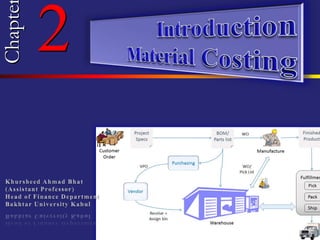

2Chapte
Chapter 3 Material Management
• Chapter outlines
• Introduction to Material Management.
Khursheed Ahmad Bhat, Controller of Finaces Bakhtar University kabul
2
1. Introduction to Materials:
• The materials are a major part of the total cost of producing a product
and are one of the most important assets in majority of the business
enterprises.
• Hence the total cost of a product can be controlled and reduced by
efficiently using materials.
• The materials are of two types, namely:
1. Direct Material
2. Indirect Material.
Khursheed Ahmad Bhat, Controller of Finaces Bakhtar University kabul
3
(i) Direct materials:
• The materials which can be easily identified and attributable to the
individual units being manufactured are known as direct materials.
These materials also form part of finished products. All costs which
are incurred to obtain direct materials are known as direct material
costs.
Khursheed Ahmad Bhat, Controller of Finaces Bakhtar University kabul
4
(ii) Indirect materials:
• Indirect materials, on the other hand, are those materials which are of
small value such as nuts, pins, screws, etc. and do not physically form
part of the finished product.
• Costs associated with indirect materials are known as indirect material
costs.
• Factory supplies, office supplies and selling supplies are generally
termed as stores.
Khursheed Ahmad Bhat, Controller of Finaces Bakhtar University kabul
5
Purchasing Control and Procedure:
• Purchasing is an art.
• Wrong purchases increase the cost of materials, store equipments and
the finished goods.
• Hence it is imperative that purchases should be effectively, efficiently
and economically performed.
• Dr. Walters defines scientific purchasing as the “Procurement by
purchase of the proper materials, machinery, equipment and supplies
of stores used in the manufacture of a product, adapted to marketing in
the proper quantity and quality at the proper time and the lowest price
consistent with the quality desired”.
Khursheed Ahmad Bhat, Controller of Finaces Bakhtar University kabul
6
The major objectives of scientific
purchasing it.
 To purchase the right quantity at the best price,
 Materials purchased should suit the objective, production should not
be held up,
 Unnecessarily capital should not be locked up in stores,
 Best quality of materials should be purchased and company’s
competitive position and its reputation for fairness and integrity
should be safeguarded.
Khursheed Ahmad Bhat, Controller of Finaces Bakhtar University kabul
7
Methods of Purchasing
• Purchasing can be broadly classified as centralized and localized
purchasing.
• (a) Centralized Purchasing: In a large organization, manufacturing
units are many. In such cases centralized purchasing is beneficial.
• The advantages of centralized purchasing are:
1. Specialized and expert knowledge is available.
2. Advantages arise due to bulk purchases.
3. The cost of purchasing can be reduced and selling price can be
lowered.
4. As there is good knowledge of market conditions, greater control can
be exercised.
Khursheed Ahmad Bhat, Controller of Finaces Bakhtar University kabul
8
5. When materials have to be imported, it is advantageous to centralize
the buying.
6. Economy and ease in compilation and consultation of results.
7. It can take advantage of market changes.
8. Investment in inventories can be reduced.
9. Other advantages include undivided responsibility, consistent buying
policies.
Khursheed Ahmad Bhat, Controller of Finaces Bakhtar University kabul
9
(b) Decentralization of Purchases:
The advantages of localized purchasing or decentralization of purchases
are:-
1. Each plant may have its own particular need. This can be given
special attention.
2. Direct contact can be established with suppliers.
3. The time lag between indenting and receiving materials can be
reduced.
4. Technical requirements of each plant can be ascertained.
Khursheed Ahmad Bhat, Controller of Finaces Bakhtar University kabul
10
Purchase Procedure:
• The steps usually followed for purchase of materials may be
enumerated as follows:-
1. Indenting for materials
2. Issue of tenders to suppliers
3. Placing of purchase orders
4. Inspection
5. Receiving Stores
6. Checking and passing of bills for payment
Khursheed Ahmad Bhat, Controller of Finaces Bakhtar University kabul
11
Purchase Procedure:
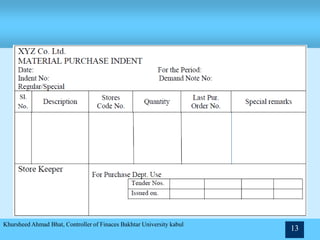
1. Indenting for materials : The stores department prepares indents
for the purchase of materials for replenishment of and sends it to the
purchase department.
• Regular indents are prepared periodically and placed when the
ordering level for different items of stocks are reached.
• The quantity indented is equal to the ordering quantity fixed for each
item.
• The special indents are based on the demands received either from the
planning or production department.
Khursheed Ahmad Bhat, Controller of Finaces Bakhtar University kabul
12
Khursheed Ahmad Bhat, Controller of Finaces Bakhtar University kabul
13
Purchase Procedure:………….
2) Issue of tenders to suppliers: The purchase department issue
tenders to suppliers or publish them in papers. The suppliers quote
their terms of price and delivery/payment. After the last date for
receipt of quotations is over, the tenders are opened and a
comparative statement is prepared.
• While considering the tenders, the reliability of the supplier has to be
taken into account.
• The quality of goods and time taken to deliver the goods on previous
occasions should be checked.
Khursheed Ahmad Bhat, Controller of Finaces Bakhtar University kabul
14
3) Placing of purchase orders: Normally six copies of purchase order
are made. The supplier, stores, inspection department, store
accounting section, purchase department and progress department are
sent one copy each.
• The purchase order has legal and accounting significance.
• From legal point of view, it binds both the parties to the terms of the
contract.
• Form the accounting point of view; it signifies the amount which has
to be spent. It signifies the stores department to accept the goods and
the accounts department to accept the bill.
Khursheed Ahmad Bhat, Controller of Finaces Bakhtar University kabul
15
4) Inspection: The supplier delivers goods at the place specified. Two
delivery challans are prepared by the supplier one of which is
returned. It is a proof of delivery.
• After receiving the goods, the inspection department or production
department is intimated.
• The inspector checks that the materials are in accordance with the
quality required, standard expected, tolerances allowed etc..
Khursheed Ahmad Bhat, Controller of Finaces Bakhtar University kabul
16
5) Receiving Stores: The stores department prepares a (SRN) Stores
Receipt Note for the quantity of stock accepted in inspection.
• After issuing of the Stores Receipt, the Storekeeper is responsible for
the stocks.
• The stores receipt is the document for the posting of receipts in Bin
Card and the Stores Ledger.
• It is prepared in quadruplicate and sent to the supplier; stores
accounting section and purchase department and one copy are retained
with the stores.
• The supplier encloses this copy along with his bill. The stores
accounting section compares the note with the purchase order.
Khursheed Ahmad Bhat, Controller of Finaces Bakhtar University kabul
17
6) Checking and passing of bills for payment: Bills received by the
purchase department are forwarded to the stores accounting section
to check the authenticity regarding quantity and price and the
arithmetical accuracy.
• Special items included in the bills eg:- freight, packing charges are
verified with the purchase order. The bill is later passed for payment.
Khursheed Ahmad Bhat, Controller of Finaces Bakhtar University kabul
18
Storekeeping:
• Store keeping is a service function. The storekeeper is a custodian of
all the items kept in the store.
• The stores should be maintained properly and cost minimized. The
main objectives of store keeping are:-
• i) To protect stores against losses
• ii) To keep goods ready for delivery/issue
• iii) To provide maximum service at minimum cost.
Khursheed Ahmad Bhat, Controller of Finaces Bakhtar University kabul
19
Requisitioning for Stores
• One of the duties of the storekeeper is to send requisitions for
materials for replenishment in time so that the production is not held
up due to shortage of materials.
• The storekeeper should also see that there is no unnecessary blocking
of capital due to overstocking of materials.
• For this he keeps a check on the re-order level, economic ordering
quantity, and the maximum and minimum quantity which he is
authorized to store in respect of each kind of material.
Khursheed Ahmad Bhat, Controller of Finaces Bakhtar University kabul
20
(a) Re-ordering Level
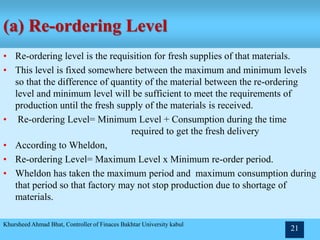
• Re-ordering level is the requisition for fresh supplies of that materials.
• This level is fixed somewhere between the maximum and minimum levels
so that the difference of quantity of the material between the re-ordering
level and minimum level will be sufficient to meet the requirements of
production until the fresh supply of the materials is received.
• Re-ordering Level= Minimum Level + Consumption during the time
required to get the fresh delivery
• According to Wheldon,
• Re-ordering Level= Maximum Level x Minimum re-order period.
• Wheldon has taken the maximum period and maximum consumption during
that period so that factory may not stop production due to shortage of
materials.
Khursheed Ahmad Bhat, Controller of Finaces Bakhtar University kabul
21
Question 1
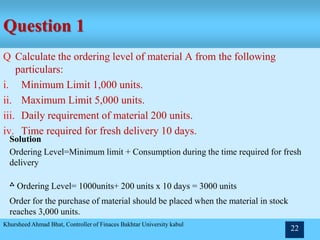
Q Calculate the ordering level of material A from the following
particulars:
i. Minimum Limit 1,000 units.
ii. Maximum Limit 5,000 units.
iii. Daily requirement of material 200 units.
iv. Time required for fresh delivery 10 days.
Khursheed Ahmad Bhat, Controller of Finaces Bakhtar University kabul
22
Solution
Ordering Level=Minimum limit + Consumption during the time required for fresh
delivery
‫؞‬Ordering Level= 1000units+ 200 units x 10 days = 3000 units
Order for the purchase of material should be placed when the material in stock
reaches 3,000 units.
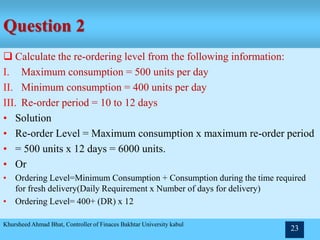
Question 2
 Calculate the re-ordering level from the following information:
I. Maximum consumption = 500 units per day
II. Minimum consumption = 400 units per day
III. Re-order period = 10 to 12 days
• Solution
• Re-order Level = Maximum consumption x maximum re-order period
• = 500 units x 12 days = 6000 units.
• Or
• Ordering Level=Minimum Consumption + Consumption during the time required
for fresh delivery(Daily Requirement x Number of days for delivery)
• Ordering Level= 400+ (DR) x 12
Khursheed Ahmad Bhat, Controller of Finaces Bakhtar University kabul
23
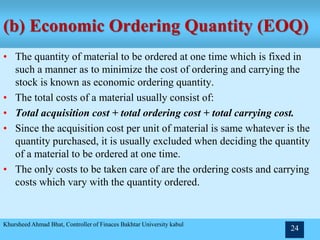
(b) Economic Ordering Quantity (EOQ)
• The quantity of material to be ordered at one time which is fixed in
such a manner as to minimize the cost of ordering and carrying the
stock is known as economic ordering quantity.
• The total costs of a material usually consist of:
• Total acquisition cost + total ordering cost + total carrying cost.
• Since the acquisition cost per unit of material is same whatever is the
quantity purchased, it is usually excluded when deciding the quantity
of a material to be ordered at one time.
• The only costs to be taken care of are the ordering costs and carrying
costs which vary with the quantity ordered.
Khursheed Ahmad Bhat, Controller of Finaces Bakhtar University kabul
24
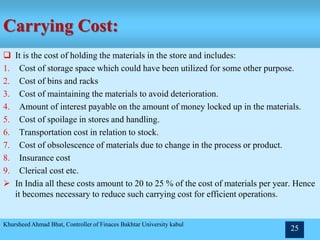
Carrying Cost:
 It is the cost of holding the materials in the store and includes:
1. Cost of storage space which could have been utilized for some other purpose.
2. Cost of bins and racks
3. Cost of maintaining the materials to avoid deterioration.
4. Amount of interest payable on the amount of money locked up in the materials.
5. Cost of spoilage in stores and handling.
6. Transportation cost in relation to stock.
7. Cost of obsolescence of materials due to change in the process or product.
8. Insurance cost
9. Clerical cost etc.
 In India all these costs amount to 20 to 25 % of the cost of materials per year. Hence
it becomes necessary to reduce such carrying cost for efficient operations.
Khursheed Ahmad Bhat, Controller of Finaces Bakhtar University kabul
25
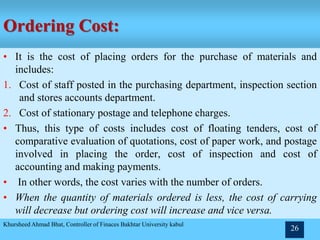
Ordering Cost:
• It is the cost of placing orders for the purchase of materials and
includes:
1. Cost of staff posted in the purchasing department, inspection section
and stores accounts department.
2. Cost of stationary postage and telephone charges.
• Thus, this type of costs includes cost of floating tenders, cost of
comparative evaluation of quotations, cost of paper work, and postage
involved in placing the order, cost of inspection and cost of
accounting and making payments.
• In other words, the cost varies with the number of orders.
• When the quantity of materials ordered is less, the cost of carrying
will decrease but ordering cost will increase and vice versa.
Khursheed Ahmad Bhat, Controller of Finaces Bakhtar University kabul
26
(b) (EOQ)
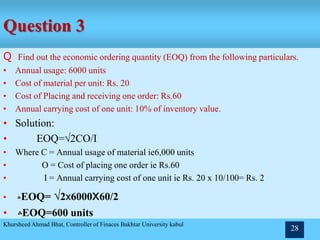
• Q = Quantity to be ordered
• C = Consumption of the material concerned in units during a year.
• O = Cost of placing one order including the cost of receiving the
goods
• I = Interest payment including variable cost of storing per unit per
year i.e holding costs of inventory.
Khursheed Ahmad Bhat, Controller of Finaces Bakhtar University kabul
27
Question 3
Q Find out the economic ordering quantity (EOQ) from the following particulars.
• Annual usage: 6000 units
• Cost of material per unit: Rs. 20
• Cost of Placing and receiving one order: Rs.60
• Annual carrying cost of one unit: 10% of inventory value.
• Solution:
• EOQ=√2CO/I
• Where C = Annual usage of material ie6,000 units
• O = Cost of placing one order ie Rs.60
• I = Annual carrying cost of one unit ie Rs. 20 x 10/100= Rs. 2
• ‫؞‬EOQ= √2x6000x60/2
• ‫؞‬EOQ=600 units
Khursheed Ahmad Bhat, Controller of Finaces Bakhtar University kabul
28
c) Minimum Level or Safety Stock level
• The minimum level is that quantity of the material which must be
maintained in hand at all times. The quantity is fixed so that the
production is not held up due to shortage of the materials. In fixing
this level, the following factors should be considered:
• Formula for calculating minimum level or safety stock level given by
Wheldon is as follows:
• Minimum Stock Level =
Re-ordering level – (Normal consumption x Normal Re-order period)
Khursheed Ahmad Bhat, Controller of Finaces Bakhtar University kabul
29
d) Maximum Level
• It is the maximum of stock which should be held in stock at any time
during the year. The quantity is fixed so as to avoid overstocking as it
leads to the following disadvantages.
1. Overstocking leads to increase in working capital requirement.
2. Overstocking will need more godown space. (More rent)
3. It may also lead to obsolescence on account of overstocking.
4. There are chances that the quality of materials will deteriorate.
• According to Wheldon,
• Maximum Stock level = Reordering level + Re-ordering Quantity –
• (Min. consumption x Min. re-ordering period)
Khursheed Ahmad Bhat, Controller of Finaces Bakhtar University kabul
30
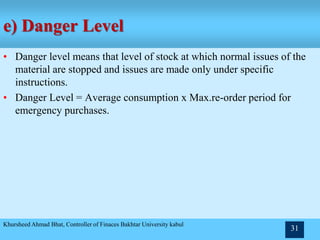
e) Danger Level
• Danger level means that level of stock at which normal issues of the
material are stopped and issues are made only under specific
instructions.
• Danger Level = Average consumption x Max.re-order period for
emergency purchases.
Khursheed Ahmad Bhat, Controller of Finaces Bakhtar University kabul
31
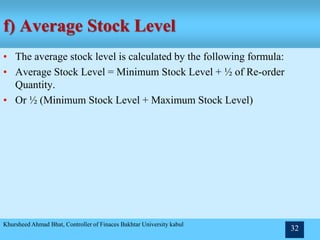
f) Average Stock Level
• The average stock level is calculated by the following formula:
• Average Stock Level = Minimum Stock Level + ½ of Re-order
Quantity.
• Or ½ (Minimum Stock Level + Maximum Stock Level)
Khursheed Ahmad Bhat, Controller of Finaces Bakhtar University kabul
32
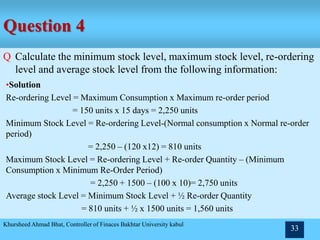
Question 4
Q Calculate the minimum stock level, maximum stock level, re-ordering
level and average stock level from the following information:
I. Minimum consumption = 100 units per day
II. Maximum consumption = 150 units per day
III. Normal consumption = 120 units per day
IV. Re-order period = 10-15 days
V. Re-order quantity = 1,500 units
VI. Normal re-order period = 12 days
Khursheed Ahmad Bhat, Controller of Finaces Bakhtar University kabul
33
•Solution
Re-ordering Level = Maximum Consumption x Maximum re-order period
= 150 units x 15 days = 2,250 units
Minimum Stock Level = Re-ordering Level-(Normal consumption x Normal re-order
period)
= 2,250 – (120 x12) = 810 units
Maximum Stock Level = Re-ordering Level + Re-order Quantity – (Minimum
Consumption x Minimum Re-Order Period)
= 2,250 + 1500 – (100 x 10)= 2,750 units
Average stock Level = Minimum Stock Level + ½ Re-order Quantity
= 810 units + ½ x 1500 units = 1,560 units
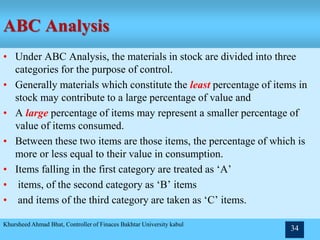
ABC Analysis
• Under ABC Analysis, the materials in stock are divided into three
categories for the purpose of control.
• Generally materials which constitute the least percentage of items in
stock may contribute to a large percentage of value and
• A large percentage of items may represent a smaller percentage of
value of items consumed.
• Between these two items are those items, the percentage of which is
more or less equal to their value in consumption.
• Items falling in the first category are treated as ‘A’
• items, of the second category as ‘B’ items
• and items of the third category are taken as ‘C’ items.
Khursheed Ahmad Bhat, Controller of Finaces Bakhtar University kabul
34
ABC Always Best Control
• This technique of stock control is also known as ABC analysis or
Always Better Control method.
• Thus, under this technique of material control, materials are listed in
‘A’, ‘B’ and ‘C’ categories in descending order based on money value
of consumption.
• The report of the Indian Productivity Team on “Stores and Inventory
Control in U.S.A., Japan and West Germany” gives the following
example of ABC Analysis:
Khursheed Ahmad Bhat, Controller of Finaces Bakhtar University kabul
35
Group Percentage of Items Percentage of Cost
A 8% 75%
B 25% 20%
C 67% 5%
First-in First-out (FIFO) Method
• This method is based on the assumption that materials which are
purchased first are issued first.
• It uses the price of the first batch of materials purchased for all issues
until all units from this batch have been issued.
• In other words the materials are issued at the oldest cost price listed
in the stores ledger account and thus, the materials in stock are valued
at the price of the latest purchases.
Khursheed Ahmad Bhat, Controller of Finaces Bakhtar University kabul
36
QUESTION
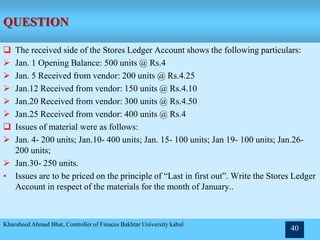
 The received side of the Stores Ledger Account shows the following particulars:
 Jan. 1 Opening Balance: 500 units @ Rs.4
 Jan. 5 Received from vendor: 200 units @ Rs.4.25
 Jan.12 Received from vendor: 150 units @ Rs.4.10
 Jan.20 Received from vendor: 300 units @ Rs.4.50
 Jan.25 Received from vendor: 400 units @ Rs.4
 Issues of material were as follows:
 Jan. 4- 200 units; Jan.10- 400 units; Jan. 15- 100 units; Jan 19- 100 units; Jan.26-
200 units;
 Jan.30- 250 units.
• Issues are to be priced on the principle of “first in first out”. Write the Stores Ledger
Account in respect of the materials for the month of January..
Khursheed Ahmad Bhat, Controller of Finaces Bakhtar University kabul
37
Solution:
Khursheed Ahmad Bhat, Controller of Finaces Bakhtar University kabul
38
Date Particulars
Receipts Issues Balance
Qty
Units
Total
Cost
Unit
Cost
Qty
Units
Total
Cost
Unit
Cost
Qty
Units
Total
Cost
Unit
Cost
1 Jan Balance B/b - - - - - - 500 2000 4
4 Jan Requisition Slip no…… - - - 200 800 4 300 1200 4
5 Jan Goods Received Note No.. 200 850 4.25 - - - 300
200
1200
850
4
4.25
10 Jan Requisition Slip no…… - - - 300
100
1200
425
4
4.25
-
100
-
425
-
4.25
12 Jan Goods Received Note No.. 150 615 4.10 - - - 100
150
425
615
4.25
4.10
15 Jan Requisition Slip no…… - - - 100 425 4.25 150 615 4.10
19 Jan Requisition Slip no…… - - - 100 410 4.10 50 205 4.10
20 Jan Goods Received Note No.. 300 1350 4.5 - - - 50
300
205
1350
4.10
4.50
25 Jan Goods Received Note No.. 400 1600 4.00 - - - 50
300
400
205
1350
1600
4.10
4.50
4.00
26 Jan Requisition Slip no…… - - - 50
150
205
675
4.10
4.50
150
400
675
1600
4.50
4.00
30 Jan Requisition Slip no…… - - - 150
100
675
400
4.50
4.00
300 1200 4.00
Lifo-in First-out (LIFO) Method
• The principle adopted is that the materials used in production is from
the latest purchase.
• The inventory is priced at the oldest costs. As the method applies the
current cost of materials to the cost of units, it is also known as the
replacement cost method.
• It is the most significant method in matching cost with revenue in the
income determination procedure.
Khursheed Ahmad Bhat, Controller of Finaces Bakhtar University kabul
39
QUESTION
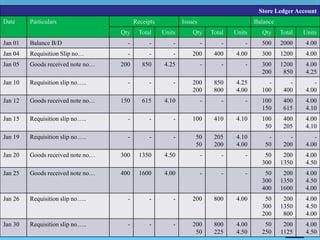
 The received side of the Stores Ledger Account shows the following particulars:
 Jan. 1 Opening Balance: 500 units @ Rs.4
 Jan. 5 Received from vendor: 200 units @ Rs.4.25
 Jan.12 Received from vendor: 150 units @ Rs.4.10
 Jan.20 Received from vendor: 300 units @ Rs.4.50
 Jan.25 Received from vendor: 400 units @ Rs.4
 Issues of material were as follows:
 Jan. 4- 200 units; Jan.10- 400 units; Jan. 15- 100 units; Jan 19- 100 units; Jan.26-
200 units;
 Jan.30- 250 units.
• Issues are to be priced on the principle of “Last in first out”. Write the Stores Ledger
Account in respect of the materials for the month of January..
Khursheed Ahmad Bhat, Controller of Finaces Bakhtar University kabul
40
Khursheed Ahmad Bhat, Controller of Finaces Bakhtar University kabul
41
Store Ledger Account
Date Particulars Receipts Issues Balance
Qty Total Units Qty Total Units Qty Total Units
Jan 01 Balance B/D - - - - - - 500 2000 4.00
Jan 04 Requisition Slip no… - - - 200 400 4.00 300 1200 4.00
Jan 05 Goods received note no… 200 850 4.25 - - - 300
200
1200
850
4.00
4.25
Jan 10 Requisition slip no….. - - - 200
200
850
800
4.25
4.00
-
100
-
400
-
4.00
Jan 12 Goods received note no… 150 615 4.10 - - - 100
150
400
615
4.00
4.10
Jan 15 Requisition slip no….. - - - 100 410 4.10 100
50
400
205
4.00
4.10
Jan 19 Requisition slip no….. - - - 50
50
205
200
4.10
4.00
-
50
-
200
-
4.00
Jan 20 Goods received note no… 300 1350 4.50 - - - 50
300
200
1350
4.00
4.50
Jan 25 Goods received note no… 400 1600 4.00 - - - 50
300
400
200
1350
1600
4.00
4.50
4.00
Jan 26 Requisition slip no….. - - - 200 800 4.00 50
300
200
200
1350
800
4.00
4.50
4.00
Jan 30 Requisition slip no….. - - - 200
50
800
225
4.00
4.50
50
250
200
1125
4.00
4.50
Khursheed Ahmad Bhat, Controller of Finaces Bakhtar University kabul
42

Materil costing

  • 1.
  • 2.
    Chapter 3 MaterialManagement • Chapter outlines • Introduction to Material Management. Khursheed Ahmad Bhat, Controller of Finaces Bakhtar University kabul 2
  • 3.
    1. Introduction toMaterials: • The materials are a major part of the total cost of producing a product and are one of the most important assets in majority of the business enterprises. • Hence the total cost of a product can be controlled and reduced by efficiently using materials. • The materials are of two types, namely: 1. Direct Material 2. Indirect Material. Khursheed Ahmad Bhat, Controller of Finaces Bakhtar University kabul 3
  • 4.
    (i) Direct materials: •The materials which can be easily identified and attributable to the individual units being manufactured are known as direct materials. These materials also form part of finished products. All costs which are incurred to obtain direct materials are known as direct material costs. Khursheed Ahmad Bhat, Controller of Finaces Bakhtar University kabul 4
  • 5.
    (ii) Indirect materials: •Indirect materials, on the other hand, are those materials which are of small value such as nuts, pins, screws, etc. and do not physically form part of the finished product. • Costs associated with indirect materials are known as indirect material costs. • Factory supplies, office supplies and selling supplies are generally termed as stores. Khursheed Ahmad Bhat, Controller of Finaces Bakhtar University kabul 5
  • 6.
    Purchasing Control andProcedure: • Purchasing is an art. • Wrong purchases increase the cost of materials, store equipments and the finished goods. • Hence it is imperative that purchases should be effectively, efficiently and economically performed. • Dr. Walters defines scientific purchasing as the “Procurement by purchase of the proper materials, machinery, equipment and supplies of stores used in the manufacture of a product, adapted to marketing in the proper quantity and quality at the proper time and the lowest price consistent with the quality desired”. Khursheed Ahmad Bhat, Controller of Finaces Bakhtar University kabul 6
  • 7.
    The major objectivesof scientific purchasing it.  To purchase the right quantity at the best price,  Materials purchased should suit the objective, production should not be held up,  Unnecessarily capital should not be locked up in stores,  Best quality of materials should be purchased and company’s competitive position and its reputation for fairness and integrity should be safeguarded. Khursheed Ahmad Bhat, Controller of Finaces Bakhtar University kabul 7
  • 8.
    Methods of Purchasing •Purchasing can be broadly classified as centralized and localized purchasing. • (a) Centralized Purchasing: In a large organization, manufacturing units are many. In such cases centralized purchasing is beneficial. • The advantages of centralized purchasing are: 1. Specialized and expert knowledge is available. 2. Advantages arise due to bulk purchases. 3. The cost of purchasing can be reduced and selling price can be lowered. 4. As there is good knowledge of market conditions, greater control can be exercised. Khursheed Ahmad Bhat, Controller of Finaces Bakhtar University kabul 8
  • 9.
    5. When materialshave to be imported, it is advantageous to centralize the buying. 6. Economy and ease in compilation and consultation of results. 7. It can take advantage of market changes. 8. Investment in inventories can be reduced. 9. Other advantages include undivided responsibility, consistent buying policies. Khursheed Ahmad Bhat, Controller of Finaces Bakhtar University kabul 9
  • 10.
    (b) Decentralization ofPurchases: The advantages of localized purchasing or decentralization of purchases are:- 1. Each plant may have its own particular need. This can be given special attention. 2. Direct contact can be established with suppliers. 3. The time lag between indenting and receiving materials can be reduced. 4. Technical requirements of each plant can be ascertained. Khursheed Ahmad Bhat, Controller of Finaces Bakhtar University kabul 10
  • 11.
    Purchase Procedure: • Thesteps usually followed for purchase of materials may be enumerated as follows:- 1. Indenting for materials 2. Issue of tenders to suppliers 3. Placing of purchase orders 4. Inspection 5. Receiving Stores 6. Checking and passing of bills for payment Khursheed Ahmad Bhat, Controller of Finaces Bakhtar University kabul 11
  • 12.
    Purchase Procedure: 1. Indentingfor materials : The stores department prepares indents for the purchase of materials for replenishment of and sends it to the purchase department. • Regular indents are prepared periodically and placed when the ordering level for different items of stocks are reached. • The quantity indented is equal to the ordering quantity fixed for each item. • The special indents are based on the demands received either from the planning or production department. Khursheed Ahmad Bhat, Controller of Finaces Bakhtar University kabul 12
  • 13.
    Khursheed Ahmad Bhat,Controller of Finaces Bakhtar University kabul 13
  • 14.
    Purchase Procedure:…………. 2) Issueof tenders to suppliers: The purchase department issue tenders to suppliers or publish them in papers. The suppliers quote their terms of price and delivery/payment. After the last date for receipt of quotations is over, the tenders are opened and a comparative statement is prepared. • While considering the tenders, the reliability of the supplier has to be taken into account. • The quality of goods and time taken to deliver the goods on previous occasions should be checked. Khursheed Ahmad Bhat, Controller of Finaces Bakhtar University kabul 14
  • 15.
    3) Placing ofpurchase orders: Normally six copies of purchase order are made. The supplier, stores, inspection department, store accounting section, purchase department and progress department are sent one copy each. • The purchase order has legal and accounting significance. • From legal point of view, it binds both the parties to the terms of the contract. • Form the accounting point of view; it signifies the amount which has to be spent. It signifies the stores department to accept the goods and the accounts department to accept the bill. Khursheed Ahmad Bhat, Controller of Finaces Bakhtar University kabul 15
  • 16.
    4) Inspection: Thesupplier delivers goods at the place specified. Two delivery challans are prepared by the supplier one of which is returned. It is a proof of delivery. • After receiving the goods, the inspection department or production department is intimated. • The inspector checks that the materials are in accordance with the quality required, standard expected, tolerances allowed etc.. Khursheed Ahmad Bhat, Controller of Finaces Bakhtar University kabul 16
  • 17.
    5) Receiving Stores:The stores department prepares a (SRN) Stores Receipt Note for the quantity of stock accepted in inspection. • After issuing of the Stores Receipt, the Storekeeper is responsible for the stocks. • The stores receipt is the document for the posting of receipts in Bin Card and the Stores Ledger. • It is prepared in quadruplicate and sent to the supplier; stores accounting section and purchase department and one copy are retained with the stores. • The supplier encloses this copy along with his bill. The stores accounting section compares the note with the purchase order. Khursheed Ahmad Bhat, Controller of Finaces Bakhtar University kabul 17
  • 18.
    6) Checking andpassing of bills for payment: Bills received by the purchase department are forwarded to the stores accounting section to check the authenticity regarding quantity and price and the arithmetical accuracy. • Special items included in the bills eg:- freight, packing charges are verified with the purchase order. The bill is later passed for payment. Khursheed Ahmad Bhat, Controller of Finaces Bakhtar University kabul 18
  • 19.
    Storekeeping: • Store keepingis a service function. The storekeeper is a custodian of all the items kept in the store. • The stores should be maintained properly and cost minimized. The main objectives of store keeping are:- • i) To protect stores against losses • ii) To keep goods ready for delivery/issue • iii) To provide maximum service at minimum cost. Khursheed Ahmad Bhat, Controller of Finaces Bakhtar University kabul 19
  • 20.
    Requisitioning for Stores •One of the duties of the storekeeper is to send requisitions for materials for replenishment in time so that the production is not held up due to shortage of materials. • The storekeeper should also see that there is no unnecessary blocking of capital due to overstocking of materials. • For this he keeps a check on the re-order level, economic ordering quantity, and the maximum and minimum quantity which he is authorized to store in respect of each kind of material. Khursheed Ahmad Bhat, Controller of Finaces Bakhtar University kabul 20
  • 21.
    (a) Re-ordering Level •Re-ordering level is the requisition for fresh supplies of that materials. • This level is fixed somewhere between the maximum and minimum levels so that the difference of quantity of the material between the re-ordering level and minimum level will be sufficient to meet the requirements of production until the fresh supply of the materials is received. • Re-ordering Level= Minimum Level + Consumption during the time required to get the fresh delivery • According to Wheldon, • Re-ordering Level= Maximum Level x Minimum re-order period. • Wheldon has taken the maximum period and maximum consumption during that period so that factory may not stop production due to shortage of materials. Khursheed Ahmad Bhat, Controller of Finaces Bakhtar University kabul 21
  • 22.
    Question 1 Q Calculatethe ordering level of material A from the following particulars: i. Minimum Limit 1,000 units. ii. Maximum Limit 5,000 units. iii. Daily requirement of material 200 units. iv. Time required for fresh delivery 10 days. Khursheed Ahmad Bhat, Controller of Finaces Bakhtar University kabul 22 Solution Ordering Level=Minimum limit + Consumption during the time required for fresh delivery ‫؞‬Ordering Level= 1000units+ 200 units x 10 days = 3000 units Order for the purchase of material should be placed when the material in stock reaches 3,000 units.
  • 23.
    Question 2  Calculatethe re-ordering level from the following information: I. Maximum consumption = 500 units per day II. Minimum consumption = 400 units per day III. Re-order period = 10 to 12 days • Solution • Re-order Level = Maximum consumption x maximum re-order period • = 500 units x 12 days = 6000 units. • Or • Ordering Level=Minimum Consumption + Consumption during the time required for fresh delivery(Daily Requirement x Number of days for delivery) • Ordering Level= 400+ (DR) x 12 Khursheed Ahmad Bhat, Controller of Finaces Bakhtar University kabul 23
  • 24.
    (b) Economic OrderingQuantity (EOQ) • The quantity of material to be ordered at one time which is fixed in such a manner as to minimize the cost of ordering and carrying the stock is known as economic ordering quantity. • The total costs of a material usually consist of: • Total acquisition cost + total ordering cost + total carrying cost. • Since the acquisition cost per unit of material is same whatever is the quantity purchased, it is usually excluded when deciding the quantity of a material to be ordered at one time. • The only costs to be taken care of are the ordering costs and carrying costs which vary with the quantity ordered. Khursheed Ahmad Bhat, Controller of Finaces Bakhtar University kabul 24
  • 25.
    Carrying Cost:  Itis the cost of holding the materials in the store and includes: 1. Cost of storage space which could have been utilized for some other purpose. 2. Cost of bins and racks 3. Cost of maintaining the materials to avoid deterioration. 4. Amount of interest payable on the amount of money locked up in the materials. 5. Cost of spoilage in stores and handling. 6. Transportation cost in relation to stock. 7. Cost of obsolescence of materials due to change in the process or product. 8. Insurance cost 9. Clerical cost etc.  In India all these costs amount to 20 to 25 % of the cost of materials per year. Hence it becomes necessary to reduce such carrying cost for efficient operations. Khursheed Ahmad Bhat, Controller of Finaces Bakhtar University kabul 25
  • 26.
    Ordering Cost: • Itis the cost of placing orders for the purchase of materials and includes: 1. Cost of staff posted in the purchasing department, inspection section and stores accounts department. 2. Cost of stationary postage and telephone charges. • Thus, this type of costs includes cost of floating tenders, cost of comparative evaluation of quotations, cost of paper work, and postage involved in placing the order, cost of inspection and cost of accounting and making payments. • In other words, the cost varies with the number of orders. • When the quantity of materials ordered is less, the cost of carrying will decrease but ordering cost will increase and vice versa. Khursheed Ahmad Bhat, Controller of Finaces Bakhtar University kabul 26
  • 27.
    (b) (EOQ) • Q= Quantity to be ordered • C = Consumption of the material concerned in units during a year. • O = Cost of placing one order including the cost of receiving the goods • I = Interest payment including variable cost of storing per unit per year i.e holding costs of inventory. Khursheed Ahmad Bhat, Controller of Finaces Bakhtar University kabul 27
  • 28.
    Question 3 Q Findout the economic ordering quantity (EOQ) from the following particulars. • Annual usage: 6000 units • Cost of material per unit: Rs. 20 • Cost of Placing and receiving one order: Rs.60 • Annual carrying cost of one unit: 10% of inventory value. • Solution: • EOQ=√2CO/I • Where C = Annual usage of material ie6,000 units • O = Cost of placing one order ie Rs.60 • I = Annual carrying cost of one unit ie Rs. 20 x 10/100= Rs. 2 • ‫؞‬EOQ= √2x6000x60/2 • ‫؞‬EOQ=600 units Khursheed Ahmad Bhat, Controller of Finaces Bakhtar University kabul 28
  • 29.
    c) Minimum Levelor Safety Stock level • The minimum level is that quantity of the material which must be maintained in hand at all times. The quantity is fixed so that the production is not held up due to shortage of the materials. In fixing this level, the following factors should be considered: • Formula for calculating minimum level or safety stock level given by Wheldon is as follows: • Minimum Stock Level = Re-ordering level – (Normal consumption x Normal Re-order period) Khursheed Ahmad Bhat, Controller of Finaces Bakhtar University kabul 29
  • 30.
    d) Maximum Level •It is the maximum of stock which should be held in stock at any time during the year. The quantity is fixed so as to avoid overstocking as it leads to the following disadvantages. 1. Overstocking leads to increase in working capital requirement. 2. Overstocking will need more godown space. (More rent) 3. It may also lead to obsolescence on account of overstocking. 4. There are chances that the quality of materials will deteriorate. • According to Wheldon, • Maximum Stock level = Reordering level + Re-ordering Quantity – • (Min. consumption x Min. re-ordering period) Khursheed Ahmad Bhat, Controller of Finaces Bakhtar University kabul 30
  • 31.
    e) Danger Level •Danger level means that level of stock at which normal issues of the material are stopped and issues are made only under specific instructions. • Danger Level = Average consumption x Max.re-order period for emergency purchases. Khursheed Ahmad Bhat, Controller of Finaces Bakhtar University kabul 31
  • 32.
    f) Average StockLevel • The average stock level is calculated by the following formula: • Average Stock Level = Minimum Stock Level + ½ of Re-order Quantity. • Or ½ (Minimum Stock Level + Maximum Stock Level) Khursheed Ahmad Bhat, Controller of Finaces Bakhtar University kabul 32
  • 33.
    Question 4 Q Calculatethe minimum stock level, maximum stock level, re-ordering level and average stock level from the following information: I. Minimum consumption = 100 units per day II. Maximum consumption = 150 units per day III. Normal consumption = 120 units per day IV. Re-order period = 10-15 days V. Re-order quantity = 1,500 units VI. Normal re-order period = 12 days Khursheed Ahmad Bhat, Controller of Finaces Bakhtar University kabul 33 •Solution Re-ordering Level = Maximum Consumption x Maximum re-order period = 150 units x 15 days = 2,250 units Minimum Stock Level = Re-ordering Level-(Normal consumption x Normal re-order period) = 2,250 – (120 x12) = 810 units Maximum Stock Level = Re-ordering Level + Re-order Quantity – (Minimum Consumption x Minimum Re-Order Period) = 2,250 + 1500 – (100 x 10)= 2,750 units Average stock Level = Minimum Stock Level + ½ Re-order Quantity = 810 units + ½ x 1500 units = 1,560 units
  • 34.
    ABC Analysis • UnderABC Analysis, the materials in stock are divided into three categories for the purpose of control. • Generally materials which constitute the least percentage of items in stock may contribute to a large percentage of value and • A large percentage of items may represent a smaller percentage of value of items consumed. • Between these two items are those items, the percentage of which is more or less equal to their value in consumption. • Items falling in the first category are treated as ‘A’ • items, of the second category as ‘B’ items • and items of the third category are taken as ‘C’ items. Khursheed Ahmad Bhat, Controller of Finaces Bakhtar University kabul 34
  • 35.
    ABC Always BestControl • This technique of stock control is also known as ABC analysis or Always Better Control method. • Thus, under this technique of material control, materials are listed in ‘A’, ‘B’ and ‘C’ categories in descending order based on money value of consumption. • The report of the Indian Productivity Team on “Stores and Inventory Control in U.S.A., Japan and West Germany” gives the following example of ABC Analysis: Khursheed Ahmad Bhat, Controller of Finaces Bakhtar University kabul 35 Group Percentage of Items Percentage of Cost A 8% 75% B 25% 20% C 67% 5%
  • 36.
    First-in First-out (FIFO)Method • This method is based on the assumption that materials which are purchased first are issued first. • It uses the price of the first batch of materials purchased for all issues until all units from this batch have been issued. • In other words the materials are issued at the oldest cost price listed in the stores ledger account and thus, the materials in stock are valued at the price of the latest purchases. Khursheed Ahmad Bhat, Controller of Finaces Bakhtar University kabul 36
  • 37.
    QUESTION  The receivedside of the Stores Ledger Account shows the following particulars:  Jan. 1 Opening Balance: 500 units @ Rs.4  Jan. 5 Received from vendor: 200 units @ Rs.4.25  Jan.12 Received from vendor: 150 units @ Rs.4.10  Jan.20 Received from vendor: 300 units @ Rs.4.50  Jan.25 Received from vendor: 400 units @ Rs.4  Issues of material were as follows:  Jan. 4- 200 units; Jan.10- 400 units; Jan. 15- 100 units; Jan 19- 100 units; Jan.26- 200 units;  Jan.30- 250 units. • Issues are to be priced on the principle of “first in first out”. Write the Stores Ledger Account in respect of the materials for the month of January.. Khursheed Ahmad Bhat, Controller of Finaces Bakhtar University kabul 37
  • 38.
    Solution: Khursheed Ahmad Bhat,Controller of Finaces Bakhtar University kabul 38 Date Particulars Receipts Issues Balance Qty Units Total Cost Unit Cost Qty Units Total Cost Unit Cost Qty Units Total Cost Unit Cost 1 Jan Balance B/b - - - - - - 500 2000 4 4 Jan Requisition Slip no…… - - - 200 800 4 300 1200 4 5 Jan Goods Received Note No.. 200 850 4.25 - - - 300 200 1200 850 4 4.25 10 Jan Requisition Slip no…… - - - 300 100 1200 425 4 4.25 - 100 - 425 - 4.25 12 Jan Goods Received Note No.. 150 615 4.10 - - - 100 150 425 615 4.25 4.10 15 Jan Requisition Slip no…… - - - 100 425 4.25 150 615 4.10 19 Jan Requisition Slip no…… - - - 100 410 4.10 50 205 4.10 20 Jan Goods Received Note No.. 300 1350 4.5 - - - 50 300 205 1350 4.10 4.50 25 Jan Goods Received Note No.. 400 1600 4.00 - - - 50 300 400 205 1350 1600 4.10 4.50 4.00 26 Jan Requisition Slip no…… - - - 50 150 205 675 4.10 4.50 150 400 675 1600 4.50 4.00 30 Jan Requisition Slip no…… - - - 150 100 675 400 4.50 4.00 300 1200 4.00
  • 39.
    Lifo-in First-out (LIFO)Method • The principle adopted is that the materials used in production is from the latest purchase. • The inventory is priced at the oldest costs. As the method applies the current cost of materials to the cost of units, it is also known as the replacement cost method. • It is the most significant method in matching cost with revenue in the income determination procedure. Khursheed Ahmad Bhat, Controller of Finaces Bakhtar University kabul 39
  • 40.
    QUESTION  The receivedside of the Stores Ledger Account shows the following particulars:  Jan. 1 Opening Balance: 500 units @ Rs.4  Jan. 5 Received from vendor: 200 units @ Rs.4.25  Jan.12 Received from vendor: 150 units @ Rs.4.10  Jan.20 Received from vendor: 300 units @ Rs.4.50  Jan.25 Received from vendor: 400 units @ Rs.4  Issues of material were as follows:  Jan. 4- 200 units; Jan.10- 400 units; Jan. 15- 100 units; Jan 19- 100 units; Jan.26- 200 units;  Jan.30- 250 units. • Issues are to be priced on the principle of “Last in first out”. Write the Stores Ledger Account in respect of the materials for the month of January.. Khursheed Ahmad Bhat, Controller of Finaces Bakhtar University kabul 40
  • 41.
    Khursheed Ahmad Bhat,Controller of Finaces Bakhtar University kabul 41 Store Ledger Account Date Particulars Receipts Issues Balance Qty Total Units Qty Total Units Qty Total Units Jan 01 Balance B/D - - - - - - 500 2000 4.00 Jan 04 Requisition Slip no… - - - 200 400 4.00 300 1200 4.00 Jan 05 Goods received note no… 200 850 4.25 - - - 300 200 1200 850 4.00 4.25 Jan 10 Requisition slip no….. - - - 200 200 850 800 4.25 4.00 - 100 - 400 - 4.00 Jan 12 Goods received note no… 150 615 4.10 - - - 100 150 400 615 4.00 4.10 Jan 15 Requisition slip no….. - - - 100 410 4.10 100 50 400 205 4.00 4.10 Jan 19 Requisition slip no….. - - - 50 50 205 200 4.10 4.00 - 50 - 200 - 4.00 Jan 20 Goods received note no… 300 1350 4.50 - - - 50 300 200 1350 4.00 4.50 Jan 25 Goods received note no… 400 1600 4.00 - - - 50 300 400 200 1350 1600 4.00 4.50 4.00 Jan 26 Requisition slip no….. - - - 200 800 4.00 50 300 200 200 1350 800 4.00 4.50 4.00 Jan 30 Requisition slip no….. - - - 200 50 800 225 4.00 4.50 50 250 200 1125 4.00 4.50
  • 42.
    Khursheed Ahmad Bhat,Controller of Finaces Bakhtar University kabul 42