HRM IN A DYNAMIC ENVIRONMENT Chapter EXCEL BOOKS 3-1 3
ANNOTATED OUTLINE 3-2 INTRODUCTION Organisations are open systems and are, therefore, influenced by the environment (internal as well as external ) in which they operate.
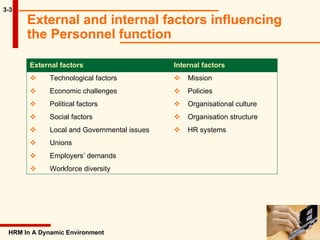
3-3 External and internal factors influencing the Personnel function   External factors Internal factors  Technological factors    Mission    Economic challenges    Policies    Political factors    Organisational culture    Social factors    Organisation structure    Local and Governmental issues    HR systems    Unions    Employers’ demands    Workforce diversity
Technological Changes And HRM  3-4 Technology includes tools, machinery, equipment, work procedures and employee knowledge and skills. The impact of technology on HR can be profound, as the following things clearly reveal: New skills, knowledge, experience and expertise required to gain  the edge over rivals.  Downsize operations, cut organisational layers and cut the extra  fat to survive in a competitive world Collaborate and achieve teamwork Relocate work from the office to the home Internet and intranet revolution
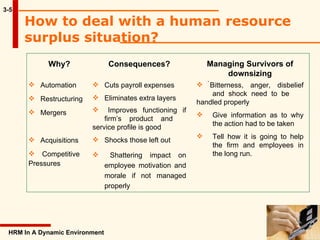
How to deal with a human resource surplus situation? 3-5 Why? Automation Restructuring Mergers Acquisitions Competitive Pressures Consequences? Cuts payroll expenses Eliminates extra layers Improves functioning if  firm’s product and  service profile is good Shocks those left out Shattering impact on  employee motivation and  morale if not managed  properly Managing Survivors of downsizing  Bitterness, anger, disbelief  and shock need to be  handled properly  Give information as to why  the action had to be taken  Tell how it is going to help  the firm and employees in  the long run.
3-6 Role of HR in a virtual organisation   A virtual organisation is a network of companies or employees connected by computers. Virtual workers work from home, hotels, their cars, or wherever their work takes them. The human resource function plays a unique role in a virtual organisation:    Psychological fit:  The lack of face-to-face interaction in a  virtual  organisation, virtually compels HR professionals to determine the  psychological fit between different units initially.    System alignment:  Given the lack of physical proximity, it  becomes even more critical that the organisation's mission, vision  and measures be aligned and that all parties are familiar with these  issues; the HR function can play an important role in this task.    Reconsider rewards:  In a virtual unit, very few permanent  positions exist. In many cases, the organisation will be staffed  with  workers having different motivational forces. So rewarding each  entity in an effective way becomes an important job. Cont…
3-7    Reconsider staffing needs:  In a virtual organisation, most  employees work on a contractual basis. Finding people with  requisite skills, knowledge and motivation levels becomes an  important activity.    Build partnerships:  Virtual, teams have to be built from  scratch  paying attention to their unique requirements. The  concept of  employment needs to be replaced by the concept of 'partnership'  especially when most tend to work independently away from the  permanent employees or owners of the organisation    Develop leaders:  Leaders become the major forces for building  trust, creating a mission and instilling a sense of belonging to the  organisation. HR can play a major role in ensuring that leaders  assume these responsibilities and meet them in an effective way. Role of HR in a virtual organisation
Total Quality Management Programmes  3-8 TQM is a way of creating an organisational culture committed to the continuous improvement of skills, teamwork, processes, product and service quality and customer satisfaction.
TQM: The main ideas 3-9 Do it right the first time Be customer oriented Make continuous improvement a way of life Build teamwork Empower people  Create a climate of trust, an atmosphere for innovation
Total Quality HR Approach 3-10 The Total Quality HR Approach is all about employee participation and empowerment, carried out in a sincere and wholehearted manner. Rewards are designed to meet employee needs. Employees are treated like customers. 360 degree appraisals are carried out before picking up the best performing teams. Small ideas and improvements are encouraged.
3-11 Quality snaps of Indian companies   Name of Company Efforts toward TQM 1. Indo-Gulf Fertilizers Ltd Upgrading technology; training people; monitoring cost,  quality  and delivery criteria; participative management, HRD; ISO 9002  Certification, first fertilizer company to get this in India;  Shaktiman Krishi Seva Kendras in UP, Bihar and West Bengal. 2. Bharat Heavy Electricals Ltd  First to get ISO 9001 certification, in Dec 93; Strict metal parts  (BHEL)  quality control; 100% checking of insulators for testing their  strength; strict quality assurance tests; high quality testing labs,  etc. 3. TELCO (Lucknow) SUMO model Jeeps manufactured here according highest  priority to ISO 9000 certifications; training and self-inspection  given top priority. 4. Philips India Ltd Implemented TQM in 1995; first step was moving toward  international quality system standards ISO 9000; total employee  involvement; creation of self managing mini, micro and mega- teams; got the European Quality Award; Kaizen and suggestion  schemes introduced followed by rewards and recognition  system; regular surveys of employee motivation levels  accompanied by customer surveys
3-12 Benchmarking   Effective implementation of TQM requires benchmarking. The essence of benchmarking is striving to be the best of the best in one’s area of operations. It is a continuous process of measuring products, services and practices against the toughest competitors or industry leaders with the aim of mutual improvement.  Reengineering The primary focus of TQM is on continuous improvement or ongoing incremental change. Reengineering is all about achieving this.  Actually speaking, reengineering takes place when more than 70 per cent of the work processes in an organisation are evaluated and altered. The focus is on simplifying operations and making them more efficient and customer oriented.
Essentials of reengineering 3-13 Give people a mission; a clear view of how to achieve that mission. Either serve the customer superbly or don’t even try. Change is the way of life. It is not a process, it is a value. Technology is never really a problem. The problem is how to use  technology effectively. The wrong answer rarely kills you. What it does is waste time. The weak link in reengineering is will. Once people catch on to reengineering, you can’t hold them back. It’s a  lifetime opportunity. In India TELCO, TISCO, L&T, Ranbaxy and Crompton Greaves have  successfully brought about radical changes through Reengineering.
Flexible Manufacturing systems   3-14 It is the integration of computer aided design, engineering and manufacturing to produce low volume products at mass production costs.  In such a scenario, employees need to acquire skills and get trained constantly. One should be capable of handle a variety of tasks.
3-15 Economic, Political And Social  Challenges And HR Now-a-days, people, goods, capital and information are moving around the globe as never before. Global competition is making every firm to think in terms of gaining an edge over rivals by producing high quality goods at a very competitive price. This is where the ‘people’ dimension comes into being. Incentives, favourable work climate, team spirit, freedom to think and act independently, and a host of other HR initiatives are needed to keep talent from flying away.
What HR managers can do ? 3-16 Use workforce skills and abilities in order to exploit environmental opportunities and  neutralise threats. Employ innovative reward plans that recognise employee contributions and  grant  enhancements. Indulge in continuous quality improvement through TQM and HR  contributions  (training, development, counselling, coaching etc.). Utilise people with distinctive capabilities to create unsurpassed competence in  an area (Xerox in photocopier, 3M in adhesives, Telco in trucks, Britannia in  biscuits, Nestle in coffee, McDonald’s in fast foods, etc.). Decentralise operations and rely on self managed teams to deliver goods in  difficult  times (Motorola is famous for short product development cycles. It has quickly  commercialised ideas from its research labs). Lay off workers in a smooth way, explaining facts (IBM, Kodak, Xerox, AT&T,  Steel and Textile firms in India etc.) to unions, workers and other  affected groups.  HR generally plays a key role, these days, in planning and implementing corporate  downsizings, and then in maintaining the morale of the remaining employees.
Political factors 3-17 Political stability Formation of new political parties Influence of politicians over Productivity linked wage agreements  Political parties sympathetic to trade unionism Opposition to VRS schemes, downsizing operations, restructuring  exercises. Freedom to show the door to unwanted people Social factors   Conducting business in a socially relevant and responsible way. Hire qualified people or hire inexperienced local people and train them  to avoid trouble? Helping economically poor people, unemployed, underprivileged  ones,  etc.
Local and government-related factors  3-18 Meet legislative requirements Offering jobs to certain sections of local community Trade unions   Demands for higher wages, better working conditions,  incentives,  benefits, services
MANAGING WORKFORCE DIVERSITY 3-19 The workforce is becoming increasingly diverse now and organisations are doing their best to address employee concerns and to maximise benefits of different kind to employees with diverse educational, cultural and religious backgrounds. The diversity issues, mainly, include the following : Composition In terms of age, caste, education, culture, region, religion Minority groups Economically backward groups Displaced persons  Child labour Contract labour  Women employees
3-20 Ways to cheer up women employees Provide alternative career paths Offer extended leave facilities so that they can meet their pressing  commitments according to their convenience Allow female workers to create their own schedules and process  work at home Create flexible work arrangements Permit job sharing especially in case of relatively independent  tasks such as filing, faxing, word processing, photo copying etc. In order to benefit from diversity, managers should recognise the potential concerns of employees and make sure that the exchange between the organisation and employees is mutually beneficial and satisfying.
3-21 INTERNAL ENVIRONMENT AND HR  Organisations are also influenced by a variety of internal factors relating to strategy, culture, structure etc. Mission and Strategy Internal Policies Organisational Culture Organisation structure Human resource systems
3-22 Designing appropriate HR systems  Issue Focus on Nature of employment : Job/Career Recruitment : Internal/external/both Selection : Merit/other considerations Training and employee  : 6 months/yearly development  actions Regular/irregular/need based Degree of participation : Top down/bottom up Incentives : Individual merit/group output Job security : Lifelong employment/need-based jobs Employee welfare : Be a model employer (offer those that  are needed by law.)

Chapter 03

  • 1.
    HRM IN ADYNAMIC ENVIRONMENT Chapter EXCEL BOOKS 3-1 3
  • 2.
    ANNOTATED OUTLINE 3-2INTRODUCTION Organisations are open systems and are, therefore, influenced by the environment (internal as well as external ) in which they operate.
  • 3.
    3-3 External andinternal factors influencing the Personnel function External factors Internal factors  Technological factors  Mission  Economic challenges  Policies  Political factors  Organisational culture  Social factors  Organisation structure  Local and Governmental issues  HR systems  Unions  Employers’ demands  Workforce diversity
  • 4.
    Technological Changes AndHRM 3-4 Technology includes tools, machinery, equipment, work procedures and employee knowledge and skills. The impact of technology on HR can be profound, as the following things clearly reveal: New skills, knowledge, experience and expertise required to gain the edge over rivals. Downsize operations, cut organisational layers and cut the extra fat to survive in a competitive world Collaborate and achieve teamwork Relocate work from the office to the home Internet and intranet revolution
  • 5.
    How to dealwith a human resource surplus situation? 3-5 Why? Automation Restructuring Mergers Acquisitions Competitive Pressures Consequences? Cuts payroll expenses Eliminates extra layers Improves functioning if firm’s product and service profile is good Shocks those left out Shattering impact on employee motivation and morale if not managed properly Managing Survivors of downsizing  Bitterness, anger, disbelief and shock need to be handled properly  Give information as to why the action had to be taken  Tell how it is going to help the firm and employees in the long run.
  • 6.
    3-6 Role ofHR in a virtual organisation A virtual organisation is a network of companies or employees connected by computers. Virtual workers work from home, hotels, their cars, or wherever their work takes them. The human resource function plays a unique role in a virtual organisation:  Psychological fit: The lack of face-to-face interaction in a virtual organisation, virtually compels HR professionals to determine the psychological fit between different units initially.  System alignment: Given the lack of physical proximity, it becomes even more critical that the organisation's mission, vision and measures be aligned and that all parties are familiar with these issues; the HR function can play an important role in this task.  Reconsider rewards: In a virtual unit, very few permanent positions exist. In many cases, the organisation will be staffed with workers having different motivational forces. So rewarding each entity in an effective way becomes an important job. Cont…
  • 7.
    3-7  Reconsider staffing needs: In a virtual organisation, most employees work on a contractual basis. Finding people with requisite skills, knowledge and motivation levels becomes an important activity.  Build partnerships: Virtual, teams have to be built from scratch paying attention to their unique requirements. The concept of employment needs to be replaced by the concept of 'partnership' especially when most tend to work independently away from the permanent employees or owners of the organisation  Develop leaders: Leaders become the major forces for building trust, creating a mission and instilling a sense of belonging to the organisation. HR can play a major role in ensuring that leaders assume these responsibilities and meet them in an effective way. Role of HR in a virtual organisation
  • 8.
    Total Quality ManagementProgrammes 3-8 TQM is a way of creating an organisational culture committed to the continuous improvement of skills, teamwork, processes, product and service quality and customer satisfaction.
  • 9.
    TQM: The mainideas 3-9 Do it right the first time Be customer oriented Make continuous improvement a way of life Build teamwork Empower people Create a climate of trust, an atmosphere for innovation
  • 10.
    Total Quality HRApproach 3-10 The Total Quality HR Approach is all about employee participation and empowerment, carried out in a sincere and wholehearted manner. Rewards are designed to meet employee needs. Employees are treated like customers. 360 degree appraisals are carried out before picking up the best performing teams. Small ideas and improvements are encouraged.
  • 11.
    3-11 Quality snapsof Indian companies Name of Company Efforts toward TQM 1. Indo-Gulf Fertilizers Ltd Upgrading technology; training people; monitoring cost, quality and delivery criteria; participative management, HRD; ISO 9002 Certification, first fertilizer company to get this in India; Shaktiman Krishi Seva Kendras in UP, Bihar and West Bengal. 2. Bharat Heavy Electricals Ltd First to get ISO 9001 certification, in Dec 93; Strict metal parts (BHEL) quality control; 100% checking of insulators for testing their strength; strict quality assurance tests; high quality testing labs, etc. 3. TELCO (Lucknow) SUMO model Jeeps manufactured here according highest priority to ISO 9000 certifications; training and self-inspection given top priority. 4. Philips India Ltd Implemented TQM in 1995; first step was moving toward international quality system standards ISO 9000; total employee involvement; creation of self managing mini, micro and mega- teams; got the European Quality Award; Kaizen and suggestion schemes introduced followed by rewards and recognition system; regular surveys of employee motivation levels accompanied by customer surveys
  • 12.
    3-12 Benchmarking Effective implementation of TQM requires benchmarking. The essence of benchmarking is striving to be the best of the best in one’s area of operations. It is a continuous process of measuring products, services and practices against the toughest competitors or industry leaders with the aim of mutual improvement. Reengineering The primary focus of TQM is on continuous improvement or ongoing incremental change. Reengineering is all about achieving this. Actually speaking, reengineering takes place when more than 70 per cent of the work processes in an organisation are evaluated and altered. The focus is on simplifying operations and making them more efficient and customer oriented.
  • 13.
    Essentials of reengineering3-13 Give people a mission; a clear view of how to achieve that mission. Either serve the customer superbly or don’t even try. Change is the way of life. It is not a process, it is a value. Technology is never really a problem. The problem is how to use technology effectively. The wrong answer rarely kills you. What it does is waste time. The weak link in reengineering is will. Once people catch on to reengineering, you can’t hold them back. It’s a lifetime opportunity. In India TELCO, TISCO, L&T, Ranbaxy and Crompton Greaves have successfully brought about radical changes through Reengineering.
  • 14.
    Flexible Manufacturing systems 3-14 It is the integration of computer aided design, engineering and manufacturing to produce low volume products at mass production costs. In such a scenario, employees need to acquire skills and get trained constantly. One should be capable of handle a variety of tasks.
  • 15.
    3-15 Economic, PoliticalAnd Social Challenges And HR Now-a-days, people, goods, capital and information are moving around the globe as never before. Global competition is making every firm to think in terms of gaining an edge over rivals by producing high quality goods at a very competitive price. This is where the ‘people’ dimension comes into being. Incentives, favourable work climate, team spirit, freedom to think and act independently, and a host of other HR initiatives are needed to keep talent from flying away.
  • 16.
    What HR managerscan do ? 3-16 Use workforce skills and abilities in order to exploit environmental opportunities and neutralise threats. Employ innovative reward plans that recognise employee contributions and grant enhancements. Indulge in continuous quality improvement through TQM and HR contributions (training, development, counselling, coaching etc.). Utilise people with distinctive capabilities to create unsurpassed competence in an area (Xerox in photocopier, 3M in adhesives, Telco in trucks, Britannia in biscuits, Nestle in coffee, McDonald’s in fast foods, etc.). Decentralise operations and rely on self managed teams to deliver goods in difficult times (Motorola is famous for short product development cycles. It has quickly commercialised ideas from its research labs). Lay off workers in a smooth way, explaining facts (IBM, Kodak, Xerox, AT&T, Steel and Textile firms in India etc.) to unions, workers and other affected groups. HR generally plays a key role, these days, in planning and implementing corporate downsizings, and then in maintaining the morale of the remaining employees.
  • 17.
    Political factors 3-17Political stability Formation of new political parties Influence of politicians over Productivity linked wage agreements Political parties sympathetic to trade unionism Opposition to VRS schemes, downsizing operations, restructuring exercises. Freedom to show the door to unwanted people Social factors Conducting business in a socially relevant and responsible way. Hire qualified people or hire inexperienced local people and train them to avoid trouble? Helping economically poor people, unemployed, underprivileged ones, etc.
  • 18.
    Local and government-relatedfactors 3-18 Meet legislative requirements Offering jobs to certain sections of local community Trade unions Demands for higher wages, better working conditions, incentives, benefits, services
  • 19.
    MANAGING WORKFORCE DIVERSITY3-19 The workforce is becoming increasingly diverse now and organisations are doing their best to address employee concerns and to maximise benefits of different kind to employees with diverse educational, cultural and religious backgrounds. The diversity issues, mainly, include the following : Composition In terms of age, caste, education, culture, region, religion Minority groups Economically backward groups Displaced persons Child labour Contract labour Women employees
  • 20.
    3-20 Ways tocheer up women employees Provide alternative career paths Offer extended leave facilities so that they can meet their pressing commitments according to their convenience Allow female workers to create their own schedules and process work at home Create flexible work arrangements Permit job sharing especially in case of relatively independent tasks such as filing, faxing, word processing, photo copying etc. In order to benefit from diversity, managers should recognise the potential concerns of employees and make sure that the exchange between the organisation and employees is mutually beneficial and satisfying.
  • 21.
    3-21 INTERNAL ENVIRONMENTAND HR Organisations are also influenced by a variety of internal factors relating to strategy, culture, structure etc. Mission and Strategy Internal Policies Organisational Culture Organisation structure Human resource systems
  • 22.
    3-22 Designing appropriateHR systems Issue Focus on Nature of employment : Job/Career Recruitment : Internal/external/both Selection : Merit/other considerations Training and employee : 6 months/yearly development actions Regular/irregular/need based Degree of participation : Top down/bottom up Incentives : Individual merit/group output Job security : Lifelong employment/need-based jobs Employee welfare : Be a model employer (offer those that are needed by law.)