Managing Engineering and Technology  Third Edition Babcock and Morse Some Human Aspects of Organizing Chapter 6
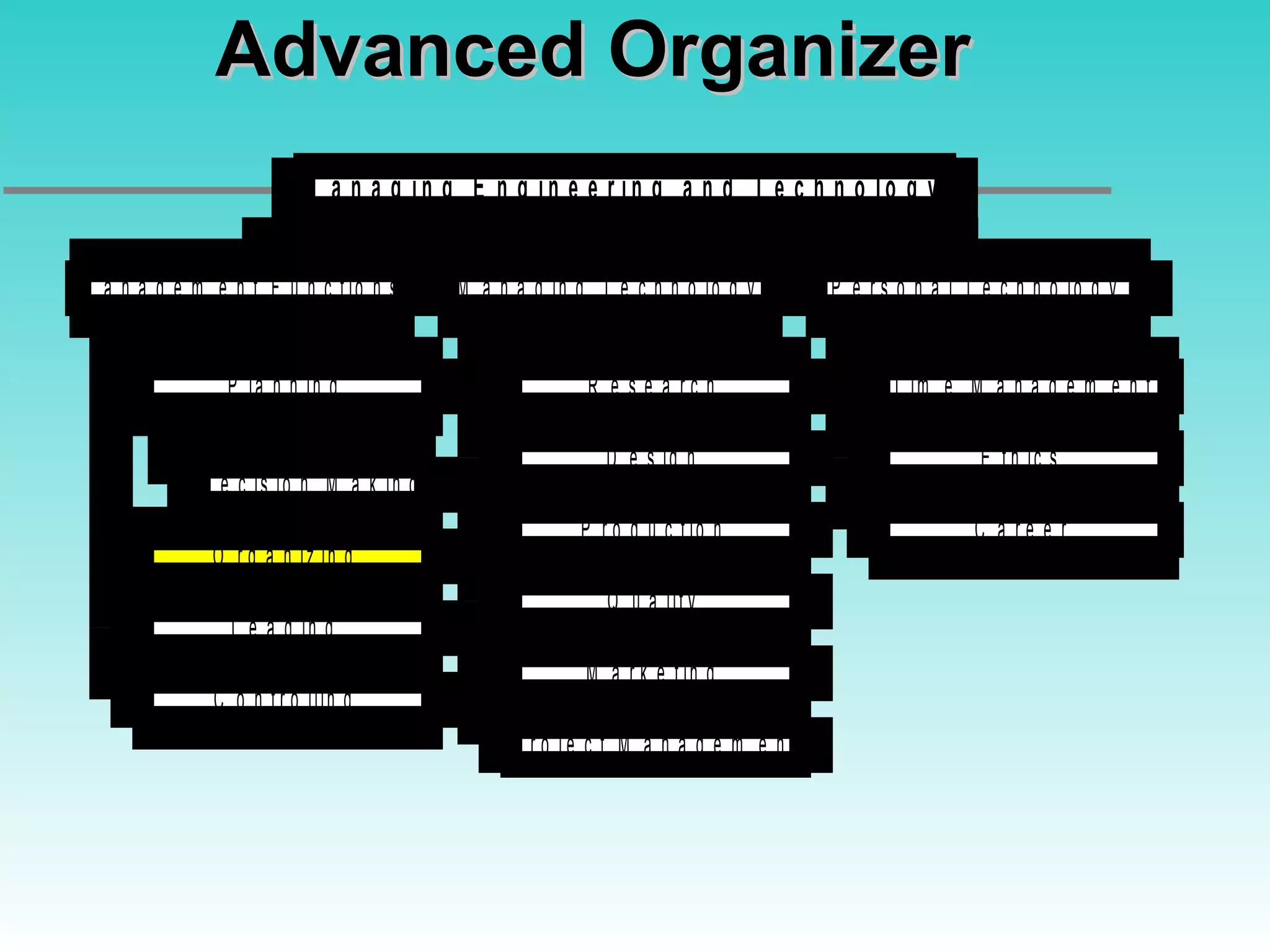
Advanced Organizer
Chapter Objectives Describe the steps in staffing technical organizations Explain the importance of delegation
Staffing Technical Organizations Identify the Skill Base Estimate the Number of Personnel Plan Recruiting Policies Select the Best Applicants Orient and Train Applicants Evaluate Performance Provide Compensation
New Hires Establish the need for new hires  Determine sources for new hires New college graduates Experienced professionals Technician support Other sources
Human Resource Planning Selection Usually involves several steps in a filtering process Applications/Resumes reviewed Interviews accomplished References checked Candidates passing initial screens formally interviewed
Resume The first impression an engineer makes is usually through the resume
Employment Application If the resume creates a favorable impression the job candidate will be asked to fill out an application May be redundant with the resume but will usually lead to an interview
Campus Interview Graduating engineer typically makes contact with potential employers on campus Successful campus interviews Applicant learns about employment opportunities and other advantages with firm Interviewer learns enough about the applicant
Site (Plant) Visit Means company has a substantial interest Normally means three or four staff interviews Would include a tour of the area in which the candidate will work Normally includes a briefing on company benefit programs and general company policies
The Job Offer Is a formal letter offering specific position and identifies Salary Reporting date Position and title The supervisor the candidate reports to Provisions regarding moving expenses (if applicable)
Orientation and Training Helps newcomer become aware of organization and values
Orientation and Training Some corporations Hold orientation classes Rotate newcomers through short assignments in various key departments Includes total socialization of newcomer to the environment and culture of the organization
Appraising Performance Provide feedback to the employee Provide guidance on how to improve performance Provide a performance basis for rewards/promotions Provide objective documentation for actions against non-performers
Authority and Power In organizations , legitimate power based on position, to direct subordinate’s work. In corporate , individuals invest their assets in corporate stock and delegate the right to manage them to board of directors. Acceptance theory of authority : because subordinates choose to accept the directives of superiors.
Sources of Power Legitimate/position Reward Coercive/punishment Expert Referent System 1 System 2 System 1 works with traditional bureaucratic orgs. System 2 works with high-tech people.
Additional sources of power Thro access to important individuals Thro praise Manipulative Thro persistence/assertiveness Forming coalitions
Status and Culture Functional status : from type of profession, like status to doctor in hospital or prof. in non-academic setting. Eg. Scientist and lab-coat. Scalar status : due to level in org. Usually avoided to lessen social distance b/w levels of org. Called  corporate culture .
Delegation (May/Jun ’06, Q2b) Assignment : mgrs use authority to assign duties to subordinates, making them responsible. Flow is downwards. assign president assign Vice president Chief project engineer Delegation of auth : give auth to subordinate to order resources etc. subordinate must have enough auth. to carry out assignments. Accountability : mgr must extract accountability from subordinate making him `responsible to’ mgr.  But mgr is responsible for higher authorities. Flow is upwards. accntble president Vice president Chief project engineer accntble
Reasons for delegation Relieves mgr. of that work Allows subordinates to develop skills Delegation concentrates decision-making closer to activity Barriers to delegation for engineers Do it right yourself v/s allow subordinates to do their work Delegation (May/Jun ’06, Q2b)
5 degrees of initiative Initiative on part of subordinates Wait until told Ask what to do Recommend, then take resulting action Act, but advise at once Act on own, then report routinely Should progress from 4&5 ASAP.
Committees Reasons for using committees: Policy making/administration : operating decisions are made by a subset of this group called `executive committee’. Representation : a) reps from each org unit affected by a particular class of problems. b) committee members are supposed to reflect the opinions and needs of the unit that sent them to group deliberation. Shared knowledge and expertise : no one person has all the expertise needed to solve a complex problem. Securing co-operation in execution : must secure co-op from committee members for smooth operation. Pooling of authority : a committee of people need authority to accomplish a job, then solve the problem by joint decision. Training of participants : a) excellent education to potential managers and they get to b) consider viewpoints that they don’t see every day. Disadvantages:  Tend to produce compromise solutions and `get back to work’, this produces inferior solutions compared to that of most competent member. Usually holds one person responsible. Committees usually cause delay in solving the problem.
Effective Committees (Jan/Feb 2006, Q2c) Purpose and chair : careful defn. of purpose the committee is to serve, its authority and expected life span. Size and membership : 5 members is logical, but for complex problems, groups also ok. Members should be chosen well, they should contribute but not dominate. Preparation : chairman is responsible for this. Publish meeting date in advance, agenda to be prepared and distributed to members. Conduct of meeting :  task functions : to get the job done AND  group relations function : to maintain constructive relations among members to facilitate attaining group objectives. Meeting follow-up : chairman should provide concise, clear and readable minutes of meeting to members. Should identify action items, who is responsible for what, deadlines etc.

Chapt06

  • 1.
    Managing Engineering andTechnology Third Edition Babcock and Morse Some Human Aspects of Organizing Chapter 6
  • 2.
  • 3.
    Chapter Objectives Describethe steps in staffing technical organizations Explain the importance of delegation
  • 4.
    Staffing Technical OrganizationsIdentify the Skill Base Estimate the Number of Personnel Plan Recruiting Policies Select the Best Applicants Orient and Train Applicants Evaluate Performance Provide Compensation
  • 5.
    New Hires Establishthe need for new hires Determine sources for new hires New college graduates Experienced professionals Technician support Other sources
  • 6.
    Human Resource PlanningSelection Usually involves several steps in a filtering process Applications/Resumes reviewed Interviews accomplished References checked Candidates passing initial screens formally interviewed
  • 7.
    Resume The firstimpression an engineer makes is usually through the resume
  • 8.
    Employment Application Ifthe resume creates a favorable impression the job candidate will be asked to fill out an application May be redundant with the resume but will usually lead to an interview
  • 9.
    Campus Interview Graduatingengineer typically makes contact with potential employers on campus Successful campus interviews Applicant learns about employment opportunities and other advantages with firm Interviewer learns enough about the applicant
  • 10.
    Site (Plant) VisitMeans company has a substantial interest Normally means three or four staff interviews Would include a tour of the area in which the candidate will work Normally includes a briefing on company benefit programs and general company policies
  • 11.
    The Job OfferIs a formal letter offering specific position and identifies Salary Reporting date Position and title The supervisor the candidate reports to Provisions regarding moving expenses (if applicable)
  • 12.
    Orientation and TrainingHelps newcomer become aware of organization and values
  • 13.
    Orientation and TrainingSome corporations Hold orientation classes Rotate newcomers through short assignments in various key departments Includes total socialization of newcomer to the environment and culture of the organization
  • 14.
    Appraising Performance Providefeedback to the employee Provide guidance on how to improve performance Provide a performance basis for rewards/promotions Provide objective documentation for actions against non-performers
  • 15.
    Authority and PowerIn organizations , legitimate power based on position, to direct subordinate’s work. In corporate , individuals invest their assets in corporate stock and delegate the right to manage them to board of directors. Acceptance theory of authority : because subordinates choose to accept the directives of superiors.
  • 16.
    Sources of PowerLegitimate/position Reward Coercive/punishment Expert Referent System 1 System 2 System 1 works with traditional bureaucratic orgs. System 2 works with high-tech people.
  • 17.
    Additional sources ofpower Thro access to important individuals Thro praise Manipulative Thro persistence/assertiveness Forming coalitions
  • 18.
    Status and CultureFunctional status : from type of profession, like status to doctor in hospital or prof. in non-academic setting. Eg. Scientist and lab-coat. Scalar status : due to level in org. Usually avoided to lessen social distance b/w levels of org. Called corporate culture .
  • 19.
    Delegation (May/Jun ’06,Q2b) Assignment : mgrs use authority to assign duties to subordinates, making them responsible. Flow is downwards. assign president assign Vice president Chief project engineer Delegation of auth : give auth to subordinate to order resources etc. subordinate must have enough auth. to carry out assignments. Accountability : mgr must extract accountability from subordinate making him `responsible to’ mgr. But mgr is responsible for higher authorities. Flow is upwards. accntble president Vice president Chief project engineer accntble
  • 20.
    Reasons for delegationRelieves mgr. of that work Allows subordinates to develop skills Delegation concentrates decision-making closer to activity Barriers to delegation for engineers Do it right yourself v/s allow subordinates to do their work Delegation (May/Jun ’06, Q2b)
  • 21.
    5 degrees ofinitiative Initiative on part of subordinates Wait until told Ask what to do Recommend, then take resulting action Act, but advise at once Act on own, then report routinely Should progress from 4&5 ASAP.
  • 22.
    Committees Reasons forusing committees: Policy making/administration : operating decisions are made by a subset of this group called `executive committee’. Representation : a) reps from each org unit affected by a particular class of problems. b) committee members are supposed to reflect the opinions and needs of the unit that sent them to group deliberation. Shared knowledge and expertise : no one person has all the expertise needed to solve a complex problem. Securing co-operation in execution : must secure co-op from committee members for smooth operation. Pooling of authority : a committee of people need authority to accomplish a job, then solve the problem by joint decision. Training of participants : a) excellent education to potential managers and they get to b) consider viewpoints that they don’t see every day. Disadvantages: Tend to produce compromise solutions and `get back to work’, this produces inferior solutions compared to that of most competent member. Usually holds one person responsible. Committees usually cause delay in solving the problem.
  • 23.
    Effective Committees (Jan/Feb2006, Q2c) Purpose and chair : careful defn. of purpose the committee is to serve, its authority and expected life span. Size and membership : 5 members is logical, but for complex problems, groups also ok. Members should be chosen well, they should contribute but not dominate. Preparation : chairman is responsible for this. Publish meeting date in advance, agenda to be prepared and distributed to members. Conduct of meeting : task functions : to get the job done AND group relations function : to maintain constructive relations among members to facilitate attaining group objectives. Meeting follow-up : chairman should provide concise, clear and readable minutes of meeting to members. Should identify action items, who is responsible for what, deadlines etc.