International Business
Chapter Three
The Political and Legal
Environments Facing Business
International
Business
10e
Daniels/Radebaugh/Sullivan
3-1
2004 Prentice Hall, Inc
Chapter Objectives
 Discuss the different functions political
systems perform
 Compare political regimes and how they
influence managerial decisions
 Describe how management formulates
and implements strategies to deal with
differing political environments
 Study different types of legal systems and
relationships
 Exam major legal issues in international
business
3-2
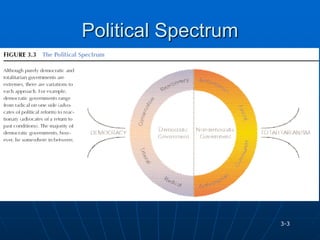
Political Spectrum
3-3
Introduction
The role of the political system is to integrate the
various parts of its society into a viable, functioning
whole.
It also influences the extent to which government
intervenes in business, and the way in which business
is conducted domestically and internationally.
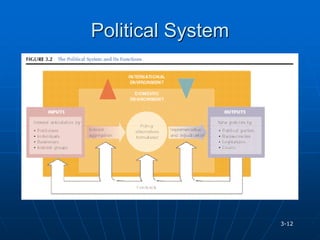
The Functions of the Political Process
 Interest Articulation
 Interest Aggregation
 Policy Making
 Policy Implementation and
Adjudication
Individualism
The general orientation within a society concerning the
primacy of the rights and role the individual versus that
of the larger community.
Individualism:
Political officials and agencies have a limited role in
society.
Make and apply regulations to correct market inefficiencies:
accessibility to information, promoting fair and just
competition.
Government is detached from and independent of the day-
to-day practices of business in an individualistic society.
Collectivism
 Government officials should intervene in the structure of
industries, conduct of companies, and actions of
managers to ensure they benefit society.
 Setting up formal and informal partnerships with the
business community to develop successful companies.
 Governments are highly connected to and interdependent
with business.
Democracy
 Freedom of opinion, expression, press and
organization
 Elections
 Limited terms for elected officials
 Independent court system
• High regard for individual rights
• Respect for property
 Nonpolitical bureaucracy and defense
infrastructure
 Accessibility to the decision-making
process
3-8
Indicators of Political Rights
 Degree to which fair and competitive
elections occur
 Ability of voters to endow
representatives with real power
 Ability to organize political parties
 Existence of safeguards on the rights
of minorities
3-4
Political & Legal Influences
3-5
Indicators of Civil Liberties
 Existence of freedom of the press
 Equality under the law for all
individuals
 Extent of personal social freedoms
 Degree of freedom from extreme
governmental indifference or
corruption
3-6
Comparative Measures of Freedom
POLITICAL RIGHTS
CIVIL LIBERTIES
Partly Free
Not Free Free
3-7
Totalitarianism
A political system in which a single agent, whether
an individual, group, or party, monopolizes all
political power.
Aims to subordinate all aspects of the day-to-day
life of people to the power of the state.
Merging the concepts of the state and the people.
Order is often imposed through military power.
Neither recognizes nor permits opposition. Tools
used include: violence, persecution, propaganda,
censorship. 3-9
 Authoritarianism: a political system that aims to
rule completely all affairs of all citizens.
 Fascism: to control people’s minds and souls
through the supremacy of the state.
 Secular Totalitarianism: using the power of the
state or the army to enforce control of all aspects
of the business environment. Communism and
total government ownership and control of the
factors of production.
 Theocratic Totalitarianism: religious leaders are
the political leaders,
Trends in Political Systems
1. Breakdown of Totalitarian Regimes.
Many totalitarian regimes failed to deliver economic
progress to the vast majority of their populations.
2. Improved Communication Technology
Weakened the ability of totalitarian states to control
citizens’ access to information.
3. Higher Standards of Living
State of Totalitarianism
 Multi-ethnic societies where power is
not held by a dominant ethnic group
 Neocommunist or post communist
transitional societies
 Many are creeping towards market
model
• Political changes
• Economic changes
3-10
Political Risks for International Business
 Political Risk:
The chance that political decisions, events,
or conditions in a country will affect the
business environment in ways that lead
investors:
- To lose some or all of the value of their
investment, or
- Be forced to accept a lower than expected
rate of return.
3-11
Sources of Political Risk
 Systemic: Political risk created by shifts in public policy, such
as a new political leadership that may adopt a different approach
than its predecessor.
 Procedural: Political actions can sometimes create frictions
that interfere with the procedural transactions between units.
(Government corruption, labor disputes, a partisan judicial
system)
 Distributive: Political actions that aim to claim a greater share
of rewards.
 Catastrophic: Random political developments.
Political System
3-12
Political Strategies for International
Businesses
 Identify the exact issue
• Trade barrier?
• Environmental standards?
• Workers rights, etc?
 Define/determine the political aspect of the issue
 Assess the potential political action of other
companies
 Identify important institutions and individuals
 Formulate strategies
• Key objectives
• Alternatives
• Probable effectiveness
3-13
Legal Environment
 Common law systems (tradition/precedent)
• United States
• United Kingdom
 Civil law: based on a systematic and extensive
codification of laws. Political officials prepare a written
collection of laws. Judges apply existing laws instead of
creating them.
• Germany
• France
• Japan
 Theocratic law (based on religious principles and rules)
Islamic Law that is based on the Qur’an, the practices of the prophet,
the writings of scholars, and consensus of the community.
• Sudan
• Pakistan
 A Customary Law System: follows the wisdom of daily
experience.
 A Mixed Legal System. 3-14
Impact of Laws on International Business
 National laws affect all local business
activities.
 National laws affect cross-border
activities.
 International treaties and
conventions may govern some cross-
border transactions.
Legal Issues in International Business
Managers look at legal issues from two
perspectives:
 Operational (Procedural) Concerns: How do legal
regulations impact day-to-day operations?
 starting a business,
 hiring and firing,
 entering and enforcing contracts,
 closing down the business
Legal Issues in International Business
 Strategic Concerns: How do legal regulations
affect companies’ long-term competitiveness?
 Product safety and liability
 Marketplace behaviour
 Product origin
 Legal jurisdiction
 Arbitration
Intellectual Property Rights (IPRs)
Now, countries are competing on the strength of
their brainpower to create might, prestige, and
wealth.
The output of this brainpower is called intellectual
property – books, designs,brand names, software.
Problems occur because IP is hard to conceive but
easy to copy. (Piracy)
IPRs refer to the right to control and derive the
benefits from writing (copyrights), inventions
(patents), processes (trade secrets),and identifiers
(trademarks).
Intellectual Property Rights (IPRs)
 Legal problems arise because countries because
not all countries formally support the various
conventions that protect IPRs.
 The Paris Convention for the Protection of
Industrial Property
 The Berne Convention for the Protection of
Literary and Artisitic Works.
 The Trade Related Aspects of Intellectual Property
Rights (TRIPS) code of the WTO.
Why Some Countries are Less Inclined to
Protect IPRs
1. Level of Economic Development: Poorer countries
provide weaker legal protection than do richer countries.
Rich countries: protecting ideas is the only way to
energize the incentive to innovate.
Poor countries: Strict protection of IPRs restricts the
diffusion of new technologies, inflates the prices, inhibits
economic development by controlling the use of existing
knowledge.
2. National Cultural Attributes:
Individualist v. Collectivist Orientations
Legal Issues for International
Businesses
 Worker relations
• Health and safety standards
• Workweek
 Employment practices
 Antitrust prohibitions
 Contractual relationships
 Environmental practices
 Patents, trademarks, and intellectual
property protection
 Taxes and reporting requirements
3-15
Chapter Review
 Discuss the different functions political
systems perform
 Compare political regimes and how they
influence managerial decisions
 Describe how management formulates
and implements strategies to deal with
differing political environments
 Study different types of legal systems and
relationships
 Exam major legal issues in international
business
3-16

Ch6 IM.ppt

  • 1.
    International Business Chapter Three ThePolitical and Legal Environments Facing Business International Business 10e Daniels/Radebaugh/Sullivan 3-1 2004 Prentice Hall, Inc
  • 2.
    Chapter Objectives  Discussthe different functions political systems perform  Compare political regimes and how they influence managerial decisions  Describe how management formulates and implements strategies to deal with differing political environments  Study different types of legal systems and relationships  Exam major legal issues in international business 3-2
  • 3.
  • 4.
    Introduction The role ofthe political system is to integrate the various parts of its society into a viable, functioning whole. It also influences the extent to which government intervenes in business, and the way in which business is conducted domestically and internationally.
  • 5.
    The Functions ofthe Political Process  Interest Articulation  Interest Aggregation  Policy Making  Policy Implementation and Adjudication
  • 6.
    Individualism The general orientationwithin a society concerning the primacy of the rights and role the individual versus that of the larger community. Individualism: Political officials and agencies have a limited role in society. Make and apply regulations to correct market inefficiencies: accessibility to information, promoting fair and just competition. Government is detached from and independent of the day- to-day practices of business in an individualistic society.
  • 7.
    Collectivism  Government officialsshould intervene in the structure of industries, conduct of companies, and actions of managers to ensure they benefit society.  Setting up formal and informal partnerships with the business community to develop successful companies.  Governments are highly connected to and interdependent with business.
  • 8.
    Democracy  Freedom ofopinion, expression, press and organization  Elections  Limited terms for elected officials  Independent court system • High regard for individual rights • Respect for property  Nonpolitical bureaucracy and defense infrastructure  Accessibility to the decision-making process 3-8
  • 9.
    Indicators of PoliticalRights  Degree to which fair and competitive elections occur  Ability of voters to endow representatives with real power  Ability to organize political parties  Existence of safeguards on the rights of minorities 3-4
  • 10.
    Political & LegalInfluences 3-5
  • 11.
    Indicators of CivilLiberties  Existence of freedom of the press  Equality under the law for all individuals  Extent of personal social freedoms  Degree of freedom from extreme governmental indifference or corruption 3-6
  • 12.
    Comparative Measures ofFreedom POLITICAL RIGHTS CIVIL LIBERTIES Partly Free Not Free Free 3-7
  • 13.
    Totalitarianism A political systemin which a single agent, whether an individual, group, or party, monopolizes all political power. Aims to subordinate all aspects of the day-to-day life of people to the power of the state. Merging the concepts of the state and the people. Order is often imposed through military power. Neither recognizes nor permits opposition. Tools used include: violence, persecution, propaganda, censorship. 3-9
  • 14.
     Authoritarianism: apolitical system that aims to rule completely all affairs of all citizens.  Fascism: to control people’s minds and souls through the supremacy of the state.  Secular Totalitarianism: using the power of the state or the army to enforce control of all aspects of the business environment. Communism and total government ownership and control of the factors of production.  Theocratic Totalitarianism: religious leaders are the political leaders,
  • 15.
    Trends in PoliticalSystems 1. Breakdown of Totalitarian Regimes. Many totalitarian regimes failed to deliver economic progress to the vast majority of their populations. 2. Improved Communication Technology Weakened the ability of totalitarian states to control citizens’ access to information. 3. Higher Standards of Living
  • 16.
    State of Totalitarianism Multi-ethnic societies where power is not held by a dominant ethnic group  Neocommunist or post communist transitional societies  Many are creeping towards market model • Political changes • Economic changes 3-10
  • 17.
    Political Risks forInternational Business  Political Risk: The chance that political decisions, events, or conditions in a country will affect the business environment in ways that lead investors: - To lose some or all of the value of their investment, or - Be forced to accept a lower than expected rate of return. 3-11
  • 18.
    Sources of PoliticalRisk  Systemic: Political risk created by shifts in public policy, such as a new political leadership that may adopt a different approach than its predecessor.  Procedural: Political actions can sometimes create frictions that interfere with the procedural transactions between units. (Government corruption, labor disputes, a partisan judicial system)  Distributive: Political actions that aim to claim a greater share of rewards.  Catastrophic: Random political developments.
  • 19.
  • 20.
    Political Strategies forInternational Businesses  Identify the exact issue • Trade barrier? • Environmental standards? • Workers rights, etc?  Define/determine the political aspect of the issue  Assess the potential political action of other companies  Identify important institutions and individuals  Formulate strategies • Key objectives • Alternatives • Probable effectiveness 3-13
  • 21.
    Legal Environment  Commonlaw systems (tradition/precedent) • United States • United Kingdom  Civil law: based on a systematic and extensive codification of laws. Political officials prepare a written collection of laws. Judges apply existing laws instead of creating them. • Germany • France • Japan  Theocratic law (based on religious principles and rules) Islamic Law that is based on the Qur’an, the practices of the prophet, the writings of scholars, and consensus of the community. • Sudan • Pakistan  A Customary Law System: follows the wisdom of daily experience.  A Mixed Legal System. 3-14
  • 22.
    Impact of Lawson International Business  National laws affect all local business activities.  National laws affect cross-border activities.  International treaties and conventions may govern some cross- border transactions.
  • 23.
    Legal Issues inInternational Business Managers look at legal issues from two perspectives:  Operational (Procedural) Concerns: How do legal regulations impact day-to-day operations?  starting a business,  hiring and firing,  entering and enforcing contracts,  closing down the business
  • 24.
    Legal Issues inInternational Business  Strategic Concerns: How do legal regulations affect companies’ long-term competitiveness?  Product safety and liability  Marketplace behaviour  Product origin  Legal jurisdiction  Arbitration
  • 25.
    Intellectual Property Rights(IPRs) Now, countries are competing on the strength of their brainpower to create might, prestige, and wealth. The output of this brainpower is called intellectual property – books, designs,brand names, software. Problems occur because IP is hard to conceive but easy to copy. (Piracy) IPRs refer to the right to control and derive the benefits from writing (copyrights), inventions (patents), processes (trade secrets),and identifiers (trademarks).
  • 26.
    Intellectual Property Rights(IPRs)  Legal problems arise because countries because not all countries formally support the various conventions that protect IPRs.  The Paris Convention for the Protection of Industrial Property  The Berne Convention for the Protection of Literary and Artisitic Works.  The Trade Related Aspects of Intellectual Property Rights (TRIPS) code of the WTO.
  • 27.
    Why Some Countriesare Less Inclined to Protect IPRs 1. Level of Economic Development: Poorer countries provide weaker legal protection than do richer countries. Rich countries: protecting ideas is the only way to energize the incentive to innovate. Poor countries: Strict protection of IPRs restricts the diffusion of new technologies, inflates the prices, inhibits economic development by controlling the use of existing knowledge. 2. National Cultural Attributes: Individualist v. Collectivist Orientations
  • 28.
    Legal Issues forInternational Businesses  Worker relations • Health and safety standards • Workweek  Employment practices  Antitrust prohibitions  Contractual relationships  Environmental practices  Patents, trademarks, and intellectual property protection  Taxes and reporting requirements 3-15
  • 29.
    Chapter Review  Discussthe different functions political systems perform  Compare political regimes and how they influence managerial decisions  Describe how management formulates and implements strategies to deal with differing political environments  Study different types of legal systems and relationships  Exam major legal issues in international business 3-16