Darwinian Theory of Evolution and Motivation Saturday, 17 th  Oct 09
Course Outline   Sr. | Chap|Final Exam Chapter Heading No.|No. | Q. No. 1.   1 1 An Introduction to Motivational Concept (260909) 2.   2  2 Motivation in the History (101009) 3.   3  3 Darwinian Theory of Evolution and Motivation (171009) 4.   4  4 Instinct and Motivation 5.   5  5  The Effect of Frustration, Conflict and Stress  6.   6 6  Need Theories of Motivation 7.   7  7  Reinforcement/Incentive Theories 8.   8  8  Expectancy Theories of Motivation 9.   9 9 Motivation, Satisfaction, and Performance 10.  10  10 Motivation and Monetary Rewards 11.  11 11 Motivation Through MBO and Performance Appraisal
Motivation Motivation is getting others to do something because they want to do it.  The process which encourages and guides behavior. The act or process of stimulating to action, providing an incentive or motive, especially for an act. Motivation is the  internal   drive   to accomplish a particular  goal .   In a work setting, motivation is what makes people  want   to work. Motivation: Goal directed behavior
QUIZ Answer any three: What is Knowledge? Who described it and how? What is instinct? Give the description by Wilms or Rene Descartes. Write about Will and Free Will. What are the three grades of soul according to Aristotle? What is hedonism? Write the name of the historian who described it.
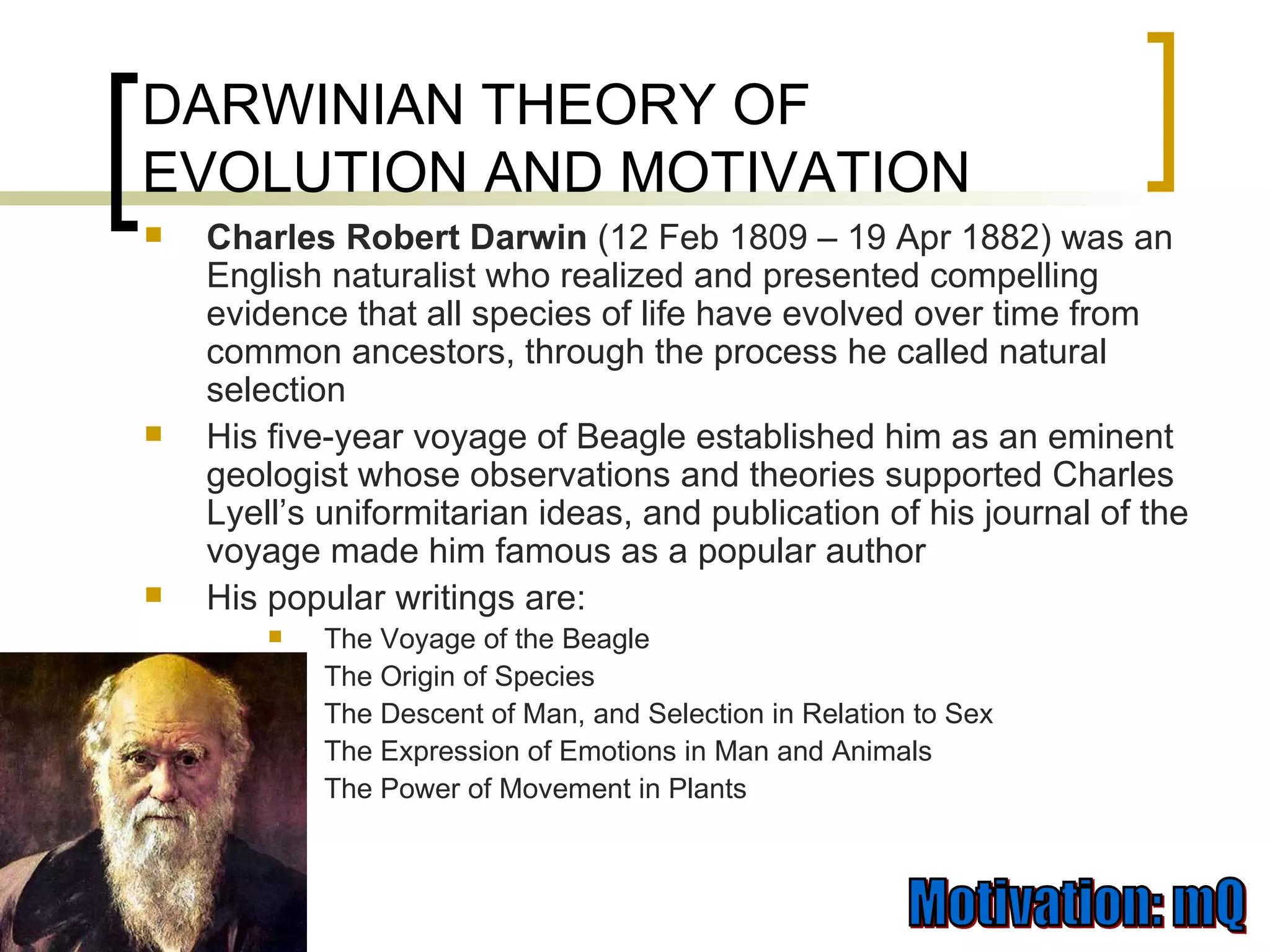
DARWINIAN THEORY OF EVOLUTION AND MOTIVATION Charles Robert Darwin  (12 Feb 1809 – 19 Apr 1882) was an English naturalist who realized and presented compelling evidence that all species of life have evolved over time from common ancestors, through the process he called natural selection  His five-year voyage of Beagle established him as an eminent geologist whose observations and theories supported Charles Lyell’s uniformitarian ideas, and publication of his journal of the voyage made him famous as a popular author  His popular writings are: The Voyage of the Beagle The Origin of Species  The Descent of Man, and Selection in Relation to Sex  The Expression of Emotions in Man and Animals  The Power of Movement in Plants
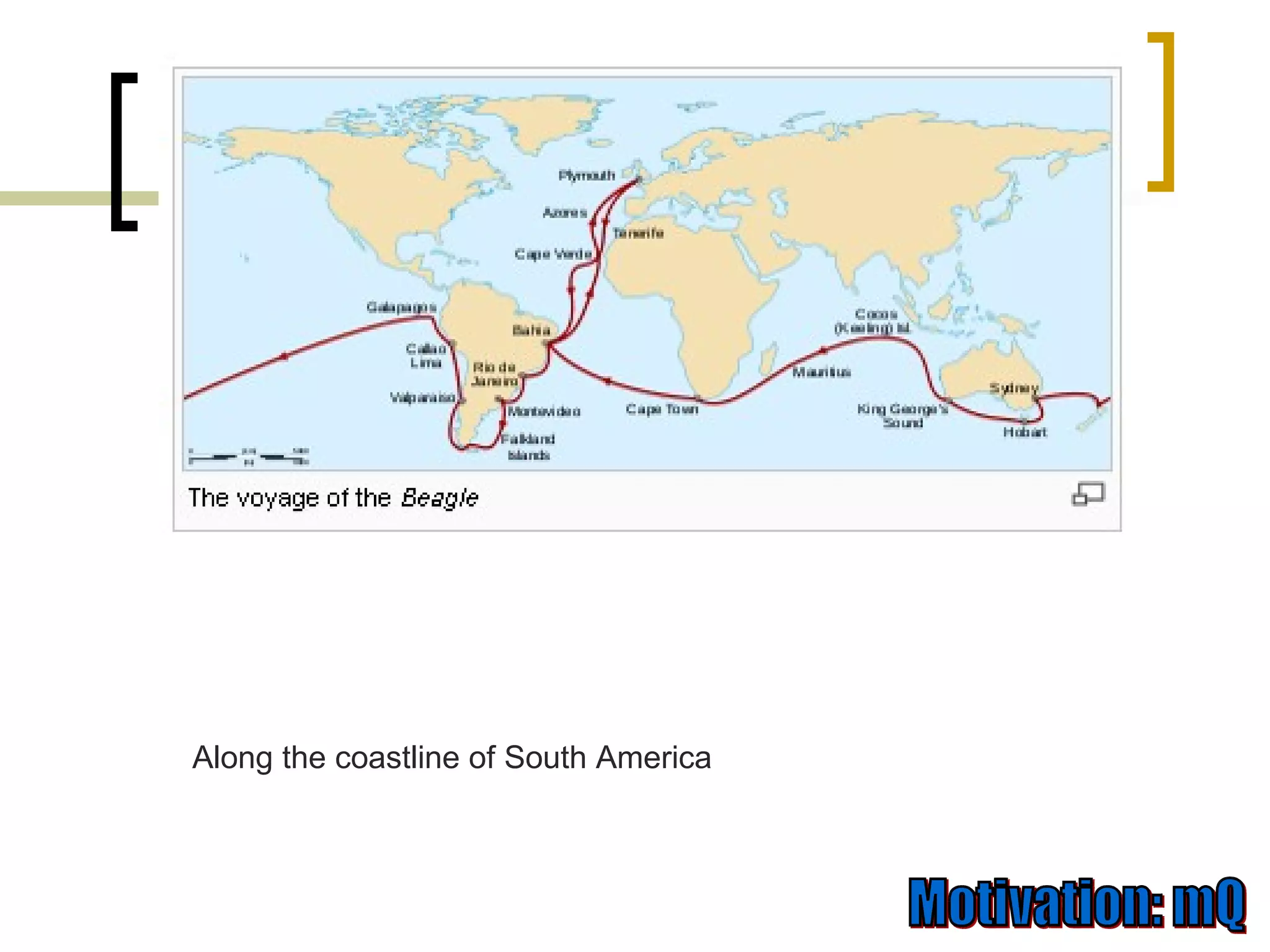
Along the coastline of South America
Darwin’s Important Assumptions The specific environmental factors to which some members of the species were exposed were associated with the modifications observed when separation or isolation had persisted over many generations The living beings are in the process of struggle and conflict, in the process of survival
SURVIVAL OF THE FITTEST There is a competition among species and members of the same species for use of the earth’s limited resources (in a particular environmental setting).  In the competition some organisms will survive, others will not.  If the characteristics of the survivors are transmitted to their offspring (and of course those of the non survivors cannot be transmitted) there will be modification of the species over the time.  Further environmental change will also lead to the differential survival of those best and those least able to adopt themselves to the change, with consequent variation in species” Multiply, vary and let the fittest survive
EVOLUTION AND PSYCHOLOGY There is continuity of characteristics between man and animals Adaptation to the environmental change is significant to the survival Psychology is not the derivative of philosophical questions rather it’s a biological science
DEVELOPMENT OF COMPARATIVE PSYCHOLOGY This was only after Darwin that some of the human specific characteristics such as intelligence & learning were searched in animals The instincts were studied in man more specifically The study of instinctual and irrational sources of behavior led the way to the study of motivation Psychological sources in terms of adaptation/ survival were studied such as; Consciousness Reason Memory Learning Skill etc Evolution played an important role in the formulation of the concept of Motivation
Wilm (1925) says;  “ The natural prompting called instincts are purposive activities implanted in the animals by nature creator or by the world reason or creator for the guidance of the creature in the attainment of ends useful to it, in its own preservation or the preservation of the species, and the avoidance of the contrary” Wilm says “ The animal is impelled by sense impulse, directed towards the pleasurable. Man’s activity, through impulse plays a part, is motivated by rational insight into the relation between the act and its end, which is the realization of the good”  2. Instinct From Chap:2
INSTINCT According to Troland (1928); “ An instinct is an inherited tendency to action of a specific kind, usually set off by a limited range of stimuli, and having definite survival or biological value in the struggle for existence” A mechanistic definition; “ The instinct is comprised of a group of reflexes or processes of a fixed type, energizing the muscles via the outgoing nerves” According to McDougall;  “ An instinct is a purpose force, the motor expression of which are very plastic or variable”
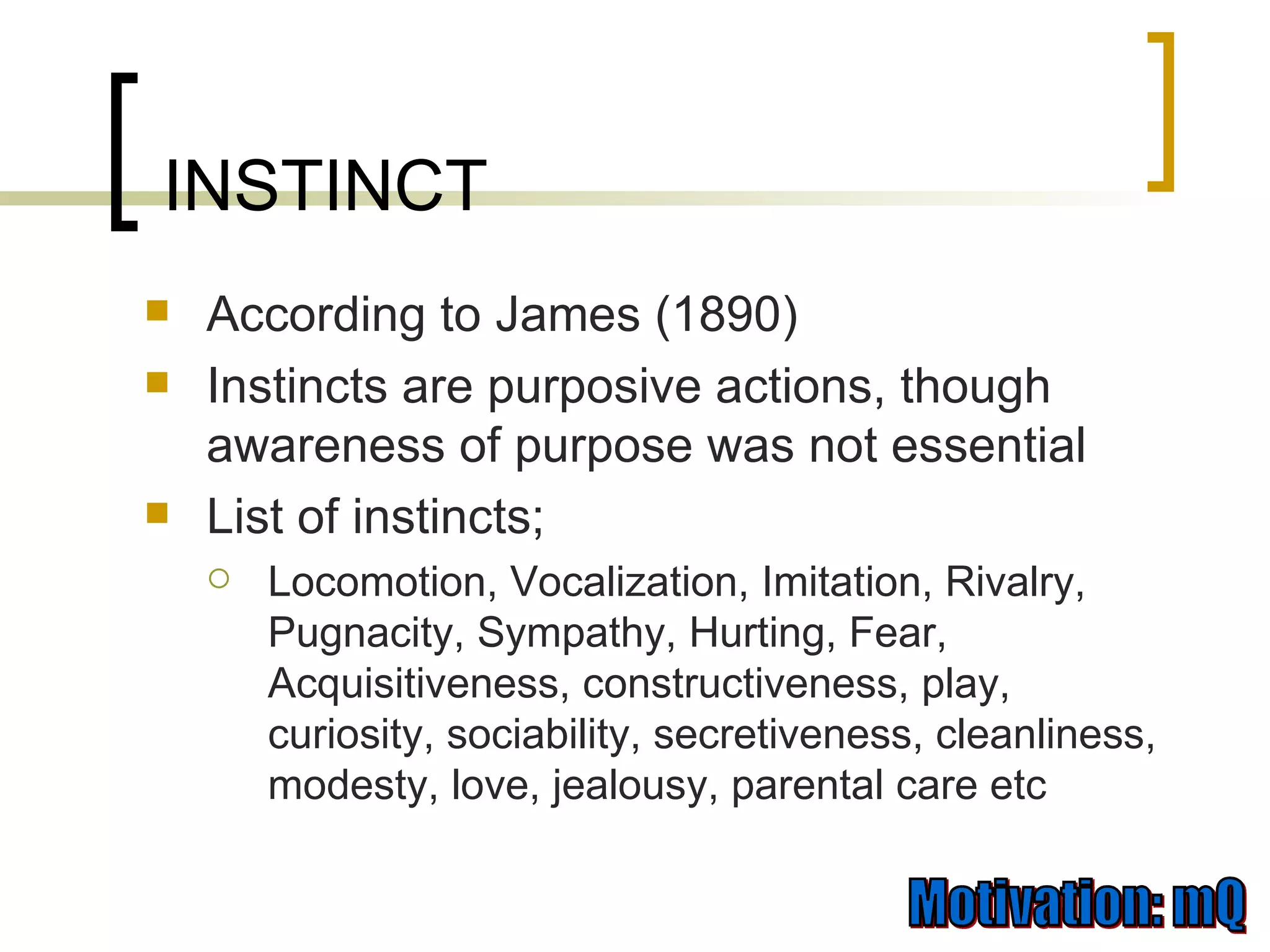
According to James (1890) Instincts are purposive actions, though awareness of purpose was not essential List of instincts; Locomotion, Vocalization, Imitation, Rivalry, Pugnacity, Sympathy, Hurting, Fear, Acquisitiveness, constructiveness, play, curiosity, sociability, secretiveness, cleanliness, modesty, love, jealousy, parental care etc INSTINCT
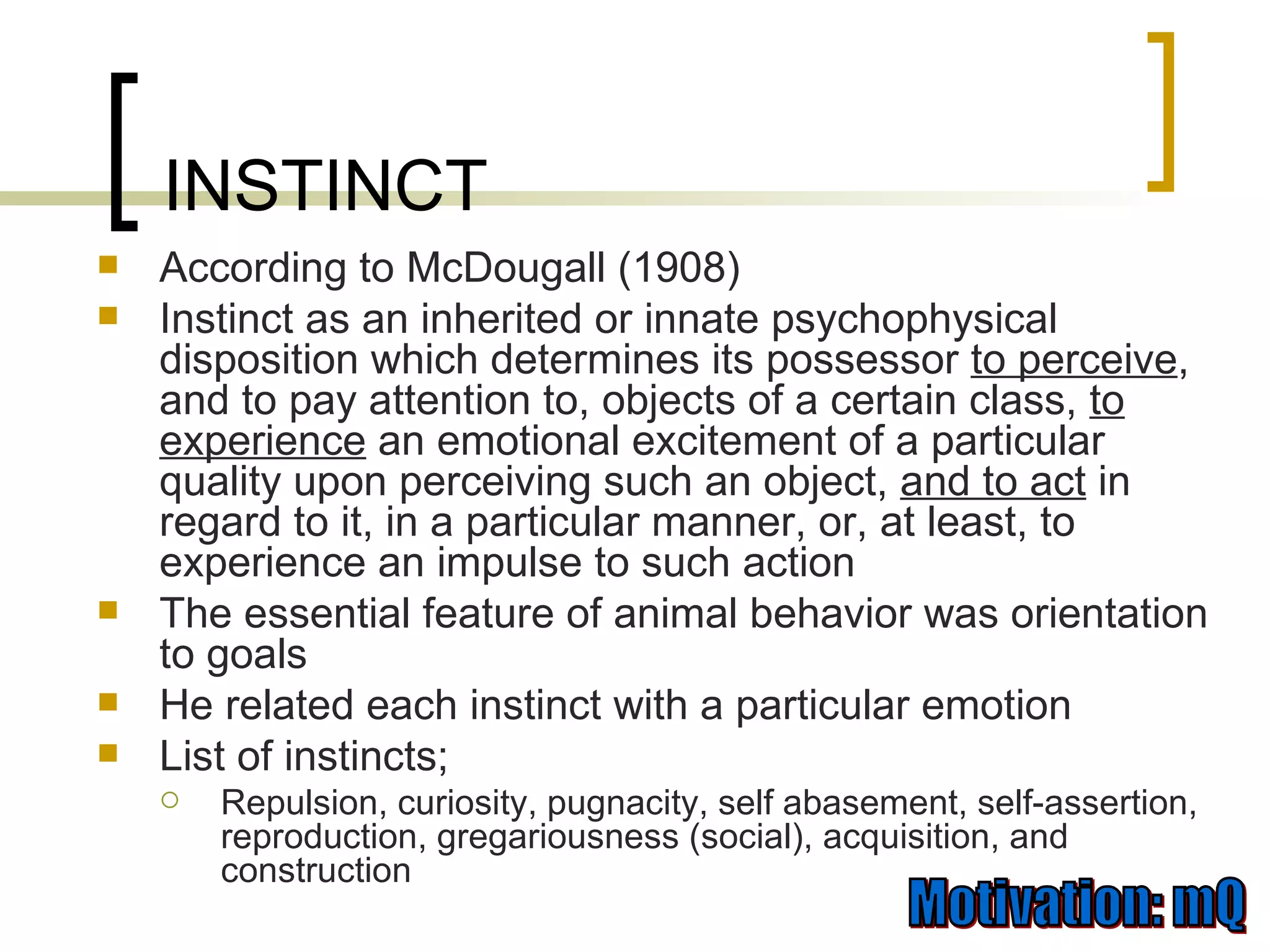
According to McDougall (1908) Instinct as an inherited or innate psychophysical disposition which determines its possessor  to perceive , and to pay attention to, objects of a certain class,  to experience  an emotional excitement of a particular quality upon perceiving such an object,  and to act  in regard to it, in a particular manner, or, at least, to experience an impulse to such action The essential feature of animal behavior was orientation to goals He related each instinct with a particular emotion List of instincts; Repulsion, curiosity, pugnacity, self abasement, self-assertion, reproduction, gregariousness (social), acquisition, and construction INSTINCT
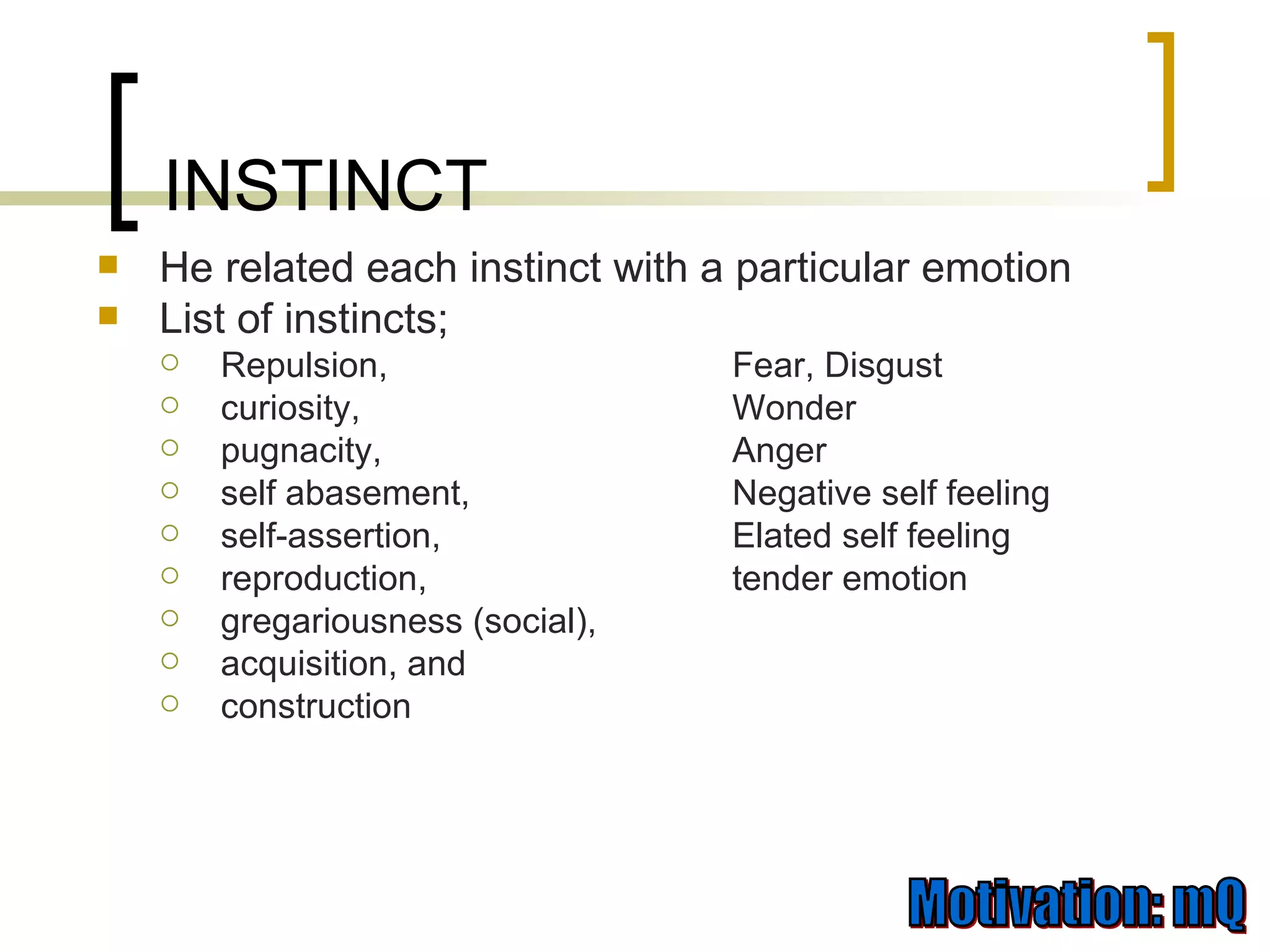
He related each instinct with a particular emotion List of instincts; Repulsion,  Fear, Disgust curiosity,  Wonder pugnacity,  Anger self abasement,  Negative self feeling self-assertion,  Elated self feeling reproduction,  tender emotion gregariousness (social),  acquisition, and  construction INSTINCT
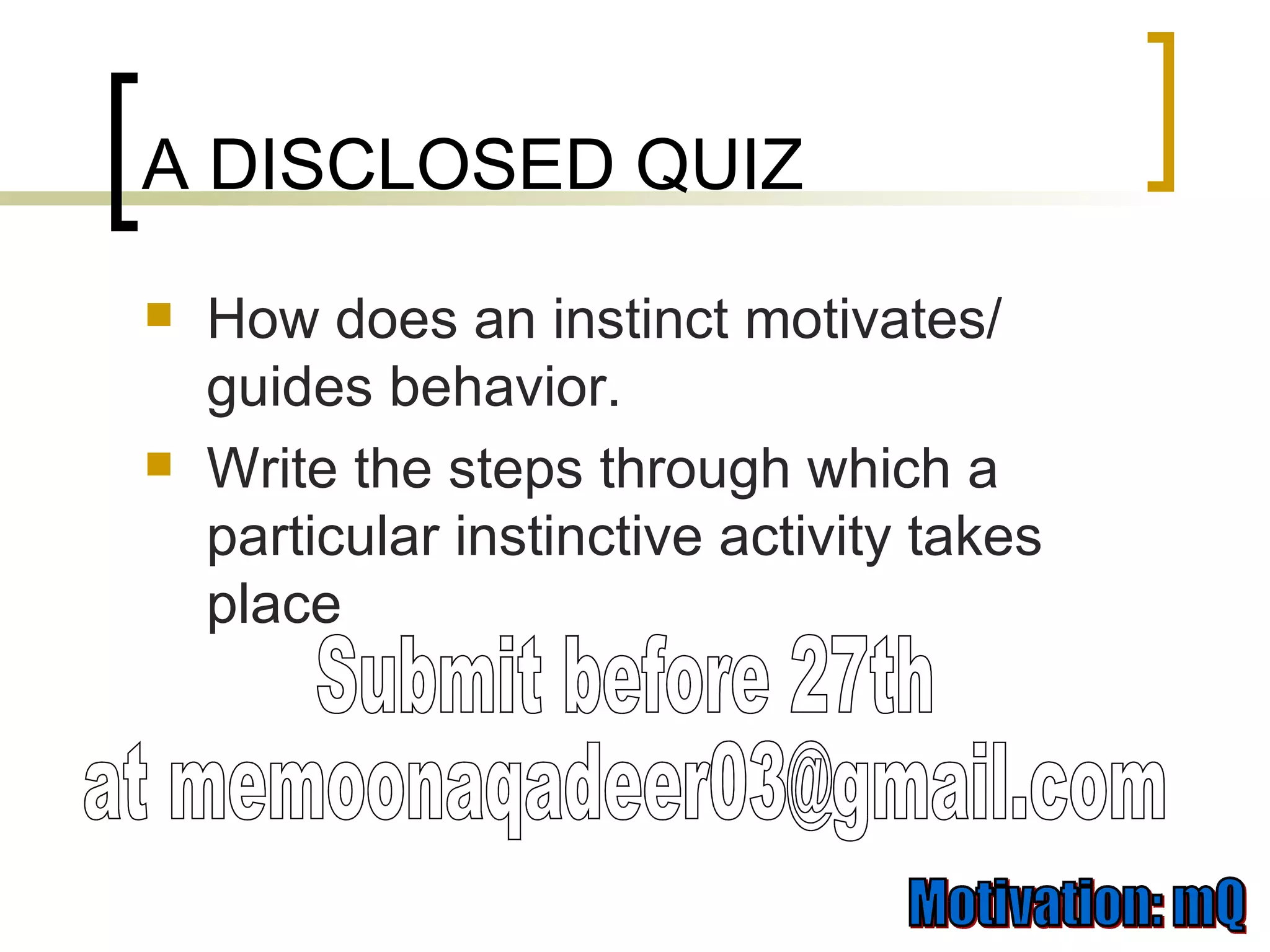
A DISCLOSED QUIZ How does an instinct motivates/ guides behavior. Write the steps through which a particular instinctive activity takes place Submit before 27th at memoonaqadeer03@gmail.com
Compensatory classes Final Assignment

Chap 3 Darwinian Theory Of Evo And Mot

  • 1.
    Darwinian Theory ofEvolution and Motivation Saturday, 17 th Oct 09
  • 2.
    Course Outline Sr. | Chap|Final Exam Chapter Heading No.|No. | Q. No. 1. 1 1 An Introduction to Motivational Concept (260909) 2. 2 2 Motivation in the History (101009) 3. 3 3 Darwinian Theory of Evolution and Motivation (171009) 4. 4 4 Instinct and Motivation 5. 5 5 The Effect of Frustration, Conflict and Stress 6. 6 6 Need Theories of Motivation 7. 7 7 Reinforcement/Incentive Theories 8. 8 8 Expectancy Theories of Motivation 9. 9 9 Motivation, Satisfaction, and Performance 10. 10 10 Motivation and Monetary Rewards 11. 11 11 Motivation Through MBO and Performance Appraisal
  • 3.
    Motivation Motivation isgetting others to do something because they want to do it. The process which encourages and guides behavior. The act or process of stimulating to action, providing an incentive or motive, especially for an act. Motivation is the internal drive to accomplish a particular goal . In a work setting, motivation is what makes people want to work. Motivation: Goal directed behavior
  • 4.
    QUIZ Answer anythree: What is Knowledge? Who described it and how? What is instinct? Give the description by Wilms or Rene Descartes. Write about Will and Free Will. What are the three grades of soul according to Aristotle? What is hedonism? Write the name of the historian who described it.
  • 5.
    DARWINIAN THEORY OFEVOLUTION AND MOTIVATION Charles Robert Darwin (12 Feb 1809 – 19 Apr 1882) was an English naturalist who realized and presented compelling evidence that all species of life have evolved over time from common ancestors, through the process he called natural selection His five-year voyage of Beagle established him as an eminent geologist whose observations and theories supported Charles Lyell’s uniformitarian ideas, and publication of his journal of the voyage made him famous as a popular author His popular writings are: The Voyage of the Beagle The Origin of Species The Descent of Man, and Selection in Relation to Sex The Expression of Emotions in Man and Animals The Power of Movement in Plants
  • 6.
    Along the coastlineof South America
  • 7.
    Darwin’s Important AssumptionsThe specific environmental factors to which some members of the species were exposed were associated with the modifications observed when separation or isolation had persisted over many generations The living beings are in the process of struggle and conflict, in the process of survival
  • 8.
    SURVIVAL OF THEFITTEST There is a competition among species and members of the same species for use of the earth’s limited resources (in a particular environmental setting). In the competition some organisms will survive, others will not. If the characteristics of the survivors are transmitted to their offspring (and of course those of the non survivors cannot be transmitted) there will be modification of the species over the time. Further environmental change will also lead to the differential survival of those best and those least able to adopt themselves to the change, with consequent variation in species” Multiply, vary and let the fittest survive
  • 9.
    EVOLUTION AND PSYCHOLOGYThere is continuity of characteristics between man and animals Adaptation to the environmental change is significant to the survival Psychology is not the derivative of philosophical questions rather it’s a biological science
  • 10.
    DEVELOPMENT OF COMPARATIVEPSYCHOLOGY This was only after Darwin that some of the human specific characteristics such as intelligence & learning were searched in animals The instincts were studied in man more specifically The study of instinctual and irrational sources of behavior led the way to the study of motivation Psychological sources in terms of adaptation/ survival were studied such as; Consciousness Reason Memory Learning Skill etc Evolution played an important role in the formulation of the concept of Motivation
  • 11.
    Wilm (1925) says; “ The natural prompting called instincts are purposive activities implanted in the animals by nature creator or by the world reason or creator for the guidance of the creature in the attainment of ends useful to it, in its own preservation or the preservation of the species, and the avoidance of the contrary” Wilm says “ The animal is impelled by sense impulse, directed towards the pleasurable. Man’s activity, through impulse plays a part, is motivated by rational insight into the relation between the act and its end, which is the realization of the good” 2. Instinct From Chap:2
  • 12.
    INSTINCT According toTroland (1928); “ An instinct is an inherited tendency to action of a specific kind, usually set off by a limited range of stimuli, and having definite survival or biological value in the struggle for existence” A mechanistic definition; “ The instinct is comprised of a group of reflexes or processes of a fixed type, energizing the muscles via the outgoing nerves” According to McDougall; “ An instinct is a purpose force, the motor expression of which are very plastic or variable”
  • 13.
    According to James(1890) Instincts are purposive actions, though awareness of purpose was not essential List of instincts; Locomotion, Vocalization, Imitation, Rivalry, Pugnacity, Sympathy, Hurting, Fear, Acquisitiveness, constructiveness, play, curiosity, sociability, secretiveness, cleanliness, modesty, love, jealousy, parental care etc INSTINCT
  • 14.
    According to McDougall(1908) Instinct as an inherited or innate psychophysical disposition which determines its possessor to perceive , and to pay attention to, objects of a certain class, to experience an emotional excitement of a particular quality upon perceiving such an object, and to act in regard to it, in a particular manner, or, at least, to experience an impulse to such action The essential feature of animal behavior was orientation to goals He related each instinct with a particular emotion List of instincts; Repulsion, curiosity, pugnacity, self abasement, self-assertion, reproduction, gregariousness (social), acquisition, and construction INSTINCT
  • 15.
    He related eachinstinct with a particular emotion List of instincts; Repulsion, Fear, Disgust curiosity, Wonder pugnacity, Anger self abasement, Negative self feeling self-assertion, Elated self feeling reproduction, tender emotion gregariousness (social), acquisition, and construction INSTINCT
  • 16.
    A DISCLOSED QUIZHow does an instinct motivates/ guides behavior. Write the steps through which a particular instinctive activity takes place Submit before 27th at memoonaqadeer03@gmail.com
  • 17.