

Changing Organizational
Mindset
Image credit: NLShop/Shutterstock
Allison Pollard
• Agile coach and
consultant
• Firm believer in
continuous
improvement
• DFW Scrum user group
leader and Dallas Agile
Leadership Network
member
• Glasses wearer
Ronnie Cooke
• Agile Coach, Scrum
Master, and Consultant
• Proud father
• Missionary
• Family Social Media
private investigator,
prosecutor, and judge
Today’s Agenda
• About Change
– Why people resist change
– The change process
– Approaching resistance
– Finding congruence
• Being a Coach for Change
– Building trust by listening
– Training
– Mentoring
– Facilitating
– Coaching
• Wrap Up and Takeaways
ABOUT CHANGE
Image credit: NLShop/Shutterstock
Change!
• Move at least 2 tables away
• Look to your left and right. You cannot sit
next to those people
Was that fun?
Image credit: NLShop/Shutterstock
What are some things that make
people resistant to change?
• Nothing is broken
• Status/earned respect
with current
• Don’t know how to do
the new behavior or
practice
• Like working the current
way/enjoyment
• Sense of control with old
• Perceived value of new
behavior or practice is
low
Image credit: NLShop/Shutterstock
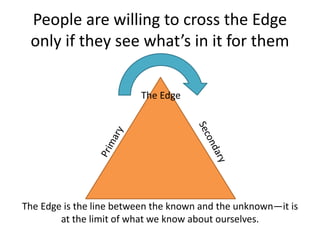
People are willing to cross the Edge
only if they see what’s in it for them
The Edge
The Edge is the line between the known and the unknown—it is
at the limit of what we know about ourselves.
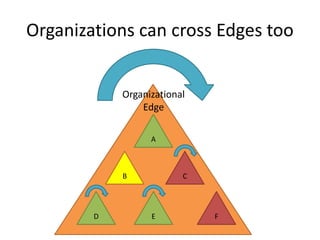
Organizations can cross Edges too
Organizational
Edge
D
B
E F
C
A
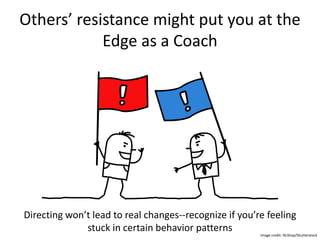
Others’ resistance might put you at the
Edge as a Coach
Directing won’t lead to real changes--recognize if you’re feeling
stuck in certain behavior patterns
Image credit: NLShop/Shutterstock
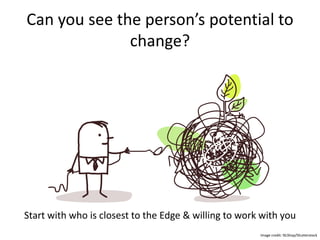
Can you see the person’s potential to
change?
Start with who is closest to the Edge & willing to work with you
Image credit: NLShop/Shutterstock
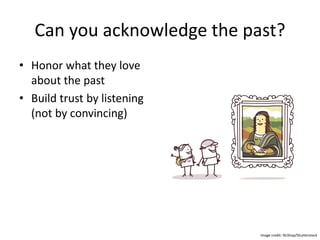
Can you acknowledge the past?
• Honor what they love
about the past
• Build trust by listening
(not by convincing)
Image credit: NLShop/Shutterstock
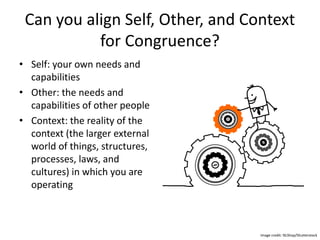
Can you align Self, Other, and Context
for Congruence?
• Self: your own needs and
capabilities
• Other: the needs and
capabilities of other people
• Context: the reality of the
context (the larger external
world of things, structures,
processes, laws, and
cultures) in which you are
operating
Image credit: NLShop/Shutterstock
BEING A COACH FOR CHANGE
Image credit: NLShop/Shutterstock
Building Trust by Listening
• Inquiry: asking
questions
• Acknowledgement:
proving that you
understand the other
person
• Advocacy: sharing your
own perspective
Image credit: NLShop/Shutterstock
Activity
Listener
Coach
Speaker
• Listener: Select topic.
Can only use inquiry
and acknowledgement.
• Speaker: Antagonizes
Listener. Can only use
advocacy.
• Coach: Keeps the
Listener on track.
A Coach’s Palette
Teaching Mentoring
Facilitating Coaching
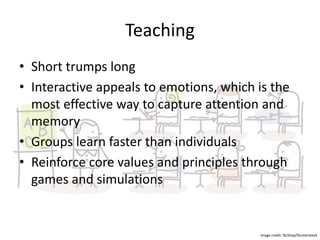
Teaching
• Short trumps long
• Interactive appeals to
emotions, which is the
most effective way to
capture attention and
memory
• Groups learn faster than
individuals
• Reinforce core values and
principles through games
and simulations
Image credit: NLShop/Shutterstock
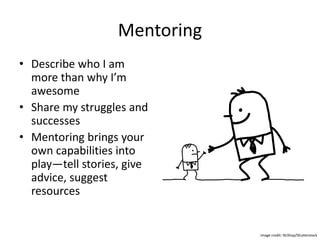
Mentoring
• Describe who I am
more than why I’m
awesome
• Share my struggles and
successes
• Mentoring brings your
own capabilities into
play—tell stories, give
advice, suggest
resources
Image credit: NLShop/Shutterstock
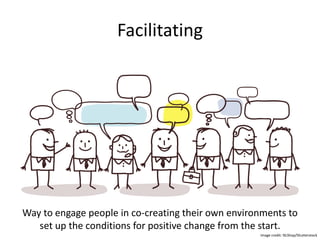
Facilitating
Way to engage people in co-creating their own environments to
set up the conditions for positive change from the start.
Image credit: NLShop/Shutterstock
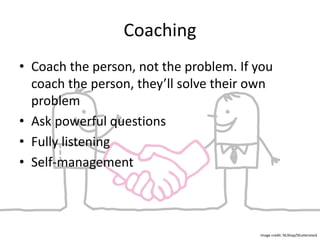
Coaching
• Coach the person, not
the problem. If you
coach the person,
they’ll solve their own
problem
• Ask powerful questions
• Fully listening
• Self-management
Image credit: NLShop/Shutterstock
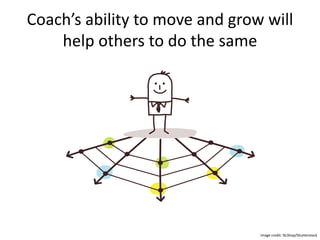
Coach’s ability to move and grow will
help others to do the same
Image credit: NLShop/Shutterstock
WRAP-UP & TAKEAWAYS
Image credit: NLShop/Shutterstock
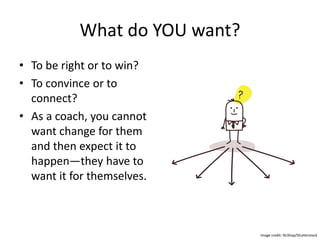
What do YOU want?
• To be right or to win?
• To convince or to
connect?
• As a coach, you cannot
want change for them
and then expect it to
happen—they have to
want it for themselves.
Image credit: NLShop/Shutterstock
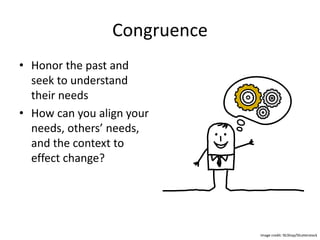
Congruence
Image credit: NLShop/Shutterstock
• Honor the past and
seek to understand
their needs
• How can you align your
needs, others’ needs,
and the context to
effect change?
Elevating Your Skills
• Step back and assess
where you are and how
it’s going
• Are you willing to
stretch yourself for
change to happen?
• Try using different skills
in your approach
Image credit: NLShop/Shutterstock
Transforming the Organization
• Consider the broader
organizational context and
determine your best actions to
positively affect it.
• Identify thought leaders and
enroll them in the change. Once a
majority is enrolled, most of the
rest will fall in.
• The process will require time and
continued support to effect the
change. Not everyone will agree
with the change.
Image credit: NLShop/Shutterstock
Contact
Allison Pollard
allison@improving.com
@allison_pollard
www.allisonpollard.com
Ronnie Cooke
ronnie.cooke@improving.
com
linkedin.com/ronniecooke

Changing organizational mindset

  • 1.
  • 2.
    Allison Pollard • Agilecoach and consultant • Firm believer in continuous improvement • DFW Scrum user group leader and Dallas Agile Leadership Network member • Glasses wearer
  • 3.
    Ronnie Cooke • AgileCoach, Scrum Master, and Consultant • Proud father • Missionary • Family Social Media private investigator, prosecutor, and judge
  • 4.
    Today’s Agenda • AboutChange – Why people resist change – The change process – Approaching resistance – Finding congruence • Being a Coach for Change – Building trust by listening – Training – Mentoring – Facilitating – Coaching • Wrap Up and Takeaways
  • 5.
    ABOUT CHANGE Image credit:NLShop/Shutterstock
  • 6.
    Change! • Move atleast 2 tables away • Look to your left and right. You cannot sit next to those people Was that fun? Image credit: NLShop/Shutterstock
  • 7.
    What are somethings that make people resistant to change? • Nothing is broken • Status/earned respect with current • Don’t know how to do the new behavior or practice • Like working the current way/enjoyment • Sense of control with old • Perceived value of new behavior or practice is low Image credit: NLShop/Shutterstock
  • 8.
    People are willingto cross the Edge only if they see what’s in it for them The Edge The Edge is the line between the known and the unknown—it is at the limit of what we know about ourselves.
  • 9.
    Organizations can crossEdges too Organizational Edge D B E F C A
  • 10.
    Others’ resistance mightput you at the Edge as a Coach Directing won’t lead to real changes--recognize if you’re feeling stuck in certain behavior patterns Image credit: NLShop/Shutterstock
  • 11.
    Can you seethe person’s potential to change? Start with who is closest to the Edge & willing to work with you Image credit: NLShop/Shutterstock
  • 12.
    Can you acknowledgethe past? • Honor what they love about the past • Build trust by listening (not by convincing) Image credit: NLShop/Shutterstock
  • 13.
    Can you alignSelf, Other, and Context for Congruence? • Self: your own needs and capabilities • Other: the needs and capabilities of other people • Context: the reality of the context (the larger external world of things, structures, processes, laws, and cultures) in which you are operating Image credit: NLShop/Shutterstock
  • 14.
    BEING A COACHFOR CHANGE Image credit: NLShop/Shutterstock
  • 15.
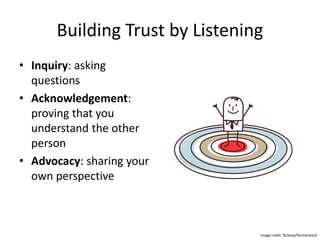
    Building Trust byListening • Inquiry: asking questions • Acknowledgement: proving that you understand the other person • Advocacy: sharing your own perspective Image credit: NLShop/Shutterstock
  • 16.
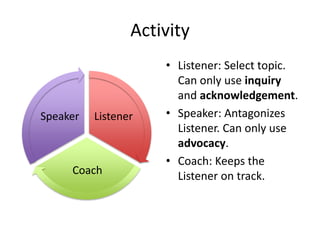
    Activity Listener Coach Speaker • Listener: Selecttopic. Can only use inquiry and acknowledgement. • Speaker: Antagonizes Listener. Can only use advocacy. • Coach: Keeps the Listener on track.
  • 17.
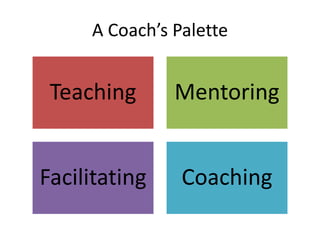
    A Coach’s Palette TeachingMentoring Facilitating Coaching
  • 18.
    Teaching • Short trumpslong • Interactive appeals to emotions, which is the most effective way to capture attention and memory • Groups learn faster than individuals • Reinforce core values and principles through games and simulations Image credit: NLShop/Shutterstock
  • 19.
    Mentoring • Describe whoI am more than why I’m awesome • Share my struggles and successes • Mentoring brings your own capabilities into play—tell stories, give advice, suggest resources Image credit: NLShop/Shutterstock
  • 20.
    Facilitating Way to engagepeople in co-creating their own environments to set up the conditions for positive change from the start. Image credit: NLShop/Shutterstock
  • 21.
    Coaching • Coach theperson, not the problem. If you coach the person, they’ll solve their own problem • Ask powerful questions • Fully listening • Self-management Image credit: NLShop/Shutterstock
  • 22.
    Coach’s ability tomove and grow will help others to do the same Image credit: NLShop/Shutterstock
  • 23.
    WRAP-UP & TAKEAWAYS Imagecredit: NLShop/Shutterstock
  • 24.
    What do YOUwant? • To be right or to win? • To convince or to connect? • As a coach, you cannot want change for them and then expect it to happen—they have to want it for themselves. Image credit: NLShop/Shutterstock
  • 25.
    Congruence Image credit: NLShop/Shutterstock •Honor the past and seek to understand their needs • How can you align your needs, others’ needs, and the context to effect change?
  • 26.
    Elevating Your Skills •Step back and assess where you are and how it’s going • Are you willing to stretch yourself for change to happen? • Try using different skills in your approach Image credit: NLShop/Shutterstock
  • 27.
    Transforming the Organization •Consider the broader organizational context and determine your best actions to positively affect it. • Identify thought leaders and enroll them in the change. Once a majority is enrolled, most of the rest will fall in. • The process will require time and continued support to effect the change. Not everyone will agree with the change. Image credit: NLShop/Shutterstock
  • 28.

Editor's Notes

  • #5 where you work your history why this topic ...is a Principal Consultant for Improving Enterprises and has worked with Agile teams as a project manager, as a Scrum Master, and in coaching roles. A firm advocate of continuous improvement and the power of teams to affect change, she believes the world needs more strong teams in order to be Agile and meet the demands of today; her goal is to help others create them, shape them, and support them. Allison also volunteers locally as one of the organizers of the DFW Scrum user group and serves on the Dallas Agile Leadership Network board.
  • #6 Ronnie Cooke is an Agile Coach and Scrum Master who shines in changing organizations from within by coaching teams to improve.  Ronnie rose through the developer ranks into Project Management at Financial Software development companies. Fast forward 10 years, Ronnie happily made the decision to transform from a Project Manager to a Scrum Master role where the passion, drive, and excitement of delivering working software takes him back to his development roots.  Ronnie is a Senior Consultant with Improving Enterprises in Dallas.
  • #7 Nick Jule is an Agile Coach and Scrum Master who shines in changing organizations from within by coaching teams to improve.  Nick rose through the developer ranks at a start up company where he first experienced Extreme Programming and Scrum. Fast forward 15 years in technology industry, Nick made the decision to transform from a Project Manager to a Scrum Master role where the passion and excitement of delivering working software takes him back to his development roots at a startup.  Nick is a Senior Consultant with Improving Enterprises in Dallas.
  • #10 Duration: 5 to 15 minutes (depending on debrief) Number of participants: unlimited Materials required: none Description/Process: This is another quick and easy game. Participants are asked to change where they are sitting so they can experience the emotions and feelings often associated with change. After the class gets situated and comfortable, the facilitator should ask participants to change seats. Discussion Questions How did it feel to be asked to change seats? Did you view changing seats as an opportunity to sit with someone new or as an uncomfortable or undesirable change? What are some things that make people resistant to change? Facilitator Notes Encourage participants to consider and share their own personal emotions related to making changes. This is what makes the exercise powerful. Another twist to this game might be asking participants to change seats frequently, which also can help them enhance their personal ability to deal with change.
  • #12 Any time you try a new behavior or consider a new idea or adopt a different perspective, you are crossing an Edge.
  • #14 Leadership and self-deception being in box leads to blaming, others in box
  • #15 If not, don’t coach them Start with who is closest to the edge and willing to work with you
  • #17 http://www.ayeconference.com/beyondblaming/ Things might be happening below the surface that you’re not aware of
  • #21 Learning to pivot as a coach
  • #24 Hearing from every person Encouraging collaboration Allowing group to be responsible for results Way to allow organization to shape itself--engage people in co-creating their own environments to set up the conditions for positive change from the start. It is a great way to get ownership and people tend to be more ok with things when they have been included in the decision making process. Ground Conditions for Successful Change New information must enter the system (who, what, where, when?) There is a sense of shared purpose about the change. Everyone has the opportunity to give input about how the change will occur. Everyone understands how input will be used and final decisions are made.