

Getting to Better Problems
An Approach to Continuous Improvement
Tim Haagenson
Tim Haagenson has over 10 years of
experience in software development
and dedicated his career to agile ways
of working. As a developer and
technical lead, he has played a part in
transforming development teams at
multiple companies, resulting in their
ability to deploy value daily. Tim
continues to learn a tremendous
amount about lean product delivery,
and he enjoys sharing his experience
with others. Tim is currently a technical
coach helping to lead delivery
transformation initiatives for American
Airlines.
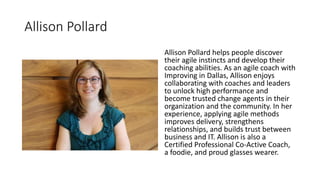
Allison Pollard
Allison Pollard helps people discover
their agile instincts and develop their
coaching abilities. As an agile coach with
Improving in Dallas, Allison enjoys
collaborating with coaches and leaders
to unlock high performance and
become trusted change agents in their
organization and the community. In her
experience, applying agile methods
improves delivery, strengthens
relationships, and builds trust between
business and IT. Allison is also a
Certified Professional Co-Active Coach,
a foodie, and proud glasses wearer.
Activity
1. Write down a problem you are facing on a card
2. Mingle and talk to others about the problem you wrote down
3. At your table, write a backlog to address your problems.
How would you get value along the way delivering on that backlog? How overwhelming is the backlog?
Our Problem – Release More Frequently
• Massive problem to solve
• Deeply coupled monolithic code base
• Long manual testing cycles
• Multiple approval stages
• Dozens of teams contributing
• Years of investment attempting to reach the goal
• Perpetually “two years” away from solving it
8
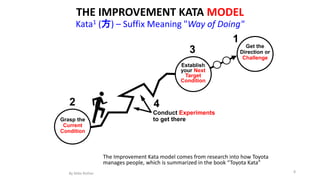
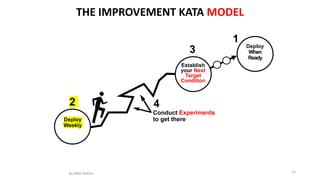
THE IMPROVEMENT KATA MODEL
Kata1 (方) – Suffix Meaning "Way of Doing"
Conduct Experiments
to get thereGrasp the
Current
Condition
Establish
your Next
Target
Condition
Get the
Direction or
Challenge
1
2
3
4
The Improvement Kata model comes from research into how Toyota
manages people, which is summarized in the book “Toyota Kata”
By Mike Rother
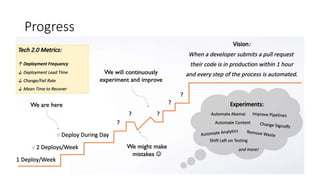
Our Challenge
When a developer submits a pull request
their code is in production within 1 hour
and every step of the deployment process
is automated
10
THE IMPROVEMENT KATA MODEL
Conduct Experiments
to get thereGrasp the
Current
Condition
Establish
your Next
Target
Condition
Deploy
When
Ready
1
2
3
4
By Mike Rother
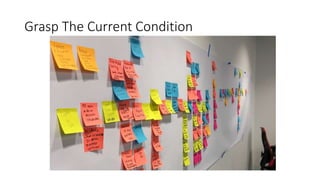
Grasp The Current Condition
12
THE IMPROVEMENT KATA MODEL
Conduct Experiments
to get thereDeploy
Weekly
Establish
your Next
Target
Condition
Deploy
When
Ready
1
2
3
4
By Mike Rother
Next Target Condition
Two deployments per week
No one has to work extra hours to make it
happen
14
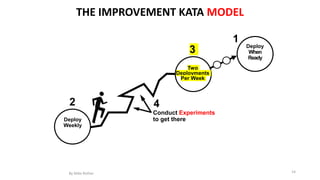
THE IMPROVEMENT KATA MODEL
Conduct Experiments
to get thereDeploy
Weekly
Two
Deployments
Per Week
Deploy
When
Ready
1
2
3
4
By Mike Rother
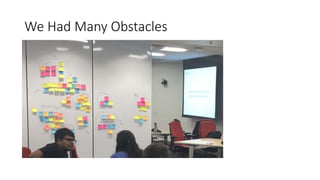
We Had Many Obstacles
Experiments
• Centralized change approvals from 3 systems to reduce waste
• Trained teams to add release notes to change requests
• Shift Left on Testing – Product teams own more of the testing
• Remove one staging environment
• Train performance testing team to build their own environments
• Remove one signoff requirement that is a bottleneck
First target condition reached with only process changes. No
new code was required.
Progress
Continuous Improvement vs. Backlog
• How do they compare?
Other Examples
• Development team wants automated tests to complete in under 10
minutes
• Leadership wants to connect with their people more effectively
• Product teams want easier access to data
Wrap-Up/Q&A
Contact
Tim Haagenson
• Timothy.Haagenson@gmail.com
• @thaagenson
Allison Pollard
• Allison.Pollard@improving.com
• @Allison_pollard
• www.allisonpollard.com

Getting to better problems

  • 1.
    Getting to BetterProblems An Approach to Continuous Improvement
  • 2.
    Tim Haagenson Tim Haagensonhas over 10 years of experience in software development and dedicated his career to agile ways of working. As a developer and technical lead, he has played a part in transforming development teams at multiple companies, resulting in their ability to deploy value daily. Tim continues to learn a tremendous amount about lean product delivery, and he enjoys sharing his experience with others. Tim is currently a technical coach helping to lead delivery transformation initiatives for American Airlines.
  • 3.
    Allison Pollard Allison Pollardhelps people discover their agile instincts and develop their coaching abilities. As an agile coach with Improving in Dallas, Allison enjoys collaborating with coaches and leaders to unlock high performance and become trusted change agents in their organization and the community. In her experience, applying agile methods improves delivery, strengthens relationships, and builds trust between business and IT. Allison is also a Certified Professional Co-Active Coach, a foodie, and proud glasses wearer.
  • 4.
    Activity 1. Write downa problem you are facing on a card 2. Mingle and talk to others about the problem you wrote down 3. At your table, write a backlog to address your problems. How would you get value along the way delivering on that backlog? How overwhelming is the backlog?
  • 5.
    Our Problem –Release More Frequently • Massive problem to solve • Deeply coupled monolithic code base • Long manual testing cycles • Multiple approval stages • Dozens of teams contributing • Years of investment attempting to reach the goal • Perpetually “two years” away from solving it
  • 6.
    8 THE IMPROVEMENT KATAMODEL Kata1 (方) – Suffix Meaning "Way of Doing" Conduct Experiments to get thereGrasp the Current Condition Establish your Next Target Condition Get the Direction or Challenge 1 2 3 4 The Improvement Kata model comes from research into how Toyota manages people, which is summarized in the book “Toyota Kata” By Mike Rother
  • 7.
    Our Challenge When adeveloper submits a pull request their code is in production within 1 hour and every step of the deployment process is automated
  • 8.
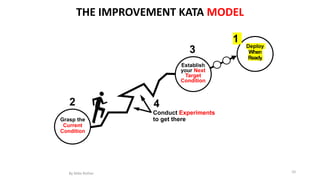
    10 THE IMPROVEMENT KATAMODEL Conduct Experiments to get thereGrasp the Current Condition Establish your Next Target Condition Deploy When Ready 1 2 3 4 By Mike Rother
  • 9.
  • 10.
    12 THE IMPROVEMENT KATAMODEL Conduct Experiments to get thereDeploy Weekly Establish your Next Target Condition Deploy When Ready 1 2 3 4 By Mike Rother
  • 11.
    Next Target Condition Twodeployments per week No one has to work extra hours to make it happen
  • 12.
    14 THE IMPROVEMENT KATAMODEL Conduct Experiments to get thereDeploy Weekly Two Deployments Per Week Deploy When Ready 1 2 3 4 By Mike Rother
  • 13.
    We Had ManyObstacles
  • 14.
    Experiments • Centralized changeapprovals from 3 systems to reduce waste • Trained teams to add release notes to change requests • Shift Left on Testing – Product teams own more of the testing • Remove one staging environment • Train performance testing team to build their own environments • Remove one signoff requirement that is a bottleneck First target condition reached with only process changes. No new code was required.
  • 15.
  • 16.
    Continuous Improvement vs.Backlog • How do they compare?
  • 17.
    Other Examples • Developmentteam wants automated tests to complete in under 10 minutes • Leadership wants to connect with their people more effectively • Product teams want easier access to data
  • 18.
  • 19.
    Contact Tim Haagenson • Timothy.Haagenson@gmail.com •@thaagenson Allison Pollard • Allison.Pollard@improving.com • @Allison_pollard • www.allisonpollard.com

Editor's Notes

  • #9 Talk about how the Challenge is long term thinking and borders on the absurd.
  • #12 Value stream mapping