

WEEK 2
Statement
of
Comprehensive Income
2.1 Purpose of Income Statement
2.2 Elements of Income Statement
2.3 Elements of Statement of
Comprehensive Income
(Service Business)
2.4 Elements of Statement of
Comprehensive Income (Merchandising
Business)
LESSON TOPICS
GROUP ACTIVITY
Basic Financial Statements
Balance Sheet
Income Statement
Statement of Cash Flows
Basic Financial Statements
Balance Sheet
Income Statement
Statement of Cash Flows
Income Statement
 also known as the Profit and Loss
Statement, reports the company's financial
performance and results of its operations in
terms of net profit or loss over a specified
period.
 Net profit or loss is arrived by deducting
expenses from income.
Income Statement answers basic questions
including:
– What is the company’s current financial
status?
– What was the company’s operating results for
the period?
– How did the company obtain and use cash
during the period?
Purpose of Income Statement
Parts of Income Statement
1. Heading
Answers the three W’s:
Who – the name of the business
What - the name of the statement
When – the date which is for a particular
day
2. Body of the statement - states the various
revenues generated and expenses incurred by the
business.
–Write down the amount of your school allowance.
–List down also the things/food that you buy with
corresponding amounts.
–How much do you save everyday, if any, from your
school allowance?
“Statement of Allowance”
• Income accounts are presented before expenses. In the
above statement, the income account is Service
Revenue. Other income accounts for service type
businesses include Professional Fees, Rent Income,
Tuition Fees, etc.
• Expenses are presented after the income accounts. It is
a good practice to arrange expenses according to
amount (largest to smallest). Some users who are
interested in the company's expenses are concerned
about the size of each expense. Arranging the expenses
from largest to smallest results in a more useful and
organized report. Nonetheless, Miscellaneous
Expense or Sundry Expense is presented last.
• The income statement complies with
the accrual basis of accounting.
• Income is recognized when earned regardless
of when collected. Expenses are recognized
when incurred regardless of when paid.
What’s the Business?
Statement of
Comprehensive Income
Service Business
Income
• Professional fees - income derived in the
practice of profession for the professional
services rendered.
• Fare Income - income derived from
transportation services provided to others.
Income
• Rent Income - income derived by lessor
engaged in the business of renting apartment,
building, condominium, market stalls,
automobiles, machines
• Interest Income - income derived from
lending money to others.
Expenses
• Salaries and Wages Expense – amount incurred or paid
for the services rendered by the employees and workers in the
business.
• Advertising Expenses - payments made in the promotion of
business merchandise, goods and/or services.
• Office Supplies Expenses - office related materials used by
the business.
• Rent Expense - amount incurred/paid for the use of space
for the office, store and or factory area
Expenses
• Utilities Expense- amount incurred for the use of
electricity, water and telephone facilities.
• Taxes and license expenses - taxes, licenses and
other fees paid or incurred.
• SSS, Pag-ibig, Medicare Contribution- the
employer’s share in the payment of SSS, Pag-ibig and
medicare for the welfare of its employees and workers.
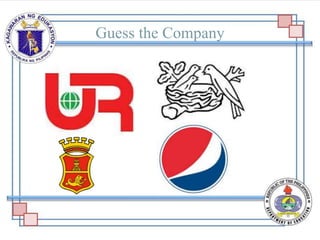
Guess the Company
Statement of
Comprehensive Income
MERCHANDISING BUSINESS
Merchandising Concern
- is a type of business organizations that buys
goods and sells the same good (without
further processing) at a price higher than its
acquisition cost.
- The inventory or stocks consists of finished
products awaiting sales.
Income Statement of Service
and Merchandising Concern
- Similar in terms of content and forms
- Both types of concerns have revenue and
expense section.
- Merchandising concern differ when it comes
to account names for revenues and cost of
goods sold section of the said statement.
The account names maintained in the
accounting records of Merchandising Concerns
• Merchandise Inventory – commodities or
goods acquired by the business intended for
sale but remain unsold.
• Delivery Expense/Freight out – amount
incurred/paid for transporting merchandise to
customers such as cost of fuel, gasoline and
oil.
The account names maintained in the
accounting records of Merchandising Concerns
• Purchases – amount of commodities or goods
acquired by the business intended for sale at a
profit.
+ Freight in – amount incurred or paid for merchandise
bought, the transportation expense of which was
shouldered by the buyer.
– Purchase returns and allowances – a contra account
that accumulate the cost of merchandise returned to
suppliers
– Purchase Discount – a reduction in the purchase price
due to payment of the buyer to the seller before the
day the discount period is over
The account names maintained in the
accounting records of Merchandising Concerns
• Sales – revenues derived from sale of goods either in cash
or on account.
- Sales Returns and Allowances – a contra-sales account
that accumulates the amount of merchandise sold to
customers but returned for various reasons like errors in
style, color, sizes
- Sales Discount – a reduction in the selling price due to
payment of the buyer to the seller before the day the
discount period is over.
Expenses
Selling Expenses – pertain to expenses related to selling
the products of the company.
 Advertising expenses
 Rent Expense of the store
 Commission expense
 Depreciation expense of the store
 Depreciation expense of the delivery van
 Freight out
 And other selling related expenditures
Expenses
Administrative Expenses - pertain to expenses related
to office and administrative work.
 Salaries expense of employees
 Rent of office
 Utilities of the head office
 Office supplies
 And other office related expenditures
Other income – revenue from sources not directly related to the
central operating activities of the business.
Ex. Interest income and gains from sale of fixed assets
Other expenses – other expenses that are not directly associated
with the operating activities of the business.
Ex. Interest expense, loss from lawsuit, losses in the
disposal of fixed assets, discount loss
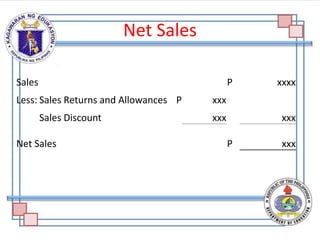
Net Sales
Sales P xxxx
Less: Sales Returns and Allowances P xxx
Sales Discount xxx xxx
Net Sales P xxx
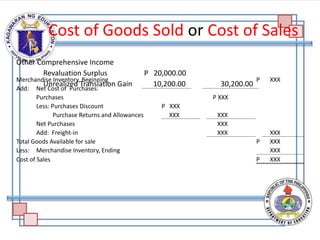
Cost of Goods Sold or Cost of Sales
Merchandise Inventory, Beginning P XXX
Add: Net Cost of Purchases:
Purchases P XXX
Less: Purchases Discount P XXX
Purchase Returns and Allowances XXX XXX
Net Purchases XXX
Add: Freight-in XXX XXX
Total Goods Available for sale P XXX
Less: Merchandise Inventory, Ending XXX
Cost of Sales P XXX
Other Comprehensive Income
Revaluation Surplus P 20,000.00
Unrealized Translation Gain 10,200.00 30,200.00
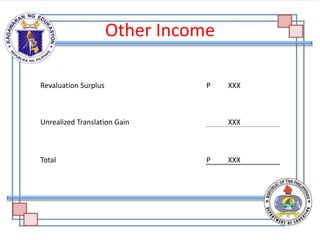
Other Income
Revaluation Surplus P XXX
Unrealized Translation Gain XXX
Total P XXX
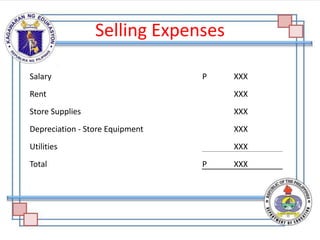
Selling Expenses
Salary P XXX
Rent XXX
Store Supplies XXX
Depreciation - Store Equipment XXX
Utilities XXX
Total P XXX
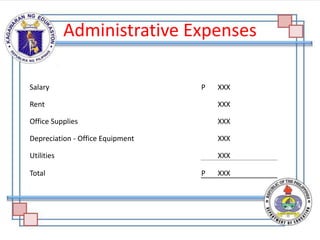
Administrative Expenses
Salary P XXX
Rent XXX
Office Supplies XXX
Depreciation - Office Equipment XXX
Utilities XXX
Total P XXX
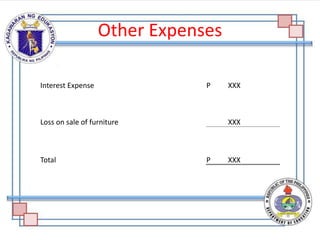
Other Expenses
Interest Expense P XXX
Loss on sale of furniture XXX
Total P XXX
Statement of
Comprehensive Income
Exercises & Problems
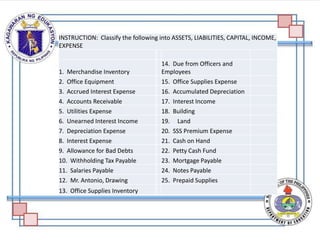
INSTRUCTION: Classify the following into ASSETS, LIABILITIES, CAPITAL, INCOME,
EXPENSE
1. Merchandise Inventory
14. Due from Officers and
Employees
2. Office Equipment 15. Office Supplies Expense
3. Accrued Interest Expense 16. Accumulated Depreciation
4. Accounts Receivable 17. Interest Income
5. Utilities Expense 18. Building
6. Unearned Interest Income 19. Land
7. Depreciation Expense 20. SSS Premium Expense
8. Interest Expense 21. Cash on Hand
9. Allowance for Bad Debts 22. Petty Cash Fund
10. Withholding Tax Payable 23. Mortgage Payable
11. Salaries Payable 24. Notes Payable
12. Mr. Antonio, Drawing 25. Prepaid Supplies
13. Office Supplies Inventory
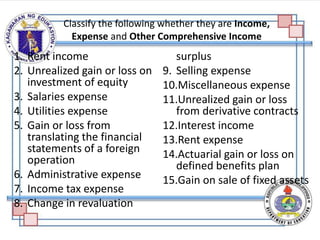
Classify the following whether they are Income,
Expense and Other Comprehensive Income
1. Rent income
2. Unrealized gain or loss on
investment of equity
3. Salaries expense
4. Utilities expense
5. Gain or loss from
translating the financial
statements of a foreign
operation
6. Administrative expense
7. Income tax expense
8. Change in revaluation
surplus
9. Selling expense
10.Miscellaneous expense
11.Unrealized gain or loss
from derivative contracts
12.Interest income
13.Rent expense
14.Actuarial gain or loss on
defined benefits plan
15.Gain on sale of fixed assets
STATEMENT OF COMPREHENSIVE INCOME-WEEK 2.pptx

STATEMENT OF COMPREHENSIVE INCOME-WEEK 2.pptx

  • 2.
  • 3.
    2.1 Purpose ofIncome Statement 2.2 Elements of Income Statement 2.3 Elements of Statement of Comprehensive Income (Service Business) 2.4 Elements of Statement of Comprehensive Income (Merchandising Business) LESSON TOPICS
  • 4.
  • 5.
    Basic Financial Statements BalanceSheet Income Statement Statement of Cash Flows
  • 6.
    Basic Financial Statements BalanceSheet Income Statement Statement of Cash Flows
  • 7.
    Income Statement  alsoknown as the Profit and Loss Statement, reports the company's financial performance and results of its operations in terms of net profit or loss over a specified period.  Net profit or loss is arrived by deducting expenses from income.
  • 8.
    Income Statement answersbasic questions including: – What is the company’s current financial status? – What was the company’s operating results for the period? – How did the company obtain and use cash during the period? Purpose of Income Statement
  • 9.
    Parts of IncomeStatement 1. Heading Answers the three W’s: Who – the name of the business What - the name of the statement When – the date which is for a particular day 2. Body of the statement - states the various revenues generated and expenses incurred by the business.
  • 10.
    –Write down theamount of your school allowance. –List down also the things/food that you buy with corresponding amounts. –How much do you save everyday, if any, from your school allowance? “Statement of Allowance”
  • 11.
    • Income accountsare presented before expenses. In the above statement, the income account is Service Revenue. Other income accounts for service type businesses include Professional Fees, Rent Income, Tuition Fees, etc. • Expenses are presented after the income accounts. It is a good practice to arrange expenses according to amount (largest to smallest). Some users who are interested in the company's expenses are concerned about the size of each expense. Arranging the expenses from largest to smallest results in a more useful and organized report. Nonetheless, Miscellaneous Expense or Sundry Expense is presented last.
  • 12.
    • The incomestatement complies with the accrual basis of accounting. • Income is recognized when earned regardless of when collected. Expenses are recognized when incurred regardless of when paid.
  • 13.
  • 14.
  • 15.
    Income • Professional fees- income derived in the practice of profession for the professional services rendered. • Fare Income - income derived from transportation services provided to others.
  • 16.
    Income • Rent Income- income derived by lessor engaged in the business of renting apartment, building, condominium, market stalls, automobiles, machines • Interest Income - income derived from lending money to others.
  • 17.
    Expenses • Salaries andWages Expense – amount incurred or paid for the services rendered by the employees and workers in the business. • Advertising Expenses - payments made in the promotion of business merchandise, goods and/or services. • Office Supplies Expenses - office related materials used by the business. • Rent Expense - amount incurred/paid for the use of space for the office, store and or factory area
  • 18.
    Expenses • Utilities Expense-amount incurred for the use of electricity, water and telephone facilities. • Taxes and license expenses - taxes, licenses and other fees paid or incurred. • SSS, Pag-ibig, Medicare Contribution- the employer’s share in the payment of SSS, Pag-ibig and medicare for the welfare of its employees and workers.
  • 19.
  • 20.
  • 21.
    Merchandising Concern - isa type of business organizations that buys goods and sells the same good (without further processing) at a price higher than its acquisition cost. - The inventory or stocks consists of finished products awaiting sales.
  • 22.
    Income Statement ofService and Merchandising Concern - Similar in terms of content and forms - Both types of concerns have revenue and expense section. - Merchandising concern differ when it comes to account names for revenues and cost of goods sold section of the said statement.
  • 23.
    The account namesmaintained in the accounting records of Merchandising Concerns • Merchandise Inventory – commodities or goods acquired by the business intended for sale but remain unsold. • Delivery Expense/Freight out – amount incurred/paid for transporting merchandise to customers such as cost of fuel, gasoline and oil.
  • 24.
    The account namesmaintained in the accounting records of Merchandising Concerns • Purchases – amount of commodities or goods acquired by the business intended for sale at a profit. + Freight in – amount incurred or paid for merchandise bought, the transportation expense of which was shouldered by the buyer. – Purchase returns and allowances – a contra account that accumulate the cost of merchandise returned to suppliers – Purchase Discount – a reduction in the purchase price due to payment of the buyer to the seller before the day the discount period is over
  • 25.
    The account namesmaintained in the accounting records of Merchandising Concerns • Sales – revenues derived from sale of goods either in cash or on account. - Sales Returns and Allowances – a contra-sales account that accumulates the amount of merchandise sold to customers but returned for various reasons like errors in style, color, sizes - Sales Discount – a reduction in the selling price due to payment of the buyer to the seller before the day the discount period is over.
  • 26.
    Expenses Selling Expenses –pertain to expenses related to selling the products of the company.  Advertising expenses  Rent Expense of the store  Commission expense  Depreciation expense of the store  Depreciation expense of the delivery van  Freight out  And other selling related expenditures
  • 27.
    Expenses Administrative Expenses -pertain to expenses related to office and administrative work.  Salaries expense of employees  Rent of office  Utilities of the head office  Office supplies  And other office related expenditures
  • 28.
    Other income –revenue from sources not directly related to the central operating activities of the business. Ex. Interest income and gains from sale of fixed assets Other expenses – other expenses that are not directly associated with the operating activities of the business. Ex. Interest expense, loss from lawsuit, losses in the disposal of fixed assets, discount loss
  • 29.
    Net Sales Sales Pxxxx Less: Sales Returns and Allowances P xxx Sales Discount xxx xxx Net Sales P xxx
  • 30.
    Cost of GoodsSold or Cost of Sales Merchandise Inventory, Beginning P XXX Add: Net Cost of Purchases: Purchases P XXX Less: Purchases Discount P XXX Purchase Returns and Allowances XXX XXX Net Purchases XXX Add: Freight-in XXX XXX Total Goods Available for sale P XXX Less: Merchandise Inventory, Ending XXX Cost of Sales P XXX Other Comprehensive Income Revaluation Surplus P 20,000.00 Unrealized Translation Gain 10,200.00 30,200.00
  • 31.
    Other Income Revaluation SurplusP XXX Unrealized Translation Gain XXX Total P XXX
  • 32.
    Selling Expenses Salary PXXX Rent XXX Store Supplies XXX Depreciation - Store Equipment XXX Utilities XXX Total P XXX
  • 33.
    Administrative Expenses Salary PXXX Rent XXX Office Supplies XXX Depreciation - Office Equipment XXX Utilities XXX Total P XXX
  • 34.
    Other Expenses Interest ExpenseP XXX Loss on sale of furniture XXX Total P XXX
  • 35.
  • 36.
    INSTRUCTION: Classify thefollowing into ASSETS, LIABILITIES, CAPITAL, INCOME, EXPENSE 1. Merchandise Inventory 14. Due from Officers and Employees 2. Office Equipment 15. Office Supplies Expense 3. Accrued Interest Expense 16. Accumulated Depreciation 4. Accounts Receivable 17. Interest Income 5. Utilities Expense 18. Building 6. Unearned Interest Income 19. Land 7. Depreciation Expense 20. SSS Premium Expense 8. Interest Expense 21. Cash on Hand 9. Allowance for Bad Debts 22. Petty Cash Fund 10. Withholding Tax Payable 23. Mortgage Payable 11. Salaries Payable 24. Notes Payable 12. Mr. Antonio, Drawing 25. Prepaid Supplies 13. Office Supplies Inventory
  • 37.
    Classify the followingwhether they are Income, Expense and Other Comprehensive Income 1. Rent income 2. Unrealized gain or loss on investment of equity 3. Salaries expense 4. Utilities expense 5. Gain or loss from translating the financial statements of a foreign operation 6. Administrative expense 7. Income tax expense 8. Change in revaluation surplus 9. Selling expense 10.Miscellaneous expense 11.Unrealized gain or loss from derivative contracts 12.Interest income 13.Rent expense 14.Actuarial gain or loss on defined benefits plan 15.Gain on sale of fixed assets