The Financial
Statements
Fundamentals of Accountancy, Business, and Management 1
The Financial
Statements
Fundamentals of Accountancy, Business, and Management 1
- Key product or end
product of the
accounting process.
Types of Financial
Statements
1. Statement of Financial
Position or Balance
Sheet
2. Income Statement
3. Statement of Owner’s
Equity
4. Statement of Cash
Flow
Fundamentals of Accountancy, Business, and Management 1
Balance Sheet
-Shows the financial
condition/position of a
business of a given period.
- Consists of Asset,
Liabilities & Capital
Fundamentals of Accountancy, Business, and Management 1
Income Statement
-Shows the result of
operation for a given
period.
- Consists of Revenue,
Cost & Expenses.
Fundamentals of Accountancy, Business, and Management 1
Statement of Owner’s
Equity
-Shows the changes in
capital or owner’s equity as
a result of additional
investment or withdrawals
of the owner.
Fundamentals of Accountancy, Business, and Management 1
Statement of Cash Flows
-Summarizes the cash
receipts & cash
disbursements for the
accounting period.
- Cash inflows (receipts)
- Cash Outflows (payments)
Fundamentals of Accountancy, Business, and Management 1
Typical Account
Titles Used in
Balance Sheet
Fundamentals of Accountancy, Business, and Management 1
Assets
- Economic resources
owned by business
expected for future
gains.
- Property & Rights of
value owned by the
business.
Fundamentals of Accountancy, Business, and Management 1
Liabilities
- Includes Debts,
Obligations to pay &
claims of the creditors
on the assets of the
Business.
Fundamentals of Accountancy, Business, and Management 1
Owner’s Equity or Capital
- Includes the interests of the
owners on the business; claims
of the owners on the assets,
and the investment of the
owner +/- the result of
operation.
- 2 sources (investment/earnings
of business)
Fundamentals of Accountancy, Business, and Management 1
The Fundamental
Accounting Equation
Fundamentals of Accountancy, Business, and Management 1
ASSET LIABILITIES
OWNER’S
EQUITY
FUNDAMENTAL ACCOUNTING EQUATION
Given liabilities of Php. 50,000
and Owner’s Equity of Php.
150,000. Find the value of assets.
Fundamentals of Accountancy, Business, and Management 1
Assets = Liabilities + Owners
Equity
Given assets of Php. 180,000 and
Owner’s Equity of Php. 110,000.
Find the Liabilities
Fundamentals of Accountancy, Business, and Management 1
Liabilities = Assets - Owners Equity
Given assets of Php. 250,000 and
Liabilities of Php. 90,000. Find the
Owner’s Equity
Fundamentals of Accountancy, Business, and Management 1
Owner’s Equity = Assets - Liabilities
Drill 1
Fundamentals of Accountancy, Business, and Management 1
Drill 1
Fundamentals of Accountancy, Business, and Management 1
ASSETS LIABILITIES OWNER’S EQUITY
Php. 650, 000 Php 340,000
Php. 295,000 Php. 305,000
Php. 967,000 Php. 660,000
Php. 788,000 Php. 345,000
Php. 845,000 Php. 533,000
Drill 2
For every
transaction, the
accounting
equation should
always balance
Sample Transactions:
July 1 - Paolo Reyes started a delivery service on July 1, 2013. The following
transactions occurred during the month of July. He invested
PHP800,000 cash and Cars amounting to PHP200,000
July 2 – Reyes borrowed PHP100,000 cash from PNB for use in his business.
July 7 – Bought tables and chairs from Orocan and paid PHP45,000 cash
July 15 – Various equipment were purchased on account from Fortune for
PHP55,000
July 18 – Reyes made a cash withdrawal of PHP5,000 for personal use
July 20 – The account due to Fortune was paid in cash
Determining Profit through Operations:
July 21 – A customer hired the services of Reyes. Cash of PHP15,000 was
received from the customers.
July 22 – Cash was paid for the following : gas and oil, PHP500 and car repairs,
PHP1,000.
July 24 – Another customer hired the services of Reyes and promised to pay
PHP16,000 on July 31.
July 25 – Paid PHP500 for telephone bill.
July 27 – Another customer hired the services of Reyes. A bill was issued to them
for PHP20,000, 50% of which was collected
July 30 – The customer on July 24 paid 50% of his account in cash.
July 31 – Paid PHP10,000 for rental of office space, and salaries of PHP9,000
Concept Check:
Concept Check:
Analyzing Transactions:
Types of Major
Accounts
Fundamentals of Accountancy, Business, and Management 1
Types of Major
Accounts
Fundamentals of Accountancy, Business, and Management 1
ASSETS:
Current
Assets
are assets that can be realized
(collected, sold, used up) one year
after year-end date. Examples include
Cash, Accounts
Receivable, Merchandise Inventory,
Prepaid Expense, etc.
Non-Current
Assets
are assets that cannot be realized
(collected, sold, used up) one year after
year-end date. Examples include Property,
Plant and Equipment (equipment,
furniture, building, land), long term
investments, etc.
ASSETS:
Tangible
Assets
are physical assets such as
cash, supplies, and furniture
and fixtures.
Non-Current
Assets
are non-physical assets such
as patents and trademarks
Account Titles – Asset Accounts
Cash
is money on hand, or in banks,
and other items considered as
medium of exchange in business
transactions.
Accounts
Receivable
are amounts due from customers
arising from credit sales or credit
services.
Account Titles – Asset Accounts
Supplies
are items purchased by an
enterprise which are unused
as of the reporting date.
Prepaid
Expenses
are expenses paid in advance. They
are assets at the time of payment and
become expenses through the
passage of time.
Account Titles – Asset Accounts
Notes
Receivable
are amounts due from
clients supported by
promissory notes.
Inventories
are assets held for
resale
Account Titles – Non-Current Assets
Property, Plant
and Equipment
are long-lived assets which
have been acquired for use in
operations.
EXAMPLES - LAND, BUILDINGS, EQUIPMENT,
FURNITURE & FIXTURES
Account Titles – Non-Current Assets
Long term
Investments
are the investments made by
the company for long-term
purposes.
Intangible
Assets
are assets without a physical
substance. Examples include
franchise and copyright.
LIABILITY
LIABILITY
are the debts and
obligations of the
company to another
entity.
Current Vs. Non-Current Liabilities
Current
Liabilities
Liabilities that fall due (paid, recognized
as revenue) within one year after year-
end date.
Examples include Accounts
Payable, Utilities Payable and Unearned
Income.
Non-current
Liabilities
are liabilities that do not fall due (paid,
recognized as revenue) within one year
after year-end date. Examples include
Notes Payable, Loans Payable, Mortgage
Payable, etc.
Account Titles – LIABILITIES
Accounts
Payable
are amounts due, or payable to,
suppliers for goods purchased
on account or for services
received on account.
Notes
Payable
are amounts due to third
parties supported by
promissory notes.
Account Titles – LIABILITIES
Accrued
Expenses
are expenses that are incurred
but not yet paid (examples:
salaries payable, taxes payable)
Unearned
Income
is cash collected in advance;
the liability is the services to
be performed or goods to be
delivered in the future.
OWNER’S EQUITY
OWNER’S
EQUITY
is the residual interest of
the owner from the
business. It can be
derived by deducting
liabilities from assets.
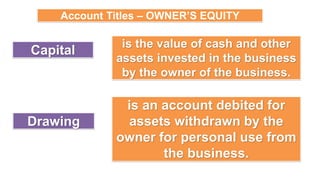
Account Titles – OWNER’S EQUITY
Capital
is the value of cash and other
assets invested in the business
by the owner of the business.
Drawing
is an account debited for
assets withdrawn by the
owner for personal use from
the business.
INCOME VS. EXPENSE
INCOME
is the Increase in resources
resulting from performance of
service or selling of goods.
Expense
is the decrease in resources
resulting from the operations
of business
Chart of Accounts:
• A chart of accounts is a listing of the
accounts used by companies in their
financial records.
• The chart of accounts helps to identify
where the money is coming from and
where it is going.
• The chart of accounts is the foundation of
the financial statements.
EXAMPLE -
CHART OF
ACCOUNTS
DRILL
LIABILITIES
P.P.E.
INTANGIBLE ASSETS
OWNER’S EQUITY
CASH
RENT EXPENSE
ASSETS
NOTES PAYABLE
GENERAL
JOURNAL
Fundamentals of Accountancy, Business, and Management 1
GENERAL JOURNAL
Is the most basic journal. Typically, a journal
has space for:
• DATES
• ACCOUNT TITLES &
EXPLANATIONS
• REFERENCES
• TWO AMOUNT COLUMN
RULES OF DEBIT
AND CREDIT
The Normal Balance is the
expected balance each
account type maintains,
which is the side that
increases.
NORMAL BALANCE OF ACCOUNTS
6 MAJOR ACCOUNTS
ASSET
EXPENSE
DRAWINGS
LIABILITY
EQUITY
(CAPITAL)
REVENUE
The Financial Statements (Basic Accounting)

The Financial Statements (Basic Accounting)

  • 1.
    The Financial Statements Fundamentals ofAccountancy, Business, and Management 1
  • 2.
    The Financial Statements Fundamentals ofAccountancy, Business, and Management 1 - Key product or end product of the accounting process.
  • 3.
    Types of Financial Statements 1.Statement of Financial Position or Balance Sheet 2. Income Statement 3. Statement of Owner’s Equity 4. Statement of Cash Flow Fundamentals of Accountancy, Business, and Management 1
  • 4.
    Balance Sheet -Shows thefinancial condition/position of a business of a given period. - Consists of Asset, Liabilities & Capital Fundamentals of Accountancy, Business, and Management 1
  • 5.
    Income Statement -Shows theresult of operation for a given period. - Consists of Revenue, Cost & Expenses. Fundamentals of Accountancy, Business, and Management 1
  • 6.
    Statement of Owner’s Equity -Showsthe changes in capital or owner’s equity as a result of additional investment or withdrawals of the owner. Fundamentals of Accountancy, Business, and Management 1
  • 7.
    Statement of CashFlows -Summarizes the cash receipts & cash disbursements for the accounting period. - Cash inflows (receipts) - Cash Outflows (payments) Fundamentals of Accountancy, Business, and Management 1
  • 8.
    Typical Account Titles Usedin Balance Sheet Fundamentals of Accountancy, Business, and Management 1
  • 9.
    Assets - Economic resources ownedby business expected for future gains. - Property & Rights of value owned by the business. Fundamentals of Accountancy, Business, and Management 1
  • 10.
    Liabilities - Includes Debts, Obligationsto pay & claims of the creditors on the assets of the Business. Fundamentals of Accountancy, Business, and Management 1
  • 11.
    Owner’s Equity orCapital - Includes the interests of the owners on the business; claims of the owners on the assets, and the investment of the owner +/- the result of operation. - 2 sources (investment/earnings of business) Fundamentals of Accountancy, Business, and Management 1
  • 12.
    The Fundamental Accounting Equation Fundamentalsof Accountancy, Business, and Management 1
  • 13.
    Fundamentals of Accountancy,Business, and Management 1 ASSET LIABILITIES OWNER’S EQUITY FUNDAMENTAL ACCOUNTING EQUATION
  • 14.
    Given liabilities ofPhp. 50,000 and Owner’s Equity of Php. 150,000. Find the value of assets. Fundamentals of Accountancy, Business, and Management 1 Assets = Liabilities + Owners Equity
  • 15.
    Given assets ofPhp. 180,000 and Owner’s Equity of Php. 110,000. Find the Liabilities Fundamentals of Accountancy, Business, and Management 1 Liabilities = Assets - Owners Equity
  • 16.
    Given assets ofPhp. 250,000 and Liabilities of Php. 90,000. Find the Owner’s Equity Fundamentals of Accountancy, Business, and Management 1 Owner’s Equity = Assets - Liabilities
  • 17.
    Drill 1 Fundamentals ofAccountancy, Business, and Management 1
  • 18.
    Drill 1 Fundamentals ofAccountancy, Business, and Management 1 ASSETS LIABILITIES OWNER’S EQUITY Php. 650, 000 Php 340,000 Php. 295,000 Php. 305,000 Php. 967,000 Php. 660,000 Php. 788,000 Php. 345,000 Php. 845,000 Php. 533,000
  • 19.
  • 20.
  • 21.
    Sample Transactions: July 1- Paolo Reyes started a delivery service on July 1, 2013. The following transactions occurred during the month of July. He invested PHP800,000 cash and Cars amounting to PHP200,000 July 2 – Reyes borrowed PHP100,000 cash from PNB for use in his business. July 7 – Bought tables and chairs from Orocan and paid PHP45,000 cash July 15 – Various equipment were purchased on account from Fortune for PHP55,000 July 18 – Reyes made a cash withdrawal of PHP5,000 for personal use July 20 – The account due to Fortune was paid in cash
  • 23.
    Determining Profit throughOperations: July 21 – A customer hired the services of Reyes. Cash of PHP15,000 was received from the customers. July 22 – Cash was paid for the following : gas and oil, PHP500 and car repairs, PHP1,000. July 24 – Another customer hired the services of Reyes and promised to pay PHP16,000 on July 31. July 25 – Paid PHP500 for telephone bill. July 27 – Another customer hired the services of Reyes. A bill was issued to them for PHP20,000, 50% of which was collected July 30 – The customer on July 24 paid 50% of his account in cash. July 31 – Paid PHP10,000 for rental of office space, and salaries of PHP9,000
  • 24.
  • 25.
  • 26.
  • 27.
    Types of Major Accounts Fundamentalsof Accountancy, Business, and Management 1
  • 28.
    Types of Major Accounts Fundamentalsof Accountancy, Business, and Management 1
  • 29.
    ASSETS: Current Assets are assets thatcan be realized (collected, sold, used up) one year after year-end date. Examples include Cash, Accounts Receivable, Merchandise Inventory, Prepaid Expense, etc. Non-Current Assets are assets that cannot be realized (collected, sold, used up) one year after year-end date. Examples include Property, Plant and Equipment (equipment, furniture, building, land), long term investments, etc.
  • 30.
    ASSETS: Tangible Assets are physical assetssuch as cash, supplies, and furniture and fixtures. Non-Current Assets are non-physical assets such as patents and trademarks
  • 31.
    Account Titles –Asset Accounts Cash is money on hand, or in banks, and other items considered as medium of exchange in business transactions. Accounts Receivable are amounts due from customers arising from credit sales or credit services.
  • 32.
    Account Titles –Asset Accounts Supplies are items purchased by an enterprise which are unused as of the reporting date. Prepaid Expenses are expenses paid in advance. They are assets at the time of payment and become expenses through the passage of time.
  • 33.
    Account Titles –Asset Accounts Notes Receivable are amounts due from clients supported by promissory notes. Inventories are assets held for resale
  • 34.
    Account Titles –Non-Current Assets Property, Plant and Equipment are long-lived assets which have been acquired for use in operations. EXAMPLES - LAND, BUILDINGS, EQUIPMENT, FURNITURE & FIXTURES
  • 35.
    Account Titles –Non-Current Assets Long term Investments are the investments made by the company for long-term purposes. Intangible Assets are assets without a physical substance. Examples include franchise and copyright.
  • 36.
    LIABILITY LIABILITY are the debtsand obligations of the company to another entity.
  • 37.
    Current Vs. Non-CurrentLiabilities Current Liabilities Liabilities that fall due (paid, recognized as revenue) within one year after year- end date. Examples include Accounts Payable, Utilities Payable and Unearned Income. Non-current Liabilities are liabilities that do not fall due (paid, recognized as revenue) within one year after year-end date. Examples include Notes Payable, Loans Payable, Mortgage Payable, etc.
  • 38.
    Account Titles –LIABILITIES Accounts Payable are amounts due, or payable to, suppliers for goods purchased on account or for services received on account. Notes Payable are amounts due to third parties supported by promissory notes.
  • 39.
    Account Titles –LIABILITIES Accrued Expenses are expenses that are incurred but not yet paid (examples: salaries payable, taxes payable) Unearned Income is cash collected in advance; the liability is the services to be performed or goods to be delivered in the future.
  • 40.
    OWNER’S EQUITY OWNER’S EQUITY is theresidual interest of the owner from the business. It can be derived by deducting liabilities from assets.
  • 41.
    Account Titles –OWNER’S EQUITY Capital is the value of cash and other assets invested in the business by the owner of the business. Drawing is an account debited for assets withdrawn by the owner for personal use from the business.
  • 42.
    INCOME VS. EXPENSE INCOME isthe Increase in resources resulting from performance of service or selling of goods. Expense is the decrease in resources resulting from the operations of business
  • 43.
    Chart of Accounts: •A chart of accounts is a listing of the accounts used by companies in their financial records. • The chart of accounts helps to identify where the money is coming from and where it is going. • The chart of accounts is the foundation of the financial statements.
  • 44.
  • 45.
  • 49.
  • 50.
    GENERAL JOURNAL Is themost basic journal. Typically, a journal has space for: • DATES • ACCOUNT TITLES & EXPLANATIONS • REFERENCES • TWO AMOUNT COLUMN
  • 52.
  • 53.
    The Normal Balanceis the expected balance each account type maintains, which is the side that increases. NORMAL BALANCE OF ACCOUNTS
  • 54.