1.The Ever-Evolving World of
Science
7th class science curiosity
By:K Sandeep Swamy(M.Sc,B.Ed)
For Online Classes (IITJEE & NEET foundation and academics) contact :
9491878325
Subscribe Samyans Eduhub youtube channel
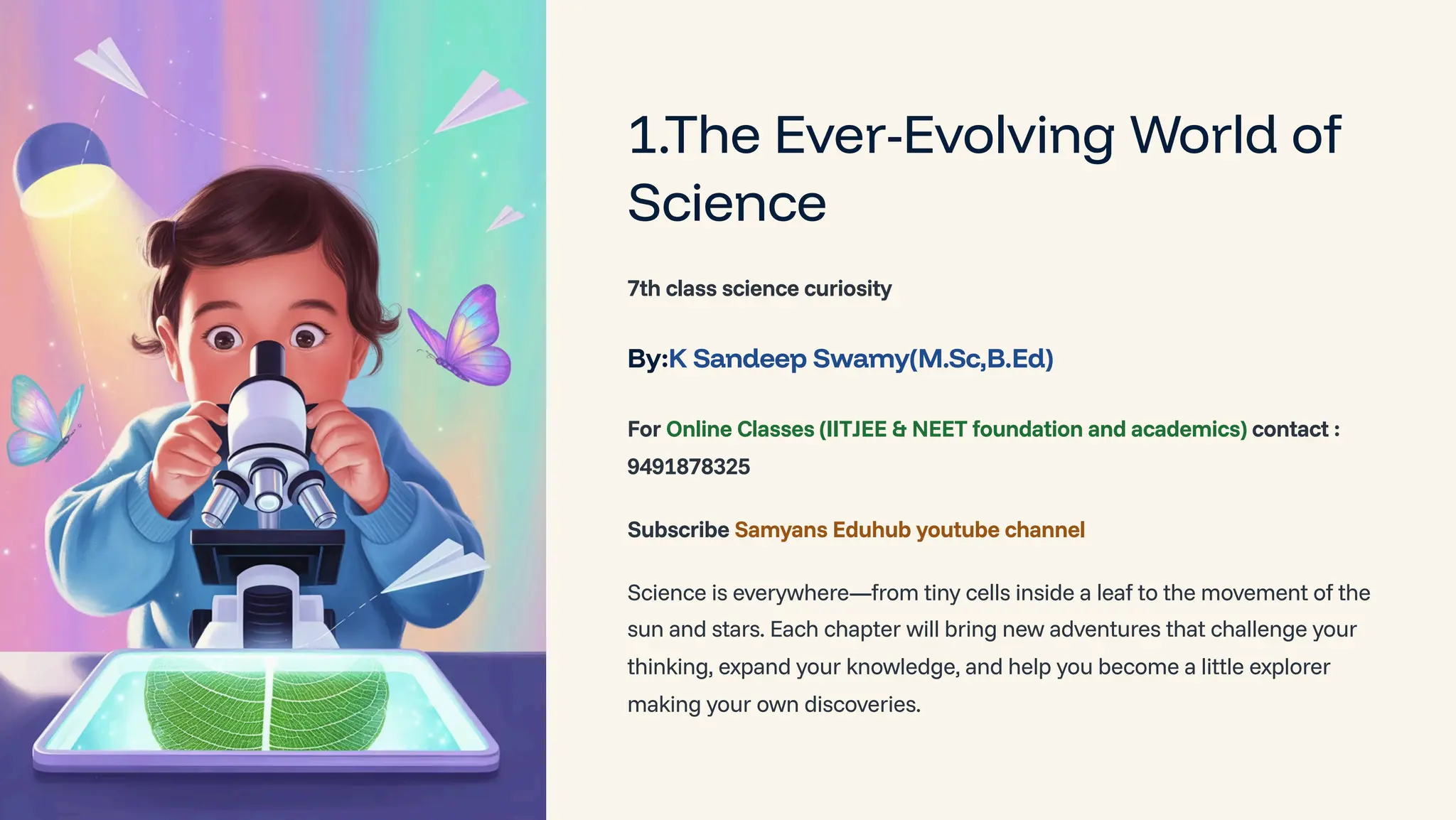
Science is everywhere4from tiny cells inside a leaf to the movement of the
sun and stars. Each chapter will bring new adventures that challenge your
thinking, expand your knowledge, and help you become a little explorer
making your own discoveries.
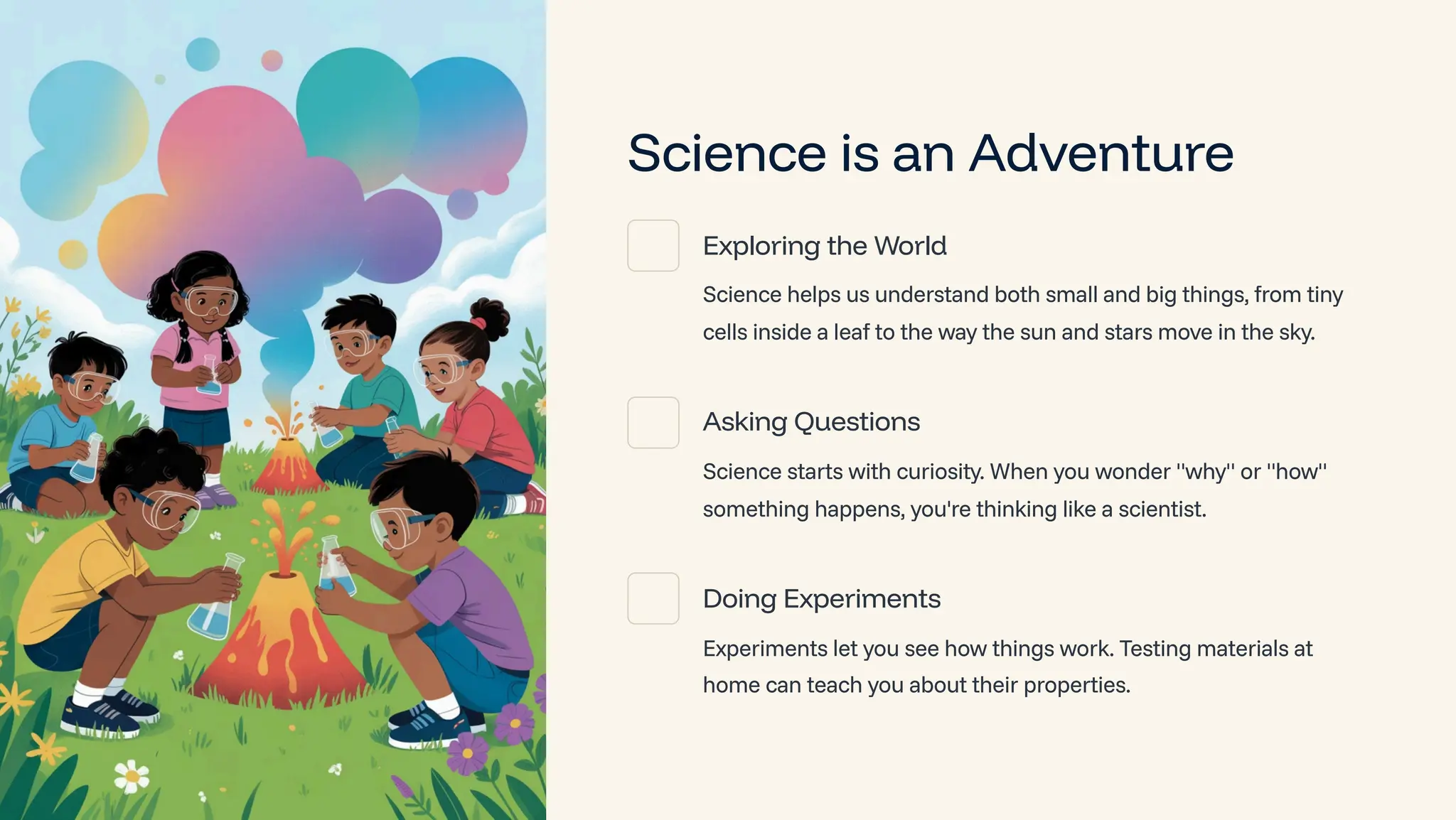
Science is an Adventure
Exploring the World
Science helps us understand both small and big things, from tiny
cells inside a leaf to the way the sun and stars move in the sky.
Asking Questions
Science starts with curiosity. When you wonder "why" or "how"
something happens, you're thinking like a scientist.
Doing Experiments
Experiments let you see how things work. Testing materials at
home can teach you about their properties.
Learning Takes Flight
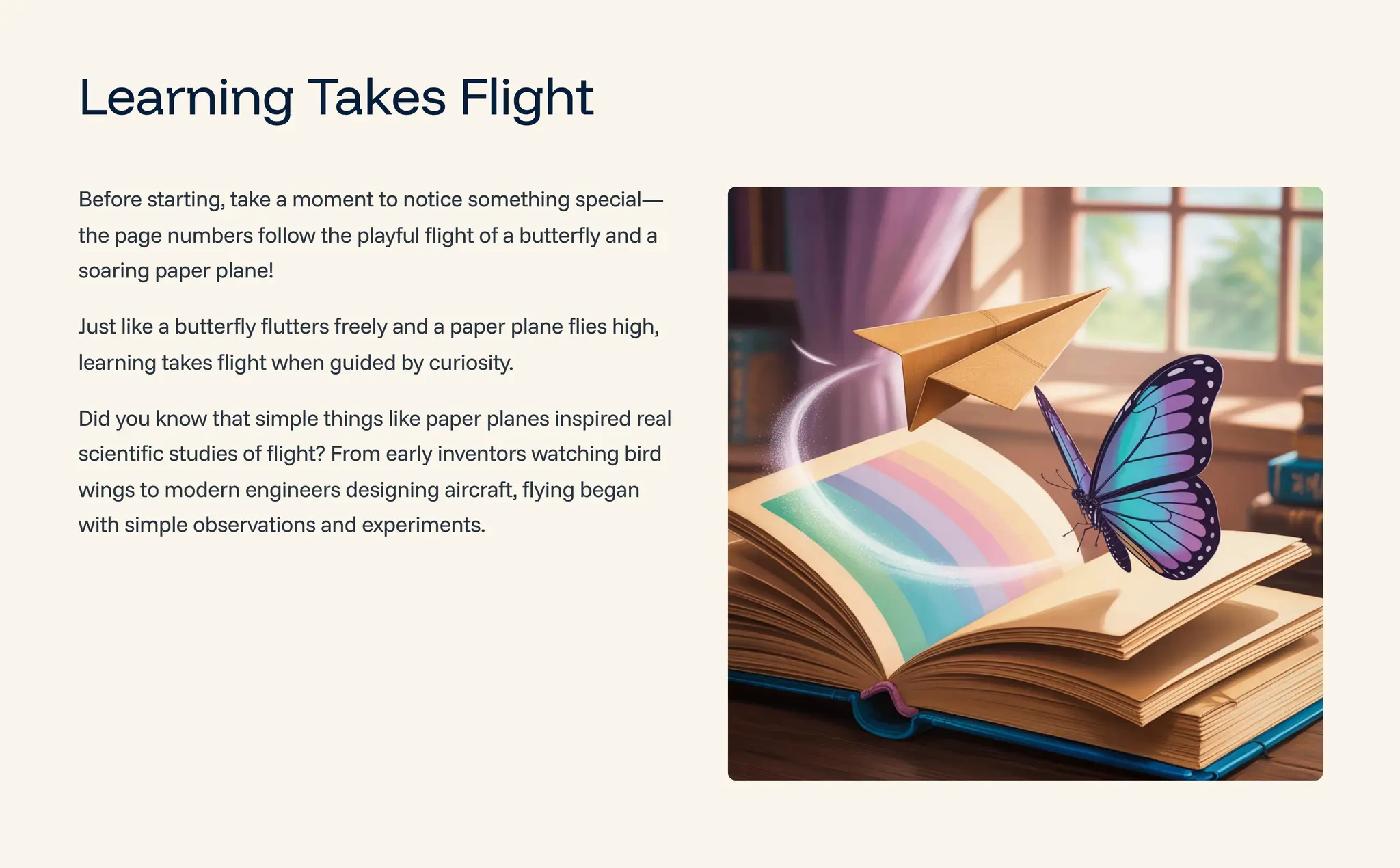
Before starting, take a moment to notice something special4
the page numbers follow the playful flight of a butterfly and a
soaring paper plane!
Just like a butterfly flutters freely and a paper plane flies high,
learning takes flight when guided by curiosity.
Did you know that simple things like paper planes inspired real
scientific studies of flight? From early inventors watching bird
wings to modern engineers designing aircraft, flying began
with simple observations and experiments.
Science as a Way of Thinking
Science is a process4a way of thinking that encourages curiosity, asks questions, and stays
open to the unknown.
Ask Questions
How do things work? Why do events happen the way they do?
Explore & Observe
Step outside the book to understand science through experiments and
observation.
Discover Patterns
What can we learn from patterns in nature?
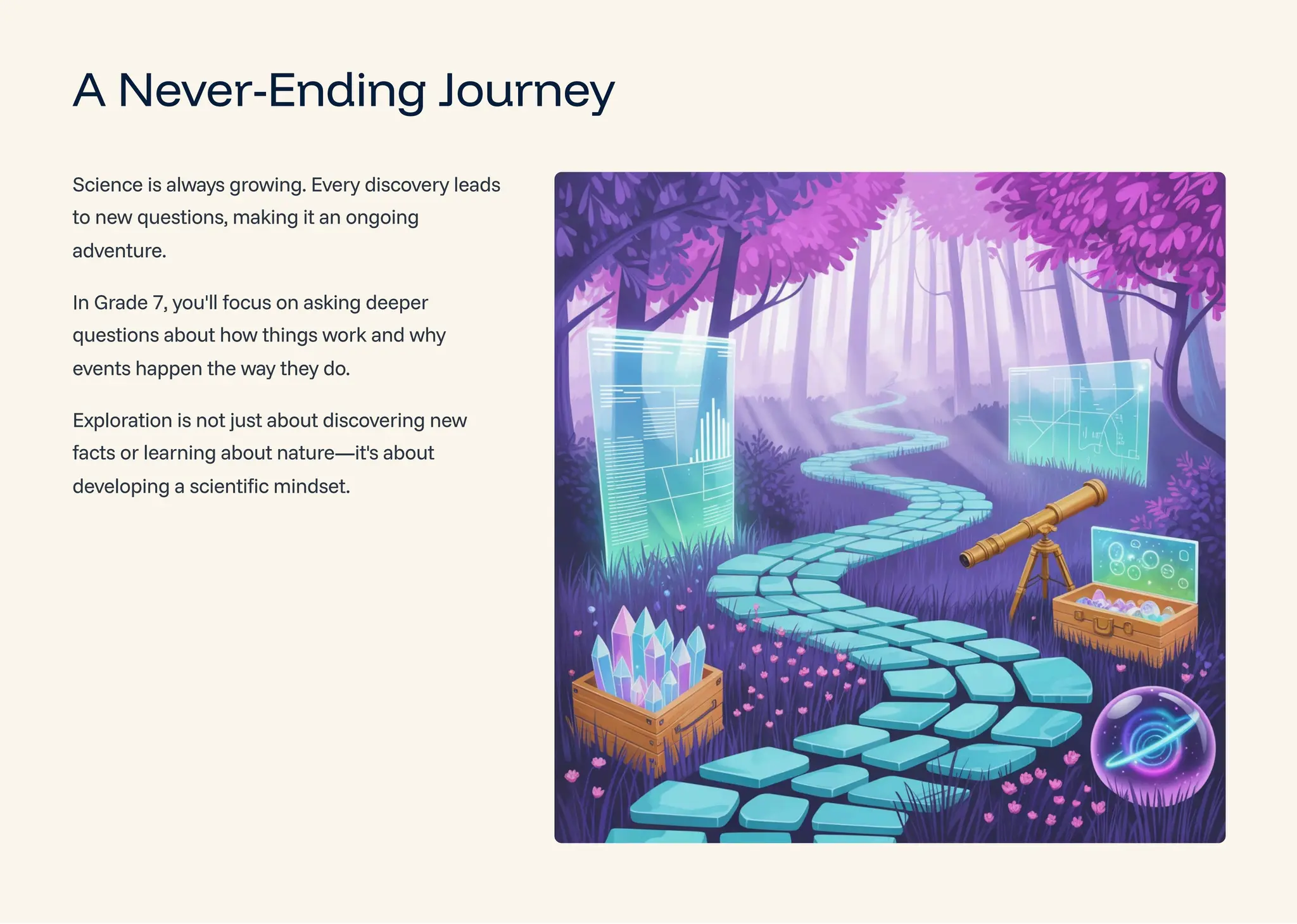
A Never-Ending Journey
Science is always growing. Every discovery leads
to new questions, making it an ongoing
adventure.
In Grade 7, you'll focus on asking deeper
questions about how things work and why
events happen the way they do.
Exploration is not just about discovering new
facts or learning about nature4it's about
developing a scientific mindset.
Responsibility to Nature
Environmental Impact
Science shows how human actions affect the environment. For example, pollution
can harm nature.
Sustainable Solutions
Science can help us find ways to protect the planet and make it more sustainable for
the future.
Connecting with Society
What we do affects the world, and science helps us understand our role in keeping
nature and society balanced.
Exploring Substances
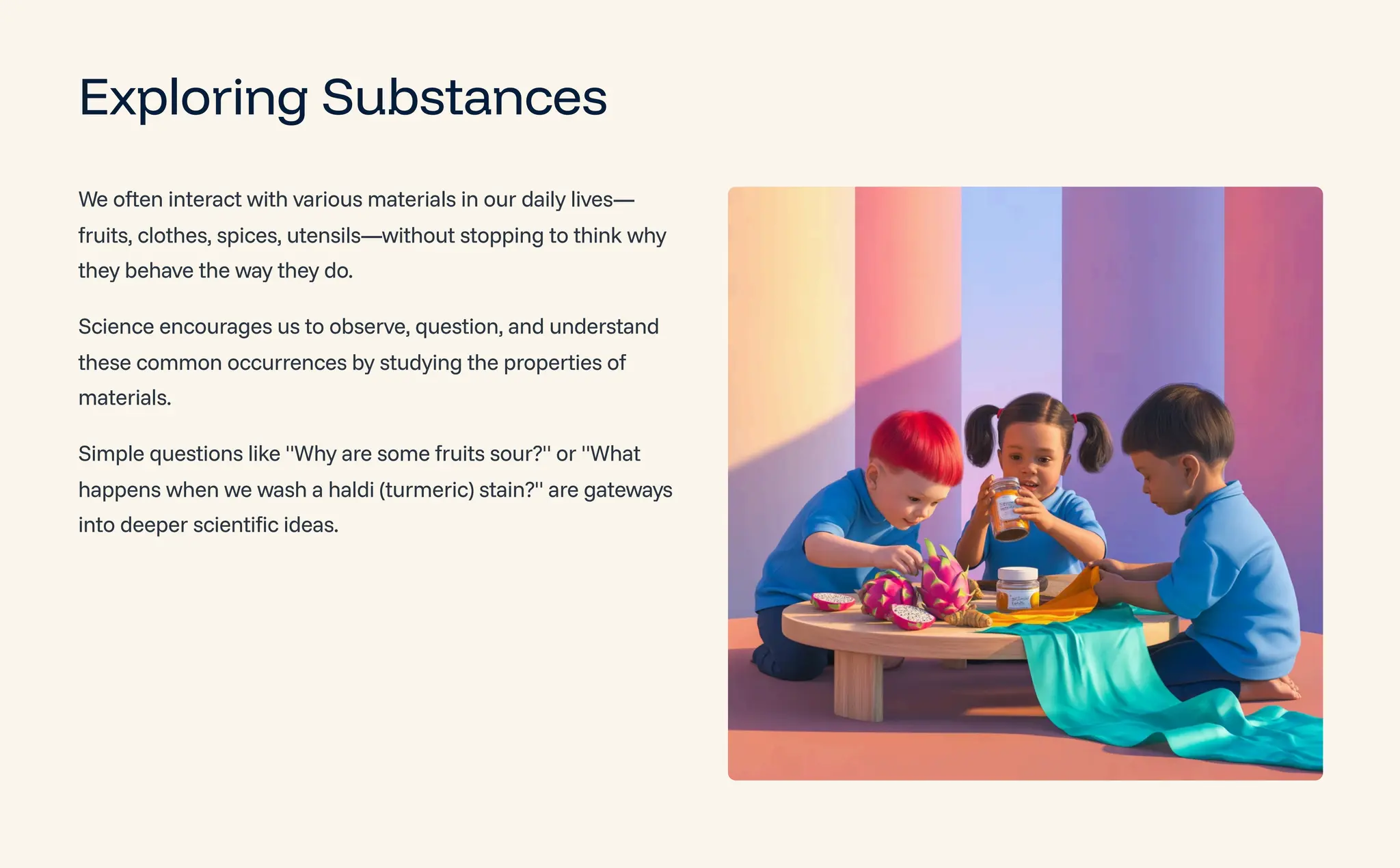
We often interact with various materials in our daily lives4
fruits, clothes, spices, utensils4without stopping to think why
they behave the way they do.
Science encourages us to observe, question, and understand
these common occurrences by studying the properties of
materials.
Simple questions like "Why are some fruits sour?" or "What
happens when we wash a haldi (turmeric) stain?" are gateways
into deeper scientific ideas.
Exploring Properties of Materials
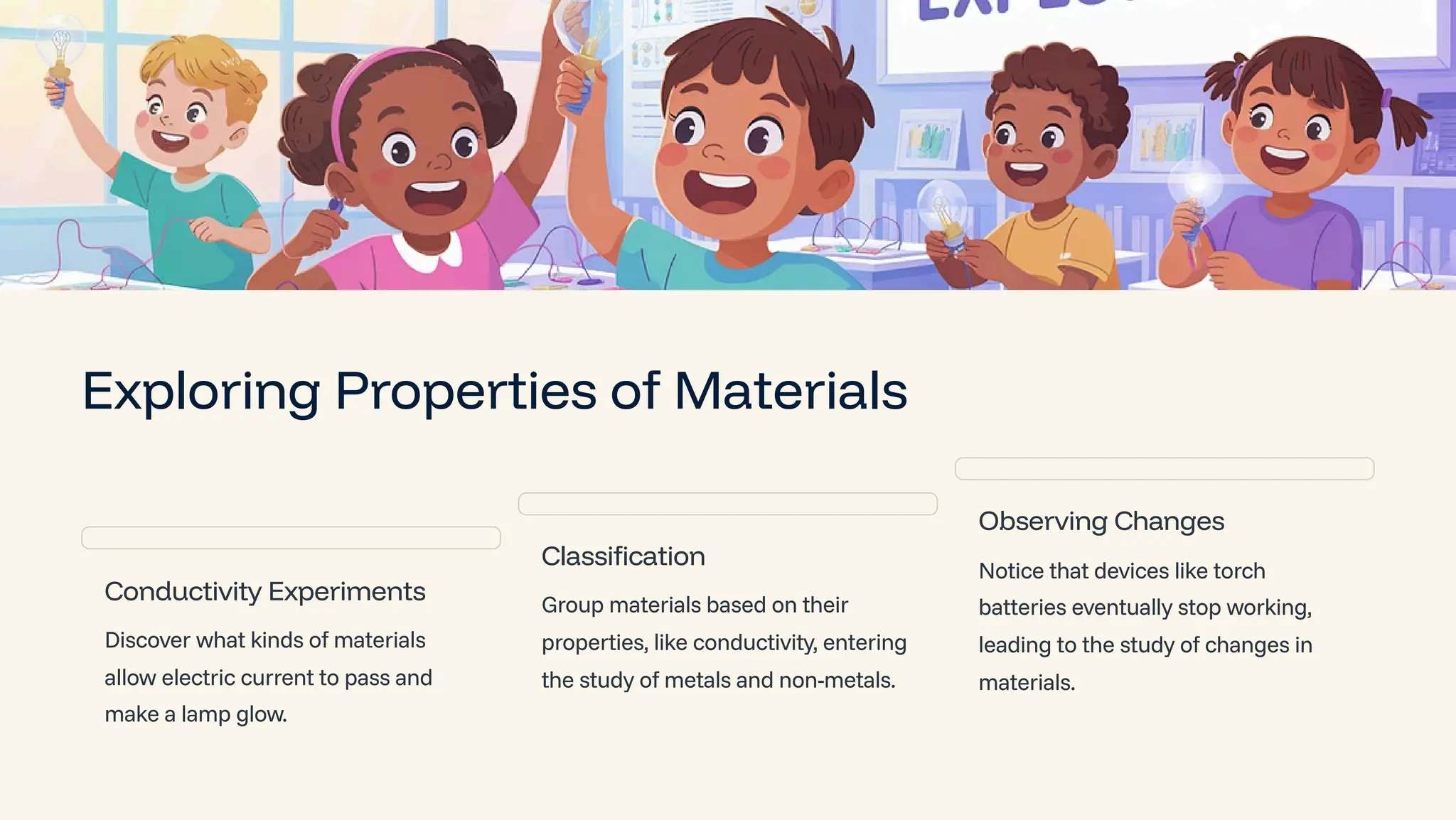
Conductivity Experiments
Discover what kinds of materials
allow electric current to pass and
make a lamp glow.
Classification
Group materials based on their
properties, like conductivity, entering
the study of metals and non-metals.
Observing Changes
Notice that devices like torch
batteries eventually stop working,
leading to the study of changes in
materials.
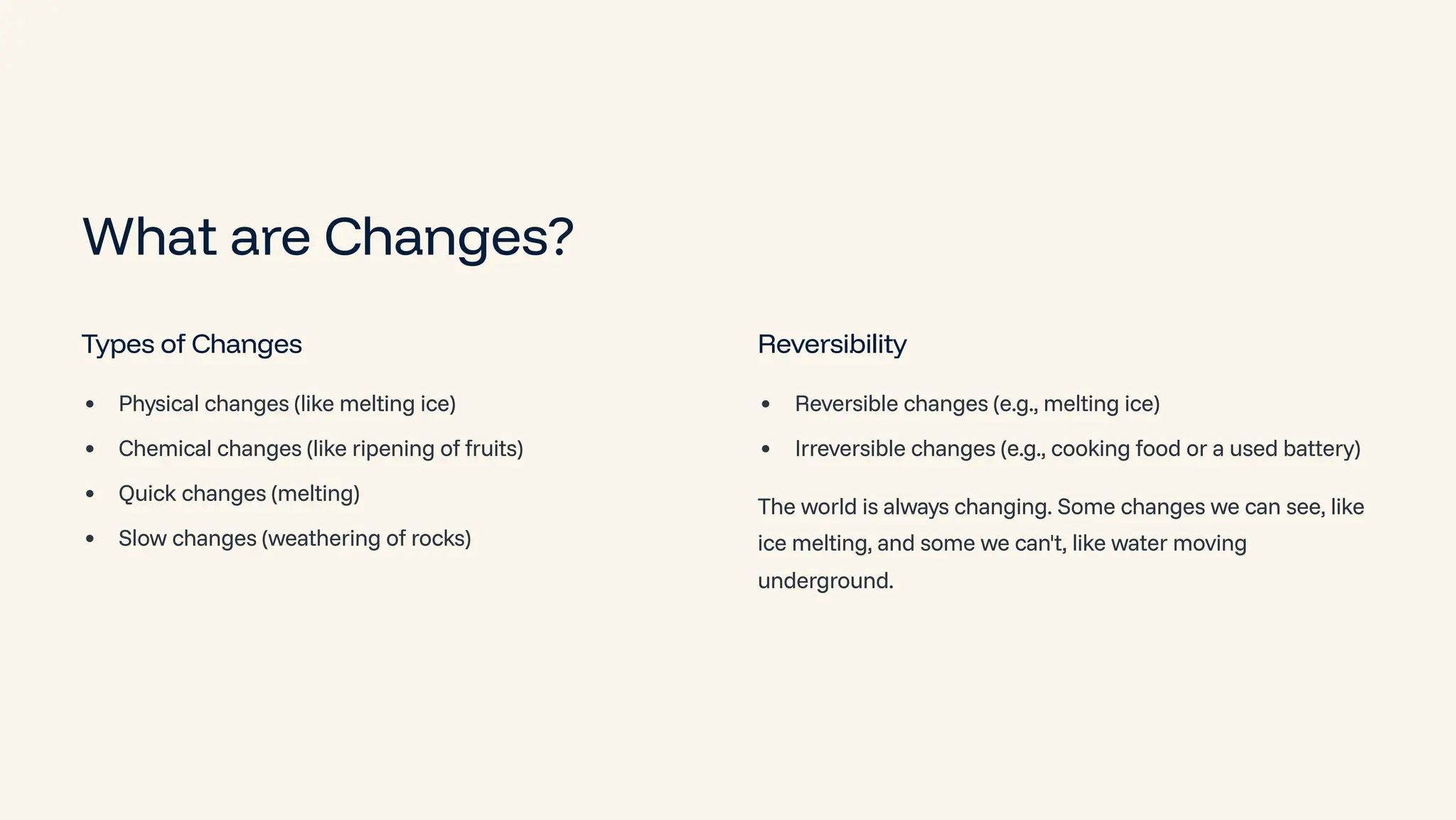
What are Changes?
Types of Changes
Physical changes (like melting ice)
Chemical changes (like ripening of fruits)
Quick changes (melting)
Slow changes (weathering of rocks)
Reversibility
Reversible changes (e.g., melting ice)
Irreversible changes (e.g., cooking food or a used battery)
The world is always changing. Some changes we can see, like
ice melting, and some we can't, like water moving
underground.
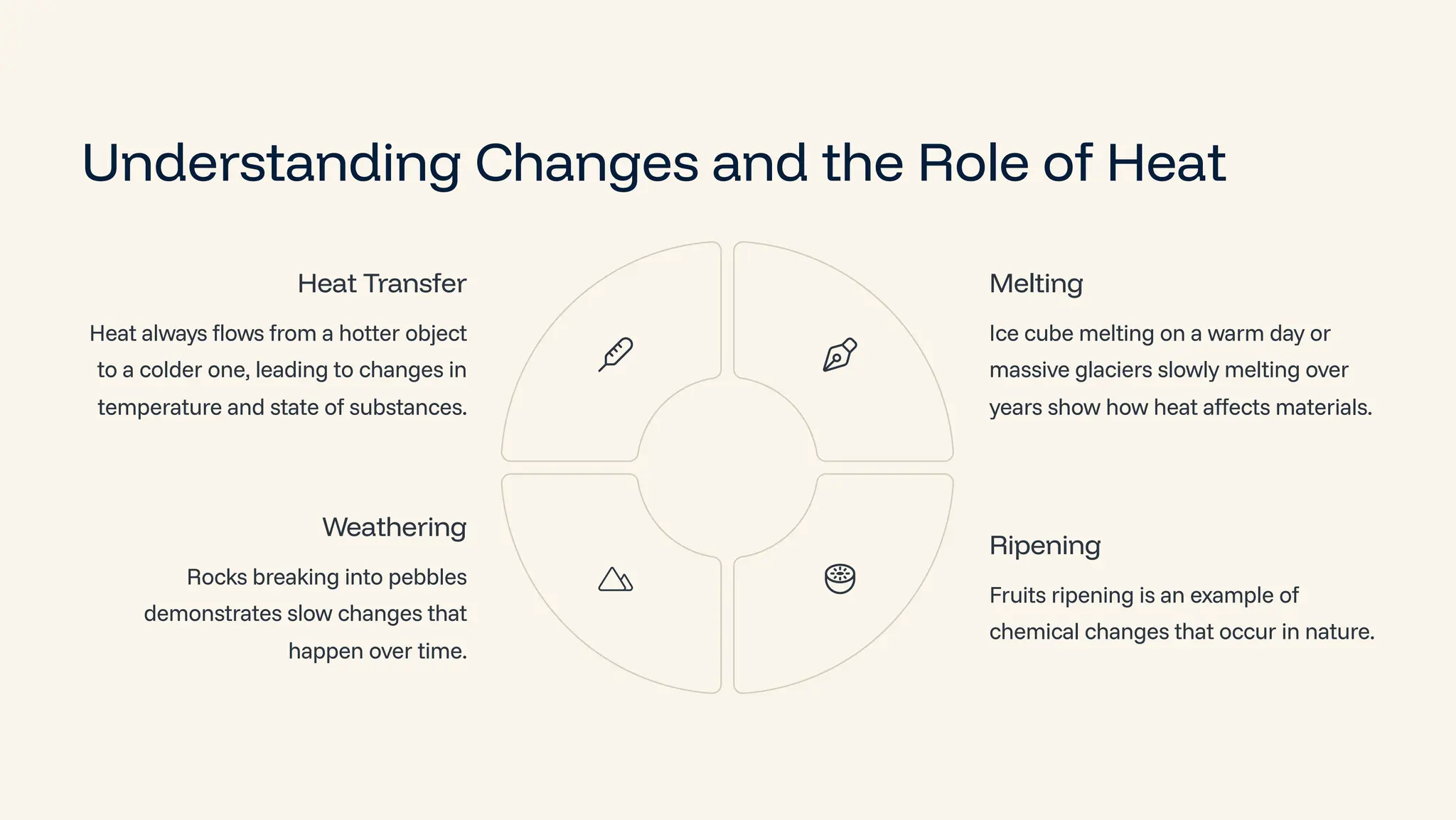
Understanding Changes and the Role of Heat
Heat Transfer
Heat always flows from a hotter object
to a colder one, leading to changes in
temperature and state of substances.
Melting
Ice cube melting on a warm day or
massive glaciers slowly melting over
years show how heat affects materials.
Ripening
Fruits ripening is an example of
chemical changes that occur in nature.
Weathering
Rocks breaking into pebbles
demonstrates slow changes that
happen over time.
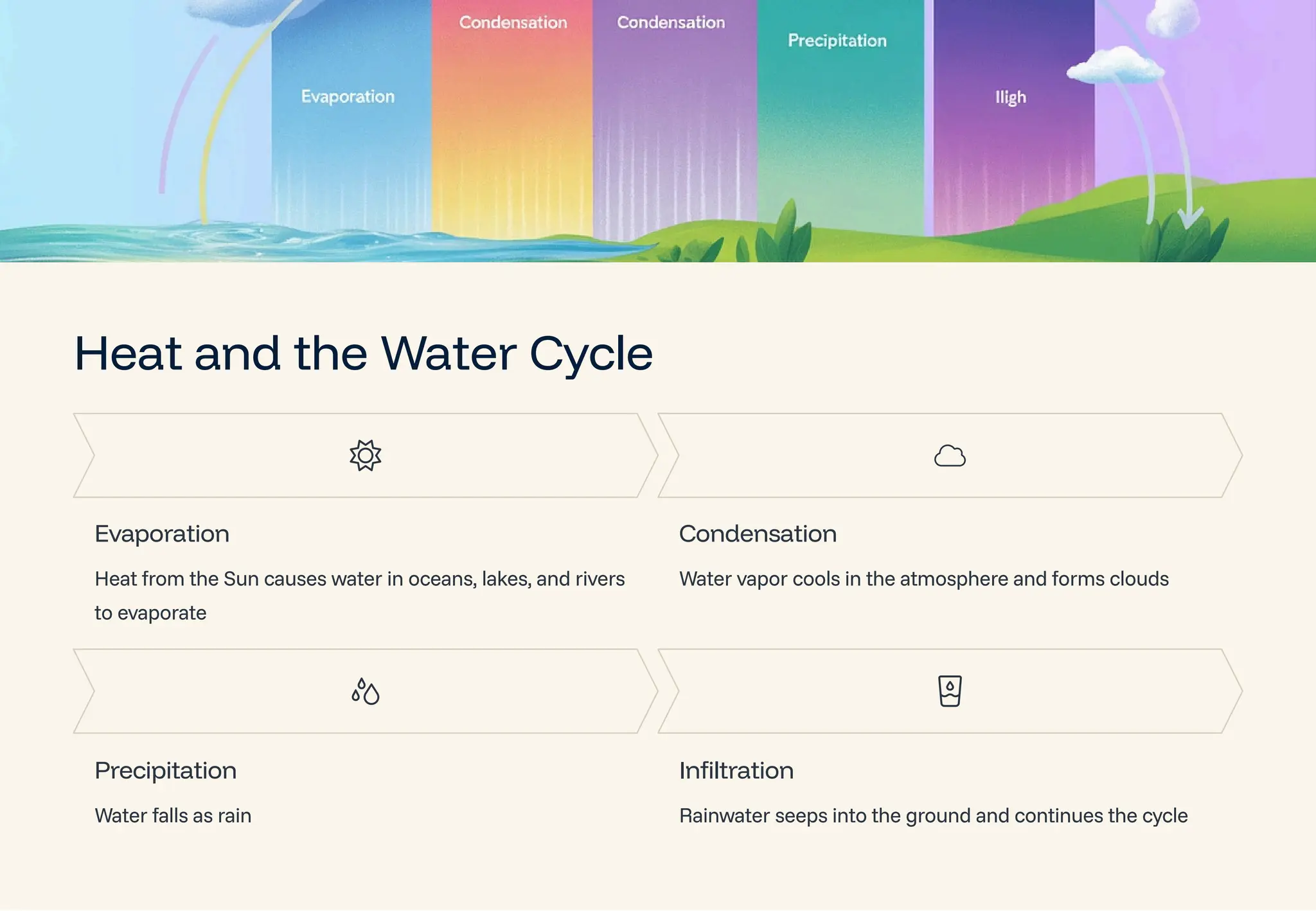
Heat and the Water Cycle
Evaporation
Heat from the Sun causes water in oceans, lakes, and rivers
to evaporate
Condensation
Water vapor cools in the atmosphere and forms clouds
Precipitation
Water falls as rain
Infiltration
Rainwater seeps into the ground and continues the cycle
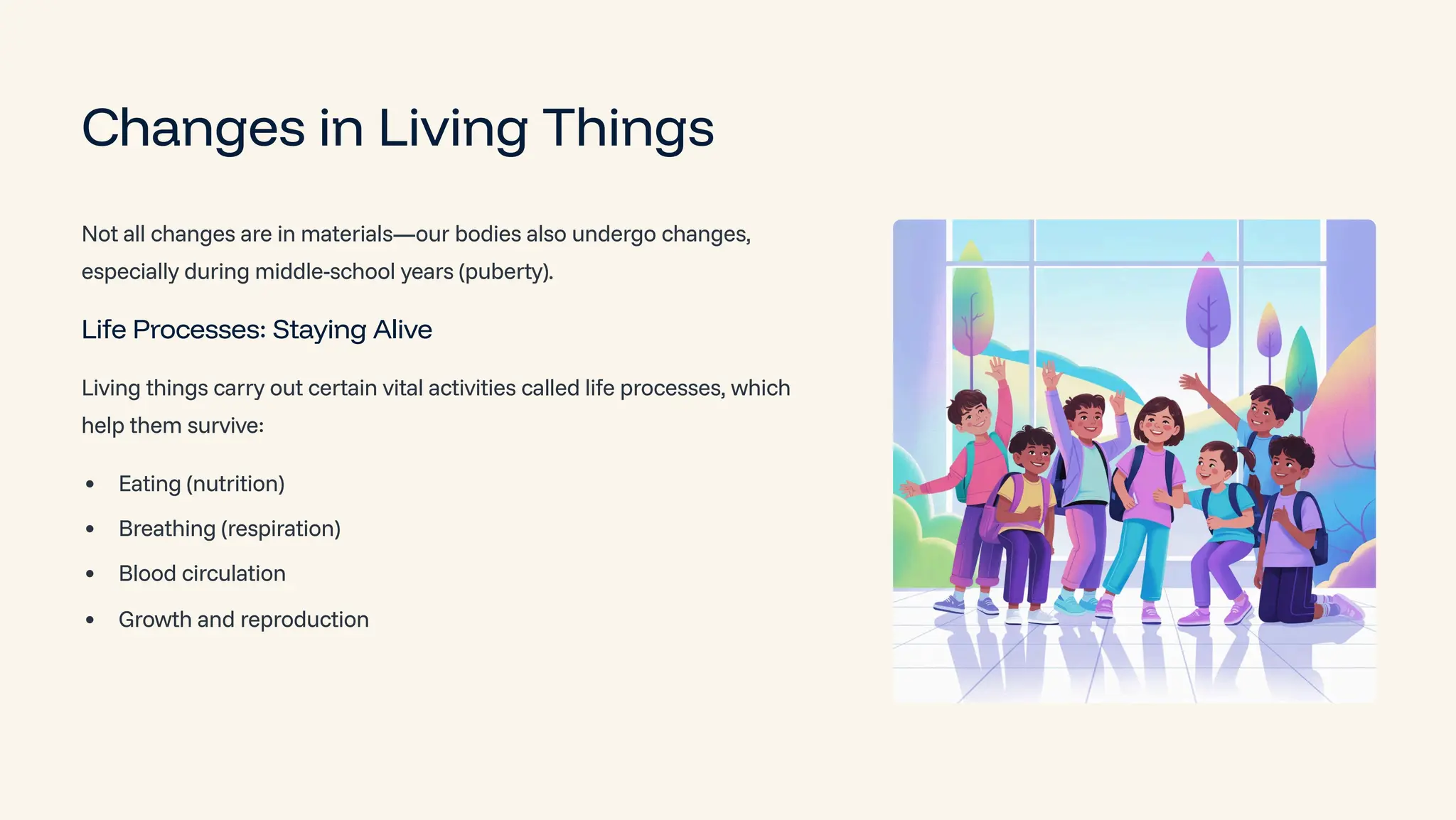
Changes in Living Things
Not all changes are in materials4our bodies also undergo changes,
especially during middle-school years (puberty).
Life Processes: Staying Alive
Living things carry out certain vital activities called life processes, which
help them survive:
Eating (nutrition)
Breathing (respiration)
Blood circulation
Growth and reproduction
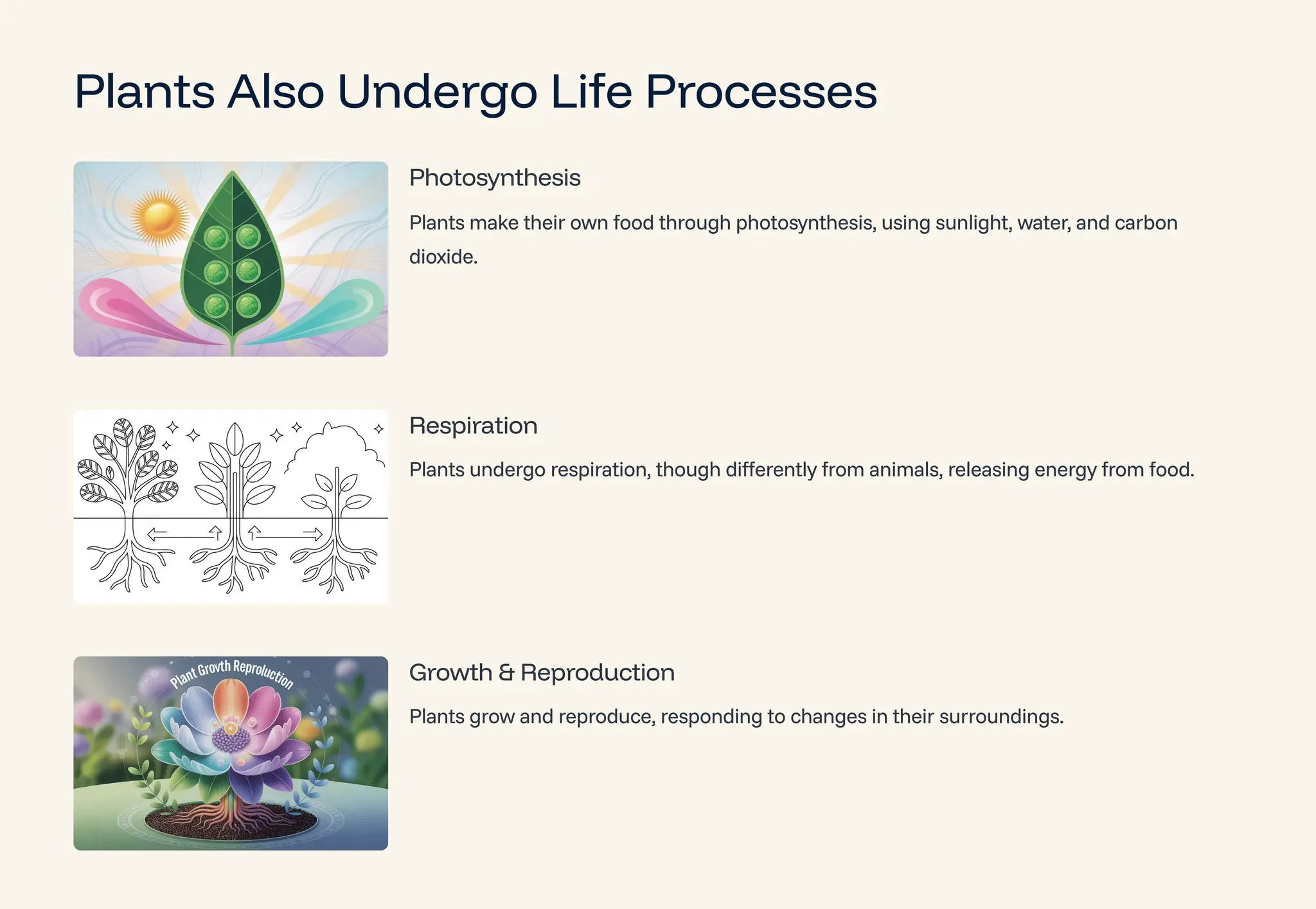
Plants Also Undergo Life Processes
Photosynthesis
Plants make their own food through photosynthesis, using sunlight, water, and carbon
dioxide.
Respiration
Plants undergo respiration, though differently from animals, releasing energy from food.
Growth & Reproduction
Plants grow and reproduce, responding to changes in their surroundings.
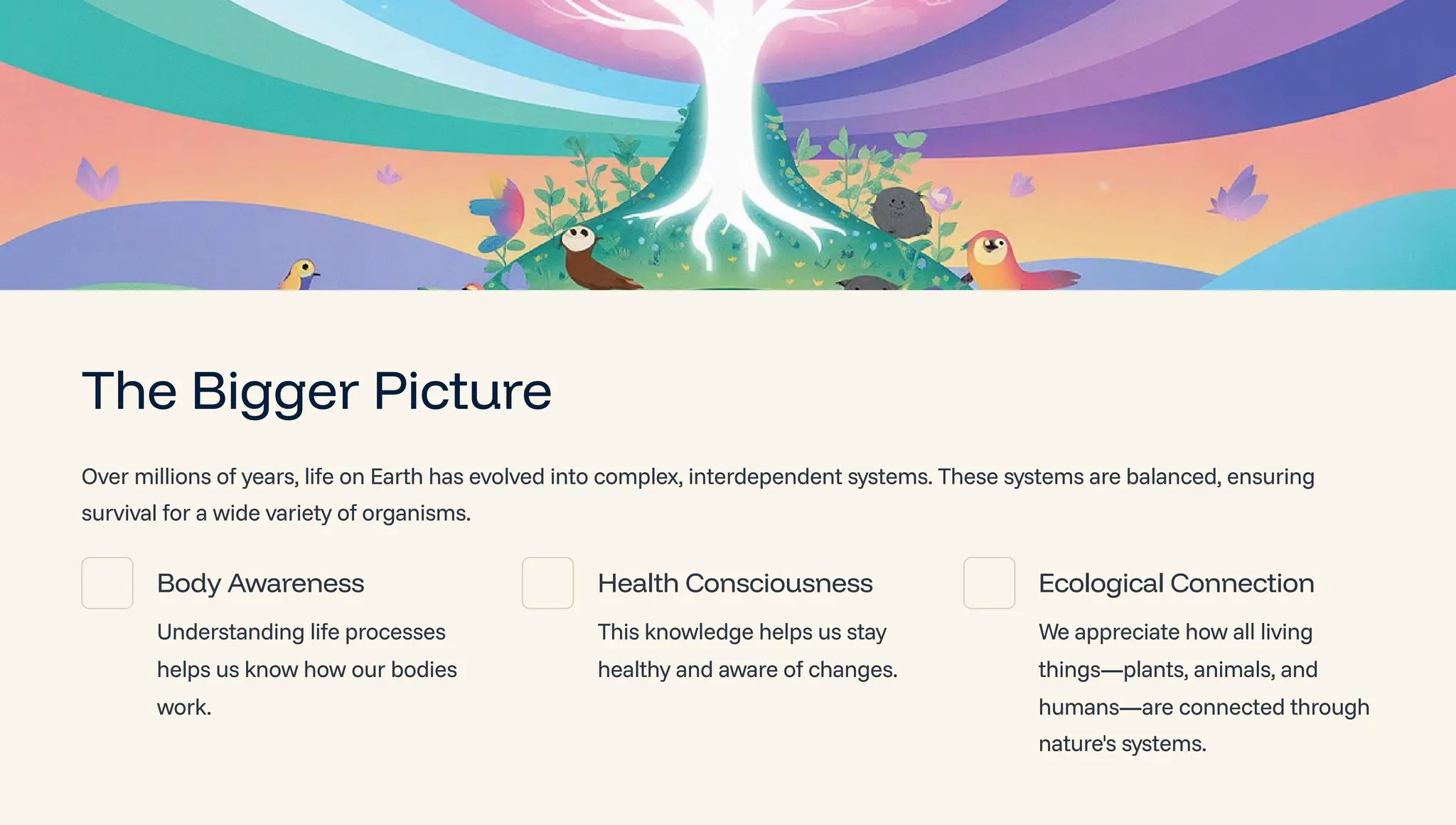
The Bigger Picture
Over millions of years, life on Earth has evolved into complex, interdependent systems. These systems are balanced, ensuring
survival for a wide variety of organisms.
Body Awareness
Understanding life processes
helps us know how our bodies
work.
Health Consciousness
This knowledge helps us stay
healthy and aware of changes.
Ecological Connection
We appreciate how all living
things4plants, animals, and
humans4are connected through
nature's systems.
Measuring Time
What is Time?
Time helps us organize our day, like knowing when to go to
school or sleep.
How We Measure Time:
Today, we use clocks and watches to tell time. Long ago,
people used the sun's shadows to measure time by watching
how shadows moved as the sun changed position in the sky.
Time affects when we wake up, eat, or sleep, and it's
connected to nature, like day and night.
Understanding time helps us plan our lives and learn how
nature works.
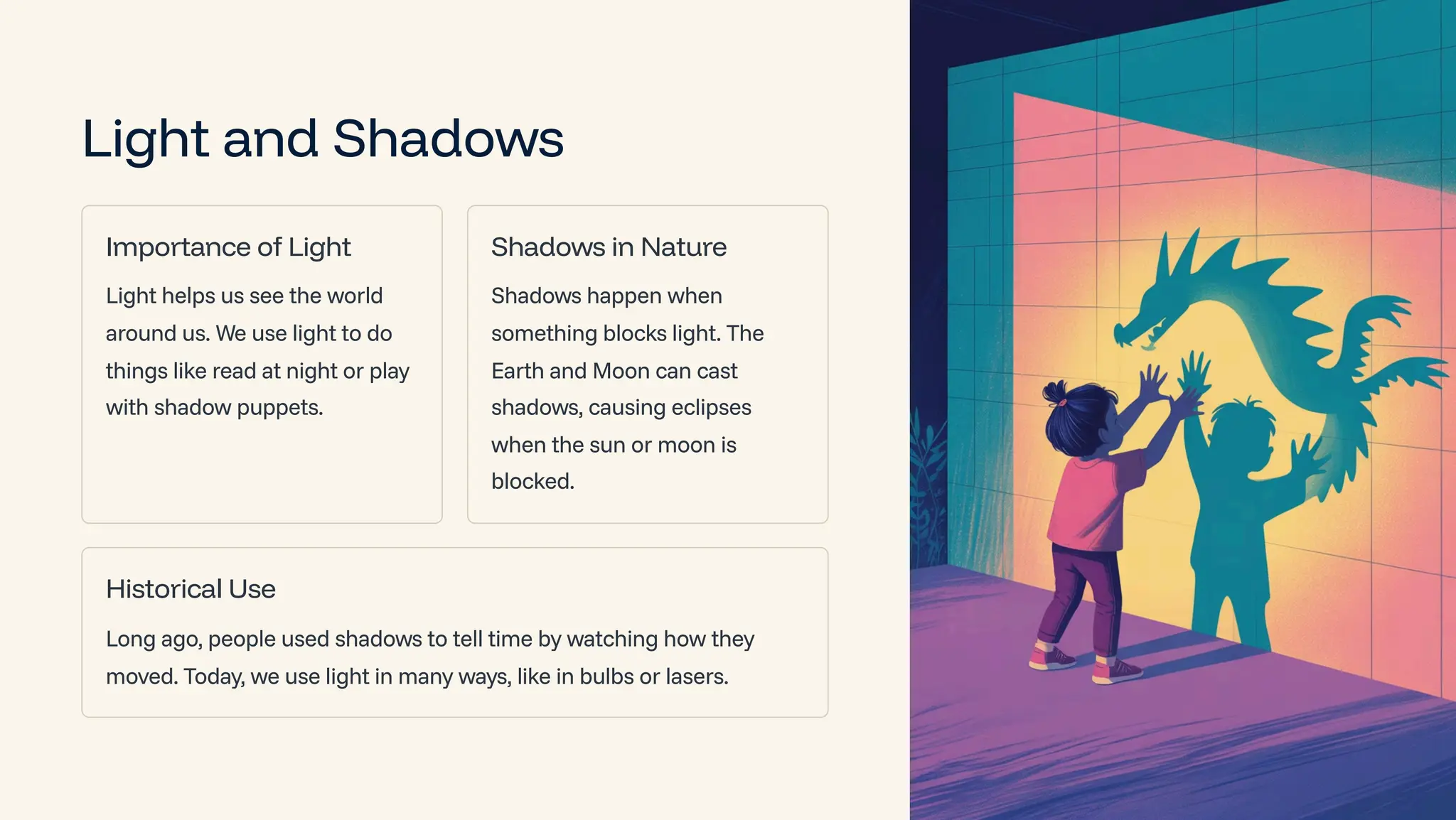
Light and Shadows
Importance of Light
Light helps us see the world
around us. We use light to do
things like read at night or play
with shadow puppets.
Shadows in Nature
Shadows happen when
something blocks light. The
Earth and Moon can cast
shadows, causing eclipses
when the sun or moon is
blocked.
Historical Use
Long ago, people used shadows to tell time by watching how they
moved. Today, we use light in many ways, like in bulbs or lasers.
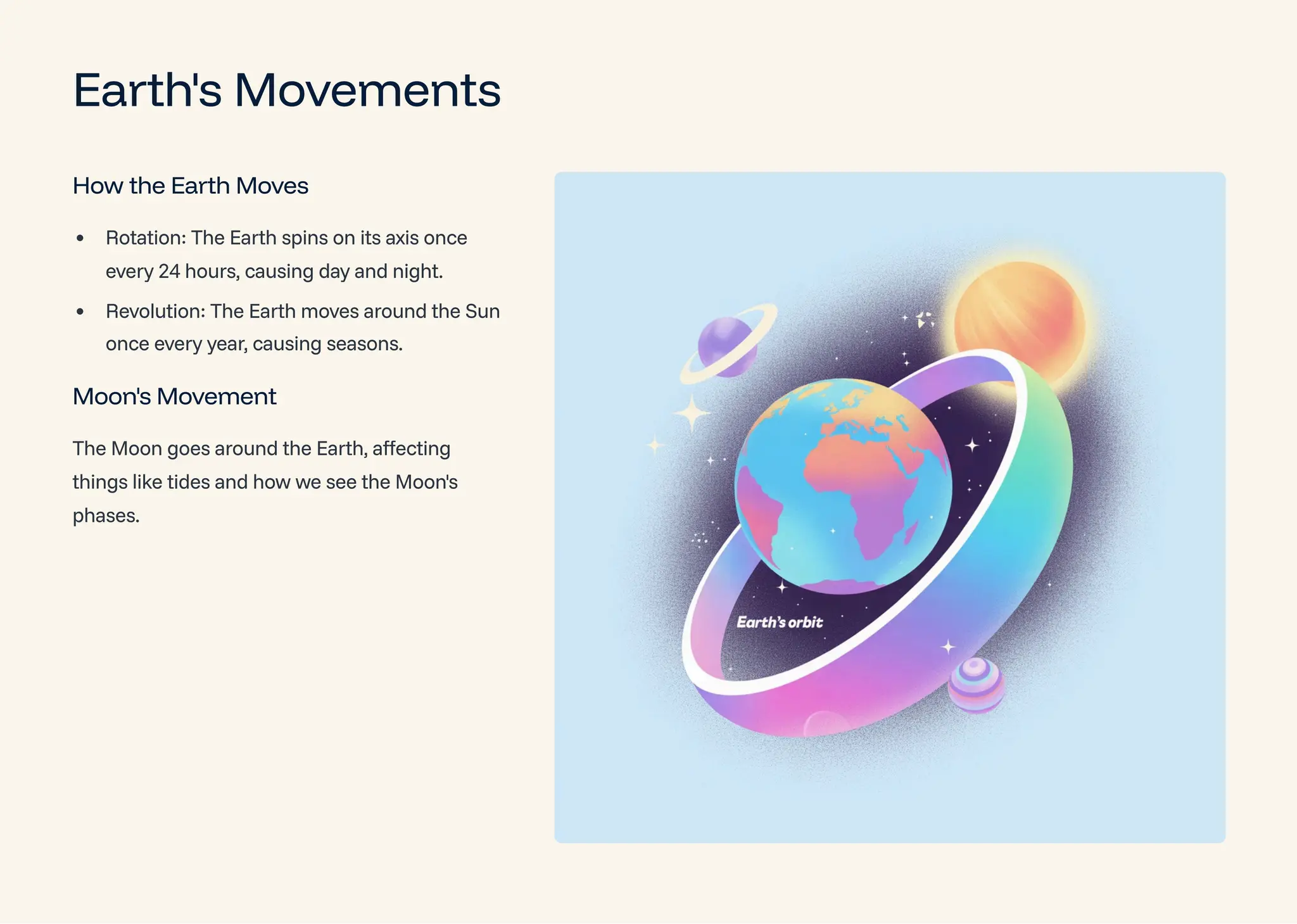
Earth's Movements
How the Earth Moves
Rotation: The Earth spins on its axis once
every 24 hours, causing day and night.
Revolution: The Earth moves around the Sun
once every year, causing seasons.
Moon's Movement
The Moon goes around the Earth, affecting
things like tides and how we see the Moon's
phases.
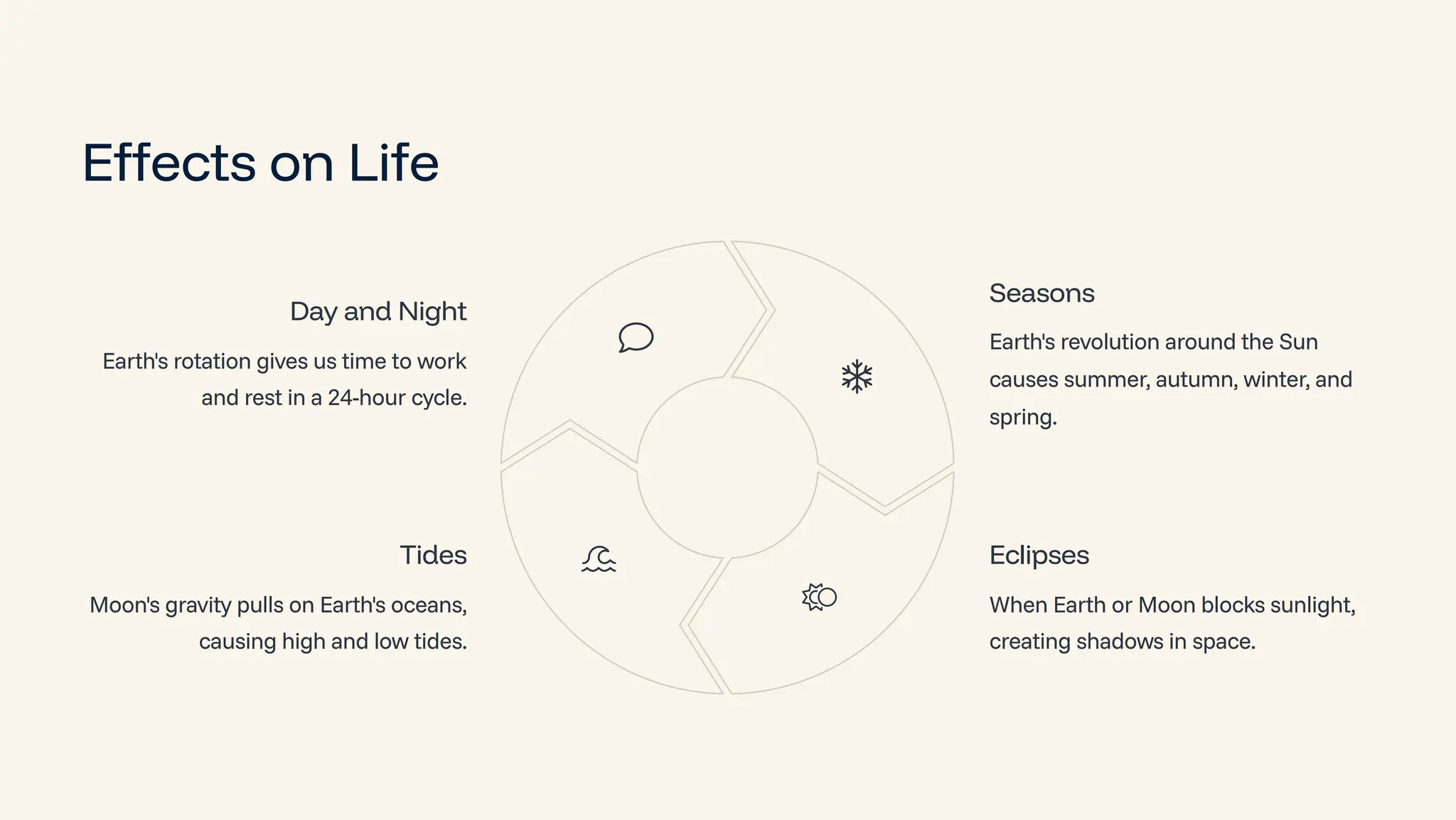
Effects on Life
Day and Night
Earth's rotation gives us time to work
and rest in a 24-hour cycle.
Seasons
Earth's revolution around the Sun
causes summer, autumn, winter, and
spring.
Eclipses
When Earth or Moon blocks sunlight,
creating shadows in space.
Tides
Moon's gravity pulls on Earth's oceans,
causing high and low tides.
Key Concepts to Remember
Science as Process
Science is an adventure where you ask questions, do experiments, and explore the
world with curiosity.
Connected Sciences
All sciences (physics, chemistry, biology, earth sciences) are connected, and ideas
from one help us understand others.
Material Properties
Materials have different properties, like conducting electricity, and we group them as
metals or non-metals.
Changes in Nature
Changes can be reversible or irreversible, and heat often causes or speeds up these
changes.
Difficult Words and Their Meanings
Curiosity: Wanting to know or learn more about
something
Properties: The qualities of something, like hardness or
conductivity
Classifying: Sorting things into groups based on
similarities
Reversible: A change that can go back to its original form
Irreversible: A change that cannot go back
Evaporates: When a liquid turns into a gas and rises into
the air
Nutrients: Things in food that help living things grow
Eclipses: When one object in space blocks light from
another
Rotation: When something spins around a center point
Revolution: When something moves in a circle around
another object

1.The-Ever-Evolving-World-of-Science.pdf7th class science curiosity By:K Sandeep Swamy(M.Sc,B.Ed)

  • 1.
    1.The Ever-Evolving Worldof Science 7th class science curiosity By:K Sandeep Swamy(M.Sc,B.Ed) For Online Classes (IITJEE & NEET foundation and academics) contact : 9491878325 Subscribe Samyans Eduhub youtube channel Science is everywhere4from tiny cells inside a leaf to the movement of the sun and stars. Each chapter will bring new adventures that challenge your thinking, expand your knowledge, and help you become a little explorer making your own discoveries.
  • 2.
    Science is anAdventure Exploring the World Science helps us understand both small and big things, from tiny cells inside a leaf to the way the sun and stars move in the sky. Asking Questions Science starts with curiosity. When you wonder "why" or "how" something happens, you're thinking like a scientist. Doing Experiments Experiments let you see how things work. Testing materials at home can teach you about their properties.
  • 3.
    Learning Takes Flight Beforestarting, take a moment to notice something special4 the page numbers follow the playful flight of a butterfly and a soaring paper plane! Just like a butterfly flutters freely and a paper plane flies high, learning takes flight when guided by curiosity. Did you know that simple things like paper planes inspired real scientific studies of flight? From early inventors watching bird wings to modern engineers designing aircraft, flying began with simple observations and experiments.
  • 4.
    Science as aWay of Thinking Science is a process4a way of thinking that encourages curiosity, asks questions, and stays open to the unknown. Ask Questions How do things work? Why do events happen the way they do? Explore & Observe Step outside the book to understand science through experiments and observation. Discover Patterns What can we learn from patterns in nature?
  • 5.
    A Never-Ending Journey Scienceis always growing. Every discovery leads to new questions, making it an ongoing adventure. In Grade 7, you'll focus on asking deeper questions about how things work and why events happen the way they do. Exploration is not just about discovering new facts or learning about nature4it's about developing a scientific mindset.
  • 6.
    Responsibility to Nature EnvironmentalImpact Science shows how human actions affect the environment. For example, pollution can harm nature. Sustainable Solutions Science can help us find ways to protect the planet and make it more sustainable for the future. Connecting with Society What we do affects the world, and science helps us understand our role in keeping nature and society balanced.
  • 7.
    Exploring Substances We ofteninteract with various materials in our daily lives4 fruits, clothes, spices, utensils4without stopping to think why they behave the way they do. Science encourages us to observe, question, and understand these common occurrences by studying the properties of materials. Simple questions like "Why are some fruits sour?" or "What happens when we wash a haldi (turmeric) stain?" are gateways into deeper scientific ideas.
  • 8.
    Exploring Properties ofMaterials Conductivity Experiments Discover what kinds of materials allow electric current to pass and make a lamp glow. Classification Group materials based on their properties, like conductivity, entering the study of metals and non-metals. Observing Changes Notice that devices like torch batteries eventually stop working, leading to the study of changes in materials.
  • 9.
    What are Changes? Typesof Changes Physical changes (like melting ice) Chemical changes (like ripening of fruits) Quick changes (melting) Slow changes (weathering of rocks) Reversibility Reversible changes (e.g., melting ice) Irreversible changes (e.g., cooking food or a used battery) The world is always changing. Some changes we can see, like ice melting, and some we can't, like water moving underground.
  • 10.
    Understanding Changes andthe Role of Heat Heat Transfer Heat always flows from a hotter object to a colder one, leading to changes in temperature and state of substances. Melting Ice cube melting on a warm day or massive glaciers slowly melting over years show how heat affects materials. Ripening Fruits ripening is an example of chemical changes that occur in nature. Weathering Rocks breaking into pebbles demonstrates slow changes that happen over time.
  • 11.
    Heat and theWater Cycle Evaporation Heat from the Sun causes water in oceans, lakes, and rivers to evaporate Condensation Water vapor cools in the atmosphere and forms clouds Precipitation Water falls as rain Infiltration Rainwater seeps into the ground and continues the cycle
  • 12.
    Changes in LivingThings Not all changes are in materials4our bodies also undergo changes, especially during middle-school years (puberty). Life Processes: Staying Alive Living things carry out certain vital activities called life processes, which help them survive: Eating (nutrition) Breathing (respiration) Blood circulation Growth and reproduction
  • 13.
    Plants Also UndergoLife Processes Photosynthesis Plants make their own food through photosynthesis, using sunlight, water, and carbon dioxide. Respiration Plants undergo respiration, though differently from animals, releasing energy from food. Growth & Reproduction Plants grow and reproduce, responding to changes in their surroundings.
  • 14.
    The Bigger Picture Overmillions of years, life on Earth has evolved into complex, interdependent systems. These systems are balanced, ensuring survival for a wide variety of organisms. Body Awareness Understanding life processes helps us know how our bodies work. Health Consciousness This knowledge helps us stay healthy and aware of changes. Ecological Connection We appreciate how all living things4plants, animals, and humans4are connected through nature's systems.
  • 15.
    Measuring Time What isTime? Time helps us organize our day, like knowing when to go to school or sleep. How We Measure Time: Today, we use clocks and watches to tell time. Long ago, people used the sun's shadows to measure time by watching how shadows moved as the sun changed position in the sky. Time affects when we wake up, eat, or sleep, and it's connected to nature, like day and night. Understanding time helps us plan our lives and learn how nature works.
  • 16.
    Light and Shadows Importanceof Light Light helps us see the world around us. We use light to do things like read at night or play with shadow puppets. Shadows in Nature Shadows happen when something blocks light. The Earth and Moon can cast shadows, causing eclipses when the sun or moon is blocked. Historical Use Long ago, people used shadows to tell time by watching how they moved. Today, we use light in many ways, like in bulbs or lasers.
  • 17.
    Earth's Movements How theEarth Moves Rotation: The Earth spins on its axis once every 24 hours, causing day and night. Revolution: The Earth moves around the Sun once every year, causing seasons. Moon's Movement The Moon goes around the Earth, affecting things like tides and how we see the Moon's phases.
  • 18.
    Effects on Life Dayand Night Earth's rotation gives us time to work and rest in a 24-hour cycle. Seasons Earth's revolution around the Sun causes summer, autumn, winter, and spring. Eclipses When Earth or Moon blocks sunlight, creating shadows in space. Tides Moon's gravity pulls on Earth's oceans, causing high and low tides.
  • 19.
    Key Concepts toRemember Science as Process Science is an adventure where you ask questions, do experiments, and explore the world with curiosity. Connected Sciences All sciences (physics, chemistry, biology, earth sciences) are connected, and ideas from one help us understand others. Material Properties Materials have different properties, like conducting electricity, and we group them as metals or non-metals. Changes in Nature Changes can be reversible or irreversible, and heat often causes or speeds up these changes.
  • 20.
    Difficult Words andTheir Meanings Curiosity: Wanting to know or learn more about something Properties: The qualities of something, like hardness or conductivity Classifying: Sorting things into groups based on similarities Reversible: A change that can go back to its original form Irreversible: A change that cannot go back Evaporates: When a liquid turns into a gas and rises into the air Nutrients: Things in food that help living things grow Eclipses: When one object in space blocks light from another Rotation: When something spins around a center point Revolution: When something moves in a circle around another object