Change Towards Doom!
Climate change
through the decades
Decade 1 :
1980-1990
The development of the
climate change regime in
the late 1980s and early
1990s rode a wave of
environmental activity,
which began in 1987 with
the discovery of the
stratospheric “ozone
hole”.
By the early 1980s, the
slight cooling trend from
1945-1975 had stopped.
Aerosol pollution had
decreased in many areas
due to environmental
legislation and changes in
fuel use, and it became
clear that the cooling effect
from aerosols was not
going to increase
substantially while carbon
dioxide levels were
progressively increasing.
Decade 1 :
1990-2000
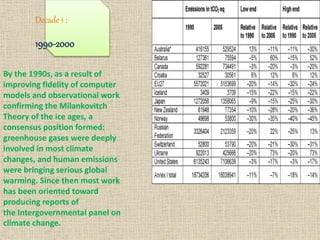
By the 1990s, as a result of
improving fidelity of computer
models and observational work
confirming the Milankovitch
Theory of the ice ages, a
consensus position formed:
greenhouse gases were deeply
involved in most climate
changes, and human emissions
were bringing serious global
warming. Since then most work
has been oriented toward
producing reports of
the Intergovernmental panel on
climate change.
THE 21st century
The following is a predicted timeline for events that will likely
occur this century:
2007—More of the world's population now lives in cities than in
rural areas, which is changing patterns of land use and rainfall
patterns. The world population will surpass 6.6 billion.
2008—Global oil production will peak between 2008
and 2018. Once “Hubbert's” Peak is reached, global oil
production will begin an irreversible decline, possibly
triggering a global recession, food shortages and
conflict between nations over dwindling oil supplies.
2020—Flash floods will very likely increase across
all parts of Europe.
Less rainfall could reduce agriculture yields by up to
50 percent in some parts of the world.
World population will reach 7.6 billion people.
2030—Up to 18 percent of the world's coral reefs will likely
be lost as a result of climate change and other environmental
stresses. In Asian coastal waters, the coral loss could reach
30 percent.
World population will reach 8.3 billion people.
Warming temperatures will cause temperate glaciers on
equatorial mountains in Africa to disappear.
In developing countries, the urban population will more than
double.
2040—The Arctic Sea could be ice-free in the summer, and
winter ice depth may shrink drastically. However, some
researchers argue that the region could still have summer ice up
until between 2060 and 2105.
2050—Small alpine glaciers will very likely disappear
completely, and large glaciers will shrink by 30 to 70 percent.
Austrian scientist Roland Psenner of the University of Innsbruck
says this is a conservative estimate, and the small alpine glaciers
could be gone as soon as 2037.
In Australia, there will likely be an additional 3,200 to 5,200 heat-
related deaths per year. The hardest hit will be people over the
age of 65. An extra 500 to 1,000 people will die of heat-related
deaths in New York City per year. In the United Kingdom, the
opposite will occur, and cold-related deaths will outpace heat-
related ones.
World population reaches 9.4 billion people.
Crop yields could increase by up to 20 percent in East and
Southeast Asia, while decreasing by up to 30 percent in Central
and South Asia. Similar shifts in crop yields may occur on other
continents.
As biodiversity hotspots are more threatened, a quarter of the
world's plant and vertebrate animal species could face extinction.
2070—As glaciers disappear and areas affected by drought
increase, electricity production for the world's existing
hydropower stations will decrease. Hardest hit will be Europe,
where hydropower potential is expected to decline on average by
6 percent; around the Mediterranean, the decrease could be up
to 50 percent.
2080—While some parts of the world dry out, others will be
inundated. Up to 100 million people could experience coastal
flooding each year. Most at risk are densely populated and low-
lying areas that are less able to adapt to rising sea levels and
areas which already face other challenges such as tropical
storms.
Between 1.1 and 3.2 billion people will experience water
shortages and up to 600 million will go hungry.
Sea levels could rise around New York City by more than three
feet, potentially causing extensive flooding around the city.
2085—The risk of dengue fever from climate change is estimated to
increase to 3.5 billion people.
2100—A combination of global warming and other factors will push
many ecosystems to the limit, forcing them to exceed their natural
ability to adapt to climate change.
Atmospheric carbon dioxide levels will be much higher than anytime
during the past 650,000 years.
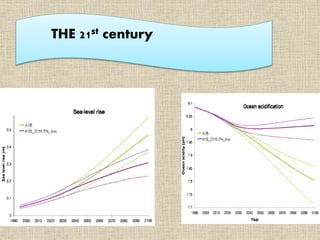
Ocean pH levels will very likely decrease by as much as 0.5 pH units,
the lowest it's been in the last 20 million years. The ability of marine
organisms such as corals, crabs and oysters to form shells or
exoskeletons could be impaired.
Thawing permafrost and other factors will make Earth's land a net
source of carbon emissions, meaning it will emit more carbon dioxide
into the atmosphere than it absorbs.
Nearly up to one third of all species of plants and land animals-more
than a million total-could be driven to extinction.

Change towards doom!

  • 1.
    Change Towards Doom! Climatechange through the decades
  • 2.
    Decade 1 : 1980-1990 Thedevelopment of the climate change regime in the late 1980s and early 1990s rode a wave of environmental activity, which began in 1987 with the discovery of the stratospheric “ozone hole”. By the early 1980s, the slight cooling trend from 1945-1975 had stopped. Aerosol pollution had decreased in many areas due to environmental legislation and changes in fuel use, and it became clear that the cooling effect from aerosols was not going to increase substantially while carbon dioxide levels were progressively increasing.
  • 3.
    Decade 1 : 1990-2000 Bythe 1990s, as a result of improving fidelity of computer models and observational work confirming the Milankovitch Theory of the ice ages, a consensus position formed: greenhouse gases were deeply involved in most climate changes, and human emissions were bringing serious global warming. Since then most work has been oriented toward producing reports of the Intergovernmental panel on climate change.
  • 4.
  • 6.
    The following isa predicted timeline for events that will likely occur this century: 2007—More of the world's population now lives in cities than in rural areas, which is changing patterns of land use and rainfall patterns. The world population will surpass 6.6 billion. 2008—Global oil production will peak between 2008 and 2018. Once “Hubbert's” Peak is reached, global oil production will begin an irreversible decline, possibly triggering a global recession, food shortages and conflict between nations over dwindling oil supplies.
  • 7.
    2020—Flash floods willvery likely increase across all parts of Europe. Less rainfall could reduce agriculture yields by up to 50 percent in some parts of the world. World population will reach 7.6 billion people. 2030—Up to 18 percent of the world's coral reefs will likely be lost as a result of climate change and other environmental stresses. In Asian coastal waters, the coral loss could reach 30 percent. World population will reach 8.3 billion people. Warming temperatures will cause temperate glaciers on equatorial mountains in Africa to disappear. In developing countries, the urban population will more than double.
  • 8.
    2040—The Arctic Seacould be ice-free in the summer, and winter ice depth may shrink drastically. However, some researchers argue that the region could still have summer ice up until between 2060 and 2105. 2050—Small alpine glaciers will very likely disappear completely, and large glaciers will shrink by 30 to 70 percent. Austrian scientist Roland Psenner of the University of Innsbruck says this is a conservative estimate, and the small alpine glaciers could be gone as soon as 2037. In Australia, there will likely be an additional 3,200 to 5,200 heat- related deaths per year. The hardest hit will be people over the age of 65. An extra 500 to 1,000 people will die of heat-related deaths in New York City per year. In the United Kingdom, the opposite will occur, and cold-related deaths will outpace heat- related ones. World population reaches 9.4 billion people. Crop yields could increase by up to 20 percent in East and Southeast Asia, while decreasing by up to 30 percent in Central and South Asia. Similar shifts in crop yields may occur on other continents. As biodiversity hotspots are more threatened, a quarter of the world's plant and vertebrate animal species could face extinction.
  • 9.
    2070—As glaciers disappearand areas affected by drought increase, electricity production for the world's existing hydropower stations will decrease. Hardest hit will be Europe, where hydropower potential is expected to decline on average by 6 percent; around the Mediterranean, the decrease could be up to 50 percent. 2080—While some parts of the world dry out, others will be inundated. Up to 100 million people could experience coastal flooding each year. Most at risk are densely populated and low- lying areas that are less able to adapt to rising sea levels and areas which already face other challenges such as tropical storms. Between 1.1 and 3.2 billion people will experience water shortages and up to 600 million will go hungry. Sea levels could rise around New York City by more than three feet, potentially causing extensive flooding around the city.
  • 10.
    2085—The risk ofdengue fever from climate change is estimated to increase to 3.5 billion people. 2100—A combination of global warming and other factors will push many ecosystems to the limit, forcing them to exceed their natural ability to adapt to climate change. Atmospheric carbon dioxide levels will be much higher than anytime during the past 650,000 years. Ocean pH levels will very likely decrease by as much as 0.5 pH units, the lowest it's been in the last 20 million years. The ability of marine organisms such as corals, crabs and oysters to form shells or exoskeletons could be impaired. Thawing permafrost and other factors will make Earth's land a net source of carbon emissions, meaning it will emit more carbon dioxide into the atmosphere than it absorbs. Nearly up to one third of all species of plants and land animals-more than a million total-could be driven to extinction.