@tsiacommunity | #TSW18
Change Management – A Human Aspect
Liz Holland | Dell | @LZHolland
@tsiacommunity | #TSW18
Liz Holland
2
• Held leadership managed services roles at Dell EMC
• Delivery Operations, Service Management, Service
Enablement, Transformation, PMO, and Professional Services
• Matured the operating model for the scale of the business
• Lead evolution to next-gen MS transformation program
• Deep expertise leading large IT Svc change programs
• Prior work: Virtustream, EDS, and Tyler Technologies
• Dell Technologies: $79.9B revenues, 180 countries, serve
99% of Fortune 500, 145k team, 30k services team
20 years in IT
NYC based
Sr Director Managed Services
@tsiacommunity | #TSW18
Change Today is Exponential
• Moore’s law – states the value compute power
doubles every Eighteen months (1960)
• Reed's law is the assertion of David P. Reed that
the utility of large networks, particularly social networks,
can scale exponentially with the size of the network.
(2001)
@tsiacommunity | #TSW18 4
Today Change is Continuous
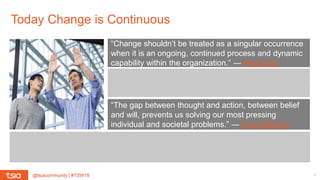
“Change shouldn’t be treated as a singular occurrence
when it is an ongoing, continued process and dynamic
capability within the organization.” ― Pearl Zhu
“The gap between thought and action, between belief
and will, prevents us solving our most pressing
individual and societal problems.” ― Paul Gibbons
@tsiacommunity | #TSW18
Change Management – A Human Aspect
Change Management Definition
5
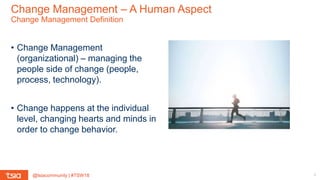
• Change Management
(organizational) – managing the
people side of change (people,
process, technology).
• Change happens at the individual
level, changing hearts and minds in
order to change behavior.
@tsiacommunity | #TSW18
Why change? Is your organization ready?
6
• Is the organization ready
for a change?
• Set a simple vision that
could be cascaded to
every individual in the
organization.
@tsiacommunity | #TSW18 7
Set the Vision
@tsiacommunity | #TSW18
Set the vision
8
• Simple
• High level
• Understandable
@tsiacommunity | #TSW18
How to ensure successful organizational change
9
• Champion who is
committed
• Core change team –
energetic, resilient,
evangelist
• Stakeholders are aligned
• Measurable
@tsiacommunity | #TSW18
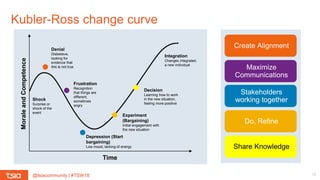
Kubler-Ross change curve
10
Create Alignment
Maximize
Communications
Stakeholders
working together
Do, Refine
Share Knowledge
MoraleandCompetence
Shock
Surprise or
shock of the
event
Time
Denial
Disbelieve,
looking for
evidence that
this is not true
Frustration
Recognition
that things are
different,
sometimes
angry
Depression (Start
bargaining)
Low mood; lacking of energy
Experiment
(Bargaining)
Initial engagement with
the new situation
Decision
Learning how to work
in the new situation,
feeling more positive
Integration
Changes integrated,
a new individual
@tsiacommunity | #TSW18 11
Stakeholder Alignment
@tsiacommunity | #TSW18
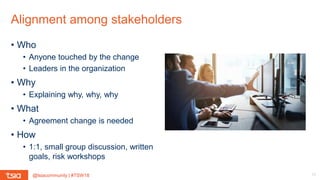
Alignment among stakeholders
12
• Who
• Anyone touched by the change
• Leaders in the organization
• Why
• Explaining why, why, why
• What
• Agreement change is needed
• How
• 1:1, small group discussion, written
goals, risk workshops
@tsiacommunity | #TSW18
Stakeholder analysis
13
• Who
• Key leaders and directs
• Continually through program
• Identify top risks
• What is the impact if a specific
stakeholder is not aligned?
@tsiacommunity | #TSW18 14
Communication Plan
@tsiacommunity | #TSW18
Communication plan – “Create the future with words”
Takahiro Hosoda
15
@tsiacommunity | #TSW18
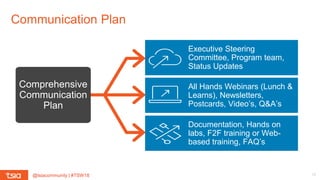
Communication Plan
16
Executive Steering
Committee, Program team,
Status Updates
All Hands Webinars (Lunch &
Learns), Newsletters,
Postcards, Video’s, Q&A’s
Documentation, Hands on
labs, F2F training or Web-
based training, FAQ’s
Icon
Comprehensive
Communication
Plan
@tsiacommunity | #TSW18
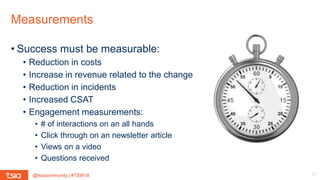
Measurements
17
• Success must be measurable:
• Reduction in costs
• Increase in revenue related to the change
• Reduction in incidents
• Increased CSAT
• Engagement measurements:
• # of interactions on an all hands
• Click through on an newsletter article
• Views on a video
• Questions received
@tsiacommunity | #TSW18
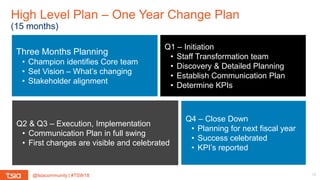
High Level Plan – One Year Change Plan
(15 months)
18
Three Months Planning
• Champion identifies Core team
• Set Vision – What’s changing
• Stakeholder alignment
Q2 & Q3 – Execution, Implementation
• Communication Plan in full swing
• First changes are visible and celebrated
Q1 – Initiation
• Staff Transformation team
• Discovery & Detailed Planning
• Establish Communication Plan
• Determine KPIs
Q4 – Close Down
• Planning for next fiscal year
• Success celebrated
• KPI’s reported
Thank you.
© Technology Services Industry Association
Questions?
@tsiacommunity | #TSW18
Liz Holland
• Sr. Director, Dell Managed Services
• Liz.Holland@Dell.com
• 214-864-3405
• @LZHolland
Contact Information

Change management a human aspect

  • 1.
    @tsiacommunity | #TSW18 ChangeManagement – A Human Aspect Liz Holland | Dell | @LZHolland
  • 2.
    @tsiacommunity | #TSW18 LizHolland 2 • Held leadership managed services roles at Dell EMC • Delivery Operations, Service Management, Service Enablement, Transformation, PMO, and Professional Services • Matured the operating model for the scale of the business • Lead evolution to next-gen MS transformation program • Deep expertise leading large IT Svc change programs • Prior work: Virtustream, EDS, and Tyler Technologies • Dell Technologies: $79.9B revenues, 180 countries, serve 99% of Fortune 500, 145k team, 30k services team 20 years in IT NYC based Sr Director Managed Services
  • 3.
    @tsiacommunity | #TSW18 ChangeToday is Exponential • Moore’s law – states the value compute power doubles every Eighteen months (1960) • Reed's law is the assertion of David P. Reed that the utility of large networks, particularly social networks, can scale exponentially with the size of the network. (2001)
  • 4.
    @tsiacommunity | #TSW184 Today Change is Continuous “Change shouldn’t be treated as a singular occurrence when it is an ongoing, continued process and dynamic capability within the organization.” ― Pearl Zhu “The gap between thought and action, between belief and will, prevents us solving our most pressing individual and societal problems.” ― Paul Gibbons
  • 5.
    @tsiacommunity | #TSW18 ChangeManagement – A Human Aspect Change Management Definition 5 • Change Management (organizational) – managing the people side of change (people, process, technology). • Change happens at the individual level, changing hearts and minds in order to change behavior.
  • 6.
    @tsiacommunity | #TSW18 Whychange? Is your organization ready? 6 • Is the organization ready for a change? • Set a simple vision that could be cascaded to every individual in the organization.
  • 7.
    @tsiacommunity | #TSW187 Set the Vision
  • 8.
    @tsiacommunity | #TSW18 Setthe vision 8 • Simple • High level • Understandable
  • 9.
    @tsiacommunity | #TSW18 Howto ensure successful organizational change 9 • Champion who is committed • Core change team – energetic, resilient, evangelist • Stakeholders are aligned • Measurable
  • 10.
    @tsiacommunity | #TSW18 Kubler-Rosschange curve 10 Create Alignment Maximize Communications Stakeholders working together Do, Refine Share Knowledge MoraleandCompetence Shock Surprise or shock of the event Time Denial Disbelieve, looking for evidence that this is not true Frustration Recognition that things are different, sometimes angry Depression (Start bargaining) Low mood; lacking of energy Experiment (Bargaining) Initial engagement with the new situation Decision Learning how to work in the new situation, feeling more positive Integration Changes integrated, a new individual
  • 11.
    @tsiacommunity | #TSW1811 Stakeholder Alignment
  • 12.
    @tsiacommunity | #TSW18 Alignmentamong stakeholders 12 • Who • Anyone touched by the change • Leaders in the organization • Why • Explaining why, why, why • What • Agreement change is needed • How • 1:1, small group discussion, written goals, risk workshops
  • 13.
    @tsiacommunity | #TSW18 Stakeholderanalysis 13 • Who • Key leaders and directs • Continually through program • Identify top risks • What is the impact if a specific stakeholder is not aligned?
  • 14.
    @tsiacommunity | #TSW1814 Communication Plan
  • 15.
    @tsiacommunity | #TSW18 Communicationplan – “Create the future with words” Takahiro Hosoda 15
  • 16.
    @tsiacommunity | #TSW18 CommunicationPlan 16 Executive Steering Committee, Program team, Status Updates All Hands Webinars (Lunch & Learns), Newsletters, Postcards, Video’s, Q&A’s Documentation, Hands on labs, F2F training or Web- based training, FAQ’s Icon Comprehensive Communication Plan
  • 17.
    @tsiacommunity | #TSW18 Measurements 17 •Success must be measurable: • Reduction in costs • Increase in revenue related to the change • Reduction in incidents • Increased CSAT • Engagement measurements: • # of interactions on an all hands • Click through on an newsletter article • Views on a video • Questions received
  • 18.
    @tsiacommunity | #TSW18 HighLevel Plan – One Year Change Plan (15 months) 18 Three Months Planning • Champion identifies Core team • Set Vision – What’s changing • Stakeholder alignment Q2 & Q3 – Execution, Implementation • Communication Plan in full swing • First changes are visible and celebrated Q1 – Initiation • Staff Transformation team • Discovery & Detailed Planning • Establish Communication Plan • Determine KPIs Q4 – Close Down • Planning for next fiscal year • Success celebrated • KPI’s reported
  • 19.
    Thank you. © TechnologyServices Industry Association
  • 20.
    © Technology ServicesIndustry Association Questions?
  • 21.
    @tsiacommunity | #TSW18 LizHolland • Sr. Director, Dell Managed Services • Liz.Holland@Dell.com • 214-864-3405 • @LZHolland Contact Information

Editor's Notes

  • #4 Today I want to discuss the human aspect of change. Technology is changing at an exponential rate. Everywhere we look we are see rapid change taking place. For the past 50 years we have used Moore’s law as a guidepost for the timeframe for change in technology, in the data center about every 18 months to two years. The equipment in the data center would reduce in footprint and increase in capacity, in the PC world we went from desktops to laptops to handheld devices. In 2018 we look at technology change in months, not years. Social Networks, and platforms can produce new products in a matter of hours. The pace of change can be overwhelming to individuals, which is what I will discuss today. Moore's law is the observation that the number of transistors in a dense integrated circuit doubles about every two years. The observation is named after Gordon Moore, the co-founder of Fairchild Semiconductor and Intel, whose 1965 paper described a doubling every year in the number of components per integrated circuit,[2]and projected this rate of growth would continue for at least another decade.[3] In 1975,[4] looking forward to the next decade,[5] he revised the forecast to doubling every two years.[6][7][8] The period is often quoted as 18 months because of Intel executive David House, who predicted that chip performance would double every 18 months (being a combination of the effect of more transistors and the transistors being faster).[9] Reed's law is the assertion of David P. Reed that the utility of large networks, particularly social networks, can scale exponentially with the size of the network [1]. The reason for this is that the number of possible sub-groups of network participants is 2N − N − 1, where N is the number of participants. This grows much more rapidly than either the number of participants, N, or the number of possible pair connections, N(N − 1)/2 (which follows Metcalfe's law). so that even if the utility of groups available to be joined is very small on a per-group basis, eventually the network effect of potential group membership can dominate the overall economics of the system.
  • #5 Organizational change previously would occur every several years, you would have a material change (new ERP system, M&A, organization re-org) put together a change team and they would be manage the change and disperse. Today change is constant, you need to consider including change management as your BAU organization vs. a one-time change. Change happens continuously and you need to have someone focused on understanding the impact of the industry changes to your business. In the past ten years the rapid change is upon us. Airbnb (more valued than Hyatt and Wyndham combined) Founded in 2008, Blockchain 2008 (2013 before it was commonplace), Instagram 2010, Uber founded in 2012, self-driving automobiles are all examples of rapidly changing technologies that could impact your business. “The gap between thought and action, between belief and will, prevents us solving our most pressing individual and societal problems.”  ― Paul Gibbons, The Science of Successful Organizational Change: How Leaders Set Strategy, Change Behavior, and Create an Agile Culture “Change shouldn’t be treated as a singular occurrence when it is an ongoing, continued process and dynamic capability within the organization.”  ― Pearl Zhu, Change Insight: Change as an Ongoing Capability to Fuel Digital Transformation
  • #6 With all the change you need to focus on the people side of change. Organizational Change Management is the topic I will touch today. The definition I have here, managing the people side of change. It’s the deliberate focus on the people who are involved and affected by the change. Change happens at the individual level, in a services organization you cannot ignore how your workforce will accept and integrate the change. As an example of the people side of change. If you implement a new HR system, you could implement the new system, shut down the old, but if you have communicated with the people on how to interact with the new system it will not be successful.
  • #7 Why embark on a change? You may have your strategist, transformation team, CTO, etc. seeing the horizon and realizing we need to change ASAP, while your delivery org is meeting their numbers their customers seem happy and they don’t’ understand why there is a need for change. Until you get to the tension point, maybe you lose business or a customer leaves for a competitor you may not be able to have enough tension in the organization to be ready for a change. The right time to change is when all of your executives can see its time to start the journey.
  • #8 Change happens at the individual level, without each individual integrating the change into their daily work, you will not be successful. Leaders can decide what the objective, and what needs to change, but without individual understanding and changing behavior change will not be successful. How do we get there?
  • #9 Set the vision – Once you recognize its time to change, you need to work with your champion and change leader to set the vision. What are you changing? It needs to be high level, understandable and something everyone can get behind. Disney – We make people happy Dell’s vision is to become the essential infrastructure company – from the edge to the data center to the cloud – not only for today’s applications, but for the cloud-native world we’re entering Amazon’s vision is to be earth's most customer centric company; to build a place where people can come to find and discover anything they might want to buy online. Everyone needs to be able to relate to the vision, keep it simple.
  • #10 There are 4 main areas I want to focus on the ensure success Champion – ensure you have a champion who is 100% committed, this person must be the flag bearer and be willing to unblock any issues. Core Team Stakeholders aligned Measurable
  • #11 The Kubler Ross Change curve was created to describe the 7 stages of grief, but it can be applied to any change someone may be involved in. Shock that we need to change. If I use the HR system example again, Why? What’s wrong with the system we have today!? Denial – it will never happen, by the time that HR systems is implemented it won’t affect me. Frustration – I can’t believe there will be no HR system for three weeks, how will I get anything done?! Bargaining – Ok, I’m going to learn just enough to get by, I do NOT want to go to this new system. Depression/Experimenting – maybe I’ll try these two functions, if that works ok, I’ll try a couple more. Decision – Hey, I can show you how to use this system and its pretty cool! Integration – the HR system is part of BAU and no one remembers the implementation. Everyone goes through the change curve and a different pace, you need to keep this in mind as you understand if your stakeholders are aligned.
  • #13 Can we get a people picture here? Stakeholder alignment must be a focused and deliberate exercise. Who are your stakeholders, you champion, executive steering committee and every leader who is affected? Why the need for the change so your stakeholders can be behind the WHAT. What is change your stakeholders need to be aligned to what you are trying to achieve? How do you gain alignment?
  • #14 After you have gone through an alignment exercise. You will need to create a stakeholder analysis. Assess each stakeholder, where they stand on buy-in, what are their concerns, try to address them and understand the impact to the program if they are not bought in. If a key executive stakeholder is not bought in, you may consider pausing to understand their reservations and how you can mitigate their concerns. This analysis must be done during the entire program to ensure continued alignment.
  • #16 Communication Plans become the center of everything in the change program. Takahiro Hosoda published a book in 2013 “Create the future with Words: One phrase strategy”. Every individual needs to learn about the change, go through the change curve and integrate the change into their daily lives. It starts with communication And more communication. Individuals learn differently, some can read, others need to hear it, while others are kinetic learners who may need to see, hear and have a physical experience to integrate the change. With the age range of our current workforce. (22 – 62) we have several types of learners in our organization. The oldest generation may need to read documents with details about every step of the change, why we are changing, the before and after, etc. The youngest generation may only need snippets and a video to get them on board for the journey, they are in a world that changes everyday online. They receive information in small doses, won’t take the time to read in-depth documents. We also have groups that don’t read directions and just jump into the change, they may need labs or trainings to teach them about the change. You must communicate EVERYWHERE Up the execs, sideways to the leaders and to the individual contributors.
  • #17 The communication plan has two dimensions: Internal to the team leading the changing, including the steering committee and external. The external plan is focused on the individuals in the organization. The organization must see, read, hear and be able to access information about the change. A full time communication person is necessary for a seismic or material change in your organization.
  • #19 Three Months Planning (Q4 of previous year) Champion identifies Core team Set Vision – What’s changing Stakeholder alignment Q1 – Initiation Staff Transformation team Discovery & Detailed Planning Establish Communication Plan Determine KPIs Q2 & Q3– Execution, Implementation Communication Plan in full swings All hands, email updates, video’s, etc. First changes are visible and celebrates Q4 – Close Down Planning for next fiscal year Success celebrated KPI’s report Change is continuous and