Change Agency and
Dealing with Failure
Oliver Benson | @ollybenson
Dominic Cushnan | @domcushnan
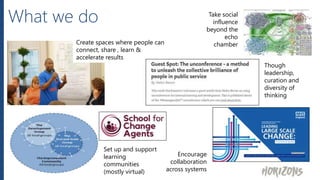
What we do
Create spaces where people can
connect, share , learn &
accelerate results
Set up and support
learning
communities
(mostly virtual)
Encourage
collaboration
across systems
Take social
influence
beyond the
echo
chamber
Though
leadership,
curation and
diversity of
thinking
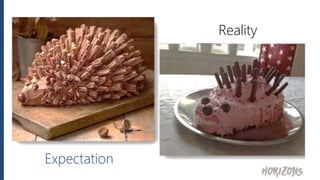
Expectation
Reality
How can you use change
agency to reduce the chance
of failure?
Change agent perspectives
• Why we need to think about resistance
• Resistance vs reactance
• How to avoid or overcome reactance
Source of image: thenounproject.com
What’s the evidence on failure?
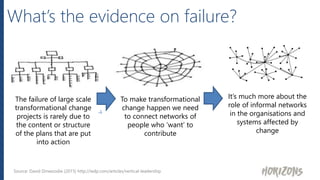
The failure of large scale
transformational change
projects is rarely due to
the content or structure
of the plans that are put
into action
To make transformational
change happen we need
to connect networks of
people who ‘want’ to
contribute
Source: David Dinwoodie (2015) http://iedp.com/articles/vertical-leadership
It’s much more about the
role of informal networks
in the organisations and
systems affected by
change
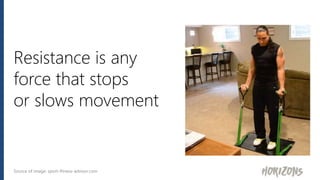
Source of image: sport-fitness-advisor.com
Resistance is any
force that stops
or slows movement
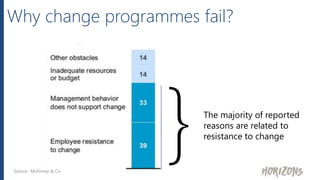
Why change programmes fail?
The majority of reported
reasons are related to
resistance to change
Source: McKinsey & Co
}
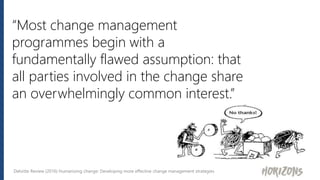
“Most change management
programmes begin with a
fundamentally flawed assumption: that
all parties involved in the change share
an overwhelmingly common interest.”
Deloitte Review (2016) Humanizing change: Developing more effective change management strategies
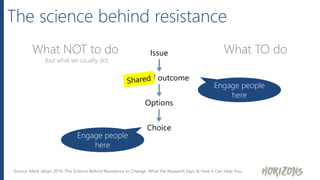
What NOT to do
Engage people
here
Source: Mark Jaban 2016: The Science Behind Resistance to Change: What the Research Says & How it Can Help You
Issue
Desired outcome
Options
Choice
Engage people
here
What TO do
(but what we usually do)
The science behind resistance
“Resistant behaviour is a good
indicator of missing relevance”
Harald Schirmer
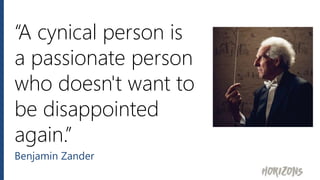
“A cynical person is
a passionate person
who doesn't want to
be disappointed
again.”
Benjamin Zander
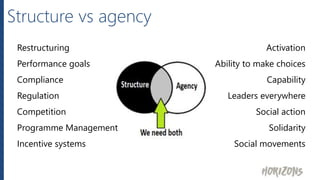
Restructuring
Performance goals
Compliance
Regulation
Competition
Programme Management
Incentive systems
Activation
Ability to make choices
Capability
Leaders everywhere
Social action
Solidarity
Social movements
Structure vs agency
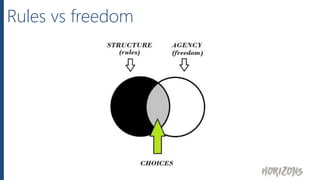
Rules vs freedom
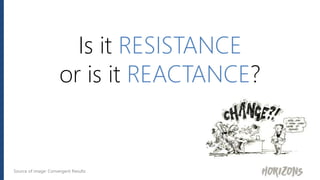
Is it RESISTANCE
or is it REACTANCE?
Source of image: Convergent Results
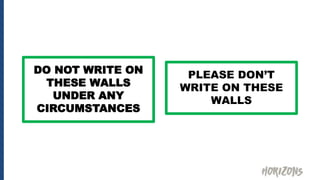
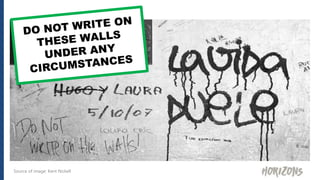
DO NOT WRITE ON
THESE WALLS
UNDER ANY
CIRCUMSTANCES
PLEASE DON’T
WRITE ON THESE
WALLS
Source of image: Kent Nickell
“I don’t like being told what to
do. If you tell me I HAVE to do
something, I will do the
opposite.”
Kathryn
What is reactance?
The instantaneous reaction to being told what
to do.
“Unpleasant motivational arousal that emerges
when people experience a threat or loss to
their free behaviours”
Steindl and colleagues, 2015
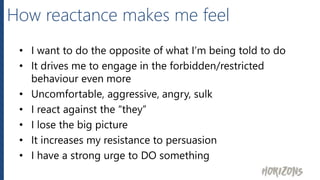
How reactance makes me feel
• I want to do the opposite of what I’m being told to do
• It drives me to engage in the forbidden/restricted
behaviour even more
• Uncomfortable, aggressive, angry, sulk
• I react against the “they”
• I lose the big picture
• It increases my resistance to persuasion
• I have a strong urge to DO something
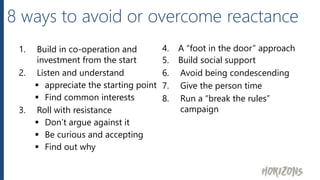
8 ways to avoid or overcome reactance
1. Build in co-operation and
investment from the start
2. Listen and understand
 appreciate the starting point
 Find common interests
3. Roll with resistance
 Don’t argue against it
 Be curious and accepting
 Find out why
4. A “foot in the door” approach
5. Build social support
6. Avoid being condescending
7. Give the person time
8. Run a “break the rules”
campaign
“If parents want to give their children a gift,
the best thing they can do is to teach their
children to love challenges, be intrigued by
mistakes, enjoy effort, and keep on learning.
That way, their children don’t have to be
slaves of praise. They will have a lifelong way
to build and repair their own confidence.”
Carol Dweck
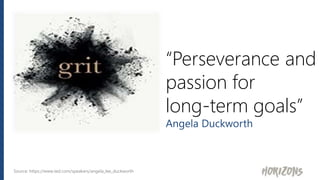
“Perseverance and
passion for
long-term goals”
Angela Duckworth
Source: https://www.ted.com/speakers/angela_lee_duckworth
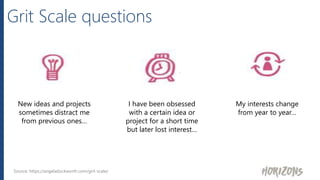
New ideas and projects
sometimes distract me
from previous ones…
I have been obsessed
with a certain idea or
project for a short time
but later lost interest…
Source: https://angeladuckworth.com/grit-scale/
Grit Scale questions
My interests change
from year to year…
Task 1 (5 mins)
Find someone close to where you are sitting.
Discuss a project you are working that you are
anxious about and has the potential to fail?
Task 2 (15 mins)
Each pair should present back to the table in turn
Rather than present your own project; each pair
should present the other person’s project.
Task 3 (7 mins)
As a group choose one of the projects that has been
discussed. Choose one that you are most interested
in or one that most people have knowledge about.
Teoriya Resheniya
Izobretatelskikh Zadach
About TRIZ
A problem solving, analysis and forecasting tool.
Depersonalising and unpicking topics that people are
passionate about.
Part of ‘Liberating Structures’:
Frameworks that make it possible for people and
organisations to create, do new things and to be
innovative.
Step 1 (12 mins)
As a table, make a list of all the things that we could
do to ensure we meet our goal:
How could we reliably create a __________
that NEVER works and is totally
ineffective?
Step 2 (12 mins)
As a table, look at the post-it notes on the table and
keep all the post-it notes that meet the following
statement:
Something that we currently do, in
some way, shape or form, resembles
the actions on the post it note.
Step 3 (12 mins)
As a table, remove all the post-it notes that that meet
the following criteria:
We have no ability to
stop or control this.
Thank you
Oliver Benson | @ollybenson
Dominic Cushnan | @domcushnan

Change Agency and Dealing with Failure

  • 1.
    Change Agency and Dealingwith Failure Oliver Benson | @ollybenson Dominic Cushnan | @domcushnan
  • 2.
    What we do Createspaces where people can connect, share , learn & accelerate results Set up and support learning communities (mostly virtual) Encourage collaboration across systems Take social influence beyond the echo chamber Though leadership, curation and diversity of thinking
  • 3.
  • 4.
    How can youuse change agency to reduce the chance of failure?
  • 5.
    Change agent perspectives •Why we need to think about resistance • Resistance vs reactance • How to avoid or overcome reactance Source of image: thenounproject.com
  • 6.
    What’s the evidenceon failure? The failure of large scale transformational change projects is rarely due to the content or structure of the plans that are put into action To make transformational change happen we need to connect networks of people who ‘want’ to contribute Source: David Dinwoodie (2015) http://iedp.com/articles/vertical-leadership It’s much more about the role of informal networks in the organisations and systems affected by change
  • 7.
    Source of image:sport-fitness-advisor.com Resistance is any force that stops or slows movement
  • 8.
    Why change programmesfail? The majority of reported reasons are related to resistance to change Source: McKinsey & Co }
  • 9.
    “Most change management programmesbegin with a fundamentally flawed assumption: that all parties involved in the change share an overwhelmingly common interest.” Deloitte Review (2016) Humanizing change: Developing more effective change management strategies
  • 10.
    What NOT todo Engage people here Source: Mark Jaban 2016: The Science Behind Resistance to Change: What the Research Says & How it Can Help You Issue Desired outcome Options Choice Engage people here What TO do (but what we usually do) The science behind resistance
  • 11.
    “Resistant behaviour isa good indicator of missing relevance” Harald Schirmer
  • 12.
    “A cynical personis a passionate person who doesn't want to be disappointed again.” Benjamin Zander
  • 13.
    Restructuring Performance goals Compliance Regulation Competition Programme Management Incentivesystems Activation Ability to make choices Capability Leaders everywhere Social action Solidarity Social movements Structure vs agency
  • 14.
  • 15.
    Is it RESISTANCE oris it REACTANCE? Source of image: Convergent Results
  • 16.
    DO NOT WRITEON THESE WALLS UNDER ANY CIRCUMSTANCES PLEASE DON’T WRITE ON THESE WALLS
  • 17.
    Source of image:Kent Nickell
  • 18.
    “I don’t likebeing told what to do. If you tell me I HAVE to do something, I will do the opposite.” Kathryn
  • 19.
    What is reactance? Theinstantaneous reaction to being told what to do. “Unpleasant motivational arousal that emerges when people experience a threat or loss to their free behaviours” Steindl and colleagues, 2015
  • 20.
    How reactance makesme feel • I want to do the opposite of what I’m being told to do • It drives me to engage in the forbidden/restricted behaviour even more • Uncomfortable, aggressive, angry, sulk • I react against the “they” • I lose the big picture • It increases my resistance to persuasion • I have a strong urge to DO something
  • 21.
    8 ways toavoid or overcome reactance 1. Build in co-operation and investment from the start 2. Listen and understand  appreciate the starting point  Find common interests 3. Roll with resistance  Don’t argue against it  Be curious and accepting  Find out why 4. A “foot in the door” approach 5. Build social support 6. Avoid being condescending 7. Give the person time 8. Run a “break the rules” campaign
  • 22.
    “If parents wantto give their children a gift, the best thing they can do is to teach their children to love challenges, be intrigued by mistakes, enjoy effort, and keep on learning. That way, their children don’t have to be slaves of praise. They will have a lifelong way to build and repair their own confidence.” Carol Dweck
  • 23.
    “Perseverance and passion for long-termgoals” Angela Duckworth Source: https://www.ted.com/speakers/angela_lee_duckworth
  • 24.
    New ideas andprojects sometimes distract me from previous ones… I have been obsessed with a certain idea or project for a short time but later lost interest… Source: https://angeladuckworth.com/grit-scale/ Grit Scale questions My interests change from year to year…
  • 25.
    Task 1 (5mins) Find someone close to where you are sitting. Discuss a project you are working that you are anxious about and has the potential to fail?
  • 26.
    Task 2 (15mins) Each pair should present back to the table in turn Rather than present your own project; each pair should present the other person’s project.
  • 27.
    Task 3 (7mins) As a group choose one of the projects that has been discussed. Choose one that you are most interested in or one that most people have knowledge about.
  • 28.
  • 29.
    About TRIZ A problemsolving, analysis and forecasting tool. Depersonalising and unpicking topics that people are passionate about. Part of ‘Liberating Structures’: Frameworks that make it possible for people and organisations to create, do new things and to be innovative.
  • 30.
    Step 1 (12mins) As a table, make a list of all the things that we could do to ensure we meet our goal: How could we reliably create a __________ that NEVER works and is totally ineffective?
  • 31.
    Step 2 (12mins) As a table, look at the post-it notes on the table and keep all the post-it notes that meet the following statement: Something that we currently do, in some way, shape or form, resembles the actions on the post it note.
  • 32.
    Step 3 (12mins) As a table, remove all the post-it notes that that meet the following criteria: We have no ability to stop or control this.
  • 33.
    Thank you Oliver Benson| @ollybenson Dominic Cushnan | @domcushnan

Editor's Notes

  • #4 Link to point 7
  • #9 Original title: Why do organisational change programmes fail to achieve their objectives?
  • #10 Are we surprised? Rest of quote: Power dynamics, contextual considerations, and resistance to change are underestimated and even considered anomalous. After all, organisational change means changing human behaviour, notwithstanding little evidence suggesting that behaviour can be pliable or predictable.
  • #11 Mark Jaben – clinican dedicated to understanding how to create change in health services https://www.youtube.com/watch?v=qJaajLuKh4U We don’t need buyers (who “buy-in” to change) We need investors
  • #12 http://de.slideshare.net/haraldschirmer/strategies-for-corporate-change-the-new-role-of-hr-driving-social-adoption-and-change-in-the-enterprise
  • #15 Today, we’re going to think about resistance to change in this context
  • #17 Researchers Pennebaker and Sanders put one of two si What do you think they found when they went back after two weeks? gns on college bathroom walls:
  • #23 Be honest with yourself and others. There are going to be challenges… it is how you deal with them that counts!
  • #27 Sometimes we think we have told the person what our issue is but they hear something else. Sometimes we internalise failure.
  • #29 It’s a russian acronym. We’re going to call it TRIZ
  • #31 Go wild! The more creative the better. Use post it notes (one per action!) – put them out onto the table/wall so you can see them all (Then get feedback from the room)
  • #32 If yes, remove these post-it notes from the table/wall Be unforgiving about these items and talk about their impact
  • #33 If yes, remove these post-it notes from the table/wall