CHAPTER EIGHT SOCIAL ANDCHAPTER EIGHT SOCIAL AND
POLITICAL PHILOSOPHYPOLITICAL PHILOSOPHY
P H I L O S O P H YP H I L O S O P H Y
A TEXT WITH READINGSA TEXT WITH READINGS
1212thth
EDITIONEDITION
Manual VelasquezManual Velasquez
Chapter 8:Chapter 8:
“Social and Political Philosophy”“Social and Political Philosophy”
The Limits of GovernmentThe Limits of Government
• Beyond conducting war and maintaining
domestic law, the government of the United
States does many things:
– It provides loans to banks, insurance companies, and
car companies and has bought up large portions of
stock in companies.
– It provides welfare for those who are poor, disabled,
and unemployed and pays for medical services for
older adults.
– It pays for the education of all children.
• Are these legitimate functions of government?
CHAPTER EIGHT: SOCIAL ANDCHAPTER EIGHT: SOCIAL AND
POLITICAL PHILOSOPHYPOLITICAL PHILOSOPHY
Issues within Social andIssues within Social and
Political PhilosophyPolitical Philosophy
• The focus of this chapter is “Social and Political”
• This philosophy addresses the previous
question as well as the following:
– What is the source of the authority government wields
over us?
– Is it just that government should play such a large role
in regulating our lives?
– What is justice and what does justice demand that we
should do for the poor and the needy among us?
– What is the relationship of the individual to society?
CHAPTER EIGHT: SOCIAL ANDCHAPTER EIGHT: SOCIAL AND
POLITICAL PHILOSOPHYPOLITICAL PHILOSOPHY
The Meaning of ‘State’The Meaning of ‘State’
• When we use the word ‘state’, we are not
referring to California or Michigan.
• Rather, we generally use the word to refer to
what we today often refer to as a “nation”: a
politically organized body of people who occupy
a definite territory and whose political
organization has supreme or “sovereign”
authority over the people in that territory.
– In this sense, the United States as a whole is a state,
but California and New York are not states.
CHAPTER EIGHT: SOCIAL ANDCHAPTER EIGHT: SOCIAL AND
POLITICAL PHILOSOPHYPOLITICAL PHILOSOPHY
Outline of Topics in Chapter 8Outline of Topics in Chapter 8
• The remainder of the chapter focuses on
three sets of issues:
– 8.2 What Justifies the State?
– 8.3 What is Justice?
– 8.4 Limits on the State
CHAPTER EIGHT: SOCIAL ANDCHAPTER EIGHT: SOCIAL AND
POLITICAL PHILOSOPHYPOLITICAL PHILOSOPHY
8.28.2 What Justifies the State?What Justifies the State?
• The state is the highest authority in a society,
and has the legal power to define the public
interest and enforce its definition.
• One clear example of the state’s doing this can
be seen in the income tax system.
– The state sets priorities—that is, defines the public
interest—then, it taxes citizens to implement these
priorities.
– Not everybody agrees with the priorities of the state –
should they too be forced to pay taxes on those items
they find unacceptable?
CHAPTER EIGHT: SOCIAL ANDCHAPTER EIGHT: SOCIAL AND
POLTICAL PHILOSOPHYPOLTICAL PHILOSOPHY
Justifying the StateJustifying the State
• Various theories have been advanced to define
the legitimacy of the state and justify its power.
• Appeals have been made to:
– Divine authority.
• Some rulers have claimed the power to rule as a divine right,
as a kind of mandate from God.
– The public interest.
• Insofar as the state furthers the public interest, it is justified.
– An important and influential theory of justification is
social contract theory.
CHAPTER EIGHT: SOCIAL ANDCHAPTER EIGHT: SOCIAL AND
POLITICAL PHILOSOPHYPOLITICAL PHILOSOPHY
Social Contract TheorySocial Contract Theory
• Social contract theory says that individuals
agree to give up certain liberties and rights to
the state, which in return guarantees such rights
as life, liberty, and the pursuit of happiness.
– Contract theory is both an explanation of the origin of
the state and a defense of its authority.
– This theory has been defended by Thomas Hobbes,
John Locke, Jean Jacques Rousseau and more
recently by the philosopher John Rawls.
CHAPTER EIGHT: SOCIAL ANDCHAPTER EIGHT: SOCIAL AND
POLITICAL PHILOSOPHYPOLITICAL PHILOSOPHY
Hobbesian JusticeHobbesian Justice
• Unlike previous philosophers, Thomas Hobbes
(1588-1679) viewed the world as a mechanical
system explainable in terms of physical laws.
– Even the behavior of humans or complex societies, it
is argued, is reducible to geometric and physical
explanations.
– Accordingly, in his book In Leviathan, Hobbes
portrays humans as selfish, unsocial creatures driven
by two needs: survival and personal gain.
• Therefore, human life is characterized by constant struggle,
strife, and war, with individual pitted against individual in a
battle for self-preservation and gain.
CHAPTER EIGHT: SOCIAL ANDCHAPTER EIGHT: SOCIAL AND
POLITICAL PHILOSOPHYPOLITICAL PHILOSOPHY
Rational Self-InterestRational Self-Interest
• “The passions that incline men to peace, are fear
of death; desire of such things as are necessary
to commodious living; and a hope by their
industry to obtain them. And reason suggesteth
convenient articles of peace, upon which men
may be drawn to agreement. These articles, are
they, which otherwise are called the Laws of
Nature.” (546)
– Hobbes is saying that a rational concern for their own
survival and best long-term interests impels humans to
enter into a contract with one another and form society.
CHAPTER EIGHT: SOCIAL ANDCHAPTER EIGHT: SOCIAL AND
POLITICAL PHILOSOPHYPOLITICAL PHILOSOPHY
Irrevocable AuthorityIrrevocable Authority
• Because they recognize that otherwise their lives
are destined to be “solitary, poor, nasty, brutish,
and short,” humans accept state authority outside
themselves and over them.
– The agreement that establishes this authority is
irrevocable: once set up, the political body wielding this
power exercises absolute authority over its subjects
and remains in power as long as it is able to compel
them to do what they otherwise would not do.
– Thus, the state that individuals contract with becomes
superior to the individuals.
CHAPTER EIGHT: SOCIAL ANDCHAPTER EIGHT: SOCIAL AND
POLITICAL HILOSOPHYPOLITICAL HILOSOPHY
Locke and Natural Moral LawsLocke and Natural Moral Laws
• John Locke (1632-17040 also believes human
beings started off in a state of nature.
• However, his assumptions about humans in the
state of nature contrasts with those of Hobbes
– Humans, for Hobbes, are naturally without morality ,
whereas for Locke they are essentially moral beings
who feel the pull of natural moral rules.
• Thus, where Hobbes saw warfare as the human’s natural state,
Locke saw our natural state as at least partly regulated by
natural moral laws.
• As a result, Locke viewed humans as free and equal by nature,
regardless of the existence of any government.
CHAPTER EIGHT: SOCIAL ANDCHAPTER EIGHT: SOCIAL AND
POLITICAL PHILOSOPHYPOLITICAL PHILOSOPHY
Why Government?Why Government?
• According to Locke, human beings seek to
establish governments because three things are
missing in the state of nature:
1. a firm, clearly understood interpretation of the
natural but unwritten moral laws;
2. unbiased judges to resolve disputes;
3. a power capable of enforcing justice when one is
wronged.
• So, individuals enter into a social contract to
maintain their natural rights.
CHAPTER EIGHT: SOCIAL ANDCHAPTER EIGHT: SOCIAL AND
POLITICAL PHILOSOPHYPOLITICAL PHILOSOPHY
In Locke’s Own WordsIn Locke’s Own Words
• “Thus mankind, notwithstanding all the privileges of the
state of Nature, being but in an ill condition while they
remain in it are quickly driven into society. Hence it
comes to pass, that we seldom find any number of men
live any time together in this state. The inconveniences
that they are therein exposed to by the irregular and
uncertain exercise of the power every man has of
punishing the transgressions of others, make them take
sanctuary under the established laws of government,
and therein seek the preservation of their property.”
(547)
CHAPTER EIGHT: SOCIALANDCHAPTER EIGHT: SOCIALAND
POLITICAL PHILOSOPHYPOLITICAL PHILOSOPHY
Limited AuthorityLimited Authority
• The social contract human beings form is based
on the consent of the majority, and all agree to
abide by the decisions of the majority.
– Therefore, the state’s authority is limited by the terms
of the contract, which is continually reviewed by the
citizenry.
– So, unlike Hobbes’s absolutistic state, Locke’s state is
specific and limited.
– Indeed, one of the fundamental moral rights in
Locke’s political state is the right to resist and to
challenge authority.
CHAPTER EIGHT: SOCIAL ANDCHAPTER EIGHT: SOCIAL AND
POLITICAL PHILOSOPHYPOLITICAL PHILOSOPHY
Focus on FreedomFocus on Freedom
• Locke agrees with Hobbes that…
– humans use their reason to perceive the necessity of
entering a social contract.
– the source of the state’s authority is the the consent
of the governed.
• However, Locke emphasizes freedom more
than Hobbes.
• Locke’s version of the social contract helped
inspire the Declaration of Independence and the
American Revolution in 1776.
CHAPTER EIGHT: SOCIAL ANDCHAPTER EIGHT: SOCIAL AND
POLITICAL PHILOSOPHYPOLITICAL PHILOSOPHY
Rousseau’s Social ContractRousseau’s Social Contract
• Many consider Jean Jacques Rousseau (1712–
1778) to be the foremost philosopher of the
social contract theory.
– Rousseau did not appeal to a self-evident natural
moral law as Locke had, but argued that if people are
to act morally, they must live under laws that they
freely accept.
– He thus emphasizes personal moral autonomy, and
assumes that the fundamental requirement of a
morally acceptable government is that the governed
have freely subscribed to a common body of law.
CHAPTER EIGHT: SOCIAL ANDCHAPTER EIGHT: SOCIAL AND
POLITICAL PHILOSOPHYPOLITICAL PHILOSOPHY
““Born in Chains”Born in Chains”
• Rousseau began his most important political
work, Of the Social Contract, with the
sensational words “Man was born free, but he is
everywhere in chains.”
– How then did we all came to be bound by the “chains”
of the all-powerful authority of the state?
– Rousseau answers this question by arguing that each
person, while by nature free and autonomous, freely
gives up their freedom to form a state.
CHAPTER EIGHT: SOCIAL ANDCHAPTER EIGHT: SOCIAL AND
POLITICAL PHILOSOPHYPOLITICAL PHILOSOPHY
The General WillThe General Will
• The power of the state is consistent with human
freedom if individuals freely choose to subject
themselves to it.
– For Rousseau the “general will” is the corporate
expression of this mutually agreed on decision.
• Because each citizen is an integral part of the general
will, what the general will decides and does is really
what each citizen is deciding and doing.
• Thus, in obeying the state, the individual is truly
obeying himself and is therefore free: The power of
the state is a morally justified power.
CHAPTER EIGHT: SOCIAL ANDCHAPTER EIGHT: SOCIAL AND
POLITICAL PHILOSOPHYPOLITICAL PHILOSOPHY
In Rousseau’s Own WordsIn Rousseau’s Own Words
• “If, then, we set aside what is not of the essence of the
social contract, we shall find that it is reducible to the
following terms: ‘Each of us puts in common his person
and his whole power under the supreme direction of the
general will; and in return we receive every member as
an indivisible part of the whole.’
• Forthwith, instead of the individual personalities of all the
contracting parties, this act of association produces a
moral and collective body, which is composed of as
many members as the assembly has voices, and which
receives from this same act its unity, its common self
(moi), its life, and its will.” (550)
CHAPTER EIGHT: SOCIAL ANDCHAPTER EIGHT: SOCIAL AND
POLITICAL PHILOSOPHYPOLITICAL PHILOSOPHY
The General WillThe General Will
Versus the “Will of All”Versus the “Will of All”
• The general will is not the same as the “will of
all,” or unanimity of feeling.
– A group of wills is general when each member of the
group aims at the common good.
– Sometimes, the general will and the will of all might
result in the same action, for each group member
may see his or her own best interests being served.
– But Rousseau felt that agreement is more likely when
everyone tries to determine whether a proposed
action is best for the good of all, for the general good,
rather than just for the self.
CHAPTER EIGHT: SOCIAL ANDCHAPTER EIGHT: SOCIAL AND
POLITICAL PHILOSOPHYPOLITICAL PHILOSOPHY
Contemporary Social ContractContemporary Social Contract
Theory: RawlsTheory: Rawls
• David Hume (1711-1776) argued that the notion
of a social contract was strictly fictional.
– If we go back in history, he pointed out, we will find no
signs of people coming together to choose their
governments.
– After Hume’s attack, most philosophers gave up on
social contract theory.
– However, Harvard philosopher John Rawls (1921–
2002) reshaped social contract theory into a powerful
new way of thinking about the nature of government
and society.
CHAPTER EIGHT: SOCIAL ANDCHAPTER EIGHT: SOCIAL AND
POLITICAL PHILOSOPHYPOLITICAL PHILOSOPHY
What Social ContractWhat Social Contract
Theory is Really AboutTheory is Really About
• Rawls argues that the fictional nature of the social
contract is not important.
• The key idea in social contract theory is that it
gives us a way of thinking about what the nature
and purpose of government should be.
– In order to decide what kind of government is best to
have, social contract theory prescribes that we should
imagine that we are starting our society from scratch.
– What kind of government and society would we choose
for ourselves if we were in this starting or “original”
position?
CHAPTER EIGHT: SOCIAL ANDCHAPTER EIGHT: SOCIAL AND
POLITICAL PHILOSOPHYPOLITICAL PHILOSOPHY
The Veil of IgnoranceThe Veil of Ignorance
• Rawls wonders how we can conceptualize a just
government – one that is equally fair to everyone
and shows favoritism to none?
• He claims that the principles of such a
government could be decided only if we chose
them under a “veil of ignorance”
– We would have be ignorant of any characteristics that
we might possess -- for example, whether we are
male or female, black or white, rich or poor, young or
old, our religious convictions, etc.
CHAPTER EIGHT: SOCIAL ANDCHAPTER EIGHT: SOCIAL AND
POLITICAL PHILOSOPHYPOLITICAL PHILOSOPHY
In Rawls’ Own WordsIn Rawls’ Own Words
• “This original position is not, of course, thought of as an
actual historical state of affairs…. It is understood as a
purely hypothetical situation characterized so as to lead
to a certain conception of justice. Among the essential
features of this situation is that no one knows his place in
society, his class position or social status, nor does
anyone know his fortune in the distribution of natural
assets and abilities, his intelligence, strength and the
like. . . . Since all are similarly situated and no one is
able to design principles to favor his particular condition,
the principles of justice [for society and government] are
the result of a fair agreement or bargain.” (552)
CHAPTER EIGHT: SOCIAL ANDCHAPTER EIGHT: SOCIAL AND
POLITICAL PHILOSOPHYPOLITICAL PHILOSOPHY
Rawlsian Justified GovernmentRawlsian Justified Government
• Rawls has shifted our attention from the issue of
the government we actually have, to the issue of
government we should have.
– Contrary to the traditional social contract theory of
Hobbes, Locke and Rousseau, the authority of our
government is justified not because we actually
consented to live under our government in the state of
nature.
– Rather, the authority of government is justified
because we would consent to live under that type of
government if we were in the original position.
CHAPTER EIGHT: SOCIAL ANDCHAPTER EIGHT: SOCIAL AND
POLITICAL PHILOSOPHYPOLITICAL PHILOSOPHY
The Communitarian CritiqueThe Communitarian Critique
• Communitarians criticize social contract theory,
arguing that it overlooks the social nature of
human beings, and overemphasizes the
individual.
• They claim that we cannot hope to understand
ourselves or our government apart from our
community and its cultural traditions.
• Historically, this viewpoint is first anticipated by
the holistic social philosophy of Aristotle, and
then later by Hegel.
CHAPTER EIGHT: SOCIAL ANDCHAPTER EIGHT: SOCIAL AND
POLITICAL PHILOSOPHYPOLITICAL PHILOSOPHY
Aristotle: the State as NaturalAristotle: the State as Natural
• Aristotle (384-322 B.C.E.) argued that
government is a natural outgrowth of our natural
tendency to associate with other human beings.
• Just as the family and the tribe are outgrowths of
our natural tendencies to live with one another,
so is the state:
– “We know that the state is a creation of nature and
that it is prior to the individual by the fact that the
individual apart from the state is not self-sufficient.
The individual is like a part that is dependent on the
whole.” (554)
CHAPTER EIGHT: SOCIAL ANDCHAPTER EIGHT: SOCIAL AND
POLITICAL PHILOSOPHYPOLITICAL PHILOSOPHY
Hegel: The State as the CompletionHegel: The State as the Completion
of Individual Freedomof Individual Freedom
• G.W.F. Hegel (1770-1831) agreed with Aristotle
that the state is the completion of all earlier
human associations.
• Humans cannot develop either fully or freely
without the state and its cultural practices:
– “Nor [is the state a means by which] each individual
limits his own freedom so that [every individual] can
secure a small space of liberty for himself. Rather, we
affirm, that Law, Morality, Government, and they
alone, are the positive reality and completion of
Freedom. . . .” (555)
CHAPTER EIGHT: SOCIAL ANDCHAPTER EIGHT: SOCIAL AND
POLITICAL PHILOSOPHYPOLITICAL PHILOSOPHY
Sandel’s CommunitarianismSandel’s Communitarianism
• The contemporary communitarian philosopher,
Michael Sandel, thinks Rawls is mistaken in
claiming that the state must support no particular
culture but leave people free to choose their own
cultural preferences.
– He argues instead each state and its government
must favor and support some set of cultural traditions.
– Thus, the government of each state must educate its
people so that they learn about these cultural
traditions and come to accept their values
CHAPTER EIGHT: SOCIAL ANDCHAPTER EIGHT: SOCIAL AND
POLITICAL PHILOSOPHYPOLITICAL PHILOSOPHY
In Sandel’s Own WordsIn Sandel’s Own Words
• “Participating in politics . . . means deliberating
with fellow citizens about the common good and
helping to shape the destiny of the political
community. But to deliberate well about the
common good requires more than the capacity
to choose one’s ends and to respect others’
rights to do the same. It requires a knowledge of
public affairs and also a sense of belonging, a
concern for the whole, a moral bond with the
community whose fate is at stake.” (556-557)
CHAPTER EIGHT: SOCIAL ANDCHAPTER EIGHT: SOCIAL AND
POLITICAL PHILOSOPHYPOLITICAL PHILOSOPHY
Communitarianism in SumCommunitarianism in Sum
• Communitarian views imply that
1. the state is not an artificial construct …
2. because without the state, humans could not
develop, for there would be no one to enter a social
contract in “the state of nature,”
3. and because our culture and traditions make us who
we are, the state should support the cultural
traditions of its people, including their religion,
morality, and cultural values.
CHAPTER EIGHT: SOCIAL ANDCHAPTER EIGHT: SOCIAL AND
POLITICAL PHILOSOPHYPOLITICAL PHILOSOPHY
Women’s Critique of SocialWomen’s Critique of Social
Contract TheoryContract Theory
• At the heart of contract theory is the idea that
authority over adults depends on their consent.
– A social contract is necessary to establish the state
because the contract is the means through which
citizens consent to be ruled by a government.
– But this fundamental idea raises an important question
that many women have asked: What justifies the
authority that males have traditionally exercised over
females, particularly in the family?
– How can philosophers like Hobbes, Locke and
Rousseau justify the traditional dominance of men
over women?
CHAPTER EIGHT: SOCIAL ANDCHAPTER EIGHT: SOCIAL AND
POLITICAL PHILOSOPHYPOLITICAL PHILOSOPHY
Public/PrivatePublic/Private
• Social contract theory, as developed by Hobbes,
Locke, and Rousseau, explicitly indicates that the
state is created by an agreement that males make
with one another.
• Why did they fail to apply their fundamental
principles to the family?
– Possibly because of a basic assumption we all
unconsciously make: that “private” or “personal”
matters, such as family matters, have nothing to do
with the “public” matters of politics—what happens to
women within the family is a private matter unrelated to
the politics that rules our public lives
CHAPTER EIGHT: SOCIAL ANDCHAPTER EIGHT: SOCIAL AND
POLITICAL PHILOSOPHYPOLITICAL PHILOSOPHY
PowerlessPowerless
• Traditionally, women have shouldered the major
part of the unpaid work in the "private" life of the
family: cooking, cleaning, laundry, and caring for
the children.
– Some feminists argue this frees men to engage in the
more powerful "public" life of economic and political
activities, while women are relegated to a relatively
powerless and unequal role.
– Confining women to the private and men to the public
sphere is not necessarily unfair. However, in our
society, real economic and political power is available
only in the public world.
CHAPTER EIGHT: SOCIAL ANDCHAPTER EIGHT: SOCIAL AND
POLITICAL PHILOSOPHYPOLITICAL PHILOSOPHY
Rethinking Social ContractRethinking Social Contract
• The problems that feminist thinkers have identified
in political theory seem to call the whole social
contract tradition into question.
– That’s because this tradition seems to be built on the
assumption that our private lives and our public affairs
are and should be separate.
– But by ignoring the private domain, the assumption
ignores the most fundamental source of political and
economic inequalities: the family.
– Is it possible to rethink social contract ideals of equality,
freedom, and consent as applied to the family?
CHAPTER EIGHT: SOCIAL ANDCHAPTER EIGHT: SOCIAL AND
POLITICAL PHILOSOPHYPOLITICAL PHILOSOPHY
8.38.3 What Is Justice?What Is Justice?
• Whether we believe that government rests on
individual consent or on community values, we
want government to be just.
– Justice includes both retributive justice, which looks at
how fair punishments are, and distributive justice,
which looks at how societies distribute social, political
and economic benefits, such as jobs, and economic
burdens, such as taxes.
• Embedded in any answer to the question of how these things
should be distributed is a principle of distributive justice – this
is an assumption about the proper way of distributing what is
available when there isn’t enough for all.
CHAPTER EIGHT: SOCIAL ANDCHAPTER EIGHT: SOCIAL AND
POLITICAL PHILOSOPHYPOLITICAL PHILOSOPHY
Formal JusticeFormal Justice
• Aristotle articulated one of the earliest principles
of distributive justice, known as formal justice.
– Formal justice is the requirement that we should treat
similar people similarly.
– For example, if Jack and Jill, carry the same amount
of water for us, then we should pay them the same.
• We should not pay Jack more merely because he is a man.
• Neither should we pay Jill more merely because her skin is
white and Jack's is not.
– This raises the question: when should we consider
people to be “the same”?
CHAPTER EIGHT: SOCIAL ANDCHAPTER EIGHT: SOCIAL AND
POLITICAL PHILOSOPHYPOLITICAL PHILOSOPHY
What is a Relevant Difference?What is a Relevant Difference?
• On the one hand, the formal principle of justice
tells us something about what justice and
injustice are – if we agree about what counts as
relevant difference and what doesn’t.
• On the other hand, the formal principle of justice
does not settle all the issues, because there can
be disagreement about what counts as a
relevant difference.
– There have been many conceptions of “relevant
differences” among people, -- these are called
“material” or “substantive” principles of justice.
CHAPTER EIGHT: SOCIAL ANDCHAPTER EIGHT: SOCIAL AND
POLITICAL PHILOSOPHYPOLITICAL PHILOSOPHY
Material JusticeMaterial Justice
• A number of accounts of material justice,
each with a different notion of relevant
difference have been defended, including:
– Justice as Merit
– Justice as Equality
– Justice as Social Utility
– Justice as Based on Need and Ability
– Justice as Based on Liberty
• Welfare Liberalism and Clssical Liberalism
CHAPTER EIGHT: SOCIAL ANDCHAPTER EIGHT: SOCIAL AND
POLITICAL PHILOSOPHYPOLITICAL PHILOSOPHY
Justice as MeritJustice as Merit
• Justice as merit holds that benefits and burdens
should be distributed unequally according to
people’s ability, effort, achievement, or social
status.
– From the perspective, the main “relevant difference”
among people is merit: what people deserve in light of
their talents and achievements.
– This view plays an important role in many of our
perceptions of justice.
– Can you think of any examples of this sort of justice?
CHAPTER EIGHT: SOCIAL ANDCHAPTER EIGHT: SOCIAL AND
POLITICAL PHILOSOPHYPOLITICAL PHILOSOPHY
Plato and Aristotle andPlato and Aristotle and
Meritocratic JusticeMeritocratic Justice
• Plato and Aristotle both offered defenses of
merit-based principles of justice.
– Plato argued that people, naturally, have different
talents and abilities, so society will function best if
each person plays the role for which he or she is best
suited.
– Aristotle also shared the assumption that individuals
are unequal and that justice is giving to unequal
individuals their unequal due.
• In his Politics, Aristotle even defended slavery on this basis.
– Is this a workable principle of justice?
CHAPTER EIGHT: SOCIAL ANDCHAPTER EIGHT: SOCIAL AND
POLITICAL PHILOSOPHYPOLITICAL PHILOSOPHY
Justice as EqualityJustice as Equality
• ‘Equal’ means the same.
• In the US, this idea of justice is intuitively
plausible for most of us.
– We widely believe that everyone is entitled to roughly
the same kind of basic education, that the sexes and
races should be treated the same, that individuals
should be treated the same before the law, etc.
– One reason we reject slavery on principle is because
it violates our belief that everyone is equal.
– But what does the commitment to equality imply?
•
CHAPTER EIGHT: SOCIALCHAPTER EIGHT: SOCIAL
AND POLITICAL PHILOSOPHYAND POLITICAL PHILOSOPHY
Strict EgalitarianismStrict Egalitarianism
• According to strict egalitarianism equality, in a
just society, implies that every person will be
given exactly equal shares of that society’s
benefits and burdens.
– Egalitarians say there are no relevant differences
among people, so all should be treated equally.
– Pick one area of society (e.g., employment,
education) and determine how this principle would
change that aspect of society.
CHAPTER EIGHT: SOCIAL ANDCHAPTER EIGHT: SOCIAL AND
POLITICAL PHILOSOPHYPOLITICAL PHILOSOPHY
Questions about EqualityQuestions about Equality
• The main challenge for strict egalitarianism, is
that people are not equal, and their inequalities
seem to sometimes demand an unequal sharing
in society’s resources.
– Human beings have different needs, different abilities,
different desires, and different virtues. They put
forward different efforts and have different skills and
different physical abilities.
– Don’t we have to take these differences into account
when we distribute benefits among people?
CHAPTER EIGHT: SOCIAL ANDCHAPTER EIGHT: SOCIAL AND
POLITICAL PHILOSOPHYPOLITICAL PHILOSOPHY
Moderate EgalitarianismModerate Egalitarianism
CHAPTER EIGHT: SOCIAL ANDCHAPTER EIGHT: SOCIAL AND
POLITICAL PHILOSOPHYPOLITICAL PHILOSOPHY
• Some egalitarians respond to these criticisms by
proposing a more moderate form of
egalitarianism which hinges on a distinction
between political equality and economic equality.
– People have political equality when they have an
equal right to participate in our political processes,
and in equal political rights (e.g., a right to due
process)
– Moderate egalitarians argue that people should have
strictly equal political rights.
Moderate EgalitarianismModerate Egalitarianism
• In applying equality to the economic arena,
moderates make a distinction between equality of
income and wealth, and equality of economic
opportunity.
– Moderate egalitarians argue against making everyone’s
income and wealth equal, although some differences
among people have to be recognized when distributing
income and wealth.
– On the other hand, moderate egalitarians continue,
everyone should have an equal opportunity to get those
jobs and positions that carry higher levels of income
and wealth.
CHAPTER EIGHT: SOCIAL ANDCHAPTER EIGHT: SOCIAL AND
POLITICAL PHILOSOPHYPOLITICAL PHILOSOPHY
Justice as Social UtilityJustice as Social Utility
• Another influential material principle of justice is
that justice is what promotes the general
welfare, that is, the well-being or happiness of
citizens.
– In developing his theory of utilitarianism, John Stuart
Mill (1806-1873) argued that society should always try
to minimize social harms and maximize social
benefits.
– Whatever the institution, policy, or program, its justice
depends ultimately on its expediency—the extent to
which it will be advantageous to society.
CHAPTER EIGHT: SOCIAL ANDCHAPTER EIGHT: SOCIAL AND
POLITICAL PHILOSOPHYPOLITICAL PHILOSOPHY
Criticisms of Social UtilityCriticisms of Social Utility
• Mill’s account of justice has been subject to many
of the same criticisms as his ethical theory,
utilitarianism.
– For example, some have argued that slavery can be
advantageous for a society under some conditions.
• In fact, some have argued that in primitive societies, slavery
gave some people the leisure needed to develop theories and
technologies that in the long run made those societies better
off than they would have been if everyone had been forced to
spend all their time laboring.
– If these arguments are correct, then the utilitarian would
have to agree that slavery in such situations is just.
• CHAPTER EIGHT: SOCIAL ANDCHAPTER EIGHT: SOCIAL AND
POLITICAL PHILOSOPHYPOLITICAL PHILOSOPHY
Justice Based onJustice Based on
Need and AbilityNeed and Ability
• Socialism is an influential political philosophy
that emphasizes public ownership of wealth and
the public control of business and industry.
• Karl Marx developed a socialist principle of
justice based on need and ability:
– “From each according to his ability, to each according
to his need.”
– Marx’s slogan is another interpretation of what
relevant difference means in the principle of formal
justice.
CHAPTER EIGHT: SOCIAL ANDCHAPTER EIGHT: SOCIAL AND
POLITICAL PHILOSOPHYPOLITICAL PHILOSOPHY
What Marxian Justice ImpliesWhat Marxian Justice Implies
• For Marx, the key differences that are relevant
when distributing things justly are people’s
abilities and needs.
– Justice requires that jobs and tasks should be
assigned to people according to their abilities.
• Those with few or no abilities should have light or easy tasks,
whereas those who are extremely able and talented should
have heavier and more complex jobs.
– On the other hand, the goods that society produces—
food, clothing, housing, medical care, luxuries—should
be distributed according to people’s needs.
– In what areas of life do we employ this principle?
CHAPTER EIGHT: SOCIAL ANDCHAPTER EIGHT: SOCIAL AND
POLITICAL PHILOSOPHYPOLITICAL PHILOSOPHY
Two ConsequencesTwo Consequences
• Marx argues that people should realize their
human potential through productive work that
exercises their particular abilities. This means:
– that work should be distributed according to people’s
abilities.
– the goods produced through work should be used first
to meet people’s basic needs and then their other,
nonbasic needs.
• What two objections to Marx have critics raised?
(572)
CHAPTER EIGHT: SOCIAL ANDCHAPTER EIGHT: SOCIAL AND
POLITICAL PHILOSOPHYPOLITICAL PHILOSOPHY
Justice Based on LibertyJustice Based on Liberty
• Liberalism holds that liberty is the highest value
that society and government can promote.
– Liberals support freedom of conscience, freedom of
speech, freedom of association, as well as equal
political rights and civil liberties.
– During the twentieth century, liberalism divided into
two camps:
• welfare liberalism;
• classical liberalism.
CHAPTER EIGHT: SOCIAL PHILOSOPHYCHAPTER EIGHT: SOCIAL PHILOSOPHY
Welfare LiberalismWelfare Liberalism
• We have seen that for John Rawls, legitimate
principles of justice are those that would be
chosen behind such a “veil of ignorance.”
– He argues that only these would be fair to everyone
because without such knowledge, one would not
choose principles that advantage the rich or the poor,
the talented or the untalented, black or white, male or
female, and so on.
– Rawls argues that under these constraints, three
principles would be chosen: the principle of equal
liberty, the principle of equal opportunity, and the
difference principle.
CHAPTER EIGHT: SOCIAL ANDCHAPTER EIGHT: SOCIAL AND
POLITICAL PHILOSOPHYPOLITICAL PHILOSOPHY
The Principle of Equal LibertyThe Principle of Equal Liberty
• The principle of equal liberty states that “each
person participating in a [political] practice or
affected by it has an equal right to the most
extensive liberty compatible with a like liberty for
all.”
– This principle would primarily govern society’s political
institutions (e.g., its constitution and government).
– It implies that each person must have as many
political rights and freedoms as possible, as long as
everyone else can have the same (“equal”) political
rights and freedoms.
CHAPTER EIGHT: SOCIAL ANDCHAPTER EIGHT: SOCIAL AND
POLITICAL PHILOSOPHYPOLITICAL PHILOSOPHY
The Principle of EqualThe Principle of Equal
OpportunityOpportunity
• The principle states that desirable jobs and
positions should be open to anyone who is
qualified by his or her abilities. This means:
– that job qualifications should be related to the
requirements of the job and should not discriminate
by race or sex;
– that society should provide people with the training
and education needed to qualify for desirable jobs.
– This principle is supposed to govern a society’s
economic institutions.
CHAPTER EIGHT: SOCIALANDCHAPTER EIGHT: SOCIALAND
POLITICAL PHILOSOPHYPOLITICAL PHILOSOPHY
The Difference PrincipleThe Difference Principle
• The difference principle says that “[s]ocial and
economic inequalities are to be arranged so that
they are . . . to the greatest benefit of the least
advantaged.”(575)
– This principle also governs economic institutions.
– Unlike the political arena, where everyone must be
equal, the economic arena must allow for some
inequalities – to ensure productivity.
– But inequalities obviously raise the possibility of
unfairness and therefore of instability.
CHAPTER EIGHT: SOCIAL ANDCHAPTER EIGHT: SOCIAL AND
POLITICAL PHILOSOPHYPOLITICAL PHILOSOPHY
Rationale for theRationale for the
Difference PrincipleDifference Principle
• Rawls is aware that any society will include
those who are disadvantaged (those who cannot
work or who have few talents and abilities).
– These people may be disfavored by principles that
allow inequalities.
– Consequently, Rawls proposes that inequalities
should be allowed only if the plight of the
disadvantaged is relieved (through welfare programs,
for example) by the extra productivity that unequal
work incentives can produce.
CHAPTER EIGHT: SOCIAL ANDCHAPTER EIGHT: SOCIAL AND
POLITICAL PHILOSOPHYPOLITICAL PHILOSOPHY
Rawlsian Justice: In SumRawlsian Justice: In Sum
• The distribution of benefits and burdens in a
society is just if
– 1.each person has the most political liberty
compatible with equal liberty for all, and
– 2.economic inequalities are arranged so that
• A. everyone has an equal opportunity to qualify for
all positions, and
• B. inequalities produce benefits for the least
advantaged persons.
CHAPTER EIGHT: SOCIAL ANDCHAPTER EIGHT: SOCIAL AND
POLITICAL PHILOSOPHYPOLITICAL PHILOSOPHY
Classical LiberalismClassical Liberalism
• Robert Nozick (1938–2002) agreed with what
Rawls had to say about political liberty: in the
political arena, people should be equal and
should have as much liberty as is possible.
• In economic affairs, Nozick points out that Rawls
advocates a “patterned” theory of justice in
economic affairs.
– A patterned theory is one that says goods should be
distributed among the members of a society
according to a certain pattern or formula.
CHAPTER EIGHT: SOCIAL ANDCHAPTER EIGHT: SOCIAL AND
POLITICAL PHILOSOPHYPOLITICAL PHILOSOPHY
Nozick’s ObjectionNozick’s Objection
• Nozick objects that any patterned theory will
always require the unjust use of force and
coercion.
– People’s free choices will always change any pattern
that society tries to establish.
– Then, government will unjustly have to force some
individuals to give their goods to others until the
required distribution is achieved again.
– How does Nozick illustrate his criticism using the
example of Wilt Chamberlain? (575-576)
CHAPTER EIGHT: SOCIAL ANDCHAPTER EIGHT: SOCIAL AND
POLITICAL PHILOSOPHYPOLITICAL PHILOSOPHY
Nozick’s ObjectionsNozick’s Objections
• He raises a number of specific objections to
Rawls’ theory:
– First, Rawls is using the better-off people in society as
means to ensure the welfare of the worst-off. – this is
fundamentally unjust because it uses people as
means.
– Second, against Rawls’ claim that wealthier
individuals may have to give up some of their money,
Nozick argues they are not entitled to keep what they
own.
CHAPTER EIGHT: SOCIAL ANDCHAPTER EIGHT: SOCIAL AND
POLITICAL PHILOSOPHYPOLITICAL PHILOSOPHY
Nozick’s PrincipleNozick’s Principle
• Nozick holds the following principle, which we
may take as the principle of justice of classical
liberalism:
– Benefits and burdens are distributed justly when
society allows every individual the freedom to do what
he chooses to do for himself or for others, the
freedom to keep what he makes for himself or what
others choose to give him, and the freedom to keep
what he has or give it to whomever he chooses.
(576)
CHAPTER EIGHT: SOCIAL ANDCHAPTER EIGHT: SOCIAL AND
POLITICAL PHILOSOPHYPOLITICAL PHILOSOPHY
The Importance of Free ChoiceThe Importance of Free Choice
• Nozick gives gives priority to free choice.
• He argues that justice is respecting people’s free
choices.
– Thus, any distribution of economic benefits and
burdens is just if it is the result of individuals freely
choosing to exchange with each other the goods that
each person already owns.
– How does Rawls reply to Nozick? (577)
CHAPTER EIGHT: SOCIAL ANDCHAPTER EIGHT: SOCIAL AND
POLITICAL PHILOSOPHYPOLITICAL PHILOSOPHY
8.48.4 Limits on the StateLimits on the State
• Are there any other limits on the authority of the
state?
– Can citizens resist state authority through acts of civil
disobedience, when the laws of the state are unjust?
– What limits do the right to freedom and other human
rights impose on the authority of the state?
– Are there are any moral limits on the use of violence
between states, in acts of war, and states and
individuals in acts of terrorism?
CHAPTER EIGHT: SOCIAL ANDCHAPTER EIGHT: SOCIAL AND
POLITICAL PHILOSOPHYPOLITICAL PHILOSOPHY
Unjust Laws and CivilUnjust Laws and Civil
DisobedienceDisobedience
• According to the dictionary, law means a general
rule or body of general rules that is enforced by
government and that regulates the behavior of
citizens.
– Clearly, the laws that governments enact are not
always just.
• The laws of the United States, for example, once supported
slavery.
– Are we obligated to obey such laws? Can disobeying
unjust laws be morally legitimate?
CHAPTER EIGHT: SOCIAL ANDCHAPTER EIGHT: SOCIAL AND
POLITICAL PHILOSOPHYPOLITICAL PHILOSOPHY
Justifying DisobedienceJustifying Disobedience
• According to Thomas Aquinas, a human law is a
true law only when it does not violate the moral
law or force its citizens to violate the moral law.
– Morality, for Aquinas, is built into our very nature in
the form of various inclinations toward the basic
goods in which we find our happiness.
– Accordingly to say that a law violates the moral law, is
to say that it violates the natural law that directs us
toward those goods in which we find our happiness.
CHAPTER EIGHT: SOCIAL ANDCHAPTER EIGHT: SOCIAL AND
POLITICAL PHILOSOPHYPOLITICAL PHILOSOPHY
Justified LawsJustified Laws
• For Aquinas, laws are just and must be obeyed
only when:
1. they serve the common good of the whole
community;
2. they do not exceed the authorized power of the
lawmaker;
3. they do not unjustly discriminate against some and
unfairly advantage others;
4. they do not require citizens to violate their religious
beliefs.
– If a law fails on any of these counts, it is no law at all
and so citizens have no obligation to obey it.
CHAPTER EIGHT: SOCIAL ANDCHAPTER EIGHT: SOCIAL AND
POLITICAL PHILOSOPHYPOLITICAL PHILOSOPHY
Legal PositivismLegal Positivism
• Many philosophers have strongly objected to this
way of linking law and morality.
– For example, the British legal philosopher John Austin
(1790–1859) argued that a law is nothing more than a
command issued by the ruler, backed by threats of
punishment and maintained by a habit of obedience.
– Consequently, once a law has been issued by a ruler
who has the power to punish and whom citizens
habitually obey, it is a valid law whether or not it is
moral, and whether we like it or not.
CHAPTER EIGHT: SOCIAL ANDCHAPTER EIGHT: SOCIAL AND
POLITICAL PHILOSOPHYPOLITICAL PHILOSOPHY
Disobeying Unjust LawsDisobeying Unjust Laws
• The critique of civil disobedience made by legal
positivists has not convinced everyone.
– A number of political leaders have continued to
embrace the view of Aquinas, particularly those who,
suffering under unjust or discriminatory laws, have
advocated disobeying such laws in favor of the
“higher law” of conscience.
– Explain the justification of civil disobedience given by
Martin Luther King, Jr. and Gandhi ? (582-583)
CHAPTER EIGHT: SOCIAL ANDCHAPTER EIGHT: SOCIAL AND
POLITICAL PHILOSOPHYPOLITICAL PHILOSOPHY
More than EfficiencyMore than Efficiency
• If we valued only efficiency in government, then
any evaluation of the rightful limits of
governmental authority would be relatively
simple.
– Evaluated strictly on social utility, it is entirely possible
that the most authoritarian government might prove
the most efficient.
– Yet clearly our society is concerned with more than
efficiency-- we are also concerned with justice and
individual freedoms, issues that are not always
compatible with efficiency.
CHAPTER EIGHT: SOCIAL ANDCHAPTER EIGHT: SOCIAL AND
POLITICAL PHILOSOPHYPOLITICAL PHILOSOPHY
In Defense of FreedomIn Defense of Freedom
• Contract theory regards both justice and
individual liberty as of paramount importance.
– But contract theory is not clear about how justice and
other kinds of moral considerations should be
balanced against important individual liberties.
– The liberties that concern us here are political and
social freedoms, including freedom of thought, and
being able to live as one wants without interference
from others.
CHAPTER EIGHT: SOCIAL ANDCHAPTER EIGHT: SOCIAL AND
POLITICAL PHILOSOPHYPOLITICAL PHILOSOPHY
Tyranny of the MajorityTyranny of the Majority
• Freedom finds its classic defense in John Stuart
Mill’s essay On Liberty.
• Mill’s central concern in this essay is the extent to
which government and society must be prohibited
from interfering with an individual’s life.
• His concern for freedom grew out of his fear of what
he called the “tyranny of the majority,” the tendency of
government—and society in general—to persecute
and suppress any forms of life or ways of thinking that
it dislikes, and to force individuals to conform to what
the majority wants.
CHAPTER EIGHT: SOCIAL ANDCHAPTER EIGHT: SOCIAL AND
POLITICAL PHILOSOPHYPOLITICAL PHILOSOPHY
The Harm PrincipleThe Harm Principle
• Against this tendency of society to impose a
“tyranny” over the individual, Mill proposed a
fundamental principle that is now sometimes
called the “harm principle.”
• The harm principle imposes a significant limit on
the power of government:
– “…the only purpose for which power can be rightfully
exercised over any member of a civilized community,
against his will, is to prevent harm to others. . . .”
(584)
CHAPTER EIGHT: SOCIAL ANDCHAPTER EIGHT: SOCIAL AND
POLITICAL PHILOSOPHYPOLITICAL PHILOSOPHY
Three Domains of FreedomThree Domains of Freedom
• Mill identified three domains where society has
only an indirect interest :
– the inward domain of consciousness demanding liberty
of conscience, thought and feeling.
– The domain of tastes and pursuits, of framing the plan
of our life to suit our own character; of doing what we
like . . . without impediment from our fellow-creatures,
so long as what we do does not harm them.
– The ability to connect and unite with individuals, so long
as no one is harmed.
– What objections might be raised to Mill’s defense of
liberty? (586)
CHAPTER EIGHT: SOCIAL ANDCHAPTER EIGHT: SOCIAL AND
POLITICAL PHILOSOPHYPOLITICAL PHILOSOPHY
Human RightsHuman Rights
• Uncertainty about notions such as “harm to
others” have led philosophers and social critics
to seek a firmer basis for determining the limits
of the law.
– Many have argued that the law should also be judged
by the respect that it shows for human rights.
– All people, they believe, have certain basic rights, and
the law should show respect for such rights.
– Some people have held that when a law fails to
respect human rights, the law is evil and need not be
obeyed.
CHAPTER EIGHT: SOCIAL ANDCHAPTER EIGHT: SOCIAL AND
POLITICAL PHILOSOPHYPOLITICAL PHILOSOPHY
Rights and DutiesRights and Duties
• The philosopher H. J. McCloskey has defined a
right as a justified entitlement or claim on others.
– For example, if I have a right to privacy, then I have a
justified claim to be left alone by others.
– The flip side of a right is a duty: if someone has a
right to something, then others have certain duties or
obligations toward that person.
– So, rights are always correlated with duties.
• Thus, if I have a right to privacy, you have a duty not to
invade my privacy.
CHAPTER EIGHT: SOCIAL ANDCHAPTER EIGHT: SOCIAL AND
POLITICAL PHILOSOPHYPOLITICAL PHILOSOPHY
Legal and Moral RightsLegal and Moral Rights
• There are two kinds of rights.
– Legal rights depend on the laws of a nation or
country.
• For example, the laws of the United States give all citizens a
legal right to equal treatment under the law.
– Moral rights, or, as they are sometimes called, human
rights, are rights that all people have simply because
they are human beings.
• These rights are justified or supported by moral principles
that impose the same obligations on all human beings.
CHAPTER EIGHT: SOCIAL ANDCHAPTER EIGHT: SOCIAL AND
POLITICAL PHILOSOPHYPOLITICAL PHILOSOPHY
Negative and Positive RightsNegative and Positive Rights
• Some philosophers further divide human rights
into two groups:
– Positive rights are rights that guarantee people certain
goods.
• These include the right to an education; the right to adequate
medical care, food, and housing.
• They impose a positive duty.
– Negative rights are rights that protect freedoms of
various kinds.
• These include the right to privacy, the right not to be killed.
• They impose a negative duty.
CHAPTER EIGHT: SOCIAL ANDCHAPTER EIGHT: SOCIAL AND
POLITICAL PHILOSOPHYPOLITICAL PHILOSOPHY
Justifying RightsJustifying Rights
• Immanuel Kant offered a defense of positive and
negative rights based on the claim that every
human being has a worth or a dignity that must
be respected.
– Because of their fundamental human dignity, then, all
persons have positive as well as negative human
rights.
– On this basis, government may legitimately levy taxes
to care for the welfare, education, and development of
persons “who are not able to support themselves.”
CHAPTER EIGHT: SOCIAL ANDCHAPTER EIGHT: SOCIAL AND
POLITICAL PHILOSOPHYPOLITICAL PHILOSOPHY
What does Dignity Imply?What does Dignity Imply?
• Other philosophers have agreed with Kant that
everyone has a basic dignity, but interpreted the
notion of human dignity more restrictively.
– For example, Robert Nozick has argued that human
dignity implies only that people should be free from
having others interfere with their lives.
– From this perspective, the only rights that humans
have are negative rights to be left alone.
– Therefore, government should guarantee only
people’s negative rights and not their positive ones.
CHAPTER EIGHT: SOCIAL ANDCHAPTER EIGHT: SOCIAL AND
POLITICAL PHILOSOPHYPOLITICAL PHILOSOPHY
Three Conditions for RightsThree Conditions for Rights
• Still others have agreed with Kant’s conclusions,
but not that rights have a basis in dignity.
• Thus, Thomas Donaldson holds that people
have both negative and positive human rights,
on the basis of three conditions:
1. They must protect something of very great
importance to human beings;
2. They must be subject to substantial and recurrent
threats;
3. The obligations they impose on others must be fair
and affordable.
CHAPTER EIGHT: SOCIAL ANDCHAPTER EIGHT: SOCIAL AND
POLITICAL PHILOSOPHYPOLITICAL PHILOSOPHY
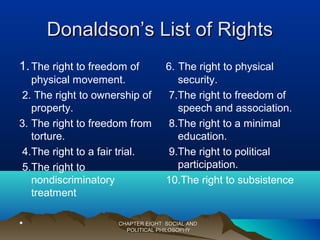
Donaldson’s List of RightsDonaldson’s List of Rights
1.The right to freedom of
physical movement.
2. The right to ownership of
property.
3. The right to freedom from
torture.
4.The right to a fair trial.
5.The right to
nondiscriminatory
treatment
•
6. The right to physical
security.
7.The right to freedom of
speech and association.
8.The right to a minimal
education.
9.The right to political
participation.
10.The right to subsistence
CHAPTER EIGHT: SOCIAL ANDCHAPTER EIGHT: SOCIAL AND
POLITICAL PHILOSOPHYPOLITICAL PHILOSOPHY
Disagreements About RightsDisagreements About Rights
• The distinction between negative and positive
rights helps clarify many of the intense social
controversies that confront our society.
– Many people today believe that the law should
enforce only negative rights.
• What things would they tend to favor and disfavor?
– Many other Americans believe that government
should do more than enforce these negative rights.
• What they things would they tend to favor or disfavor?
CHAPTER EIGHT: SOCIAL ANDCHAPTER EIGHT: SOCIAL AND
POLITICAL PHILOSOPHYPOLITICAL PHILOSOPHY
War and TerrorismWar and Terrorism
• The text has discussed some of the moral limits
on what the state may do to its citizens.
• We now turn to a consideration of the state’s
relationship to other states or to the citizens of
other states?
– For example, is it ever wrong for nations to use
violence or force upon each other?
– Are there any moral limits on what warring nations can
do to each other?
– What events in recent news raises these questions?
CHAPTER EIGHT: SOCIAL ANDCHAPTER EIGHT: SOCIAL AND
POLITICAL PHILOSOPHYPOLITICAL PHILOSOPHY
Political RealismPolitical Realism
• Political realism, sometimes called “realpolitik,”
is the view that there are no moral limits on what
one nation may do to another in pursuit of its
own interests.
– The classic proponent of this view is Thomas Hobbes,
who wrote that nations exist in a “state of nature,”
without an international government.
– In this state of nature, war is the norm, and there can
be no binding moral obligations to constrain nations.
– Instead, the only constraint on one nation’s behavior
is the force or power of other nations.
CHAPTER EIGHT: SOCIAL ANDCHAPTER EIGHT: SOCIAL AND
POLITICAL PHILOSOPHYPOLITICAL PHILOSOPHY
Outside of MoralityOutside of Morality
• If we accept political realism, then morality has
no place in international relations.
– Thus, the use of violence between nations and even
some acts of terrorism can never be condemned as
morally wrong or unjust, but only as imprudent or not
in the nation’s best interests.
• What objections do critics of political realism
raise?
• How do political realists respond to them?
• (591-592)
CHAPTER EIGHT: SOCIAL ANDCHAPTER EIGHT: SOCIAL AND
POLITICAL PHILOSOPHYPOLITICAL PHILOSOPHY
PacifismPacifism
• Pacifists claim that there are moral limits that
govern relations and violence between nations.
• There are two forms of pacifism:
– Absolute pacifism is the view that war is always
wrong;
– Conditional pacifism is the position that war—
especially modern war—is generally wrong, but there
may be some rare situations in which war might be
justified.
CHAPTER EIGHT: SOCIAL ANDCHAPTER EIGHT: SOCIAL AND
POLITICAL PHILOSOPHYPOLITICAL PHILOSOPHY
Absolute PacifismAbsolute Pacifism
• Some forms of absolute pacifism have a religious
basis:
– Many Christians have held, for example, that the
teachings of Jesus—“Love your enemies” —directly
prohibit the use of violence, even in self-defense.
• Other pacifists appeal to utilitarian grounds:
– They point to the fact that the destructive
consequences of war far outweigh the benefits that
supposedly produce. Therefore, war is always morally
unjustified.
CHAPTER EIGHT: SOCIAL ANDCHAPTER EIGHT: SOCIAL AND
POLITICAL PHILOSOPHYPOLITICAL PHILOSOPHY
Absolute PacifismAbsolute Pacifism
• Still other pacifists make a deontological
argument for pacifism:
• They use Kant’s theory and argue that because of the
dignity or sanctity of the human person, every human
being has a right not to be killed and a right not to
have violence used against him or her. Thus, because
war necessarily involves violence and killing, war is
absolutely immoral.
• Explain Jan Narveson’s criticism of the deontological
argument for absolute pacifism
• What do critics say about absolute pacifism? (593-594)
CHAPTER EIGHT: SOCIAL ANDCHAPTER EIGHT: SOCIAL AND
POLITICAL PHILOSOPHYPOLITICAL PHILOSOPHY
Conditional PacifismConditional Pacifism
• Conditional pacifists agree with critics of
absolute pacifism that in some extreme and
extremely rare situations, war might be justified.
– It is possible, of course, to imagine an ideal war
between ideally decent enemies, in which the benefits
of fighting the war might outweigh its horrible costs.
– But conditional pacifists point out that modern wars
are fought with weapons that necessarily inflict
widespread injuries and suffering on numerous
innocent parties: civilians, children, the aged.
– This implies that modern wars cannot be justified.
CHAPTER EIGHT: SOCIAL ANDCHAPTER EIGHT: SOCIAL AND
POLITICAL PHILOSOPHYPOLITICAL PHILOSOPHY
Weighing the CostsWeighing the Costs
and Benefitsand Benefits
• Critics point out that conditional pacifists admit
that to properly evaluate the justice of a war, one
needs to weigh its costs against its benefits.
• Once this is admitted, then the conditional
pacifist has opened the door to the possibility of
a just, moral war.
– And if war is sometimes justified, then we must ask
this question: Under what conditions is war justified?
– Just war theory tries to answer that question.
CHAPTER EIGHT: SOCIAL ANDCHAPTER EIGHT: SOCIAL AND
POLITICAL PHILOSOPHYPOLITICAL PHILOSOPHY
Just War TheoryJust War Theory
• Just war theory is a middle way between political
realism’s claim that there are no moral limits to
war, and the pacifist rejection of war as virtually
always immoral.
– According to just war theory although war is evil
because killing is wrong, it is sometimes morally
justified for a state to engage in war because the
state has an obligation to defend its citizens, protect
the innocent, and enforce justice.
– Just war theory then sets out a number of principles
to determine when war is morally justified.
CHAPTER EIGHT: SOCIAL ANDCHAPTER EIGHT: SOCIAL AND
POLITICAL PHILOSOPHYPOLITICAL PHILOSOPHY
Principles of Just War:Principles of Just War:
Jus ad bellamJus ad bellam
• Augustine, Aquinas and other modern thinkers,
have developed just war theory, arguing that
going to war is morally justified when:
1. It is declared by a legitimate authority;
2. It is fought for a just cause;
3. It is fought with a right intention;
4. It is fought as a last resort;
5. there is a real and certain danger;
6. It has a reasonable probability of success;
7. the end is proportional to the probable harm.
CHAPTER EIGHT: SOCIAL ANDCHAPTER EIGHT: SOCIAL AND
POLITICAL PHILOSOPHYPOLITICAL PHILOSOPHY
Principles of Just War:Principles of Just War:
Jus in belloJus in bello
• In addition to the principles governing going to
war, there are also principles that constrain
nations when they are already fighting a war:
1. The means used must be proportional to the end;
2. Combatants must not intentionally target
noncombatants and must be able to discriminate
between combatants and noncombatants.
• Explain the perspectives on just war developed
by Eastern philosophies, such as Sikhism?
(597-598)
CHAPTER EIGHT: SOCIAL ANDCHAPTER EIGHT: SOCIAL AND
POLITICAL PHILOSOPHYPOLITICAL PHILOSOPHY
CriticismsCriticisms
• Pacifists have argued that, historically, the
theory has been used only as an excuse for
going to war and has not been used to avoid
war.
– Consequently, the pacifist claims, just war theory has
encouraged war instead of having served to limit war.
• What other criticisms of just war theory have
been made? And how do just war theorists
respond? (598)
CHAPTER EIGHT: SOCIAL ANDCHAPTER EIGHT: SOCIAL AND
POLITICAL PHILOSOPHYPOLITICAL PHILOSOPHY
TerrorismTerrorism
• Terrorism has been defined as…
– Acts of violence designed to create terror among the
members of a society; forms of violence in pursuit of a
political goal such as a more just government;
intentionally directed actions against noncombatants.
• C.A. J. Coades defines terrorism as:
– Intentionally targeting noncombatants with lethal or
severe violence to achieve political purposes, perhaps
through the creation of fear and perhaps including the
targeting of property that is related to life or security.
CHAPTER EIGHT: SOCIAL ANDCHAPTER EIGHT: SOCIAL AND
POLITICAL PHILOSOPHYPOLITICAL PHILOSOPHY
The Verdict on TerrorismThe Verdict on Terrorism
• What does each of the approaches to war we’ve
covered so far say about terrorism? (pgs 600 ff)
– Political Realism?
– Pacifism?
• Absolute / Condition
– Just War Theory?
• What does just war theory imply about the
permissibility of extreme punishment techniques,
such as waterboarding?
CHAPTER EIGHT: SOCIAL ANDCHAPTER EIGHT: SOCIAL AND
POLITICAL PHILOSOPHYPOLITICAL PHILOSOPHY

Ch8ppt velasquez12

  • 1.
    CHAPTER EIGHT SOCIALANDCHAPTER EIGHT SOCIAL AND POLITICAL PHILOSOPHYPOLITICAL PHILOSOPHY P H I L O S O P H YP H I L O S O P H Y A TEXT WITH READINGSA TEXT WITH READINGS 1212thth EDITIONEDITION Manual VelasquezManual Velasquez Chapter 8:Chapter 8: “Social and Political Philosophy”“Social and Political Philosophy”
  • 2.
    The Limits ofGovernmentThe Limits of Government • Beyond conducting war and maintaining domestic law, the government of the United States does many things: – It provides loans to banks, insurance companies, and car companies and has bought up large portions of stock in companies. – It provides welfare for those who are poor, disabled, and unemployed and pays for medical services for older adults. – It pays for the education of all children. • Are these legitimate functions of government? CHAPTER EIGHT: SOCIAL ANDCHAPTER EIGHT: SOCIAL AND POLITICAL PHILOSOPHYPOLITICAL PHILOSOPHY
  • 3.
    Issues within SocialandIssues within Social and Political PhilosophyPolitical Philosophy • The focus of this chapter is “Social and Political” • This philosophy addresses the previous question as well as the following: – What is the source of the authority government wields over us? – Is it just that government should play such a large role in regulating our lives? – What is justice and what does justice demand that we should do for the poor and the needy among us? – What is the relationship of the individual to society? CHAPTER EIGHT: SOCIAL ANDCHAPTER EIGHT: SOCIAL AND POLITICAL PHILOSOPHYPOLITICAL PHILOSOPHY
  • 4.
    The Meaning of‘State’The Meaning of ‘State’ • When we use the word ‘state’, we are not referring to California or Michigan. • Rather, we generally use the word to refer to what we today often refer to as a “nation”: a politically organized body of people who occupy a definite territory and whose political organization has supreme or “sovereign” authority over the people in that territory. – In this sense, the United States as a whole is a state, but California and New York are not states. CHAPTER EIGHT: SOCIAL ANDCHAPTER EIGHT: SOCIAL AND POLITICAL PHILOSOPHYPOLITICAL PHILOSOPHY
  • 5.
    Outline of Topicsin Chapter 8Outline of Topics in Chapter 8 • The remainder of the chapter focuses on three sets of issues: – 8.2 What Justifies the State? – 8.3 What is Justice? – 8.4 Limits on the State CHAPTER EIGHT: SOCIAL ANDCHAPTER EIGHT: SOCIAL AND POLITICAL PHILOSOPHYPOLITICAL PHILOSOPHY
  • 6.
    8.28.2 What Justifiesthe State?What Justifies the State? • The state is the highest authority in a society, and has the legal power to define the public interest and enforce its definition. • One clear example of the state’s doing this can be seen in the income tax system. – The state sets priorities—that is, defines the public interest—then, it taxes citizens to implement these priorities. – Not everybody agrees with the priorities of the state – should they too be forced to pay taxes on those items they find unacceptable? CHAPTER EIGHT: SOCIAL ANDCHAPTER EIGHT: SOCIAL AND POLTICAL PHILOSOPHYPOLTICAL PHILOSOPHY
  • 7.
    Justifying the StateJustifyingthe State • Various theories have been advanced to define the legitimacy of the state and justify its power. • Appeals have been made to: – Divine authority. • Some rulers have claimed the power to rule as a divine right, as a kind of mandate from God. – The public interest. • Insofar as the state furthers the public interest, it is justified. – An important and influential theory of justification is social contract theory. CHAPTER EIGHT: SOCIAL ANDCHAPTER EIGHT: SOCIAL AND POLITICAL PHILOSOPHYPOLITICAL PHILOSOPHY
  • 8.
    Social Contract TheorySocialContract Theory • Social contract theory says that individuals agree to give up certain liberties and rights to the state, which in return guarantees such rights as life, liberty, and the pursuit of happiness. – Contract theory is both an explanation of the origin of the state and a defense of its authority. – This theory has been defended by Thomas Hobbes, John Locke, Jean Jacques Rousseau and more recently by the philosopher John Rawls. CHAPTER EIGHT: SOCIAL ANDCHAPTER EIGHT: SOCIAL AND POLITICAL PHILOSOPHYPOLITICAL PHILOSOPHY
  • 9.
    Hobbesian JusticeHobbesian Justice •Unlike previous philosophers, Thomas Hobbes (1588-1679) viewed the world as a mechanical system explainable in terms of physical laws. – Even the behavior of humans or complex societies, it is argued, is reducible to geometric and physical explanations. – Accordingly, in his book In Leviathan, Hobbes portrays humans as selfish, unsocial creatures driven by two needs: survival and personal gain. • Therefore, human life is characterized by constant struggle, strife, and war, with individual pitted against individual in a battle for self-preservation and gain. CHAPTER EIGHT: SOCIAL ANDCHAPTER EIGHT: SOCIAL AND POLITICAL PHILOSOPHYPOLITICAL PHILOSOPHY
  • 10.
    Rational Self-InterestRational Self-Interest •“The passions that incline men to peace, are fear of death; desire of such things as are necessary to commodious living; and a hope by their industry to obtain them. And reason suggesteth convenient articles of peace, upon which men may be drawn to agreement. These articles, are they, which otherwise are called the Laws of Nature.” (546) – Hobbes is saying that a rational concern for their own survival and best long-term interests impels humans to enter into a contract with one another and form society. CHAPTER EIGHT: SOCIAL ANDCHAPTER EIGHT: SOCIAL AND POLITICAL PHILOSOPHYPOLITICAL PHILOSOPHY
  • 11.
    Irrevocable AuthorityIrrevocable Authority •Because they recognize that otherwise their lives are destined to be “solitary, poor, nasty, brutish, and short,” humans accept state authority outside themselves and over them. – The agreement that establishes this authority is irrevocable: once set up, the political body wielding this power exercises absolute authority over its subjects and remains in power as long as it is able to compel them to do what they otherwise would not do. – Thus, the state that individuals contract with becomes superior to the individuals. CHAPTER EIGHT: SOCIAL ANDCHAPTER EIGHT: SOCIAL AND POLITICAL HILOSOPHYPOLITICAL HILOSOPHY
  • 12.
    Locke and NaturalMoral LawsLocke and Natural Moral Laws • John Locke (1632-17040 also believes human beings started off in a state of nature. • However, his assumptions about humans in the state of nature contrasts with those of Hobbes – Humans, for Hobbes, are naturally without morality , whereas for Locke they are essentially moral beings who feel the pull of natural moral rules. • Thus, where Hobbes saw warfare as the human’s natural state, Locke saw our natural state as at least partly regulated by natural moral laws. • As a result, Locke viewed humans as free and equal by nature, regardless of the existence of any government. CHAPTER EIGHT: SOCIAL ANDCHAPTER EIGHT: SOCIAL AND POLITICAL PHILOSOPHYPOLITICAL PHILOSOPHY
  • 13.
    Why Government?Why Government? •According to Locke, human beings seek to establish governments because three things are missing in the state of nature: 1. a firm, clearly understood interpretation of the natural but unwritten moral laws; 2. unbiased judges to resolve disputes; 3. a power capable of enforcing justice when one is wronged. • So, individuals enter into a social contract to maintain their natural rights. CHAPTER EIGHT: SOCIAL ANDCHAPTER EIGHT: SOCIAL AND POLITICAL PHILOSOPHYPOLITICAL PHILOSOPHY
  • 14.
    In Locke’s OwnWordsIn Locke’s Own Words • “Thus mankind, notwithstanding all the privileges of the state of Nature, being but in an ill condition while they remain in it are quickly driven into society. Hence it comes to pass, that we seldom find any number of men live any time together in this state. The inconveniences that they are therein exposed to by the irregular and uncertain exercise of the power every man has of punishing the transgressions of others, make them take sanctuary under the established laws of government, and therein seek the preservation of their property.” (547) CHAPTER EIGHT: SOCIALANDCHAPTER EIGHT: SOCIALAND POLITICAL PHILOSOPHYPOLITICAL PHILOSOPHY
  • 15.
    Limited AuthorityLimited Authority •The social contract human beings form is based on the consent of the majority, and all agree to abide by the decisions of the majority. – Therefore, the state’s authority is limited by the terms of the contract, which is continually reviewed by the citizenry. – So, unlike Hobbes’s absolutistic state, Locke’s state is specific and limited. – Indeed, one of the fundamental moral rights in Locke’s political state is the right to resist and to challenge authority. CHAPTER EIGHT: SOCIAL ANDCHAPTER EIGHT: SOCIAL AND POLITICAL PHILOSOPHYPOLITICAL PHILOSOPHY
  • 16.
    Focus on FreedomFocuson Freedom • Locke agrees with Hobbes that… – humans use their reason to perceive the necessity of entering a social contract. – the source of the state’s authority is the the consent of the governed. • However, Locke emphasizes freedom more than Hobbes. • Locke’s version of the social contract helped inspire the Declaration of Independence and the American Revolution in 1776. CHAPTER EIGHT: SOCIAL ANDCHAPTER EIGHT: SOCIAL AND POLITICAL PHILOSOPHYPOLITICAL PHILOSOPHY
  • 17.
    Rousseau’s Social ContractRousseau’sSocial Contract • Many consider Jean Jacques Rousseau (1712– 1778) to be the foremost philosopher of the social contract theory. – Rousseau did not appeal to a self-evident natural moral law as Locke had, but argued that if people are to act morally, they must live under laws that they freely accept. – He thus emphasizes personal moral autonomy, and assumes that the fundamental requirement of a morally acceptable government is that the governed have freely subscribed to a common body of law. CHAPTER EIGHT: SOCIAL ANDCHAPTER EIGHT: SOCIAL AND POLITICAL PHILOSOPHYPOLITICAL PHILOSOPHY
  • 18.
    ““Born in Chains”Bornin Chains” • Rousseau began his most important political work, Of the Social Contract, with the sensational words “Man was born free, but he is everywhere in chains.” – How then did we all came to be bound by the “chains” of the all-powerful authority of the state? – Rousseau answers this question by arguing that each person, while by nature free and autonomous, freely gives up their freedom to form a state. CHAPTER EIGHT: SOCIAL ANDCHAPTER EIGHT: SOCIAL AND POLITICAL PHILOSOPHYPOLITICAL PHILOSOPHY
  • 19.
    The General WillTheGeneral Will • The power of the state is consistent with human freedom if individuals freely choose to subject themselves to it. – For Rousseau the “general will” is the corporate expression of this mutually agreed on decision. • Because each citizen is an integral part of the general will, what the general will decides and does is really what each citizen is deciding and doing. • Thus, in obeying the state, the individual is truly obeying himself and is therefore free: The power of the state is a morally justified power. CHAPTER EIGHT: SOCIAL ANDCHAPTER EIGHT: SOCIAL AND POLITICAL PHILOSOPHYPOLITICAL PHILOSOPHY
  • 20.
    In Rousseau’s OwnWordsIn Rousseau’s Own Words • “If, then, we set aside what is not of the essence of the social contract, we shall find that it is reducible to the following terms: ‘Each of us puts in common his person and his whole power under the supreme direction of the general will; and in return we receive every member as an indivisible part of the whole.’ • Forthwith, instead of the individual personalities of all the contracting parties, this act of association produces a moral and collective body, which is composed of as many members as the assembly has voices, and which receives from this same act its unity, its common self (moi), its life, and its will.” (550) CHAPTER EIGHT: SOCIAL ANDCHAPTER EIGHT: SOCIAL AND POLITICAL PHILOSOPHYPOLITICAL PHILOSOPHY
  • 21.
    The General WillTheGeneral Will Versus the “Will of All”Versus the “Will of All” • The general will is not the same as the “will of all,” or unanimity of feeling. – A group of wills is general when each member of the group aims at the common good. – Sometimes, the general will and the will of all might result in the same action, for each group member may see his or her own best interests being served. – But Rousseau felt that agreement is more likely when everyone tries to determine whether a proposed action is best for the good of all, for the general good, rather than just for the self. CHAPTER EIGHT: SOCIAL ANDCHAPTER EIGHT: SOCIAL AND POLITICAL PHILOSOPHYPOLITICAL PHILOSOPHY
  • 22.
    Contemporary Social ContractContemporarySocial Contract Theory: RawlsTheory: Rawls • David Hume (1711-1776) argued that the notion of a social contract was strictly fictional. – If we go back in history, he pointed out, we will find no signs of people coming together to choose their governments. – After Hume’s attack, most philosophers gave up on social contract theory. – However, Harvard philosopher John Rawls (1921– 2002) reshaped social contract theory into a powerful new way of thinking about the nature of government and society. CHAPTER EIGHT: SOCIAL ANDCHAPTER EIGHT: SOCIAL AND POLITICAL PHILOSOPHYPOLITICAL PHILOSOPHY
  • 23.
    What Social ContractWhatSocial Contract Theory is Really AboutTheory is Really About • Rawls argues that the fictional nature of the social contract is not important. • The key idea in social contract theory is that it gives us a way of thinking about what the nature and purpose of government should be. – In order to decide what kind of government is best to have, social contract theory prescribes that we should imagine that we are starting our society from scratch. – What kind of government and society would we choose for ourselves if we were in this starting or “original” position? CHAPTER EIGHT: SOCIAL ANDCHAPTER EIGHT: SOCIAL AND POLITICAL PHILOSOPHYPOLITICAL PHILOSOPHY
  • 24.
    The Veil ofIgnoranceThe Veil of Ignorance • Rawls wonders how we can conceptualize a just government – one that is equally fair to everyone and shows favoritism to none? • He claims that the principles of such a government could be decided only if we chose them under a “veil of ignorance” – We would have be ignorant of any characteristics that we might possess -- for example, whether we are male or female, black or white, rich or poor, young or old, our religious convictions, etc. CHAPTER EIGHT: SOCIAL ANDCHAPTER EIGHT: SOCIAL AND POLITICAL PHILOSOPHYPOLITICAL PHILOSOPHY
  • 25.
    In Rawls’ OwnWordsIn Rawls’ Own Words • “This original position is not, of course, thought of as an actual historical state of affairs…. It is understood as a purely hypothetical situation characterized so as to lead to a certain conception of justice. Among the essential features of this situation is that no one knows his place in society, his class position or social status, nor does anyone know his fortune in the distribution of natural assets and abilities, his intelligence, strength and the like. . . . Since all are similarly situated and no one is able to design principles to favor his particular condition, the principles of justice [for society and government] are the result of a fair agreement or bargain.” (552) CHAPTER EIGHT: SOCIAL ANDCHAPTER EIGHT: SOCIAL AND POLITICAL PHILOSOPHYPOLITICAL PHILOSOPHY
  • 26.
    Rawlsian Justified GovernmentRawlsianJustified Government • Rawls has shifted our attention from the issue of the government we actually have, to the issue of government we should have. – Contrary to the traditional social contract theory of Hobbes, Locke and Rousseau, the authority of our government is justified not because we actually consented to live under our government in the state of nature. – Rather, the authority of government is justified because we would consent to live under that type of government if we were in the original position. CHAPTER EIGHT: SOCIAL ANDCHAPTER EIGHT: SOCIAL AND POLITICAL PHILOSOPHYPOLITICAL PHILOSOPHY
  • 27.
    The Communitarian CritiqueTheCommunitarian Critique • Communitarians criticize social contract theory, arguing that it overlooks the social nature of human beings, and overemphasizes the individual. • They claim that we cannot hope to understand ourselves or our government apart from our community and its cultural traditions. • Historically, this viewpoint is first anticipated by the holistic social philosophy of Aristotle, and then later by Hegel. CHAPTER EIGHT: SOCIAL ANDCHAPTER EIGHT: SOCIAL AND POLITICAL PHILOSOPHYPOLITICAL PHILOSOPHY
  • 28.
    Aristotle: the Stateas NaturalAristotle: the State as Natural • Aristotle (384-322 B.C.E.) argued that government is a natural outgrowth of our natural tendency to associate with other human beings. • Just as the family and the tribe are outgrowths of our natural tendencies to live with one another, so is the state: – “We know that the state is a creation of nature and that it is prior to the individual by the fact that the individual apart from the state is not self-sufficient. The individual is like a part that is dependent on the whole.” (554) CHAPTER EIGHT: SOCIAL ANDCHAPTER EIGHT: SOCIAL AND POLITICAL PHILOSOPHYPOLITICAL PHILOSOPHY
  • 29.
    Hegel: The Stateas the CompletionHegel: The State as the Completion of Individual Freedomof Individual Freedom • G.W.F. Hegel (1770-1831) agreed with Aristotle that the state is the completion of all earlier human associations. • Humans cannot develop either fully or freely without the state and its cultural practices: – “Nor [is the state a means by which] each individual limits his own freedom so that [every individual] can secure a small space of liberty for himself. Rather, we affirm, that Law, Morality, Government, and they alone, are the positive reality and completion of Freedom. . . .” (555) CHAPTER EIGHT: SOCIAL ANDCHAPTER EIGHT: SOCIAL AND POLITICAL PHILOSOPHYPOLITICAL PHILOSOPHY
  • 30.
    Sandel’s CommunitarianismSandel’s Communitarianism •The contemporary communitarian philosopher, Michael Sandel, thinks Rawls is mistaken in claiming that the state must support no particular culture but leave people free to choose their own cultural preferences. – He argues instead each state and its government must favor and support some set of cultural traditions. – Thus, the government of each state must educate its people so that they learn about these cultural traditions and come to accept their values CHAPTER EIGHT: SOCIAL ANDCHAPTER EIGHT: SOCIAL AND POLITICAL PHILOSOPHYPOLITICAL PHILOSOPHY
  • 31.
    In Sandel’s OwnWordsIn Sandel’s Own Words • “Participating in politics . . . means deliberating with fellow citizens about the common good and helping to shape the destiny of the political community. But to deliberate well about the common good requires more than the capacity to choose one’s ends and to respect others’ rights to do the same. It requires a knowledge of public affairs and also a sense of belonging, a concern for the whole, a moral bond with the community whose fate is at stake.” (556-557) CHAPTER EIGHT: SOCIAL ANDCHAPTER EIGHT: SOCIAL AND POLITICAL PHILOSOPHYPOLITICAL PHILOSOPHY
  • 32.
    Communitarianism in SumCommunitarianismin Sum • Communitarian views imply that 1. the state is not an artificial construct … 2. because without the state, humans could not develop, for there would be no one to enter a social contract in “the state of nature,” 3. and because our culture and traditions make us who we are, the state should support the cultural traditions of its people, including their religion, morality, and cultural values. CHAPTER EIGHT: SOCIAL ANDCHAPTER EIGHT: SOCIAL AND POLITICAL PHILOSOPHYPOLITICAL PHILOSOPHY
  • 33.
    Women’s Critique ofSocialWomen’s Critique of Social Contract TheoryContract Theory • At the heart of contract theory is the idea that authority over adults depends on their consent. – A social contract is necessary to establish the state because the contract is the means through which citizens consent to be ruled by a government. – But this fundamental idea raises an important question that many women have asked: What justifies the authority that males have traditionally exercised over females, particularly in the family? – How can philosophers like Hobbes, Locke and Rousseau justify the traditional dominance of men over women? CHAPTER EIGHT: SOCIAL ANDCHAPTER EIGHT: SOCIAL AND POLITICAL PHILOSOPHYPOLITICAL PHILOSOPHY
  • 34.
    Public/PrivatePublic/Private • Social contracttheory, as developed by Hobbes, Locke, and Rousseau, explicitly indicates that the state is created by an agreement that males make with one another. • Why did they fail to apply their fundamental principles to the family? – Possibly because of a basic assumption we all unconsciously make: that “private” or “personal” matters, such as family matters, have nothing to do with the “public” matters of politics—what happens to women within the family is a private matter unrelated to the politics that rules our public lives CHAPTER EIGHT: SOCIAL ANDCHAPTER EIGHT: SOCIAL AND POLITICAL PHILOSOPHYPOLITICAL PHILOSOPHY
  • 35.
    PowerlessPowerless • Traditionally, womenhave shouldered the major part of the unpaid work in the "private" life of the family: cooking, cleaning, laundry, and caring for the children. – Some feminists argue this frees men to engage in the more powerful "public" life of economic and political activities, while women are relegated to a relatively powerless and unequal role. – Confining women to the private and men to the public sphere is not necessarily unfair. However, in our society, real economic and political power is available only in the public world. CHAPTER EIGHT: SOCIAL ANDCHAPTER EIGHT: SOCIAL AND POLITICAL PHILOSOPHYPOLITICAL PHILOSOPHY
  • 36.
    Rethinking Social ContractRethinkingSocial Contract • The problems that feminist thinkers have identified in political theory seem to call the whole social contract tradition into question. – That’s because this tradition seems to be built on the assumption that our private lives and our public affairs are and should be separate. – But by ignoring the private domain, the assumption ignores the most fundamental source of political and economic inequalities: the family. – Is it possible to rethink social contract ideals of equality, freedom, and consent as applied to the family? CHAPTER EIGHT: SOCIAL ANDCHAPTER EIGHT: SOCIAL AND POLITICAL PHILOSOPHYPOLITICAL PHILOSOPHY
  • 37.
    8.38.3 What IsJustice?What Is Justice? • Whether we believe that government rests on individual consent or on community values, we want government to be just. – Justice includes both retributive justice, which looks at how fair punishments are, and distributive justice, which looks at how societies distribute social, political and economic benefits, such as jobs, and economic burdens, such as taxes. • Embedded in any answer to the question of how these things should be distributed is a principle of distributive justice – this is an assumption about the proper way of distributing what is available when there isn’t enough for all. CHAPTER EIGHT: SOCIAL ANDCHAPTER EIGHT: SOCIAL AND POLITICAL PHILOSOPHYPOLITICAL PHILOSOPHY
  • 38.
    Formal JusticeFormal Justice •Aristotle articulated one of the earliest principles of distributive justice, known as formal justice. – Formal justice is the requirement that we should treat similar people similarly. – For example, if Jack and Jill, carry the same amount of water for us, then we should pay them the same. • We should not pay Jack more merely because he is a man. • Neither should we pay Jill more merely because her skin is white and Jack's is not. – This raises the question: when should we consider people to be “the same”? CHAPTER EIGHT: SOCIAL ANDCHAPTER EIGHT: SOCIAL AND POLITICAL PHILOSOPHYPOLITICAL PHILOSOPHY
  • 39.
    What is aRelevant Difference?What is a Relevant Difference? • On the one hand, the formal principle of justice tells us something about what justice and injustice are – if we agree about what counts as relevant difference and what doesn’t. • On the other hand, the formal principle of justice does not settle all the issues, because there can be disagreement about what counts as a relevant difference. – There have been many conceptions of “relevant differences” among people, -- these are called “material” or “substantive” principles of justice. CHAPTER EIGHT: SOCIAL ANDCHAPTER EIGHT: SOCIAL AND POLITICAL PHILOSOPHYPOLITICAL PHILOSOPHY
  • 40.
    Material JusticeMaterial Justice •A number of accounts of material justice, each with a different notion of relevant difference have been defended, including: – Justice as Merit – Justice as Equality – Justice as Social Utility – Justice as Based on Need and Ability – Justice as Based on Liberty • Welfare Liberalism and Clssical Liberalism CHAPTER EIGHT: SOCIAL ANDCHAPTER EIGHT: SOCIAL AND POLITICAL PHILOSOPHYPOLITICAL PHILOSOPHY
  • 41.
    Justice as MeritJusticeas Merit • Justice as merit holds that benefits and burdens should be distributed unequally according to people’s ability, effort, achievement, or social status. – From the perspective, the main “relevant difference” among people is merit: what people deserve in light of their talents and achievements. – This view plays an important role in many of our perceptions of justice. – Can you think of any examples of this sort of justice? CHAPTER EIGHT: SOCIAL ANDCHAPTER EIGHT: SOCIAL AND POLITICAL PHILOSOPHYPOLITICAL PHILOSOPHY
  • 42.
    Plato and AristotleandPlato and Aristotle and Meritocratic JusticeMeritocratic Justice • Plato and Aristotle both offered defenses of merit-based principles of justice. – Plato argued that people, naturally, have different talents and abilities, so society will function best if each person plays the role for which he or she is best suited. – Aristotle also shared the assumption that individuals are unequal and that justice is giving to unequal individuals their unequal due. • In his Politics, Aristotle even defended slavery on this basis. – Is this a workable principle of justice? CHAPTER EIGHT: SOCIAL ANDCHAPTER EIGHT: SOCIAL AND POLITICAL PHILOSOPHYPOLITICAL PHILOSOPHY
  • 43.
    Justice as EqualityJusticeas Equality • ‘Equal’ means the same. • In the US, this idea of justice is intuitively plausible for most of us. – We widely believe that everyone is entitled to roughly the same kind of basic education, that the sexes and races should be treated the same, that individuals should be treated the same before the law, etc. – One reason we reject slavery on principle is because it violates our belief that everyone is equal. – But what does the commitment to equality imply? • CHAPTER EIGHT: SOCIALCHAPTER EIGHT: SOCIAL AND POLITICAL PHILOSOPHYAND POLITICAL PHILOSOPHY
  • 44.
    Strict EgalitarianismStrict Egalitarianism •According to strict egalitarianism equality, in a just society, implies that every person will be given exactly equal shares of that society’s benefits and burdens. – Egalitarians say there are no relevant differences among people, so all should be treated equally. – Pick one area of society (e.g., employment, education) and determine how this principle would change that aspect of society. CHAPTER EIGHT: SOCIAL ANDCHAPTER EIGHT: SOCIAL AND POLITICAL PHILOSOPHYPOLITICAL PHILOSOPHY
  • 45.
    Questions about EqualityQuestionsabout Equality • The main challenge for strict egalitarianism, is that people are not equal, and their inequalities seem to sometimes demand an unequal sharing in society’s resources. – Human beings have different needs, different abilities, different desires, and different virtues. They put forward different efforts and have different skills and different physical abilities. – Don’t we have to take these differences into account when we distribute benefits among people? CHAPTER EIGHT: SOCIAL ANDCHAPTER EIGHT: SOCIAL AND POLITICAL PHILOSOPHYPOLITICAL PHILOSOPHY
  • 46.
    Moderate EgalitarianismModerate Egalitarianism CHAPTEREIGHT: SOCIAL ANDCHAPTER EIGHT: SOCIAL AND POLITICAL PHILOSOPHYPOLITICAL PHILOSOPHY • Some egalitarians respond to these criticisms by proposing a more moderate form of egalitarianism which hinges on a distinction between political equality and economic equality. – People have political equality when they have an equal right to participate in our political processes, and in equal political rights (e.g., a right to due process) – Moderate egalitarians argue that people should have strictly equal political rights.
  • 47.
    Moderate EgalitarianismModerate Egalitarianism •In applying equality to the economic arena, moderates make a distinction between equality of income and wealth, and equality of economic opportunity. – Moderate egalitarians argue against making everyone’s income and wealth equal, although some differences among people have to be recognized when distributing income and wealth. – On the other hand, moderate egalitarians continue, everyone should have an equal opportunity to get those jobs and positions that carry higher levels of income and wealth. CHAPTER EIGHT: SOCIAL ANDCHAPTER EIGHT: SOCIAL AND POLITICAL PHILOSOPHYPOLITICAL PHILOSOPHY
  • 48.
    Justice as SocialUtilityJustice as Social Utility • Another influential material principle of justice is that justice is what promotes the general welfare, that is, the well-being or happiness of citizens. – In developing his theory of utilitarianism, John Stuart Mill (1806-1873) argued that society should always try to minimize social harms and maximize social benefits. – Whatever the institution, policy, or program, its justice depends ultimately on its expediency—the extent to which it will be advantageous to society. CHAPTER EIGHT: SOCIAL ANDCHAPTER EIGHT: SOCIAL AND POLITICAL PHILOSOPHYPOLITICAL PHILOSOPHY
  • 49.
    Criticisms of SocialUtilityCriticisms of Social Utility • Mill’s account of justice has been subject to many of the same criticisms as his ethical theory, utilitarianism. – For example, some have argued that slavery can be advantageous for a society under some conditions. • In fact, some have argued that in primitive societies, slavery gave some people the leisure needed to develop theories and technologies that in the long run made those societies better off than they would have been if everyone had been forced to spend all their time laboring. – If these arguments are correct, then the utilitarian would have to agree that slavery in such situations is just. • CHAPTER EIGHT: SOCIAL ANDCHAPTER EIGHT: SOCIAL AND POLITICAL PHILOSOPHYPOLITICAL PHILOSOPHY
  • 50.
    Justice Based onJusticeBased on Need and AbilityNeed and Ability • Socialism is an influential political philosophy that emphasizes public ownership of wealth and the public control of business and industry. • Karl Marx developed a socialist principle of justice based on need and ability: – “From each according to his ability, to each according to his need.” – Marx’s slogan is another interpretation of what relevant difference means in the principle of formal justice. CHAPTER EIGHT: SOCIAL ANDCHAPTER EIGHT: SOCIAL AND POLITICAL PHILOSOPHYPOLITICAL PHILOSOPHY
  • 51.
    What Marxian JusticeImpliesWhat Marxian Justice Implies • For Marx, the key differences that are relevant when distributing things justly are people’s abilities and needs. – Justice requires that jobs and tasks should be assigned to people according to their abilities. • Those with few or no abilities should have light or easy tasks, whereas those who are extremely able and talented should have heavier and more complex jobs. – On the other hand, the goods that society produces— food, clothing, housing, medical care, luxuries—should be distributed according to people’s needs. – In what areas of life do we employ this principle? CHAPTER EIGHT: SOCIAL ANDCHAPTER EIGHT: SOCIAL AND POLITICAL PHILOSOPHYPOLITICAL PHILOSOPHY
  • 52.
    Two ConsequencesTwo Consequences •Marx argues that people should realize their human potential through productive work that exercises their particular abilities. This means: – that work should be distributed according to people’s abilities. – the goods produced through work should be used first to meet people’s basic needs and then their other, nonbasic needs. • What two objections to Marx have critics raised? (572) CHAPTER EIGHT: SOCIAL ANDCHAPTER EIGHT: SOCIAL AND POLITICAL PHILOSOPHYPOLITICAL PHILOSOPHY
  • 53.
    Justice Based onLibertyJustice Based on Liberty • Liberalism holds that liberty is the highest value that society and government can promote. – Liberals support freedom of conscience, freedom of speech, freedom of association, as well as equal political rights and civil liberties. – During the twentieth century, liberalism divided into two camps: • welfare liberalism; • classical liberalism. CHAPTER EIGHT: SOCIAL PHILOSOPHYCHAPTER EIGHT: SOCIAL PHILOSOPHY
  • 54.
    Welfare LiberalismWelfare Liberalism •We have seen that for John Rawls, legitimate principles of justice are those that would be chosen behind such a “veil of ignorance.” – He argues that only these would be fair to everyone because without such knowledge, one would not choose principles that advantage the rich or the poor, the talented or the untalented, black or white, male or female, and so on. – Rawls argues that under these constraints, three principles would be chosen: the principle of equal liberty, the principle of equal opportunity, and the difference principle. CHAPTER EIGHT: SOCIAL ANDCHAPTER EIGHT: SOCIAL AND POLITICAL PHILOSOPHYPOLITICAL PHILOSOPHY
  • 55.
    The Principle ofEqual LibertyThe Principle of Equal Liberty • The principle of equal liberty states that “each person participating in a [political] practice or affected by it has an equal right to the most extensive liberty compatible with a like liberty for all.” – This principle would primarily govern society’s political institutions (e.g., its constitution and government). – It implies that each person must have as many political rights and freedoms as possible, as long as everyone else can have the same (“equal”) political rights and freedoms. CHAPTER EIGHT: SOCIAL ANDCHAPTER EIGHT: SOCIAL AND POLITICAL PHILOSOPHYPOLITICAL PHILOSOPHY
  • 56.
    The Principle ofEqualThe Principle of Equal OpportunityOpportunity • The principle states that desirable jobs and positions should be open to anyone who is qualified by his or her abilities. This means: – that job qualifications should be related to the requirements of the job and should not discriminate by race or sex; – that society should provide people with the training and education needed to qualify for desirable jobs. – This principle is supposed to govern a society’s economic institutions. CHAPTER EIGHT: SOCIALANDCHAPTER EIGHT: SOCIALAND POLITICAL PHILOSOPHYPOLITICAL PHILOSOPHY
  • 57.
    The Difference PrincipleTheDifference Principle • The difference principle says that “[s]ocial and economic inequalities are to be arranged so that they are . . . to the greatest benefit of the least advantaged.”(575) – This principle also governs economic institutions. – Unlike the political arena, where everyone must be equal, the economic arena must allow for some inequalities – to ensure productivity. – But inequalities obviously raise the possibility of unfairness and therefore of instability. CHAPTER EIGHT: SOCIAL ANDCHAPTER EIGHT: SOCIAL AND POLITICAL PHILOSOPHYPOLITICAL PHILOSOPHY
  • 58.
    Rationale for theRationalefor the Difference PrincipleDifference Principle • Rawls is aware that any society will include those who are disadvantaged (those who cannot work or who have few talents and abilities). – These people may be disfavored by principles that allow inequalities. – Consequently, Rawls proposes that inequalities should be allowed only if the plight of the disadvantaged is relieved (through welfare programs, for example) by the extra productivity that unequal work incentives can produce. CHAPTER EIGHT: SOCIAL ANDCHAPTER EIGHT: SOCIAL AND POLITICAL PHILOSOPHYPOLITICAL PHILOSOPHY
  • 59.
    Rawlsian Justice: InSumRawlsian Justice: In Sum • The distribution of benefits and burdens in a society is just if – 1.each person has the most political liberty compatible with equal liberty for all, and – 2.economic inequalities are arranged so that • A. everyone has an equal opportunity to qualify for all positions, and • B. inequalities produce benefits for the least advantaged persons. CHAPTER EIGHT: SOCIAL ANDCHAPTER EIGHT: SOCIAL AND POLITICAL PHILOSOPHYPOLITICAL PHILOSOPHY
  • 60.
    Classical LiberalismClassical Liberalism •Robert Nozick (1938–2002) agreed with what Rawls had to say about political liberty: in the political arena, people should be equal and should have as much liberty as is possible. • In economic affairs, Nozick points out that Rawls advocates a “patterned” theory of justice in economic affairs. – A patterned theory is one that says goods should be distributed among the members of a society according to a certain pattern or formula. CHAPTER EIGHT: SOCIAL ANDCHAPTER EIGHT: SOCIAL AND POLITICAL PHILOSOPHYPOLITICAL PHILOSOPHY
  • 61.
    Nozick’s ObjectionNozick’s Objection •Nozick objects that any patterned theory will always require the unjust use of force and coercion. – People’s free choices will always change any pattern that society tries to establish. – Then, government will unjustly have to force some individuals to give their goods to others until the required distribution is achieved again. – How does Nozick illustrate his criticism using the example of Wilt Chamberlain? (575-576) CHAPTER EIGHT: SOCIAL ANDCHAPTER EIGHT: SOCIAL AND POLITICAL PHILOSOPHYPOLITICAL PHILOSOPHY
  • 62.
    Nozick’s ObjectionsNozick’s Objections •He raises a number of specific objections to Rawls’ theory: – First, Rawls is using the better-off people in society as means to ensure the welfare of the worst-off. – this is fundamentally unjust because it uses people as means. – Second, against Rawls’ claim that wealthier individuals may have to give up some of their money, Nozick argues they are not entitled to keep what they own. CHAPTER EIGHT: SOCIAL ANDCHAPTER EIGHT: SOCIAL AND POLITICAL PHILOSOPHYPOLITICAL PHILOSOPHY
  • 63.
    Nozick’s PrincipleNozick’s Principle •Nozick holds the following principle, which we may take as the principle of justice of classical liberalism: – Benefits and burdens are distributed justly when society allows every individual the freedom to do what he chooses to do for himself or for others, the freedom to keep what he makes for himself or what others choose to give him, and the freedom to keep what he has or give it to whomever he chooses. (576) CHAPTER EIGHT: SOCIAL ANDCHAPTER EIGHT: SOCIAL AND POLITICAL PHILOSOPHYPOLITICAL PHILOSOPHY
  • 64.
    The Importance ofFree ChoiceThe Importance of Free Choice • Nozick gives gives priority to free choice. • He argues that justice is respecting people’s free choices. – Thus, any distribution of economic benefits and burdens is just if it is the result of individuals freely choosing to exchange with each other the goods that each person already owns. – How does Rawls reply to Nozick? (577) CHAPTER EIGHT: SOCIAL ANDCHAPTER EIGHT: SOCIAL AND POLITICAL PHILOSOPHYPOLITICAL PHILOSOPHY
  • 65.
    8.48.4 Limits onthe StateLimits on the State • Are there any other limits on the authority of the state? – Can citizens resist state authority through acts of civil disobedience, when the laws of the state are unjust? – What limits do the right to freedom and other human rights impose on the authority of the state? – Are there are any moral limits on the use of violence between states, in acts of war, and states and individuals in acts of terrorism? CHAPTER EIGHT: SOCIAL ANDCHAPTER EIGHT: SOCIAL AND POLITICAL PHILOSOPHYPOLITICAL PHILOSOPHY
  • 66.
    Unjust Laws andCivilUnjust Laws and Civil DisobedienceDisobedience • According to the dictionary, law means a general rule or body of general rules that is enforced by government and that regulates the behavior of citizens. – Clearly, the laws that governments enact are not always just. • The laws of the United States, for example, once supported slavery. – Are we obligated to obey such laws? Can disobeying unjust laws be morally legitimate? CHAPTER EIGHT: SOCIAL ANDCHAPTER EIGHT: SOCIAL AND POLITICAL PHILOSOPHYPOLITICAL PHILOSOPHY
  • 67.
    Justifying DisobedienceJustifying Disobedience •According to Thomas Aquinas, a human law is a true law only when it does not violate the moral law or force its citizens to violate the moral law. – Morality, for Aquinas, is built into our very nature in the form of various inclinations toward the basic goods in which we find our happiness. – Accordingly to say that a law violates the moral law, is to say that it violates the natural law that directs us toward those goods in which we find our happiness. CHAPTER EIGHT: SOCIAL ANDCHAPTER EIGHT: SOCIAL AND POLITICAL PHILOSOPHYPOLITICAL PHILOSOPHY
  • 68.
    Justified LawsJustified Laws •For Aquinas, laws are just and must be obeyed only when: 1. they serve the common good of the whole community; 2. they do not exceed the authorized power of the lawmaker; 3. they do not unjustly discriminate against some and unfairly advantage others; 4. they do not require citizens to violate their religious beliefs. – If a law fails on any of these counts, it is no law at all and so citizens have no obligation to obey it. CHAPTER EIGHT: SOCIAL ANDCHAPTER EIGHT: SOCIAL AND POLITICAL PHILOSOPHYPOLITICAL PHILOSOPHY
  • 69.
    Legal PositivismLegal Positivism •Many philosophers have strongly objected to this way of linking law and morality. – For example, the British legal philosopher John Austin (1790–1859) argued that a law is nothing more than a command issued by the ruler, backed by threats of punishment and maintained by a habit of obedience. – Consequently, once a law has been issued by a ruler who has the power to punish and whom citizens habitually obey, it is a valid law whether or not it is moral, and whether we like it or not. CHAPTER EIGHT: SOCIAL ANDCHAPTER EIGHT: SOCIAL AND POLITICAL PHILOSOPHYPOLITICAL PHILOSOPHY
  • 70.
    Disobeying Unjust LawsDisobeyingUnjust Laws • The critique of civil disobedience made by legal positivists has not convinced everyone. – A number of political leaders have continued to embrace the view of Aquinas, particularly those who, suffering under unjust or discriminatory laws, have advocated disobeying such laws in favor of the “higher law” of conscience. – Explain the justification of civil disobedience given by Martin Luther King, Jr. and Gandhi ? (582-583) CHAPTER EIGHT: SOCIAL ANDCHAPTER EIGHT: SOCIAL AND POLITICAL PHILOSOPHYPOLITICAL PHILOSOPHY
  • 71.
    More than EfficiencyMorethan Efficiency • If we valued only efficiency in government, then any evaluation of the rightful limits of governmental authority would be relatively simple. – Evaluated strictly on social utility, it is entirely possible that the most authoritarian government might prove the most efficient. – Yet clearly our society is concerned with more than efficiency-- we are also concerned with justice and individual freedoms, issues that are not always compatible with efficiency. CHAPTER EIGHT: SOCIAL ANDCHAPTER EIGHT: SOCIAL AND POLITICAL PHILOSOPHYPOLITICAL PHILOSOPHY
  • 72.
    In Defense ofFreedomIn Defense of Freedom • Contract theory regards both justice and individual liberty as of paramount importance. – But contract theory is not clear about how justice and other kinds of moral considerations should be balanced against important individual liberties. – The liberties that concern us here are political and social freedoms, including freedom of thought, and being able to live as one wants without interference from others. CHAPTER EIGHT: SOCIAL ANDCHAPTER EIGHT: SOCIAL AND POLITICAL PHILOSOPHYPOLITICAL PHILOSOPHY
  • 73.
    Tyranny of theMajorityTyranny of the Majority • Freedom finds its classic defense in John Stuart Mill’s essay On Liberty. • Mill’s central concern in this essay is the extent to which government and society must be prohibited from interfering with an individual’s life. • His concern for freedom grew out of his fear of what he called the “tyranny of the majority,” the tendency of government—and society in general—to persecute and suppress any forms of life or ways of thinking that it dislikes, and to force individuals to conform to what the majority wants. CHAPTER EIGHT: SOCIAL ANDCHAPTER EIGHT: SOCIAL AND POLITICAL PHILOSOPHYPOLITICAL PHILOSOPHY
  • 74.
    The Harm PrincipleTheHarm Principle • Against this tendency of society to impose a “tyranny” over the individual, Mill proposed a fundamental principle that is now sometimes called the “harm principle.” • The harm principle imposes a significant limit on the power of government: – “…the only purpose for which power can be rightfully exercised over any member of a civilized community, against his will, is to prevent harm to others. . . .” (584) CHAPTER EIGHT: SOCIAL ANDCHAPTER EIGHT: SOCIAL AND POLITICAL PHILOSOPHYPOLITICAL PHILOSOPHY
  • 75.
    Three Domains ofFreedomThree Domains of Freedom • Mill identified three domains where society has only an indirect interest : – the inward domain of consciousness demanding liberty of conscience, thought and feeling. – The domain of tastes and pursuits, of framing the plan of our life to suit our own character; of doing what we like . . . without impediment from our fellow-creatures, so long as what we do does not harm them. – The ability to connect and unite with individuals, so long as no one is harmed. – What objections might be raised to Mill’s defense of liberty? (586) CHAPTER EIGHT: SOCIAL ANDCHAPTER EIGHT: SOCIAL AND POLITICAL PHILOSOPHYPOLITICAL PHILOSOPHY
  • 76.
    Human RightsHuman Rights •Uncertainty about notions such as “harm to others” have led philosophers and social critics to seek a firmer basis for determining the limits of the law. – Many have argued that the law should also be judged by the respect that it shows for human rights. – All people, they believe, have certain basic rights, and the law should show respect for such rights. – Some people have held that when a law fails to respect human rights, the law is evil and need not be obeyed. CHAPTER EIGHT: SOCIAL ANDCHAPTER EIGHT: SOCIAL AND POLITICAL PHILOSOPHYPOLITICAL PHILOSOPHY
  • 77.
    Rights and DutiesRightsand Duties • The philosopher H. J. McCloskey has defined a right as a justified entitlement or claim on others. – For example, if I have a right to privacy, then I have a justified claim to be left alone by others. – The flip side of a right is a duty: if someone has a right to something, then others have certain duties or obligations toward that person. – So, rights are always correlated with duties. • Thus, if I have a right to privacy, you have a duty not to invade my privacy. CHAPTER EIGHT: SOCIAL ANDCHAPTER EIGHT: SOCIAL AND POLITICAL PHILOSOPHYPOLITICAL PHILOSOPHY
  • 78.
    Legal and MoralRightsLegal and Moral Rights • There are two kinds of rights. – Legal rights depend on the laws of a nation or country. • For example, the laws of the United States give all citizens a legal right to equal treatment under the law. – Moral rights, or, as they are sometimes called, human rights, are rights that all people have simply because they are human beings. • These rights are justified or supported by moral principles that impose the same obligations on all human beings. CHAPTER EIGHT: SOCIAL ANDCHAPTER EIGHT: SOCIAL AND POLITICAL PHILOSOPHYPOLITICAL PHILOSOPHY
  • 79.
    Negative and PositiveRightsNegative and Positive Rights • Some philosophers further divide human rights into two groups: – Positive rights are rights that guarantee people certain goods. • These include the right to an education; the right to adequate medical care, food, and housing. • They impose a positive duty. – Negative rights are rights that protect freedoms of various kinds. • These include the right to privacy, the right not to be killed. • They impose a negative duty. CHAPTER EIGHT: SOCIAL ANDCHAPTER EIGHT: SOCIAL AND POLITICAL PHILOSOPHYPOLITICAL PHILOSOPHY
  • 80.
    Justifying RightsJustifying Rights •Immanuel Kant offered a defense of positive and negative rights based on the claim that every human being has a worth or a dignity that must be respected. – Because of their fundamental human dignity, then, all persons have positive as well as negative human rights. – On this basis, government may legitimately levy taxes to care for the welfare, education, and development of persons “who are not able to support themselves.” CHAPTER EIGHT: SOCIAL ANDCHAPTER EIGHT: SOCIAL AND POLITICAL PHILOSOPHYPOLITICAL PHILOSOPHY
  • 81.
    What does DignityImply?What does Dignity Imply? • Other philosophers have agreed with Kant that everyone has a basic dignity, but interpreted the notion of human dignity more restrictively. – For example, Robert Nozick has argued that human dignity implies only that people should be free from having others interfere with their lives. – From this perspective, the only rights that humans have are negative rights to be left alone. – Therefore, government should guarantee only people’s negative rights and not their positive ones. CHAPTER EIGHT: SOCIAL ANDCHAPTER EIGHT: SOCIAL AND POLITICAL PHILOSOPHYPOLITICAL PHILOSOPHY
  • 82.
    Three Conditions forRightsThree Conditions for Rights • Still others have agreed with Kant’s conclusions, but not that rights have a basis in dignity. • Thus, Thomas Donaldson holds that people have both negative and positive human rights, on the basis of three conditions: 1. They must protect something of very great importance to human beings; 2. They must be subject to substantial and recurrent threats; 3. The obligations they impose on others must be fair and affordable. CHAPTER EIGHT: SOCIAL ANDCHAPTER EIGHT: SOCIAL AND POLITICAL PHILOSOPHYPOLITICAL PHILOSOPHY
  • 83.
    Donaldson’s List ofRightsDonaldson’s List of Rights 1.The right to freedom of physical movement. 2. The right to ownership of property. 3. The right to freedom from torture. 4.The right to a fair trial. 5.The right to nondiscriminatory treatment • 6. The right to physical security. 7.The right to freedom of speech and association. 8.The right to a minimal education. 9.The right to political participation. 10.The right to subsistence CHAPTER EIGHT: SOCIAL ANDCHAPTER EIGHT: SOCIAL AND POLITICAL PHILOSOPHYPOLITICAL PHILOSOPHY
  • 84.
    Disagreements About RightsDisagreementsAbout Rights • The distinction between negative and positive rights helps clarify many of the intense social controversies that confront our society. – Many people today believe that the law should enforce only negative rights. • What things would they tend to favor and disfavor? – Many other Americans believe that government should do more than enforce these negative rights. • What they things would they tend to favor or disfavor? CHAPTER EIGHT: SOCIAL ANDCHAPTER EIGHT: SOCIAL AND POLITICAL PHILOSOPHYPOLITICAL PHILOSOPHY
  • 85.
    War and TerrorismWarand Terrorism • The text has discussed some of the moral limits on what the state may do to its citizens. • We now turn to a consideration of the state’s relationship to other states or to the citizens of other states? – For example, is it ever wrong for nations to use violence or force upon each other? – Are there any moral limits on what warring nations can do to each other? – What events in recent news raises these questions? CHAPTER EIGHT: SOCIAL ANDCHAPTER EIGHT: SOCIAL AND POLITICAL PHILOSOPHYPOLITICAL PHILOSOPHY
  • 86.
    Political RealismPolitical Realism •Political realism, sometimes called “realpolitik,” is the view that there are no moral limits on what one nation may do to another in pursuit of its own interests. – The classic proponent of this view is Thomas Hobbes, who wrote that nations exist in a “state of nature,” without an international government. – In this state of nature, war is the norm, and there can be no binding moral obligations to constrain nations. – Instead, the only constraint on one nation’s behavior is the force or power of other nations. CHAPTER EIGHT: SOCIAL ANDCHAPTER EIGHT: SOCIAL AND POLITICAL PHILOSOPHYPOLITICAL PHILOSOPHY
  • 87.
    Outside of MoralityOutsideof Morality • If we accept political realism, then morality has no place in international relations. – Thus, the use of violence between nations and even some acts of terrorism can never be condemned as morally wrong or unjust, but only as imprudent or not in the nation’s best interests. • What objections do critics of political realism raise? • How do political realists respond to them? • (591-592) CHAPTER EIGHT: SOCIAL ANDCHAPTER EIGHT: SOCIAL AND POLITICAL PHILOSOPHYPOLITICAL PHILOSOPHY
  • 88.
    PacifismPacifism • Pacifists claimthat there are moral limits that govern relations and violence between nations. • There are two forms of pacifism: – Absolute pacifism is the view that war is always wrong; – Conditional pacifism is the position that war— especially modern war—is generally wrong, but there may be some rare situations in which war might be justified. CHAPTER EIGHT: SOCIAL ANDCHAPTER EIGHT: SOCIAL AND POLITICAL PHILOSOPHYPOLITICAL PHILOSOPHY
  • 89.
    Absolute PacifismAbsolute Pacifism •Some forms of absolute pacifism have a religious basis: – Many Christians have held, for example, that the teachings of Jesus—“Love your enemies” —directly prohibit the use of violence, even in self-defense. • Other pacifists appeal to utilitarian grounds: – They point to the fact that the destructive consequences of war far outweigh the benefits that supposedly produce. Therefore, war is always morally unjustified. CHAPTER EIGHT: SOCIAL ANDCHAPTER EIGHT: SOCIAL AND POLITICAL PHILOSOPHYPOLITICAL PHILOSOPHY
  • 90.
    Absolute PacifismAbsolute Pacifism •Still other pacifists make a deontological argument for pacifism: • They use Kant’s theory and argue that because of the dignity or sanctity of the human person, every human being has a right not to be killed and a right not to have violence used against him or her. Thus, because war necessarily involves violence and killing, war is absolutely immoral. • Explain Jan Narveson’s criticism of the deontological argument for absolute pacifism • What do critics say about absolute pacifism? (593-594) CHAPTER EIGHT: SOCIAL ANDCHAPTER EIGHT: SOCIAL AND POLITICAL PHILOSOPHYPOLITICAL PHILOSOPHY
  • 91.
    Conditional PacifismConditional Pacifism •Conditional pacifists agree with critics of absolute pacifism that in some extreme and extremely rare situations, war might be justified. – It is possible, of course, to imagine an ideal war between ideally decent enemies, in which the benefits of fighting the war might outweigh its horrible costs. – But conditional pacifists point out that modern wars are fought with weapons that necessarily inflict widespread injuries and suffering on numerous innocent parties: civilians, children, the aged. – This implies that modern wars cannot be justified. CHAPTER EIGHT: SOCIAL ANDCHAPTER EIGHT: SOCIAL AND POLITICAL PHILOSOPHYPOLITICAL PHILOSOPHY
  • 92.
    Weighing the CostsWeighingthe Costs and Benefitsand Benefits • Critics point out that conditional pacifists admit that to properly evaluate the justice of a war, one needs to weigh its costs against its benefits. • Once this is admitted, then the conditional pacifist has opened the door to the possibility of a just, moral war. – And if war is sometimes justified, then we must ask this question: Under what conditions is war justified? – Just war theory tries to answer that question. CHAPTER EIGHT: SOCIAL ANDCHAPTER EIGHT: SOCIAL AND POLITICAL PHILOSOPHYPOLITICAL PHILOSOPHY
  • 93.
    Just War TheoryJustWar Theory • Just war theory is a middle way between political realism’s claim that there are no moral limits to war, and the pacifist rejection of war as virtually always immoral. – According to just war theory although war is evil because killing is wrong, it is sometimes morally justified for a state to engage in war because the state has an obligation to defend its citizens, protect the innocent, and enforce justice. – Just war theory then sets out a number of principles to determine when war is morally justified. CHAPTER EIGHT: SOCIAL ANDCHAPTER EIGHT: SOCIAL AND POLITICAL PHILOSOPHYPOLITICAL PHILOSOPHY
  • 94.
    Principles of JustWar:Principles of Just War: Jus ad bellamJus ad bellam • Augustine, Aquinas and other modern thinkers, have developed just war theory, arguing that going to war is morally justified when: 1. It is declared by a legitimate authority; 2. It is fought for a just cause; 3. It is fought with a right intention; 4. It is fought as a last resort; 5. there is a real and certain danger; 6. It has a reasonable probability of success; 7. the end is proportional to the probable harm. CHAPTER EIGHT: SOCIAL ANDCHAPTER EIGHT: SOCIAL AND POLITICAL PHILOSOPHYPOLITICAL PHILOSOPHY
  • 95.
    Principles of JustWar:Principles of Just War: Jus in belloJus in bello • In addition to the principles governing going to war, there are also principles that constrain nations when they are already fighting a war: 1. The means used must be proportional to the end; 2. Combatants must not intentionally target noncombatants and must be able to discriminate between combatants and noncombatants. • Explain the perspectives on just war developed by Eastern philosophies, such as Sikhism? (597-598) CHAPTER EIGHT: SOCIAL ANDCHAPTER EIGHT: SOCIAL AND POLITICAL PHILOSOPHYPOLITICAL PHILOSOPHY
  • 96.
    CriticismsCriticisms • Pacifists haveargued that, historically, the theory has been used only as an excuse for going to war and has not been used to avoid war. – Consequently, the pacifist claims, just war theory has encouraged war instead of having served to limit war. • What other criticisms of just war theory have been made? And how do just war theorists respond? (598) CHAPTER EIGHT: SOCIAL ANDCHAPTER EIGHT: SOCIAL AND POLITICAL PHILOSOPHYPOLITICAL PHILOSOPHY
  • 97.
    TerrorismTerrorism • Terrorism hasbeen defined as… – Acts of violence designed to create terror among the members of a society; forms of violence in pursuit of a political goal such as a more just government; intentionally directed actions against noncombatants. • C.A. J. Coades defines terrorism as: – Intentionally targeting noncombatants with lethal or severe violence to achieve political purposes, perhaps through the creation of fear and perhaps including the targeting of property that is related to life or security. CHAPTER EIGHT: SOCIAL ANDCHAPTER EIGHT: SOCIAL AND POLITICAL PHILOSOPHYPOLITICAL PHILOSOPHY
  • 98.
    The Verdict onTerrorismThe Verdict on Terrorism • What does each of the approaches to war we’ve covered so far say about terrorism? (pgs 600 ff) – Political Realism? – Pacifism? • Absolute / Condition – Just War Theory? • What does just war theory imply about the permissibility of extreme punishment techniques, such as waterboarding? CHAPTER EIGHT: SOCIAL ANDCHAPTER EIGHT: SOCIAL AND POLITICAL PHILOSOPHYPOLITICAL PHILOSOPHY