BY- Soubhagya, Ashish, Sandeepa and Shaheen
PREPARATION OF FINANCIAL
STATEMENTS
Introduction To Financial Statements
Financial statements are essential documents that provide a snapshot of a company's financial performance and positi
on over a specific period. The main purpose of financial statements is to offer information about the economic health of
a business to various stakeholders, including investors, creditors, management, and other interested parties. These state
ments typically include:
1.Income Statement (Profit and Loss Statement): This document shows the company's revenues, expenses, and profits
or losses over a specific period, providing insights into its operational performance.
2.Balance Sheet (Statement of Financial Position): The balance sheet presents the company's assets, liabilities, and shar
eholders' equity at a specific point in time. It gives a snapshot of the company's financial position and its ability to meet
its short-term and long-term obligations.
3.Cash Flow Statement:This statement outlines the sources and uses of cash during a given period, categorizing activitie
s into operating, investing, and financing activities. It helps assess a company's ability to generate cash and manage its c
ash flow effectively.
Preparation Of Final Statement
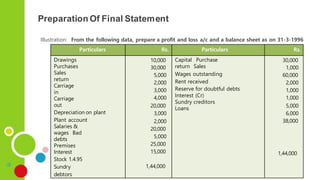
Particulars Rs. Particulars Rs.
Drawings
Purchases
Sales
return
Carriage
in
Carriage
out
Depreciation on plant
Plant account
Salaries &
wages Bad
debts
Premises
Interest
Stock 1.4.95
Sundry
debtors
10,000
30,000
5,000
2,000
3,000
4,000
20,000
3,000
2,000
20,000
5,000
25,000
15,000
1,44,000
Capital Purchase
return Sales
Wages outstanding
Rent received
Reserve for doubtful debts
Interest (Cr)
Sundry creditors
Loans
30,000
1,000
60,000
2,000
1,000
1,000
5,000
6,000
38,000
1,44,000
Illustration: From the following data, prepare a profit and loss a/c and a balance sheet as on 31-3-1996
Adjustments
(a)Stock on 31-3-96 was Rs.40,000. A fire broke-out in the go down and destr
oyed stock
worth Rs.5,000. Insurance company had accepted the claim in full.
(b)Provide for bad debts @ 10% and provide for discount on debtors @ 5% a
nd on
creditors @ 10%
(c) Depreciate buildings at the rate of 15% p.a.
(d) Rent outstanding amounted to Rs.1,000
(e) Closing stock includes samples worth of Rs.2,000.
(f) Provide interest on drawings @ 10% and on capital @ 10%.
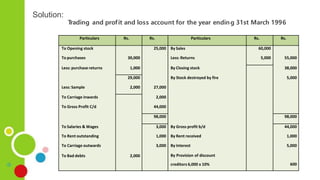
Solution:
Trading and profit and loss account for the year ending 31st M 6
arch 199
Particulars Rs. Rs. Particulars Rs. Rs.
To Opening stock 25,000 By Sales 60,000
To purchases 30,000 Less: Returns 5,000 55,000
Less: purchase returns 1,000 By Closing stock 38,000
29,000 By Stock destroyed by fire 5,000
Less: Sample 2,000 27,000
To Carriage inwards 2,000
To Gross Profit C/d 44,000
98,000 98,000
To Salaries & Wages 3,000 By Gross profit b/d 44,000
To Rent outstanding 1,000 By Rent received 1,000
To Carriage outwards 3,000 By Interest 5,000
To Bad debts 2,000 By Provision of discount
creditors 6,000 x 10% 600
Particulars Rs. Rs. Particulars Rs. Rs.
Add: New provision for By Interest on drawings
bad debts (15,000 x
10%) 1,500
(10,000 x 10%) 1,000
3,500
Less: Existing provision
for bad bets 1,000 2,500
To Provision for discount
on debtors (15,000-1,500)
x 5% 675
Interest 5,000
To Depreciation:
Plant 4,000
Building(20,000x15%) 3,000 7,000
To Interest on capital 3,000
To Net profit, transferred
to capital account.
26,425
51,600 51,600
Liabilities Rs. Assets Rs.
Sundry creditors 6,000 Debtors
Less: Provision for baddebts
Less: Provision for discount
ondebtors
Closing stock Samples
in stockInsurance claim
Receivable
Plant Premises
Less: Depreciation
15,000
Less: Provision fordiscount
600 1,500
5,400 13,500
Loans 38,000
Wages outstanding
Rent outstanding
2,000
1,000
675
12,825
Capital 30,000 38,000
Add: Net profit 26,425 2,000
Add: Interest on capital 3,000 5,000
59,425 20,000
Less: Interest on drawings 1,000 20,000
58,425 3,000 17,000
Less: Drawings 10,000
48,425
94,825 94,825
Balance sheet as on 31.3.1996
What Is Depreciation?
Depreciation is an accounting practice used to spread the cost of a tangible
or physical asset over its useful life. Depreciation represents how much of
the asset's value has been used up in any given time period. Companies
depreciate assets for both tax and accounting purposes and have several
different methods to choose from.
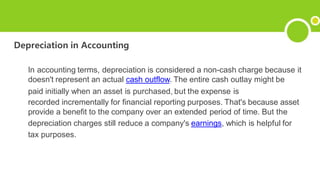
Depreciation in Accounting
In accounting terms, depreciation is considered a non-cash charge because it
doesn't represent an actual cash outflow. The entire cash outlay might be
paid initially when an asset is purchased, but the expense is
recorded incrementally for financial reporting purposes. That's because asset
provide a benefit to the company over an extended period of time. But the
depreciation charges still reduce a company's earnings, which is helpful for
tax purposes.
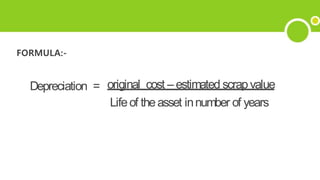
FORMULA:-
Depreciation = original cost – estimated scrapvalue
Lifeof theasset innumber of years
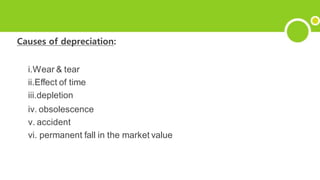
Causes of depreciation:
i.Wear & tear
ii.Effect of time
iii.depletion
iv. obsolescence
v. accident
vi. permanent fall in the market value
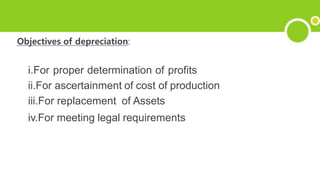
Objectives of depreciation:
i.For proper determination of profits
ii.For ascertainment of cost of production
iii.For replacement of Assets
iv.For meeting legal requirements
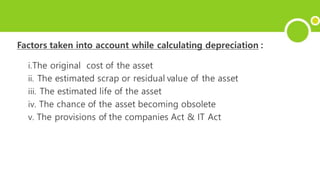
Factors taken into account while calculating depreciation :
i.The original cost of the asset
ii. The estimated scrap or residual value of the asset
iii. The estimated life of the asset
iv. The chance of the asset becoming obsolete
v. The provisions of the companies Act & IT Act
Methods of charging depreciation
1.Straight line method
2.Written down value method
Retained earnings are the cumulative net earnings or profits of a
company after accounting for dividend payments. As an important concept In accounting, the wo
rd “retained” captures the fact that because
those earning were not paid out to shareholders as dividends,they were instead retained by the c
ompany.
For this reason, retained earnings decrease when a company either
loses money or pays dividends and increase when new profits are created.
What Are Retained Earnings?
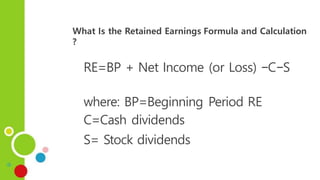
What Is the Retained Earnings Formula and Calculation
?
RE=BP + Net Income (or Loss) −C−S
where: BP=Beginning Period RE
C=Cash dividends
S= Stock dividends
What Can Retained Earnings Tell You?
Retained earnings refer to the historical profits earned by a company, minus
any dividends it paid in the past. To get a better understanding of what
retained earnings can tell you, the following options broadly cover all possible u
ses
that a company can make of its surplus money. For instance, the first option
leads to the earnings money going out of the books and accounts of the
business forever because dividend payments are irreversible.
All of the other options retain the earnings for use within the business, and such
investments and funding activities constitute retained earnings.
•The income money can be distributed (fully or partially) among the business owners
(shareholders) in the form of dividends.
•It can be invested to expand existing business operations, like increasing the production
capacity of the existing products or hiring more sales representatives.
•It can be invested to launch a new product/variant, like a refrigerator maker foraying
into producing air conditioners or a chocolate cookie manufacturer launching orange or
pineapple - flavored variants.
•The money can be used for any possible merger, acquisition, or partnership that leads
to improved business prospects.
•It can also be used for share buybacks.
•The earnings can be used to repay any outstanding loan (debt) that the business may
owe.
Retained earnings are also called earnings surplus and represent reserve money, which is
available to company management for reinvesting back into the business. When express
ed as a percentage of total earnings, it is also called the retention ratio and is equal to
(1 - the dividend payout ratio).
Though the last option of debt repayment also leads to the money going out of the
business, it still has an impact on the business’s accounts (for example, on saving future
interest payments, which qualifies it for inclusion in retained earnings).
Profits give a lot of room to the business owner(s) or the company management to use
the surplus money earned. This profit is often paid out to shareholders, but it can also
be reinvested back into the company for growth purposes. The money not paid to share
holders counts as retained earnings.
What is a Dividend?
A dividend is a share of profits and retained earnings that a company pays
out to its shareholders and owners. When a company generates a profit and
accumulates retained earnings, those earnings can be either reinvested in
the business or paid out to shareholders as a dividend. The annual dividend
per share divided by the share price is the dividend yield.
How a Dividend Works
A dividend’s value is determined on a per-share basis and is to be paid equally to all shareholders o
f the same class (common, preferred, etc.). The payment must be approved by the Board of
Directors. When a dividend is declared, it will then be paid on a certain date, known as the
payable date.
Steps of how it works:
•The company generates profits and retained earnings
•The management team decides some excess profits should be paid out to shareholders (instead of
being reinvested)
•The board approves the planned dividend
•The company announces the dividend (the value per share, the date when it will be paid, the
record date, etc.)
•The dividend is paid to shareholders
Key Highlights
When a company generates a profit and accumulates retained earnings, those earnings can b
e either reinvested in the business or paid out to shareholders as a dividend.
A dividend’s value is determined on a per-share basis and is to be paid equally to all shareho
lders of the same class. The payment must be approved by the Board of Directors.
A company may also return cash to shareholders via a share buyback.
Dividend Example
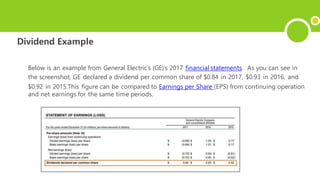
Below is an example from General Electric’s (GE)’s 2017 financial statements. As you can see in
the screenshot, GE declared a dividend per common share of $0.84 in 2017, $0.93 in 2016, and
$0.92 in 2015.This figure can be compared to Earnings per Share (EPS) from continuing operation
and net earnings for the same time periods.
Types of Dividends
There are various types of dividends a company can pay to its shareholders. Below is a list and a
brief description of the most common types that shareholders receive
Types include:
Cash – this is the payment of actual cash from the company directly to the shareholders and is
the most common type of payment. The payment is usually made electronically (wire transfer),
but may also be paid by check or cash.
Stock – stock dividends are paid out to shareholders by issuing new shares in the company.
These are paid out pro-rata, based on the number of shares the investor already owns.
Assets – a company is not limited to paying distributions to its shareholders in the form of cash
or shares. A company may also pay out other assets such as investment securities, physical asset,
and real estate, although this is not a common practice
.
Special – a special dividend is one that’s paid outside of a company’s regular policy (i.e., quarterly,
annual, etc.). It is usually the result of having excess cash on hand for one reason or another
Common – this refers to the class of shareholders (i.e., common shareholders), not what’s actually
being received as payment.
Preferred – this also refers to the class of shareholders receiving the payment.
Other – other, less common, types of financial assets can be paid out as dividends, such as
options, warrants, shares in a new spin-out company, etc.
Dividends are not Expenses
When a company pays a dividend it is not considered an expense since it is a payment made to
the company’s shareholders. This differentiates it from a payment for a service to a third-party
vendor, which would be considered a company expense.
What Is Stockholders' Equity?
Stockholders' equity is the remaining assets available to shareholders after all liabilities are paid. It
is calculated either as a firm's total assets less its total liabilities or alternatively as the sum of
share capital and retained earnings less treasury shares. Stockholders' equity might include
common stock, paid-in capital, retained earnings, and treasury stock.
Conceptually, stockholders' equity is useful as a means of judging the funds retained within a
business. If this figure is negative, it may indicate an oncoming bankruptcy for that business,
particularly if there exists a large debt liability as well.
How to Calculate Stockholders' Equity
You can determine shareholders' equity by calculating the total assets and liabilities using the
following formula:
Stockholder’s Equity= Total Assets−Total Liabilities Stockholder’s Equity
or
=T
otal Assets−
T
otal Liabilities
All the information required to compute shareholders' equity is available on a company's balance
sheet, including total assets:
Current Assets: These are assets that can be converted to cash within a year. These include cash,
accounts receivable, and inventory.
Non-Current Assets: This category includes long-term assets that cannot be converted to cash or
consumed within a year, such as investments; property, plant, and equipment; and intangibles,
such as patents.
What is Valuation of Investment?
Valuation of investment is the process of determining the value of an investment. It is done by
analyzing various factors such as financial statements, market conditions, industry trends, and the
overall economic environment. The valuation of investment helps investors to determine the fair
price of an investment and make informed decisions.
Why is Valuation of Investment Important for Investors?
● Helps in making informed investment decisions
The valuation of investment provides investors with the necessary information to make informed
investment decisions. It helps investors to determine the fair price of an investment and whether
it is overvalued or undervalued. This information is crucial in making investment decisions that
can lead to profitable returns
● Helps in managing risks
Investing always comes with some level of risk. However, the valuation of investment can help
investors to manage these risks. By understanding the value of an investment, investors can
identify risks and make decisions based on their risk tolerance. This can help them to mitigate
potential losses and maximize their returns.
● Helps in identifying growth potential
Investors invest in businesses with the expectation of growth and profits. The valuation of
investment helps investors to identify the growth potential of an investment. By analyzing
financial statements, market conditions, and industry trends, investors can determine whether an
investment has the potential for growth and profitability.
● Helps in identifying the right time to buy or sell an investment
Valuation of investment also helps investors to identify the right time to buy or sell an investment
. By analyzing the fair price of an investment, investors can determine whether it is the right time
to buy or sell. This can help them to maximize their returns and avoid losses.

Preparation Final statement ppt (1) 125-1.pptx

  • 1.
    BY- Soubhagya, Ashish,Sandeepa and Shaheen PREPARATION OF FINANCIAL STATEMENTS
  • 2.
    Introduction To FinancialStatements Financial statements are essential documents that provide a snapshot of a company's financial performance and positi on over a specific period. The main purpose of financial statements is to offer information about the economic health of a business to various stakeholders, including investors, creditors, management, and other interested parties. These state ments typically include: 1.Income Statement (Profit and Loss Statement): This document shows the company's revenues, expenses, and profits or losses over a specific period, providing insights into its operational performance. 2.Balance Sheet (Statement of Financial Position): The balance sheet presents the company's assets, liabilities, and shar eholders' equity at a specific point in time. It gives a snapshot of the company's financial position and its ability to meet its short-term and long-term obligations. 3.Cash Flow Statement:This statement outlines the sources and uses of cash during a given period, categorizing activitie s into operating, investing, and financing activities. It helps assess a company's ability to generate cash and manage its c ash flow effectively.
  • 3.
    Preparation Of FinalStatement Particulars Rs. Particulars Rs. Drawings Purchases Sales return Carriage in Carriage out Depreciation on plant Plant account Salaries & wages Bad debts Premises Interest Stock 1.4.95 Sundry debtors 10,000 30,000 5,000 2,000 3,000 4,000 20,000 3,000 2,000 20,000 5,000 25,000 15,000 1,44,000 Capital Purchase return Sales Wages outstanding Rent received Reserve for doubtful debts Interest (Cr) Sundry creditors Loans 30,000 1,000 60,000 2,000 1,000 1,000 5,000 6,000 38,000 1,44,000 Illustration: From the following data, prepare a profit and loss a/c and a balance sheet as on 31-3-1996
  • 4.
    Adjustments (a)Stock on 31-3-96was Rs.40,000. A fire broke-out in the go down and destr oyed stock worth Rs.5,000. Insurance company had accepted the claim in full. (b)Provide for bad debts @ 10% and provide for discount on debtors @ 5% a nd on creditors @ 10% (c) Depreciate buildings at the rate of 15% p.a. (d) Rent outstanding amounted to Rs.1,000 (e) Closing stock includes samples worth of Rs.2,000. (f) Provide interest on drawings @ 10% and on capital @ 10%.
  • 5.
    Solution: Trading and profitand loss account for the year ending 31st M 6 arch 199 Particulars Rs. Rs. Particulars Rs. Rs. To Opening stock 25,000 By Sales 60,000 To purchases 30,000 Less: Returns 5,000 55,000 Less: purchase returns 1,000 By Closing stock 38,000 29,000 By Stock destroyed by fire 5,000 Less: Sample 2,000 27,000 To Carriage inwards 2,000 To Gross Profit C/d 44,000 98,000 98,000 To Salaries & Wages 3,000 By Gross profit b/d 44,000 To Rent outstanding 1,000 By Rent received 1,000 To Carriage outwards 3,000 By Interest 5,000 To Bad debts 2,000 By Provision of discount creditors 6,000 x 10% 600
  • 6.
    Particulars Rs. Rs.Particulars Rs. Rs. Add: New provision for By Interest on drawings bad debts (15,000 x 10%) 1,500 (10,000 x 10%) 1,000 3,500 Less: Existing provision for bad bets 1,000 2,500 To Provision for discount on debtors (15,000-1,500) x 5% 675 Interest 5,000 To Depreciation: Plant 4,000 Building(20,000x15%) 3,000 7,000 To Interest on capital 3,000 To Net profit, transferred to capital account. 26,425 51,600 51,600
  • 8.
    Liabilities Rs. AssetsRs. Sundry creditors 6,000 Debtors Less: Provision for baddebts Less: Provision for discount ondebtors Closing stock Samples in stockInsurance claim Receivable Plant Premises Less: Depreciation 15,000 Less: Provision fordiscount 600 1,500 5,400 13,500 Loans 38,000 Wages outstanding Rent outstanding 2,000 1,000 675 12,825 Capital 30,000 38,000 Add: Net profit 26,425 2,000 Add: Interest on capital 3,000 5,000 59,425 20,000 Less: Interest on drawings 1,000 20,000 58,425 3,000 17,000 Less: Drawings 10,000 48,425 94,825 94,825 Balance sheet as on 31.3.1996
  • 9.
    What Is Depreciation? Depreciationis an accounting practice used to spread the cost of a tangible or physical asset over its useful life. Depreciation represents how much of the asset's value has been used up in any given time period. Companies depreciate assets for both tax and accounting purposes and have several different methods to choose from.
  • 10.
    Depreciation in Accounting Inaccounting terms, depreciation is considered a non-cash charge because it doesn't represent an actual cash outflow. The entire cash outlay might be paid initially when an asset is purchased, but the expense is recorded incrementally for financial reporting purposes. That's because asset provide a benefit to the company over an extended period of time. But the depreciation charges still reduce a company's earnings, which is helpful for tax purposes.
  • 11.
    FORMULA:- Depreciation = originalcost – estimated scrapvalue Lifeof theasset innumber of years
  • 13.
    Causes of depreciation: i.Wear& tear ii.Effect of time iii.depletion iv. obsolescence v. accident vi. permanent fall in the market value
  • 14.
    Objectives of depreciation: i.Forproper determination of profits ii.For ascertainment of cost of production iii.For replacement of Assets iv.For meeting legal requirements
  • 15.
    Factors taken intoaccount while calculating depreciation : i.The original cost of the asset ii. The estimated scrap or residual value of the asset iii. The estimated life of the asset iv. The chance of the asset becoming obsolete v. The provisions of the companies Act & IT Act
  • 16.
    Methods of chargingdepreciation 1.Straight line method 2.Written down value method
  • 17.
    Retained earnings arethe cumulative net earnings or profits of a company after accounting for dividend payments. As an important concept In accounting, the wo rd “retained” captures the fact that because those earning were not paid out to shareholders as dividends,they were instead retained by the c ompany. For this reason, retained earnings decrease when a company either loses money or pays dividends and increase when new profits are created. What Are Retained Earnings?
  • 18.
    What Is theRetained Earnings Formula and Calculation ? RE=BP + Net Income (or Loss) −C−S where: BP=Beginning Period RE C=Cash dividends S= Stock dividends
  • 19.
    What Can RetainedEarnings Tell You? Retained earnings refer to the historical profits earned by a company, minus any dividends it paid in the past. To get a better understanding of what retained earnings can tell you, the following options broadly cover all possible u ses that a company can make of its surplus money. For instance, the first option leads to the earnings money going out of the books and accounts of the business forever because dividend payments are irreversible.
  • 20.
    All of theother options retain the earnings for use within the business, and such investments and funding activities constitute retained earnings. •The income money can be distributed (fully or partially) among the business owners (shareholders) in the form of dividends. •It can be invested to expand existing business operations, like increasing the production capacity of the existing products or hiring more sales representatives. •It can be invested to launch a new product/variant, like a refrigerator maker foraying into producing air conditioners or a chocolate cookie manufacturer launching orange or pineapple - flavored variants. •The money can be used for any possible merger, acquisition, or partnership that leads to improved business prospects. •It can also be used for share buybacks. •The earnings can be used to repay any outstanding loan (debt) that the business may owe.
  • 21.
    Retained earnings arealso called earnings surplus and represent reserve money, which is available to company management for reinvesting back into the business. When express ed as a percentage of total earnings, it is also called the retention ratio and is equal to (1 - the dividend payout ratio). Though the last option of debt repayment also leads to the money going out of the business, it still has an impact on the business’s accounts (for example, on saving future interest payments, which qualifies it for inclusion in retained earnings). Profits give a lot of room to the business owner(s) or the company management to use the surplus money earned. This profit is often paid out to shareholders, but it can also be reinvested back into the company for growth purposes. The money not paid to share holders counts as retained earnings.
  • 22.
    What is aDividend? A dividend is a share of profits and retained earnings that a company pays out to its shareholders and owners. When a company generates a profit and accumulates retained earnings, those earnings can be either reinvested in the business or paid out to shareholders as a dividend. The annual dividend per share divided by the share price is the dividend yield.
  • 23.
    How a DividendWorks A dividend’s value is determined on a per-share basis and is to be paid equally to all shareholders o f the same class (common, preferred, etc.). The payment must be approved by the Board of Directors. When a dividend is declared, it will then be paid on a certain date, known as the payable date. Steps of how it works: •The company generates profits and retained earnings •The management team decides some excess profits should be paid out to shareholders (instead of being reinvested) •The board approves the planned dividend •The company announces the dividend (the value per share, the date when it will be paid, the record date, etc.) •The dividend is paid to shareholders
  • 24.
    Key Highlights When acompany generates a profit and accumulates retained earnings, those earnings can b e either reinvested in the business or paid out to shareholders as a dividend. A dividend’s value is determined on a per-share basis and is to be paid equally to all shareho lders of the same class. The payment must be approved by the Board of Directors. A company may also return cash to shareholders via a share buyback.
  • 25.
    Dividend Example Below isan example from General Electric’s (GE)’s 2017 financial statements. As you can see in the screenshot, GE declared a dividend per common share of $0.84 in 2017, $0.93 in 2016, and $0.92 in 2015.This figure can be compared to Earnings per Share (EPS) from continuing operation and net earnings for the same time periods.
  • 26.
    Types of Dividends Thereare various types of dividends a company can pay to its shareholders. Below is a list and a brief description of the most common types that shareholders receive Types include: Cash – this is the payment of actual cash from the company directly to the shareholders and is the most common type of payment. The payment is usually made electronically (wire transfer), but may also be paid by check or cash. Stock – stock dividends are paid out to shareholders by issuing new shares in the company. These are paid out pro-rata, based on the number of shares the investor already owns. Assets – a company is not limited to paying distributions to its shareholders in the form of cash or shares. A company may also pay out other assets such as investment securities, physical asset, and real estate, although this is not a common practice .
  • 27.
    Special – aspecial dividend is one that’s paid outside of a company’s regular policy (i.e., quarterly, annual, etc.). It is usually the result of having excess cash on hand for one reason or another Common – this refers to the class of shareholders (i.e., common shareholders), not what’s actually being received as payment. Preferred – this also refers to the class of shareholders receiving the payment. Other – other, less common, types of financial assets can be paid out as dividends, such as options, warrants, shares in a new spin-out company, etc.
  • 28.
    Dividends are notExpenses When a company pays a dividend it is not considered an expense since it is a payment made to the company’s shareholders. This differentiates it from a payment for a service to a third-party vendor, which would be considered a company expense. What Is Stockholders' Equity? Stockholders' equity is the remaining assets available to shareholders after all liabilities are paid. It is calculated either as a firm's total assets less its total liabilities or alternatively as the sum of share capital and retained earnings less treasury shares. Stockholders' equity might include common stock, paid-in capital, retained earnings, and treasury stock.
  • 29.
    Conceptually, stockholders' equityis useful as a means of judging the funds retained within a business. If this figure is negative, it may indicate an oncoming bankruptcy for that business, particularly if there exists a large debt liability as well. How to Calculate Stockholders' Equity You can determine shareholders' equity by calculating the total assets and liabilities using the following formula: Stockholder’s Equity= Total Assets−Total Liabilities Stockholder’s Equity or =T otal Assets− T otal Liabilities
  • 30.
    All the informationrequired to compute shareholders' equity is available on a company's balance sheet, including total assets: Current Assets: These are assets that can be converted to cash within a year. These include cash, accounts receivable, and inventory. Non-Current Assets: This category includes long-term assets that cannot be converted to cash or consumed within a year, such as investments; property, plant, and equipment; and intangibles, such as patents.
  • 31.
    What is Valuationof Investment? Valuation of investment is the process of determining the value of an investment. It is done by analyzing various factors such as financial statements, market conditions, industry trends, and the overall economic environment. The valuation of investment helps investors to determine the fair price of an investment and make informed decisions. Why is Valuation of Investment Important for Investors? ● Helps in making informed investment decisions The valuation of investment provides investors with the necessary information to make informed investment decisions. It helps investors to determine the fair price of an investment and whether it is overvalued or undervalued. This information is crucial in making investment decisions that can lead to profitable returns
  • 32.
    ● Helps inmanaging risks Investing always comes with some level of risk. However, the valuation of investment can help investors to manage these risks. By understanding the value of an investment, investors can identify risks and make decisions based on their risk tolerance. This can help them to mitigate potential losses and maximize their returns. ● Helps in identifying growth potential Investors invest in businesses with the expectation of growth and profits. The valuation of investment helps investors to identify the growth potential of an investment. By analyzing financial statements, market conditions, and industry trends, investors can determine whether an investment has the potential for growth and profitability. ● Helps in identifying the right time to buy or sell an investment Valuation of investment also helps investors to identify the right time to buy or sell an investment . By analyzing the fair price of an investment, investors can determine whether it is the right time to buy or sell. This can help them to maximize their returns and avoid losses.