SOME LESSONS FROM CAPITAL
MARKET HISTORY
Chapter 12
OUTLINE
1. Returns
2. History
3. Average Returns: The First Lesson
4. Variability of Returns: The Second Lesson
5. Arithmetic & Geometric Averages
6. Capital Market Efficiency
2
RETURNS
3
PERSPECTIVE
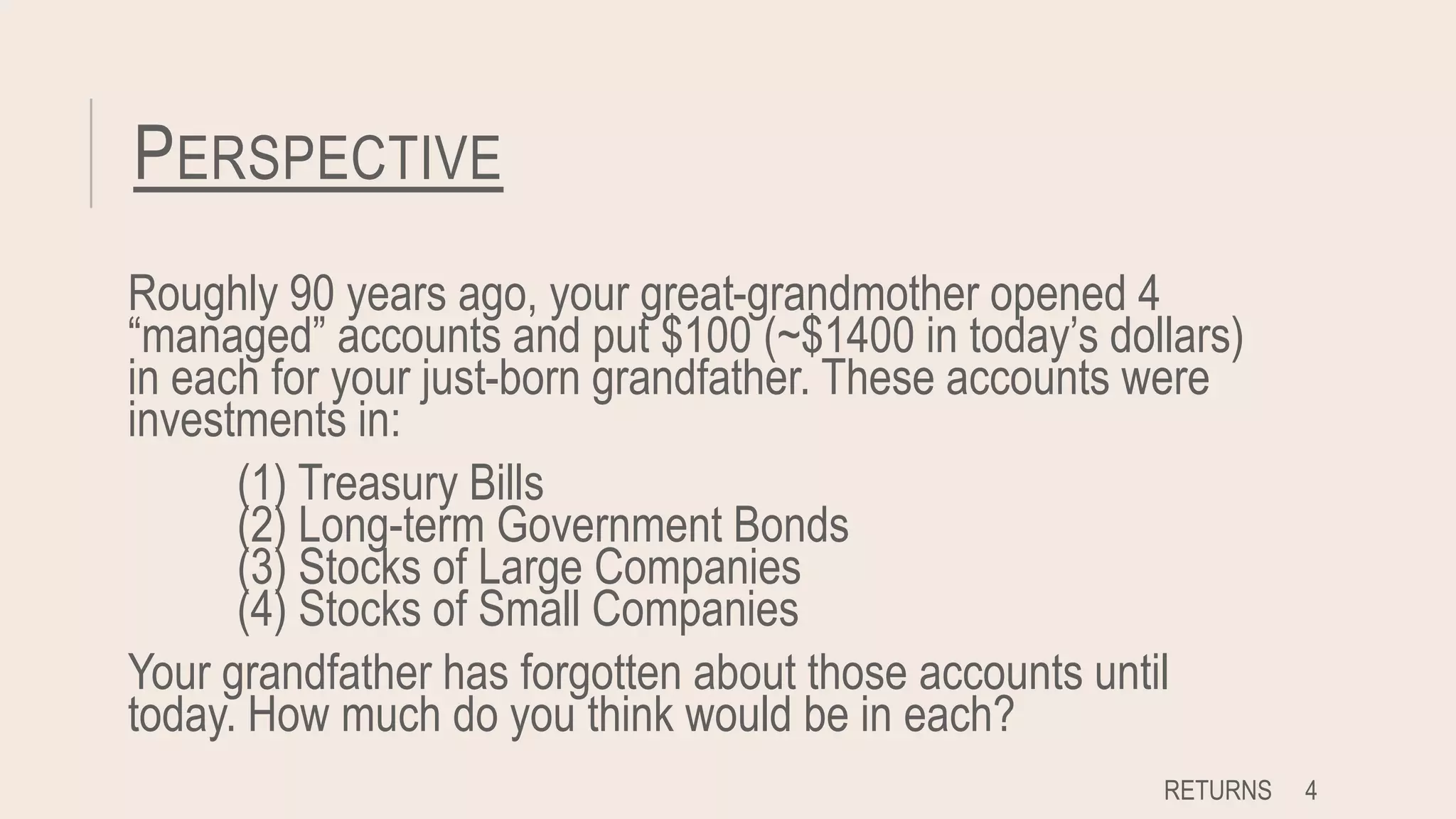
Roughly 90 years ago, your great-grandmother opened 4
“managed” accounts and put $100 (~$1400 in today’s dollars)
in each for your just-born grandfather. These accounts were
investments in:
(1) Treasury Bills
(2) Long-term Government Bonds
(3) Stocks of Large Companies
(4) Stocks of Small Companies
Your grandfather has forgotten about those accounts until
today. How much do you think would be in each?
RETURNS 4
PERSPECTIVE
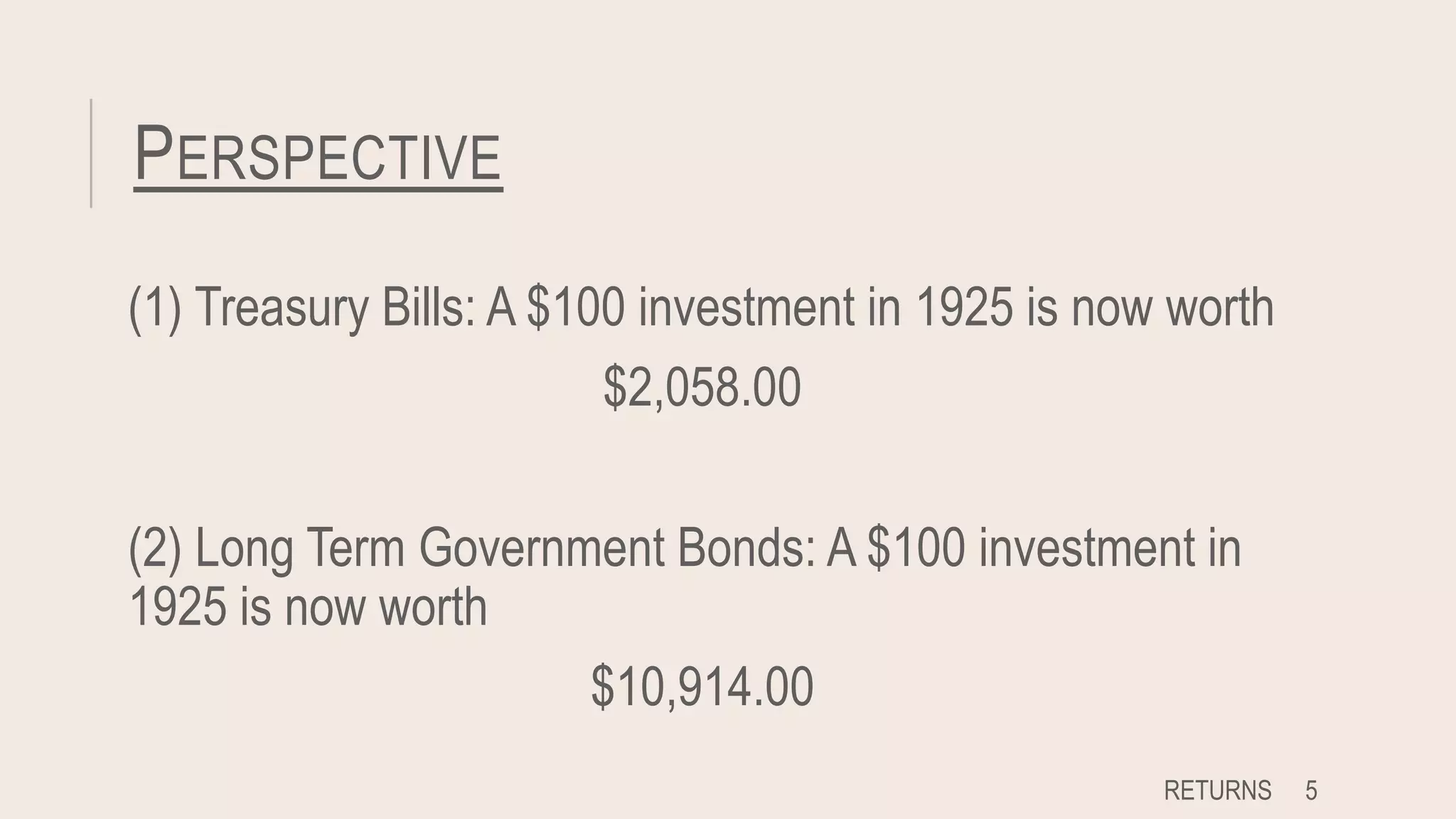
(1) Treasury Bills: A $100 investment in 1925 is now worth
$2,058.00
(2) Long Term Government Bonds: A $100 investment in
1925 is now worth
$10,914.00
RETURNS 5
PERSPECTIVE
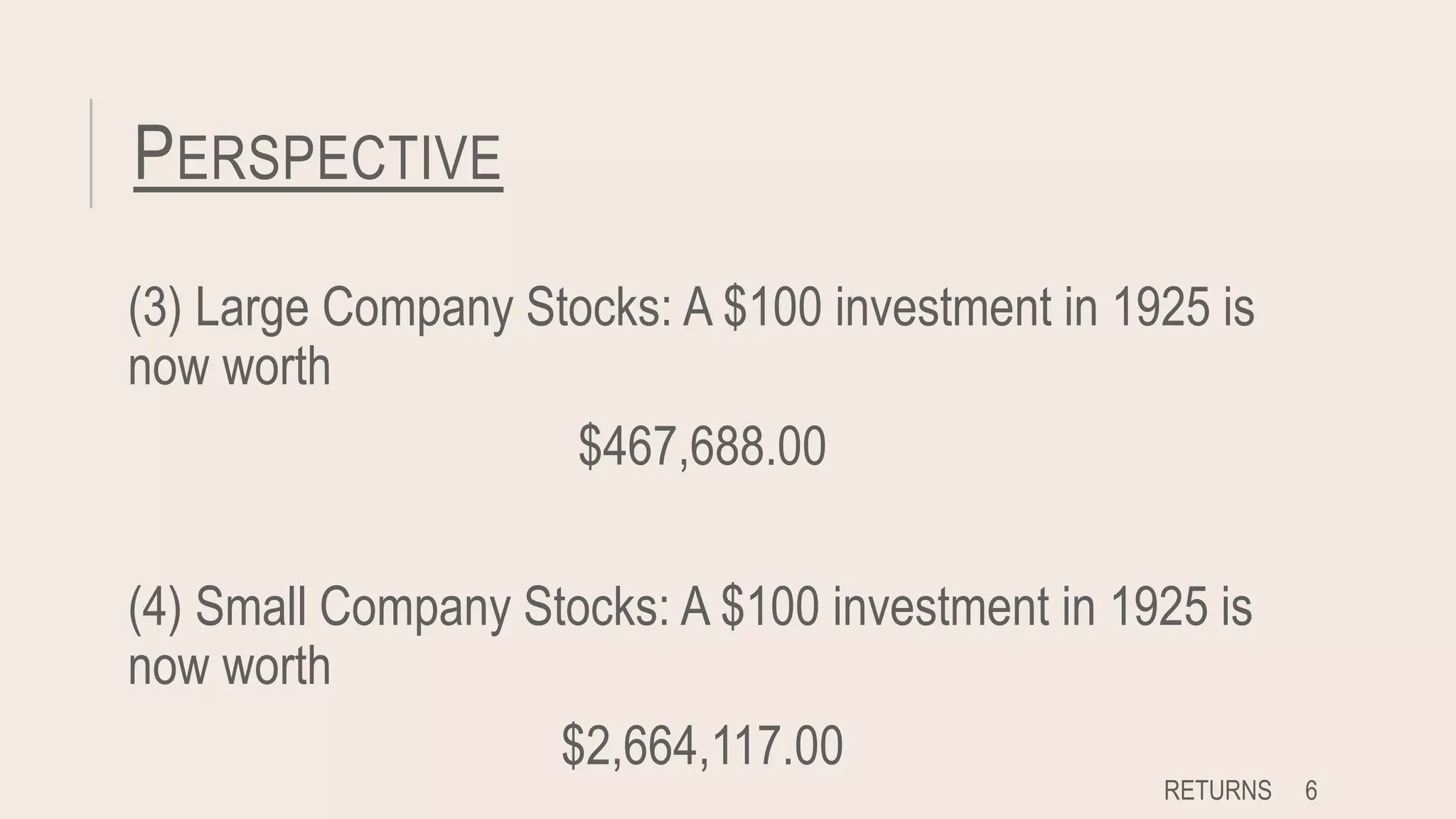
(3) Large Company Stocks: A $100 investment in 1925 is
now worth
$467,688.00
(4) Small Company Stocks: A $100 investment in 1925 is
now worth
$2,664,117.00
RETURNS 6
RETURNS
Your RETURN ON INVESTMENT is your gain (or loss) from
holding some financial asset.
Generally, we think in terms of
(1) Dollar Returns
(2) Percentage Returns
RETURNS 7
(1) DOLLAR RETURNS
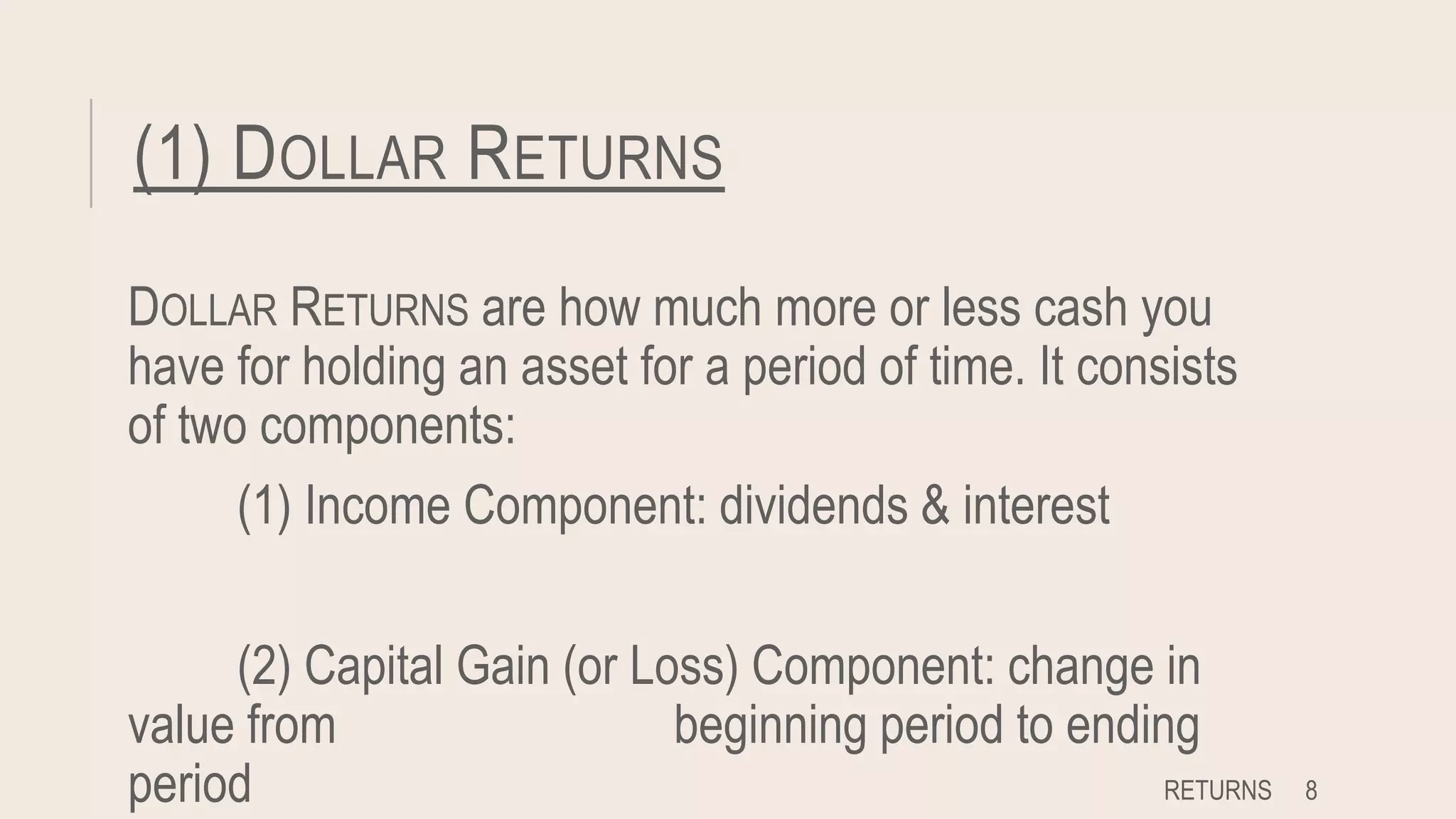
DOLLAR RETURNS are how much more or less cash you
have for holding an asset for a period of time. It consists
of two components:
(1) Income Component: dividends & interest
(2) Capital Gain (or Loss) Component: change in
value from beginning period to ending
period RETURNS 8
(1) DOLLAR RETURNS EXAMPLE
Given the information from finance.yahoo.com on the
next slide, what is your dollar return assuming you
purchased 100 Coca-Cola shares at the Close Price on
January 1, 2018 and sold 100 Coca-Cola shares at the
Close Price on April 1, 2018?
RETURNS 9
(1) DOLLAR RETURNS EXAMPLE
Income Component: Dividend x Shares = 0.39 x 100 = $39
Capital Gain (Loss) Component: (End – Beginning) x Shares = ($43.210 - $47.590)
x 100 = -$438
Total Dollar Return = Income + Capital Gain (Loss) = $39 + ($438) = -$399
RETURNS 10
(2) PERCENTAGE RETURNS
The PERCENTAGE RETURN tells us how much we get for
each $1 invested.
As we’ve seen before, the percentage return consists of:
(1) Dividend Yield
(2) Capital Gains Yield
RETURNS 11
(2) PERCENTAGE RETURNS
The dividend yield expresses the dividend as a
percentage of the beginning stock price.
RETURNS 12
(2) PERCENTAGE RETURNS
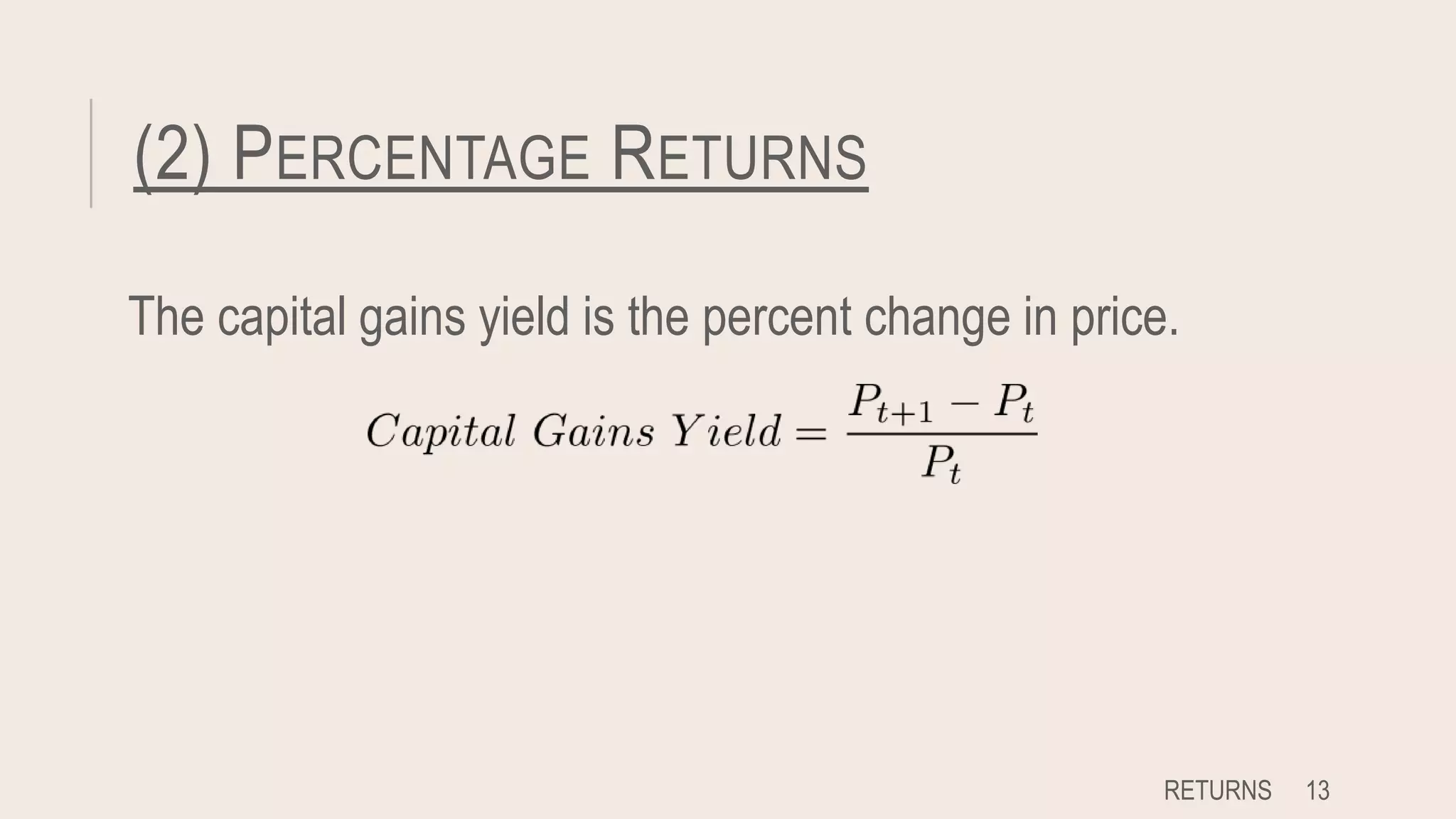
The capital gains yield is the percent change in price.
RETURNS 13
(2) PERCENTAGE RETURNS EXAMPLE
Suppose you pay $37 for a share of Pfizer. This firm pays
a dividend of $1.85. At the end of the year, you sell this
share for $40.33. What’s the percent return?
Dividend Yield
=1.85 / 37 = 0.05 = 5%
Capital Gains Yield
=(40.33 – 37) / 37 = 0.09 = 9%
RETURNS 14
(2) PERCENTAGE RETURNS EXAMPLE,
CONT.
Now we can find the total return:
= 5% + 9%
= 14%
Our percentage return is 14%, or 14 cents per dollar invested.
RETURNS 15
TO SUMMARIZE
Our return on investment can be presented in dollar terms
or percentage returns. Both have a type of income and
capital gains (loss) component.
RETURNS 16
HISTORY
17
HISTORY 18
SMALL STOCKS: smallest 20% of
companies on the NYSE.
LARGE STOCKS: the S&P 500
LONG-TERM US GOVERNMENT
BONDS: 20 year maturity
U.S. TREASURY BILLS: 1 month
maturity
HISTORICAL RETURNS
Why not just hold the small stocks?
Why would anyone hold T-bills?
Do all investors buy these investments and hold for 90+
years?
HISTORY 19
HISTORICAL RETURNS- SMALL STOCKS
VS. T-BILLS
HISTORY 20
HISTORICAL RETURNS- VARIOUS
INVESTMENTS
HISTORY 21
TO SUMMARIZE
Riskier assets tend to provide higher returns. Risky small
stocks have had annual returns as good as 143% and as
bad as -53%. Safe T-bills have never had a negative
return, but have never returned more than 15%.
HISTORY 22
AVERAGE RETURNS: THE FIRST
LESSON
23
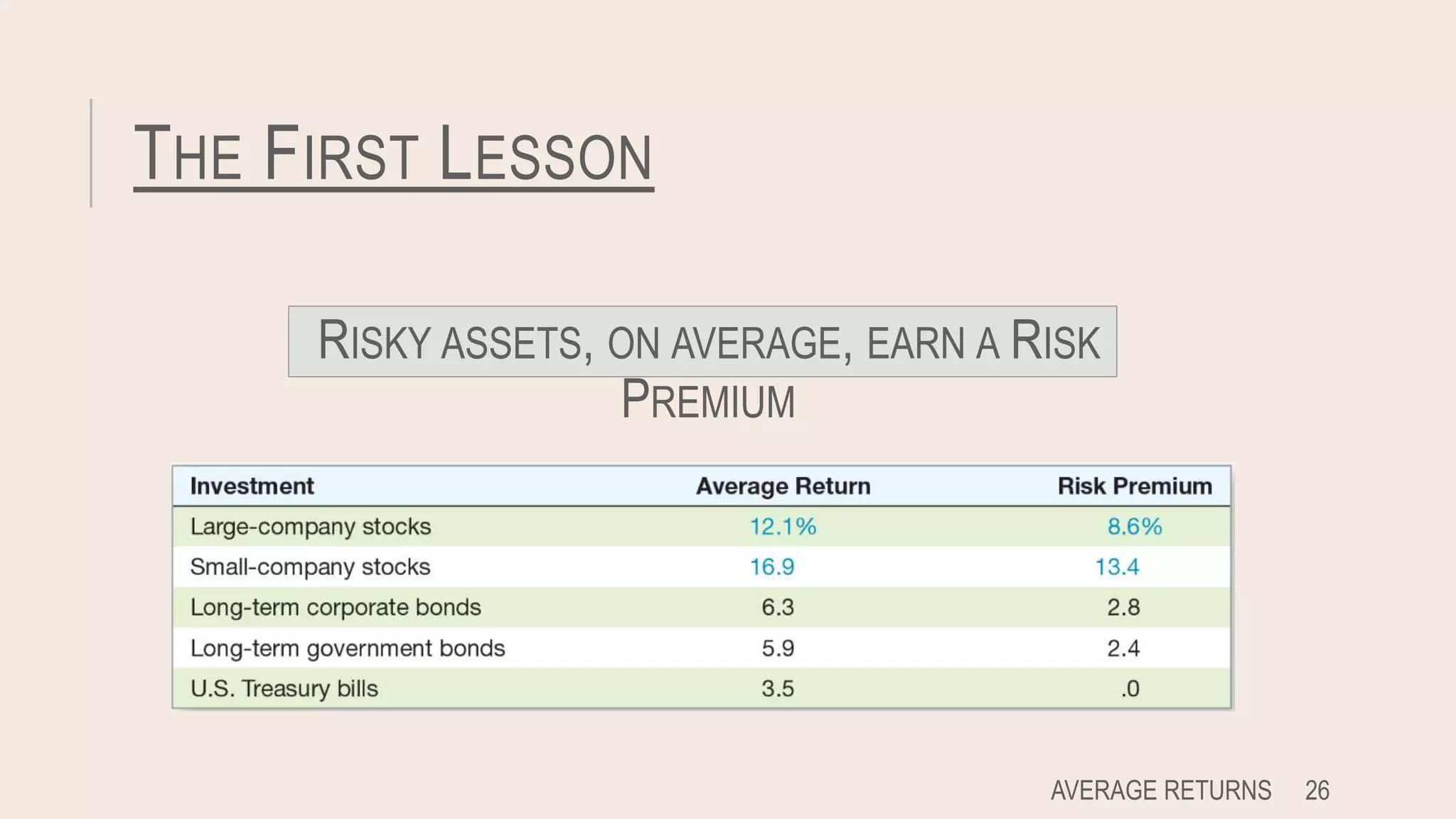
AVERAGE RETURNS BY INVESTMENT TYPE
AVERAGE RETURNS 24
RISK PREMIUM
The RISK PREMIUM is the excess return required from an
investment in a risky asset over that required from a risk-
free investment. It’s found by subtracting the risk free rate
from the average return.
AVERAGE RETURNS 25
THE FIRST LESSON
AVERAGE RETURNS 26
RISKY ASSETS, ON AVERAGE, EARN A RISK
PREMIUM
VARIABILITY OF RETURNS: THE
SECOND LESSON
27
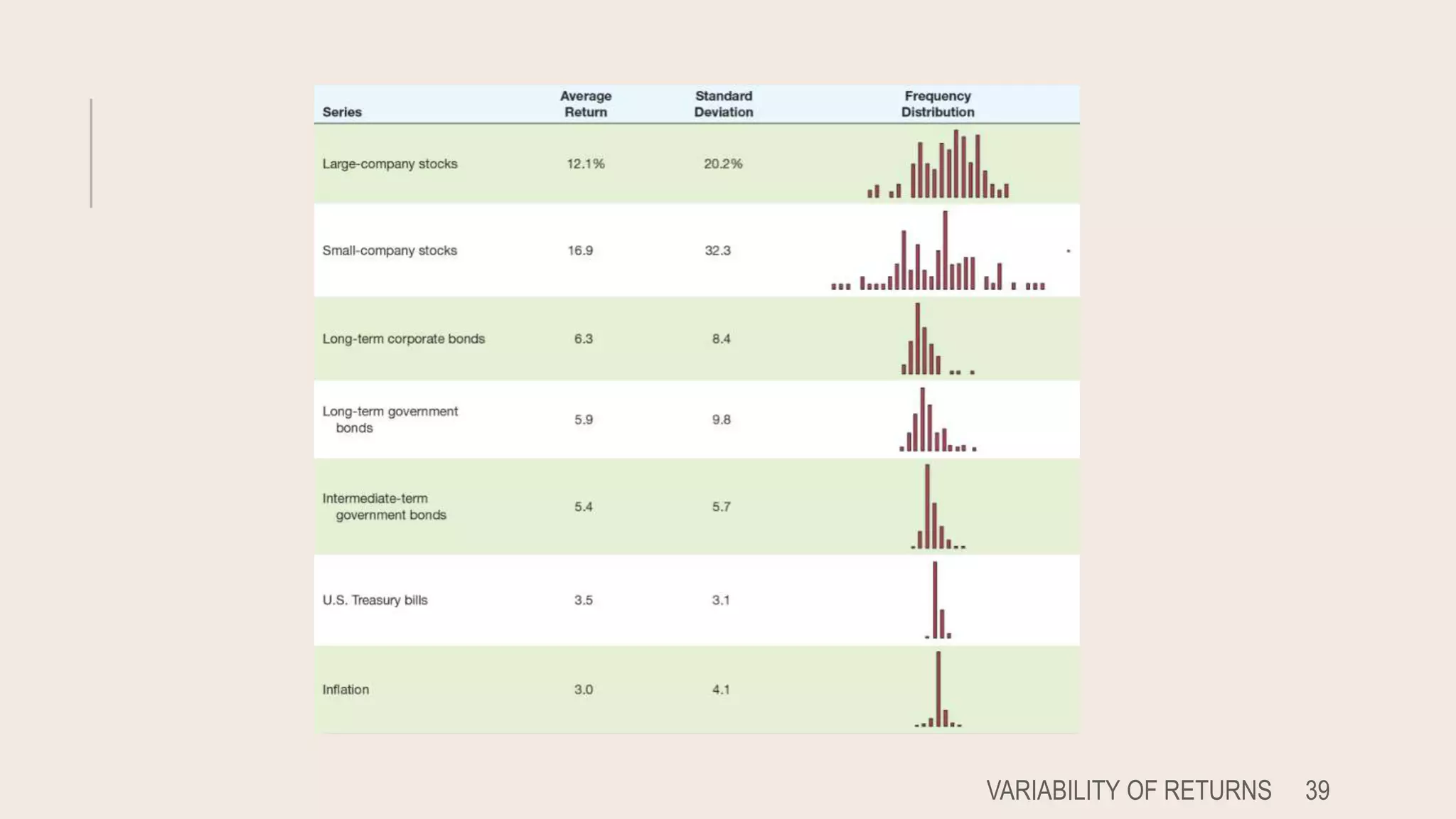
VARIABILITY OF RETURNS
In order to determine a level of risk, we need to
understand the spread of an asset’s returns overtime.
This is known as the VARIABILITY OF RETURNS.
We use the VARIANCE and STANDARD DEVIATION of returns
as measures of VOLATILITY, or risk.
VARIABILITY OF RETURNS 28
VARIANCE
The VARIANCE is the average squared difference between the
actual return and the average return. A higher variance
indicates that returns are more spread out from the mean.
R is the return of an asset.
R-bar is the average return of the asset.
T represents the number of returns.
VARIABILITY OF RETURNS 29
VARIANCE EXAMPLE: KROGER
Suppose Kroger stock has returned the following over the
past 4 years: 10%, 12%, 3%, -9%. What is the VARIANCE
of returns over this time period?
VARIABILITY OF RETURNS 30
VARIANCE EXAMPLE: KROGER
Returns: 10%, 12%, 3%, -9%.
(1) Calculate the average (R-bar) first
(0.10 + 0.12 + 0.03 + (-0.09)) / 4 = 0.04 = 4%
VARIABILITY OF RETURNS 31
VARIANCE EXAMPLE: KROGER
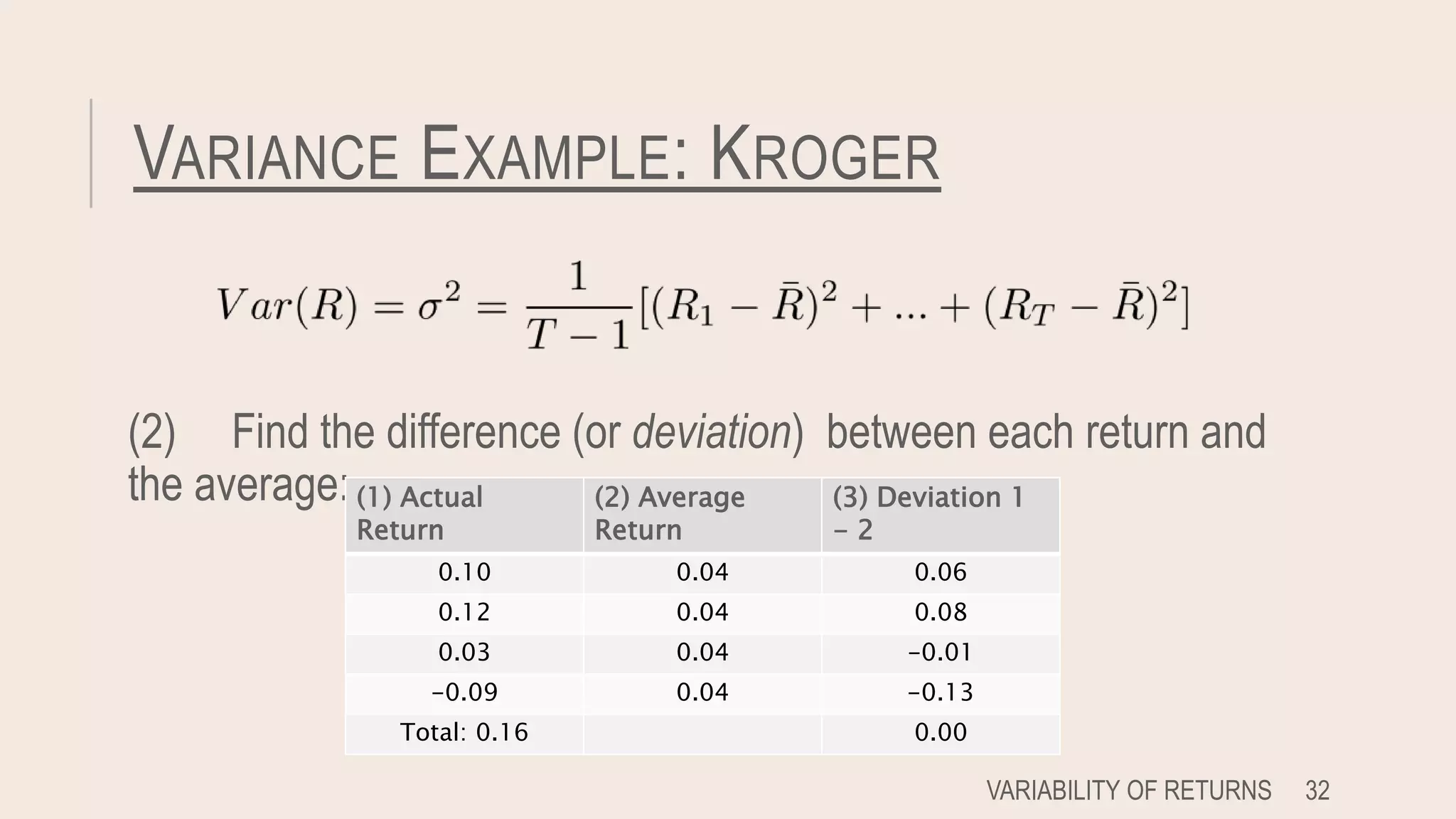
(2) Find the difference (or deviation) between each return and
the average:
VARIABILITY OF RETURNS 32
(1) Actual
Return
(2) Average
Return
(3) Deviation 1
- 2
0.10 0.04 0.06
0.12 0.04 0.08
0.03 0.04 -0.01
-0.09 0.04 -0.13
Total: 0.16 0.00
VARIANCE EXAMPLE: KROGER
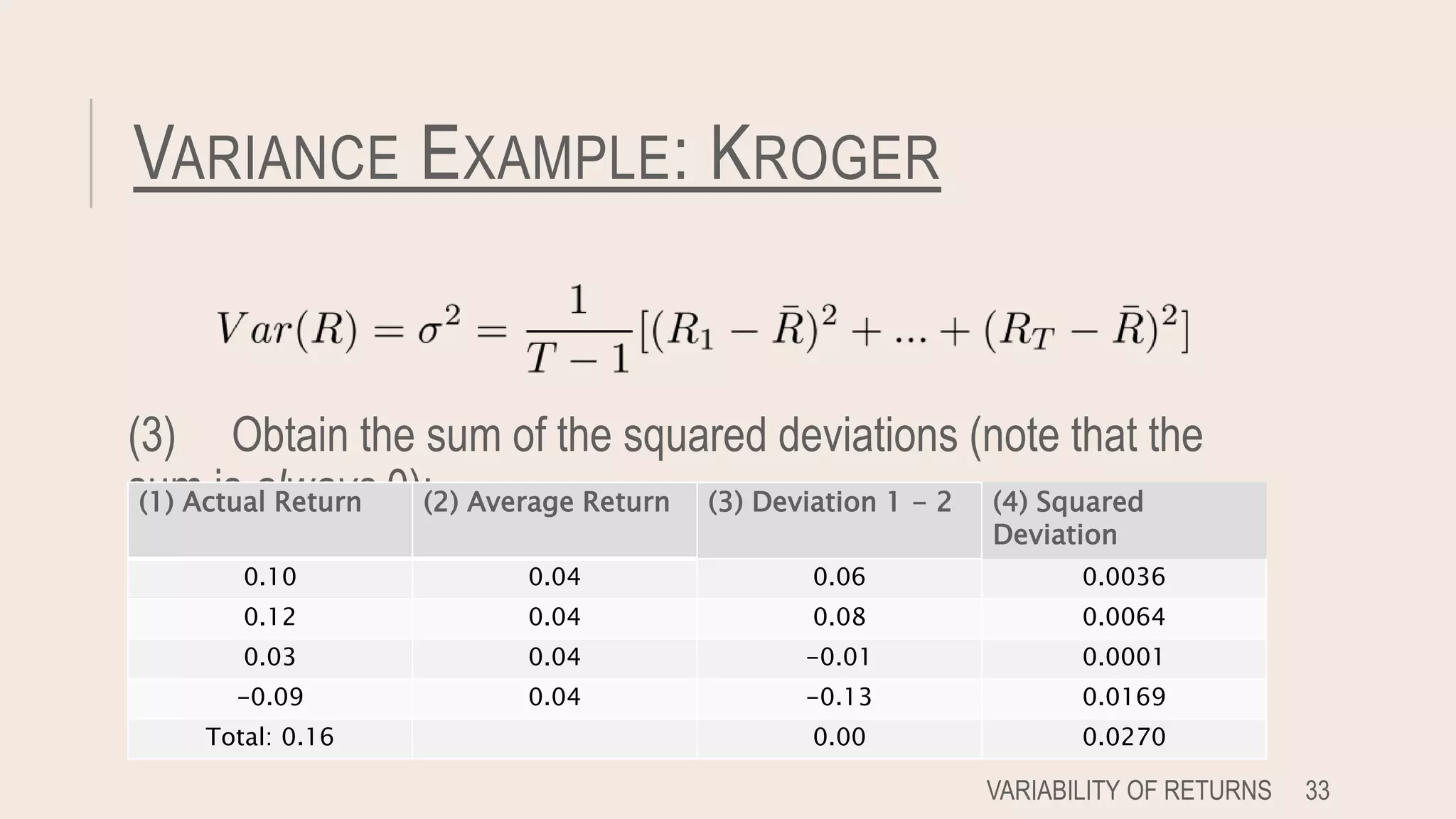
(3) Obtain the sum of the squared deviations (note that the
sum is always 0):
VARIABILITY OF RETURNS 33
(1) Actual Return (2) Average Return (3) Deviation 1 - 2 (4) Squared
Deviation
0.10 0.04 0.06 0.0036
0.12 0.04 0.08 0.0064
0.03 0.04 -0.01 0.0001
-0.09 0.04 -0.13 0.0169
Total: 0.16 0.00 0.0270
VARIANCE EXAMPLE: KROGER
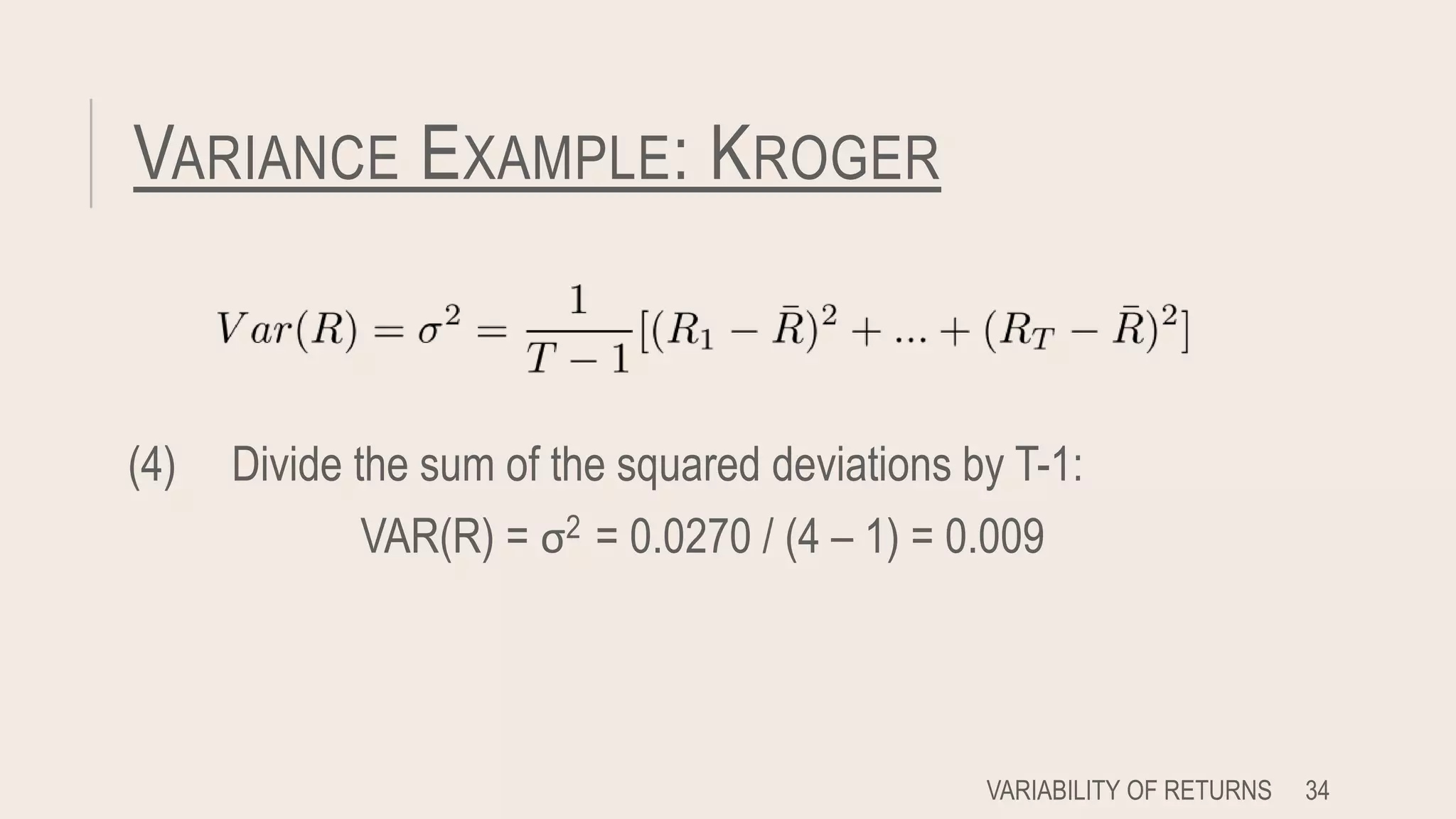
(4) Divide the sum of the squared deviations by T-1:
VAR(R) = σ2 = 0.0270 / (4 – 1) = 0.009
VARIABILITY OF RETURNS 34
VARIANCE EXAMPLE: KROGER
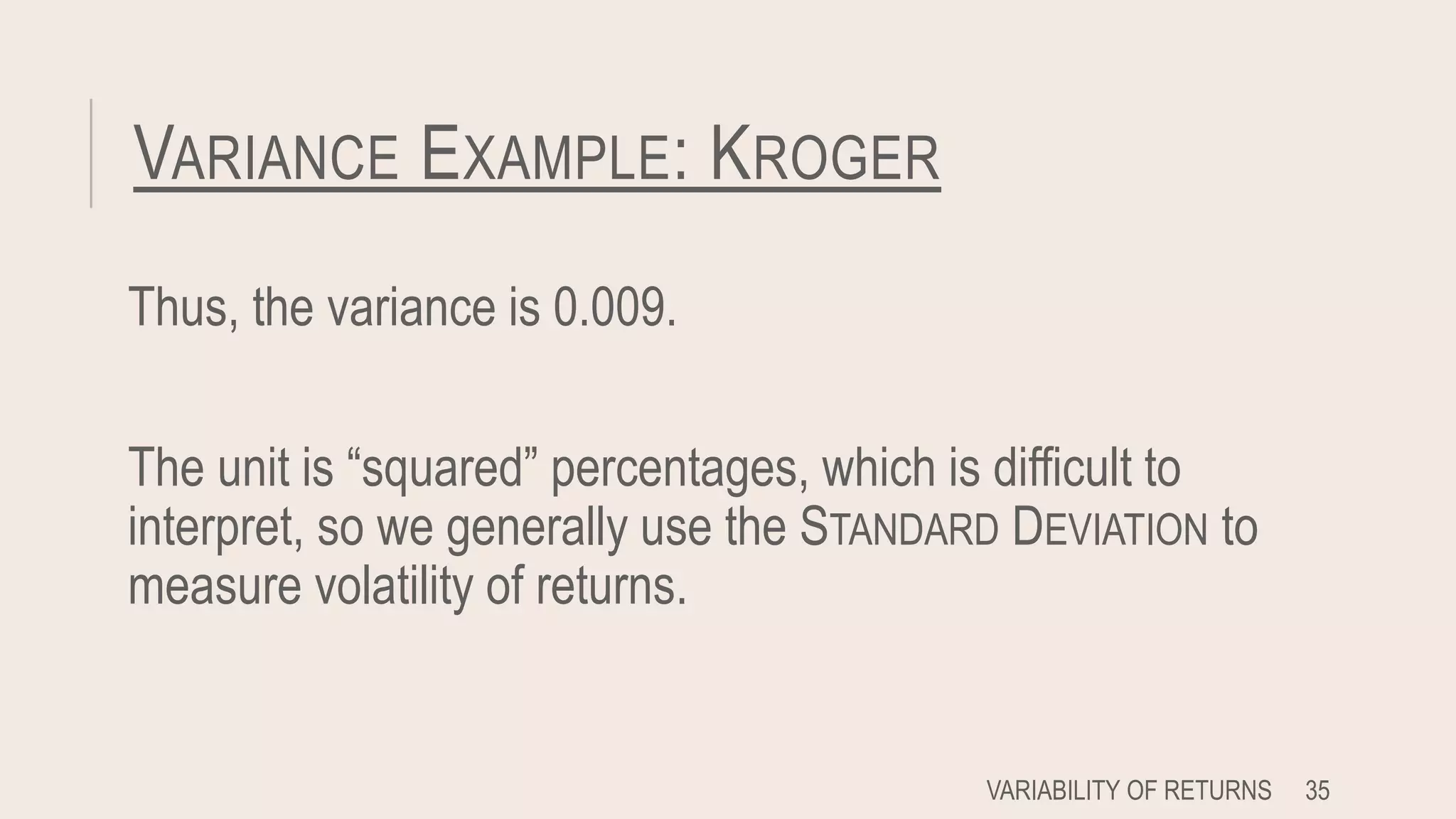
Thus, the variance is 0.009.
The unit is “squared” percentages, which is difficult to
interpret, so we generally use the STANDARD DEVIATION to
measure volatility of returns.
VARIABILITY OF RETURNS 35
STANDARD DEVIATION
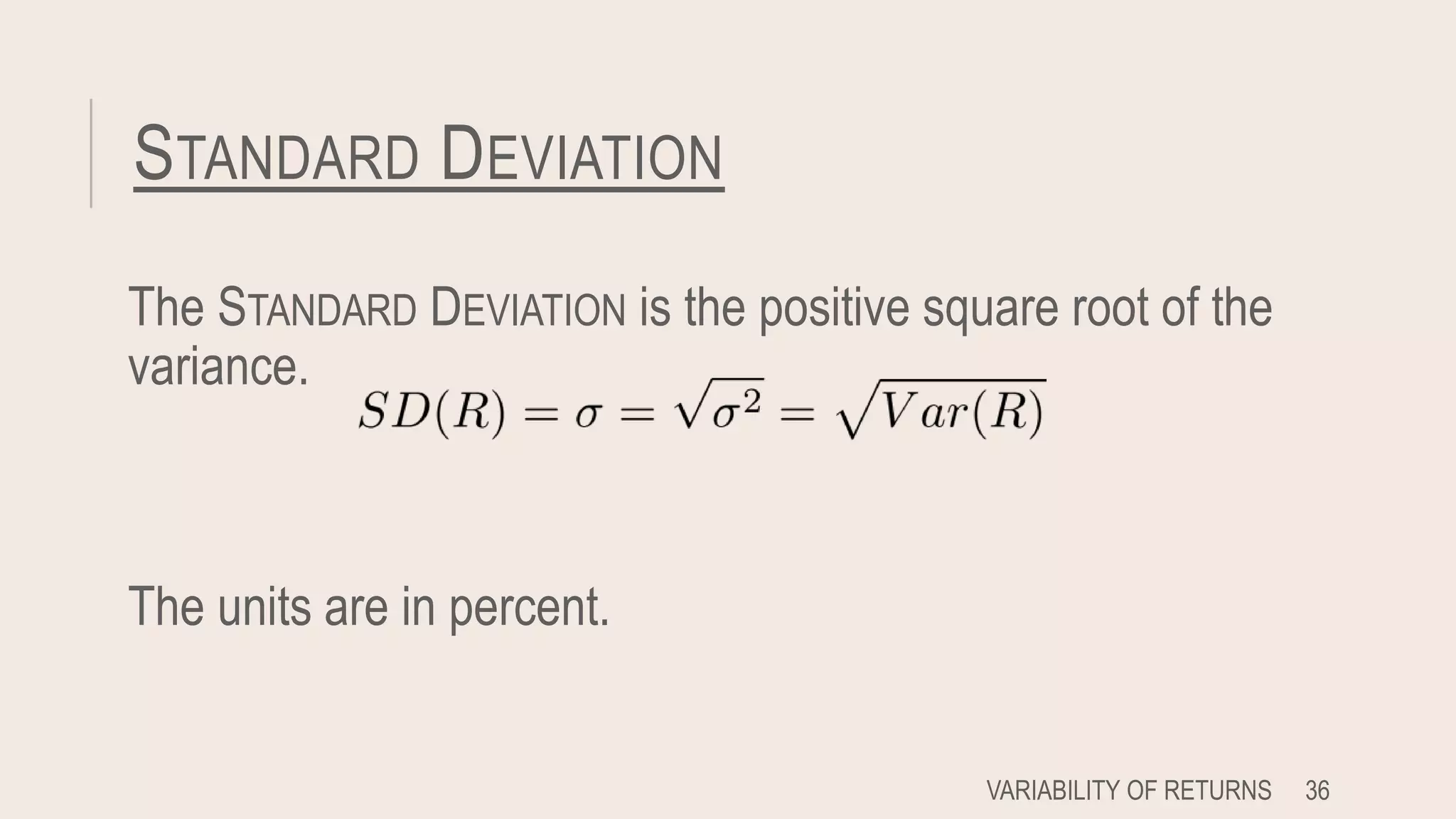
The STANDARD DEVIATION is the positive square root of the
variance.
The units are in percent.
VARIABILITY OF RETURNS 36
STANDARD DEVIATION EXAMPLE: KROGER
The standard deviation of the Kroger returns is the square
root of 0.009, which is 0.09486833 = 9.49%.
VARIABILITY OF RETURNS 37
REAL-WORLD EXAMPLE: VFINX
We can obtain the standard deviation of returns for the
Vanguard VFINX S&P 500 Index Fund on Morningstar’s
website here.
VARIABILITY OF RETURNS 38
VARIABILITY OF RETURNS 39
THE SECOND LESSON
AVERAGE RETURNS 40
THE GREATER THE RISK, THE GREATER THE
POTENTIAL REWARD.
RISK PREMIUM AND THE REQUIRED
RETURN
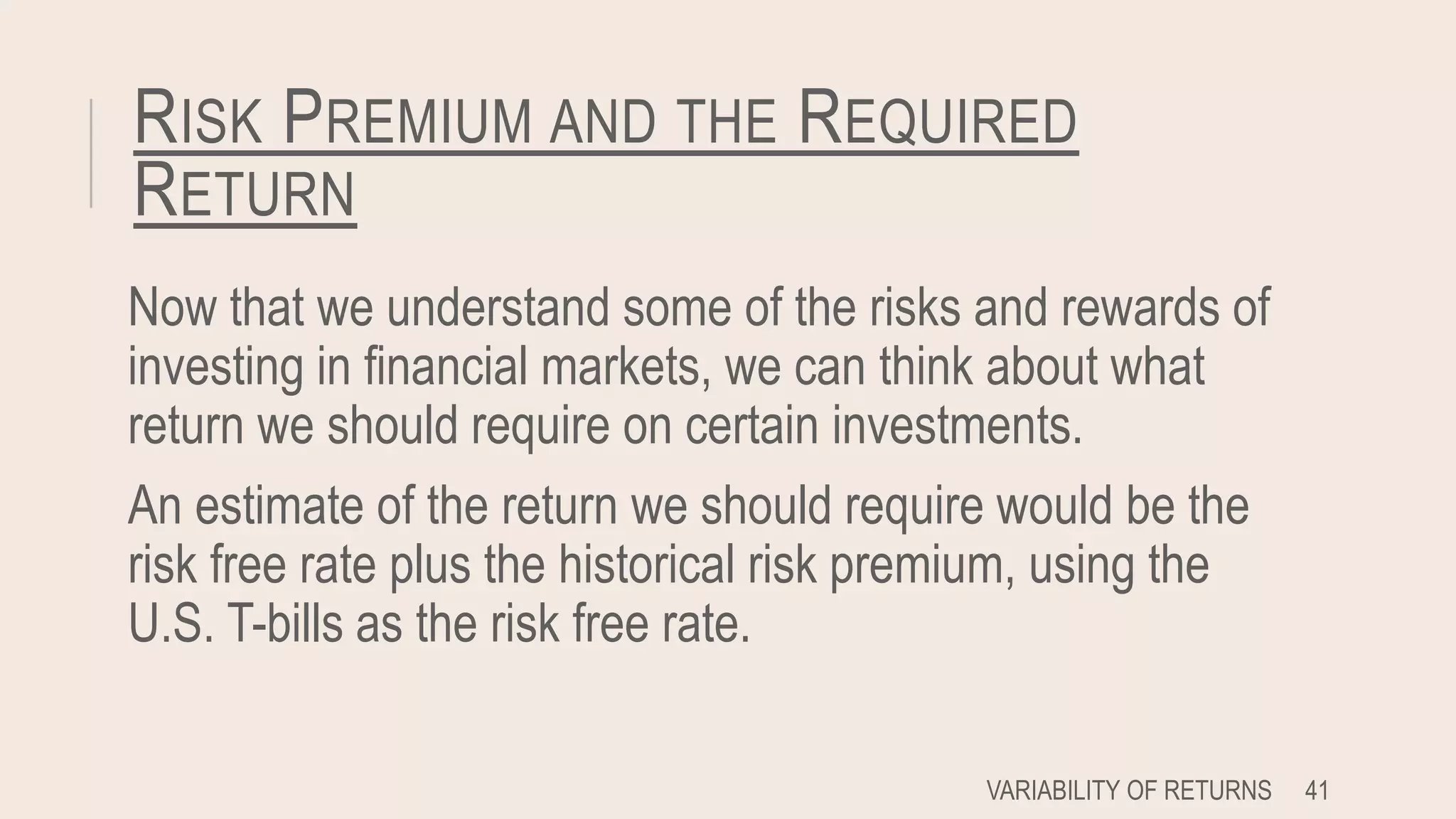
Now that we understand some of the risks and rewards of
investing in financial markets, we can think about what
return we should require on certain investments.
An estimate of the return we should require would be the
risk free rate plus the historical risk premium, using the
U.S. T-bills as the risk free rate.
VARIABILITY OF RETURNS 41
REAL WORLD EXAMPLE: RISK PREMIUM &
REQUIRED RETURN
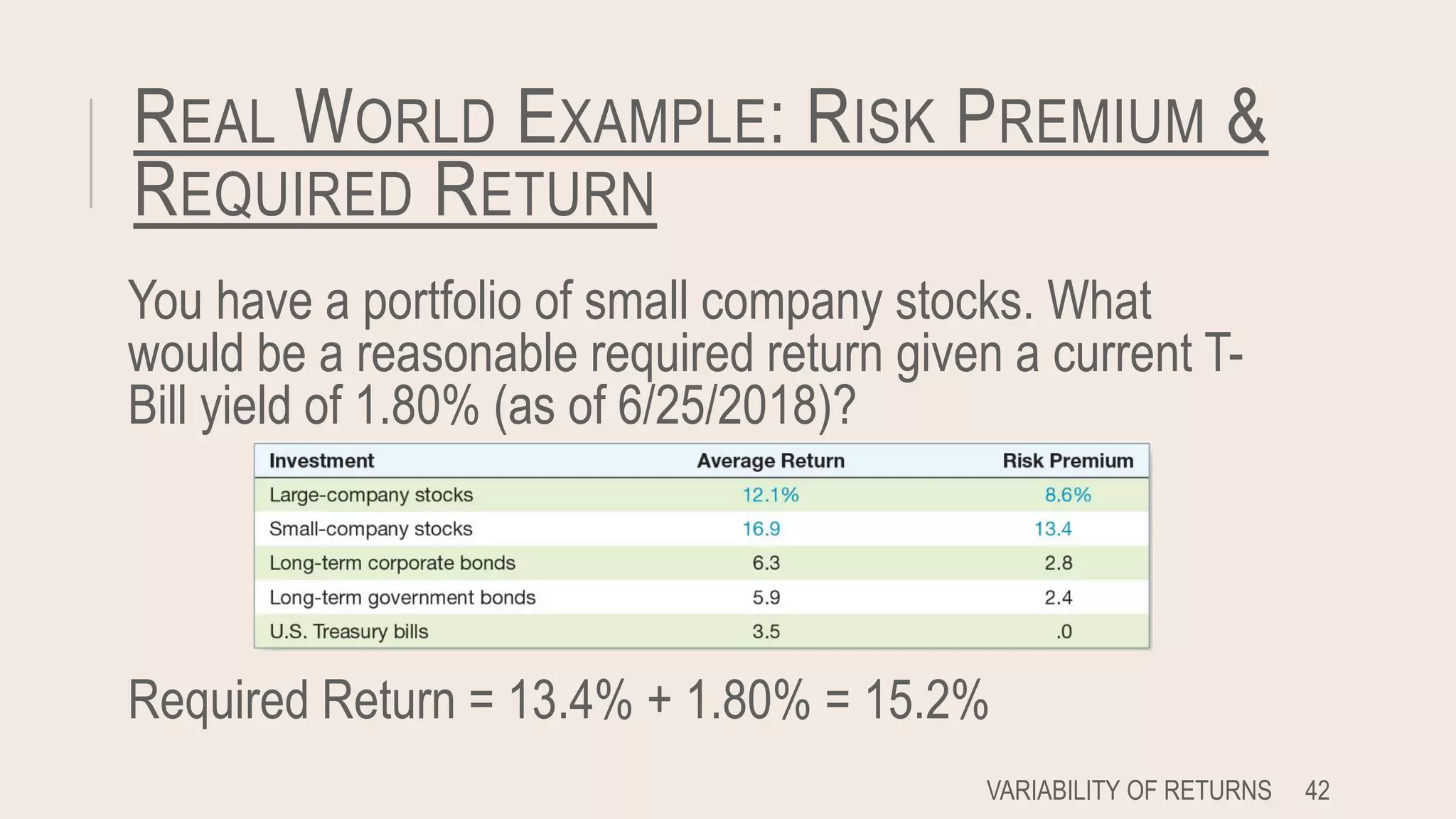
You have a portfolio of small company stocks. What
would be a reasonable required return given a current T-
Bill yield of 1.80% (as of 6/25/2018)?
Required Return = 13.4% + 1.80% = 15.2%
VARIABILITY OF RETURNS 42
THE STOCK MARKET RISK PREMIUM
(1900-2005)
VARIABILITY OF RETURNS 43
TO SUMMARIZE: THE LESSONS FROM
CAPITAL MARKET HISTORY
(1) Risky assets, on average, earn a risk premium.
(2) The greater the risk, the greater the potential reward.
VARIABILITY OF RETURNS 44
ARITHMETIC AND GEOMETRIC
AVERAGES
45
ARITHMETIC AVERAGES
Thus far, we’ve looked at simple ARITHMETIC AVERAGES.
But consider the following example:
You buy a $100 share which falls to $50 in the first year.
This is a negative 50% return. In the second year, it rises
back to $100. This is a positive 100% return ($50
doubling to $100). What is your average return?
(100% + -50%) / 2 = 25%.
AVERAGES 46
ARITHMETIC AVERAGES
Your average return on this investment over two years is
25% even though your stock is worth the same as before!
AVERAGES 47
GEOMETRIC AVERAGES
We can also compute the GEOMETRIC AVERAGE.
Revisiting the example:
(1+(-0.50)) x (1+1.00))(1/2)-1 = (1) (1/2)-1 = 0
AVERAGES 48
GEOMETRIC AVERAGE: EXAMPLE
Find the Geometric Average for these 5 annual returns of
the S&P 500:
13.75%, 35.70%, 45.08%, -8.80%, and -25.13%
AVERAGES 49
Returns Product
13.75 1.1375
35.70 x 1.3570
45.08 x 1.4508
-8.80 x 0.9120
-25.13 x 0.7487
1.5291
1.5291(1/5) –
1
= 0.0887
= 8.87%
ARITHMETIC VS. GEOMETRIC AVERAGE
RETURN
The geometric average tells you what you actually earned
per time period on average, including compounding
effects. The arithmetic mean tells you what you earned in
a typical time period.
Unless otherwise stated, “average” means “arithmetic
AVERAGES 50
TO SUMMARIZE
The arithmetic average of returns presents what you earn
in a typical year while the geometric average presents
what you actually earned per year, on average, including
compounding.
AVERAGES 51
CAPITAL MARKET EFFICIENCY
52
FLUCTUATION OF MARKET VALUES
Why do stock and bond prices fluctuate?
Prices change, in part, because new information arrives
and investors reassess asset values based on that
information.
EFFICIENT MARKETS 53
EFFICIENT MARKETS
An EFFICIENT CAPITAL MARKET is a market in which
security prices reflect available information.
The EFFICIENT MARKET HYPOTHESIS states that actual
capital markets are efficient.
EFFICIENT MARKETS 54
EFFICIENT MARKETS EXAMPLE
AstraZeneca has, through years of secret R&D,
developed a cure for cancer. They predict this is a highly
positive NPV project. They will make an announcement
about this discovery on day 0. Today, on day
-1, the stock price only reflects what is publicly known
about AstraZeneca’s future projects. Tomorrow, when the
announcement is made, the stock price will shoot up and
quickly settle as investors buy and sell shares to adjust to
the news. EFFICIENT MARKETS 55
EFFICIENT MARKETS EXAMPLE
EFFICIENT MARKETS 56
EFFICIENT MARKETS CONSEQUENCES
If asset prices fully reflect available information, you
cannot make money by trading based on past information
(earnings, ROA, past stock returns). And making money
on just-released news is difficult as the prices quickly
adjust.
Some disagree… and how efficient markets are is a
matter of debate. EFFICIENT MARKETS 57
TO SUMMARIZE
In efficient markets, prices adjust quickly and correctly to
new information.
EFFICIENT MARKETS 58
TAKEAWAYS
59
TAKEAWAYS
1. We learn two important lessons from capital market history:
risky assets on average earn a risk premium, and the greater
the risk, the greater the potential reward.
2. The standard deviation gives us a measure of risk by looking
at the variability of returns.
3. The arithmetic average presents the returns you’d achieve in
a typical period while the geometric average presents the
returns you’d actually achieve on average over a period.
4. Efficient markets suggest that asset prices in the market
reflect all publicly available information.
TAKEAWAYS 60
END.
61

Ch12

  • 1.
    SOME LESSONS FROMCAPITAL MARKET HISTORY Chapter 12
  • 2.
    OUTLINE 1. Returns 2. History 3.Average Returns: The First Lesson 4. Variability of Returns: The Second Lesson 5. Arithmetic & Geometric Averages 6. Capital Market Efficiency 2
  • 3.
  • 4.
    PERSPECTIVE Roughly 90 yearsago, your great-grandmother opened 4 “managed” accounts and put $100 (~$1400 in today’s dollars) in each for your just-born grandfather. These accounts were investments in: (1) Treasury Bills (2) Long-term Government Bonds (3) Stocks of Large Companies (4) Stocks of Small Companies Your grandfather has forgotten about those accounts until today. How much do you think would be in each? RETURNS 4
  • 5.
    PERSPECTIVE (1) Treasury Bills:A $100 investment in 1925 is now worth $2,058.00 (2) Long Term Government Bonds: A $100 investment in 1925 is now worth $10,914.00 RETURNS 5
  • 6.
    PERSPECTIVE (3) Large CompanyStocks: A $100 investment in 1925 is now worth $467,688.00 (4) Small Company Stocks: A $100 investment in 1925 is now worth $2,664,117.00 RETURNS 6
  • 7.
    RETURNS Your RETURN ONINVESTMENT is your gain (or loss) from holding some financial asset. Generally, we think in terms of (1) Dollar Returns (2) Percentage Returns RETURNS 7
  • 8.
    (1) DOLLAR RETURNS DOLLARRETURNS are how much more or less cash you have for holding an asset for a period of time. It consists of two components: (1) Income Component: dividends & interest (2) Capital Gain (or Loss) Component: change in value from beginning period to ending period RETURNS 8
  • 9.
    (1) DOLLAR RETURNSEXAMPLE Given the information from finance.yahoo.com on the next slide, what is your dollar return assuming you purchased 100 Coca-Cola shares at the Close Price on January 1, 2018 and sold 100 Coca-Cola shares at the Close Price on April 1, 2018? RETURNS 9
  • 10.
    (1) DOLLAR RETURNSEXAMPLE Income Component: Dividend x Shares = 0.39 x 100 = $39 Capital Gain (Loss) Component: (End – Beginning) x Shares = ($43.210 - $47.590) x 100 = -$438 Total Dollar Return = Income + Capital Gain (Loss) = $39 + ($438) = -$399 RETURNS 10
  • 11.
    (2) PERCENTAGE RETURNS ThePERCENTAGE RETURN tells us how much we get for each $1 invested. As we’ve seen before, the percentage return consists of: (1) Dividend Yield (2) Capital Gains Yield RETURNS 11
  • 12.
    (2) PERCENTAGE RETURNS Thedividend yield expresses the dividend as a percentage of the beginning stock price. RETURNS 12
  • 13.
    (2) PERCENTAGE RETURNS Thecapital gains yield is the percent change in price. RETURNS 13
  • 14.
    (2) PERCENTAGE RETURNSEXAMPLE Suppose you pay $37 for a share of Pfizer. This firm pays a dividend of $1.85. At the end of the year, you sell this share for $40.33. What’s the percent return? Dividend Yield =1.85 / 37 = 0.05 = 5% Capital Gains Yield =(40.33 – 37) / 37 = 0.09 = 9% RETURNS 14
  • 15.
    (2) PERCENTAGE RETURNSEXAMPLE, CONT. Now we can find the total return: = 5% + 9% = 14% Our percentage return is 14%, or 14 cents per dollar invested. RETURNS 15
  • 16.
    TO SUMMARIZE Our returnon investment can be presented in dollar terms or percentage returns. Both have a type of income and capital gains (loss) component. RETURNS 16
  • 17.
  • 18.
    HISTORY 18 SMALL STOCKS:smallest 20% of companies on the NYSE. LARGE STOCKS: the S&P 500 LONG-TERM US GOVERNMENT BONDS: 20 year maturity U.S. TREASURY BILLS: 1 month maturity
  • 19.
    HISTORICAL RETURNS Why notjust hold the small stocks? Why would anyone hold T-bills? Do all investors buy these investments and hold for 90+ years? HISTORY 19
  • 20.
    HISTORICAL RETURNS- SMALLSTOCKS VS. T-BILLS HISTORY 20
  • 21.
  • 22.
    TO SUMMARIZE Riskier assetstend to provide higher returns. Risky small stocks have had annual returns as good as 143% and as bad as -53%. Safe T-bills have never had a negative return, but have never returned more than 15%. HISTORY 22
  • 23.
    AVERAGE RETURNS: THEFIRST LESSON 23
  • 24.
    AVERAGE RETURNS BYINVESTMENT TYPE AVERAGE RETURNS 24
  • 25.
    RISK PREMIUM The RISKPREMIUM is the excess return required from an investment in a risky asset over that required from a risk- free investment. It’s found by subtracting the risk free rate from the average return. AVERAGE RETURNS 25
  • 26.
    THE FIRST LESSON AVERAGERETURNS 26 RISKY ASSETS, ON AVERAGE, EARN A RISK PREMIUM
  • 27.
    VARIABILITY OF RETURNS:THE SECOND LESSON 27
  • 28.
    VARIABILITY OF RETURNS Inorder to determine a level of risk, we need to understand the spread of an asset’s returns overtime. This is known as the VARIABILITY OF RETURNS. We use the VARIANCE and STANDARD DEVIATION of returns as measures of VOLATILITY, or risk. VARIABILITY OF RETURNS 28
  • 29.
    VARIANCE The VARIANCE isthe average squared difference between the actual return and the average return. A higher variance indicates that returns are more spread out from the mean. R is the return of an asset. R-bar is the average return of the asset. T represents the number of returns. VARIABILITY OF RETURNS 29
  • 30.
    VARIANCE EXAMPLE: KROGER SupposeKroger stock has returned the following over the past 4 years: 10%, 12%, 3%, -9%. What is the VARIANCE of returns over this time period? VARIABILITY OF RETURNS 30
  • 31.
    VARIANCE EXAMPLE: KROGER Returns:10%, 12%, 3%, -9%. (1) Calculate the average (R-bar) first (0.10 + 0.12 + 0.03 + (-0.09)) / 4 = 0.04 = 4% VARIABILITY OF RETURNS 31
  • 32.
    VARIANCE EXAMPLE: KROGER (2)Find the difference (or deviation) between each return and the average: VARIABILITY OF RETURNS 32 (1) Actual Return (2) Average Return (3) Deviation 1 - 2 0.10 0.04 0.06 0.12 0.04 0.08 0.03 0.04 -0.01 -0.09 0.04 -0.13 Total: 0.16 0.00
  • 33.
    VARIANCE EXAMPLE: KROGER (3)Obtain the sum of the squared deviations (note that the sum is always 0): VARIABILITY OF RETURNS 33 (1) Actual Return (2) Average Return (3) Deviation 1 - 2 (4) Squared Deviation 0.10 0.04 0.06 0.0036 0.12 0.04 0.08 0.0064 0.03 0.04 -0.01 0.0001 -0.09 0.04 -0.13 0.0169 Total: 0.16 0.00 0.0270
  • 34.
    VARIANCE EXAMPLE: KROGER (4)Divide the sum of the squared deviations by T-1: VAR(R) = σ2 = 0.0270 / (4 – 1) = 0.009 VARIABILITY OF RETURNS 34
  • 35.
    VARIANCE EXAMPLE: KROGER Thus,the variance is 0.009. The unit is “squared” percentages, which is difficult to interpret, so we generally use the STANDARD DEVIATION to measure volatility of returns. VARIABILITY OF RETURNS 35
  • 36.
    STANDARD DEVIATION The STANDARDDEVIATION is the positive square root of the variance. The units are in percent. VARIABILITY OF RETURNS 36
  • 37.
    STANDARD DEVIATION EXAMPLE:KROGER The standard deviation of the Kroger returns is the square root of 0.009, which is 0.09486833 = 9.49%. VARIABILITY OF RETURNS 37
  • 38.
    REAL-WORLD EXAMPLE: VFINX Wecan obtain the standard deviation of returns for the Vanguard VFINX S&P 500 Index Fund on Morningstar’s website here. VARIABILITY OF RETURNS 38
  • 39.
  • 40.
    THE SECOND LESSON AVERAGERETURNS 40 THE GREATER THE RISK, THE GREATER THE POTENTIAL REWARD.
  • 41.
    RISK PREMIUM ANDTHE REQUIRED RETURN Now that we understand some of the risks and rewards of investing in financial markets, we can think about what return we should require on certain investments. An estimate of the return we should require would be the risk free rate plus the historical risk premium, using the U.S. T-bills as the risk free rate. VARIABILITY OF RETURNS 41
  • 42.
    REAL WORLD EXAMPLE:RISK PREMIUM & REQUIRED RETURN You have a portfolio of small company stocks. What would be a reasonable required return given a current T- Bill yield of 1.80% (as of 6/25/2018)? Required Return = 13.4% + 1.80% = 15.2% VARIABILITY OF RETURNS 42
  • 43.
    THE STOCK MARKETRISK PREMIUM (1900-2005) VARIABILITY OF RETURNS 43
  • 44.
    TO SUMMARIZE: THELESSONS FROM CAPITAL MARKET HISTORY (1) Risky assets, on average, earn a risk premium. (2) The greater the risk, the greater the potential reward. VARIABILITY OF RETURNS 44
  • 45.
  • 46.
    ARITHMETIC AVERAGES Thus far,we’ve looked at simple ARITHMETIC AVERAGES. But consider the following example: You buy a $100 share which falls to $50 in the first year. This is a negative 50% return. In the second year, it rises back to $100. This is a positive 100% return ($50 doubling to $100). What is your average return? (100% + -50%) / 2 = 25%. AVERAGES 46
  • 47.
    ARITHMETIC AVERAGES Your averagereturn on this investment over two years is 25% even though your stock is worth the same as before! AVERAGES 47
  • 48.
    GEOMETRIC AVERAGES We canalso compute the GEOMETRIC AVERAGE. Revisiting the example: (1+(-0.50)) x (1+1.00))(1/2)-1 = (1) (1/2)-1 = 0 AVERAGES 48
  • 49.
    GEOMETRIC AVERAGE: EXAMPLE Findthe Geometric Average for these 5 annual returns of the S&P 500: 13.75%, 35.70%, 45.08%, -8.80%, and -25.13% AVERAGES 49 Returns Product 13.75 1.1375 35.70 x 1.3570 45.08 x 1.4508 -8.80 x 0.9120 -25.13 x 0.7487 1.5291 1.5291(1/5) – 1 = 0.0887 = 8.87%
  • 50.
    ARITHMETIC VS. GEOMETRICAVERAGE RETURN The geometric average tells you what you actually earned per time period on average, including compounding effects. The arithmetic mean tells you what you earned in a typical time period. Unless otherwise stated, “average” means “arithmetic AVERAGES 50
  • 51.
    TO SUMMARIZE The arithmeticaverage of returns presents what you earn in a typical year while the geometric average presents what you actually earned per year, on average, including compounding. AVERAGES 51
  • 52.
  • 53.
    FLUCTUATION OF MARKETVALUES Why do stock and bond prices fluctuate? Prices change, in part, because new information arrives and investors reassess asset values based on that information. EFFICIENT MARKETS 53
  • 54.
    EFFICIENT MARKETS An EFFICIENTCAPITAL MARKET is a market in which security prices reflect available information. The EFFICIENT MARKET HYPOTHESIS states that actual capital markets are efficient. EFFICIENT MARKETS 54
  • 55.
    EFFICIENT MARKETS EXAMPLE AstraZenecahas, through years of secret R&D, developed a cure for cancer. They predict this is a highly positive NPV project. They will make an announcement about this discovery on day 0. Today, on day -1, the stock price only reflects what is publicly known about AstraZeneca’s future projects. Tomorrow, when the announcement is made, the stock price will shoot up and quickly settle as investors buy and sell shares to adjust to the news. EFFICIENT MARKETS 55
  • 56.
  • 57.
    EFFICIENT MARKETS CONSEQUENCES Ifasset prices fully reflect available information, you cannot make money by trading based on past information (earnings, ROA, past stock returns). And making money on just-released news is difficult as the prices quickly adjust. Some disagree… and how efficient markets are is a matter of debate. EFFICIENT MARKETS 57
  • 58.
    TO SUMMARIZE In efficientmarkets, prices adjust quickly and correctly to new information. EFFICIENT MARKETS 58
  • 59.
  • 60.
    TAKEAWAYS 1. We learntwo important lessons from capital market history: risky assets on average earn a risk premium, and the greater the risk, the greater the potential reward. 2. The standard deviation gives us a measure of risk by looking at the variability of returns. 3. The arithmetic average presents the returns you’d achieve in a typical period while the geometric average presents the returns you’d actually achieve on average over a period. 4. Efficient markets suggest that asset prices in the market reflect all publicly available information. TAKEAWAYS 60
  • 61.