Articles 4-7 The Powers of the US Constitution to Change, Control and Represent the United States
Article 1 – Powers… Legislative  Article 2 – Powers… Executive  Article 3 – Powers… Judicial  Article 4 – Relations Between the States Article 5 – Amending the Constitution  Article 6 – Supremacy of the Constitution Article 7 – Ratification of the Constitution  Review
Full Faith and Credit Clause Each State must respect the laws, court rulings, and certifications of others states.  Get married to Justin Bieber in Illinois? Florida will recognize it, too! Imagine if each state  had their own currency. Or driving age! Privileges and immunities  is clause is similar, stating that no state may discriminate based on another citizen’s residence in another state.  Protection from invasion Government promises to protect states from foreign invasion, or when there is conflict between or  in the states. Article 4 Relations Between States
Fugitive Slave Clause  was the same thing, as the Supreme Court ruled  free states  must return slaves that escaped from  slave states .  Each state must have a Republican Government NOT direct democracy no referendum, initiative, recall? Article 4, continued… Relations Between States Extradition Clause Criminals that escape one state for another must be returned to their “home” state should they flee!
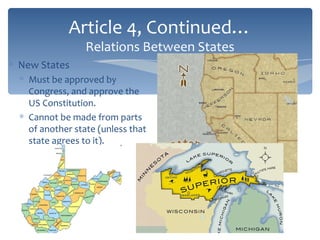
New States Must be approved by Congress, and approve the US Constitution.  Cannot be made from parts of another state (unless that state agrees to it). Article 4, Continued… Relations Between States
Article 5 Amending the Constitution  Amend = to Change (so Amending means Changing the Constitution)
27 Total Amendments 11* are in the original Bill of Rights 2 cancel each other out 14 is really the actual number of Amendments Some have been very close to becoming Amendments. Equal Rights Amendment (1970’s) Child Labor Amendment (1920’s) Most don’t have expiration dates, can be ratified at any time.  The 27 th  Amendment was actually one of the ORIGINAL Bill of Rights Amendments! Article 5, Continued…  Notable Amendments
Supremacy Clause : whenever a state’s laws come in conflict with a Federal law, the Federal law is supreme.  The US also makes all treaties and laws which concern the nation, not states. The US also cannot require any religious test for Federal office.  Article 6 Supremacy of the US Constitution
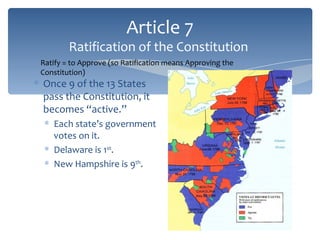
Once 9 of the 13 States pass the Constitution, it becomes “active.” Each state’s government votes on it. Delaware is 1 st . New Hampshire is 9 th . Article 7 Ratification of the Constitution  Ratify = to Approve (so Ratification means Approving the Constitution)

Articles 4 7

  • 1.
    Articles 4-7 ThePowers of the US Constitution to Change, Control and Represent the United States
  • 2.
    Article 1 –Powers… Legislative Article 2 – Powers… Executive Article 3 – Powers… Judicial Article 4 – Relations Between the States Article 5 – Amending the Constitution Article 6 – Supremacy of the Constitution Article 7 – Ratification of the Constitution Review
  • 3.
    Full Faith andCredit Clause Each State must respect the laws, court rulings, and certifications of others states. Get married to Justin Bieber in Illinois? Florida will recognize it, too! Imagine if each state had their own currency. Or driving age! Privileges and immunities is clause is similar, stating that no state may discriminate based on another citizen’s residence in another state. Protection from invasion Government promises to protect states from foreign invasion, or when there is conflict between or in the states. Article 4 Relations Between States
  • 4.
    Fugitive Slave Clause was the same thing, as the Supreme Court ruled free states must return slaves that escaped from slave states . Each state must have a Republican Government NOT direct democracy no referendum, initiative, recall? Article 4, continued… Relations Between States Extradition Clause Criminals that escape one state for another must be returned to their “home” state should they flee!
  • 5.
    New States Mustbe approved by Congress, and approve the US Constitution. Cannot be made from parts of another state (unless that state agrees to it). Article 4, Continued… Relations Between States
  • 6.
    Article 5 Amendingthe Constitution Amend = to Change (so Amending means Changing the Constitution)
  • 7.
    27 Total Amendments11* are in the original Bill of Rights 2 cancel each other out 14 is really the actual number of Amendments Some have been very close to becoming Amendments. Equal Rights Amendment (1970’s) Child Labor Amendment (1920’s) Most don’t have expiration dates, can be ratified at any time. The 27 th Amendment was actually one of the ORIGINAL Bill of Rights Amendments! Article 5, Continued… Notable Amendments
  • 8.
    Supremacy Clause :whenever a state’s laws come in conflict with a Federal law, the Federal law is supreme. The US also makes all treaties and laws which concern the nation, not states. The US also cannot require any religious test for Federal office. Article 6 Supremacy of the US Constitution
  • 9.
    Once 9 ofthe 13 States pass the Constitution, it becomes “active.” Each state’s government votes on it. Delaware is 1 st . New Hampshire is 9 th . Article 7 Ratification of the Constitution Ratify = to Approve (so Ratification means Approving the Constitution)