Chapter 1
Introduction
Introductory Econometrics for Finance © Chris Brooks 2014 1
The Nature and Purpose of Econometrics
• What is Econometrics?
• Literal meaning is “measurement in economics”.
• Definition of financial econometrics:
The application of statistical and mathematical techniques to problems in
finance.
Introductory Econometrics for Finance © Chris Brooks 2014 2
Examples of the kind of problems that
may be solved by an Econometrician
1. Testing whether financial markets are weak-form informationally
efficient.
2. Testing whether the CAPM or APT represent superior models for the
determination of returns on risky assets.
3. Measuring and forecasting the volatility of bond returns.
4. Explaining the determinants of bond credit ratings used by the ratings
agencies.
5. Modelling long-term relationships between prices and exchange rates
Introductory Econometrics for Finance © Chris Brooks 2014 3
Examples of the kind of problems that
may be solved by an Econometrician (cont’d)
6. Determining the optimal hedge ratio for a spot position in oil.
7. Testing technical trading rules to determine which makes the most
money.
8. Testing the hypothesis that earnings or dividend announcements have
no effect on stock prices.
9. Testing whether spot or futures markets react more rapidly to news.
10. Forecasting the correlation between the returns to the stock indices of
two countries.
Introductory Econometrics for Finance © Chris Brooks 2014 4
What are the Special Characteristics
of Financial Data?
• Frequency & quantity of data
Stock market prices are measured every time there is a trade or somebody
posts a new quote.
• Quality
Recorded asset prices are usually those at which the transaction took place.
No possibility for measurement error but financial data are “noisy”.
Introductory Econometrics for Finance © Chris Brooks 2014 5
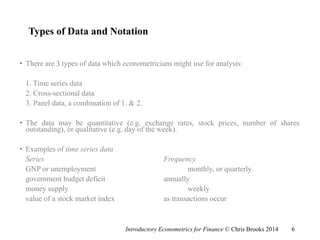
Types of Data and Notation
• There are 3 types of data which econometricians might use for analysis:
1. Time series data
2. Cross-sectional data
3. Panel data, a combination of 1. & 2.
• The data may be quantitative (e.g. exchange rates, stock prices, number of shares
outstanding), or qualitative (e.g. day of the week).
• Examples of time series data
Series Frequency
GNP or unemployment monthly, or quarterly
government budget deficit annually
money supply weekly
value of a stock market index as transactions occur
Introductory Econometrics for Finance © Chris Brooks 2014 6
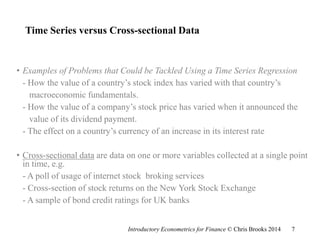
Time Series versus Cross-sectional Data
• Examples of Problems that Could be Tackled Using a Time Series Regression
- How the value of a country’s stock index has varied with that country’s
macroeconomic fundamentals.
- How the value of a company’s stock price has varied when it announced the
value of its dividend payment.
- The effect on a country’s currency of an increase in its interest rate
• Cross-sectional data are data on one or more variables collected at a single point
in time, e.g.
- A poll of usage of internet stock broking services
- Cross-section of stock returns on the New York Stock Exchange
- A sample of bond credit ratings for UK banks
Introductory Econometrics for Finance © Chris Brooks 2014 7
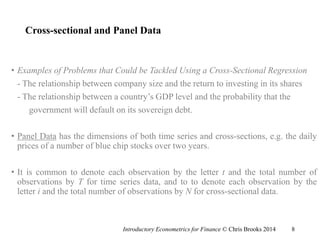
Cross-sectional and Panel Data
• Examples of Problems that Could be Tackled Using a Cross-Sectional Regression
- The relationship between company size and the return to investing in its shares
- The relationship between a country’s GDP level and the probability that the
government will default on its sovereign debt.
• Panel Data has the dimensions of both time series and cross-sections, e.g. the daily
prices of a number of blue chip stocks over two years.
• It is common to denote each observation by the letter t and the total number of
observations by T for time series data, and to to denote each observation by the
letter i and the total number of observations by N for cross-sectional data.
Introductory Econometrics for Finance © Chris Brooks 2014 8
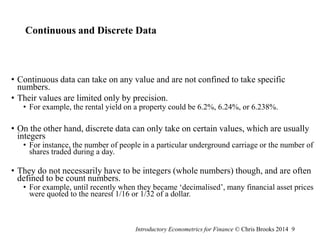
Continuous and Discrete Data
• Continuous data can take on any value and are not confined to take specific
numbers.
• Their values are limited only by precision.
• For example, the rental yield on a property could be 6.2%, 6.24%, or 6.238%.
• On the other hand, discrete data can only take on certain values, which are usually
integers
• For instance, the number of people in a particular underground carriage or the number of
shares traded during a day.
• They do not necessarily have to be integers (whole numbers) though, and are often
defined to be count numbers.
• For example, until recently when they became ‘decimalised’, many financial asset prices
were quoted to the nearest 1/16 or 1/32 of a dollar.
Introductory Econometrics for Finance © Chris Brooks 2014 9
Cardinal, Ordinal and Nominal Numbers
• Another way in which we could classify numbers is according to whether they are
cardinal, ordinal, or nominal.
• Cardinal numbers are those where the actual numerical values that a particular variable
takes have meaning, and where there is an equal distance between the numerical values.
• Examples of cardinal numbers would be the price of a share or of a building, and the number
of houses in a street.
• Ordinal numbers can only be interpreted as providing a position or an ordering.
• Thus, for cardinal numbers, a figure of 12 implies a measure that is `twice as good' as a figure
of 6. On the other hand, for an ordinal scale, a figure of 12 may be viewed as `better' than a
figure of 6, but could not be considered twice as good. Examples of ordinal numbers would be
the position of a runner in a race.
Introductory Econometrics for Finance © Chris Brooks 2014 10
Cardinal, Ordinal and Nominal Numbers (Cont’d)
• Nominal numbers occur where there is no natural ordering of the values at all.
• Such data often arise when numerical values are arbitrarily assigned, such as telephone
numbers or when codings are assigned to qualitative data (e.g. when describing the
exchange that a US stock is traded on.
• Cardinal, ordinal and nominal variables may require different modelling approaches
or at least different treatments, as should become evident in the subsequent
chapters.
Introductory Econometrics for Finance © Chris Brooks 2014 11
Thank You!
‘Introductory Econometrics for Finance’
© Chris Brooks 2013
12

Ch1_slides.ppt

  • 1.
    Chapter 1 Introduction Introductory Econometricsfor Finance © Chris Brooks 2014 1
  • 2.
    The Nature andPurpose of Econometrics • What is Econometrics? • Literal meaning is “measurement in economics”. • Definition of financial econometrics: The application of statistical and mathematical techniques to problems in finance. Introductory Econometrics for Finance © Chris Brooks 2014 2
  • 3.
    Examples of thekind of problems that may be solved by an Econometrician 1. Testing whether financial markets are weak-form informationally efficient. 2. Testing whether the CAPM or APT represent superior models for the determination of returns on risky assets. 3. Measuring and forecasting the volatility of bond returns. 4. Explaining the determinants of bond credit ratings used by the ratings agencies. 5. Modelling long-term relationships between prices and exchange rates Introductory Econometrics for Finance © Chris Brooks 2014 3
  • 4.
    Examples of thekind of problems that may be solved by an Econometrician (cont’d) 6. Determining the optimal hedge ratio for a spot position in oil. 7. Testing technical trading rules to determine which makes the most money. 8. Testing the hypothesis that earnings or dividend announcements have no effect on stock prices. 9. Testing whether spot or futures markets react more rapidly to news. 10. Forecasting the correlation between the returns to the stock indices of two countries. Introductory Econometrics for Finance © Chris Brooks 2014 4
  • 5.
    What are theSpecial Characteristics of Financial Data? • Frequency & quantity of data Stock market prices are measured every time there is a trade or somebody posts a new quote. • Quality Recorded asset prices are usually those at which the transaction took place. No possibility for measurement error but financial data are “noisy”. Introductory Econometrics for Finance © Chris Brooks 2014 5
  • 6.
    Types of Dataand Notation • There are 3 types of data which econometricians might use for analysis: 1. Time series data 2. Cross-sectional data 3. Panel data, a combination of 1. & 2. • The data may be quantitative (e.g. exchange rates, stock prices, number of shares outstanding), or qualitative (e.g. day of the week). • Examples of time series data Series Frequency GNP or unemployment monthly, or quarterly government budget deficit annually money supply weekly value of a stock market index as transactions occur Introductory Econometrics for Finance © Chris Brooks 2014 6
  • 7.
    Time Series versusCross-sectional Data • Examples of Problems that Could be Tackled Using a Time Series Regression - How the value of a country’s stock index has varied with that country’s macroeconomic fundamentals. - How the value of a company’s stock price has varied when it announced the value of its dividend payment. - The effect on a country’s currency of an increase in its interest rate • Cross-sectional data are data on one or more variables collected at a single point in time, e.g. - A poll of usage of internet stock broking services - Cross-section of stock returns on the New York Stock Exchange - A sample of bond credit ratings for UK banks Introductory Econometrics for Finance © Chris Brooks 2014 7
  • 8.
    Cross-sectional and PanelData • Examples of Problems that Could be Tackled Using a Cross-Sectional Regression - The relationship between company size and the return to investing in its shares - The relationship between a country’s GDP level and the probability that the government will default on its sovereign debt. • Panel Data has the dimensions of both time series and cross-sections, e.g. the daily prices of a number of blue chip stocks over two years. • It is common to denote each observation by the letter t and the total number of observations by T for time series data, and to to denote each observation by the letter i and the total number of observations by N for cross-sectional data. Introductory Econometrics for Finance © Chris Brooks 2014 8
  • 9.
    Continuous and DiscreteData • Continuous data can take on any value and are not confined to take specific numbers. • Their values are limited only by precision. • For example, the rental yield on a property could be 6.2%, 6.24%, or 6.238%. • On the other hand, discrete data can only take on certain values, which are usually integers • For instance, the number of people in a particular underground carriage or the number of shares traded during a day. • They do not necessarily have to be integers (whole numbers) though, and are often defined to be count numbers. • For example, until recently when they became ‘decimalised’, many financial asset prices were quoted to the nearest 1/16 or 1/32 of a dollar. Introductory Econometrics for Finance © Chris Brooks 2014 9
  • 10.
    Cardinal, Ordinal andNominal Numbers • Another way in which we could classify numbers is according to whether they are cardinal, ordinal, or nominal. • Cardinal numbers are those where the actual numerical values that a particular variable takes have meaning, and where there is an equal distance between the numerical values. • Examples of cardinal numbers would be the price of a share or of a building, and the number of houses in a street. • Ordinal numbers can only be interpreted as providing a position or an ordering. • Thus, for cardinal numbers, a figure of 12 implies a measure that is `twice as good' as a figure of 6. On the other hand, for an ordinal scale, a figure of 12 may be viewed as `better' than a figure of 6, but could not be considered twice as good. Examples of ordinal numbers would be the position of a runner in a race. Introductory Econometrics for Finance © Chris Brooks 2014 10
  • 11.
    Cardinal, Ordinal andNominal Numbers (Cont’d) • Nominal numbers occur where there is no natural ordering of the values at all. • Such data often arise when numerical values are arbitrarily assigned, such as telephone numbers or when codings are assigned to qualitative data (e.g. when describing the exchange that a US stock is traded on. • Cardinal, ordinal and nominal variables may require different modelling approaches or at least different treatments, as should become evident in the subsequent chapters. Introductory Econometrics for Finance © Chris Brooks 2014 11
  • 12.
    Thank You! ‘Introductory Econometricsfor Finance’ © Chris Brooks 2013 12

Editor's Notes

  • #3 Copyright 2002, Chris Brooks