Usability refers to five factors of use:

•   ease of learning
•   efficiency of use
•   memorability
•   error frequency, severity, and recovery
•   subjective satisfaction


       Chapter 13. Reviewing, Evaluating, and Testing   © 2012 by Bedford/St. Martin's   1
What are reviewing,
              evaluating, and testing?

• Reviewing refers to three techniques—revising,
  editing, and proofreading—that you can use to study
  your draft and change it to make it easier to use.
• Evaluating refers to having other people help you by
  reading the draft and commenting on its strengths and
  weaknesses.
• Testing refers to formal techniques of observing
  people and analyzing their actions as they try to use
  your draft to carry out tasks.

     Chapter 13. Reviewing, Evaluating, and Testing   © 2012 by Bedford/St. Martin's   2
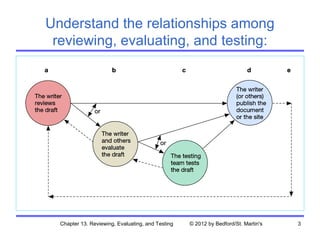
Understand the relationships among
 reviewing, evaluating, and testing:


  Chapter 13. Reviewing, Evaluating, and Testing   © 2012 by Bedford/St. Martin's   3
Consider three factors when deciding
     whether to evaluate or test:

• the importance of the document or site
• your time
• your money


     Chapter 13. Reviewing, Evaluating, and Testing   © 2012 by Bedford/St. Martin's   4
Ask these four questions to get the
    “big picture” before editing your draft:

• Is the design effective?
• Does my draft meet my readers’ expectations?
• Is my draft honest, and does it adhere to
  appropriate legal standards?
• Do I come across as reliable, honest, and
  helpful?


      Chapter 13. Reviewing, Evaluating, and Testing   © 2012 by Bedford/St. Martin's   5
Ask these four questions about organization
 and development when editing your draft:

• Have I left out anything in turning my outline into
  a draft?
• Is the organization logical?
• Is the emphasis appropriate throughout the
  draft?
• Are my arguments well developed?


       Chapter 13. Reviewing, Evaluating, and Testing   © 2012 by Bedford/St. Martin's   6
Ask these four questions about the
    verbal and visual elements of your draft:

•   Are all the elements presented consistently?
•   Are my paragraphs well developed?
•   Are my sentences clear, emphatic, and correct?
•   Have I used graphics appropriately?


         Chapter 13. Reviewing, Evaluating, and Testing   © 2012 by Bedford/St. Martin's   7
There are five types of usability evaluations:

•   surveying or interviewing users
•   observing users
•   interviewing SMEs and usability experts
•   conducting focus groups
•   using a commercial usability service


         Chapter 13. Reviewing, Evaluating, and Testing   © 2012 by Bedford/St. Martin's   8
Usability testing rests on three principles:

• Usability testing permeates product
  development.
• Usability testing involves studying real users as
  they use the product.
• Usability testing involves setting measurable
  goals and determining whether the product
  meets them.


       Chapter 13. Reviewing, Evaluating, and Testing   © 2012 by Bedford/St. Martin's   9
Usability testing occurs in three stages:

• preparing for the usability test
• conducting the usability test
• interpreting and reporting the data from a
  usability test


       Chapter 13. Reviewing, Evaluating, and Testing   © 2012 by Bedford/St. Martin's   10
Preparing for a usability
                test requires eight steps:

1.   Understand users’ needs.
2.   Determine the purpose of the test.
3.   Staff the test team.
4.   Set up the test environment.
5.   Develop a test plan.
6.   Select participants.
7.   Prepare the test materials.
8.   Conduct a pilot test.
       Chapter 13. Reviewing, Evaluating, and Testing   © 2012 by Bedford/St. Martin's   11
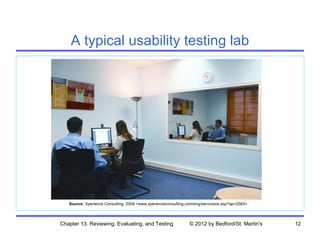
A typical usability testing lab


   Source: Xperience Consulting, 2008 <www.xperienceconsulting.com/eng/serviceios.asp?ap=25#3>.


Chapter 13. Reviewing, Evaluating, and Testing                  © 2012 by Bedford/St. Martin's    12
Obtain informed consent
       for tests that involve recording:

• Explain that the test participant can stop the test.
• Ask for permission before recording begins.
• Explain how the recording will be used.
• Explain who will have access to the recording and
  where it might be shown.
• Explain how the test participant’s identity will be
  disguised—if at all—if the recording is shown publicly.
• Let the test participant view the recording and change
  his or her mind about how it might be used.

      Chapter 13. Reviewing, Evaluating, and Testing   © 2012 by Bedford/St. Martin's   13
Conducting a usability
              test involves two tasks:

• interacting with the test participant during the
  test
• debriefing the test participant after the test


    Chapter 13. Reviewing, Evaluating, and Testing   © 2012 by Bedford/St. Martin's   14
Interpreting and reporting the data
from a usability test requires three steps:

• tabulating the information
• analyzing the information
• reporting the information


    Chapter 13. Reviewing, Evaluating, and Testing   © 2012 by Bedford/St. Martin's   15

Ch13 slides

  • 1.
    Usability refers tofive factors of use: • ease of learning • efficiency of use • memorability • error frequency, severity, and recovery • subjective satisfaction Chapter 13. Reviewing, Evaluating, and Testing © 2012 by Bedford/St. Martin's 1
  • 2.
    What are reviewing, evaluating, and testing? • Reviewing refers to three techniques—revising, editing, and proofreading—that you can use to study your draft and change it to make it easier to use. • Evaluating refers to having other people help you by reading the draft and commenting on its strengths and weaknesses. • Testing refers to formal techniques of observing people and analyzing their actions as they try to use your draft to carry out tasks. Chapter 13. Reviewing, Evaluating, and Testing © 2012 by Bedford/St. Martin's 2
  • 3.
    Understand the relationshipsamong reviewing, evaluating, and testing: Chapter 13. Reviewing, Evaluating, and Testing © 2012 by Bedford/St. Martin's 3
  • 4.
    Consider three factorswhen deciding whether to evaluate or test: • the importance of the document or site • your time • your money Chapter 13. Reviewing, Evaluating, and Testing © 2012 by Bedford/St. Martin's 4
  • 5.
    Ask these fourquestions to get the “big picture” before editing your draft: • Is the design effective? • Does my draft meet my readers’ expectations? • Is my draft honest, and does it adhere to appropriate legal standards? • Do I come across as reliable, honest, and helpful? Chapter 13. Reviewing, Evaluating, and Testing © 2012 by Bedford/St. Martin's 5
  • 6.
    Ask these fourquestions about organization and development when editing your draft: • Have I left out anything in turning my outline into a draft? • Is the organization logical? • Is the emphasis appropriate throughout the draft? • Are my arguments well developed? Chapter 13. Reviewing, Evaluating, and Testing © 2012 by Bedford/St. Martin's 6
  • 7.
    Ask these fourquestions about the verbal and visual elements of your draft: • Are all the elements presented consistently? • Are my paragraphs well developed? • Are my sentences clear, emphatic, and correct? • Have I used graphics appropriately? Chapter 13. Reviewing, Evaluating, and Testing © 2012 by Bedford/St. Martin's 7
  • 8.
    There are fivetypes of usability evaluations: • surveying or interviewing users • observing users • interviewing SMEs and usability experts • conducting focus groups • using a commercial usability service Chapter 13. Reviewing, Evaluating, and Testing © 2012 by Bedford/St. Martin's 8
  • 9.
    Usability testing restson three principles: • Usability testing permeates product development. • Usability testing involves studying real users as they use the product. • Usability testing involves setting measurable goals and determining whether the product meets them. Chapter 13. Reviewing, Evaluating, and Testing © 2012 by Bedford/St. Martin's 9
  • 10.
    Usability testing occursin three stages: • preparing for the usability test • conducting the usability test • interpreting and reporting the data from a usability test Chapter 13. Reviewing, Evaluating, and Testing © 2012 by Bedford/St. Martin's 10
  • 11.
    Preparing for ausability test requires eight steps: 1. Understand users’ needs. 2. Determine the purpose of the test. 3. Staff the test team. 4. Set up the test environment. 5. Develop a test plan. 6. Select participants. 7. Prepare the test materials. 8. Conduct a pilot test. Chapter 13. Reviewing, Evaluating, and Testing © 2012 by Bedford/St. Martin's 11
  • 12.
    A typical usabilitytesting lab Source: Xperience Consulting, 2008 <www.xperienceconsulting.com/eng/serviceios.asp?ap=25#3>. Chapter 13. Reviewing, Evaluating, and Testing © 2012 by Bedford/St. Martin's 12
  • 13.
    Obtain informed consent for tests that involve recording: • Explain that the test participant can stop the test. • Ask for permission before recording begins. • Explain how the recording will be used. • Explain who will have access to the recording and where it might be shown. • Explain how the test participant’s identity will be disguised—if at all—if the recording is shown publicly. • Let the test participant view the recording and change his or her mind about how it might be used. Chapter 13. Reviewing, Evaluating, and Testing © 2012 by Bedford/St. Martin's 13
  • 14.
    Conducting a usability test involves two tasks: • interacting with the test participant during the test • debriefing the test participant after the test Chapter 13. Reviewing, Evaluating, and Testing © 2012 by Bedford/St. Martin's 14
  • 15.
    Interpreting and reportingthe data from a usability test requires three steps: • tabulating the information • analyzing the information • reporting the information Chapter 13. Reviewing, Evaluating, and Testing © 2012 by Bedford/St. Martin's 15