Moment of a Force
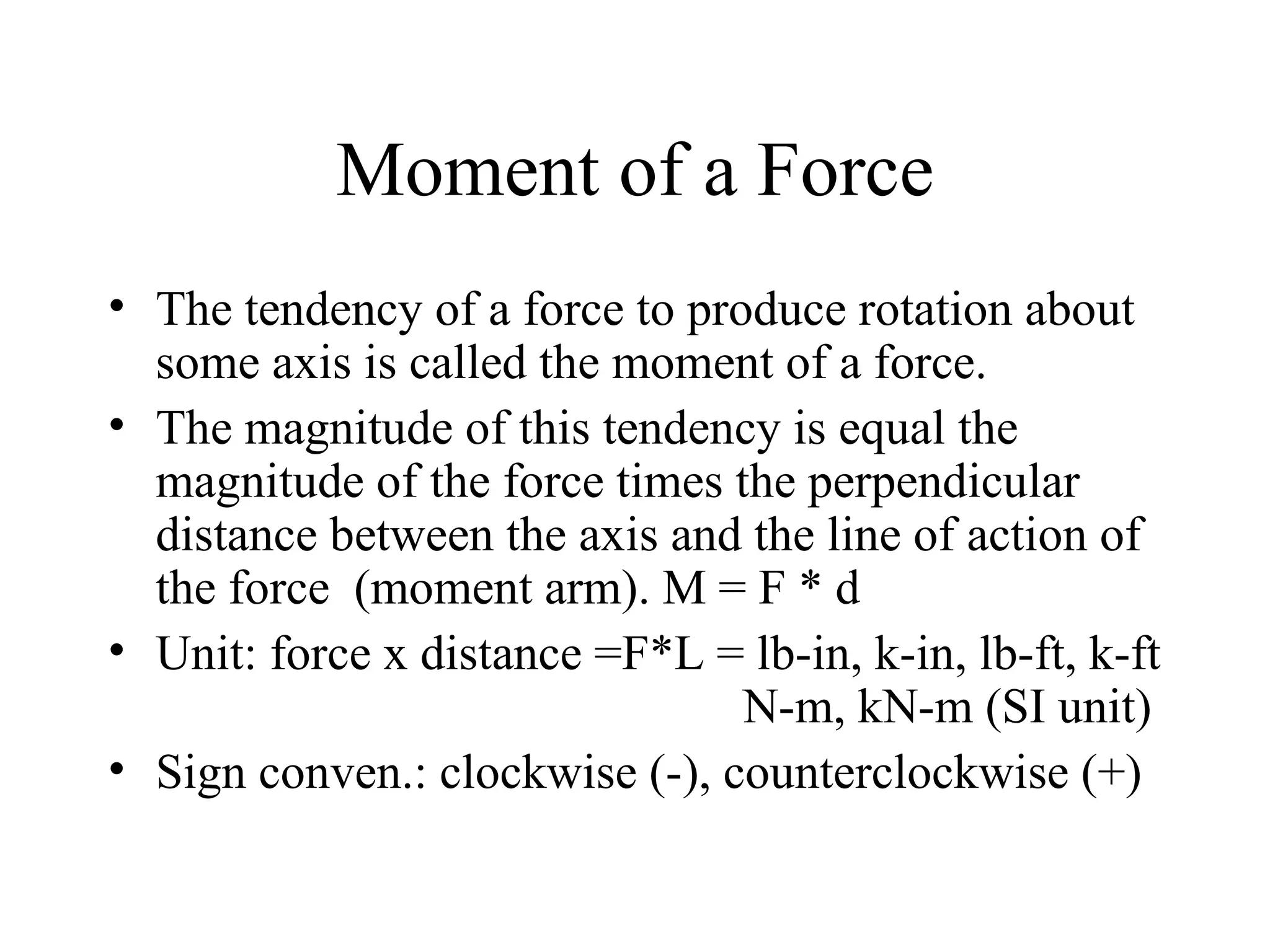
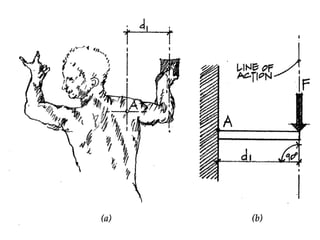
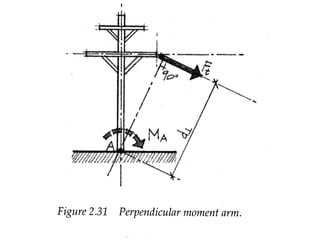
• The tendency of a force to produce rotation about
  some axis is called the moment of a force.
• The magnitude of this tendency is equal the
  magnitude of the force times the perpendicular
  distance between the axis and the line of action of
  the force (moment arm). M = F * d
• Unit: force x distance =F*L = lb-in, k-in, lb-ft, k-ft
                                N-m, kN-m (SI unit)
• Sign conven.: clockwise (-), counterclockwise (+)
Varignon’s Theorem or the
      Principle of Moments
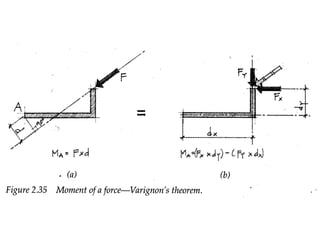
• The algebraic summation of of the
  components of a force with respect to any
  point is equal to the moment of the original
  force.
Couples
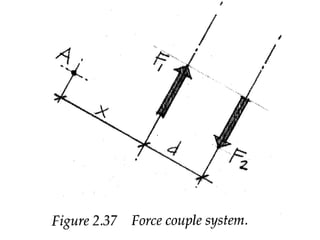
• Two parallel forces having different lines of
  action, equal in magnitude, but opposite in sense
  constitute a couple.
• A couple causes rotation about an axis
  perpendicular to its plane. M = F * d
   – The moment of a couple is independent of the choice of
     the axis of moment (moment center)
   – A couple cannot be replaced with a single equivalent
     resultant force
   – A couple may be transferred to any location in its plane
     and still have the same effect
Resolution of a force into a force
  and couple acting at another
              point
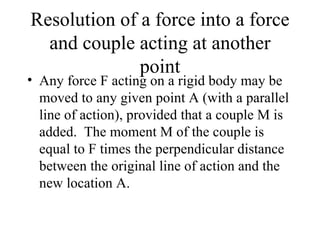
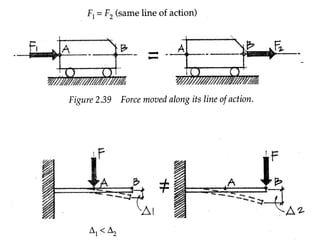
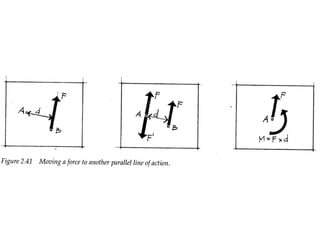
• Any force F acting on a rigid body may be
  moved to any given point A (with a parallel
  line of action), provided that a couple M is
  added. The moment M of the couple is
  equal to F times the perpendicular distance
  between the original line of action and the
  new location A.
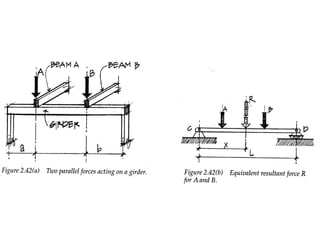
Resultant of two parallel forces
• The magnitude of the resultant R of the
  parallel forces A and B equals the algebraic
  summation of A and B, where R = A + B.
• Location of the resultant R is obtained by
  the principle of moments.
Equilibrium Equations
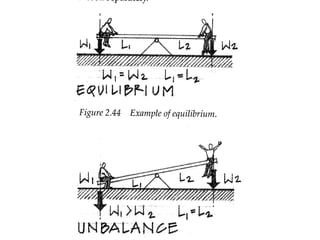
• Equilibrium: with zero motion, both the body and
  the entire system of external forces and moments
  acting on the body are in equilibrium.
• Conditions of equilibrium: the resultant of a force
  system must be zero if the force system is to be in
  equilibrium:
   – The algebraic sum of all forces (or components of
     forces) along any axis must be equal to zero (Σ F = 0)
   – The algebraic sum of the moments of the forces about
     any axis or point must be equal to zero (Σ M = 0)
   – In two dimensional case Σ Fx = 0, Σ Fy = 0, Σ M = 0
Equilibrium of Force System
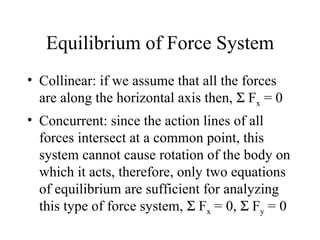
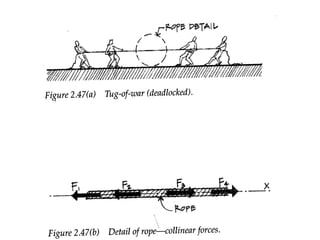
• Collinear: if we assume that all the forces
  are along the horizontal axis then, Σ Fx = 0
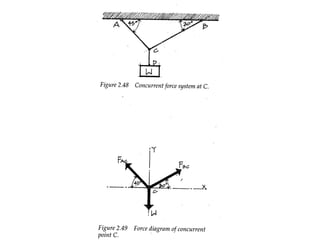
• Concurrent: since the action lines of all
  forces intersect at a common point, this
  system cannot cause rotation of the body on
  which it acts, therefore, only two equations
  of equilibrium are sufficient for analyzing
  this type of force system, Σ Fx = 0, Σ Fy = 0
Equilibrium of Force System
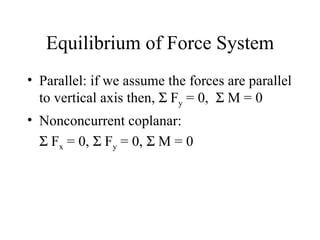
• Parallel: if we assume the forces are parallel
  to vertical axis then, Σ Fy = 0, Σ M = 0
• Nonconcurrent coplanar:
  Σ Fx = 0, Σ Fy = 0, Σ M = 0
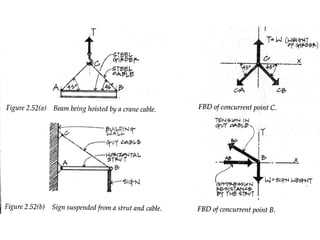
The Free Body Diagram (FBD)
• To isolate a body and identify the force system
  acting on the body so that unknown forces can be
  determined is known as the FBD.
• The external forces acting on the free body may be
  direct forces due to contact between the free body
  and other bodies external to it or indirect forces,
  such as gravitational or magnetic forces, which act
  without bodily contact.
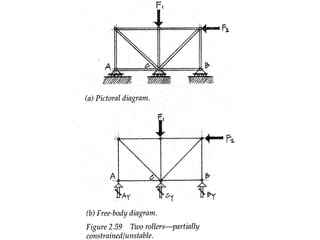
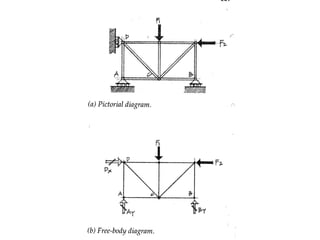
Statistical Indeterminacy and
       Improper Constraints
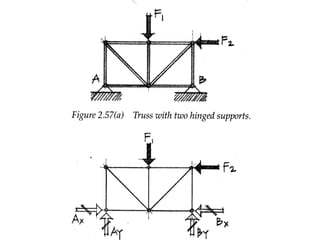
• When the number of unknown forces exceeds the
  number of equations of equilibrium, the rigid body
  is said to be statically indeterminate.
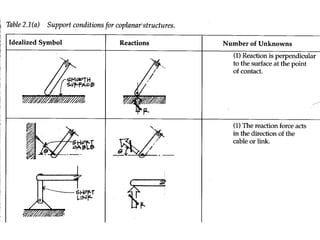
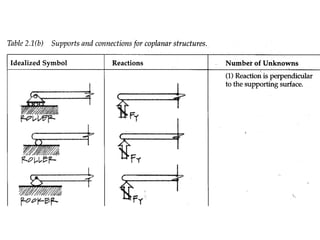
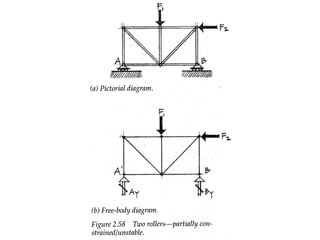
• When the support forces are sufficient to resist
  translation in both the x and y directions as well as
  rotational tendencies about any point, the rigid
  body is said to be completely constrained,
  otherwise the rigid body is unstable or partially
  constrained.
3
3
3
3

3

  • 1.
    Moment of aForce • The tendency of a force to produce rotation about some axis is called the moment of a force. • The magnitude of this tendency is equal the magnitude of the force times the perpendicular distance between the axis and the line of action of the force (moment arm). M = F * d • Unit: force x distance =F*L = lb-in, k-in, lb-ft, k-ft N-m, kN-m (SI unit) • Sign conven.: clockwise (-), counterclockwise (+)
  • 5.
    Varignon’s Theorem orthe Principle of Moments • The algebraic summation of of the components of a force with respect to any point is equal to the moment of the original force.
  • 7.
    Couples • Two parallelforces having different lines of action, equal in magnitude, but opposite in sense constitute a couple. • A couple causes rotation about an axis perpendicular to its plane. M = F * d – The moment of a couple is independent of the choice of the axis of moment (moment center) – A couple cannot be replaced with a single equivalent resultant force – A couple may be transferred to any location in its plane and still have the same effect
  • 9.
    Resolution of aforce into a force and couple acting at another point • Any force F acting on a rigid body may be moved to any given point A (with a parallel line of action), provided that a couple M is added. The moment M of the couple is equal to F times the perpendicular distance between the original line of action and the new location A.
  • 12.
    Resultant of twoparallel forces • The magnitude of the resultant R of the parallel forces A and B equals the algebraic summation of A and B, where R = A + B. • Location of the resultant R is obtained by the principle of moments.
  • 14.
    Equilibrium Equations • Equilibrium:with zero motion, both the body and the entire system of external forces and moments acting on the body are in equilibrium. • Conditions of equilibrium: the resultant of a force system must be zero if the force system is to be in equilibrium: – The algebraic sum of all forces (or components of forces) along any axis must be equal to zero (Σ F = 0) – The algebraic sum of the moments of the forces about any axis or point must be equal to zero (Σ M = 0) – In two dimensional case Σ Fx = 0, Σ Fy = 0, Σ M = 0
  • 16.
    Equilibrium of ForceSystem • Collinear: if we assume that all the forces are along the horizontal axis then, Σ Fx = 0 • Concurrent: since the action lines of all forces intersect at a common point, this system cannot cause rotation of the body on which it acts, therefore, only two equations of equilibrium are sufficient for analyzing this type of force system, Σ Fx = 0, Σ Fy = 0
  • 19.
    Equilibrium of ForceSystem • Parallel: if we assume the forces are parallel to vertical axis then, Σ Fy = 0, Σ M = 0 • Nonconcurrent coplanar: Σ Fx = 0, Σ Fy = 0, Σ M = 0
  • 20.
    The Free BodyDiagram (FBD) • To isolate a body and identify the force system acting on the body so that unknown forces can be determined is known as the FBD. • The external forces acting on the free body may be direct forces due to contact between the free body and other bodies external to it or indirect forces, such as gravitational or magnetic forces, which act without bodily contact.
  • 29.
    Statistical Indeterminacy and Improper Constraints • When the number of unknown forces exceeds the number of equations of equilibrium, the rigid body is said to be statically indeterminate. • When the support forces are sufficient to resist translation in both the x and y directions as well as rotational tendencies about any point, the rigid body is said to be completely constrained, otherwise the rigid body is unstable or partially constrained.