Chapter 10: Database Design
Objectives Become familiar with several object-persistence formats. Be able to map problem domain objects to different object-persistence formats. Be able to apply the steps of normalization to a relational database. Be able to optimize a relational database for object storage and access. Become familiar with indexes for relational databases. Be able to estimate the size of a relational database. Be able to design the data access and manipulation classes.
The Data Management Layer Includes both  data access and manipulation logic, and the actual design of the storage Four-step design approach Selecting the format of the storage Mapping problem-domain objects to object-persistence format optimizing the object-persistence format designing the data access & manipulation classes
OBJECT PERSISTENCE FORMATS
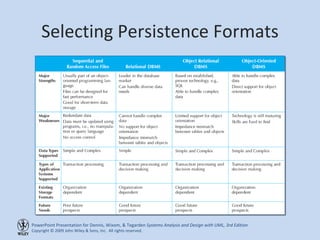
Object Persistence Formats Files (Sequential and Random) Relational databases Object-relational databases  Object-oriented databases
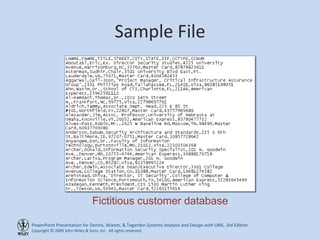
Sample File Fictitious customer database
Sequential & Random Access Files Sequential access files allow sequential operations Read, write, and search Efficient for report writing Searches are not efficient because an average of 50% of records have to be accessed Two versions Ordered unordered
Random Access Files Allow only random or direct file operations Good for finding and updating a specific object Inefficient report writing
Application File Types Master Files Look-up files Transaction files Audit file History file
Relational Databases Collection of tables Comprised of fields that define entities Primary key has unique values in each row of a table Foreign key is primary key of another table Tables related to each other Primary key field of a table is a field of another table and called a foreign key Relationship established by a foreign key of one table connecting to the primary key of another table
Database Management System Software that creates and manipulates a database RDBMS is a DBMS for a relational database RDBMS usually support  Referential Integrity the idea of ensuring that values linking the tables together through the primary and foreign keys are valid and correctly synchronized
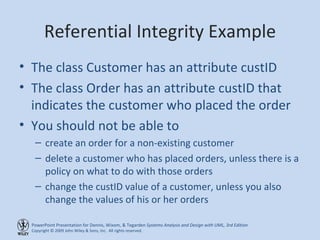
Referential Integrity Example The class Customer has an attribute custID The class Order has an attribute custID that indicates the customer who placed the order You should not be able to  create an order for a non-existing customer delete a customer who has placed orders, unless there is a policy on what to do with those orders change the custID value of a customer, unless you also change the values of his or her orders
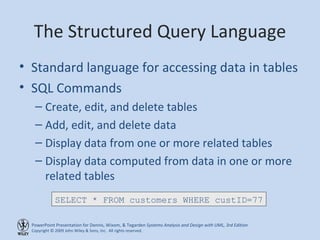
The Structured Query Language Standard language for accessing data in tables SQL Commands Create, edit, and delete tables Add, edit, and delete data Display data from one or more related tables Display data computed from data in one or more related tables SELECT * FROM customers WHERE custID=77
Selecting Persistence Formats
MAPPING PROBLEM-DOMAIN OBJECTS TO OBJECT-PERSISTENCE FORMATS
Mapping PD Classes to RDBMS Map all concrete problem domain classes to the RDBMS tables.  Map single valued attributes to columns of the tables. Map methods to stored procedures or to program modules. Map single-valued aggregation and association relationships to a column that can store the key of the related table Map multi-valued attributes and repeating groups to new tables and create a one-to-many association from the original table to the new ones.
Mapping PD Classes to RDBMS Map multi-valued aggregation and association relationships to a new associative table that relates the two original tables together. Copy the primary key from both original tables to the new associative table For aggregation and association relationships of mixed type, copy the primary key from the single-valued side (1..1 or 0..1) of the relationship to a new column in the table on the multi-valued side (1..* or 0..*) of the relationship that can store the key of the related table Ensure that the primary key of the subclass instance is the same as the primary key of the superclass..
OPTIMIZING RDBMS-BASED OBJECT STORAGE
Optimizing Storage Efficiency No redundant data Wastes space Allows more room for error Few null values in tables Difficult to interpret
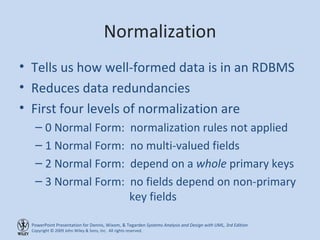
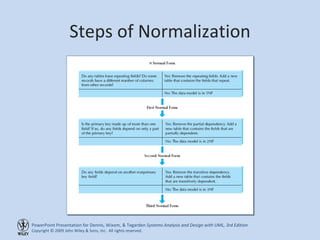
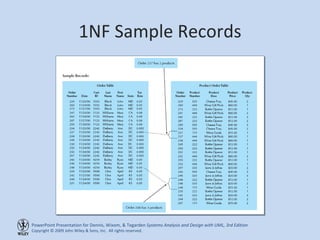
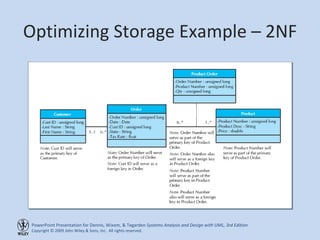
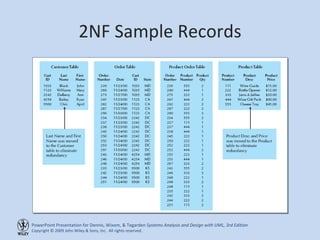
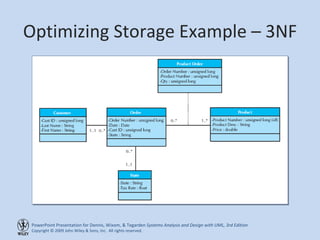
Normalization Tells us how well-formed data is in an RDBMS Reduces data redundancies First four levels of normalization are 0 Normal Form:  normalization rules not applied 1 Normal Form:  no multi-valued fields 2 Normal Form:  depend on a  whole  primary keys 3 Normal Form:  no fields depend on non-primary    key fields
Steps of Normalization
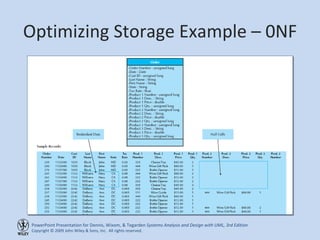
Optimizing Storage Example – 0NF
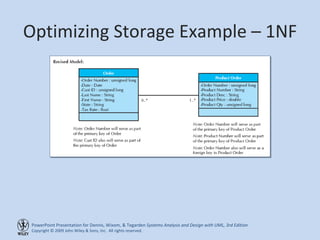
Optimizing Storage Example – 1NF
1NF Sample Records
Optimizing Storage Example – 2NF
2NF Sample Records
Optimizing Storage Example – 3NF
NONFUNCTIONAL REQUIREMENTS AND DATA MANAGEMENT LAYER DESIGN
Non-Functional Requirements Operational Requirements DAM layer technologies that must be used Performance Requirements DAM layer speed and capacity Security Requirements Access controls, encryption, and backup Political & Cultural Requirements Date formats, currency conversions
DESIGNING DATA ACCESS AND MANIPULATION CLASSES
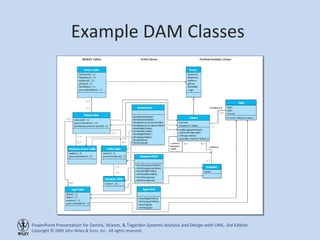
Data Access & Manipulation Data access & manipulation (DAM) classes act as a translator between the object-persistence and the problem domain objects There should be one DAM class for each concrete problem domain class
Example DAM Classes
Summary Object Persistence Formats Mapping Problem-Domain Objects to Object-Persistence Formats Optimizing RDBMS-Based Object Storage Nonfunctional Requirements and Data Management Layer Design Designing Data Access and Manipulation Classes

Ch10

  • 1.
  • 2.
    Objectives Become familiarwith several object-persistence formats. Be able to map problem domain objects to different object-persistence formats. Be able to apply the steps of normalization to a relational database. Be able to optimize a relational database for object storage and access. Become familiar with indexes for relational databases. Be able to estimate the size of a relational database. Be able to design the data access and manipulation classes.
  • 3.
    The Data ManagementLayer Includes both data access and manipulation logic, and the actual design of the storage Four-step design approach Selecting the format of the storage Mapping problem-domain objects to object-persistence format optimizing the object-persistence format designing the data access & manipulation classes
  • 4.
  • 5.
    Object Persistence FormatsFiles (Sequential and Random) Relational databases Object-relational databases Object-oriented databases
  • 6.
    Sample File Fictitiouscustomer database
  • 7.
    Sequential & RandomAccess Files Sequential access files allow sequential operations Read, write, and search Efficient for report writing Searches are not efficient because an average of 50% of records have to be accessed Two versions Ordered unordered
  • 8.
    Random Access FilesAllow only random or direct file operations Good for finding and updating a specific object Inefficient report writing
  • 9.
    Application File TypesMaster Files Look-up files Transaction files Audit file History file
  • 10.
    Relational Databases Collectionof tables Comprised of fields that define entities Primary key has unique values in each row of a table Foreign key is primary key of another table Tables related to each other Primary key field of a table is a field of another table and called a foreign key Relationship established by a foreign key of one table connecting to the primary key of another table
  • 11.
    Database Management SystemSoftware that creates and manipulates a database RDBMS is a DBMS for a relational database RDBMS usually support Referential Integrity the idea of ensuring that values linking the tables together through the primary and foreign keys are valid and correctly synchronized
  • 12.
    Referential Integrity ExampleThe class Customer has an attribute custID The class Order has an attribute custID that indicates the customer who placed the order You should not be able to create an order for a non-existing customer delete a customer who has placed orders, unless there is a policy on what to do with those orders change the custID value of a customer, unless you also change the values of his or her orders
  • 13.
    The Structured QueryLanguage Standard language for accessing data in tables SQL Commands Create, edit, and delete tables Add, edit, and delete data Display data from one or more related tables Display data computed from data in one or more related tables SELECT * FROM customers WHERE custID=77
  • 14.
  • 15.
    MAPPING PROBLEM-DOMAIN OBJECTSTO OBJECT-PERSISTENCE FORMATS
  • 16.
    Mapping PD Classesto RDBMS Map all concrete problem domain classes to the RDBMS tables. Map single valued attributes to columns of the tables. Map methods to stored procedures or to program modules. Map single-valued aggregation and association relationships to a column that can store the key of the related table Map multi-valued attributes and repeating groups to new tables and create a one-to-many association from the original table to the new ones.
  • 17.
    Mapping PD Classesto RDBMS Map multi-valued aggregation and association relationships to a new associative table that relates the two original tables together. Copy the primary key from both original tables to the new associative table For aggregation and association relationships of mixed type, copy the primary key from the single-valued side (1..1 or 0..1) of the relationship to a new column in the table on the multi-valued side (1..* or 0..*) of the relationship that can store the key of the related table Ensure that the primary key of the subclass instance is the same as the primary key of the superclass..
  • 18.
  • 19.
    Optimizing Storage EfficiencyNo redundant data Wastes space Allows more room for error Few null values in tables Difficult to interpret
  • 20.
    Normalization Tells ushow well-formed data is in an RDBMS Reduces data redundancies First four levels of normalization are 0 Normal Form: normalization rules not applied 1 Normal Form: no multi-valued fields 2 Normal Form: depend on a whole primary keys 3 Normal Form: no fields depend on non-primary key fields
  • 21.
  • 22.
  • 23.
  • 24.
  • 25.
  • 26.
  • 27.
  • 28.
    NONFUNCTIONAL REQUIREMENTS ANDDATA MANAGEMENT LAYER DESIGN
  • 29.
    Non-Functional Requirements OperationalRequirements DAM layer technologies that must be used Performance Requirements DAM layer speed and capacity Security Requirements Access controls, encryption, and backup Political & Cultural Requirements Date formats, currency conversions
  • 30.
    DESIGNING DATA ACCESSAND MANIPULATION CLASSES
  • 31.
    Data Access &Manipulation Data access & manipulation (DAM) classes act as a translator between the object-persistence and the problem domain objects There should be one DAM class for each concrete problem domain class
  • 32.
  • 33.
    Summary Object PersistenceFormats Mapping Problem-Domain Objects to Object-Persistence Formats Optimizing RDBMS-Based Object Storage Nonfunctional Requirements and Data Management Layer Design Designing Data Access and Manipulation Classes