Ch.1 Challenges and Opportunities
in Listening Instruction
Presentation: Chaewon Lim
Listening Comprehension
 It is generally recognized that both bottom-up and top-down
strategies are necessary.
The bottom-up processing
a process of decoding the sounds that one hears in a linear
fashion
The top-down processing
a reconstruction process; the listener actively constructs the
original meaning of the speaker using incoming sounds as
clues
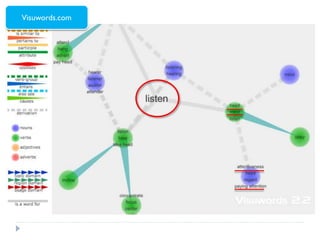
Visuwords.com
Challenges and Dilemmas
In L2 listening Instruction
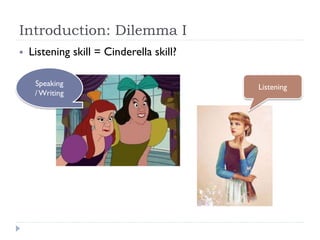
Introduction: Dilemma I
 Listening skill = Cinderella skill?
Speaking
/ Writing
Listening
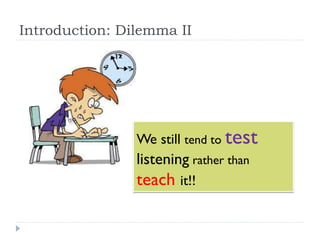
Introduction: Dilemma II
We still tend to test
listening rather than
teach it!!
The key to solving the problem
 Metacognition: the act of thinking about thinking; the
ability of learners’ controlling their thoughts and
regulating their own learning
 Learners are seldom taught how to listen, how to manage
the listening input.
Pre-listening
- More than Background knowledge!
- Learners are just “primed” to listen to a specific piece of text
While-listening
- No guidance on strategic listening
Listening instruction: overview
 Text-oriented instruction (Dilemma I & II)
Recognizing and understanding different components of a
listening input
 Communication-oriented instruction (Dilemma I & II)
Listening in the service of something other than itself
 Learner-oriented instruction (Solution)
Developing learners’ awareness of the process
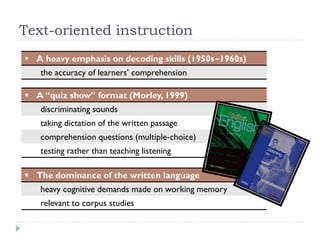
Text-oriented instruction
 A heavy emphasis on decoding skills (1950s~1960s)
the accuracy of learners’ comprehension
 A “quiz show” format (Morley, 1999)
discriminating sounds
taking dictation of the written passage
comprehension questions (multiple-choice)
testing rather than teaching listening
 The dominance of the written language
heavy cognitive demands made on working memory
relevant to corpus studies
Communication-oriented instruction
 Complex communicative skills
Taxonomies of listening skills
Munby’s (1978) communicative syllabus design
Richards’ (1983) taxonomy
Authentic listening materials
A variety of classroom interaction/ learner
response
 “Sleeping partner” in CLT methodology
emphasis on the speaking component
information gap activity
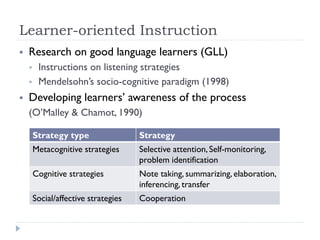
Learner-oriented Instruction
 Research on good language learners (GLL)
 Instructions on listening strategies
 Mendelsohn’s socio-cognitive paradigm (1998)
 Developing learners’ awareness of the process
(O’Malley & Chamot, 1990)
Strategy type Strategy
Metacognitive strategies Selective attention, Self-monitoring,
problem identification
Cognitive strategies Note taking, summarizing, elaboration,
inferencing, transfer
Social/affective strategies Cooperation
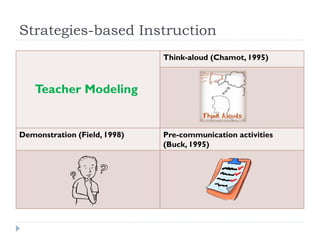
Strategies-based Instruction
Teacher Modeling
Think-aloud (Chamot, 1995)
Demonstration (Field, 1998) Pre-communication activities
(Buck, 1995)
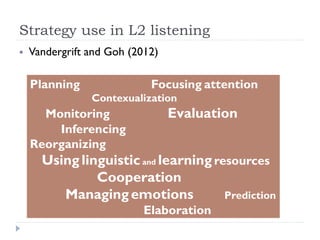
Strategy use in L2 listening
 Vandergrift and Goh (2012)
Planning Focusing attention
Contexualization
Monitoring Evaluation
Inferencing
Reorganizing
Using linguisticand learningresources
Cooperation
Managingemotions Prediction
Elaboration
Challenges in the three instructions
 Text-oriented instruction
Current course textbooks which requires learners’
comprehension-based techniques alone (a “quiz show”
mode)
 Communication-oriented instruction
A focus on the product of listening
A disguised form of testing (Sheerin, 1987)
 Learner-oriented instruction
Intangible!
A lack in a variety of structural support
Conclusion
 The intrinsic challenges within the three types of listening
instruction can be addressed by teaching within a
metacognitive framework.
 No testing any more!!
 Better learners? Or More effective learners?
Ch.1 challenges and opportunities

Ch.1 challenges and opportunities

  • 1.
    Ch.1 Challenges andOpportunities in Listening Instruction Presentation: Chaewon Lim
  • 2.
    Listening Comprehension  Itis generally recognized that both bottom-up and top-down strategies are necessary. The bottom-up processing a process of decoding the sounds that one hears in a linear fashion The top-down processing a reconstruction process; the listener actively constructs the original meaning of the speaker using incoming sounds as clues
  • 3.
  • 4.
    Challenges and Dilemmas InL2 listening Instruction
  • 5.
    Introduction: Dilemma I Listening skill = Cinderella skill? Speaking / Writing Listening
  • 6.
    Introduction: Dilemma II Westill tend to test listening rather than teach it!!
  • 7.
    The key tosolving the problem  Metacognition: the act of thinking about thinking; the ability of learners’ controlling their thoughts and regulating their own learning  Learners are seldom taught how to listen, how to manage the listening input. Pre-listening - More than Background knowledge! - Learners are just “primed” to listen to a specific piece of text While-listening - No guidance on strategic listening
  • 8.
    Listening instruction: overview Text-oriented instruction (Dilemma I & II) Recognizing and understanding different components of a listening input  Communication-oriented instruction (Dilemma I & II) Listening in the service of something other than itself  Learner-oriented instruction (Solution) Developing learners’ awareness of the process
  • 9.
    Text-oriented instruction  Aheavy emphasis on decoding skills (1950s~1960s) the accuracy of learners’ comprehension  A “quiz show” format (Morley, 1999) discriminating sounds taking dictation of the written passage comprehension questions (multiple-choice) testing rather than teaching listening  The dominance of the written language heavy cognitive demands made on working memory relevant to corpus studies
  • 10.
    Communication-oriented instruction  Complexcommunicative skills Taxonomies of listening skills Munby’s (1978) communicative syllabus design Richards’ (1983) taxonomy Authentic listening materials A variety of classroom interaction/ learner response  “Sleeping partner” in CLT methodology emphasis on the speaking component information gap activity
  • 11.
    Learner-oriented Instruction  Researchon good language learners (GLL)  Instructions on listening strategies  Mendelsohn’s socio-cognitive paradigm (1998)  Developing learners’ awareness of the process (O’Malley & Chamot, 1990) Strategy type Strategy Metacognitive strategies Selective attention, Self-monitoring, problem identification Cognitive strategies Note taking, summarizing, elaboration, inferencing, transfer Social/affective strategies Cooperation
  • 12.
    Strategies-based Instruction Teacher Modeling Think-aloud(Chamot, 1995) Demonstration (Field, 1998) Pre-communication activities (Buck, 1995)
  • 13.
    Strategy use inL2 listening  Vandergrift and Goh (2012) Planning Focusing attention Contexualization Monitoring Evaluation Inferencing Reorganizing Using linguisticand learningresources Cooperation Managingemotions Prediction Elaboration
  • 14.
    Challenges in thethree instructions  Text-oriented instruction Current course textbooks which requires learners’ comprehension-based techniques alone (a “quiz show” mode)  Communication-oriented instruction A focus on the product of listening A disguised form of testing (Sheerin, 1987)  Learner-oriented instruction Intangible! A lack in a variety of structural support
  • 15.
    Conclusion  The intrinsicchallenges within the three types of listening instruction can be addressed by teaching within a metacognitive framework.  No testing any more!!  Better learners? Or More effective learners?