Listening Comprehension
        Assessment

• By Professor Michelle Commeyras
• University of Georgia
• commeyra@uga.edu
Listening
Comprehension
                    Listening comprehension may

                    involve looking at what is being

                    read. Think of a classroom scene

Listening           where every student has a copy of

comprehension is    the text and is instructed to

the ability to      follow along while the teacher or a

understand and      student reads out loud. Now think

think about         of an out of school situation such

something that is   as listening to an audio book.

read to you.        Usually the listener is not also

                    looking at the print version of the

                    book.
Knowing a child’s listening comprehension
  level can be useful in discerning
  whether comprehension difficulties are
  due to decoding.

For example, if the listening level of a
  fourth grade student is good on a fourth
  grade text but that child has difficulty
  with comprehension when reading then
  there is probably a need for instruction
  on decoding and word identification.
• According to McKenna and Stahl (2009)“The
  listening level is conventionally defined as the
  highest passage at which comprehension of the
  passage read aloud to the child is at least 75%”
  (p. 63).
   – It is difficult to determine what comprehending
     something at the 75% level means. One difficulty is
     that the child must either speak or write to show
     his or her comprehension. Speaking and writing
     are different language systems from listening.
     “Research shows that listening, speaking, reading,
     and writing emerge in overlapping, cascading
     waves rather than in strict sequential phases and
     develop in interacting fashion throughout early and
     middle childhood (Berninger & Abbott, 2010, p.
     636).
• Conduct a listening comprehension
  assessment with a text at the child’s
  current school grade level.
   – It is less intimidating to be asked to listen to someone
     else read and retell what you understood then to be
     asked to read and retell.
   – This is one reason to do a listening comprehension
     assessment before a reading comprehension
     assessment.
What level text should be used for this listening
           comprehension assessment?

• For many children it is helpful to select something that is
  considered at their grade level. It can be a narrative or an
  expository text.
    – For children in grades three and up it is informative to select a text similar
      to their science or social studies book or other content area reading
      materials. Why? Because listening to others read is something teachers
      do to accommodate children who are behind the average readers in the
      class.
    – The question the tutor is exploring what the child’s level of
      comprehension is when listening to grade level texts.
    – If the child demonstrates understanding of the material then there is
      support for the hypothesis that comprehension is not the child’s main
      difficulty as a reader.
    – If the child does not demonstrate understanding then listening
      comprehension becomes something to work on during tutoring sessions.
Making a Listening Comprehension Assessment

•   1. What grade level is the child in at school? You need to know whom
    you are going to be assessing and what their current grade level is. Let us
    imagine that I am planning on assessing a boy who is in second grade.

•   2. What text will be used? The text you use depends on what it is that
    you want to learn about the child’s reading. We are all going to meeting
    the children we are tutoring for the first time. With listening
    comprehension it will be what the child comprehends when they are read
    something that is considered to be at their grade level.
•   I have picked out three books about animals because I know that this boy
    likes everything to do with animals.

     – Hungry, Hungry Sharks by Joanna Cole
     – In the Animal World by Silver Burdett
     – Gorillas by Patricia Demuth
•   All three are books with word and pictures. I will read each one to
    decide which one might be best for the listening comprehension
    assessment.
•   After reading I concluded that they are all appropriate. There are
    chapters in one book whereas the other two books are not divided into
    chapters.
•   If I want to limit the time for listening assessment then I should use “In
    the Animal World” and pick one of the chapters which are about the fox,
    the raccoon, and the otter.
•   Although the pictures are in black and white and that might not be as
    engaging for some children.
•   My intention is to pick something that will be of enough interest that the
    child will try to understand it.
•   Interest is one of the factors that affect comprehension.
•    If I chose one of the other books I would limit the listening
    comprehension assessment procedures to a subset of 100 – 200 words
    from the book.
•   The subset of words should seem somewhat complete. Think about
    whether you could just read that section of the book and still be able to
    comprehend the content.
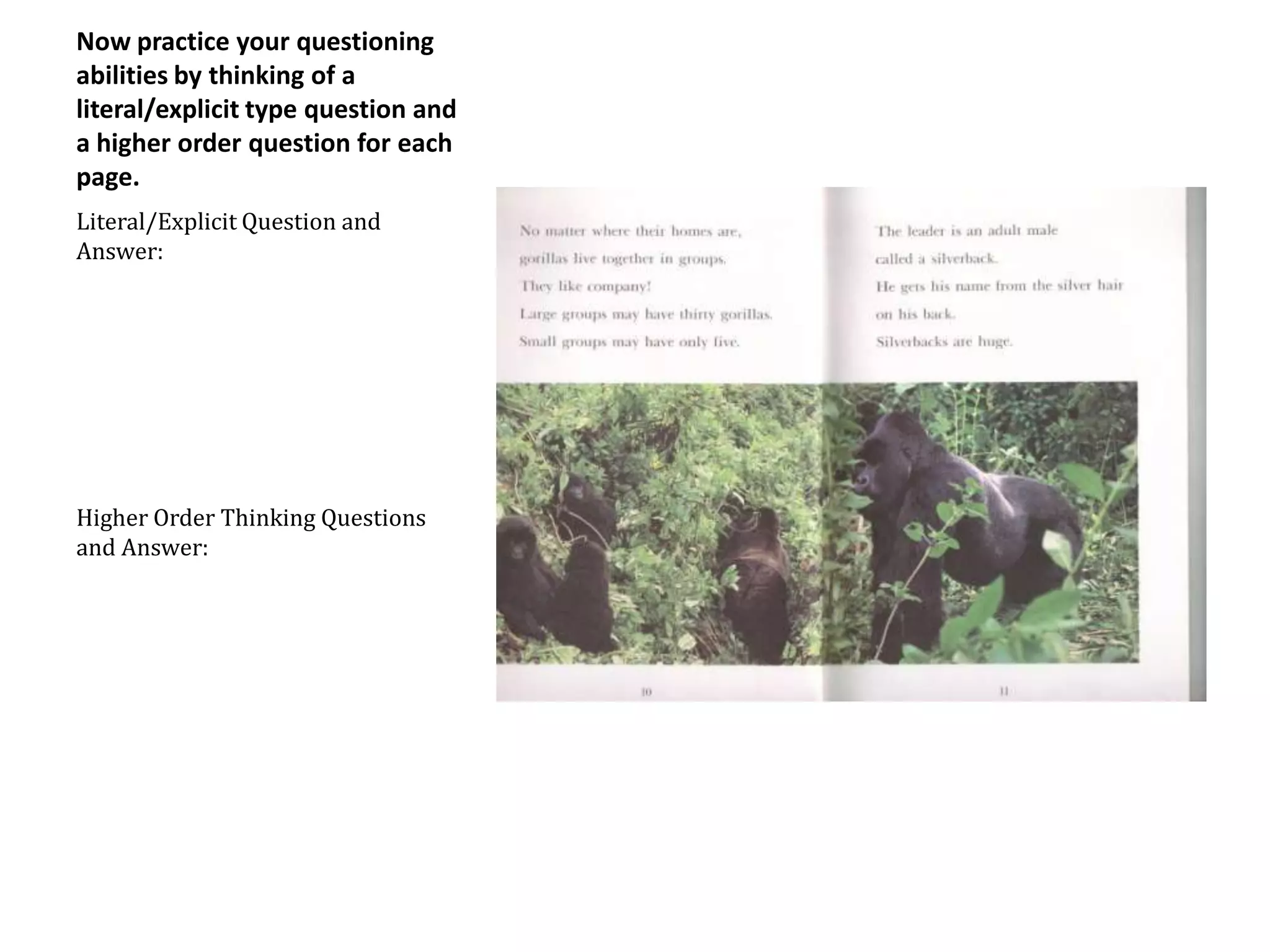
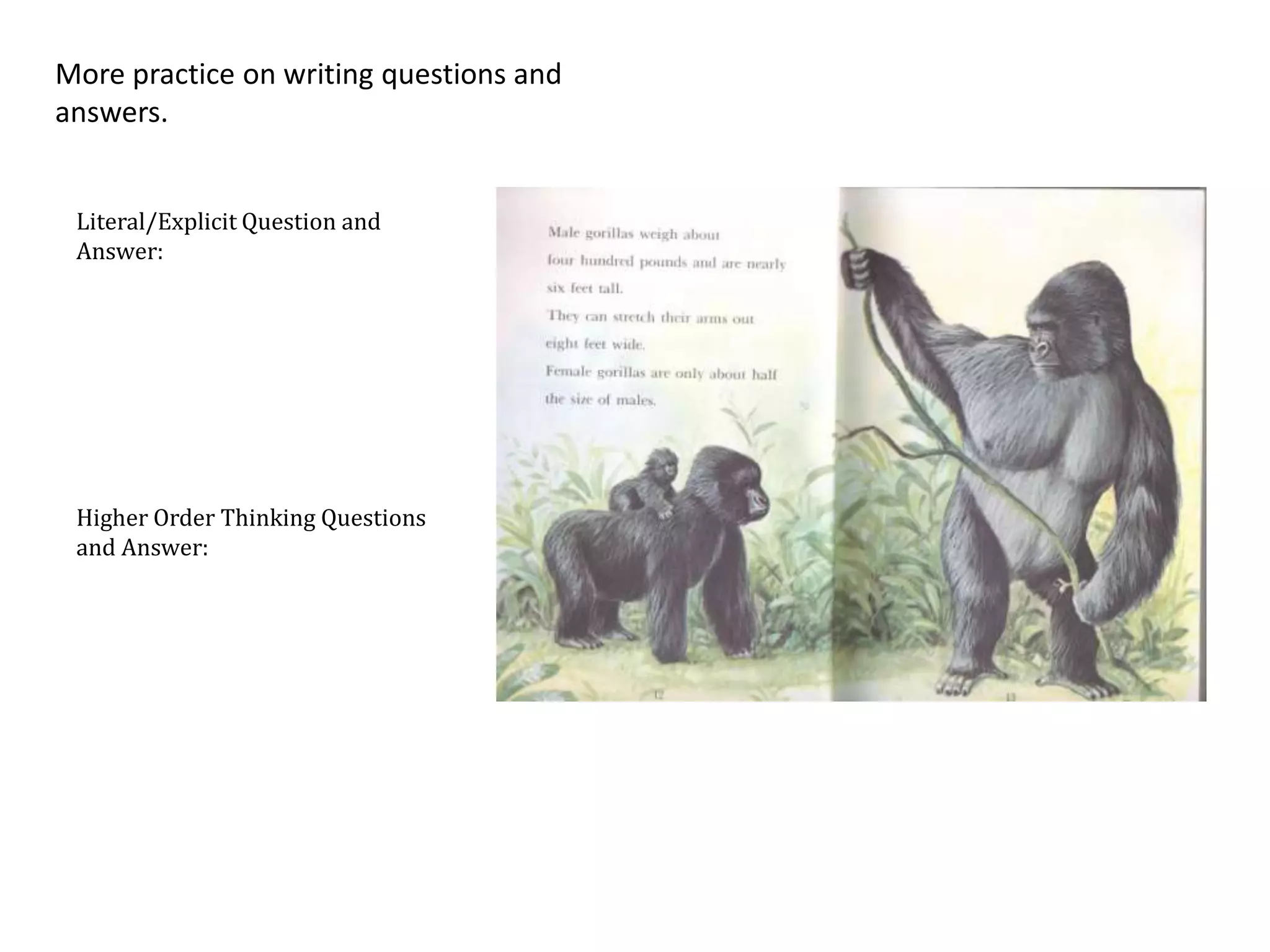
Selected pages 8 - 13
Examples of Questions and Answers for Three Types of Questions.

•Literal/Explicit Question and Answer:
     What do you call the leader?
     [An adult male called a silverback.]
     Who likes company?
     [Gorillas]

•Higher Order Thinking Questions
and Answer:
     Why do gorillas live in groups ?
     [They like being with each other.]
     What did you learn about gorillas
     living in groups?
     [Some live in small groups and
     others live in large groups. The
     leader is an adult male with silver
     hair.]

Vocabulary Question:
     What does the word “company”
     mean in the sentence “They like
     company?”
     [They like to be together.]
Now practice your questioning
abilities by thinking of a
literal/explicit type question and
a higher order question for each
page.
Literal/Explicit Question and
Answer:


Higher Order Thinking Questions
and Answer:
More practice on writing questions and
answers.


 Literal/Explicit Question and
 Answer:


 Higher Order Thinking Questions
 and Answer:
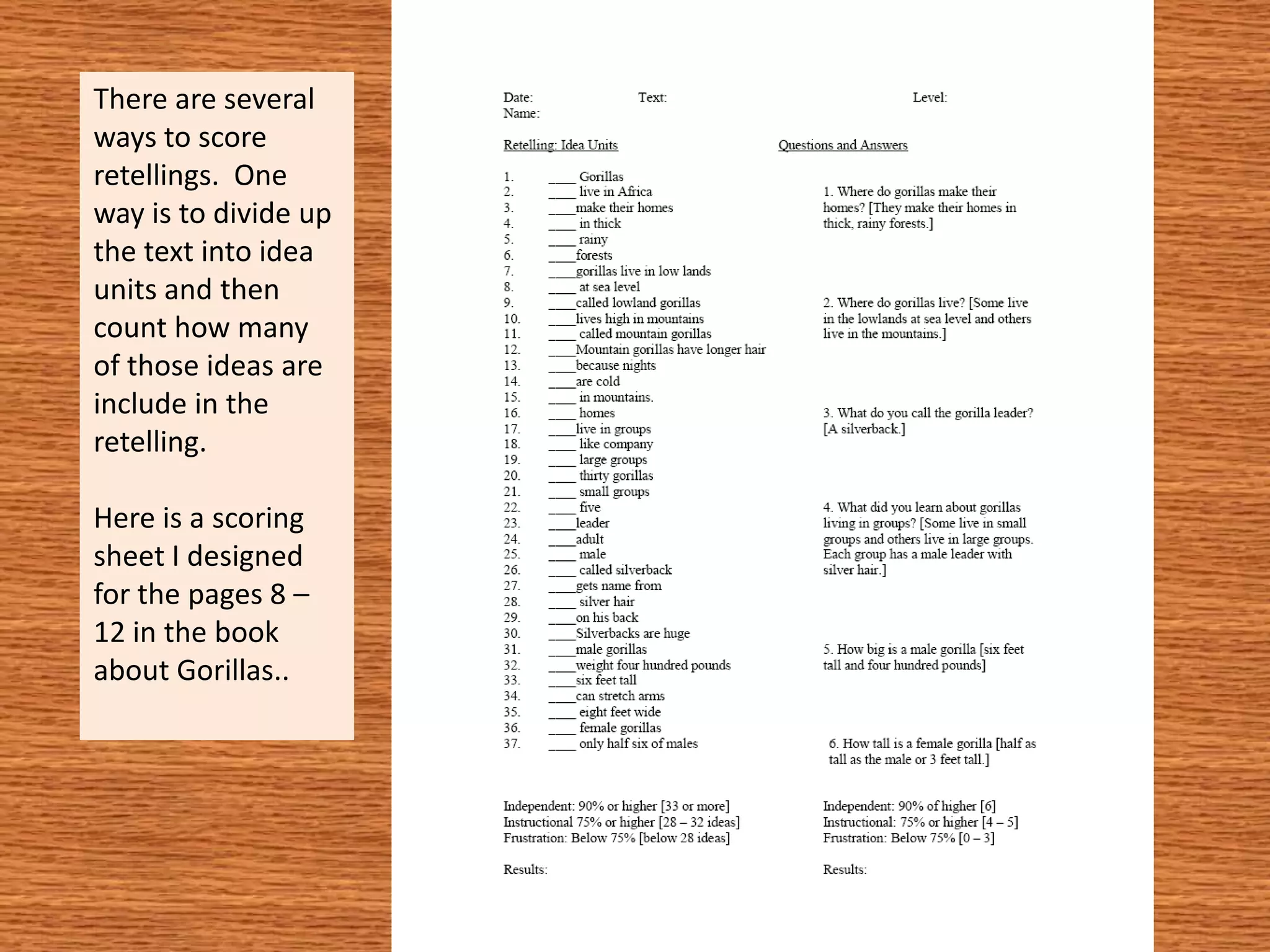
There are several
ways to score
retellings. One
way is to divide up
the text into idea
units and then
count how many
of those ideas are
include in the
retelling.

Here is a scoring
sheet I designed
for the pages 8 –
12 in the book
about Gorillas..

Listening comprehension assessment how to make

  • 1.
    Listening Comprehension Assessment • By Professor Michelle Commeyras • University of Georgia • commeyra@uga.edu
  • 2.
    Listening Comprehension Listening comprehension may involve looking at what is being read. Think of a classroom scene Listening where every student has a copy of comprehension is the text and is instructed to the ability to follow along while the teacher or a understand and student reads out loud. Now think think about of an out of school situation such something that is as listening to an audio book. read to you. Usually the listener is not also looking at the print version of the book.
  • 3.
    Knowing a child’slistening comprehension level can be useful in discerning whether comprehension difficulties are due to decoding. For example, if the listening level of a fourth grade student is good on a fourth grade text but that child has difficulty with comprehension when reading then there is probably a need for instruction on decoding and word identification.
  • 4.
    • According toMcKenna and Stahl (2009)“The listening level is conventionally defined as the highest passage at which comprehension of the passage read aloud to the child is at least 75%” (p. 63). – It is difficult to determine what comprehending something at the 75% level means. One difficulty is that the child must either speak or write to show his or her comprehension. Speaking and writing are different language systems from listening. “Research shows that listening, speaking, reading, and writing emerge in overlapping, cascading waves rather than in strict sequential phases and develop in interacting fashion throughout early and middle childhood (Berninger & Abbott, 2010, p. 636).
  • 5.
    • Conduct alistening comprehension assessment with a text at the child’s current school grade level. – It is less intimidating to be asked to listen to someone else read and retell what you understood then to be asked to read and retell. – This is one reason to do a listening comprehension assessment before a reading comprehension assessment.
  • 6.
    What level textshould be used for this listening comprehension assessment? • For many children it is helpful to select something that is considered at their grade level. It can be a narrative or an expository text. – For children in grades three and up it is informative to select a text similar to their science or social studies book or other content area reading materials. Why? Because listening to others read is something teachers do to accommodate children who are behind the average readers in the class. – The question the tutor is exploring what the child’s level of comprehension is when listening to grade level texts. – If the child demonstrates understanding of the material then there is support for the hypothesis that comprehension is not the child’s main difficulty as a reader. – If the child does not demonstrate understanding then listening comprehension becomes something to work on during tutoring sessions.
  • 7.
    Making a ListeningComprehension Assessment • 1. What grade level is the child in at school? You need to know whom you are going to be assessing and what their current grade level is. Let us imagine that I am planning on assessing a boy who is in second grade. • 2. What text will be used? The text you use depends on what it is that you want to learn about the child’s reading. We are all going to meeting the children we are tutoring for the first time. With listening comprehension it will be what the child comprehends when they are read something that is considered to be at their grade level. • I have picked out three books about animals because I know that this boy likes everything to do with animals. – Hungry, Hungry Sharks by Joanna Cole – In the Animal World by Silver Burdett – Gorillas by Patricia Demuth
  • 8.
    All three are books with word and pictures. I will read each one to decide which one might be best for the listening comprehension assessment. • After reading I concluded that they are all appropriate. There are chapters in one book whereas the other two books are not divided into chapters. • If I want to limit the time for listening assessment then I should use “In the Animal World” and pick one of the chapters which are about the fox, the raccoon, and the otter. • Although the pictures are in black and white and that might not be as engaging for some children. • My intention is to pick something that will be of enough interest that the child will try to understand it. • Interest is one of the factors that affect comprehension. • If I chose one of the other books I would limit the listening comprehension assessment procedures to a subset of 100 – 200 words from the book. • The subset of words should seem somewhat complete. Think about whether you could just read that section of the book and still be able to comprehend the content.
  • 9.
  • 10.
    Examples of Questionsand Answers for Three Types of Questions. •Literal/Explicit Question and Answer: What do you call the leader? [An adult male called a silverback.] Who likes company? [Gorillas] •Higher Order Thinking Questions and Answer: Why do gorillas live in groups ? [They like being with each other.] What did you learn about gorillas living in groups? [Some live in small groups and others live in large groups. The leader is an adult male with silver hair.] Vocabulary Question: What does the word “company” mean in the sentence “They like company?” [They like to be together.]
  • 11.
    Now practice yourquestioning abilities by thinking of a literal/explicit type question and a higher order question for each page. Literal/Explicit Question and Answer: Higher Order Thinking Questions and Answer:
  • 12.
    More practice onwriting questions and answers. Literal/Explicit Question and Answer: Higher Order Thinking Questions and Answer:
  • 13.
    There are several waysto score retellings. One way is to divide up the text into idea units and then count how many of those ideas are include in the retelling. Here is a scoring sheet I designed for the pages 8 – 12 in the book about Gorillas..