Henric Johnson 1
Chapter 9
Intruders and Viruses
Henric Johnson
Blekinge Institute of Technology, Sweden
http://www.its.bth.se/staff/hjo/
henric.johnson@bth.se
Henric Johnson 2
Outline
• Intruders
– Intrusion Techniques
– Password Protection
– Password Selection Strategies
– Intrusion Detection
• Viruses and Related Threats
– Malicious Programs
– The Nature of Viruses
– Antivirus Approaches
– Advanced Antivirus Techniques
• Recommended Reading and WEB Sites
Henric Johnson 3
Intruders
• Three classes of intruders (hackers
or crackers):
– Masquerader
– Misfeasor
– Clandestine user
Henric Johnson 4
Intrusion Techniques
• System maintain a file that
associates a password with each
authorized user.
• Password file can be protected with:
– One-way encryption
– Access Control
Henric Johnson 5
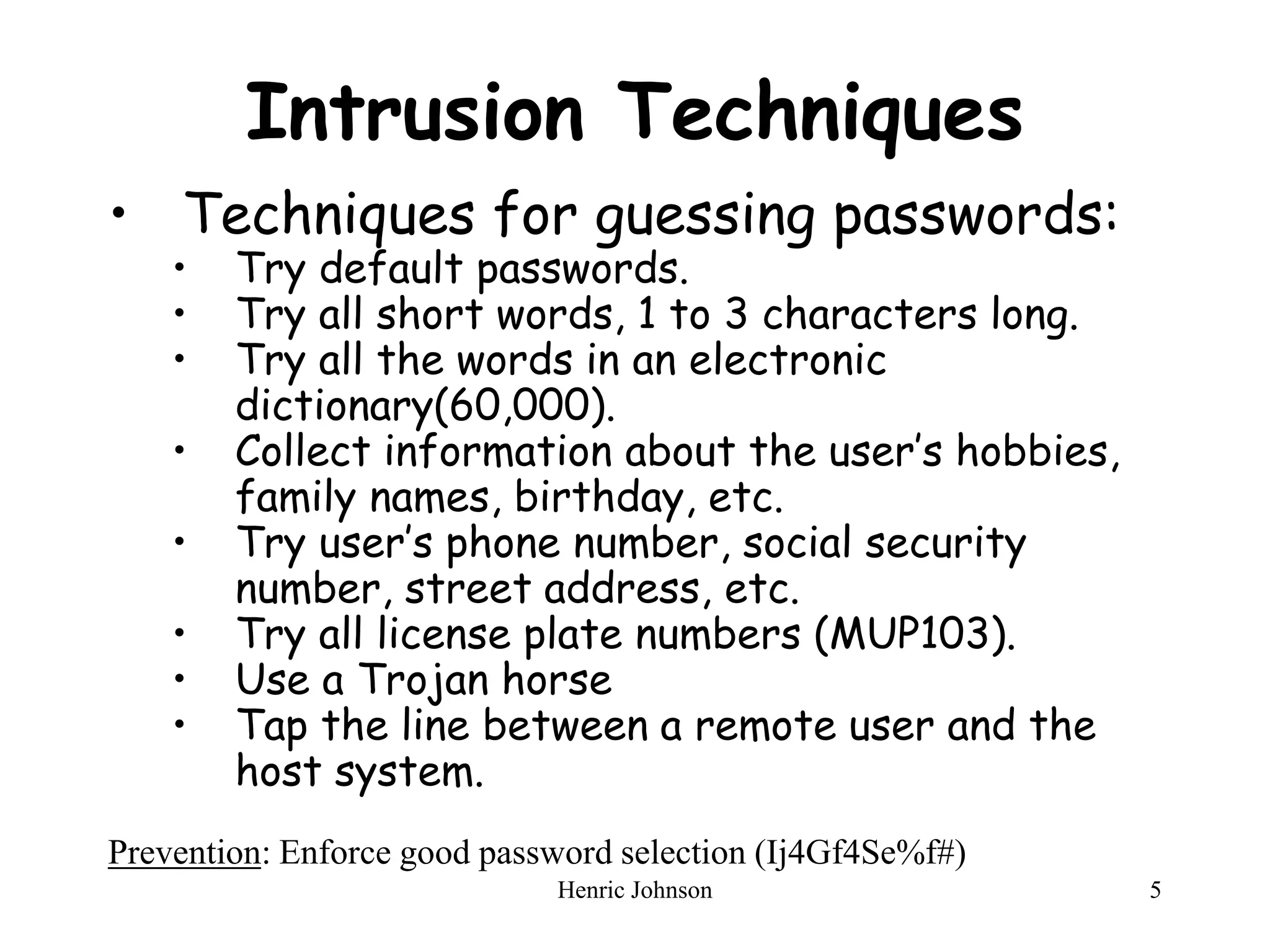
Intrusion Techniques
• Techniques for guessing passwords:
• Try default passwords.
• Try all short words, 1 to 3 characters long.
• Try all the words in an electronic
dictionary(60,000).
• Collect information about the user’s hobbies,
family names, birthday, etc.
• Try user’s phone number, social security
number, street address, etc.
• Try all license plate numbers (MUP103).
• Use a Trojan horse
• Tap the line between a remote user and the
host system.
Prevention: Enforce good password selection (Ij4Gf4Se%f#)
Henric Johnson 6
UNIX Password Scheme
Loading a new password
Henric Johnson 7
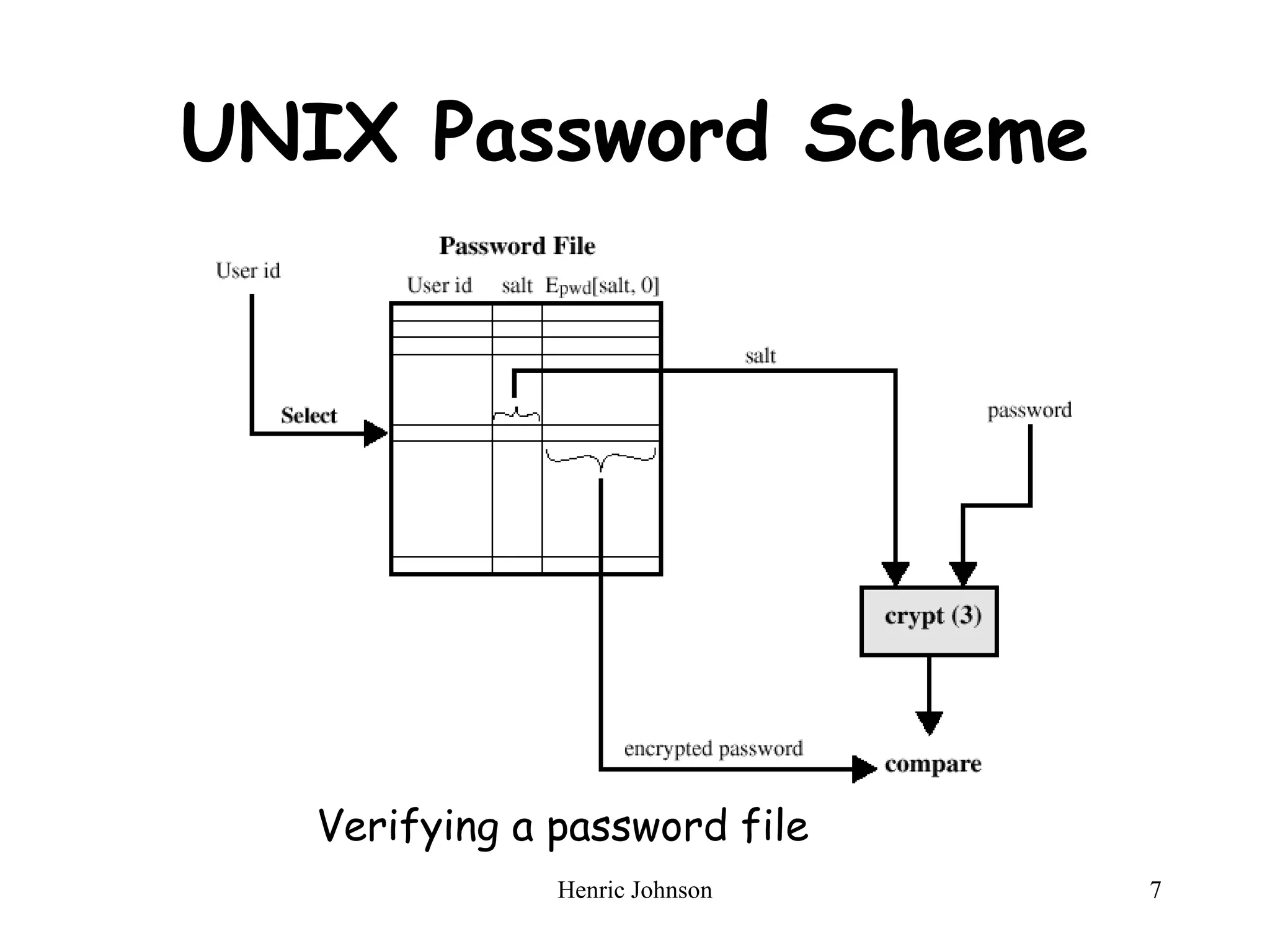
UNIX Password Scheme
Verifying a password file
Henric Johnson 8
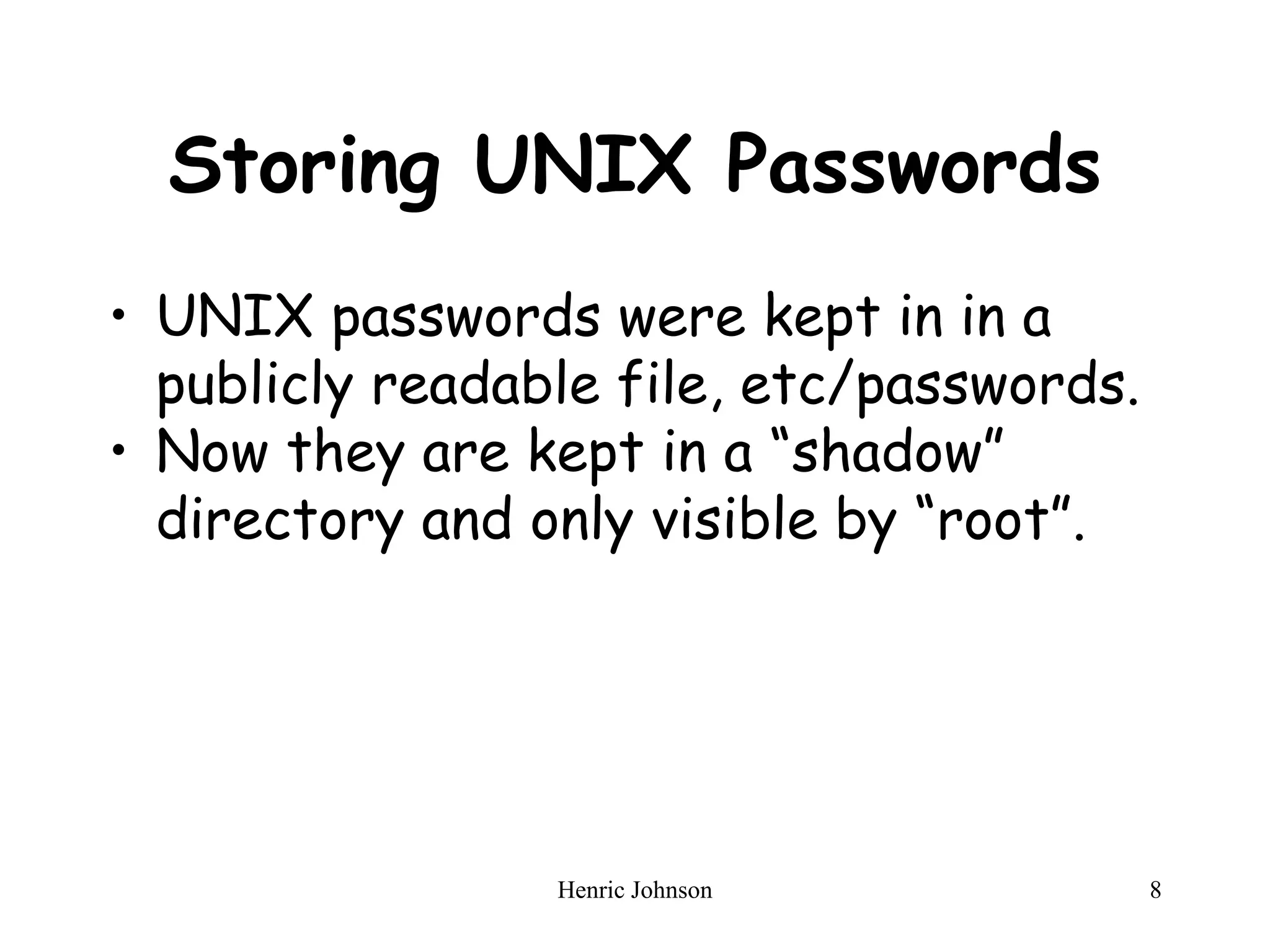
Storing UNIX Passwords
• UNIX passwords were kept in in a
publicly readable file, etc/passwords.
• Now they are kept in a “shadow”
directory and only visible by “root”.
Henric Johnson 9
”Salt”
• The salt serves three purposes:
– Prevents duplicate passwords.
– Effectively increases the length of the
password.
– Prevents the use of hardware
implementations of DES
Henric Johnson 10
Password Selecting
Strategies
• User ducation
• Computer-generated passwords
• Reactive password checking
• Proactive password checking
Henric Johnson 11
Markov Model
Henric Johnson 12
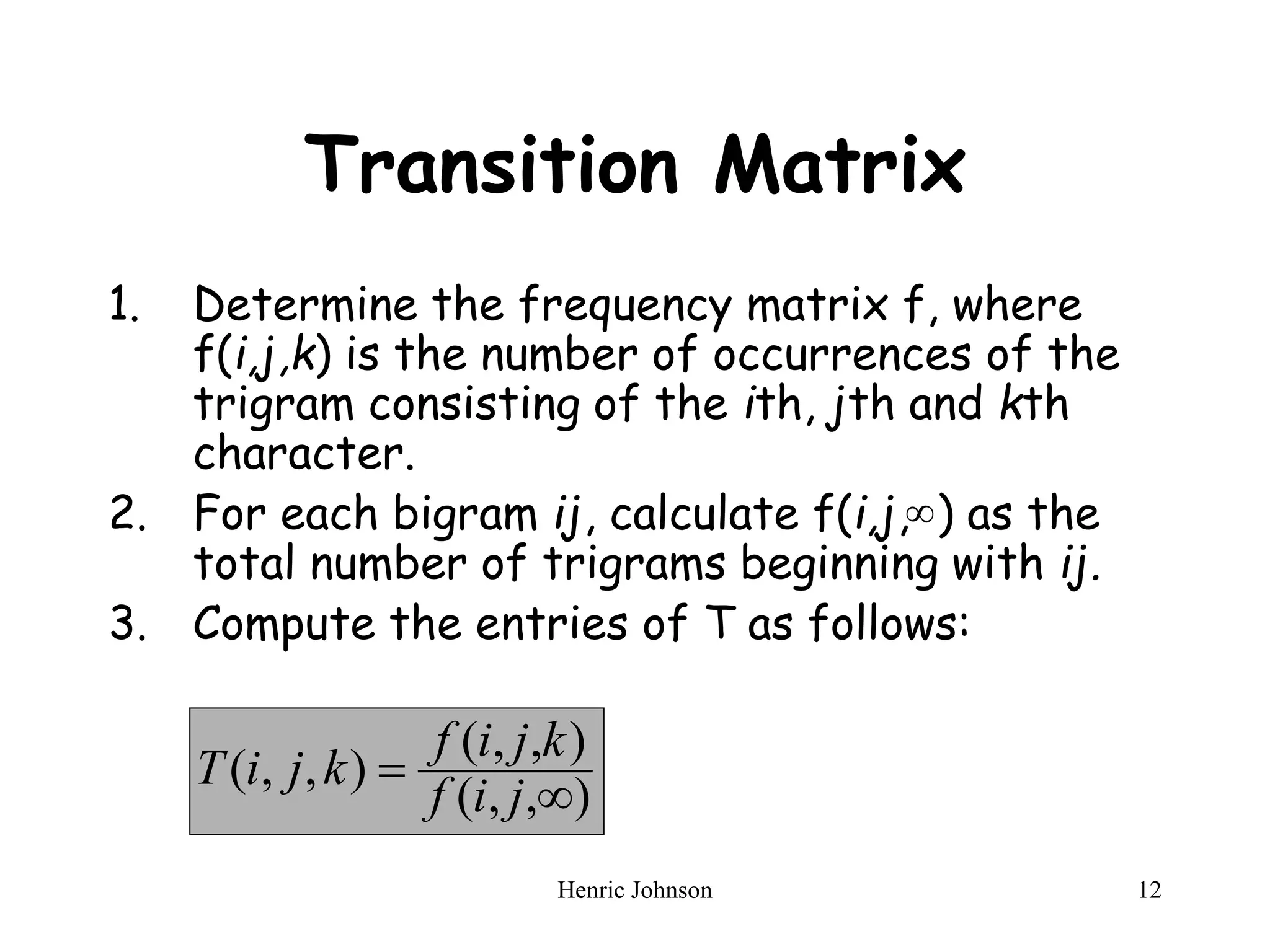
Transition Matrix
1. Determine the frequency matrix f, where
f(i,j,k) is the number of occurrences of the
trigram consisting of the ith, jth and kth
character.
2. For each bigram ij, calculate f(i,j, ) as the
total number of trigrams beginning with ij.
3. Compute the entries of T as follows:

)
,
,
(
)
,
,
(
)
,
,
(


j
i
f
k
j
i
f
k
j
i
T
Henric Johnson 13
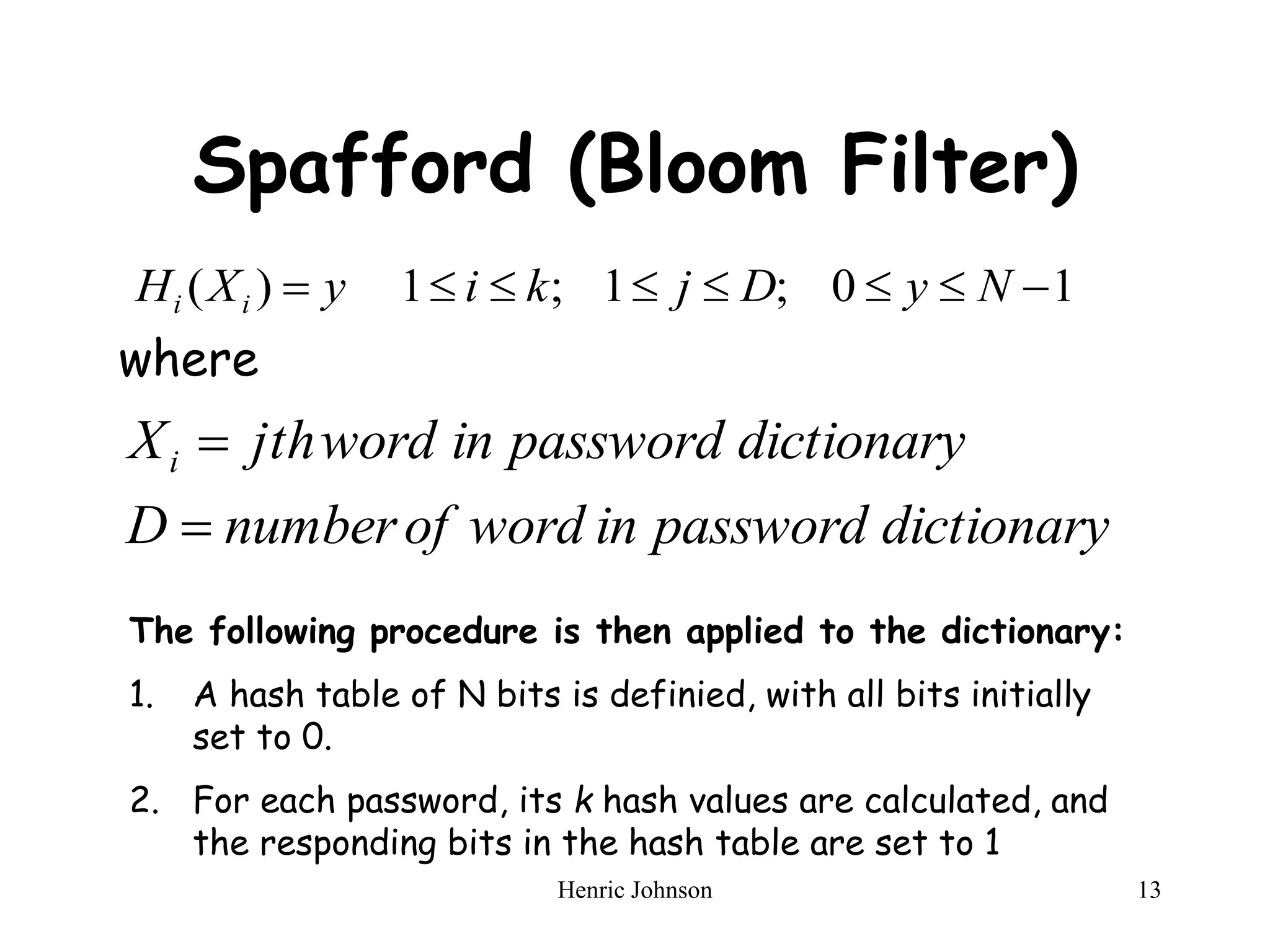
Spafford (Bloom Filter)
where
1
0
;
1
;
1
)
( 






 N
y
D
j
k
i
y
X
H i
i
dictionary
password
in
word
of
number
D
dictionary
password
in
word
jth
Xi


The following procedure is then applied to the dictionary:
1. A hash table of N bits is definied, with all bits initially
set to 0.
2. For each password, its k hash values are calculated, and
the responding bits in the hash table are set to 1
Henric Johnson 14
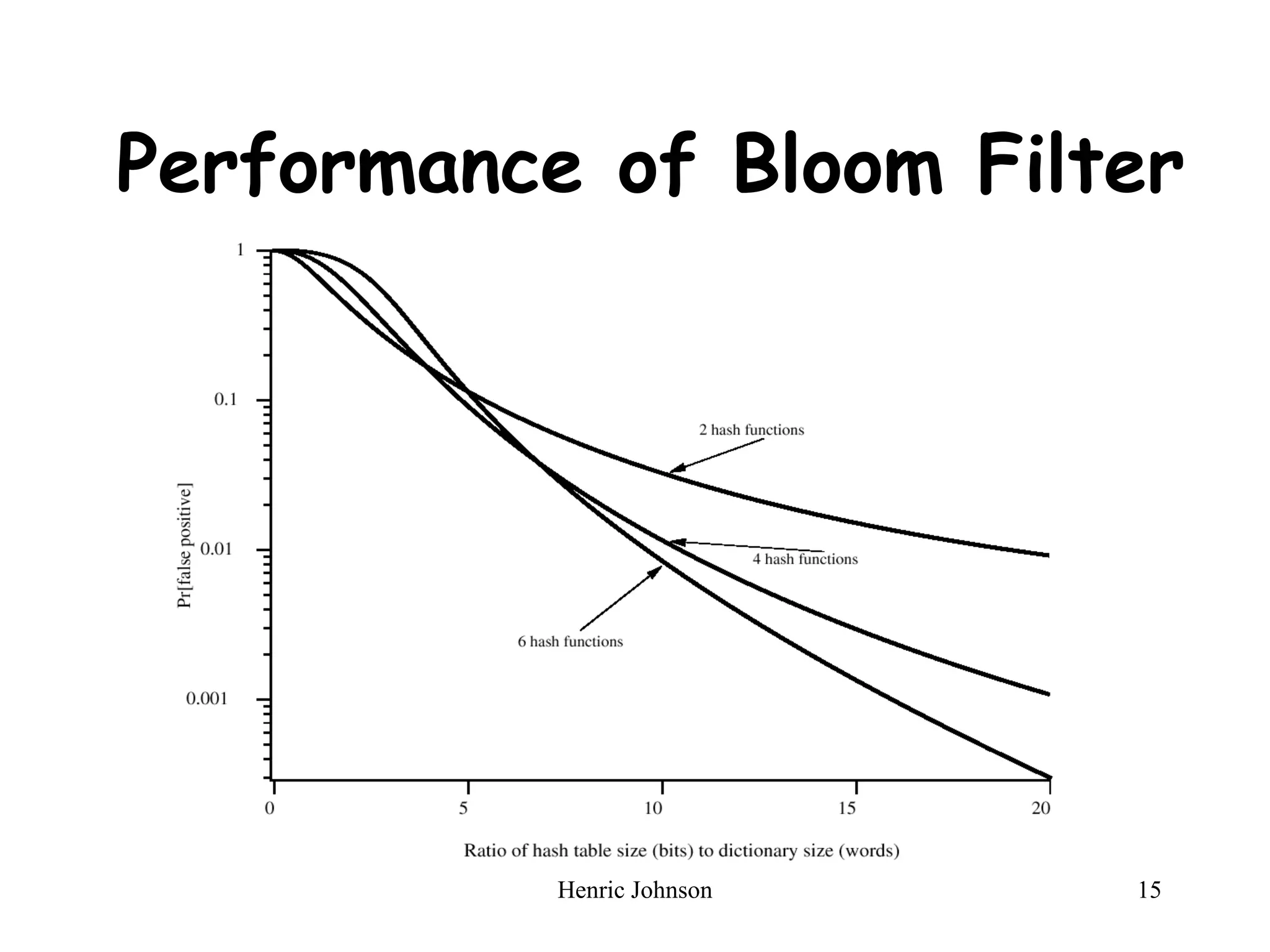
Spafford (Bloom Filter)
• Design the hash scheme to minimize false
positive.
• Probability of false positive:
)
(
)
(
,
/
)
1
ln(
,
,
)
1
(
)
1
(
/
1
/
/
words
size
dictionary
to
bits
size
table
hash
of
ratio
D
N
R
dictionary
in
words
of
number
D
table
hash
in
bits
of
number
N
function
hash
of
number
k
where
P
k
R
ly
equivalent
or
e
e
P
k
k
R
k
k
N
kD










 

Henric Johnson 15
Performance of Bloom Filter
Henric Johnson 16
The Stages of a Network
Intrusion
1. Scan the network to:
• locate which IP addresses are in use,
• what operating system is in use,
• what TCP or UDP ports are “open” (being listened
to by Servers).
2. Run “Exploit” scripts against open ports
3. Get access to Shell program which is “suid” (has
“root” privileges).
4. Download from Hacker Web site special versions
of systems files that will let Cracker have free
access in the future without his cpu time or disk
storage space being noticed by auditing programs.
5. Use IRC (Internet Relay Chat) to invite friends to
the feast.
16
Henric Johnson 17
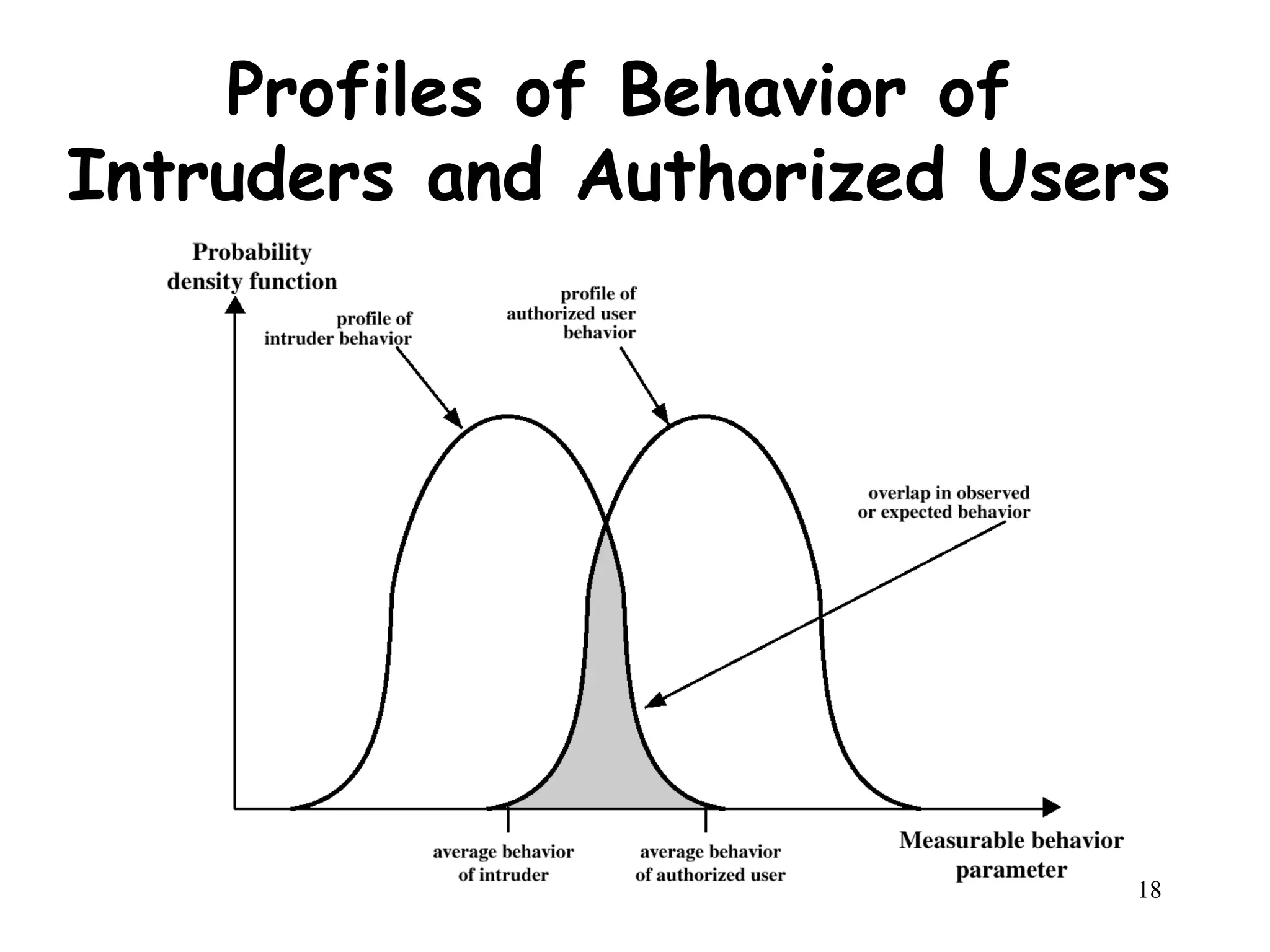
Intusion Detection
• The intruder can be identified and ejected
from the system.
• An effective intrusion detection can
prevent intrusions.
• Intrusion detection enables the collection
of information about intrusion techniques
that can be used to strengthen the
intrusion prevention facility.
Henric Johnson 18
Profiles of Behavior of
Intruders and Authorized Users
Henric Johnson 19
Intrusion Detection
• Statistical anomaly detection
– Treshold detection
– Profile based
• Rule based detection
– Anomaly detection
– Penetration identidication
Henric Johnson 20
Measures used for
Intrusion Detection
• Login frequency by day and time.
• Frequency of login at different locations.
• Time since last login.
• Password failures at login.
• Execution frequency.
• Execution denials.
• Read, write, create, delete frequency.
• Failure count for read, write, create and
delete.
Henric Johnson 21
Distributed Intrusion Detection
Developed at University of California at Davis
Henric Johnson 22
Distributed Intrusion Detection
Henric Johnson 23
Viruses and ”Malicious
Programs”
• Computer “Viruses” and related programs have the
ability to replicate themselves on an ever increasing
number of computers. They originally spread by people
sharing floppy disks. Now they spread primarily over
the Internet (a “Worm”).
• Other “Malicious Programs” may be installed by hand on
a single machine. They may also be built into widely
distributed commercial software packages. These are
very hard to detect before the payload activates
(Trojan Horses, Trap Doors, and Logic Bombs).
Henric Johnson 24
Taxanomy of Malicious Programs
Need Host
Program
Independent
Trapdoors Logic
Bombs
Trojan
Horses
Viruses Bacteria Worms
Malicious
Programs
Henric Johnson 25
Definitions
• Virus - code that copies itself into other
programs.
• A “Bacteria” replicates until it fills all disk
space, or CPU cycles.
• Payload - harmful things the malicious
program does, after it has had time to
spread.
• Worm - a program that replicates itself
across the network (usually riding on email
messages or attached documents (e.g.,
macro viruses).
Henric Johnson 26
Definitions
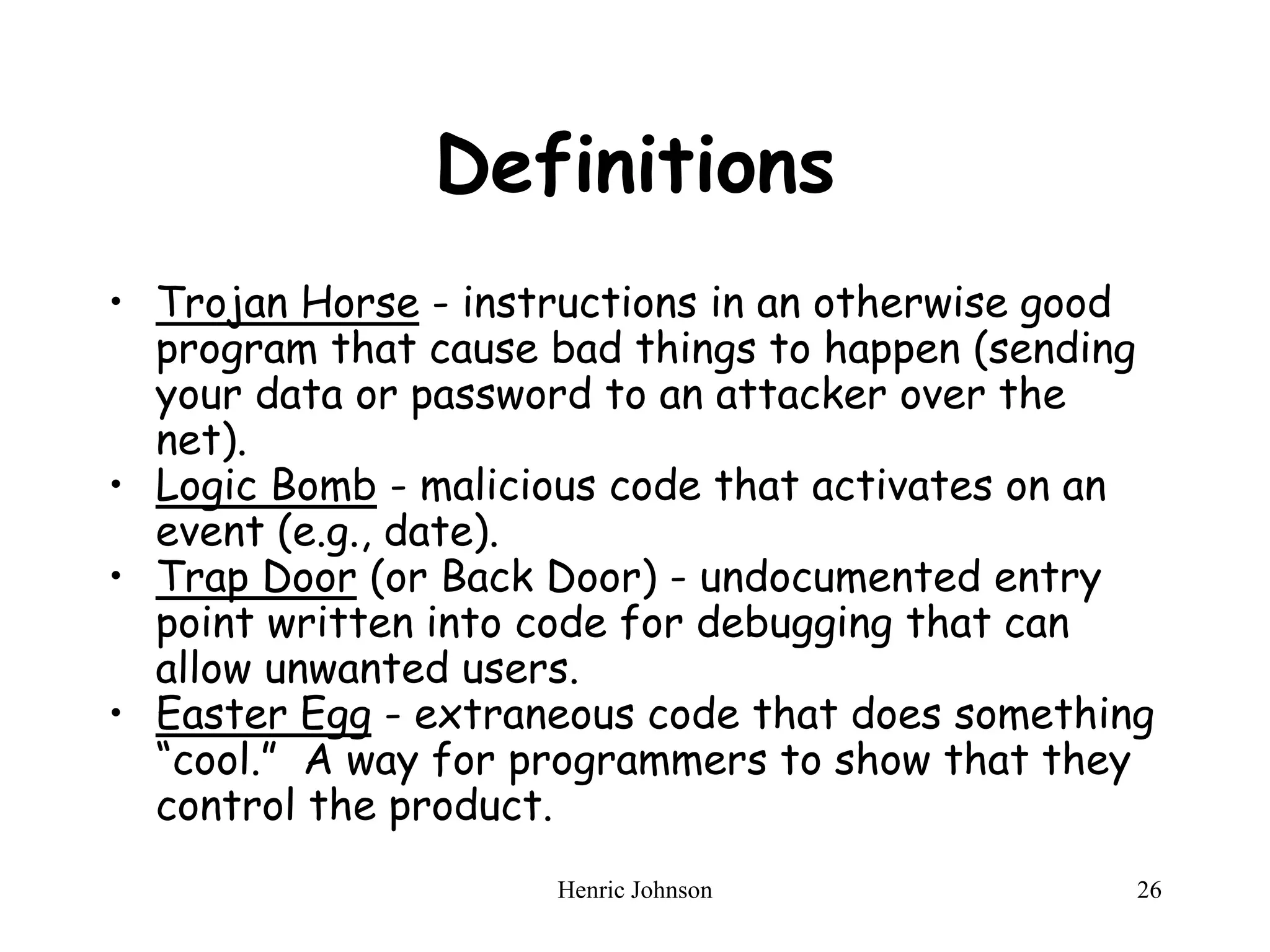
• Trojan Horse - instructions in an otherwise good
program that cause bad things to happen (sending
your data or password to an attacker over the
net).
• Logic Bomb - malicious code that activates on an
event (e.g., date).
• Trap Door (or Back Door) - undocumented entry
point written into code for debugging that can
allow unwanted users.
• Easter Egg - extraneous code that does something
“cool.” A way for programmers to show that they
control the product.
Henric Johnson 27
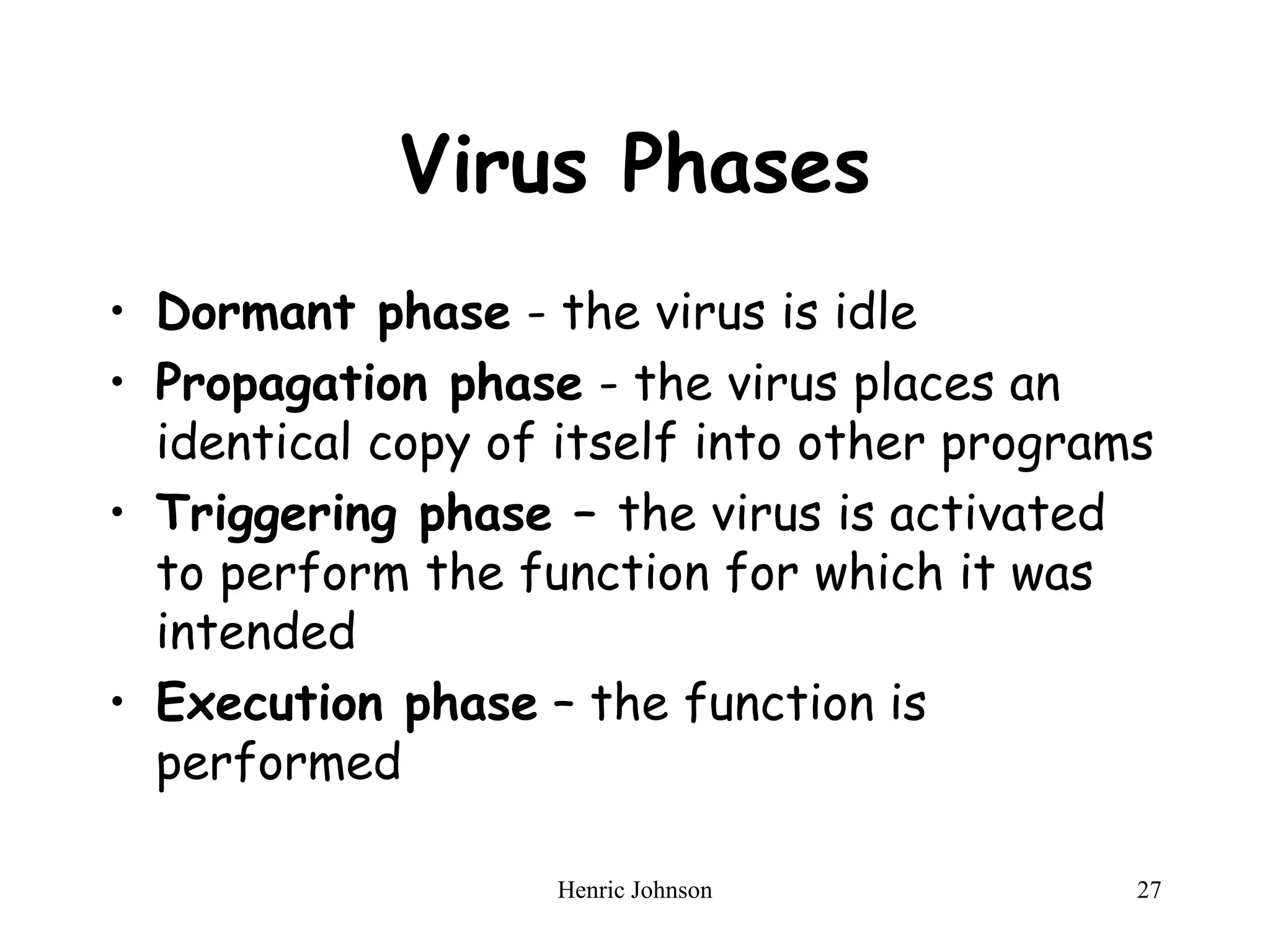
Virus Phases
• Dormant phase - the virus is idle
• Propagation phase - the virus places an
identical copy of itself into other programs
• Triggering phase – the virus is activated
to perform the function for which it was
intended
• Execution phase – the function is
performed
Henric Johnson 28
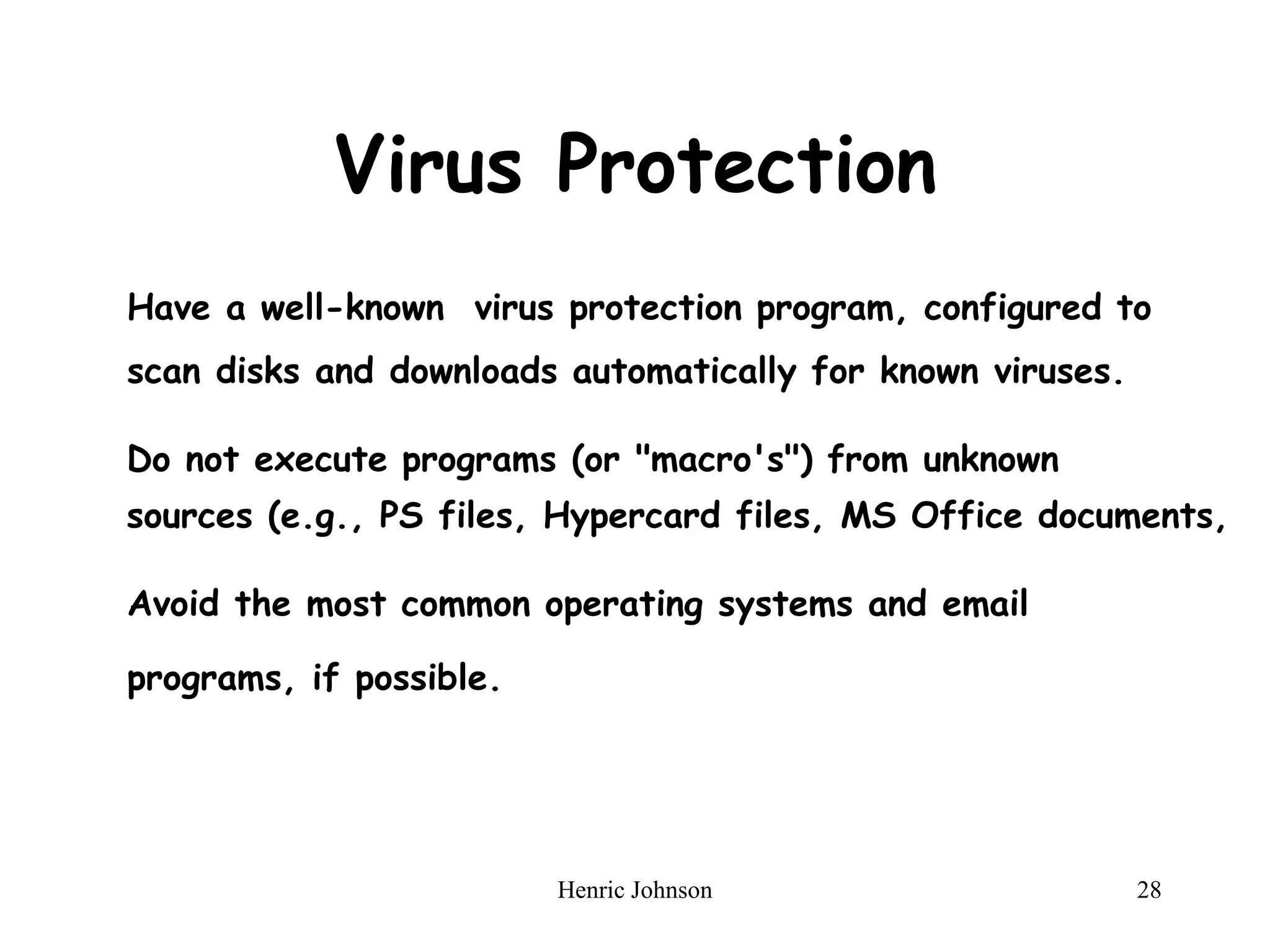
Virus Protection
Have a well-known virus protection program, configured to
scan disks and downloads automatically for known viruses.
Do not execute programs (or "macro's") from unknown
sources (e.g., PS files, Hypercard files, MS Office documents,
Avoid the most common operating systems and email
programs, if possible.
Henric Johnson 29
Virus Structure
Henric Johnson 30
A Compression Virus
Henric Johnson 31
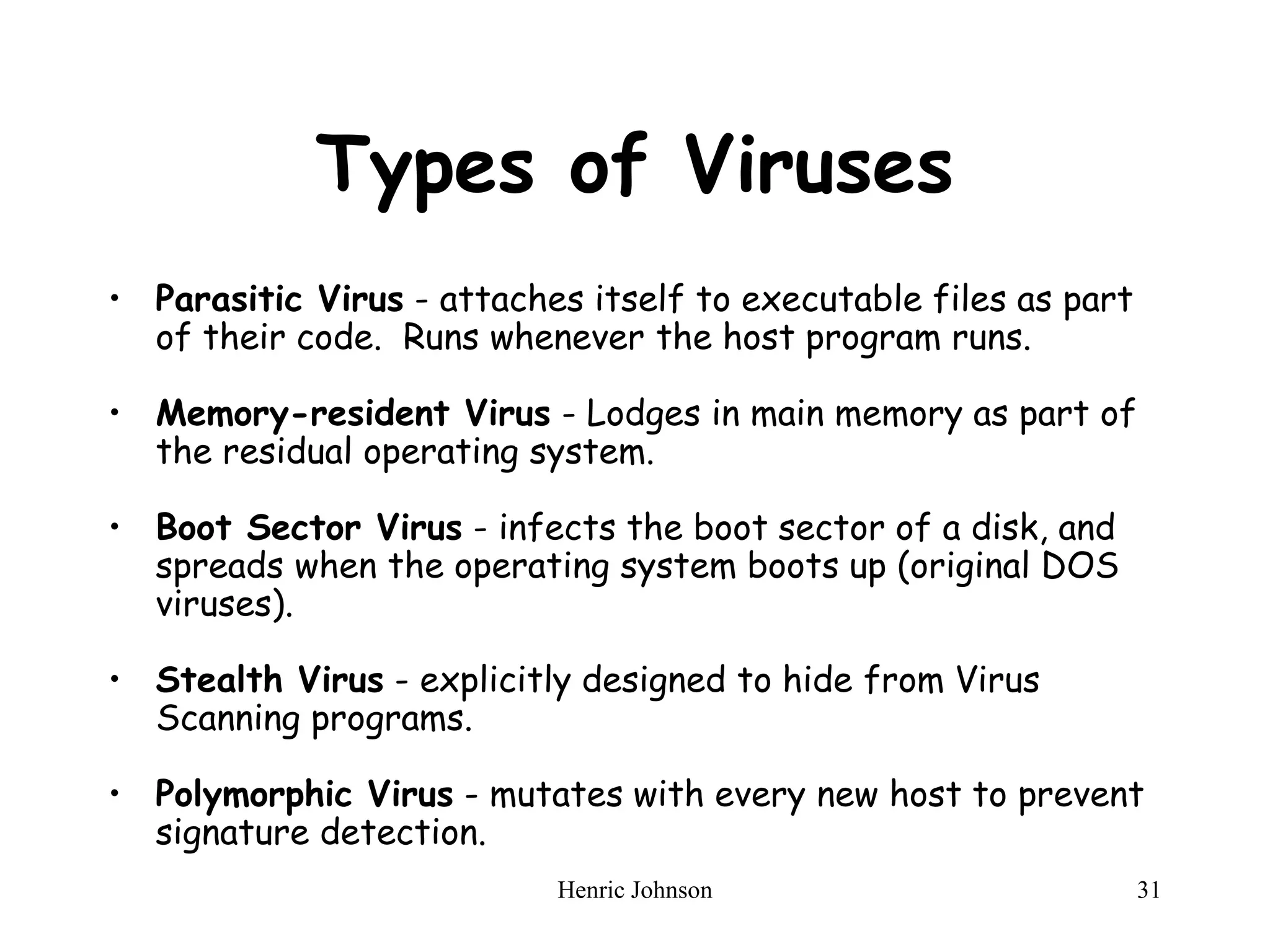
Types of Viruses
• Parasitic Virus - attaches itself to executable files as part
of their code. Runs whenever the host program runs.
• Memory-resident Virus - Lodges in main memory as part of
the residual operating system.
• Boot Sector Virus - infects the boot sector of a disk, and
spreads when the operating system boots up (original DOS
viruses).
• Stealth Virus - explicitly designed to hide from Virus
Scanning programs.
• Polymorphic Virus - mutates with every new host to prevent
signature detection.
Henric Johnson 32
Macro Viruses
• Microsoft Office applications allow
“macros” to be part of the document. The
macro could run whenever the document is
opened, or when a certain command is
selected (Save File).
• Platform independent.
• Infect documents, delete files, generate
email and edit letters.
Henric Johnson 33
Antivirus Approaches
1st Generation, Scanners: searched files for any of a
library of known virus “signatures.” Checked
executable files for length changes.
2nd Generation, Heuristic Scanners: looks for more
general signs than specific signatures (code
segments common to many viruses). Checked files
for checksum or hash changes.
3rd Generation, Activity Traps: stay resident in
memory and look for certain patterns of software
behavior (e.g., scanning files).
4th Generation, Full Featured: combine the best of
the techniques above.
Henric Johnson 34
Advanced Antivirus
Techniques
• Generic Decryption (GD)
– CPU Emulator
– Virus Signature Scanner
– Emulation Control Module
• For how long should a GD scanner run
each interpretation?
Henric Johnson 35
Advanced Antivirus
Techniques
Henric Johnson 36
Recommended Reading and
WEB Sites
• Denning, P. Computers Under Attack:
Intruders, Worms, and Viruses.
Addison-Wesley, 1990
• CERT Coordination Center (WEB Site)
• AntiVirus Online (IBM’s site)

ch09 (1).ppt

  • 1.
    Henric Johnson 1 Chapter9 Intruders and Viruses Henric Johnson Blekinge Institute of Technology, Sweden http://www.its.bth.se/staff/hjo/ henric.johnson@bth.se
  • 2.
    Henric Johnson 2 Outline •Intruders – Intrusion Techniques – Password Protection – Password Selection Strategies – Intrusion Detection • Viruses and Related Threats – Malicious Programs – The Nature of Viruses – Antivirus Approaches – Advanced Antivirus Techniques • Recommended Reading and WEB Sites
  • 3.
    Henric Johnson 3 Intruders •Three classes of intruders (hackers or crackers): – Masquerader – Misfeasor – Clandestine user
  • 4.
    Henric Johnson 4 IntrusionTechniques • System maintain a file that associates a password with each authorized user. • Password file can be protected with: – One-way encryption – Access Control
  • 5.
    Henric Johnson 5 IntrusionTechniques • Techniques for guessing passwords: • Try default passwords. • Try all short words, 1 to 3 characters long. • Try all the words in an electronic dictionary(60,000). • Collect information about the user’s hobbies, family names, birthday, etc. • Try user’s phone number, social security number, street address, etc. • Try all license plate numbers (MUP103). • Use a Trojan horse • Tap the line between a remote user and the host system. Prevention: Enforce good password selection (Ij4Gf4Se%f#)
  • 6.
    Henric Johnson 6 UNIXPassword Scheme Loading a new password
  • 7.
    Henric Johnson 7 UNIXPassword Scheme Verifying a password file
  • 8.
    Henric Johnson 8 StoringUNIX Passwords • UNIX passwords were kept in in a publicly readable file, etc/passwords. • Now they are kept in a “shadow” directory and only visible by “root”.
  • 9.
    Henric Johnson 9 ”Salt” •The salt serves three purposes: – Prevents duplicate passwords. – Effectively increases the length of the password. – Prevents the use of hardware implementations of DES
  • 10.
    Henric Johnson 10 PasswordSelecting Strategies • User ducation • Computer-generated passwords • Reactive password checking • Proactive password checking
  • 11.
  • 12.
    Henric Johnson 12 TransitionMatrix 1. Determine the frequency matrix f, where f(i,j,k) is the number of occurrences of the trigram consisting of the ith, jth and kth character. 2. For each bigram ij, calculate f(i,j, ) as the total number of trigrams beginning with ij. 3. Compute the entries of T as follows:  ) , , ( ) , , ( ) , , (   j i f k j i f k j i T
  • 13.
    Henric Johnson 13 Spafford(Bloom Filter) where 1 0 ; 1 ; 1 ) (         N y D j k i y X H i i dictionary password in word of number D dictionary password in word jth Xi   The following procedure is then applied to the dictionary: 1. A hash table of N bits is definied, with all bits initially set to 0. 2. For each password, its k hash values are calculated, and the responding bits in the hash table are set to 1
  • 14.
    Henric Johnson 14 Spafford(Bloom Filter) • Design the hash scheme to minimize false positive. • Probability of false positive: ) ( ) ( , / ) 1 ln( , , ) 1 ( ) 1 ( / 1 / / words size dictionary to bits size table hash of ratio D N R dictionary in words of number D table hash in bits of number N function hash of number k where P k R ly equivalent or e e P k k R k k N kD             
  • 15.
  • 16.
    Henric Johnson 16 TheStages of a Network Intrusion 1. Scan the network to: • locate which IP addresses are in use, • what operating system is in use, • what TCP or UDP ports are “open” (being listened to by Servers). 2. Run “Exploit” scripts against open ports 3. Get access to Shell program which is “suid” (has “root” privileges). 4. Download from Hacker Web site special versions of systems files that will let Cracker have free access in the future without his cpu time or disk storage space being noticed by auditing programs. 5. Use IRC (Internet Relay Chat) to invite friends to the feast. 16
  • 17.
    Henric Johnson 17 IntusionDetection • The intruder can be identified and ejected from the system. • An effective intrusion detection can prevent intrusions. • Intrusion detection enables the collection of information about intrusion techniques that can be used to strengthen the intrusion prevention facility.
  • 18.
    Henric Johnson 18 Profilesof Behavior of Intruders and Authorized Users
  • 19.
    Henric Johnson 19 IntrusionDetection • Statistical anomaly detection – Treshold detection – Profile based • Rule based detection – Anomaly detection – Penetration identidication
  • 20.
    Henric Johnson 20 Measuresused for Intrusion Detection • Login frequency by day and time. • Frequency of login at different locations. • Time since last login. • Password failures at login. • Execution frequency. • Execution denials. • Read, write, create, delete frequency. • Failure count for read, write, create and delete.
  • 21.
    Henric Johnson 21 DistributedIntrusion Detection Developed at University of California at Davis
  • 22.
    Henric Johnson 22 DistributedIntrusion Detection
  • 23.
    Henric Johnson 23 Virusesand ”Malicious Programs” • Computer “Viruses” and related programs have the ability to replicate themselves on an ever increasing number of computers. They originally spread by people sharing floppy disks. Now they spread primarily over the Internet (a “Worm”). • Other “Malicious Programs” may be installed by hand on a single machine. They may also be built into widely distributed commercial software packages. These are very hard to detect before the payload activates (Trojan Horses, Trap Doors, and Logic Bombs).
  • 24.
    Henric Johnson 24 Taxanomyof Malicious Programs Need Host Program Independent Trapdoors Logic Bombs Trojan Horses Viruses Bacteria Worms Malicious Programs
  • 25.
    Henric Johnson 25 Definitions •Virus - code that copies itself into other programs. • A “Bacteria” replicates until it fills all disk space, or CPU cycles. • Payload - harmful things the malicious program does, after it has had time to spread. • Worm - a program that replicates itself across the network (usually riding on email messages or attached documents (e.g., macro viruses).
  • 26.
    Henric Johnson 26 Definitions •Trojan Horse - instructions in an otherwise good program that cause bad things to happen (sending your data or password to an attacker over the net). • Logic Bomb - malicious code that activates on an event (e.g., date). • Trap Door (or Back Door) - undocumented entry point written into code for debugging that can allow unwanted users. • Easter Egg - extraneous code that does something “cool.” A way for programmers to show that they control the product.
  • 27.
    Henric Johnson 27 VirusPhases • Dormant phase - the virus is idle • Propagation phase - the virus places an identical copy of itself into other programs • Triggering phase – the virus is activated to perform the function for which it was intended • Execution phase – the function is performed
  • 28.
    Henric Johnson 28 VirusProtection Have a well-known virus protection program, configured to scan disks and downloads automatically for known viruses. Do not execute programs (or "macro's") from unknown sources (e.g., PS files, Hypercard files, MS Office documents, Avoid the most common operating systems and email programs, if possible.
  • 29.
  • 30.
    Henric Johnson 30 ACompression Virus
  • 31.
    Henric Johnson 31 Typesof Viruses • Parasitic Virus - attaches itself to executable files as part of their code. Runs whenever the host program runs. • Memory-resident Virus - Lodges in main memory as part of the residual operating system. • Boot Sector Virus - infects the boot sector of a disk, and spreads when the operating system boots up (original DOS viruses). • Stealth Virus - explicitly designed to hide from Virus Scanning programs. • Polymorphic Virus - mutates with every new host to prevent signature detection.
  • 32.
    Henric Johnson 32 MacroViruses • Microsoft Office applications allow “macros” to be part of the document. The macro could run whenever the document is opened, or when a certain command is selected (Save File). • Platform independent. • Infect documents, delete files, generate email and edit letters.
  • 33.
    Henric Johnson 33 AntivirusApproaches 1st Generation, Scanners: searched files for any of a library of known virus “signatures.” Checked executable files for length changes. 2nd Generation, Heuristic Scanners: looks for more general signs than specific signatures (code segments common to many viruses). Checked files for checksum or hash changes. 3rd Generation, Activity Traps: stay resident in memory and look for certain patterns of software behavior (e.g., scanning files). 4th Generation, Full Featured: combine the best of the techniques above.
  • 34.
    Henric Johnson 34 AdvancedAntivirus Techniques • Generic Decryption (GD) – CPU Emulator – Virus Signature Scanner – Emulation Control Module • For how long should a GD scanner run each interpretation?
  • 35.
    Henric Johnson 35 AdvancedAntivirus Techniques
  • 36.
    Henric Johnson 36 RecommendedReading and WEB Sites • Denning, P. Computers Under Attack: Intruders, Worms, and Viruses. Addison-Wesley, 1990 • CERT Coordination Center (WEB Site) • AntiVirus Online (IBM’s site)