VIRUSES AND VIRUS
COUNTETMEASURES
Prawinrajan N
Anna university Trichy
prawinrajan2@gmail.com
What is Virus?
A computer Virus is a piece of software that can infect other programs by modifying them.
The virus is embedded with a computer program. n, whenever the infected computer comes
into contact with an uninfected piece of software, a fresh copy of the virus passes into the new program.
• From one computer to another computer by swap disk or over the network(while communication).
Infection can be spread by,
Three parts of virus:
• Infection mechanism: virus spreads, enabling it to replicate.
• Trigger: The event or condition that determines when the payload is
activated or delivered.
• Payload: What the virus does, besides spreading. The payload may
involve damage or may involve benign but noticeable activity
VIRUS LIFETIME:
• Dormant phase: The virus is idle. It is activated by some
• event,
• such as a date,
• the presence of another program or file,
• capacity of the disk exceeding some limit.
• Propagation phase:
• The virus places a copy of itself into other programs or other location.
• Each infected program will now contain a clone of the virus,
which will itself enter a propagation phase.
• Triggering phase:
1. The virus is activated to perform the function for which it was intended.
2. As with the dormant phase, the triggering phase can be caused by a variety of system events,
including a count of the number of times that this copy of the virus has made copies of itself.
• Execution phase:
1. function may be harmless, such as a message on the screen, or damaging,
such as the destruction of programs and data files.
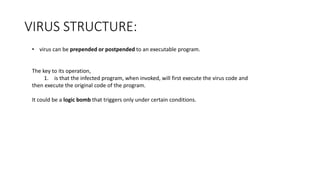
VIRUS STRUCTURE:
• virus can be prepended or postpended to an executable program.
The key to its operation,
1. is that the infected program, when invoked, will first execute the virus code and
then execute the original code of the program.
It could be a logic bomb that triggers only under certain conditions.
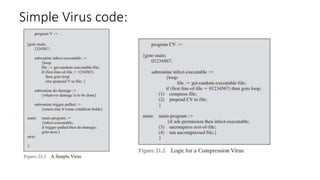
Simple Virus code:
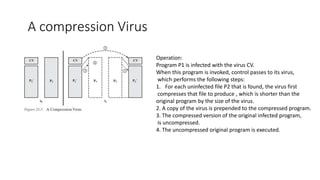
A compression Virus
Operation:
Program P1 is infected with the virus CV.
When this program is invoked, control passes to its virus,
which performs the following steps:
1. For each uninfected file P2 that is found, the virus first
compresses that file to produce , which is shorter than the
original program by the size of the virus.
2. A copy of the virus is prepended to the compressed program.
3. The compressed version of the original infected program,
is uncompressed.
4. The uncompressed original program is executed.
INITIAL INFECTION
• Once a virus has gained entry to a system by infecting a single program, it is in a position to potentially
infect some or all other executable files on that system when the infected program executes.
• Once it started it may not be stop able. Because it is triggered outside.
• Nowadays, System security is improved. So, Virus creator moved into macro and e-mail viruses
VIRUSES CLASSIFICATION
• Boot sector infector: Infects a master boot record or boot record and spreads when a system is booted
from the disk containing the virus.
• File infector: Infects files that the operating system or shell consider to be executable.
• Macro virus: Infects files with macro code that is interpreted by an application.
VIRUS CLASSIFICATION BY CONCEALMENT
STRATEGY
1. Encrypted virus:
• s. A portion of the virus creates a random encryption key and encrypts the remainder of the Virus.
The key is stored with the virus. When an infected program is invoked, the virus uses the stored
Random key to decrypt the virus. When the virus replicates, a different random key is selected.
Because the bulk of the virus is encrypted with a different key for each instance,
there is no constant bit pattern to observe.
2 .Stealth virus:
• A form of virus explicitly designed to hide itself from detection by antivirus software.
Thus, the entire virus, not just a payload is hidden.
3. Polymorphic virus:
• A virus that mutates with every infection, making detection by the “signature” of the virus impossible
4. Metamorphic virus: As with a polymorphic virus, a metamorphic virus mutates with every
infection. The difference is that a metamorphic virus rewrites itself completely at each iteration,
increasing the difficulty of detection. Metamorphic viruses may change their behavior as well as their
appearance.
Virus Kit:
1. virus writers. quickly create a number of different viruses.
Macro Viruses:
1. The virus is platform independent.
2. Macro viruses infect documents
3. Easily spread. A very common method is by electronic mail.
4. Main Target is Microsoft documents.
E-Mail viruses:
• Malicious software is the e-mail virus.
1. The e-mail virus sends itself to everyone on the mailing list in the user’s e-mail package.
2. The virus does local damage on the user’s system.
activated (either by opening an e-mail attachment or by opening the e-mail) to all of the e-mail
addresses known to the infected host
Virus Countermeasures
Antivirus Approaches:
1. Detection: Once the infection has occurred , determine that it has occurred and locate the virus.
2. Identification: specific virus that has infected a program.
3. Removal: remove all traces of thevirus from the infected program and restore it to its original state.
If detection succeeds, then discard the infected file and reload a clean backup version.
Advances in virus , identified and purged withrelatively simple antivirus software packages.
[STEP93] IDENTIFIES FOUR GENERATIONS OF
ANTIVIRUS SOFTWARE:
1.First generation: simple scanners
2.Second generation: heuristic scanners
3.Third generation: activity traps
4.Fourth generation: full-featured protection
1. first-generation: identify a virus. The virus may contain “Wildcard” (same structure and bit pattern in all copies.)
2. second-generation:
• Beginning of an encryption loop used in a poly-morphic virus and discover the
encryption key. Once the key is discovered, the scanner can decrypt the virus to identify
it, then remove the infection and return the program to service.
• Another approach is integrity checking. checksum can be appended to each program. If a virus infects
the program without changing the check sum, then an integrity check will catch the change.
• The encryption key is stored separately from the program so that the virus cannot generate a
new hash code and encrypt that.
3. Third-generation:
• programs are memory-resident programs that identify a virus by its actions rather than its structure in an
infected program.
• not necessary to develop signatures and heuristics for a wide array of viruses.
4. Fourth-generation: scanning and activity trap components.
Advanced Antivirus Techniques:
Generic decryption (GD):
• technology enables the antivirus program to easily detect even the most
complex polymorphic viruses while maintaining fast scanning speeds [NACH97].
• decrypt itself to activate. In order to detect such a structure , executable files are run
• through a GD scanner
1. CPU emulator:
• A software-based virtual computer . Instructions in an executable file are interpreted by the emulator
rather than executed on the underlying processor . The emulator includes software versions of all
Registers and other processor hardware , so that the underlying processor is unaffected by programs
interpreted on the emulator.
2. Virus signature scanner: looking for known virus signatures.
3. Emulation control module: Controls the execution of the target code.
• The emulator begins interpreting instructions in the target code , one at a time.
Thus , if the code includes a decryption routine that decrypts and hence exposes the virus , that code is
Interpreted.
• interpretation to scan the target code for virus signatures.
• GD scanner, longer the scanner emulates - catch any hidden viruses.
Antivirus Program can take up only a limited amount of time and resources before users
complain of degraded system performance.
DIGITAL IMMUNE SYSTEM
• typically updated on a monthly basis | small role in the spread of viruses
• Integrated mail systems:
• Systems such as Lotus Notes and Microsoft Outlook make it very simple to send
anything to anyone and to work with objects that are received.
• Mobile-program systems:
• Capabilities such as Java and ActiveX allow programs to move on their own from one
system to another.
• rapid response time so that viruses can be stamped out almost as soon as they are
introduced.
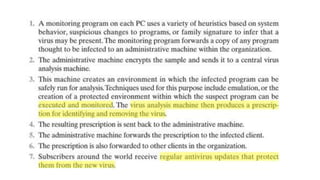
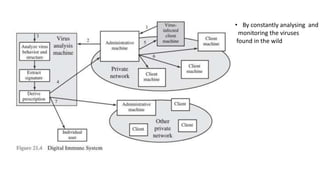
• When a new virus enters an organization , the immune system automatically captures it ,
analyzes it , adds detection and shielding for it , removes it , and passes information about
that virus to systems running IBM Antivirus so that it can be detected before it is allowed to
run elsewhere.
IBM has developed a prototype digital immune system
• By constantly analysing and
monitoring the viruses
found in the wild
BEHAVIOR-BLOCKINGSOFTWARE
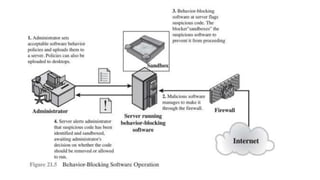
Behaviour-blocking software integrates with the operating system of a host computer and monitors
program Behavior in real-time for malicious actions
Behaviour-blocking software runs on server and desktop computers and is instructed through
policies set by the network administrator to let benign actions take place but to intercede when
unauthorized or suspicious actions occur.
Viruses and virus countetmeasures

Viruses and virus countetmeasures

  • 1.
    VIRUSES AND VIRUS COUNTETMEASURES PrawinrajanN Anna university Trichy prawinrajan2@gmail.com
  • 2.
    What is Virus? Acomputer Virus is a piece of software that can infect other programs by modifying them. The virus is embedded with a computer program. n, whenever the infected computer comes into contact with an uninfected piece of software, a fresh copy of the virus passes into the new program. • From one computer to another computer by swap disk or over the network(while communication). Infection can be spread by,
  • 3.
    Three parts ofvirus: • Infection mechanism: virus spreads, enabling it to replicate. • Trigger: The event or condition that determines when the payload is activated or delivered. • Payload: What the virus does, besides spreading. The payload may involve damage or may involve benign but noticeable activity
  • 4.
    VIRUS LIFETIME: • Dormantphase: The virus is idle. It is activated by some • event, • such as a date, • the presence of another program or file, • capacity of the disk exceeding some limit. • Propagation phase: • The virus places a copy of itself into other programs or other location. • Each infected program will now contain a clone of the virus, which will itself enter a propagation phase.
  • 5.
    • Triggering phase: 1.The virus is activated to perform the function for which it was intended. 2. As with the dormant phase, the triggering phase can be caused by a variety of system events, including a count of the number of times that this copy of the virus has made copies of itself. • Execution phase: 1. function may be harmless, such as a message on the screen, or damaging, such as the destruction of programs and data files.
  • 6.
    VIRUS STRUCTURE: • viruscan be prepended or postpended to an executable program. The key to its operation, 1. is that the infected program, when invoked, will first execute the virus code and then execute the original code of the program. It could be a logic bomb that triggers only under certain conditions.
  • 7.
  • 8.
    A compression Virus Operation: ProgramP1 is infected with the virus CV. When this program is invoked, control passes to its virus, which performs the following steps: 1. For each uninfected file P2 that is found, the virus first compresses that file to produce , which is shorter than the original program by the size of the virus. 2. A copy of the virus is prepended to the compressed program. 3. The compressed version of the original infected program, is uncompressed. 4. The uncompressed original program is executed.
  • 9.
    INITIAL INFECTION • Oncea virus has gained entry to a system by infecting a single program, it is in a position to potentially infect some or all other executable files on that system when the infected program executes. • Once it started it may not be stop able. Because it is triggered outside. • Nowadays, System security is improved. So, Virus creator moved into macro and e-mail viruses VIRUSES CLASSIFICATION • Boot sector infector: Infects a master boot record or boot record and spreads when a system is booted from the disk containing the virus. • File infector: Infects files that the operating system or shell consider to be executable. • Macro virus: Infects files with macro code that is interpreted by an application.
  • 10.
    VIRUS CLASSIFICATION BYCONCEALMENT STRATEGY 1. Encrypted virus: • s. A portion of the virus creates a random encryption key and encrypts the remainder of the Virus. The key is stored with the virus. When an infected program is invoked, the virus uses the stored Random key to decrypt the virus. When the virus replicates, a different random key is selected. Because the bulk of the virus is encrypted with a different key for each instance, there is no constant bit pattern to observe. 2 .Stealth virus: • A form of virus explicitly designed to hide itself from detection by antivirus software. Thus, the entire virus, not just a payload is hidden. 3. Polymorphic virus: • A virus that mutates with every infection, making detection by the “signature” of the virus impossible
  • 11.
    4. Metamorphic virus:As with a polymorphic virus, a metamorphic virus mutates with every infection. The difference is that a metamorphic virus rewrites itself completely at each iteration, increasing the difficulty of detection. Metamorphic viruses may change their behavior as well as their appearance. Virus Kit: 1. virus writers. quickly create a number of different viruses. Macro Viruses: 1. The virus is platform independent. 2. Macro viruses infect documents 3. Easily spread. A very common method is by electronic mail. 4. Main Target is Microsoft documents.
  • 12.
    E-Mail viruses: • Malicioussoftware is the e-mail virus. 1. The e-mail virus sends itself to everyone on the mailing list in the user’s e-mail package. 2. The virus does local damage on the user’s system. activated (either by opening an e-mail attachment or by opening the e-mail) to all of the e-mail addresses known to the infected host
  • 13.
    Virus Countermeasures Antivirus Approaches: 1.Detection: Once the infection has occurred , determine that it has occurred and locate the virus. 2. Identification: specific virus that has infected a program. 3. Removal: remove all traces of thevirus from the infected program and restore it to its original state. If detection succeeds, then discard the infected file and reload a clean backup version. Advances in virus , identified and purged withrelatively simple antivirus software packages.
  • 14.
    [STEP93] IDENTIFIES FOURGENERATIONS OF ANTIVIRUS SOFTWARE: 1.First generation: simple scanners 2.Second generation: heuristic scanners 3.Third generation: activity traps 4.Fourth generation: full-featured protection
  • 15.
    1. first-generation: identifya virus. The virus may contain “Wildcard” (same structure and bit pattern in all copies.) 2. second-generation: • Beginning of an encryption loop used in a poly-morphic virus and discover the encryption key. Once the key is discovered, the scanner can decrypt the virus to identify it, then remove the infection and return the program to service. • Another approach is integrity checking. checksum can be appended to each program. If a virus infects the program without changing the check sum, then an integrity check will catch the change. • The encryption key is stored separately from the program so that the virus cannot generate a new hash code and encrypt that. 3. Third-generation: • programs are memory-resident programs that identify a virus by its actions rather than its structure in an infected program. • not necessary to develop signatures and heuristics for a wide array of viruses.
  • 16.
    4. Fourth-generation: scanningand activity trap components. Advanced Antivirus Techniques: Generic decryption (GD): • technology enables the antivirus program to easily detect even the most complex polymorphic viruses while maintaining fast scanning speeds [NACH97]. • decrypt itself to activate. In order to detect such a structure , executable files are run • through a GD scanner 1. CPU emulator: • A software-based virtual computer . Instructions in an executable file are interpreted by the emulator rather than executed on the underlying processor . The emulator includes software versions of all Registers and other processor hardware , so that the underlying processor is unaffected by programs interpreted on the emulator.
  • 17.
    2. Virus signaturescanner: looking for known virus signatures. 3. Emulation control module: Controls the execution of the target code. • The emulator begins interpreting instructions in the target code , one at a time. Thus , if the code includes a decryption routine that decrypts and hence exposes the virus , that code is Interpreted. • interpretation to scan the target code for virus signatures. • GD scanner, longer the scanner emulates - catch any hidden viruses. Antivirus Program can take up only a limited amount of time and resources before users complain of degraded system performance.
  • 18.
    DIGITAL IMMUNE SYSTEM •typically updated on a monthly basis | small role in the spread of viruses • Integrated mail systems: • Systems such as Lotus Notes and Microsoft Outlook make it very simple to send anything to anyone and to work with objects that are received. • Mobile-program systems: • Capabilities such as Java and ActiveX allow programs to move on their own from one system to another.
  • 19.
    • rapid responsetime so that viruses can be stamped out almost as soon as they are introduced. • When a new virus enters an organization , the immune system automatically captures it , analyzes it , adds detection and shielding for it , removes it , and passes information about that virus to systems running IBM Antivirus so that it can be detected before it is allowed to run elsewhere. IBM has developed a prototype digital immune system
  • 21.
    • By constantlyanalysing and monitoring the viruses found in the wild
  • 22.
    BEHAVIOR-BLOCKINGSOFTWARE Behaviour-blocking software integrateswith the operating system of a host computer and monitors program Behavior in real-time for malicious actions Behaviour-blocking software runs on server and desktop computers and is instructed through policies set by the network administrator to let benign actions take place but to intercede when unauthorized or suspicious actions occur.