Managerial Accounting: Tools for Business Decision-Making   Canadian Edition Weygandt   ●  Kieso  ●  Kimmel  ●  Aly
Pricing Chapter 8
Calculate a target cost when a product’s price is determined by the market. Calculate target selling price using cost-plus pricing. Use time and material pricing to determine the cost of services provided. Chapter 8   Pricing Study Objectives
Study Objectives: Continued Define “transfer price” and its role in an organization. Determine a transfer price using the negotiated, cost-based, and market-based approaches. Explain the issues that arise when transferring goods between divisions located in countries with different tax rates.
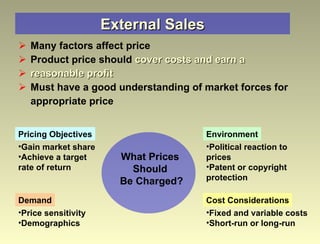
External Sales Many factors affect price Product price should  cover costs and earn a reasonable profit  Must have a good understanding of market forces for  appropriate price Fixed and variable costs Short-run or long-run Pricing Objectives Demand Environment Gain market share Achieve a target rate of return Political reaction to prices Patent or copyright protection Cost Considerations Price sensitivity Demographics What Prices  Should  Be Charged?
External Sales   (Continued) A company can accept the price as set by the competitive market (supply and demand) Market sets price when product cannot be easily differentiated from competing products Examples: farm products and minerals A company can set the price when  Product is specially made  One of a kind No one else produces the product Company can differentiate its product from others Examples: Designer dress and patent or copyright on a unique process
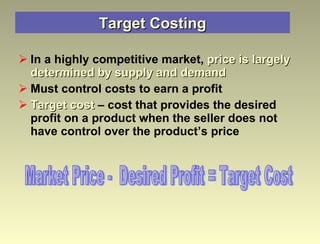
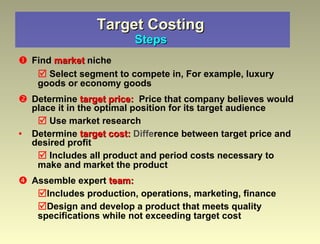
Target Costing In a highly competitive market,  price is largely determined by supply and demand Must control costs to earn a profit Target cost  – cost that provides the desired profit on a product when the seller does not have control over the product’s price Market Price -  Desired Profit = Target Cost
Target Costing   Steps  Find  market  niche Select segment to compete in, For example, luxury goods or economy goods Determine  target price:   Price that company believes would place it in the optimal position for its target audience Use market research Determine  target cost:   Diffe rence between target price and desired profit Includes all product and period costs necessary to make and market the product Assemble expert  team: Includes production, operations, marketing, finance Design and develop a product that meets quality specifications while not exceeding target cost
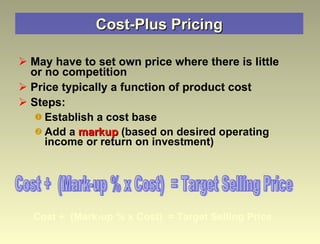
Cost-Plus Pricing May have to set own price where there is little or no competition Price typically a function of product cost  Steps: Establish a cost base Add a  markup  (based on desired operating income or return on investment) Cost +  (Mark-up % x Cost)  = Target Selling Price Cost +  (Mark-up % x Cost)  = Target Selling Price
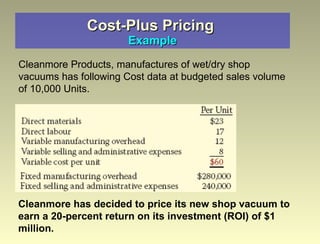
Cost-Plus Pricing  Example Cleanmore Products, manufactures of wet/dry shop vacuums has following Cost data at budgeted sales volume of 10,000 Units. Cleanmore has decided to price its new shop vacuum to earn a 20-percent return on its investment (ROI) of $1 million.
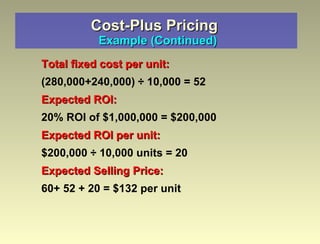
Cost-Plus Pricing    Example (Continued) Total fixed cost per unit:   (280,000+240,000)  ÷  10,000 = 52 Expected ROI:   20% ROI of $1,000,000 = $200,000 Expected ROI per unit:  $200,000  ÷ 10,000 units = 20 Expected Selling Price:  60+ 52 + 20 = $132 per unit
Cost-Plus Pricing   Limitations Advantage –  Easy to calculate Disadvantages: Does not consider demand side Will the customer pay the price? Fixed cost per unit changes with change in  volume  At  lower  sales volume, company must charge  higher  price to meet  desired ROI
Variable Cost Pricing Alternative pricing approach: Simply add a markup to variable costs Avoids using poor cost information related to fixed costs per unit Useful in pricing special orders or when excess capacity exists Major disadvantage: Prices set too low to cover fixed costs
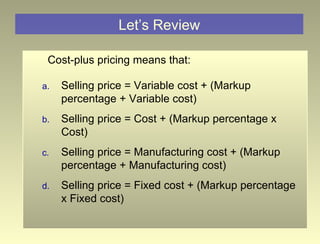
Let’s Review Cost-plus pricing means that: Selling price = Variable cost + (Markup percentage + Variable cost) Selling price = Cost + (Markup percentage x Cost) Selling price = Manufacturing cost + (Markup percentage + Manufacturing cost) Selling price = Fixed cost + (Markup percentage x Fixed cost)
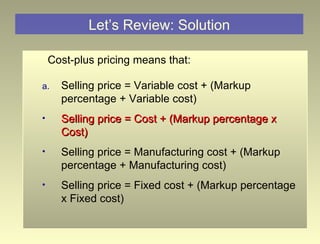
Let’s Review: Solution Cost-plus pricing means that: Selling price = Variable cost + (Markup percentage + Variable cost) Selling price = Cost + (Markup percentage x Cost) Selling price = Manufacturing cost + (Markup percentage + Manufacturing cost) Selling price = Fixed cost + (Markup percentage x Fixed cost)
Time and Material Pricing An approach to cost-plus pricing in which the company uses  two  pricing rates: One for the  labour  used on a job  One for the  material Widely used in service industries, especially professional firms Public accounting Law Engineering
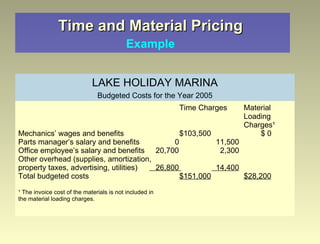
Time and Material Pricing   Example   Time Charges Material Loading  Charges¹ Mechanics’ wages and benefits  $103,500    $ 0 Parts manager’s salary and benefits    0    11,500 Office employee’s salary and benefits    20,700    2,300 Other overhead (supplies, amortization, property taxes, advertising, utilities)    26,800    14,400 Total budgeted costs  $151,000   $28,200 ¹ The invoice cost of the materials is not included in the material loading charges. LAKE HOLIDAY MARINA Budgeted Costs for the Year 2005
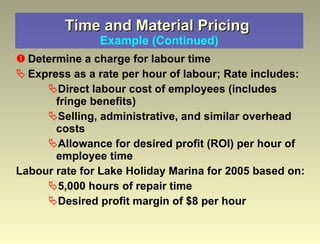
Time and Material Pricing  Example (Continued) Determine a charge for labour time Express as a rate per hour of labour; Rate includes:  Direct labour cost of employees (includes fringe benefits) Selling, administrative, and similar overhead costs Allowance for desired profit (ROI) per hour of employee time  Labour rate for Lake Holiday Marina for 2005 based on: 5,000 hours of repair time Desired profit margin of $8 per hour
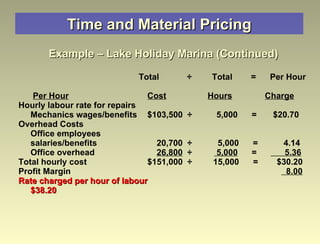
Time and Material Pricing Example – Lake Holiday Marina (Continued)     Total  ÷ Total  =  Per Hour    Per Hour   Cost   Hours   Charge Hourly labour rate for repairs Mechanics wages/benefits  $103,500  ÷    5,000  =  $20.70 Overhead Costs  Office employees  salaries/benefits    20,700  ÷  5,000  =  4.14 Office overhead     26,800   ÷    5,000   =  5.36 Total hourly cost $151,000  ÷  15,000  =  $30.20 Profit Margin   8.00 Rate charged per hour of labour   $38.20
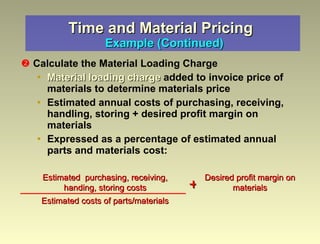
Time and Material Pricing   Example (Continued) Calculate the Material Loading Charge Material loading charge   added to invoice price of materials to determine materials price Estimated annual costs of purchasing, receiving, handling, storing + desired profit margin on materials Expressed as a percentage of estimated annual parts and materials cost: Desired profit margin on materials Estimated costs of parts/materials +   Estimated  purchasing, receiving, handing, storing costs
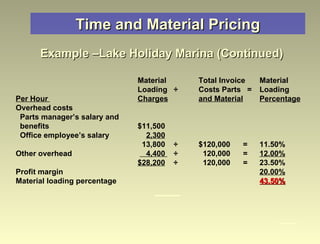
Time and Material Pricing Example –Lake Holiday Marina (Continued)     Material  Total Invoice  Material  Loading  ÷  Costs Parts  =  Loading Per Hour  Charges   and Material   Percentage Overhead costs Parts manager’s salary and  benefits  $11,500 Office employee’s salary    2,300   13,800  ÷ $120,000  = 11.50% Other overhead    4,400  ÷     120,000  =  12.00% $28,200   ÷     120,000  =  23.50% Profit margin  20.00% Material loading percentage  43.50%
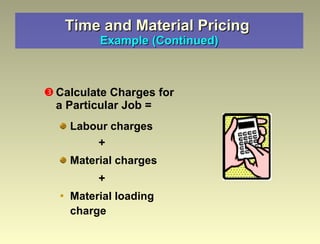
Time and Material Pricing  Example (Continued) Calculate Charges for a Particular Job = Labour charges + Material charges + Material loading charge
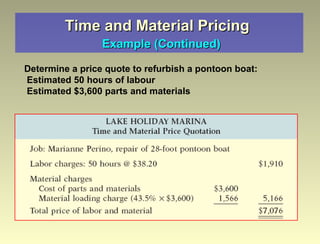
Time and Material Pricing    Example (Continued) Determine a price quote to refurbish a pontoon boat: Estimated 50 hours of labour  Estimated $3,600 parts and materials
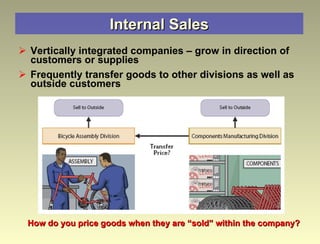
Internal Sales Vertically integrated companies – grow in direction of customers or supplies Frequently transfer goods to other divisions as well as outside customers How do you price goods when they are “sold” within the company?
Internal Sales Transfer price  – price used to record the transfer between two divisions of a company  Ways to determine a transfer price: Negotiated transfer prices Cost-based transfer prices Market-based transfer prices Conceptually   - a negotiated transfer price  is best  Due to   practical considerations , other two methods are more widely used Negotiated transfer prices is determined by  agreement   of the division managers when no external market price is available
Negotiated Transfer Price   Example: Alberta Company Sells hiking boots as well as soles for work & hiking boots Structured into two divisions:  Boot and Sole Sole Division  -  sells soles externally Boot Division -  makes leather uppers for hiking boots which are attached to purchased soles Each Division Manager compensated on division profitability Management now wants Sole Division to provide at least some soles to the Boot Division
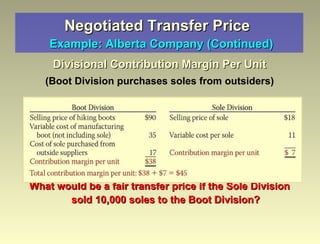
Negotiated Transfer Price    Example: Alberta Company (Continued) Divisional Contribution Margin Per Unit (Boot Division purchases soles from outsiders) What would be a fair transfer price if the Sole Division sold 10,000 soles to the Boot Division?
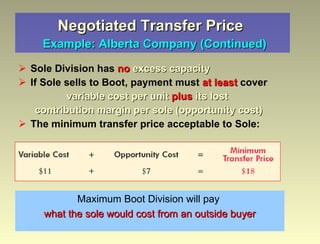
Negotiated Transfer Price    Example: Alberta Company (Continued) Sole Division has   no   excess capacity If Sole sells to Boot, payment must  at least  cover variable cost per unit  plus  its lost contribution margin per sole (opportunity cost) The minimum transfer price acceptable to Sole: Maximum Boot Division will pay  what the sole would cost from an outside buyer
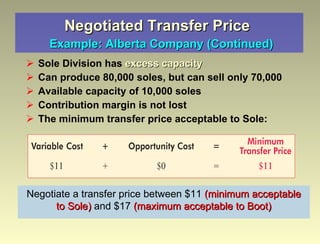
Negotiated Transfer Price    Example: Alberta Company (Continued) Sole Division has  excess capacity  Can produce 80,000 soles, but can sell only 70,000 Available capacity of 10,000 soles Contribution margin is not lost The minimum transfer price acceptable to Sole: Negotiate a transfer price between $11   (minimum acceptable to Sole)   and $17   (maximum acceptable to Boot)
Negotiated Transfer Price   Variable Costs In the minimum transfer price formula,  variable cost is the variable cost of units sold   internally May differ – higher or lower – for units sold internally versus those sold externally  The minimum transfer pricing formula can still be used – just use the internal variable costs
Negotiated Transfer Price Summary Transfer prices established: Minimum by selling division Maximum by the buying division Often not used because: Market price information sometimes not available Lack of trust between the two divisions Different pricing strategies between divisions Therefore, companies often use cost or market based information to develop transfer prices
Cost-Based Transfer Prices Uses costs incurred by the division producing the goods as its foundation May be based on variable costs  or  variable costs plus fixed costs Markup may also be added Can result in improper transfer prices causing: Loss of profitability for company  Unfair evaluation of division performance
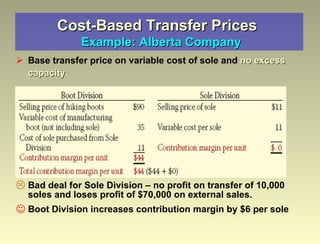
Cost-Based Transfer Prices    Example: Alberta Company Base transfer price on variable cost of sole and  no excess capacity Bad deal for Sole Division – no profit on transfer of 10,000 soles and loses profit of $70,000 on external sales. Boot Division increases contribution margin by $6 per sole
Cost-Based Transfer Prices    Example: Alberta Company  (Continued) Sole Division has  excess capacity :  Continues to report zero profit but does not lose the $7 per unit due to excess capacity Boot Division gains $6 Overall, company is better off by $60,000 (10,000 X 6) Does not reflect Sole Division’s true profitability
Cost-Based Transfer Prices     Summary Disadvantages Does not reflect a division’s true profitability Does not provide an incentive to control costs which are passed on to the next division Advantages Simple to understand Easy to use due to availability of information Market information often not available Most common method
Market-Based Transfer Prices Based on existing market prices of competing products Often considered best approach because: Objective Economic incentives Indifferent  between selling internally and externally if can charge/pay market price  Can lead to bad decisions if have excess capacity Why?  No opportunity cost. Where there is not a well-defined market price, companies use cost-based systems
Effect of Outsourcing on Transfer Prices Contracting with an external party to provide a good or service, rather than doing the work internally Virtual Companies  outsource all of their production As outsourcing increases, fewer components are transferred internally between divisions Use incremental analysis to determine if outsourcing is profitable
Transfers between Divisions in Different Countries Going global increases transfers between divisions located in different countries 60% of trade between countries estimated to be transfers between divisions Different tax rates make determining appropriate transfer price more difficult
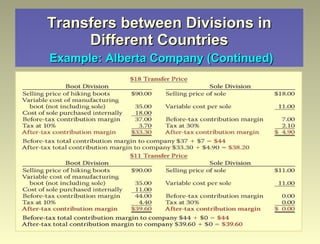
Transfers between Divisions in Different Countries   Example: Alberta Company Boot Division is in a country with 10% tax rate  Sole Division is located in a country with a 30% rate The before-tax total contribution margin is $44 regardless of whether the transfer price is $18 or $11 The  after-tax total  is $38.20 using the $18 transfer price, and $39.60 using the $11 transfer price Why? More of the contribution margin is attributed to the division in the country with the lower tax rate.
Transfers between Divisions in Different Countries   Example: Alberta Company (Continued)
Copyright © 2006 John Wiley & Sons Canada, Ltd.  All rights reserved.  Reproduction or translation of this work beyond that permitted by Access Copyright (The Canadian Copyright Licensing Agency) is unlawful.  Requests for further information should be addressed to the Permissions Department, John Wiley & Sons Canada, Ltd.  The purchaser may make back-up copies for his or her own use only and not for distribution or resale.  The author and the publisher assume no responsibility for errors, omissions, or damages caused by the use of these programs or from the use of the information contained herein. Copyright

Ch08

  • 1.
    ManagerialAccounting: Tools for Business Decision-Making Canadian Edition Weygandt ● Kieso ● Kimmel ● Aly
  • 2.
  • 3.
    Calculate a targetcost when a product’s price is determined by the market. Calculate target selling price using cost-plus pricing. Use time and material pricing to determine the cost of services provided. Chapter 8 Pricing Study Objectives
  • 4.
    Study Objectives: ContinuedDefine “transfer price” and its role in an organization. Determine a transfer price using the negotiated, cost-based, and market-based approaches. Explain the issues that arise when transferring goods between divisions located in countries with different tax rates.
  • 5.
    External Sales Manyfactors affect price Product price should cover costs and earn a reasonable profit Must have a good understanding of market forces for appropriate price Fixed and variable costs Short-run or long-run Pricing Objectives Demand Environment Gain market share Achieve a target rate of return Political reaction to prices Patent or copyright protection Cost Considerations Price sensitivity Demographics What Prices Should Be Charged?
  • 6.
    External Sales (Continued) A company can accept the price as set by the competitive market (supply and demand) Market sets price when product cannot be easily differentiated from competing products Examples: farm products and minerals A company can set the price when Product is specially made One of a kind No one else produces the product Company can differentiate its product from others Examples: Designer dress and patent or copyright on a unique process
  • 7.
    Target Costing Ina highly competitive market, price is largely determined by supply and demand Must control costs to earn a profit Target cost – cost that provides the desired profit on a product when the seller does not have control over the product’s price Market Price - Desired Profit = Target Cost
  • 8.
    Target Costing Steps Find market niche Select segment to compete in, For example, luxury goods or economy goods Determine target price: Price that company believes would place it in the optimal position for its target audience Use market research Determine target cost: Diffe rence between target price and desired profit Includes all product and period costs necessary to make and market the product Assemble expert team: Includes production, operations, marketing, finance Design and develop a product that meets quality specifications while not exceeding target cost
  • 9.
    Cost-Plus Pricing Mayhave to set own price where there is little or no competition Price typically a function of product cost Steps: Establish a cost base Add a markup (based on desired operating income or return on investment) Cost + (Mark-up % x Cost) = Target Selling Price Cost + (Mark-up % x Cost) = Target Selling Price
  • 10.
    Cost-Plus Pricing Example Cleanmore Products, manufactures of wet/dry shop vacuums has following Cost data at budgeted sales volume of 10,000 Units. Cleanmore has decided to price its new shop vacuum to earn a 20-percent return on its investment (ROI) of $1 million.
  • 11.
    Cost-Plus Pricing Example (Continued) Total fixed cost per unit: (280,000+240,000) ÷ 10,000 = 52 Expected ROI: 20% ROI of $1,000,000 = $200,000 Expected ROI per unit: $200,000 ÷ 10,000 units = 20 Expected Selling Price: 60+ 52 + 20 = $132 per unit
  • 12.
    Cost-Plus Pricing Limitations Advantage – Easy to calculate Disadvantages: Does not consider demand side Will the customer pay the price? Fixed cost per unit changes with change in volume At lower sales volume, company must charge higher price to meet desired ROI
  • 13.
    Variable Cost PricingAlternative pricing approach: Simply add a markup to variable costs Avoids using poor cost information related to fixed costs per unit Useful in pricing special orders or when excess capacity exists Major disadvantage: Prices set too low to cover fixed costs
  • 14.
    Let’s Review Cost-pluspricing means that: Selling price = Variable cost + (Markup percentage + Variable cost) Selling price = Cost + (Markup percentage x Cost) Selling price = Manufacturing cost + (Markup percentage + Manufacturing cost) Selling price = Fixed cost + (Markup percentage x Fixed cost)
  • 15.
    Let’s Review: SolutionCost-plus pricing means that: Selling price = Variable cost + (Markup percentage + Variable cost) Selling price = Cost + (Markup percentage x Cost) Selling price = Manufacturing cost + (Markup percentage + Manufacturing cost) Selling price = Fixed cost + (Markup percentage x Fixed cost)
  • 16.
    Time and MaterialPricing An approach to cost-plus pricing in which the company uses two pricing rates: One for the labour used on a job One for the material Widely used in service industries, especially professional firms Public accounting Law Engineering
  • 17.
    Time and MaterialPricing Example Time Charges Material Loading Charges¹ Mechanics’ wages and benefits $103,500 $ 0 Parts manager’s salary and benefits 0 11,500 Office employee’s salary and benefits 20,700 2,300 Other overhead (supplies, amortization, property taxes, advertising, utilities) 26,800 14,400 Total budgeted costs $151,000 $28,200 ¹ The invoice cost of the materials is not included in the material loading charges. LAKE HOLIDAY MARINA Budgeted Costs for the Year 2005
  • 18.
    Time and MaterialPricing Example (Continued) Determine a charge for labour time Express as a rate per hour of labour; Rate includes: Direct labour cost of employees (includes fringe benefits) Selling, administrative, and similar overhead costs Allowance for desired profit (ROI) per hour of employee time Labour rate for Lake Holiday Marina for 2005 based on: 5,000 hours of repair time Desired profit margin of $8 per hour
  • 19.
    Time and MaterialPricing Example – Lake Holiday Marina (Continued) Total ÷ Total = Per Hour Per Hour Cost Hours Charge Hourly labour rate for repairs Mechanics wages/benefits $103,500 ÷ 5,000 = $20.70 Overhead Costs Office employees salaries/benefits 20,700 ÷ 5,000 = 4.14 Office overhead 26,800 ÷ 5,000 = 5.36 Total hourly cost $151,000 ÷ 15,000 = $30.20 Profit Margin 8.00 Rate charged per hour of labour $38.20
  • 20.
    Time and MaterialPricing Example (Continued) Calculate the Material Loading Charge Material loading charge added to invoice price of materials to determine materials price Estimated annual costs of purchasing, receiving, handling, storing + desired profit margin on materials Expressed as a percentage of estimated annual parts and materials cost: Desired profit margin on materials Estimated costs of parts/materials + Estimated purchasing, receiving, handing, storing costs
  • 21.
    Time and MaterialPricing Example –Lake Holiday Marina (Continued) Material Total Invoice Material Loading ÷ Costs Parts = Loading Per Hour Charges and Material Percentage Overhead costs Parts manager’s salary and benefits $11,500 Office employee’s salary 2,300 13,800 ÷ $120,000 = 11.50% Other overhead 4,400 ÷ 120,000 = 12.00% $28,200 ÷ 120,000 = 23.50% Profit margin 20.00% Material loading percentage 43.50%
  • 22.
    Time and MaterialPricing Example (Continued) Calculate Charges for a Particular Job = Labour charges + Material charges + Material loading charge
  • 23.
    Time and MaterialPricing Example (Continued) Determine a price quote to refurbish a pontoon boat: Estimated 50 hours of labour Estimated $3,600 parts and materials
  • 24.
    Internal Sales Verticallyintegrated companies – grow in direction of customers or supplies Frequently transfer goods to other divisions as well as outside customers How do you price goods when they are “sold” within the company?
  • 25.
    Internal Sales Transferprice – price used to record the transfer between two divisions of a company Ways to determine a transfer price: Negotiated transfer prices Cost-based transfer prices Market-based transfer prices Conceptually - a negotiated transfer price is best Due to practical considerations , other two methods are more widely used Negotiated transfer prices is determined by agreement of the division managers when no external market price is available
  • 26.
    Negotiated Transfer Price Example: Alberta Company Sells hiking boots as well as soles for work & hiking boots Structured into two divisions: Boot and Sole Sole Division - sells soles externally Boot Division - makes leather uppers for hiking boots which are attached to purchased soles Each Division Manager compensated on division profitability Management now wants Sole Division to provide at least some soles to the Boot Division
  • 27.
    Negotiated Transfer Price Example: Alberta Company (Continued) Divisional Contribution Margin Per Unit (Boot Division purchases soles from outsiders) What would be a fair transfer price if the Sole Division sold 10,000 soles to the Boot Division?
  • 28.
    Negotiated Transfer Price Example: Alberta Company (Continued) Sole Division has no excess capacity If Sole sells to Boot, payment must at least cover variable cost per unit plus its lost contribution margin per sole (opportunity cost) The minimum transfer price acceptable to Sole: Maximum Boot Division will pay what the sole would cost from an outside buyer
  • 29.
    Negotiated Transfer Price Example: Alberta Company (Continued) Sole Division has excess capacity Can produce 80,000 soles, but can sell only 70,000 Available capacity of 10,000 soles Contribution margin is not lost The minimum transfer price acceptable to Sole: Negotiate a transfer price between $11 (minimum acceptable to Sole) and $17 (maximum acceptable to Boot)
  • 30.
    Negotiated Transfer Price Variable Costs In the minimum transfer price formula, variable cost is the variable cost of units sold internally May differ – higher or lower – for units sold internally versus those sold externally The minimum transfer pricing formula can still be used – just use the internal variable costs
  • 31.
    Negotiated Transfer PriceSummary Transfer prices established: Minimum by selling division Maximum by the buying division Often not used because: Market price information sometimes not available Lack of trust between the two divisions Different pricing strategies between divisions Therefore, companies often use cost or market based information to develop transfer prices
  • 32.
    Cost-Based Transfer PricesUses costs incurred by the division producing the goods as its foundation May be based on variable costs or variable costs plus fixed costs Markup may also be added Can result in improper transfer prices causing: Loss of profitability for company Unfair evaluation of division performance
  • 33.
    Cost-Based Transfer Prices Example: Alberta Company Base transfer price on variable cost of sole and no excess capacity Bad deal for Sole Division – no profit on transfer of 10,000 soles and loses profit of $70,000 on external sales. Boot Division increases contribution margin by $6 per sole
  • 34.
    Cost-Based Transfer Prices Example: Alberta Company (Continued) Sole Division has excess capacity : Continues to report zero profit but does not lose the $7 per unit due to excess capacity Boot Division gains $6 Overall, company is better off by $60,000 (10,000 X 6) Does not reflect Sole Division’s true profitability
  • 35.
    Cost-Based Transfer Prices Summary Disadvantages Does not reflect a division’s true profitability Does not provide an incentive to control costs which are passed on to the next division Advantages Simple to understand Easy to use due to availability of information Market information often not available Most common method
  • 36.
    Market-Based Transfer PricesBased on existing market prices of competing products Often considered best approach because: Objective Economic incentives Indifferent between selling internally and externally if can charge/pay market price Can lead to bad decisions if have excess capacity Why? No opportunity cost. Where there is not a well-defined market price, companies use cost-based systems
  • 37.
    Effect of Outsourcingon Transfer Prices Contracting with an external party to provide a good or service, rather than doing the work internally Virtual Companies outsource all of their production As outsourcing increases, fewer components are transferred internally between divisions Use incremental analysis to determine if outsourcing is profitable
  • 38.
    Transfers between Divisionsin Different Countries Going global increases transfers between divisions located in different countries 60% of trade between countries estimated to be transfers between divisions Different tax rates make determining appropriate transfer price more difficult
  • 39.
    Transfers between Divisionsin Different Countries Example: Alberta Company Boot Division is in a country with 10% tax rate Sole Division is located in a country with a 30% rate The before-tax total contribution margin is $44 regardless of whether the transfer price is $18 or $11 The after-tax total is $38.20 using the $18 transfer price, and $39.60 using the $11 transfer price Why? More of the contribution margin is attributed to the division in the country with the lower tax rate.
  • 40.
    Transfers between Divisionsin Different Countries Example: Alberta Company (Continued)
  • 41.
    Copyright © 2006John Wiley & Sons Canada, Ltd. All rights reserved. Reproduction or translation of this work beyond that permitted by Access Copyright (The Canadian Copyright Licensing Agency) is unlawful. Requests for further information should be addressed to the Permissions Department, John Wiley & Sons Canada, Ltd. The purchaser may make back-up copies for his or her own use only and not for distribution or resale. The author and the publisher assume no responsibility for errors, omissions, or damages caused by the use of these programs or from the use of the information contained herein. Copyright