Chapter Five Hand Tools and Shop Equipment
Objectives List the basic units of measure for length, volume, and mass in the two measuring systems. Describe the different types of fasteners used in the automotive industry. List the various mechanical measuring tools used in the automotive shop. Describe the proper procedure for measuring with a micrometer.
Objectives (Contโ€™d) List some of the hand tools used in auto repair. List the common types of shop equipment and state their purpose. Describe the use of common pneumatic, electrical, and hydraulic power tools found in an automotive service department. Describe the different sources for service information that are available to technicians.
Units of Measure United States Customary (USC)   Linear   examples : inch, foot, yard, mile Weight   examples : ounce, pound, ton Temperature   example : Fahrenheit Pressure   examples : pounds per square inch Torque   example : foot pounds
Units of Measure (Contโ€™d) Metric Linear examples:   meter, centimeter, kilometer Weight   examples :  grams, kilograms Temperature   example :  Celsius Pressure   examples :  kilogram per square centimeter, bar Torque   example :  Newton meters
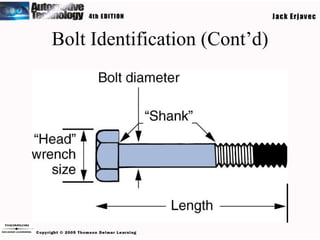
Bolt Identification Diameter Measured across the threaded area Thread pitch (English system) The number of threads per inch Thread pitch (Metric system) The distance in millimeters between two adjacent threads
Bolt Identification (Contโ€™d)
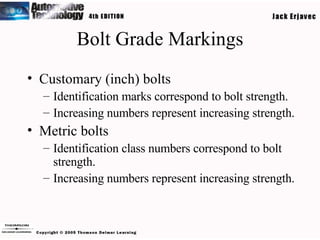
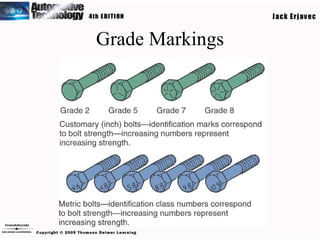
Bolt Grade Markings Customary (inch) bolts Identification marks correspond to bolt strength. Increasing numbers represent increasing strength. Metric bolts Identification class numbers correspond to bolt strength. Increasing numbers represent increasing strength.
Grade Markings
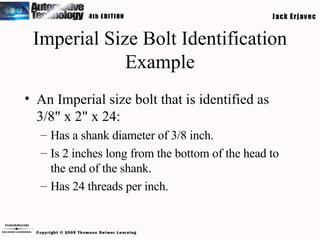
Imperial Size Bolt Identification Example An Imperial size bolt that is identified as 3/8" x 2" x 24: Has a shank diameter of 3/8 inch. Is 2 inches long from the bottom of the head to the end of the shank. Has 24 threads per inch.
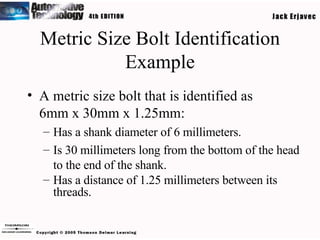
Metric Size Bolt Identification Example A metric size bolt that is identified as  6mm x 30mm x 1.25mm: Has a shank diameter of 6 millimeters. Is 30 millimeters long from the bottom of the head to the end of the shank. Has a distance of 1.25 millimeters between its threads.
Measuring Devices Machinistโ€™s rule Is usually used to measure items that donโ€™t require extremely close tolerances, such as bolt lengths. Vernier caliper Is usually used to measure items that require a closer degree of accuracy, such as shim thickness.
Measuring Devices (Contโ€™d) Dial caliper Is a version of a vernier caliper that is easier to read. Micrometer Is used for measuring items that require very close tolerances, such as shaft thickness and bearing diameter.
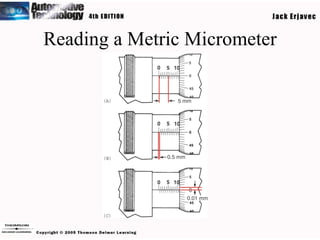
Reading a Metric Micrometer
Measuring Devices (Contโ€™d) Dial indicator Is used to measure radial or axial movement, such as a shaftโ€™s runout or end play. Telescoping gauge Is commonly used to measure larger bore diameters, such as an engine cylinder.
Measuring Devices (Contโ€™d) Small hole gauge Is used for measuring small bores, such as an engine valve guide. Feeler gauge Is used to measure clearances, such as a spark plug gap. Screw pitch gauge Is used to determine thread pitch of a bolt or screw.
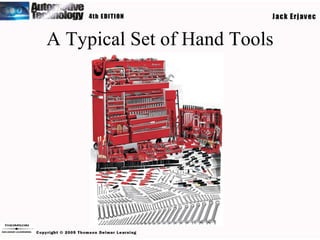
A Typical Set of Hand Tools
Hand Tools Wrenches Open-end Box-end Flare nut or line Metric or USCS Allen
Hand Tools (Contโ€™d) Ratchets and Sockets Six, eight, or twelve point Deep and shallow Metric or USCS Impact or chrome Torx Swivel sockets
Hand Tools (Contโ€™d) Screwdrivers Pliers Hammers and mallets Punches and chisels Files Taps and dies
Types of Torque Wrenches Beam Is not very accurate. โ€œ Clickโ€ When the handle reaches the preset torque, the wrench clicks. Dial A dial indicates the amount of torque exerted. Digital read out Is usually the most accurate design.
Hand Tool Safety Use the proper tool for the job. Use the correct size wrench or socket. Use box-end wrench or socket whenever possible. Always pull on a wrench.
Power Tools Impact wrenches Air ratchets Drills Blow guns Grinders Cutting tools
Power Tools (Contโ€™d) Drill press Bench grinders Grinding wheel Wire wheel Buffing wheel
Power Tools (Contโ€™d) Presses Trouble lights Incandescent or fluorescent
Service Information Sources Manufacturersโ€™ service information Computer-based information systems Flat-rate manuals Ownerโ€™s manuals Lubrication guides Aftermarket suppliersโ€™ guides and catalogs Hotline services International Automotive Technicians Network
Steps for Using a Service Manual Select the appropriate manual for the vehicle being serviced. Use the table of contents to locate the applicable section. Use the index at the front of the section to locate the required information.
Steps for Using a Service Manual (Contโ€™d) Carefully read the information and study the illustrations and diagrams. Follow the required steps and procedures. Adhere to all of the given specifications  and safety precautions.
Lifting Tools Hydraulic floor jack Is used to raise vehicle off the ground. Is used with safety stands. Pneumatic jack Uses air to raise vehicle. Is used with safety stands.
Lifting Tools (Contโ€™d) Safety stand Is used to support a vehicle when raised. Hydraulic lift Is safest lifting tool. Is also called a hoist.
Lifting Tools (Contโ€™d) Engine hoist Is sometimes called a cherry picker. Uses hydraulic pressure to lift an engine from a vehicle.
Summary Repairing the modern automobile requires the use of many different hand and power tools. It is crucial to use the proper amount of torque when tightening fasteners on any part of a vehicle, particularly the engine.
Summary (Contโ€™d) Metric and SAE size wrenches are not interchangeable. Carelessness or mishandling of power tools can cause serious injury. The primary source of repair and specification information for any vehicle is the manufacturerโ€™s service manual.

Ch05 Hand Toolsand Shop Equipment Rev

  • 1.
    Chapter Five HandTools and Shop Equipment
  • 2.
    Objectives List thebasic units of measure for length, volume, and mass in the two measuring systems. Describe the different types of fasteners used in the automotive industry. List the various mechanical measuring tools used in the automotive shop. Describe the proper procedure for measuring with a micrometer.
  • 3.
    Objectives (Contโ€™d) Listsome of the hand tools used in auto repair. List the common types of shop equipment and state their purpose. Describe the use of common pneumatic, electrical, and hydraulic power tools found in an automotive service department. Describe the different sources for service information that are available to technicians.
  • 4.
    Units of MeasureUnited States Customary (USC) Linear examples : inch, foot, yard, mile Weight examples : ounce, pound, ton Temperature example : Fahrenheit Pressure examples : pounds per square inch Torque example : foot pounds
  • 5.
    Units of Measure(Contโ€™d) Metric Linear examples: meter, centimeter, kilometer Weight examples : grams, kilograms Temperature example : Celsius Pressure examples : kilogram per square centimeter, bar Torque example : Newton meters
  • 6.
    Bolt Identification DiameterMeasured across the threaded area Thread pitch (English system) The number of threads per inch Thread pitch (Metric system) The distance in millimeters between two adjacent threads
  • 7.
  • 8.
    Bolt Grade MarkingsCustomary (inch) bolts Identification marks correspond to bolt strength. Increasing numbers represent increasing strength. Metric bolts Identification class numbers correspond to bolt strength. Increasing numbers represent increasing strength.
  • 9.
  • 10.
    Imperial Size BoltIdentification Example An Imperial size bolt that is identified as 3/8" x 2" x 24: Has a shank diameter of 3/8 inch. Is 2 inches long from the bottom of the head to the end of the shank. Has 24 threads per inch.
  • 11.
    Metric Size BoltIdentification Example A metric size bolt that is identified as 6mm x 30mm x 1.25mm: Has a shank diameter of 6 millimeters. Is 30 millimeters long from the bottom of the head to the end of the shank. Has a distance of 1.25 millimeters between its threads.
  • 12.
    Measuring Devices Machinistโ€™srule Is usually used to measure items that donโ€™t require extremely close tolerances, such as bolt lengths. Vernier caliper Is usually used to measure items that require a closer degree of accuracy, such as shim thickness.
  • 13.
    Measuring Devices (Contโ€™d)Dial caliper Is a version of a vernier caliper that is easier to read. Micrometer Is used for measuring items that require very close tolerances, such as shaft thickness and bearing diameter.
  • 14.
    Reading a MetricMicrometer
  • 15.
    Measuring Devices (Contโ€™d)Dial indicator Is used to measure radial or axial movement, such as a shaftโ€™s runout or end play. Telescoping gauge Is commonly used to measure larger bore diameters, such as an engine cylinder.
  • 16.
    Measuring Devices (Contโ€™d)Small hole gauge Is used for measuring small bores, such as an engine valve guide. Feeler gauge Is used to measure clearances, such as a spark plug gap. Screw pitch gauge Is used to determine thread pitch of a bolt or screw.
  • 17.
    A Typical Setof Hand Tools
  • 18.
    Hand Tools WrenchesOpen-end Box-end Flare nut or line Metric or USCS Allen
  • 19.
    Hand Tools (Contโ€™d)Ratchets and Sockets Six, eight, or twelve point Deep and shallow Metric or USCS Impact or chrome Torx Swivel sockets
  • 20.
    Hand Tools (Contโ€™d)Screwdrivers Pliers Hammers and mallets Punches and chisels Files Taps and dies
  • 21.
    Types of TorqueWrenches Beam Is not very accurate. โ€œ Clickโ€ When the handle reaches the preset torque, the wrench clicks. Dial A dial indicates the amount of torque exerted. Digital read out Is usually the most accurate design.
  • 22.
    Hand Tool SafetyUse the proper tool for the job. Use the correct size wrench or socket. Use box-end wrench or socket whenever possible. Always pull on a wrench.
  • 23.
    Power Tools Impactwrenches Air ratchets Drills Blow guns Grinders Cutting tools
  • 24.
    Power Tools (Contโ€™d)Drill press Bench grinders Grinding wheel Wire wheel Buffing wheel
  • 25.
    Power Tools (Contโ€™d)Presses Trouble lights Incandescent or fluorescent
  • 26.
    Service Information SourcesManufacturersโ€™ service information Computer-based information systems Flat-rate manuals Ownerโ€™s manuals Lubrication guides Aftermarket suppliersโ€™ guides and catalogs Hotline services International Automotive Technicians Network
  • 27.
    Steps for Usinga Service Manual Select the appropriate manual for the vehicle being serviced. Use the table of contents to locate the applicable section. Use the index at the front of the section to locate the required information.
  • 28.
    Steps for Usinga Service Manual (Contโ€™d) Carefully read the information and study the illustrations and diagrams. Follow the required steps and procedures. Adhere to all of the given specifications and safety precautions.
  • 29.
    Lifting Tools Hydraulicfloor jack Is used to raise vehicle off the ground. Is used with safety stands. Pneumatic jack Uses air to raise vehicle. Is used with safety stands.
  • 30.
    Lifting Tools (Contโ€™d)Safety stand Is used to support a vehicle when raised. Hydraulic lift Is safest lifting tool. Is also called a hoist.
  • 31.
    Lifting Tools (Contโ€™d)Engine hoist Is sometimes called a cherry picker. Uses hydraulic pressure to lift an engine from a vehicle.
  • 32.
    Summary Repairing themodern automobile requires the use of many different hand and power tools. It is crucial to use the proper amount of torque when tightening fasteners on any part of a vehicle, particularly the engine.
  • 33.
    Summary (Contโ€™d) Metricand SAE size wrenches are not interchangeable. Carelessness or mishandling of power tools can cause serious injury. The primary source of repair and specification information for any vehicle is the manufacturerโ€™s service manual.