Global Marketing Management, 5eChapter 4Copyright (c) 2009 John Wiley & Sons, Inc.1Chapter 4Global Cultural Environment and Buying Behavior
Chapter OverviewChapter 4Copyright (c) 2009 John Wiley & Sons, Inc.21.  Definition of Culture2.  Elements of Culture3.  Cross-Cultural Comparisons4.  Adapting to Cultures5.  Cultures and the Marketing Mix6.  Organizational Cultures7.  Global Account Management (GAM)8.  Global Customer Relationship  Management (CRM)
IntroductionChapter 4Copyright (c) 2009 John Wiley & Sons, Inc.3Buyer behavior and consumer needs are largely driven by cultural norms.Global business means dealing with consumers, strategic partners, distributors, and competitors with different cultural mindsets.Within a given culture, consumption processes can include four stages: access, buying behavior, consumption characteristics, and disposal (Exhibit 4-1).Each of these stages is heavily influenced by the culture in which the consumer thrives.
Exhibit 4-1: The A-B-C-D ParadigmChapter 4Copyright (c) 2009 John Wiley & Sons, Inc.4
1. Definition of CultureChapter 4Copyright (c) 2009 John Wiley & Sons, Inc.5There are numerous definitions of culture. In this text, culture (in a business setting) is defined as being a learned, shared, compelling, interrelated set of symbols whose meanings provide a set of orientations for members of society.Cultures may be defined by national borders, especially when countries are isolated by natural barriers.Cultures contain subcultures that have little in common with one another.
2. Elements of CultureChapter 4Copyright (c) 2009 John Wiley & Sons, Inc.6Culture consists of many interrelated components. Knowledge of a culture requires a deep understanding of its different parts. Following are the elements of culture:Material life(technologies that are used to produce, distribute, and consume goods and services)Language (language has two parts: the spoken and the silent language)Blunders of translation are common either direction	(Exhibit 4-2)Back-translation can help avoid problems
Chapter 4Copyright (c) 2007 John Wiley & Sons, Inc.7Exhibit 4-2: Notice to Guests
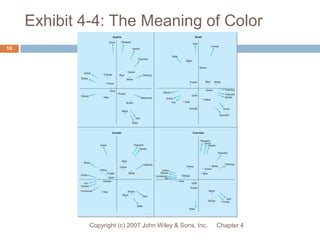
2. Elements of CultureChapter 4Copyright (c) 2009 John Wiley & Sons, Inc.8Social Interaction(social interactions among people; nuclear family, extended family; reference groups) (Exhibit 4-3).Aesthetics (ideas and perceptions that a culture upholds in terms of beauty and good taste) (Exhibit 4-4).Religion (community’s set of beliefs relating to a reality that cannot be verified empirically) (Exhibit 4-5).Education (One of the major vehicles to channel from one generation to the next) (Exhibit 4-6).Value System(values shape people’s norms and standards) (Exhibit 4-7).
Chapter 4Copyright (c) 2007 John Wiley & Sons, Inc.9Exhibit 4-3: Rules to Start Cracking the Guanxi Code in China
Chapter 4Copyright (c) 2007 John Wiley & Sons, Inc.10Exhibit 4-4: The Meaning of Color
Chapter 4Copyright (c) 2007 John Wiley & Sons, Inc.11Exhibit 4-5: Higher Education Achievement
Chapter 4Copyright (c) 2007 John Wiley & Sons, Inc.12Exhibit 4-6: Dentsu Lifestyle Survey
3. Cross-Cultural ComparisonsChapter 4Copyright (c) 2009 John Wiley & Sons, Inc.13Cultures differ from one another, but usually share certain aspects. Recent social psychology research reveal key cultural differences between East (high) and West (low) context cultures in how people perceive reality and reasoning (see below).
High-context cultures: Interpretation of messages rests on contextual cues; e.g., China, Korea, Japan.
Low-context cultures: Put the most emphasis on written or spoken words; e.g., USA, Scandinavia, Germany.Chapter 4Copyright (c) 2009 John Wiley & Sons, Inc.143. Cross-Cultural ComparisonsJapaneseHigh contextIMPLICITArabianLatin AmericanSpanishItalianEnglish (UK)FrenchEnglish (US)ScandinavianGermanLow contextEXPLICITSwiss
3. Cross-Cultural ComparisonsChapter 4Copyright (c) 2009 John Wiley & Sons, Inc.15Geert Hofstede’s Cultural Classification Scheme:Power distance: The degree of inequality among people that is viewed as being equitableUncertainty avoidance: The extent to which people in a given culture prefer structured situations with clear rules over unstructured ones
3. Cross-Cultural ComparisonsChapter 4Copyright (c) 2009 John Wiley & Sons, Inc.16Individualism: The degree to which people prefer to act as individuals rather than group members.Masculinity: The importance of “male” values (assertiveness, success, competitive drive, achievement) versus “female” values (solidarity, quality of life).Long-term orientation versus short-term focus: Future versus past and present orientations
3. Cross-Cultural ComparisonsChapter 4Copyright (c) 2009 John Wiley & Sons, Inc.17Project GLOBE (Global Leadership and Organizational Behavior Effectiveness) Project GLOBE is a large-scale ongoing research project that explores cultural values and their impact on organizational leadership in 62 countries (Exhibit 4-9).The first three dimensions (uncertainty avoidance, power distance, and collectivism) are the same as Hofstede’s constructs.
3. Cross-Cultural ComparisonsChapter 4Copyright (c) 2009 John Wiley & Sons, Inc.18The remaining six dimensions include: collectivism II, gender egalitarianism, assertiveness, future orientation, performance orientation, and humane orientation.World Value Survey: The WVS is organized by the University of Michigan.The WVS has been conducted multiple times and the population covered is much broader than in other similar studies.
3. Cross-Cultural ComparisonsChapter 4Copyright (c) 2009 John Wiley & Sons, Inc.19The WVS encompasses two broad categories: traditional versus secular values, and the quality of life (Exhibit 4-9).
Exhibit 4-9: World Value SurveyChapter 4Copyright (c) 2007 John Wiley & Sons, Inc.20
4. Adaptation to CulturesChapter 4Copyright (c) 2009 John Wiley & Sons, Inc.21Global marketers need to become sensitive to cultural biases that influence their thinking, behavior, and decision making.Self-reference criterion (SRC):Refers to the people’s unconscious tendency to resort to their own cultural experience and value systems to interpret a given business situation.Ethnocentrism refers to the feeling of one’s own cultural superiority.
5. Culture and the Marketing MixChapter 4Copyright (c) 2009 John Wiley & Sons, Inc.22Culture is a key pillar of the marketplace.Product Policy: Certain products are more culture-bound than other products. Food, beverages, and clothing products tend to be very culture-bound.Pricing: Pricing policies are driven by four Cs:CustomersCompany (costs, objectives, strategy)Competition Collaborators (e.g., distributors)
5. Culture and the Marketing MixChapter 4Copyright (c) 2009 John Wiley & Sons, Inc.23Distribution: Cultural variables may also dictate distribution strategies.Promotion: Promotion is the most visible element of the marketing mix. Culture will typically have a major influence on a firm’s communication strategy. Local cultural taboos and norms also influence advertising styles.	(See Exhibit 4-10.)
Chapter 4Copyright (c) 2007 John Wiley & Sons, Inc.24Exhibit 4-10: McDonald’s Chinese New Year Promotion (Hong Kong)
6. Organizational CulturesChapter 4Copyright (c) 2009 John Wiley & Sons, Inc.25Organizational Culture: Most companies are characterized by their organizational (corporate) culture.A model of organizational culture types includes the following four cultures (Exhibit 4-11):Clan cultureAdhocracy cultureHierarchy cultureMarket cultureAdditional business cultures exist in countries as well (Exhibit 4-12).
Exhibit 4-11: Model of Organizational Culture TypesChapter 4Copyright (c) 2009 John Wiley & Sons, Inc.26
Chapter 4Copyright (c) 2007 John Wiley & Sons, Inc.27Exhibit 4-12: Seven Distinctive Business Cultures
7. Global Account Management (GAM)Chapter 4Copyright (c) 2009 John Wiley & Sons, Inc.28The coordination of the management of customer accounts across national boundaries are referred to as global account management (GAM).Global Accounts’ Requirements:May require a single point of contactMay demand coordination of resources for serving customersMay push for uniform prices and terms of tradeMay have standardized products and serviceMay require a high degree of consistency in service quality and performanceMay requiresupport in countries where the company has no presence
7. Global Account Management (GAM)Chapter 4Copyright (c) 2009 John Wiley & Sons, Inc.29Managing Global Account Relationships:Clarify the role of the global account management team.Make incentive structure realistic.Pick the right global account managers.Create a strong support network.Make sure that the customer relationship operates at more than one level.GAM should be flexible and dynamic.
8. Global Customer Relationship Management (CRM)Chapter 4Copyright (c) 2009 John Wiley & Sons, Inc.30The process of managing interaction between the company and its customers is called customer relationship management (CRM):Helps in customer retentionHelps in richer communication and interactive marketingHelps in tailored servicesHelps to maintain a closer contact with the customers
8. Global Customer Relationship Management (CRM)Chapter 4Copyright (c) 2009 John Wiley & Sons, Inc.31Benefits of CRM:A better understanding of customers’ expectations and behaviorAbility to measure the customers’ value to the companyLower customer acquisition and retention costsAbility to interact and communicate with customers in countries where access to traditional channels is limited

Ch04 Kotabe

  • 1.
    Global Marketing Management,5eChapter 4Copyright (c) 2009 John Wiley & Sons, Inc.1Chapter 4Global Cultural Environment and Buying Behavior
  • 2.
    Chapter OverviewChapter 4Copyright(c) 2009 John Wiley & Sons, Inc.21. Definition of Culture2. Elements of Culture3. Cross-Cultural Comparisons4. Adapting to Cultures5. Cultures and the Marketing Mix6. Organizational Cultures7. Global Account Management (GAM)8. Global Customer Relationship Management (CRM)
  • 3.
    IntroductionChapter 4Copyright (c)2009 John Wiley & Sons, Inc.3Buyer behavior and consumer needs are largely driven by cultural norms.Global business means dealing with consumers, strategic partners, distributors, and competitors with different cultural mindsets.Within a given culture, consumption processes can include four stages: access, buying behavior, consumption characteristics, and disposal (Exhibit 4-1).Each of these stages is heavily influenced by the culture in which the consumer thrives.
  • 4.
    Exhibit 4-1: TheA-B-C-D ParadigmChapter 4Copyright (c) 2009 John Wiley & Sons, Inc.4
  • 5.
    1. Definition ofCultureChapter 4Copyright (c) 2009 John Wiley & Sons, Inc.5There are numerous definitions of culture. In this text, culture (in a business setting) is defined as being a learned, shared, compelling, interrelated set of symbols whose meanings provide a set of orientations for members of society.Cultures may be defined by national borders, especially when countries are isolated by natural barriers.Cultures contain subcultures that have little in common with one another.
  • 6.
    2. Elements ofCultureChapter 4Copyright (c) 2009 John Wiley & Sons, Inc.6Culture consists of many interrelated components. Knowledge of a culture requires a deep understanding of its different parts. Following are the elements of culture:Material life(technologies that are used to produce, distribute, and consume goods and services)Language (language has two parts: the spoken and the silent language)Blunders of translation are common either direction (Exhibit 4-2)Back-translation can help avoid problems
  • 7.
    Chapter 4Copyright (c)2007 John Wiley & Sons, Inc.7Exhibit 4-2: Notice to Guests
  • 8.
    2. Elements ofCultureChapter 4Copyright (c) 2009 John Wiley & Sons, Inc.8Social Interaction(social interactions among people; nuclear family, extended family; reference groups) (Exhibit 4-3).Aesthetics (ideas and perceptions that a culture upholds in terms of beauty and good taste) (Exhibit 4-4).Religion (community’s set of beliefs relating to a reality that cannot be verified empirically) (Exhibit 4-5).Education (One of the major vehicles to channel from one generation to the next) (Exhibit 4-6).Value System(values shape people’s norms and standards) (Exhibit 4-7).
  • 9.
    Chapter 4Copyright (c)2007 John Wiley & Sons, Inc.9Exhibit 4-3: Rules to Start Cracking the Guanxi Code in China
  • 10.
    Chapter 4Copyright (c)2007 John Wiley & Sons, Inc.10Exhibit 4-4: The Meaning of Color
  • 11.
    Chapter 4Copyright (c)2007 John Wiley & Sons, Inc.11Exhibit 4-5: Higher Education Achievement
  • 12.
    Chapter 4Copyright (c)2007 John Wiley & Sons, Inc.12Exhibit 4-6: Dentsu Lifestyle Survey
  • 13.
    3. Cross-Cultural ComparisonsChapter4Copyright (c) 2009 John Wiley & Sons, Inc.13Cultures differ from one another, but usually share certain aspects. Recent social psychology research reveal key cultural differences between East (high) and West (low) context cultures in how people perceive reality and reasoning (see below).
  • 14.
    High-context cultures: Interpretationof messages rests on contextual cues; e.g., China, Korea, Japan.
  • 15.
    Low-context cultures: Putthe most emphasis on written or spoken words; e.g., USA, Scandinavia, Germany.Chapter 4Copyright (c) 2009 John Wiley & Sons, Inc.143. Cross-Cultural ComparisonsJapaneseHigh contextIMPLICITArabianLatin AmericanSpanishItalianEnglish (UK)FrenchEnglish (US)ScandinavianGermanLow contextEXPLICITSwiss
  • 16.
    3. Cross-Cultural ComparisonsChapter4Copyright (c) 2009 John Wiley & Sons, Inc.15Geert Hofstede’s Cultural Classification Scheme:Power distance: The degree of inequality among people that is viewed as being equitableUncertainty avoidance: The extent to which people in a given culture prefer structured situations with clear rules over unstructured ones
  • 17.
    3. Cross-Cultural ComparisonsChapter4Copyright (c) 2009 John Wiley & Sons, Inc.16Individualism: The degree to which people prefer to act as individuals rather than group members.Masculinity: The importance of “male” values (assertiveness, success, competitive drive, achievement) versus “female” values (solidarity, quality of life).Long-term orientation versus short-term focus: Future versus past and present orientations
  • 18.
    3. Cross-Cultural ComparisonsChapter4Copyright (c) 2009 John Wiley & Sons, Inc.17Project GLOBE (Global Leadership and Organizational Behavior Effectiveness) Project GLOBE is a large-scale ongoing research project that explores cultural values and their impact on organizational leadership in 62 countries (Exhibit 4-9).The first three dimensions (uncertainty avoidance, power distance, and collectivism) are the same as Hofstede’s constructs.
  • 19.
    3. Cross-Cultural ComparisonsChapter4Copyright (c) 2009 John Wiley & Sons, Inc.18The remaining six dimensions include: collectivism II, gender egalitarianism, assertiveness, future orientation, performance orientation, and humane orientation.World Value Survey: The WVS is organized by the University of Michigan.The WVS has been conducted multiple times and the population covered is much broader than in other similar studies.
  • 20.
    3. Cross-Cultural ComparisonsChapter4Copyright (c) 2009 John Wiley & Sons, Inc.19The WVS encompasses two broad categories: traditional versus secular values, and the quality of life (Exhibit 4-9).
  • 21.
    Exhibit 4-9: WorldValue SurveyChapter 4Copyright (c) 2007 John Wiley & Sons, Inc.20
  • 22.
    4. Adaptation toCulturesChapter 4Copyright (c) 2009 John Wiley & Sons, Inc.21Global marketers need to become sensitive to cultural biases that influence their thinking, behavior, and decision making.Self-reference criterion (SRC):Refers to the people’s unconscious tendency to resort to their own cultural experience and value systems to interpret a given business situation.Ethnocentrism refers to the feeling of one’s own cultural superiority.
  • 23.
    5. Culture andthe Marketing MixChapter 4Copyright (c) 2009 John Wiley & Sons, Inc.22Culture is a key pillar of the marketplace.Product Policy: Certain products are more culture-bound than other products. Food, beverages, and clothing products tend to be very culture-bound.Pricing: Pricing policies are driven by four Cs:CustomersCompany (costs, objectives, strategy)Competition Collaborators (e.g., distributors)
  • 24.
    5. Culture andthe Marketing MixChapter 4Copyright (c) 2009 John Wiley & Sons, Inc.23Distribution: Cultural variables may also dictate distribution strategies.Promotion: Promotion is the most visible element of the marketing mix. Culture will typically have a major influence on a firm’s communication strategy. Local cultural taboos and norms also influence advertising styles. (See Exhibit 4-10.)
  • 25.
    Chapter 4Copyright (c)2007 John Wiley & Sons, Inc.24Exhibit 4-10: McDonald’s Chinese New Year Promotion (Hong Kong)
  • 26.
    6. Organizational CulturesChapter4Copyright (c) 2009 John Wiley & Sons, Inc.25Organizational Culture: Most companies are characterized by their organizational (corporate) culture.A model of organizational culture types includes the following four cultures (Exhibit 4-11):Clan cultureAdhocracy cultureHierarchy cultureMarket cultureAdditional business cultures exist in countries as well (Exhibit 4-12).
  • 27.
    Exhibit 4-11: Modelof Organizational Culture TypesChapter 4Copyright (c) 2009 John Wiley & Sons, Inc.26
  • 28.
    Chapter 4Copyright (c)2007 John Wiley & Sons, Inc.27Exhibit 4-12: Seven Distinctive Business Cultures
  • 29.
    7. Global AccountManagement (GAM)Chapter 4Copyright (c) 2009 John Wiley & Sons, Inc.28The coordination of the management of customer accounts across national boundaries are referred to as global account management (GAM).Global Accounts’ Requirements:May require a single point of contactMay demand coordination of resources for serving customersMay push for uniform prices and terms of tradeMay have standardized products and serviceMay require a high degree of consistency in service quality and performanceMay requiresupport in countries where the company has no presence
  • 30.
    7. Global AccountManagement (GAM)Chapter 4Copyright (c) 2009 John Wiley & Sons, Inc.29Managing Global Account Relationships:Clarify the role of the global account management team.Make incentive structure realistic.Pick the right global account managers.Create a strong support network.Make sure that the customer relationship operates at more than one level.GAM should be flexible and dynamic.
  • 31.
    8. Global CustomerRelationship Management (CRM)Chapter 4Copyright (c) 2009 John Wiley & Sons, Inc.30The process of managing interaction between the company and its customers is called customer relationship management (CRM):Helps in customer retentionHelps in richer communication and interactive marketingHelps in tailored servicesHelps to maintain a closer contact with the customers
  • 32.
    8. Global CustomerRelationship Management (CRM)Chapter 4Copyright (c) 2009 John Wiley & Sons, Inc.31Benefits of CRM:A better understanding of customers’ expectations and behaviorAbility to measure the customers’ value to the companyLower customer acquisition and retention costsAbility to interact and communicate with customers in countries where access to traditional channels is limited