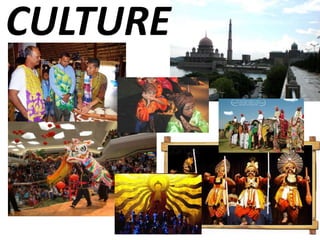
CULTURE
  DEFINITION
  CONCEPT OF CULTURE
  ELEMETS OF CULTURE
HOFSTEDE’S 5 DIMENSION OF NATIONAL CULTURE
  CAUSES OF CULTURE DIFFERENCE
  WHY AND HOW THE CULTURE CHANGE
 BEHAVIORAL PRACTICS AFFECTING BUSINESS
RECONCILIATION OF INTERNATIONAL DIFFERENCESDEFINITIONCulture consists of specific learned norms based on attitudes, values, and beliefs, all of which exist in every society – by John D. Daniels & Lee H. Radebaugh, 8th edition, 1998.Culture is defined as the values, attitudes, beliefs, artifacts and other meaningful symbols represented in the pattern of life adopted by people that help them interpret, evaluate and communicate as members of a society– by V. Kumar, 2000
DEFINITION cont..Culture configuration of learned behaviorand results of behavior whose component elements are shared and transmitted by members of particular society– by Ralph Linton, 1945
DEFINITION cont..Spiritual improvement, human thinking by practices and experiencesThe sum total of attitudes (sikap), values (nilai), beliefs (kepercayaan) and custom (adat/kebiasaan)Norms which influence personal character of the local populationLearning, practicing, sharing  with the community
CONCEPT OF CULTURECulture is different across national borders and have a substantial impact on how business is normally conducted in different countries.Culture plays a major role in influencing human behavior, and understanding human behavior in a given situation is very important decision to engage in international business.
CONCEPT OF CULTURECulture is not a characteristic of individuals, its an attributes of a society and in compasses all members of that society who have been conditioned by similar life experience.Culture can be applied to groups of individuals in a country, society, profession or social organization.
ReligionAttitudes & ValuesLanguageTime
Age
Education
Status
International Language
Lingua Franca
TranslationELEMENT OF CULTURESocial StructureCommunicationVerbal
Non Verbal

2 culture accoding_to_silibus

  • 1.
  • 2.
  • 3.
    CONCEPTOF CULTURE
  • 4.
    ELEMETSOF CULTURE
  • 5.
    HOFSTEDE’S 5 DIMENSIONOF NATIONAL CULTURE
  • 6.
    CAUSESOF CULTURE DIFFERENCE
  • 7.
    WHYAND HOW THE CULTURE CHANGE
  • 8.
    BEHAVIORAL PRACTICSAFFECTING BUSINESS
  • 9.
    RECONCILIATION OF INTERNATIONALDIFFERENCESDEFINITIONCulture consists of specific learned norms based on attitudes, values, and beliefs, all of which exist in every society – by John D. Daniels & Lee H. Radebaugh, 8th edition, 1998.Culture is defined as the values, attitudes, beliefs, artifacts and other meaningful symbols represented in the pattern of life adopted by people that help them interpret, evaluate and communicate as members of a society– by V. Kumar, 2000
  • 10.
    DEFINITION cont..Culture configurationof learned behaviorand results of behavior whose component elements are shared and transmitted by members of particular society– by Ralph Linton, 1945
  • 11.
    DEFINITION cont..Spiritual improvement,human thinking by practices and experiencesThe sum total of attitudes (sikap), values (nilai), beliefs (kepercayaan) and custom (adat/kebiasaan)Norms which influence personal character of the local populationLearning, practicing, sharing with the community
  • 12.
    CONCEPT OF CULTURECultureis different across national borders and have a substantial impact on how business is normally conducted in different countries.Culture plays a major role in influencing human behavior, and understanding human behavior in a given situation is very important decision to engage in international business.
  • 13.
    CONCEPT OF CULTURECultureis not a characteristic of individuals, its an attributes of a society and in compasses all members of that society who have been conditioned by similar life experience.Culture can be applied to groups of individuals in a country, society, profession or social organization.
  • 14.
  • 15.
  • 16.
  • 17.
  • 18.
  • 19.
  • 20.
    TranslationELEMENT OF CULTURESocialStructureCommunicationVerbal
  • 21.