Chapter 1Chapter 1
Communicating inCommunicating in
Today’s WorkplaceToday’s Workplace
Business Communication: Process and Product, 6e
Mary Ellen Guffey
Mary Ellen Guffey, Business Communication: Process and Product, 6e Ch. 1, Slide 2
Communicating in the BusinessCommunicating in the Business
WorkplaceWorkplace
Ethical Business
Communication
The Communication
Process
Skills for
Career Success
Organizational
Communication
Mary Ellen Guffey, Business Communication: Process and Product, 6e Ch. 1, Slide 3
Strong communication skills are
 necessary for hiring.
 top skill set sought by employers.
 critical for promotion.
 essential for effective job performance.
 more important now as a result of
technology.
 learned through instruction and practice.
Why You Need to Build Career SkillsWhy You Need to Build Career Skills
Mary Ellen Guffey, Business Communication: Process and Product, 6e Ch. 1, Slide 4
Ensure Your Success as a Knowledge WorkerEnsure Your Success as a Knowledge Worker
In today’s Information Age, expect to
 work with words, figures, and data
 think critically
 make decisions
 take charge of your career
 continue learning all your life
Mary Ellen Guffey, Business Communication: Process and Product, 6e Ch. 1, Slide 5
Get Ready for Critical Thinking,Get Ready for Critical Thinking,
Decision Making, and Problem SolvingDecision Making, and Problem Solving
Identify and clarify
Problem
Gather information
Evaluate evidence
Consider options
Test best option
Mary Ellen Guffey, Business Communication: Process and Product, 6e Ch. 1, Slide 6
Factors that Affect You in the WorkplaceFactors that Affect You in the Workplace
 Heightened global competition
 Flattened management hierarchies
 Expanded team-based management
 Innovative communication
technology
 New work environments
 Increasingly diverse workforce
Mary Ellen Guffey, Business Communication: Process and Product, 6e Ch. 1, Slide 7
©Jean-LouisBellurgetRF /Pixland/Jupiterimages
Success forSuccess for YOUYOU in the new globalin the new global
and diverse workplaceand diverse workplace
requires excellent communication skills!requires excellent communication skills!
Mary Ellen Guffey, Business Communication: Process and Product, 6e Ch. 1, Slide 8
Noise Noise
Noise Noise
Noise
Noise Noise
Noise
Sender
has idea 1
Sender
encodes
idea in
message
2
Message
travels
over
channel
3
Receiver
decodes
message
4
Feedback
travels to
sender
5
Possible
additional
feedback
to receiver
6
The Communication Process – Basic ModelThe Communication Process – Basic Model
Mary Ellen Guffey, Business Communication: Process and Product, 6e Ch. 1, Slide 9
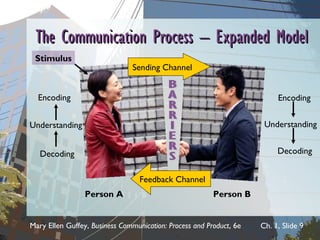
The Communication Process – Expanded ModelThe Communication Process – Expanded Model
Encoding
Decoding
Encoding
Understanding
Decoding
Person A Person B
Feedback Channel
Sending Channel
Stimulus
Understanding
Mary Ellen Guffey, Business Communication: Process and Product, 6e Ch. 1, Slide 10
 Communication climate
 Context and setting
 Background, experiences
 Knowledge, mood
 Values, beliefs, culture
Understanding Is Shaped byUnderstanding Is Shaped by
Mary Ellen Guffey, Business Communication: Process and Product, 6e Ch. 1, Slide 11
Barriers That Create MisunderstandingsBarriers That Create Misunderstandings
 Bypassing
 Poor listening skills
 Differing frames of reference
 Lack of language skills
 Emotional interference
 Physical distractions
Mary Ellen Guffey, Business Communication: Process and Product, 6e Ch. 1, Slide 12
Overcoming Barriers That CauseOvercoming Barriers That Cause
MisunderstandingsMisunderstandings
 Realize that communication is imperfect.
 Adapt the message to the receiver.
 Improve your language and listening skills.
 Question your preconceptions.
 Encourage feedback.
Mary Ellen Guffey, Business Communication: Process and Product, 6e Ch. 1, Slide 13
Organizational CommunicationOrganizational Communication
 Functions
 Internal
 External
 New emphasis
 Interactive
 Mobile
 Instant
 Forms
 Oral
 Written
 Delivery
 Electronic
 Hard copy
Mary Ellen Guffey, Business Communication: Process and Product, 6e Ch. 1, Slide 14
Communication and Formal ChannelsCommunication and Formal Channels
WrittenWritten
Memos, letters
Annual report
Company newsletter
Bulletin board postings
Orientation manual
ElectronicElectronic
E-mail, Instant messaging
Voicemail, Videoconferencing
Intranet
OralOral
Telephone
Face-to-face conversation
Company meetings
Team meetings
Mary Ellen Guffey, Business Communication: Process and Product, 6e Ch. 1, Slide 15
Information Flow in Organizations - FormalInformation Flow in Organizations - Formal
ChannelsChannels
Downward flow
Upward flow
Managers Supervisors
Subordinates Supervisees
Coworkers
Coworkers
Horizontal flow
Mary Ellen Guffey, Business Communication: Process and Product, 6e Ch. 1, Slide 16
Information Flow in Organizations - FormalInformation Flow in Organizations - Formal
ChannelsChannels Managers Supervisors
Subordinates Supervisees
Job plans
Policies
Instructions
Procedures
Flows fromFlows from
decision makersdecision makers
to workersto workers
Downward
Mary Ellen Guffey, Business Communication: Process and Product, 6e Ch. 1, Slide 17
Information Flow in Organizations - FormalInformation Flow in Organizations - Formal
ChannelsChannels Managers Supervisors
Subordinates Supervisees
Feedback
Progress
Problems
Suggestions
Flows fromFlows from
employees toemployees to
decision makersdecision makers
Upward
Mary Ellen Guffey, Business Communication: Process and Product, 6e Ch. 1, Slide 18
Information Flow in Organizations - FormalInformation Flow in Organizations - Formal
ChannelsChannels
Horizontal flow
Shared information to coordinate
tasks, solve problems, resolve conflict
Flows among workersFlows among workers
at the same levelat the same level
Coworkers
Coworkers
Mary Ellen Guffey, Business Communication: Process and Product, 6e Ch. 1, Slide 19
Information Flows in Organizations - InformalInformation Flows in Organizations - Informal
ChannelsChannels
The grapevine - gossip from the break room
to the water cooler
 Carries unofficial messages
 Flows haphazardly
 Can be remarkably accurate
 Is mostly disliked by management
 Thrives where official information
is limited
Mary Ellen Guffey, Business Communication: Process and Product, 6e Ch. 1, Slide 20
Barriers to the Flow of OrganizationalBarriers to the Flow of Organizational
InformationInformation
 Lack of trust, turf wars, fear of reprisal
 Uneven reward systems
 Closed communication climate
 Top-heavy organizational structure
 Filtering, prejudice, ego involvement
 Poor communication skills
Mary Ellen Guffey, Business Communication: Process and Product, 6e Ch. 1, Slide 21
Overcoming Barriers to Effective CommunicationOvercoming Barriers to Effective Communication
 Encourage open, trusting environment for
interaction and feedback.
 Provide more information through formal
channels.
 Train managers and employees to improve
communication skills.
Mary Ellen Guffey, Business Communication: Process and Product, 6e Ch. 1, Slide 22
Overcoming Barriers to Effective CommunicationOvercoming Barriers to Effective Communication
 Flatten the organizational structure.
 Establish hotline and ombudsman programs.
 Establish fair reward system for individual
and team achievement.
 Encourage full participation in teams.
Mary Ellen Guffey, Business Communication: Process and Product, 6e Ch. 1, Slide 23
Understanding Ethical Behavior on the JobUnderstanding Ethical Behavior on the Job
What is ethical behavior?
Doing the right thing
given the circumstances
Mary Ellen Guffey, Business Communication: Process and Product, 6e Ch. 1, Slide 24
Five Common Ethical Traps to Avoid on the JobFive Common Ethical Traps to Avoid on the Job
1. The false necessity trap
Convincing yourself that no other choice exists
1. The doctrine of relative filth
Comparing your unethical behavior with
someone else’s even more unethical behavior
1. The rationalization trap
Justifying unethical actions with excuses
Mary Ellen Guffey, Business Communication: Process and Product, 6e Ch. 1, Slide 25
Five Common Ethical Traps to Avoid on the JobFive Common Ethical Traps to Avoid on the Job
4.4. The self-deception trapThe self-deception trap
Persuading yourself, for example,
that a lie is not really a lie
4.4. The ends-justify-the-means trapThe ends-justify-the-means trap
Using unethical methods to accomplish a
desirable goal
Mary Ellen Guffey, Business Communication: Process and Product, 6e Ch. 1, Slide 26
Goals of Ethical Business CommunicatorsGoals of Ethical Business Communicators
 Abide by the law.
 Tell the truth.
 Label opinions.
 Be objective.
 Communicate clearly.
 Use inclusive language.
 Give credit.
Mary Ellen Guffey, Business Communication: Process and Product, 6e Ch. 1, Slide 27
Tools for Doing the Right ThingTools for Doing the Right Thing
 Is the action you are considering legal?
 How would you see the problem if
you were on the opposite side?
 What are alternate solutions?
 Can you discuss the problem with
someone you trust?
 How would you feel if people you care
about learned of your action?
Seven C’s Effective CommunicationSeven C’s Effective Communication
1. Completeness.
2. Conciseness.
3. Consideration.
4. Concreteness.
5. Clarity.
6. Courtesy.
7. Correctness.
CompletenessCompleteness
Definition
Message is complete when it contain all the facts the
reader or the listener need for the reaction you desired.
Benefits:
1. Achieving desired result without further expense on
messages.
2. Building goodwill.
3. Turn away costly Law suit.
ConcisenessConciseness
Definition
It means to be point not brief but in fewest possible word
or relevant according to subject matter.
Benefits
 Save time and Expense.
 Increase repetition by not cluttering their professional life's.
How to apply
 Eliminate wordy expression.( e.g. use substitute word/active
voices).
 Include only relevant material. (Avoid long intro,
unnecessary explanation, excessive adjective, phrases).
 Avoid unnecessary repetition.(e.g.use abrev.CDA,PTCL,
Pronouns).
ConsiderationConsideration
Definition
Putting your self in their place . Focus on “you”
in place of “I” or “we”. Stress the positive in your
message.
How to apply
 Focus onYou attitude instead of I.
 Show audience benefits or interest in the receiver.
 Emphasis positive and pleasant fact.
ConcretenessConcreteness
It means be very clear in thought and
expression and must base on facts and figure
during writing a message.
How to apply
 Use specific facts and figures.
 Put action in your verbs.
 Choose vivid , image –building words.
ClarityClarity
Using words that familiar to the message of
receiver.
How to apply
Choose precise, concrete and familiar
words.
Construct effective sentences and
paragraphs.
CourtesyCourtesy
Definition
Being aware not only of the perspective of
others, but also their feeling. It stems from sincere
you-attitude.
How to apply
 Be Sincerely,Tactful,Thoughtful and Appreciative
 Use expression that show respect.
 Choose non discriminatory expression.
CorrectnessCorrectness
Definition
It is proper check on grammar, punctuation,
and spelling.
How to apply
 Use right level of language.
 Check accuracy of figures, facts& words.
 Maintain acceptable writing mechanics.
ConclusionConclusion
Know the seven C’s and using them , help
you become a better communicator .

Business communication

  • 1.
    Chapter 1Chapter 1 CommunicatinginCommunicating in Today’s WorkplaceToday’s Workplace Business Communication: Process and Product, 6e Mary Ellen Guffey
  • 2.
    Mary Ellen Guffey,Business Communication: Process and Product, 6e Ch. 1, Slide 2 Communicating in the BusinessCommunicating in the Business WorkplaceWorkplace Ethical Business Communication The Communication Process Skills for Career Success Organizational Communication
  • 3.
    Mary Ellen Guffey,Business Communication: Process and Product, 6e Ch. 1, Slide 3 Strong communication skills are  necessary for hiring.  top skill set sought by employers.  critical for promotion.  essential for effective job performance.  more important now as a result of technology.  learned through instruction and practice. Why You Need to Build Career SkillsWhy You Need to Build Career Skills
  • 4.
    Mary Ellen Guffey,Business Communication: Process and Product, 6e Ch. 1, Slide 4 Ensure Your Success as a Knowledge WorkerEnsure Your Success as a Knowledge Worker In today’s Information Age, expect to  work with words, figures, and data  think critically  make decisions  take charge of your career  continue learning all your life
  • 5.
    Mary Ellen Guffey,Business Communication: Process and Product, 6e Ch. 1, Slide 5 Get Ready for Critical Thinking,Get Ready for Critical Thinking, Decision Making, and Problem SolvingDecision Making, and Problem Solving Identify and clarify Problem Gather information Evaluate evidence Consider options Test best option
  • 6.
    Mary Ellen Guffey,Business Communication: Process and Product, 6e Ch. 1, Slide 6 Factors that Affect You in the WorkplaceFactors that Affect You in the Workplace  Heightened global competition  Flattened management hierarchies  Expanded team-based management  Innovative communication technology  New work environments  Increasingly diverse workforce
  • 7.
    Mary Ellen Guffey,Business Communication: Process and Product, 6e Ch. 1, Slide 7 ©Jean-LouisBellurgetRF /Pixland/Jupiterimages Success forSuccess for YOUYOU in the new globalin the new global and diverse workplaceand diverse workplace requires excellent communication skills!requires excellent communication skills!
  • 8.
    Mary Ellen Guffey,Business Communication: Process and Product, 6e Ch. 1, Slide 8 Noise Noise Noise Noise Noise Noise Noise Noise Sender has idea 1 Sender encodes idea in message 2 Message travels over channel 3 Receiver decodes message 4 Feedback travels to sender 5 Possible additional feedback to receiver 6 The Communication Process – Basic ModelThe Communication Process – Basic Model
  • 9.
    Mary Ellen Guffey,Business Communication: Process and Product, 6e Ch. 1, Slide 9 The Communication Process – Expanded ModelThe Communication Process – Expanded Model Encoding Decoding Encoding Understanding Decoding Person A Person B Feedback Channel Sending Channel Stimulus Understanding
  • 10.
    Mary Ellen Guffey,Business Communication: Process and Product, 6e Ch. 1, Slide 10  Communication climate  Context and setting  Background, experiences  Knowledge, mood  Values, beliefs, culture Understanding Is Shaped byUnderstanding Is Shaped by
  • 11.
    Mary Ellen Guffey,Business Communication: Process and Product, 6e Ch. 1, Slide 11 Barriers That Create MisunderstandingsBarriers That Create Misunderstandings  Bypassing  Poor listening skills  Differing frames of reference  Lack of language skills  Emotional interference  Physical distractions
  • 12.
    Mary Ellen Guffey,Business Communication: Process and Product, 6e Ch. 1, Slide 12 Overcoming Barriers That CauseOvercoming Barriers That Cause MisunderstandingsMisunderstandings  Realize that communication is imperfect.  Adapt the message to the receiver.  Improve your language and listening skills.  Question your preconceptions.  Encourage feedback.
  • 13.
    Mary Ellen Guffey,Business Communication: Process and Product, 6e Ch. 1, Slide 13 Organizational CommunicationOrganizational Communication  Functions  Internal  External  New emphasis  Interactive  Mobile  Instant  Forms  Oral  Written  Delivery  Electronic  Hard copy
  • 14.
    Mary Ellen Guffey,Business Communication: Process and Product, 6e Ch. 1, Slide 14 Communication and Formal ChannelsCommunication and Formal Channels WrittenWritten Memos, letters Annual report Company newsletter Bulletin board postings Orientation manual ElectronicElectronic E-mail, Instant messaging Voicemail, Videoconferencing Intranet OralOral Telephone Face-to-face conversation Company meetings Team meetings
  • 15.
    Mary Ellen Guffey,Business Communication: Process and Product, 6e Ch. 1, Slide 15 Information Flow in Organizations - FormalInformation Flow in Organizations - Formal ChannelsChannels Downward flow Upward flow Managers Supervisors Subordinates Supervisees Coworkers Coworkers Horizontal flow
  • 16.
    Mary Ellen Guffey,Business Communication: Process and Product, 6e Ch. 1, Slide 16 Information Flow in Organizations - FormalInformation Flow in Organizations - Formal ChannelsChannels Managers Supervisors Subordinates Supervisees Job plans Policies Instructions Procedures Flows fromFlows from decision makersdecision makers to workersto workers Downward
  • 17.
    Mary Ellen Guffey,Business Communication: Process and Product, 6e Ch. 1, Slide 17 Information Flow in Organizations - FormalInformation Flow in Organizations - Formal ChannelsChannels Managers Supervisors Subordinates Supervisees Feedback Progress Problems Suggestions Flows fromFlows from employees toemployees to decision makersdecision makers Upward
  • 18.
    Mary Ellen Guffey,Business Communication: Process and Product, 6e Ch. 1, Slide 18 Information Flow in Organizations - FormalInformation Flow in Organizations - Formal ChannelsChannels Horizontal flow Shared information to coordinate tasks, solve problems, resolve conflict Flows among workersFlows among workers at the same levelat the same level Coworkers Coworkers
  • 19.
    Mary Ellen Guffey,Business Communication: Process and Product, 6e Ch. 1, Slide 19 Information Flows in Organizations - InformalInformation Flows in Organizations - Informal ChannelsChannels The grapevine - gossip from the break room to the water cooler  Carries unofficial messages  Flows haphazardly  Can be remarkably accurate  Is mostly disliked by management  Thrives where official information is limited
  • 20.
    Mary Ellen Guffey,Business Communication: Process and Product, 6e Ch. 1, Slide 20 Barriers to the Flow of OrganizationalBarriers to the Flow of Organizational InformationInformation  Lack of trust, turf wars, fear of reprisal  Uneven reward systems  Closed communication climate  Top-heavy organizational structure  Filtering, prejudice, ego involvement  Poor communication skills
  • 21.
    Mary Ellen Guffey,Business Communication: Process and Product, 6e Ch. 1, Slide 21 Overcoming Barriers to Effective CommunicationOvercoming Barriers to Effective Communication  Encourage open, trusting environment for interaction and feedback.  Provide more information through formal channels.  Train managers and employees to improve communication skills.
  • 22.
    Mary Ellen Guffey,Business Communication: Process and Product, 6e Ch. 1, Slide 22 Overcoming Barriers to Effective CommunicationOvercoming Barriers to Effective Communication  Flatten the organizational structure.  Establish hotline and ombudsman programs.  Establish fair reward system for individual and team achievement.  Encourage full participation in teams.
  • 23.
    Mary Ellen Guffey,Business Communication: Process and Product, 6e Ch. 1, Slide 23 Understanding Ethical Behavior on the JobUnderstanding Ethical Behavior on the Job What is ethical behavior? Doing the right thing given the circumstances
  • 24.
    Mary Ellen Guffey,Business Communication: Process and Product, 6e Ch. 1, Slide 24 Five Common Ethical Traps to Avoid on the JobFive Common Ethical Traps to Avoid on the Job 1. The false necessity trap Convincing yourself that no other choice exists 1. The doctrine of relative filth Comparing your unethical behavior with someone else’s even more unethical behavior 1. The rationalization trap Justifying unethical actions with excuses
  • 25.
    Mary Ellen Guffey,Business Communication: Process and Product, 6e Ch. 1, Slide 25 Five Common Ethical Traps to Avoid on the JobFive Common Ethical Traps to Avoid on the Job 4.4. The self-deception trapThe self-deception trap Persuading yourself, for example, that a lie is not really a lie 4.4. The ends-justify-the-means trapThe ends-justify-the-means trap Using unethical methods to accomplish a desirable goal
  • 26.
    Mary Ellen Guffey,Business Communication: Process and Product, 6e Ch. 1, Slide 26 Goals of Ethical Business CommunicatorsGoals of Ethical Business Communicators  Abide by the law.  Tell the truth.  Label opinions.  Be objective.  Communicate clearly.  Use inclusive language.  Give credit.
  • 27.
    Mary Ellen Guffey,Business Communication: Process and Product, 6e Ch. 1, Slide 27 Tools for Doing the Right ThingTools for Doing the Right Thing  Is the action you are considering legal?  How would you see the problem if you were on the opposite side?  What are alternate solutions?  Can you discuss the problem with someone you trust?  How would you feel if people you care about learned of your action?
  • 28.
    Seven C’s EffectiveCommunicationSeven C’s Effective Communication 1. Completeness. 2. Conciseness. 3. Consideration. 4. Concreteness. 5. Clarity. 6. Courtesy. 7. Correctness.
  • 29.
    CompletenessCompleteness Definition Message is completewhen it contain all the facts the reader or the listener need for the reaction you desired. Benefits: 1. Achieving desired result without further expense on messages. 2. Building goodwill. 3. Turn away costly Law suit.
  • 30.
    ConcisenessConciseness Definition It means tobe point not brief but in fewest possible word or relevant according to subject matter. Benefits  Save time and Expense.  Increase repetition by not cluttering their professional life's. How to apply  Eliminate wordy expression.( e.g. use substitute word/active voices).  Include only relevant material. (Avoid long intro, unnecessary explanation, excessive adjective, phrases).  Avoid unnecessary repetition.(e.g.use abrev.CDA,PTCL, Pronouns).
  • 31.
    ConsiderationConsideration Definition Putting your selfin their place . Focus on “you” in place of “I” or “we”. Stress the positive in your message. How to apply  Focus onYou attitude instead of I.  Show audience benefits or interest in the receiver.  Emphasis positive and pleasant fact.
  • 32.
    ConcretenessConcreteness It means bevery clear in thought and expression and must base on facts and figure during writing a message. How to apply  Use specific facts and figures.  Put action in your verbs.  Choose vivid , image –building words.
  • 33.
    ClarityClarity Using words thatfamiliar to the message of receiver. How to apply Choose precise, concrete and familiar words. Construct effective sentences and paragraphs.
  • 34.
    CourtesyCourtesy Definition Being aware notonly of the perspective of others, but also their feeling. It stems from sincere you-attitude. How to apply  Be Sincerely,Tactful,Thoughtful and Appreciative  Use expression that show respect.  Choose non discriminatory expression.
  • 35.
    CorrectnessCorrectness Definition It is propercheck on grammar, punctuation, and spelling. How to apply  Use right level of language.  Check accuracy of figures, facts& words.  Maintain acceptable writing mechanics.
  • 36.
    ConclusionConclusion Know the sevenC’s and using them , help you become a better communicator .

Editor's Notes

  • #20 The drinking fountain is my photo.