BUSINESS 
COMMUNICATION 
B E S T P RACT ICE S 
Domitilla Sandusky 
ORG536-1 – Contemporary Business Writing and 
Communication 
Colorado State University – Global Campus 
Dr. Robert Olszewski 
September 28, 2014
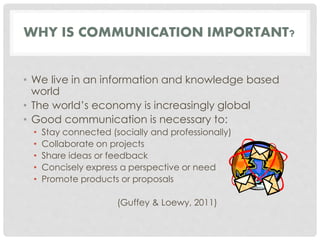
WHY IS COMMUNICATION IMPORTANT? 
• We live in an information and knowledge based 
world 
• The world’s economy is increasingly global 
• Good communication is necessary to: 
• Stay connected (socially and professionally) 
• Collaborate on projects 
• Share ideas or feedback 
• Concisely express a perspective or need 
• Promote products or proposals 
(Guffey & Loewy, 2011)
WHO NEEDS COMMUNICATION? 
• Everyone! 
• Companies want to hire people that communicate 
well 
• Workgroups are often widespread now 
• Geographically dispersed groups cannot communicate 
face-to-face 
• It’s important to communicate well through oral and written 
channels 
• Communication skills are verbal and non-verbal
EFFECTIVE COMMUNICATION 
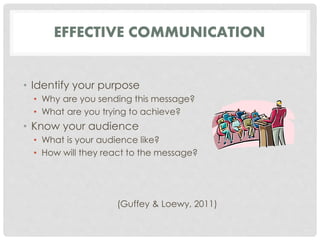
• Identify your purpose 
• Why are you sending this message? 
• What are you trying to achieve? 
• Know your audience 
• What is your audience like? 
• How will they react to the message? 
(Guffey & Loewy, 2011)
EFFECTIVE COMMUNICATION 
• Select the best communication channel based on: 
• Importance of the message 
• Amount and speed of feedback and interactivity required 
• Necessity of a permanent record 
• Cost of the channel 
• Degree of formality desired 
• Confidentiality and sensitivity of the message 
(Guffey & Loewy, 2011)
EFFECTIVE COMMUNICATION 
• Effective communicators are also effective leaders. 
• Effective leaders use these communication practices: 
• Mind the say-do gap – build follower’s trust by aligning your 
actions and words 
• Make the complex simple – say what you mean concisely 
• Find your own voice – be genuine 
• Be visible – interact with your team (even if it’s by phone) 
• Listen with your eyes as well as your ears – pay attention to your 
audience 
(Tardanico, 2012)
ETHICAL COMMUNICATION 
• Scandals have raised awareness of unethical 
business practices 
• Enron and WorldCom were examples in the 2000s (Guffey & 
Loewy, 2011) 
• Corinthian Colleges is an example in 2014 (Halperin, 2014) 
• The goals of improving ethical communication are: 
• Abiding the law and telling the truth 
• Separating opinion from fact and being objective 
• Communicating clearly with inclusive language 
• Giving credit where due (Guffey & Loewy, 2011)
ETHICAL COMMUNICATION 
• Choose to do the right thing 
• Use these tools to examine if your decision is right: 
• Is the action you are considering legal? 
• How would you see the problem if you were on the 
opposite side? 
• What are alternate solutions? 
• Can you discuss the problem with someone whose advise 
you trust? 
• How would you feel if your family, friends, employer, or 
coworkers learned of your action? 
(Guffey & Loewy, 2011, p. 29)
PROFESSIONALISM 
• Professionalism is important in the workplace 
• In your attire 
• In your attitude 
• In your communications 
• Be aware of how you come across in your 
communications 
• Professionalism is reflected in word choice, sincerity, 
respect, and consideration of other’s opinions 
(Guffey & Loewy, 2011)
INTERCULTURAL BUSINESS 
COMMUNICATION 
• In an increasingly global economy, be aware of 
how your culture is different 
• Know the difference between high- and low-context 
communication styles 
• Low-context communication – messages are 
communicated directly; words are taken literally 
• Used in American and German cultures 
• High-context communication – more emphasis is on the 
context of the situation rather than the words used 
• Used in Asian cultures 
(Guffey & Loewy, 2011)
INTERCULTURAL BUSINESS 
COMMUNICATION 
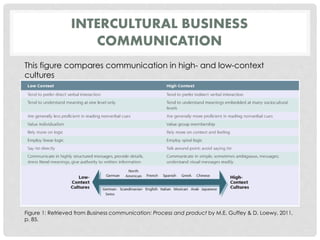
This figure compares communication in high- and low-context 
cultures 
Figure 1: Retrieved from Business communication: Process and product by M.E. Guffey & D. Loewy, 2011, 
p. 85.
BUSINESS WRITING TIPS 
• Business writing is to educate, persuade, or motivate 
people 
• When writing, it is important to remember: 
• The audience wants relevant information 
• Clarity is more important than creative word choice 
• Time is important – the audience wants to get information 
quickly and easily 
(Shanan, 2013)
BUSINESS WRITING TIPS 
• Writing skills are even more important in a 
technologically based business world 
• Some basic tips will help you become more 
effective as a communicator: 
• Clearly define what message you are trying to deliver 
• Know your audience 
• Select the appropriate communication channel for your 
purpose 
• Be genuine and professional in your delivery 
(Guffey & Loewy, 2011; Tardanico, 2012)
BUSINESS WRITING TIPS 
• Remember, the tone of your delivery is as important 
as the message 
• Being concise does not mean being bossy or rude 
• Even when the message is urgent, word choice is 
important 
(Nordquist, n.d.)
BUSINESS WRITING TIPS: EMAIL 
• Email is the most common form of written 
communication in the business world (Nordquist, 
n.d.) 
• It is useful for communicating to large numbers of 
people (Guffey & Loewy, 2011) 
• It is best for relaying short messages (Guffey & 
Loewy, 2011) 
• Email is not appropriate for sharing lengthy or 
confidential information (Guffey & Loewy, 2011)
BUSINESS WRITING TIPS: EMAIL 
• Nordquist (n.d.) shared 10 tips for writing effective 
emails: 
• Put a meaningful topic in the subject line 
• Keep your main point in the first sentence 
• Be specific about your subject (don’t use “this” – like “this 
needs to be done today) 
• Use appropriate capitalization (don’t use all capitals or 
lower case letters) 
• Avoid using abbreviations and acronyms
BUSINESS WRITING TIPS: EMAIL 
• Nordquist’s (n.d.) email tips (continued): 
• Be brief and polite 
• If the message is longer than two or three short paragraphs: 
• Reduce the message, or 
• Provide an attachment 
• Genuinely use “please” and “thank you” 
• Keep appropriate information in the signature 
• Edit and proofread message before sending 
• Reply promptly to serious messages, even if it’s to explain a 
delay in response
BUSINESS WRITING TIPS: TEXTING 
• Texting can be a fast, effective way to 
communicate 
• Keep texts short and professional 
• Some professional ways to text would be: 
• Share information in a meeting or schedule a meeting 
• Share news with coworkers or send a quick reminder 
• Track delivery of packages 
• Interact with customers or clients 
• Advertise new products or share product alerts 
(Inc., 2010)
BUSINESS WRITING TIPS: SOCIAL MEDIA 
• 73% of Millennials and 55% of consumers ages 14-75 
regularly socialize online (Guffey & Loewy, 2011) 
• Social media is a huge opportunity for businesses to 
connect with their customers 
• Customer reviews and recommendations, and 
company visibility on social media sites increases 
consumer trust (Hajli, 2014) 
• Trust is positively linked with consumers patronizing a 
business (Hajli, 2014)
BUSINESS WRITING TIPS: SOCIAL MEDIA 
• Companies that successfully use social media 
engage consumers 
• Walmart is a company that uses social media daily 
• Walmart has many Twitter handles to post news stories and 
accomplishments of their employees; this channel quickly 
reaches large numbers of consumers (Pollitt, 2014) 
• Walmart engages consumers on their Facebook page by 
posting fun videos or taking short surveys of products (Moth, 
2013) 
• Consumers can leave feedback or suggestions on their local 
Walmart’s Facebook page (Walmart, 2014
BUSINESS WRITING TIPS: SOCIAL MEDIA 
• Social media is an informal channel of 
communication, but messages should still be 
professional 
• Some companies encourage employee and 
consumer professionalism through social media 
guidelines 
• Companies can control social media messages by 
limiting the team in charge of using the channels 
(Guffey & Loewy, 2011)
POSITIVE MESSAGES 
• Positive messages are straightforward 
communications (like emails, letters, etc.) 
• They communicate everyday business requests 
• They express friendliness or recognition 
• Appropriate channels must still be evaluated and 
used to communicate the message most effectively 
• Marketing and use of social media is another way 
for businesses to share positive messages 
• They can control how the message is presented 
• They can control what information is shared 
(Guffey & Loewy, 2011)
NEGATIVE MESSAGES 
• Bad or disappointing things happen in business 
• Negative messages must be carefully planned 
before delivery to lessen the impact 
• Individuals receiving bad news may be more 
receptive if they: 
• Know the reason behind a decision or error 
• Feel the message was shared in a sensitive manner 
• Believe the concern was seriously reviewed and dealt with 
fairly 
(Guffey & Loewy, 2011)
NEGATIVE MESSAGES 
• Companies may also deal with negative publicity or 
poor customer reviews 
• Companies should not fear customer complaints in 
public settings (like on social media sites) 
• Poor reviews can be leveraged to positive customer 
interactions (Lloyd, n.d.) 
• Companies can make a public effort to address customer 
concerns, thereby building trust 
• Customers are more satisfied with companies that 
quickly acknowledge problems and take 
responsibility (Gurău, 2012)
BUSINESS PRESENTATIONS 
• When preparing a presentation, only add things 
that will enhance your message 
• Effective presentations: 
• Have clear, concise text 
• Use consistent fonts, backgrounds, and relevant special 
effects 
• Use appropriate images and graphics to enhance message 
• Engage the audience through interaction or additional 
content 
• Can be accessed later (via the Internet or company 
intranet) 
(Guffey & Loewy, 2011)
BUSINESS PRESENTATIONS 
• Before presenting 
• Prepare and rehearse 
• Time yourself 
• During the presentation 
• Be aware of your audience’s reactions 
• Stay on topic and use presentation aids effectively 
• Summarize your main points 
• After the presentation 
• Distribute handouts 
• Encourage questions 
• Summarize your main points (Guffey & Loewy, 2011)
BUSINESS REPORTS, PLANS AND 
PROPOSALS 
• First-hand data and research is valuable for business 
executives (CSU-Global, 2014) 
• Executives use reports to make informed decisions 
(CSU-Global, 2014) 
• Reports are typically formal or informal 
• Formal reports or proposals are typically lengthy 
• Are serious in tone 
• Tend to be very structured in organization (Guffey & Loewy, 
2011)
BUSINESS REPORTS, PLANS AND 
PROPOSALS 
• There are two basic categories of informal reports: 
• Informational reports, such as: 
• Summaries 
• Periodic activity 
• Trip, convention and conference reports 
• Progress and interim reports 
• Investigative reports 
• Analytical reports – have three sections: 
• Introduction 
• Findings 
• Conclusions/Recommendations 
(CSU-Global, 2014)
BUSINESS COMMUNICATION 
• Writing skills are an important tool of every 
employee 
• Businesses have many tools to communicate 
• Effective communication depends on: 
• Understanding your message 
• Choosing the right channel 
• Knowing your audience 
(Guffey & Loewy, 2011)
REFERENCES 
Colorado State University – Global Campus. (2014). Module 7: Informal and formal business reports, plans , and proposals 
[Blackboard ecourse]. In ORG536-1 – Contemporary Business Writing and Communication. Greenwood Village, CO: 
Author. 
Guffey, M., & Loewy, D. (2011). Business communication: Process and product (7th ed.). Independence, KY: Cengage 
Learning. 
Gurău, C. (2012). Solving customer complaints: A study of multiple commercial settings. Annals Of The University Of Oradea, 
Economic Science Series, 21(2), 827-833. Retrieved from https://eds-a-ebscohost-com.csuglobal.idm.oclc.org 
Hajli, M. (2014). A study of the impact of social media on consumers. International Journal Of Market Research, 56(3), 387- 
404. doi:10.2501/IJMR-2014-025 
Halperin, D. (2014, June 20). For-profit Corinthian Colleges on the brink: Who’s responsible? Huffington Post. Retrieved from 
http://www.huffingtonpost.com/davidhalperin/for-profit-corinthian-col_b_5516063.html 
Inc. (2010). Ten ways to use texting for business. Retrieved from http://www.inc.com/ss/ten-ways-use-texting-business 
Lloyd, J. (n.d.). Complaints offer opportunities. Retrieved from http://www.joanlloyd.com/Your-Career/Complaints-offer-opportunities. 
aspx 
Moth, D. (2013). How Walmart uses Pinterest, Facebook, Twitter and Google+. Retrieved from 
https://econsultancy.com/blog/61827-how-walmart-uses-pinterest-facebook-twitter-and-google#i.14ocqor72eeqyp 
Nordquist, R. (n.d.). 10 Tips on how to write a professional email. Retrieved from 
http://grammar.about.com/od/developingessays/a/profemails.htm 
Pollitt, C. (2014). An inside view of Walmart’s digital communications strategy. Retrieved from 
http://www.socialmediatoday.com/content/inside-view-walmarts-digital-communications-strategy 
Shanan. (2013, June 7). The three biggest mistakes in business writing [Web log post]. Retrieved from 
http://www.theprocrastiwriter.com/the-three-biggest-mistakes-in-business-writing/ 
Tardanico, S. (2012, November 29). 5 Habits of highly effective communicators. Forbes. Retrieved from 
http://www.forbes.com/sites/susantardanico/2012/11/29/5-habits-of-highly-effective-communicators/ 
Walmart. (2014). Walmart’s social media guidelines. Retrieved from http://corporate.walmart.com/social-media-guidelines

Sandusky org536 mod 8

  • 1.
    BUSINESS COMMUNICATION BE S T P RACT ICE S Domitilla Sandusky ORG536-1 – Contemporary Business Writing and Communication Colorado State University – Global Campus Dr. Robert Olszewski September 28, 2014
  • 2.
    WHY IS COMMUNICATIONIMPORTANT? • We live in an information and knowledge based world • The world’s economy is increasingly global • Good communication is necessary to: • Stay connected (socially and professionally) • Collaborate on projects • Share ideas or feedback • Concisely express a perspective or need • Promote products or proposals (Guffey & Loewy, 2011)
  • 3.
    WHO NEEDS COMMUNICATION? • Everyone! • Companies want to hire people that communicate well • Workgroups are often widespread now • Geographically dispersed groups cannot communicate face-to-face • It’s important to communicate well through oral and written channels • Communication skills are verbal and non-verbal
  • 4.
    EFFECTIVE COMMUNICATION •Identify your purpose • Why are you sending this message? • What are you trying to achieve? • Know your audience • What is your audience like? • How will they react to the message? (Guffey & Loewy, 2011)
  • 5.
    EFFECTIVE COMMUNICATION •Select the best communication channel based on: • Importance of the message • Amount and speed of feedback and interactivity required • Necessity of a permanent record • Cost of the channel • Degree of formality desired • Confidentiality and sensitivity of the message (Guffey & Loewy, 2011)
  • 6.
    EFFECTIVE COMMUNICATION •Effective communicators are also effective leaders. • Effective leaders use these communication practices: • Mind the say-do gap – build follower’s trust by aligning your actions and words • Make the complex simple – say what you mean concisely • Find your own voice – be genuine • Be visible – interact with your team (even if it’s by phone) • Listen with your eyes as well as your ears – pay attention to your audience (Tardanico, 2012)
  • 7.
    ETHICAL COMMUNICATION •Scandals have raised awareness of unethical business practices • Enron and WorldCom were examples in the 2000s (Guffey & Loewy, 2011) • Corinthian Colleges is an example in 2014 (Halperin, 2014) • The goals of improving ethical communication are: • Abiding the law and telling the truth • Separating opinion from fact and being objective • Communicating clearly with inclusive language • Giving credit where due (Guffey & Loewy, 2011)
  • 8.
    ETHICAL COMMUNICATION •Choose to do the right thing • Use these tools to examine if your decision is right: • Is the action you are considering legal? • How would you see the problem if you were on the opposite side? • What are alternate solutions? • Can you discuss the problem with someone whose advise you trust? • How would you feel if your family, friends, employer, or coworkers learned of your action? (Guffey & Loewy, 2011, p. 29)
  • 9.
    PROFESSIONALISM • Professionalismis important in the workplace • In your attire • In your attitude • In your communications • Be aware of how you come across in your communications • Professionalism is reflected in word choice, sincerity, respect, and consideration of other’s opinions (Guffey & Loewy, 2011)
  • 10.
    INTERCULTURAL BUSINESS COMMUNICATION • In an increasingly global economy, be aware of how your culture is different • Know the difference between high- and low-context communication styles • Low-context communication – messages are communicated directly; words are taken literally • Used in American and German cultures • High-context communication – more emphasis is on the context of the situation rather than the words used • Used in Asian cultures (Guffey & Loewy, 2011)
  • 11.
    INTERCULTURAL BUSINESS COMMUNICATION This figure compares communication in high- and low-context cultures Figure 1: Retrieved from Business communication: Process and product by M.E. Guffey & D. Loewy, 2011, p. 85.
  • 12.
    BUSINESS WRITING TIPS • Business writing is to educate, persuade, or motivate people • When writing, it is important to remember: • The audience wants relevant information • Clarity is more important than creative word choice • Time is important – the audience wants to get information quickly and easily (Shanan, 2013)
  • 13.
    BUSINESS WRITING TIPS • Writing skills are even more important in a technologically based business world • Some basic tips will help you become more effective as a communicator: • Clearly define what message you are trying to deliver • Know your audience • Select the appropriate communication channel for your purpose • Be genuine and professional in your delivery (Guffey & Loewy, 2011; Tardanico, 2012)
  • 14.
    BUSINESS WRITING TIPS • Remember, the tone of your delivery is as important as the message • Being concise does not mean being bossy or rude • Even when the message is urgent, word choice is important (Nordquist, n.d.)
  • 15.
    BUSINESS WRITING TIPS:EMAIL • Email is the most common form of written communication in the business world (Nordquist, n.d.) • It is useful for communicating to large numbers of people (Guffey & Loewy, 2011) • It is best for relaying short messages (Guffey & Loewy, 2011) • Email is not appropriate for sharing lengthy or confidential information (Guffey & Loewy, 2011)
  • 16.
    BUSINESS WRITING TIPS:EMAIL • Nordquist (n.d.) shared 10 tips for writing effective emails: • Put a meaningful topic in the subject line • Keep your main point in the first sentence • Be specific about your subject (don’t use “this” – like “this needs to be done today) • Use appropriate capitalization (don’t use all capitals or lower case letters) • Avoid using abbreviations and acronyms
  • 17.
    BUSINESS WRITING TIPS:EMAIL • Nordquist’s (n.d.) email tips (continued): • Be brief and polite • If the message is longer than two or three short paragraphs: • Reduce the message, or • Provide an attachment • Genuinely use “please” and “thank you” • Keep appropriate information in the signature • Edit and proofread message before sending • Reply promptly to serious messages, even if it’s to explain a delay in response
  • 18.
    BUSINESS WRITING TIPS:TEXTING • Texting can be a fast, effective way to communicate • Keep texts short and professional • Some professional ways to text would be: • Share information in a meeting or schedule a meeting • Share news with coworkers or send a quick reminder • Track delivery of packages • Interact with customers or clients • Advertise new products or share product alerts (Inc., 2010)
  • 19.
    BUSINESS WRITING TIPS:SOCIAL MEDIA • 73% of Millennials and 55% of consumers ages 14-75 regularly socialize online (Guffey & Loewy, 2011) • Social media is a huge opportunity for businesses to connect with their customers • Customer reviews and recommendations, and company visibility on social media sites increases consumer trust (Hajli, 2014) • Trust is positively linked with consumers patronizing a business (Hajli, 2014)
  • 20.
    BUSINESS WRITING TIPS:SOCIAL MEDIA • Companies that successfully use social media engage consumers • Walmart is a company that uses social media daily • Walmart has many Twitter handles to post news stories and accomplishments of their employees; this channel quickly reaches large numbers of consumers (Pollitt, 2014) • Walmart engages consumers on their Facebook page by posting fun videos or taking short surveys of products (Moth, 2013) • Consumers can leave feedback or suggestions on their local Walmart’s Facebook page (Walmart, 2014
  • 21.
    BUSINESS WRITING TIPS:SOCIAL MEDIA • Social media is an informal channel of communication, but messages should still be professional • Some companies encourage employee and consumer professionalism through social media guidelines • Companies can control social media messages by limiting the team in charge of using the channels (Guffey & Loewy, 2011)
  • 22.
    POSITIVE MESSAGES •Positive messages are straightforward communications (like emails, letters, etc.) • They communicate everyday business requests • They express friendliness or recognition • Appropriate channels must still be evaluated and used to communicate the message most effectively • Marketing and use of social media is another way for businesses to share positive messages • They can control how the message is presented • They can control what information is shared (Guffey & Loewy, 2011)
  • 23.
    NEGATIVE MESSAGES •Bad or disappointing things happen in business • Negative messages must be carefully planned before delivery to lessen the impact • Individuals receiving bad news may be more receptive if they: • Know the reason behind a decision or error • Feel the message was shared in a sensitive manner • Believe the concern was seriously reviewed and dealt with fairly (Guffey & Loewy, 2011)
  • 24.
    NEGATIVE MESSAGES •Companies may also deal with negative publicity or poor customer reviews • Companies should not fear customer complaints in public settings (like on social media sites) • Poor reviews can be leveraged to positive customer interactions (Lloyd, n.d.) • Companies can make a public effort to address customer concerns, thereby building trust • Customers are more satisfied with companies that quickly acknowledge problems and take responsibility (Gurău, 2012)
  • 25.
    BUSINESS PRESENTATIONS •When preparing a presentation, only add things that will enhance your message • Effective presentations: • Have clear, concise text • Use consistent fonts, backgrounds, and relevant special effects • Use appropriate images and graphics to enhance message • Engage the audience through interaction or additional content • Can be accessed later (via the Internet or company intranet) (Guffey & Loewy, 2011)
  • 26.
    BUSINESS PRESENTATIONS •Before presenting • Prepare and rehearse • Time yourself • During the presentation • Be aware of your audience’s reactions • Stay on topic and use presentation aids effectively • Summarize your main points • After the presentation • Distribute handouts • Encourage questions • Summarize your main points (Guffey & Loewy, 2011)
  • 27.
    BUSINESS REPORTS, PLANSAND PROPOSALS • First-hand data and research is valuable for business executives (CSU-Global, 2014) • Executives use reports to make informed decisions (CSU-Global, 2014) • Reports are typically formal or informal • Formal reports or proposals are typically lengthy • Are serious in tone • Tend to be very structured in organization (Guffey & Loewy, 2011)
  • 28.
    BUSINESS REPORTS, PLANSAND PROPOSALS • There are two basic categories of informal reports: • Informational reports, such as: • Summaries • Periodic activity • Trip, convention and conference reports • Progress and interim reports • Investigative reports • Analytical reports – have three sections: • Introduction • Findings • Conclusions/Recommendations (CSU-Global, 2014)
  • 29.
    BUSINESS COMMUNICATION •Writing skills are an important tool of every employee • Businesses have many tools to communicate • Effective communication depends on: • Understanding your message • Choosing the right channel • Knowing your audience (Guffey & Loewy, 2011)
  • 30.
    REFERENCES Colorado StateUniversity – Global Campus. (2014). Module 7: Informal and formal business reports, plans , and proposals [Blackboard ecourse]. In ORG536-1 – Contemporary Business Writing and Communication. Greenwood Village, CO: Author. Guffey, M., & Loewy, D. (2011). Business communication: Process and product (7th ed.). Independence, KY: Cengage Learning. Gurău, C. (2012). Solving customer complaints: A study of multiple commercial settings. Annals Of The University Of Oradea, Economic Science Series, 21(2), 827-833. Retrieved from https://eds-a-ebscohost-com.csuglobal.idm.oclc.org Hajli, M. (2014). A study of the impact of social media on consumers. International Journal Of Market Research, 56(3), 387- 404. doi:10.2501/IJMR-2014-025 Halperin, D. (2014, June 20). For-profit Corinthian Colleges on the brink: Who’s responsible? Huffington Post. Retrieved from http://www.huffingtonpost.com/davidhalperin/for-profit-corinthian-col_b_5516063.html Inc. (2010). Ten ways to use texting for business. Retrieved from http://www.inc.com/ss/ten-ways-use-texting-business Lloyd, J. (n.d.). Complaints offer opportunities. Retrieved from http://www.joanlloyd.com/Your-Career/Complaints-offer-opportunities. aspx Moth, D. (2013). How Walmart uses Pinterest, Facebook, Twitter and Google+. Retrieved from https://econsultancy.com/blog/61827-how-walmart-uses-pinterest-facebook-twitter-and-google#i.14ocqor72eeqyp Nordquist, R. (n.d.). 10 Tips on how to write a professional email. Retrieved from http://grammar.about.com/od/developingessays/a/profemails.htm Pollitt, C. (2014). An inside view of Walmart’s digital communications strategy. Retrieved from http://www.socialmediatoday.com/content/inside-view-walmarts-digital-communications-strategy Shanan. (2013, June 7). The three biggest mistakes in business writing [Web log post]. Retrieved from http://www.theprocrastiwriter.com/the-three-biggest-mistakes-in-business-writing/ Tardanico, S. (2012, November 29). 5 Habits of highly effective communicators. Forbes. Retrieved from http://www.forbes.com/sites/susantardanico/2012/11/29/5-habits-of-highly-effective-communicators/ Walmart. (2014). Walmart’s social media guidelines. Retrieved from http://corporate.walmart.com/social-media-guidelines