Ch 2. Capsules
Berhanemeskel W.G, Asst. Prof.
Department of Pharmaceutics
School of Pharmacy
College of Medicine and Health Sciences
University of Gondar
May 2009
1
Empty capsules
• Empty capsules are sold by sizes
• The ones most commonly employed for human
use range from size 0, the largest to size 5, the
smallest
• Capsule changes dimensions to some extent
with varied moisture content and conditions
encountered before use
• The amount filled in capsule may vary according
to the degree of pressure used in filling the
capsules
2
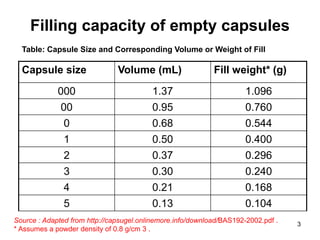
Filling capacity of empty capsules
Capsule size Volume (mL) Fill weight* (g)
000 1.37 1.096
00 0.95 0.760
0 0.68 0.544
1 0.50 0.400
2 0.37 0.296
3 0.30 0.240
4 0.21 0.168
5 0.13 0.104
Table: Capsule Size and Corresponding Volume or Weight of Fill
Source : Adapted from http://capsugel.onlinemore.info/download/BAS192-2002.pdf .
* Assumes a powder density of 0.8 g/cm 3 .
3
Basic Components of Capsule
filling equipments
• Hopper for empty capsules
• Hopper of powder
• Rectifier- orient cap-body
• Transport segment- transport the rectified
capsules
• Capsule separation (vacuum device)
• Filling system- dosing stations/nozzles
• Closing station
• Ejection station
• Collection stations- accepted and rejected once
4
Capsule fill weight Determination
• Example
1. Formulation- 350mg
Tapped density-0.75gm/ml
– Capsule size ??
– Amount of diluent required?
2. Formulation- 0.5gm
Tapped density- 0.8gm/ml
– Capsule size ??
– Amount of diluent required?
5
Capsule Filling Machine
1. Hand Operated
2. Semi-automatic
3. Fully automatic
– Most employs
• Pistons or filler dosator machines
• Tamping pins-filler dosing disc machine
6
Semi-Automatic Machines
• Semi-automatic machines, which require an
operator to be in attendance at all times, were
once the workhorses of the capsule filling
industry.
• Today, they are more likely to be employed
when smaller batch sizes are required, such as
production of early phase clinical supplies.
• Quoted production capacities for powder filing
range from 6000-8000 capsules/hour up to as
high as 15,000 capsules/hour, depending on the
capsule size.
7
Fully Automatic Machines
• Most modern automatic filling machines employ
pistons or tamping pins that lightly compress the
powder into plugs (sometimes referred to as
“slugs”), and eject the plugs into the empty
capsule bodies.
• The compression forces are low, often in the
range of 50–150N, up to about 100-fold less
than that employed in typical tablet compression.
• There are two main types of these fillers:
– dosator machines and
– Dosing disc machines.
8
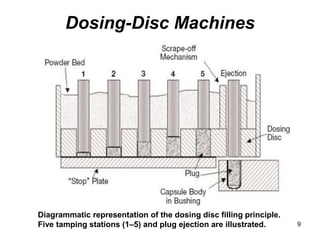
Dosing-Disc Machines
Diagrammatic representation of the dosing disc filling principle.
Five tamping stations (1–5) and plug ejection are illustrated. 9
Dosator Machines
Diagrammatic representation of the dosator filling principle. 10
NB
• During filling powders have dust problem (avoided by
making compartment) and de-mixing
• For potent medicaments- addition of diluents and
lubricant
• For high dose/low potency- addition of flow promoter/
glidant and lubricant
• To increase bioavailability
– Addition of surfactants
– For potent drugs
• Soluble drug in insolubel diluents
• Insoluble drug in soluble diluents mixture
• Filling Semisolids
– It is a recent innovation
• Adv.- dust free environment, control release system and increase
solubility of the drug
11
Quality control/In process
control
• Weight variation
• Dissolution test
• Disintegration test
• Content uniformity
• Bulk Powder Level (Under fill): inspection
device
• X-ray
• Passing the filled capsule to charged plate
12
Excipient in capsules
• Bentonite
• CaCO3
• Edible oil in pellet
fillings
• Lactose
• Mannitol
• MgCO3
• MgO
• Silica
• Starch
• Talc
• Mg stearate
13
Finishing process
• Finished capsules from all filling
equipment require some sort of dusting
and or polishing operation before the
remaining operations of inspection;
bottling and labeling are completed
• Dusting or polishing operations vary
according to:
– The type of filling equipment used
– The type of powder used for filling and
– The individual desires for the finished
appearance of the completed capsules
14
• The following are the methods most
commonly used based on desired output,
formulation, required final appearance and
so on.
1. Pan polishing
2. Cloth dusting
3. Brushing
15
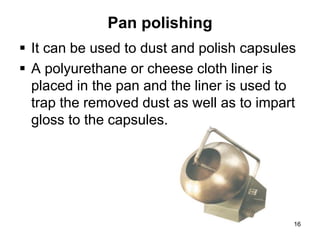
Pan polishing
 It can be used to dust and polish capsules
 A polyurethane or cheese cloth liner is
placed in the pan and the liner is used to
trap the removed dust as well as to impart
gloss to the capsules.
16
Cloth dusting
• The bulk filled capsules are rubbed with a
cloth that may or may not be impregnated
with an inert oil
• It is hand operation
– Can handle reasonable volume
– Positive method for removal of resistant
materials
– Imparts some what improved gloss to the
capsules
17
Brushing
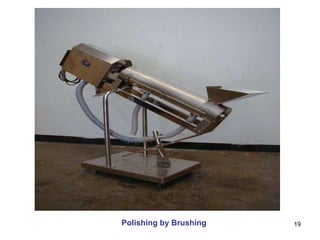
 Capsules are fed under rotating soft brushes
which serve to remove the dust from the
capsule shell
 This operation must be accompanied by a
vacuuming for dust removal
 Limitation
– Some materials are extremely difficult to
remove by brushing
– May cause scratches or deformation of the
capsules
18
Brushing machine
Polishing by Brushing 19
Special techniques
• Some special techniques that may be applied to the
capsules as a dosage form include the following:
1. Imprinting
2. Special purpose capsules: there could be special treatment
• to retard the solubility of active ingredients
• To delay absorption
• To provide enteric properties
3. Separation of incompatible materials
• Two phase fill in the capsule:
– one phase consists of either a soft capsule, a smaller hard capsule, a pill or a
suitable coated tablet.
– Second phase is powder fill in usual manner
4. Filling of conventional two piece gelatin capsules
with liquids (oils) and semisolids
• The fills are either thermosetting (filled warm) or thixotropic
20
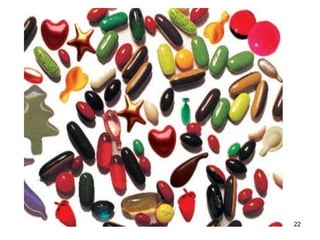
2.2. Soft Gelatin Capsules
 Soft gelatin capsules are hermetically sealed
one - piece capsules containing a liquid or a
semisolid fill.
 Contents to be filled:
– liquids,
– suspensions,
– pasty materials,
– dry powders and even preformed granules,
– pellets, tablets.
 They may be manufactured to be oblong, oval or
round in shape.
21
22
 The advantages of soft gelatin capsules
 pharmaceutically elegant
 easily swallowed by the patient
 The pharmaceutical applications of soft gelatin
capsules are
 as an oral dosage form
 as a suppository dosage form for rectal or vaginal
use
 as a specialty package in tube form, for human and
veterinary single dose application of topical,
ophthalmic, and otic preparations, and rectal
ointments.
 In cosmetics industry used as special package for
breath fresheners, perfumes, bath oils, suntan oils
and various skin creams
23
The components of soft gelatin capsules
 Gelatin
 Plasticizer- glycerin or
polyhydric alcohol
(sorbitol and
propylene glycol)
 water/moisture
 Preservative
 Colorant
 Markings
 Opaquants
 Flavors may be
added and up to 5%
sucrose may be
included for its
sweetness and to
produce a chewable
shell.
24
SGC Methods of Manufacture
Types of Machines
1. The plate process (using a set of molds)
2. Rotary die process (1933, R. P. Scherer)
3. The reciprocating die process (1949, Norton company)
4. The Accogel machine (1949, Cyanamid company)
5. Dripping method
The production capacity of each machines is
determined by:
 Die size (no. of die pockets)
 Speed of the machine
 Physical characteristics of the material to be
capsulated
25
The plate process
 The plates contain die pockets.
 Placing a warm sheet of gelatin on the bottom
plate
 Pouring the liquid-containing medications
 Placing the second sheet of gelatin
 Putting the top plate of the mold into place
 Pressing the mold to form, fill, and seal the
capsules simultaneously
 Removing and washing the capsule
 Today, this equipment can no longer be
purchased.
26
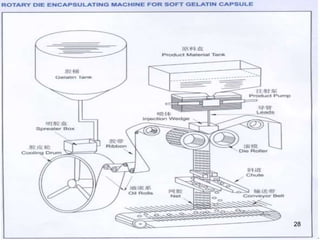
The rotary die process
 It is more efficient and productive
 Liquid gelatin is formed into two ribbons
 The two ribbons are brought together
 Metered fill material is injected between
the ribbons
 These pockets of fill-containing gelatin are
sealed
27
28
Rotary die soft capsule
machine The dies for production of soft
capsule
29
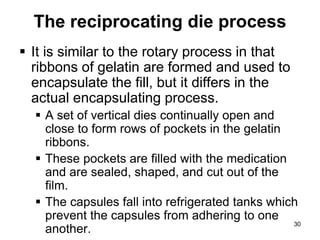
The reciprocating die process
 It is similar to the rotary process in that
ribbons of gelatin are formed and used to
encapsulate the fill, but it differs in the
actual encapsulating process.
 A set of vertical dies continually open and
close to form rows of pockets in the gelatin
ribbons.
 These pockets are filled with the medication
and are sealed, shaped, and cut out of the
film.
 The capsules fall into refrigerated tanks which
prevent the capsules from adhering to one
another.
30
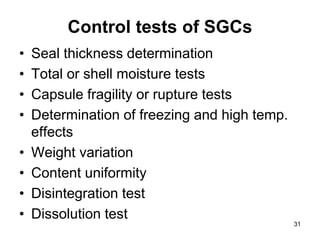
Control tests of SGCs
• Seal thickness determination
• Total or shell moisture tests
• Capsule fragility or rupture tests
• Determination of freezing and high temp.
effects
• Weight variation
• Content uniformity
• Disintegration test
• Dissolution test
31
2.3. Micro-encapsulation
• It is a means of applying relatively thin coatings to
small particles of solids or droplets of liquids and
dispersions
• Micro-encapsulation provides:
– The means of converting liquids to solids
– Altering colloidal and surface properties
– Environmental protection
– Controlling the release characteristics or availability of
coated materials
• The uniqueness of micro-encapsulation is:
– The smallness of the coated particles
– Their subsequent use and adaptation to a wide variety
of dosage forms and product applications
32
• Applications of micro-encapsulation
– Sustained release or prolonged action medications
– Taste masked chewable tablets, powders and
suspensions
– Single layer tablets containing chemically
incompatible ingredients
• Problems
– Incomplete or discontinuous coating
– Inadequate stability or shelf life of sensitive
pharmaceuticals
– Non reproducible and unstable release characteristics
of coated products
– Economic limitation 33
Fundamental considerations
• The realization of the potential that micro-
encapsulation offers involves a basic
understanding of the general properties of
microcapsules such as:
– The nature of the core and coating materials
– The stability and release characteristics of the coated
materials and
– The micro-encapsulation methods
34
Core material
• It is defined as the specific material to
be coated, can be
–liquid- dispersed or dissolved
materials
–solid in nature-mixtures of active
ingredient, stabilizer, diluents, excipient
and release rate retardants or
accelerators.
35
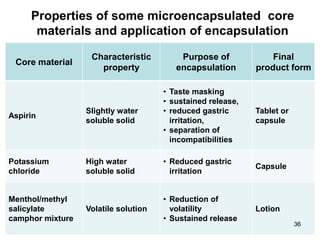
Properties of some microencapsulated core
materials and application of encapsulation
Core material
Characteristic
property
Purpose of
encapsulation
Final
product form
Aspirin
Slightly water
soluble solid
• Taste masking
• sustained release,
• reduced gastric
irritation,
• separation of
incompatibilities
Tablet or
capsule
Potassium
chloride
High water
soluble solid
• Reduced gastric
irritation
Capsule
Menthol/methyl
salicylate
camphor mixture
Volatile solution
• Reduction of
volatility
• Sustained release
Lotion
36
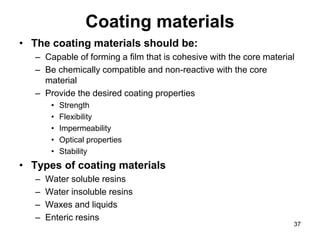
Coating materials
• The coating materials should be:
– Capable of forming a film that is cohesive with the core material
– Be chemically compatible and non-reactive with the core
material
– Provide the desired coating properties
• Strength
• Flexibility
• Impermeability
• Optical properties
• Stability
• Types of coating materials
– Water soluble resins
– Water insoluble resins
– Waxes and liquids
– Enteric resins
37
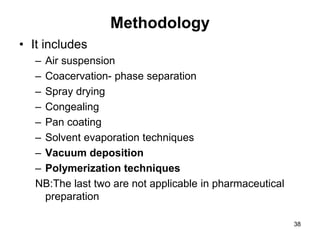
Methodology
• It includes
– Air suspension
– Coacervation- phase separation
– Spray drying
– Congealing
– Pan coating
– Solvent evaporation techniques
– Vacuum deposition
– Polymerization techniques
NB:The last two are not applicable in pharmaceutical
preparation
38
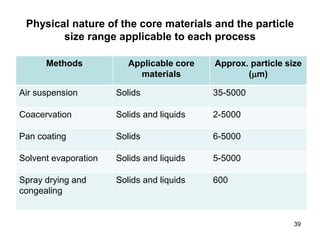
Physical nature of the core materials and the particle
size range applicable to each process
Methods Applicable core
materials
Approx. particle size
(m)
Air suspension Solids 35-5000
Coacervation Solids and liquids 2-5000
Pan coating Solids 6-5000
Solvent evaporation Solids and liquids 5-5000
Spray drying and
congealing
Solids and liquids 600
39

Ch 2 capsules industrial pharmacy

  • 1.
    Ch 2. Capsules BerhanemeskelW.G, Asst. Prof. Department of Pharmaceutics School of Pharmacy College of Medicine and Health Sciences University of Gondar May 2009 1
  • 2.
    Empty capsules • Emptycapsules are sold by sizes • The ones most commonly employed for human use range from size 0, the largest to size 5, the smallest • Capsule changes dimensions to some extent with varied moisture content and conditions encountered before use • The amount filled in capsule may vary according to the degree of pressure used in filling the capsules 2
  • 3.
    Filling capacity ofempty capsules Capsule size Volume (mL) Fill weight* (g) 000 1.37 1.096 00 0.95 0.760 0 0.68 0.544 1 0.50 0.400 2 0.37 0.296 3 0.30 0.240 4 0.21 0.168 5 0.13 0.104 Table: Capsule Size and Corresponding Volume or Weight of Fill Source : Adapted from http://capsugel.onlinemore.info/download/BAS192-2002.pdf . * Assumes a powder density of 0.8 g/cm 3 . 3
  • 4.
    Basic Components ofCapsule filling equipments • Hopper for empty capsules • Hopper of powder • Rectifier- orient cap-body • Transport segment- transport the rectified capsules • Capsule separation (vacuum device) • Filling system- dosing stations/nozzles • Closing station • Ejection station • Collection stations- accepted and rejected once 4
  • 5.
    Capsule fill weightDetermination • Example 1. Formulation- 350mg Tapped density-0.75gm/ml – Capsule size ?? – Amount of diluent required? 2. Formulation- 0.5gm Tapped density- 0.8gm/ml – Capsule size ?? – Amount of diluent required? 5
  • 6.
    Capsule Filling Machine 1.Hand Operated 2. Semi-automatic 3. Fully automatic – Most employs • Pistons or filler dosator machines • Tamping pins-filler dosing disc machine 6
  • 7.
    Semi-Automatic Machines • Semi-automaticmachines, which require an operator to be in attendance at all times, were once the workhorses of the capsule filling industry. • Today, they are more likely to be employed when smaller batch sizes are required, such as production of early phase clinical supplies. • Quoted production capacities for powder filing range from 6000-8000 capsules/hour up to as high as 15,000 capsules/hour, depending on the capsule size. 7
  • 8.
    Fully Automatic Machines •Most modern automatic filling machines employ pistons or tamping pins that lightly compress the powder into plugs (sometimes referred to as “slugs”), and eject the plugs into the empty capsule bodies. • The compression forces are low, often in the range of 50–150N, up to about 100-fold less than that employed in typical tablet compression. • There are two main types of these fillers: – dosator machines and – Dosing disc machines. 8
  • 9.
    Dosing-Disc Machines Diagrammatic representationof the dosing disc filling principle. Five tamping stations (1–5) and plug ejection are illustrated. 9
  • 10.
    Dosator Machines Diagrammatic representationof the dosator filling principle. 10
  • 11.
    NB • During fillingpowders have dust problem (avoided by making compartment) and de-mixing • For potent medicaments- addition of diluents and lubricant • For high dose/low potency- addition of flow promoter/ glidant and lubricant • To increase bioavailability – Addition of surfactants – For potent drugs • Soluble drug in insolubel diluents • Insoluble drug in soluble diluents mixture • Filling Semisolids – It is a recent innovation • Adv.- dust free environment, control release system and increase solubility of the drug 11
  • 12.
    Quality control/In process control •Weight variation • Dissolution test • Disintegration test • Content uniformity • Bulk Powder Level (Under fill): inspection device • X-ray • Passing the filled capsule to charged plate 12
  • 13.
    Excipient in capsules •Bentonite • CaCO3 • Edible oil in pellet fillings • Lactose • Mannitol • MgCO3 • MgO • Silica • Starch • Talc • Mg stearate 13
  • 14.
    Finishing process • Finishedcapsules from all filling equipment require some sort of dusting and or polishing operation before the remaining operations of inspection; bottling and labeling are completed • Dusting or polishing operations vary according to: – The type of filling equipment used – The type of powder used for filling and – The individual desires for the finished appearance of the completed capsules 14
  • 15.
    • The followingare the methods most commonly used based on desired output, formulation, required final appearance and so on. 1. Pan polishing 2. Cloth dusting 3. Brushing 15
  • 16.
    Pan polishing  Itcan be used to dust and polish capsules  A polyurethane or cheese cloth liner is placed in the pan and the liner is used to trap the removed dust as well as to impart gloss to the capsules. 16
  • 17.
    Cloth dusting • Thebulk filled capsules are rubbed with a cloth that may or may not be impregnated with an inert oil • It is hand operation – Can handle reasonable volume – Positive method for removal of resistant materials – Imparts some what improved gloss to the capsules 17
  • 18.
    Brushing  Capsules arefed under rotating soft brushes which serve to remove the dust from the capsule shell  This operation must be accompanied by a vacuuming for dust removal  Limitation – Some materials are extremely difficult to remove by brushing – May cause scratches or deformation of the capsules 18
  • 19.
  • 20.
    Special techniques • Somespecial techniques that may be applied to the capsules as a dosage form include the following: 1. Imprinting 2. Special purpose capsules: there could be special treatment • to retard the solubility of active ingredients • To delay absorption • To provide enteric properties 3. Separation of incompatible materials • Two phase fill in the capsule: – one phase consists of either a soft capsule, a smaller hard capsule, a pill or a suitable coated tablet. – Second phase is powder fill in usual manner 4. Filling of conventional two piece gelatin capsules with liquids (oils) and semisolids • The fills are either thermosetting (filled warm) or thixotropic 20
  • 21.
    2.2. Soft GelatinCapsules  Soft gelatin capsules are hermetically sealed one - piece capsules containing a liquid or a semisolid fill.  Contents to be filled: – liquids, – suspensions, – pasty materials, – dry powders and even preformed granules, – pellets, tablets.  They may be manufactured to be oblong, oval or round in shape. 21
  • 22.
  • 23.
     The advantagesof soft gelatin capsules  pharmaceutically elegant  easily swallowed by the patient  The pharmaceutical applications of soft gelatin capsules are  as an oral dosage form  as a suppository dosage form for rectal or vaginal use  as a specialty package in tube form, for human and veterinary single dose application of topical, ophthalmic, and otic preparations, and rectal ointments.  In cosmetics industry used as special package for breath fresheners, perfumes, bath oils, suntan oils and various skin creams 23
  • 24.
    The components ofsoft gelatin capsules  Gelatin  Plasticizer- glycerin or polyhydric alcohol (sorbitol and propylene glycol)  water/moisture  Preservative  Colorant  Markings  Opaquants  Flavors may be added and up to 5% sucrose may be included for its sweetness and to produce a chewable shell. 24
  • 25.
    SGC Methods ofManufacture Types of Machines 1. The plate process (using a set of molds) 2. Rotary die process (1933, R. P. Scherer) 3. The reciprocating die process (1949, Norton company) 4. The Accogel machine (1949, Cyanamid company) 5. Dripping method The production capacity of each machines is determined by:  Die size (no. of die pockets)  Speed of the machine  Physical characteristics of the material to be capsulated 25
  • 26.
    The plate process The plates contain die pockets.  Placing a warm sheet of gelatin on the bottom plate  Pouring the liquid-containing medications  Placing the second sheet of gelatin  Putting the top plate of the mold into place  Pressing the mold to form, fill, and seal the capsules simultaneously  Removing and washing the capsule  Today, this equipment can no longer be purchased. 26
  • 27.
    The rotary dieprocess  It is more efficient and productive  Liquid gelatin is formed into two ribbons  The two ribbons are brought together  Metered fill material is injected between the ribbons  These pockets of fill-containing gelatin are sealed 27
  • 28.
  • 29.
    Rotary die softcapsule machine The dies for production of soft capsule 29
  • 30.
    The reciprocating dieprocess  It is similar to the rotary process in that ribbons of gelatin are formed and used to encapsulate the fill, but it differs in the actual encapsulating process.  A set of vertical dies continually open and close to form rows of pockets in the gelatin ribbons.  These pockets are filled with the medication and are sealed, shaped, and cut out of the film.  The capsules fall into refrigerated tanks which prevent the capsules from adhering to one another. 30
  • 31.
    Control tests ofSGCs • Seal thickness determination • Total or shell moisture tests • Capsule fragility or rupture tests • Determination of freezing and high temp. effects • Weight variation • Content uniformity • Disintegration test • Dissolution test 31
  • 32.
    2.3. Micro-encapsulation • Itis a means of applying relatively thin coatings to small particles of solids or droplets of liquids and dispersions • Micro-encapsulation provides: – The means of converting liquids to solids – Altering colloidal and surface properties – Environmental protection – Controlling the release characteristics or availability of coated materials • The uniqueness of micro-encapsulation is: – The smallness of the coated particles – Their subsequent use and adaptation to a wide variety of dosage forms and product applications 32
  • 33.
    • Applications ofmicro-encapsulation – Sustained release or prolonged action medications – Taste masked chewable tablets, powders and suspensions – Single layer tablets containing chemically incompatible ingredients • Problems – Incomplete or discontinuous coating – Inadequate stability or shelf life of sensitive pharmaceuticals – Non reproducible and unstable release characteristics of coated products – Economic limitation 33
  • 34.
    Fundamental considerations • Therealization of the potential that micro- encapsulation offers involves a basic understanding of the general properties of microcapsules such as: – The nature of the core and coating materials – The stability and release characteristics of the coated materials and – The micro-encapsulation methods 34
  • 35.
    Core material • Itis defined as the specific material to be coated, can be –liquid- dispersed or dissolved materials –solid in nature-mixtures of active ingredient, stabilizer, diluents, excipient and release rate retardants or accelerators. 35
  • 36.
    Properties of somemicroencapsulated core materials and application of encapsulation Core material Characteristic property Purpose of encapsulation Final product form Aspirin Slightly water soluble solid • Taste masking • sustained release, • reduced gastric irritation, • separation of incompatibilities Tablet or capsule Potassium chloride High water soluble solid • Reduced gastric irritation Capsule Menthol/methyl salicylate camphor mixture Volatile solution • Reduction of volatility • Sustained release Lotion 36
  • 37.
    Coating materials • Thecoating materials should be: – Capable of forming a film that is cohesive with the core material – Be chemically compatible and non-reactive with the core material – Provide the desired coating properties • Strength • Flexibility • Impermeability • Optical properties • Stability • Types of coating materials – Water soluble resins – Water insoluble resins – Waxes and liquids – Enteric resins 37
  • 38.
    Methodology • It includes –Air suspension – Coacervation- phase separation – Spray drying – Congealing – Pan coating – Solvent evaporation techniques – Vacuum deposition – Polymerization techniques NB:The last two are not applicable in pharmaceutical preparation 38
  • 39.
    Physical nature ofthe core materials and the particle size range applicable to each process Methods Applicable core materials Approx. particle size (m) Air suspension Solids 35-5000 Coacervation Solids and liquids 2-5000 Pan coating Solids 6-5000 Solvent evaporation Solids and liquids 5-5000 Spray drying and congealing Solids and liquids 600 39