Neither too far nor too
close to the sun
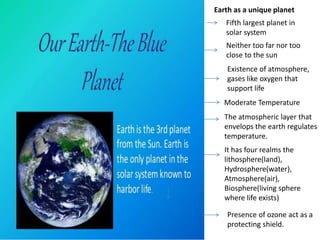
Fifth largest planet in
solar system
Existence of atmosphere,
gases like oxygen that
support life
Moderate Temperature
It has four realms the
lithosphere(land),
Hydrosphere(water),
Atmosphere(air),
Biosphere(living sphere
where life exists)
The atmospheric layer that
envelops the earth regulates
temperature.
Earth as a unique planet
Presence of ozone act as a
protecting shield.
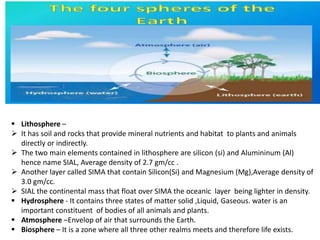
 Lithosphere –
 It has soil and rocks that provide mineral nutrients and habitat to plants and animals
directly or indirectly.
 The two main elements contained in lithosphere are silicon (si) and Alumininum (Al)
hence name SIAL, Average density of 2.7 gm/cc .
 Another layer called SIMA that contain Silicon(Si) and Magnesium (Mg),Average density of
3.0 gm/cc.
 SIAL the continental mass that float over SIMA the oceanic layer being lighter in density.
 Hydrosphere - It contains three states of matter solid ,Liquid, Gaseous. water is an
important constituent of bodies of all animals and plants.
 Atmosphere –Envelop of air that surrounds the Earth.
 Biosphere – It is a zone where all three other realms meets and therefore life exists.
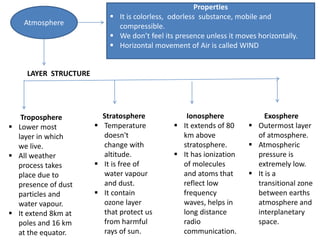
Atmosphere
Properties
 It is colorless, odorless substance, mobile and
compressible.
 We don’t feel its presence unless it moves horizontally.
 Horizontal movement of Air is called WIND
Troposphere
 Lower most
layer in which
we live.
 All weather
process takes
place due to
presence of dust
particles and
water vapour.
 It extend 8km at
poles and 16 km
at the equator.
Stratosphere
 Temperature
doesn't
change with
altitude.
 It is free of
water vapour
and dust.
 It contain
ozone layer
that protect us
from harmful
rays of sun.
Ionosphere
 It extends of 80
km above
stratosphere.
 It has ionization
of molecules
and atoms that
reflect low
frequency
waves, helps in
long distance
radio
communication.
Exosphere
 Outermost layer
of atmosphere.
 Atmospheric
pressure is
extremely low.
 It is a
transitional zone
between earths
atmosphere and
interplanetary
space.
LAYER STRUCTURE
Shape of the Earth
 It is spherical/ oblate spheroid that means it is slightly flattened at the poles and bulges at
the Equator.
 The observations were made by early scholars- Aristotle, Pythagoras, Aryabhatta, columbus
,Magellan.
 Scientific observations and discoveries are as follows-
 Sunrise and sunset don't take place at all places on the earth at the same time.
 The shadow of the earth on the moon .is always circular during lunar eclipse when the earth
passes between the sun and moon.
 While standing on a sea shore and watching a ship coming towards port, the ship does not
Show whole of it at one time.
 Magellan completed the navigation without coming across a sharp edge anywhere, This
made him think about spherical shape of the earth.
 The earth is an oblate sphere because its equatorial diameter is slightly longer than the polar
diameter, This is due to slight bulge at the equator and slight flattening at the poles.
 All the heavenly bodies such as sun, moon, the other planets are spherical in shape due to
their rotation, so earth being member of the large heavenly bodies cant be exceptional.

Ch 1-earth as a planet

  • 2.
    Neither too farnor too close to the sun Fifth largest planet in solar system Existence of atmosphere, gases like oxygen that support life Moderate Temperature It has four realms the lithosphere(land), Hydrosphere(water), Atmosphere(air), Biosphere(living sphere where life exists) The atmospheric layer that envelops the earth regulates temperature. Earth as a unique planet Presence of ozone act as a protecting shield.
  • 4.
     Lithosphere – It has soil and rocks that provide mineral nutrients and habitat to plants and animals directly or indirectly.  The two main elements contained in lithosphere are silicon (si) and Alumininum (Al) hence name SIAL, Average density of 2.7 gm/cc .  Another layer called SIMA that contain Silicon(Si) and Magnesium (Mg),Average density of 3.0 gm/cc.  SIAL the continental mass that float over SIMA the oceanic layer being lighter in density.  Hydrosphere - It contains three states of matter solid ,Liquid, Gaseous. water is an important constituent of bodies of all animals and plants.  Atmosphere –Envelop of air that surrounds the Earth.  Biosphere – It is a zone where all three other realms meets and therefore life exists.
  • 5.
    Atmosphere Properties  It iscolorless, odorless substance, mobile and compressible.  We don’t feel its presence unless it moves horizontally.  Horizontal movement of Air is called WIND Troposphere  Lower most layer in which we live.  All weather process takes place due to presence of dust particles and water vapour.  It extend 8km at poles and 16 km at the equator. Stratosphere  Temperature doesn't change with altitude.  It is free of water vapour and dust.  It contain ozone layer that protect us from harmful rays of sun. Ionosphere  It extends of 80 km above stratosphere.  It has ionization of molecules and atoms that reflect low frequency waves, helps in long distance radio communication. Exosphere  Outermost layer of atmosphere.  Atmospheric pressure is extremely low.  It is a transitional zone between earths atmosphere and interplanetary space. LAYER STRUCTURE
  • 6.
    Shape of theEarth  It is spherical/ oblate spheroid that means it is slightly flattened at the poles and bulges at the Equator.  The observations were made by early scholars- Aristotle, Pythagoras, Aryabhatta, columbus ,Magellan.  Scientific observations and discoveries are as follows-  Sunrise and sunset don't take place at all places on the earth at the same time.  The shadow of the earth on the moon .is always circular during lunar eclipse when the earth passes between the sun and moon.  While standing on a sea shore and watching a ship coming towards port, the ship does not Show whole of it at one time.  Magellan completed the navigation without coming across a sharp edge anywhere, This made him think about spherical shape of the earth.  The earth is an oblate sphere because its equatorial diameter is slightly longer than the polar diameter, This is due to slight bulge at the equator and slight flattening at the poles.  All the heavenly bodies such as sun, moon, the other planets are spherical in shape due to their rotation, so earth being member of the large heavenly bodies cant be exceptional.