Chapter 16 Wind and water  in our atmosphere
Wind is caused by the unequal heating of the earth!
Important fact! Wind is always named by where it is coming from! It is called a NORTH wind because it is moving from the north to the south. What would a wind be named if it is blowing from Georgia to Florida?
Two main types of wind: Local - small area Global - across continents
Local winds Most often noticed at the beach!
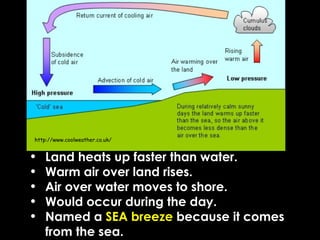
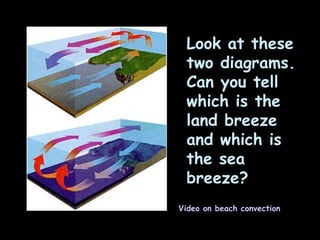
Land heats up faster than water. Warm air over land rises. Air over water moves to shore. Would occur during the day. Named a  SEA breeze  because it comes from the sea. http://www.coolweather.co.uk/
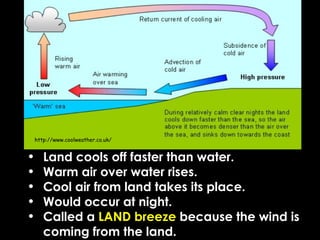
Land cools off faster than water. Warm air over water rises.  Cool air from land takes its place. Would occur at night. Called a  LAND breeze  because the wind is coming from the land.  http://www.coolweather.co.uk/
Look at these two diagrams.  Can you tell which is the land breeze and which is the sea breeze? Video on beach convection
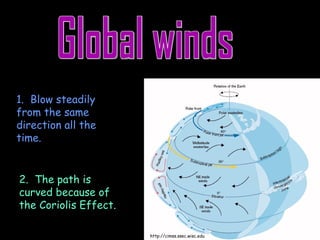
Global winds 1.  Blow steadily from the same direction all the time. 2.  The path is curved because of the Coriolis Effect. http://cimss.ssec.wisc.edu
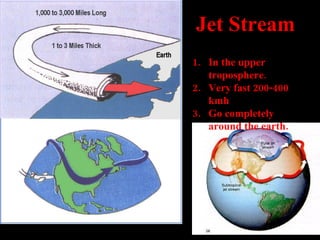
Jet Stream In the upper troposphere. Very fast 200-400 kmh Go completely around the earth.
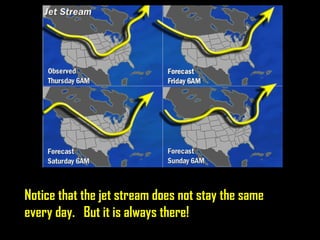
Notice that the jet stream does not stay the same every day.  But it is always there!
jet stream
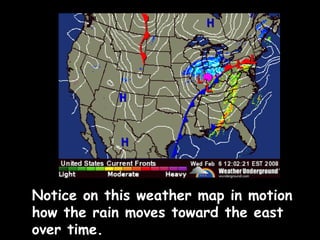
Notice on this weather map in motion how the rain moves toward the east over time.
Humidity Is a measure of how much water vapor is in the air. It is measured in a percent using a  psychrometer . More humidity means more clouds and more likely chance of precipitation.
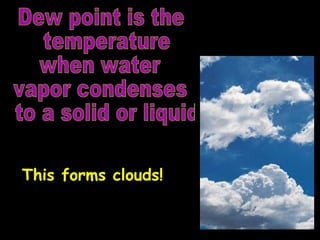
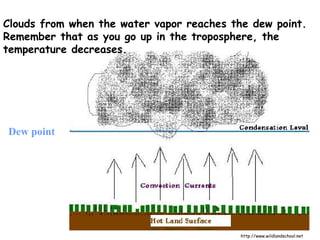
Dew point is the temperature  when water  vapor condenses to a solid or liquid This forms clouds!
http://www.wildlandschool.net Clouds from when the water vapor reaches the dew point. Remember that as you go up in the troposphere, the temperature decreases. Dew point
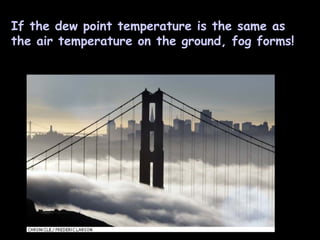
If the dew point temperature is the same as the air temperature on the ground, fog forms!
Precipitation Any form of  H 2 O that falls from clouds  and reaches the  earth's surface.
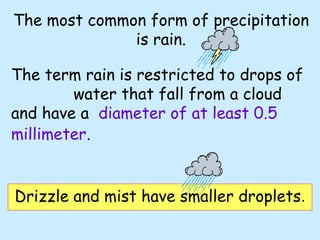
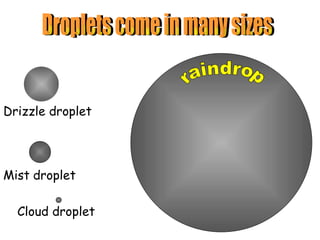
The term rain is restricted to drops of  water that fall from a cloud and have a  diameter of at least 0.5 millimeter . Drizzle and mist have smaller droplets . The most common form of precipitation is rain.
Drizzle droplet raindrop Mist   droplet Cloud droplet Droplets come in many sizes
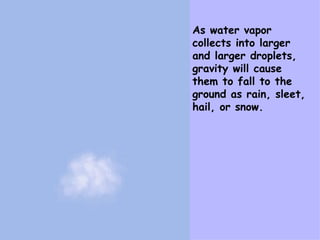
As water vapor collects into larger and larger droplets, gravity will cause them to fall to the ground as rain, sleet, hail, or snow.
Clouds Form when water vapor condenses to form drops of liquid water or ice crystals. There are three main types of clouds.
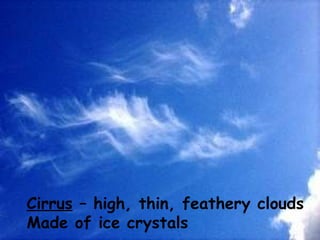
Cirrus  – high, thin, feathery clouds Made of ice crystals
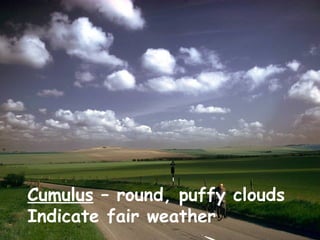
Cumulus  – round, puffy clouds Indicate fair weather
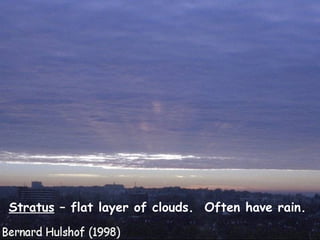
Stratus  – flat layer of clouds.  Often have rain.
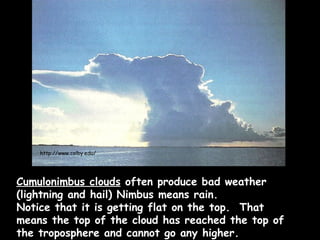
Cumulonimbus clouds  often produce bad weather (lightning and hail) Nimbus means rain.  Notice that it is getting flat on the top.  That means the top of the cloud has reached the top of the troposphere and cannot go any higher. http://www.colby.edu/
Any questions?

Ch 16 Wind And Water

  • 1.
    Chapter 16 Windand water in our atmosphere
  • 2.
    Wind is causedby the unequal heating of the earth!
  • 3.
    Important fact! Windis always named by where it is coming from! It is called a NORTH wind because it is moving from the north to the south. What would a wind be named if it is blowing from Georgia to Florida?
  • 4.
    Two main typesof wind: Local - small area Global - across continents
  • 5.
    Local winds Mostoften noticed at the beach!
  • 6.
    Land heats upfaster than water. Warm air over land rises. Air over water moves to shore. Would occur during the day. Named a SEA breeze because it comes from the sea. http://www.coolweather.co.uk/
  • 7.
    Land cools offfaster than water. Warm air over water rises. Cool air from land takes its place. Would occur at night. Called a LAND breeze because the wind is coming from the land. http://www.coolweather.co.uk/
  • 8.
    Look at thesetwo diagrams. Can you tell which is the land breeze and which is the sea breeze? Video on beach convection
  • 9.
    Global winds 1. Blow steadily from the same direction all the time. 2. The path is curved because of the Coriolis Effect. http://cimss.ssec.wisc.edu
  • 10.
    Jet Stream Inthe upper troposphere. Very fast 200-400 kmh Go completely around the earth.
  • 11.
    Notice that thejet stream does not stay the same every day. But it is always there!
  • 12.
  • 13.
    Notice on thisweather map in motion how the rain moves toward the east over time.
  • 14.
    Humidity Is ameasure of how much water vapor is in the air. It is measured in a percent using a psychrometer . More humidity means more clouds and more likely chance of precipitation.
  • 15.
    Dew point isthe temperature when water vapor condenses to a solid or liquid This forms clouds!
  • 16.
    http://www.wildlandschool.net Clouds fromwhen the water vapor reaches the dew point. Remember that as you go up in the troposphere, the temperature decreases. Dew point
  • 17.
    If the dewpoint temperature is the same as the air temperature on the ground, fog forms!
  • 18.
    Precipitation Any formof H 2 O that falls from clouds and reaches the earth's surface.
  • 19.
    The term rainis restricted to drops of water that fall from a cloud and have a diameter of at least 0.5 millimeter . Drizzle and mist have smaller droplets . The most common form of precipitation is rain.
  • 20.
    Drizzle droplet raindropMist droplet Cloud droplet Droplets come in many sizes
  • 21.
    As water vaporcollects into larger and larger droplets, gravity will cause them to fall to the ground as rain, sleet, hail, or snow.
  • 22.
    Clouds Form whenwater vapor condenses to form drops of liquid water or ice crystals. There are three main types of clouds.
  • 23.
    Cirrus –high, thin, feathery clouds Made of ice crystals
  • 24.
    Cumulus –round, puffy clouds Indicate fair weather
  • 25.
    Stratus –flat layer of clouds. Often have rain.
  • 26.
    Cumulonimbus clouds often produce bad weather (lightning and hail) Nimbus means rain. Notice that it is getting flat on the top. That means the top of the cloud has reached the top of the troposphere and cannot go any higher. http://www.colby.edu/
  • 27.