Software Quality Models:
A Comparative Study paper
Summarized in 2017
Presented by: Moutasm tamimi
Software Quality
Al-Badareen, Anas Bassam, et al. "Software Quality Models: A Comparative Study." ICSECS (1). 2011.
Outline
■ Abstract
■ Introduction
■ Background
■ McCall, Boehm, FURPS, Dromey, and ISO (Comparisons)
■ This study intends to
■ McCall Model
■ Boehm Model
■ FURPS Model
■ Dromey (1995) Model
■ ISO IEC 9126 Model
■ ISO IEC 9126 Model Advantages
■ The Comparison Method
■ Case Study
■ Result and Discussion
■ The values
■ Conclusion
Abstract
The models were proposed to evaluate general or specific scopes of software products.
■ The proposed models were developed based on comparisons between the well-known
models, in order to customize the closed model to the intended scope.
■ These comparisons are leak of criteria that is conducted based on different perspectives
and understanding.
■ Therefore, a formal method of comparison between software quality models is
proposed.
■ The proposed method is applied on a comprehensive comparison between well-known
software quality models.
■ The result of the proposed method shows the strength and weaknesses of those models.
Background
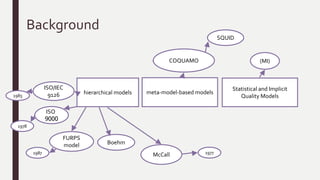
hierarchical models meta-model-based models
Statistical and Implicit
Quality Models
McCall
FURPS
model
ISO/IEC
9126
COQUAMO
SQUID
(MI)
ISO
9000
1978
1985
19771987
Boehm
Introduction
■ McCall [2] model was developed in 1976-7, which is one of the oldest software quality models.
This model started with a volume of 55 quality characteristics which have an important
influence on quality, and called them "factors".
■ The quality factors were compressed into eleven main factors in order to simplify the model.
■ The quality of software products was defined according to three major perspectives,
– product revision (ability to undergo changes),
– product transition (adaptability to new environments) and
– product operations (its operation characteristics).
■ Boehm model[4], the model was based on McCall model, he defined the second set of quality
factors.
■ SPARDAT is a commercial quality model was developed in the banking environment.The
model classified three significant factors: applicability, maintainability, and adaptability.
McCall, Boehm, FURPS, Dromey, and ISO
(Comparisons)
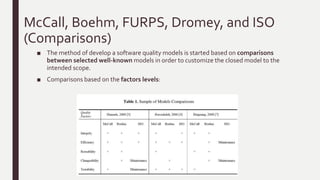
■ The method of develop a software quality models is started based on comparisons
between selected well-known models in order to customize the closed model to the
intended scope.
■ Comparisons based on the factors levels:
This study intends to
■ Develop a formal method that can be used to compare and differentiate between software
quality models mathematically.
■ Help to avoid any contradictions that may occur during development.
■ help to define a standard basic for developing a software quality model.
■ The paper have the following:
– Section two: Quality Models Background
– Section three: Comparison Method
– Section four: CaseStudy
– Section Five: Result and Discussion
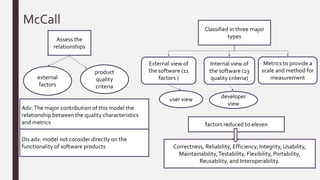
McCall Model
external
factors
product
quality
criteria
Assess the
relationships
Classified in three major
types
External view of
the software (11
factors )
Internal view of
the software (23
quality criteria)
user view developer
view
Metrics to provide a
scale and method for
measurement
factors reduced to eleven
Correctness, Reliability, Efficiency, Integrity, Usability,
Maintainability,Testability, Flexibility, Portability,
Reusability, and Interoperability.
Adv:The major contribution of this model the
relationship between the quality characteristics
and metrics
Dis adv: model not consider directly on the
functionality of software products
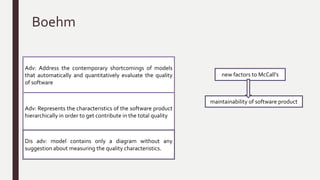
Boehm Model
new factors to McCall’s
maintainability of software product
Adv: Address the contemporary shortcomings of models
that automatically and quantitatively evaluate the quality
of software
Adv: Represents the characteristics of the software product
hierarchically in order to get contribute in the total quality
Dis adv: model contains only a diagram without any
suggestion about measuring the quality characteristics.
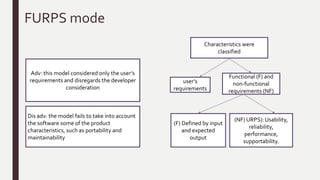
FURPS Model
user’s
requirements
Functional (F) and
non-functional
requirements (NF)
Characteristics were
classified
(F) Defined by input
and expected
output
(NF) URPS): Usability,
reliability,
performance,
supportability.
Adv: this model considered only the user’s
requirements and disregards the developer
consideration
Dis adv: the model fails to take into account
the software some of the product
characteristics, such as portability and
maintainability
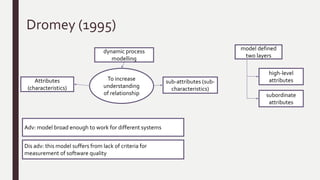
Dromey (1995) Model
Adv: model broad enough to work for different systems
To increase
understanding
of relationship
Attributes
(characteristics)
sub-attributes (sub-
characteristics)
model defined
two layers
high-level
attributes
subordinate
attributes
Dis adv: this model suffers from lack of criteria for
measurement of software quality
dynamic process
modelling
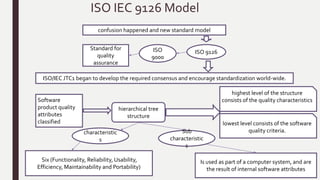
ISO IEC 9126 Model
confusion happened and new standard model
Standard for
quality
assurance
ISO
9000
ISO 9126
ISO/IEC JTC1 began to develop the required consensus and encourage standardization world-wide.
Software
product quality
attributes
classified
hierarchical tree
structure
characteristic
s
Sub
characteristic
s
Six (Functionality, Reliability, Usability,
Efficiency, Maintainability and Portability)
Is used as part of a computer system, and are
the result of internal software attributes
highest level of the structure
consists of the quality characteristics
lowest level consists of the software
quality criteria.
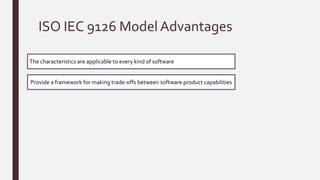
ISO IEC 9126 ModelAdvantages
The characteristics are applicable to every kind of software
Provide a framework for making trade-offs between software product capabilities
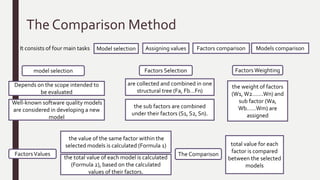
The Comparison Method
Assigning values Factors comparison Models comparison
model selection
Depends on the scope intended to
be evaluated
Well-known software quality models
are considered in developing a new
model
Factors Selection
are collected and combined in one
structural tree (Fa, Fb…Fn)
the sub factors are combined
under their factors (S1, S2, Sn).
FactorsWeighting
the weight of factors
(W1, W2…….Wn) and
sub factor (Wa,
Wb……Wm) are
assigned
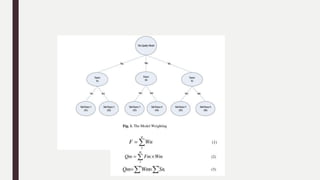
FactorsValues
the value of the same factor within the
selected models is calculated (Formula 1)
the total value of each model is calculated
(Formula 2), based on the calculated
values of their factors.
The Comparison
total value for each
factor is compared
between the selected
models
It consists of four main tasks Model selection
Case Study
The comparison shows the main differences between these models.The following steps are
followed in order to perform the task:
– Step 1: combine the factors of the selected models and remove the repeated
– Step 2: combine the sub-factors for each factor
– Step 3: assign the weight for each factor
– Step 4: assign the weight for each sub factor Step
– 5: calculate the weight for each factor in every model independently
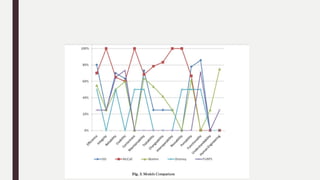
– Step 6: compare the values of same factors in all of the selected models
Result and Discussion
■ This study was to collect the factors that included by selected models and remove the
repeated according to the definition of each of them.
■ The second step is combining the sub-factors from all of the models for specific
factor.
■ The repeated sub characteristics were removed according to the definition of each of
them.
The values
■ The values were seated equivalently which gave 50% of the value to present whether
the factor is included in the model, whereas 25% was given if the characteristic is
included as a sub factor.
■ Because of the generality of this comparison which not considered any type of
software or any specific software domain, the value of the factors are same.
■ the values for each factor within the same model are calculated according to the same
formula that was used to calculate the values of the factors.
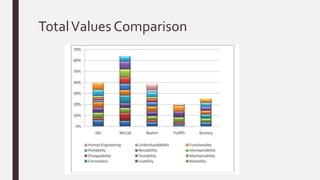
The total value for each model
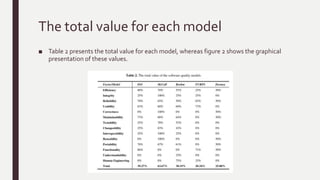
■ Table 2 presents the total value for each model, whereas figure 2 shows the graphical
presentation of these values.
TotalValues Comparison
Conclusion
■ Each model was discussed in details, the advantages and disadvantages were expressed.
■ Comprehensive comparison between the selected models was presented.The comparison
goes behind the definitions of the software quality factors into sub factors and criteria.
■ New comparison method was proposed, in order to get clear and accurate differences
between software quality models.
■ The comparison was basic on mathematical formula, in order to show graphically the
differences between those models.
■ This method requires assign values for the sub factors moreover the main factors. Which is
gave a clear picture of the differences between the models
Speaker Information
 Moutasm tamimi
Independent consultant , IT Researcher , CEO at ITG7
Instructor of: Project Development.
DBMS.
.NET applications.
Digital marketing.
Email: tamimi@itg7.com
LinkedIn: click here.
Software Quality Models: A Comparative Study  paper

Software Quality Models: A Comparative Study paper

  • 1.
    Software Quality Models: AComparative Study paper Summarized in 2017 Presented by: Moutasm tamimi Software Quality Al-Badareen, Anas Bassam, et al. "Software Quality Models: A Comparative Study." ICSECS (1). 2011.
  • 2.
    Outline ■ Abstract ■ Introduction ■Background ■ McCall, Boehm, FURPS, Dromey, and ISO (Comparisons) ■ This study intends to ■ McCall Model ■ Boehm Model ■ FURPS Model ■ Dromey (1995) Model ■ ISO IEC 9126 Model ■ ISO IEC 9126 Model Advantages ■ The Comparison Method ■ Case Study ■ Result and Discussion ■ The values ■ Conclusion
  • 3.
    Abstract The models wereproposed to evaluate general or specific scopes of software products. ■ The proposed models were developed based on comparisons between the well-known models, in order to customize the closed model to the intended scope. ■ These comparisons are leak of criteria that is conducted based on different perspectives and understanding. ■ Therefore, a formal method of comparison between software quality models is proposed. ■ The proposed method is applied on a comprehensive comparison between well-known software quality models. ■ The result of the proposed method shows the strength and weaknesses of those models.
  • 4.
    Background hierarchical models meta-model-basedmodels Statistical and Implicit Quality Models McCall FURPS model ISO/IEC 9126 COQUAMO SQUID (MI) ISO 9000 1978 1985 19771987 Boehm
  • 5.
    Introduction ■ McCall [2]model was developed in 1976-7, which is one of the oldest software quality models. This model started with a volume of 55 quality characteristics which have an important influence on quality, and called them "factors". ■ The quality factors were compressed into eleven main factors in order to simplify the model. ■ The quality of software products was defined according to three major perspectives, – product revision (ability to undergo changes), – product transition (adaptability to new environments) and – product operations (its operation characteristics). ■ Boehm model[4], the model was based on McCall model, he defined the second set of quality factors. ■ SPARDAT is a commercial quality model was developed in the banking environment.The model classified three significant factors: applicability, maintainability, and adaptability.
  • 6.
    McCall, Boehm, FURPS,Dromey, and ISO (Comparisons) ■ The method of develop a software quality models is started based on comparisons between selected well-known models in order to customize the closed model to the intended scope. ■ Comparisons based on the factors levels:
  • 7.
    This study intendsto ■ Develop a formal method that can be used to compare and differentiate between software quality models mathematically. ■ Help to avoid any contradictions that may occur during development. ■ help to define a standard basic for developing a software quality model. ■ The paper have the following: – Section two: Quality Models Background – Section three: Comparison Method – Section four: CaseStudy – Section Five: Result and Discussion
  • 8.
    McCall Model external factors product quality criteria Assess the relationships Classifiedin three major types External view of the software (11 factors ) Internal view of the software (23 quality criteria) user view developer view Metrics to provide a scale and method for measurement factors reduced to eleven Correctness, Reliability, Efficiency, Integrity, Usability, Maintainability,Testability, Flexibility, Portability, Reusability, and Interoperability. Adv:The major contribution of this model the relationship between the quality characteristics and metrics Dis adv: model not consider directly on the functionality of software products
  • 9.
    Boehm Model new factorsto McCall’s maintainability of software product Adv: Address the contemporary shortcomings of models that automatically and quantitatively evaluate the quality of software Adv: Represents the characteristics of the software product hierarchically in order to get contribute in the total quality Dis adv: model contains only a diagram without any suggestion about measuring the quality characteristics.
  • 10.
    FURPS Model user’s requirements Functional (F)and non-functional requirements (NF) Characteristics were classified (F) Defined by input and expected output (NF) URPS): Usability, reliability, performance, supportability. Adv: this model considered only the user’s requirements and disregards the developer consideration Dis adv: the model fails to take into account the software some of the product characteristics, such as portability and maintainability
  • 11.
    Dromey (1995) Model Adv:model broad enough to work for different systems To increase understanding of relationship Attributes (characteristics) sub-attributes (sub- characteristics) model defined two layers high-level attributes subordinate attributes Dis adv: this model suffers from lack of criteria for measurement of software quality dynamic process modelling
  • 12.
    ISO IEC 9126Model confusion happened and new standard model Standard for quality assurance ISO 9000 ISO 9126 ISO/IEC JTC1 began to develop the required consensus and encourage standardization world-wide. Software product quality attributes classified hierarchical tree structure characteristic s Sub characteristic s Six (Functionality, Reliability, Usability, Efficiency, Maintainability and Portability) Is used as part of a computer system, and are the result of internal software attributes highest level of the structure consists of the quality characteristics lowest level consists of the software quality criteria.
  • 13.
    ISO IEC 9126ModelAdvantages The characteristics are applicable to every kind of software Provide a framework for making trade-offs between software product capabilities
  • 14.
    The Comparison Method Assigningvalues Factors comparison Models comparison model selection Depends on the scope intended to be evaluated Well-known software quality models are considered in developing a new model Factors Selection are collected and combined in one structural tree (Fa, Fb…Fn) the sub factors are combined under their factors (S1, S2, Sn). FactorsWeighting the weight of factors (W1, W2…….Wn) and sub factor (Wa, Wb……Wm) are assigned FactorsValues the value of the same factor within the selected models is calculated (Formula 1) the total value of each model is calculated (Formula 2), based on the calculated values of their factors. The Comparison total value for each factor is compared between the selected models It consists of four main tasks Model selection
  • 16.
    Case Study The comparisonshows the main differences between these models.The following steps are followed in order to perform the task: – Step 1: combine the factors of the selected models and remove the repeated – Step 2: combine the sub-factors for each factor – Step 3: assign the weight for each factor – Step 4: assign the weight for each sub factor Step – 5: calculate the weight for each factor in every model independently – Step 6: compare the values of same factors in all of the selected models
  • 17.
    Result and Discussion ■This study was to collect the factors that included by selected models and remove the repeated according to the definition of each of them. ■ The second step is combining the sub-factors from all of the models for specific factor. ■ The repeated sub characteristics were removed according to the definition of each of them.
  • 18.
    The values ■ Thevalues were seated equivalently which gave 50% of the value to present whether the factor is included in the model, whereas 25% was given if the characteristic is included as a sub factor. ■ Because of the generality of this comparison which not considered any type of software or any specific software domain, the value of the factors are same. ■ the values for each factor within the same model are calculated according to the same formula that was used to calculate the values of the factors.
  • 19.
    The total valuefor each model ■ Table 2 presents the total value for each model, whereas figure 2 shows the graphical presentation of these values.
  • 20.
  • 22.
    Conclusion ■ Each modelwas discussed in details, the advantages and disadvantages were expressed. ■ Comprehensive comparison between the selected models was presented.The comparison goes behind the definitions of the software quality factors into sub factors and criteria. ■ New comparison method was proposed, in order to get clear and accurate differences between software quality models. ■ The comparison was basic on mathematical formula, in order to show graphically the differences between those models. ■ This method requires assign values for the sub factors moreover the main factors. Which is gave a clear picture of the differences between the models
  • 23.
    Speaker Information  Moutasmtamimi Independent consultant , IT Researcher , CEO at ITG7 Instructor of: Project Development. DBMS. .NET applications. Digital marketing. Email: tamimi@itg7.com LinkedIn: click here.