Chapter 1 – An Introduction to
Financial Management
Keown, Martin, Petty, and Scott
What is Finance
 Financial Management is concerned with the
maintenance and creation of wealth.
 Finance focuses on decision making with an
eye towards creating wealth.
What is Finance
As such finance deal with decisions such as
1. When to introduce a new product
2. When to invest in new assets
3. When to replace existing assets
4. When to borrow from banks
5. When to issue stocks and bonds
6. When to extend credit to a customer, and
7. How much cash to be maintained.
Goal of a firm
 Profit maximization vs. maximization of
shareholder wealth
 The timeline for profit maximization affects
the outcome.
 Financial managers’ decisions must take into
account the risk and returns of each project,
as well as the timing of the returns.
Goal of a firm
 Profit maximization goal is unclear about the
time frame over which profits are to be
measured.
 It is easy to manipulate the profits through
various accounting policies.
 Profit maximization goal ignores risk and
timing of cash flows.
Goal of a firm
 Maximization of shareholder wealth
 Modifies the profit maximization goal to incorporate
uncertainty and risk.
 Decisions are made based upon what should
happen to the stock price if everything else were
held constant.
Legal Forms of Business Organization
 Sole proprietorship
 Owned by an individual with full rights to profits
and responsible for all liabilities. Unlimited liability.
 Initiated simply by starting business operations.
 Termination occurs by owner’s choice or death.
Legal Forms of Business Organization
 Partnership
 Two or more people acting as co-owners to
operate a business for profit.
 Two types of partnership: General or Limited
General Partnership
 General Partnership – each partner is fully
responsible for liabilities.
Limited Partnership
Limited Partnership – one or more partners have
liability limited to the amount of capital invested.
 One or more partners can have limited liability
 There must be at least one general partner with unlimited
liability.
 Limited partners cannot participate in the management
of the business and their names cannot appear in the
name of the firm.
Legal Forms of Business Organization
 Corporation – an entity that legally functions
separately and apart from its owners
 Owners of the corporation hold shares of common
stock that are transferable.
 Liability is limited to the amount of investment in
the company’s common stock.
 Corporations continue even with transfer of
shares or death of owners.
Comparison of Organizational Forms
Large growing firms choose the corporate form
 Benefits:
 Limited liability
 Easy to transfer ownership
 Unlimited life (unless the firm goes through corporate
restructuring such as mergers and bankruptcies)
 Drawbacks:
 No secrecy of information
 Maybe delays in decision making
 Greater regulation
 Double taxation
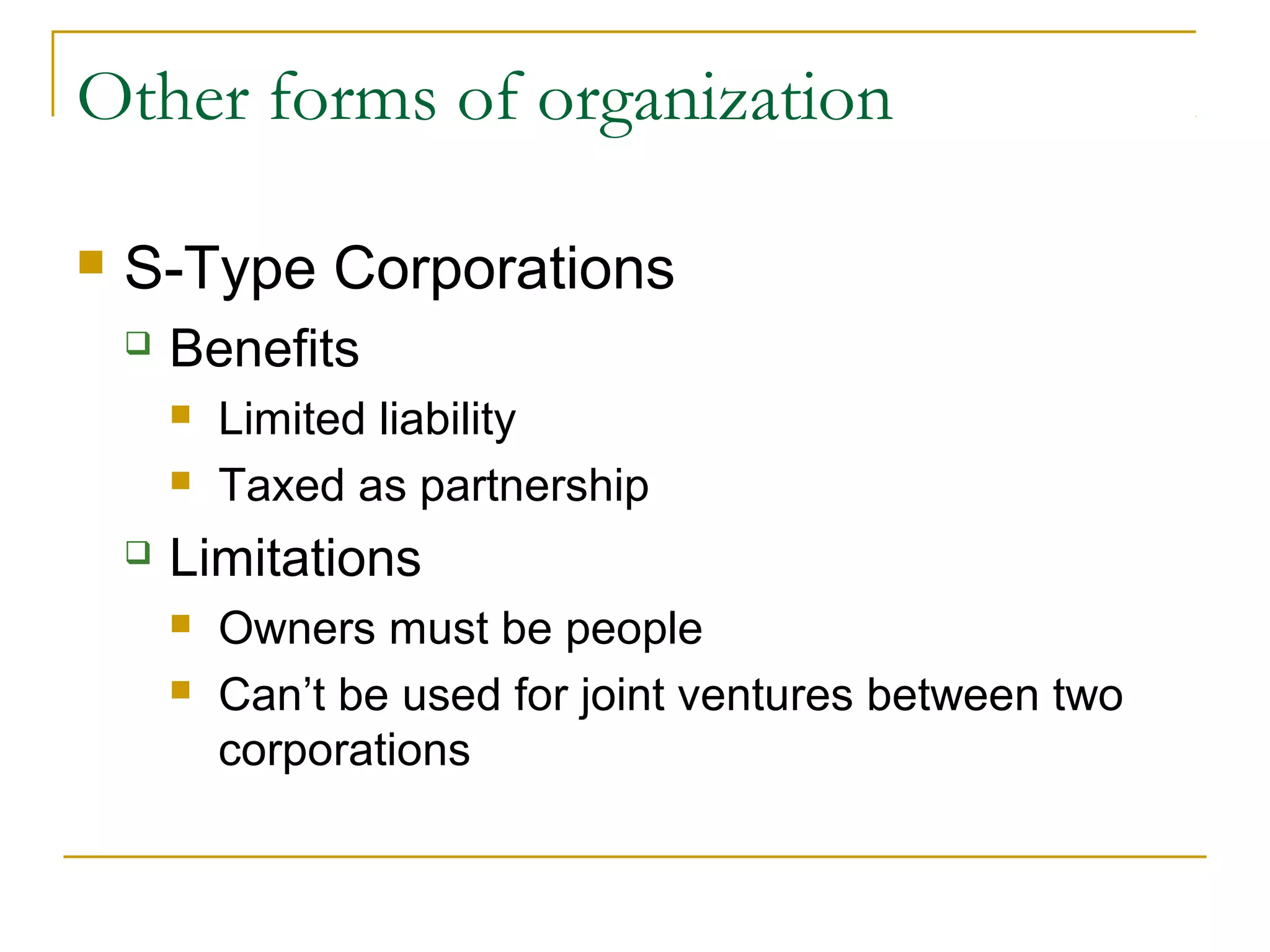
Other forms of organization
 S-Type Corporations
 Benefits
 Limited liability
 Taxed as partnership
 Limitations
 Owners must be people
 Can’t be used for joint ventures between two
corporations
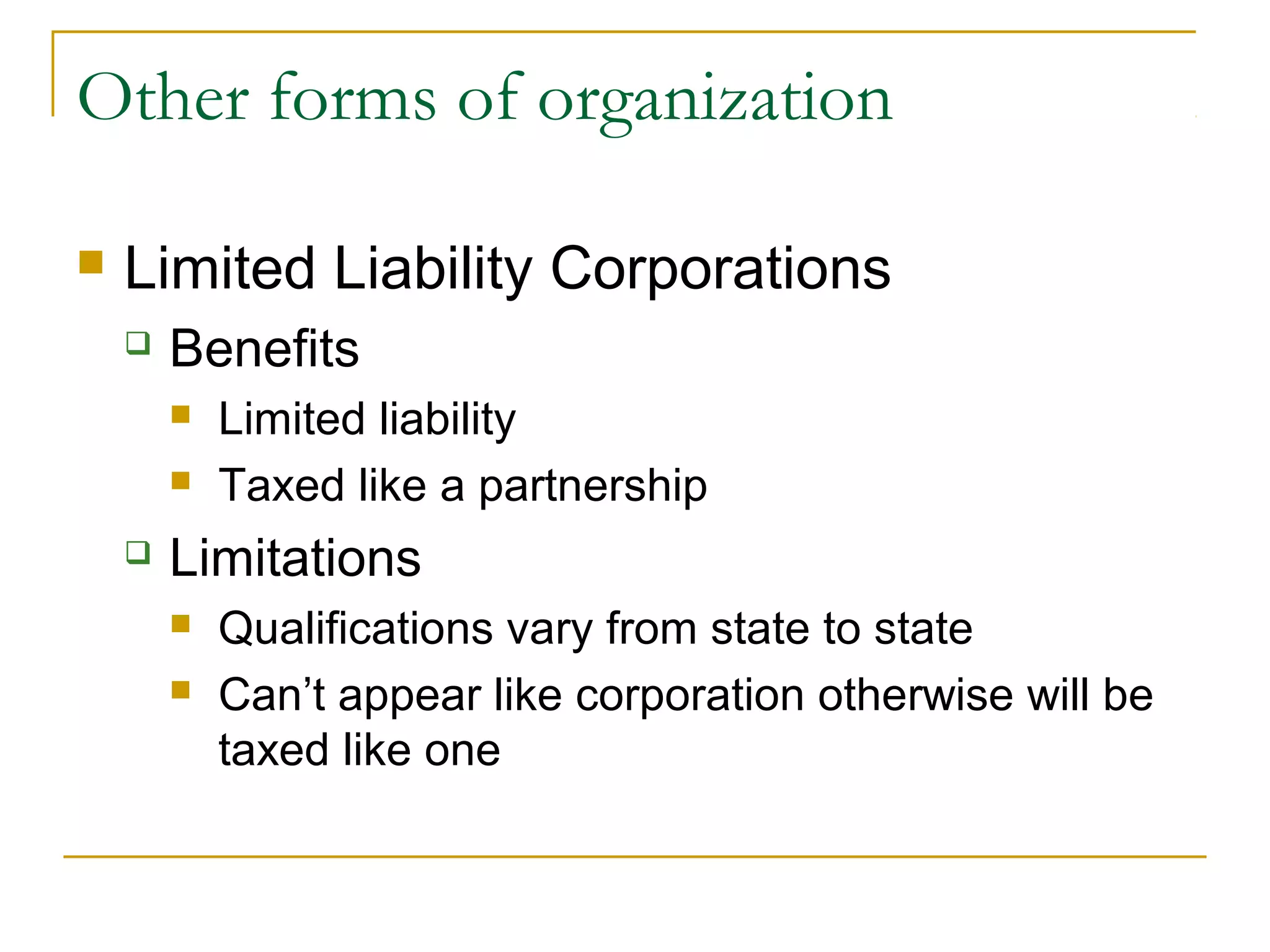
Other forms of organization
 Limited Liability Corporations
 Benefits
 Limited liability
 Taxed like a partnership
 Limitations
 Qualifications vary from state to state
 Can’t appear like corporation otherwise will be
taxed like one
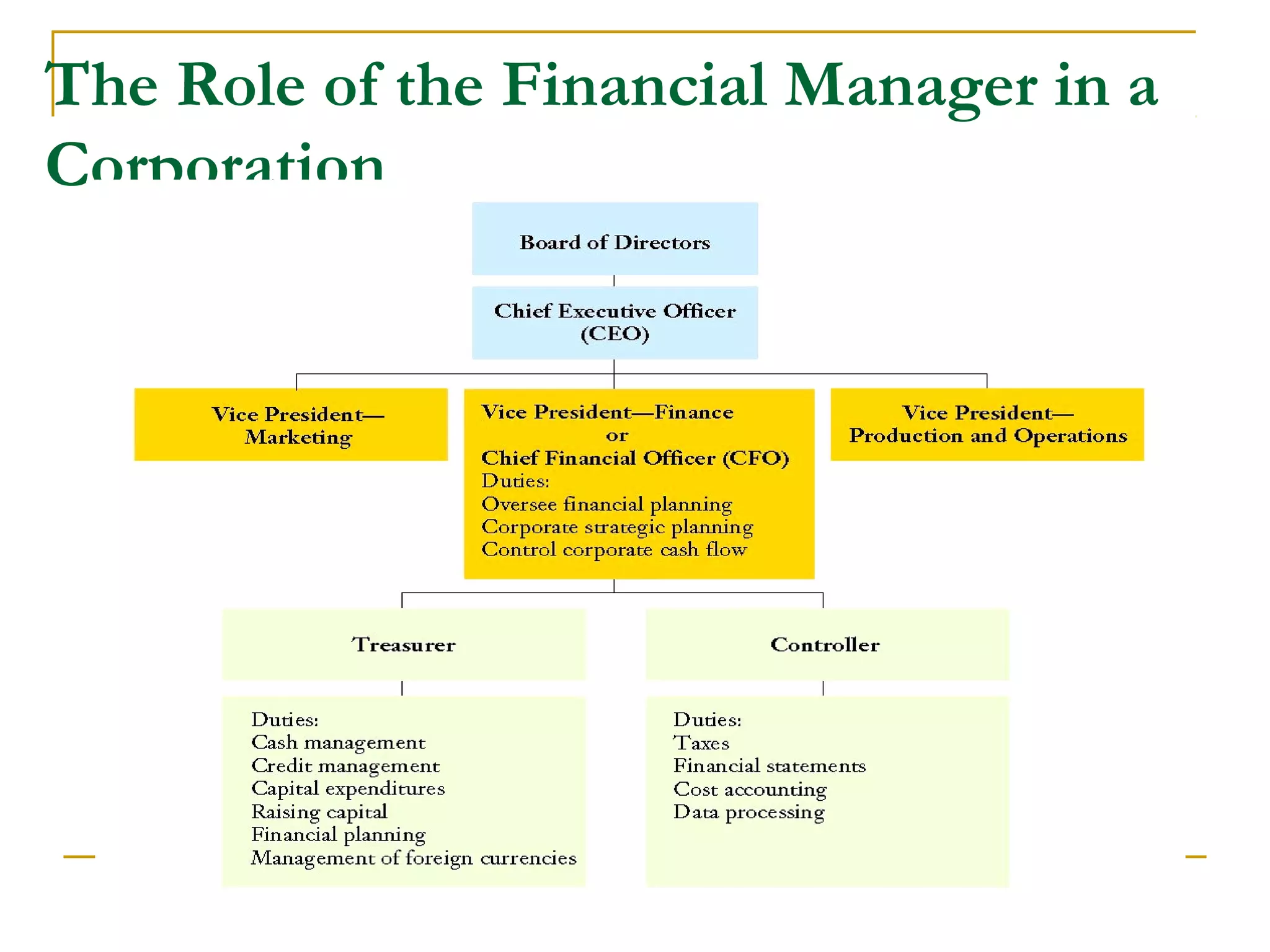
The Role of the Financial Manager in a
Corporation
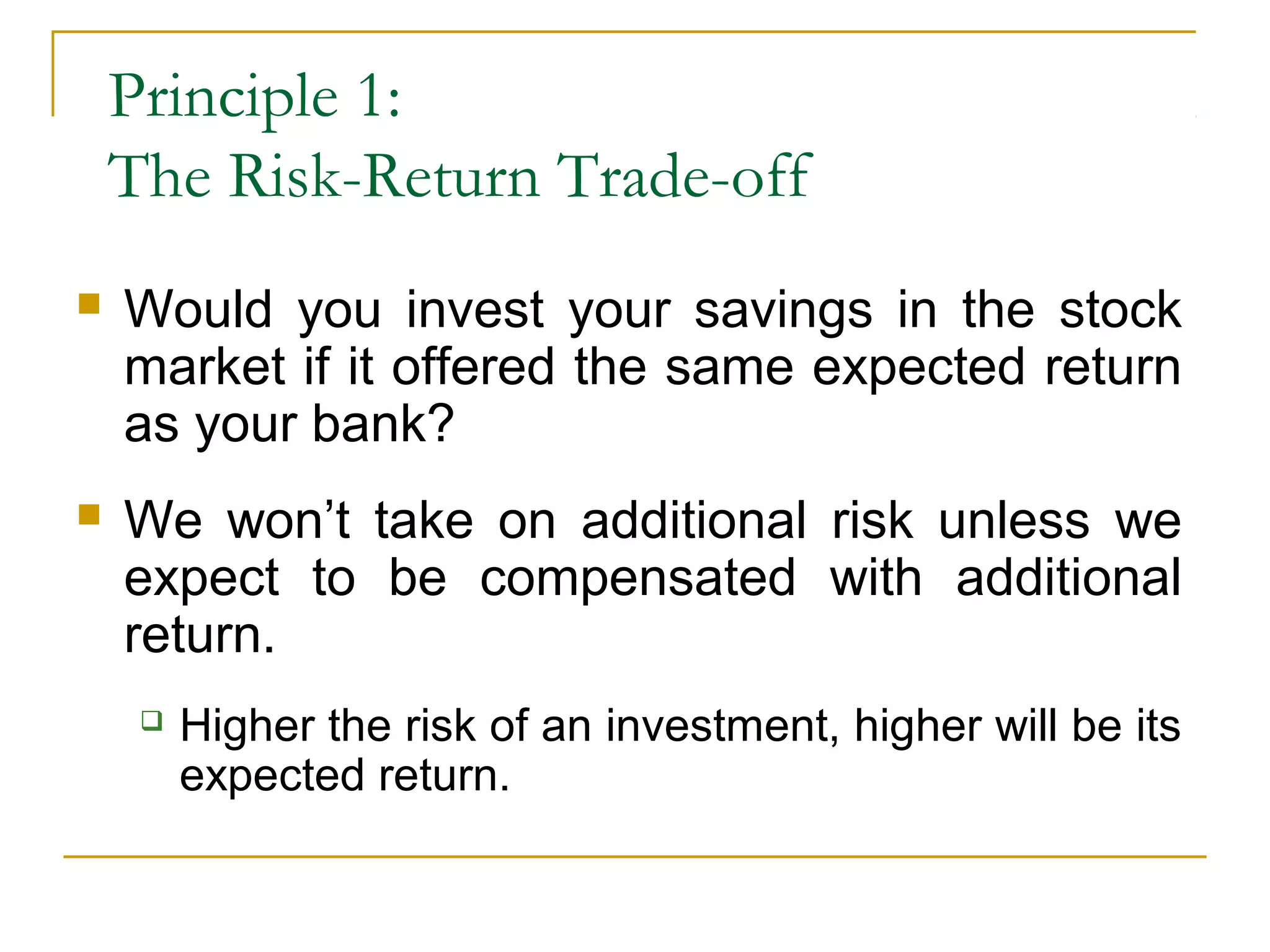
Principle 1:
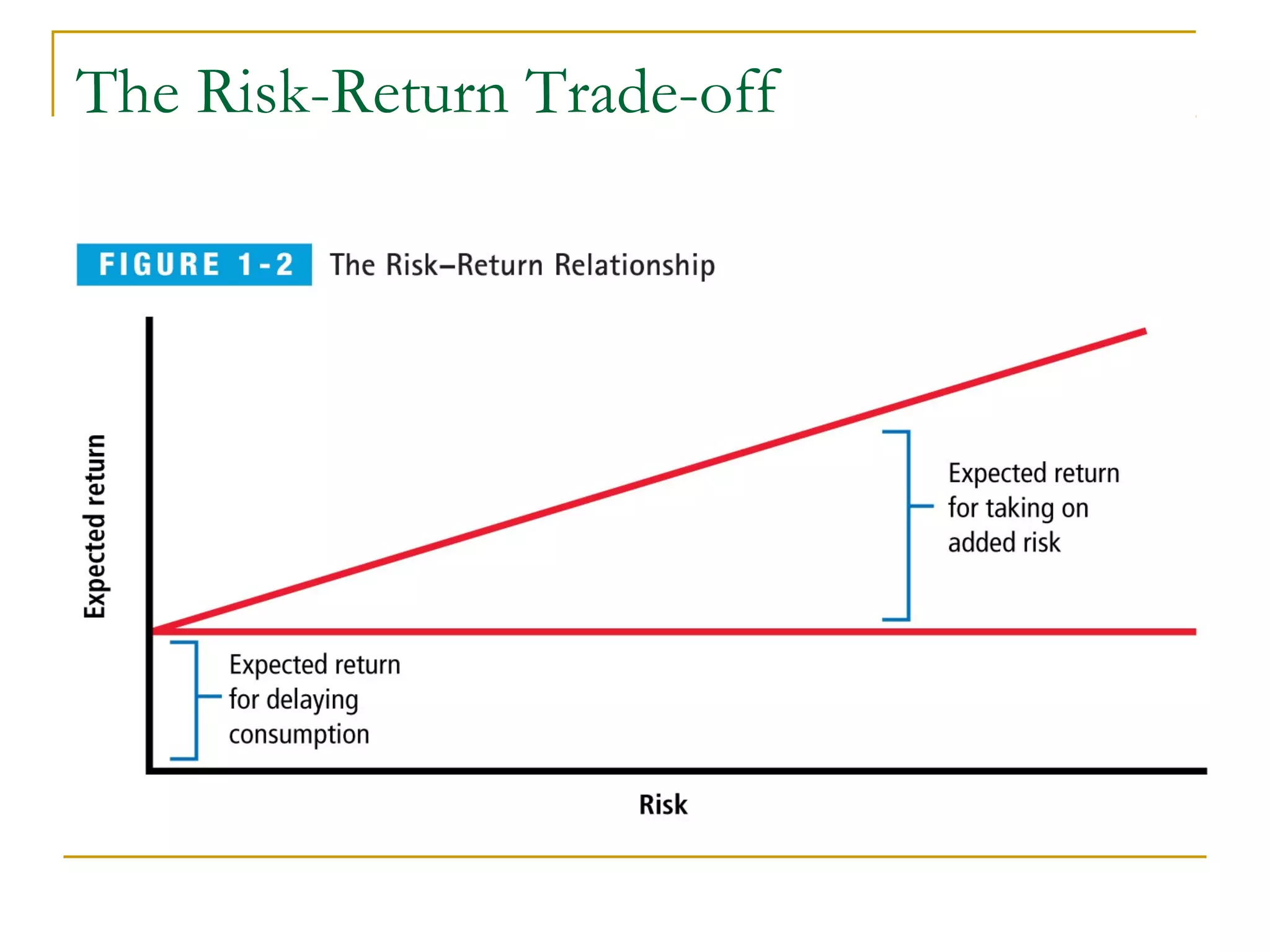
The Risk-Return Trade-off
 Would you invest your savings in the stock
market if it offered the same expected return
as your bank?
 We won’t take on additional risk unless we
expect to be compensated with additional
return.
 Higher the risk of an investment, higher will be its
expected return.
The Risk-Return Trade-off
Principle 2:
The Time Value of Money
 A dollar received today is worth more than
a dollar to be received in the future.
 Because we can earn interest on money
received today, it is better to receive money
earlier rather than later.
Principle 3:
Cash—Not Profits—Is King
 In measuring wealth or value, we use cash
Flow, not accounting profit, as our
measurement tool.
 Cash flows are actually received by the firm
and can be reinvested. On the other hand,
profits are recorded when they are earned
rather than when money is actually received.
 It is possible for a firm to show profits on the
books but have no cash!
Principle 4:
Incremental Cash Flows
 The incremental cash flow is the difference
between the projected cash flows if the
project is selected, versus what they will
be, if the project is not selected.
 This difference reflects the true impact of a
decision.
Principle 5:
The Curse of Competitive Markets
 It is hard to find exceptionally profitable projects.
 If an industry is generating large profits, new entrants
are usually attracted. The additional competition and
added capacity can result in profits being driven down
to the required rate of return.
 Product Differentiation (through Service, Quality) and
cost advantages (through economies of Scale) can
insulate products from competition.
Principle 6:
Efficient Capital Markets
 The values of securities at any instant in time
fully reflect all publicly available information.
 Prices reflect value and are right.
 Price changes reflect changes in expected cash
flows (and not cosmetic changes such as
accounting policy changes). Good decisions
drive up the stock prices and vice versa.
Principle 7:
The Agency Problem
 The separation of management and the
ownership of the firm creates an agency
problem.
 Managers may make decisions that are not in line
with the goal of maximization of shareholder
wealth.
 Agency conflict reduced through monitoring (ex.
Annual reports), compensation schemes (ex.
stock options), and market mechanisms (ex.
Takeovers).
Principle 8:
Taxes Bias Business Decisions
 The cash flows we consider for decision
making are the after-tax incremental cash
flows to the firm as a whole.
Principle 9:
All Risk is Not Equal
 Some risk can be diversified away, and some
cannot.
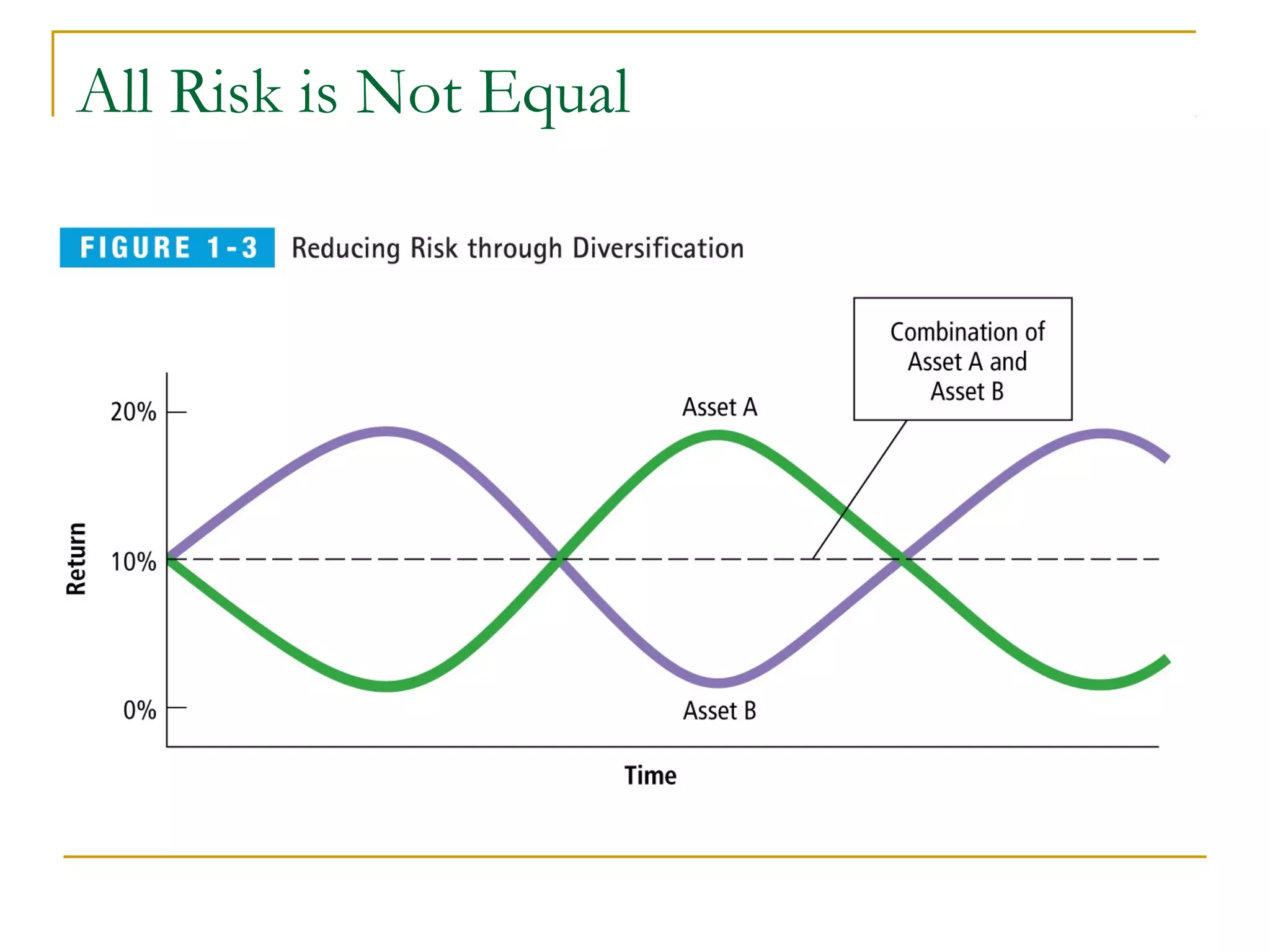
 The process of diversification can reduce risk, and
as a result, measuring a project’s or an asset’s
risk is very difficult. A project’s risk changes
depending on whether you measure it standing
alone or together with other projects the company
may take on.
All Risk is Not Equal
Principle10:
Ethical Behavior Is Doing the Right Thing, and
Ethical Dilemmas Are Everywhere in Finance
 Ethical dilemma — Each person has his or her
own set of values, which forms the basis for
personal judgments about what is the right thing.
 Ethics are relevant in business and unethical
decisions can destroy shareholder wealth (ex.
Enron Scandal).

Finance NSU EMB 510 Chapter 1

  • 1.
    Chapter 1 –An Introduction to Financial Management Keown, Martin, Petty, and Scott
  • 2.
    What is Finance Financial Management is concerned with the maintenance and creation of wealth.  Finance focuses on decision making with an eye towards creating wealth.
  • 3.
    What is Finance Assuch finance deal with decisions such as 1. When to introduce a new product 2. When to invest in new assets 3. When to replace existing assets 4. When to borrow from banks 5. When to issue stocks and bonds 6. When to extend credit to a customer, and 7. How much cash to be maintained.
  • 4.
    Goal of afirm  Profit maximization vs. maximization of shareholder wealth  The timeline for profit maximization affects the outcome.  Financial managers’ decisions must take into account the risk and returns of each project, as well as the timing of the returns.
  • 5.
    Goal of afirm  Profit maximization goal is unclear about the time frame over which profits are to be measured.  It is easy to manipulate the profits through various accounting policies.  Profit maximization goal ignores risk and timing of cash flows.
  • 6.
    Goal of afirm  Maximization of shareholder wealth  Modifies the profit maximization goal to incorporate uncertainty and risk.  Decisions are made based upon what should happen to the stock price if everything else were held constant.
  • 7.
    Legal Forms ofBusiness Organization  Sole proprietorship  Owned by an individual with full rights to profits and responsible for all liabilities. Unlimited liability.  Initiated simply by starting business operations.  Termination occurs by owner’s choice or death.
  • 8.
    Legal Forms ofBusiness Organization  Partnership  Two or more people acting as co-owners to operate a business for profit.  Two types of partnership: General or Limited
  • 9.
    General Partnership  GeneralPartnership – each partner is fully responsible for liabilities.
  • 10.
    Limited Partnership Limited Partnership– one or more partners have liability limited to the amount of capital invested.  One or more partners can have limited liability  There must be at least one general partner with unlimited liability.  Limited partners cannot participate in the management of the business and their names cannot appear in the name of the firm.
  • 11.
    Legal Forms ofBusiness Organization  Corporation – an entity that legally functions separately and apart from its owners  Owners of the corporation hold shares of common stock that are transferable.  Liability is limited to the amount of investment in the company’s common stock.  Corporations continue even with transfer of shares or death of owners.
  • 12.
    Comparison of OrganizationalForms Large growing firms choose the corporate form  Benefits:  Limited liability  Easy to transfer ownership  Unlimited life (unless the firm goes through corporate restructuring such as mergers and bankruptcies)  Drawbacks:  No secrecy of information  Maybe delays in decision making  Greater regulation  Double taxation
  • 13.
    Other forms oforganization  S-Type Corporations  Benefits  Limited liability  Taxed as partnership  Limitations  Owners must be people  Can’t be used for joint ventures between two corporations
  • 14.
    Other forms oforganization  Limited Liability Corporations  Benefits  Limited liability  Taxed like a partnership  Limitations  Qualifications vary from state to state  Can’t appear like corporation otherwise will be taxed like one
  • 15.
    The Role ofthe Financial Manager in a Corporation
  • 16.
    Principle 1: The Risk-ReturnTrade-off  Would you invest your savings in the stock market if it offered the same expected return as your bank?  We won’t take on additional risk unless we expect to be compensated with additional return.  Higher the risk of an investment, higher will be its expected return.
  • 17.
  • 18.
    Principle 2: The TimeValue of Money  A dollar received today is worth more than a dollar to be received in the future.  Because we can earn interest on money received today, it is better to receive money earlier rather than later.
  • 19.
    Principle 3: Cash—Not Profits—IsKing  In measuring wealth or value, we use cash Flow, not accounting profit, as our measurement tool.  Cash flows are actually received by the firm and can be reinvested. On the other hand, profits are recorded when they are earned rather than when money is actually received.  It is possible for a firm to show profits on the books but have no cash!
  • 20.
    Principle 4: Incremental CashFlows  The incremental cash flow is the difference between the projected cash flows if the project is selected, versus what they will be, if the project is not selected.  This difference reflects the true impact of a decision.
  • 21.
    Principle 5: The Curseof Competitive Markets  It is hard to find exceptionally profitable projects.  If an industry is generating large profits, new entrants are usually attracted. The additional competition and added capacity can result in profits being driven down to the required rate of return.  Product Differentiation (through Service, Quality) and cost advantages (through economies of Scale) can insulate products from competition.
  • 22.
    Principle 6: Efficient CapitalMarkets  The values of securities at any instant in time fully reflect all publicly available information.  Prices reflect value and are right.  Price changes reflect changes in expected cash flows (and not cosmetic changes such as accounting policy changes). Good decisions drive up the stock prices and vice versa.
  • 23.
    Principle 7: The AgencyProblem  The separation of management and the ownership of the firm creates an agency problem.  Managers may make decisions that are not in line with the goal of maximization of shareholder wealth.  Agency conflict reduced through monitoring (ex. Annual reports), compensation schemes (ex. stock options), and market mechanisms (ex. Takeovers).
  • 24.
    Principle 8: Taxes BiasBusiness Decisions  The cash flows we consider for decision making are the after-tax incremental cash flows to the firm as a whole.
  • 25.
    Principle 9: All Riskis Not Equal  Some risk can be diversified away, and some cannot.  The process of diversification can reduce risk, and as a result, measuring a project’s or an asset’s risk is very difficult. A project’s risk changes depending on whether you measure it standing alone or together with other projects the company may take on.
  • 26.
    All Risk isNot Equal
  • 27.
    Principle10: Ethical Behavior IsDoing the Right Thing, and Ethical Dilemmas Are Everywhere in Finance  Ethical dilemma — Each person has his or her own set of values, which forms the basis for personal judgments about what is the right thing.  Ethics are relevant in business and unethical decisions can destroy shareholder wealth (ex. Enron Scandal).