Federal Aviation 
Administration Integration of Civil 
Unmanned Aircraft 
Systems (UAS) into the 
National Airspace 
System (NAS): 
A Discussion about Risk 
Presented to: sUSB Exposition 
By: Jim Williams, Manager, FAA, 
UAS Integration Office, AFS-80 
Date: May 8, 2014
Federal Aviation 132 
Administration 
sUSB Exposition 
May 8, 2014 
FAA.gov/about/initiatives/uas 
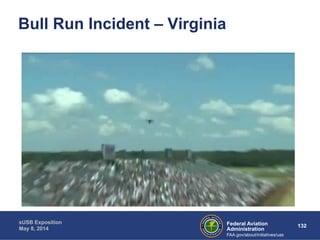
Bull Run Incident – Virginia
Endure Batavia Triathlon Incident – 
Australia 
Federal Aviation 133 
Administration 
sUSB Exposition 
May 8, 2014 
FAA.gov/about/initiatives/uas
Near-Mid Air Collision Incident – 
Florida 
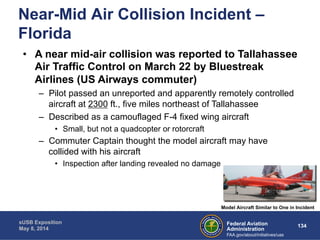
• A near mid-air collision was reported to Tallahassee 
Air Traffic Control on March 22 by Bluestreak 
Airlines (US Airways commuter) 
– Pilot passed an unreported and apparently remotely controlled 
aircraft at 2300 ft., five miles northeast of Tallahassee 
– Described as a camouflaged F-4 fixed wing aircraft 
Model Aircraft Similar to One in Incident 
Federal Aviation 134 
Administration 
sUSB Exposition 
May 8, 2014 
FAA.gov/about/initiatives/uas 
• Small, but not a quadcopter or rotorcraft 
– Commuter Captain thought the model aircraft may have 
collided with his aircraft 
• Inspection after landing revealed no damage
Federal Aviation 135 
Administration 
sUSB Exposition 
May 8, 2014 
FAA.gov/about/initiatives/uas 
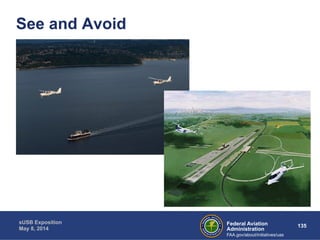
See and Avoid
ASTM Small Unmanned Aircraft 
System Standards 
1. Specification for Aircraft Flight Manual (AFM) 
(F2908) 
2. Practice for Maintenance and Continued 
Airworthiness (F2909) 
3. Specification for Design and Construction (F2910) 
4. Practice for Production Acceptance (F2911) 
5. Specification for Design of the Command and 
Control System (F3002) 
6. Specification for Quality Assurance (F3003) 
7. Specification for Batteries (F3005) 
Federal Aviation 136 
Administration 
sUSB Exposition 
May 8, 2014 
FAA.gov/about/initiatives/uas
Federal Aviation 137 
Administration 
Raphael Pirker Case 
sUSB Exposition 
May 8, 2014 
FAA.gov/about/initiatives/uas 
• Background 
– Raphael Pirker fined $10,000 for “reckless and careless” operation 
of a UAS following commercial filming at the University of Virginia, 
2011 
• Legal Actions 
– National Transportation Safety Board (NTSB) judge dismissed 
case on March 6, 2014 
– FAA appealing decision to full NTSB panel 
• Judge’s decision stayed, pending NTSB review 
• Impact 
– Media coverage has portrayed the Pirker case as a nullification of 
FAA authority to regulate commercial UAS operations 
– Increase of news reports of unauthorized commercial operations 
• Response 
– FAA preparing a public notice to clarify our oversight authority in 
this area
Federal Aviation 138 
Administration 
sUSB Exposition 
May 8, 2014 
FAA.gov/about/initiatives/uas 
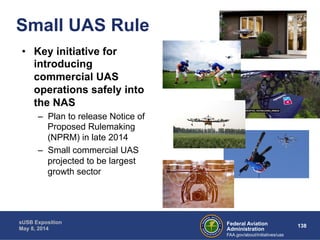
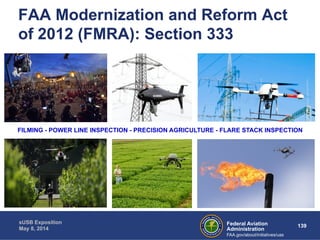
Small UAS Rule 
• Key initiative for 
introducing 
commercial UAS 
operations safely into 
the NAS 
– Plan to release Notice of 
Proposed Rulemaking 
(NPRM) in late 2014 
– Small commercial UAS 
projected to be largest 
growth sector
FAA Modernization and Reform Act 
of 2012 (FMRA): Section 333 
FILMING - POWER LINE INSPECTION - PRECISION AGRICULTURE - FLARE STACK INSPECTION 
Federal Aviation 139 
Administration 
sUSB Exposition 
May 8, 2014 
FAA.gov/about/initiatives/uas
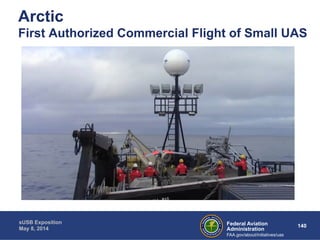
Arctic 
First Authorized Commercial Flight of Small UAS 
Federal Aviation 140 
Administration 
sUSB Exposition 
May 8, 2014 
FAA.gov/about/initiatives/uas
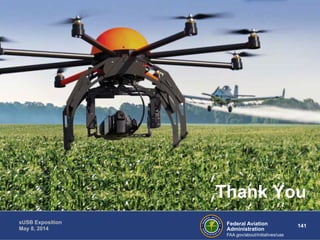
Thank You 
Federal Aviation 141 
Administration 
sUSB Exposition 
May 8, 2014 
FAA.gov/about/initiatives/uas
Federal Aviation 142 
Administration 
sUSB Exposition 
May 8, 2014 
FAA.gov/about/initiatives/uas 
Backup
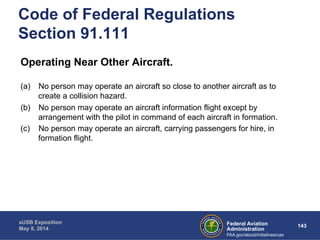
Code of Federal Regulations 
Section 91.111 
Operating Near Other Aircraft. 
(a) No person may operate an aircraft so close to another aircraft as to 
Federal Aviation 143 
Administration 
sUSB Exposition 
May 8, 2014 
FAA.gov/about/initiatives/uas 
create a collision hazard. 
(b) No person may operate an aircraft information flight except by 
arrangement with the pilot in command of each aircraft in formation. 
(c) No person may operate an aircraft, carrying passengers for hire, in 
formation flight.
Code of Federal Regulations 
Section 91.113 
Right-of-way rules: Except water operations. 
(a) Inapplicability. This section does not apply to the operation of an aircraft on water. 
(b) General. When weather conditions permit, regardless of whether an operation is conducted under instrument flight rules or 
visual flight rules, vigilance shall be maintained by each person operating an aircraft so as to see and avoid other aircraft. 
When a rule of this section gives another aircraft the right-of-way, the pilot shall give way to that aircraft and may not pass 
over, under, or ahead of it unless well clear. 
(c) In distress. An aircraft in distress has the right-of-way over all other air traffic. 
(d) Converging. When aircraft of the same category are converging at approximately the same altitude (except head-on, or 
nearly so), the aircraft to the other's right has the right-of-way. If the aircraft are of different categories-- 
(1) A balloon has the right-of-way over any other category of aircraft; 
[(2) A glider has the right-of-way over an airship, powered parachute, weight-shift-control aircraft, airplane, or rotorcraft. 
(3) An airship has the right-of-way over a powered parachute, weight-shift-control aircraft, airplane, or rotorcraft.] 
However, an aircraft towing or refueling other aircraft has the right-of-way over all other engine-driven aircraft. 
(e) Approaching head-on. When aircraft are approaching each other head-on, or nearly so, each pilot of each aircraft shall 
Federal Aviation 144 
Administration 
sUSB Exposition 
May 8, 2014 
FAA.gov/about/initiatives/uas 
alter course to the right. 
(f) Overtaking. Each aircraft that is being overtaken has the right-of-way and each pilot of an overtaking aircraft shall alter 
course to the right to pass well clear. 
(g) Landing. Aircraft, while on final approach to land or while landing, have the right-of-way over other aircraft in flight or 
operating on the surface, except that they shall not take advantage of this rule to force an aircraft off the runway surface 
which has already landed and is attempting to make way for an aircraft on final approach. When two or more aircraft are 
approaching an airport for the purpose of landing, the aircraft at the lower altitude has the right-of-way, but it shall not take 
advantage of this rule to cut in front of another which is on final approach to land or to overtake that aircraft.
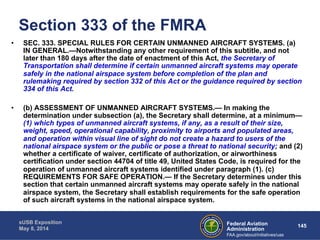
Section 333 of the FMRA 
• SEC. 333. SPECIAL RULES FOR CERTAIN UNMANNED AIRCRAFT SYSTEMS. (a) 
IN GENERAL.—Notwithstanding any other requirement of this subtitle, and not 
later than 180 days after the date of enactment of this Act, the Secretary of 
Transportation shall determine if certain unmanned aircraft systems may operate 
safely in the national airspace system before completion of the plan and 
rulemaking required by section 332 of this Act or the guidance required by section 
334 of this Act. 
• (b) ASSESSMENT OF UNMANNED AIRCRAFT SYSTEMS.— In making the 
determination under subsection (a), the Secretary shall determine, at a minimum— 
(1) which types of unmanned aircraft systems, if any, as a result of their size, 
weight, speed, operational capability, proximity to airports and populated areas, 
and operation within visual line of sight do not create a hazard to users of the 
national airspace system or the public or pose a threat to national security; and (2) 
whether a certificate of waiver, certificate of authorization, or airworthiness 
certification under section 44704 of title 49, United States Code, is required for the 
operation of unmanned aircraft systems identified under paragraph (1). (c) 
REQUIREMENTS FOR SAFE OPERATION.— If the Secretary determines under this 
section that certain unmanned aircraft systems may operate safely in the national 
airspace system, the Secretary shall establish requirements for the safe operation 
of such aircraft systems in the national airspace system. 
Federal Aviation 145 
Administration 
sUSB Exposition 
May 8, 2014 
FAA.gov/about/initiatives/uas

#6 SUSB Expo 2014 FAA

  • 1.
    Federal Aviation AdministrationIntegration of Civil Unmanned Aircraft Systems (UAS) into the National Airspace System (NAS): A Discussion about Risk Presented to: sUSB Exposition By: Jim Williams, Manager, FAA, UAS Integration Office, AFS-80 Date: May 8, 2014
  • 2.
    Federal Aviation 132 Administration sUSB Exposition May 8, 2014 FAA.gov/about/initiatives/uas Bull Run Incident – Virginia
  • 3.
    Endure Batavia TriathlonIncident – Australia Federal Aviation 133 Administration sUSB Exposition May 8, 2014 FAA.gov/about/initiatives/uas
  • 4.
    Near-Mid Air CollisionIncident – Florida • A near mid-air collision was reported to Tallahassee Air Traffic Control on March 22 by Bluestreak Airlines (US Airways commuter) – Pilot passed an unreported and apparently remotely controlled aircraft at 2300 ft., five miles northeast of Tallahassee – Described as a camouflaged F-4 fixed wing aircraft Model Aircraft Similar to One in Incident Federal Aviation 134 Administration sUSB Exposition May 8, 2014 FAA.gov/about/initiatives/uas • Small, but not a quadcopter or rotorcraft – Commuter Captain thought the model aircraft may have collided with his aircraft • Inspection after landing revealed no damage
  • 5.
    Federal Aviation 135 Administration sUSB Exposition May 8, 2014 FAA.gov/about/initiatives/uas See and Avoid
  • 6.
    ASTM Small UnmannedAircraft System Standards 1. Specification for Aircraft Flight Manual (AFM) (F2908) 2. Practice for Maintenance and Continued Airworthiness (F2909) 3. Specification for Design and Construction (F2910) 4. Practice for Production Acceptance (F2911) 5. Specification for Design of the Command and Control System (F3002) 6. Specification for Quality Assurance (F3003) 7. Specification for Batteries (F3005) Federal Aviation 136 Administration sUSB Exposition May 8, 2014 FAA.gov/about/initiatives/uas
  • 7.
    Federal Aviation 137 Administration Raphael Pirker Case sUSB Exposition May 8, 2014 FAA.gov/about/initiatives/uas • Background – Raphael Pirker fined $10,000 for “reckless and careless” operation of a UAS following commercial filming at the University of Virginia, 2011 • Legal Actions – National Transportation Safety Board (NTSB) judge dismissed case on March 6, 2014 – FAA appealing decision to full NTSB panel • Judge’s decision stayed, pending NTSB review • Impact – Media coverage has portrayed the Pirker case as a nullification of FAA authority to regulate commercial UAS operations – Increase of news reports of unauthorized commercial operations • Response – FAA preparing a public notice to clarify our oversight authority in this area
  • 8.
    Federal Aviation 138 Administration sUSB Exposition May 8, 2014 FAA.gov/about/initiatives/uas Small UAS Rule • Key initiative for introducing commercial UAS operations safely into the NAS – Plan to release Notice of Proposed Rulemaking (NPRM) in late 2014 – Small commercial UAS projected to be largest growth sector
  • 9.
    FAA Modernization andReform Act of 2012 (FMRA): Section 333 FILMING - POWER LINE INSPECTION - PRECISION AGRICULTURE - FLARE STACK INSPECTION Federal Aviation 139 Administration sUSB Exposition May 8, 2014 FAA.gov/about/initiatives/uas
  • 10.
    Arctic First AuthorizedCommercial Flight of Small UAS Federal Aviation 140 Administration sUSB Exposition May 8, 2014 FAA.gov/about/initiatives/uas
  • 11.
    Thank You FederalAviation 141 Administration sUSB Exposition May 8, 2014 FAA.gov/about/initiatives/uas
  • 12.
    Federal Aviation 142 Administration sUSB Exposition May 8, 2014 FAA.gov/about/initiatives/uas Backup
  • 13.
    Code of FederalRegulations Section 91.111 Operating Near Other Aircraft. (a) No person may operate an aircraft so close to another aircraft as to Federal Aviation 143 Administration sUSB Exposition May 8, 2014 FAA.gov/about/initiatives/uas create a collision hazard. (b) No person may operate an aircraft information flight except by arrangement with the pilot in command of each aircraft in formation. (c) No person may operate an aircraft, carrying passengers for hire, in formation flight.
  • 14.
    Code of FederalRegulations Section 91.113 Right-of-way rules: Except water operations. (a) Inapplicability. This section does not apply to the operation of an aircraft on water. (b) General. When weather conditions permit, regardless of whether an operation is conducted under instrument flight rules or visual flight rules, vigilance shall be maintained by each person operating an aircraft so as to see and avoid other aircraft. When a rule of this section gives another aircraft the right-of-way, the pilot shall give way to that aircraft and may not pass over, under, or ahead of it unless well clear. (c) In distress. An aircraft in distress has the right-of-way over all other air traffic. (d) Converging. When aircraft of the same category are converging at approximately the same altitude (except head-on, or nearly so), the aircraft to the other's right has the right-of-way. If the aircraft are of different categories-- (1) A balloon has the right-of-way over any other category of aircraft; [(2) A glider has the right-of-way over an airship, powered parachute, weight-shift-control aircraft, airplane, or rotorcraft. (3) An airship has the right-of-way over a powered parachute, weight-shift-control aircraft, airplane, or rotorcraft.] However, an aircraft towing or refueling other aircraft has the right-of-way over all other engine-driven aircraft. (e) Approaching head-on. When aircraft are approaching each other head-on, or nearly so, each pilot of each aircraft shall Federal Aviation 144 Administration sUSB Exposition May 8, 2014 FAA.gov/about/initiatives/uas alter course to the right. (f) Overtaking. Each aircraft that is being overtaken has the right-of-way and each pilot of an overtaking aircraft shall alter course to the right to pass well clear. (g) Landing. Aircraft, while on final approach to land or while landing, have the right-of-way over other aircraft in flight or operating on the surface, except that they shall not take advantage of this rule to force an aircraft off the runway surface which has already landed and is attempting to make way for an aircraft on final approach. When two or more aircraft are approaching an airport for the purpose of landing, the aircraft at the lower altitude has the right-of-way, but it shall not take advantage of this rule to cut in front of another which is on final approach to land or to overtake that aircraft.
  • 15.
    Section 333 ofthe FMRA • SEC. 333. SPECIAL RULES FOR CERTAIN UNMANNED AIRCRAFT SYSTEMS. (a) IN GENERAL.—Notwithstanding any other requirement of this subtitle, and not later than 180 days after the date of enactment of this Act, the Secretary of Transportation shall determine if certain unmanned aircraft systems may operate safely in the national airspace system before completion of the plan and rulemaking required by section 332 of this Act or the guidance required by section 334 of this Act. • (b) ASSESSMENT OF UNMANNED AIRCRAFT SYSTEMS.— In making the determination under subsection (a), the Secretary shall determine, at a minimum— (1) which types of unmanned aircraft systems, if any, as a result of their size, weight, speed, operational capability, proximity to airports and populated areas, and operation within visual line of sight do not create a hazard to users of the national airspace system or the public or pose a threat to national security; and (2) whether a certificate of waiver, certificate of authorization, or airworthiness certification under section 44704 of title 49, United States Code, is required for the operation of unmanned aircraft systems identified under paragraph (1). (c) REQUIREMENTS FOR SAFE OPERATION.— If the Secretary determines under this section that certain unmanned aircraft systems may operate safely in the national airspace system, the Secretary shall establish requirements for the safe operation of such aircraft systems in the national airspace system. Federal Aviation 145 Administration sUSB Exposition May 8, 2014 FAA.gov/about/initiatives/uas