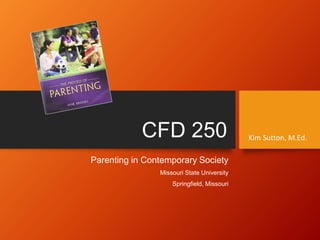
CFD 250
Parenting in Contemporary Society
Missouri State University
Springfield, Missouri
Kim Sutton, M.Ed.
Learning to Parent Chapter 3
What Parents Learn in
Childhood
• Parents typically learn how to parent and
discipline from their parents
• Parents also learn about relationships from
their parents:
• How people relate to each other
• How trustworthy others are
• How others regard and will treat them
• How enjoyable relationships are
Secure Positive Relationships
• If parents are sensitive, responsive, loving figures
• Children form secure attachments
• Feel lovable
• Act in kind ways to others
• Form positive ties to adult partners
• With their own children
• They repeat the same care they received
• In adulthood
• Has positive relationships with partners as well as children
Attachment
Styles
Learning From Other Sources
• Doctors
• Extended family and friends
• Religious faith
• Media (books, magazines, articles, websites)
• TV programs (Dr. Phil, Dr. Oz)
• Lower income parents
• More likely to use TV
• Free, easily accessible, entertaining as well as informative
• Upper income parents
• More likely to use Internet
• Hire a “coach” to help child sleep, eat
• Seek professional consultation for learning disabilities
Learning from Science
• Genetics
• Responsive to internal physiological changes
• Parenting that soothes and reduces stress response can protect
children from long-term effects of abuse
• Neurobiology
• Cells communicate across synapses
• One neuron can have as many as 80,000 connections with other cells Use it
or lose it (pruning)
• Mirror neurons (prewired to imitate)
• New connections and myelination continue in adulthood
• Porge’s Three Neural Circuits
Temperament Refers to:
• Biologically based behaviors that arise spontaneously and
may be difficult to change
• Influence children’s reactions in many situations
• Trigger reactions in parents, peers, and others
• Shape the effects of parents’ parenting
• Can put a child at risk for certain problems
Three Dimensions of
Temperament
• Child is very sensitive to new stimulation, is fearful, inhibited,
withdraws and seeks parental support
• Highly active, easily frustrated child who is fearless in
approaching new stimuli
• Happy, outgoing child who easily adapts to new situations and
makes friends
Executive Functioning (EF)
• Three general skills that are related to effortful control
• Ability to inhibit habitual behaviors
• Ability to hold and use information in working memory
• Ability to adjust to change and solve problems flexibly
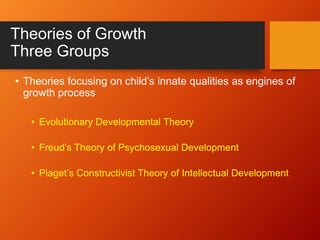
Theories of Growth
Three Groups
• Theories focusing on child’s innate qualities as engines of
growth process
• Evolutionary Developmental Theory
• Freud’s Theory of Psychosexual Development
• Piaget’s Constructivist Theory of Intellectual Development
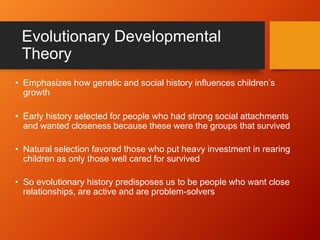
Evolutionary Developmental
Theory
• Emphasizes how genetic and social history influences children’s
growth
• Early history selected for people who had strong social attachments
and wanted closeness because these were the groups that survived
• Natural selection favored those who put heavy investment in rearing
children as only those well cared for survived
• So evolutionary history predisposes us to be people who want close
relationships, are active and are problem-solvers
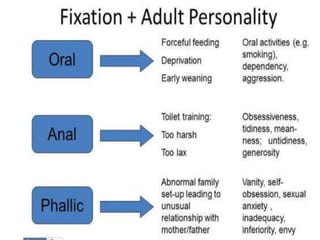
Freudian Theory
• Freud believed our strong internal physiological drives
power our development
• Pleasures associated with various areas of the body direct
our actions
• Parents’ roles are to be authoritative guides and supporters
on the path to maturity not generals commanding the
march
Freudian Theory
Piaget’s Constructivist Theory
• Emphasized that children think differently about the world
than adults
• Piaget described predictable qualitative stages of
intellectual growth children go through as they mature –
stages thought to apply to all children
• Piaget emphasized child’s active role in constructing a
view of the world based on exploration and action
Theories of Growth (cont.)
• Theories stressing external influences as engines of
growth process
• Attachment Theory
• Learning Theory
• Vygotsky’s Theory
Attachment Theory
• Focuses on the quality of the attachment between parent and
child as the main mover of growth
• Attachment defined as enduring affectional tie that unites two
persons over time and space and gives sense of safety, security,
protection
• Sensitive warm, accepting, available care enables baby to form
secure attachment to parent who then serves as secure base
for more independent activities
• Creates long-lasting expectations about the ways the world will treat
them, the way the world works, and how people interact
• Can improve or deteriorate depending on the sensitivity and
availability of the parent
Attachment Theory (cont.)
• Three forms of insecure attachment
• Anxious avoidant attachment
• Mother is intrusive and over stimulating, baby ignores mother’s
comings and goings
• Anxious, resistant attachment:
• Mother is insensitive, unavailable, baby resists mother but also
tries to get close
• Disoriented/disorganized attachment:
• Mother is traumatized person subject to sudden strong feelings,
child becomes disorganized, afraid sometimes, but eagerly
approaching mothers other times
Learning Theory
• Emphasizes the role of positive consequences in increasing
approved behaviors and negative consequences for behaviors
parents want to decrease
• Attention is one of most powerful positive rewards because it is
a pleasurable social one
• Children want parental attention and will seek it by negative
behaviors if that is the only way to get it
• Children also learn from observing the behaviors others model
for them
• Parents play a very active role in providing models of behavior –
good or bad
Vygotsky’s Sociocultural Theory
• Play serves an important function in helping children learn
about culture to think and plan
• Language plays a very important part in helping children think –
thought is seen as internalized speech
• Knowledge, thought, memory processes all rest on social
interactions with knowledgeable partners
• Parent’s job is to present culture’s view of the world and the
way to solve problems
• Parents support children’s activities, aiding them through
supportive guidance to achieve more mature levels of
functioning
The Zone of
Proximal Development
In scaffolding instruction, the caregiver
provides scaffolds or supports to
facilitate the learner’s development
The activities provided in scaffolding
instruction are just beyond the level of
what the learner can do alone (ZPD)
Theories of Growth (cont.)
• Theories stressing interaction of internal and external
factors as system directing growth
• Erikson’s Lifespan Theory
• Bronfenbrenner’s Bioecological Theory
• Family Stress Theory
• Parental Stress Theory
Erik Erikson’s Lifespan Theory
• Has 8 related stages
• Each stage evokes a developmental crises or conflict that
requires resolution
• Parenthood is central force in stimulating growth because
it involves taking love and care experienced in childhood
and giving it to next generation
• Believes identity formation is a central task of teen years
and society must validate choices or teens remain
uncertain of who they are
Bronfenbrenner’s Bioecological
Theory
• Most inclusive theory - describes interactions between parents
and child as described in first chapter, but has detailed
description of the social forces surrounding children and
parents
• Also gives great importance to concept of time, both historical
time in which people live, but the timing of events in people’s
lives – for example, poverty has a different meaning in the life
of an infant and a teenager
• Categorization of social forces into nested systems that make
up the family’s environment
Bronfenbrenner’s Theory
• Development can be affected by many levels of
relationships, from close family all the way to national
policies
• All systems affect one another
• Microsystem – family members, friends, caregivers
• Mesosystem – relationships among the microsystems
• Exosystem – indirect social settings
• Macrosystem – culture, values, beliefs, public policy
• Chronosystem – changes in all systems over time
ChronosystemChronosystem - Time
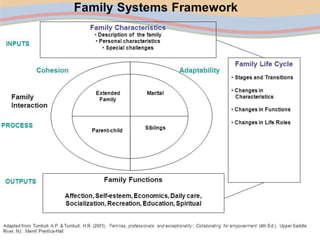
Family Systems Theory
• Family Systems Theory states that members in family interact
and influence each other in mutually responsive ways, and
what happens to one member affects all members
• When one member changes, change affects balance among
members and change occurs frequently with children as they
are always growing and having new needs that must be met
• Families have to maintain balance within the family and
balance between the family and outside social forces with
competing demands
Family Systems Stress Theory
• Family Systems Stress Theory ABC-X proposes:
• When stressor event A occurs
• The level of stress felt – X depends on
• B Family’s resources
• C Family’s perception of event
• When stress occurs, families can:
• Take action to change the situation – get hospice to help with
elderly, ill family member
• Change interpretation of situation – failing test will lead to more
studying
• Manage feelings triggered by event
Parental Stress Theory
• Researchers have applied Stress Theory to parenting and
described three kinds of stressor events for parents
• Normative stresses - expected, hard work of caring for infants,
challenges with rebellious teens
• Nonnormative stresses – coping with child who suddenly needs
surgery for appendicitis
• Chronic Stresses - atypical and persist over time – having a
child with a developmental delay
Types of Research
• Coercive Family Process
• Baumrind’s Parenting Types
• Video Feedback Intervention Positive Parenting
(VIPP)
Coercive Family Process (Gerald
Patterson)
• Process gets going early in life -- in infancy or toddlerhood and either
parent or child can start it
• Infant is irritable and fussy, and mother is negative and unpredictable in
her response for whatever reason (depression, few resources)
• Infant comes to see world as unrewarding, unsupportive, and
unpredictable
• Mother may start the issue with being negative and baby becomes
irritable, fussy and so on
Coercive Family Process (cont.)
• Infant develops into noncompliant, negative toddler who fails to
follows rules
• Crying, fussing, and whining give way to hitting, kicking, and
breaking things to force parents to do what toddler wants
• Parents intensify problem with spanking and cycle of negative
reactions escalates
• Noncompliant toddler becomes impulsive, defiant preschooler and
early elementary school student in school, bullying, lying, and
stealing
• Changes can occur in this pattern when parents work to establish a
positive relationship and a positive form of parenting, focusing on
supporting child, spending time playing and encouraging skill
development, monitoring children’s activities, and engaging in
problem-solving
Baumrind’s Parenting Types
•Authoritative - parents are attentive to children’s needs and
individuality but also have high standards; parents use reasoning and
mutually responsive problem-solving when there are conflicts – children
are self-reliant and self-confident
•Authoritarian - parents have high standards, demanding and
controlling without attention to children’s wishes or needs; emphasize
obedience rather than independence – children are often unhappy,
withdrawn, inhibited
•Permissive - parents set few limits, they accept all children’s
impulses, granting freedom within bonds of safety; parents allow all
feelings even those that angered them; parents anger build up and
sometimes they lash out – their children were least independent and
controlled, best described as immature
Video-Feedback Intervention
Positive Parenting (VIPP)
• Based on Attachment Theory and Coercion Theory
• Clinically trained home visitor makes 4-8 weekly sessions
to videotape mother and child playing and interacting in
family routines
• Home visitor identifies positive forms of interaction and
highlighting them for parent each week
• Video-Feedback Program increases mothers’ sensitivity
and infant’s secure attachment to mother in numerous
samples
CFD 250
Parenting in Contemporary Society
Missouri State University
Springfield, Missouri
Kim Sutton, M.Ed.

Cfd 250 chapter 3

  • 1.
    CFD 250 Parenting inContemporary Society Missouri State University Springfield, Missouri Kim Sutton, M.Ed.
  • 2.
  • 3.
    What Parents Learnin Childhood • Parents typically learn how to parent and discipline from their parents • Parents also learn about relationships from their parents: • How people relate to each other • How trustworthy others are • How others regard and will treat them • How enjoyable relationships are
  • 4.
    Secure Positive Relationships •If parents are sensitive, responsive, loving figures • Children form secure attachments • Feel lovable • Act in kind ways to others • Form positive ties to adult partners • With their own children • They repeat the same care they received • In adulthood • Has positive relationships with partners as well as children
  • 5.
  • 6.
    Learning From OtherSources • Doctors • Extended family and friends • Religious faith • Media (books, magazines, articles, websites) • TV programs (Dr. Phil, Dr. Oz) • Lower income parents • More likely to use TV • Free, easily accessible, entertaining as well as informative • Upper income parents • More likely to use Internet • Hire a “coach” to help child sleep, eat • Seek professional consultation for learning disabilities
  • 7.
    Learning from Science •Genetics • Responsive to internal physiological changes • Parenting that soothes and reduces stress response can protect children from long-term effects of abuse • Neurobiology • Cells communicate across synapses • One neuron can have as many as 80,000 connections with other cells Use it or lose it (pruning) • Mirror neurons (prewired to imitate) • New connections and myelination continue in adulthood • Porge’s Three Neural Circuits
  • 8.
    Temperament Refers to: •Biologically based behaviors that arise spontaneously and may be difficult to change • Influence children’s reactions in many situations • Trigger reactions in parents, peers, and others • Shape the effects of parents’ parenting • Can put a child at risk for certain problems
  • 9.
    Three Dimensions of Temperament •Child is very sensitive to new stimulation, is fearful, inhibited, withdraws and seeks parental support • Highly active, easily frustrated child who is fearless in approaching new stimuli • Happy, outgoing child who easily adapts to new situations and makes friends
  • 10.
    Executive Functioning (EF) •Three general skills that are related to effortful control • Ability to inhibit habitual behaviors • Ability to hold and use information in working memory • Ability to adjust to change and solve problems flexibly
  • 11.
    Theories of Growth ThreeGroups • Theories focusing on child’s innate qualities as engines of growth process • Evolutionary Developmental Theory • Freud’s Theory of Psychosexual Development • Piaget’s Constructivist Theory of Intellectual Development
  • 12.
    Evolutionary Developmental Theory • Emphasizeshow genetic and social history influences children’s growth • Early history selected for people who had strong social attachments and wanted closeness because these were the groups that survived • Natural selection favored those who put heavy investment in rearing children as only those well cared for survived • So evolutionary history predisposes us to be people who want close relationships, are active and are problem-solvers
  • 13.
    Freudian Theory • Freudbelieved our strong internal physiological drives power our development • Pleasures associated with various areas of the body direct our actions • Parents’ roles are to be authoritative guides and supporters on the path to maturity not generals commanding the march
  • 14.
  • 15.
    Piaget’s Constructivist Theory •Emphasized that children think differently about the world than adults • Piaget described predictable qualitative stages of intellectual growth children go through as they mature – stages thought to apply to all children • Piaget emphasized child’s active role in constructing a view of the world based on exploration and action
  • 17.
    Theories of Growth(cont.) • Theories stressing external influences as engines of growth process • Attachment Theory • Learning Theory • Vygotsky’s Theory
  • 18.
    Attachment Theory • Focuseson the quality of the attachment between parent and child as the main mover of growth • Attachment defined as enduring affectional tie that unites two persons over time and space and gives sense of safety, security, protection • Sensitive warm, accepting, available care enables baby to form secure attachment to parent who then serves as secure base for more independent activities • Creates long-lasting expectations about the ways the world will treat them, the way the world works, and how people interact • Can improve or deteriorate depending on the sensitivity and availability of the parent
  • 20.
    Attachment Theory (cont.) •Three forms of insecure attachment • Anxious avoidant attachment • Mother is intrusive and over stimulating, baby ignores mother’s comings and goings • Anxious, resistant attachment: • Mother is insensitive, unavailable, baby resists mother but also tries to get close • Disoriented/disorganized attachment: • Mother is traumatized person subject to sudden strong feelings, child becomes disorganized, afraid sometimes, but eagerly approaching mothers other times
  • 21.
    Learning Theory • Emphasizesthe role of positive consequences in increasing approved behaviors and negative consequences for behaviors parents want to decrease • Attention is one of most powerful positive rewards because it is a pleasurable social one • Children want parental attention and will seek it by negative behaviors if that is the only way to get it • Children also learn from observing the behaviors others model for them • Parents play a very active role in providing models of behavior – good or bad
  • 22.
    Vygotsky’s Sociocultural Theory •Play serves an important function in helping children learn about culture to think and plan • Language plays a very important part in helping children think – thought is seen as internalized speech • Knowledge, thought, memory processes all rest on social interactions with knowledgeable partners • Parent’s job is to present culture’s view of the world and the way to solve problems • Parents support children’s activities, aiding them through supportive guidance to achieve more mature levels of functioning
  • 23.
    The Zone of ProximalDevelopment In scaffolding instruction, the caregiver provides scaffolds or supports to facilitate the learner’s development The activities provided in scaffolding instruction are just beyond the level of what the learner can do alone (ZPD)
  • 24.
    Theories of Growth(cont.) • Theories stressing interaction of internal and external factors as system directing growth • Erikson’s Lifespan Theory • Bronfenbrenner’s Bioecological Theory • Family Stress Theory • Parental Stress Theory
  • 25.
    Erik Erikson’s LifespanTheory • Has 8 related stages • Each stage evokes a developmental crises or conflict that requires resolution • Parenthood is central force in stimulating growth because it involves taking love and care experienced in childhood and giving it to next generation • Believes identity formation is a central task of teen years and society must validate choices or teens remain uncertain of who they are
  • 27.
    Bronfenbrenner’s Bioecological Theory • Mostinclusive theory - describes interactions between parents and child as described in first chapter, but has detailed description of the social forces surrounding children and parents • Also gives great importance to concept of time, both historical time in which people live, but the timing of events in people’s lives – for example, poverty has a different meaning in the life of an infant and a teenager • Categorization of social forces into nested systems that make up the family’s environment
  • 28.
    Bronfenbrenner’s Theory • Developmentcan be affected by many levels of relationships, from close family all the way to national policies • All systems affect one another • Microsystem – family members, friends, caregivers • Mesosystem – relationships among the microsystems • Exosystem – indirect social settings • Macrosystem – culture, values, beliefs, public policy • Chronosystem – changes in all systems over time
  • 29.
  • 30.
    Family Systems Theory •Family Systems Theory states that members in family interact and influence each other in mutually responsive ways, and what happens to one member affects all members • When one member changes, change affects balance among members and change occurs frequently with children as they are always growing and having new needs that must be met • Families have to maintain balance within the family and balance between the family and outside social forces with competing demands
  • 32.
    Family Systems StressTheory • Family Systems Stress Theory ABC-X proposes: • When stressor event A occurs • The level of stress felt – X depends on • B Family’s resources • C Family’s perception of event • When stress occurs, families can: • Take action to change the situation – get hospice to help with elderly, ill family member • Change interpretation of situation – failing test will lead to more studying • Manage feelings triggered by event
  • 33.
    Parental Stress Theory •Researchers have applied Stress Theory to parenting and described three kinds of stressor events for parents • Normative stresses - expected, hard work of caring for infants, challenges with rebellious teens • Nonnormative stresses – coping with child who suddenly needs surgery for appendicitis • Chronic Stresses - atypical and persist over time – having a child with a developmental delay
  • 34.
    Types of Research •Coercive Family Process • Baumrind’s Parenting Types • Video Feedback Intervention Positive Parenting (VIPP)
  • 35.
    Coercive Family Process(Gerald Patterson) • Process gets going early in life -- in infancy or toddlerhood and either parent or child can start it • Infant is irritable and fussy, and mother is negative and unpredictable in her response for whatever reason (depression, few resources) • Infant comes to see world as unrewarding, unsupportive, and unpredictable • Mother may start the issue with being negative and baby becomes irritable, fussy and so on
  • 36.
    Coercive Family Process(cont.) • Infant develops into noncompliant, negative toddler who fails to follows rules • Crying, fussing, and whining give way to hitting, kicking, and breaking things to force parents to do what toddler wants • Parents intensify problem with spanking and cycle of negative reactions escalates • Noncompliant toddler becomes impulsive, defiant preschooler and early elementary school student in school, bullying, lying, and stealing • Changes can occur in this pattern when parents work to establish a positive relationship and a positive form of parenting, focusing on supporting child, spending time playing and encouraging skill development, monitoring children’s activities, and engaging in problem-solving
  • 37.
    Baumrind’s Parenting Types •Authoritative- parents are attentive to children’s needs and individuality but also have high standards; parents use reasoning and mutually responsive problem-solving when there are conflicts – children are self-reliant and self-confident •Authoritarian - parents have high standards, demanding and controlling without attention to children’s wishes or needs; emphasize obedience rather than independence – children are often unhappy, withdrawn, inhibited •Permissive - parents set few limits, they accept all children’s impulses, granting freedom within bonds of safety; parents allow all feelings even those that angered them; parents anger build up and sometimes they lash out – their children were least independent and controlled, best described as immature
  • 39.
    Video-Feedback Intervention Positive Parenting(VIPP) • Based on Attachment Theory and Coercion Theory • Clinically trained home visitor makes 4-8 weekly sessions to videotape mother and child playing and interacting in family routines • Home visitor identifies positive forms of interaction and highlighting them for parent each week • Video-Feedback Program increases mothers’ sensitivity and infant’s secure attachment to mother in numerous samples
  • 40.
    CFD 250 Parenting inContemporary Society Missouri State University Springfield, Missouri Kim Sutton, M.Ed.